POEM: “Lost Sheep” by Margaret DeRitter: DeRitter writes about a lost Merino sheep in Australia who, because left unsheared for so long, was carrying over seventy-five pounds of wool on his back. He was found in 2021 and rescued by Edgar’s Mission Farm Sanctuary in Lancefield.
+++
SONGS:
>> “What Have We Become” by the Sweeplings:The Sweeplings are Cami Bradley and Whitney Dean, a singing-songwriting folk pop duo. From their album Rise and Fall (2015), “What Have We Become” laments how sin encroaches on our lives—we may welcome it in at first, but then it takes over, makes of our house a wasteland. This theme is embodied by a shadowy, thorny-veiled dancer in the music video.
>> “It Knows Me” by Avi Kaplan: Living outside Nashville, Tennessee, Avi Kaplan is best known for being the original vocal bass of the a cappella group Pentatonix, from 2011 to 2017. This song of self-probing is from his second solo EP, I’ll Get By (2020). It’s about the freedom that comes from reckoning with one’s inner darkness and accepting grace. The animation in the video is by Mertcan Mertbilek.
“It Knows Me” is an extremely personal song to me. I believe that everyone has a darker side of them, and that you can choose to play into that, or you can choose to not. This song is about that battle between those two forces, and having a little grace for yourself when you do falter on your path.
>> “Not the Devil Song” by Marcus & Marketo:Marcus & Marketo (Marcus Clingaman and Marketo Michel) are a worship music duo from South Bend, Indiana, fusing the styles of gospel, classical, country, and soul. “Not the Devil Song,” which they wrote in 2019, is about the power Christians are given to tell Satan to back off! When he dangles temptations in front of you, whispers lies in your ear, sows seeds of doubt or fear or hopelessness, you can confidently retort, “Devil, no, you gotta let go; Jesus died to save my soul.”
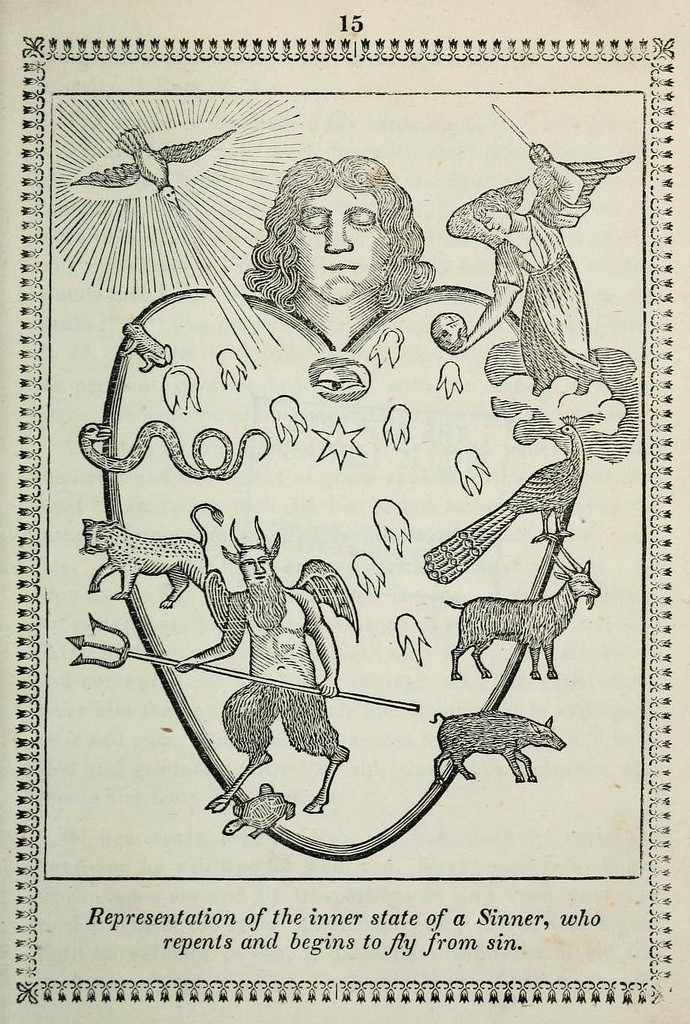
In his book The Forge of Vision (2015), visual studies scholar David Morgan contrasts this emblematic series with the related Cor Jesu amanti sacrum by Anton Wierix (which I wrote about here). Whereas the Wierix engravings from Antwerp are marked by sweetness, with the Christ child gently cleaning and setting up house in the human heart, the anonymous illustrations Gossner uses portray more of a psychomachia (battle for the soul), with armed angels seeking to oust Satan and his minions.
+++
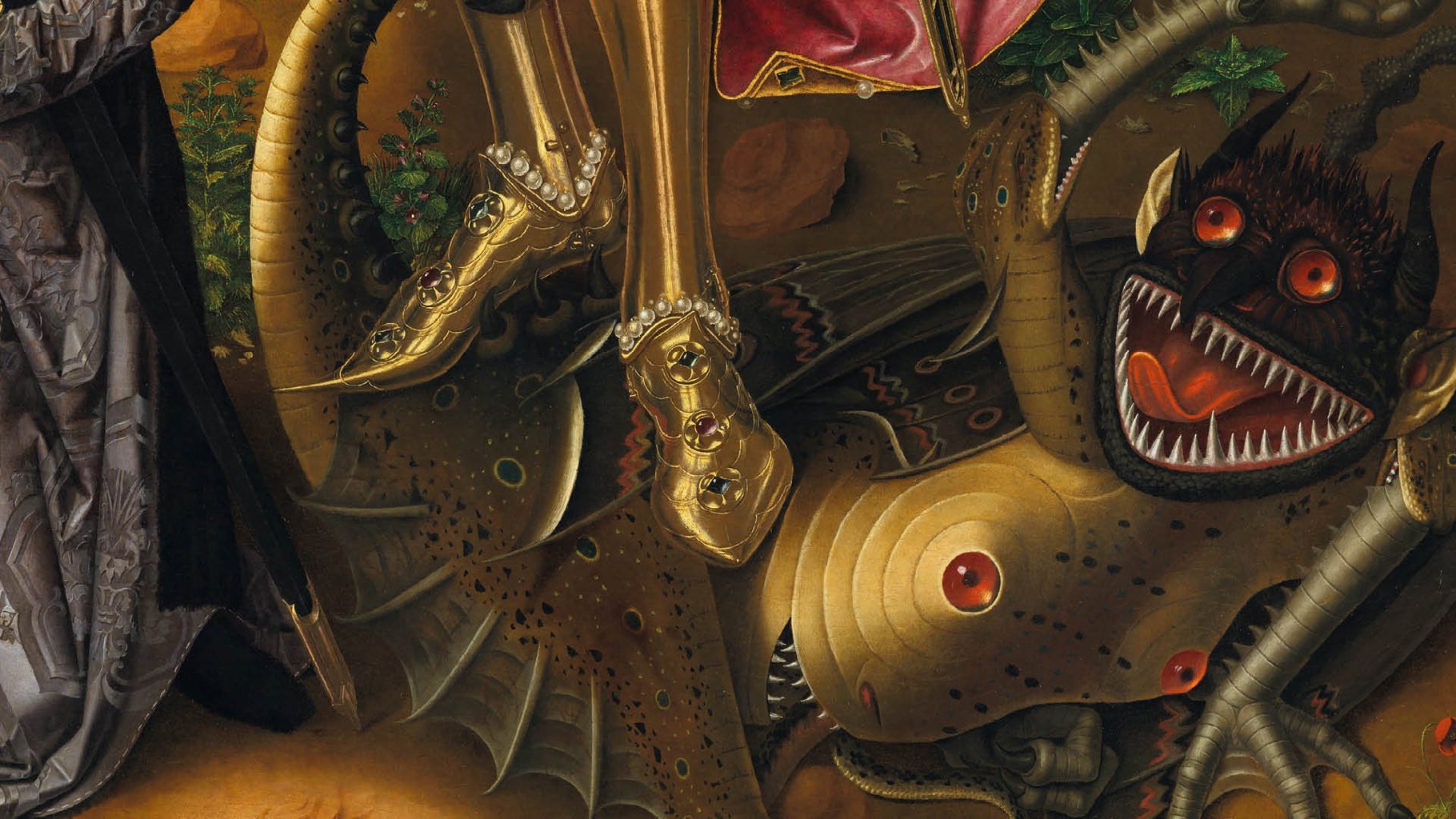
VIDEO: “How Bermejo paints good and evil in Saint Michael Triumphs over the Devil”: In this nine-minute video, Daniel Sobrino Ralston, associate curator for Spanish paintings at the National Gallery in London, examines a late Gothic painting in the museum’s collection by the Spanish artist Bartolomé Bermejo, showing the archangel Michael slaying Satan. Based on Revelation 12:7–9, this subject gave artists the chance to flex their imaginations in portraying evil incarnate and its vanquishment. Possessing an impressive capacity for fantastical invention, Bermejo gives the devil snakes for arms, eyes for nipples, bird claws, moth-like wings, a spiky tail, and a cactus growing out of its head!
Bartolomé Bermejo (Spanish, ca. 1440–after 1495), Saint Michael Triumphs over the Devil (detail), 1468. Oil and gold on wood, 179.7 × 81.9 cm. National Gallery, London.
If this visual subject interests you, I recommend the book Angels and Demons in Art by Rosa Giorgi, from the J. Paul Getty Museum’s Guide to Imagery series.
LENT SERIES: “Let go of unlove this Lent: Let’s practice love together—a new and improved Lenten reflection series starting March 5th” by Tamara Hill Murphy: I’ve been nurtured for years by Murphy’s gentle spiritual writing and curated beauty and wisdom, and I especially appreciate her annual Advent and Lent Daybook series. This Lent, she’ll be exploring four postures of cruciform love given to us in 1 Corinthians 13, providing daily scripture readings, prayers, and art, along with weekly practices. You can gain access for just $16. (She uses the Substack platform.)
Forgive Thy Other by Scott Erickson
I like how Murphy frames the season: “Lent is a significant time for us to seek a deeper understanding of God’s heart and recognize the gaps in our experiences of His love. Through its beautiful stories, prayers, and practices, Lent also invites us to reflect on our own expressions of love and unlove. The Book of Common Prayer encourages us to let go of our unloving ways so we can love what (and who) God loves. Let’s joyfully embrace this transformative season together, reflecting God’s love with compassion and understanding.”
+++
NEW PLAYLIST: God’s Love (Art & Theology): Related to Tamara Hill Murphy’s 2025 Lent Daybook theme: here’s a new playlist I put together of songs about the abounding, ever-present love of God the Father, Son, and Holy Spirit, a love that seeks, heals, and transforms.
The cover photo is of an early twentieth-century relief sculpture from the exterior of Holy Trinity Church in the town of St Andrews, Scotland, taken by Joy Marie Clarkson; it shows a pelican pecking her breast to feed her young with her own blood, a medieval symbol of Christ’s self-giving love.
There’s some overlap between this playlist and my dedicated Lent Playlist. I hope it uplifts you in the knowledge of the depths and riches of God’s love for you.
+++
SONGS:
>> “And Am I Born to Die?”: Lent opens with a call to “remember you are dust, and to dust you shall return.” A reflection on human mortality, this somber hymn was written by the great English Methodist hymnist Charles Wesley (1707–1788) and set to music—a shape-note tune—by Ananias Davisson (1780–1857), a Presbyterian elder from Virginia. In this video from January 2023, it’s performed by the Appalachian folk musician Nora Brown, with Stephanie Coleman on fiddle and James Shipp on harmonium.
And am I born to die? To lay this body down? And must my trembling spirit fly Into a world unknown?
Awaked by trumpet sounds, I from my grave shall rise, And see the Judge, with glory crowned, And see the flaming skies.
Soon as from earth I go, What will become of me? Eternal happiness or woe Must then my portion be.
>> “Nunc tempus acceptabile” (Now Is the Accepted Time): Second Corinthians 5:20b–6:10 is traditionally read on Ash Wednesday, a passage that includes the adjuration, “Behold, now is the acceptable time; behold, now is the day of salvation!” (2 Cor. 6:2). There’s a beautiful tenth-century Latin hymn for Lent, from the Liber Hymnarius, that opens with this line. In 2013, the Chicago-based composer and conductor Paul M. French set it to music for SSA a cappella choir, its unison opening unfolding into an increasingly expressive three-part harmony. It’s performed here by the Notre Dame Magnificat Choir under the direction of Daniel Bayless.
Nunc tempus acceptabile
Fulget datum divinitus,
Ut sanet orbem languidum
Medela parsimoniae.

Christi decoro lumine
Dies salutis emicat,
Dum corda culpis saucia
Reformat abstinentia.

Hanc mente nos et corpore,
Deus, tenere perfice,
Ut appetamus prospero
Perenne pascha transitu.

Te rerum universitas,
Clemens, adoret, Trinitas,
Et nos novi per veniam
Novum canamus canticum.

Amen.
Today is the accepted time. Christ’s healing light, the gift divine, shines forth to save the penitent, to wake the world by means of Lent.
The light of Christ will show the way that leads to God’s salvation day. The rigor of this fasting mends the hearts that hateful sinning rends.
Keep all our minds and bodies true in sacrifice, O God, to you, that we may join, when Lents have ceased, the everlasting Paschal feast.
Let all creation join to raise, most gracious Trinity, your praise. And when your love has made us new, may we sing new songs, Lord, to you.
LECTURE: “Embracing the Ephemeral: How Art Honors Creaturehood” by James K. A. Smith, Duke Divinity School, February 17, 2022: Mortality means something more than being a creature who will someday die, says philosopher James K. A. Smith; it is a way of being, not defined solely by its terminus. “To be created is to be ephemeral, fugitive, contingent. To be a creature is to be a mortal, subject to the vicissitudes of time.” Part of the Duke Initiatives in Theology and the Arts Distinguished Lecture Series, this talk about developing a Christian temporal awareness is based on chapter 4 of Smith’s then-forthcoming, award-winning book How to Inhabit Time (Brazos, 2022), titled “Embrace the Ephemeral: How to Love What You’ll Lose.”
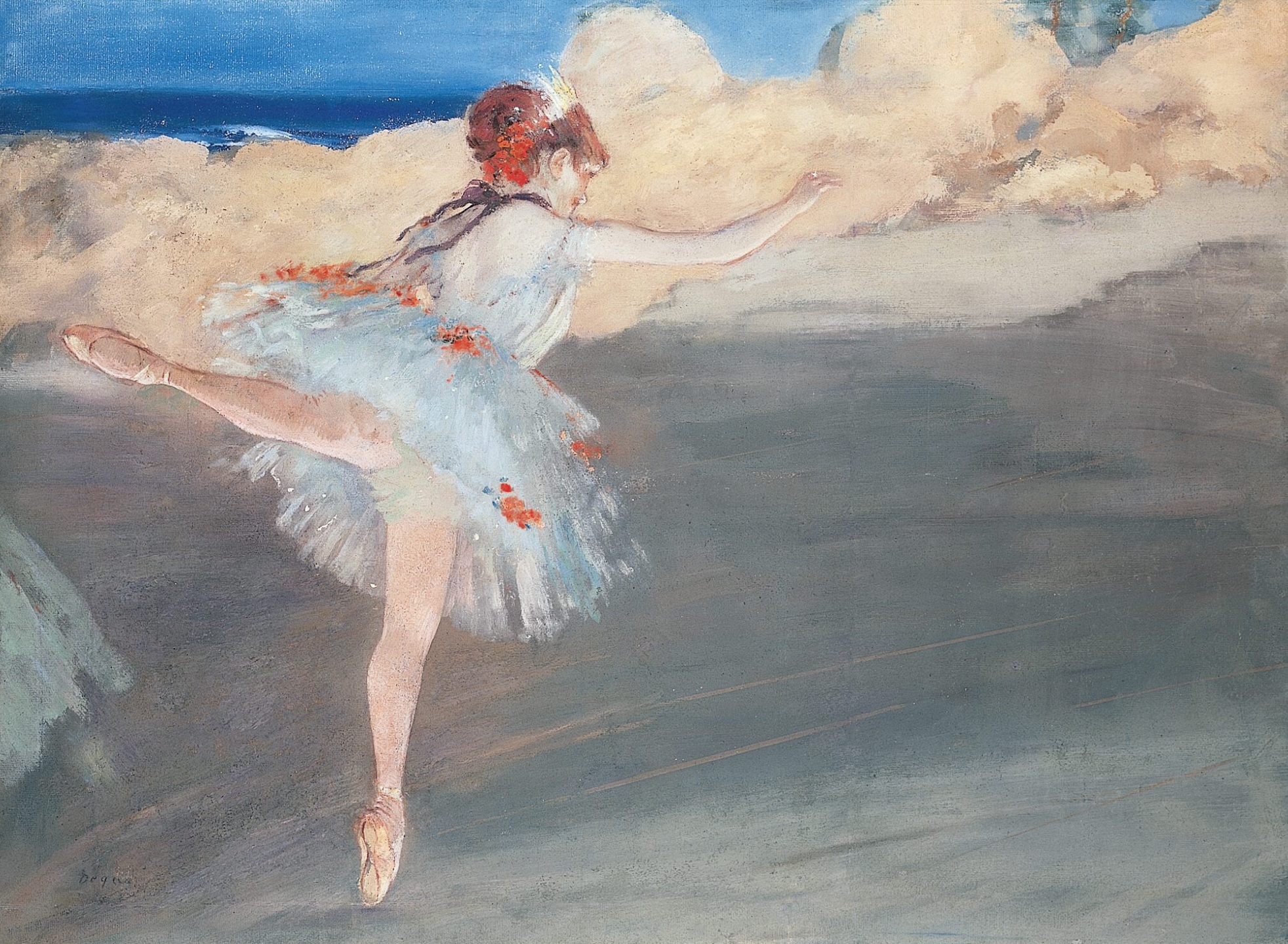
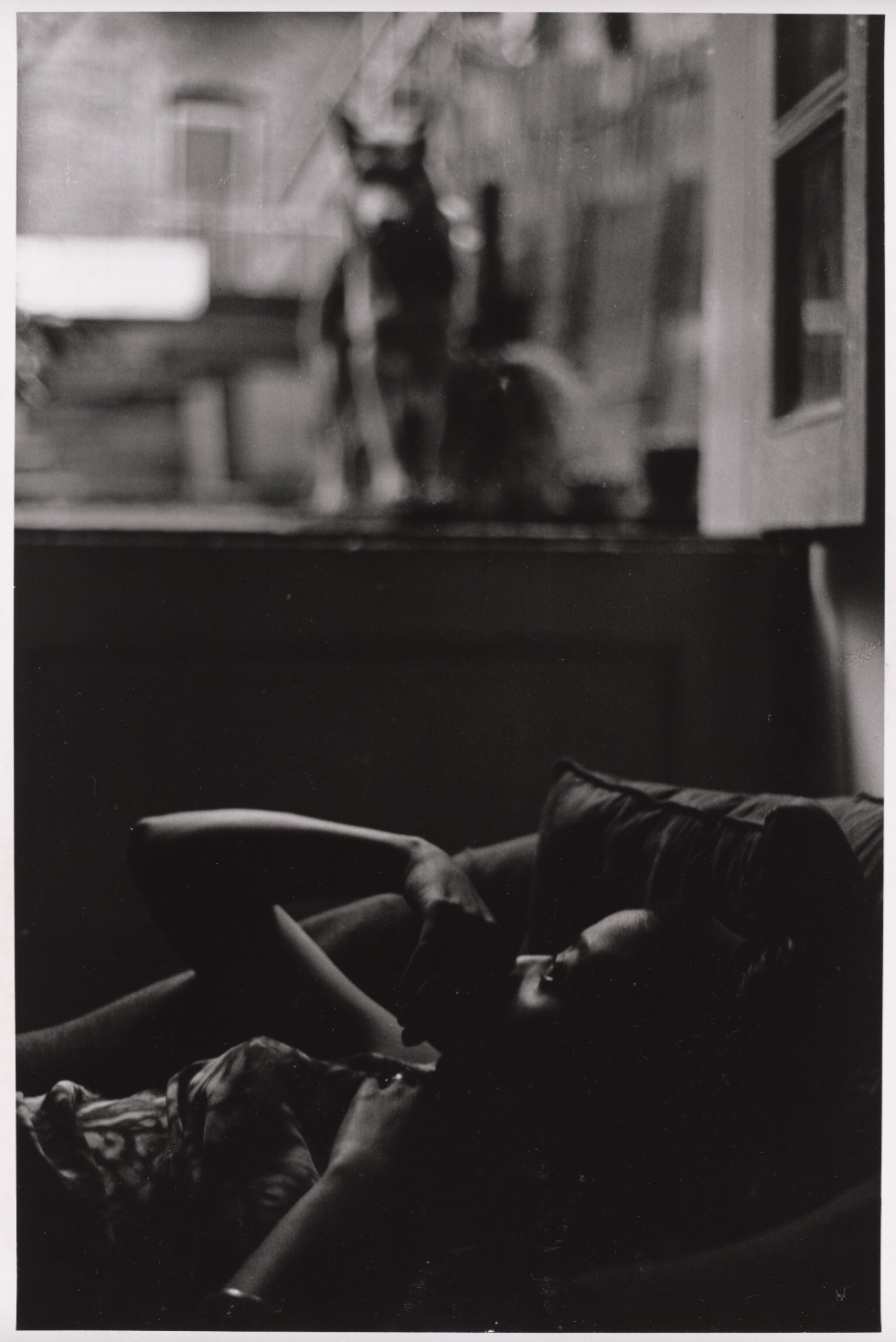
Edgar Degas (French, 1834–1917), The Star: Dancer on Pointe, ca. 1878–80. Gouache and pastel on paper, mounted on board, 22 1/4 × 29 3/4 in. (56.5 × 75.6 cm). Norton Simon Museum, Pasadena, California.Herbert Randall (American, 1936–), Untitled (Lower East Side, New York), 1960s. Gelatin silver print, 13 7/16 × 8 7/8 in. (34.2 × 22.5 cm). J. Paul Getty Museum, Los Angeles.
Some notes I took:
“We need not only memento mori, but also memento tempore—reminders of our temporality, not just our mortality.”
“Imagine embracing the ephemeral as a discipline of not only conceding our mortality as a condition but also receiving our mortality as a gift.”
“Our finitude is not a fruit of the fall, even if it is affected by the fall. Contingency is not a curse. . . . Aging is not a curse. Autumn is not a punishment. Not all that is fleeting should be counted as loss. The coming to be and passing away that characterize our mortal life are simply the rhythms of creaturehood.”
Resting in our mortality instead of resenting it
Theologian Peter Leithart says hebel means not “emptiness,” “vanity,” or “meaninglessness” but, literally, “mist” or “vapor.” The Teacher in Ecclesiastes uses that word repeatedly to describe human life: it’s vaporous, elusive, escapes our efforts to hold on to it, to manage it.
How to sift tragedy from good creaturely rhythms in which good things fade?
“To dwell faithfully mortally is to achieve a way of being in the world for which not all change is loss and not all loss is tragic, while at the same time naming and lamenting those losses that ought not to be. . . . To be faithfully mortal is a feat of receiving and letting go, celebrating and lamenting. Being mortal is the art of living with loss, knowing when to say thank you and knowing when to curse the darkness.”
“One Art” by Elizabeth Bishop: “The art of losing isn’t hard to master . . .”
A Q&A takes place from 39:00 onward. The first question, asked by theologian Jeremy Begbie, is the one I had, and it recurs with different phrasing at 58:17.
Mortality is one of the main themes in Silver’s poetry, including the physicalities of being human, as reflected in “Ash Wednesday,” in which she, the speaker, muses on the shared Christian ritual of the imposition of ashes at the beginning of Lent. Silver, who died of breast cancer eight years after writing this poem, was used to practicing memento mori (“remember you must die”): her mastectomy scar and silicone breast prosthesis are constant reminders of the fact, she writes. She wants to touch the body of God, wants to wrap her fingers around some tangible promise of healing, but both remain elusive. Instead she resolves to embrace the finiteness of her present form, taking the burnt remains of those Hosanna palms from last year and wearing them with repentance and praise, knowing that what is sown in perishability will be raised in imperishability (1 Cor. 15:42).
I’m compelled by how Silver both laments her fragility and owns it. There’s a defiant quality to the tone, the ash-and-oil mixture that’s thumbed into her forehead in the shape of a cross evoking a football player applying eye black in front of a locker room mirror before the big game. Wearing the mark of Christ, she’s ready for the face-off between herself and death.
SUBSTACK POST: “Read something medieval this year” by Grace Hamman: One of the most frequently asked questions that medievalist Grace Hamman receives is: “What books should I read from the past?” She gives recommendations for the following six scenarios (including specific translations/editions!).
I have never read anything medieval before! Where do I start?
I have not read any medieval literature, but I did read Confessions in college. How about something a little later, a little more “medieval”?
I want to read some medieval theology.
I’ve read Bernard. Give me a theology deep cut!
No thanks on the monastic theology. Give me poetry! Give me drama and beauty and weirdness!
I’m a stubborn cuss / good millennial hipster / professional troublemaker. I want to read what no one else is reading casually. Make it super hard and dialectical and confusing (but awesome).
+++
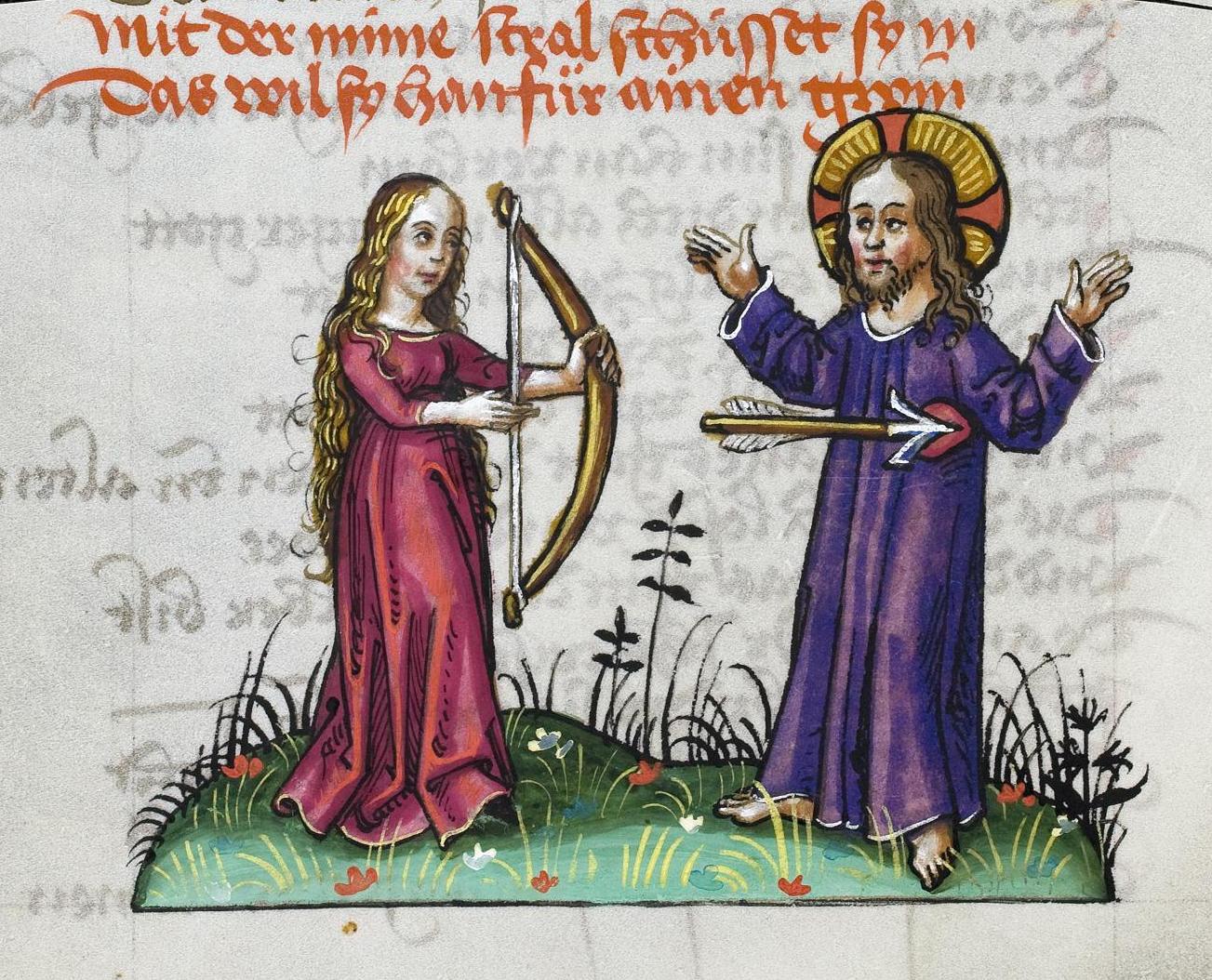
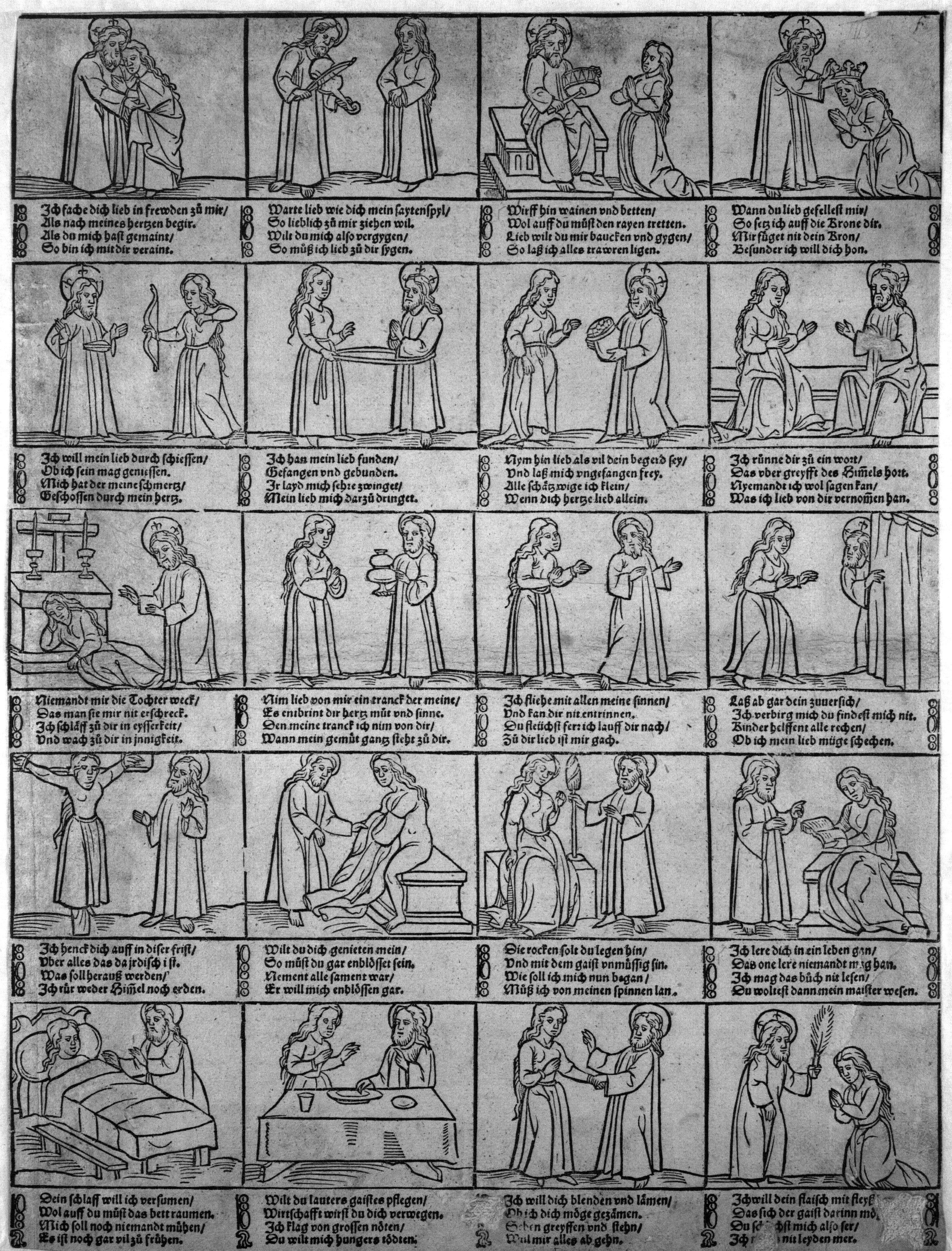
LECTURE: “Christ Our Lover: Medieval Art and Poetry of Jesus the Bridegroom” by Grace Hamman: Last fall I had the pleasure of inviting Dr. Grace Hamman (see previous roundup item) to my neck of the woods to speak for the Eliot Society, a Maryland nonprofit I serve on the board of. She gave this wonderful lecture on one of the popular medieval metaphors for Christ in theology and the arts, which was Jesus as bridegroom, or lover. For medieval people, “the union between God and the human soul was . . . a marriage made in mutual desire, joy, and even mutual submission,” she says. Hamman explores a few different pieces belonging to this tradition, including the fourteenth-century poem “Quia Amore Langueo” (Because I Languish for Love) and the fascinating fifteenth-century verse and image sequence Christus und die minnende Seele (Christ and the Loving Soul).
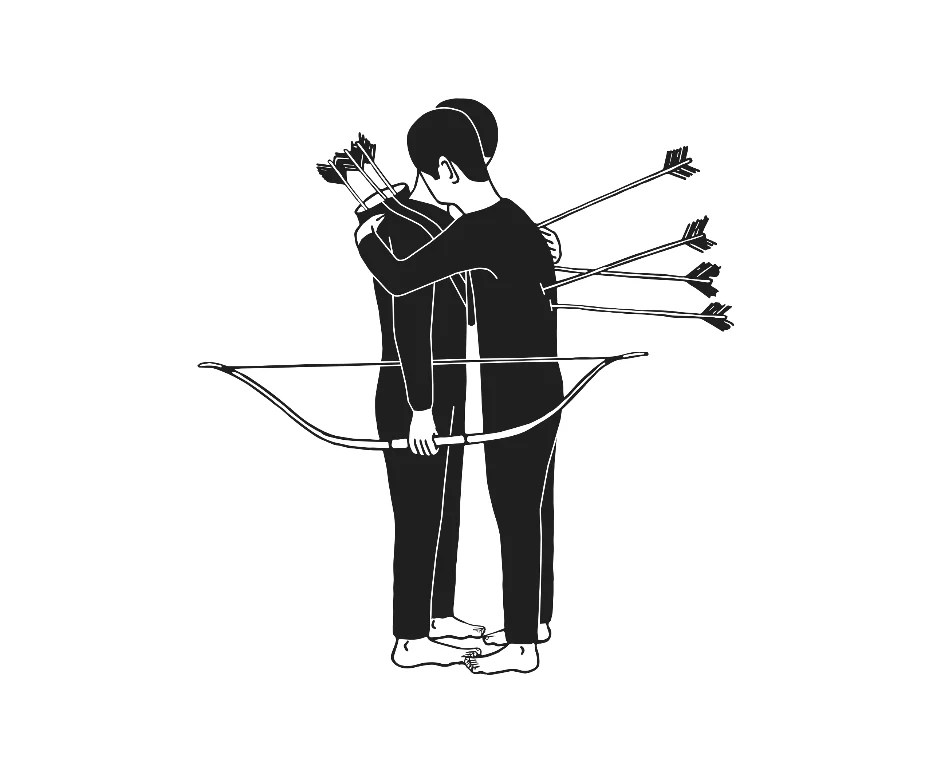
Illustration by Rudolf Stahel (ca. 1448–1528) from a copy of Christus und die minnende Seele, Constance, Germany, ca. 1495. Karlsruhe, Badische Landesbibliothek, Cod. Donaueschingen 106, fol. 26v. Amber L. Griffioen provides this caption: “The Soul takes up her bow, draws her minne stral (or ‘arrow of love’), and goes on the hunt. She shoots and wounds Christ in the side, capturing him as her prize in order to ‘enjoy him’ forever.”Christus und die minnende Seele, from the printing house of Matthäus Franck in Augsburg, Germany, 1559–68. Woodcut, 35.5 × 27 cm. Munich, Bayerische Staatsbibliothek, Einblatt III, 52f.
+++
SONGS:
Inspired by Hamman’s talk, I’d like to turn your attention to the following two songs: one Jewish, the other Christian.
>> “Et Dodim Kala (Time for Lovers)”: The Hebrew text of this song, drawn from the biblical book the Song of Songs, is traditional Jewish (the video attributes it to Rabbi Haim Ben Sahl of the tenth century), and the music is a traditional gnawa melody (gnawa is a genre of Moroccan religious music marked by repetition). The performance is led by Lala Tamar on vocals and guembri (three-stringed bass plucked lute), and she’s joined by Ella Greenbaum and Imanouelle Harel on background vocals and krakebs (hand cymbals) and Tal Avraham on trumpet.
Tamar is an Israeli musician of Moroccan and Brazilian descent who performs Moroccan Jewish liturgical poems as well as contemporary music in Moroccan Arabic and Ladino.
Turn on closed captioning (CC) in the above video for the lyrics and their English translation, which is basically, “A time for lovers, my bride: / The vine has blossomed, / The pomegranates have budded.” The song is also available on Spotify.
>> “The Heavenly Courtier”: The anonymous words of this hymn were first published in 1694, and the tune is from The Christian Harmony (1805), a shape-note hymnal compiled by Jeremiah Ingalls. The song speaks of “Christ the glorious lover” who comes to earth “to woo himself a bride, resolving for to win her.” At first she’s resistant to his romantic entreaties, preferring instead the company of other lovers. But when she sees him for who he truly is—receives “one glimpse of [his] love and power”—she is overcome with ecstasy and accepts his proposal. The song ends with a wedding feast and mutual embrace. Read the full lyrics here, and listen to the Boston Camerata, directed by Joel Cohen, perform the piece on their album An American Christmas (1993); the vocalist is Joel Frederiksen.
I wouldn’t commend this hymn for a worship service, at least not without adaptation: while I’m on board with most of it, its Christ is in parts coercive, threatening violence, and there’s an overemphasis on the bride’s wretchedness and shame, with Christ the wooer breaking her down by revealing how “filthy” and unworthy she is. The Boston Camerata removes two of the more problematic verses, but I still think further tweaking needs to be done, more nuancing around the doctrines of sin and salvation (literarily, of course, preserving the extended metaphor!), to faithfully communicate the gospel through this song.
Regardless, I find it interesting as an artifact of early American Christian worship (it was sung congregationally in New England) and as an elaboration of the biblical picture of Christ the Bridegroom, not to mention poetically and musically charming. As I gathered from Grace Hamman’s lecture posted above, we can still appreciate creative works from the past and be moved or instructed by aspects of them without embracing them wholesale. It’s important for us Christians to be able to step outside our own cultural, historical, and denominational contexts with humble curiosity.
+++
2025 CALVIN SYMPOSIUM ON WORSHIP:
Calvin University’s annual Symposium on Worship was held last week. I wasn’t able to go this year, but I enjoyed tuning in virtually to the services that were livestreamed, now archived on the “Live” tab of the Calvin Institute of Christian Worship YouTube page. Here are two examples.
>> “Vesper: I Will Lift Mine Eyes,” led by Kate Williams and Tony Alonso: “Inspired by ancient and modern contemplative texts, this Vespers service is an invitation to come into the quiet and discover the eternal beauty of God’s consoling presence.” View the song credits in the YouTube video description.
>> “Worship Service: The Rich Man and Lazarus”: The Calvin University Gospel Choir, under the direction of Nate Glasper and with some songs guest-conducted by Raymond Wise, leads the musical portion of this service, and Rev. Dr. Dennis R. Edwards preaches on Luke 16:19–31, Jesus’s parable of the rich man and Lazarus. I especially enjoyed Wise’s original gospel song “Make a Joyful Noise” at 16:30, based on Psalm 100:1, and, also new to me, “Poor Man Lazarus” at 36:46, a traditional African American spiritual arranged by Jester Hairston. See additional song credits in the YouTube video description.
Charles White (American, 1918–1979), Mother Courage II, 1974. Oil on canvas, 49 3/4 × 39 7/8 in. National Academy of Design, New York.
She lay, skin down in the moist dirt, the canebrake rustling with the whispers of leaves, and loud longing of hounds and the ransack of hunters crackling the near branches.
She muttered, lifting her head a nod toward freedom, I shall not, I shall not be moved.
She gathered her babies, their tears slick as oil on black faces, their young eyes canvassing mornings of madness. Momma, is Master going to sell you from us tomorrow?
Yes. Unless you keep walking more and talking less. Yes. Unless the keeper of our lives releases me from all commandments. Yes. And your lives, never mine to live, will be executed upon the killing floor of innocents. Unless you match my heart and words, saying with me,
I shall not be moved.
In Virginia tobacco fields, leaning into the curve of Steinway pianos, along Arkansas roads, in the red hills of Georgia, into the palms of her chained hands, she cried against calamity, You have tried to destroy me and though I perish daily,
I shall not be moved.
Her universe, often summarized into one black body falling finally from the tree to her feet, made her cry each time into a new voice. All my past hastens to defeat, and strangers claim the glory of my love, Iniquity has bound me to his bed,
yet, I must not be moved.
She heard the names, swirling ribbons in the wind of history: nigger, nigger bitch, heifer, mammy, property, creature, ape, baboon, whore, hot tail, thing, it. She said, But my description cannot fit your tongue, for I have a certain way of being in this world,
and I shall not, I shall not be moved.
No angel stretched protecting wings above the heads of her children, fluttering and urging the winds of reason into the confusions of their lives. They sprouted like young weeds, but she could not shield their growth from the grinding blades of ignorance, nor shape them into symbolic topiaries. She sent them away, underground, overland, in coaches and shoeless. When you learn, teach. When you get, give. As for me,
I shall not be moved.
She stood in midocean, seeking dry land. She searched God’s face. Assured, she placed her fire of service on the altar, and though clothed in the finery of faith, when she appeared at the temple door, no sign welcomed Black Grandmother. Enter here.
Into the crashing sound, into wickedness, she cried, No one, no, nor no one million ones dare deny me God, I go forth along, and stand as ten thousand. The Divine upon my right impels me to pull forever at the latch on Freedom’s gate.
The Holy Spirit upon my left leads my feet without ceasing into the camp of the righteous and into the tents of the free.
These momma faces, lemon-yellow, plum-purple, honey-brown, have grimaced and twisted down a pyramid of years. She is Sheba and Sojourner, Harriet and Zora, Mary Bethune and Angela, Annie to Zenobia.
She stands before the abortion clinic, confounded by the lack of choices. In the Welfare line, reduced to the pity of handouts. Ordained in the pulpit, shielded by the mysteries. In the operating room, husbanding life. In the choir loft, holding God in her throat. On lonely street corners, hawking her body. In the classroom, loving the children to understanding.
Centered on the world’s stage, she sings to her loves and beloveds, to her foes and detractors: However I am perceived and deceived, however my ignorance and conceits, lay aside your fears that I will be undone,
Maya Angelou (1928–2014) was an African American poet, storyteller, civil rights activist, and lecturer, most famous for her autobiography I Know Why the Caged Bird Sings (1969). She began her career as a singer, dancer, and actress but started writing in the late 1950s, often combining personal narrative with advocacy for racial and gender equality. In 1960 she worked as the northern coordinator for Martin Luther King Jr.’s Southern Christian Leadership Conference, before moving to Egypt and then Ghana with her son. She returned to the US in 1965 to help Malcolm X build the Organization of Afro-American Unity.
In addition to seven autobiographies and multiple poetry collections, Angelou also wrote children’s books, cookbooks, essays, short stories, stage plays, screenplays, documentaries, and music (including film scores). She was a recipient of three Grammys for her spoken-word albums, an Emmy nomination for her portrayal of Kunta Kinte’s grandmother in the miniseries Roots (1977), the National Medal of Arts (2000), the Presidential Medal of Freedom (2010), the Literarian Award (2013), and many other honors. Recurring themes in her literary works include hardship and loss, love, social justice, Black beauty, the strength of women, and the human spirit.
I often wonder what would happen if I could come face to face with a grandparent, a great-great-great-grandparent. Suppose you did? Just imagine. What would happen? Not a specter, a real person, 200 years old, who said, “So . . . You’re the reason I took the lash, you’re it, huh? So you’re the reason I took the auction block, and stayed alive . . . you’re it, are you? How is it with you? How are you doing with the gifts I gave you?”
She went on to describe how her grandmother and mother used to sing the African American spiritual “I Shall Not Be Moved” around the house. Its lyrics are based on Jeremiah 17:7–8: “Blessed are those who trust in the LORD, whose trust is the LORD. They shall be like a tree planted by water, sending out its roots by the stream. It shall not fear when heat comes, and its leaves shall stay green; in the year of drought it is not anxious, and it does not cease to bear fruit” (cf. Ps. 1:3; 62:6).
Angelou then talked about the importance of “being flexible so one can bend, resilient so that one can stand erect after being knocked down,” before proceeding to read her poem “Our Grandmothers.”
The poem celebrates the strong Black women who have gone before, that great cloud of witnesses, the ancestors, who stood firm in the face of all kinds of adversity, giving life to succeeding generations. The queen of Sheba (who gifted gold, spices, and jewels to King Solomon of Israel, as 1 Kings 10 relates, and who the ancient historian Josephus said ruled over Ethiopia and Egypt), abolitionist Harriet Tubman, writer Zora Neale Hurston, and educator and philanthropist Mary Bethune are among the women named. Self-assertive, tenacious, filled with holy desire, steadfast in the pursuit of freedom and justice.
Angelou is one of the most banned authors in the United States, particularly in high schools, where some districts deem her books inappropriate for their use of racial epithets and frank depictions of violence, including sexual assault. “Our Grandmothers” is mild by comparison to her first autobiography, but it does allude to lynching and rape and contains a litany of vulgar, demeaning names. She does not want to sugarcoat these realities, this history.
While acknowledging the suffering endured by Angelou’s female forebears, the poem is triumphant in tone. It’s that refusal to despair, that holding on to faith, that Angelou so admires and that impels her to join in that old refrain, composed in chains and having carried her people through countless trials and acts of resistance: “Like a tree planted by the water, I shall not be moved.”
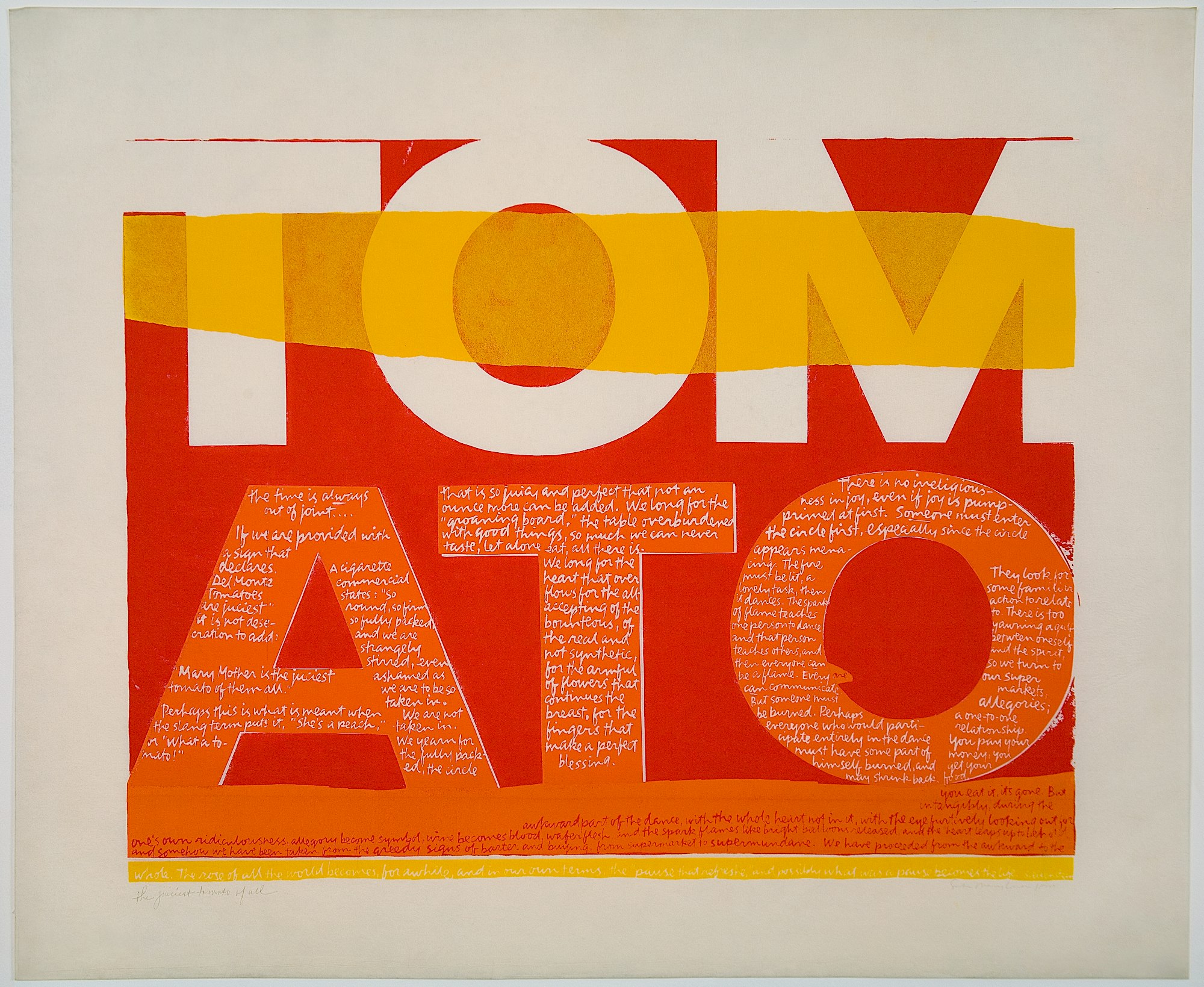
>> Annual Candlemas Lecture by Ayla Lepine, February 3, 2025, 7 p.m. GMT (2 p.m. ET): Rev. Dr. Ayla Lepine, who is the associate rector at St James’s Piccadilly in London and an art historian and theologian, “will explore two works of art featured in her forthcoming book, Women, Art, God. In the series entitled The Annunciation (A Study), Julia Margaret Cameron reimagined and reconfigured paintings by Renaissance artists including Perugino and Lippi. In her photography, blurred and hazy aspects of the image are suggestive of the Holy Spirit in this new technology.
“A century later, the American nun Sister Corita Kent produced a groundbreaking silkscreen print, The Juiciest Tomato of All. This artwork compared the Virgin Mary to a ripe fruit, with a title inspired by Del Monte tinned fruit and vegetable slogans from her local supermarket. By considering these two artworks by women from the nineteenth and twentieth centuries as a pair, new ways of encountering Mary in art history, theology, and prayer can emerge with unexpected resonance for the twenty-first century.”
>> “The Annunciation in Theology and Art: Shedding New Light on an Old Doctrine”by Tina Beattie, March 26, 2025, 3 p.m. GMT (10 a.m. ET): No details other than the title have been given about this lecture. But the speaker is a leading Marian theologian and writer whom I’ve been familiar with for some time, and an emerita professor of Catholic studies at the University of Roehampton. Her research is in the areas of gender, sexuality, and reproductive ethics; Catholic social teaching and women’s rights; theology and the visual arts, especially images of Mary; and the relationship between medieval mysticism, sacramental theology, and psychoanalytic theory.
+++
WEBINAR with Drew Jackson, Eugene Peterson Center for Christian Imagination, February 4, 2025, 7 p.m. ET: A conversation on the intersection of poetry, ministry, and Christian imagination. Registration is free. “Drew Jackson is a poet, speaker, and public theologian. He is author of God Speaks Through Wombs: Poems on God’s Unexpected Coming and Touch the Earth: Poems on the Way. . . . Drew received his B.A. in Political Science from the University of Chicago and his M.A. in Theology from Fuller Theological Seminary. He currently works as the Managing Director of Mission Integration for the Center for Action and Contemplation, and lives in Brooklyn, NY, with his wife and daughters.”
+++
CONFERENCES/SYMPOSIA:
>> Calvin Symposium on Worship, Calvin University, Grand Rapids, Michigan, February 5–7, 2025: “An ecumenical conference dedicated to worship and learning, bringing together people in a variety of roles in worship and leadership from across the country and around the world.”
>> Contemporary Art as/in Pilgrimage, Columbia University, New York, February 11, 2025: Organized by the Association of Scholars of Christianity in the History of Art, this one-day symposium “will explore such questions as: Are galleries, museums, art expos, and art installations the new ‘slow spaces’ for spiritual sustenance and transcendent experiences? How are temples, churches and other ‘religious’ sites transformed by artist installations intended to invoke deep spiritual encounter and healing? And how is the art of contemporary artists working in a diversity of media and practice seen through the lens of pilgrimage?”
The keynote speaker is Kathryn R. Barush, author of Imaging Pilgrimage: Art as Embodied Experience (Bloomsbury, 2021). She will be joined by eleven other presenters. Plus, Elissa Yukiko Weichbrodt, author of Redeeming Vision: A Christian Guide to Looking at and Learning from Art, will lead attendees in the practice of intentional looking at the Cathedral of Saint John the Divine.
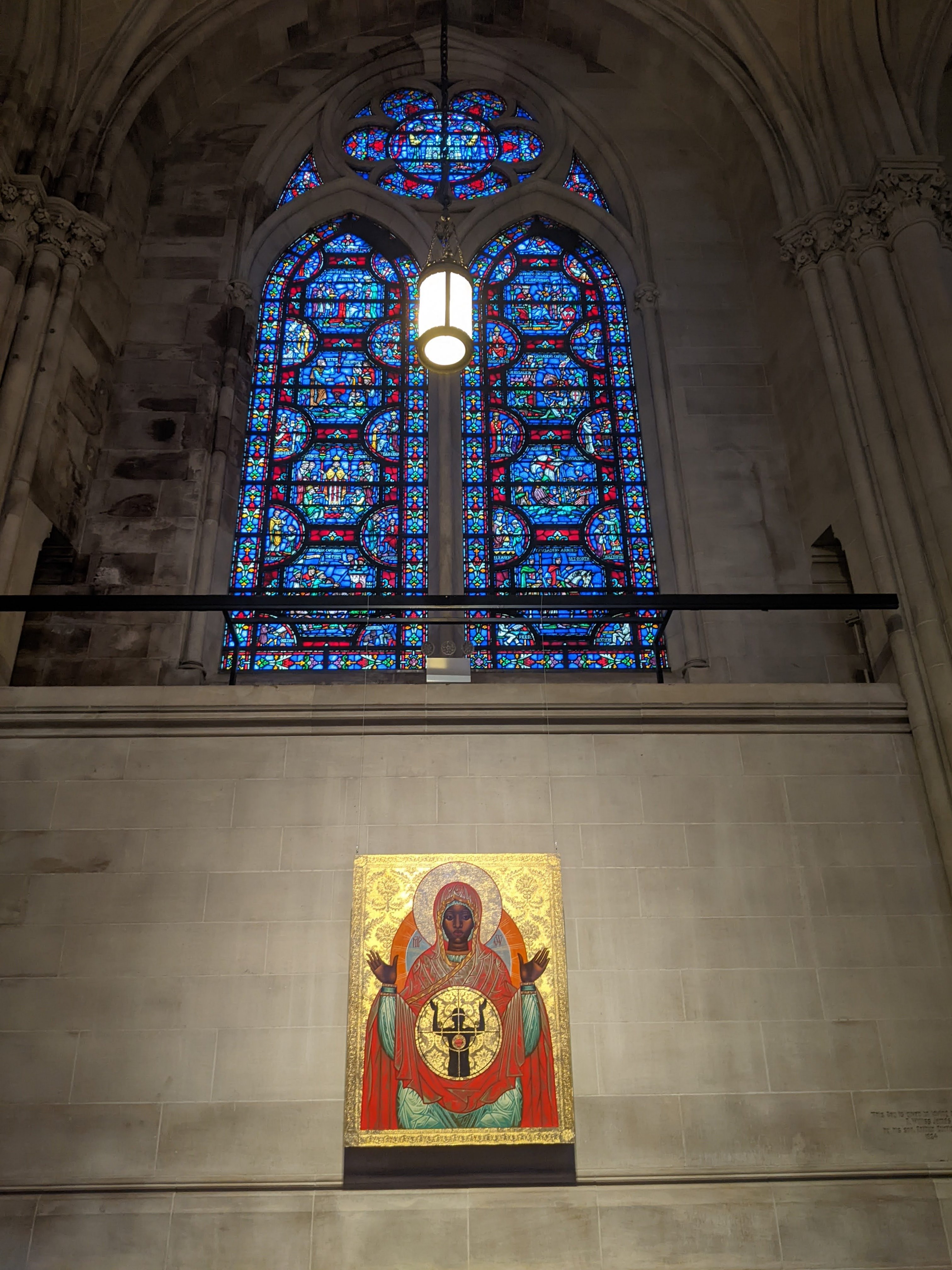
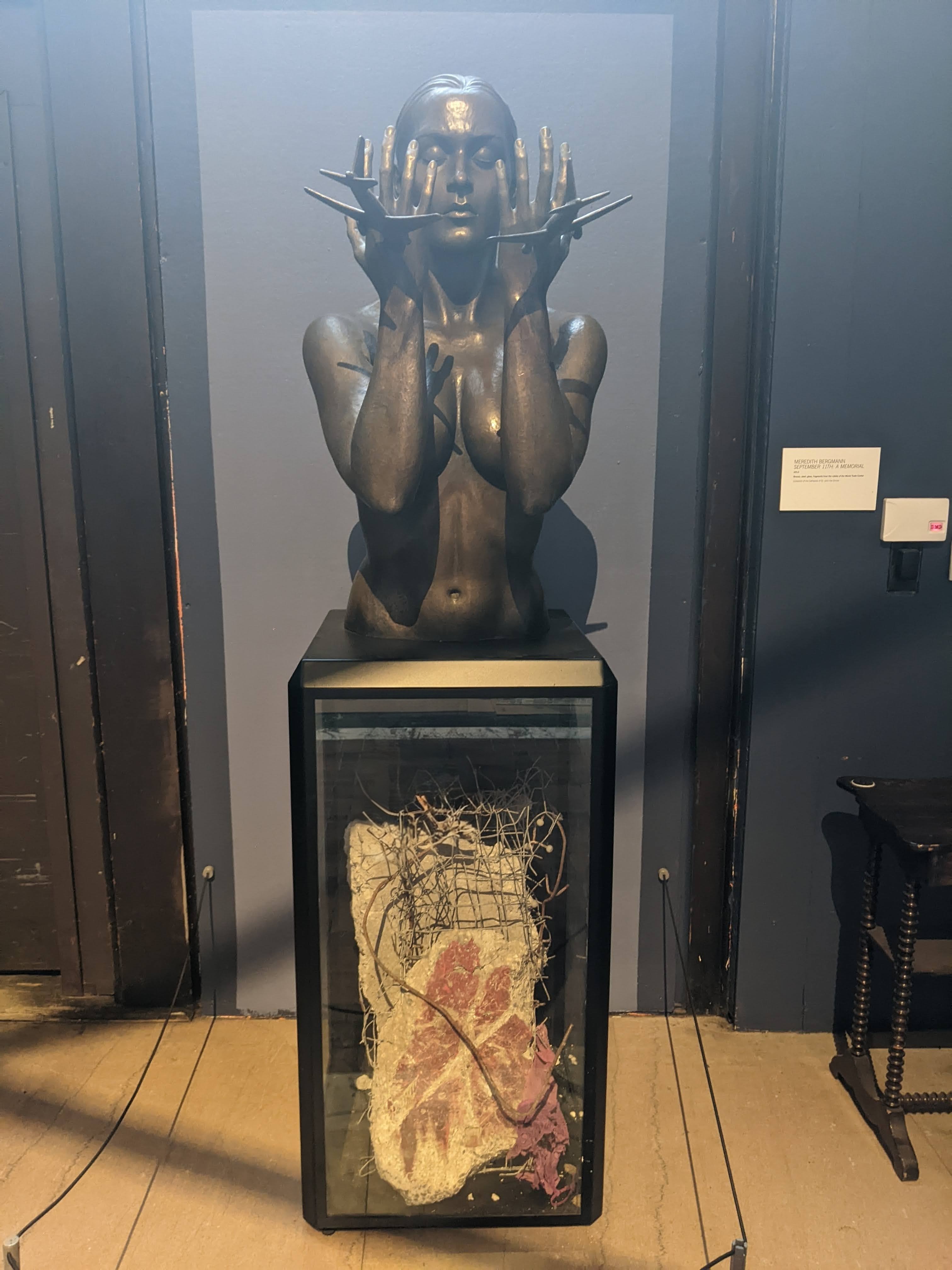
Mark Doox (American, 1958–), Our Lady, Mother of Ferguson and All Those Killed by Gun Violence, 2016. Acrylic and gold leaf on wood, 48 × 36 in. Cathedral of Saint John the Divine, New York. Photo: Victoria Emily Jones, 2022.Meredith Bergmann (American, 1955–), September 11th: A Memorial, 2012. Bronze on pedestal of steel and glass, containing reinforced concrete and brick from the rubble of the World Trade Towers, 78 × 22 × 24 in. Cathedral of Saint John the Divine, New York. Photo: Victoria Emily Jones, 2022.
>> Square Halo Conference, Trust Performing Arts Center, Lancaster, Pennsylvania, March 7–8, 2025: “The Square Halo conferences have offered times not only of fascinating and inspiring ideas in a high caliber of wide and varied presentations, but also of rich, meaningful interactions, dialogue, and (in a deep sense of this word) fellowship. Creativity, collaboration, and community . . . an apt description of what [takes] place” (Matthew Dickerson).
The keynote speaker is Diana Pavlac Glyer, who teaches literature, history, theology, and philosophy in an integrated Great Books curriculum at Azusa Pacific University, and the Saturday-night concert will feature Thomas Austin and Skye Peterson.
>> The Breath and the Clay, Winston-Salem, North Carolina, March 21–23, 2025: “This year we will explore how the light gets in through the fragments of our stories, our lives and our art. We are each built of broken pieces, a mosaic of joys and sorrows, of mundane and miraculous happenings. When we surrender the full spectrum of our human experience, even our pain, doubts and sorrows can heal into art. Through our workshops, keynote talks, immersive gallery and performances, we will explore various facets of the creative life and how everything from inspiration to the everyday, from family to vocation and community coalesce to reveal a hidden wholeness.”
Presenters include Sho Baraka, Vesper Stamper, Justin McRoberts, Cheryl Bridges Johns, Elissa Yukiko Weichbrodt, and more.
>> Illuminate: Art and Faith, Southern Adventist University, Collegedale, Tennessee, March 31–April 1, 2025: “Author and theologian Frederick Buechner famously wrote, ‘Pay attention to the things that bring a tear to your eye or a lump in your throat because they are signs that the holy is drawing near.’ Paintings, poetry, music, and other creative mediums hold strong potential to do just that—to indirectly communicate powerful truths, many of which have eternal consequences. Are we open to what they’re telling us? Will we utilize these tools to share important stories (including The Story) with others? Join us for two rich days of education, inspiration, and community! . . .
“This year’s conference will include a variety of hands-on workshops (flash fiction, drawing, songwriting), as well as sessions exploring fascinating figures, including C. S. Lewis, Madeleine L’Engle, Eugene Peterson, Kurt Vonnegut, Dorothy Sayers, Vincent van Gogh, Norman Rockwell, Ludwig van Beethoven, Duke Ellington, and many more.”
Among the session leaders and performers are art historian Elissa Yukiko Weichbrodt (Redeeming Vision), writer Douglas McKelvey (Every Moment Holy), film and literature scholar Mary McCampbell (Imagining Our Neighbors as Ourselves), pastor Russ Ramsey (Van Gogh Has a Broken Heart; Rembrandt Is in the Wind), illustrator John Hendrix (The Mythmakers; Go and Do Likewise!), and singer-songwriter Andy Gullahorn.
>> Visible and Invisible: Surprising Encounters in Theology and the Arts (DITA 2025), Duke University, Durham, North Carolina, September 4–7, 2025: I’ll be attending this one! Organized by Duke Initiatives in Theology and the Arts. “How can the arts help us open up the very heart of the Christian faith, celebrated at the Council of Nicaea in 325, that Jesus Christ is ‘one in being’ with God? Featuring world-class academics, artists, musicians, and clergy from around the globe and a robust range of programming, DITA2025 is a four-day symposium at Duke University celebrating Nicaea and the myriad surprises the Creed holds in store for artists, academics, clergy, and parishioners today. . . .
“By pairing theologians with poets, clergy with novelists, dancers with liturgists, musicians with scholars, the symposium will generate a series of meetings rarely offered in academic and artistic settings. Including interactive keynotes, plenary presentations, seminar lectures, applied workshops, an evening concert, and more, DITA2025 is a unique opportunity to experience the arts and the academy in action.”
Dancer and choreographer Leah Glenn performs an original work, The Youngest of Nine, at DITA 2019.
Speakers include Rowan Williams, Chigozie Obioma, Natalie Carnes, Sandra McCracken, James K.A. Smith, Malcolm Guite, Amy Peeler, and Josh Rodriguez. Early-bird registration ends February 15.
CALL FOR APPLICATIONS: 2025 Artist Residency at Village Church, Beaverton, Oregon: “Village Church is seeking an Artist in Residence for 11 months of 2025, February to December, to create a lasting, creative impact on the wider community and church. The artist will create original work, lead art showcases, inspire future generations, and use art as a bridge between the tech culture surrounding the church, with the spiritual and theological. This residency offers the chance to create art that reflects God’s beauty, promotes worship, and connects people in meaningful ways.”
Applicants must have a minimum of five years of experience. If chosen, you will receive a monthly stipend, free housing, and studio space and will have the cost of all art supplies covered. The pastor tells me that the original application deadline of January 15 is being extended.
+++
NEW(ISH) ALBUM: The Hymnal by Life in Grooveland: Released last April. From World Music Central: “Life in Grooveland’s The Hymnal reimagines traditional hymns with dynamic, world music-influenced rhythms, creating an album that brings together spirituality and groove. Produced and arranged by Nashville session drummer and percussionist Justin Amaral, this fascinating instrumental collection features ten exquisitely crafted duets presenting some of Nashville’s most talented and inventive musicians, including Jeff Coffin (Dave Matthews Band, Béla Fleck), Fats Kaplin (Mitski, Jack White), Paul Niehaus (Lambchop), and Billy Contreras (Ricky Skaggs). Amaral’s versatile drumming, which ranges from subtle to explosive, provides the backbone for each track, layering rhythm to amplify each hymn.” Thanks to blog reader Ted Olsen for bringing this to my attention!
+++
PODCAST EPISODE: “The Hillbilly Thomists: Bourbon, Bluegrass, and the Bible,”No Small Endeavor: I really enjoyed this! “There aren’t many Billboard-charting bluegrass bands made up entirely of Dominican friars, who play their shows clad in white tunics and rosaries. In fact, there is precisely one such band: the Hillbilly Thomists. ‘A Thomist is someone who follows the thought and theological teaching of Saint Thomas Aquinas,’ they explain. ‘We combine it with a little bit of humor about our human condition.’ In this episode, they talk about their theology and vocation, as well as how they manage life on the road as priests who have taken a vow of poverty. Plus, they give live performances of some of their finest songs.”
+++
NEW POEM: “Jesus, Son of Gop” by Sarah M. Wells: Exposing the ridiculousness of followers of the nonviolent Christ sanctioning violence, this satirical poem is a response to a politician’s egregious misappropriation of the apostle Paul’s “armor of God” language. It’s an alternate history that rewrites how Jesus’s arrest in the garden went down. Listen to Wells discuss the poem on The Reformed Journal Podcast.
+++
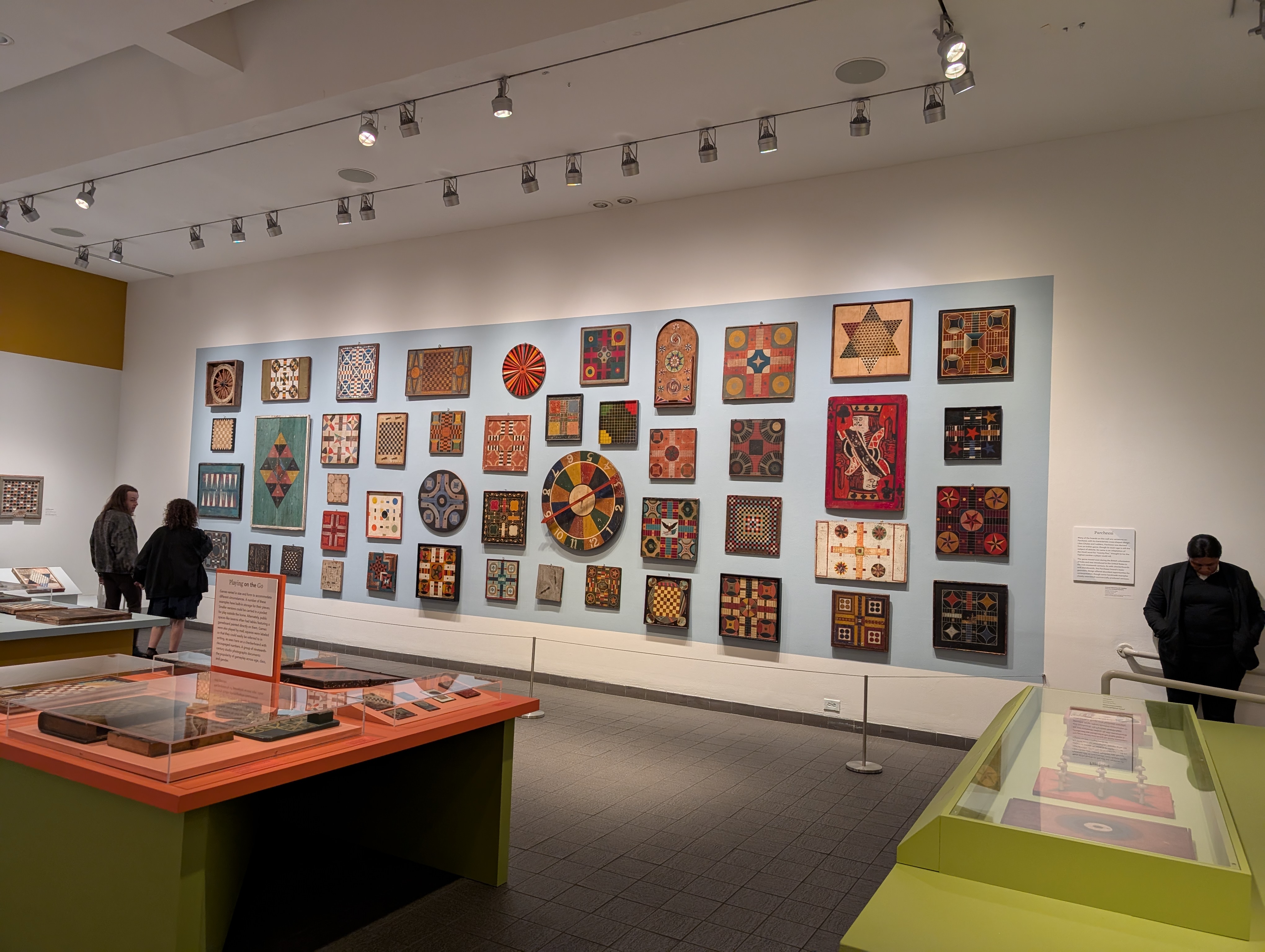
EXHIBITION: Playing with Design: Gameboards, Art, and Culture, September 13, 2024–January 26, 2025, American Folk Art Museum, New York City: I saw this show last weekend and was absolutely delighted by it! Curated by Emelie Gevalt with Austin Losada, it features over one hundred handmade gameboards, mostly nineteenth century, from the exuberant collection of Bruce and Doranna Wendel. Many are of familiar games I used to play as a child—Parcheesi (which I learned originated in India, its name an adaptation of the Hindi word for “twenty-five”), checkers, Chutes and Ladders—and others are creative variations on the typical racing board game. There is also a fortune-telling game, in the vein of the Magic 8 Ball! The objects on display—hand-carved and hand-painted and from the imaginations of common folk—are interesting both culturally and aesthetically.
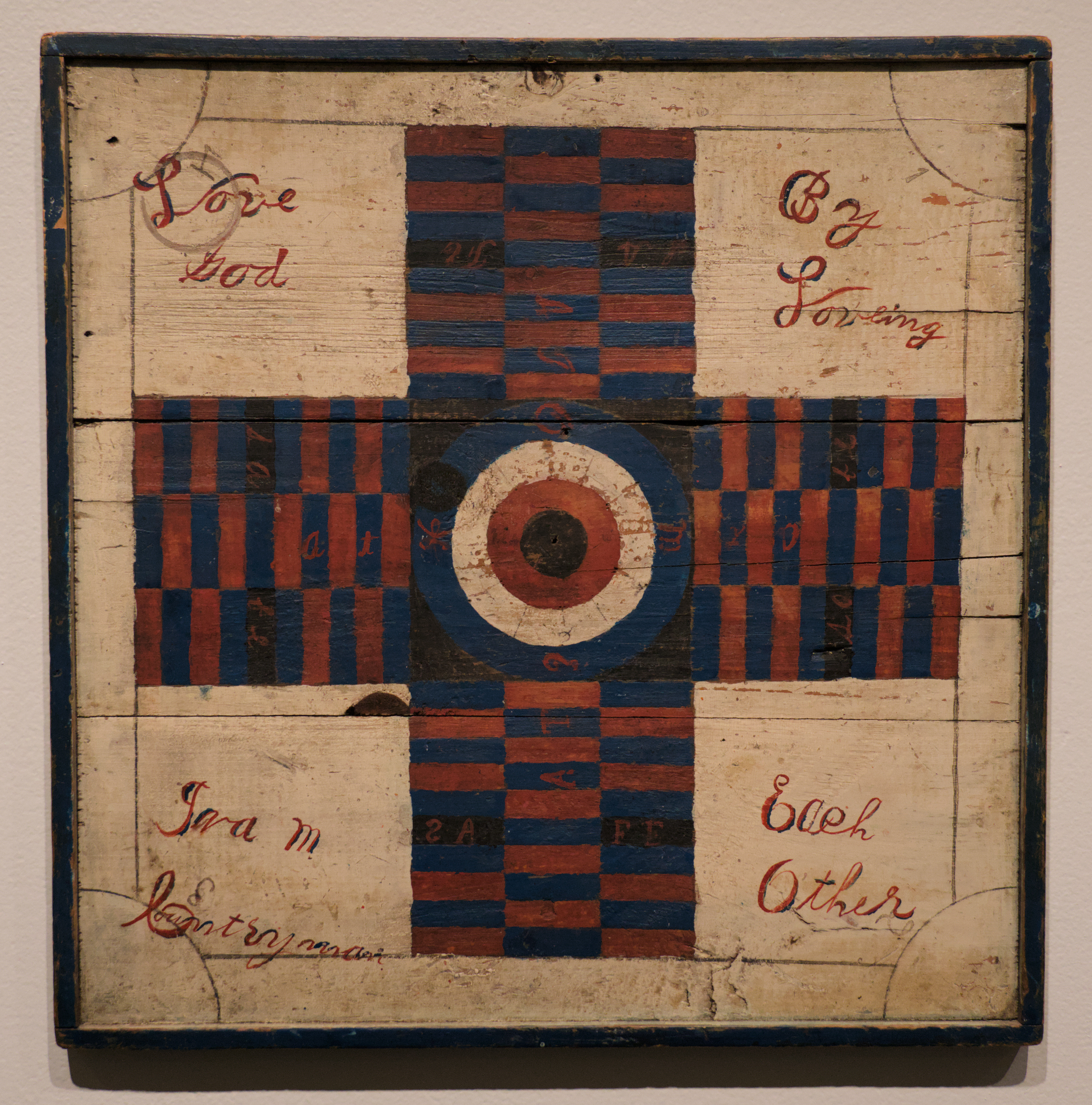
Two that made me chuckle contain religious references. “Gameplay, especially cards, was sometimes thought to encourage vice, in particular gambling or idleness,” the gallery label reads. So board makers sometimes incorporated spiritual aphorisms or precepts into the design to counteract the corrupting influence and remind players to uphold Christian virtues even in moments of leisure. A Parcheesi board instructs players to “Love God by loving each other”—and I can’t make out what the Chinese checkers board says, other than “The Lord . . . your . . . God . . .”
Possibly Ira M. Countryman or Jimmy Hall, Parcheesi Board, late 19th century. Paint on wood, 21 × 21 in. American Folk Art Museum, Gift of Doranna and Bruce Wendel, 2024.7.3. Photo: Victoria Emily Jones.Possibly George Clark, Chinese Checkers Board, late 19th or early 20th century. Paint on wood, 17 1/2 × 15 in. Collection of Doranna and Bruce Wendel. Photo: Victoria Emily Jones.
The American Folk Art Museum is one of the few FREE museums in New York, and I’ve enjoyed it so much every time I’ve been there. (See the blog post “The biblical imagination of folk sculptor Annie Hooper,” documenting one of my previous visits.) It’s small—only three galleries. It’s on the Upper West Side of Manhattan, right off the Lincoln Center subway stop.
+++
Interested to see what books I read in 2024? Goodreads has put together a “My Year in Books” page! Follow me on Goodreads if you want to stay apprised of my latest reads, want-to-reads, and star ratings.
BLOG POST: “On the Twelfth Day of Christmas: 12+ ways to keep celebrating with the rest of the world (loads of links!)” (Watch & Do for Twelfth Night and Epiphanytide) by Tamara Hill Murphy: In this blog post from 2019, spiritual director and writer Tamara Hill Murphy has compiled a wonderful roundup of resources for Twelfth Night (January 5) and the Feast of Epiphany (January 6), on such things as chalking the door, stargazing, making origami Christmas stars, baking a Three Kings Cake, Three Kings Day parades, Christmas tree bonfires, and more. She shares several videos, including this one of Denis Adide reading “The Journey of the Magi” by T. S. Eliot, shot in locations around Bristol:
I really love this unique rendition, which, with all its dissonance, is different from all the others I’m familiar with. James Johnson, one of the YouTube commenters on the video, writes: “I think this rendition is transporting. Listen to it. Close your eyes and you can feel the hot dry wind of the desert blowing in your face. You may wonder why make this trip at all, and then, that star. That amazing star. Yep, we can make it past a few more dunes, beyond Herod, and on to . . . ‘a manger’? And the rhythm section just pushes me on. . . . This earthly trinity, Melchior, Caspar, and Balthazar, are the hippest trio in Jerusalem and I want to go where they go, know what they know.”
This performance appears on the orchestra’s live album Big Band Holidays (2015) [previously].
+++
NEW ARTWORK: Christmas in the Air Raid Shelter by Olya Kravchenko: For Christmas 2024, with Russia still deploying cruise missiles and suicide drones against Ukraine, Ukrainian iconographer Olya Kravchenko constructed a three-dimensional painting that shows the Holy Family huddled in the basement of an apartment complex, hiding out from air raids. A large, bright star hovers overhead, showing the three magi to the spot where Jesus lies.
Olya Kravchenko (Ukrainian, 1985–), Christmas in the Air Raid Shelter, 2024. Plywood, tempera, and gilding, 67 × 40 × 25 cm.
This piece can be seen through January 26 at the eighty-fourth annual Krippenausstellung (Nativity Scene) exhibition at RELiGIO: Westfälisches Museum für religiöse Kultur (Westphalian Museum of Religious Culture) in Telgte, Germany, whose theme is “Heller Stern” (Bright Star).
+++
SONG: “Magi, Kings of Persia” by Michael Adamis, from the suite 4 Christmas Idiomela: Performed by Cappella Romana under the direction of Alexander Lingas, this choral piece by the Greek composer Michael Adamis (1929–2013) is a setting of an Eastern Orthodox liturgical text for Christmas that translates to:
The magi, kings of Persia, manifestly recognizing the King of heaven who was born on earth, arrived in Bethlehem, led by the radiant star, bearing choice gifts of gold, frankincense and myrrh; and falling down, they offered worship, for they beheld the Timeless One lying in the cave as a babe.
The video is from Cappella Romana’s 2020 Christmas concert.
+++
BLOG POST: “‘So glorious a gleam, over dale and down’” by Eleanor Parker: Medievalist Eleanor Parker shares two medieval English carols (text only; the original music does not survive) about the visit of the magi, a popular theme in that era. She translates them into modern English and provides commentary.
Maryam and Isa (Mary and Jesus), miniature from a Falnama, Mughal India, 1550–1600. Opaque paint, gold, and silver on paper, 49 × 35 cm. Wereldmuseum, Rotterdam, Netherlands, Inv. 07180329.
This delicate painting is from an Islamic manuscript made in India during the Mughal era. It shows Mary sitting outside with her son, Jesus, on her lap, whose flaming halo identifies him as a prophet. Enclosed by a gate, they are seated on a mat, and Jesus hands his mother a fruit that looks to me like a pomegranate—though a date would cohere better with the Qur’an’s Nativity account (19:25–26). Verdant pink hills rise up behind them, as does a palm tree, under which sits a pitcher of water. From the left, an anthropomorphized sun gazes down on the sacred pair. The inscriptions are in Persian.
Like Christians, Muslims revere Jesus—his birth is recounted in the Qur’an 19:16–34 and 3:45–53, and in that book he is also described as the Messiah, the Word of God, and the Spirit of God—but unlike Christians, Muslims do not regard Jesus as divine.
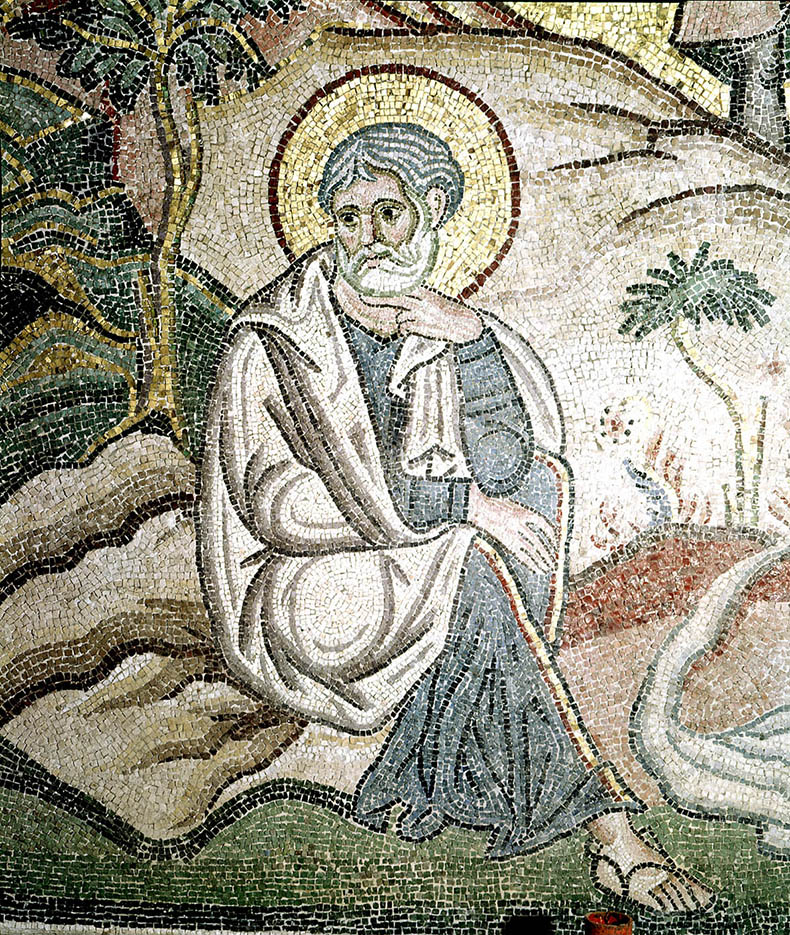
Saint Joseph at the Nativity, ca. 1100, mosaic detail from Daphni Monastery, Haidari (outside Athens), Greece [ view full scene ]
After the Wise Men went, and the strange star
Had faded out, Joseph the father sat
Watching the sleeping Mother and the Babe,
And thinking stern, sweet thoughts the long night through.

“Ah, what am I, that God has chosen me
To bear this blessed burden, to endure
Daily the presence of this loveliness,
To guide this Glory that shall guide the world?

“Brawny these arms to win Him bread, and broad
This bosom to sustain Her. But my heart
Quivers in lonely pain before that Beauty
It loves—and serves—and cannot understand!”
from The Frozen Grail and Other Poems by Elsa Barker (Duffield & Company, 1910)
Elsa Barker (1869–1954) was a novelist, short story writer, and poet from New England. She lived for extended periods in London and Paris and was a member of the Theosophical Society.
Jacob Riis (Danish American, 1849–1914), In the Home of an Italian Rag-Picker, Jersey Street, ca. 1890. Photograph, 7 15/16 × 9 3/4 in. (20.2 × 24.7 cm).
My soul magnifies the poor
the sore
the raw
and my spirit rejoices in God
my downcast
my outcast
my twig-bone wrong caste
for He regards the low estate
the no-go estate
the empty plate
and squats there with those generations.

For at Whose Name the cosmos shakes
and canyons quake
sought sanctuary within a womb
a young girl’s chaste, unopened room
a sparse, unblemished catacomb
and holy is He amongst the lame.

His mercy is on those who fear Him
hear Him
those near Him
in desert flapping bivouac or dehydrated barrio.

The night sky rolled out by His arm,
the preening proud ignore His balm
and slink towards the warlock charm
of their small ambitions;
and those on thrones end up alone
replaced by fly-pecked innocents.

He only eats with the hungry,
and if they don’t, He too refrains;
and as for the rich –
a table cannot be found for them.

My soul magnifies the poor
the sore
the raw
and my spirit rejoices in God
my outcast.
Stewart Henderson is a poet, song lyricist, and broadcaster. His children’s poems, taken from his three best-selling children’s collections (Poetry Emotion, All Things Weird and Wonderful, and Who Left Grandad at the Chip Shop?), are included in the UK’s national education curriculum. As a song lyricist, the music magazines Q and Mojo place his lyrics alongside those of Randy Newman and Radiohead. And as an award-winning presenter and producer of many documentaries for BBC network radio, he continues in the grand tradition, established by the likes of Dylan Thomas, Louis MacNeice, Cecil Day-Lewis, and others, of leading poets being commissioned to make primetime programs for Britain’s national broadcaster. Liverpool-born but long since residing on the southwest fringes of London, Henderson has been a regular participant, since its inception in 1974, in the Greenbelt Festival, an annual summer event in England dedicated to the arts, faith, and justice, for which Henderson served as a board director for twelve years.










 Art & Theology