Roundup: New Easter songs, joint Easter-iftar dinner, and more

Here’s my new (nonthematic) playlist for the month of April!

But also, because Easter lasts through May 18, be sure to check out the 184 songs I handpicked for the season, which includes some new ones mixed in since the playlist’s original publication.

+++

NEW SONGS:

>> “He Lives” by Emma Nissen: Emma Nissen is a Latter-day Saint singer-songwriter from Arizona known for her gorgeous jazz vocals. Here she performs an original song about God the Father giving his Son, Jesus, to redeem the world through his life, death, and resurrection. “Let there be light, let there be love . . .”

>> “Living Among the Dead” by Caleb Stine: Alt-country singer-songwriter Caleb Stine, based in Baltimore, released this Johnny Cash–esque, resurrection-themed song just before Easter. The title and chorus come from the words the angels spoke to the women who went to Jesus’s tomb the Sunday after his death, looking for his body. “Why do you look for the living among the dead?” they asked. “He is not here but has risen. Remember how he told you, while he was still in Galilee, that the Son of Man must be handed over to the hands of sinners and be crucified and on the third day rise again” (Luke 24:5–7).

The first verse narrates that momentous visit to the tomb. The second verse fast-forwards to the present day and raises issues of poverty, mental illness, substance abuse, culture warring, and militarism, some caused and others exacerbated by the death-dealing policies or neglect of the government. Many people look to politicians for salvation, trusting in their often empty promises, embracing their divisive rhetoric, and ignoring major character flaws for the sake of power. This song cautions us not to go to a dry well for sustenance—not to quench our thirst for living water in places that cannot give it.

The third verse tells of a “thin man in a dusty hat” who regales the story of a carpenter who healed and fed people, who drove out demons from bodies and greedy opportunists from temple courtyards, who befriended those of little means and those who were ostracized. He addressed human suffering head-on with tenderness and self-sacrifice. When the chorus comes in a final time, I hear in it that this loving, serving, reconciling Christ is still living, his Spirit is still moving, and that we ought to get behind that movement, practicing resurrection where we live. “Be not of fear, be of light, lift your head.” As the body of Christ, we should follow him in doing the same deeds and proclaiming the same good news of liberation.

+++

BLOG POST: “50 Ways to Practice Resurrection during the 50 Days of Eastertide” by Tamara Hill Murphy: Spiritual director and writer Tamara Hill Murphy of Connecticut shares fifty simple ideas for celebrating the Easter season in your day-to-day, including retelling baptism stories, visiting a botanical garden, watching a movie that makes you laugh, swinging on the playground, cooking a new veggie recipe, building a new piece of furniture, or washing your car by hand. “I find a lot of joy . . . in seeing these ordinary choices during my day as ways to practice a life that trumps death, a resurrection kind of life,” Murphy writes.

+++

PODCAST EPISODE: “The Beauty—the Poetry—of Christian Experience” with Benjamin Myers, Faith & Imagination: I listen to at least a dozen podcast episodes a week, and this one has been one of my favorites of the past few months. Dr. Benjamin Myers is a literature professor at Oklahoma Baptist University and a former poet laureate of Oklahoma. Here, host Matthew Wickman interviews Myers about two of his six books: A Poetics of Orthodoxy: Christian Truth as Aesthetic Foundation (2020) and the poetry collection The Family Book of Martyrs (2022). They talk about the incarnation and its implications on art; the disclosure of the extraordinary in the ordinary; the inherently unsecular nature of all good poetry; how beauty mirrors grace; the importance of the humanities in Christian education (how it “thickens up” the soul); the obligation of Christian art to capture both the “something good” and the “something missing” of our lives; and how love calls us to the things of this world.

A few additional highlights for me:

  • Myers came to faith after attending a Lessons & Carols service, compelled by the beauty and truthfulness of the story it told.
  • “Beauty is not just in the eye of the beholder but also in the being of God.”
  • At 37:24, Myers reads a poem he wrote for his youngest daughter: “Elizabeth Discovers Rock and Roll.”

+++

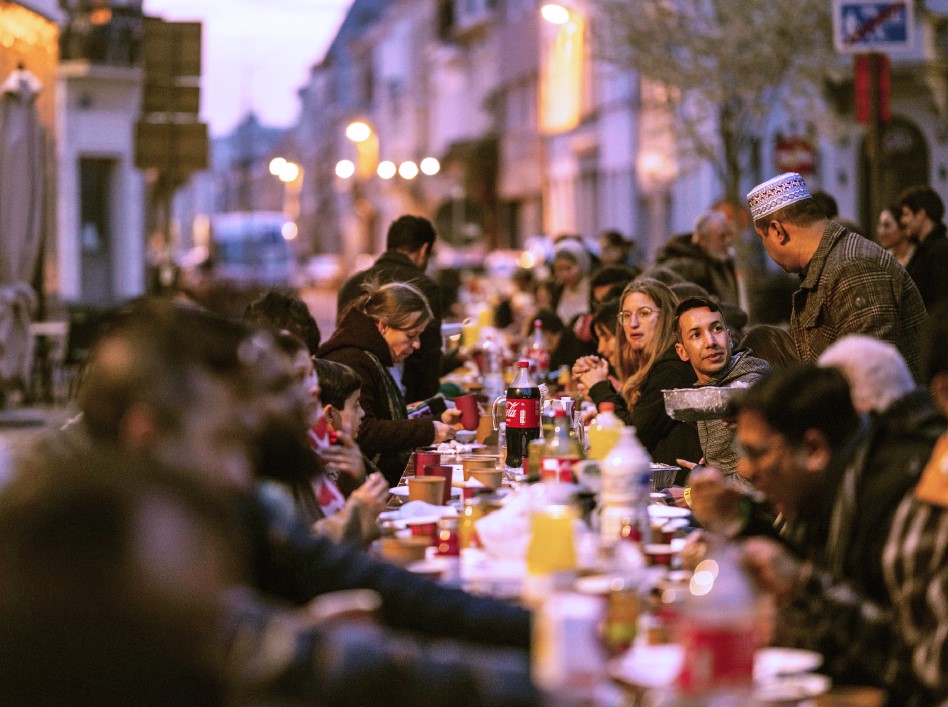
INSTAGRAM VIDEO: from AJ+: On March 31 in the Borgerhout district of Antwerp, a mile-plus-long table set up along the Turnhoutsebaan brought together city residents for a joint Easter-iftar dinner. Easter is the most sacred feast of the Christian year, celebrating the resurrection of Jesus; on Easter Sunday, Christians break the forty-day fast they’ve held for the duration of Lent. Lent almost always overlaps in part with Ramadan, a Muslim holy month of fasting that commemorates the prophet Muhammad’s first revelation. On each day of Ramadan after sunset, the fast is broken with an evening meal called an iftar.
Easter-iftar dinner
Christians and Muslims in Antwerp broke their fasts together at an outdoor Easter-iftar dinner on March 31. Photo: Sanad Latifa.

Borgerhout carried out this interfaith initiative in collaboration with the FMV cultural association and other partners in the hopes of promoting dialogue, social cohesion, and connection. I love this idea of gathering folks together across lines of religious difference to enjoy community, good food, and spiritual celebration! For more information, see https://www.2kmsamenaantafel.be/.

+++

NEW ALBUM: Three Gifts by Liturgical Folk and Jon Guerra: Ryan Flanigan of Liturgical Folk and Jon Guerra have teamed up to release an EP of three songs, one for each of the three theological virtues: faith, hope, and love (1 Cor. 13:13). Here’s “the greatest of these”:

“Easter, Before It’s Noticed” by Jill Peláez Baumgaertner (poem)

Turcios, Joaquin Vaquero_Dawn of the Resurrection
Joaquín Vaquero Turcios (Spanish, 1933–2010), Alba de Resurrección (Dawn of Resurrection), 1956. Oil on canvas, 120 × 180 cm. Museo Reina Sofia, Madrid, Spain.

The garden in the deep night
after God’s rapt silence
has no breath. No echo even
in the vacant tomb which no one
yet has visited, no one seen,
and yet everywhere his breathing,
the turn begins, the blanket
of sunrise in mist stretches
to swaddle the earth,
gouged and waiting.

From From Shade to Shine: New Poems by Jill Peláez Baumgaertner, © 2022 by Jill Peláez Baumgaertner. Used by permission of Paraclete Press, www.paracletepress.com.

Jill Peláez Baumgaertner (born 1948) is the multi-award-winning author of six poetry collections and an academic book on Flannery O’Connor as well as the editor of the anthologies Taking Root in the Heart: Poems from the Christian Century (Paraclete, 2023) and Imago Dei: Poems from Christianity and Literature (Abilene Christian University Press, 2012). A Fulbright fellowship to Spain and a nomination for the Pushcart Prize are among her honors. Professor emerita of English and former dean of humanities and theological studies at Wheaton College, she lives in Chicago with her husband, Martin, where she serves as poetry editor of the Christian Century. Hear her discuss her work on a recent Faith and Imagination podcast episode on poetry and the Divine Presence.

Roundup: One-word poems, “Go to Hell” musical setting, and more

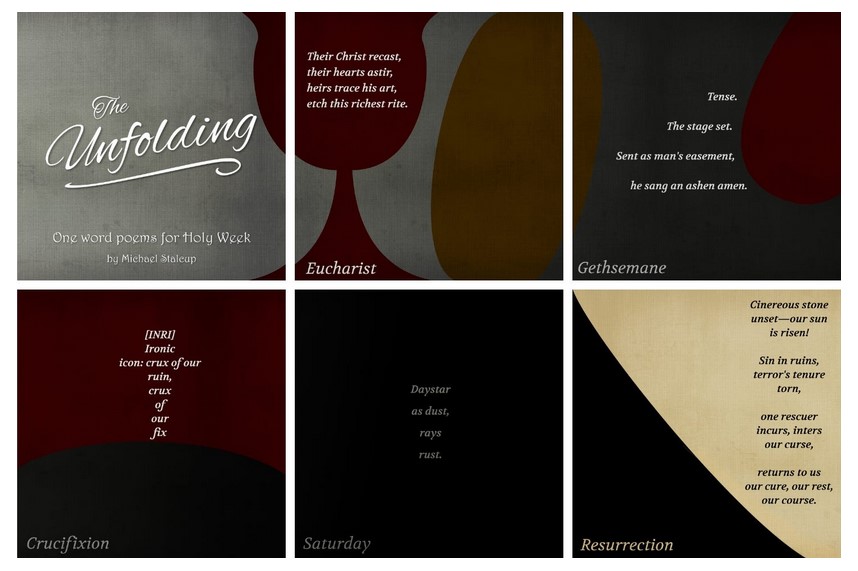
POEM SEQUENCE: “The Unfolding” by Michael Stalcup: Michael Stalcup has published a sequence of five short poems in Solum Journal that “tells the story of Jesus’ death and resurrection by unfolding five words that take us from Maundy Thursday through Easter Sunday,” he says. “I wrote these poems in a very unusual way, restricting myself to words that could be formed from the letters in each poem’s title. . . . This poetic form calls for creativity within intense limitations, which seems fitting for Holy Week—a time when Jesus crafted the most beautiful art this world has ever known within the constraints of his own suffering and death.” Stalcup has also presented them on Instagram (click on the image below).

The Unfolding by Michael Stalcup

+++

ARTICLE: “Don’t Rush Past Good Friday” by Brian Zahnd: Pastor and author Brian Zahnd cautions us not to shortchange the cross on the way to Easter, but rather to slow down and dwell there, beholding the crucified Christ.

+++

SONGS:

>> “Friday Morning” by Sydney Carter, performed by Timothy Renner: This Good Friday song by the English folk musician Sydney Bertram Carter (1915–2004) is difficult—one might even say blasphemous. That’s because it’s voiced from the perspective of the “bad” thief, who is spewing hatred and bitterness over his fate and blaming God for having created such a cruel world. But we’re aware of an irony in the refrain that the convicted man is not: “It’s God they ought to crucify / Instead of you and me, / I said to the carpenter / A-hanging on the tree.”

Read or listen to a reflection on “Friday Morning,” by Andrew Pratt, here.

>> “Go to Hell” by Nick Chambers: This song is a setting of a poem by Pádraig Ó Tuama from his collection Sorry for Your Troubles (Canterbury Press Norwich, 2013). The title is shocking, I know, but it’s derived from a line in the Apostles’ Creed, where we Christians profess that after Jesus died, he “descended into hell.” The singer-songwriter, Nick Chambers, writes in the YouTube video description: “In between Good Friday and Easter Sunday is possibly strangest day of the Christian year. On Holy Saturday, not only is Jesus, the God-Man, in the grave; traditions abound about his descent to the dead, his ‘harrowing of hell.’ What does it mean for the coming down of God-with-us not to end on earth but ‘under the earth,’ extending hope to the furthest regions of human pain and abandonment? Such a question deserves more poetry than explanation.”

“Go to hell” is a slang expression of scorn or rejection, to which Jesus was no stranger. As in the previous song, there’s an irony here, in telling Jesus to go to hell—because he did. Literally. Ó Tuama meditates on how Jesus shares in our vulnerabilities and yearnings and seeks to pull us out of the hells we’re in and redeem our stories.

Hear the poem read by the poet here, or at the end of the Stations of the Cross video below. “he is called to hell, this man / he is called to glory . . .”

+++

GUIDED MEDITATION: “Stations of the Cross, Good Friday, 2020” by Pádraig Ó Tuama: In 2020 the poet-theologian Pádraig Ó Tuama put together this twenty-minute video reflection for Good Friday structured around the Stations of the Cross, consisting of photos of art he’s taken and the praying of collects he’s written. (Several of the collects can be found in his book Daily Prayer with the Corrymeela Community from 2017.) The throughline is a set of stained-glass Stations by Sheila Corcoran at the Church of Our Lady Queen of Heaven at Dublin Airport; others are by Jong-Tae Choi, Gib Singleton, Sieger Köder, Richard P. Campbell, and Audrey Frank Anastasi.

Corcoran, Sheila_Veronica's Veil
Sheila Corcoran, Station 6: Veronica Wipes the Face of Jesus, ca. 1964. Stained glass, Church of Our Lady Queen of Heaven, Dublin Airport. Photo: Patrick Comerford.

Campbell, Richard_Stripped
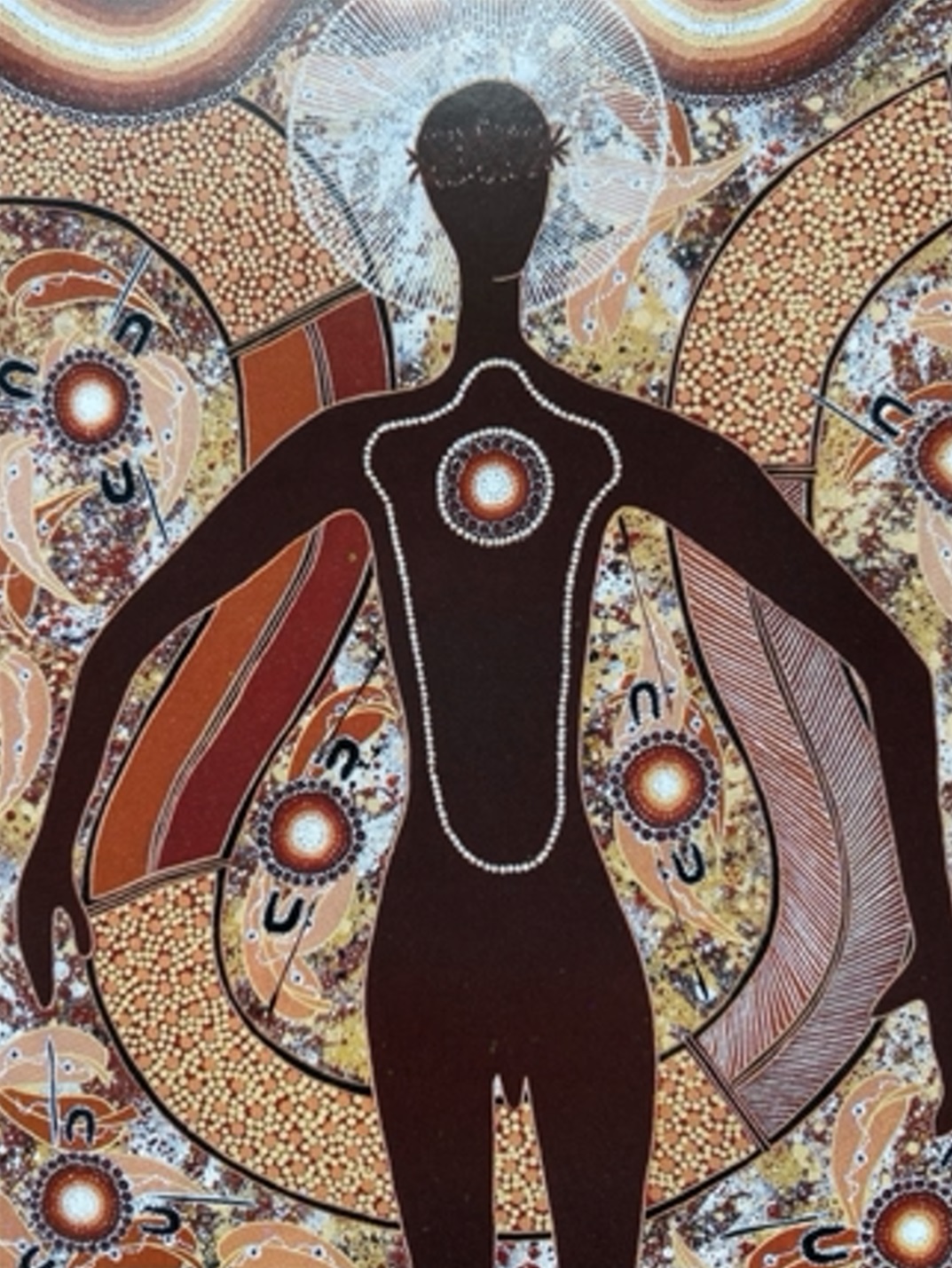
Richard P. Campbell (Dunghutti/Gumbaynggirr, 1958–), Station 10: Jesus is stripped of his garments, 2001. Reconciliation Church, La Perouse, Sydney, Australia.

But before stepping onto Jesus’s Via Dolorosa, Ó Tuama considers Judas, sharing a stained glass panel by Harry Clarke that illustrates a medieval legend about the Irish monastic saint Brendan the Navigator. According to the Navigatio Sancti Brendani Abbatis, on one of his voyages St. Brendan encountered Judas at sea, tied to an iceberg. He learned that an angel had taken pity on Judas in hell and given him a reprieve of one hour to cool himself from the flames of judgment. Ó Tuama then prays for those who, like Judas, are tormented by guilt and see no way out.

He closes with a reading of his poem “Go to Hell” (set to music in the previous roundup item).

+++

SONG: “For the Songless Hearts” by Jon Guerra: “There’s a lot of hubbub around Easter weekend in churches. And for good reason,” says singer-songwriter Jon Guerra. “But our hearts can’t always cooperate with the prescribed mood of the Easter season: ‘Celebrate! Be happy! Sing!’ Sometimes the last thing we are able to do is sing. Thankfully, Good Friday and Easter are not about mustering a mood. Good Friday and Easter are about remembering that there is One who meets us in our life and meets us in our death. He sings for us—and over us—when we can’t.”

That’s what “For the Songless Hearts” is about—a single released in 2017, and which Guerra sings with his wife, Valerie. In a Mockingbird blog post about it, Guerra admonishes, “Remember that before the tomb was empty, it was full. ‘When he was laid in the tomb, he laid right next to you.’” Jesus knew the depths of sorrow and the sting of death. We are not alone in such experiences.

“El Greco: Espolio” by Earle Birney (poem)

El Greco_El Espolio
El Greco (Domenikos Theotocopoulos) (Spanish, 1541–1614), El Espolio (The Disrobing of Christ), 1577–79. Oil on panel, 55.7 × 34.7 cm. National Trust, Upton House, Warwickshire, England. Photo: National Trust Photo Library / John Hammond. [object record]

The carpenter is intent on the pressure of his hand
on the awl, and the trick of pinpointing his strength
through the awl to the wood, which is tough.
He has no effort to spare for despoilings
nor to worry if he’ll be cut in on the dice.
His skill is vital to the scene, and the safety of the state.
Anyone can perform the indignities; it is his hard arms
and craft that hold the eyes of the convict’s women.
There is the problem of getting the holes straight
(in the middle of this shoving crowd)
and deep enough to hold the spikes
after they’ve sunk through those soft feet
and wrists waiting behind him.

The carpenter isn’t aware that one of the hands
is held in a curious beseechment over him—
but what is besought, forgiveness or blessing?—
nor if he saw would he take the time to be puzzled.
Criminals come in all sorts, as anyone knows who makes crosses,
are as mad or sane as those who decide on their killings.
Our one at least has been quiet so far,
though they say he has talked himself into this trouble—
a carpenter’s son who got notions of preaching.
Well here’s a carpenter’s son who’ll have carpenter’s sons,
God willing, and build what’s wanted, temples or tables,
mangers or crosses, and shape them decently,
working alone in that firm and profound abstraction
which blots out the bawling of rag-snatchers.
To construct with hands, knee-weight, braced thigh,
keeps the back turned from death.
But it’s too late now for the other carpenter’s boy
to return to this peace before the nails are hammered.

From Selected Poems, 1940–1966 by Earle Birney (Toronto: McClelland and Stewart, 1966), copyright © the Estate of Earle Birney.

Earle Birney (1904–1995) is regarded as one of Canada’s finest poets. He is the author of twenty-five poetry collections, including David and Other Poems (1942), Now Is Time (1945), and Near False Creek Mouth (1964). He taught English at the University of British Columbia, where he founded and directed the first Canadian creative writing program. He was also a novelist, essayist, literary critic, and radio playwright.

Book Review: Jesus through Medieval Eyes by Grace Hamman

As an English major in college, I was required to take a course on medieval literature. I had not been looking forward to it—Romantic and Victorian lit were more my thing. I worried that working through Old English and Middle English texts would be a slog. But boy were my expectations upended! I was enthralled by all the imaginative theology I encountered in verse, drama, and sermons, from the Dream of the Rood on down. I went to a public university, but the saturation in Christian thought is unavoidable for students of the history of English literature. After overcoming some hang-ups I had acquired from my fundamentalist Baptist upbringing, I found my faith opened up, strengthened, and inspired by my study of medieval writers. The same has held true in my studies of medieval art.

If you missed the opportunity to study the creative outputs of the Middle Ages in school but want to wade into those waters, you must follow the work of Dr. Grace Hamman, a medieval scholar from Denver who writes and teaches on the great works of that era through her newsletter, podcast, and more recently her first book, Jesus through Medieval Eyes: Beholding Christ with the Artists, Mystics, and Theologians of the Middle Ages (Zondervan, 2023). The book explores seven identities of Jesus—Judge, Lover, Knight, Word, Mother, Good Medieval Christian, and Wounded God—engaging art and literature that develop these tropes, some more familiar to us as moderns than others. Mechthild of Magdeburg, Julian of Norwich, Margery Kempe, Gregory the Great, Fra Angelico, Petrus Christus, Thomas Aquinas, Anselm of Canterbury, and Richard Rolle are among the folks we meet.

The church’s writings and images from the past, Hamman says, are a gift to us in the present that can help us see beyond our time- and culture-bound limitations. “In reading these exploring, adoring, faithful witnesses from the past, we can come to know Jesus—and ourselves—better,” she writes. “What we find strange or beautiful in these medieval witnesses can reveal our concerns, hidden biases, and even new truths. They also teach us new and profound ways to love him” (6).

She continues,

I began reading medieval texts because, to my joyful surprise, I learned that medieval Christians loved Jesus. They wrote about Jesus incessantly, compulsively, athirst with love, devotion, and creativity. They possessed vast Christian imaginations, often more expansive and interesting than many of the Christians who preceded or followed them. I discovered that writers of this period were far more comfortable than we today in thinking about Jesus metaphorically, highlighting particular and peculiar attributes, and crafting new stories about him. Their narrative freedom, delight in allegory and metaphor as paths to truth, and cultural difference offer us the gift of strange new insights—the gift of surprise. (10)

To receive that gift of surprise, Hamman advises, we must approach the texts with a spirit of openness—a willingness to sit with them quietly, attentively, and humbly before making judgments, acknowledging that our own views are not necessarily superior. Then we can welcome in the discernment process, weighing the validity of the picture at hand, determining whether we want to graft it into our understanding of Christ and his work.

I appreciate how Hamman regards the medieval era with neither nostalgia nor negativity. She’s not suggesting we simply embrace medieval theology wholesale, as if it represents some kind of golden age we ought to return to. No, we can and should be critical of certain aspects—but we should first come to these works with a genuine readiness to receive and to learn, not instantly writing them off because they come from a time or tradition we’re not a part of.

Some of the pictures of Jesus that Hamman addresses are

  • a barefoot knight who jousts with the devil and storms the gates of hell, wearing human nature as his armor
  • a mother who gestates, gives birth, and breastfeeds
  • a lover who “forms us in blooming beauty through his tender desire” (53)

In chapter 3, “The Lover,” Hamman includes a woodcut illustration of one of the couplets from the late medieval verse dialogue Christus und die minnende Seele (Christ and the Loving Soul), showing the soul making herself naked before Christ her bridegroom so that they can join in spiritual union. Each gives themselves to the other in vulnerability.

Christ as Lover
“Christus beraubt die Seele ihrer Kleider, so daß sie nackt ist” (Christ strips the soul of its garments so that it is naked), Germany, ca. 1460. Woodcut illustration from a broadsheet of Christus und die minnende Seele (Christ and the Loving Soul). Albertina Museum, Vienna, Inv. DG1930/197/3.

She also walks us through the anonymous fifteenth-century poem “Quia Amore Langueo,” which brings together the language of romance with imagery of the crucifixion; its Latin refrain, taken from Song of Songs 2:5, translates to “Because I swoon with love.”


It’s important to pay attention to the places in these ancient texts and images that cause discomfort or confusion, as they are often places that helpfully challenge our assumptions today of who God is or what Christianity should look like.

—Grace Hamman, Jesus through Medieval Eyes, pp. 53–54

Jesus through Medieval Eyes introduces the reader to several important medieval texts, including the Old English poem Christ III, concerned with the second coming of Christ; Piers Plowman by William Langland, an allegorical poem in which the narrator, Will, is on a quest for the true Christian life; and the enormously influential Meditationes Vitae Christi (Meditations on the Life of Christ) and its derivative The Mirror of the Blessed Life of Jesus Christ by Nicholas Love, who encourages us to exercise our “devout imagination” by envisioning the events of the Gospels. The latter includes charming, homey little narrative details, like Mary using her kerchief as a swaddle for the newborn Jesus, and after his forty-day fast in the desert, Jesus craving his mama’s home cooking.

I admire how Hamman takes art seriously as a theological medium, recognizing how historically, the church has expounded its theology not only through the written word but also through painting and other visual expressions. And so she integrates art images throughout the book, weaving them into her discussion. There are sixteen total, reproduced in black-and-white near the text that refers to them, for convenience, as well as in a color insert, where they can be enjoyed more fully. I wish more theologians and church historians would follow Hamman’s example of drawing on art as a resource for understanding the development of, and for inquiring into and articulating, religious ideas.

But what really sets Hamman apart from other medievalists, in my opinion, is the balance in tone she manages to achieve between academic, devotional, and personal. (It’s something I struggle to achieve as a writer.) She writes with authority but also with an intimacy that is inviting and refreshing. She lets us into her own background and experiences and feelings and is transparent about her enthusiasms and distastes. I feel like she’s a wise old friend conversing with me over a cup of tea. Whether it’s an audio commentary she’s published on her podcast, a Substack missive, or this book, I always come away from her content having learned something, been given something to reflect on or explore further, and been drawn closer to God. She’s a wonderful teacher!

Christus, Petrus_Christ as the Man of Sorrows
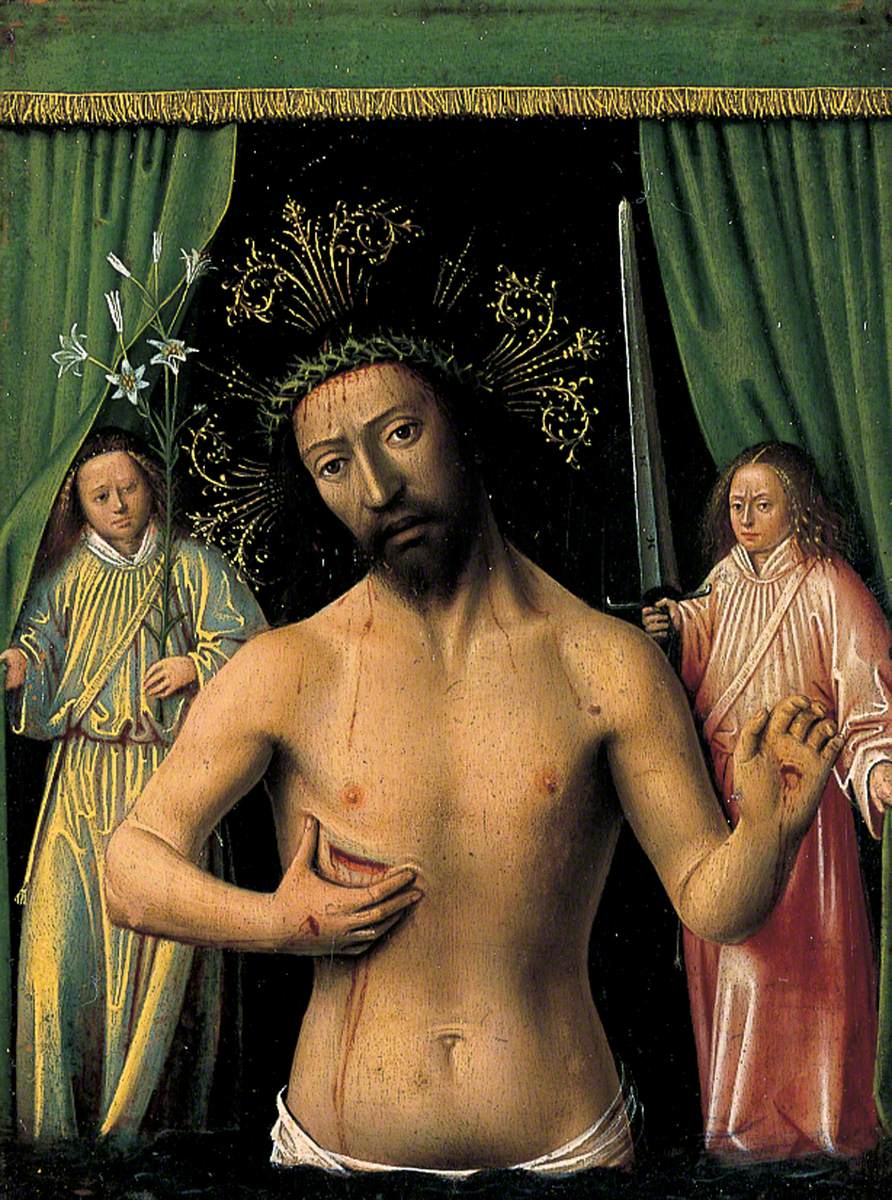
Petrus Christus (Netherlandish, ca. 1410–ca. 1475), Christ as the Man of Sorrows, ca. 1450. Oil on panel, 11.2 × 8.5 cm. Birmingham Museum and Art Gallery, Birmingham, England.

In Jesus through Medieval Eyes, each chapter ends with a scripture, reflection questions, one or two suggested exercises, and a prayer—some sourced from medieval authors, others original.

Each chapter opens with a whimsical line drawing based on medieval manuscript marginalia, which often feature humorous scenarios, like a knight fighting a snail or a rabbit hunting a human! (Role reversals were a favorite form of play for medieval artists.) This design element further immerses the reader in that world. The cover too, its art taken from a French book of hours illuminated by Jean Colombe, gives a sense of the shine of medieval manuscripts with its gilt lettering and halos of the saints.

Hamman has revitalized my interest in medieval literature, in all its wild beauty and strangeness. You may have noticed her influence on my blog over the past few years I’ve been following her. I encourage you to follow her on Twitter @GraceHammanPhD and Instagram @oldbookswithgrace, subscribe to her Medievalish newsletter, and BUY HER BOOK! It would be great material for a Christian book club, and would also make a great gift.

You may also want to check out the recent interview Hamman sat for on The Habit Podcast, part of the Rabbit Room Podcast Network. It’s a terrific introduction to her work:

A version of Hildegard of Bingen’s “Ave generosa” by Gabriele Uhlein

Hudyma, Olesya_Ukrainian Madonna
Olesya Hudyma (Ukrainian, 1980–), Ukrainian Madonna, 2021. Oil on canvas.

Mary,

God delights in you so much,
God was so taken with you,
he sank his love’s fire
deep within you.

So much love he gave you,
that with it you nurture his son.

So full of ecstasy is your body
that it resounds with heaven’s symphony.

Your womb exults.

It exults like the grass,
grass the dew has nestled on,
grass the dew has infused with verdant strength.

That is how it is with you,
Mother of all joy.

From Meditations with Hildegard of Bingen, introduction and versions by Gabriele Uhlein (Rochester, VT: Bear & Company, 1983). Used by permission of Inner Traditions International. All rights reserved.

This book is the first time Hildegard’s writings appeared in English. In selecting, translating, and adapting the material for it, Uhlein worked from the German critical editions of De Operatione Dei (1965), Liber Vitae Meritorum (1972), and Hildegard’s letters (Briefweschel) (1965) and songs (Lieder) (1969), all published by Otto Müller Verlag in Salzburg.

For the original Latin of the above hymn and a more straightforward translation by Nathaniel M. Campbell, see here. This link also includes a musical performance of the Latin (Hildegard wrote her own lyrics and music!).


Hildegard of Bingen, OSB, (ca. 1098–1179) was a German Benedictine abbess, theologian, preacher, poet, composer, playwright, and medical writer and practitioner. She founded the monasteries of Rupertsberg and Eibingen and was named a “doctor of the church” by Pope Benedict XVI in recognition of “her holiness of life and the originality of her teaching.” Hildegard’s most significant works are her three volumes of visionary theology: Scivias (Know the Ways) (for which she also supervised miniature illuminations), the Liber Vitae Meritorum (Book of Life’s Merits), and the Liber Divinorum Operum (Book of Divine Works). But she is also well known for her liturgical hymns and antiphons, as well as the many letters she wrote to popes, emperors, abbots, abbesses, fellow mystics, and layfolk, dispensing wisdom and advice.

Gabriele Uhlein, OSF, (born 1952) is a retreat guide, workshop leader, and artist dedicated to the recovery of the Christian mystical tradition and the honoring of intuition and creativity in spiritual deepening. Born in Klingenberg, Germany, she emigrated to the US at age two. She has a PhD in process theology and Jungian-oriented psychology from Chicago Theological Seminary and is a member of the core staff at the Christine Center, a natural sanctuary in Willard, Wisconsin, rooted in the Franciscan principles of contemplation, hospitality, compassion, simplicity, transformation, and care for the earth.

Roundup: New choral setting of R. S. Thomas poems, “Christ Jesus Knew a Wilderness,” “St. Gabriel to Mary flies,” and more

WORLD PREMIERE: “Yr Oedd Gardd / There Was a Garden” by Alex Mills, March 29, 2024, Saint Deiniol’s Cathedral, Bangor, Wales: On Good Friday this year, a new setting of seven unpublished R. S. Thomas poems, curated from the archives of the R. S. Thomas Research Centre, will be performed for the first time by Saint Deiniol’s Cathedral Choir under the direction of Joe Cooper, accompanied by devotional readings. The choral composition is by Alex Mills [previously], and it was commissioned by Saint Deiniol’s for Holy Week. The title comes from John 19:41–42: “Now there was a garden in the place where he was crucified, and in the garden there was a new tomb in which no one had ever been laid. And so, because it was the Jewish day of Preparation, and the tomb was nearby, they laid Jesus there.”

Thomas was a priest in the Church of Wales and one of the twentieth century’s greatest poets, his works exploring the cross, the presence and absence of God, forgiveness, and redemption.

This is the second commission Mills has fulfilled for the cathedral; last year he wrote “Saith Air y Groes / Seven Last Words from the Cross,” a choral setting of the seven short phrases uttered by Jesus from the cross, according to the Gospel writers, but in Welsh.

+++

CONTEMPORARY HYMNS/GOSPEL SONGS BY WOMEN:

I try to be intentional about featuring the work of women throughout the year, but as March is Women’s History Month, I wanted to call attention to these three sacred songs by Christian women from the generation or two before me.

>> “Christ Jesus Knew a Wilderness” by Jane Parker Huber (1986): Born in China to American Presbyterian missionaries, Jane Parker Huber (1926–2008) is best known as a hymn writer and an advocate for women in the church. This hymn—which can be found in A Singing Faith (1987), among other songbooks—is particularly suitable for Lent. Huber wrote the words, pairing them with an older tune by George J. Elvey. Lucas Gillan, a drummer, educator, church music director, composer, and occasional singer-songwriter from Chicago and founding member of the jazz quartet Many Blessings, arranged the hymn and performs it here with his wife, Anna Gillan, a project commissioned by Saint Matthew Lutheran Church in Walnut Creek, California. What a great violin part!

Christ Jesus knew a wilderness
Of noonday heat and nighttime cold
Of doubts and hungers new and old
Temptation waiting to take hold

Christ Jesus knew uncertainty
Would all forsake, deny, betray?
Would crowds that followed turn away?
Would pow’rs of evil hold their sway?

Christ Jesus knew an upper room
An olive grove, a judgment hall
A skull-like hill, a drink of gall
An airless tomb bereft of all

Christ Jesus in our wilderness
You are our bread, our drink, our light
Your death and rising set things right
Your presence puts our fears to flight

>> “For Those Tears I Died (Come to the Water)” by Marsha Stevens-Pino (1969): I grew up in an independent Baptist church in the southern US, and though the worship music consisted almost entirely of traditional hymns, I have a faint recollection of a woman singing this song as an offertory one Sunday. (Or maybe I heard it on a Gaithers’ television special at my grandma’s house?) It is an early CCM (contemporary Christian music) song that was popular with the emerging Jesus Movement. Marsha Stevens-Pino (née Carter) (born 1952) of Southern California wrote it in 1969 when she was sixteen and a brand-new Christian, and it was recorded by Children of the Day in 1971.

In the video below, excerpted from the DVD Stories and Songs, vol. 1, it is sung by Callie DeSoto and Maggie Beth Phelps with their father, David Phelps.

>> “The First One Ever” by Linda Wilberger Egan (1980): An alumna of the Union Theological Seminary School of Sacred Music with a background in voice and organ, Linda Wilberger Egan (born 1946) has served Lutheran, United Methodist, and Presbyterian congregations as music director throughout her career. Based on Luke 1:26–38, John 4:7–30, and Luke 24:1–11, her hymn “The First One Ever” honors the gospel witness of biblical women: Mother Mary, who said yes to God’s plan for her life, bearing the Messiah into the world; the unnamed woman of Samaria, who, after Jesus personally revealed his messianic identity to her, evangelized her whole village; and Mary Magdalene, Joanna, and Mary the mother of James, the first people to receive the news of Jesus’s resurrection and to preach it to the apostles.

The hymn is sung in the following video by Lauren Gagnon at St. Mark’s Episcopal Church in Chenango Bridge, New York, accompanied by her husband, Jacob Gagnon, on guitar.

+++

SUBSTACK POST: “St. Gabriel to Mary flies / this is the end of snow & ice” by Kristin Haakenson: Kristin Haakenson, creator of Hearthstone Fables, is an artist, farmer, and mom from the Pacific Northwest who shares art and reflections inspired by the sacred and the seasonal, place and past. In this most recent post of hers, she discusses the yearly intersection of Lent and the Feast of the Annunciation. “In a time when the Annunciation isn’t celebrated as universally within the Church as it once was, it may feel somewhat disjointed to stumble upon this joyful feast – celebrating the conception of Jesus – during the penitential season of Lent,” she writes. “This timing, though, is part of a revelatory harmony within the Christian calendar. When we step back to see it in the context of the rest of the liturgical year – and also in the context of the natural, astronomical seasons – the theology embedded in this system of sacred time begins to absolutely bloom.”

+++

LITURGICAL POEM: “Annunciation 2022” by Kate Bluett: Kate Bluett from Indiana writes metrical verse around the liturgical calendar and is also one of the lyricists of the Porter’s Gate music collective. In this poem (which she said was inspired in part by the timing of this blog post!) she brings the Annunciation into conversation with the Song of Solomon in such resonant ways.

Annunciation (Gladzor Gospels)
Toros Taronatsi (Armenian, 1276–ca. 1346), The Annunciation to the Virgin Mary, 1323, from a Gospel-book made at Gladzor Monastery, Siunik, Armenia. MS 6289, fol. 143, Matenadaran Collection (Mesrop Mashtots Institute of Ancient Manuscripts), Yerevan.

On Holy Saturday I’m planning to feature a song that connects the Song of Solomon to the women at Jesus’s tomb! If you haven’t read that Old Testament book or it’s been a while, I’d encourage you to do so, as then you’ll be able to more easily identify the references in Bluett’s poem and the upcoming song I’ve scheduled for the Paschal Triduum.

“To Calvary he bore his cross,” aka “My Fearful Dream”: An Early Tudor Passion Carol from the Fayrfax Manuscript

The English Crucifixion lyric “My Fearful Dream” (also known by the beginning of its first line, “To Calvary he bore his cross”) was written anonymously in the fifteenth century. It is preserved, with music by Gilbert Banastir (sometimes spelled Banaster or Banester) (ca. 1445–1487), on folios 77v–82r of the famous Tudor songbook BL Add. MS. 5465, intended for use at the court of King Henry VII. Compiled around the year 1500, this manuscript is commonly referred to as the Fayrfax Manuscript after Robert Fayrfax, the Tudor composer who was organist of St. Albans and a Gentleman of the Chapel Royal—that is, an adult male singer in the monarch’s household choir. It contains twelve sacred songs and thirty-seven secular songs, all in English—with, “beyond question, the finest music written to vernacular words which survives from pre-Reformation England,” writes John Stevens in Early Tudor Songs and Carols (xvi). It is unknown whether the text or the music was written first.

In 1982 “My Fearful Dream” was performed by Pro Cantione Antiqua under the direction of Mark Brown at the Church of St. John-at-Hackney in London. The recording of this performance was originally released in 1985 in vinyl format on A Gentill Jhesu: Music from the Fayrfax Ms. and Henry VIII’s Book (Hyperion A66152) and was later reissued by Regis Records in 2006 on the CD Tears & Lamentations: English Renaissance Polyphony (RRC 1259). Unfortunately, the CD is out of print, the choral group is inactive, and I can find no performances online. I thus provide the recording of “My Fearful Dream” (or “My Fearfull Dreme,” as the track list spells it) directly below for educational purposes. It is a song for three voices: alto, tenor, bass.

Below is the original text as transcribed by Richard Leighton Greene from the Fayrfax Manuscript in The Early English Carols (Oxford: Clarendon Press, 1935), page 124, followed by a version with modernized spellings and updates of a few antiquated words. The text also appears in John Stevens, Music and Poetry in the Early Tudor Court (London: Methuen, 1961), no. 56, and the music in John Stevens, ed., Early Tudor Songs and Carols (Musica Britannica 36) (London: Stainer and Bell, 1975), page 476.

Pro Cantione Antiqua does not sing the third stanza.

van der Weyden, Rogier_Crucifixion (Philadelphia)
Rogier van der Weyden (Netherlandish, 1399/1400–1464), The Crucifixion, with the Virgin and Saint John the Evangelist Mourning, ca. 1460. Oil on panel, overall 71 × 73 in. (180.3 × 185 cm). Philadelphia Museum of Art.

Most people today use the word “carol” as synonymous with a cheerful Christmas song. But up until about 1550, the term was used for lyrics of a certain form rather than a certain subject or spirit. Greene defines the medieval or Renaissance carol as “a song on any subject, composed of uniform stanzas and provided with a burden . . . [that is,] an invariable line or group of lines which is to be sung before the first stanza and after all stanzas” (Early English Carols, xxxii–xxxiii). He distinguishes a burden from a refrain: “The refrain, as defined in this essay, is a repeated element which forms part of a stanza, in the carols usually the last line. The burden, on the other hand, is a repeated element which does not form any part of a stanza, but stands wholly outside the individual stanza-pattern” (clx).

That’s why “My Fearful Dream” can properly be called a carol. The two lines beginning “My fearful dream” open the song and repeat after each stanza.


My Feerfull Dreme

My feerfull dreme nevyr forgete can I:
Methought a maydynys childe causless shulde dye.


To Calvery he bare his cross with doulfull payne,
And theruppon straynyd he was in every vayne;
A crowne of thorne as nedill sharpe shyfft in his brayne;
His modir dere tendirly wept and cowde not refrayne.
Myn hart can yerne and mylt
When I sawe hym so spilt,
Alas, for all my gilt,
Tho I wept and sore did complayne
To se the sharpe swerde of sorow smert,
Hough it thirlyd her thoroughoute the hart,
So ripe and endles was her payne.

My feerfull dreme . . .

His grevous deth and her morenyng grevid me sore;
With pale visage tremlyng she strode her child before,
Beholdyng ther his lymmys all to-rent and tore,
That with dispaire for feer and dred I was nere forlore.
For myne offence, she said,
Her Son was so betraide,
With wondis sore araid,
Me unto grace for to restore:
‘Yet thou are unkynd, which sleith myn hert,’
Wherewith she fell downe with paynys so smert;
Unneth on worde cowde she speke more.

My feerfull dreme . . .

Saynt Jhon than said, ‘Feere not, Mary; his paynys all
He willfully doth suffir for love speciall
He hath to man, to make hym fre that now is thrall.’
‘O frend,’ she said, ‘I am sure he is inmortall.’
‘Why than so depe morne ye?’
‘Of moderly pete
I must nedis wofull be,
As a woman terrestriall
Is by nature constraynyd to smert,
And yet verely I know in myn hart
From deth to lyff he aryse shall.’

My feerfull dreme . . .

Unto the cross, handes and feete, nailid he was;
Full boistusly in the mortess he was downe cast;
His vaynys all and synowis to-raff and brast;
The erth quakyd, the son was dark, whos lyght was past,
When he lamentable
Cried, ‘Hely, hely, hely!’
His moder rufully
Wepyng and wrang her handes fast.
Uppon her he cast his dedly loke,
Wherwith soddenly anon I awoke,
And of my dreme was sore agast.

My feerfull dreme . . .

My Fearful Dream (modernized)

My fearful dream never forget can I:
Methought a maiden’s child causeless should die.


To Calvary he bore his cross with doleful pain,
And thereupon strained he was in every vein;
A crown of thorns, sharp as needles, shoved in his brain.
His mother dear tenderly wept and could not refrain.
My heart did yearn and melt
When I saw him so spilt,
Alas, for all my guilt,
And I wept and did sore complain
To see the sharp sword of sorrow smart,
How it pierced her straight through the heart,
So ripe and endless was her pain.

My fearful dream never forget can I:
Methought a maiden’s child causeless should die.


His grievous death and her mourning grieved me sore;
With pale visage, trembling, she strode before her child,
Beholding his limbs all rent and torn,
That with despair for fear and dread I was near forlorn.
For my offense, she said,
Her Son was so betrayed,
With wounds sore arrayed,
Me unto grace for to restore:
“Yet thou art unkind, which slayeth my heart,”
Wherewith she fell down with pains so smart;
Hardly one word could she speak more.

My fearful dream never forget can I:
Methought a maiden’s child causeless should die.


Saint John then said, “Fear not, Mary; all his pains
He willfully suffers for the special love
He has to man, to make him free that’s now in thrall.”
“O friend,” she said, “I am sure he is immortal.”
“Why, then, do you mourn so deeply?”
“Of motherly pity
I needs must woeful be,
As a terrestrial woman
Is by nature constrained to smart,
And yet verily I know in my heart
From death to life he shall arise.”

My fearful dream never forget can I:
Methought a maiden’s child causeless should die.


Unto the cross, hands and feet, he was nailed;
Violently into the mortise he was cast down;
His veins and sinews were all riven apart and burst;
The earth quaked, the sun was dark, whose light was past,
When he, lamenting,
Cried, “Eli, Eli, Eli!”
His mother was ruefully
Weeping and wrung her hands fast.
Upon her he cast his deathly look,
Wherewith suddenly anon I awoke,
And of my dream was sore aghast.

My fearful dream never forget can I:
Methought a maiden’s child causeless should die.

The speaker of this carol has a dream—a nightmare—of Calvary, where he beholds the ignominious death of Jesus and the agonizing grief of Jesus’s mother and realizes that such suffering was undertaken for his sake, to save him from sin and its fatal consequences. The accusation that Mary hurls at the speaker in her hour of torment is biting: “You slay my heart!” My son is dead because of you. It’s such a humanizing passage, this expression of a mother’s anger at a death that didn’t have to be.

This is the Mater Dolorosa (Latin for “Sorrowful Mother”) of Christian tradition, who is sometimes depicted with a sword (or seven!) in her chest, literalizing Simeon’s prophecy to her as a teen and evoking the piercing sensation of losing a child. In Rogier van der Weyden’s Crucifixion diptych that I’ve reproduced here, created in roughly the same period as “My Fearful Dream” but in the Low Countries, there’s no sword, but Mary’s sorrow is evident in her tear-stained face, the wringing of her hands, and her literally collapsing under the unbearable weight of what she’s been asked to endure.

van der Weyden, Rogier_Crucifixion (detail)

(Related post: https://artandtheology.org/2023/09/15/her-stations-of-the-cross-by-marjorie-maddox/)

In the carol, the apostle John, present with Mary at the foot of the cross, catches her in her swoon and offers consolation, reassuring her that Jesus suffers willingly out of love. She responds that she knows it in her heart, and that she knows too that he will ultimately rise from death, but that that doesn’t diminish the sharpness of the pain she feels, deep in her body, watching her son shamed and wounded so.

The final image in the dream is of Jesus looking on his mother with a deathly pallor. With that, the speaker is jolted awake and sits with the horror.

On this side of the resurrection, it can be easy to breeze past Good Friday (“He didn’t stay dead!”) or to meditate on the Crucifixion only in a spiritual or theological sense. But this poem, this carol, sticks us in medias res, before the resurrection, into a physical human drama full of emotional intensity, so that we can feel what it might have been like to be present at the execution of the Son of God. Maybe you feel that the graphic details are gratuitous (the thorns shoved in his brain[!], his sinews riven apart, etc.), that sensory engagement with the scene is an exercise that fails to honor the bigger picture, and that it’s fruitless to generate pity for Christ or his mother, as the event is passed and what’s done is done. But centuries of faithful Christians have found otherwise: that meditating on Christ’s pain and that of his mother can help us better appreciate the real-life as opposed to merely mythic dimensions of the story and can cultivate in us a proper horror of sin and a deeper gratitude for Christ’s sacrifice.

The word “causeless” in the burden of the carol—the speaker sees a woman’s child dying without cause—does not imply that Jesus’s death served no purpose, but rather that he was put to death on wrongful charges. The Jewish tribunal charged him with blasphemy for calling himself the Son of God, and the Roman courts charged him with sedition, with inciting insurrection against the empire. But he was telling the truth about his identity and did so in ultimate reverence for God, not lack of it, and while the path he called his followers to would in some ways challenge the values of Rome and reorient ultimate loyalties, he never took up arms or encouraged his followers to do so (quite the contrary), and he never sought political power or overthrow.

Listen once more to Pro Cantione Antiqua’s performance of this carol as it would have been performed for the first Tudor monarch, Henry VII, presumably in private religious services for him and his family. May the depths to which God went to save God’s beloved world be something you never can forget.

van der Weyden, Rogier_Crucifixion (right panel)

“Upon the Bleeding Crucifix” by Richard Crashaw (poem)

Vision of St. Bernard (Crucifixion)
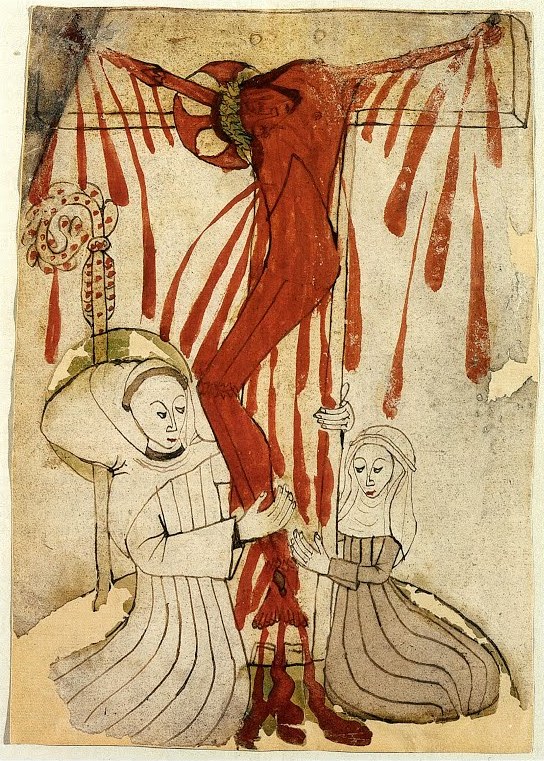
Vision of Saint Bernard (Blood Crucifix), by a nun from the Lower Rhine, 14th century. Ink and colored washes on paper, 25.5 × 18 cm. Museum Schnütgen, Cologne.

Jesu, no more! It is full tide;
From thy hands and from thy feet,
From thy head, and from thy side,
All the purple rivers meet.

What need thy fair head bear a part
In showers, as if thine eyes had none?
What need they help to drown thy heart,
That strives in torrents of its own?

Water’d by the showers they bring,
The thorns that thy blest brow encloses
(A cruel and a costly spring)
Conceive proud hopes of proving roses.

Thy restless feet now cannot go
For us and our eternal good,
As they were ever wont. What though?
They swim, alas! in their own flood.

Thy hand to give thou canst not lift,
Yet will thy hand still giving be.
It gives, but O, itself’s the gift,
It gives though bound, though bound ’tis free.

But, O thy side, thy deep-digg’d side,
That hath a double Nilus going:
Nor ever was the Pharian tide
Half so fruitful, half so flowing.

No hair so small, but pays his river
To this Red Sea of thy blood;
Their little channels can deliver
Something to the general flood.

But while I speak, whither are run
All the rivers named before?
I counted wrong: there is but one;
But O that one is one all o’er.

Rain-swol’n rivers may rise proud,
Bent all to drown and overflow;
But when indeed all’s overflow’d,
They themselves are drowned too.

This thy blood’s deluge (a dire chance,
Dear Lord, to thee) to us is found
A deluge of deliverance,
A deluge lest we should be drown’d.

Ne’er wast thou in a sense so sadly true,
The well of living waters, Lord, till now.

This poem was published in the second edition of Steps to the Temple: Sacred Poems, with Other Delights of the Muses (London, 1648) under the title “On the Bleeding Body of Our Crucified Lord”; an earlier version appeared in the book’s first edition in 1646 under the title “On the Bleeding Wounds of Our Crucified Lord.” I use the title by which it is most commonly known, “Upon the Bleeding Crucifix,” first assigned to it in Crashaw’s posthumously published collection Carmen Deo Nostro (Paris, 1652). I’ve modernized the spellings.


Richard Crashaw (1612–1649) was one of the major Metaphysical poets of seventeenth-century England, a movement marked by the use of elaborate figurative language, original conceits, paradoxes, and philosophical exploration. He was also a priest. Ordained in the Church of England in 1638, he was installed as curate of the Church of St Mary the Less in Cambridge, embracing the high-church reforms of Archbishop William Laud, for which he was persecuted. In 1643, during the English Civil War, Oliver Cromwell and his Puritan posse forced Crashaw into exile in France, where he converted to Roman Catholicism. Waiting for a papal retainer, he struggled with poverty and ill health. Pope Innocent X finally granted Crashaw a post at a seminary in Rome in 1647, and two years later he was given a cathedral benefice in Loreto, where he died of a fever at age thirty-six. He published two collections of poetry during his lifetime.

For more Crashaw on the blog, see the article “The ‘Nothing’ that won our salvation.”

“I Thirst” by Frances Ellen Watkins Harper (poem)

Knight, Chad_Release
Digital concept for outdoor fountain by Chad Knight, 2017 [purchase]

FIRST VOICE.

I thirst, but earth cannot allay
The fever coursing through my veins.
The healing stream is far away—
It flows through Salem’s lovely plains.
The murmurs of its crystal flow
Break ever o’er this world of strife;
My heart is weary, let me go,
To bathe it in the stream of life;
For many worn and weary hearts
Have bathed in this pure healing stream,
And felt their griefs and cares depart,
E’en like some sad forgotten dream.
SECOND VOICE.
“The Word is nigh thee, even in thy heart.”
Say not, within thy weary heart,
Who shall ascend above,
To bring unto thy fever’d lips
The fount of joy and love.
Nor do thou seek to vainly delve
Where death’s pale angels tread,
To hear the murmur of its flow
Around the silent dead.
Within, in thee’s one living fount,
Fed from the springs above;
There quench thy thirst till thou shalt bathe
In God’s own sea of love.

This poem was originally published in Sketches of Southern Life (1872) (revised and expanded from an earlier version in Forest Leaves [1845]) and is in the public domain.


Tired and disheartened, the speaker in the first half of “I Thirst” by Frances Ellen Watkins Harper longs to be with God in the New Jerusalem (Salem for short). She thirsts for another world, away from the brokenness and suffering endured on earth. She can faintly hear the rush of living waters somewhere above and beyond her, and she wants desperately to plunge in. Essentially, she wishes to die, to enter the eternal presence of the Lord, where true life is.

But then a wise voice gently reprimands her escapist attitude, reminding her that God is with her in the Spirit right now, pouring his life into her, even residing within her. She has intimate access to the Divine. While full beatitude still lies on the horizon, in the meantime, we can quench our thirst for that “something more” by communing with God interiorly, through prayer and the word, and in corporate worship with our fellow pilgrims on the way. We receive a foretaste of the heavenly feast at the Lord’s Table, and throughout the week God nourishes us again and again so that, overflowing with the Holy Spirit, we may nourish others, pointing them to the Source.

This second half of the poem is based on Romans 10:6–8: “The righteousness which is of faith speaketh on this wise: ‘Say not in thine heart, “Who shall ascend into heaven?” (That is, to bring Christ down from above.) Or, “Who shall descend into the deep?” (That is, to bring up Christ again from the dead.)’ But what saith it? ‘The word is nigh thee, even in thy mouth, and in thy heart: that is, the word of faith . . .’” (KJV). There’s an echo of Jesus’s words to his disciples that “neither shall they say, ‘Lo here!’ or, ‘lo there!’ for, behold, the kingdom of God is within you” (Luke 17:21). There’s also an implicit connection to John 4:13–14 and 7:38, which says that springs of living water—that is, Spirit-powered life—flow forth from the hearts of believers unto eternity.

[Related post: “‘River’ by Eugene McDaniels (song)”]


Frances Ellen Watkins Harper (1825–1911) was a best-selling poet, fiction writer, essayist, traveling lecturer, and prominent political activist who advocated for abolitionism, temperance, and women’s suffrage. Born to free African American parents in Baltimore, Maryland (a slave state), she was orphaned at age three and subsequently raised by her maternal uncle, William Watkins, an AME minister and educator. In her twenties she moved to Philadelphia, and a letter she wrote to a friend in April 1858 describes how, against orders, she refused to give up her seat on a city trolley to a white person. At the forefront of nineteenth-century Black political thought and action, Harper founded, supported, and held high office in several national progressive organizations, including the National Association of Colored Women. She was also at the forefront of the early African American literary tradition, publishing ten volumes of poetry during her lifetime, which sold in the tens of thousands—in addition to her short stories and novels.