LOOK: Journey to Bethlehem mosaic from the former Chora Church
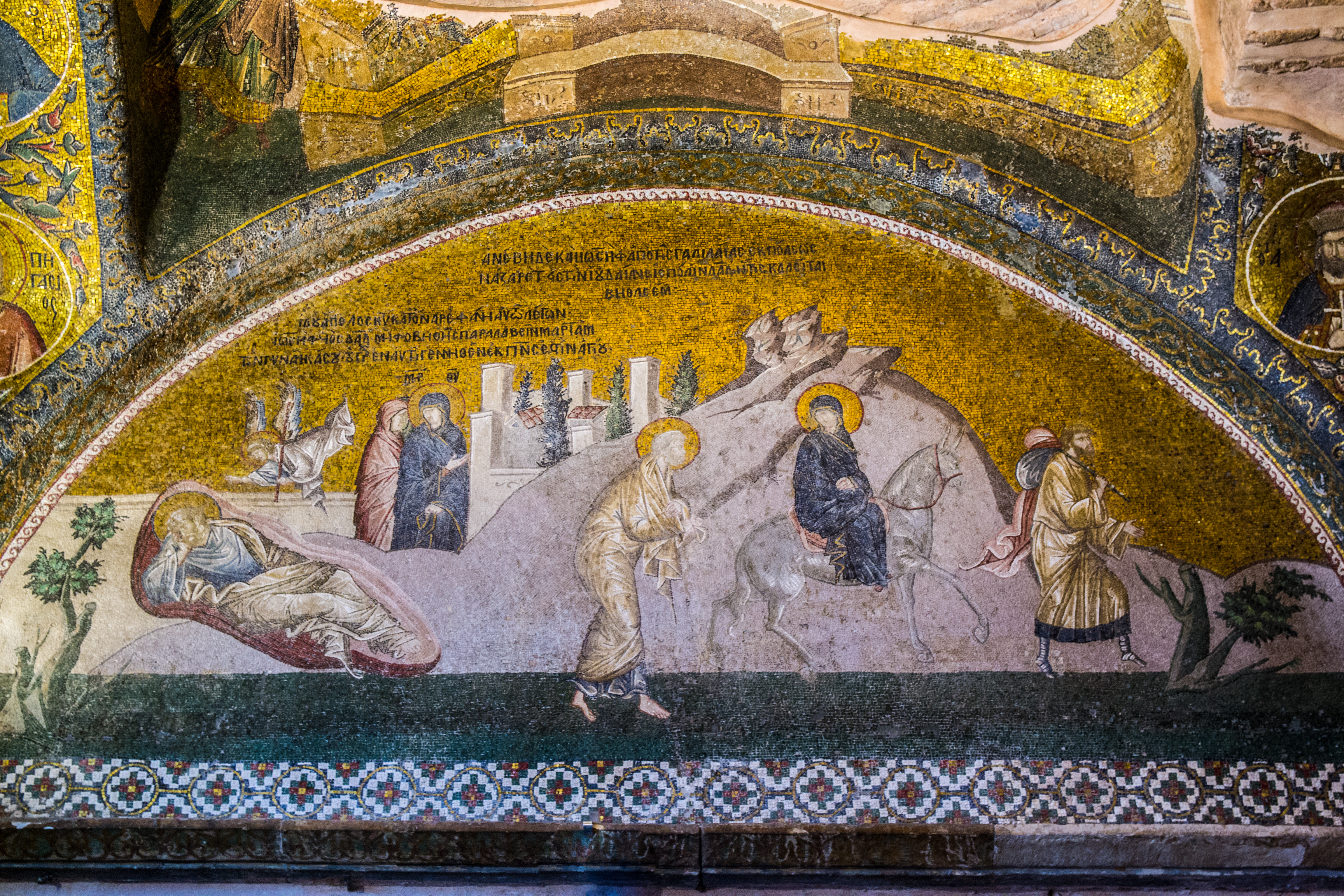
Joseph’s Dream and the Journey to Bethlehem, 1315–20. Mosaic, outer narthex, Kariye Camii (Chora Mosque) (formerly Chora Church), Istanbul, Turkey.
Among the finest artworks of the Palaeologan Renaissance, this Late Byzantine mosaic is in the lunette directly above the north door of a thirteenth-century church in Istanbul (formerly Constantinople), through which the clergy would have entered. It shows on the left an angel appearing to Joseph in a dream to corroborate Mary’s story of the miraculous conception of the son in her womb, and on the right the couple traveling to Bethlehem to register for the census, their donkey led by one of Joseph’s sons from a previous marriage (an apocryphal character from the Protoevangelium of James 17:1–2 and the Gospel of Pseudo-Matthew 13). I believe the scene in the middle background is the Visitation, in which Mary visits her older cousin Elizabeth in the hill country for support during her early months of pregnancy.
The building the mosaic was made for has changed possession and uses over the centuries. Originally a Byzantine church called the Church of the Holy Savior at Chora, it was converted to a mosque in 1511, over a half century after the Ottoman conquest of Constantinople. Because of the important cultural heritage it contains—namely, its Christian mosaics and frescoes—the secular Turkish Republic turned it into a museum in 1945 by court decree. In 2019 that decree was overturned, and the following year it was reconsecrated as a mosque.
It just reopened to the public May 6 of this year. Visitors are allowed daily, excluding Fridays, from 9 a.m. to 6 p.m. except during Muslim prayer times, which vary based on the sun but last for an hour in the early afternoon and an hour in the late afternoon. During prayer, the mosaics and frescoes in the “naos” (nave) are covered with curtains to honor the prohibition in the hadith against visual representations of human beings. But the images in the exonarthex, like the one shown here, remain uncovered at all times.
LISTEN: “Lift Up Your Heads” (original title: “Macht hoch die Tür”) | Original German words by Georg Weissel, 1623; translated into English by Catherine Winkworth, 1855 | Tune: TRURO, Anon., from Thomas Williams’s Psalmodia Evangelica, 1789 | Performed by Sufjan Stevens and friends on Silver & Gold, 2012
1. Lift up your heads, ye mighty gates! Behold, the King of Glory waits; The King of kings is drawing near, The Savior of the world is here. Life and salvation he doth bring, Wherefore rejoice and gladly sing: We praise thee, Father, now, Creator, wise art thou!
2. A Helper just he comes to thee, His chariot is humility, His kingly crown is holiness, His scepter, pity in distress, The end of all our woe he brings; Wherefore the earth is glad and sings: We praise thee, Savior, now, Mighty in deed art thou!
3. O blest the land, the city blest, Where Christ the Ruler is confessed! O happy hearts and happy homes To whom this King in triumph comes! The cloudless Sun of joy he is, Who bringeth pure delight and bliss. We praise thee, Spirit, now, Our Comforter art thou!
4. Fling wide the portals of your heart; Make it a temple set apart From earthly use for heaven’s employ, Adorned with prayer and love and joy. So shall your Sovereign enter in And new and nobler life begin. To thee, O God, be praise For word and deed and grace!
5. Redeemer, come! I open wide My heart to thee; here, Lord, abide! Let me thy inner presence feel, Thy grace and love in me reveal; Thy Holy Spirit guide us on Until our glorious goal is won! Eternal praise and fame We offer to Thy name!
Georg Weissel (1590–1635) was a German Lutheran minister and hymn writer. He wrote “Macht hoch die Tür” (Lift Up Your Heads) in 1623 for the dedication, during Advent, of the newly built Altroßgärter Kirche in Konigsberg, where he served as pastor until his death. The hymn is rooted in Psalm 24, especially verses 9–10:
Lift up your heads, O gates! and be lifted up, O ancient doors, that the King of glory may come in! Who is this King of glory? The LORD of hosts, he is the King of glory. Selah
Likely written by King David on the occasion of the ark of the covenant’s coming to Jerusalem after being taken back from the Philistines (2 Sam. 6), this psalm directs its hearers to open wide the city gates to welcome in God’s presence, symbolized by this precious gold-plated chest. In his hymn, Weissel turns this directive into a metaphor, telling worshippers to open the gates of their hearts so that God can enter in and abide there.
Weissel’s hymn has an odd meter of 88.88.88.66—six lines of eight syllables, followed by two lines of six syllables. Many hymnals of the past century have modified the hymn’s structure to create four-line stanzas instead, each line of equal measure, nixing the shorter ending couplets and combining what remains.
On his 2012 Christmas album, Silver & Gold, Sufjan Stevens and a small vocal ensemble sing what in the original hymn is stanzas 1a and 3a. The group sings the four-part harmonies to a simple piano accompaniment for the first verse and a cappella the second.
For a contemporary arrangement that covers more lyrical ground, see Josh Bales’s 2018 recording of the hymn, from his album Come Away from Rush and Hurry:
I’ve paired this hymn with an artwork of the Journey to Bethlehem to show how “the King of kings is drawing near,” bringing life and salvation. Will you “fling wide the portals of your heart” to receive him?
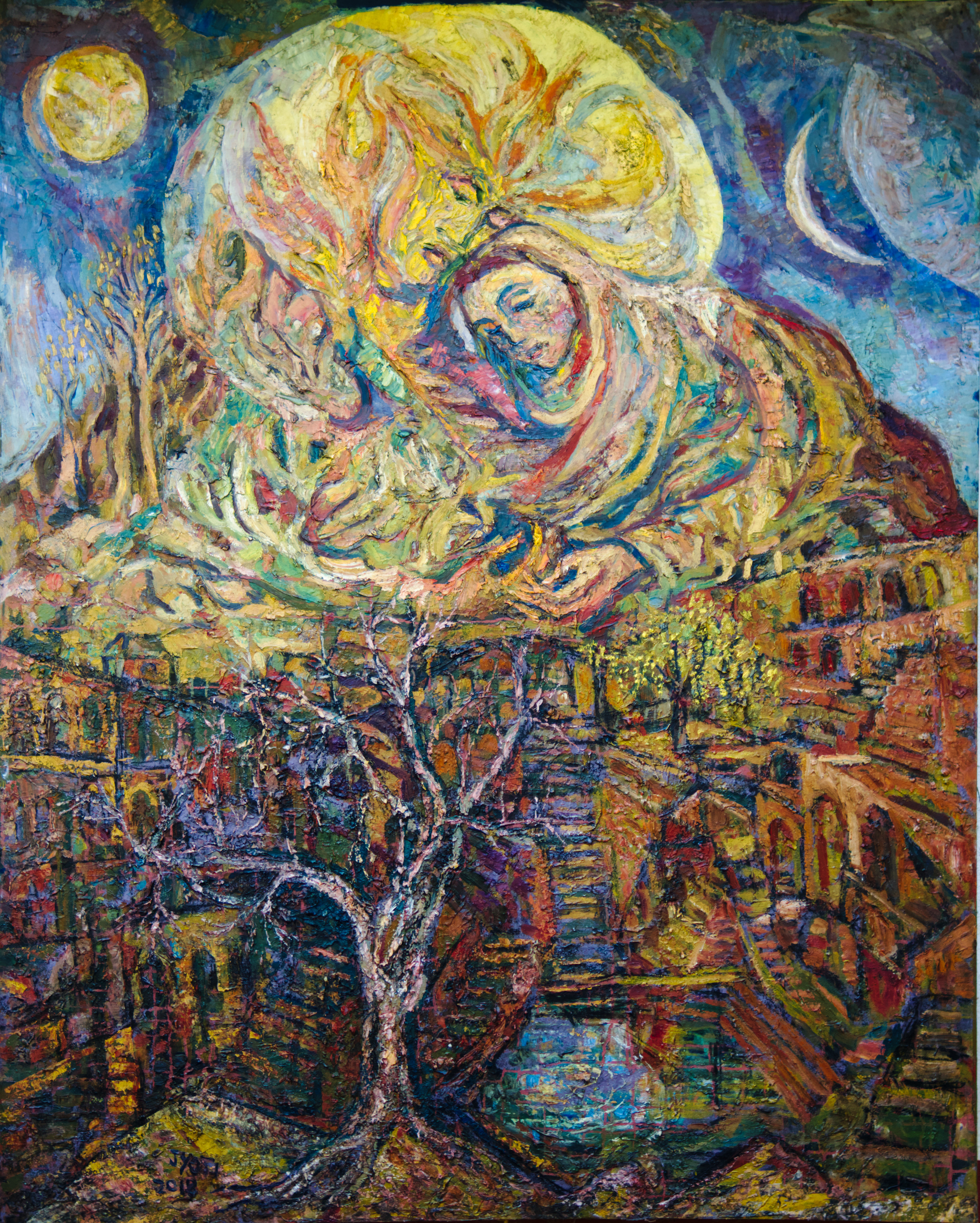
Jyoti Sahi (Indian, 1944–), Beulah, 2018. Oil and acrylic on canvas, 5 × 4 ft. Photo: Victoria Emily Jones.
In Isaiah 62:2–5, God talks to Zion about her future. He says that on the day of the Lord,
The nations shall see your vindication and all the kings your glory, and you shall be called by a new name that the mouth of the LORD will give. You shall be a beautiful crown in the hand of the LORD and a royal diadem in the hand of your God. You shall no more be termed Forsaken, and your land shall no more be termed Desolate, but you shall be called My Delight Is in Her and your land Married, for the Lord delights in you, and your land shall be married. For as a young man marries a young woman, so shall your builder marry you, and as the bridegroom rejoices over the bride, so shall your God rejoice over you.
The painting Beulah by the Indian Christian artist Jyoti Sahi (pictured below) takes its title from the Hebrew word for “married” that’s used in Isaiah 62:4. He told me the image pictures the coming together of heaven and earth, the sun marrying the land, which can also be read as Christ uniting with his bride. Christ comes as dawn, his head like flame, like the great I AM revealed to Moses in the burning bush. His glory, the yellow halo around his head, encompasses the female figure. He leans in, tenderly resting his head on hers, and their hands touch.
Beulah shows the reunion not only of humanity and the Divine at the end of time, but also of the land and the Divine. As the Isaiah passage states, the earth, too, will be redeemed and made to flourish once again.
The two figures here form a sacred mountain. A river of life flows down between them, watering the new city, which is a wilderness no longer. This is Isaiah’s vision wrapped up into John the Revelator’s.
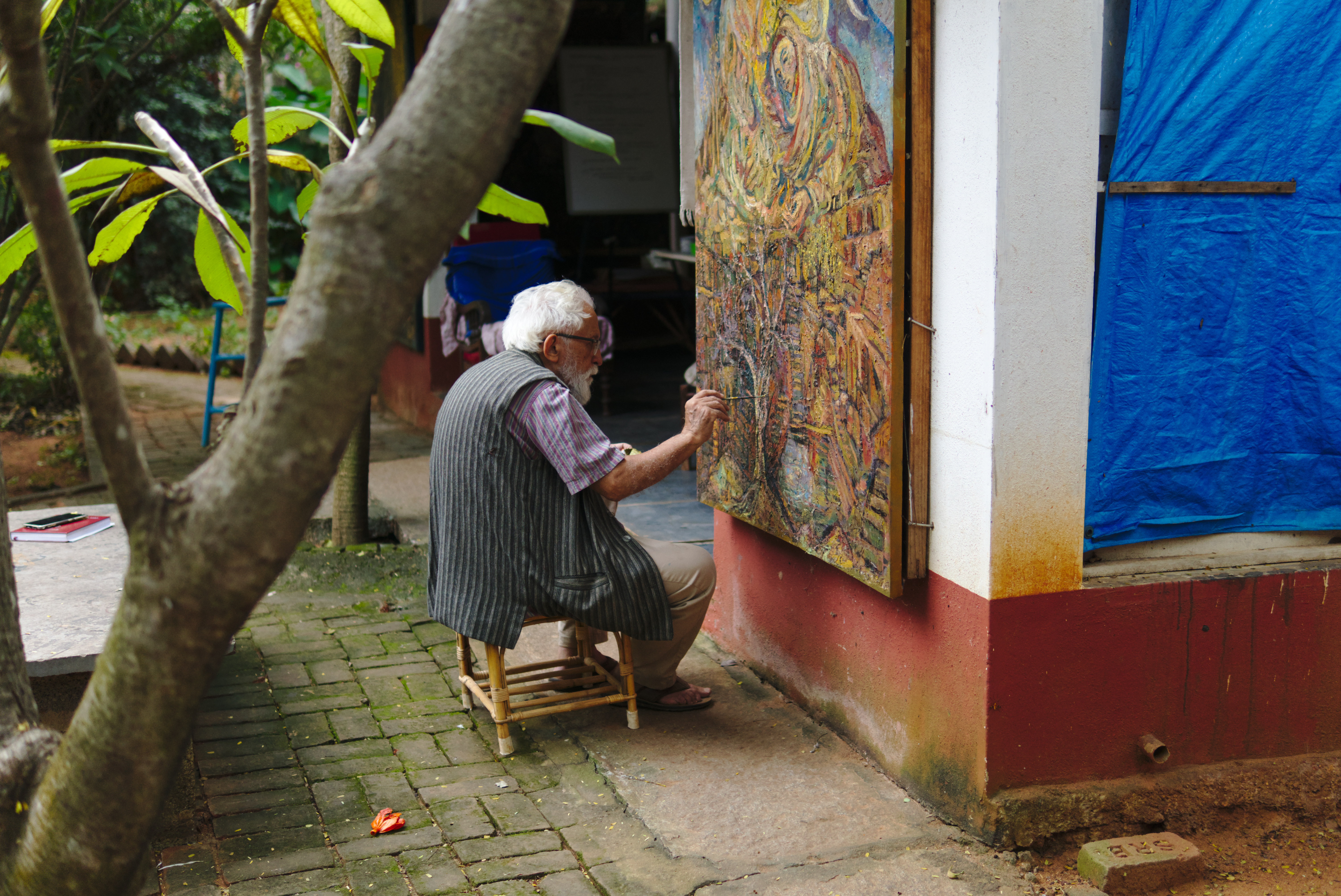
Jyoti Sahi touches up a detail of his painting Beulah. Photo: Victoria Emily Jones.
LISTEN: “The Reign of Mercy” by Kate Bluett and Paul Zach, 2021 | Performed by Paul Zach and Lauren Plank Goans on Advent Songs by the Porter’s Gate, 2021
Oh may our world at last be just And hilltops echo with your peace A harvest come from barren dust The reign of mercy never cease He comes as rain upon the grass High heaven’s sun to earth descends Not as the seasons that will pass But with a light that never ends
Oh come to him and find your rest Who saw the poor and came as one Who hears the cries of the oppressed And rules till all oppression’s done Someday he’ll come to reign as king And we will see his justice done Our souls will magnify and sing The Christ whose kingdom now is come
And all the mighty and the strong Will bow before him on that day The silenced fill the world with song The poor and lowly he will raise And all our bitterness and tears Our violence and our endless wars Will end at last when he draws near Come soon, come soon, oh Christ our Lord
Purvis Young (American, 1943–2010), Untitled, 1990s. Paint on fiberboard, 65 1/16 × 47 5/8 in. (165.3 × 121 cm). Smithsonian National Museum of African American History and Culture, Washington, DC. Photo: Victoria Emily Jones. [object record]
From the gallery label at the Smithsonian National Museum of African American History and Culture, where I first encountered this painting in 2019:
Purvis Young was a long-time resident of Overtown, a Black neighborhood in Miami, Florida. He began drawing while in jail, after a vision led him to embrace the idea of becoming an artist. He educated himself about the history of art, and focused on a daily routine of making art, much of it on public surfaces and walls. In Untitled, as in much of Young’s work, angels and horses are prominently featured; angels represent goodness and horses represent freedom. Just as he had found salvation through art, he hoped his own art would bring harmony to his neighborhood, and to the world.
In the foreground of the painting, four angels look onto a scene of what appears to be celebration. Myriad figures hold aloft circular items—tambourines? halos? Is this the gathering of saints in heaven, where goodness and freedom abound?
Kama simcha yesh bevetcha, kshe’kulam sharim beyachad Al shehaya al sheyieh ve’al kol she’Ata oseh Hayu yamim tovim yoter, ach le’olam lo nevater Al hasimcha ha’arucha, she’od tavo ken hi tavo
Im lo nashir unehalel ha’avanim lo ishteku Kol habria lecha koret, baruch haba Maran Ata Bein im od shana o od me’ah, lecha namtin betsipia Hu she’ala, gam od yered ve’az tatchil hachagiga [Refrain]
Outro: Hineh ma tov uma naim, kshe’kulanu mehalelim Sharim beyachad le’Elohim, kol echad hu chelek, kulam bifnim
ENGLISH TRANSLATION:
There’s so much joy in Your home, when everyone is singing About what was, and what will be, and about everything You’re doing There were better days, but we’ll never give up On the joy that has been prepared, that will come, yes, joy will come
Refrain: Lift up your hands; we’re celebrating before Yeshua [Jesus] We’ll see Your goodness in heaven, but also in the land of the living We’ll lift our voices to the heavens, filling them with song We’ll celebrate as a family, when we come again into Your home
If we won’t sing and worship, the stones will not remain silent All of creation is calling for You, “Blessed are You! Come, Lord. Maranatha.” Whether it takes a year or a hundred, we’ll wait for You with expectancy He who ascended will descend again, and then our celebration will start [Refrain]
Outro: How good and pleasant it is, when all of us worship Singing together to God, everyone takes part, everybody is in
Shilo Ben Hod is a Messianic Jewish worship leader from Israel. He sings this song of his in Hebrew with his wife, Sarah, and other family and friends.
Arise, shine; for your light has come, and the glory of the LORD has risen upon you.
—Isaiah 60:1
But for you who revere my name the sun of righteousness shall rise, with healing in its wings.
—Malachi 4:2a
LOOK: Christ as Sol Invictus, Early Christian mosaic
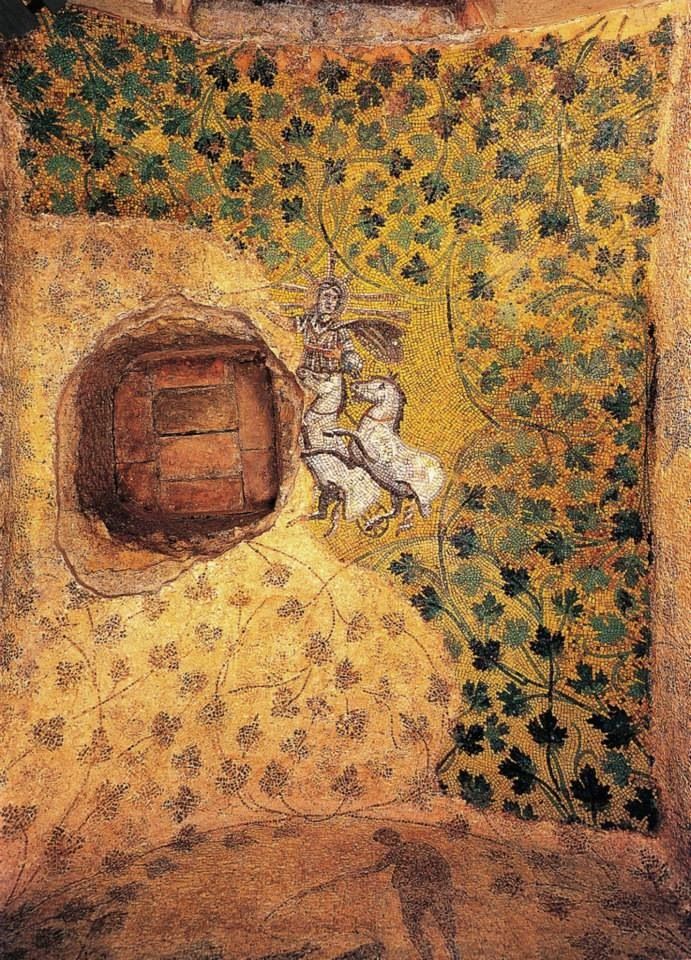
Christ as Sol Invictus, late 3rd or early 4th century. Mosaic from the Tomb of the Julii (Mausoleum “M”), Vatican Necropolis, under St. Peter’s Basilica, Rome. Photo: Tyler Bell.
This ceiling mosaic from an ancient Roman mausoleum built for one Julius Tarpeianus and his family contains an extraordinary depiction of Jesus Christ modeled after the sun-god Sol Invictus, who was sometimes identified with Helios, Apollo, or Mithras. It’s one of many surviving examples of how the early Christians appropriated pagan iconography for their own use, communicating the sacred stories and truths of the new faith—in this case, Jesus as the light of the world.
Buried beneath St. Peter’s Basilica in Vatican City, the mausoleum was first discovered in 1574 when a workman conducting floor alterations on the cathedral accidentally broke through. A larger hole was then drilled to gain access, which is why this mosaic on its vault is partially destroyed.
The mosaic shows a male figure wearing a radial crown and wheeling through the sky in a quadriga (four-horse chariot)—though just two of the horses survive. He holds an orb, symbolic of his dominion over the earth, and is dressed in a tunic and a windswept cloak. His other hand, missing due to the damage, may have been making a blessing gesture. He sends forth rays in all directions, lighting up the sky with a golden sheen. Grapevine tendrils unfurl all around him, symbolic of life and especially the life-giving Eucharist.
Most scholars identify the image as Christian and read the figure on the sun-wagon as Christ, though this is debated. Other images in the mausoleum are of a fisherman, a shepherd, and a man being swallowed by a sea-monster (e.g., Jonah)—all of which appear in both pagan and Christian funerary contexts in that era.
That December 25 was the birthday of Sol Invictus (and Mithras, a Persian sun-god whose cult gained popularity in Rome in the third century) likely factored into the church choosing that date for the annual celebration of Jesus’s birth. In his book Living the Christian Year: Time to Inhabit the Story of God, Bobby Gross, the vice president for graduate and faculty ministries for InterVarsity Christian Fellowship, writes,
Worship of the sun has a long history in ancient cultures. The Roman emperor Aurelian, who apparently wanted to unite the empire around a common religion, instituted the cult of Sol Invictus, the “Unconquered Sun,” in 274 and declared the day of the winter solstice, December 25, as the birthday and feast of the sun-god. [The official date of the winter solstice in the Roman Empire would change to December 21 when the Council of Nicaea adjusted the Julian calendar in 325.] The earliest evidence of Christians in Rome celebrating Christ’s nativity on December 25 appears later in 336. Many scholars conclude that the church purposefully countered the pagan festival by adopting its date for their celebration of the birth of “the sun of righteousness” (Mal. 4:2). This cultural appropriation became an implicit witness to the truly unconquerable light. (66–67)
Other scholars argue that December 25 was chosen because the Feast of the Annunciation—celebrating the miraculous conception of Christ in Mary’s womb—had already been fixed on March 25, the spring equinox, and if you count forward nine months (the average human gestation period), you land on December 25.
These two theories of the dating of Christmas are not mutually exclusive. Christ’s birth was and is celebrated in Rome as a festival of light, so it makes sense that Christians there would mark that birth on the date when the daylight hours first start to grow longer. (Just as it makes sense that his conception was placed in springtime, reflecting the flowering of new life.) Jesus came to us in the depths of our darkness, bringing light. The winter solstice is not an intrinsically pagan event—it’s a natural one, which religions of all kinds find meaning in, not to mention the practicality in ancient societies of marking time by the courses of the sun and the moon.
Many of the church fathers wrote about Jesus as light-bringer and as Light itself. In chapter 11 of his Protrepticus pros Hellenas (Exhortation to the Greeks), written around 200 CE, Clement of Alexandria glories in the light of Christ that extends over all of creation, banishing the darkness. The chapter is editorially titled “How great are the benefits conferred on humanity through the advent of Christ”:
Hail, O light! For in us, buried in darkness, shut up in the shadow of death, light has shone forth from heaven, purer than the sun, sweeter than life here below. That light is eternal life; and whatever partakes of it lives. But night fears the light, and hiding itself in terror, gives place to the day of the Lord. Sleepless light is now over all, and sunset has turned into dawn. This is the meaning of the new creation; for the Sun of Righteousness, who drives his chariot over all, pervades equally all humanity, like his Father, who makes his sun to rise on everyone, and distills on them the dew of the truth. (translated from the Greek by William Wilson, adapt.; emphasis mine)
In chapter 9 of the same work, Clement expounds on Ephesians 5:14, writing, “Awake, he says, you that sleep, and arise from the dead, and Christ shall give you light—Christ, the Sun of the Resurrection, he who was born before the morning star, and with his beams bestows life.”
Similarly, Ambrose of Milan refers to Christ as “the true sun” in his Latin hymn “Splendor paternae gloriae,” written in the second half of the fourth century:
O splendor of God’s glory bright, O Thou that bringest light from light, O Light of Light, light’s Living Spring, O Day, all days illumining.
O Thou true Sun, on us Thy glance let fall in royal radiance, the Spirit’s sanctifying beam upon our earthly senses stream.
Morn in her rosy car is borne: let Him come forth our Perfect Morn, the Word in God the Father One, the Father perfect in the Son. Amen.
Trans. Robert Bridges
Some Christians may feel uncomfortable with Christ’s being made to resemble a pagan deity in the Vatican Necropolis mosaic, or with the suggestion that the church saw fit to celebrate Christ’s birth on the same day Sol Invictus, the “Invincible Sun,” was said to be born. As for myself, I feel no such qualms. Just as the apostle Paul affirmatively quoted the pagan poets Epimenides and Aratus in his Areopagus sermon to reveal the truth of Christ (Acts 17:28), so too can we recognize connection points between our own faith tradition and others, which often reveal common yearnings we share—for example, for light that the darkness cannot overcome.
It’s then for us to articulate what makes Christ, who is such a light, distinct from those who came before and after. He is true God and true man, born miraculously of a virgin in first-century Judaea. He knows our sorrows intimately, because he was one of us—he made himself vulnerable. He taught people how to live as citizens of the kingdom of heaven. For that he was crucified, but he conquered death, rising from the grave and ascending to the right hand of the Father, where he lives and intercedes for us. He will come again to restore us to our true home. This, the story of Christ, is what C. S. Lewis called “a true myth.”
Suggestions for further reading:
Robin Jensen, Understanding Early Christian Art, 2nd ed. (London and New York: Routledge, 2023)
Kurt Weitzmann, ed., Age of Spirituality: Late Antique and Early Christian Art, Third to Seventh Century (New York: Metropolitan Museum of Art; Princeton, NJ: Princeton University Press, 1979) (available to read online for free)
>> Performed by the Fisk Jubilee Singers, dir. Paul T. Kwami, feat. Briana Barbour, 2016:
>> Performed by the William Appling Singers on Shall We Gather, 2001:
Refrain: Rise, shine, for thy light is a-comin’ Rise, shine, for thy light is a-comin’ Rise, shine, for thy light is a-comin’ My Lord says he’s comin’ by and by
This is the year of Jubilee (My Lord says he’s comin’ by and by) My Lord has set his people free (My Lord says he’s comin’ by and by) [Refrain]
I intend to shout and never stop (My Lord says he’s comin’ by and by) Until I reach the mountaintop (My Lord says he’s comin’ by and by) [Refrain]
Wet or dry, I intend to try (My Lord says he’s comin’ by and by) To serve the Lord until I die (My Lord says he’s comin’ by and by) [Refrain]
This song originated in enslaved African American communities in the southern US in the first half of the nineteenth century. They composed spirituals as a way to hold on to hope amid the suffering inflicted on them by their enslavers.
The spirituals often hold double meanings, with words like “salvation,” “deliverance,” and “freedom” referring to God’s acts toward the soul and the body. So “freedom,” on the one hand, can mean freedom from sin and eternal death, but it can also mean freedom from physical bondage. “Light” could be the light of the world, Jesus, returning to consummate his kingdom on earth, and it could be the lantern of an Underground Railroad conductor, come to guide you up north to liberation.
The “year of Jubilee” in the first verse refers to the Jubilee law of ancient Israel, which dictates that every fifty years, the enslaved are to be set free (see Leviticus 25). “Wet” in the last verse may refer to how some enslaved people tried to escape by crossing rivers.
“Rise, Shine, for Thy Light Is a-Comin’” exhorts its hearers to take heart, for the sun of righteousness is on its way.
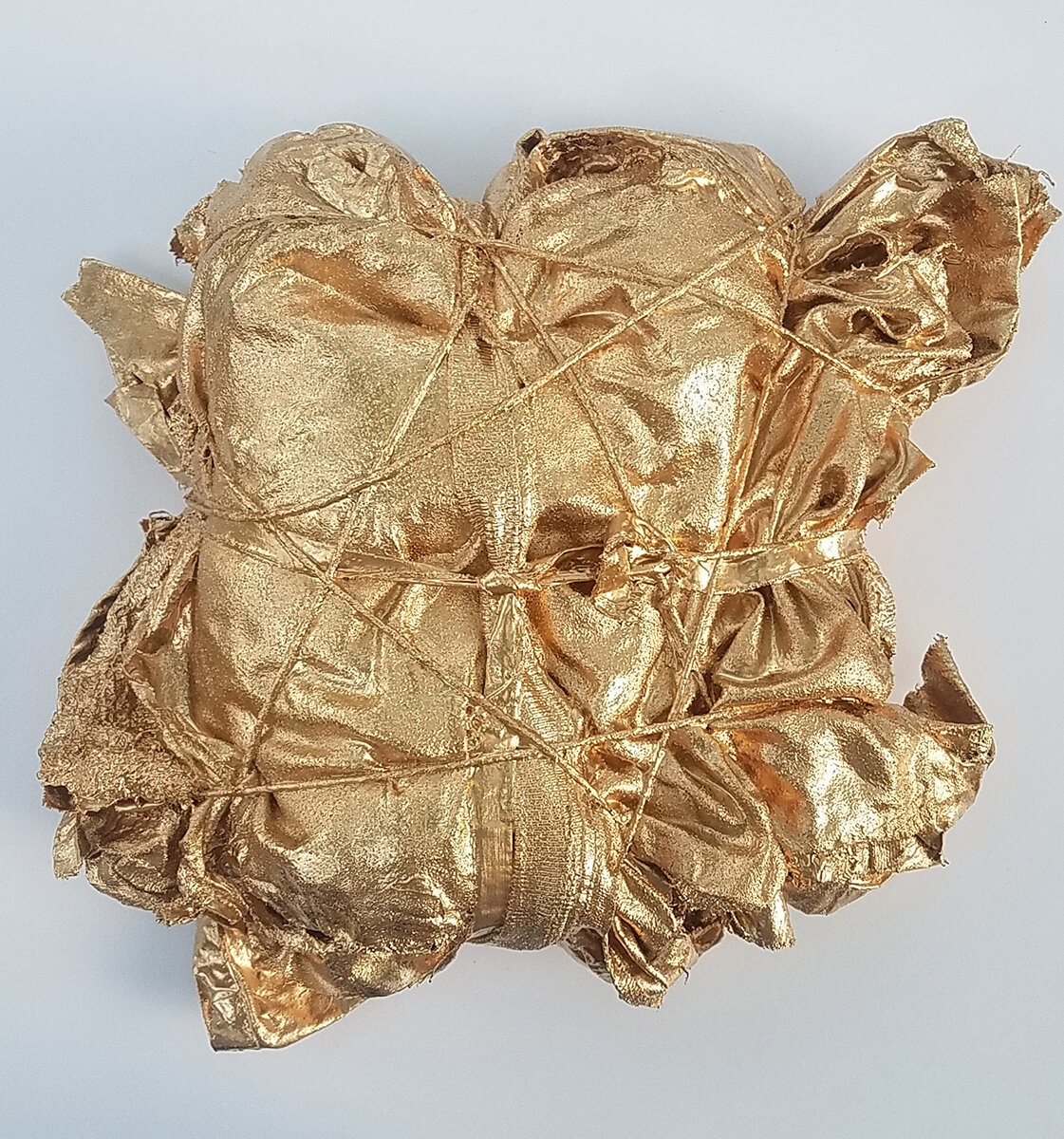
ART SERIES: Magnificat by Mandy Cano Villalobos:Mandy Cano Villalobos [previously] is a multidisciplinary artist from Grand Rapids, Michigan. Her Magnificat series consists of bundles of discarded clothing, bound in string and meticulously hand-coated with imitation gold. The title—the Latin name of Mary’s praise song that opens, “My soul magnifies the Lord!”—invites associations with the Christmas story, including the image of the swaddled Christ child, a gift to the world that surprises and delights.
Mandy Cano Villalobos (American, 1979–), Magnificat XV, 2019. Cloth, string, and imitation gold.Installation of select pieces from the Magnificat and Cor Aurum series by Mandy Cano Villalobos, December 2020, Sojourn Midtown, Louisville, Kentucky
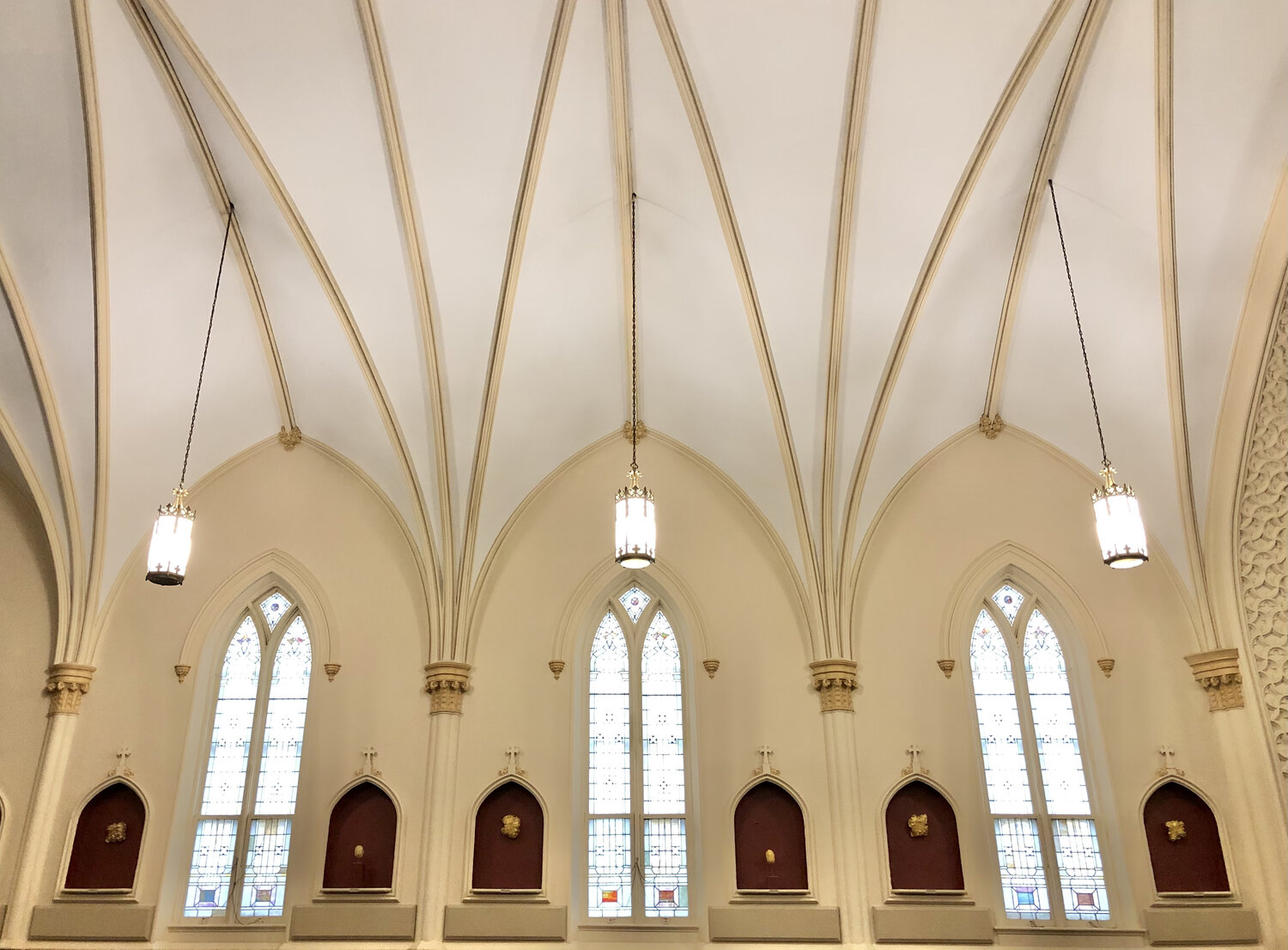
The series debuted in 2019 at Cano Villalobos’s solo show All That Glitters at the Urban Institute for Contemporary Arts (UICA) in Grand Rapids. I first encountered it, though, through online promotions of Sojourn Midtown’s Advent 2020 installation to correspond with the church’s sermon series Wrapped in Flesh, for which twelve of the artist’s works, some from her related Cor Aurum (Heart of Gold) series, were placed in niches around the sanctuary.
“The objects, all made of wood and fabric covered in imitation gold, point to something both humble and glorious,” writes Michael Winters, Sojourn Midtown’s arts and culture director. “Like these small sculptures of rags and gold, the birth of Jesus was also marked by humility and glory.”
+++
ARTICLE: “My Swaddled Savior” by Jeff Peabody, Christianity Today: Pastor Jeff Peabody of Tacoma, Washington, describes the traditional Japanese art of furishoki, or wrapping goods in cloths, as he reflects on Jesus having been swaddled as an infant, a wrapped gift given to the world. “Jesus came to us in furoshiki, wrapped in cloths,” he writes.
+++
BLOG POST: How to receive gifts and enjoy feasting without shame, by Tamara Hill Murphy: In this old blog post of hers, spiritual director and The Spacious Path author Tamara Hill Murphy absolves us of the guilt we so often feel around (1) receiving (unreciprocated) gifts and (2) feasting. We should receive both presents and food, she says, as means of grace. Too often we’re embarrassed when we receive a gift from someone to whom we gave no gift, or a gift of lesser value, and so instead of receiving their gift with joy, we receive it with shame or an annoying sense of obligation. But Murphy says she hopes to receive gifts this way: “When Jesus told us to come to him as little children, he must have been imagining the way children openly, delightedly, innocently receive gifts. Children do not question their place as ones worthy of receiving gifts. Children boldly believe the beauty of unearned kindness.”
As for food, how many times have you been to a Christmas party or dinner and heard people bemoan all the fat and sugar they’ve been consuming, and about how they’ll have to punish their body in the new year to work off the extra calories, to shrink themselves back down to size? Feasting, though, is a spiritual discipline, a way to celebrate important events, like the birth of Christ, with family and friends. Feel no shame about indulging in gustatory pleasures this Christmas! Take in the sweet, the creamy, and the juicy! Murphy’s mom’s motto for hospitality is a wise one: “While we feast, we savor.”
On her blog A Clerk of Oxford, medievalist Eleanor Parker also affirms the virtue of feasting, noting how the popular modern practice of fasting in January runs counter to medieval Christian practice:
Since the late 20th century it’s become common to invert the traditional relationship between fasting and feasting in the Christmas season. The ancient custom was to fast in Advent in preparation for the feast, and then to celebrate for at least twelve days after Christmas (and to some degree, all through January). Now we do it the other way around; for many people the feast is followed by a penitential fast, in the form of ‘Dry January’ or New Year’s resolutions about eating less and going to the gym. As a manifestation of the desire for a fresh start, this ‘new year, new you’ impulse is natural enough, but it does strike me as strange that it’s so often framed in negative terms. There’s an odd sense, encouraged mostly perhaps by journalists and advertisers, that the indulgence of Christmas is a ‘sin’ which has to be atoned for – as if eating and drinking with friends and family, to celebrate the turn of the year from darkness to light, is a moral lapse for which one must subsequently make amends by privation and self-punishment. We are much less kind to ourselves in these weeks after Christmas than the strictest confessor would have been in the Middle Ages. Feasting at Christmas is not something to atone for, but a proper observance due to the season; and that feasting is also the sustenance we need to carry us into the New Year with energy and strength.
+++
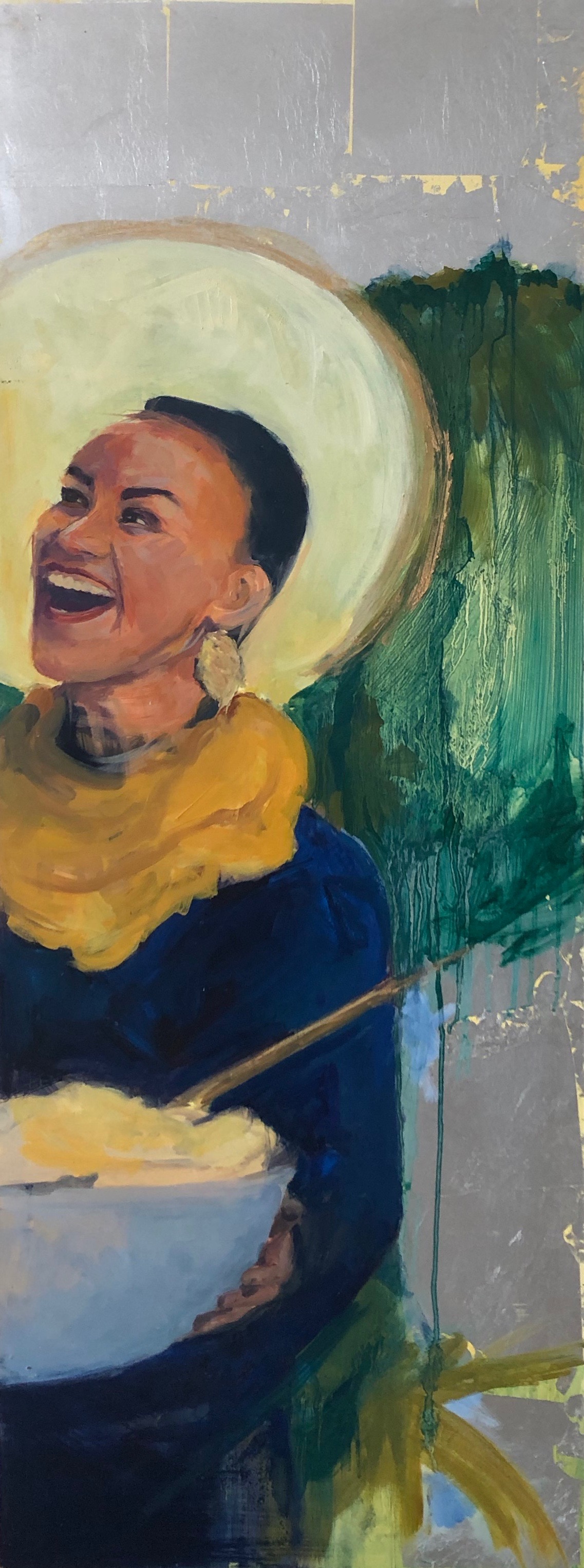
VIDEO: “Our Vocation of Delight: On Advent, Beauty, and Joy” by Christen Yates: In this thirty-minute “Space for God” Advent devotional from Coracle, artist Christen Yates (Instagram @christenbyates) invites us to experience the Christian “duty of delight” through engaging a selection of artworks by herself, Sedrick Huckaby, Letitia Huckaby, and Ashley Sauder Miller. She opens with a liturgical commission she fulfilled for the Advent season while serving as artist in residence at her church in Charlottesville: a portrait painting of congregation member Arley Bell (née Arrington), a baker who is now the owner of Arley Cakes in Richmond. Waiting for her dough to rise, Arley captures the joyful expectancy of Advent.
Christen Yates (American, 1977–), Advent: Arley, baker, 2016. Oil and gold and silver leaf on board, 48 × 18 in. Collection of All Souls Charlottesville, Charlottesville, Virginia. Photo courtesy of the artist.
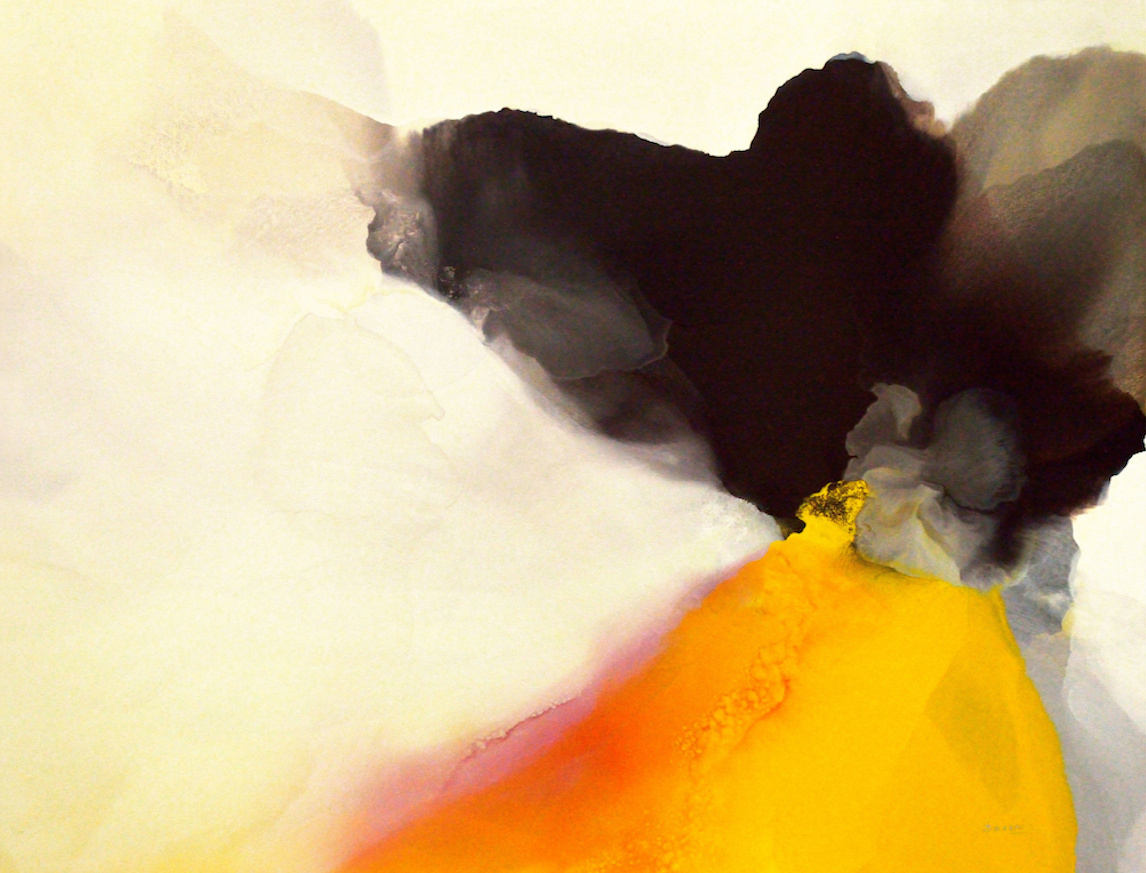
Bassmi Ibrahim (Egyptian, 1941–), Awareness 30, 2014. Mixed media on panel, 36 × 48 in. (91.4 × 121.9 cm).
LISTEN: “Diboo ning Maloo” (Darkness and Light) by Elfi Bohl, on Barakoo (Blessing), 2004| Text: Isaiah 9:2, 6; 35:5–6a; Psalm 24:9–10 | Performed by Elfi Bohl, 2021
Moolu menu be taama kang
Diboo kono ye mala baa je
Moolu menu be siring sayaa siiringo la
Mala baa le malata I kang

Refrain:
I ko: dingo wuluta n ye, dinkewo diita n na
Adung a be kumandi la:
Yamaroolu baa, Alla talaa, Badaa-badaa Famaa
Yamaroolu baa, Alla talaa, Badaa-badaa Famaa
Kayira-mansoo

Finkintewol’ ñaal’ be yele la
Tulusuukuuringol’ tuloo be yele la
Namatoolu be sawung na ko minango
Nungunungunaal be sari la sewoo kamma la

Dundandal’ ye yele, dundundal’ ye yele hawu,
Fo Mansa kalangkee si dun nang.
Jumal’le mu ñing Mansa kewo ti?
Alla le mu, Alla meng warata
The people who were wandering in darkness
Have seen a great light
On those living in the land of death
A light has dawned

Refrain:
To us a child is born, to us a Son is given
And he will be called:
Wonderful Counselor, Mighty God, Everlasting Father (2×)
Prince of Peace

Then the blind will see
The deaf will hear
The lame leap like a deer
The mute tongue shout for joy

Open the doors and the ancient gates
That the King of Glory may come in
Who is this King of Glory?
It is God, the Lord, strong and mighty
This song by Elfi Bohl combines three short, Advent-themed scripture passages—two from Isaiah, one from the Psalms—in the Mandinka language of West Africa, which Bohl sings to her own kora and flute accompaniment.
Originally from Switzerland, Bohl lived in The Gambia from 1989 to 2001 with her husband and three children as a missionary with WEC International. There she learned to play the kora, a twenty-one-stringed harp-lute made of a dried calabash gourd half covered with cow skin. She was initially hesitant to take up the instrument, as it’s traditionally played only by Mandinka men from jali families, a hereditary caste of oral historians, praise singers, and musicians. She thought it might be considered disrespectful for her, a white European woman, to play it.
She already had a background in piano and guitar, but she told me that neither instrument seemed appropriate in the rural Gambian church setting she was in. “At the little church, we sang Christian songs that former missionaries had brought from Germany, the UK, and Australia and had translated into the Mandinka language. The music I heard on the local radio and the songs people were singing sounded very different,” she said. “I started praying and asking God to show me how I could use my musical gift in a culturally relevant way.”
Then one day in 1998, a salesman came to her house trying to sell her a kora, and she thought that maybe this was God’s answer. She decided to give it a try. A local jali agreed to give her a few lessons, teaching her three traditional melodies. She continued practicing on her own and developing her skill, and even started composing some of her own kora melodies to set Bible passages to, as well as arranging traditional ones for the same purpose.
For a while Bohl played only in private, but one day she took a leap of faith and played a kora song in church. The people in the congregation were delighted to hear one of their native instruments and traditional tunes used in Christian worship, and they encouraged Bohl to seek out other opportunities to play in public.
Word got out about Bohl’s facility with the kora, and she started receiving invitations to perform in a variety of settings. Eventually she was playing in Muslim villages, prisons, Islamic schools, and at public meetings and government functions. She was even invited to play some of her songs live on Radio Gambia, the country’s national radio broadcaster, and the station also plays recordings from her two albums.
When she was interviewed on the radio, two imams called in, thanked her for honoring their tradition, and invited her to their villages to sing these “deep words from the Qur’an.” Bohl thanked them for the invitation but clarified that the words originated in the Tawurat, the Jabuur, and the Injil—the books of the followers of Isa (Jesus). Even though the lyrics were from the Bible, they still insisted she come. One promised to prepare a meal with goat meat to honor her coming, and the other said Bohl should first come to his village because he would kill a cow for her! It was the public approval of these imams that gave her the freedom to sing and play anywhere.
Bohl’s kora playing has opened up doors for the gospel to enter places that are typically closed to missionaries. “People believe that the kora itself has a spirit that speaks the truth,” Bohl says. In Mandinka culture, if lyrics are accompanied by a kora, the people must pay attention because there’s an important message for them to hear.
A local pastor told her that when he first heard her play and sing, he believed God had called her to The Gambia to become a jali sharing the gospel with the Mandinka, a people group who are almost entirely Muslim.
During Bohl’s radio appearance, the host introduced her as “Jali-musoo [Female Singer] Mariyama Suso.” I asked her how she got that name. She said,
Even before I started to play the Kora, I had been given the name Mariyama. Our local friends asked us if we could take a local name, mainly because it was often hard for them to pronounce our “foreign” names. The surname “Suso” I got, because the surname of the young man who taught me to play the Kora was Suso. The name Suso tells you that its family members by tradition are musicians. Because I was recognised by the Gambian people as one of their Kora players (jali or griot), I was allowed to take on that name. In fact, it is great honour to be called that name.
“We know these songs and melodies but have never heard these words.”
“The fact that you’ve learned to play the kora and sing in our language means you really love us.”
“We know the old prophets you sing about. What Allah told them happened. Therefore, you must also be a prophet and we need to listen to you.”
“Your songs are educative and soothing for our troubled hearts.”
“These songs give me real hope although I know I’m soon going to die.”
When I asked Bohl if she has ever received any pushback from West Africans for playing the kora because of her gender, her non-jali biological lineage, and her not having been raised in the culture, she said the response has been overwhelmingly supportive. The only exception, she said, was when she was performing at a baby dedication, invited by the father of the newborn to announce the boy’s name through song, another kora player entered the yard and started singing over her. He left when the host asked him to, and that was that.
In 2001 Bohl and her family returned to their home country of Switzerland, continuing their work with WEC. She and her husband moved back to West Africa in 2011, but this time to Dakar, Senegal, where they served as regional directors of the missions organization in sub-Saharan Africa until 2019, a role that involved traveling the continent and making connections with people and communities.
Bohl currently lives in Switzerland, coaching and mentoring missionaries and prospective missionaries with an interest in Africa and in using music in ministry. She still plays the kora and writes songs for it.
“The Kora has always been part of our ministry,” Bohl told me.
It has been a wonderful “door and hearts opener” in the many African countries we travelled during our time as regional directors. In the years as leaders of WEC in Switzerland, I shared the testimony of the Kora at many missions conferences and in churches to testify that God uses music and arts to reach people with the gospel. I still share the Kora story and sing songs when given the opportunity. Lately, I also play at programmes for immigrants in Switzerland. There again, the Kora draws people from many, not only African, cultures.
Unless otherwise marked by hyperlinked source, quotes by Elfi Bohl are from my November 2024 interview with her via email. Thank you to Paul Neeley of the blog Global Christian Worship for putting me in touch with her!
LISTEN: “Advent ‘O’ Carol” by Joanna Forbes L’Estrange, 2018 | Performed by London Voices, dir. Ben Parry, on Winter Light, 2024
Refrain: O, O, O, O, O, O, O O, O, O, O, O, O, O
We long for your coming, O Wisdom; we long for your coming, O Lord. Come and teach us the way of understanding; you are the living Word. [Refrain]
We long for you, O Lord and Ruler; we long for your coming, O Lord. Come and stretch out your arms and redeem us; you are the living Word. [Refrain]
We long for you, O Root of Jesse; we long for your coming, O Lord. Come to deliver us and do not tarry; you are the living Word. [Refrain]
We long for you, O Key of David; we long for your coming, O Lord. Come and bring forth the captive from his prison, who sits in the shadow of death. [Refrain]
Dawn of the East, we long for your coming, O Lord. Come and lighten those who sit in darkness and in the shadow of death. [Refrain]
We long for you, O King of the Gentiles; we long for your coming, O Lord. Come and deliver man, whom you formed out of the dust of the earth. [Refrain]
O Emmanuel! When will you come? Come to save us, O Lord our God. [Refrain]
Tomorrow I will come.
Revealing different titles of the Messiah based on Isaiah’s prophecies, the seven so-called O Antiphons have been sung, one each from December 17 to 23, since at least as far back as the eighth century. For Christians outside the Roman Catholic Church, these antiphons are probably most familiar as the basis of the Advent hymn “O Come, O Come, Emmanuel.”
The British composer Joanna Forbes L’Estrange has lightly adapted them and set them to music for unaccompanied SATB choir. She offers the following note:
“Advent ‘O’ Carol” is inspired by the text and chants of the seven “O” Antiphons which traditionally would have been sung in the days immediately preceding Christmas (known as the Greater Ferias). The “O” refrain, which opens the piece and reoccurs between each of the seven verses, is based on the opening melodic chant of the Medieval antiphons, its 7/8 time signature reinforcing the piece’s connection to the number seven.
Ignoring the “O,” the first letter of each verse forms an acrostic which, when reversed, spells ERO CRAS, Latin for “I shall be (with you) tomorrow.” I have reworded this as “Tomorrow I will come” for the final resolution of the piece.
LOOK: Contours of Mary’s Dream by Lauren Wright Pittman
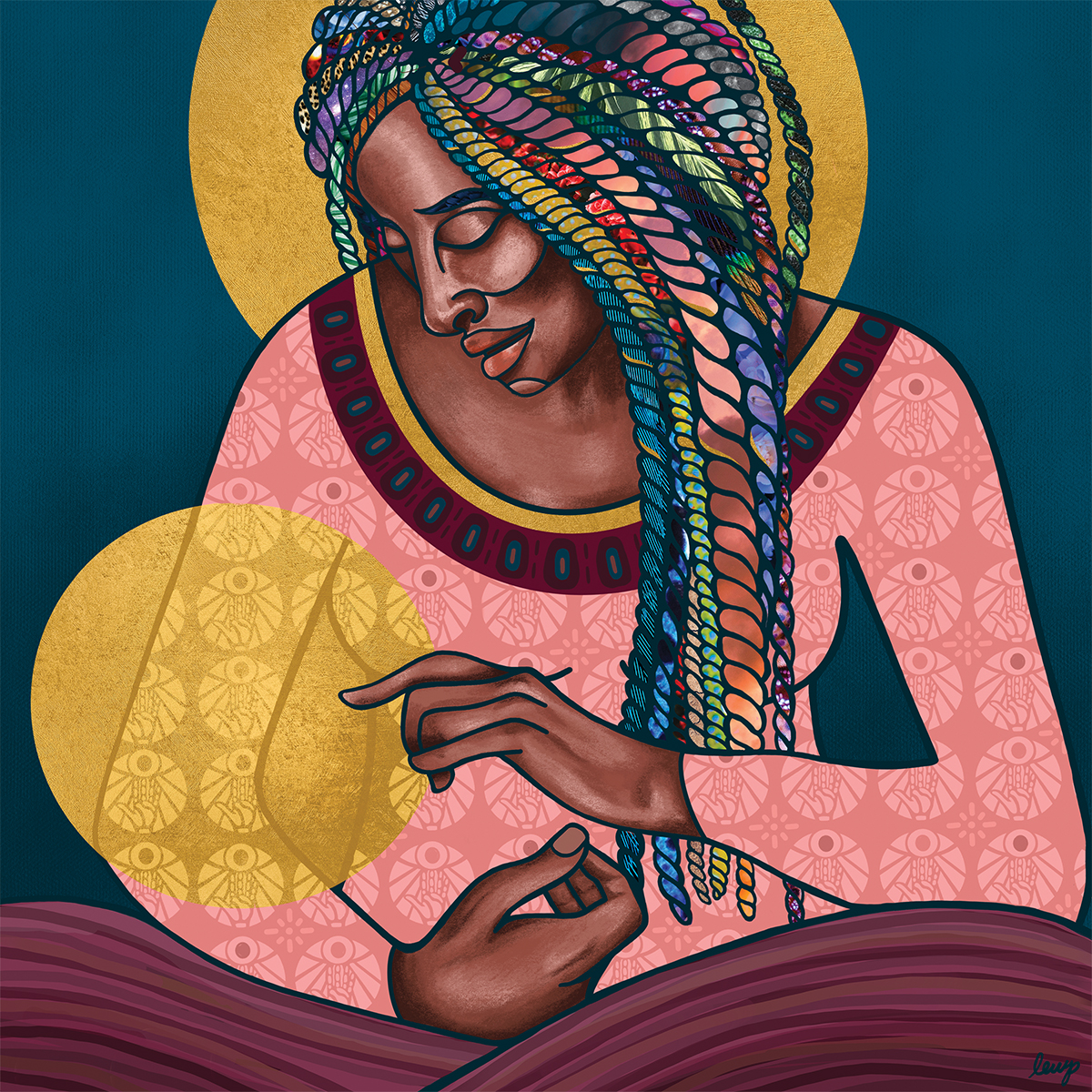
Lauren Wright Pittman (American, 1988–), Contours of Mary’s Dream, 2020. Digital painting with collage, 20 × 20 in. Used with permission.
Contours of Mary’s Dream by Rev. Lauren Wright Pittman of Knoxville, Tennessee, shows Mary, the mother of Jesus, bonding with her in utero son. She sits cross-legged and nimbed, tenderly caressing a hovering gold halo that represents the Holy One, the light of the world, taking shape inside her. Repeated in roundels, the design on her shirt is an upraised, open hand illuminated by sunrays, an allusion to the Magnificat, Mary’s praise song from Luke 1:46–55, which begins, “My soul magnifies the Lord!” A whole world of possibility opens up with God’s taking on flesh. Wright Pittman says,
I have this instinct to read the Magnificat alongside the first creation narrative in Genesis. I imagine Christ taking form in Mary’s womb much like I imagine all of creation emerging at the Creator’s voice. I collaged macrophotography of patterns, textures, and colors from creation—such as sunsets, bird’s feathers, fish scales, galaxies, leaves, planets, fur, water, etc.—and wove them into her hair. Jesus, the thread of creation, is being knit together in her womb. God’s dream for all creation is materializing as cells divide in her body; all the while she sings of a dream, still unrealized.
Creation–new creation, and Jesus the firstborn of both.
There’s wonder and excitement in the image, but there’s also a trace of loss, as the orb that Mary cradles could be seen as not only a potentiality that’s forming, a God-lit body coming to be, but also an absence, the vestigial essence of a boy wrenched from the protective arms of his mother. The artist said she was thinking of the painting Analogous Colors by Titus Kaphar that appeared on the cover of the June 15, 2020, issue of Time magazine, which reported on the nationwide protests in the US in the wake of George Floyd’s murder by a police officer. In Kaphar’s image, a grieving Black mother holds an empty silhouette of her infant close to her chest, alluding to the many African American women whose children’s lives have been taken by police and racist vigilantes.
“When I read the Magnificat, Kaphar’s image came into sharp relief,” Wright Pittman says. “How could I image Mary holding the contours of her dreams for the world, while also holding the contour of her loss? Mary’s son would be publicly murdered at the hands of the state. Mary’s song reverberates for all mothers who have had dreams for their children shattered by senseless violence.”
I originally wrote this description for the Advent 2022 edition of the Daily Prayer Project.
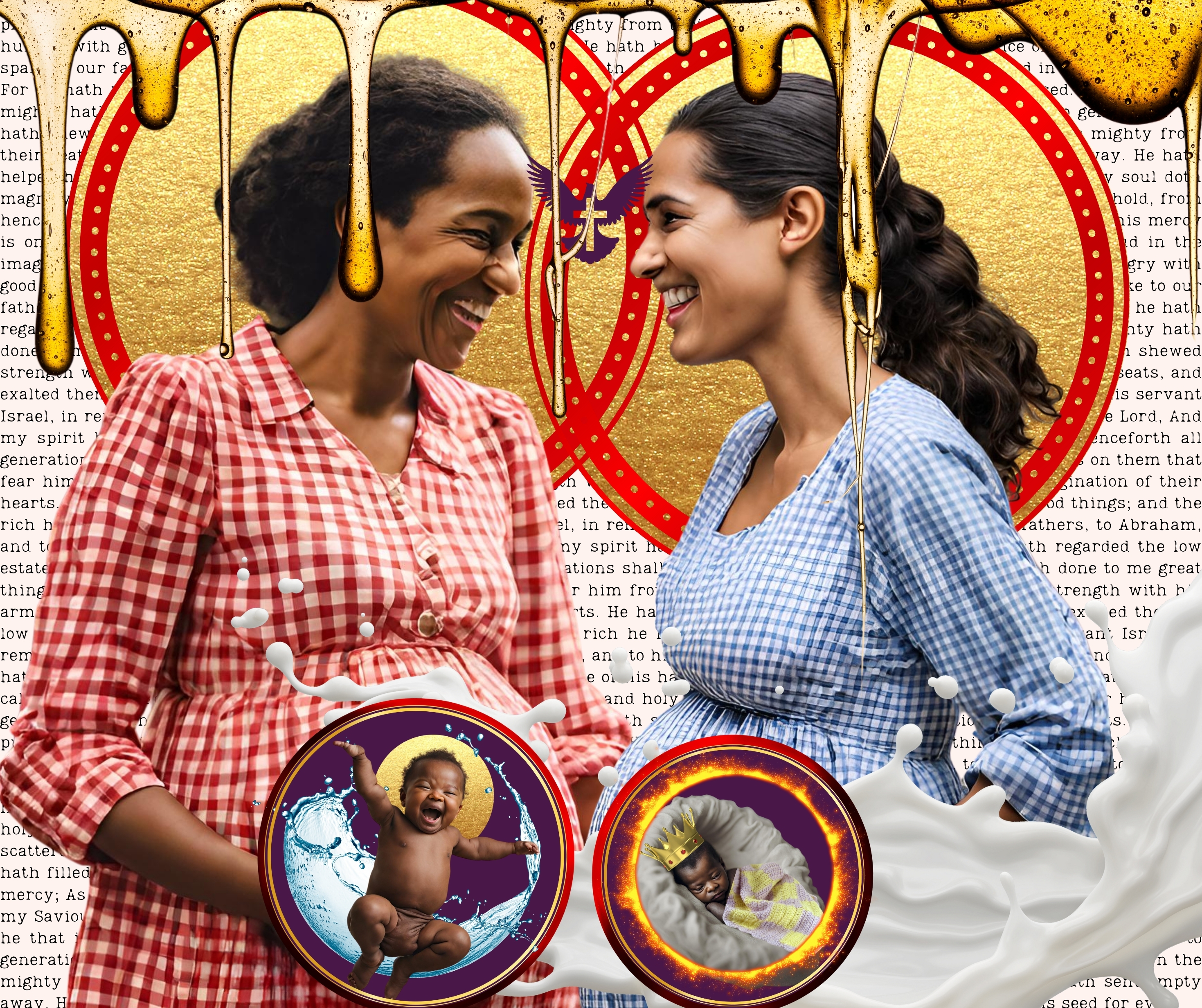
Beth Felker Jones (American, 1976–), Visitation, 2024. Digital collage with AI-generated elements.
Dr. Beth Felker Jones is a theologian who teaches at Northern Seminary near Chicago. This past year she has been making digital collages of biblical figures, especially women, with the assistance of AI technology. She shares them on her Substack, Church Blogmatics, and offers them for free with watermark or just $10 for a high-resolution, watermark-free download.
Her Visitation, she says, “imagines Mary’s visit to Elizabeth in Luke 1, flowing with milk and honey,” symbols of abundance and nourishment. (The promised land is often referred to in scripture using this poetic expression; see Exod. 3:8, Num. 14:8, Deut. 31:20, and Ezek. 20:15.) With the coming of a Savior, a great spiritual bounty awaits God’s people.
Luke the Evangelist describes Elizabeth as “filled with the Holy Spirit” (1:41). The Spirit is present in the center of this collage, silhouetted in purple, the color of Advent. His wings touch the women’s foreheads as if to bless or to join them together in celebration.
Luke also says that John the Baptist “leaped for joy” inside Elizabeth upon hearing Mary’s greeting (1:44), already recognizing that the one she bore was the Messiah. Jones shows this exultation of the in utero prophet. He splashes in the waters of his mama’s womb, as he will one day in the river Jordan, baptizing the repentant. Meanwhile, the great I AM, enfleshed as a preborn baby, sleeps inside a fiery ring in Mama Mary, crowned as king.
The words of Mary’s Magnificat form the backdrop of the scene.
LISTEN: “Among Us” by Nick Chambers, on Advent Songs by Incarnation Music (2023)
My soul will magnify The Lord who looked on my Lowliness with grace My soul will magnify My neighbor’s precious life I see Christ in their face
Refrain: God is among us In human disguise Born as one of us To open our eyes
My soul will magnify The Lord who took on my Lowliness in flesh My soul will magnify My neighbor’s desperate cry For in Christ they are blessed [Refrain]
Based on the Magnificat (Luke 1:46–55), “Among Us” by singer-songwriter Nick Chambers highlights how God’s becoming flesh helps us see the imago Dei (image of God) in our fellow humans. There’s an old Orthodox hymn that says, “Christ was born to raise the image that fell of old. Christ came to restore the beautiful image of God within humankind,” the image that had become obscured through sin.
With Mary, Elizabeth, and baby John, let us celebrate the Lord who brings salvation, raising up the lowly, restoring the broken, and reminding us of the dignity and belovedness of our embodied selves.





 Art & Theology