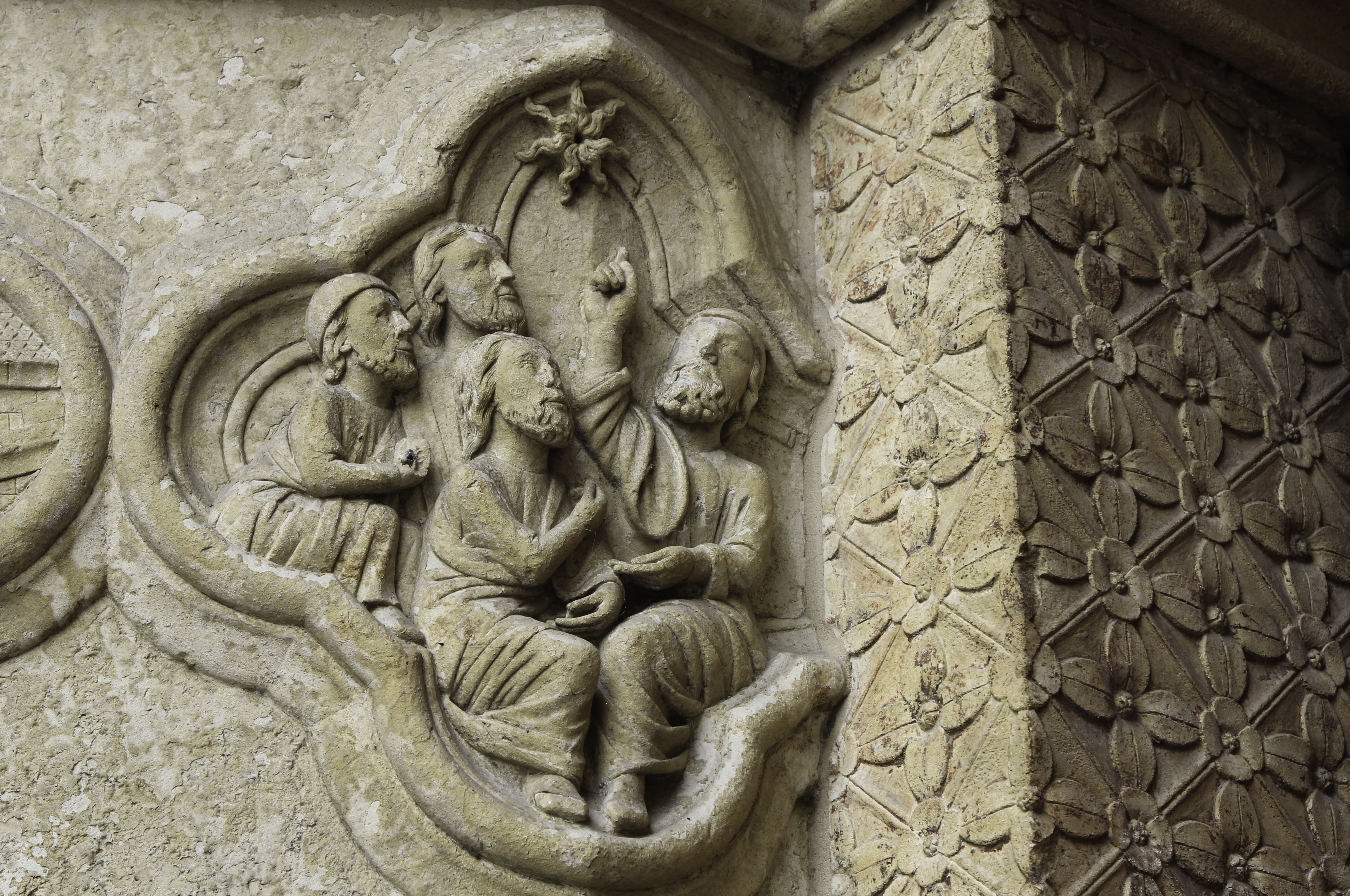
LOOK: Relief sculpture of the magi, Amiens Cathedral
Quatrefoil relief sculpture from the south portal of Amiens Cathedral, France, 13th century. Photo: Fr. Lawrence Lew, OP.
In this sculpture, the Old Testament prophet Balaam pronounces his oracle that “a star shall come out of Jacob, and a scepter shall rise out of Israel” (Num. 24:17). The anonymous artist shows the magi, who studied celestial events, noticing the prophesied star centuries later and preparing to follow it.
To view a wider shot that includes all the adjacent bas-reliefs, see here.
LISTEN: “Twinkle, Twinkle, Little Star” | Words by Jane Taylor, 1806 | Anonymous French pastoral tune, 1761 | Arranged and performed by God’s Children, 2023
Twinkle, twinkle, little star How I wonder what you are Up above the world so high Like a diamond in the sky Twinkle, twinkle, little star How I wonder what you are
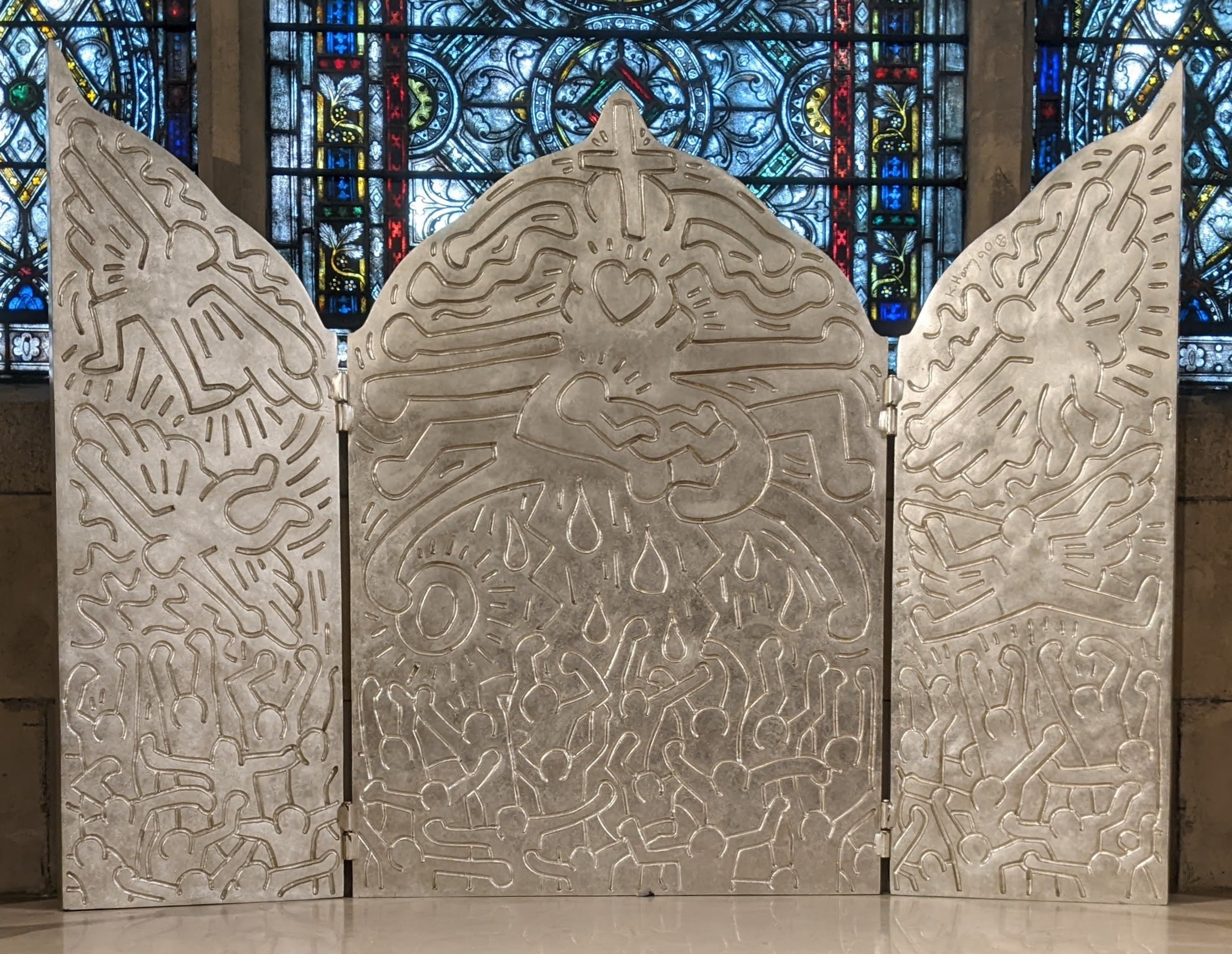
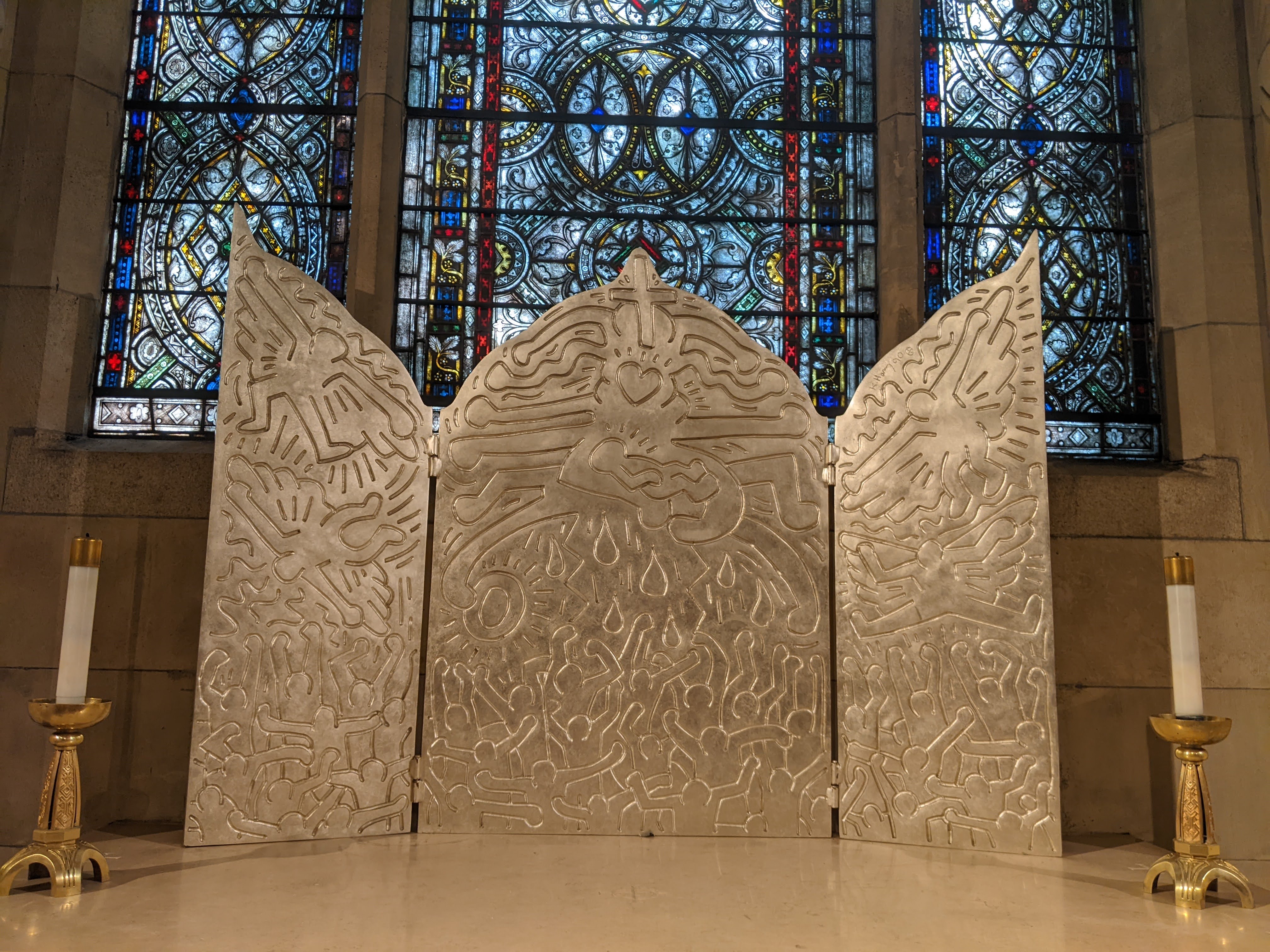
Keith Haring (American, 1958–1990), The Life of Christ, 1990. Bronze altarpiece with white gold leaf patina, 81 × 60 × 2 in. Edition of 9. Chapel of St. Columba, Cathedral of St. John the Divine, New York. All photos by Victoria Emily Jones.
Keith Haring [previously] was a popular artist and activist on the New York scene during the 1980s. Inspired by graffiti art, he started his career by filling empty poster spaces with chalk drawings in the city’s subway stations. He wanted to make art accessible to everyone and believed that it “should be something that liberates the soul, provokes the imagination, and encourages people to go further.”
His style is characterized by bold black outlines, vibrant colors, a sense of rhythm, and simple iconic figures like the Barking Dog and Radiant Baby, which recur again and again in his oeuvre.
Sadly, Haring’s career was cut short by AIDS, which he died of on February 16, 1990, at age thirty-one. The last work he completed, just weeks before his death, was a Life of Christ altarpiece, a work that conveys eternal love and loss, divine suffering and hope. Without any preliminary sketches, he cut the design into clay using a loop knife. It was posthumously cast in bronze and covered in a white gold patina, an edition of nine.
The first edition is housed in the Cathedral of St. John the Divine in New York, the world’s fourth-largest church by area, where Haring’s memorial service was held.
Chapel of St. Columba, Cathedral of St. John the Divine, New York, designed by the architectural firm Heins & LaFarge, dedicated 1911. The stained glass windows are by Wilbur Burnham of Boston and Clayton & Bell of London, and the altarpiece, a later addition, is by Keith Haring.
Pulsating, cosmic, and somehow both mournful and joyous, the altarpiece is a triptych, meaning it has three panels. The central panel shows, at the top, a cross, below which is a multiarmed figure holding a baby. The top figure I interpret as God the Father, his arms all-embracing. Below him, at torso level, I discern a second figure (though the head is not clearly defined), who must be Mary, a shining heart over her face. Nestled in her arms is, irrefutably, her infant son Jesus.
Another possible reading is that this is the Trinity—Father, Spirit, and Son—united in an act of self-giving.
The surplus of arms (I count thirteen, plus the baby’s two) reminds me of the Thousand-Armed Avalokiteśvara in Buddhism; a bodhisattva associated with limitless compassion, his arms represent his extending aid, his reaching out to touch, heal, and uplift. One of the arms here stretches down to bestow a halo on humankind, which in Christianity symbolizes the grace/light of God.
Below this primary grouping is a crowd of people who appear to me to be dancing and celebrating, lifting their arms to receive the blessings that flow forth from the holy child. (Or are they clamoring, turning away, resisting? Without facial features and fingers, it’s hard to tell!) Drops of Jesus’s blood fall over all, bringing redemption.
On the two side panels, angels careen down from the heavens, surfing, leaping, tumbling, one screeching to a halt.
Haring’s Life of Christ combines, as have many artworks before it, Jesus’s birth and death, collapsing his time on earth, his ministry of salvation, into a single image of incarnation and atonement. Mary holds him as a newborn, but she also holds him as a lifeless adult after his crucifixion—a traditional representation known as the Pietà. Many artists have given Mary a sad twinge in her eye at the nativity, suggesting a premonition of loss.
Haring’s figures are faceless, so we can’t look there for emotional clues, but Mary’s body language suggests both a desire to keep and protect her son, and a willingness to give him up for the greater good.
I wonder whether, when Haring incised the sacred blood drops, he was not only thinking of the “power in the blood” that Christians sing about in reference to Jesus’s redemptive sacrifice—and all the weight that bodily fluid as Christian symbol carries—but also lamenting the HIV infecting his own bloodstream, ravaging his body and stigmatizing him, and that had already killed many of his friends and his partner.
Haring’s friend Sam Havadtoy, who was present at the altar’s creation, reports that when Haring finished the piece, he stepped back and, gazing at it, said, “Man, this is really heavy.”
I think the prominence of blood must have been at least partly influenced by the destructiveness of the AIDS epidemic and the artist’s meditation on his mortality, perhaps even hope for transcendence through death. And if so, then the Radiant Baby, who, the artist’s title would lead us to assume, is Jesus, could also double as the soul of an AIDS victim being taken back up to God.
While I hesitate to ascribe prayers or intentions to others that they have not clearly voiced, I can’t help but think that this last artwork of Haring’s, executed in the final throes of his illness, its subject returning him to the Christianity of his youth, to a story that once captivated him, was in one sense a plea for (physical and spiritual?) cleansing, for deliverance.
LISTEN: “We Sing Glory” by Fred Hammond, on Fred Hammond Christmas . . . : Just Remember (2001)
Little baby boy, sent as God among us For your plan to free all humanity We sing glory to your name Sing glory to your name
Tiny fragile heart Pumped your blood to save us For you’ve come to be a sin offering Singing glory to the Lamb Sing glory to the Lamb
Singing glory to the one Who saved the whole world Born to die but you live again And take all our sins away
Little hands and feet Made for nail and hammer For the pain and grief you suffered for me I sing glory to the Lamb Oh, glory to the Lamb
Tiny arms and legs Broad, strong, and sturdy You carry the key to our victory We sing glory to your name We sing glory to your name
We sing glory to the Child Who will save the whole world Born to die and then live again To take all our sins away
Glory, glory to the one Who was born to save the whole world You died but you’ll rise again So Jesus, we praise your name
Hark the herald angels sing Glory to the newborn King Peace on earth and mercy mild God and sinner reconciled Thank you, Jesus
Hark the herald angels sing Glory to the newborn King Peace on earth and mercy mild God has come to save us Yes, he has
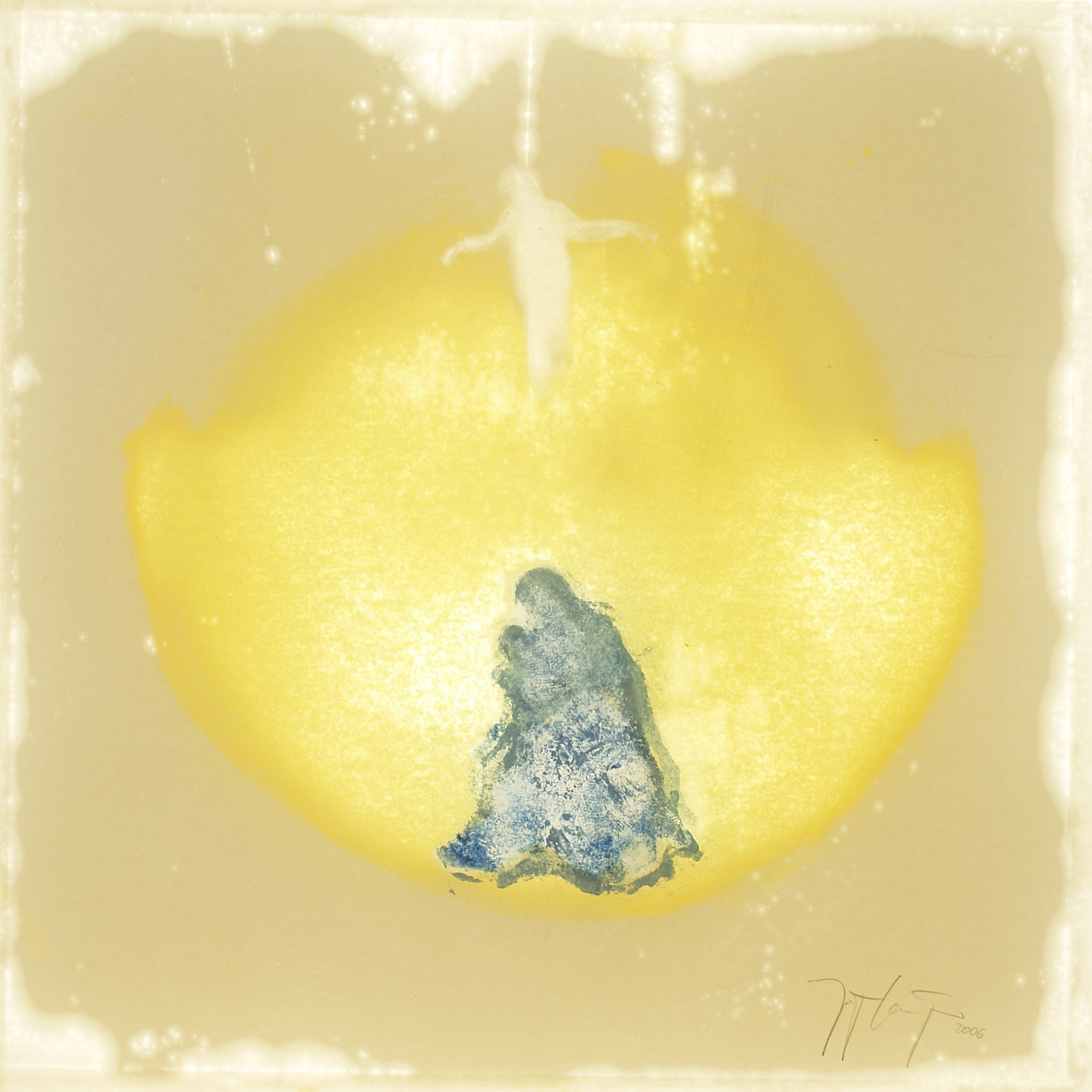
Jörg Länger (German, 1964–), Chr. Geb., 2006. Linocut, wax, oil, and graphite pencil on paper, 33 × 33 cm, cast with resin between two Optiwhite sheets of glass, 38 × 38 cm.
The contemporary German artist Jörg Länger creates extraordinary mixed-media works, many of which are in dialogue with Christian art history. In addition to earning an advanced degree in art, Länger has also done university coursework in theology and philosophy, so it’s no wonder his pieces demonstrate a keen theological awareness and spiritual sensibility.
After some fifteen years of working in photography, installation art, performance art, and conceptual art, in 1998 Länger shifted gears to focus on drawing, painting, and printmaking. He developed a series, still ongoing, that he calls “Protagonisten aus 23.000 Jahren Kulturgeschichte” (Protagonists from 23,000 Years of Cultural History), in which he takes figures from prehistoric petroglyphs and bas-reliefs, ancient Greek vases, medieval manuscripts, European Renaissance paintings, and contemporary art, simplifies them, and puts them into a new pictorial context. He copies the figure’s outline onto a linoleum block, inks and prints it to produce a sort of silhouette, and builds out from there using oil paint, pastels, wax, and/or gold leaf, while still retaining a minimalist aesthetic.
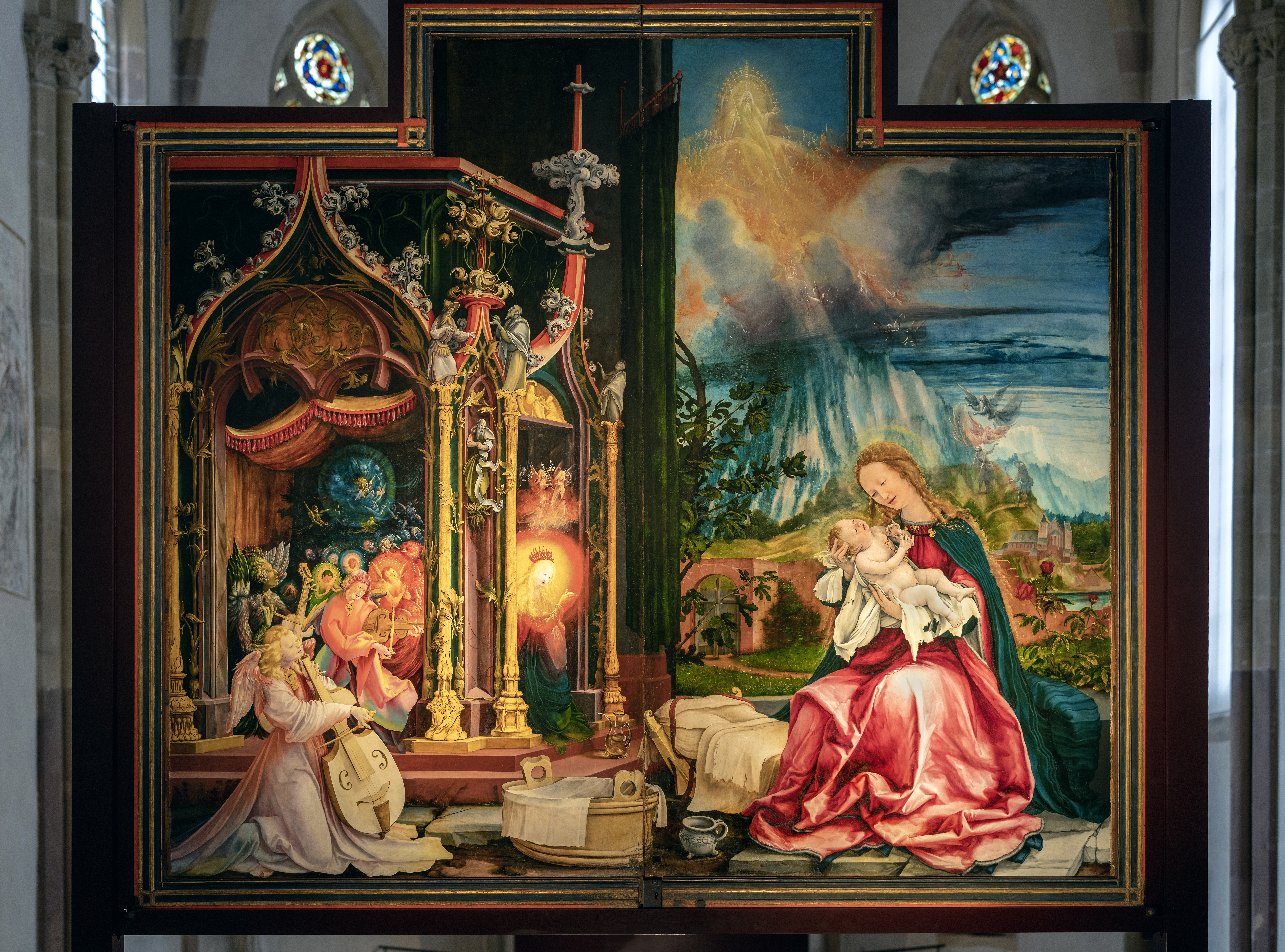
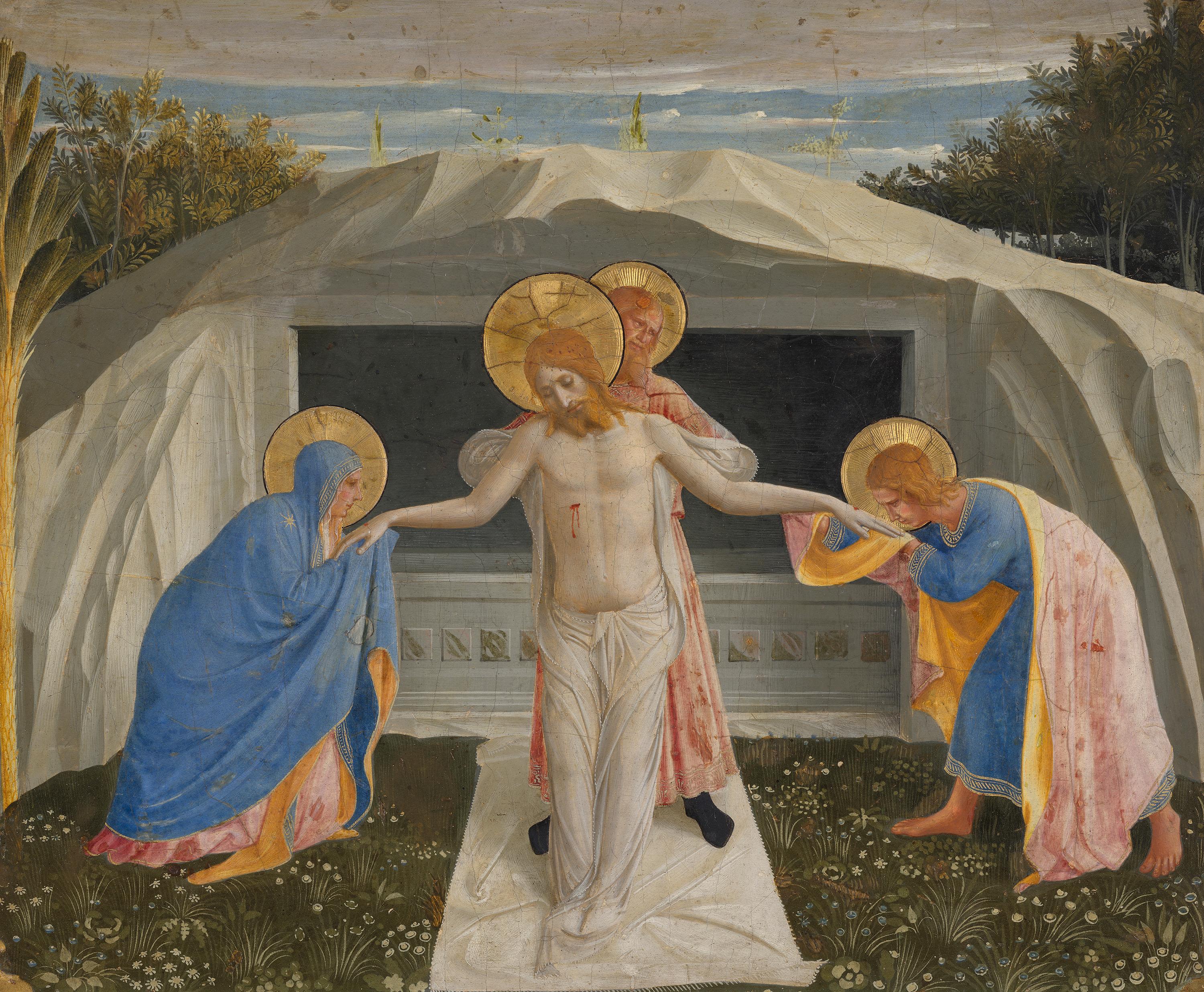
In his 2006 piece Chr. Geb. (short for Geburt Christi, “Birth of Christ”), the silhouetted figures are taken from Matthias Grünewald’s Isenheim Altarpiece and Fra Angelico’s Entombment of Christ.
Matthais Grünewald (German, ca. 1475/80–1528), The Nativity, central panel (first open view) of the Isenheim Altarpiece, 1515. Oil on wood, 269 × 307 cm. Unterlinden Museum, Colmar, France. Photo: Steven Zucker.Fra Angelico (Italian, ca. 1400–1455), Entombment of Christ, 1438–40. Tempera on wood, 37.9 × 46.6 cm. Alte Pinakothek, Munich.
With the shadowy blue central pair of Mother and Child, the ghostly impression of Christ’s crucified body (being dragged into a tomb in the scene it’s excised from), the expanding puddle of gold that holds together both birth and death, and the light that presses in from the edges, the work has a mystical feel. It shows the Eternal One entering time, born of a woman, to live and die and rise and so bring humanity back to God and back to their truest selves.
LISTEN: “O Vis Aeternitatis” by Hildegard of Bingen, ca. 1140–60 | Performed by Azam Ali, 2020
V. O vis aeternitatis
que omnia ordinasti in corde tuo,
per Verbum tuum omnia creata sunt
sicut voluisti,
et ipsum Verbum tuum
induit carnem
in formatione illa
que educta est de Adam.

R. Et sic indumenta ipsius
a maximo dolore
abstersa sunt.

V. O quam magna est benignitas Salvatoris,
qui omnia liberavit
per incarnationem suam,
quam divinitas exspiravit
sine vinculo peccati.

R. Et sic indumenta ipsius
a maximo dolore
abstersa sunt.

V. Gloria Patri et Filio
et Spiritui sancto.

R. Et sic indumenta ipsius
a maximo dolore
abstersa sunt.
V. O power within Eternity: All things you held in order in your heart, and through your Word were all created according to your will. And then your very Word was clothed within that form of flesh from Adam born.
R. And so his garments were washed and cleansed from greatest suffering.
V. How great the Savior’s goodness is! For he has freed all things by his own Incarnation, which divinity breathed forth unchained by any sin.
R. And so his garments were washed and cleansed by greatest suffering.
V. Glory be to the Father and to the Son and to the Holy Spirit.
R. And so his garments were washed and cleansed by greatest suffering.
Hildegard of Bingen [previously] was a twelfth-century German nun and polymath who wrote works on theology, medicine, and natural history; hymns, antiphons, and a drama for the liturgy (all with original music); and one of the largest bodies of letters to survive from the Middle Ages. In 1136 she was unanimously elected to lead her Benedictine community as abbess, which she did until her death in 1179.
“O vis aeternitatis” is the first entry in Hildegard’s Symphonia armonie celestium revelationum (Symphony of the Harmony of Celestial Revelations), a compilation of her liturgical songs that she made during her lifetime. It is labeled a “Responsory to the Creator.” “The responsory, one of several compositional forms Hildegard used,” explains medievalist Nathaniel M. Campbell, “is a series of solo verses [marked V] alternating with choral responses [marked R] sung at the first office of the day, vigils (matins), in the monastic liturgy.” It’s basically a call-and-response song.
This responsory, Campbell continues, “contemplate[s] the Incarnation . . . as the pivotal moment in which creation reached its perfect and predestined trajectory.” He notes how the refrain meditates on the cleansing of Adam’s flesh both from suffering and by (Christ’s) suffering. God put on our humanity and redeemed it.
Here’s how the medievalist Barbara Newman translates the responsory on page 99 of the critical edition of the Symphonia published by Cornell University Press:
Strength of the everlasting! In your heart you invented order. Then you spoke the word and all that you ordered was, just as you wished.
And your word put on vestments woven of flesh cut from a woman born of Adam to bleach the agony out of his clothes.
The Savior is grand and kind! From the breath of God he took flesh unfettered (for sin was not in it) to set everything free and bleach the agony out of his clothes.
Glorify the Father, the Spirit, and the Son.
He bleached the agony out of his clothes.
In the video above, “O vis aeternitatis” is performed by Azam Ali, an internationally acclaimed singer, producer, and composer who was born in Iran and raised in India and is now based in Los Angeles. She writes in the video’s YouTube description that Hildegard is part of the canon of universal spirituality and mysticism and that she is attracted to her cosmology, especially her articulation of the ancient philosophical concept of “the music of the spheres.”
In addition to her solo work, Ali is part of the musical group Niyaz, who blend medieval Sufi poetry and ancient Middle Eastern folk songs with modern electronic and trance music.
In today’s Christmas devotional, there’s a convergence of three Native cultures of Turtle Island (North America): Jemez, Dakelh, and Kwakwaka’wakw.
LOOK: Jemez Nativity by Maxine Toya
Maxine Toya (Jemez Pueblo, 1948–), Jemez Nativity, 2014. Polychrome pottery figures, red micaceous slip, tallest figure 8 1/2 inches high. Photo: Blair Clark, courtesy of Susan’s Christmas Shop, Santa Fe.
A granddaughter of Persingula Gachupin and a daughter of Marie Romero (both eminent Jemez Pueblo potters), Maxine Toya grew up assisting her family with pottery chores and painting. She began making her own pottery in 1974 and is one of the most renowned living potters from Jemez Pueblo, a census-designated place in Sandoval County, New Mexico. She has won numerous awards at the prestigious Santa Fe Indian Market, which every August brings together a thousand-plus Indigenous artists from more than two hundred tribal nations to exhibit and sell their work.
I learned about this artist from the wonderful book Nativities of the Southwest by Susan Topp Weber, the owner and operator of Susan’s Christmas Shop in Santa Fe. The book compiles dozens of nativities made with local clays and other materials by Pueblo Indians, Navajo Indians, and Spanish and Anglo artists of New Mexico and Arizona. Maxine Toya’s nativity appears on page 47. Weber writes,
Maxine’s donkey in this nativity has a blanket painted with a fringe similar to the one made by her mother, Marie [see page 46]. . . . She sometimes combines her figures into groups. Her standing figures all have closed eyes. The carefully painted detail distinguishes this nativity, as well as the sweet little Pueblo drummer boy with his drumstick raised in the air. The angel’s wings have a lovely feather design.
You can watch Maxine Toya give a pottery demonstration with her daughter Domnique Toya, also a potter, in this 2022 video from the Museum of Indian Arts and Culture. (I cued it up to Maxine’s first section.)
Cheryl Bear (DMin, The King’s University) is an award-winning singer-songwriter, speaker, and workshop leader from Nadleh Whut’en First Nation in central British Columbia, whose work explores the intersection of Christian faith and First Nations cultures. She is a founding board member of NAIITS: An Indigenous Learning Community (formerly the North American Institute for Indigenous Theological Studies), an organization that addresses biblical, theological, and ethical issues from Indigenous perspectives. She travels throughout North America telling the Great Story of Jesus both within and outside Indigenous communities, bringing to bear her Indigenous worldview and values.
Bear’s song “Welcome Our Creator” is from her sophomore album, The Good Road. It opens with a drumbeat and then her singing a series of vocables (small nonlexical “words” without semantic meaning). “The song is played to the drum beat of my people,” the Dakelh (Carrier), she writes in the liner notes. “I use the words ‘Gilakas’la Gikumi’ from the Kwakwaka’wakw Nation,” which translate to “Welcome our Creator.”
The song’s title on the CD sleeve and in online metadata does not have a comma, suggesting that the phrase, if interpreted in relation to Christmas, is an exhortation to give Jesus welcome, to gladly and hospitably receive him. But it could also be sung as a greeting to the incarnate God himself: “Welcome, our Creator!”
Outside the Christmas context, the song might be sung during an assembly as an acknowledgment of Creator’s presence.
I was sleeping, but my heart was awake. The sound of my beloved knocking! “Open to me, my sister, my love, my dove, my perfect one, for my head is wet with dew, my locks with the drops of the night.”
—Song of Songs 5:2
“Listen! I am standing at the door, knocking; if you hear my voice and open the door, I will come in and eat with you, and you with me.”
—Revelation 3:20
LOOK: Christ knocking on the door of the heart, Germany, 16th century
Christ knocking on the door of the heart, engraving after a drawing by an anonymous German nun, ca. 1550. Current location unknown. Source: Jeffrey F. Hamburger, Nuns as Artists, p. 126, from Adolf Spamer, Das kleine Andachtsbild von XIV. bis zum XX. Jahrhundert (1930).
Known from a single impression that’s now lost, this New Year’s engraving from sixteenth-century Germany shows a nun welcoming the Christ child into her heart, depicted as a house—a devotional image developed in medieval convents. Art historian Jeffrey F. Hamburger discusses the image in his excellent book Nuns as Artists:
The print depicts three steps (labeled “gedechtnus,” “erkantnus,” and “frey willkur,” “Memory, Intellect, and Free Will”) rising to the door of a heart-shaped house. . . . The staircase embodies the virtuous ascent toward the Godhead. . . . At the entrance a nun extends her hands to greet the Christ Child, behind whom flutters the dove of the Holy Spirit.
In bidding her bridegroom enter, the nun also welcomes the New Year; Christ declares, “Ich hab das neu Jar angesungen, / nun ist mir gar woll gelungen, / das ich bin gelaßen ein, / das freiet sich das hertze mein,” “I have announced the New Year; now indeed I have succeeded in being let in, which makes my heart rejoice.” The nun replies: “pis mir wilkum mein lieber herr, / Ich thue dir auff das hercze mein, / kum mit dein gnaden dreyn,” “Be welcome, my dear Lord; I open up my heart to you. Come in with your blessings.” (153)
“Developed in the fifteenth century,” Hamburger continues, “New Year’s prints served as the late medieval equivalent of the modern-day Christmas card”—and this one would have been disseminated widely among German-speaking nuns.
LISTEN: “Mitt hjerte alltid vanker” (My Heart Always Wanders) (original Danish title: “Mit hjerte altid vanker”) | Original Danish words by Hans Adolph Brorson, 1732; translated into Norwegian | Music: Swedish folk melody, adapted | Performed by Ingebjørg Bratland on Sorgen Og Gleden, 2008, and live on Beat for Beat on NRK1, 2010 (video below)
1. Mitt hjerte alltid vanker,
i Jesu føderum,
der samles mine tanker
som i sin hovedsum.
Det er min lengsel hjemme,
der har min tro sin skatt,
jeg kan deg aldri glemme,
velsignet julenatt!

2. Men under uten like,
hvor kan jeg vel forstå
at Gud av himmerike
i stallen ligge må?
At himlens fryd og ære,
det levende Guds ord
skal så foraktet være
på denne arme jord?

3. Hvi lot du ei utspenne
en himmel til ditt telt
og stjernefakler brenne,
å store himmelhelt?
Hvi lot du frem ei trede
en mektig englevakt
som deg i dyre klede
så prektig burde lagt?

4. En spurv har dog sitt rede
og sikre hvilebo,
en svale må ei bede
om nattely og ro;
en løve vet sin hule
hvor den kan hvile få
– skal da min Gud seg skjule
i andres stall og strå?

5. Jeg gjerne palmegrener
vil om din krybbe strø
for deg, for deg alene
jeg leve vil og dø
Kom, la min sjel dog finne
sin rette gledes stund
at du er født her inne
i hjertets dype grunn

6. Å, kom, jeg opp vil lukke
mitt hjerte og mitt sinn
og full av lengsel sukke:
Kom, Jesus, dog herinn!
Det er ei fremmed bolig,
Du har den selv jo kjøpt,
så skal du blive trolig
her i mitt hjerte svøpt.
1. My heart always wanders
to the place of Jesus’s birth.
There my thoughts gather,
focused in contemplation.
There my longing is fulfilled;
there my faith finds its treasure.
I can never forget you,
blessed Christmas night!

2. But wonder without equal,
how can it be
that the God of heaven
must lie in a stable?
That the joy and glory of heaven,
the living Word of God,
should be so despised
on this poor earth?

3. Why did you not pitch
a sky for your tent
and bring down the stars for light,
oh great heaven’s hero?
Why did you not bring forth
a mighty angelic retinue
to lay out fine bedding for you
so splendidly?

4. A sparrow has its nest
and a safe resting place;
a swallow need not ask
for night shelter and peace;
a lion knows its den,
where it will find its calm—
should, then, my God have to hide
in someone else’s stable and straw?

5. I would gladly spread palm branches
around your manger.
For you and you alone
I will live and die.
Come, let my soul find
the completion of its joy:
you, Lord, born anew
in the depths of my heart.

6. Oh come; I will open
my heart and mind
and, full of longing, sigh:
Come, Jesus, come in!
I know it’s a strange dwelling,
but you yourself have bought it,
so enter and stay,
wrapped here in my heart.

(English translation courtesy of Google Translate, with some tweaks by me)
“Mit hjerte altid vanker” is a popular Scandinavian Christmas hymn whose first line has been variously translated as “My heart always wanders,” “My heart always lingers,” “My heart is always present,” “My heart will always return,” “My heart so dearly ponders,” and “My heart often visits.” It was originally written with eleven stanzas by the Danish Pietist bishop Hans Adolph Brorson and published in his song booklet Nøgle Jule-Psalmer (New Christmas Hymns) in 1732. The lyrics have been set to several tunes over the centuries, the most popular one in Denmark being by Carl Nielsen. And the number of stanzas is typically reduced to six or fewer.
At some point the song was translated into Norwegian (a language very similar to Danish) as “Mitt hjerte alltid vanker.”
The tune used by the Norwegian folk singer Ingebjørg Bratland is a Norwegian variant of a Swedish folk tune (first published in 1816) from the Västergötland region. The most popular recording that uses this tune, from 1995, is by the Norwegian superstar Sissel Kyrkjebø—but I’m partial to Bratland’s rendition. In her 2010 television appearance, she sings verses 1 and 5; on the album, verses 1–5. It’s a shame she omits verse 6, as it’s my favorite, even if it’s a bit twee: It invites Christ to enter one’s heart and rest there, swaddled in one’s love.
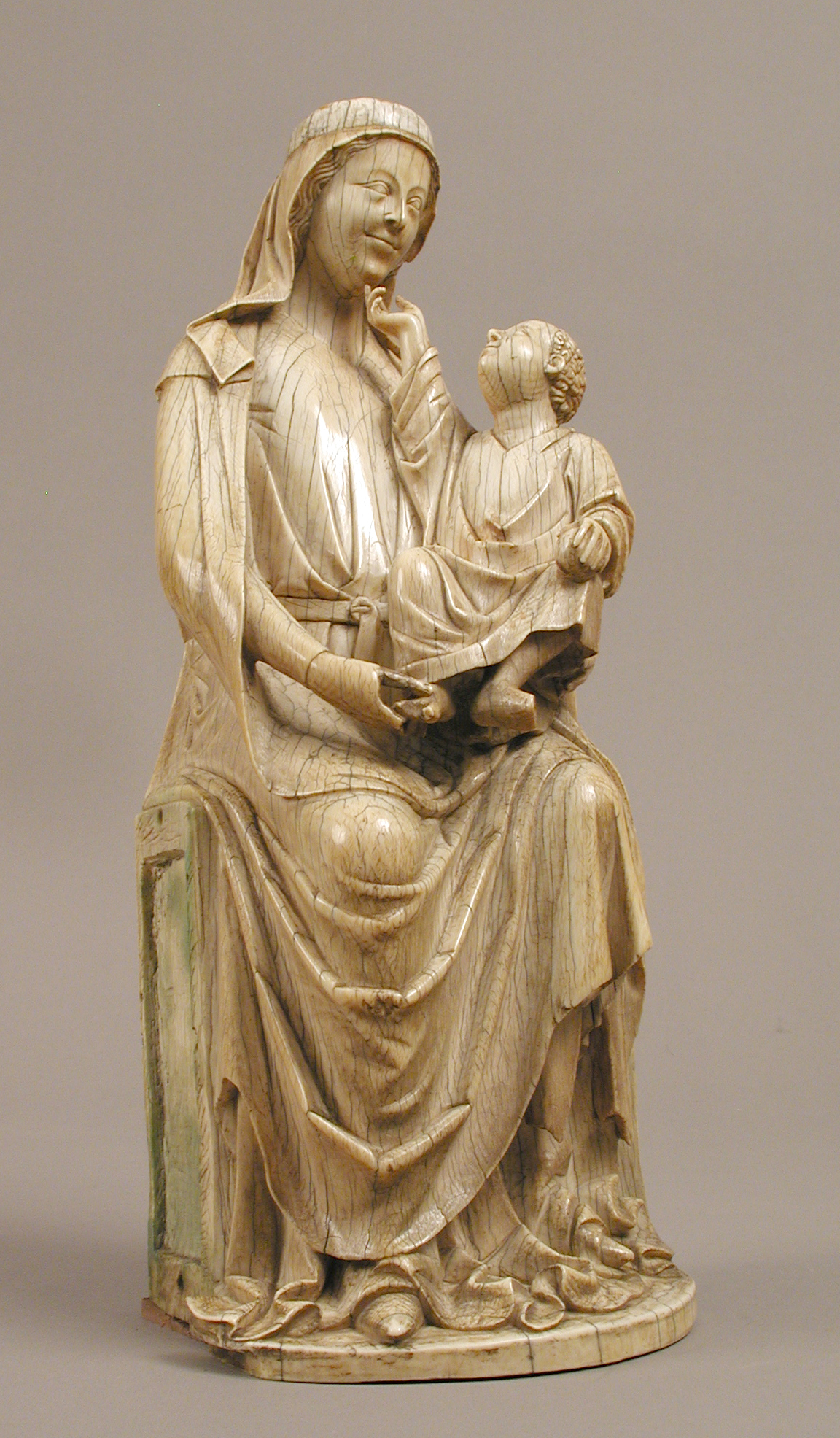
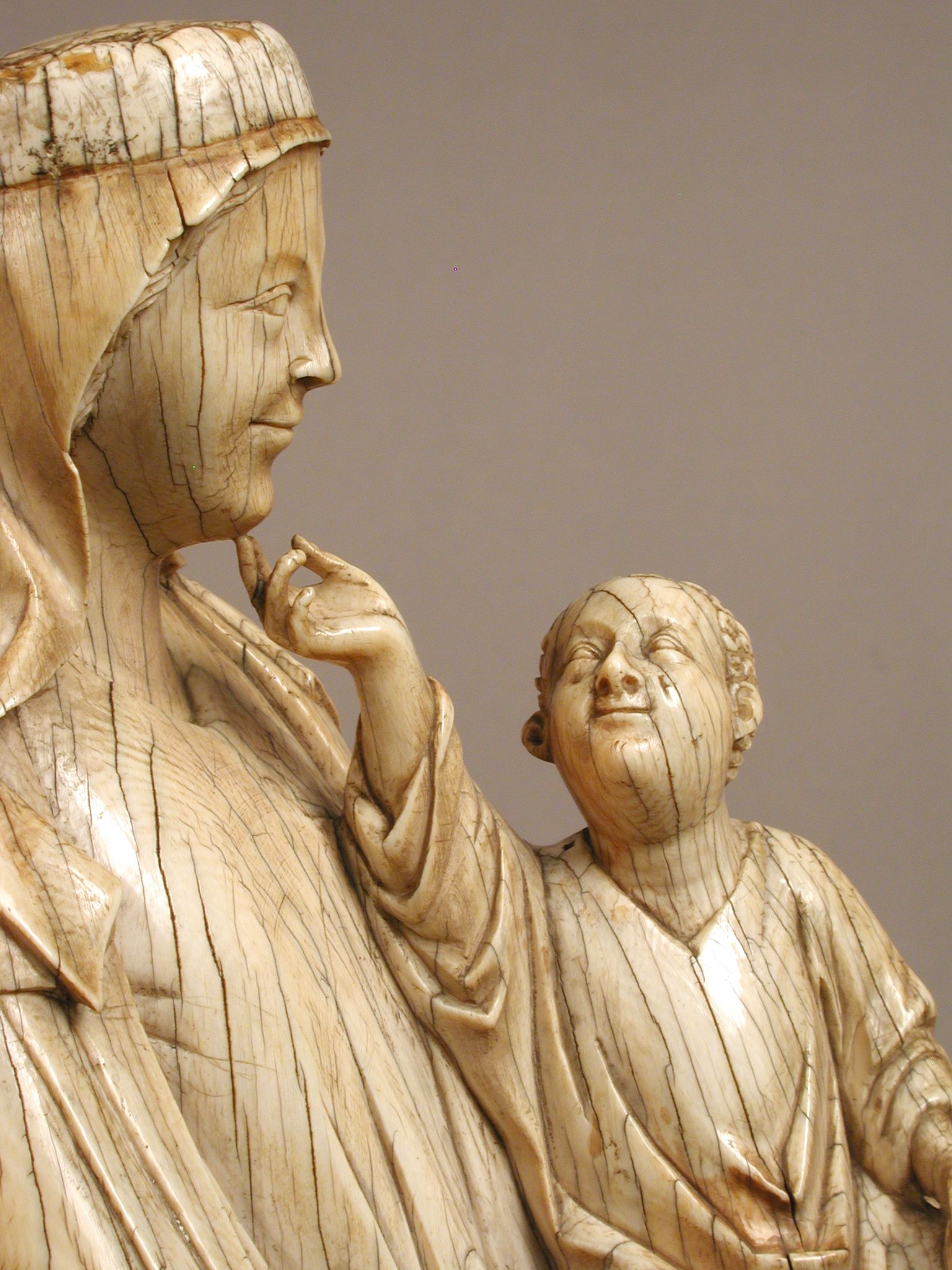
Virgin and Child, northern France, ca. 1250. Ivory, 11 5/8 × 4 3/4 × 4 1/16 in. (29.5 × 12.1 × 10.3 cm). Metropolitan Museum of Art, New York.
I love the affection between mother and child in this thirteenth-century ivory statuette from northern France. A variation of the Virgin Eleousa (Virgin of Tenderness) icon type, it shows Jesus seated in Mary’s lap, sweetly touching her chin, while she reciprocates with a squeeze of his foot.
LISTEN: “Quid petis, o fili?” (What Do You Seek, O Son?) | Words: Anonymous | Music by Richard Pygott, ca. 1510 | Performed by The Sixteen, dir. Harry Christophers, on Christus Natus Est: An Early English Christmas, 1996
ORIGINAL MIDDLE ENGLISH:
Quid petis, o fily? Mater dulcissima ba ba. O pater, O fili? Michi plausus oscula da da!
The moder full manerly and mekly as a mayd, Lokyng on her lytill son, so laughyng in lap layd, So pretyly, so pertly, so passingly well apayd, Full softly and full soberly unto her swet son she saide:
Quid petis, o fily? . . .
I mene this by Mary, our Maker’s moder of myght, Full lovely lookyng on our Lord, the lanterne of lyght, Thus saying to our Saviour; this saw I in my syght; This reson that I rede you now, I rede it full ryght:
Quid petis, o fily? . . .
Musyng on her manners, so ny mard was my mayne, Save it plesyd me so passyngly that past was my payn; Yet softly to her swete sonne methought I hard her sayn: Now, gracious God and goode swete babe, yet ons this game agayne.
Quid petis, o fily? . . .
Source: London, British Library, Add. MS 31922, fols. 112v–116r; transcribed in John Stevens, Music and Poetry in the Early Tudor Court (Cambridge University Press, 1979), p. 421, cat. H105
MODERNIZED SPELLINGS:
Quid petis, O fili? Mater dulcissima, ba ba. O pater, O fili? Mihi plausus oscula, da da.
[Translation: “What do you seek, O son?” “Sweetest mother, kiss, kiss.” “O father, O son?” “Clapping hands, give me kisses!” – or – “Applaud me with kisses!” – or – “Kisses on me, give, give!”]
The mother, full mannerly and meekly as a maid, Looking on her little son, so laughing in lap laid, So prettily, so pertly, so passingly well apayed, [pertly = beautifully; apayed = contented] Full softly and full soberly, unto her sweet son she said:
Quid petis, O fili? . . .
I mean this by Mary, our Maker’s mother of might, [I mean this by = I refer to] Full lovely looking on our Lord, the lantern of light. Thus saying to our Savior, this saw I in my sight; This reason that I read you now, I read it full right: [reason = statement]
Quid petis, O fili? . . .
Musing on her manners, so nigh marred was my main, [sapped was my strength] Save it pleased me so passingly that passed was my pain; Yet softly to her sweet son, methought I heard her sayn: “Now, gracious God and good sweet babe, yet once this game again”:
Quid petis, O fili? . . .
This carol for four voices is from the so-called Henry VIII Manuscript, an anthology of polyphonic songs and instrumental music from the Tudor court. Of the 108 compositions in the collection, “Quid petis, O fili” is one of the few religious ones. The author of the text is unknown, but the composer is Richard Pygott (ca. 1485–1552).
The four-line Latin burden* is a dialogue between Mary and the Christ child. Presumably he’s wiggling or making noise, because she asks him what he wants. “Kisses!” he replies. She calls him, oddly, both son and “father,” which reflects her unusual relationship with the God-boy she bore into the world: He’s both her child and her God.
There are three stanzas in the carol—all in English—voiced by a first-person narrator who has witnessed the playful mother-son exchange. It so endeared him that he wants to share it with others.
* Scholars of medieval carols differentiate between a refrain and what’s called a burden. “The refrain . . . is a repeated element which forms part of a stanza, in the carols usually the last line. The burden, on the other hand, is a repeated element which does not form any part of a stanza, but stands wholly outside the individual stanza-pattern.” Richard Leighton Greene, ed., The Early English Carols, 2nd ed., revised and enlarged (Clarendon Press, 1977; 1st ed. 1935), clx.
Wondering why I’m still posting Christmas content? Because Christmas is a twelve-day feast that began December 25 and extends through January 5. While the stores and most media have moved on, the church continues to celebrate. So I encourage you to keep your Christmas decorations up, keep singing and playing carols, and keep partying!
Here’s a link to my Christmastide playlist, comprising over twenty-seven hours of hand-picked sacred Christmas music. Also check out my Epiphany playlist for January 6.
+++
SONGS:
>> “Mary’s Boy Child / Oh My Lord” by Boney M.: The calypso carol “Mary’s Boy Child” was written in 1956 by Jester Hairston and popularized by Harry Belafonte, who recorded it that year. The most famous cover, though, is by Boney M., a reggae, funk, and disco band founded in 1975 in West Germany by the record producer Frank Farian. Its four original members were Liz Mitchell and Marcia Barrett from Jamaica, Maizie Williams from Montserrat, and Bobby Farrell from Aruba. Boney M. released their disco-lite version of “Mary’s Boy Child,” in medley with the new song “Oh My Lord” (by Frank Farian and Fred Jay), as a single in 1978 and then on their full-length Christmas album in 1981. It’s one of the best-selling singles of all time in the UK.
The song makes me smile so much—it’s bright and catchy—especially when I watch the music video, which shows the band singing and dancing in a white room wearing furry white coats. It’s one of two music videos they made for the song, the other cut together with kids enacting the Nativity.
>> “O Ho, Masih Aaya, Zameen Par” (Oh, Christ Has Come! There Is Joy on Earth!) by Akshay Mathews: This contemporary carol from India opens, “Oh, Christ has come! There is joy on earth, there is joy throughout the heavens. Oh, Christ has come!” Then it describes the Annunciation to the Shepherds. Read the Hindi lyrics here. In the video, singer-songwriter Akshay Mathews [previously], who lives in Delhi, triplicates himself using a clone effect so that he is shown playing all three accompanying instruments: guitar, keyboard, and hand drum.
>> “There’s a Fire in Bethlehem,” arr. Conrad Susa: I learned of this traditional Spanish villancico, “En Belén tocan a fuego,” from Calvin University’s 2022 Lessons and Carols Service, For God So Loved the Cosmos. As part of that program, the song was performed in English by the university’s Women’s Chorale, as arranged by Conrad Susa. It opens with imagery of the fire of God’s love flaring out from a stable, and develops into a scene of fish, rivers, and birds rejoicing in the birth of their Redeemer. There was a recording error that puts the lips out of sync with the sound, but the music otherwise comes across just fine.
I love the playful chorus, where the tempo picks up and the pianist shifts to staccato technique (detached and bouncy): “Fish in the river are glistening and dancing, dancing and leaping to celebrate his birthday.” In the sixteenth-note piano run that signals the transition between chorus and verse, I can picture the cavorting, splashing, and darting of our gill-bearing brothers. Although several animal characters make an appearance in Christmas songs, fish usually aren’t one of them. I like how the anonymous writer of this song includes them among the ones who celebrate Christ’s birth. Reminds me a bit of the animated Christmas short from Russia that I shared back in 2017.
To hear a professional recording by the Balthasar-Neumann-Chor, click here.
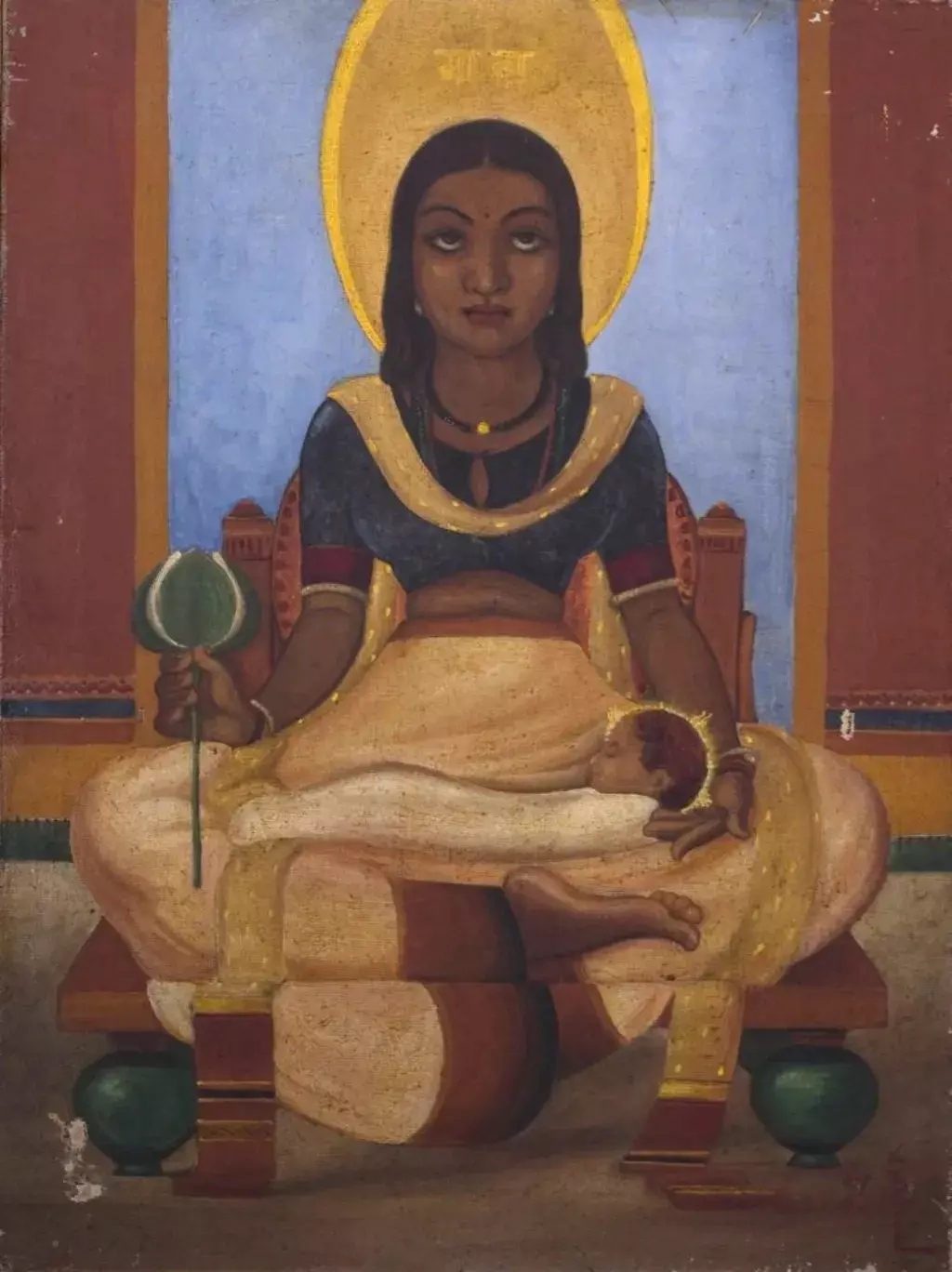
Angelo da Fonseca (Indian, 1902–1967), Mother and Child, 1952. Watercolor on paper. Photo courtesy of the Xavier Centre of Historical Research, Goa.
>> “A Resolution for People Who Are Already Doing Their Best” by Kate Bowler, Everything Happens (Substack): “Every January, we perform this ritual together. We shake off the indulgence of the holidays and brace ourselves for improvement. We tell ourselves that this will be the year we get it together . . . that any mess was temporary . . . that with the right plan, the right habits, the right mindset, we can finally become the person we were always supposed to be. This is not a small thing. In the United States and Canada (bless us all), New Year’s resolutions have become a kind of secular sacrament—an annual recommitment to the belief that limits are a problem to be solved. But what if they aren’t?”
Kate Bowler [previously], an award-winning author, podcaster, and historian of American self-help, breaks the illusion of unlimited agency and shares the question she’s asking herself for the new year instead of “What should I fix?”
Today’s format is a little bit different, in that the visual art and music are part of a singular video piece which also prominently features dance—so, multiple media all wrapped up into one.
Every year in the church calendar, December 28 commemorates the Massacre of the Innocents—the boys of Bethlehem slain by agents of the state, deployed by Herod, who feared the perceived threat they posed. The story is told in Matthew 2:16–18 and quotes the prophet Jeremiah:
A voice was heard in Ramah, wailing and loud lamentation, Rachel weeping for her children; she refused to be consoled, because they are no more.
While the remembrance marks this ancient event specifically, the church also takes the occasion to pray for present-day innocents who have been victimized by the powerful. For example, the collect (succinct prayer) for this day from the Book of Common Prayer reads:
We remember today, O God, the slaughter of the holy innocents of Bethlehem by King Herod. Receive, we pray, into the arms of your mercy all innocent victims; and by your great might frustrate the designs of evil tyrants and establish your rule of justice, love, and peace; through Jesus Christ our Lord, who lives and reigns with you, in the unity of the Holy Spirit, one God, for ever and ever. Amen.
The artists of today’s piece, made in 2019, confront the unjustified killing of Black men in America by police. They do not make the explicit connection to Herod’s massacre, but I do, as I hear, in the many Black mothers who have lost their children to state violence, Rachel weeping and refusing to be comforted. And I see Herod-like rulers who want to silence those wails and reverse the progress made in awareness and reform.
LOOK & LISTEN: The Ritual of Being, a site-specific dance performance by T. Lang in front of the Mothers March On mural by Sheila Pree Bright, 2019
The 2010s was a decade of racial reckoning in America. In response to neighborhood watchman George Zimmerman’s killing of the unarmed Black teen Trayvon Martin and subsequent acquittal, the Black Lives Matter movement was founded in 2013, demanding policing and criminal justice reform and the safety of marginalized Black communities. BLM activism and the continual miscarriages of racial justice that prompt it received ample media coverage all the way through the movement’s peak in 2020 with the murder of George Floyd. That coverage has lessened in the last few years, but the movement is still active, and mothers still bear the wound of their slain children.
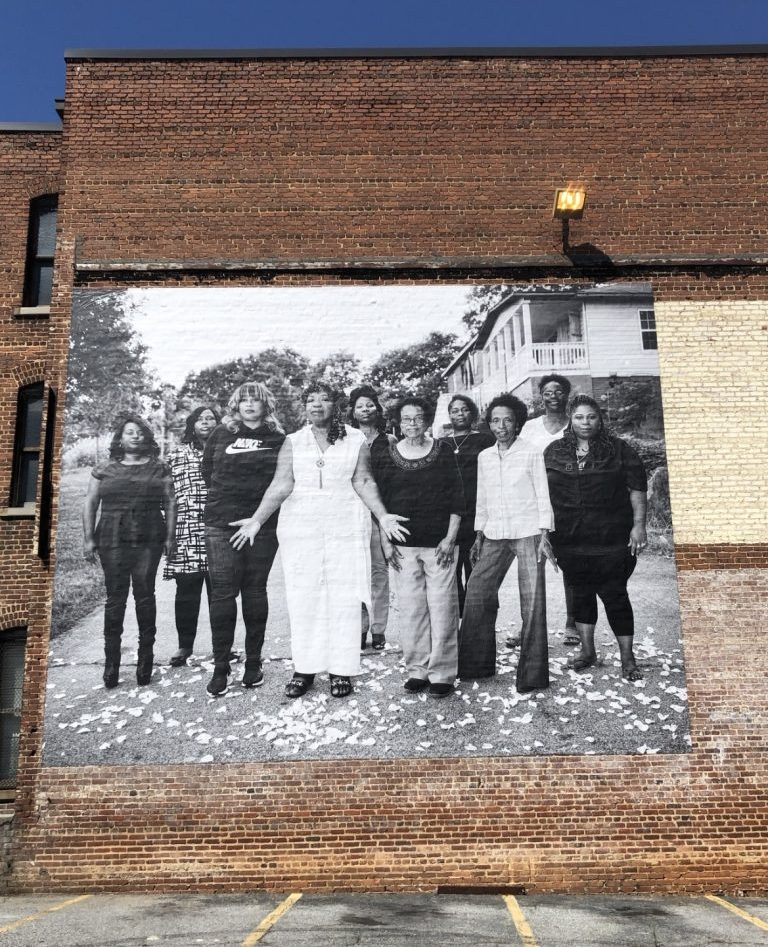
In 2019, the lens-based artist Sheila Pree Bright, author of #1960Now: Photographs of Civil Rights Activists and Black Lives Matter Protests, brought together nine mothers who are fighting for justice for their boys whose lives were taken from them by police. She wanted to give them a safe space to talk, and to photograph them. The portrait Mothers March On depicts, from left to right, Tynesha Tilson (mother of Shali Tilson), Wanda Johnson (mother of Oscar Grant), Felicia Thomas (mother of Nicholas Thomas), Gwen Carr (mother of Eric Garner), Monteria Robinson (mother of Jamarion Robinson), Dr. Roslyn Pope (author of An Appeal for Human Rights), Dalphine Robinson (mother of Jabril Robinson), Patricia Scott (mother of Raemawn Scott), Montye Benjamin (mother of Jayvis Benjamin), and Samaria Rice (mother of Tamir Rice).
Sheila Pree Bright (American, 1967–), Mothers March On, 2019. Vinyl-print photo mural installed at 190 Pryor Street, Atlanta, Georgia, 30 × 60 ft. (9.1 × 18.3 m).
Carr, whose son died in the chokehold of an NYPD officer who ignored his cries of “I can’t breathe,” is the focal point of the image, with her arms outstretched and fingers spread. This body language connotes an offering of self to the cause of justice and a readiness to receive it. That her hands are open rather than clenched in a fist indicates unguardedness, while her planted feet indicate firmness.
The woman in glasses beside Carr is Roslyn Pope, who died in 2023. A mother to two daughters, she had not herself lost a child to police violence, but she was part of Mothers March On on account of her seminal civil rights work in Atlanta. In 1960, while serving as president of the student government at Spelman College, she drafted the manifesto An Appeal for Human Rights, announcing the formation of the Atlanta Student Movement, whose campaign of civil disobedience would contribute to the dissolution of racist Jim Crow laws across the region. In a 2020 interview for the sixtieth anniversary of the manifesto’s publication, Pope expressed concern that some of the students’ hard-fought gains were being eroded, telling the Associated Press, “We have to be careful. It’s not as if we can rest and think that all is well.”
The Mothers March On photographic project is about Black women who have witnessed the tragic loss of their children who have fallen to police brutality. . . . This project pays homage to the sacrifices, wisdom, and guidance of Black mothers as nurturers and protectors who are passing on a legacy of determination and love, showing how they are fierce and tender, protective and vulnerable, and strong and soft. I’m honoring the struggles of Black mothers, celebrating the beauty of their strength and resilience. These mothers continue to march on for Human rights for their children to bring attention to the urgent need for police reform and the systemic racism that continues to fuel police brutality against Black bodies since slavery.
Bright’s depiction . . . stresses Black mothers’ memory, determination, love, and corporeality. Through the repetition of standing figures, the portrait insists on the integrity of Black bodily form. The women speak back to lynching culture. With rose petals at their feet, like fallen bodies of their murdered sons, these mothers, on the front-lines of state violence, refuse to relent. They know who and what has been taken from them; they will never forget. . . .
Bright printed the portrait in large scale and pasted it on the side of a brick retail building at 190 Pryor Street in Atlanta, Georgia, near the Georgia State Capitol. Then, for ProtectYoHeART Day in Atlanta, she and the performance artist T. Lang collaborated on a video piece at that site, where T. Lang dances before the mural to the aching instrumental jazz piece “Alabama” by the saxophonist John Coltrane. (Coltrane wrote the music as a memorial for the four girls who were murdered by Ku Klux Klansmen at Sixteenth Street Baptist Church in Birmingham in 1963; learn more here.) Clothed in a fringe dress, T. Lang spins, jerks, reaches, heaves, throws herself against the wall, crouches, withers, bursts, climbs, pulls, and walks forward, movements of grief and struggle capped by resolve.
A temporary installation, the Mothers March On mural is no longer on Pryor Street.
I first learned about Sheila Pree Bright’s photography from a compelling series of hers that I saw at the Wadsworth Atheneum in Hartford, Connecticut, titled Young Americans. In it she invited people across the US between the ages of eighteen and twenty-five to pose with the American flag in whatever way they felt most comfortable. “My practice moves between documentary and conceptual work, from portraiture to constructed realities—always grounded in truth, history, and lived experience,” Bright says.
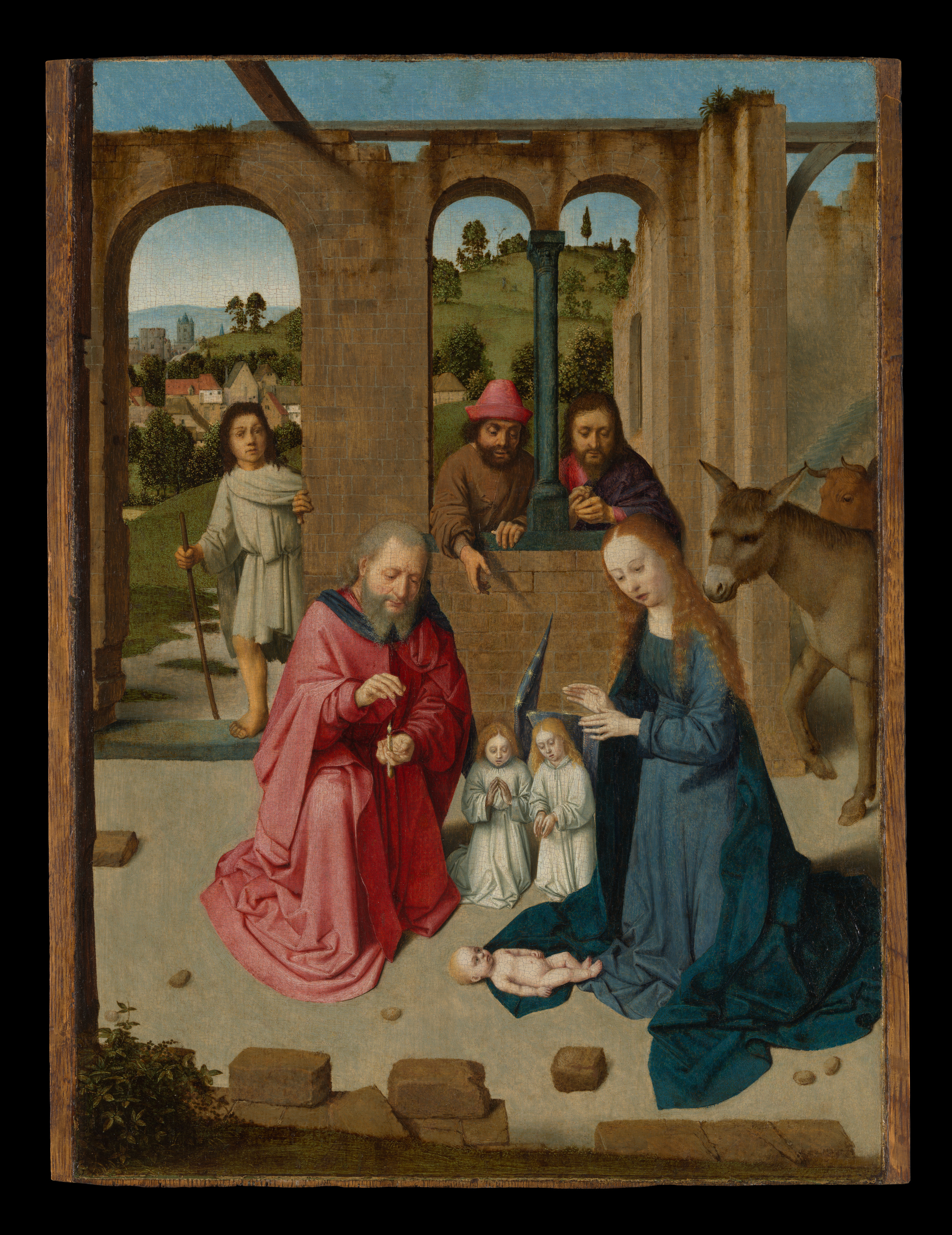
Gerard David (Netherlandish, ca. 1455–1523), The Nativity, early 1480s. Oil on wood, 18 3/4 × 13 1/2 in. (47.6 × 34.3 cm). Metropolitan Museum of Art, New York.
LISTEN: “Where Is This Stupendous Stranger” | Words by Christopher Smart, 1765 | Music by Linda L. Hanson, 2012 | Performed by Fire (women’s a cappella chamber ensemble), 2020
Where is this stupendous Stranger? Prophets, shepherds, kings, advise! Lead me to my Master’s manger, Show me where my Savior lies.
O most mighty, O most holy, Far beyond the seraph’s thought, Are you then so mean and lowly As unheeded prophets taught?
O the magnitude of meekness, Worth from worth immortal sprung! O the strength of infant weakness, If eternal is so young!
God all-bounteous, all-creative, Whom no ills from good dissuade, You have come to be a native Of the very world you made.
The four verses of this Christmas hymn are excerpted from a nine-stanza poem by Christopher Smart [previously] published in Hymns and Spiritual Songs for the Fasts and Festivals of the Church of England (London, 1765). The poem was recovered in the twentieth century and since then has received multiple new musical settings—by composers such as I-to Loh, Charles Heaton, Conrad Susa, Joan A. Fyock, Leo Nestor, Alec Wyton, Thomas Gibbs Jr., Scott M. Hyslop, and Jacques Cohen—as well as pairings with older tunes.
My favorite setting of the text is by Linda L. Hanson, the founding director of Fire, a women’s a cappella chamber ensemble in Charlottesville, Virginia. The group performs the hymn in the video above, which Fire member Mary Welby von Thelen spliced together from thirteen solitary recordings during the COVID-19 pandemic. Hanson is in the top row, the third from the left.
The alliterative opening line of the hymn asks where the “stupendous Stranger” can be found—the divine one sent from heaven. Stupendous isn’t an adjective we use often. It means “causing astonishment or wonder: awesome, marvelous.” The poetic speaker begs the prophets, shepherds, and magi to divulge the location of the Christ child so that he can go and worship him.
The next two stanzas marvel at the paradoxes of the Incarnation—how Christ is “mighty” and “holy,” beyond the comprehension of even the angels, and yet “mean” (humble) and “lowly,” lying here in the dirt before us, visible, tangible, vulnerable, no longer far above us but in our very midst. What “magnitude of meekness,” what “strength of infant weakness.” The eternal one is born in time.
The omnibenevolent Creator has deigned to become part of his creation. No potential ill that he will suffer as a result—and he will suffer many and grievous ills, culminating in death by crucifixion—can deter him from making his beloved earth his home.
Hanson has generously allowed me to share the sheet music of “Where Is This Stupendous Stranger,” and says the hymn can be freely used by local church congregations. Anything outside that context will require her permission.





 Art & Theology