If I, your Lord and Teacher, have washed your feet, you also ought to wash one another’s feet. For I have set you an example, that you also should do as I have done to you. . . .
I give you a new commandment, that you love one another. Just as I have loved you, you also should love one another. By this everyone will know that you are my disciples, if you have love for one another.
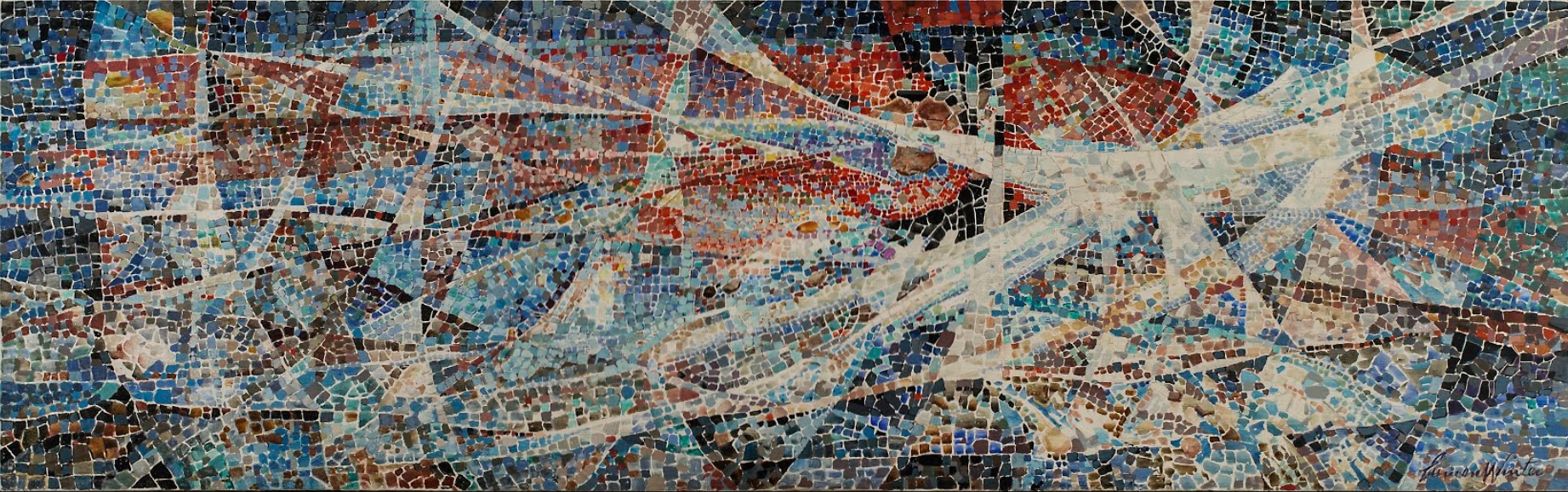
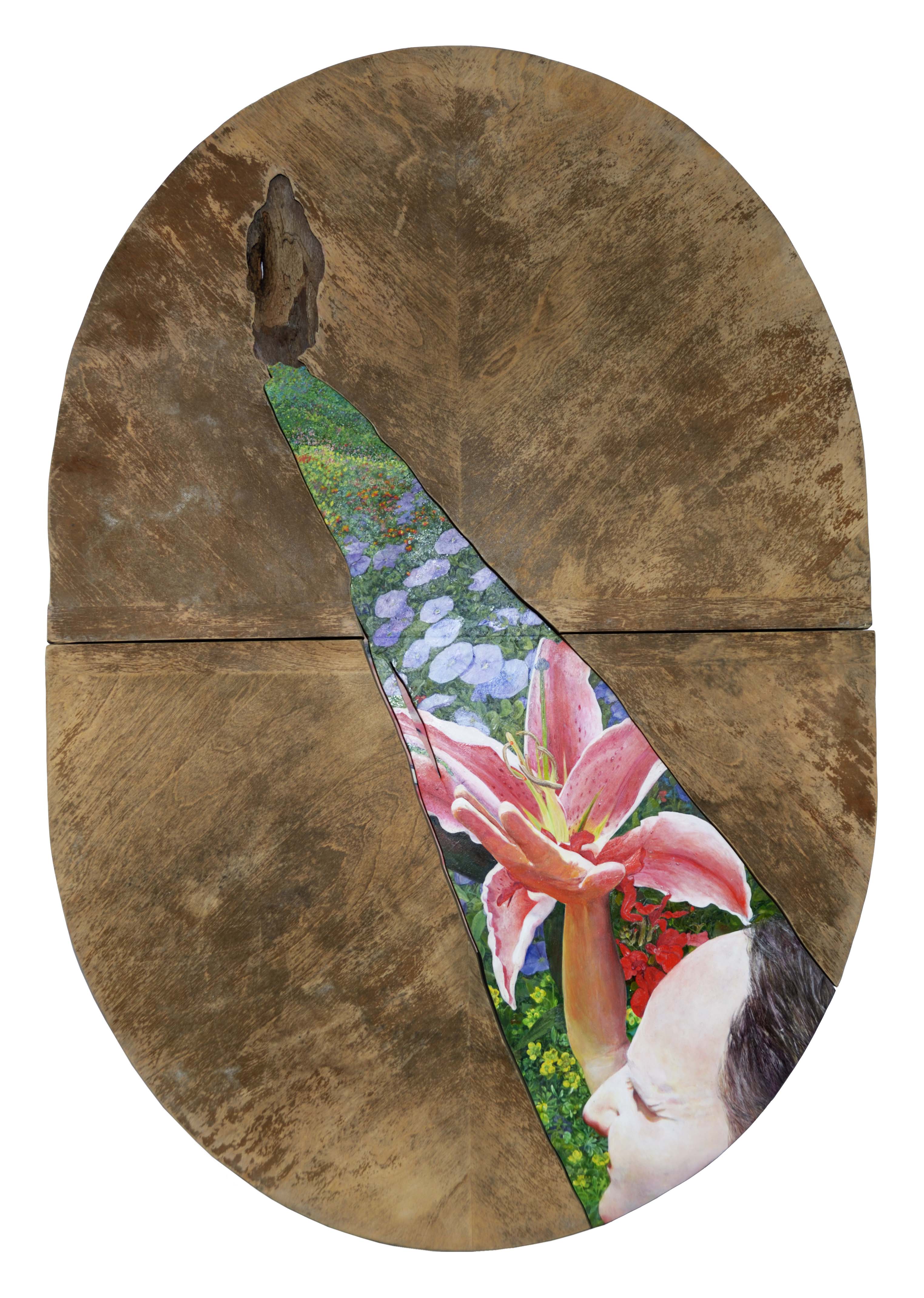
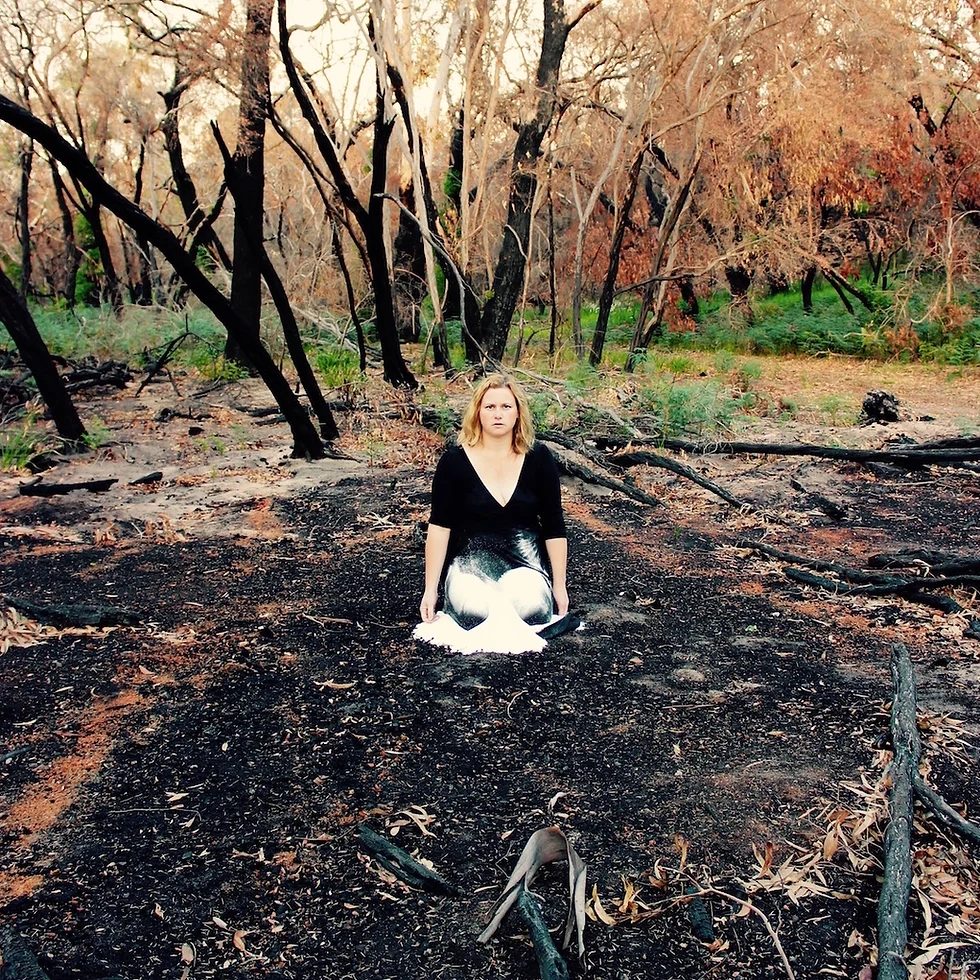
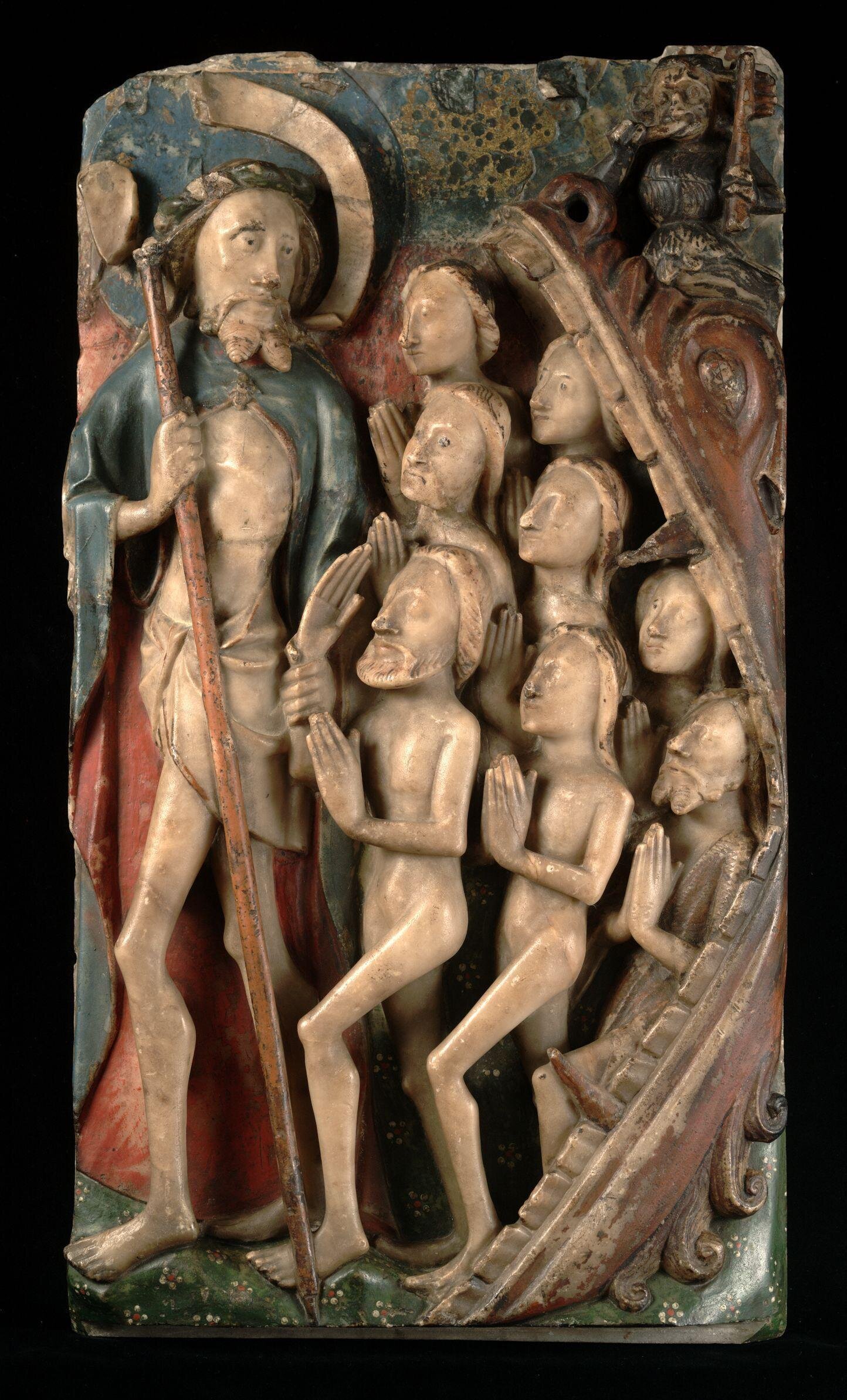
Hyeyoung Shin (Korean American, 1974–), We Are, 2010. Performance, graphite drawings on paper and paper garments, and lithographs on muslin. Big Orbit Gallery, Buffalo, New York.Foot-washing performance by Hyeyoung Shin at the opening of We Are, April 23, 2010, Big Orbit Gallery, Buffalo, New York.
Hyeyoung Shin is a South Korean–born, Kansas City–based artist whose work explores human vulnerability, humility, intimacy, empathy, interpersonal relationships, and belonging.
We Are is the name of a solo exhibition of hers from 2010 consisting of life-size drawings and lithographs of human feet and a foot-washing performance. Shin executed thirty-four graphite drawings on paper as well as on paper garments that she custom-made. The structural anchor of the installation was five muslin panels, each ten yards long, suspended from the ceiling and draped like a hammock. On the upper reaches of each were lithographs of two pairs of legs, and in the bed of the hammock lay a mat, a pillow, and a paper dress. Leading up to the hammock was a long sheet of paper with twelve sets of footprints arranged in two rows, evoking Jesus’s twelve disciples.
Graphite drawing on handmade paper garment with hanji, 2009Lithographs on muslin, approx. 288 × 30 in., 2009–10Graphite drawings on paper, 42 × 64 in., 2009
Shin enacted the foot washings herself. She said that “through the experiences, I began to learn again how to practice love akin to holding my mother’s feet” as she lay dying of a terminal illness. The physical proximity and tender touch at that gallery event opened up channels of empathy between the artist and participants.
LISTEN: “Reverie: This is my will,” arr. Anne-Marie O’Farrell, on Easter in Ireland: Music for the Paschal Season (2020)
Rev. Dr. Anne-Marie O’Farrell, a harpist, composer, and Church of Ireland minister from Dublin, wrote this reverie on the Maundy Thursday hymn “This Is My Will” for solo lever harp in 2019. (A reverie is an instrumental piece suggesting a dreamy or musing state.) The Jesuit priest James Quinn (1918–2010) of Scotland wrote the hymn text, reproduced below, in 1969, a paraphrase of John 15:11–17, pairing it with a traditional Irish suantraí (lullaby) melody. It is that melody—which in Ireland has come to be associated with Holy Week, thanks to Quinn—that O’Farrell has arranged here. Purchase sheet music for O’Farrell’s harp reverie, or an arrangement for SATB voices and solo.
This is my will, my one command, that love should dwell among you all. This is my will, that you should love as I have shown that I love you.
No greater love a man can have than that he die to save his friends. You are my friends if you obey all I command that you should do.
I call you now no longer slaves; no slave knows all his master does. I call you friends, for all I hear my Father say you hear from me.
You chose not me, but I chose you, that you should go and bear much fruit. I called you out that you in me should bear much fruit that will abide.
All that you ask my Father dear for my name’s sake you shall receive. This is my will, my one command, that love should dwell in each, in all.
Jesus speaks this discourse after washing his disciples’ feet the day before his death. The name traditionally accorded to Thursday of Holy Week—Maundy Thursday—comes from the Latin word mandatum, “command,” referencing this passage.
When they were approaching Jerusalem . . . they brought the colt to Jesus and threw their cloaks on it, and he sat on it. Many people spread their cloaks on the road, and others spread leafy branches that they had cut in the fields. Then those who went ahead and those who followed were shouting,
Hosanna! Blessed is the one who comes in the name of the Lord! Blessed is the coming kingdom of our ancestor David! Hosanna in the highest heaven!
Then he entered Jerusalem and went into the temple . . .
—Mark 11:1, 7–11
LOOK: Palm Sunday by Kai Althoff
Kai Althoff (German, 1966–), Palmsonntag (Palm Sunday), 2002. Boat varnish, watercolor, and tinted paper on canvas, 70 × 90 cm. Private collection, Berlin.
In Kai Althoff’s painting of Jesus entering Jerusalem on a donkey, the background pulsates with color and people from all walks of life lay down their garments to carpet his path. There’s a nun and a monk in their habits; two bishops in dalmatics, one of whom casts his mozzetta at Christ’s feet; a choirboy; folks in a coat and tails and party dresses; and others in overalls, sweaters, and wool skirts. On the left, a backpacker passes by, looking behind him with curiosity at the hubbub, while at the bottom right a crowd of haloed people point and gaze—one man even yanks the collar of a friend, trying to pull him closer to the front for a better view.
Several of those present wave palm branches and shout, “Hosanna!,” meaning “Save us!” They quote Psalm 118:25–26: “Save us, we beseech you, O LORD! O LORD, we beseech you, give us success! Blessed is the one who comes in the name of the LORD.” The people recognize Jesus as their delivering Messiah and celebrate.
LISTEN: “Hosanna” by Jacques Berthier, 1978 | Performed by the Paul Leddington Wright Singers on Songs of Taizé, vol. 4 (2006)
Hosanna, hosanna! Hosanna in excelsis!
This Palm Sunday canon (round) is from Taizé, a community of lay brothers in southern France who welcome pilgrims, especially young ones, from all over the world. The Latin in excelsis means “in the highest.”
Though the Hebrew expression that “Hosanna” transliterates was used by Jews as a supplication, a plea, today Christians often use “Hosanna” as a shout of jubilation, an acclamation of praise, in recognition of the salvation Jesus has wrought—so instead of the imperative “Save!,” it’s the exclamative “Salvation!” I think both meanings can hold simultaneously.
This is the first post in a daily series (running through Saturday) in which I’ll highlight a handful of events from Holy Week by choosing a visual artwork and a piece of music that engage with that event. The posts will all be short like this one—I imagine people spending ten minutes or so with each—and are an invitation to prayer and contemplation. For additional music, see the Art & Theology Holy Week Playlist on Spotify.
Heads up: For each day of Holy Week (March 24–30) and the Easter Octave (March 31–April 7), I will be publishing a short post that pairs a visual artwork with a piece of music as a way of inviting you into the narrative. Here are examples from previous years:
VIDEO: “How Jesus Became the King of the World (That He Always Was)”by BibleProject: Written and directed by Jon Collins and Tim Mackie with art direction by Robert Perez, this six-minute animated video explores how Jesus brought God’s kingdom to earth and how we can live under God’s reign today.
+++
SONGS:
>> “Lead On, O King Eternal” (second verse), retuned by John Hatfield: This Palm Sunday hymn was originally written by Ernest W. Shurtleff in 1887 and paired with an older tune by Henry T. Smart. It has largely fallen out of favor due to its cringey first verse, with its militant language of battle and conquest. However, John Hatfield, a singer-songwriter from Houston, calls our attention to the second verse, which reframes what comes before, turning the martial imagery on its head. Our battle, Shurtleff writes in verse 2, is waged not with weapons but with holiness, peace, and deeds of love and mercy. “Let’s be about that, my friends,” Hatfield urges. In this Instagram video he sings “the better verse” of “Lead On, O King Eternal” to a new tune he wrote for it, self-accompanied on ukulele:
>> “Anointed One of God” by Tom Fisher: Written around 2004, Tom Fisher revisited this hymn of his in 2022, updating some of the lyrics. Where he hums, he originally had the word “Hallelujah,” but he wanted to experiment with something more subdued and to honor the tradition, observed in Roman Catholicism, Episcopalianism, and other denominations, of removing the “Alleluias” from worship services during Lent in recognition of the solemnity of the season. The song exalts Jesus as the Christ, literally “Anointed One” (messiah in Hebrew), who, contrary to expectations, fulfilled this identity by being crucified. According to Matthew’s and Mark’s Gospel accounts, an unnamed woman recognized Jesus’s messiahship at a house in Bethany two days before his death, pouring oil on his head—a prophetic act that named him king. The scent probably lingered in his hair and on his body as he went to the cross. [HT: Liturgy Fellowship]
>> “傷跡 (Scars)” by Takafumi Nagasawa, performed by Ruah Worship: A sibling group from Japan covers this contemporary worship song about Jesus taking up his cross and with it the weight of humanity’s sin. “The scars on your hands are the sign of your love for me,” goes the refrain. Turn on Closed Captioning for English subtitles.
+++
VIDEO: “The mystical brilliance of Grünewald’s Isenheim Altarpiece” by Smarthistory: This is one of my all-time favorite artworks—I’ve given talks on it, with a focus on its matchless Crucifixion panel—though I admit I’ve only seen it in books and on screens; it’s on my list of things to see before I die (it’s at the Unterlinden Museum in Colmar, France). Drs. Beth Harris and Steven Zucker have created this excellent video introduction to it, featuring wonderful photography and commentary and an animation that shows the altarpiece’s multiple configurations.
Matthias Grünewald (German, ca. 1470–1528), Crucifixion (detail) from the Isenheim Altarpiece, 1515
+++
INSTRUMENTAL INTERLUDE: “Varsha” by Reena Esmail, for cello or viola, from The Seven Last Words Project: Commissioned by Juilliard Historical Performance to compose an interlude between the “I Thirst” and “It Is Finished” movements of Haydn’s Seven Last Words of Christ, Reena Esmail wrote “Varsha” for cello, drawing on Hindustani raags that evoke rain. (She is one of seven composers who worked on the project, each contributing their own interlude.) In this video it’s performed by Madeleine Bouissou, who premiered it April 16, 2019, at the Cathedral of Saint John the Divine in New York City as part of The Seven Last Words Project.
Describing her artistic vision, Esmail writes, “Christ thirsts. Rain comes from the distance (Megh Malhaar). There is a downpour around him (Miyan ki Malhaar), but he grows slowly weaker. His next words make clear that even the rain is not enough: his thirst is of another sort, which cannot be quenched by water. And so, it is finished.”
Esmail is an Indian American composer living in Los Angeles, known for combining the worlds of Indian and Western classical music in her work.
Kay Nielsen (Danish, 1886–1957), illustration for “The Story of a Mother,” ca. 1910. Pen and black ink and watercolor, heightened with bodycolor and gum arabic, 9 7/16 × 8 1/4 in. (24 × 21 cm).
When I saw this watercolor drawing of a woman embracing a thorny shrub till she drips blood come up in my Instagram feed, I immediately thought of Christ’s passion.
The caption reveals that it’s an illustration by Kay Nielsen for Hans Christian Andersen’s “The Story of a Mother,” a fairy tale written in 1848 and published around 1910 that shows the beauty and intensity of a mother’s love for her child.
The story is about a woman whose young son is gravely ill. One evening, old man Death enters her house and takes the child. Utterly distraught, she runs out after him, seeking to save the boy from Death’s clutches. As she crosses the snowy landscape in search of her son, she is stopped by various beings who request things of her in exchange for help. Night asks her for lullabies. The blackthorn bush asks for warmth. The lake asks for her eyes, clear as pearls, so “she wept till her eyes dropped down to the bottom of the lake.” An old woman who keeps Death’s greenhouse asks for her long black hair. (Oddly, she’s a redhead in Nielsen’s drawing!) Here is the exchange with the blackthorn bush, as translated from the Danish by Jean Hersholt:
At the crossroad grew a blackthorn bush, without leaf or flower, for it was wintertime and its branches were glazed with ice.
“Did you see Death go by with my little child?”
“Yes,” said the blackthorn bush. “But I shall not tell you which way he went unless you warm me against your heart. I am freezing to death. I am stiff with ice.”
She pressed the blackthorn bush against her heart to warm it, and the thorns stabbed so deep into her flesh that great drops of red blood flowed. So warm was the mother’s heart that the blackthorn bush blossomed and put forth green leaves on that dark winter’s night. And it told her the way to go.
The mother fulfills all the demands she encounters in her quest and finally meets Death, who explains that he merely carries out God’s will, which she ought not to disrupt. She ultimately resigns herself in humility to divine providence and lets the child go.
I’m not suggesting that this fairy tale is an allegory of God’s love. That wouldn’t quite make sense, as God is invoked at the end as a character in the story—and, à la the book of Job, as one who sometimes wills death (“The LORD gives and takes away,” Job 1:21).
But the mother’s love in the story is reflective, I find, of the fierce love of God, who is willing to go to any extreme to save his children from Death. He became incarnate and embraced the way of the cross. He took unto himself the crown of thorns, the nails, the humiliation. He sacrificed not just parts of himself but his whole self.
In Nielsen’s illustration, I see a picture of Christ our mother who willingly endured pain to rescue us, the warmth of whose love reverses the curse and brings life.
As an English major in college, I was required to take a course on medieval literature. I had not been looking forward to it—Romantic and Victorian lit were more my thing. I worried that working through Old English and Middle English texts would be a slog. But boy were my expectations upended! I was enthralled by all the imaginative theology I encountered in verse, drama, and sermons, from the Dream of the Rood on down. I went to a public university, but the saturation in Christian thought is unavoidable for students of the history of English literature. After overcoming some hang-ups I had acquired from my fundamentalist Baptist upbringing, I found my faith opened up, strengthened, and inspired by my study of medieval writers. The same has held true in my studies of medieval art.
If you missed the opportunity to study the creative outputs of the Middle Ages in school but want to wade into those waters, you must follow the work of Dr. Grace Hamman, a medieval scholar from Denver who writes and teaches on the great works of that era through her newsletter, podcast, and more recently her first book, Jesus through Medieval Eyes: Beholding Christ with the Artists, Mystics, and Theologians of the Middle Ages (Zondervan, 2023). The book explores seven identities of Jesus—Judge, Lover, Knight, Word, Mother, Good Medieval Christian, and Wounded God—engaging art and literature that develop these tropes, some more familiar to us as moderns than others. Mechthild of Magdeburg, Julian of Norwich, Margery Kempe, Gregory the Great, Fra Angelico, Petrus Christus, Thomas Aquinas, Anselm of Canterbury, and Richard Rolle are among the folks we meet.
The church’s writings and images from the past, Hamman says, are a gift to us in the present that can help us see beyond our time- and culture-bound limitations. “In reading these exploring, adoring, faithful witnesses from the past, we can come to know Jesus—and ourselves—better,” she writes. “What we find strange or beautiful in these medieval witnesses can reveal our concerns, hidden biases, and even new truths. They also teach us new and profound ways to love him” (6).
She continues,
I began reading medieval texts because, to my joyful surprise, I learned that medieval Christians loved Jesus. They wrote about Jesus incessantly, compulsively, athirst with love, devotion, and creativity. They possessed vast Christian imaginations, often more expansive and interesting than many of the Christians who preceded or followed them. I discovered that writers of this period were far more comfortable than we today in thinking about Jesus metaphorically, highlighting particular and peculiar attributes, and crafting new stories about him. Their narrative freedom, delight in allegory and metaphor as paths to truth, and cultural difference offer us the gift of strange new insights—the gift of surprise. (10)
To receive that gift of surprise, Hamman advises, we must approach the texts with a spirit of openness—a willingness to sit with them quietly, attentively, and humbly before making judgments, acknowledging that our own views are not necessarily superior. Then we can welcome in the discernment process, weighing the validity of the picture at hand, determining whether we want to graft it into our understanding of Christ and his work.
I appreciate how Hamman regards the medieval era with neither nostalgia nor negativity. She’s not suggesting we simply embrace medieval theology wholesale, as if it represents some kind of golden age we ought to return to. No, we can and should be critical of certain aspects—but we should first come to these works with a genuine readiness to receive and to learn, not instantly writing them off because they come from a time or tradition we’re not a part of.
Some of the pictures of Jesus that Hamman addresses are
a barefoot knight who jousts with the devil and storms the gates of hell, wearing human nature as his armor
a mother who gestates, gives birth, and breastfeeds
a lover who “forms us in blooming beauty through his tender desire” (53)
In chapter 3, “The Lover,” Hamman includes a woodcut illustration of one of the couplets from the late medieval verse dialogue Christus und die minnende Seele (Christ and the Loving Soul), showing the soul making herself naked before Christ her bridegroom so that they can join in spiritual union. Each gives themselves to the other in vulnerability.
“Christus beraubt die Seele ihrer Kleider, so daß sie nackt ist” (Christ strips the soul of its garments so that it is naked), Germany, ca. 1460. Woodcut illustration from a broadsheet of Christus und die minnende Seele (Christ and the Loving Soul). Albertina Museum, Vienna, Inv. DG1930/197/3.
She also walks us through the anonymous fifteenth-century poem “Quia Amore Langueo,” which brings together the language of romance with imagery of the crucifixion; its Latin refrain, taken from Song of Songs 2:5, translates to “Because I swoon with love.”
It’s important to pay attention to the places in these ancient texts and images that cause discomfort or confusion, as they are often places that helpfully challenge our assumptions today of who God is or what Christianity should look like.
—Grace Hamman, Jesus through Medieval Eyes, pp. 53–54
Jesus through Medieval Eyes introduces the reader to several important medieval texts, including the Old English poem Christ III, concerned with the second coming of Christ; Piers Plowman by William Langland, an allegorical poem in which the narrator, Will, is on a quest for the true Christian life; and the enormously influential Meditationes Vitae Christi (Meditations on the Life of Christ) and its derivative The Mirror of the Blessed Life of JesusChrist by Nicholas Love, who encourages us to exercise our “devout imagination” by envisioning the events of the Gospels. The latter includes charming, homey little narrative details, like Mary using her kerchief as a swaddle for the newborn Jesus, and after his forty-day fast in the desert, Jesus craving his mama’s home cooking.
I admire how Hamman takes art seriously as a theological medium, recognizing how historically, the church has expounded its theology not only through the written word but also through painting and other visual expressions. And so she integrates art images throughout the book, weaving them into her discussion. There are sixteen total, reproduced in black-and-white near the text that refers to them, for convenience, as well as in a color insert, where they can be enjoyed more fully. I wish more theologians and church historians would follow Hamman’s example of drawing on art as a resource for understanding the development of, and for inquiring into and articulating, religious ideas.
But what really sets Hamman apart from other medievalists, in my opinion, is the balance in tone she manages to achieve between academic, devotional, and personal. (It’s something I struggle to achieve as a writer.) She writes with authority but also with an intimacy that is inviting and refreshing. She lets us into her own background and experiences and feelings and is transparent about her enthusiasms and distastes. I feel like she’s a wise old friend conversing with me over a cup of tea. Whether it’s an audio commentary she’s published on her podcast, a Substack missive, or this book, I always come away from her content having learned something, been given something to reflect on or explore further, and been drawn closer to God. She’s a wonderful teacher!
Petrus Christus (Netherlandish, ca. 1410–ca. 1475), Christ as the Man of Sorrows, ca. 1450. Oil on panel, 11.2 × 8.5 cm. Birmingham Museum and Art Gallery, Birmingham, England.
In Jesus through Medieval Eyes, each chapter ends with a scripture, reflection questions, one or two suggested exercises, and a prayer—some sourced from medieval authors, others original.
Each chapter opens with a whimsical line drawing based on medieval manuscript marginalia, which often feature humorous scenarios, like a knight fighting a snail or a rabbit hunting a human! (Role reversals were a favorite form of play for medieval artists.) This design element further immerses the reader in that world. The cover too, its art taken from a French book of hours illuminated by Jean Colombe, gives a sense of the shine of medieval manuscripts with its gilt lettering and halos of the saints.
Hamman has revitalized my interest in medieval literature, in all its wild beauty and strangeness. You may have noticed her influence on my blog over the past few years I’ve been following her. I encourage you to follow her on Twitter @GraceHammanPhD and Instagram @oldbookswithgrace, subscribe to her Medievalish newsletter, and BUY HER BOOK! It would be great material for a Christian book club, and would also make a great gift.
You may also want to check out the recent interview Hamman sat for on The Habit Podcast, part of the Rabbit Room Podcast Network. It’s a terrific introduction to her work:
SPOTIFY PLAYLIST: March 2024 (Art & Theology): My new monthly playlist of thirty songs is up a day early and, as usual, includes both recent releases and older favorites. Let me also point you to the longer, thematically distinct playlists I made for Lent, Holy Week, and Eastertide.
+++
CONCERT: Phantasia performs Biber’s Mystery Sonatas, St Hubert’s Church, Corfe Mullen, England,February 17, March 23, and April 13, 2024: The Mysteries of the Rosary are a set of fifteen meditations on episodes in the lives of Jesus and his mother, Mary. They are divided into three groups: the Joyful Mysteries (the Annunciation, the Visitation, the Nativity, the Presentation of the Infant Jesus in the Temple, the Twelve-Year-Old Jesus), the Sorrowful Mysteries (Christ on the Mount of Olives, the Scourging at the Pillar, the Crown of Thorns, Jesus Carries the Cross, and the Crucifixion), and the Glorious Mysteries (the Resurrection, the Ascension, Pentecost, the Assumption of the Virgin, and the Beatification of the Virgin).
Around 1676, the Bohemian Austrian composer Heinrich Ignaz Franz von Biber (1644–1704) wrote fifteen short sonatas for violin and continuo based on these mysteries. In a free three-part event sponsored by Deus Ex Musica, the newly formed period-instrument ensemble Phantasia will be performing Biber’s Mystery Sonatas at St Hubert’s Church, Corfe Mullen, on the south coast of England, accompanied by commentary by musician and educator Dr. Delvyn Case, who will provide thoughts about the ways each sonata reflects its “mystery,” linking specific elements of the musical structure to themes or ideas in the biblical scene. The performance of the first cycle of the work has already passed, but the remaining two are still upcoming: the Sorrowful Mysteries on March 23 (the Saturday just before the start of Holy Week), and the Glorious Mysteries on April 13.
Case tells me that Deus Ex Musica hopes to eventually provide video excerpts from the performances on their YouTube channel. In the meantime, here’s a little teaser, a snippet from the “Presentation in the Temple” movement, performed by Phantasia musicians Emma-Marie Kabanova on Baroque violin and Chris Hirst on German theorbo (long-necked lute).
+++
ARTICLES:
>> “Mercy at the Movies: Ten Films That Flip the Script” by Meaghan Ritchey, Mockingbird: “Spanning almost a century of cinema, this list of films maps a world—real and imagined—devoid of the mercy for which we all have need, as well as a world animated by unexpected and unearned mercies, flipping the script and leaving the plot forever changed.” What a great list! Number 7 is one of my all-time favorite films.
>> “As If Through a Child’s Inner Eye: The Contemporary Icons of Maxim Sheshukov” by Fr. Silouan Justiniano, Orthodox Arts Journal: In this article from 2016, Fr. Silouan Justiniano, a monk at the Monastery of Saint Dionysios the Areopagite on Long Island, explores the work of contemporary iconographer Maxim Sheshukov (Максим Шешуков) of Pskov, Russia, finding it “exemplary of the diversity and flexibility possible within our ever-renewing and living Tradition.”
Maxim Sheshukov, Zacchaeus, 2015. Egg tempera on gessoed wood.Maxim Sheshukov, Judas, 2020. Egg tempera on gessoed wood.
+++
NEW ALBUMS:
>> Volume 9 (Lent-Easter-Pentecost) of The Soil and The Seed Project: This is the latest release in an ongoing series of music for the church year by musicians of faith from the Shenandoah Valley. Some of my favorite tracks are “I Will Sing to the LORD” (a setting of Psalm 104:33) and “Hosanna, Loud Hosanna” (a newly retuned but old-timey-sounding hymn for Palm Sunday). I also really like “Gentle Shepherd,” a lullaby written for the children of Salford Mennonite Church to sing in worship in 2018 and performed in this music video by the sister folk duo Spectator Bird:
>> Life and Death and Life: Songs for Lent, Holy Week, and Easter by Steve Thorngate: Chicago-based church musician and songwriter Steve Thorngate has followed up his excellent album After the Longest Night: Songs for Advent, Christmas, and Epiphany with an album for the next two seasons of the church year, including the Day of Pentecost! In addition to twelve original songs, it includes two African American spirituals, a Charles Tindley hymn, and, perhaps my favorite, a cover of (new-to-me) Brett Larson’s poetic country song “Rolling Away,” about barriers to sight and wholeness being removed and a fresh new clarity, a freedom, a path opening up:
>> JOY JOY JOY JOY JOY by Paul Zach: The ever prolific Paul Zach of Virginia’s latest release is an effusively joyous ten-track album celebrating God’s love, salvation, and sustenance. He collaborated with other musicians on the project, including Jon Guerra, Tristen Stuart-Davenport, and IAMSON. Here’s a snippet of the opening song, “Nothing,” based on Romans 8 (listen to the full track here):
BOOK: Meditations of the Heartby Howard Thurman (1953): I’ve just finished reading this book, and I think it would make an excellent companion for Lent. Written by Rev. Dr. Howard Thurman, a minister, theologian, professor, and civil rights leader, it consists of 152 one- to two-page meditations that he originally wrote for use by the congregation of Fellowship Church in San Francisco, a racially integrated, interdenominational church he cofounded in 1944. Some of the entries are prayers, some anecdotes, some reflections on scripture or spiritual topics, some expressions of desire or intent. For me, the book really started picking up in the second half. In part 5, several of the meditations begin and/or end with a mantra-like saying, such as “I will keep my heart open to truth and light” or “Teach me to affirm life this day!”—something short and memorizable to keep in the pocket of your heart and turn over and over.
Here’s an example of one of the meditations:
I want to be more loving. Often there are good and sufficient reasons for exercising what seems a clean direct resentment. Again and again, I find it hard to hold in check the sharp retort, the biting comeback when it seems that someone has done violence to my self-respect and decent regard. How natural it seems to “give as good as I get,” to “take nothing lying down,” to announce to all and sundry in a thousand ways that “no one can run over me and get away with it!” All this is a part of the thicket in which my heart gets caught again and again. Deep within me, I want to be more loving—to glow with a warmth that will take the chill off the room which I share with those whose lives touch mine in the traffic of my goings and comings. I want to be more loving!
I want to be more loving in my heart! It is often easy to have the idea in mind, the plan to be more loving. To see it with my mind and give assent to the thought of being loving—this is crystal clear. But I want to be more loving in my heart! I must feel like loving; I must ease the tension in my heart that ejects the sharp barb, the stinging word. I want to be more loving in my heart that, with unconscious awareness and deliberate intent, I shall be a kind, a gracious human being. Thus, those who walk the way with me may find it easier to love, to be gracious because of the Love of God which is increasingly expressed in my living.
Included in the volume are prayers for a gracious spirit in dealing with injustice, for placing our “little lives” and “big problems” on God’s altar, for laying ourselves bare to God’s scrutiny, for “when life grows dingy,” for the kindling of God’s light within us, “to be more holy in my words,” to learn humility from the earth, and for an enlarged heart that makes room for Peace.
+++
DOCUMENTARY: Unspoken, dir. Christopher Lamark (2022): This feature-length film takes an in-depth look at early African Christianity and its enduring heritage in African diaspora communities in America, dispelling the notion that Christianity is exclusively a white man’s religion. Director Christopher Lamark and his team interview historians, religious scholars, and cultural influencers, including Dr. Vince Bantu, Rev. Dr. Esau McCaulley, Rev. Dr. Charlie Dates, Lecrae Moore, and Sho Baraka, who reveal that Africans accepted Christianity of their own agency long before colonization or the slave trade, not just in the North but in sub-Saharan Africa as well. Bantu even points out that the Reformation was well underway in Africa a hundred years before Martin Luther, as the Ethiopian Christian monk Estifanos led a movement to bring the church’s practices more in line with scripture and to challenge abuses.
The false narrative that the Black church was born from those who drank the Kool-Aid served to them by their white oppressors has done a lot of damage, imposing shame and deterring young Black people from the Christian faith. That’s why it’s so important to correct this misinformation, to let people know that colonialism and slavery didn’t bring Christianity; it mutated it. At a time when much of white America was corrupting the gospel, Blacks preserved it, their ancient religious heritage, for subsequent generations.
SYMPOSIUM: Embodied Faith and the Art of Edward Knippers, September 20–21, 2024, Gordon-Conwell Theological Seminary, Charlotte, NC: Sponsored by the Leighton Ford Initiative in Theology, the Arts, and Gospel Witness, this year’s Gordon-Conwell theology and arts symposium will center on the paintings of Edward Knippers, from Arlington, Virginia. In addition to an exhibition of over two dozen of Knippers’ works, there will be talks by artists Steve Prince, Bruce Herman, and Rondall Reynoso and theologians Natalie Carnes, W. David O. Taylor, and Kelly Kapic, as well as a dance performance by Sarah Council and a drum circle led by Olaniyi Zainubu and David Drum.
Edward Knippers (American, 1946–), The Resurrection of Our Lord, 2007. Oil on panel, 8 × 12 ft.
“‘Disembodiment is not an option for the Christian.’ This statement by visual artist Edward Knippers is a guiding principle in his work, which features the human body, often in connection with biblical scenes. Disembodiment is not an option for those who believe that human beings are created in God’s image with beautiful bodies, that everything from sin to salvation are embodied experiences, and that God’s redemption comes through the broken and risen body of Jesus. The paintings of Edward Knippers invite us to consider the goodness, brokenness, mystery, and glory of Christ’s body as well our own, urging us to grapple with the temptation to avoid, sexualize, downplay, or disparage bodies along with a fully embodied faith.”
I signed up! The early-bird discount is $20 off and ends March 1.
+++
SONGS:
>> “Give Me a Clean Heart” by Margaret Douroux, sung by Everett Harris and friends: Written in 1970 by Dr. Margaret Pleasant Douroux, this song of penitence based on Psalm 51:10 is a gospel classic. In the 2020 video below, it’s sung a cappella by a six-person virtual choir, using an arrangement by Adoration ’N Prayze. To hear it sung in a Black church context, led by Rev. Dr. E. Dewey Smith Jr., click here.
>> “Psalm 50” (Psalm 51) in Aramaic by Seraphim Bit-Kharibi: Father Seraphim Bit-Kharibi is an Assyrian Orthodox monk who is the archimandrite (head) of the Monastery of the Thirteen Holy Assyrian Fathers in Dzwell Kanda, Georgia. He is Assyrian by ethnicity, and his native language is Aramaic, the language of Jesus. Here he chants Psalm 51 (Psalm 50 in the Greek numbering system) in Aramaic with his church choir, which appears on his 2018 album Chanting in the Language of Christ. In the following video, the singing starts fifty-one seconds in.
My people, Assyrians, . . . still pay with their lives for their worship of Christ. In Eastern countries such as Iraq, Iran, Syria, and other warzones, Assyrians get attacked in their churches and beheaded if they refuse to convert to Islam. They are being destroyed en masse.
As for Assyrians in Georgia, there are about 4,000 of them. The Assyrian language is basically Neo-Aramaic, which is about 2,500 years old. The wonderful thing is that this language allows us insight into what people living centuries ago sounded like. Out of 4,000 Assyrians living in Georgia, 2,000 of them live in my village of Kanda and comprise 95 percent of its population. Almost 90 percent of these people speak Neo-Aramaic.
+++
ART COMMENTARIES: Lent Stations: Vices and Virtues: To promote art-driven contemplation around Lenten themes, this Lent the Visual Commentary on Scripture is spotlighting fourteen artworks from its archives based on the seven deadly sins and seven virtues. So far they’ve featured a pair of medieval statues personifying the Synagogue and the Church, a diamond-encrusted skull by Damien Hirst, a Rubens painting of Cain murdering Abel, and an Egyptian textile roundel depicting scenes from the life of Joseph.
Damien Hirst (British, 1965–), For the Love of God, 2007. Platinum, diamonds, and human teeth, 17.1 × 12.7 × 19 cm.
All photos in this post, except for the last one (of the processional icon), are my own.
(Note: WordPress seems to have disabled the feature that allows you to expand an image upon clicking, but if you’re reading on a computer, you can right-click an image and open it in a new tab to view it in full resolution; if you’re reading on a phone, you can pinch to zoom.)
Located in the Horn of Africa and with access to the Red Sea, Nile River, Mediterranean Sea, and Indian Ocean, Ethiopia stands at the nexus of historical travel, trade, and pilgrimage routes that brought it into contact with surrounding cultures and influenced its artistic development. Coptic Egypt, Nubia, South Arabia, Byzantium, Armenia, Italy, India, and the greater African continent were among those influencers. But Ethiopia not only absorbed influences; it transmitted them too.
A major art exhibition is centering Ethiopia’s artistic traditions in a global context. For Ethiopia at the Crossroads at the Walters Art Museum in Baltimore (running through March 3), curator Christine Sciacca has brought together more than 220 objects from the Walters’ own extraordinary Ethiopian art collection and private and institutional lenders both domestic and international. Icons, wall paintings, processional crosses and hand crosses, illuminated Gospel books and psalters, sensuls (chain manuscripts), healing scrolls, and more are on display throughout the galleries, whose walls have been painted bright green, yellow, and red—the colors of the Ethiopian flag. To round off the exhibition, guest curator Tsedaye Makonnen, an Ethiopian American multidisciplinary artist, was tasked with curating a few works from contemporary artists of the Ethiopian diaspora.
The majority of objects are Christian, made for liturgical or private devotional use. Ethiopia is one of the world’s oldest Christian nations: in the early fourth century, persuaded by a missionary from Syria, King Ezana of Aksum embraced Christianity, and it has been the dominant religion of Ethiopia ever since. But the exhibition does also include some Islamic and Jewish objects.
One of the first works you’ll encounter is a mural that would have originally been mounted on the outer wall of an Ethiopian Orthodox church sanctuary (mäqdäs), portraying the Nativity, the Presentation of Christ in the Temple, and the Adoration of the Magi.
Nativity, Presentation of Christ in the Temple, and Adoration of the Magi, Ethiopia, 18th century. Glue tempera on overlapping canvas pieces mounted to a new stretched canvas, 49 3/16 × 66 15/16 in. (124.9 × 170 cm). Walters Art Museum, Baltimore. [object record]
Remarkably, at the Nativity, there is a feast taking place, and Jesus is feeding his mother with what looks like a Communion wafer! As the theologian Lester Ruth has said, “The sound from most baby beds is a cry to be fed. But the cry from the manger is an offer to feed on his body born into this world.”
One of history’s most famous Ethiopian painters is Fre Seyon, who worked at the court of Emperor Zara Yaqob (r. 1434–1468) and was of the first generation of Ethiopian artists who painted icons on wood panels. He was also a monk. He likely introduced one of the characteristic features of Ethiopian icons of the Virgin and Child: the archangels Michael and Gabriel flanking them with drawn swords, acting as a kind of honor guard.
Fre Seyon (Ethiopian, active 1445–1480), Triptych Icon with the Virgin Mary and Christ Child Flanked by Archangels and Saints (center), Twelve Apostles and Saints (left), and Prophets and Saints (right), mid- to late 15th century. Tempera on gesso-primed wood. Institute of Ethiopian Studies, Addis Ababa University, acc. no. IESMus4186.
My two favorite details of this triptych by Fre Seyon are (on the right wing) the image of the Ancient of Days surrounded by the tetramorph, his wild gray locks being blown about, and in the center, the bird that Christ holds, its feet grasping at a three-branched twig. On a literal level, the bird is a plaything for the boy that charmingly emphasizes his humanity (in the late Middle Ages, at least in Europe—I’m not sure about in Ethiopia—it was common for young children to keep tame birds as pets). On another level, the bird may be symbolic. In traditional Western art, Jesus sometimes holds a goldfinch, a bird with distinctive red markings that’s fond of eating thistle seeds and gathering thistle down and thus came to be read as a prefiguration of Christ’s thorny, blood-spilt passion. I’m not sure whether Fre Seyon intended a symbolic significance for this bird.
Here’s another triptych from the exhibition, this one from a century and a half later:
Triptych Icon with the Virgin Mary and Christ Child Flanked by Archangels, Scenes from the Life of Christ, Saint George, and Saints Honorius, Täklä Haymanot, and Ewostatewos, Ethiopia (Tigray), early 17th century. Glue tempera on panel, 16 3/4 × 22 5/16 in. (42.5 × 56.7 cm). Walters Art Museum, Baltimore. [object record]
The composition of the Virgin and Child is based on prints of a painted icon from Santa Maria Maggiore in Rome brought to Ethiopia by Portuguese Jesuit missionaries—but it innovates. As the wall text notes, “Mary’s cloak stretch[es] out in either direction to embrace the scene of Christ Teaching the Apostles below. Umbrella-like, Mary appears as both the protector and personification of the church.”
On the right wing, angels hold up chalices to collect the blood that flows from Jesus’s wounds on the cross, while below that, Joseph of Arimathea and Nicodemus carry Jesus’s wrapped corpse to the tomb. On the left wing is one of my favorite traditional religious scenes: the Harrowing of Hell, or Christ’s Descent into Limbo, in which, on Holy Saturday, Jesus enters the realm of his dead to take back those whom Death has held captive, first of which are our foreparents Adam and Eve. Below that scene is an image of the dragon-slaying Saint George, a late third-century figure from the Levant or Cappadocia who is the patron saint of Ethiopia.
At the bottom center is a scene of Christ teaching the twelve apostles, plus two Ethiopian saints. They all hold hand crosses, like those carried by Ethiopian priests and monks.
Hand Cross with Figure, Ethiopia, probably 18th–19th century. Wood, 13 3/8 × 4 3/16 × 9/16 in. (34 x 10.7 × 1.4 cm). Walters Art Museum, Baltimore. [object record]Coptic-Arabic Book of Prayer, Egypt, 18th century. Tempera and ink on parchment, 11 3/4 × 9 in. (29.8 × 22.8 cm). Melikian Collection. [object record]
One of the hallmarks of the exhibition is its multisensory nature: attendees are immersed not only in the sights of Ethiopia but also in the sounds and smells. Scratch-and-sniff cards invite people to take a whiff of frankincense, which would have filled the censer on display. Or to smell berbere, a hot spice blend that would have been stored in the woven baskets nearby.
This olfactory element was produced by the Institute for Digital Archaeology, which, as part of its efforts to record and preserve ephemeral culture, has launched an ambitious program to preserve the heritage of smells. “The aim is to provide the technical means for documenting the aromas of today for the benefit of future generations – and to find new methods and opportunities for experiencing the odors of the past.”
Also in the exhibition there are screens where you can watch videos of Ethiopian Orthodox worship, including music and liturgies, where you will see some of the objects in use. You can also listen to interviews with members of the local Ethiopian diaspora community. (The Washington metropolitan area has the largest Ethiopian population outside Ethiopia.)
Further contextualizing the objects and enhancing the sense of place, pasted onto the wall is a blow-up photograph of a Christian holy-day celebration wending through the streets. This serves as a backdrop to two physical artifacts present in the room: a qämis (dress) and a debab (umbrella).
The inscriptions on many of the Ethiopian icons and manuscript illuminations, which identify the figures and scenes, are in Ge‘ez (aka classical Ethiopic), an ancient South Semitic language that originated over two thousand years ago in what is now northern Ethiopia and Eritrea. It’s no longer spoken in daily life, but it is still used as the language of the Ethiopian Orthodox Church and taught to boys in Sunday school. I really wish I could read it, as it would be a great help in interpreting the Ethiopian images I come across in my studies!
Contrary to what some may assume, Ethiopians in the medieval era were not an isolated people. They traveled—to Rome, to Jerusalem, and so forth. Evidence of Holy Land pilgrimage is suggested by an early fourteenth-century Gospel book that includes the domed Church of the Holy Sepulcher as the backdrop for Christ’s resurrection:
Gospel Book with the Crucifixion and Christ’s Resurrection, Ethiopia (Tigray), early 14th century. Ink and paint on parchment, 10 1/2 × 6 11/16 in. (26.7 × 17 cm). Walters Art Museum, Baltimore, W.8.36, fols. 6v–7r. [object record]
This is an extraordinary book, one of the oldest surviving Ethiopian manuscripts and the oldest in North America. Ethiopian artists weren’t yet depicting Jesus on the cross, so to represent the Crucifixion, this artist has painted a living lamb surmounting a bejeweled cross, with the two thieves crucified on either side.
Also from the fourteenth century, a manuscript opened to a page spread of Christ’s Entry into Jerusalem:
Christ’s Entry into Jerusalem, folios added from an earlier Gospel book to a Ta’ammera Maryam manuscript, Ethiopia, 14th century. Tempera and ink on parchment. Private collection.
I like how the scene extends across both pages, creating a sense of forward progression, and the two onlookers above the city gate.
One of my favorite objects from the exhibition is a sensul from Gondar depicting ten scenes from the life of Mary. A sensul is an Ethiopian chain manuscript, in this case pocket-size, created out of a single folded strip of parchment attached to heavy hide boards at each end, which creates a small book when folded shut. Here’s a detail showing the Annunciation:
Annunciation, from a Gondarine sensul (chained manuscript), Ethiopia (Gondar), late 17th century. Ink and paint on parchment, each panel 3 5/8 × 3 1/8 in. (9.2 × 9 cm). Walters Art Museum, Baltimore. [object record] [GIF]
It’s a common misconception that Ethiopians have always depicted biblical figures as dark-skinned to reflect the local population. Such treatment didn’t become normative until the eighteenth century, although some earlier artists did choose black complexions for holy persons:
Virgin and Child, from a Psalter with the Wəddase Maryam (Praise of Mary) and Mähalǝyä Näbiyyat (Canticles of the Prophets), Ethiopia, 15th century. Ink and pigments on parchment with wooden boards, open: 8 7/8 × 6 11/16 × 3 15/16 in. (22.5 × 17 × 10 cm). Toledo Museum of Art, Ohio. [object record]The Opening of the Gospel of John, from a Gospel book, Ethiopia, ca. 1504–5. Tempera on parchment, 13 9/16 × 10 7/16 in. (34.5 × 26.5 cm). J. Paul Getty Museum, Los Angeles, Ms. 102, fols. 215v–216r. [object record]Triptych Icon with the Virgin Mary and Christ Child Flanked by Archangels (center), the Kwer‘atä re’esu (Man of Sorrows) and Saint George (left), and Saint Gäbrä Mänfäs Qeddus and Abba Arsanyos (right), Ethiopia (Gondar), late 17th–early 18th century. Tempera on gesso-primed wood. Institute of Ethiopian Studies, Addis Ababa University, acc. no. IESMus3492.
In the triptych shown above, not only is the infant Jesus depicted as Black, but he also wears a necklace made of cowrie shells, which are traditionally given to Ethiopian children for protection!
My favorite artwork from the exhibition is probably this triptych:
Triptych Icon with the Crucifixion (center), Entombment and Guards at the Tomb (left), and Temptation in the Wilderness and the Resurrection of Christ (right), Ethiopia, late 16th century. Tempera on gesso-primed wood. Institute of Ethiopian Studies, Addis Ababa University, acc. no. IESMus4126.
Its central panel depicts the Crucifixion, Christ’s head bowed in death and his fingers gesturing blessing, even as his palms are nailed. At the top, the sun and the moon mourn his passing. As we saw before, angels catch the blood that drips from his body (notice the cute little hand sticking out from behind his torso!). At the base, the two larger-scale figures are the Virgin Mary and St. John, while next to Mary on a smaller scale is Longinus, the centurion who pierces Christ’s side with a spear.
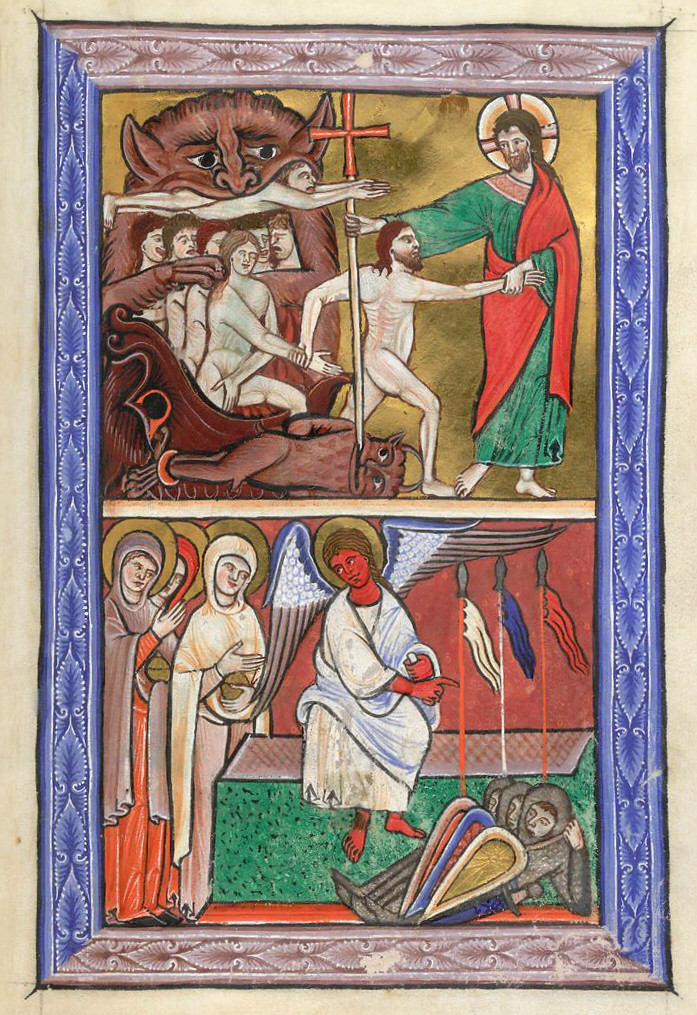
The left wing shows the Entombment of Christ, with two guards, wearing pointed turbans, sleeping at their post. The right wing shows a scene that the label identifies as “Temptation in the Wilderness” (presumably a translation of the inscription on the tree) but that looks to me more like an Agony in the Garden. Below that is the Resurrection, with Christ holding a victory banner, standing atop Hades. An angel blows a shofar and the dead rise up out of their graves, following Christ, the firstfruits of the resurrection (1 Cor. 15:20–22). Christ wears a short-sleeved, knee-length jacket with frog closures, and bunched sleeves and trousers, both of which reflect clothing from regions east of Africa.
The wall text notes the fine, wavy lines used to render the figures’ draperies, perhaps influenced by Armenian artists from the Lake Van region.
Yovsian of Vaspurakan (Armenian), Leaf from a Gospel book with the Resurrection of Christ and Visit of the Women to the Tomb of Christ, ca. 1350. Tempera on cotton paper. Private collection.
Here’s another Crucifixion, this one painted in what’s called the Second Gondarine style, characterized by smoothly modeled figures, often with darker skin tones, and wide horizontal bands of red, yellow, and green filling the background:
Diptych Icon with the Crucifixion (left) and the Mocking of Christ (right), Ethiopia, late 17th–early 18th century. Wood, polychrome, 13 1/2 × 9 7/8 in. (34.3 × 25.1 cm). Virginia Museum of Fine Arts, Richmond. [object record]
The squiggles behind Christ at the top left may simply be a decorative motif, but to me they look like falling stars, an apocalyptic sign, and as if the sky is weeping.
The right panel of the diptych shows Christ being cruelly fitted with a crown of thorns.
Two other passion images I want to share are a Last Supper wall painting and an Entombment from a disbound album.
Last Supper, Ethiopia, 18th century. Tempera on linen, mounted on panel, 16 3/4 × 24 in. (42.6 × 61 cm). Virginia Museum of Fine Arts, Richmond. [object record]Album Leaf with the Entombment of Christ, Ethiopia (Sawa?), late 17th century. Pigments on vellum. Minneapolis Institute of Art, 2009.39.3y. [object record]
In the Last Supper, Jesus and Judas both dip their bread (injera!) into the same bowl and exchange a knowing glance.
In the Entombment, Jesus, wrapped in white linen, is lowered into the ground, mourned by several of his women followers. The portrayal of his mother Mary’s weeping, her hands covering her eyes and her face stained with tears, is particularly poignant. This leaf is from a set of forty-four, now matted separately but originally arranged in series and likely painted on several long sheets of parchment that were sewn together and folded accordion-style to form a sensul.
One of the most extraordinary objects on display is a rare folding processional icon that adopts the form of a fan, from the late fifteenth century:
Folding Processional Icon in the Shape of a Fan, Ethiopia, late 15th century (Stephanite). Ink and paint on parchment, thread, extended: 24 1/4 × 154 1/8 × 4 3/4 in. (61.6 × 391.4 × 12 cm). Walters Art Museum, Baltimore. Photo courtesy of the museum. [object record]
Thirty-eight identically sized figures span the surface of this elongated parchment: the early Christian martyrs Julitta (Juliet) and Cyricus, St. George, St. John the Baptist, the archangel Michael, the Virgin Mary, the archangel Raphael, St. Paul, the Ethiopian artist-priest Afnin, and unidentified Old Testament patriarchs and prophets. There would have been a wooden handle attached to either end that, when pulled together, created a double handle for a giant wheel to be displayed during liturgical processions and church services (see here). As the museum website notes, “The Virgin Mary, whose hands are raised in a gesture of prayer, is then at the top of the wheel. By depicting Mary in the company of saints and angels, the icon powerfully evokes the celestial community of the church.”
This is just a sampling of all the wonderful art objects that are a part of the Ethiopia at the Crossroadsexhibition. I’ll share more photos on Instagram (@art_and_theology) in the coming weeks.
I strongly encourage you to go see this! I think it would be enjoyable for children as well, especially Christian children, who will be able to identify many of the painted stories. For Christians, it’s an opportunity to connect with our artistic heritage and with African church history. If you can’t catch the exhibition at the Walters in Baltimore before it closes March 3, it will be traveling to the Peabody Essex Museum in Salem, Massachusetts (April 13–July 7, 2024), and the Toledo Museum of Art in Ohio (August 17–November 10, 2024).
In this piece, lettering artist and calligrapher Cheryl Dyer of Omaha takes Psalm 90 (traditionally read on Ash Wednesday) as her subject, embellishing excerpts with watercolor and other media. Rattlesnake master is a perennial herb of the parsley family native to the tallgrass prairies of central and eastern North America.
+++
ARTICLE: “The Vindication and Blessing of Lent” by Rev. Dr. Michael Farley, Modern Reformation: I also sometimes receive pushback from others in my Reformed Christian circles for my observance of Lent. I appreciate Farley’s response to such concerns, explaining why he finds Lent—and the liturgical calendar as a whole—biblically, theologically, and practically compelling.
Note: If you’d like a new devotional booklet to work through this Lent that is broadly Reformed and that combines scripture readings, prayers, songs, art, and other elements, I recommend the Daily Prayer Project’s Living Prayer Periodical, which, full disclosure, I had a hand in producing. New for this year’s Lent edition, we’ve added a special page spread for each day of the Triduum: Maundy Thursday, Good Friday, and Holy Saturday. The cover image is of a thirteenth-century Armenian khachkar from the Monastery of Gosh and is one of eight featured artworks inside (three accompanied by written reflections, three by visio divina prompts). If you want to receive a copy by the start of Lent on Wednesday, order the digital version; otherwise, expect a few business days for shipping.
+++
SERMON: “Seasons of the Heart: Preparing for Lent” by James K. A. Smith: Last February, Jamie Smith preached on Ecclesiastes 3:1–8 and John 16:12–15 at his home church, Sherman Street Christian Reformed Church in Grand Rapids, Michigan. He talks about seasonality—how we creatures experience time in seasons, both personally and collectively—and encourages us to ask, “When am I?” Along the way he references Gustavo Gutiérrez, Rita Felski, and Bruce Springsteen. Below is a transcription of 23:42 onward, which I find so resonant. To receive the full force of this conclusion, listen to the whole sermon.
God has more to say to us in his word that we haven’t yet got. There is something in us, for us, in the word that we hear over and over and over again, and the way that we will get to the place of receiving it is precisely by giving ourselves over to the seasons in our lives and letting God do the work in us so that we get new ears, because we have new hearts. This is one of the reasons why . . . repetition is at the heart of the spiritual life. It’s exactly why we keep repeating the liturgical seasons over and over again. Why? Because every single one of us is a different person every time Advent arrives. Every single one of us has undergone something every single time Lent rolls around again.
And so as we’re preparing for Lent—this season of repentance, this season of encountering our mortality—again, I want to encourage us to ask: When am I? When are we? What am I going through? What season am I in? And then from that place, come to Lent with expectation. What does God want to say to me in the now that I find myself? What are you newly ready for because of what you’ve come through? What can Jesus say to you this year that he couldn’t tell you last year?
So many of you are mourning. And the journey of Lent is really a journey of yearning for resurrection. But it passes through the valley of the shadow of death. Unapologetically. And the psalmists’ cries that you’re going to hear in Lent, maybe this year they’re going to give voice to a cry of your own that you didn’t have before. The experience of being bereft on Holy Saturday is going to hit some of you in a way it never has before this year. But maybe that also means that Easter dawns for you in a way it never has before.
Friends, maybe some of you feel, to go back to Ecclesiastes, that it’s a time to build and plant. Because you’ve come through the season of tearing down and uprooting. Maybe this Lent you feel like you’re finally in a place where you can be vulnerable to a God that you finally learned is compassionate, who loves you all the way down. This is a season to build, to plant.
Friends, maybe some of you feel like it’s the time of giving up and throwing away. There is a time for everything, the Teacher tells us. There’s a time to give up, there’s a time to throw away. But maybe it’s precisely what you need to let go of that has been blocking your ability to experience God’s incessant, steadfast, always love.
Whenever you are, whatever season you find yourself in, God has good news to share with you. That’s what we can rely on. No matter what season you’re in, the God who is eternal—the same yesterday, today, and forever—has always a word of good news, because he is always the God with us. He is always Emmanuel. And so this Lent and Eastertide, maybe this is the year you finally get God’s song. You finally hear the song of new life. And friends, I hope you hear that God is singing to you.
+++
VESPERS SERVICES AT CALVIN UNIVERSITY:
I’ve just returned from another inspiring Calvin Symposium on Worship, so grateful for all the gifts and wisdom that were shared. There’s much I could say, but one thing I discovered was how much I loved participating in Vespers, a short evening worship service consisting of scripture readings, prayers, and song (vesper in Latin simply means “evening”). It’s not something that’s regularly offered in my (Presbyterian) tradition, at least not near me. Here are three of the Vespers services that took place this week at Calvin, the latter two at which I was present:
>> Celtic Vespers: “Psalms of Healing and Hope for a Troubled World,” led by Kiran Young Wimberly and The McGraths: This service of psalms set to Celtic melodies was led by Kiran Young Wimberly and The McGraths (a Northern Ireland–based group that performs and records together), Mary Beth Mardis-LeCroy (violin), and Brian Hehn (piano). Since Ash Wednesday is this coming week, I’ll draw your attention especially to “From Dust We Came (Psalm 90)” (see timestamp 15:28), which uses the eighteenth-century Irish tune CASADH AN T’SÚGÁIN. Plus, another highlight for me: “Love and Mercy (Psalm 85),” set to the eighteenth-century Scottish tune LOVELY MOLLY (39:55)—I’ve added this to my Advent Playlist! For more info about the musicians and their work, see https://www.celticpsalms.com/.
>> Jazz Vespers: “Lament as Worship,” led by Ruth Naomi Floyd and her jazz quartet: Ruth Naomi Floyd is a phenomenal jazz vocalist, composer, and fine-art photographer. This liturgy that she crafted and presented is so moving. In her thoughtful selection of readings, Floyd brings a James Baldwin poem into conversation with Psalm 42:7–11 and even includes an amusing proverb from Chinua Achebe’s novel Arrow of God. She also adds a visual element: black-and-white photographic portraits she shot, which were displayed on slides during each segment (not all of them are featured in the video recording).
The musical performance, I hardly have words for. All I can say is, it was utterly engrossing. The expressiveness of Floyd’s voice is unmatched, carrying such pathos. I couldn’t pick a favorite song, but the opening spiritual, “Trouble So Hard” (11:37), hit me forcefully. The first verse talks about a mountaintop experience of spiritual ecstasy (“getting happy” refers to being filled with the Spirit), and that’s contrasted in the second verse with a descent into the valley of deep suffering and grief. The refrain asserts to God, seeking divine consolation, “Oh Lord, trouble so hard,” and then testifies that only God truly knows our troubles. Also take note of the concluding song, “Press On” (34:31), an original Floyd composition whose text is taken from the writings of Frederick Douglass, part of a larger body of work that has been recorded and will most likely be released by the end of this year, Floyd told me; see https://frederickdouglassjazzworks.com/.
The amazing instrumentalists are James Weidman (piano), Keith Loftis (saxophone), Matthew Parrish (bass), and Mark Prince (drums).
>> Choral Vespers: “Christ, Holy Vine, Christ, Living Tree,” led by David M. Cherwien and The Choral Scholars: Led by the West Michigan chamber ensemble The Choral Scholars and organist/pianist David Cherwien, this service centers on botanical imagery of Christ and his people—such a generative idea! I enjoyed singing Gerald Cartford’s responsorial setting of Psalm 141:1–4a and 8 (see timestamp 12:48); the refrain is “Let my prayer rise before you as incense; and the lifting of my hands as the evening sacrifice” (the plant connection is that incense is derived from fragrant gum resins, i.e., tree sap). Also, this was my first time hearing Elizabeth Poston’s “Jesus Christ, the Apple Tree” performed live (20:48), and the first time its words truly registered with me.
+++
PRAYER-POEM: “Marked by Ashes” by Walter Brueggemann: “. . . On this Wednesday, we submit our ashen way to you—you Easter parade of newness. Before the sun sets, take our Wednesday and Easter us, Easter us to joy and energy and courage and freedom . . .” This prayer by the Old Testament scholar and theologian Walter Brueggemann, from his book Prayers for a Privileged People (2008), is ostensibly for any ol’ Wednesday in the church year, but it could be used, with one small elision, for Ash Wednesday itself. I love how it reads Easter backward into Lent, recognizing that the fruits of Christ’s resurrection are borne all year round.
P.S. This year, Ash Wednesday falls on February 14, Valentine’s Day. It did too in 2018; read the poem by Luci Shaw that I published for that occasion.
Two major exhibitions of African art are currently running in Manhattan and Baltimore, containing many Christian objects, some of them never before seen in the US. I attended both, and they’re excellent. I want to write a full-on review for each, but because I don’t know that I’ll have time to do so before they close, I wanted to at least make you aware of them in this abbreviated form in the hopes that you’ll have a chance to go see them. I will share more photos soon.
>> Africa & Byzantium, Metropolitan Museum of Art, New York City, November 19, 2023–March 3, 2024: Curated by Dr. Andrea Myers Achi. “Art history has long emphasized the glories of the Byzantine Empire (circa 330–1453), but less known are the profound artistic contributions of North Africa, Egypt, Nubia, Ethiopia, and other powerful African kingdoms whose pivotal interactions with Byzantium had a lasting impact on the Mediterranean world. Bringing together a range of masterworks—from mosaic, sculpture, pottery, and metalwork to luxury objects, paintings, and religious manuscripts—this exhibition recounts Africa’s central role in international networks of trade and cultural exchange. With artworks rarely or never before seen in public, Africa & Byzantium sheds new light on the staggering artistic achievements of medieval Africa. This long-overdue exhibition highlights how the continent contributed to the development of the premodern world and offers a more complete history of the vibrant multiethnic societies of north and east Africa that shaped the artistic, economic, and cultural life of Byzantium and beyond.”
The Annunciation, from a miscellany, Egypt, Fayyum Oasis, 913–14. Ink on parchment, 10 9/16 × 13 13/16 in. (26.8 × 35.1 cm). Collection of the Morgan Library and Museum, New York. Photo: Victoria Emily Jones.Diptych with Saint George and the Virgin and Child, Ethiopia, late 15th–early 16th century. Paint on wood, 20 1/2 × 26 5/16 × 1 3/16 in. (52 × 66.8 × 3 cm). Collection of the National Museum of African Art, Smithsonian Institution, Washington, DC. Photo: Victoria Emily Jones.
Exhibition tour:
Smarthistory video of one of the extraordinary early icons on display, borrowed from St. Catherine’s Monastery in Mount Sinai, Egypt:
>> Ethiopia at the Crossroads, Walters Art Museum, Baltimore, December 3, 2023–March 3, 2024: Curated by Dr. Christine Sciacca. “Ethiopia at the Crossroads is the first major art exhibition in America to examine an array of Ethiopian cultural and artistic traditions from their origins to the present day and to chart the ways in which engaging with surrounding cultures manifested in Ethiopian artistic practices. Featuring more than 220 objects drawn from the Walters’ world-renowned collection of Ethiopian art and augmented with loans from American, European, and Ethiopian lenders, the exhibition spans 1,750 years of Ethiopia’s proud artistic, cultural, and religious history.
“Seated in the Horn of Africa between Europe and the Middle East, Ethiopia is an intersection of diverse climates, religions, and cultures. Home to over 80 different ethnicities and religious groups, a large portion of the historic artistic production in Ethiopia supported one of the three Abrahamic faiths (Judaism, Christianity, and Islam), all of which have early roots in Ethiopia. As one of the oldest Christian kingdoms, Ethiopian artists produced icons, wall paintings, crosses of various scales, and illuminated manuscripts to support this religious tradition and its liturgy. . . .”
The exhibition will travel to the Peabody Essex Museum in Salem, Massachusetts, April 13–July 7, 2024, and to the Toledo Museum of Art in Ohio August 17–November 10, 2024.
Detail of a sensul (chained manuscript), Ethiopia, 15th–early 16th century. Parchment, ink, paint, and leather. Collection of the Peabody Essex Museum, Salem, Massachusetts. Photo: Victoria Emily Jones.Mänbärä Tabot Icon with Eight Panels and Painted Scenes, Ethiopia, ca. 1850. Carved wood and glue tempera. Private collection, United States. Photo: Victoria Emily Jones.
Also, as Lent starts on February 14, don’t forget about my Lent playlist! Since its original publication in 2021, I’ve added songs to the bottom.
+++
BLOG POST: “The True Purpose of Theology” by W. David O. Taylor: Professor Taylor shares seven things about theology that he opens his first theology class lecture with each term at Fuller. So important. I hope I reflect these on my blog.
>> Sung by Kristyn Getty and Dana Masters: Keith and Kristyn Getty, a powerhouse couple in the Christian music industry, have chosen “O Love That Wilt Not Let Me Go” as their Family Hymn of the Month for February, providing some background on the writer, a free sheet music download of their arrangement, and a video performance from 2021 with guest vocalist Dana Masters. The Gettys’ large platform among evangelicals is sure to get this lesser-known hymn into many homes!
>> Sung by Westminster Chorus: Here Westminster Chorus (from Westminster, California) performs David Phelps’s a cappella arrangement of the hymn in Petrikirche in Dortmund, Germany. I previously shared a video of Phelps singing this version with three of his fellow Gaither Vocal Band members, which is itself moving, but with a thirty-four-person choir, the effect is tremendous.
+++
VIDEO: The Greeter’s Guild Goes to Times Square: Ryan Pemberton, director of community cultivation for Image journal, introduced me to “the moustachioed motivator of the high street,” Troy Hawke, in the January 18 installment of ImageUpdate. His videos are so delightful! Pemberton writes,
Call me quaint, but at the start of a presidential election year, what I’m most looking for in books, film, and certainly in public life is kindness. Under the circumstances, I can’t stop recommending Troy Hawke to friends. A character created by British comedian Milo McCabe, Hawke is a 1930s throwback, eloquent in speech and dapper in dress. His go-to wardrobe includes a smoking jacket worn over loose-fitting linen pants and Oxford dress shoes. As founder (and only member) of the Greeters Guild, he offers hyper-specific and articulate compliments to strangers—guests entering a Waitrose, commuters at a public transit hub, or those stopping at an EV charging station. After being invited to “try that in New York,” Hawke has been spotted offering compliments to passersby in Central Park. His intentional and attentive praise is a refreshing contrast to so much vitriol pouring its way through my screens and speakers. These public encounters call to mind Kierkegaard’s Works of Love, in which he notes that the work of love is to see and name the love already present in others, and, in so doing, to catalyze that love’s growth into its fullest expression (all while refusing to take credit—it was there the whole time). In this way, Hawke is both prophetic and timely. Fred Rogers, in an interview offered toward the end of his life (captured in the 2018 documentary Won’t You Be My Neighbor), shared that the most pressing work facing our species in this millennium is “making goodness attractive.” To that end: Thank you, Mr. Hawke; I can’t look away.