LOOK:Sprites Dancing in the Dark Night by Wang Xin
Wang Xin, Sprites Dancing in the Dark Night, Chongming District, Shanghai, China, 2024
For this photograph, Wang Xin won the Royal Meteorological Society’s Standard Chartered Weather Photographer of the Year 2024. The society provides this description:
As multiple thunderstorms raged around Shanghai, Xin traveled to the Chongming District and adopted a trial-and-error approach by setting up the camera and waiting. After a few hours, a “faint red figure” flashed in Xin’s eyes, and this remarkable image was captured. The elusive sprites only last a few milliseconds, so Xin used a four-second exposure to achieve this photo.
Sprites occur due to electrical discharge, but unlike ordinary lightning, they occur well above cumulonimbus clouds, approximately 50 miles above the ground, in a layer of the atmosphere known as the mesosphere. Due to their fleeting nature, sprites are still not well understood, but they have been observed to occur after a strong, positive lightning bolt between the cloud and ground. The red color comes from changes in the energy of the electrons of nitrogen atoms high in the atmosphere.
LISTEN: “Angels from the Realms of Glory” | Words by James Montgomery, 1816 | Music by Henry Thomas Smart, 1867 | Performed by Hunter Fraser on Fraser Family Christmas, vol. 1, 2022
Angels from the realms of glory, wing your flight o’er all the earth; ye who sang creation’s story, now proclaim Messiah’s birth.
Refrain: Come and worship, come and worship, worship Christ, the newborn king.
Shepherds, in the field abiding, watching o’er your flocks by night: God with man is now residing; yonder shines the infant light. [Refrain]
Sages, leave your contemplations; brighter visions beam afar. Seek the great Desire of nations; ye have seen his natal star. [Refrain]
Saints before the altar bending, watching long in hope and fear: Suddenly the Lord, descending, in his temple shall appear. [Refrain]
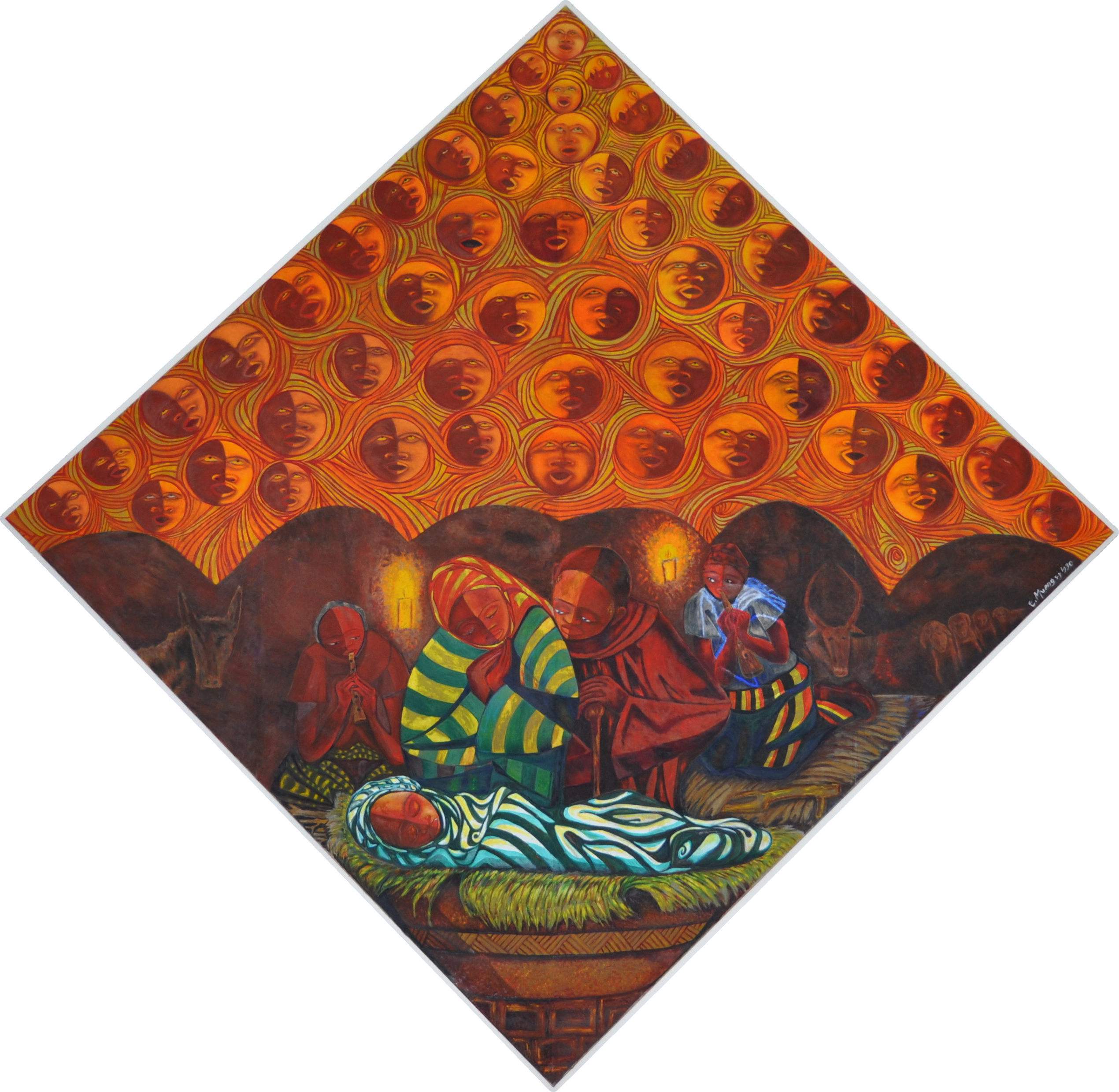
Fr. Engelbert Mveng, SJ (Cameroonian, 1930–1995), The Birth of Jesus, 1990. Central scene of mural at Our Lady of Africa Catholic Church, Chicago. All photos courtesy of the church.
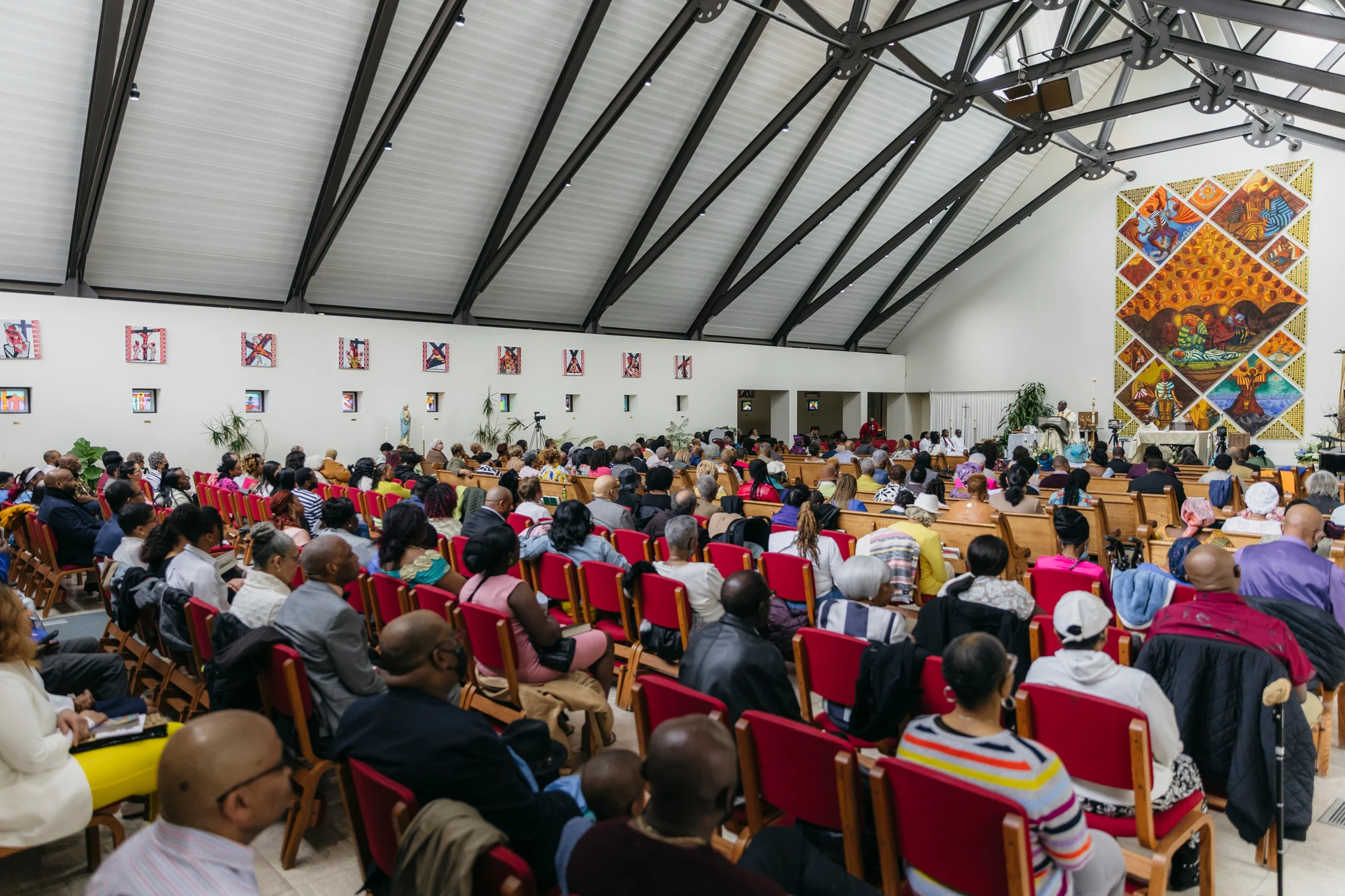
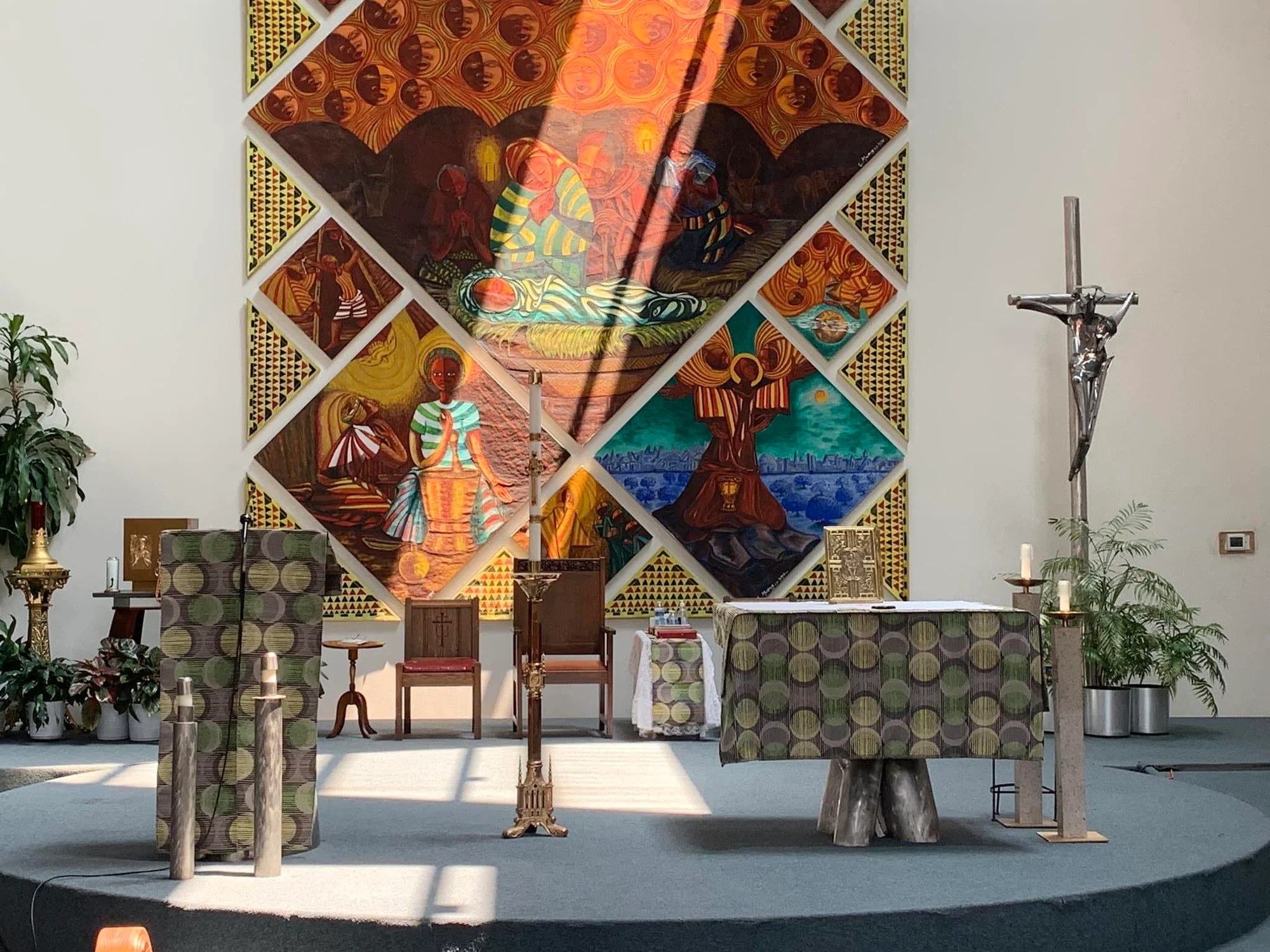
When Holy Angels Catholic Church on the south side of Chicago was rebuilt following a 1986 fire, the historic church commissioned the Cameroonian Jesuit priest, artist, and historian Engelbert Mveng (1930–1995) to paint a mural for behind the altar. He chose to represent moments of angelic intervention in biblical history. (See a close-up of the full mural here.)
The mural’s focal point is a Nativity scene, set in a hilly African landscape that’s pulsing with joy. The infant Jesus lies asleep on a grassy bed, adored by his parents and flanked by candles, pipers, and some curious animal onlookers. Caught up in the sky’s vibrant swirls are forty-nine disembodied angel heads, singing their Gloria.
In July 2021, Holy Angels merged with the faith communities of Corpus Christi, St. Ambrose, St. Anselm of Canterbury, and St. Elizabeth of Hungary in the Bronzeville/Kenwood area of Chicago to become Our Lady of Africa Parish, housed at the former Holy Angels church. The altar mural remains installed on the east end, a key visual feature of the worship space.
LISTEN: “He Came Down,” traditional Cameroonian carol | Transcribed and arranged by John L. Bell of the Iona Community, 1986 | Arranged and performed by Marty Haugen on Welcome the Child, 1992 [sheet music]
He came down that we may have life He came down that we may have life He came down that we may have life Hallelujah, forevermore!
SUBSTACK POST: “Advent and Love” by Micha Boyett, The Slow Way: “There was a mother and man who loved her. There was a baby. The baby was the story God was telling, and that story became a seven-pound human and wailed. His mother cleaned his body with cloth and water, and fed him at her breast. She hoped he would latch on. It took a while. She bled and napped. He napped and cried again. He was God’s story and human. This is how he made a home with us. His making a home with us was love, and that love created a way for peace, hope, and joy.” Micha Boyett is an excellent spiritual writer, and I’m thrilled to learn that she has an Advent book coming out next year!
+++
CHILDBIRTH PHOTOGRAPHY: “2019 Birth Becomes Her Image Contest Winners” and “2020 IAPBP Competition Winners”: I’ve never birthed a baby or witnessed a live birth, but whenever I see photographs of the process and its outcome, it makes me emotional with joy. Seriously, I tear up as I smile. I don’t know these people, and yet I’m awed and overwhelmed.
Photograph by Belle Verdiglione, 2019
Since Christmas is about the BIRTH of Jesus, I find it meaningful to spend some time with childbirth photographs to remind myself how God chose to come to us—through a woman’s birth canal. It’s a wonder that never ceases to amaze me. Althoughthereareafewexceptions, it’s a picture of birth that artists interpreting the Nativity typically don’t want to touch (in part because women’s bodies are still largely taboo, in part because the Catholic Church teaches the birth was quick, painless, and bloodless), and so in the artistic canon, we get mostly clean, calm images of postpartum bliss, not the laborious and messy before. But isn’t that, too, part of the miracle and the glory of Christmas?
>> “Love Came Down” by Joanna Forbes L’Estrange: For her 2024 album Winter Light, the British choral composer Joanna Forbes L’Estrange wrote a new setting of this beloved Christmas poem by Christina Rossetti.
>> “Yeshu Thungea Ningla” (On the Day Jesus Was Born) by James Lhomi: Released by Lareso Music, this song was written by James Lhomi, a significant Lhomi Christian musician in Nepal. The Lhomi are a Tibetan people living in India, China, and Nepal. Lhomi is also the name of their language. The song opens, “Let us a sing a sweet song on the day of Christ’s birth, let us rejoice with a joyful heart, for Emmanuel has been born unto us.” [HT: Global Christian Worship]
>> “What a Day It Is” by Evan Thomas Way: Singer-songwriter Evan Thomas Way, cofounder (with Josh White) of the Deeper Well record label, released this song on his 2014 debut album, Only Light. At the time, he was the worship pastor at Door of Hope Church in Portland, Oregon; now he’s an executive pastor there.
>> “Talj, Talj” (Snow, Snow) by Fairuz: The Lebanese singer Fairuz (فيروز,) is one of the most celebrated singers in the Arab world. Born to Christian Maronite and Syriac Orthodox parents, she is now a member of the Greek Orthodox Church. She popularized the Arabic Christmas carol “Talj, Talj” on her 1977 album Christmas Hymns, which you can watch her perform on a television special in the video below (I can’t find the year or name of the show or broadcaster). The lyrics paint a wintry scene of snow falling and hearts flowering, for “there is a baby awake in the cave, and his sweet eyes are full of love.” [HT: Global Christian Worship]
In the beginning was the Word, and the Word was with God, and the Word was God. He was in the beginning with God. All things came into being through him, and without him not one thing came into being. . . .
And the Word became flesh and lived among us, and we have seen his glory, the glory as of a father’s only son, full of grace and truth. . . . No one has ever seen God. It is the only Son, himself God, who is close to the Father’s heart, who has made him known.
—John 1:1–3, 14, 18 (NRSV)
He is the reflection of God’s glory and the exact imprint of God’s very being.
—Hebrews 1:3 (NRSV)
His birth is twofold: one, of God before time began; the other, of the Virgin in the fullness of time.
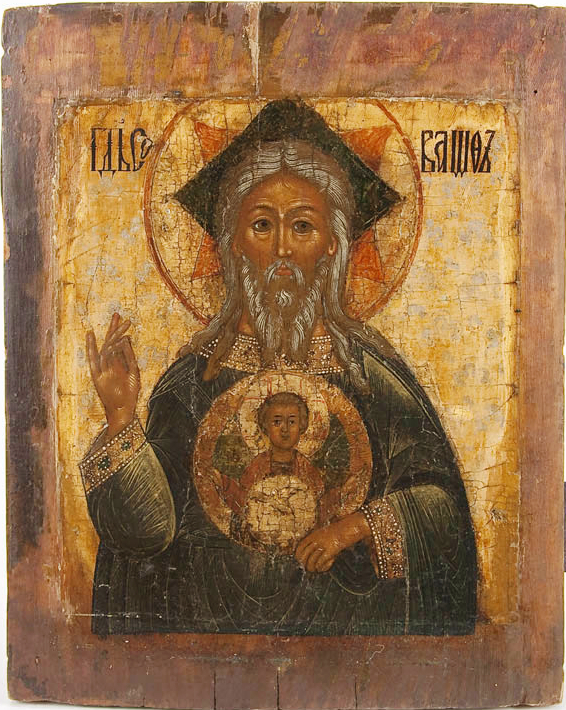
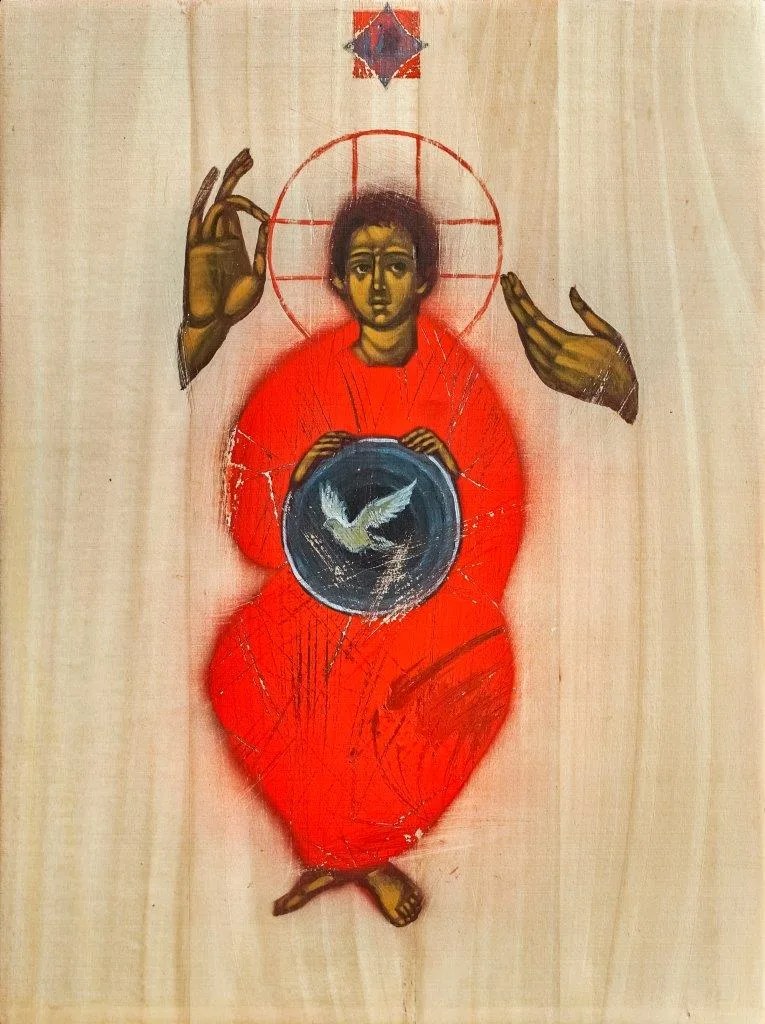
The Otechestvo—“Fatherhood” or “Paternity”—icon shows God the Father (Lord Sabaoth, as he is titled in Russian Orthodoxy) as an old man with Christ Emmanuel (Jesus in child form) seated on his lap or encircled by his “womb,” and the Holy Spirit in the form of a dove hovering before his chest. The eight-pointed slava (“glory”) behind the Father’s head signifies his eternal nature, shared by all three persons. His right hand forms the Greek letters IC XC, abbreviating “Jesus Christ.”
Here are two examples of this Trinitarian image—one from the eighteenth century, and one from just two years ago, which I encountered through the OKSSa [previously] exhibition The Father’s Love.
Otechestvo (Paternity) icon, Russia, 18th century. Tempera on wood, 33 × 27 cm. Sold by Jackson’s International Auctioneers and Appraisers, May 18, 2010.Sylwia Perczak (Polish, 1977–), “Boga nikt nigdy nie widział, Jednorodzony Bóg, który jest w łonie Ojca, o Nim pouczył” (J 1,18), 2023. Acrylic on wood, 40 × 30 cm.
The Polish artist Sylwia Perczak (IG @perczaksylwia) titles her icon after John 1:18: “No one has ever seen God. It is the only Son, himself God, who is close to the Father’s heart, who has made him known” (NRSV). The King James Version contains the lovely phrasing “the only begotten Son . . . is in the bosom of the Father.”
Perczak chooses to keep God the Father, who is incorporeal, out of frame, with the exception of his hands, which gesture to the Son, who holds the Spirit.
Thank you to David Coomler and his Russian Icons blog for introducing me to this icon type.
LISTEN: “In splendoribus sanctorum” by James MacMillan, 2005 | Performed by the Gesualdo Six, dir. Owain Park, feat. Matilda Lloyd, 2020; released on Radiant Dawn, 2025
In splendoribus sanctorum, ex utero, ante luciferum, genui te. [Psalm 109:3 Vulgate]
English translation:
In the brightness of the saints: from the womb before the day star I begot you. [Psalm 109:3 Douay–Rheims Bible]
Written for the Strathclyde University Chamber Choir, the Strathclyde Motets are a collection of fourteen Communion motets for SATB choir by the Scottish composer James MacMillan. “In splendoribus sanctorum” (In the Brightness of the Saints / Amid the Splendors of the Heavenly Sanctuary) is for Midnight Mass on Christmas Eve and includes a trumpet obbligato.
The Latin text is from Psalm 109 in the Vulgate (numbered Psalm 110 in Jewish and Protestant Bibles), a royal psalm that looks forward to the Messiah. The verse is interpreted by Christians as referring to how Christ existed before the dawn of creation, in eternity, and was begotten by the Father; he is the Son of God.
The verse didn’t ring a bell from my many readings of the Psalms over the years—and that’s because it’s from a different manuscript tradition than the Bible translations I typically use (KJV, NRSV, NIV, ESV).
See, the Vulgate, from the late fourth century, is based on the Septuagint, a Greek translation of the Hebrew scriptures produced in Alexandria in the third through first centuries BCE; so is the major Catholic translation of the Bible into English from 1610, the Douay–Rheims. But Protestant and ecumenical translations are based on the Masoretic Text, the authoritative Hebrew and Aramaic text of the twenty-four books of the Jewish canon. The Septuagint and the Masoretic Text contain some textual variants, and this verse is one of them. (Learn more on the Catholic Bible Talk blog.)
Here’s how the verse reads in the New Revised Standard Version:
Your people will offer themselves willingly on the day you lead your forces on the holy mountains.
From the womb of the morning, like dew, your youth will come to you.
The meaning of the Hebrew is obscure, but the phrase “womb of the morning” probably refers to dawn, and “your youth” to the soldiers at the Messiah’s command.
Anyway, I felt I had to explain why if you look up the verse, you might have trouble finding it, depending on which Bible you use.
The Catholic and Orthodox Churches have chosen the “from the womb before the day star I begot you” variant in their liturgies. I love its poetic theology! They use the verse to support the doctrine, taught by all three branches of Christianity, of the eternal generation of the Son—who is “God from God, Light from Light, true God from true God, begotten, not made,” as the Nicene Creed puts it.
By including this verse in its first liturgy of Christmastide, celebrated the night of Christmas Eve, the Catholic Church underscores that Jesus is of the same essence as God the Father. Mary, crucially, gives birth to Jesus, flesh of her flesh—but the Son is generated by the Father before all ages.
To hear “In splendoribus sanctorum” in Old Roman chant from the sixth century, click here.
In these long, last days She has borne creation’s Crown; Heavy, sore, afraid, The weight of love is bearing down.
Refrain: We will wait. Even so, Come, Lord, come. We will wait. Even so, Come, Lord, come.
In these long, last days We must bear the weight of sin, Broken, torn, alone, Till you bring your peace to reign. [Refrain]
Bridge: Don’t forget us, Lord, Don’t forget us, Lord, While we wait. (×3) [Refrain ×2]
Sister Sinjin was founded in 2016 by three young moms wanting to record an Advent album: Elise Erikson Barrett, Elizabeth Duffy, and Kaitlyn Ferry. Barrett left the group to focus on her work in the nonprofit and philanthropic sectors, and Duffy and Ferry recorded two more albums. This September the duo announced a name change to A Bright Abyss to reflect the evolution of their vocational identities (they are both now psychotherapists) and music, a genre they call “psychoanalytic folk.”
The lyrics of “In These Long, Last Days,” one of seven original songs on Sister Sinjin’s debut album, were written by Barrett; the music and additional lyrics, by Ferry. The first stanza refers to Mary’s pregnancy with Jesus—her carrying that bundle of Word-made-flesh inside her, eagerly awaiting the birth.
As Mary waited for the Messiah’s first coming, feeling the signs of its nearness in her body, so we await his second, and with it the rebirth of heaven on earth. We do so bearing the weight not of presence but of absence. God is with us in the Spirit, in word and sacrament, and through Christ’s ecclesial body—but the incarnate Christ, the God-man, physically ascended back into the divine realm. “Come back!” we exclaim during Advent, yearning for the return he promised. “Don’t forget us.”
Until that day, we will wait. Even so, come, Lord, come.
Rowan Mersh (British, 1982–), Invisible Boundaries, 2009. Site-specific installation of cotton thread. Click to view more photos.
Artist’s statement: “A site-specific installation derived from the exploration of a derelict space in West London. I sought to challenge the notion of invisible boundaries created by passages of light and shadow within this broken environment. Over one hundred and fifty miles of cotton thread was used, strung between points of structural relevance, physically plotting paths of light and shadow throughout the course of the day. The result is the evolution of an alternative architectural landscape.”
LISTEN: “Break of Dawn” by Antoine Bradford, feat. Montell Fish, on Light Will Find You (2021)
When I can’t find my way home There You, there You are Calling me over to Your side I can’t escape Your eye
’Cause the light, the light The light of the world Is shining, shining all around Oh, the light, the light The light of the world Is shining, shining all around
What I’m saying, Lord You are my defender in the rain Through the pain and the times Through the things I can’t change I got You all on my mind You’re the one I wanna find You’re the one I wanna see I’ve been going through the motions Feeling all thesе deep emotions But You’re the onе that keep my soul straight floating I’m straight open, I see the light of day So I bow my head and pray
Oh, the light, the light The light of the world Is shining, shining all around Oh, the light, the light The light of the world Is shining, shining all around
The light, the light Light of the world Is shining, shining all around Oh, the light, the light The light of the world Is shining, shining all around
I can see the break of dawn My joy is coming in the morning I can see the break of dawn My joy is coming in the morning I can see the break of dawn My joy is coming in the morning I can see the break of dawn
When the beauty comes, the beauty comes When the beauty comes, it all just falls from the sky (Singin’) When the beauty comes, it all just falls from the sky (Singin’) When the beauty comes, it all just falls from the sky
Refrain 2: It makes us sing, makes us sing, makes us sing, makes us sing We’re gonna sing, gonna sing, gonna sing, gonna sing, gonna sing We’re gonna sing, gonna sing, gonna sing, gonna sing, gonna sing
When we forgive someone, forgive someone When we forgive someone, the beauty just falls from the sky Every time we forgive someone, the beauty just falls from the sky Oh, when we forgive someone, the beauty just falls from the sky [Refrain 2]
When we admit we were wrong, admit we were wrong When we admit we’re wrong, beauty just falls from the sky And when we admit we’re wrong, beauty just falls from the sky And when we admit we’re wrong, beauty just falls from the sky [Refrain 2]
When merciful justice comes, merciful justice comes When merciful justice comes, beauty’s gonna fall from the sky When merciful justice comes, beauty’s gonna fall from the sky When merciful justice comes, beauty’s gonna fall from the sky [Refrain 1]
When the good Lord comes, good Lord comes And when the good Lord comes, beauty’s gonna fall from the sky (Singin’) When the good Lord comes, beauty’s gonna fall from the sky (Singin’) When the good Lord comes, beauty’s gonna fall from the sky [Refrain 1]
“See, the home of God is among mortals. He will dwell with them; they will be his peoples, and God himself will be with them; he will wipe every tear from their eyes. Death will be no more; mourning and crying and pain will be no more, for the first things have passed away.”
—Revelation 21:3–4
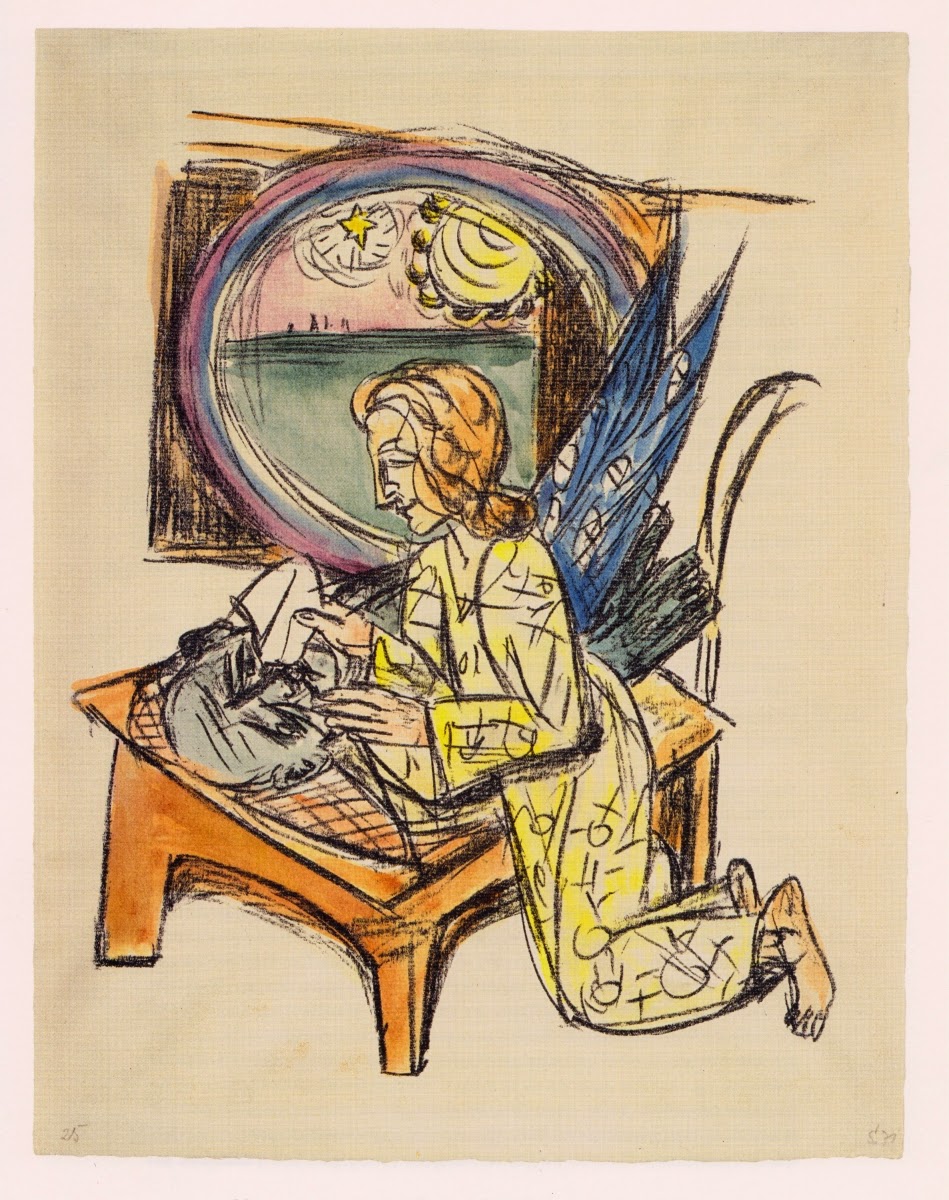
LOOK: God will wipe away every tear by Max Beckmann
Max Beckmann (German, 1884–1950), Apocalypse: God will wipe away every tear (Revelation XXI, 1-4), 1941–42. Lithograph with watercolor additions on paper, 15 3/8 × 11 13/16 in. (38.7 × 29.8 cm). Staatsgalerie Stuttgart, Germany. [object record]
The German expressionist artist Max Beckmann created this poignant lithograph in 1941–42 while living in exile in Amsterdam, having been labeled a “degenerate artist” by the Nazi Party and stigmatized as “un-German.” It’s one of a series of twenty-seven lithographs he made on the book of Revelation. Titled Apokalypse, the series was commissioned by Georg Hartmann, owner of the Bauersche Gießerei (Bauer type foundry) in Frankfurt am Main, who privately printed it as a bound volume in 1943 in an edition of twenty-four. God will wipe away every tear is page 71. I’ve pictured here the edition in the collection of the Staatsgalerie Stuttgart, but there’s another one (with different hand-coloring) at the National Gallery of Art in Washington, DC.
A winged figure is depicted by Beckmann dressed in a golden robe wiping away the tears from a squat, human figure lying on a table (who may be intended to be Beckmann himself). Through a circular window, which resembles a port hole and which is decorated with the colours of the rainbow, lies what one presumes to be the new Heaven and the new Earth (Rev. 21.1), here represented as just the river (sea?) of life and not a city. The fact that one has to gaze through the rainbow port hole to glimpse the New Jerusalem is fascinating and reminds one of Memling’s Apocalypse altarpiece of 1474–9, which depicts the heavenly throne room as existing in a circular rainbow resembling an eyeball. It has been argued that this visualization implies that the heavenly throne room (described in Rev. 4.3 as being enclosed in a rainbow) is akin to the all-seeing divine eye. Thus, in this image, if it is Memling who is being evoked here, the viewer, like John, is in the privileged position of seeing the future through the divine eye, as it were.
However, the theological intrigue plays second string to the central image, which would surely have resonated with viewers as somewhat strange, shocking even, in the 1940s. The concept of visualizing God/Christ himself wiping the tears from human eyes is not without artistic precedent, but it is rare. Giovanni di Paolo’s illustrated fifteenth-century antiphonal depicts ‘God wiping away the tears of the faithful,’ for example. [See also this historiated initial in the fourteenth-century Antiphonary of San Giovanni Fuorcivitas.] However, this is such an intimate image, and the divine figure (perhaps God/Christ or perhaps an angel) so human (apart from the wings, of course), that one cannot help being affected by the image. This New Jerusalem is a place of consolation built on relationships and not monumental landscapes. (231–32)
God shall wipe away all tears And there shall be no more death Neither sorrow nor crying Neither shall there be any more pain
Praise the Lord Praise the Lord Praise the Lord
This glorious piece of music is from the end of the final movement (“Better Is Peace”) of The Armed Man: A Mass for Peace by the Welsh composer and multi-instrumentalist Sir Karl Jenkins. Written for SATB choir, SATB soloists, muezzin, and a full orchestra with an enormous percussion section, the work was commissioned by the Royal Armouries Museum in Leeds, England, to commemorate the new millennium. Jenkins dedicated it to the victims of the Kosovo War between the Serbians and the ethnic Albanians, which lasted from February 1998 to June 1999.
One of the primary genres in the Western choral tradition is the mass, which sets to music the five unchanging sections of the Roman Catholic liturgy: the Kyrie (“Lord, have mercy”), Gloria (“Glory to God in the highest”), Credo (“I believe”), Sanctus (“Holy, holy, holy”), and Agnus Dei (“Lamb of God”). Bach’s Mass in B minor and Mozart’s Requiem in D minor are among two of the most famous. Composer’s masses were originally sung in the church’s corporate worship, but now they’re mostly confined to concert settings and are often adapted—supplemented with other texts, and sometimes one or more of the traditional sections is eliminated.
Karl Jenkins’s The Armed Man, named after the fifteenth-century French folk song “L’homme armé,” which opens the mass, comprises thirteen movements. Jenkins omits the Gloria and Credo but, in addition to the Kyrie, Sanctus (and Benedictus), and Agnus Dei, includes other religious texts and secular ones too: the Adhan (Islamic call to prayer); Psalms 56:1 and 59:2; poems or poetic extracts by Rudyard Kipling, John Dryden, Horace, Toge Sankichi (who survived the bombing of Hiroshima but died of radiation-induced cancer), Guy Wilson, and Alfred, Lord Tennyson; a passage from the ancient Hindu epic the Mahabharata and from Sir Thomas Malory’s Le Morte d’Arthur; and Revelation 21:4.
For a movement-by-movement discussion of the mass, including all the lyrics, see the Choral Singer’s Companion entry by the musicologist Honey Meconi. And here you can listen to the work in full, as performed in 2018 in Berlin by a choir of two thousand people from thirty countries to mark the centennial of the end of the First World War:
The “God shall wipe away all tears” finale is markedly different from the two sections that precede it within the same movement. Movement 13 starts (at 58:26 of the Berlin video) with a vigorous and cheerful return of the “L’homme armé” melody, this time sung with a line from Mallory—voiced, in Mallory’s version of the Arthurian legends, by Lancelot and Guinevere:
Better is peace than always war, And better is peace than evermore war, And better and better is peace, Better is peace than always war.
The melody’s original lyrics then return:
The armed man must be feared. Everywhere it has been proclaimed That each man should arm himself With an iron coat of mail.
But then the sprightly woodwinds play a Celtic dance–like interlude, leading into the choir’s “Ring, ring, ring, ring!” and a setting, with lush orchestral backing, of Tennyson’s “Ring Out, Wild Bells.” This section is joyous and triumphant, and listeners might expect that final, emphatic “Ring!” to be the closer.
But it’s not.
The final section, a sort of coda, is quiet, slow, unaccompanied—no brass fanfare, no frolicsome woodwinds, no driving percussion, just human voices singing at a largo tempo a snippet from John the Revelator’s eschatological vision of a world without death, crying, and pain, having been healed by God for all eternity.
LISTEN: “How Long, Dear Savior” (NORTHFIELD) | Words by Isaac Watts, 1707 | Music by Jeremiah Ingalls, 1805 | Performed by the Boston Camerata, dir. Anne Azéma, 2020
How long, dear Savior, O how long Shall this bright hour delay? Fly swifter round, ye wheels of time, And bring the promised day.
From the third heav’n where God resides, That holy, happy place, The new Jerusalem comes down Adorned with shining grace.
An American Christmas is one of the Boston Camerata’s most popular programs. “It features a generous selection of carols, New England anthems, Southern folk hymns, and religious ballads for the season from the early years of the American republic, and from a wide range of early tune books and manuscripts”—including the shape-note hymn “How Long, Dear Savior” from The Christian Harmony (Exeter, New Hampshire, 1805), an arrangement of a stanza from Isaac Watts’s “Lo! what a glorious sight appears” to the fuguing tune NORTHFIELD. The Boston Camerata adds a stanza from the same Watts hymn.
The Grace Doherty Library at Centre College in Danville, Kentucky, which owns a first edition of The Christian Harmony, provides biographical information about its compiler, Jeremiah Ingalls, to whom several of the tunes inside are attributed:
A native of Massachusetts who moved to Vermont around 1800, Jeremiah Ingalls (1764-1828) at various times worked as a farmer, cooper, and tavern keeper, in addition to serving as a choirmaster in the Congregational church, teaching singing school and composing music. Ingalls’ Christian Harmony contains many lively melodies, patterned after the secular songs and dances of the day. Such tunes were quite popular among the camp-meeting revival folk. In his hymn “Innocent Sounds,” Ingalls argues for the appropriateness of adopting these melodies for religious use.
The above performance of “How Long, Dear Savior” by the Boston Camerata was filmed at Boston’s historic Old North Church during the 2020 pandemic. To hear the song in a non-concert context, see this video taken at a Sacred Harp singing convention in Texas in 2011:
The “third heaven” refers to the dwelling place of God outside the universe. Beginning in the intertestamental period (ca. 420 BCE–ca. 30 CE), it was a common Jewish belief that God stacked the heavens in layers—as many as seven, but most typically three, sometimes delineated as: Earth’s atmosphere (the first heaven; i.e., the realm of the birds and clouds), interplanetary or interstellar space (the second heaven; i.e., the realm of the sun and stars), and God’s own abode, over and above what we can conceive (the third heaven). The term “third heaven” appears in Jewish apocalyptic and rabbinic texts such as the Testament of Levi 2, the Apocalypse of Moses 37:5, 2 Enoch 8:1, and 3 Baruch 4:7. The apostle Paul also uses it in 2 Corinthians 12:2–4 to describe one of his visionary experiences.
A new day will dawn on us from above because our God is loving and merciful. He will give light to those who live in the dark and in death’s shadow. He will guide us into the way of peace.
—the Jewish priest Zechariah, father of John the Baptist, in Luke 1:78–79 (GOD’S WORD Translation)
LOOK: New Morning by David Blow
David Blow (American, 1944–), New Morning, 2014. Digitally altered photograph, 28 × 40 in.
David Blow is a nature photographer from Hickory Creek, Texas. “I have developed a language using graphic shapes, colors, and patterns to express a feeling and vibration that I see in my photographs,” he writes on his website. “I am expressing the superstring theory that nothing is static, and that all things vibrate. I am contemplating how we experience nature with more than our sight, rather with all our senses simultaneously. Such as the meditative sounds we hear and see from viewing birds and animals, and the spiritual feeling we have when we are in nature.”
“New Morning,” Blow says, “presents a transcendent vision of a new day, serene and harmonious, where we are entirely at one with each other and the source of our being, God. There is a hushed air of reverence in the cathedral-like canopy of tree branches with pairs of doves perched in their branches as a faint yellow light penetrates the blanket of clouds above. These deeply moving experiences of oneness with something larger than ourselves provide us with a glimpse of that wholeness and rest we can only find in God.”
I’m attracted to the rhythmic quality of the image, and the mirror effect that evokes kaleidoscopic viewing. I’m held in a sense that this scene is unfolding dynamically into another.
Menahan Street Band is a Brooklyn-based funk and soul band formed in 2007 by Tommy Brenneck, Dave Guy, Leon Michels, Nick Movshon, Homer Steinweiss, and Mike Deller. (The latter stepped down as a permanent member in 2017.) They are part of the widely acclaimed Daptone Records roster.
The group originally recorded the tune of “There’s a New Day Coming” as a single backing track for the singer Charles Bradley (1948–2017), but it was put aside, unused, after Bradley’s death. Band member Tommy Brenneck later revivified it by adding some simple new lyrics, and the group released the new song on a 45 rpm record, with “Tommy Don’t” on the flip side, in 2019. It features Saundra Williams (of Saun & Starr) on lead vocals.






 Art & Theology