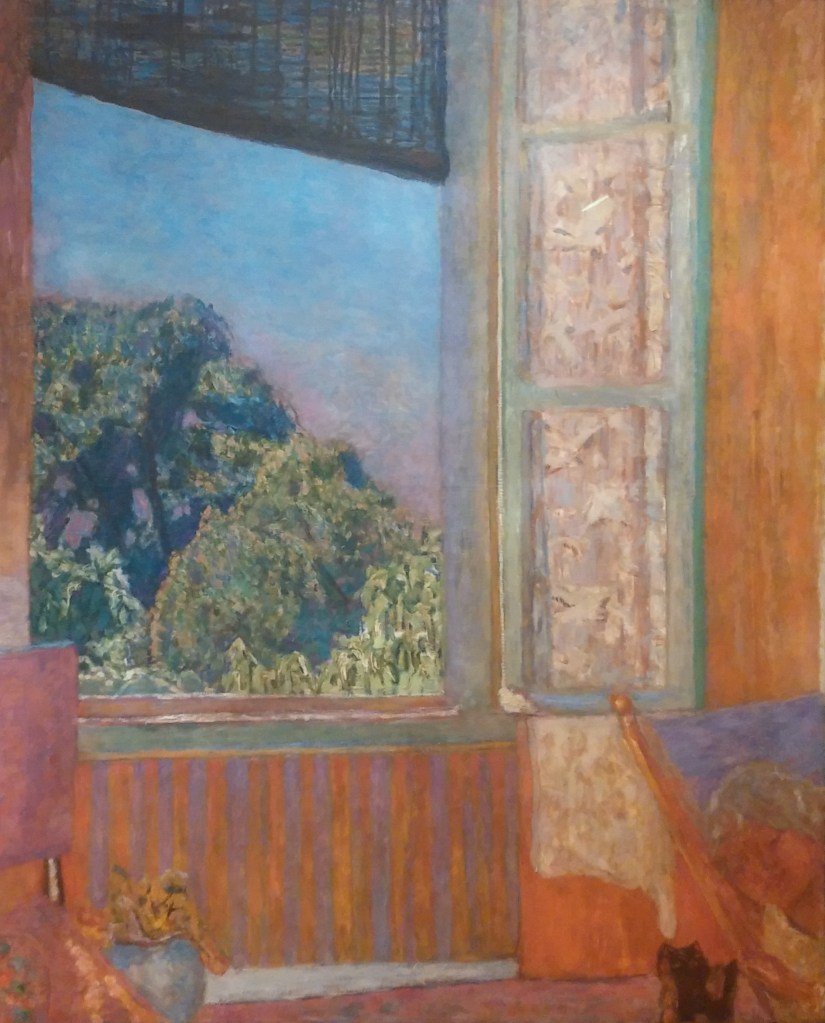
Pierre Bonnard (French, 1867–1947), The Open Window, 1921. Oil on canvas, 46 1/2 × 37 3/4 in. (118.1 × 95.9 cm). Phillips Collection, Washington, DC. Photo: Victoria Emily Jones.
Satisfy us in the morning with your steadfast love, that we may rejoice and be glad all our days.
—Psalm 90:14
+++
SONG: “Oh to Be Loved” by Thad Cockrell, on To Be Loved (2009)
This post belongs to the weekly series Artful Devotion. If you can’t view the music player in your email or RSS reader, try opening the post in your browser.
To view all the Revised Common Lectionary scripture readings for Proper 25, cycle A, click here.
Several readers have asked if there’s a way to donate to the work of this blog. After much thought I’ve decided to go ahead and add a Donation page, where those who wish to send a small financial gift to support the blog’s upkeep and development can do so through PayPal if they feel so inclined. Thank you!
+++
CIVA ART AUCTION, November 13–15, 2020: In a few weeks CIVA (Christians in the Visual Arts) is hosting an online auction of art created and/or donated by CIVA members. The lots comprise a range of media, sizes, and styles—a little something for everyone. It’s a great way to support artists of faith (by supporting CIVA), and to acquire beautiful art for your home!
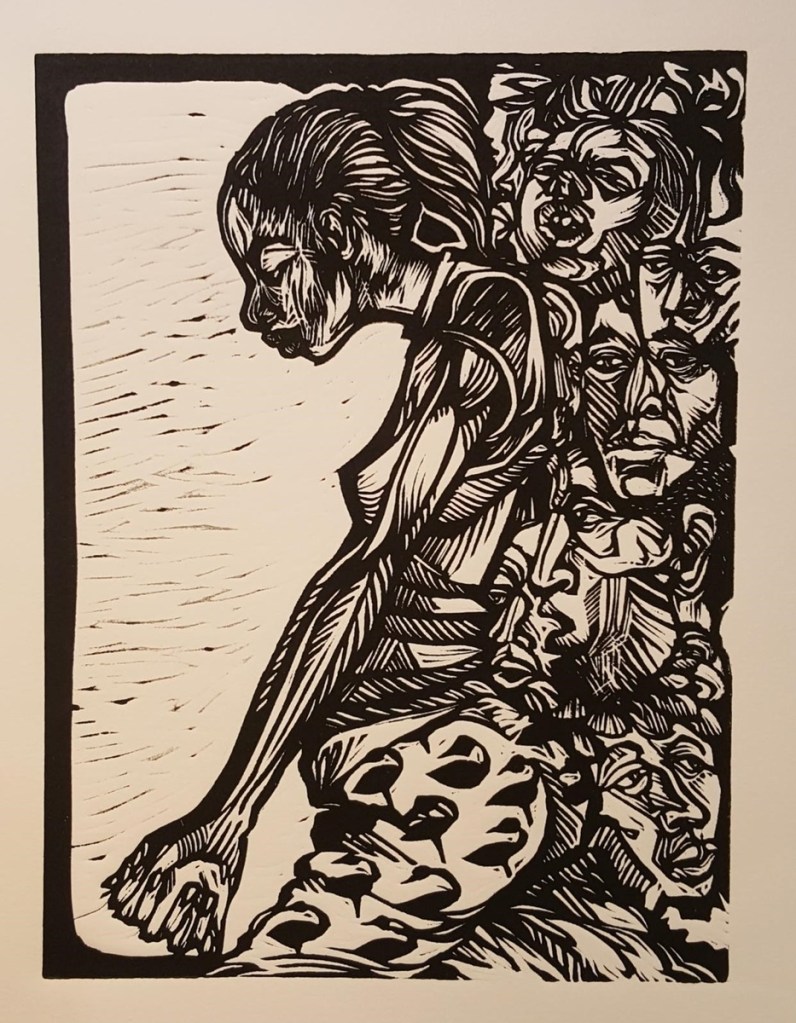
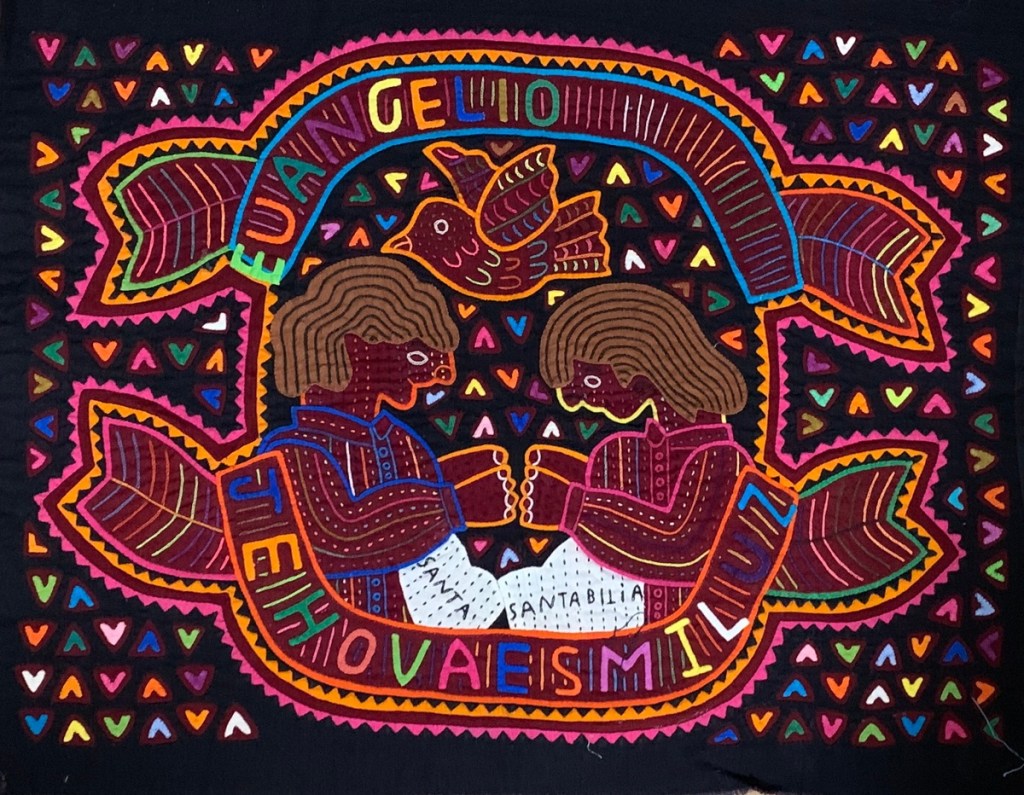
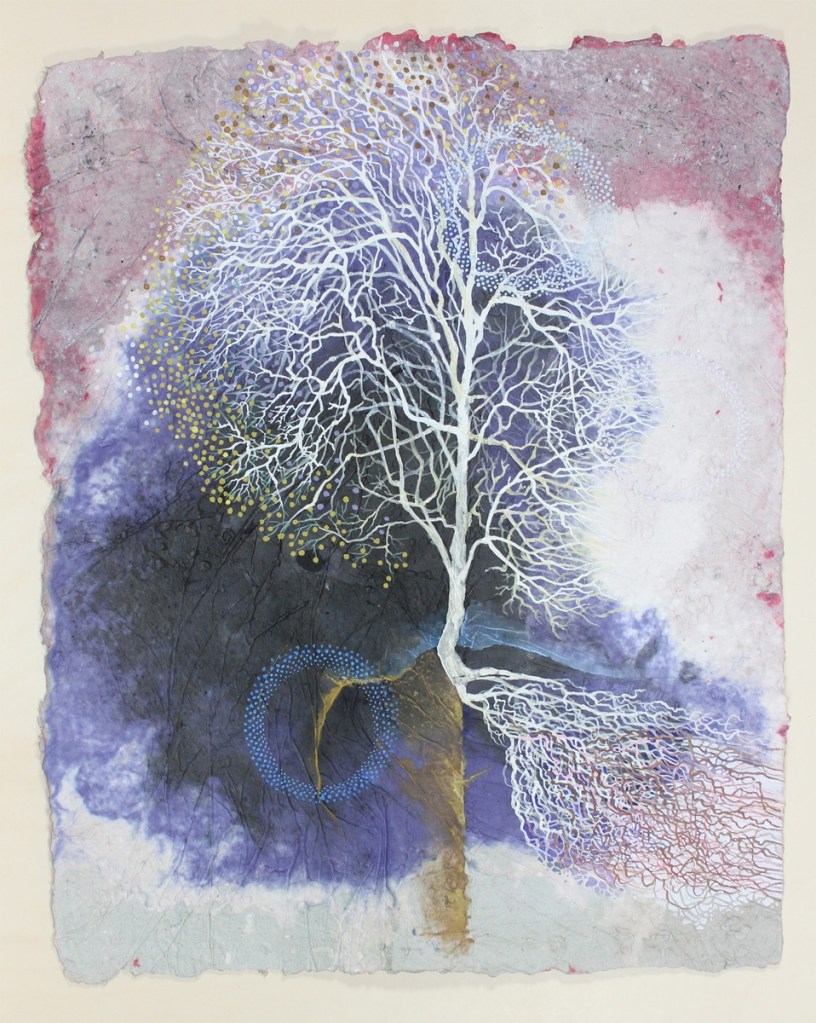
The first artwork I ever purchased was through a CIVA auction: a linocut by Steve Prince, who has three new works up for bid this year. Sandra Bowden has donated several works from her extensive and esteemed collection of religious art, including an Adoration of the Magi lithograph by the major modern artist Otto Dix and a mola (handmade textile) from Panama, which I’m eyeing. I also noticed 40 Days, Forty Sacraments, a set of gouaches painted by Kari Dunham over the course of Lent one year as a way to rediscover beauty in the ordinary. And a mixed-media piece by Joseph di Bella, whose theme of redemption is underscored by the making of the substrate, which consists of “failed and unfinished works on paper” that “are destroyed, then reformed into new, yet still imperfect sheets.”
Steve Prince, Faith Walk. Linocut, 12 × 9 in. “Shows a woman walking in faith while the ancestors encourage, uplift, and guide her along the way.”Jehova es mi luz (Jehovah Is My Light), San Blas Islands, Panama, 1980s. Reverse embroidery, 14 × 17 1/2 in.Joseph di Bella, Tree Parables (Generations), 2017. Gouache, dry pigment, and ashes on handmade paper, 38 1/2 × 30 1/2 × 1 1/2 in. (framed).
If you plan on bidding, be sure to register; you will be able to see all the other bids and can set up notifications. And if you don’t win, don’t be discouraged: you can always go to the artist’s website, and there will likely be other works available for purchase there.
+++
ALBUM: Daughter Zion’s Woe: Produced by Rachel Wilhelm and released last month by Cardiphonia, this new album features thirteen lament songs written, arranged, and performed by women. It will be available on Spotify after Christmas, but until then, all Bandcamp sales benefit Hagar’s Sisters, an organization that serves victims of domestic violence. My favorite song on the album is “The Glory Shall Be Thine” by Christy Danner, a retuning of the late nineteenth-century “Transformed” by F. G. Burroughs (pseudonym for Ophelia Burroughs, later Adams, née Browning); this hymn text is completely new to me, and what a gem! Danner’s music really draws out its poignancy. Other highlights include Eden Wilhelm’s “Lord, Draw Near” (Psalm 88), Sister Sinjin’s “Silence,” and Lo Sy Lo’s “Let It Be So” (Psalm 12).
+++
EXHIBITION:The Evidence of Things Unseen by Titus Kaphar,October 16–November 28, 2020, former Église du Gesù, Brussels: Titus Kaphar’s [previously] art, which reinterprets traditional Anglo-centric imagery through a Black lens, has grown out of his “spending time in European museums and longing for pictures that looked like they actually made space for individuals that look like me.” In this new exhibition, staged by the Maruani Mercier gallery in a deconsecrated church in Belgium, Kaphar revises Christian paintings by silhouetting, covering in tar, or duct-taping over likenesses of white Jesus, drawing attention to unseen people and narratives. The exhibition’s title is taken from Hebrews 11:1.
Titus Kaphar, Untitled, 2020. Oil and tar on canvas. Photo courtesy Maruani Mercier.
The press release reads: “It is virtually impossible to tell the story of Renaissance art without an exploration of Christianity. While the personal faith of the individual artist varied from devotee to atheist opportunist, the largest patron of the arts was the Church, and Catholic iconography the artist’s lingua franca. . . .
“In The Evidence of Things Unseen, Kaphar utilizes Catholic iconography as a ground on which to explore ideas beyond simple proselytization. Kaphar utilizes his whole vocabulary of formal innovation in this exhibition: canvases aggressively fold, crumple, undulate, and project from the wall, forcing themselves into the space of the viewer. Through Kaphar’s physical interventions, works like Susan and the Elders and Eve exist as bodies transformed into landscape and typography rather than polite easel paintings. In Jesus Noir Kaphar duct-tapes a portrait of a young black man over the face of Christ. Christ’s outstretched right hand, originally pointing to the heavens, now appears as a plea for help. The application of duct tape – a utilitarian material known to be used in all kinds of industrial and household repairs – suggest urgency and impermanence.
“Even though many biblical stories take place in the Middle East and Africa, representations of Christ and his followers are almost always depicted as European. It is not surprising that the devoted attempt to see themselves in the stories of the Bible, and to envision a Christ they can recognize: Christian tradition teaches that mankind was created in God’s own ‘image and likeness.’ And yet, religious paintings from the Renaissance unwittingly oversimplify an understanding of God by excluding a part of his creation. There are no black angels of the Renaissance. The Evidence of Things Unseen is Kaphar’s latest attempt at revision.”
+++
ANIMATED SHORT: “Brené Brown on Empathy”: In this 2013 video from the RSA (Royal Society for Arts, Manufactures and Commerce), Katy Davis animates an excerpt from a talk by Professor Brené Brown, “The Power of Vulnerability.” “The Webby Award-winning RSA Shorts animation series provides a snapshot of a big idea, blending voices from the RSA Public Events Programme and the creative talents of illustrators and animators from around the world. It responds to the ever-increasing need for new ideas and inspiration in our busy lives and acts as a jolt of ‘mental espresso’ that will awaken the curiosity in all of us. If you’re interested in the opportunity of animating one of our Shorts, please email your bio and links to your portfolio to shorts@rsa.org.uk.” Other RSA shorts include Jonathan Haidt on Why We’re Convinced We’re Right, David Brooks on Character in a Selfie Age, and David Graeber on the Value of Work.
+++
PANEL DISCUSSION: “Perspectives on Empathy and the Arts”: In 2017 Roots of Empathy brought together a panel of three—Cameron Bailey, artistic director of the Toronto International Film Festival (TIFF); Martha Durdin, chair of the board of trustees of the Royal Ontario Museum (ROM); and Raymond Mar, professor of psychology at York University—to discuss the connection between art and empathy and why it’s so important. The conversation is moderated by Mary Ito. I especially appreciated from 42:32 onward.
4:10: Children who take acting lessons are more prosocial and empathetic 5:48: Films and empathy 9:34: Fiction and empathy 12:42: Moonlight(2016) 21:54: Learning from mistakes: Into the Heart of Africa (1989) and point of view 28:38: Pompeii: In the Shadow of the Volcano (2015) 30:37: Forced assimilation of Native people in church-run residential schools 31:18: Can art museums institutionalize empathy? 34:48: How does me empathizing with a character in a book or a painted figure translate to me being empathetic to actual people? 39:05: Superhero comics and movies 41:22: Are we suffering from an empathy deficit? 44:37: Empathy for ideological opponents 46:10: Where does empathy run up against morality/ethics? Are we to empathize with abusers? 46:56: How do we do better through the arts?
Moravian devotional image by Marianne von Watteville, 18th century. Embroidery and watercolor on cardstock, 11 × 16 cm. Unity Archives, Herrnhut, Germany.
Moses said, “Please show me your glory.” And [the LORD] said, “I will make all my goodness pass before you and will proclaim before you my name ‘The LORD.’ And I will be gracious to whom I will be gracious, and will show mercy on whom I will show mercy. But,” he said, “you cannot see my face, for man shall not see me and live.” And the LORD said, “Behold, there is a place by me where you shall stand on the rock, and while my glory passes by I will put you in a cleft of the rock, and I will cover you with my hand until I have passed by. Then I will take away my hand, and you shall see my back, but my face shall not be seen.”
—Exodus 33:18–23 (emphasis added)
Then Moses and Aaron gathered the assembly together before the rock, and he said to them, “Hear now, you rebels: shall we bring water for you out of this rock?” And Moses lifted up his hand and struck the rock with his staff twice, and water came out abundantly, and the congregation drank, and their livestock.
—Numbers 20:10–11
Our fathers were all under the cloud, and all passed through the sea, and all were baptized into Moses in the cloud and in the sea, and all ate the same spiritual food, and all drank the same spiritual drink. For they drank from the spiritual Rock that followed them, and the Rock was Christ.
—1 Corinthians 10:1b–4
O my dove, in the clefts of the rock, in the crannies of the cliff, let me see your face, let me hear your voice, for your voice is sweet, and your face is lovely.
—Song of Solomon 2:14
But one of the soldiers pierced his side with a spear, and at once there came out blood and water.
—John 19:34
Exodus 33:12–23 is assigned in Sunday’s lectionary; the other Bible passages I’ve added because I want to show how an intertextual reading yielded our song of the week.
+++
HYMN: “I Thirst, Thou Wounded Lamb of God” (Ach! mein verwundter Fürste!) | Words by Nikolaus von Zinzendorf, Anna Nitschmann, and Johann Nitschmann, 1735; English translation by John Wesley, 1740 | Music by Bethany Brooks, 1997 | Performed by Bethany Brooks on the Cardiphonia compilation album Songs for the Lord’s Supper, 2011 (also on Quarry Street Hymnal, vol. 1, 2012)
I thirst, thou wounded Lamb of God,
to wash me in thy cleansing blood,
to dwell within thy wounds; then pain is
sweet, and life or death is gain.

Take my poor heart and let it be
forever closed to all but thee!
Seal thou my breast and let me wear
that pledge of love forever there.

How blest are they who still abide
close sheltered in thy bleeding side,
who life and strength from thence derive,
and by thee move, and in thee live.

What are our works but sin and death
’til thou thy quick’ning Spirit breathe?
Thou giv’st the power thy grace to move;
O wondrous grace! O boundless love!

Hence our hearts melt, our eyes o’erflow,
our words are lost; nor will we know,
nor will we think of ought beside
my Lord, my Love, is crucified.
Nikolaus von Zinzendorf, one of the authors of this German hymn, was the leader, patron, and protector of the Moravian Church from 1727 to 1760 and its major theologian and liturgist. Anna Nitschmann was chief eldress in the church since age fourteen, serving as spiritual mentor to female congregants, and a missionary for a time to the Native Americans of Pennsylvania and New York; she married Zinzendorf in 1757, but both of them died within a couple of years. Johann Nitschmann was Anna’s brother.
John Wesley, who translated “I Thirst” into English just a few years after it was written, was well acquainted with the Moravians. His journal, covering the years 1736–38, is full of comments and observations about them, starting with a transatlantic sea voyage he was on, during which a storm arose, and everyone panicked, except the Moravians, who sang hymns of praise and prayed with great calm. When he returned to London he attended a Moravian meeting in Aldersgate Street, where he experienced an evangelical conversion. After that he joined the Moravian society in Fetter Lane and in August 1738 traveled to the denomination’s headquarters in Herrnhut, Germany, to study. He corresponded with Zinzendorf, and the two met face to face on more than one occasion. In late 1779 he broke with the Moravians and soon after founded Methodism, greatly influenced by Moravian pietism.
Eighteenth-century Moravians were fascinated with Jesus’s wounds, especially his “little side hole” (where a Roman soldier pierced him on the cross to confirm he was dead), which they described as “warm,” “hot,” “beautiful,” “sweet,” and “today still open.” They wrote hymns about the side wound and created side-wound art—indeed, centered much of their devotional practice on it. As one hymn goes, “Dearest Side-hole! I do covet thy warm Blood above all Things. O thou art the most beloved of all other Wound-hole-Springs. Side-hole’s Blood, bedew me! Cover and go thro’ me! Take thy Course thro’ all my Veins, Heart and Reins, so that nought unbath’d remains.” “I Thirst” is comparatively mild (though granted, I couldn’t find the German original).
Historically, much Christian hymnody and art have fixated on the blood and woundedness of Jesus, but Zinzendorf and his followers took it to another level. To them such graphic imagery was not morbid but comforting and affective. Even I, who have a low tolerance for blood and gore, find myself strangely compelled by this devotional language and visuality of the womblike side wound.
“I Thirst, Thou Wounded Lamb of God” is one of many Moravian hymns that picture Jesus’s side wound as a shelter, a place of refuge where the blessed enter into and reside. “Rock of Ages, Cleft for Me,” written some forty years later by the Anglican cleric Augustus Toplady, is a more widely sung hymn that employs similar imagery—so, too, the less explicit and far less poetic “He Hideth My Soul” by Fanny Crosby.
Moses’s being hidden away in the cleft of a rock so that he can glimpse a glimmer of God’s glory is partly in view, in an implied way, in “I Thirst.” The Song of Songs also refers to “the cleft of a rock”—to a dove, a beloved, nesting there; a lot of Christian commentators read the rock as Christ and the dove as his church, sheltered in his torn flesh (his body was cleft by the spear). Added to the hermeneutical mix is the Numbers passage of water from the rock: during Israel’s desert wanderings, Moses strikes a rock and water streams forth to quench the people’s thirst. (Like Jesus, the rock was beaten, giving issue to a river of life.)
All these biblical stories and images come together to create a constellation of meaning.
The mixed-media needlework reproduced here, from the Unitätsarchiv in Herrnhut, is by an eighteenth-century Swiss German woman named Marianne von Watteville. In embroidery and watercolor, she shows a rocky hillock topped with grass and flowers, into which a little cave is carved, which is Christ’s side wound. She kneels inside the wound in prayer and is showered by the blood of Christ. The inscription on the lip of the wound reads, “O, I rejoice, I rejoice so much that I have found the sea from the wound, where I am a blessed little sinner. I have everything.”
This post belongs to the weekly series Artful Devotion. If you can’t view the music player in your email or RSS reader, try opening the post in your browser.
To view all the Revised Common Lectionary scripture readings for Proper 24, cycle A, click here.
Pablo Picasso (Spanish, 1881–1973), The Old Guitarist, 1904. Oil on panel, 48 3/8 × 32 1/2 in. (122.9 × 82.6 cm). Art Institute of Chicago.
Remember me, O LORD, with the favour that thou bearest unto thy people: O visit me with thy salvation.
—Psalm 106:4 (KJV)
+++
SONG: “Sing Your Song Over Me / Do Lord, Remember” by Tim Coons, on Potomac (2012)
In his Potomac album, Tim Coons combines American folk songs—mostly African American spirituals, blues, and gospel—with originals in the same track. Track 4 is based on “Do Lord,” Roud 11971. I actually learned this spiritual not in church but in Girl Scouts! Notable recordings include those by Mississippi John Hurt [previously] and Johnny Cash.
More recently Tim has been working on collaborations with his wife Betony, a visual artist, under the name Giants and Pilgrims [previously].
+++
The Art Institute of Chicago, which owns Picasso’s The Old Guitarist, writes,
Pablo Picasso made The Old Guitarist while working in Barcelona. In the paintings of his Blue Period (1901–04), the artist restricted himself to a cold, monochromatic blue palette, flattened forms, and emotional, psychological themes of human misery and alienation related to the work of such artists as Edvard Munch and Paul Gauguin. The elongated, angular figure of the blind musician also relates to Picasso’s interest in Spanish art and, in particular, the great 16th-century artist El Greco. The image reflects the twenty-two-year-old Picasso’s personal struggle and sympathy for the plight of the downtrodden; he knew what it was like to be poor, having been nearly penniless during all of 1902.
This post belongs to the weekly series Artful Devotion. If you can’t view the music player in your email or RSS reader, try opening the post in your browser.
To view all the Revised Common Lectionary scripture readings for Proper 23, cycle A, click here.
SONG: “Ahavat Olam”: Back in April the Platt Brothers—Jonah, Henry, and Ben—posted a home-recorded video of themselves singing this traditional Jewish prayer arranged by Gabriel Mann and Piper Rutman. (I know actor-singer Ben Platt from The Politician, which is probably how the video came to be recommended to me by YouTube!)
It stoked a lot of public enthusiasm, so on September 21 they released a studio recording, available for streaming and download from all major music platforms.
With an eternal love have You loved your people Israel, by teaching us the Torah and its commandments, laws, and precepts. Therefore, Adonai our God, we shall meditate on Your laws when we lie down and when we rise up, and we shall rejoice in the words of Your Torah and Your commandments forever. For they are our life and the length of our days, and we shall reflect upon them day and night.
O may You never remove Your love from us. Blessed are You, Adonai, Who loves your people Israel. [source]
+++
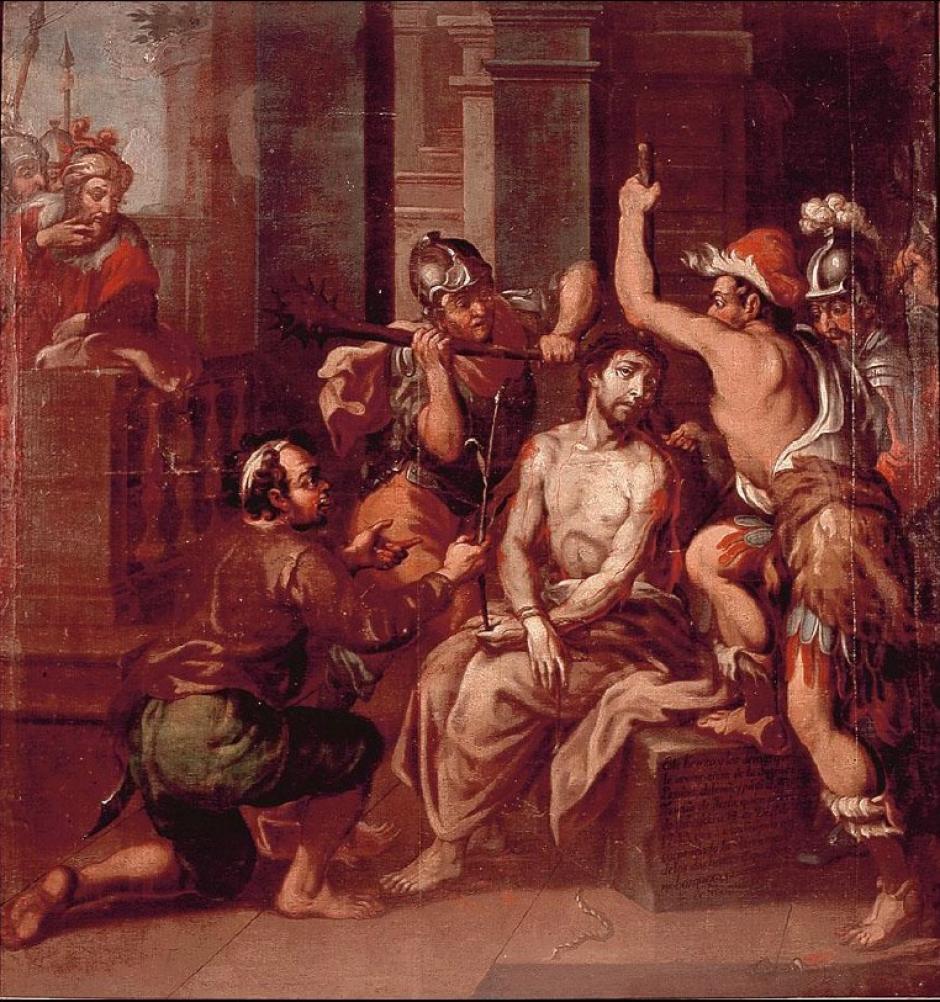
PIANO CONCERTO: Tomás de Merlo by Xavier Beteta: In February 2014 six religious paintings by the early eighteenth-century Guatemalan painter Tomás de Merlo were stolen from a church in Antigua. Although the thieves have been caught, the paintings have disappeared into the black market and have likely been smuggled out of the country. Wanting to preserve the essence of the paintings in music, Guatemalan composer Xavier Beteta wrote a piano concerto whose three movements, titled after the stolen paintings, are “La Oración en el Huerto” (The Prayer in the Garden), “La Piedad” (The Pietà), and “El Rey de Burlas” (The Mocking of Christ). Beteta said he may eventually compose three additional movements, one for each of the other three lost paintings.
Tomás de Merlo (Guatemalan, 1694–1739), El Rey de Burlas (aka La Coronación de Espinas), 1737
DOCUMENTARY: The Painter and the Thief (2020), dir. Benjamin Ree: A story of crime and trauma, love and redemption, this documentary follows Oslo-based Czech artist Barbora Kysilkova as she confronts one of the men, Karl-Bertil Nordland, who stole two of her most prized paintings. A mutual friendship develops, and it’s so beautiful to watch.
What I love about the film is how it captures the rehabilitation of both subjects—in a way that honors the complexity, the nonlinearity of that process—and the role art can play in healing. “Barbar” forgives “the Bertilizer” and helps him on his road to sobriety, and he helps her access deep parts of herself and come to grips with the history of abuse she’s suffered. They become, in a sense, each other’s muses. His stunned, tearful reaction when he sees the first portrait she paints of him melted me—someone sees him for the first time.
With documentaries I always wonder who’s the person making it and why. I had cynically assumed the project was instigated by the artist to try to vitalize her career, but no, the filmmaker, who has had an ongoing interest in art theft, contacted Kysilkova after reading about the gallery break-in in the news. As is true with most documentarians, he had no idea when he started filming that the story would evolve the way it did and shift genres, and even become feature-length. Streaming on Hulu.
+++
INTERVIEW: In 2016 Adelle M. Banks of the Religion News Service interviewed Rep. John Lewis about the National Book Award–winning graphic novel trilogy March, the role of music and religious faith in the civil rights movement, protest (and getting into “good trouble”) as a form of Christian ministry, the urgent need for the church to be a headlight, not a taillight, and more.
+++
VCS VIDEO EXHIBITION SERIES: The Visual Commentary on Scripture [previously] is an online, open-access resource for those looking to explore the biblical text through art. For every passage of scripture, an art historian, artist, theologian, media theorist, or other is solicited to select and comment on three art images that illuminate the text in some way. The site’s typical format is written commentaries, but by way of experimentation, the VCS has just released video commentaries instead for four new texts. Ben Quash comments on the story of Lot’s Wife through the lens of an early English stained glass panel, a Flemish Renaissance landscape, and a stunning photograph taken after the Allied bombing of Dresden. For Belshazzar’s Feast from the book of Daniel, Michelle Fletcher is guided by paintings from the Dutch Golden Age and the English Romantic period, which she juxtaposes with a contemporary room installation. But here I’ll highlight the videos for two New Testament passages.
The Burial of Christ, with commentary by Italian Renaissance art expert Jennifer Sliwka [previously], covers Andrea Mantegna’s innovatively foreshortened Christ on a marble slab; an altarpiece painting by Michelangelo, in which Christ’s dead body is held up for display, evoking the presentation of the eucharistic host; and a contemporary Pietà, of sorts, by Swiss artist Urs Fischer, which involves a skeleton and a fountain.
Michelle Fletcher, a feminist scholar and specialist on the book of Revelation, comments on the controversial apocalyptic figure known as The Whore of Babylon, which she discusses as a symbol of a city, as a satirization of the goddess Roma, and as bequeathing a legacy of vilification of prostitutes. Fletcher selected a didactic painting by street evangelist Robert Roberg, an ancient Roman coin, and William Hogarth’s A Harlot’s Progress.
Space Face by Akili Ron Anderson (American, 1946–)
Forgetting what lies behind and straining forward to what lies ahead, I press on toward the goal for the prize of the upward call of God in Christ Jesus.
This post belongs to the weekly series Artful Devotion. If you can’t view the music player in your email or RSS reader, try opening the post in your browser.
To view all the Revised Common Lectionary scripture readings for Proper 22, cycle A, click here.
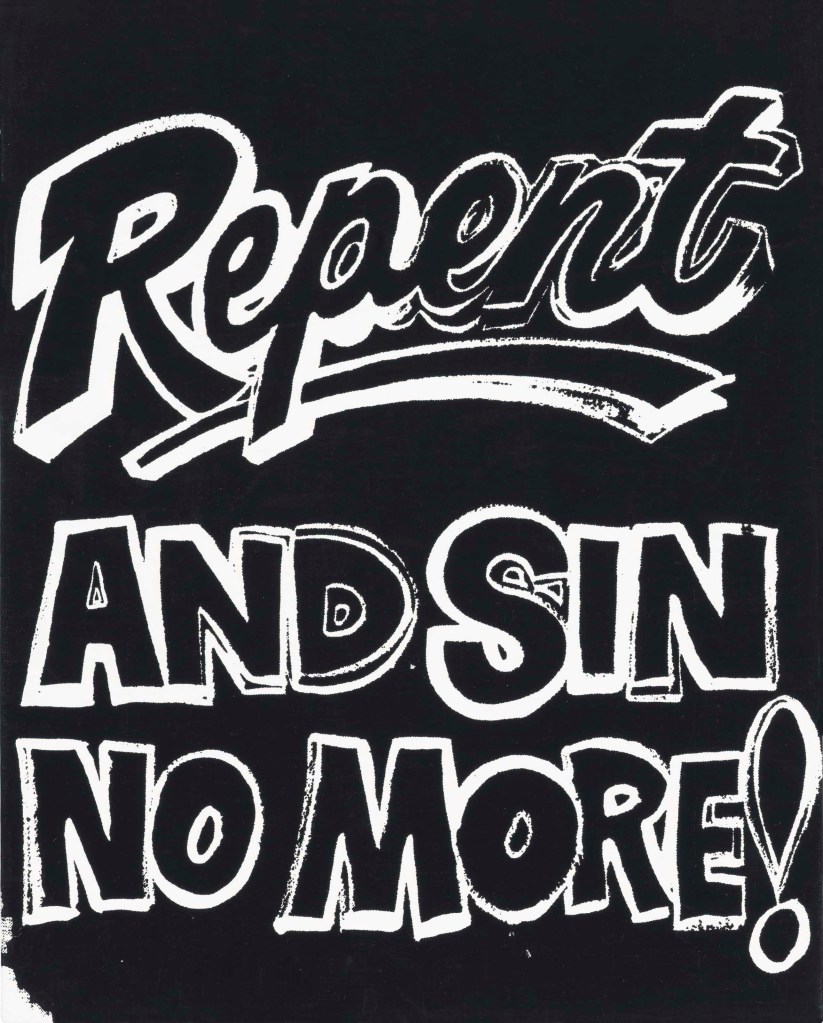
Andy Warhol (American, 1928–1987), Repent and Sin No More!, 1985–86. Synthetic polymer and silkscreen ink on canvas, 20 × 16 in. (50.8 × 40.6 cm).
“When a righteous person turns away from his righteousness and does injustice, he shall die for it; for the injustice that he has done he shall die. Again, when a wicked person turns away from the wickedness he has committed and does what is just and right, he shall save his life. Because he considered and turned away from all the transgressions that he had committed, he shall surely live; he shall not die. Yet the house of Israel says, ‘The way of the Lord is not just.’ O house of Israel, are my ways not just? Is it not your ways that are not just?
“Therefore I will judge you, O house of Israel, every one according to his ways, declares the LORD GOD. Repent and turn from all your transgressions, lest iniquity be your ruin. Cast away from you all the transgressions that you have committed, and make yourselves a new heart and a new spirit! Why will you die, O house of Israel? For I have no pleasure in the death of anyone, declares the LORD GOD; so turn, and live.”
—Ezekiel 18:26–32
+++
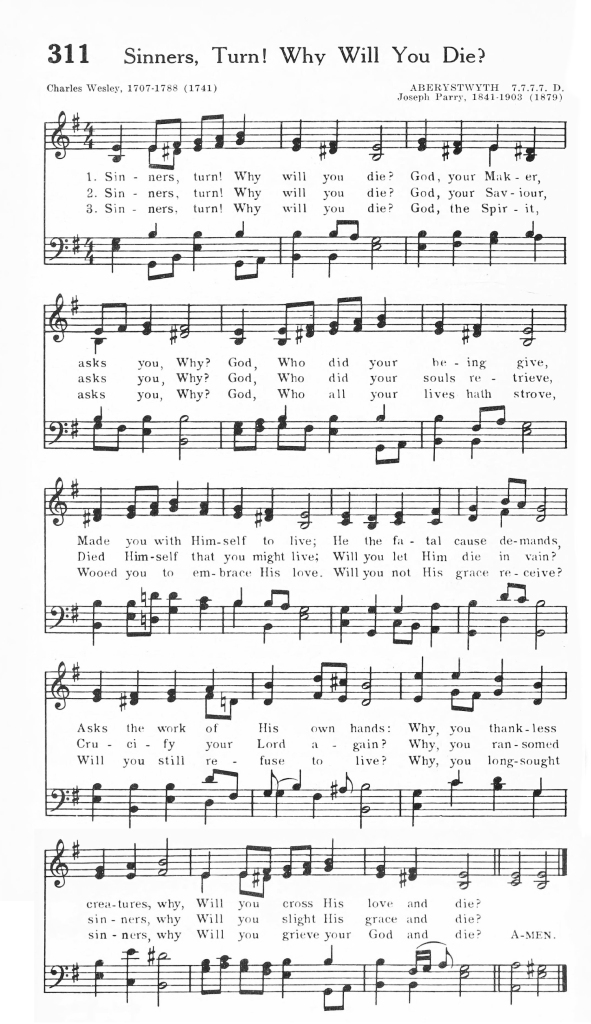
HYMN: “Sinners, Turn, Why Will You Die?” by Charles Wesley, 1742
Sinners, turn: why will you die?
God, your Maker, asks you why.
God, who did your being give,
made you himself, that you might live;
he the fatal cause demands,
asks the work of his own hands.
Why, you thankless creatures, why
will you cross his love, and die?

Sinners, turn: why will you die?
God, your Savior, asks you why.
God, who did your souls retrieve,
died himself, that you might live.
Will you let him die in vain?
Crucify your Lord again?
Why, you ransomed sinners, why
will you slight his grace and die?

Sinners, turn: why will you die?
God, the Spirit, asks you why;
he, who all your lives hath strove,
wooed you to embrace his love.
Will you not his grace receive?
Will you still refuse to live?
Why, you long-sought sinners, why
will you grieve your God, and die?

You, on whom he favors showers,
you, possessed of nobler powers,
you, of reason’s powers possessed,
you, with will and memory blest,
you, with finer sense endued,
creatures capable of God;
noblest of his creatures, why,
why will you forever die?

You, whom he ordained to be
transcripts of the Trinity,
you, whom he in life doth hold,
you for whom himself was sold,
you, on whom he still doth wait,
whom he would again create;
made by him, and purchased, why,
why will you forever die?

You, who own his record true,
you, his chosen people, you,
you, who call the Savior Lord,
you, who read his written word,
you, who see the gospel light,
claim a crown in Jesu’s right;
why will you, ye Christians, why,
will the house of Israel die?

Turn, he cries, ye sinners, turn;
by his life your God hath sworn;
he would have you turn and live,
he would all the world receive;
he hath brought to all the race
full salvation by his grace;
he hath not one soul passed by;
why will you resolve to die?

Can ye doubt, if God is love,
if to all his mercies move?
Will ye not his word receive?
Will ye not his oath believe?
See, the suffering God appears!
Jesus weeps! Believe his tears!
Mingled with his blood they cry,
why will you resolve to die?
This Wesleyan hymn of invitation has historically been paired with a number of different tunes. I quite like it with the Welsh ABERYSTWYTH by Joseph Parry, composed in 1879, but I can’t find any such recordings. Here’s the sheet music.
I did find a solo performance by Alan Lett, from his 2006 album Heart, Soul, and Hymns, that employs a very lovely and effective tune in the minor mode. I’m not sure whether the tune is traditional or contemporary, perhaps one he wrote himself, and I can’t find any contact info for him online, as it appears that he is no longer active as a music artist. Do you recognize the music? I do know that Lett is not only singing on the track but is also at the keys, and that the vocal and piano arrangements are his own—both are impressive. He cuts the length of Wesley’s text considerably, though, singing only verse 2.
+++
“Over the course of a prominent and prolific career,” writes the Andy Warhol Museum, “Andy Warhol both pictured religious subjects and practiced his religious faith. Yet in twentieth-century histories of modern American art, religion is largely excluded. Warhol was perhaps doubly excluded, as a gay man, and a believing Christian, whose identity in the art world and in American society was made complicated by those identities.”
Warhol’s Repent and Sin No More! silkscreen prints are part of a series executed toward the end of his life, with source material pulled from religious ads and pamphlets.
In January I took a weekend trip to Pittsburgh to see the exhibition Andy Warhol: Revelation[previously], which examined the pop artist’s Byzantine Catholic faith in relation to his artistic output. It actually exceeded my expectations! While there, I attended a museum lecture by Jonathan A. Anderson, coauthor of Modern Art and the Life of a Culture: The Religious Impulses of Modernism [previously], that contextualized and commented on the exhibition. You can watch it in full in the video below.
This post belongs to the weekly series Artful Devotion. If you can’t view the music player in your email or RSS reader, try opening the post in your browser.
To view all the Revised Common Lectionary scripture readings for Proper 21, cycle A, click here.
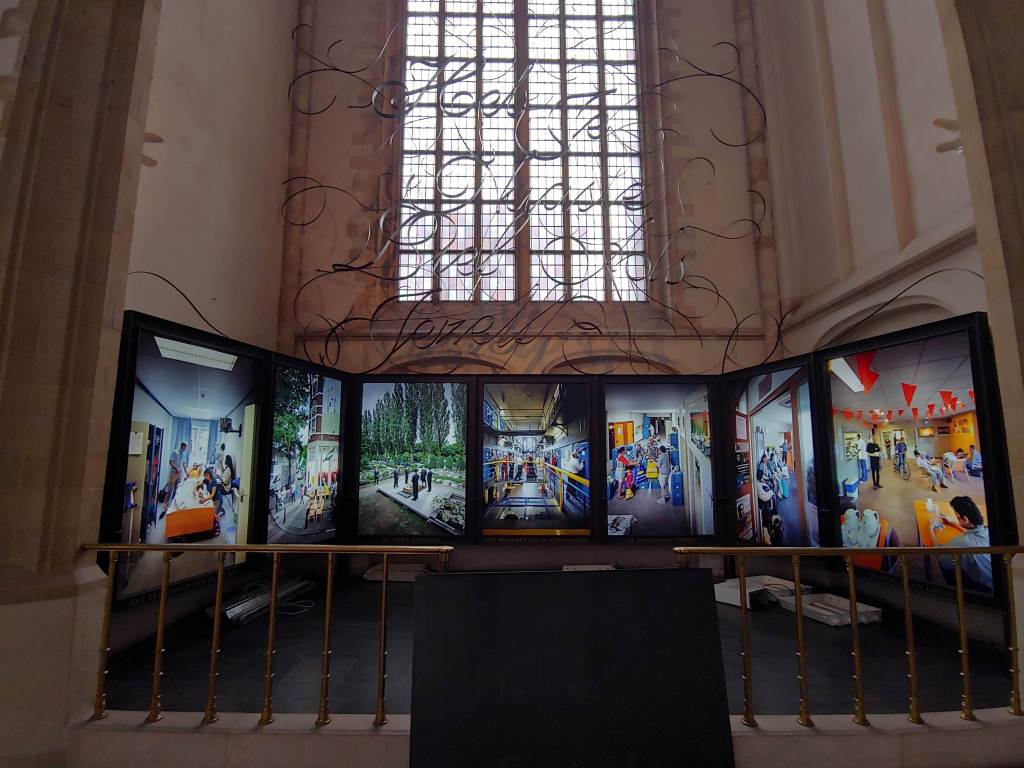
RADIX ARTICLE: “The Seven Works of Mercy: How two Dutch artworks—one Renaissance, one contemporary—can help us recover an ethic of neighborly care” by Victoria Emily Jones: When I was in the Netherlands last year, I saw lots of artistic representations of what are called the seven works of mercy, derived from Matthew 25. (Even after the Protestant Reformation, the subject remained popular among Dutch artists, who delighted in representations of everyday life.) In this article, published last week, I share just two. One is a multipaneled painting, now at the Rijksmuseum, commissioned in 1504 by the Holy Ghost Confraternity in Alkmaar, which ran an almshouse that provided medical care for the sick and housing for the poor (social welfare programs were carried out by the church in those days); notably, in each contemporary townscape, Jesus stands among the afflicted—a theologically loaded artistic choice. The other artwork is a set of photographs by Thijs Wolzak on display inside Rotterdam Cathedral, which feature community service organizations in action, caring for drug users, undocumented immigrants, and others. (Note: The chapel was in a bit of disarray when I was there, with light fixtures disassembled all over the floor and a ramp blocking my entrance, hence the messy staging of my photo! See a professional photograph in the article link, including photos of individual panels.)
Master of Alkmaar, Feeding the Hungry, leftmost panel from the Seven Works of Mercy polyptych, 1504. Oil on panel, 103.5 × 55 cm. Rijksmuseum, Amsterdam. The inscription on the original frame underneath (not pictured) is a rhyming Dutch couplet: “Deelt mildelick den armen / God zal u weder ontfarmen” (Share generously [with] the poor, [and] God shall have mercy on you).Thijs Wolzak (Dutch, 1965–), in collaboration with Kathelijne Eisses, Werken van Barmhartigheid (Works of Mercy), 2010. Duratrans prints in light boxes. Chapel of Works of Mercy, Sint-Laurenskerk (Church of St. Lawrence), Rotterdam, Netherlands. Photo: Victoria Emily Jones.
It’s interesting to consider the overlap of Christian and civic duty the images present and the way in which they function(ed) in their disparate spaces. The more explicitly theological Alkmaar polyptych was originally owned by a lay brotherhood and sited in a church beside the collection box, and its primary purpose was “to stir up . . . to love and good works” (Heb. 10:24), and to financial giving—but it is now in a large, government-run art museum, where it’s viewed mainly as an art historical object. The Wolzak piece, on the other hand, was commissioned as a permanent installation inside an active church that is also a heritage museum and something like a community center, with the purpose of highlighting the charitable work being done in the city. I like how Wolzak helps us to see where some of the needs lie in contemporary society and examples of tangible ways they might be met, through such services as safe-injection sites (for those suffering from heroin addiction) or the Lonely Funeral Foundation (for the anonymous dead).
NEW BOOK: Off the Walls: Inspired Re-Creations of Iconic Artworks: This March on social media, the Getty Museum issued the #GettyMuseumChallenge, inviting art lovers to channel the stir-crazy energy of COVID-19 quarantine into crafting themselves, their families, and their pets into masterpieces of world art and posting the photos online. By May there were at least 100,000 re-creations uploaded to the Internet—246 of which are featured in the new book Off the Walls, released this month by Getty Publications. All profits from the book will go to the charity Artist Relief to support artists facing financial emergencies to the coronavirus pandemic. This is such a fun way to get people to engage with art!
+++
NEW SONG RELEASES
“Hallelujah (Come Bless the Lord)” by September Penn:September Penn is a singer, songwriter, performance artist, worship leader, and cofounder of The Power of Song Inc., an organization that educates about social justice issues through song, theater, and art. She wrote “Hallelujah” while directing the Kaleo Choir at Fuller Theological Seminary, where she earned an MDiv this year with a focus on Worship, Theology, and the Arts. The song was released September 3 as a single on all music-streaming platforms.
“Nara Ekele Mo” by Tim Godfrey, performed by Resonance: Last month the Global Resonance Multicultural Worship Collective, under the organization Arts Release, posted on YouTube a multicontinent, multilingual cover of the Nigerian Igbo song “Nara Ekelo Mo” by Tim Godfrey. It features thirty-seven singers from Brazil, England, France, Indonesia, Singapore, and Spain, with lyrics in Igbo, Yoruba, Tamil, Bahasa Indonesia, French, Mandarin, Portuguese, Spanish, and English. (See the original version of the song here.) [HT: Global Christian Worship]
+++
POEMS
“Field Guide” by Tony Hoagland: A few weeks ago SALT Project reprinted this poem that celebrates the ordinary in nature—along with brief commentary and a stunning macrophoto of a dragonfly. An excerpt from the opening chapter of Ralph Waldo Emerson’s essay “Nature” is referenced: “If the stars should appear one night in a thousand years, how would men believe and adore; and preserve for many generations the remembrance of the city of God which had been shown! But every night come out these envoys of beauty, and light the universe with their admonishing smile.” (The poem is from Hoagland’s 2010 collection Unincorporated Persons in the Late Honda Dynasty, published by Graywolf Press.)
from the current issue of Image:Image journal is the one piece of mail I most look forward to receiving every quarter—full of poetry, visual art, literary essays, and short stories with a spiritual sensibility. In its current issue, no. 105, some of the poems I particularly enjoyed were “Trench Coat” by Cameron Alexander Lawrence, on the accumulation of things; “Pastoral with Wheat” by John Hart, on fatherhood as beatitude, and as a continual lesson in dying to self; “Duet” by Chelsea Wagenaar [previously], about the “music” of the ordinary moments of motherhood, like tending to your child’s bee sting; and “The Eighth Sacrament” by Peter Cooley, on grief, written after the death of his wife, Jacqueline.
Miniature from the Menologion of Basil II (Vat. Gr. 1613, page 59), made in Constantinople, 976–1025. Vatican Library, Rome.
When God saw what they did, how they turned from their evil way, God relented of the disaster that he had said he would do to them, and he did not do it.
But it displeased Jonah exceedingly, and he was angry. And he prayed to the LORD and said, “O LORD, is not this what I said when I was yet in my country? That is why I made haste to flee to Tarshish; for I knew that you are a gracious God and merciful, slow to anger and abounding in steadfast love, and relenting from disaster. Therefore now, O LORD, please take my life from me, for it is better for me to die than to live.” And the LORD said, “Do you do well to be angry?”
Jonah went out of the city and sat to the east of the city and made a booth for himself there. He sat under it in the shade, till he should see what would become of the city. Now the LORD God appointed a plant and made it come up over Jonah, that it might be a shade over his head, to save him from his discomfort. So Jonah was exceedingly glad because of the plant. But when dawn came up the next day, God appointed a worm that attacked the plant, so that it withered. When the sun rose, God appointed a scorching east wind, and the sun beat down on the head of Jonah so that he was faint. And he asked that he might die and said, “It is better for me to die than to live.” But God said to Jonah, “Do you do well to be angry for the plant?” And he said, “Yes, I do well to be angry, angry enough to die.” And the LORD said, “You pity the plant, for which you did not labor, nor did you make it grow, which came into being in a night and perished in a night. And should not I pity Nineveh, that great city, in which there are more than 120,000 persons who do not know their right hand from their left, and also much cattle?”
—Jonah 3:10–4:11
After Jonah, at God’s behest, reluctantly went to preach to the pagan city of Ninevah, its people repented and were spared destruction. (Ninevah was the capital of Assyria, Israel’s enemy.) This is where Sunday’s lectionary reading, the final chapter of the book of Jonah, picks up.
When God extended his mercy to Jonah earlier in the story, it filled Jonah with thanksgiving (Jonah 2:9), but when God is merciful to Ninevah, it fills Jonah with anger. Jonah believed that the Ninevites should be punished for their sin, that they are not worthy of God’s forgiveness. He wanted them to be crushed, not saved! Thus accusing God of injustice, he stalks over to a spot east of Ninevah, plops himself down, and pouts.
The book of Jonah condemns the title character’s bigotry and ethnocentrism, portraying him as a rather ridiculous figure. The idea that God loves only “us,” not “them,” is one that has persisted down through the ages and that’s satirized in this quatrain:
We are God’s chosen few,
All others will be damned;
There is no place in heaven for you,
We can’t have heaven crammed.
(This is sometimes attributed to Jonathan Swift, but it’s not in his collected works; if you know the original source, let me know!)
Jonah wants God’s love to have boundaries that hem him in and others out. To expose the faultiness of Jonah’s thinking, God “appoints a plant” to provide shade for Jonah, relief from the heat, but only for a day. The next day God destroys the plant, and Jonah is so upset that he wants to die. God then questions why he grieves the destruction of a mere plant but not the prospect of an entire city being destroyed.
The narrative ends without telling us whether Jonah receives the lesson well and repents of the hatred he harbors.
This post belongs to the weekly series Artful Devotion. If you can’t view the music player in your email or RSS reader, try opening the post in your browser.
To view all the Revised Common Lectionary scripture readings for Proper 20, cycle A, click here.
Maggi Hambling (British, 1945–), Wall of Water II, 2011. Oil on canvas, 78 × 89 in. (198.1 × 226.1 cm). Photo: Douglas Atfield.
Then the angel of God who was going before the host of Israel moved and went behind them, and the pillar of cloud moved from before them and stood behind them, coming between the host of Egypt and the host of Israel. And there was the cloud and the darkness. And it lit up the night without one coming near the other all night.
Then Moses stretched out his hand over the sea, and the LORD drove the sea back by a strong east wind all night and made the sea dry land, and the waters were divided. And the people of Israel went into the midst of the sea on dry ground, the waters being a wall to them on their right hand and on their left. The Egyptians pursued and went in after them into the midst of the sea, all Pharaoh’s horses, his chariots, and his horsemen. And in the morning watch the LORD in the pillar of fire and of cloud looked down on the Egyptian forces and threw the Egyptian forces into a panic, clogging their chariot wheels so that they drove heavily. And the Egyptians said, “Let us flee from before Israel, for the LORD fights for them against the Egyptians.”
Then the LORD said to Moses, “Stretch out your hand over the sea, that the water may come back upon the Egyptians, upon their chariots, and upon their horsemen.” So Moses stretched out his hand over the sea, and the sea returned to its normal course when the morning appeared. And as the Egyptians fled into it, the LORD threw the Egyptians into the midst of the sea. The waters returned and covered the chariots and the horsemen; of all the host of Pharaoh that had followed them into the sea, not one of them remained. But the people of Israel walked on dry ground through the sea, the waters being a wall to them on their right hand and on their left.
Thus the LORD saved Israel that day from the hand of the Egyptians, and Israel saw the Egyptians dead on the seashore. Israel saw the great power that the LORD used against the Egyptians, so the people feared the LORD, and they believed in the LORD and in his servant Moses.
—Exodus 14:19–31
+++
SONG: “Wade in the Water,” African American spiritual
There have been many, many performances of this song over the years. For a nice, concise history of recordings, from gospel and doowop and choral to modern jazz, R&B, heavy rock, and northern soul, see this article by Mike Hobart. Below is a handful I’ve found and enjoy.
A gospel version by Brother John Sellers from 1959, driven by piano:
A choral arrangement by Paul T. Kwami, performed by the Fisk Jubilee Singers in 2019 (the soloist isn’t credited, but she’s amazing!):
Pegasis is a vocal trio of sisters from the Dominican Republic, formerly performing under the name The Peguero Sisters. Accompanied on guitar by their dad, here they are with stellar harmonies from their 2016 album Peace Through Praise:
The Petersens apply their signature bluegrass stylings in their rendition, performed a few weeks ago in this video but also on their 2019 album Homesick for a Country:
According to oral lore, Harriet Tubman used the song “Wade in the Water” to communicate strategy to slaves traveling the Underground Railroad: its coded language alerted freedom seekers that bounty hunters were on their trail with bloodhounds and that they should jump into the river so that the dogs couldn’t track their scent. This popular myth about the song has not been confirmed, and the National Park Service, which preserves historical sites associated with the Underground Railroad and promotes research on the topic, suggests that it’s probably not true.
It is known, however, that it was sung at river baptisms, and still is, as the Exodus is seen as an archetype of baptism, of redemption through water. Not only that, but the song also draws on the pool of Bethesda passage in John 5, where people gathered to be healed: “For an angel went down at a certain season into the pool, and troubled the water: whosoever then first after the troubling of the water stepped in was made whole of whatsoever disease he had” (v. 4). (This verse is found in some early New Testament manuscripts but not the earliest and is therefore omitted from several modern translations.)
In the documentary God’s Greatest Hits, pastor and gospel recording artist Wintley Phipps says, “‘Wade in the Water,’ to me, . . . means people who are afraid of moving forward, progressing, taking a step, and facing uncertainty—go ahead, wade in the water. Take that step. As terrifying as it may seem at that very moment, it’s gonna be alright, and the miracle we seek is gonna happen.”
There’s the famous song “Bridge Over Troubled Water.” Well, in Exodus, God carves out a bridge through troubled water! Imagine walls of water standing multiple stories high on either side of you, filled with tiger sharks and other marine life. And you have to cross the sandy bottom in faith that those walls will hold up until you reach the other side.
“Wade in the Water” affirms that God is going to stir things up; he’s going to do something big. Just like he did when he brought Israel up out of Egypt.
Maggi Hambling is one of Britain’s most significant painters and sculptors. Her nine “Walls of Water” paintings were made in 2010–11 and were first exhibited in 2014 at the National Gallery in London. Vast, intense, and energetic, they were inspired by her experience of giant waves crashing onto the seawall at Southwold, Suffolk, where she lives. “Through turbulence and exuberant colour, Hambling continues to affirm painting’s immediacy, saying, ‘The crucial thing that only painting can do is to make you feel as if you’re there while it’s being created – as if it’s happening in front of you’” (source).
Maggi Hambling (British, 1945–), Wall of WaterV, 2011. Oil on canvas, 78 × 89 in. (198.1 × 226.1 cm). Photo: Douglas Atfield.
View other paintings from the series at Artsy.net.
This post belongs to the weekly series Artful Devotion. If you can’t view the music player in your email or RSS reader, try opening the post in your browser.
To view all the Revised Common Lectionary scripture readings for Proper 19, cycle A, click here.








 Art & Theology