Roundup: Cracked lanterns; Incarnation songs; Christmas gallery talks; pregnancy poem

COMMUNITY ART PROJECT + INSTALLATION: Light the Well by Anna Sikorska: Last month artist Anna Sikorska led the congregation of St. Martin-in-the-Fields in creating a constellation of cracked, translucent porcelain globes, lit from within like lanterns and linked together—a visualization of Paul’s words in 2 Corinthians 4:6–12, about our hearts being clay jars whose fragility and brokenness enable the light of Christ to shine through all the more. Light the Well was installed at St. Martin’s on November 11, and since November 19 the individual lanterns have been selling for £10 a piece to benefit New Art Studio and Art Refuge UK, charities working with art therapy in the context of migration and displacement. Associate vicar Jonathan Evens delivered a beautiful reflection on this artwork and the scripture that inspired it, as well as a prayer and benediction, which you can read in full here.
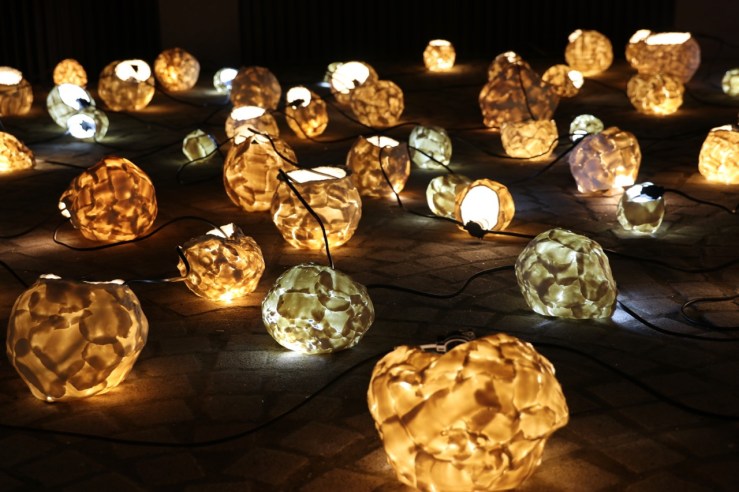
Light the Well installation

I love it when churches use art not merely to decorate or prettify the building but to further the congregation’s engagement with scripture and to foster shared doing and seeing.

+++

SONGS:

“City of David” by the Gray Havens: The Gray Havens, a “narrative pop folk duo” from Nashville made up of married couple David and Licia Radford, released a new Christmas single on November 17—recorded on an iPhone! Listen to the song and watch some of their “making of” process in the video below. God the Father often gets overlooked during this season, so I like that the refrain reminds us that “the Father sent him [the Son] down.” [Purchase here]

“Human for Me” by Katy Kinard: Released last year on the album God of Fireflies, this song praises God for assuming full humanity—for not circumventing any frustrating or painful aspect of it. [Purchase here]

+++

GALLERY TALKS:

“The Christmas Story in Art” at the National Gallery, Washington, DC: Gallery lecturer David Gariff will lead a 75-minute discussion about paintings in the collection that depict the birth of Jesus, including one of my favorites, Duccio’s Nativity with the Prophets Isaiah and Ezekiel. (Click on the link to see a full list of works.) The event is free and geared to an adult audience. To participate, meet in the West Building Rotunda at 1 p.m. on December 9 or 10, or 2 p.m. on December 14, 18, 20, 21, or 22.
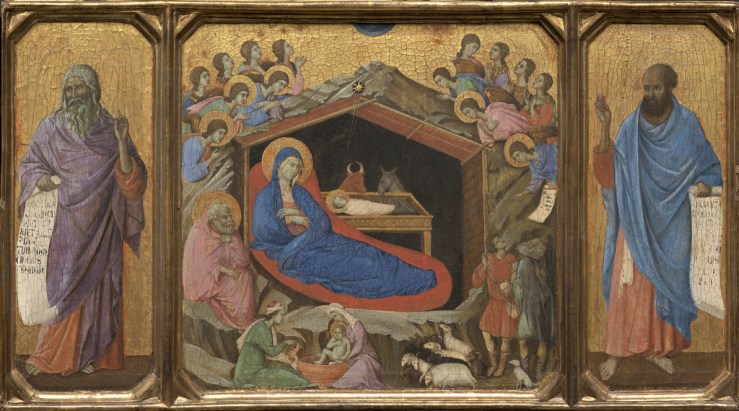
Nativity with Isaiah and Ezekiel by Duccio
Duccio (Italian, ca. 1255–60–ca. 1318/19), The Nativity with the Prophets Isaiah and Ezekiel, 1308/1311. Tempera on single poplar panel, 48 × 86.8 × 7.9 cm (18 7/8 × 34 3/16 × 3 1/8 in.). National Gallery of Art, Washington, DC.

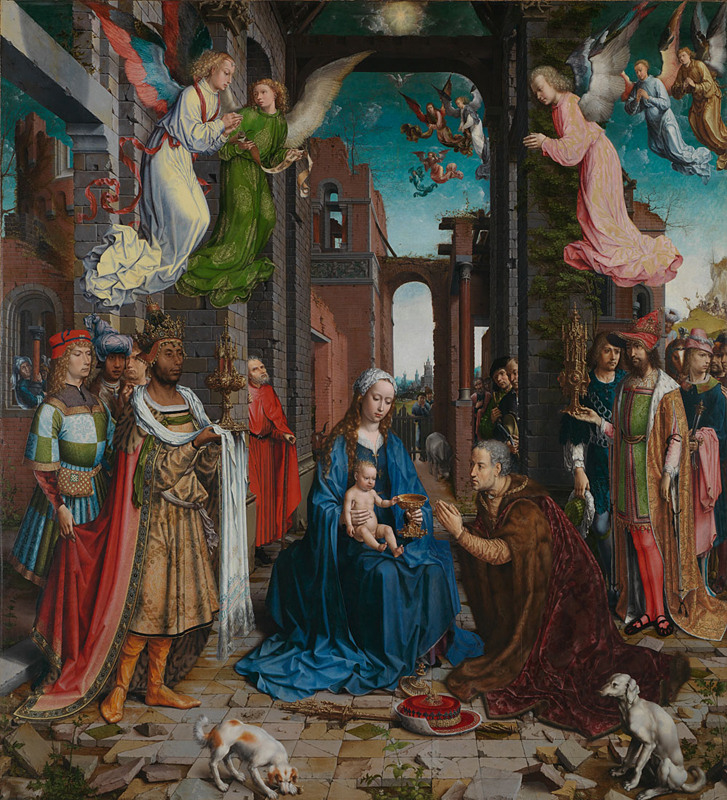
“Adoration of the Kings” Facebook Live tour at the National Gallery, London: Friday, December 15 at 9 a.m. GMT, director Gabriele Finaldi will be exploring Jan Gossaert and Pieter Bruegel the Elder’s paintings of the Adoration of the Magi. This “tour,” offered exclusively online, will be broadcast live on the Gallery’s Facebook page, and a replay version will be available on the channel afterward.
Adoration of the Kings by Jan Gossaert
Jan Gossaert (Flemish, d. 1532), The Adoration of the Kings, 1510–15. Oil on oak, 179.8 × 163.2 cm. National Gallery, London.
Adoration of the Kings by Pieter Bruegel
Pieter Bruegel the Elder (Flemish, d. 1569), The Adoration of the Kings, 1564. Oil on oak, 112.1 × 83.9 cm. National Gallery, London.

+++

POEM: “Scale” by Chelsea Wagenaar: Chelsea and I went to the same small North Carolina church as kids, back when she was a Henderson and I a Hartz, so we share a heritage of learning Bible lessons from Butch the Dragon and competing annually in the Bean Bag Relay at the AWANA Olympics. Now she is an award-winning poet, a Lilly Fellow, a lecturer in Valparaiso University’s English department, and a mom!

Inspired by her pregnancy, the poem “Scale” is full of metaphors that revel in the wonders of prenatal life—the womb is a “winterplum sky,” the cluster of baby cells “untufted cotton,” the belly a “Lenten moon.” The central theme, which Chelsea cleverly plays around, is Psalm 139:16, a praise verse by King David: “Your eyes saw my unformed substance; in your book were written, every one of them, the days that were formed for me, when as yet there was none of them.”

Chelsea’s poem is especially appropriate for Advent, a season of pregnancy in which we position ourselves retrospectively with Mary, letting our hearts expand as we wait expectantly for that marvelous deliverance, the coming of the Christ child.

Prepare the Way (Artful Devotion)

Serima Mission Church door (detail)
Teak wood relief door panel carved by Cornelio Manguma, 1958, showing John the Baptist preaching repentance (upper register) and baptizing Christ (lower register). St. Mary’s Church, Serima Mission, Zimbabwe. [full door]

A voice cries:

“In the wilderness prepare the way of the LORD;
make straight in the desert a highway for our God.
Every valley shall be lifted up,
and every mountain and hill be made low;
the uneven ground shall become level,
and the rough places a plain.
And the glory of the Lord shall be revealed,
and all flesh shall see it together,
for the mouth of the Lord has spoken.”

—Isaiah 40:3–5

The beginning of the gospel of Jesus Christ, the Son of God.

As it is written in Isaiah the prophet,

“Behold, I send my messenger before your face,
who will prepare your way,
the voice of one crying in the wilderness:
‘Prepare the way of the Lord,
make his paths straight,’”

John appeared, baptizing in the wilderness and proclaiming a baptism of repentance for the forgiveness of sins. And all the country of Judea and all Jerusalem were going out to him and were being baptized by him in the river Jordan, confessing their sins. Now John was clothed with camel’s hair and wore a leather belt around his waist and ate locusts and wild honey. And he preached, saying, “After me comes he who is mightier than I, the strap of whose sandals I am not worthy to stoop down and untie. I have baptized you with water, but he will baptize you with the Holy Spirit.”

—Mark 1:1–8

+++

SONG: “Prepare the Way, O Zion” | Text by Frans Mikael Franzen, 1812; trans. Augustus Nelson, 1958; adapt. Charles P. Price, 1980 | Music: Then Swenska Psalmboken, 1697 | Arranged and performed by Chicago Metro Presbytery Music, on Proclaim the Bridegroom Near, 2011

+++

In A Tourist in Africa (1960), the British writer Evelyn Waugh describes St. Mary’s Church in Serima, Zimbabwe, as the “African Chartres.” Designed by the Swiss Catholic missionary Fr. John Groeber, it was built in 1956–66 and filled with hundreds of carvings, murals, and ecclesiastical artworks by the Shona people. To see more photos of the church and to learn more about it, visit ZimFieldGuide.com or, if you can get your hands on a copy, check out the bilingual (English-German) book Serima: Towards an African Expression of Christian Belief (Gwelo, Rhodesia: Mambo Press, 1974), edited by Albert B. Plangger and Marcel Diethelm.

Another great resource for learning about the Serima Mission, and African Christian art in general, is Christliche Kunst in Afrika by Josef Franz Thiel and Heinz Helf (Berlin: Dietrich Reimer Verlag, 1984), whence I scanned the above photo. The text is all German, but there are hundreds of magnificent art images from all over the African continent that make this volume one of my favorites from my personal library.


This post belongs to the weekly series Artful Devotion. If you can’t view the music player in your e-mail or RSS reader, try opening the post in your browser.

To view all the Revised Common Lectionary scripture readings for the Second Sunday of Advent, cycle B, click here.

Advent 2017 online arts devotional by Biola University

The Advent Project published yearly by Biola University’s Center for Christianity, Culture, and the Arts (CCCA) is an online devotional that brings together daily scripture readings, visual art, music, poetry, and written reflections for the seasons of Advent and Christmas (which this year is December 3–January 6). Introduced in 2013, it is the only recurrently published art-forward Advent/Christmas devotional I know of, and I recommend it highly. It is in large part what inspired my year-round “Artful Devotion” series and the Advent art booklet I published digitally last year.

Click here to view and/or subscribe to Biola’s Advent Project 2017.

With so many different elements, design matters a lot, and I’m super-impressed by what Biola has come up with. The homepage is laid out as a gridded calendar with thumbnail images; click on a date, and you’re brought to a new viewing mode in which a large image and a music player are set in a fixed position on the left while the right sidebar contains scrollable text, separated into two tabs—the main content, and biographical information about the artists. This design enables the image to remain before your eyes so that you can continue to reference it as you read on (something that, frustratingly, I cannot achieve with Art & Theology’s long-scrolling format), and it also relegates the bios to “back matter.” It’s all very organized and easily navigable.

This initiative is an outworking of the CCCA’s mission to explore the rich interrelationships between contemporary art making, theology, and religious tradition. Be sure to check out the other sections of their website; they offer plenty of free resources, including an archive of past Advent (and Lent!) devotionals, and a calendar of events, such as lectures, workshops, symposia, art exhibitions, concerts, film screenings, and more.

Below is one of my favorite Advent Project entries from last year, reproduced by kind permission of the CCCA. Centered on Mary’s Magnificat, it brings together the work of an Italian Renaissance painter, a contemporary British video artist (who I’ve written about before), a modern Bohemian Austrian poet, and a minimalist composer working with Spanish, Latin, and English texts. Adjunct professor of philosophy Evan Rosa (who is a superb writer!) reflects on how scandalous Mary’s humility is for power-hungry Western Christians—just as it would have been for the Greco-Roman world in which she lived. He concludes with a prayer that invites us to move from self-magnification to the magnification of God.

Due to this blog’s design limitations, I had to adapt the following content from its original format. To view the devotion on the Biola website, click here. I have excluded biographical information for the song performers and poet.

+++

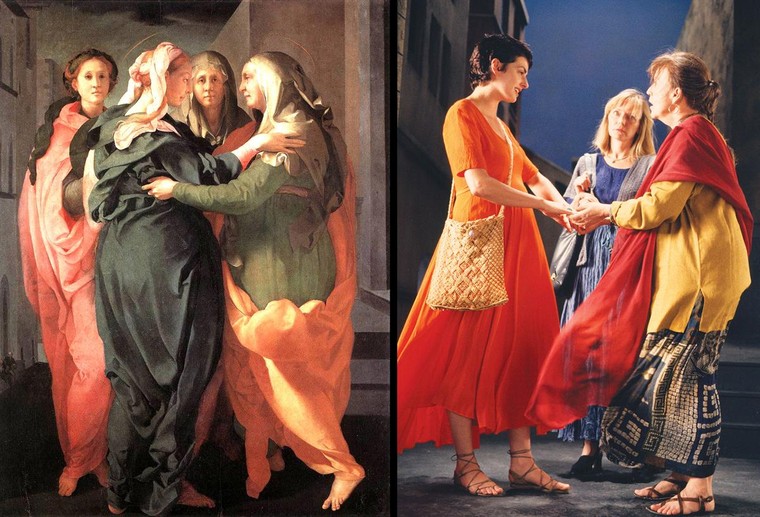
ARTWORKS: The Visitation by Pontormo; The Greeting by Bill Viola

The Greeting by Bill Viola
Left: Jacopo da Pontormo, The Visitation, 1528, oil on canvas, Church of San Francesco de Michele, Carmignano, Italy. Right: Bill Viola, The Greeting, 1995, still image from a large-screen video installation.

About the Artist and Artwork #1:

Jacopo Carucci (1494–1557), usually known as Pontormo, was an Italian Mannerist painter and portraitist from the Florentine School. His work represents a profound stylistic shift from the calm perspectival regularity that characterized the art of the Florentine Renaissance. He is famous for his use of twining poses, coupled with ambiguous perspective; his figures often seem to float in an uncertain environment, unhampered by the forces of gravity. Pontormo’s painting The Visitation, completed in 1528, now adorns the altar of a side chapel in a small church called the Pieve di San Michele in Carmignano, a town west of Florence, Italy. The setting for this painting is the visitation of the Virgin Mary on her older pregnant cousin Elizabeth, the wife of Zacharias. Elizabeth and Mary, who are painted in profile, gracefully embrace each other as they exchange glances of mutual affection and share in the news of Mary’s pregnancy. They dominate the canvas as they stand on the threshold of Zacharias’s house.

About the Artist and Artwork #2:

Bill Viola (b. 1951) is internationally recognized as one of today’s leading artists. He has been instrumental in the establishment of video as a vital form of contemporary art, and in so doing has helped to greatly expand its scope in terms of technology, content, and historical reach. His works focus on universal human experiences—birth, death, the unfolding of consciousness—and have roots in both Eastern and Western art as well as spiritual traditions.

Bill Viola’s large-screen video installation The Greeting was inspired by The Visitation, painted by Italian Mannerist artist Jacopo Pontormo. Viola’s video sequence echoes the drama of Pontormo’s Visitation, but transforms the moment into an enigmatic contemporary narrative. In this still frame, three women are dressed in long, flowing garments and stand in an Italianate architectural setting similar to that in Pontormo’s painting. The woman in the orange dress, her stomach visibly swollen, has just entered the scene from the left, interrupting a conversation and perhaps whispering to the older woman the news of her pregnancy. This encounter was filmed in less than a minute, but Viola has slowed the video down to ten minutes. The use of extreme slow motion draws attention to the nuances of the women’s gestures and glances, and intensifies the psychological dynamic of the exchange.  

Continue reading “Advent 2017 online arts devotional by Biola University”

Come Down, Shine Forth (Artful Devotion)

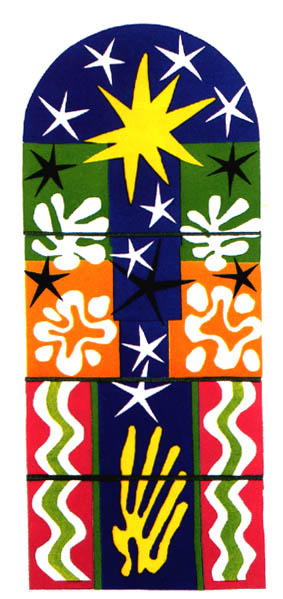
Sunday will mark the start of Advent and a new liturgical year (cycle B in the Revised Common Lectionary). In this season we dwell on the “three comings” of Christ—into human history, into our hearts, and at the eschaton. We cry out with Asaph the psalmist, “Shine forth!”

Nuit de Noel by Henri Matisse
Henri Matisse (French, 1869–1954), Maquette for Nuit de Noël, 1952. Gouache on paper, cut and pasted, mounted on board, 271.8 × 135.9 cm (107 × 53.5 in.). Museum of Modern Art, New York.

Give ear, O Shepherd of Israel,
you who lead Joseph like a flock.
You who are enthroned upon the cherubim, shine forth.
Before Ephraim and Benjamin and Manasseh,
stir up your might,
and come to save us!

Restore us, O God;
let your face shine, that we may be saved!

—Psalm 80:1–3

+++

SONG: “Holy Love Come Down” by David Isaac Rivers, from Psalms (2016)


This post belongs to the weekly series Artful Devotion. If you can’t view the music player in your email or RSS reader, try opening the post in your browser.

To view all the Revised Common Lectionary scripture readings for the First Sunday of Advent, cycle B, click here.

Interacting with artworks online: A few new(ish) resources

The global push to make art more accessible to the public has led to some impressive digital creations in the past year. The following are ones I’ve really enjoyed exploring, some released as recently as this month. They all focus on a particular artwork or era or (in the case of the Jewish art database) faith tradition. I will cover the more all-encompassing digital art initiatives/databases and commendable museum websites in a future series of posts, where I will give them more individualized attention. Some of the creations below represent single projects within those broader initiatives.

“The Audacity of Christian Art”: Written and presented by Dr. Chloë Reddaway, this series of seven short films looks at paintings from the (London) National Gallery’s Renaissance collection and explores some ingenious artistic responses to the challenge of painting Christ.

As curator of art and religion at the museum, Reddaway’s role is to understand more about the paintings’ religious content and context. (Her main academic background is theology.) She also lectures for the MA in Christianity and the Arts at King’s College London. I love how she defines her primary research interest: “visual theology, especially the recovery of historic works of art as a resource for contemporary theology.”

The trailer for “The Audacity of Christian Art” is below, followed by links to all seven episodes. All are shot in ultra-high resolution and feature stunning details.

Episode 1: “The Problem with Christ”
Episode 2: “Christ Is Not Like a Snail: Signs and Symbols”
Episode 3: “Putting God in His Place: Here, Everywhere, and Nowhere”
Episode 4: “Time and Eternity: Yesterday, Today, and Always”
Episode 5: “This World and the Next: Christ on Earth, Christ in Heaven”
Episode 6: “So Near and Yet So Far: Visions and Thresholds”
Episode 7: “Unspeakable Images: When Words Fail”

+++

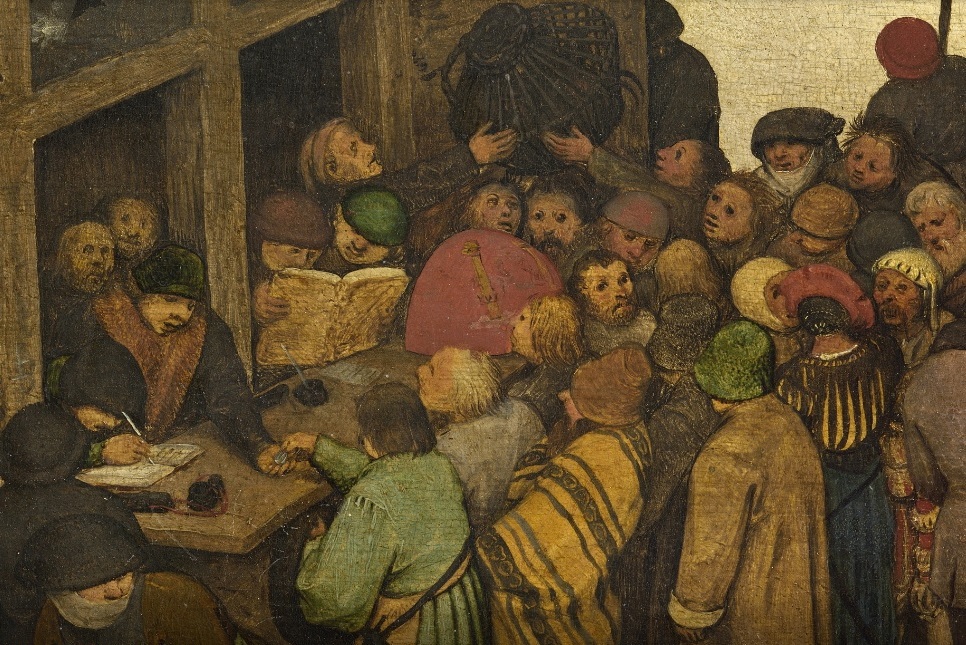
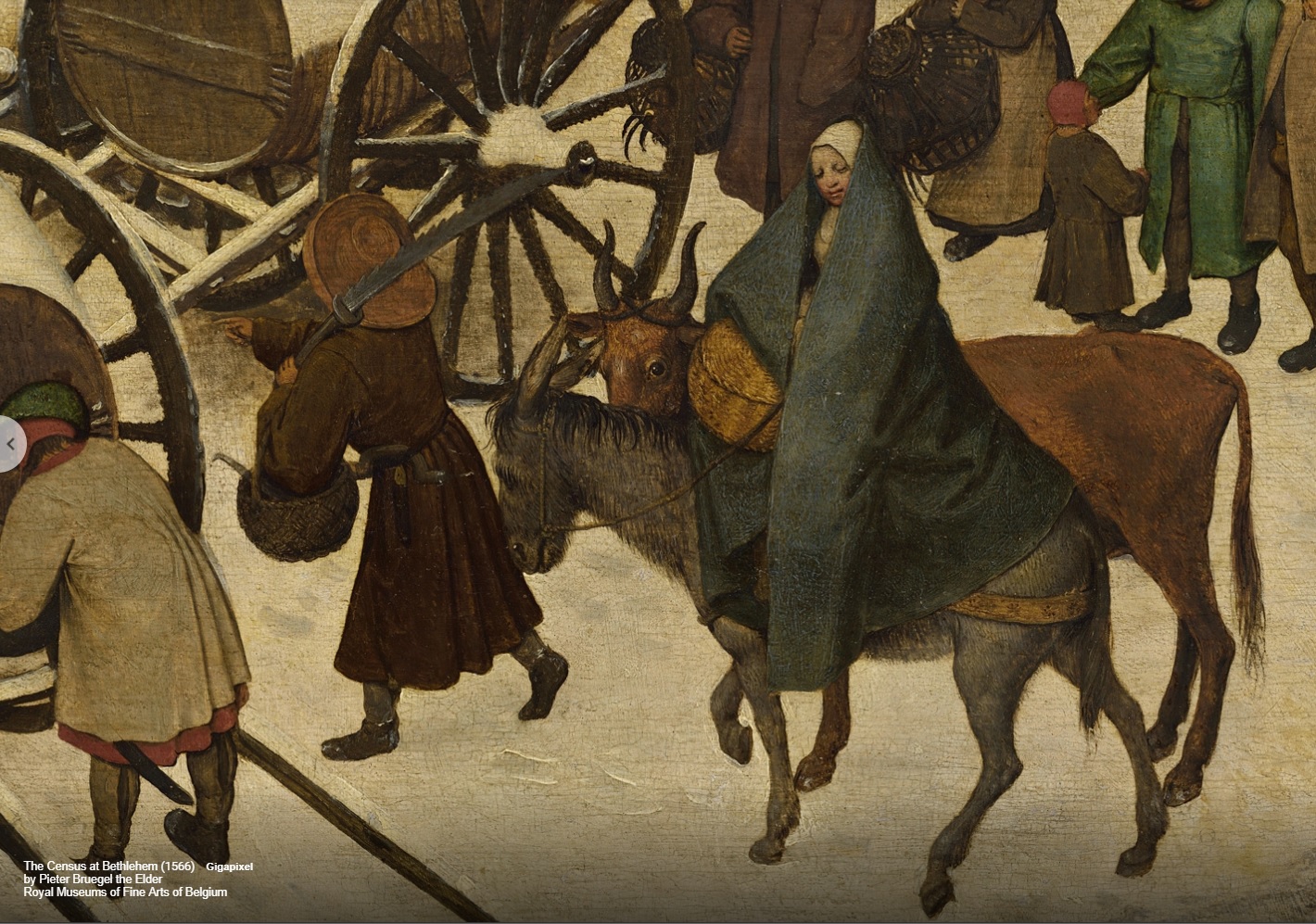
The Census at Bethlehem by Pieter Bruegel: “Online exhibitions” are something I’ve seen more and more of recently—that is, the presentation of artworks in a digital rather than physical space, using tools unique to that medium to enhance the viewing experience. Last year Google Arts and Culture launched one in conjunction with the Royal Museums of Fine Arts of Belgium, centered around Pieter Bruegel’s The Census at Bethlehem (1566), which sets Mary and Joseph’s census registration within the hustle and bustle of a Brabant village. The interface guides you through a sequence of bite-size commentaries, sometimes presented as text alongside an image detail, sometimes as a short video. What makes it an “exhibition” is that other works are shown alongside it to locate it within a larger tradition of Netherlandish painting. One frame, for example, shows how Bruegel furthered the innovative “alla prima” technique introduced by Hieronymus Bosch.

Census at Bethlehem by Pieter Bruegel
Pieter Bruegel the Elder (Dutch, 1525/30–1569), The Census at Bethlehem, 1566. Oil on panel, 116 × 164.5 cm (46 × 64.8 in.). Royal Museums of Fine Arts of Belgium, Brussels.

I studied this painting in college (through slides and textbook reproductions) but have never seen it in this much detail and am now all the more in awe of it. Bruegel’s paintings, which almost always depict a flurry of activity, lend themselves particularly well to this viewing format: it’s helpful to be guided through the various vignettes, each one a window into sixteenth-century Dutch life. Up close, you can see kids blowing up pig-bladder balloons and running across the ice pushing cow jaws they got from the butcher; you can see adults patronizing a tavern in the hollow of a tree, called “In De Swaen”; and much more.

Census at Bethlehem (detail)

Census at Bethlehem detail

Census at Bethlehem detail

+++

“Jheronimus Bosch, the Garden of Earthly Delights”: Created in 2016 by a thirty-four-person team, this “interactive documentary” provides an in-depth audiovisual tour though the Dutch artist’s most famous—and, arguably, most bizarre—painting. The interior of the triptych shows, in the central panel, life before the Flood—a depraved orgy in which humans cavort shamelessly with a whole host of beastly creatures conjured from the artist’s imagination.   Continue reading “Interacting with artworks online: A few new(ish) resources”

Every Right to Receive My Praise (Artful Devotion)

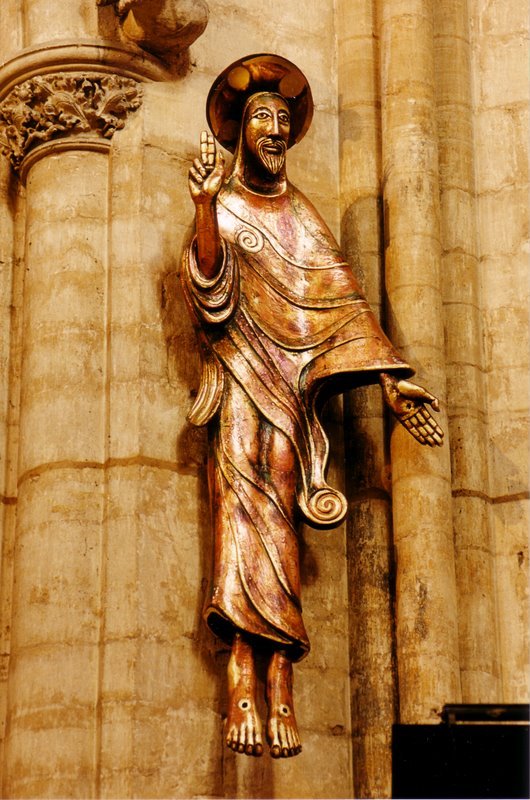
Christus Rex by Peter Eugene Ball
Peter Eugene Ball (British, 1943–), Christus Rex, 1999. Wood sculpture covered in copper and embellished with silver and gold leaf. Ely Cathedral, Cambridgeshire, England.

The final Sunday in the 2016–17 lectionary year, November 26 is designated in the Western church as the feast of Christ the King, known formally as the Solemnity of Our Lord Jesus Christ, King of the Universe. One of the scripture readings for the conclusion of cycle A is as follows:

I pray that the God of our Lord Jesus Christ, the Father of glory, may give you the Spirit of wisdom and of revelation in the knowledge of him, having the eyes of your hearts enlightened, that you may know what is the hope to which he has called you, what are the riches of his glorious inheritance in the saints, and what is the immeasurable greatness of his power toward us who believe, according to the working of his great might that he worked in Christ when he raised him from the dead and seated him at his right hand in the heavenly places, far above all rule and authority and power and dominion, and above every name that is named, not only in this age but also in the one to come. And he put all things under his feet and gave him as head over all things to the church, which is his body, the fullness of him who fills all in all.

—Ephesians 1:17–23

+++

SONG: “Every Right” | Words and music by Josh Davis, Dawn Anthony, and Billy Anthony | Performed by Josh, Dawn, and others from Proskuneo Ministries, on With One Heart (2009)

+++

If to Christ our Lord is given all power in heaven and on earth; if all people, purchased by his precious blood, are by a new right subjected to his dominion; if this power embraces all people, it must be clear that not one of our faculties is exempt from his empire. He must reign in our minds, which should assent with perfect submission and firm belief to revealed truths and to the doctrines of Christ. He must reign in our wills, which should obey the laws and precepts of God. He must reign in our hearts, which should spurn natural desires and love God above all things, and cleave to him alone. He must reign in our bodies and in our members, which should serve as instruments for the interior sanctification of our souls, or to use the words of the Apostle Paul, as instruments of justice unto God.

Encyclical of Pope Pius XI on the Feast of Christ the King (1925)


This post belongs to the weekly series Artful Devotion. If you can’t view the music player in your email or RSS reader, try opening the post in your browser.

To view all the Revised Common Lectionary scripture readings for Proper 29, cycle A, click here.

Roundup: Record-smashing painting; Sutherland Springs memorial; jazz Thanksgiving; Advent candle liturgy; Every Moment Holy

Leonardo da Vinci painting breaks all-time sales record: A painting of Christ by the Renaissance master sold for $450.3 million at Christie’s on Wednesday to an anonymous bidder, making it the most expensive painting ever acquired, either at auction or (it’s believed) through private sales. (It displaced by a long shot Picasso’s Women of Algiers, which sold for $179.4 million at auction in 2015, and the reported $300 million paid privately for Gauguin’s Nafea Faa Ipoipo?, also in 2015.) A common iconographic subject in the sixteenth century, “Salvator Mundi” translates as “Savior of the World”; Leonardo’s shows Christ in Renaissance dress, holding a crystal orb in his left hand (representative of Earth) and raising his right hand in benediction. He painted it around 1500 for King Louis XII of France, but it was presumed lost until 2005—“the biggest [artistic?] discovery of the 21st century,” said Christie’s. It’s one of only twenty known paintings attributed to Leonardo.

Salvator Mundi attributed to Leonardo da Vinci
Leonardo da Vinci (Italian, 1452–1519), Salvator Mundi (Savior of the World), ca. 1500. Oil on walnut, 45.4 × 65.6 cm (25.8 × 19.2 in.).

+++

White-chair memorial inside Sutherland Springs church opens to public before demolition: First Baptist Church in Sutherland Springs, Texas, reopened to the public on Sunday evening for the first time since a mass shooting on November 5 killed twenty-six people attending worship. In the week between, volunteers came in and repaired all the bullet holes, ripped up the carpet and tore out the pews, and applied fresh coats of white paint to the walls and concrete floor. A temporary memorial has been erected, consisting of white folding chairs that bear the names of the victims in gold paint as well as roses with chiffon ribbons. The one pink rose among twenty-five red ones is for the unborn child who died with his or her eight-months-pregnant mother.

First Baptist Church, Sutherland Springs
Temporary memorial, November 12, 2017, First Baptist Church, Sutherland Springs, Texas. Photo: Drew Anthony Smith for the New York Times

First Baptist Church, Sutherland Springs
Baby Holcombe’s pink rose sits between roses for his or her mom Crystal and brother Greg. Nine of the twenty-six shooting victims were from the Holcombe family.

Although the congregation has not yet officially voted on it, it’s likely that the church will be demolished and a new one built in its place; the pastor said many congregants do not want to go back in there because of the trauma. (The Sunday after the shooting, they worshipped in a large outdoor tent nearby.) Preemptively, a San Antonio contractor teamed up with other local business owners to form a nonprofit, Rebuilding Sutherland Springs Inc., to raise money for a new church building and park. Through GoFundMe, they have already raised $1.1 million of their $2.5 million goal. Click here to donate.

+++

Thanksgiving-themed black gospel jazz service: This video recording is from a Jazz Vespers service held on November 10, 2015, in Goodson Chapel at Duke. Chapel Dean Luke Powery and others offer prayers and readings, while the John Brown Big Band, a professional jazz ensemble, leads music. The songs are as follows: “Glory, Glory, Hallelujah” (opening); Walter Hawkins’s “Thank You (Lord, for All You’ve Done for Me)” (5:15); “Thank You, Lord” (11:44, reprised 52:26); “Every Day Is a Day of Thanksgiving” (25:05); “Perfect Love Song” (56:25); “Amazing Grace” (1:03:24); and “When the Saints Go Marching In” (1:09:04).

+++

Advent candle-lighting liturgy: Advent season is just around the corner. Here are five dramatic readings for the lighting of the Advent candles, based on traditional liturgies. They were written by Kathy Larson, director of Christian education and creative arts at Good Shepherd Presbyterian Church in Charlotte, North Carolina. They sound very compelling!

+++

NEW BOOK: Every Moment Holy by Douglas Kaine McKelvey: On November 3 Rabbit Room Press released a collection of one hundred-plus new liturgies for daily life bound together in a beautiful hardcover volume with linocut illustrations by Ned Bustard. Some of the prayers are intended for routine acts, while others are for special, memorable, difficult, or even tragic occasions. Included are liturgies for laundering, for home repair, for the watching of storms, for the first hearthfire of the season, before beginning a book, for setting up a Christmas tree, for the welcoming of a new pet, for the morning of a medical procedure, for the death of a dream, upon tasting pleasurable food, and for the sound of sirens. The aim is to encourage mindfulness of the constant presence of God. Five free liturgies are available for download at https://www.everymomentholy.com/liturgies. The book is for sale exclusively at the online Rabbit Room Store. Read an interview with the illustrator here.


Communing with the Lord during one’s daily tasks is what the seventeenth-century monk Brother Lawrence calls “practicing the presence of God”; poet George Herbert calls it “drudgery made divine.” The Anglican priest Jonathan Evens led a short meditation a few months ago at St. Stephen Walbrook that draws on the wisdom of these two near contemporaries, titled “Doing Our Common Business for the Love of God”—very much in the same spirit as McKelvey’s book.

Every Moment Holy
Every Moment Holy by Douglas Kaine McKelvey (Rabbit Room Press, 2017). Right: Part opener illustration by Ned Bustard for “Liturgies of Labor and Vocation.”

+++

QUOTE OF THE WEEK: The following church-sign photo from the Canadian Memorial United Church and Centre for Peace in Vancouver has been making the rounds on Twitter via Banksy:

Build a longer table

“If you are more fortunate than others, build a longer table, not a taller fence.”

Awake and Sober (Artful Devotion)

Nepsis by John R. P. Russell
John R. P. Russell (American, 1980–), Nepsis, 2006. Acrylic on wooden door, 80 × 24 in.

The day of the Lord will come like a thief in the night. While people are saying, “There is peace and security,” then sudden destruction will come upon them as labor pains come upon a pregnant woman, and they will not escape.

But you are not in darkness, brothers, for that day to surprise you like a thief. For you are all children of light, children of the day. We are not of the night or of the darkness. So then let us not sleep, as others do, but let us keep awake and be sober. For those who sleep, sleep at night, and those who get drunk, are drunk at night.

But since we belong to the day, let us be sober, having put on the breastplate of faith and love, and for a helmet the hope of salvation. For God has not destined us for wrath, but to obtain salvation through our Lord Jesus Christ, who died for us so that whether we are awake or asleep we might live with him.

—1 Thessalonians 5:2b–10

+++

MUSIC: “Riding Light” | Composed and performed by Joshua Roman

The cello composition “Riding Light” was commissioned in 2013 by Grace Cathedral in San Francisco to complement an installation by artist-in-residence Anne Patterson. This video captures a performance from May 2017, filmed in the Crypt chapel beneath the Church of the Intercession in Manhattan. The venue is home to the “Crypt Sessions” concert series organized by Unison Media, a company that seeks new ways to present and promote classical music.

+++

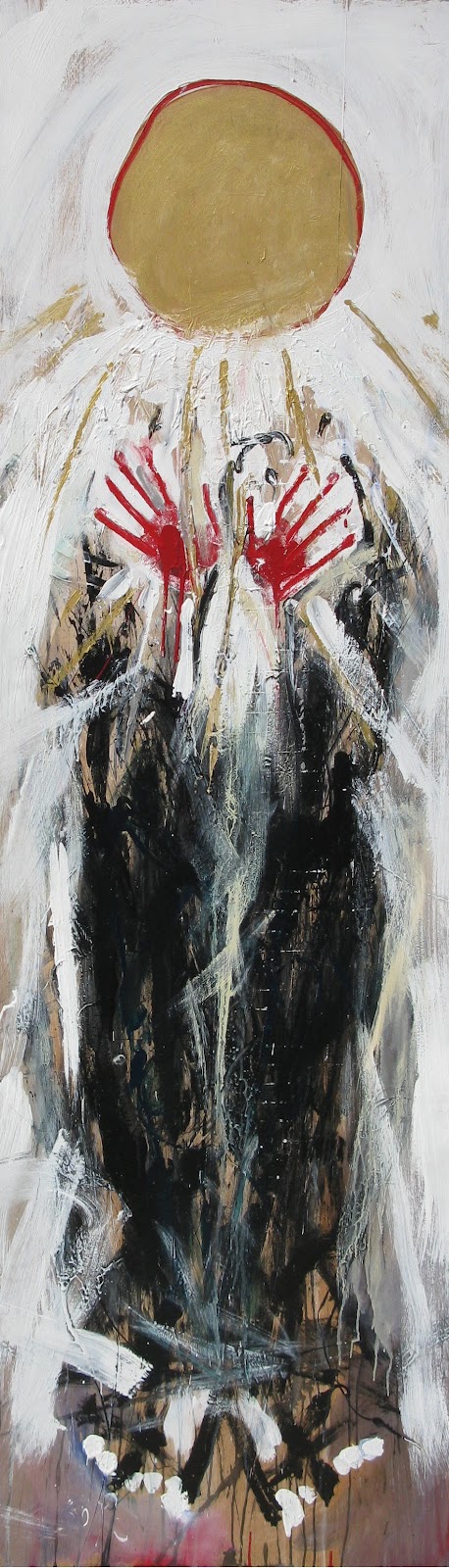
John R. P. Russell, a Byzantine Catholic priest and artist, on his painting Nepsis:

Nepsis means “watchfulness” and it is a spiritually aware state of being ever vigilant against temptation and attacks of the enemy. It is both a means to the end of theosis and a trait of those who have become one with God. This posture of the figure in this painting is taken from paintings of monks in the church of St. Mercurius in Old Cairo, Egypt. I think of the halo, which has obliterated even the face of the figure, as representing the divinity with which the person is united and the lower part of the figure’s body as representing the passions against which the person is struggling.


This post belongs to the weekly series Artful Devotion. If you can’t view the music player in your email or RSS reader, try opening the post in your browser.

To view all the Revised Common Lectionary scripture readings for Proper 28, cycle A, click here.

Let Justice Roll Down (Artful Devotion)

Misty Kirifuri Waterfall at Kurokami Mountain by Katsushika Hokusai
Katsushika Hokusai (Japanese, 1760–1849), Misty Kirifuri Waterfall at Kurokami Mountain, ca. 1833. Woodblock print on dyed paper, 37.6 × 27 cm. National Gallery of Victoria, Melbourne.

God condemns the two-facedness of his people, who offer praise to him in song and sacrifice but fail to uphold his laws of social justice:

I hate, I despise your feasts,
and I take no delight in your solemn assemblies.
Even though you offer me your burnt offerings and grain offerings,
I will not accept them;
and the peace offerings of your fattened animals,
I will not look upon them.
Take away from me the noise of your songs;
to the melody of your harps I will not listen.
But let justice roll down like waters,
and righteousness like an ever-flowing stream.

—Amos 5:21–24

+++

SONG: “Instead of a Show” by Jon Foreman, from Summer (2008)

+++

I have not said to my people: “Get rid of your discontent.” Rather, I have tried to say that this normal and healthy discontent can be channeled into the creative outlet of nonviolent direct action. And now this approach is being termed extremist.

But though I was initially disappointed at being categorized as an extremist, as I continued to think about the matter I gradually gained a measure of satisfaction from the label. Was not Jesus an extremist for love: “Love your enemies, bless them that curse you, do good to them that hate you, and pray for them which despitefully use you, and persecute you.” Was not Amos an extremist for justice: “Let justice roll down like waters and righteousness like an ever-flowing stream.” Was not Paul an extremist for the Christian gospel: “I bear in my body the marks of the Lord Jesus.” Was not Martin Luther an extremist: “Here I stand; I cannot do otherwise, so help me God.” And John Bunyan: “I will stay in jail to the end of my days before I make a butchery of my conscience.” And Abraham Lincoln: “This nation cannot survive half slave and half free.” And Thomas Jefferson: “We hold these truths to be self-evident, that all men are created equal . . .”

So the question is not whether we will be extremists, but what kind of extremists we will be. Will we be extremists for hate or for love? Will we be extremists for the preservation of injustice or for the extension of justice? In that dramatic scene on Calvary’s hill three men were crucified. We must never forget that all three were crucified for the same crime—the crime of extremism. Two were extremists for immorality, and thus fell below their environment. The other, Jesus Christ, was an extremist for love, truth and goodness, and thereby rose above his environment. Perhaps the South, the nation and the world are in dire need of creative extremists.

—Martin Luther King Jr., Letter from a Birmingham Jail


This post belongs to the weekly series Artful Devotion. If you can’t view the music player in your email or RSS reader, try opening the post in your browser.

To view all the Revised Common Lectionary scripture readings for Proper 27, cycle A, click here.

Music making at Keur Moussa Abbey, Senegal

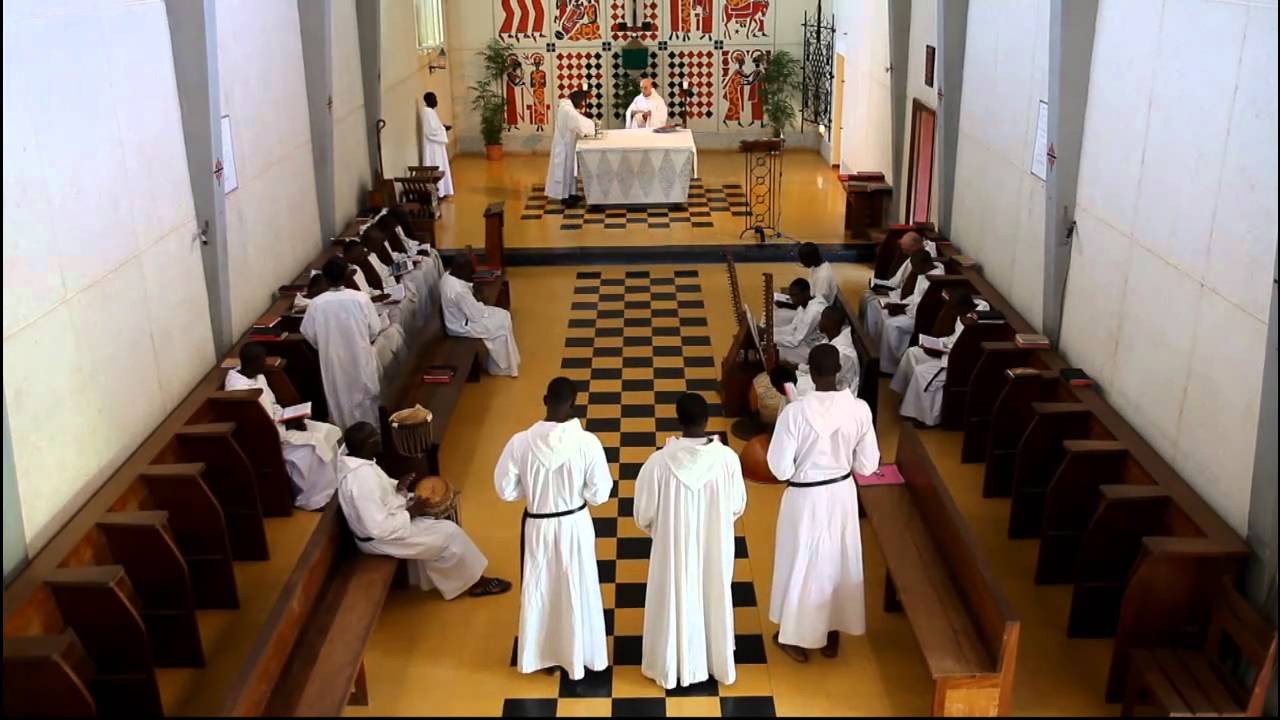
Mass at Keur Moussa Abbey in Senegal

Lately I’ve been enjoying the music of the monks at Keur Moussa Abbey, a brotherhood of French expatriates and Senegalese who wed Western liturgical chant with the rhythms and instrumental textures of West Africa. One of their income streams is musical recording sales—in North America, for example, Sounds True distributes Keur Moussa: Sacred Chant and African Rhythms from Senegal. It’s an excellent, seventeen-track CD that comprises songs of praise, exhortation, confession, and supplication in French and Wolof. Below you will find two of those tracks, embedded with the kind permission of Sounds True.

The first is “Suma Hol Nam” (“I Was Glad”), an adaptation of Psalm 122 in Wolof, accompanied by tom-tom. “Let peace reign in your tents, joy within your walls!” it exclaims. The refrain is “How glad I was when they said to me, ‘Let us go to the house of the Lord.’”


The second is “Yesu Dekalikuna” (“Jesus Is Risen”), a brisk instrumental kora interlude that evokes the holy women hastening from the tomb on Easter morning.


From the liner notes:

In 1963, nine monks from the French monastery of Saint-Pierre of Solesmes—a centuries-old stronghold of the ancient Gregorian plainchant tradition—journeyed to the remote Wolof village of Keur Moussa in Senegal to found the Benedictine Abbey of the Immaculate Heart of Mary [Abbaye du Cœur Immaculé de Marie]. Keur Moussa Abbey, as it is known to the villagers, means “House of Moses.” It is above all a place of prayer, where praise of God is celebrated through hard work, contemplative silence, and joyful music. From the first day of their arrival, these expatriate monks sought to invite the traditions, music, and people of their host village into the monastery grounds.

Today, Keur Moussa Abbey houses 35 brothers, 24 of whom are Senegalese. [According to OSB International, the current number of brothers is 44.] The abbey also sponsors an elementary school and dispensary, run by sisters and laypeople. The monks themselves live from the work of their hands, tending fruit trees, making cheese, and hand-crafting their renowned koras.

The kora, employed for both solos and accompaniment, is an African lute-harp of Mandingo origin. Enchanted by its lyrical voice, the first monks of Keur Moussa Abbey learned from the griots (nomadic Mandingo kora players and storytellers) to play the instrument, and eventually adapted it for use in their liturgical services. Through careful changes in the kora’s construction, they have made it easier to tune—a process that once frustrated even the most experienced of players—without altering its extraordinarily beautiful timbre. . . .

Through the continual exploration of their convergent musical worlds, the monks of Keur Moussa have created an entirely new liturgical choral tradition . . . weav[ing] the rhythms and instrumental textures of the African continent with the sacred words and compositional structures of traditional Western plainchant (sung in French and Wolof, the language of the region). Here, as in the daily masses at the abbey, the choral works are occasionally preceded or followed by instrumental performances on kora, tabala (a large Mauritanian camel-skin drum), balafon (a Malinke instrument similar to the xylophone), tom-tom, and flute.

The notes include English translations of all the songs, plus background information on each one.   Continue reading “Music making at Keur Moussa Abbey, Senegal”