Pamela Mordecai (born 1942) is a Jamaican poet, novelist, short story writer, and scholar of Caribbean literature and culture, living in Toronto. Born and raised in Kingston, she earned a PhD in English from the University of the West Indies and has taught language arts at secondary and postsecondary levels. She often writes in Jamaican Creole, such as for de Man (1995)—a verse play about the crucifixion of Jesus—and the two follow-up collections of narrative poems about Jesus’s parents: de book of Mary (2015) and de book of Joseph (2022).
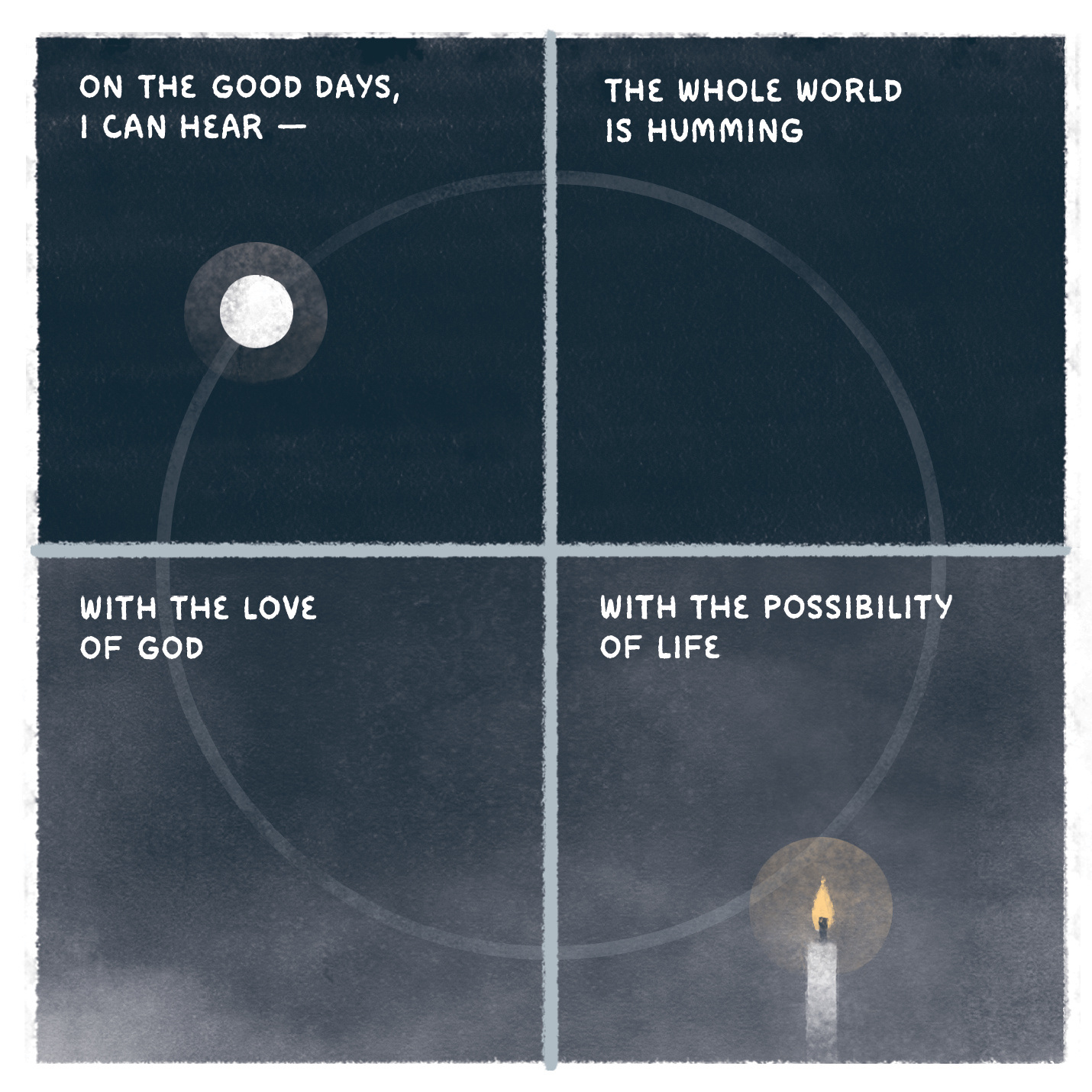
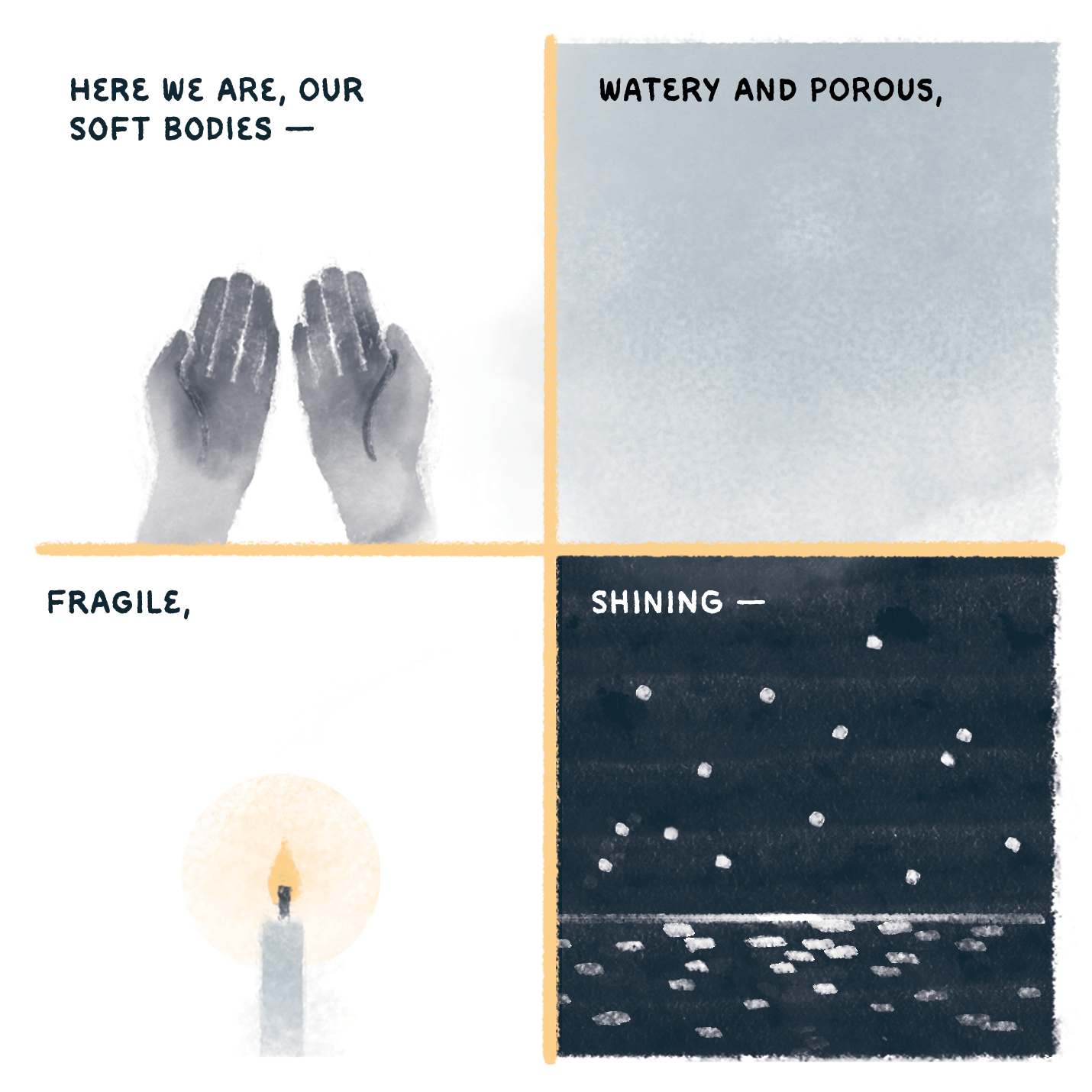
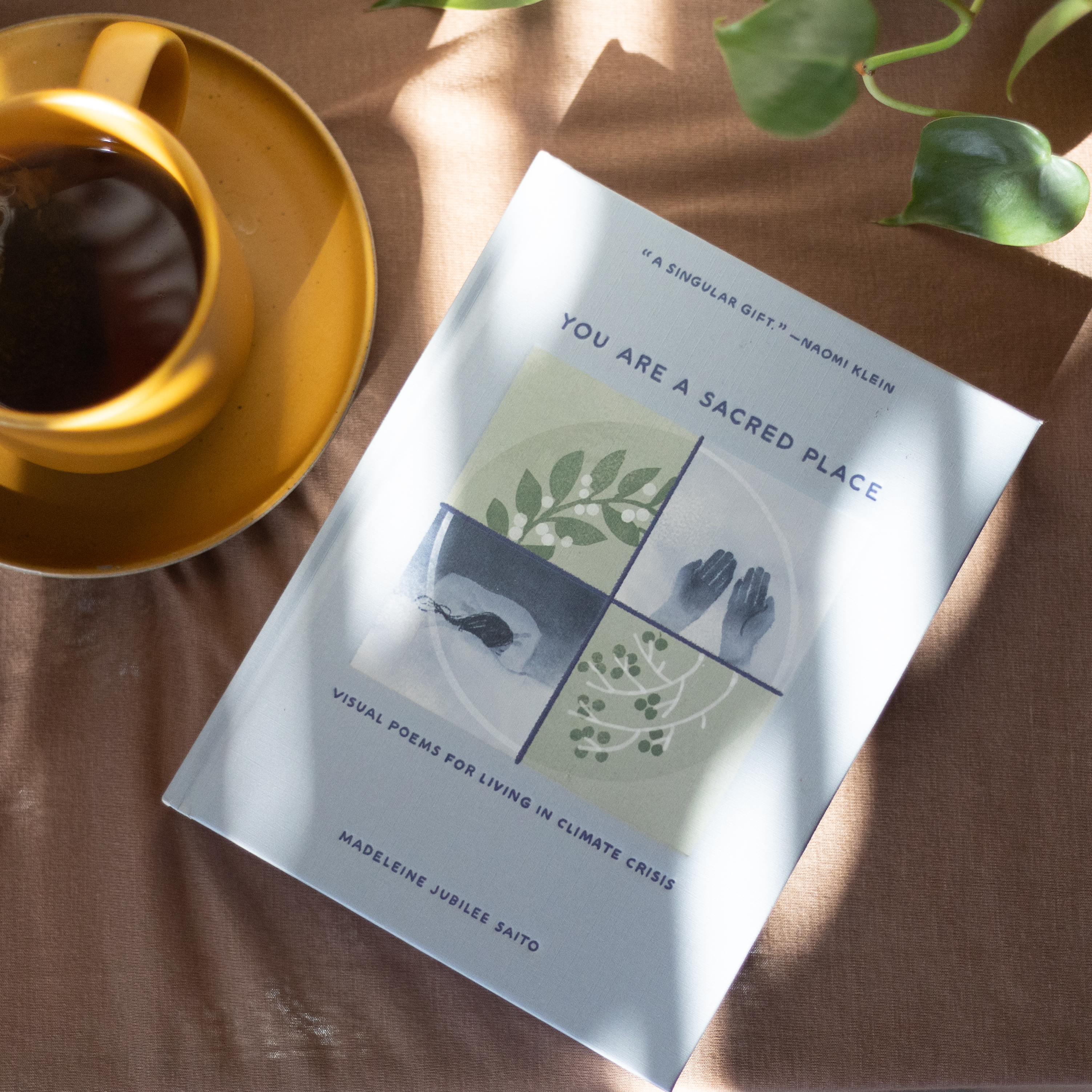
I’ve been following the work of comics artist Madeleine Jubilee Saito for several years (you may recall me featuring her here and here), and I’m thrilled that her debut collection of comics, You Are a Sacred Place: Visual Poems for Living in Climate Crisis, has now hit shelves! It’s gorgeous, you all. To coincide with the book’s release date today, I asked if she’d be willing to write a guest post providing some background and insight on comics as an art form and how Christians, including herself, have used the form. Before sharing two of her own comics, she explores three earlier examples by others—an Italian Gothic devotional painting, a late nineteenth-century African American quilt, and (where my mind typically goes when I hear “Christian comics”) a popular series of evangelistic tracts—expanding my sense of what a comic can be.
—Victoria Jones
A guest post by Madeleine Jubilee Saito
Comics have always been an art form for ordinary people—the medium of children, the illiterate, and the learning-to-read.
Since the 1960s, underground comix have been a scrappy, democratic, DIY art form: anyone with access to a black-and-white printer can make their own eight-page zine. And many Christians have found that humblest of publications, the self-published evangelistic tract, in that humblest of locations: the bathroom stall.
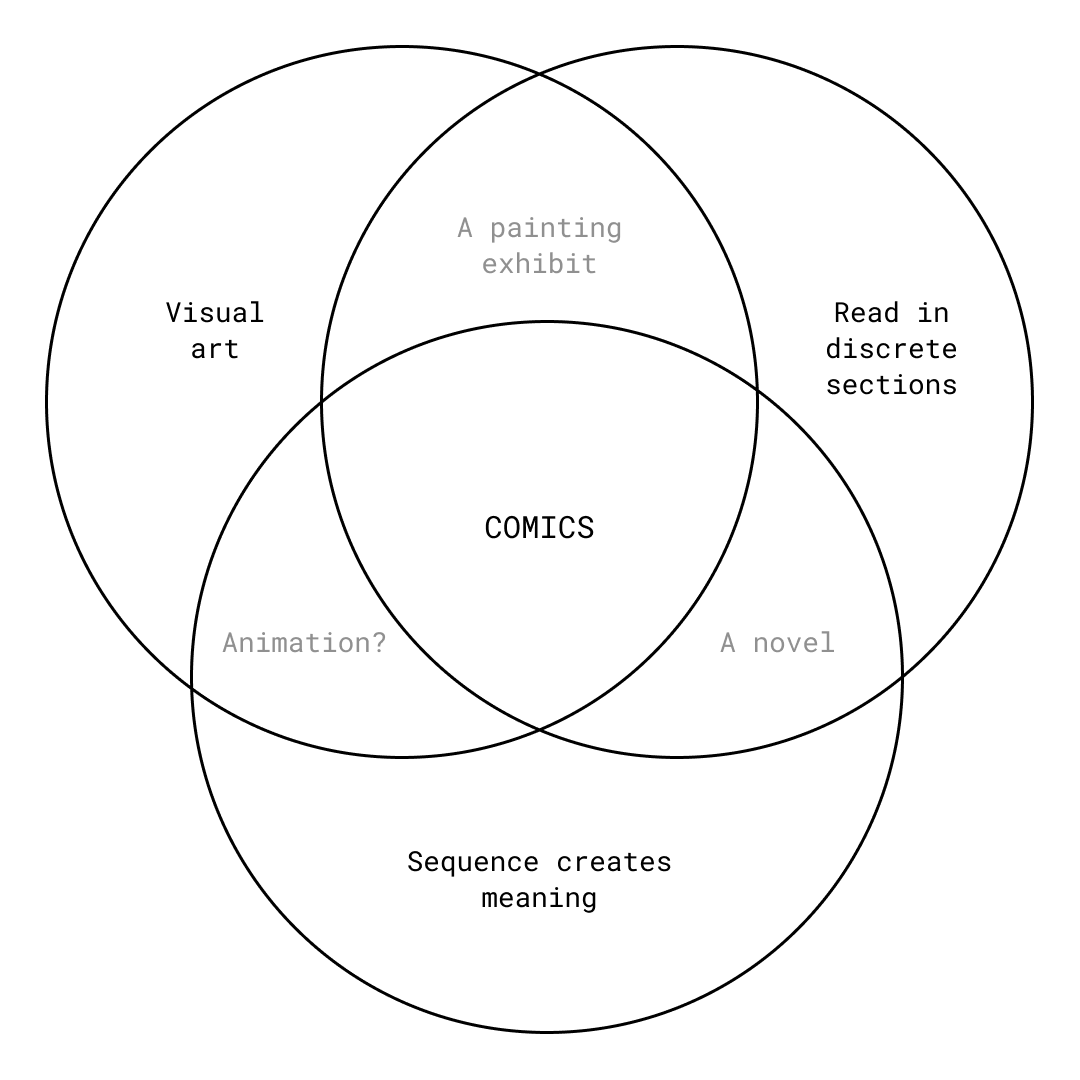
I am a Christian artist, and my medium is experimental comics. I define comics expansively as any visual artwork where meaning comes from the viewer reading discrete sections in sequence.
Breaking down my definition of comics
To put it more simply, comics are pictures (and sometimes text) that you read across panels.
Christian artists throughout time have been drawn to working in this medium. And because comics have always been a popular medium, often directed at those on the margins, reading Christian comics from the past can tell us something about how Christians of a particular time viewed ordinary people.
Three very different examples:
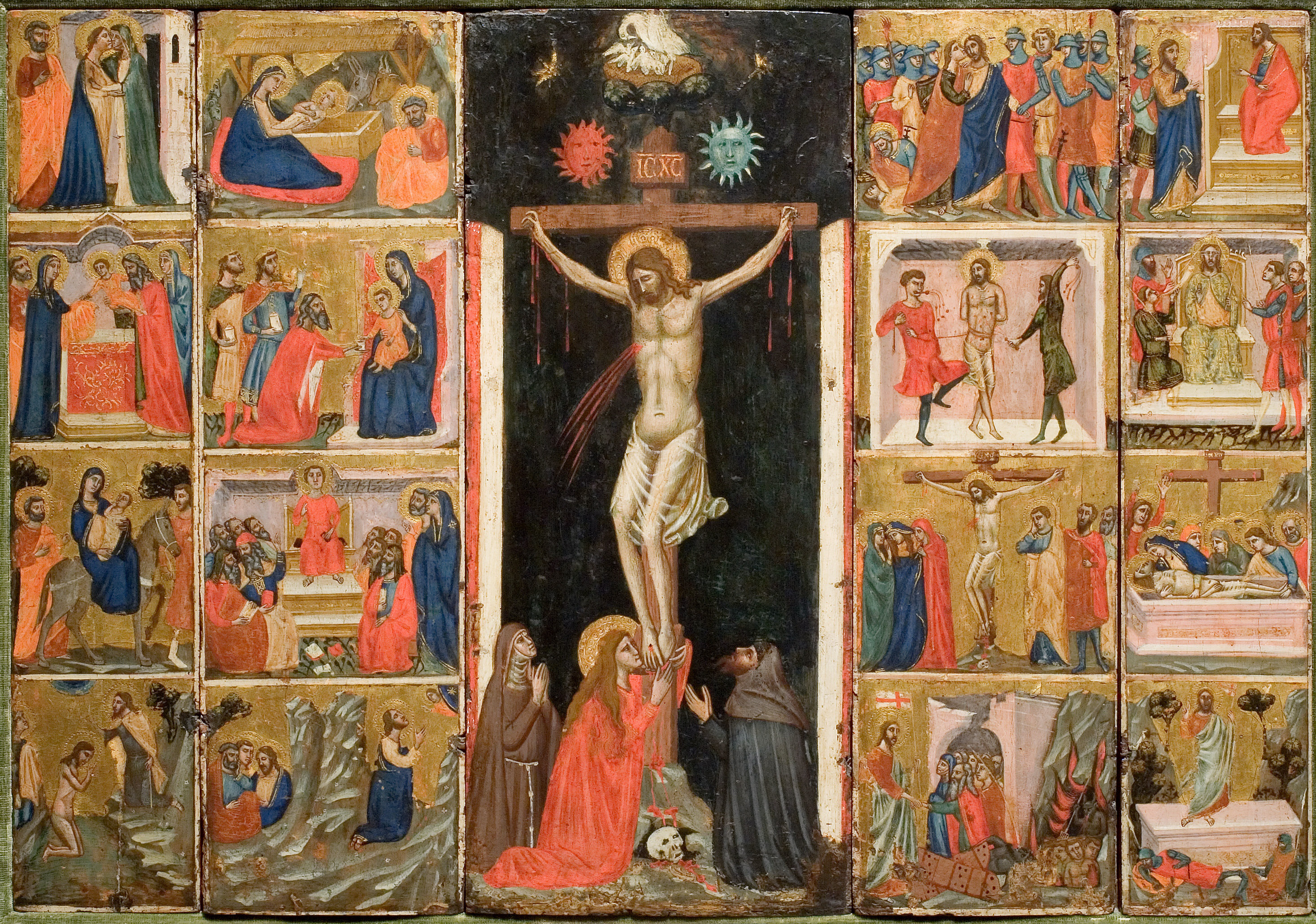
1. Pacino di Bonaguida, 14th century, Italy
Pacino di Bonaguida (Italian, active 1302–ca. 1340), Tabernacle with Scenes from the Life of Christ, ca. 1325. Tempera and gold leaf on panel, 44.5 × 63.5 cm. University of Arizona Museum of Art, Tucson.
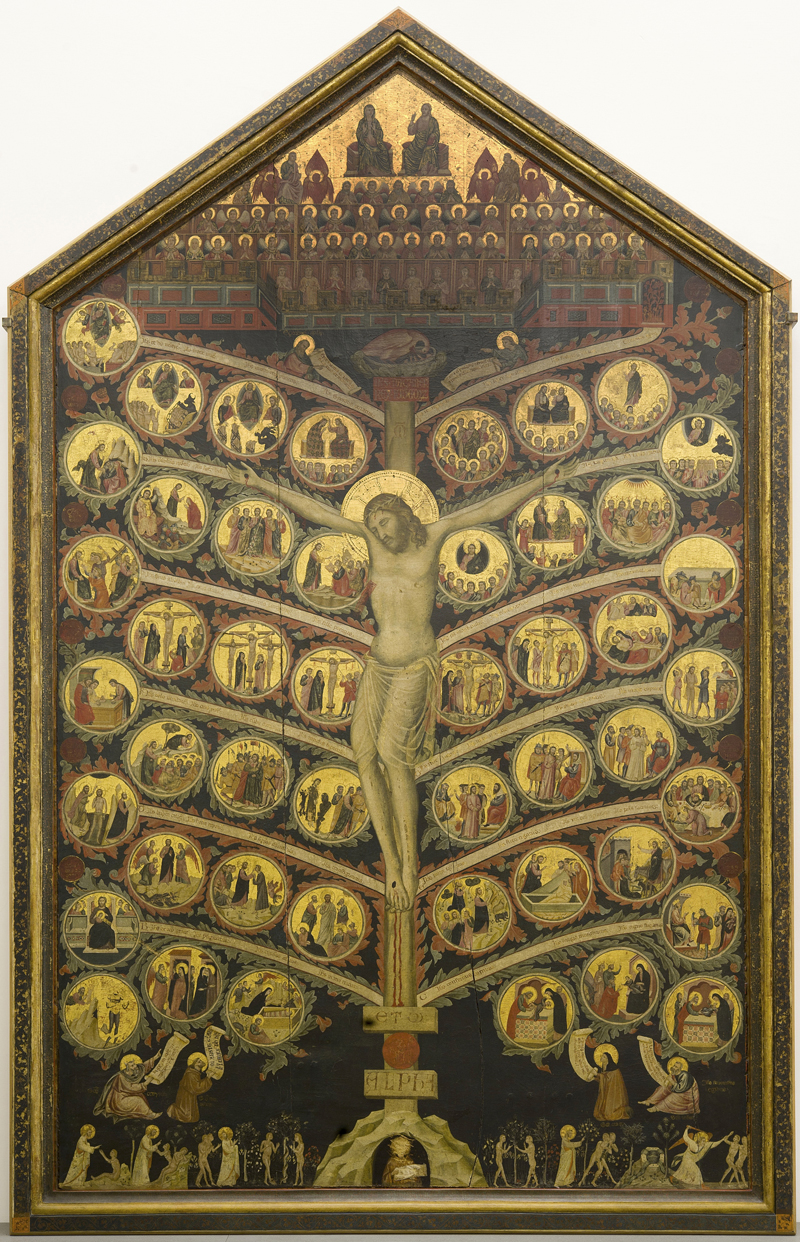
Pacino di Bonaguida is one example of an Italian artist making sacred comics alongside the rise of the Dominican and Franciscan mendicant orders in the thirteenth through fifteenth centuries.
Panels showing sequential scenes from the life of Christ were a popular choice for altarpieces. (An example of artworks in this tradition is the Stations of the Cross—I made my own entry into that tradition a few years ago.)
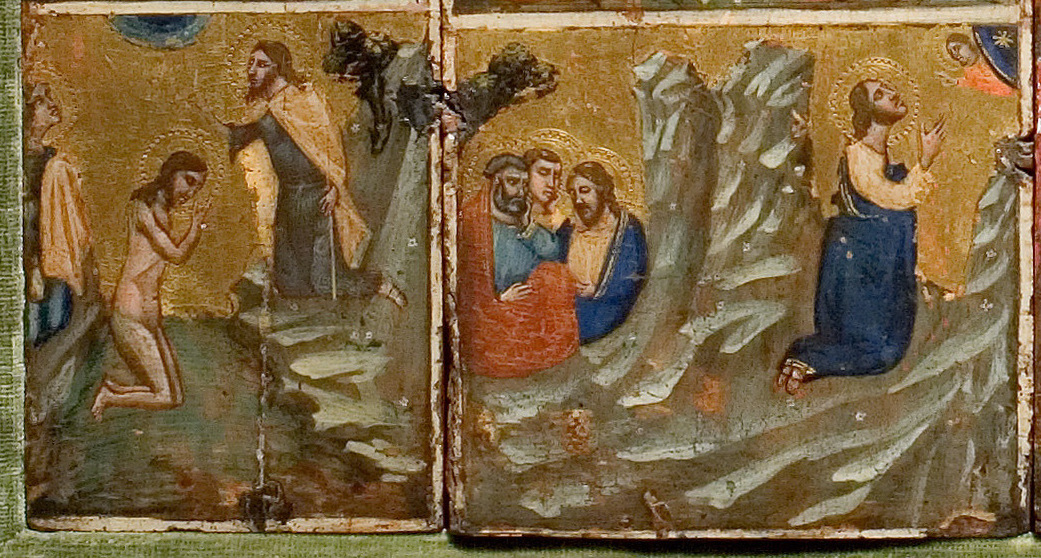
Pacino di Bonaguida, Tabernacle with Scenes from the Life of Christ, bottom left detail. Note the way that the rock forms echo between the two panels, creating rhythmic repetition between the Baptism of Christ and the Agony in the Garden.
In this period, Dominicans and Franciscans helped launch a movement in the church emphasizing preaching to and teaching common people and seeing oneself in the biblical story.
While we don’t have any writing from Pacino, we can look to the theological trends of the time to understand his comics.
The Dominicans and Franciscans encouraged ordinary Christians, including the illiterate, to move sequentially, systematically, through the story of Christ. The anonymously authored manual The Garden of Prayer (1454) instructs:
Alone and solitary, excluding every external thought from your mind, start thinking of the beginning of the Passion, starting with how Jesus entered Jerusalem on the ass. Moving slowly from episode to episode, meditate on each one, dwelling on each single stage and step of the story. And if at any point you feel a sensation of piety, stop: do not pass on as long as that sweet and devout sentiment lasts.
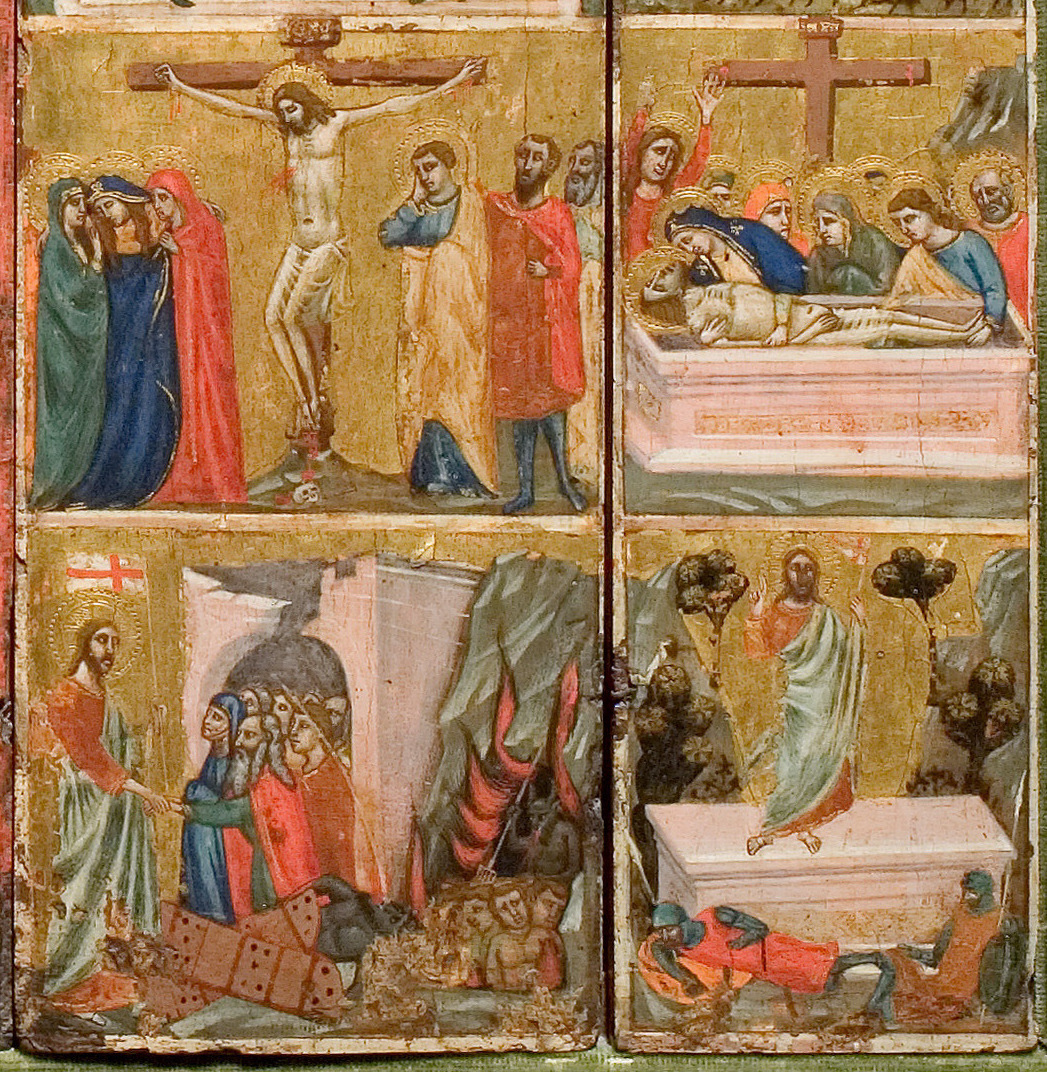
Pacino di Bonaguida, Tabernacle with Scenes from the Life of Christ, bottom right detail
We see this sequential movement reflected in the sacred comics of the time—sometimes in square panels, other times in more creative shapes.
Pacino di Bonaguida, The Tree of Life, 1320. Tempera and gold leaf on wood panel, 248 × 151 cm. Galleria dell’Accademia, Florence. Note the round panels extending from a central point.
Sermons from the time extolled the usefulness of images depicting scenes from the life of Christ as a way to expand access to the gospel narrative. In 1492, for example, the Dominican friar Michele da Carcano, citing a famous letter of Pope Gregory’s from around 600, preached that images were introduced in churches “first, on account of the ignorance of simple people, so that those who are not able to read the scriptures can yet learn by seeing the . . . faith in pictures.”
These comics were intended to expand ordinary Christians’ access to the biblical story—making it more present and compelling, especially for those who couldn’t read.
2. Harriet Powers, 19th century, American South
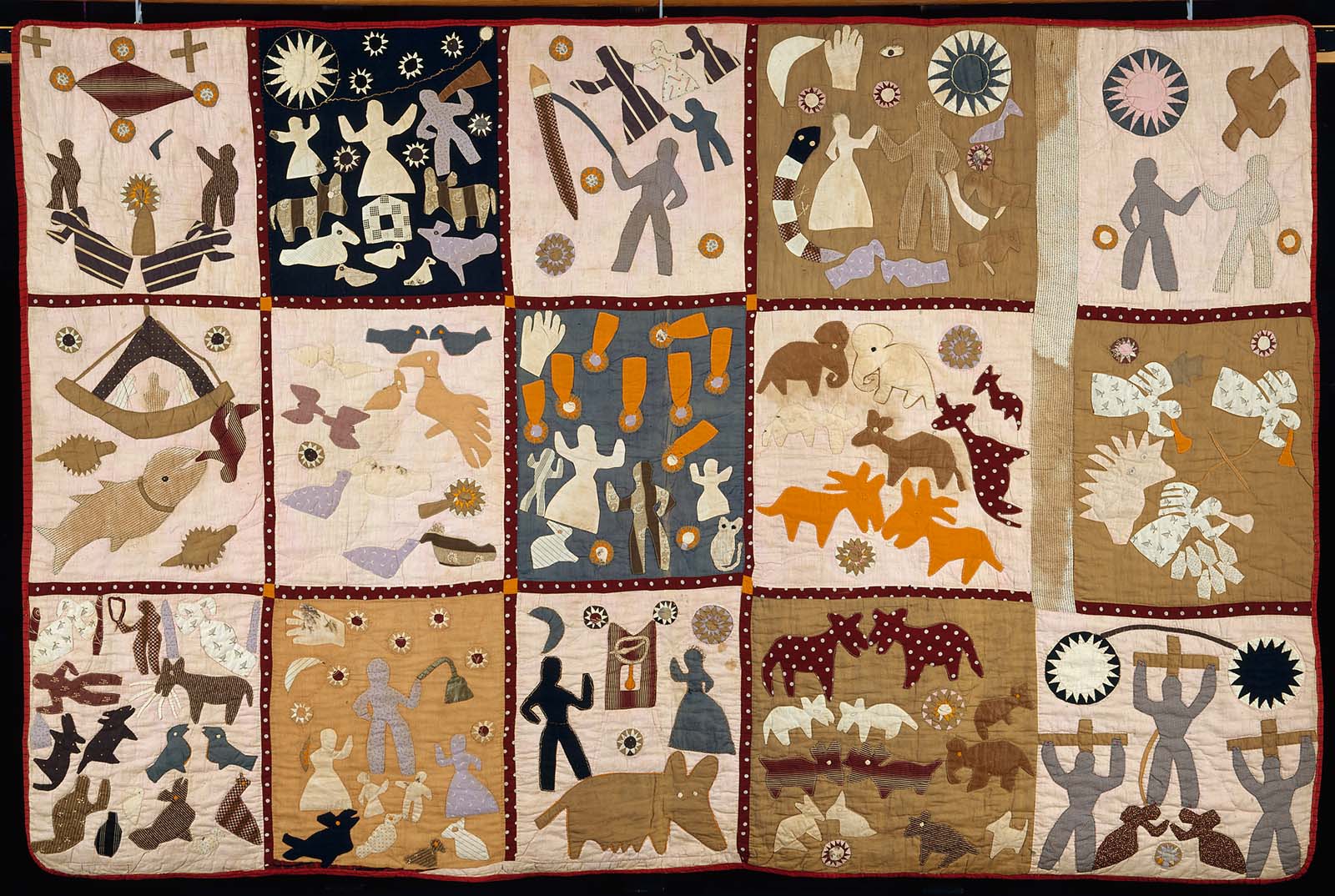
Harriet Powers (American, 1837–1910), Pictorial Quilt, 1895–98. Cotton plain weave, pieced, appliqued, embroidered, and quilted, 175 × 266.7 cm. Museum of Fine Arts, Boston.
Harriet Powers was a Black American quilter and folk artist who was born into slavery in 1837 and lived near Athens, Georgia.
Like the Dominicans and Franciscans several centuries earlier, Powers saw her comics as a more-than-verbal way to preach the gospel. She described her work as “a sermon in patchwork,” saying she intended to “preach the gospel in patchwork, to show my Lord my humility” and to “show where sin originated, out of the beginning of things.”
Rather than preaching a discursive message, [Powers] offers one that is “archaic,” or “predicated on the priority of something already there, something given.” Her symbols and textures facilitate a process of “crawling back” to a deeper level of consciousness or evoking knowledge that is already within but encumbered. . . .
Powers focuses on what her audience already knows by nurturing memory and offering faith-enlivening symbols that will embolden their Christian imagination.
Powers’s quilts weave historical scenes from the recent past with biblical scenes—visually and metaphorically linking the biblical story and her immediate reality.
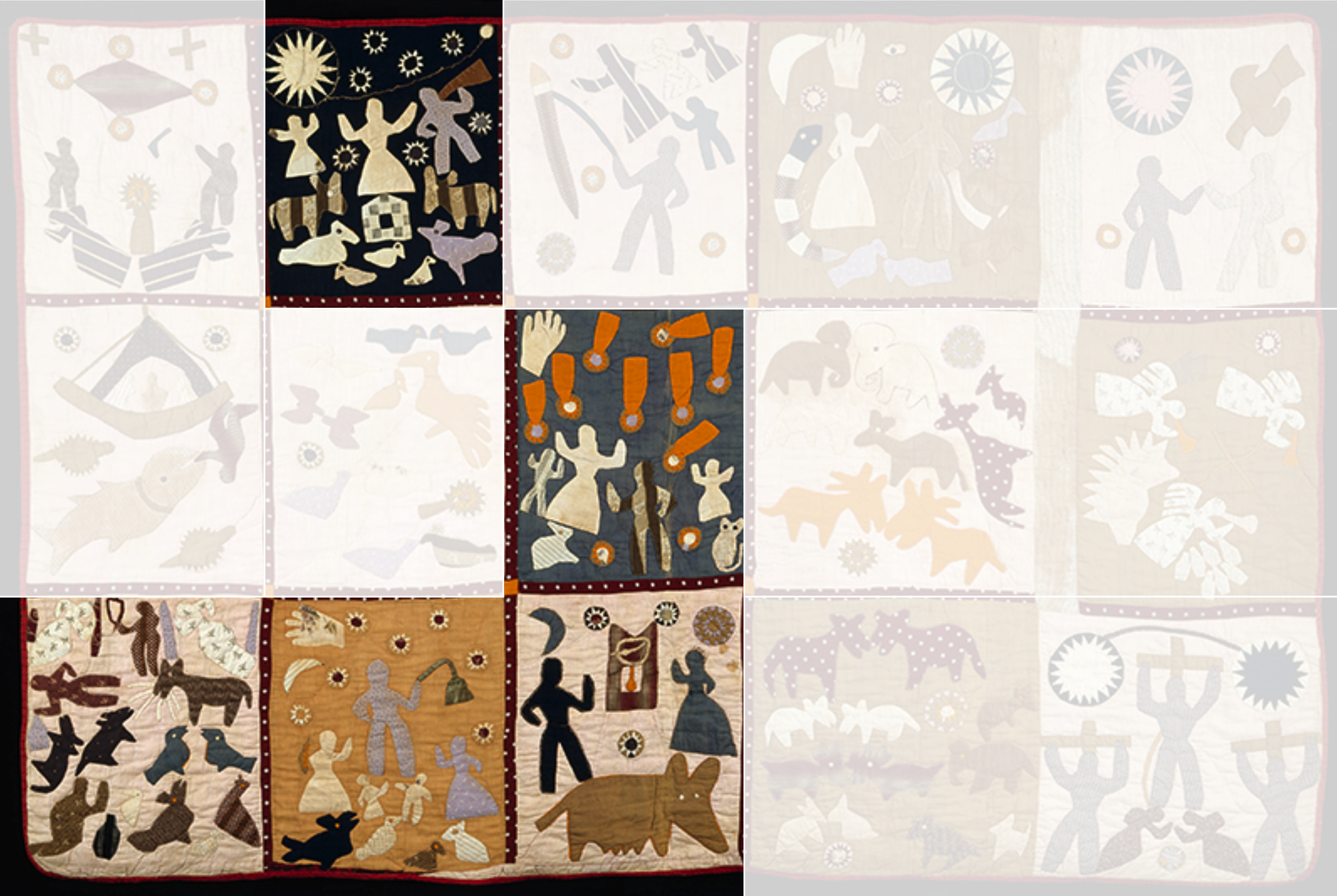
In her Pictorial Quilt, five of the fifteen panels depict recent historical and climatological events. The remaining ten depict stories from scripture.
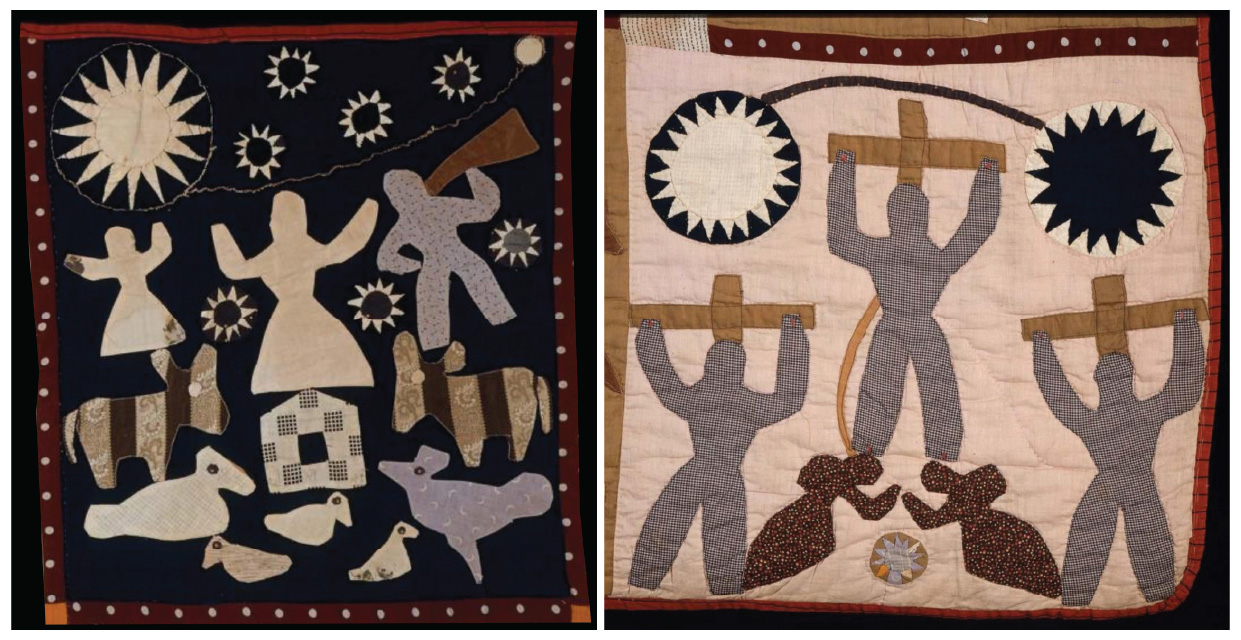
Harriet Powers, Pictorial Quilt, edited by the author to highlight historical and climatological panelsPanels from Pictorial Quilt by Harriet Powers
Left: “The dark day of May 19, 1780. The seven stars were seen 12 N. in the day. The cattle wall went to bed, chickens to roost and the trumpet was blown. The sun went off to a small spot and then to darkness.“
Right: “The crucifixion of Christ between the two thieves. The sun went into darkness. Mary and Martha weeping at his feet. The blood and water run from his right side.”
Note the way that the visual repetition of celestial bodies creates a link between the scene of recent history and Christ’s passion.
Powers’s comics, written from the margins (Powers was a formerly enslaved woman in Reconstruction-era Georgia) and for those on the margins, reflect a vision of a world where biblical stories and lived reality are not distant or separate, but already intertwined.
God is already fully present on the margins. In “Quilting the Sermon,” McCray remarks:
A vibrant spirituality drives Powers’ preaching. She envisions God as a mighty sovereign who intervenes in earthly affairs and is known primarily through obedience to scripture and attentiveness to divine revelation. This revelation is not limited to scripture but continues to unfold in human history through climatological events, celestial occurrences, and everyday activities.
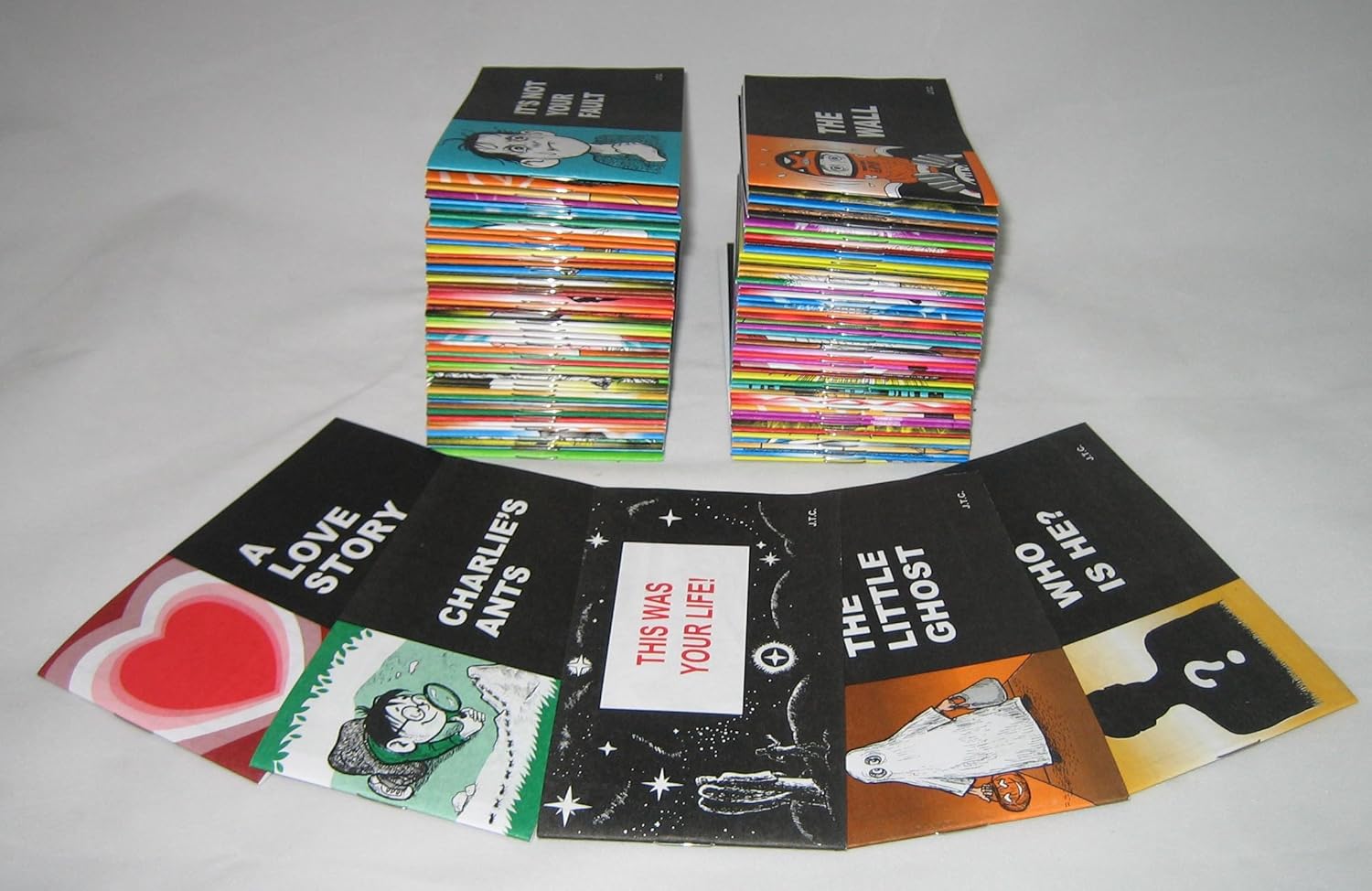
Chick tracts are broadly viewed as hate literature because of their anti-Semitic and anti-Catholic content. And Jack Chick (and his collaborators) are likely among the best-selling cartoonists in human history, with one billion tracts sold (according to Chick.com’s numbers).
While I don’t commend Chick’s work for distribution or personal meditation, I think that a critical reading of his comics reveals something interesting about a particular tradition of American Christianity—and how that tradition views the ordinary people who encounter Chick tracts in their mailboxes and workplaces and on public bathroom floors.
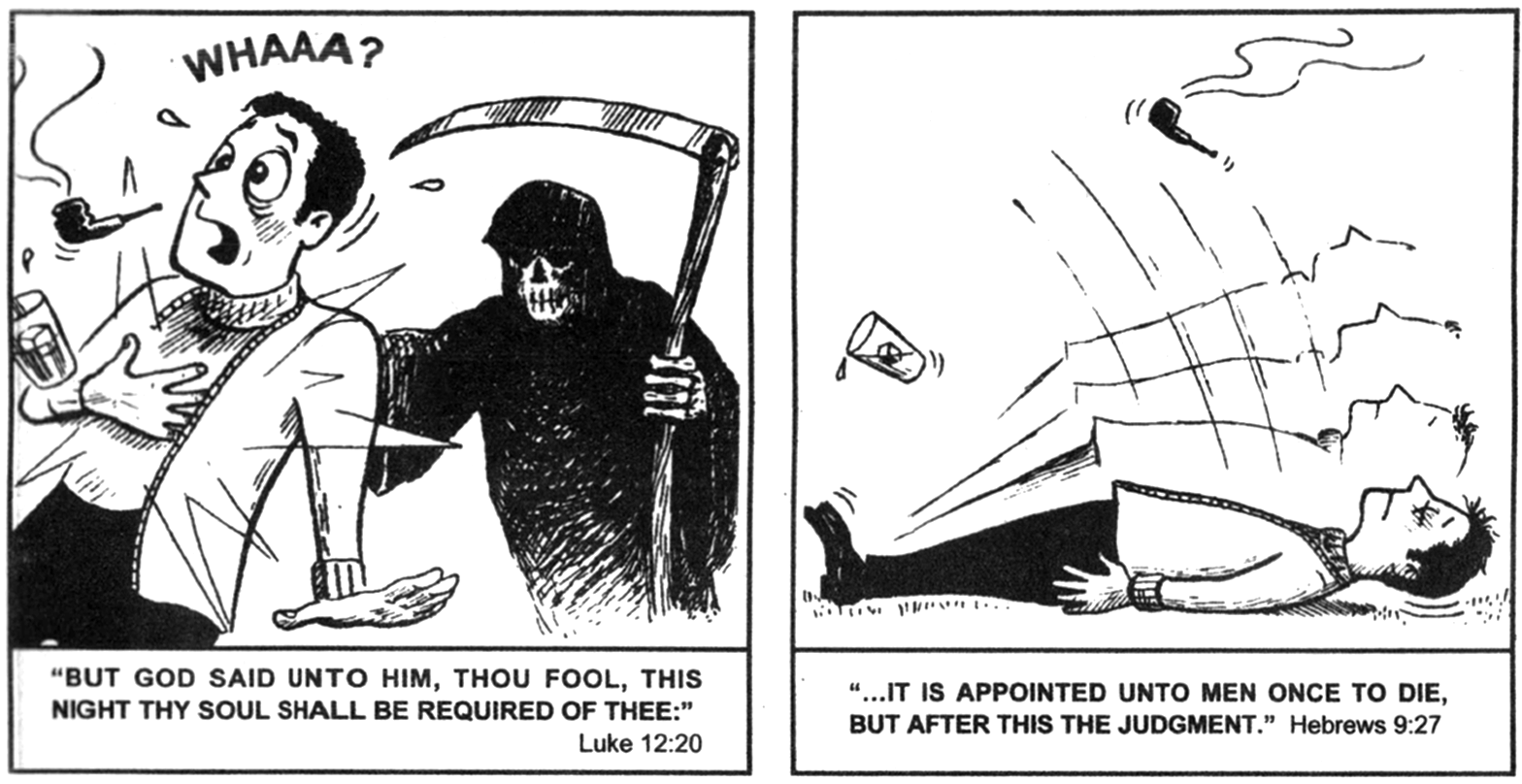
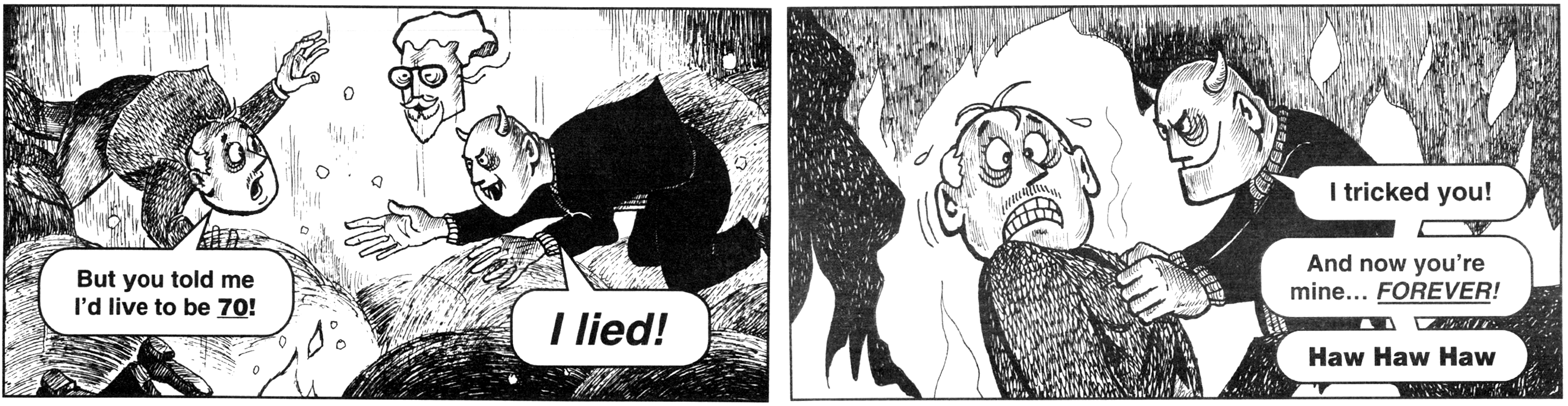
Each tract is a little larger than a business card (3″ × 5″), and usually around twenty pages long. Most tracts have a consistent rhythm: a setup, a shocking encounter, and a dramatic conversion.
If reading the Stations of the Cross feels like solemnly walking behind Christ as he makes his way through Jerusalem, Chick tracts feel like being pushed off a cliff.
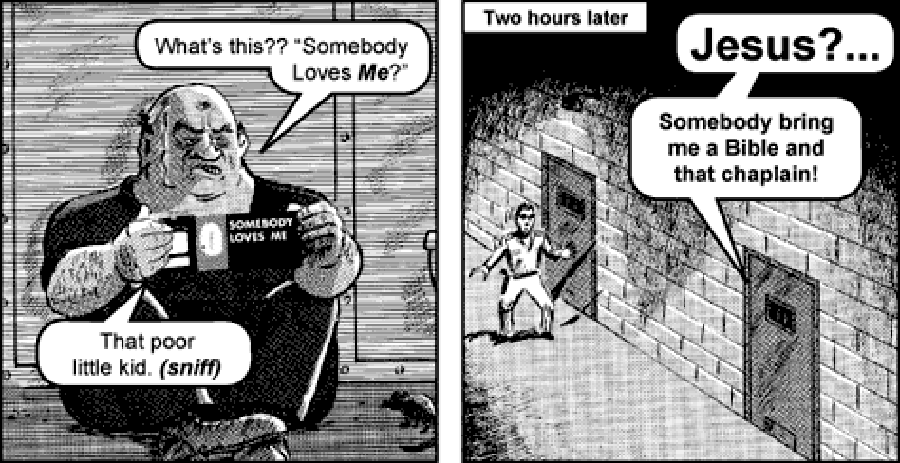
In Chick’s imagination, the reader’s encounter with Christ is flat, rote, and tightly choreographed: Chick gives his readers the words to say. The reader’s encounter with God is compressed and mass-produced—an industrial object, like the tracts themselves.
Detail from The Bull, in which the titular character has a conversion experience while reading a Chick tract
For all three artists—Pacino di Bonaguida, Harriet Powers, and Jack Chick—the form’s legibility, irresistibility, and overall accessibility made comics a compelling tool to facilitate their readers’ encounters with God.
When I started making comics in high school, I was drawn to the medium for similar reasons: there is something irresistible and magical about the format.
My first comics were influenced by the autobiographical cartoonists of the early 2000s, especially Kate Beaton and Marjane Satrapi. In recent years, I’ve begun working more experimentally, influenced by the tradition of Christian comics described above.
I’ve always loved the poetry and repetition of the Psalms and the Prophets. Comics, especially poetry comics, can have poetic resonances on multiple levels at once: in the text, in the imagery, and in the interplay between the text and imagery.
My first book, You Are a Sacred Place: Visual Poems for Living in Climate Crisis (out from Andrews McMeel March 25, 2025), is my attempt to bring the comics medium’s unique complexity into questions about the climate crisis, God’s justice, and how it feels to live in our moment in history.
Madeleine Jubilee Saito is a cartoonist and artist from rural Illinois living in Seattle and the author of You Are a Sacred Place (Andrews McMeel, 2025). In 2022, she was an inaugural artist-in-residence at On Being. Her comics open each section of the best-selling anthology of women’s writing about climate, All We Can Save (One World, 2020), and her work was recognized in Best American Comics 2019. Follow her on Instagram @madeleine_jubilee_saito.
From the publisher: “In her debut collection of comics, artist and climate activist Madeleine Jubilee Saito offers a quietly radical message of hope. Framed as a letter in response to a loved one’s pain, this series of ethereal vignettes takes readers on a journey from seemingly inescapable isolation and despair, through grief and rage, toward the hope of community and connection. Drawing on the tradition of climate justice, Saito reminds readers that if we’re going to challenge fossil fuel capitalism, we must first imagine what lies beyond it: the beauty and joy of a healed world.”
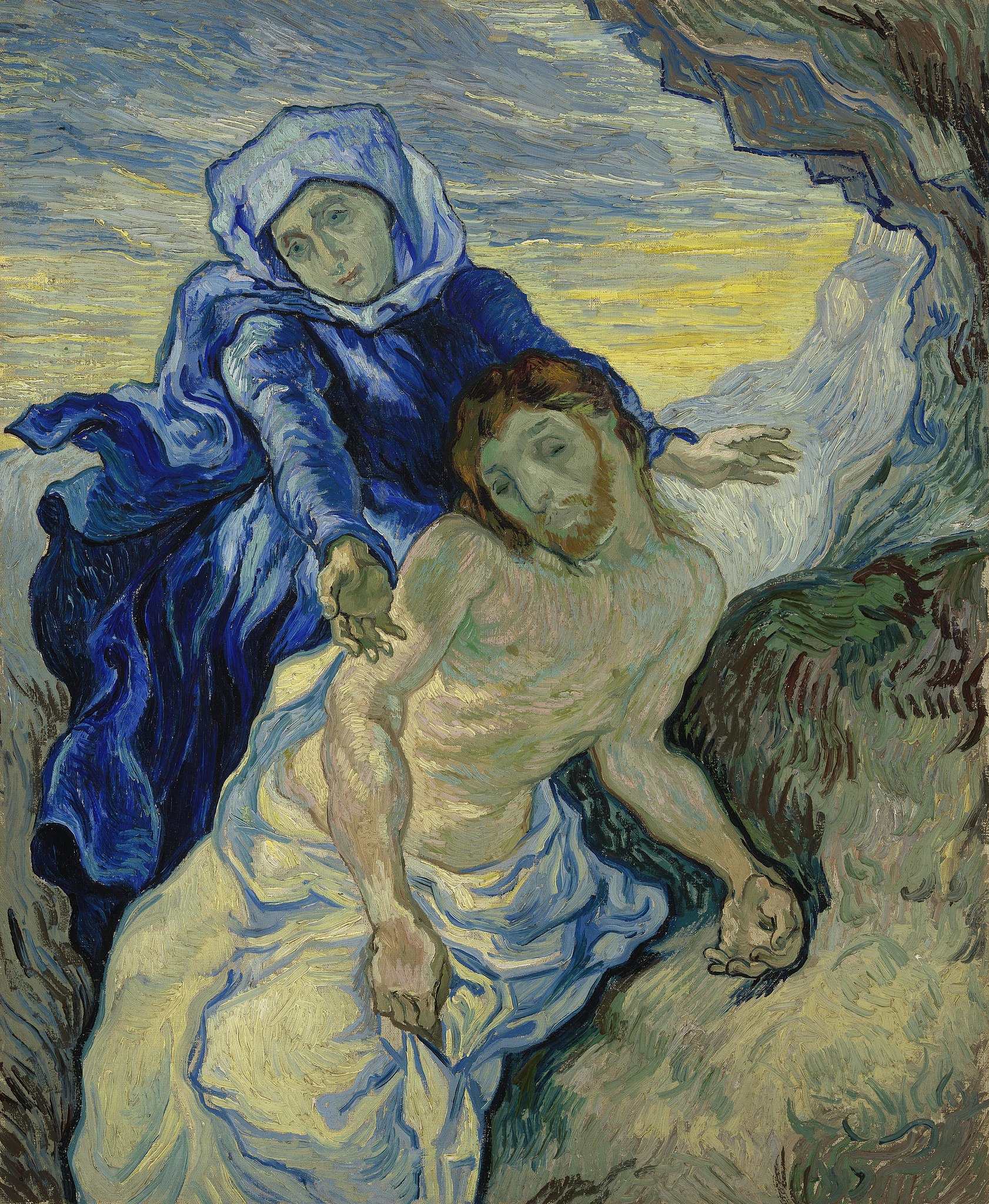
Vincent van Gogh (Dutch, 1853–1890), Pietà (after Delacroix), 1889. Oil on canvas, 73 × 60.5 cm. Van Gogh Museum, Amsterdam.
“Poor fighter, poor sufferer,”
my brother’s words for me.
                                                 Self-pity—
I have to beat it down. But how, exactly?
Never know when the next attack will come.
How to suppress religion?
Down the cloisters of the sick it beckoned—
I abused my God . . . that lithograph of Delacroix’s,
irredeemable sheets I flung in the paint and oil,
his Pietà in ruins.
                               Reconstruct it from memory.
Good technical exercise. Start with the hands,
there were four hands, four arms in the foreground—
mother and son, and the torsions of their bodies
almost impossible, draw them out—
painfully . . . no measurements—
into a great mutual gesture of despair.

Delacroix and I, we both discovered painting
when we no longer had breath or teeth.
Work into his work, strain for health,
the brain clearing, fingers firmer,
brush in the fingers going like a bow,
big bravura work—pure joy! I copy—
no, perform his masterwork of pain.

Genius of iridescent agony, Delacroix,
help me restore your lithograph with color.
I mortify before your model—
how to imitate my Christ? The bronze
of my forelock shadows his, the greatest artist:
stronger than all the others, spurning marble,
clay and paint, he worked in living flesh.

Living and yet immortal, Lord, revive me—
let me inhale the blue of Mary’s cape
billowing hurricanes of hope, clothe me
in your cerements gold with morning—
mother and son, from all your sorrow
all renewal springs, the earth you touch
turns emerald as your hand that burgeons green.
Robert Fagles (1933–2008) (PhD, Yale) was an award-winning American translator, poet, and academic. He is best known for his many translations of ancient Greek and Roman classics, especially the epic poems of Homer. He taught English and comparative literature at Princeton University from 1960 until his retirement in 2002, chairing the department from 1975 onward.
Vincent van Gogh (1853–1890) was raised in the Dutch Reformed Church, the son of a small-town minister—and even worked himself as a lay preacher in the Borinage mining region of southwestern Belgium for two years in his mid-twenties. While there, he gave away all his possessions and lived in poverty like those he served, eating a spare diet, wearing rough garments, and sleeping on the floor. Ironically, his sponsoring evangelical committee deemed such behavior unbecoming of a minister of the gospel, and, due also to his lack of eloquence and theological refinement, they withdrew their support.
This rejection soured Vincent on institutional Christianity. But it didn’t squash his faith. After moving back in with his parents in Nuenen, the Netherlands, he wrote to his brother and close confidante, Theo:
Life [. . .] always turns towards one an infinitely meaningless, discouraging, dispiriting blank side on which there is nothing, any more than on a blank canvas.
But however meaningless and vain, however dead life appears, the man of faith, of energy, of warmth, and who knows something, doesn’t let himself be fobbed off like that. He steps in and does something, and hangs on to that, in short, breaks, ‘violates’ – they say.
Let them talk, those cold theologians. [Letter 464]
Although Vincent left the church and developed conflicted feelings about the Bible, he maintained a reverence for Christ to the end of his days. His time in the Borinage was not for nothing, as it’s there that he discovered, through sketching his parishioners and the surrounding landscapes, his calling to be an artist.
This new vocation was one he ascribed metaphorically to Christ. In a letter to his friend and fellow artist Émile Bernard dated June 26, 1888, Vincent wrote that Jesus’s masterworks are human beings made fully and eternally alive:
Christ – alone – among all the philosophers, magicians, &c. declared eternal life – the endlessness of time, the non-existence of death – to be the principal certainty. The necessity and the raison d’être of serenity and devotion. Lived serenely as an artist greater than all artists–disdaining marble and clay and paint – working in LIVING FLESH. I.e. – this extraordinary artist, hardly conceivable with the obtuse instrument of our nervous and stupefied modern brains, made neither statues nor paintings nor even books . . . he states it loud and clear . . . he made . . . LIVING men, immortals. [Letter 632]
In the same letter, he contended that “the figure of Christ has been painted – as I feel it – only by Delacroix and by Rembrandt…….. And then Millet has painted…. Christ’s doctrine.”
These are the three artists Vincent admired most. He mentions them many times throughout his ample correspondence with family and friends, and he made paintings after all three.
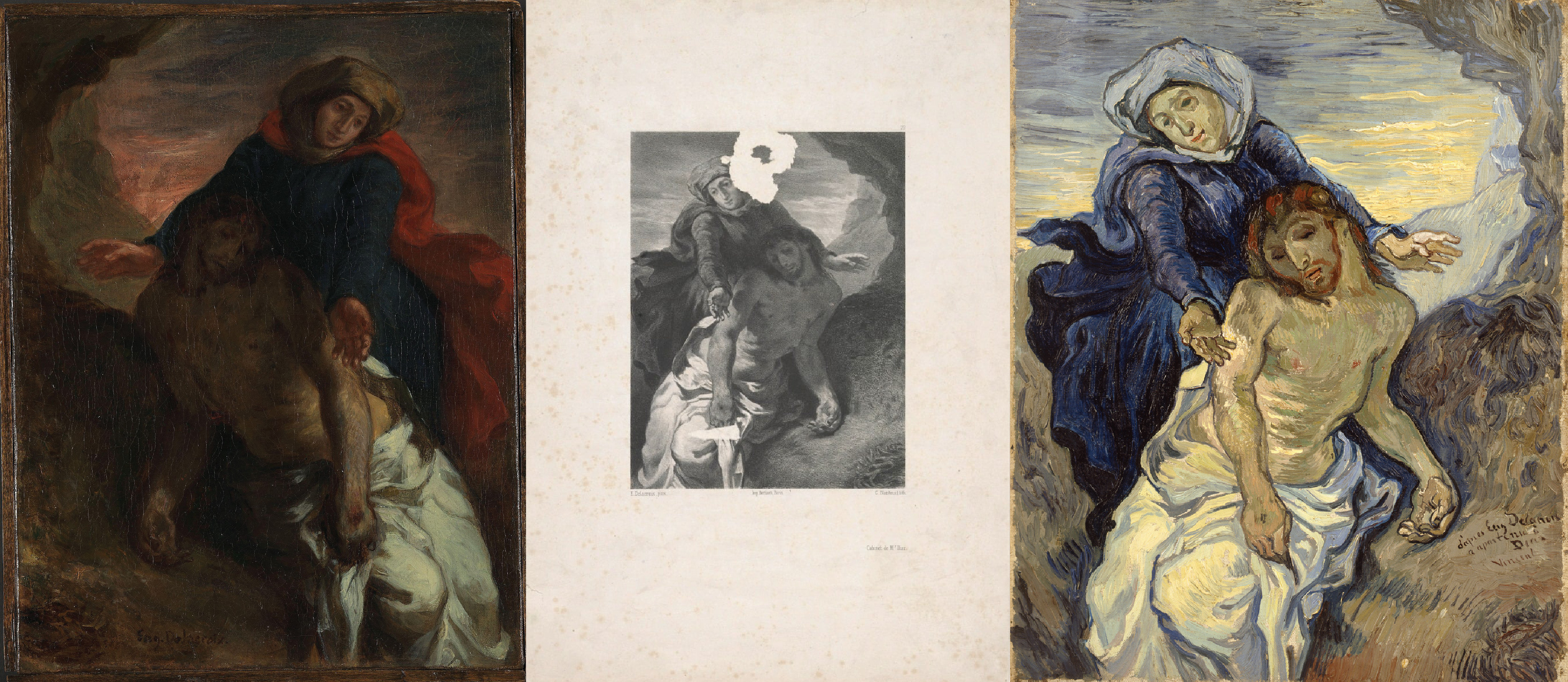
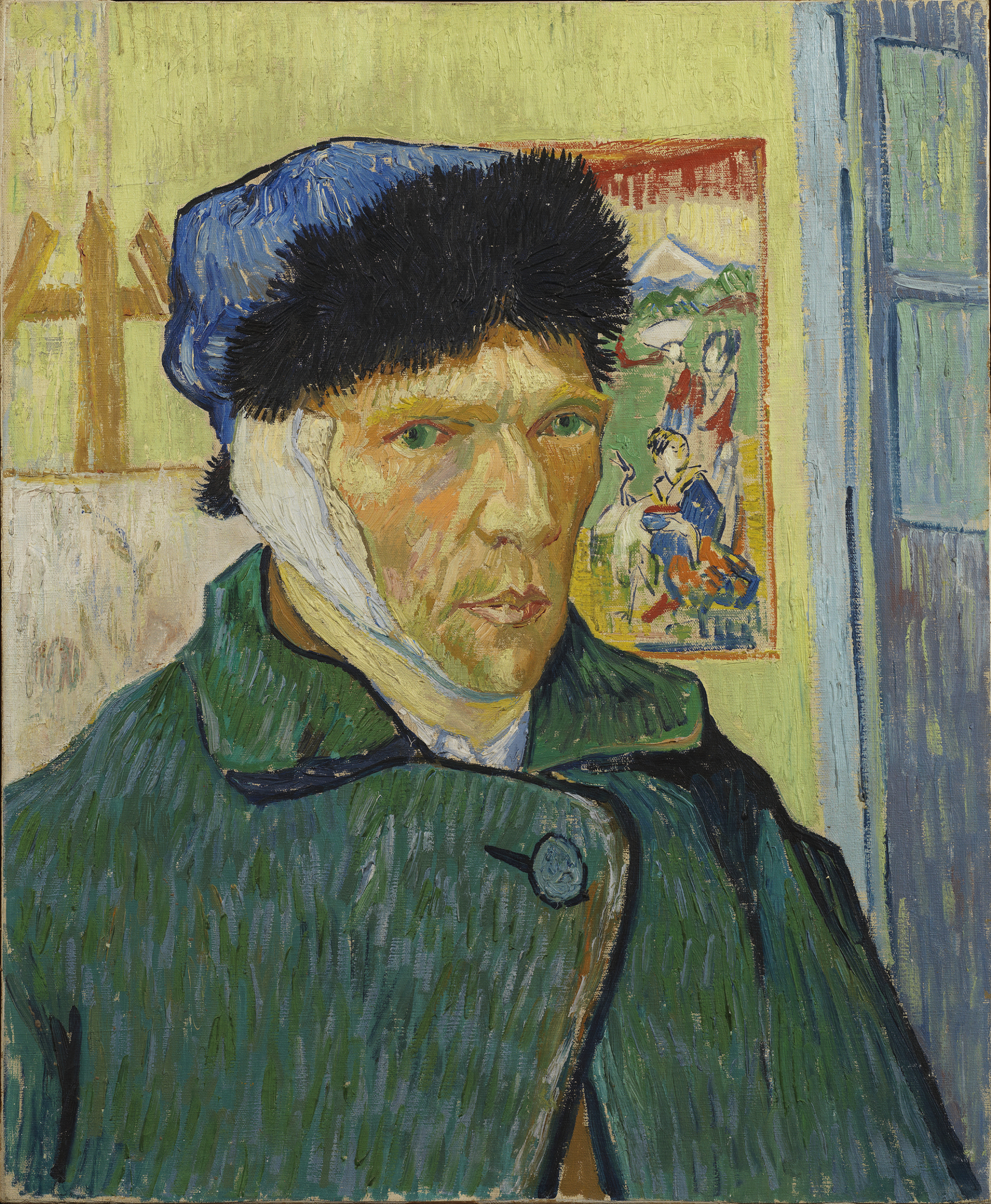
The only painting Vincent ever made of Christ was his Pietà, which he painted in two versions in September 1889, both after the French artist Eugène Delacroix (1798–1863). These are among the many works Vincent painted at a psychiatric hospital in Saint-Rémy-de-Provence in southern France, to which he had voluntarily committed himself after suffering an acute mental breakdown that resulted in his infamous severing of his left ear on December 23, 1888. Theo had rushed to Arles, where Vincent was living in “the Yellow House” at the time, and on December 28 reported on Vincent’s condition in a letter to his wife, Jo van Gogh-Bonger:
I found Vincent in the hospital in Arles. The people around him realized from his agitation that for the past few days he had been showing symptoms of that most dreadful illness, of madness, and an attack of fièvre chaude, when he injured himself with a razor, was the reason he was taken to hospital. Will he remain insane? The doctors think it possible, but daren’t yet say for certain. It should be apparent in a few days’ time when he is rested; then we will see whether he is lucid again. He seemed to be all right for a few minutes when I was with him, but lapsed shortly afterwards into his brooding about philosophy and theology. It was terribly sad being there, because from time to time all his grief would well up inside and he would try to weep, but couldn’t. Poor fighter and poor, poor sufferer. Nothing can be done to relieve his anguish now, but it is deep and hard for him to bear. [Letter 728]
Vincent returned to the Yellow House in January 1889 but over the next few months experienced recurring bouts of mania and depression and was in and out of the hospital. Some of the people of Arles grew increasingly frightened by his erratic behavior, and they essentially ran him out of town. That’s when he made his way twenty miles northeast to the town of Saint-Rémy to check in to Saint-Paul-de-Mausole, a former monastery that then, as now, served as a hospital for the mentally ill.
Vincent had two rooms there, one of which he used as a studio, setting up the various print copies he owned of acclaimed paintings. One was a lithograph by Célestin François Nanteuil-Leboeuf after Delacroix’s Pietà, from the portfolio Les artistes anciens et modernes. (Theo had bought and sent him this litho at his request.) Vincent lamented to his brother that he accidentally damaged it with spilled paint—but that impelled him to paint his own copy of Delacroix. On September 10, 1889, he wrote:
Work is going very well, I’m finding things that I’ve sought in vain for years, and feeling that I always think of those words of Delacroix that you know, that he found painting when he had neither breath nor teeth left. Ah well, I myself with the mental illness I have, I think of so many other artists suffering mentally, and I tell myself that this doesn’t prevent one from practising the role of painter as if nothing had gone wrong.
[. . .] In the very suffering, religious thoughts sometimes console me a great deal. Thus this time during my illness a misfortune happened to me – that lithograph of Delacroix, the Pietà, with other sheets had fallen into some oil and paint and got spoiled.
I was sad about it – then in the meantime I occupied myself painting it, and you’ll see it one day, on a no. 5 or 6 canvas I’ve made a copy of it which I think has feeling. [. . .] My fingers [are] so sure that I drew that Delacroix Pietà without taking a single measurement, though there are those four outstretched hands and arms – gestures and bodily postures that aren’t exactly easy or simple. [Letter 801]
LEFT: Eugène Delacroix, Pietà, ca. 1850, oil on canvas, 35.6 × 27 cm, National Museum of Art, Architecture and Design, Oslo. CENTER: Célestin François Nanteuil-Leboeuf, Pietà (after Delacroix), 1853, lithograph, Van Gogh Museum, Amsterdam. RIGHT: Vincent van Gogh, Pietà (after Delacroix), 1889, oil on canvas, 42 × 34 cm, Vatican Museums.
The painted copy he refers to here is the smaller of the two, which he gifted to his sister Willemien and is now in the collection of the Vatican Museums in Vatican City. In another letter, from September 19, he tells Wil “this little copy of course has no value from any point of view,” but “you’ll be able to see in it that Delacroix doesn’t draw the features of a Mater Dolorosa [sorrowing Mother of God] in the manner of Roman statues – and that the pallid aspect, the lost, vague gaze of a person tired of being in anguish and in tears and keeping vigil is present in it.”
The other Pietàthat Vincent painted—which is similar to the first but larger and brighter—he kept for himself, hanging it in his bedroom at Saint-Rémy. He describes the painting to Wil:
The Delacroix is a Pietà, i.e. a dead Christ with the Mater Dolorosa. The exhausted corpse lies bent forward on its left side at the entrance to a cave, its hands outstretched, and the woman stands behind. It’s an evening after the storm, and this desolate, blue-clad figure stands out – its flowing clothes blown about by the wind – against a sky in which violet clouds fringed with gold are floating. In a great gesture of despair she too is stretching out her empty arms, and one can see her hands, a working woman’s good, solid hands. With its flowing clothes this figure is almost as wide in extent as it’s tall. And as the dead man’s face is in shadow, the woman’s pale head stands out brightly against a cloud – an opposition which makes these two heads appear to be a dark flower with a pale flower, arranged expressly to bring them out better. [Letter 804]
Vincent van Gogh (Dutch, 1853–1890), Pietà (after Delacroix), 1889. Oil on canvas, 73 × 60.5 cm. Van Gogh Museum, Amsterdam.
Although Vincent may have at one time seen Delacroix’s Pietàpainting in person, at Saint-Rémy he had only a grayscale image, the lithograph by Nanteuil-Leboeuf, to reference. For his version, he invented his own color scheme—bold blues and yellows.
On September 20, Vincent described to Theo his process of “copying,” or interpreting, the masters:
What I’m seeking in it, and why it seems good to me to copy them, I’m going to try to tell you. We painters are always asked to compose ourselves and to be nothing but composers.
Very well – but in music it isn’t so – and if such a person plays some Beethoven he’ll add his personal interpretation to it – in music, and then above all for singing – a composer’s interpretation is something, and it isn’t a hard and fast rule that only the composer plays his own compositions.
Good – since I’m above all ill at present, I’m trying to do something to console myself, for my own pleasure.
I place the black-and-white by Delacroix or Millet or after them in front of me as a subject. And then I improvise colour on it but, being me, not completely of course, but seeking memories of their paintings – but the memory, the vague consonance of colours that are in the same sentiment, if not right – that’s my own interpretation.
Heaps of people don’t copy. Heaps of others do copy – for me, I set myself to it by chance, and I find that it teaches and above all sometimes consoles.
So then my brush goes between my fingers as if it were a bow on the violin and absolutely for my pleasure. [Letter 805]
Some art historians believe the Christ figure in the painting is a self-portrait—Vincent identifying himself with the suffering Christ, or recognizing Christ’s presence with him in his suffering, and expressing his longing to be cradled in loving arms and for resurrection from the grave of psychosis. In Vincent van Gogh: The Complete Paintings, Ingo F. Walther and Rainer Metzger write,
Nothing could convey more clearly his need to record his own crisis in the features of another than these two copies [of Delacroix’s Pietà]. The face of the crucified Christ in the lap of a grieving Mary quite unambiguously has van Gogh’s own features. In other words, a ginger-haired Christ with a close-trimmed beard was now the perfect symbol of suffering, the (rather crude) encoding of van Gogh’s own Passion. The painter was to attempt this daring stroke once more, in his interpretation of Rembrandt’s The Raising of Lazarus. Here, van Gogh gave his own features to a Biblical figure who, like Christ, passed through Death into new Life. It was as if, in his work as a copyist, van Gogh was pursuing the kind of oblique allegory he disapproved of in Bernard and Gauguin [see Letter 823]. Five weeks of mental darkness demanded artistic expression – and even that incorrigible realist Vincent van Gogh could not be satisfied with landscape immediacy alone. (542)
On May 16, 1890, Vincent left the hospital at Saint-Rémy, bringing his Pietà painting with him. He moved to Auvers-sur-Oise, a suburb of Paris, placing himself under the care of the homeopathic doctor Paul Gachet, who became a friend. Dr. Gachet admired the painting very much and requested his own copy. (As far as we know, Vincent never got around to making one.)
Vincent was incredibly prolific in Auvers, but his mental health continued to decline, and he died a little over two months after relocating there, on July 29, 1890, from a gunshot wound to the lower chest that was likely self-inflicted.
In his poem “Pietà” from an ekphrastic collection based entirely on Vincent’s paintings, Robert Fagles draws on Vincent’s biography and letters in addition to the titular painting to voice the spiritual and emotional yearnings of Vincent’s final year. The last stanza is a prayer that the poetic speaker Vincent addresses to God—for hope, renewal, light:
Living and yet immortal, Lord, revive me— let me inhale the blue of Mary’s cape billowing hurricanes of hope, clothe me in your cerements gold with morning— mother and son, from all your sorrow all renewal springs, the earth you touch turns emerald as your hand that burgeons green.
In Vincent’s Pietà, the dead Christ’s limp hand rests on a grassy boulder or knoll, which Fagles reads as signifying life awakening from death. You can even see the green reflected in Christ’s face and chest, not to mention the golden sun (“after the storm,” as the historical Vincent wrote) glinting on his right arm, abdomen, and shroud, a faint promise of resurrection.
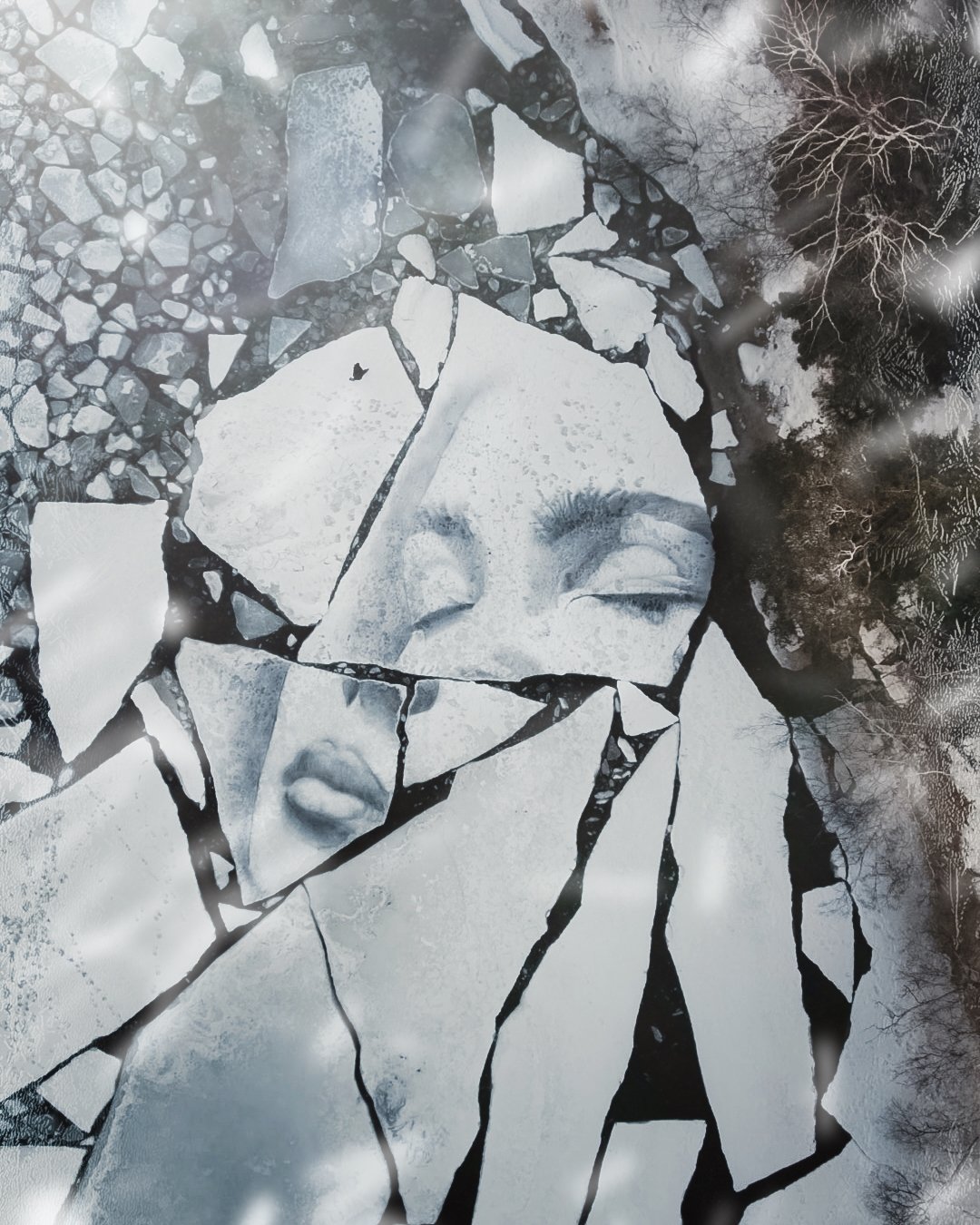
ART PROJECT: Fractured by David Popa: “Fractured is a project located on various ice floes in southern Finland. By use of only earth, charcoal and the source water, a series of portraits were created on fractured ice floes that remained for only a brief time. The pieces were documented via aerial drone video, photography and photogrammetry and hold a tactile form as limited-edition prints as well as in digital form through 1/1 NFTs. The project evolved as a response to the ongoing conflict in Ukraine, which has only further highlighted the fractured state of the world in which we live. During the project, the ice fractured completely unexpectedly at unpredictable times, leaving the artist at odds as to whether continuing the work was even worthwhile. From the ground, one would never be able to decipher any silver linings within the chaos; however, from above, the fragments hold a harmony and beauty that is imperceptible from any other perspective. The work offers a means to point the viewer not to despair and chaos, but rather questions where we must look to mend the broken fragments of our lived reality and perhaps how the fragments can be used to create an entirely new mosaic from the scattered vestiges.”
David Popa (American, 1997–), from the Fractured series, 2023. Iron oxide black earth pigment and charcoal on floating ice.
Explore more of the artist’s work at www.davidpopaart.com. For a printed interview with Popa (featuring many of his amazing photos of his amazing land art), see www.yatzer.com/david-popa.
+++
POEMS: Seven Reimagined Psalms from the Darkling Psalter by Andy Patton:The Darkling Psalter is a project by Andy Patton (MA, Trinity Evangelical Divinity School) to write new creative renditions of the Bible’s 150 psalms. The Rabbit Room recently featured seven of these: Psalms 5, 10, 12, 14, 25, 27, 30.
+++
PODCAST INTERVIEW: “Van Gogh Has a Broken Heart, with Russ Ramsey,”Makers & Mystics: I appreciated this recent conversation in which pastor, writer, and arts enthusiast Russ Ramsey discusses his latest book, exploring the struggles and sorrows of a handful of historical artists and how they are reflected in their art.
Vincent van Gogh (Dutch, 1853–1890), Self-Portrait with Bandaged Ear, 1889. Oil on canvas, 60 × 49 cm. Courtauld Gallery, London.
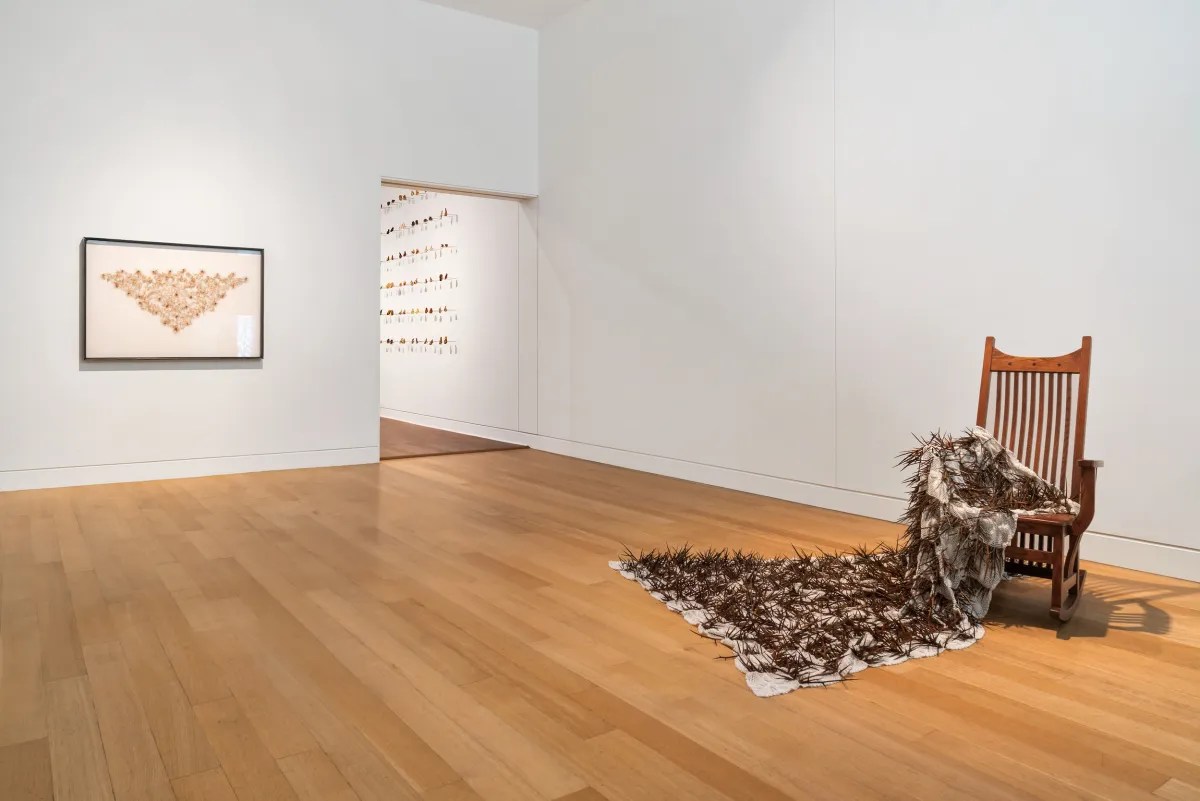
EXHIBITION REVIEW: “Selva Aparicio’s Memorials to Loss and Renewal” by Lori Waxman, Hyperallergic: Mounted last year by the DePaul Art Museum in Chicago, the first solo show of the Barcelona-born artist Selva Aparicio featured works that “offer a merciful focal point for grief.” Aparicio, Waxman writes, “treats unwanted things with extreme sensitivity, personally gathering and storing them over many years, eventually renewing them with remarkable vision.” She reproduced the twice-destroyed rose window of the Basilica de Santa Maria del Pi using lettuce leaves discarded by her neighborhood market; she filled the interior of an upright piano with wasp nests; she constructed over two dozen pairs of decorative ears out of moss, shells, seed pods, animal hair, and other materials for her late cat, Momo, whose ears were removed due to illness; using strands of hair from herself, her mother, and her niece, she sewed a mourning veil, the kind traditionally worn by widows, out of 1,365 cicada wings.
Exhibition view: Selva Aparicio: In Memory Of, DePaul Art Museum, Chicago, 2024. Left: Velo de luto (Mourning Veil) (2020), formed from 1,365 Magicicada wings; right: Solace (2023–24), crochet cotton blanket woven through with honey locust thorns.
I didn’t get to see this exhibition in person, but I’m compelled by what I saw and read of it online—how it deals so tenderly with suffering, death, remembrance, and hope.
+++
SONGS:
>> “Parce mihi Domine” (Spare Me, O Lord): A musical setting of the Latin translation of Job 7:16b–21, this motet by the Spanish Renaissance composer Cristòbal de Morales “captures the sense of desolation and abandonment that is expressed by Job, a dark condition akin to the forsakenness that our Lord experienced on the cross,” writes church music director Ken Myers. In 1994 the Hilliard Ensemble recorded the piece in collaboration with the Norwegian saxophonist Jan Garbarek for their album Officium, a jazz-classical fusion that became one of ECM’s most successful releases, selling over 1.5 million copies.
The video below features a different set of musicians paying tribute to this “unexpected . . . alliance of austere vocal music and wandering saxophone” (Elodie Olson-Coons). Filmed December 18, 2015, at the Chiesa di Sant’Anna (Church of St. Anne) in Cagliari, Italy, the performance is by the vocal ensemble Cantar Lontano (under the direction of Marco Mencoboni) and saxophonist Gavino Murgia. [HT: Global Christian Worship]
After losing his health, wealth, and children, the Old Testament character Job laments openly before God. “I will not restrain my mouth,” he says. “I will speak in the anguish of my spirit; I will complain in the bitterness of my soul” (Job 7:11). He views God as his tormentor and begs God to leave him alone (“spare me”). Adopting Job’s voice, the four singers of the Morales piece sing the following biblical passage:
Parce mihi Domine, nihil enim sunt dies mei. Quid est homo, quia magnificas eum? Aut quid apponis erga eum cor tuum? Visitas cum diluculo, et subito probas illum. Usquequo non parcis michi, nec dimittas me, ut glutiam salivam meam? Peccavi. Quid faciam tibi, o custos hominum? Quare posuisti me contrarium tibi, et factus sum michimet ipsi gravis? Cur non tollis peccatum meum, et quare non aufers iniquitatem meam? Ecce nunc in pulvere dormio; et si mane me quesieris, non subsistam.
English translation (NRSVUE):
Let me alone, for my days are a breath. What are humans, that you make so much of them, that you set your mind on them, visit them every morning, test them every moment? Will you not look away from me for a while, let me alone until I swallow my spittle? If I sin, what do I do to you, you watcher of humanity? Why have you made me your target? Why have I become a burden to you? Why do you not pardon my transgression and take away my iniquity? For now I shall lie in the earth; you will seek me, but I shall not be.
>> “Lamb of God” by The Many: From the EP Have Mercy (2021) by The Many [previously], “an uncommon, intentionally diverse collective making music for people to sing together about peace and justice and a world where all belong.” This song is an adaptation of the ancient Christian liturgical prayer known as the Agnus Dei. The music is by Gary Rand, and the lyrics are by Gary Rand and his daughter, Lenora Rand. Click here to purchase an individual MP3 recording or sheet music, or visit the group’s Bandcamp page.
Lamb of God, with love poured out you suffer with the world. Have mercy. Have mercy. Lamb of God who suffers with the world, grant us peace, grant us peace.
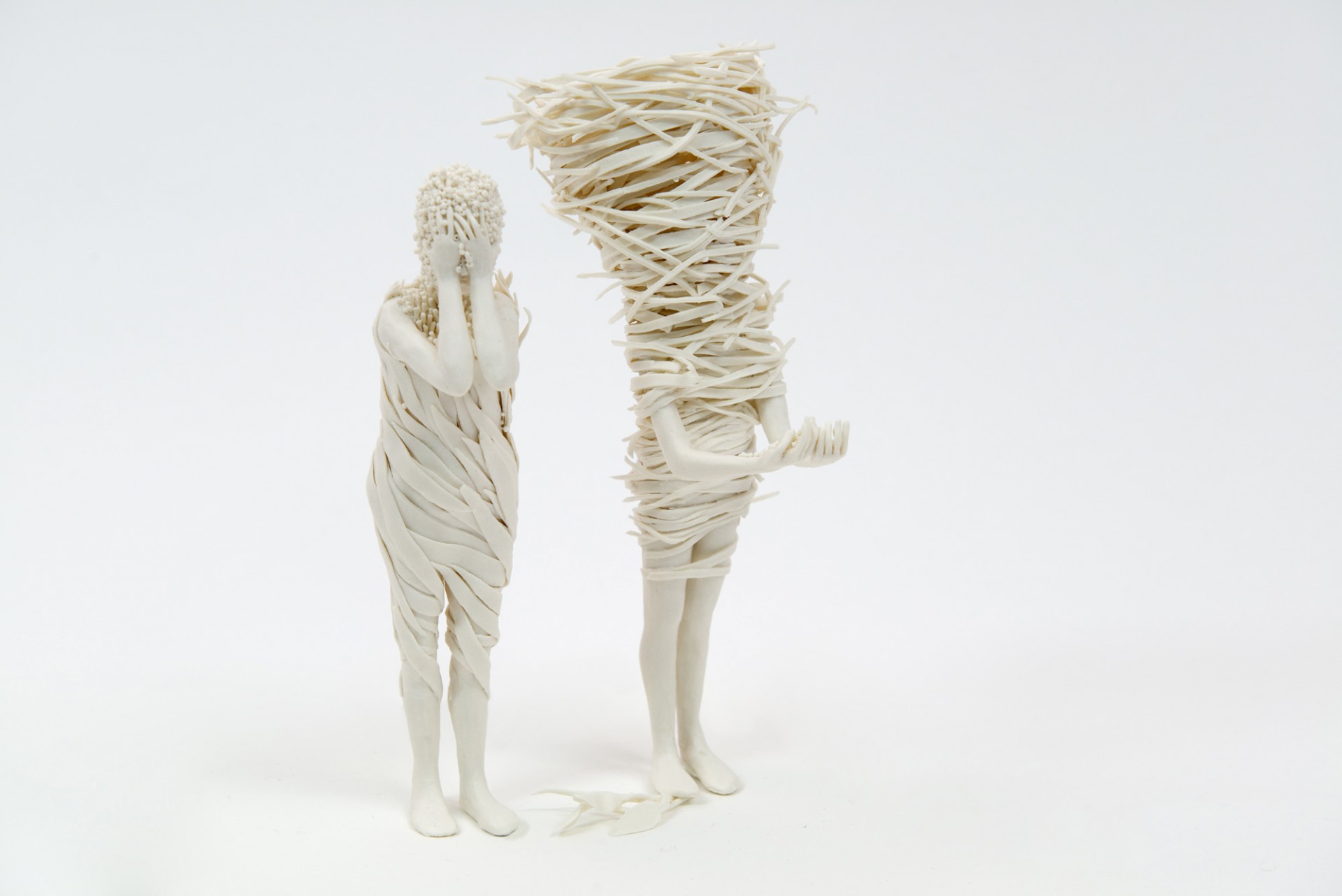
Claudia Fontes (Argentine, 1964–), sculptures from the Foreigners series, 2013–15. Flaxseed paper porcelain, height 25 cm. Photo: Bernard G. Mills.
Oh! how my mind
          Is gravel’d!
                    Not a thought
That I can find,
          But’s ravel’d
                    All to nought.
Short ends of threads,
          And narrow shreds
                    Of lists,
Knots, snarled ruffs,
          Loose broken tufts
                    Of twists,
Are my torn meditation’s ragged clothing;
Which, wound and woven, shape a suit for nothing.
One while I think, and then I am in pain
To think how to unthink that thought again.

How can my soul
          But famish
                    With this food?
Pleasure’s full bowl
          Tastes rammish,
                    Taints the blood:
Profit picks bones,
          And chews on stones
                    That choke.
Honor climbs hills;
          Fats not, but fills
                    With smoke.
And whilst my thoughts are greedy upon these,
They pass by pearls, and stoop to pick up peas.
Such wash and draff is fit for none but swine;
And such I am not, Lord, if I am thine.
          Clothe me anew, and feed me then afresh;
          Else my soul dies famish’d and starv’d with flesh.
I first encountered this poem in Before the Door of God: An Anthology of Devotional Poetry, edited by Jay Hopler and Kimberly Johnson. I had never heard of Christopher Harvey (1597–1663), an English clergyman and minor poet who was a contemporary of John Donne, George Herbert, Henry Vaughan, and Richard Crashaw, the so-called Metaphysical poets. Apparently out of a sense of humility, Harvey published his poetry anonymously during his lifetime. This poem is from a slim 1640 volume of his titled The Synagogue, or, The Shadow of The Temple, but his name didn’t start appearing on the title page until the nineteenth century. Read about the mysterious publication history of The Synagoguehere.
“Confusion” uses an unusual stanza form that befits the subject, with uneven line lengths that produce a raggedy appearance on the page. The rhyme scheme is abc abc dde ffe gghh, with an additional rhyming couplet at the end of the second stanza.
The speaker says his mind is all jumbled, unsettled. “Oh! how my mind is graveled!” he laments. “Not a thought that I can find, but’s raveled all to nought.” (“Graveled” is an archaic word meaning disarrayed, and “raveled” means entangled.) Launching into sartorial imagery, he compares his fragmented thoughts to old, partial, mismatched pieces of dress that fail to make up a coherent attire.
He doesn’t yet specify the nature of his thoughts, whether sinful (e.g., prideful, hateful, lustful) or simply trivial and unfocused on God or dominated by worry. Either way, he is suffering from intrusive and distracting thoughts that undo him.
In stanza 2 he shifts to the metaphor of food, and reveals that it is avarice he is struggling with—an insatiable need to acquire more and to be perceived as successful and important. In part to maintain an image, he indulges in the pleasures typical of rich men, which appear juicy and delicious, he says, but they actually taste quite rank (“rammish”) and make him sick. He cautions that wealth, social status, and human praise, if that’s what we feed on, not only fail to nourish (fatten) our souls; they can ultimately choke us or starve us to death.
Feasting on sensual gratification, expensive toys, and accolades instead of on Christ is like passing up pearls for peas, the speaker remarks. Such foods are the dregs, the refuse (“draff”), fit only for pigs, not for God’s children.
The closing couplet pulls together both stanzas, as the speaker asks God to clothe him in a whole new garment and to feed him afresh so that he is not “starved with flesh.” This final phrase, an oxymoron, suggests how the dishes served up by this world seem meaty but ultimately do not satisfy; when it comes to filling us, they’re as good as nothing, only leaving us empty.
Instead of being content to go about in tatters, eating slop, we must “clothe ourselves with the new self . . . in true righteousness and holiness” (Eph. 4:24) and feed on Jesus, “the bread of life . . . come down from heaven” (John 6:35, 33).
POEM: “Lost Sheep” by Margaret DeRitter: DeRitter writes about a lost Merino sheep in Australia who, because left unsheared for so long, was carrying over seventy-five pounds of wool on his back. He was found in 2021 and rescued by Edgar’s Mission Farm Sanctuary in Lancefield.
+++
SONGS:
>> “What Have We Become” by the Sweeplings:The Sweeplings are Cami Bradley and Whitney Dean, a singing-songwriting folk pop duo. From their album Rise and Fall (2015), “What Have We Become” laments how sin encroaches on our lives—we may welcome it in at first, but then it takes over, makes of our house a wasteland. This theme is embodied by a shadowy, thorny-veiled dancer in the music video.
>> “It Knows Me” by Avi Kaplan: Living outside Nashville, Tennessee, Avi Kaplan is best known for being the original vocal bass of the a cappella group Pentatonix, from 2011 to 2017. This song of self-probing is from his second solo EP, I’ll Get By (2020). It’s about the freedom that comes from reckoning with one’s inner darkness and accepting grace. The animation in the video is by Mertcan Mertbilek.
“It Knows Me” is an extremely personal song to me. I believe that everyone has a darker side of them, and that you can choose to play into that, or you can choose to not. This song is about that battle between those two forces, and having a little grace for yourself when you do falter on your path.
>> “Not the Devil Song” by Marcus & Marketo:Marcus & Marketo (Marcus Clingaman and Marketo Michel) are a worship music duo from South Bend, Indiana, fusing the styles of gospel, classical, country, and soul. “Not the Devil Song,” which they wrote in 2019, is about the power Christians are given to tell Satan to back off! When he dangles temptations in front of you, whispers lies in your ear, sows seeds of doubt or fear or hopelessness, you can confidently retort, “Devil, no, you gotta let go; Jesus died to save my soul.”
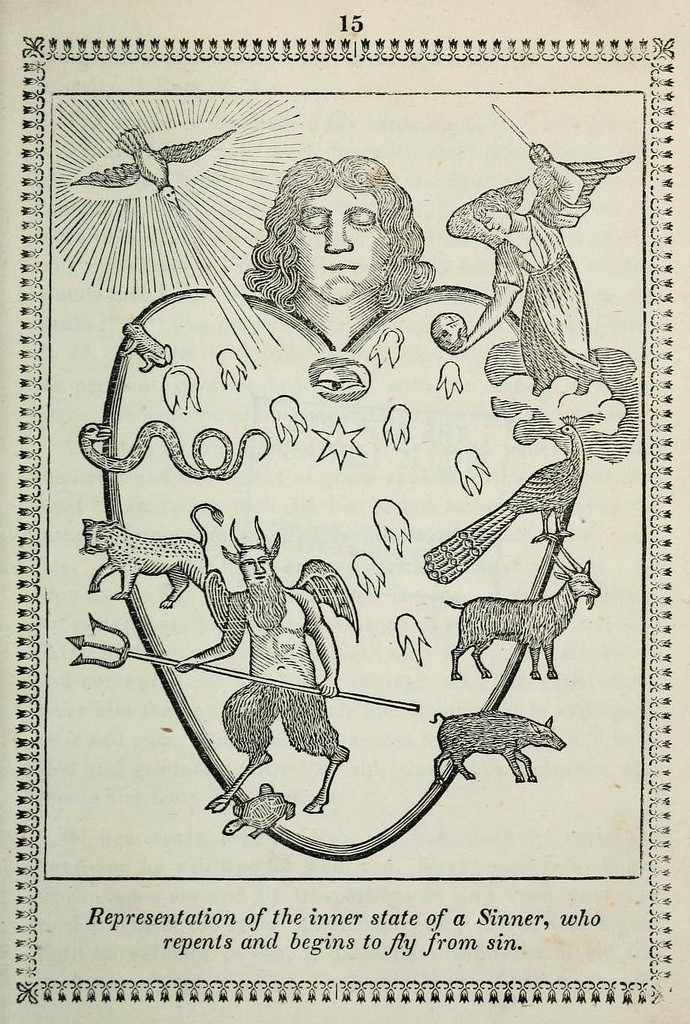
In his book The Forge of Vision (2015), visual studies scholar David Morgan contrasts this emblematic series with the related Cor Jesu amanti sacrum by Anton Wierix (which I wrote about here). Whereas the Wierix engravings from Antwerp are marked by sweetness, with the Christ child gently cleaning and setting up house in the human heart, the anonymous illustrations Gossner uses portray more of a psychomachia (battle for the soul), with armed angels seeking to oust Satan and his minions.
+++
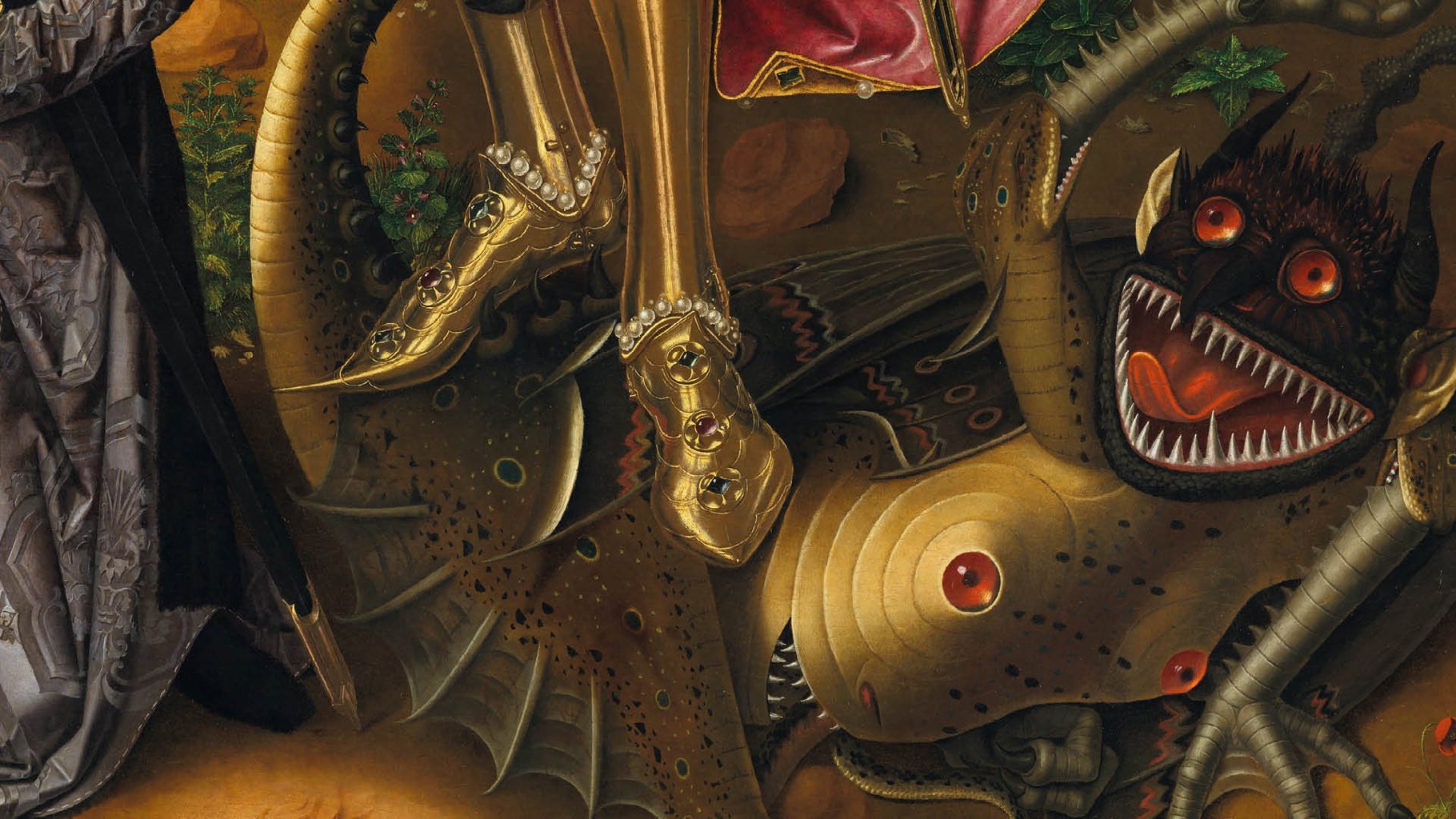
VIDEO: “How Bermejo paints good and evil in Saint Michael Triumphs over the Devil”: In this nine-minute video, Daniel Sobrino Ralston, associate curator for Spanish paintings at the National Gallery in London, examines a late Gothic painting in the museum’s collection by the Spanish artist Bartolomé Bermejo, showing the archangel Michael slaying Satan. Based on Revelation 12:7–9, this subject gave artists the chance to flex their imaginations in portraying evil incarnate and its vanquishment. Possessing an impressive capacity for fantastical invention, Bermejo gives the devil snakes for arms, eyes for nipples, bird claws, moth-like wings, a spiky tail, and a cactus growing out of its head!
Bartolomé Bermejo (Spanish, ca. 1440–after 1495), Saint Michael Triumphs over the Devil (detail), 1468. Oil and gold on wood, 179.7 × 81.9 cm. National Gallery, London.
If this visual subject interests you, I recommend the book Angels and Demons in Art by Rosa Giorgi, from the J. Paul Getty Museum’s Guide to Imagery series.
For all flesh is as grass, and all the glory of man as the flower of grass. The grass withereth, and the flower thereof falleth away: but the word of the Lord endureth for ever. And this is the word which by the gospel is preached unto you.
—1 Peter 1:24–25 (KJV) (cf. Isaiah 40:7–8)
Man is like a breath; his days are like a passing shadow.
—Psalm 144:4 (ESV)
LOOK: Fraktur attributed to David Kriebel
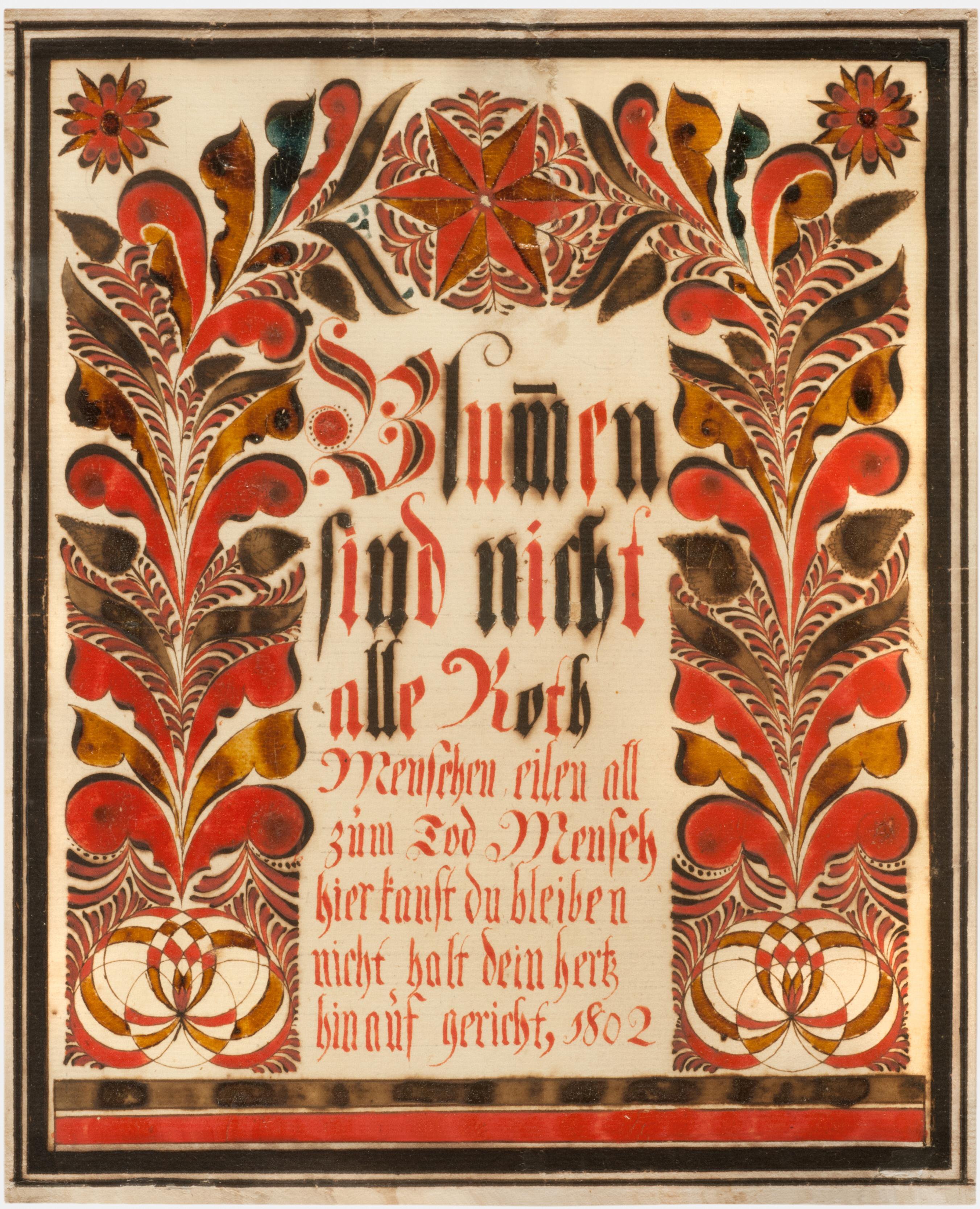
Fraktur attributed to David Kriebel (1787–1848), Gwynedd Township, Montgomery County, Pennsylvania, 1802. Watercolor and ink on laid paper, 9 1/2 × 7 1/2 in. (24.1 × 19.1 cm). Philadelphia Museum of Art.
Referring to exuberantly decorated pages made by Pennsylvania Germans, fraktur is a type of folk art that flourished in the eighteenth and nineteenth centuries. Traditionally handwritten in ink and hand-painted with letter embellishments and design motifs like birds, hearts, and tulips, these works on paper often contain religious texts and/or commemorate important life events like births, deaths, and baptisms. They were made primarily by pastors and schoolmasters, who gifted them to parishioners or students. The recipients did not frame or hang them, but rather kept them in Bibles, drawers, or chests.
The German text of this fraktur translates to “Flowers are not all red. All men hasten toward death. Man cannot remain here, so direct your heart upward.” The piece features a foliate border and a color palette of reds and browns that captures both the bloom of youth and life’s inevitable withering. It was made by David Kriebel, a farmer from Gwynedd Township in Montgomery County, Pennsylvania, who would later move to nearby Worcester Township and become a minister in the Schwenkfelder Church, a small Christian denomination rooted in the Protestant Reformation teachings of Caspar Schwenkfeld von Ossig (1489–1561), which emphasize inner spirituality over outward form.
LISTEN: “As the Life of a Flower” by Laura E. Newell (words) and George H. Ramsey (music), 1904 | Performed by the Chuck Wagon Gang, 1953 [HT]
As the life of a flow’r, as a breath or a sigh So the years that we live as a dream hasten by True, today we are here, but tomorrow may see Just a grave in the vale and a mem’ry of me
Refrain: As the life of a flow’r, as a breath or a sigh So the years glide away, and alas, we must die
As the life of a flow’r, be our lives pure and sweet May we brighten the way for the friends that we greet And sweet incense arise from our hearts as we live Close to him who doth teach us to love and forgive [Refrain]
While we tarry below, let us trust and adore Him who leads us each day toward the radiant shore Where the sun never sets and the flow’rs never fade Where no sorrow or death may its borders invade [Refrain]
This early twentieth-century gospel hymn is performed here by D. P. Carter (tenor) and three of his nine children: Rose Carter Karnes (soprano), Anna Carter Gordon (alto), and Ernest (Jim) Carter (bass, guitar). The quartet formed in 1935 and started appearing on WBAP radio in the family’s hometown of Fort Worth, Texas, the following year, billing themselves as the Chuck Wagon Gang.
“As the Life of a Flower” draws on biblical passages that compare human life to a flower for its ephemerality (e.g., Job 14:2; Psalm 103:15–16; Isa. 40:6–8; 1 Pet. 1:24–25). But flowers are also fragrant, and the song makes that comparison too, echoing verses like 2 Corinthians 2:14–15, where Paul writes, “Thanks be to God, who . . . through us spreads in every place the fragrance that comes from knowing him. For we are the aroma of Christ to God among those who are being saved and among those who are perishing.”
Though we are fading, we are glorious creations of God with joyous and sweet-smelling potential. While we live on this earth, may we exude the beauty and aroma of Christ in all we say and do.
BibleProject is a nonprofit in Portland, Oregon, that offers free videos, podcasts, articles, and classes to help people experience the Bible in a way that is approachable and transformative.
The following two songs are from the music ministry of the Cathedral Church of the Advent in downtown Birmingham, Alabama. The ministry flourished under the leadership of Rev. Dr. Zac Hicks, who served as the church’s canon for worship and liturgy from 2016 to 2021. (He is now pastor of Church of the Cross, also in Birmingham.)
The music videos used to be available on YouTube, but it appears that the church has undergone some restructuring, and they have been removed. For now, though, they are still available through Facebook, and the audio releases are available through streaming services.
>> “Lord, Who Throughout These Forty Days”: This 1873 hymn by Claudia Frances Hernaman recounts the forty days Jesus spent in fasting and prayer in the Judean wilderness at the outset of his ministry and beseeches God to give us strength, like Jesus, to fight temptation, to die to self, and to live by his word and with a keen sense of his abiding presence. It’s set to an American folk tune from the Sacred Harp tradition, known as LAND OF REST, which has roots in the ballads of northern England and Scotland. The hymn is sung by Madison Craig (née Hablas), with Emma Lawton (née Dry) and Annie Lee on background vocals, Joey Seales on pump organ, Charley Rowe on cajon, and Zac Hicks on acoustic guitar.
>> “Spring Up, O Well”: This is an original song by Zac Hicks, sung by Jordan Brown. It draws especially on the narrative in John 4, where Jesus tells a Samaritan woman at a well, “Everyone who drinks of this water will be thirsty again, but those who drink of the water that I will give them will never be thirsty. The water that I will give will become in them a spring of water gushing up to eternal life” (vv. 13–14). The exclamation “Spring up, O well!” in the song’s refrain comes from Numbers 21:17, where the Israelites praise God for providing them water in the desert, and that musical phrase is adapted from the old children’s church song “I’ve Got a River of Life.”
+++
SHORT FILM: “Silences,” dir. Nathan Clarke: Shot in 2016 at Box Canyon near Laity Lodge in the Texas Hill Country, this contemplative short film features cellist Steuart Pincombe playing a short improvisation that interacts with the natural space. The impromptu music making was for him an exercise in prayer.
Three years earlier, also while on retreat at Laity Lodge, Pincombe’s wife shot him doing the same inside the newly constructed Threshold, an interactive, site-specific, permanent outdoor installation by Roger Feldman consisting of three curved walls:
The Threshold improvisation, Pincombe writes, “stemmed from a particular note (and its harmonic overtones) that naturally resonated in the space—the cello’s lowest strings were tuned to match this strongest resonation. Playing with the confusion of resonances (or pitches) was an important part of this short musical and spatial exploration—pitches are bent or adjusted in a way that create audible pulses in the sound and play on the conflicts of resonation within the space.”
+++
ESSAY: “Silence in an Age of Mass Media: John Cage and the Art of Living” by Dr. Jonathan A. Anderson, ARTS (Spring 2017): Many twentieth- and twenty-first-century artists have explored the necessities and possibilities for aesthetic stillness and silence, Anderson writes. In this essay he considers the composer John Cage (1912–1992), best known—and most excoriated—for his modernist piano composition 4′33″ (1952), in which the pianist sits at the bench for four minutes and thirty-three seconds, playing no notes. The point was to attune the audience to the ambient sounds of the concert hall (coughing, rustling, creaking, mechanical humming, outside traffic, etc.), testing the distinction between “music” and “noise.” Cage found the fundamental difference between the two to be not in the qualities of sound but in the attentiveness of the listener.
I was pleasantly surprised to learn from Anderson’s article that even after Cage left Christianity (in which he was raised) and turned to Zen Buddhism, he continued to link his love for the givenness of environmental sounds to Jesus’s admonition to “consider the lilies” (Luke 12:27). “Cage sought to quiet his own aesthetic ‘worry’ for musical meaning,” Anderson writes, “and to instead receive the given sounds of the world as richly meaningful in themselves.”
+++
VIDEO: Lenten Jazz Vespers, Duke University Chapel, March 23, 2023: This Jazz Vespers service combines the liturgical traditions of Vespers with the musical improvisation of jazz. Exploring the theme of hope, the service is presided over by Rev. Racquel C. N. Gill, minister for intercultural engagement at Duke University Chapel. Musical leadership is provided by the John Brown Little Big Band.
Here are the time stamps:
0:01: Song: “I Came to Tell You” by Trinity Inspirational Choir
5:40: Welcome and Prayer
8:33: Song: “Miracle (It’s Time for Your Miracle)” by Marvin Sapp
14:38: Poetry reading: “Dark Testament (8)” by Pauli Murray
LENT SERIES: “Let go of unlove this Lent: Let’s practice love together—a new and improved Lenten reflection series starting March 5th” by Tamara Hill Murphy: I’ve been nurtured for years by Murphy’s gentle spiritual writing and curated beauty and wisdom, and I especially appreciate her annual Advent and Lent Daybook series. This Lent, she’ll be exploring four postures of cruciform love given to us in 1 Corinthians 13, providing daily scripture readings, prayers, and art, along with weekly practices. You can gain access for just $16. (She uses the Substack platform.)
Forgive Thy Other by Scott Erickson
I like how Murphy frames the season: “Lent is a significant time for us to seek a deeper understanding of God’s heart and recognize the gaps in our experiences of His love. Through its beautiful stories, prayers, and practices, Lent also invites us to reflect on our own expressions of love and unlove. The Book of Common Prayer encourages us to let go of our unloving ways so we can love what (and who) God loves. Let’s joyfully embrace this transformative season together, reflecting God’s love with compassion and understanding.”
+++
NEW PLAYLIST: God’s Love (Art & Theology): Related to Tamara Hill Murphy’s 2025 Lent Daybook theme: here’s a new playlist I put together of songs about the abounding, ever-present love of God the Father, Son, and Holy Spirit, a love that seeks, heals, and transforms.
The cover photo is of an early twentieth-century relief sculpture from the exterior of Holy Trinity Church in the town of St Andrews, Scotland, taken by Joy Marie Clarkson; it shows a pelican pecking her breast to feed her young with her own blood, a medieval symbol of Christ’s self-giving love.
There’s some overlap between this playlist and my dedicated Lent Playlist. I hope it uplifts you in the knowledge of the depths and riches of God’s love for you.
+++
SONGS:
>> “And Am I Born to Die?”: Lent opens with a call to “remember you are dust, and to dust you shall return.” A reflection on human mortality, this somber hymn was written by the great English Methodist hymnist Charles Wesley (1707–1788) and set to music—a shape-note tune—by Ananias Davisson (1780–1857), a Presbyterian elder from Virginia. In this video from January 2023, it’s performed by the Appalachian folk musician Nora Brown, with Stephanie Coleman on fiddle and James Shipp on harmonium.
And am I born to die? To lay this body down? And must my trembling spirit fly Into a world unknown?
Awaked by trumpet sounds, I from my grave shall rise, And see the Judge, with glory crowned, And see the flaming skies.
Soon as from earth I go, What will become of me? Eternal happiness or woe Must then my portion be.
>> “Nunc tempus acceptabile” (Now Is the Accepted Time): Second Corinthians 5:20b–6:10 is traditionally read on Ash Wednesday, a passage that includes the adjuration, “Behold, now is the acceptable time; behold, now is the day of salvation!” (2 Cor. 6:2). There’s a beautiful tenth-century Latin hymn for Lent, from the Liber Hymnarius, that opens with this line. In 2013, the Chicago-based composer and conductor Paul M. French set it to music for SSA a cappella choir, its unison opening unfolding into an increasingly expressive three-part harmony. It’s performed here by the Notre Dame Magnificat Choir under the direction of Daniel Bayless.
Nunc tempus acceptabile
Fulget datum divinitus,
Ut sanet orbem languidum
Medela parsimoniae.

Christi decoro lumine
Dies salutis emicat,
Dum corda culpis saucia
Reformat abstinentia.

Hanc mente nos et corpore,
Deus, tenere perfice,
Ut appetamus prospero
Perenne pascha transitu.

Te rerum universitas,
Clemens, adoret, Trinitas,
Et nos novi per veniam
Novum canamus canticum.

Amen.
Today is the accepted time. Christ’s healing light, the gift divine, shines forth to save the penitent, to wake the world by means of Lent.
The light of Christ will show the way that leads to God’s salvation day. The rigor of this fasting mends the hearts that hateful sinning rends.
Keep all our minds and bodies true in sacrifice, O God, to you, that we may join, when Lents have ceased, the everlasting Paschal feast.
Let all creation join to raise, most gracious Trinity, your praise. And when your love has made us new, may we sing new songs, Lord, to you.
LECTURE: “Embracing the Ephemeral: How Art Honors Creaturehood” by James K. A. Smith, Duke Divinity School, February 17, 2022: Mortality means something more than being a creature who will someday die, says philosopher James K. A. Smith; it is a way of being, not defined solely by its terminus. “To be created is to be ephemeral, fugitive, contingent. To be a creature is to be a mortal, subject to the vicissitudes of time.” Part of the Duke Initiatives in Theology and the Arts Distinguished Lecture Series, this talk about developing a Christian temporal awareness is based on chapter 4 of Smith’s then-forthcoming, award-winning book How to Inhabit Time (Brazos, 2022), titled “Embrace the Ephemeral: How to Love What You’ll Lose.”
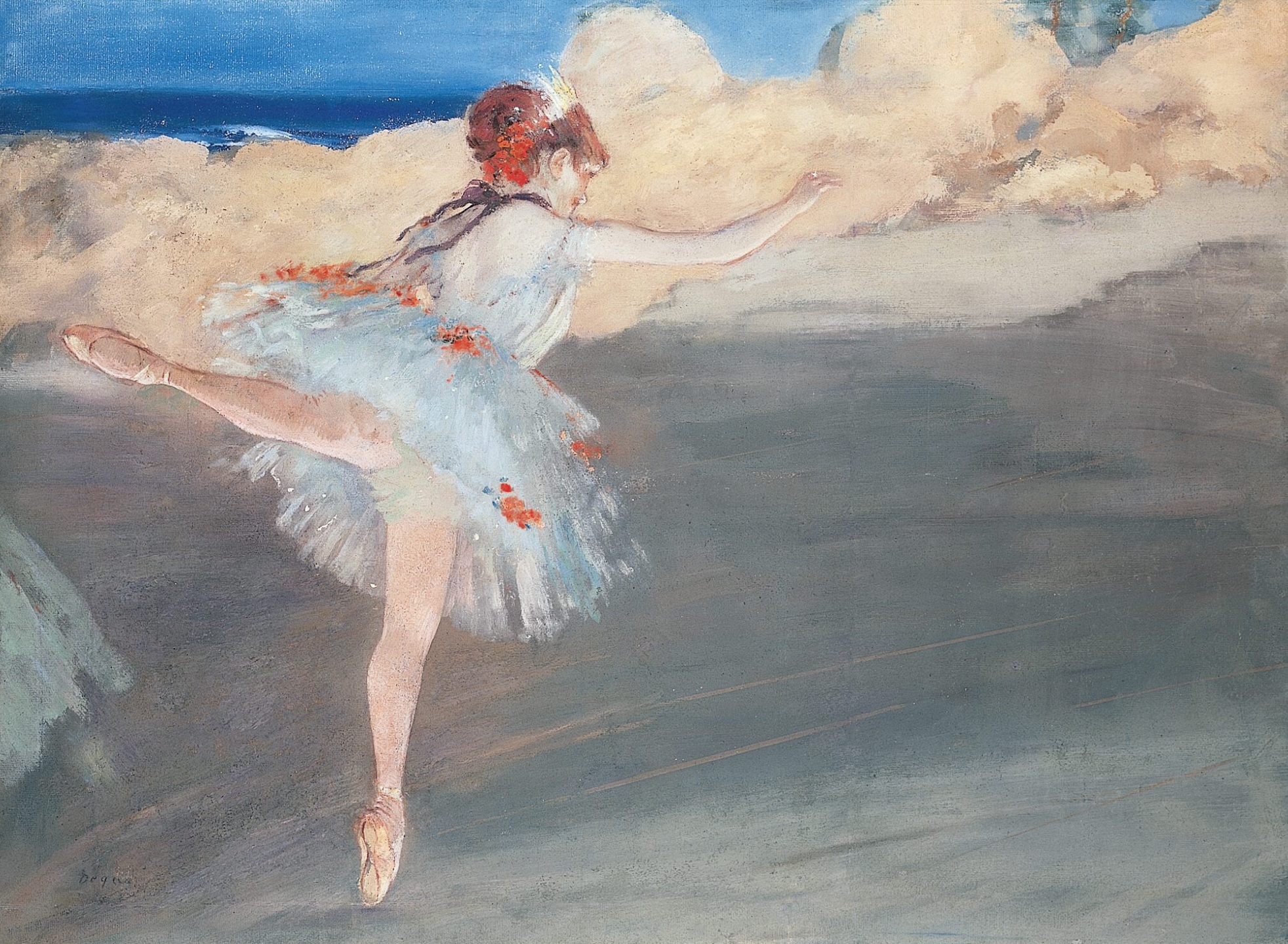
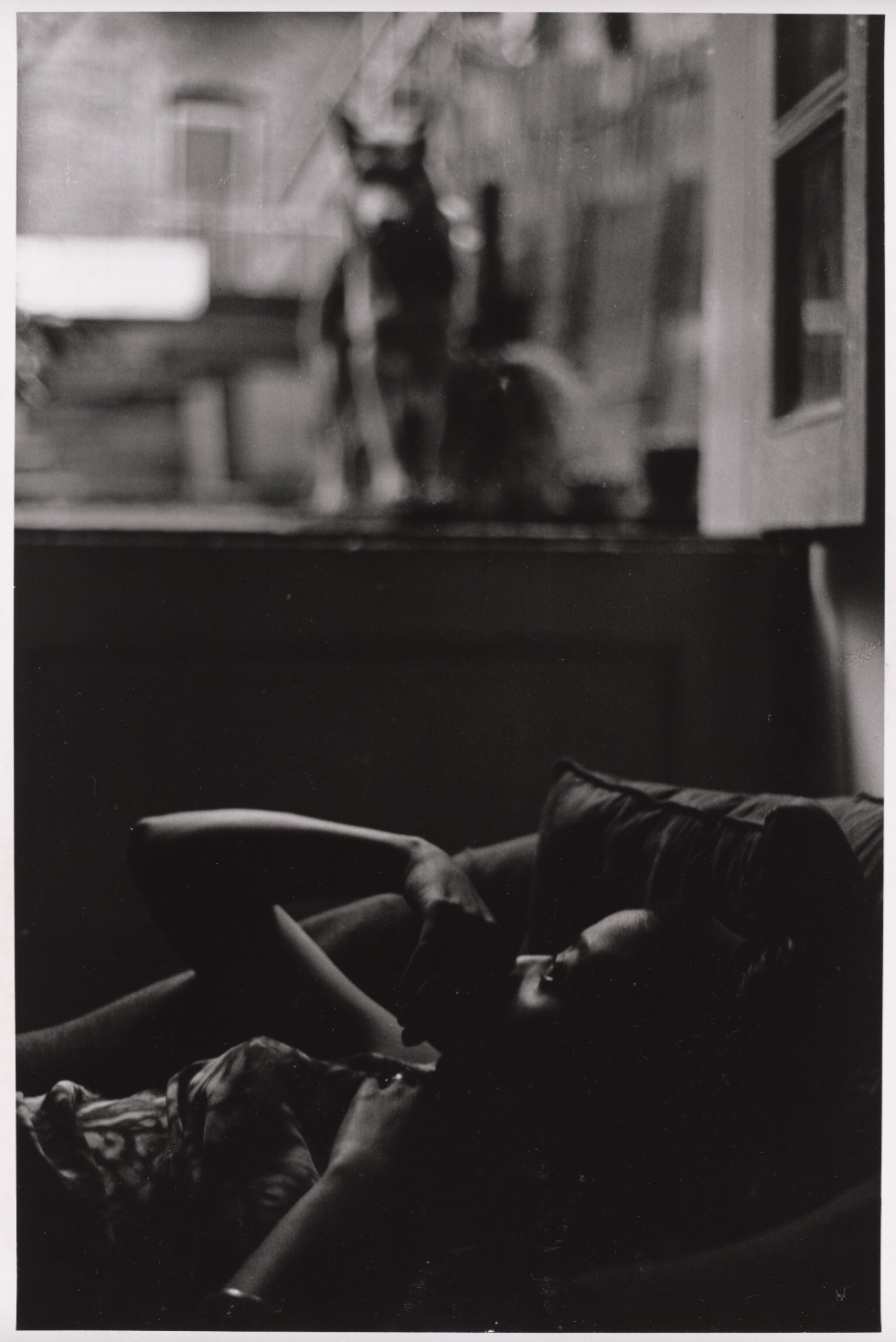
Edgar Degas (French, 1834–1917), The Star: Dancer on Pointe, ca. 1878–80. Gouache and pastel on paper, mounted on board, 22 1/4 × 29 3/4 in. (56.5 × 75.6 cm). Norton Simon Museum, Pasadena, California.Herbert Randall (American, 1936–), Untitled (Lower East Side, New York), 1960s. Gelatin silver print, 13 7/16 × 8 7/8 in. (34.2 × 22.5 cm). J. Paul Getty Museum, Los Angeles.
Some notes I took:
“We need not only memento mori, but also memento tempore—reminders of our temporality, not just our mortality.”
“Imagine embracing the ephemeral as a discipline of not only conceding our mortality as a condition but also receiving our mortality as a gift.”
“Our finitude is not a fruit of the fall, even if it is affected by the fall. Contingency is not a curse. . . . Aging is not a curse. Autumn is not a punishment. Not all that is fleeting should be counted as loss. The coming to be and passing away that characterize our mortal life are simply the rhythms of creaturehood.”
Resting in our mortality instead of resenting it
Theologian Peter Leithart says hebel means not “emptiness,” “vanity,” or “meaninglessness” but, literally, “mist” or “vapor.” The Teacher in Ecclesiastes uses that word repeatedly to describe human life: it’s vaporous, elusive, escapes our efforts to hold on to it, to manage it.
How to sift tragedy from good creaturely rhythms in which good things fade?
“To dwell faithfully mortally is to achieve a way of being in the world for which not all change is loss and not all loss is tragic, while at the same time naming and lamenting those losses that ought not to be. . . . To be faithfully mortal is a feat of receiving and letting go, celebrating and lamenting. Being mortal is the art of living with loss, knowing when to say thank you and knowing when to curse the darkness.”
“One Art” by Elizabeth Bishop: “The art of losing isn’t hard to master . . .”
A Q&A takes place from 39:00 onward. The first question, asked by theologian Jeremy Begbie, is the one I had, and it recurs with different phrasing at 58:17.
Mortality is one of the main themes in Silver’s poetry, including the physicalities of being human, as reflected in “Ash Wednesday,” in which she, the speaker, muses on the shared Christian ritual of the imposition of ashes at the beginning of Lent. Silver, who died of breast cancer eight years after writing this poem, was used to practicing memento mori (“remember you must die”): her mastectomy scar and silicone breast prosthesis are constant reminders of the fact, she writes. She wants to touch the body of God, wants to wrap her fingers around some tangible promise of healing, but both remain elusive. Instead she resolves to embrace the finiteness of her present form, taking the burnt remains of those Hosanna palms from last year and wearing them with repentance and praise, knowing that what is sown in perishability will be raised in imperishability (1 Cor. 15:42).
I’m compelled by how Silver both laments her fragility and owns it. There’s a defiant quality to the tone, the ash-and-oil mixture that’s thumbed into her forehead in the shape of a cross evoking a football player applying eye black in front of a locker room mirror before the big game. Wearing the mark of Christ, she’s ready for the face-off between herself and death.
Do you fast? Give me proof of it by your works. If you see a person who is poor, take pity on them. If you see an enemy, be reconciled to them. If you see a friend being honored, do not envy them. Let not only your mouth fast, but also your hands and feet and eyes and ears and all the members of your body. Let the hands fast by being free of avarice. Let the feet fast by ceasing to run after sin. Let the eyes fast by not looking with lust. Let the ears fast by not listening to malicious talk or false reports. Let the mouth fast from hateful words and unjust rants. For what good is it if we abstain from birds and fishes but bite and devour our brothers and sisters?
—John Chrysostom, from Homily 3 on the Statutes, secs. 11–12, written in Greek in 387 CE



 Art & Theology