This Sunday’s lectionary reading from the Epistles is 1 Corinthians 13:1–13, the famous “love” passage. Here are ten songs that set that text or are based on it. And there are many more besides!
1. “1 Corinthians 13:1–8,” chanted in Romanian by Maria Coman, 2023:
For a cover by the Good Shepherd Collective, featuring Jayne Sugg and Son of Cloud (Jonathan Seale) (his is one of my favorite male singing voices), see here. They add as an outro the refrain of Martin Smith’s “I Could Sing of Your Love Forever.”
The neo-soul/R&B album The Miseducation of Lauryn Hill (1998), Hill’s solo debut, is one of the most widely acclaimed albums of the nineties. At an evening of jazz and spoken word hosted at the White House on May 19, 2009, by then president Barack Obama, upright bass player, singer, and composer Esperanza Spalding performed her gorgeous arrangement of Hill’s “Tell Him.” The object pronoun “him” used throughout has been interpreted by listening publics as either a romantic partner or God, and the ambiguity is probably intentional. As for me, I hear the song as religious, especially given the line “the love that was shown when our lives were spared,” which I take to be a reference to Christ’s saving sacrifice. [HT]
4. “1 Corinthians 13:8–11” (excerpt) from Uganda, 2021:
This video was uploaded by Bwire Isaac, the founder of Alpha Worship Connection, a registered nonprofit that trains and equips worship leaders in Uganda. It was filmed at one of his Discipleship Training Weeks, and features a pastor named Muwanguzi playing the adungu (bow harp). I believe the language is Luganda. [HT]
5. “Love (1 Corinthians 13)” by Joni Mitchell, from Wild Things Run Fast, 1982:
The song also appears, re-recorded and in new arrangement, on Mitchell’s Travelogue (2002). Hear her speak about how the apostle Paul’s words inspired her in this two-minute video.
9. “The Gift of Love” by Hal Hopson, 1972, performed by Koiné on Gesanbuch, 2008:
The music of this one is adapted from a traditional English folk tune.
10. “Kanoo” (Love) by Elfi Bohl, aka Mariyama Suso, from Suukuu Kutoo/ A New Song, 1999:
Bohl’s “Kanoo” is an original setting of 1 Corinthians 13:4–7 in the Mandinka language of West Africa, which she sings to a kora self-accompaniment. She wrote and recorded it while living in The Gambia. To learn more about Bohl and her kora songs, see my previous blog post from December.
>> Annual Candlemas Lecture by Ayla Lepine, February 3, 2025, 7 p.m. GMT (2 p.m. ET): Rev. Dr. Ayla Lepine, who is the associate rector at St James’s Piccadilly in London and an art historian and theologian, “will explore two works of art featured in her forthcoming book, Women, Art, God. In the series entitled The Annunciation (A Study), Julia Margaret Cameron reimagined and reconfigured paintings by Renaissance artists including Perugino and Lippi. In her photography, blurred and hazy aspects of the image are suggestive of the Holy Spirit in this new technology.
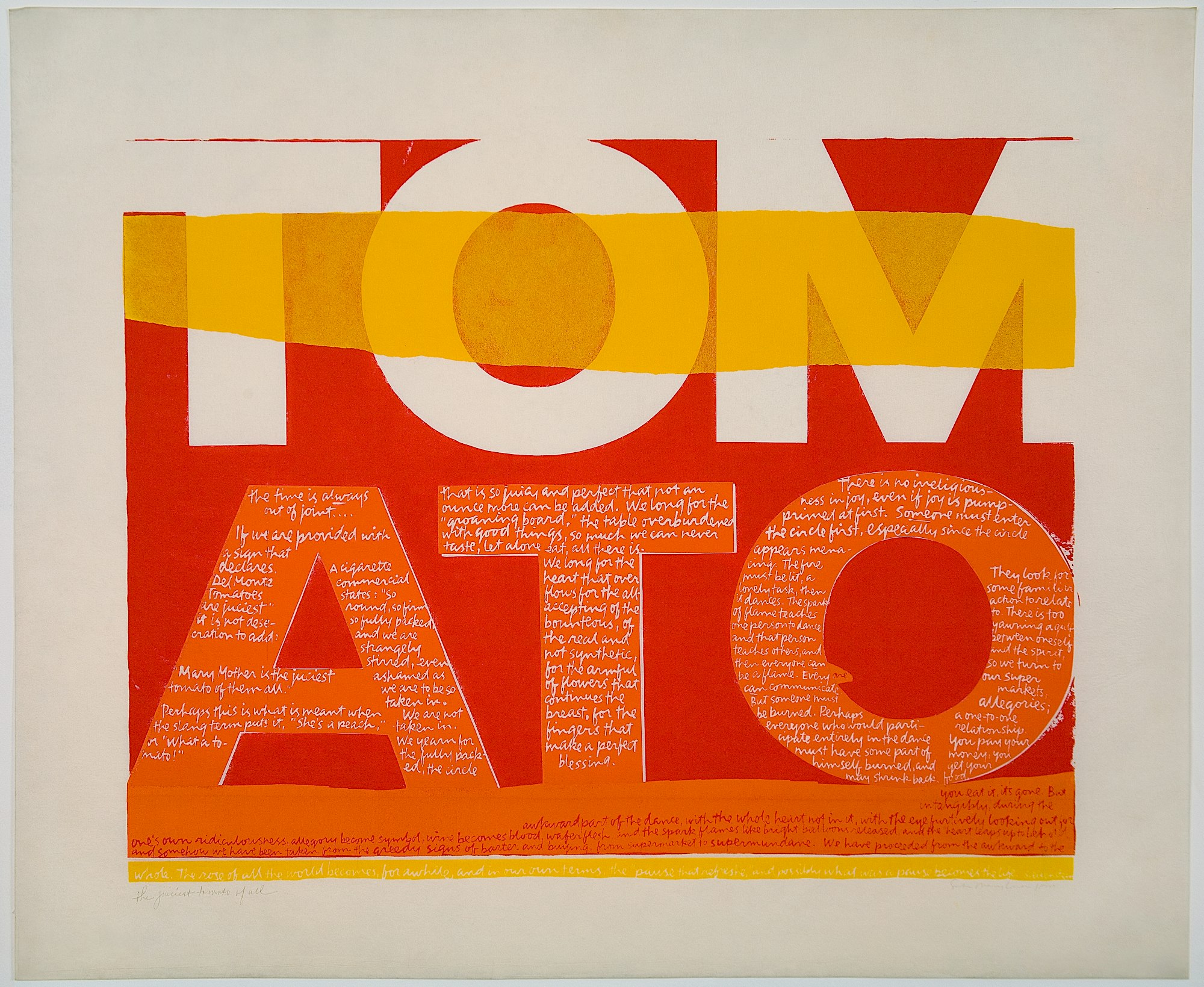
“A century later, the American nun Sister Corita Kent produced a groundbreaking silkscreen print, The Juiciest Tomato of All. This artwork compared the Virgin Mary to a ripe fruit, with a title inspired by Del Monte tinned fruit and vegetable slogans from her local supermarket. By considering these two artworks by women from the nineteenth and twentieth centuries as a pair, new ways of encountering Mary in art history, theology, and prayer can emerge with unexpected resonance for the twenty-first century.”
>> “The Annunciation in Theology and Art: Shedding New Light on an Old Doctrine”by Tina Beattie, March 26, 2025, 3 p.m. GMT (10 a.m. ET): No details other than the title have been given about this lecture. But the speaker is a leading Marian theologian and writer whom I’ve been familiar with for some time, and an emerita professor of Catholic studies at the University of Roehampton. Her research is in the areas of gender, sexuality, and reproductive ethics; Catholic social teaching and women’s rights; theology and the visual arts, especially images of Mary; and the relationship between medieval mysticism, sacramental theology, and psychoanalytic theory.
+++
WEBINAR with Drew Jackson, Eugene Peterson Center for Christian Imagination, February 4, 2025, 7 p.m. ET: A conversation on the intersection of poetry, ministry, and Christian imagination. Registration is free. “Drew Jackson is a poet, speaker, and public theologian. He is author of God Speaks Through Wombs: Poems on God’s Unexpected Coming and Touch the Earth: Poems on the Way. . . . Drew received his B.A. in Political Science from the University of Chicago and his M.A. in Theology from Fuller Theological Seminary. He currently works as the Managing Director of Mission Integration for the Center for Action and Contemplation, and lives in Brooklyn, NY, with his wife and daughters.”
+++
CONFERENCES/SYMPOSIA:
>> Calvin Symposium on Worship, Calvin University, Grand Rapids, Michigan, February 5–7, 2025: “An ecumenical conference dedicated to worship and learning, bringing together people in a variety of roles in worship and leadership from across the country and around the world.”
>> Contemporary Art as/in Pilgrimage, Columbia University, New York, February 11, 2025: Organized by the Association of Scholars of Christianity in the History of Art, this one-day symposium “will explore such questions as: Are galleries, museums, art expos, and art installations the new ‘slow spaces’ for spiritual sustenance and transcendent experiences? How are temples, churches and other ‘religious’ sites transformed by artist installations intended to invoke deep spiritual encounter and healing? And how is the art of contemporary artists working in a diversity of media and practice seen through the lens of pilgrimage?”
The keynote speaker is Kathryn R. Barush, author of Imaging Pilgrimage: Art as Embodied Experience (Bloomsbury, 2021). She will be joined by eleven other presenters. Plus, Elissa Yukiko Weichbrodt, author of Redeeming Vision: A Christian Guide to Looking at and Learning from Art, will lead attendees in the practice of intentional looking at the Cathedral of Saint John the Divine.
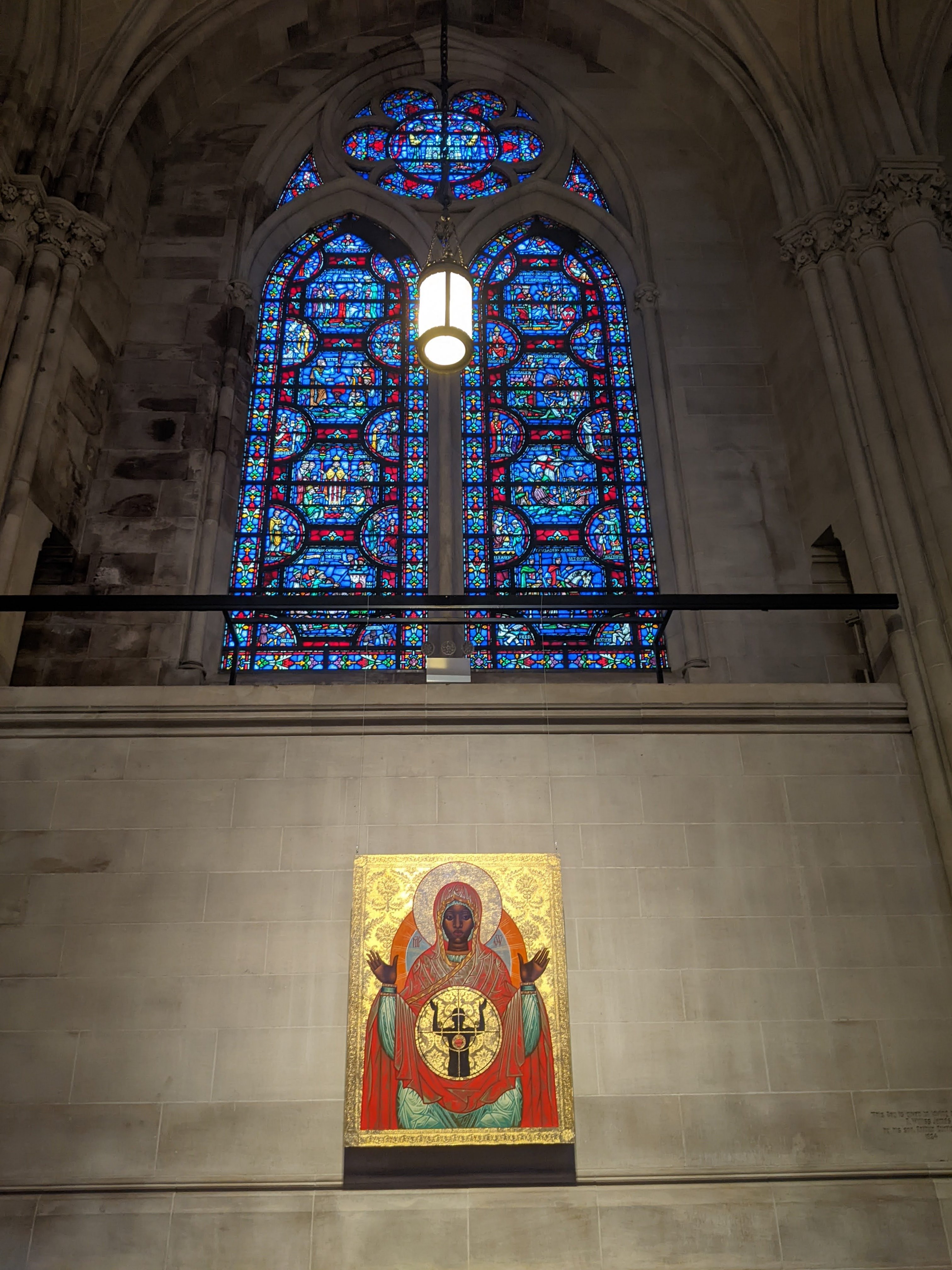
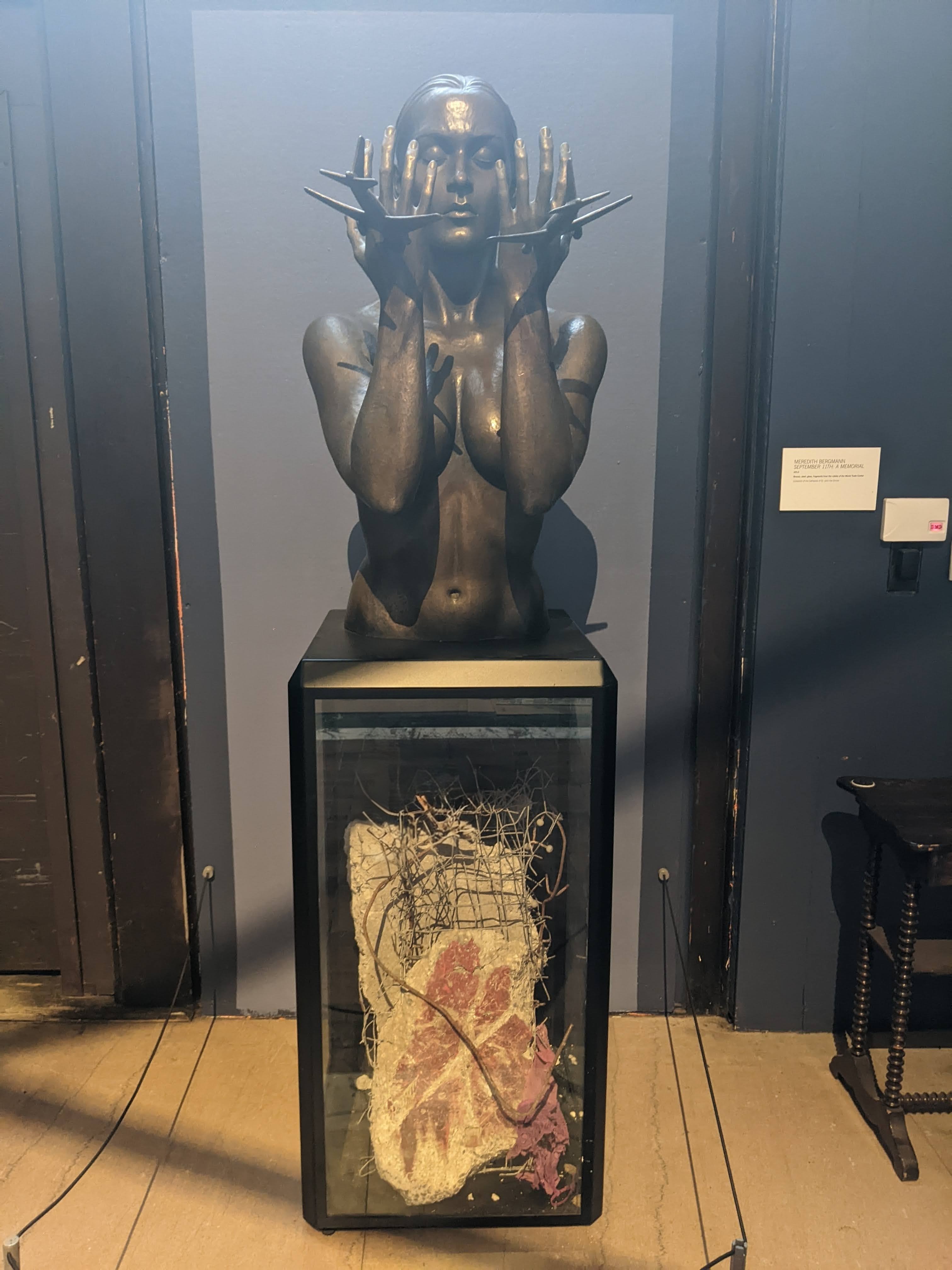
Mark Doox (American, 1958–), Our Lady, Mother of Ferguson and All Those Killed by Gun Violence, 2016. Acrylic and gold leaf on wood, 48 × 36 in. Cathedral of Saint John the Divine, New York. Photo: Victoria Emily Jones, 2022.Meredith Bergmann (American, 1955–), September 11th: A Memorial, 2012. Bronze on pedestal of steel and glass, containing reinforced concrete and brick from the rubble of the World Trade Towers, 78 × 22 × 24 in. Cathedral of Saint John the Divine, New York. Photo: Victoria Emily Jones, 2022.
>> Square Halo Conference, Trust Performing Arts Center, Lancaster, Pennsylvania, March 7–8, 2025: “The Square Halo conferences have offered times not only of fascinating and inspiring ideas in a high caliber of wide and varied presentations, but also of rich, meaningful interactions, dialogue, and (in a deep sense of this word) fellowship. Creativity, collaboration, and community . . . an apt description of what [takes] place” (Matthew Dickerson).
The keynote speaker is Diana Pavlac Glyer, who teaches literature, history, theology, and philosophy in an integrated Great Books curriculum at Azusa Pacific University, and the Saturday-night concert will feature Thomas Austin and Skye Peterson.
>> The Breath and the Clay, Winston-Salem, North Carolina, March 21–23, 2025: “This year we will explore how the light gets in through the fragments of our stories, our lives and our art. We are each built of broken pieces, a mosaic of joys and sorrows, of mundane and miraculous happenings. When we surrender the full spectrum of our human experience, even our pain, doubts and sorrows can heal into art. Through our workshops, keynote talks, immersive gallery and performances, we will explore various facets of the creative life and how everything from inspiration to the everyday, from family to vocation and community coalesce to reveal a hidden wholeness.”
Presenters include Sho Baraka, Vesper Stamper, Justin McRoberts, Cheryl Bridges Johns, Elissa Yukiko Weichbrodt, and more.
>> Illuminate: Art and Faith, Southern Adventist University, Collegedale, Tennessee, March 31–April 1, 2025: “Author and theologian Frederick Buechner famously wrote, ‘Pay attention to the things that bring a tear to your eye or a lump in your throat because they are signs that the holy is drawing near.’ Paintings, poetry, music, and other creative mediums hold strong potential to do just that—to indirectly communicate powerful truths, many of which have eternal consequences. Are we open to what they’re telling us? Will we utilize these tools to share important stories (including The Story) with others? Join us for two rich days of education, inspiration, and community! . . .
“This year’s conference will include a variety of hands-on workshops (flash fiction, drawing, songwriting), as well as sessions exploring fascinating figures, including C. S. Lewis, Madeleine L’Engle, Eugene Peterson, Kurt Vonnegut, Dorothy Sayers, Vincent van Gogh, Norman Rockwell, Ludwig van Beethoven, Duke Ellington, and many more.”
Among the session leaders and performers are art historian Elissa Yukiko Weichbrodt (Redeeming Vision), writer Douglas McKelvey (Every Moment Holy), film and literature scholar Mary McCampbell (Imagining Our Neighbors as Ourselves), pastor Russ Ramsey (Van Gogh Has a Broken Heart; Rembrandt Is in the Wind), illustrator John Hendrix (The Mythmakers; Go and Do Likewise!), and singer-songwriter Andy Gullahorn.
>> Visible and Invisible: Surprising Encounters in Theology and the Arts (DITA 2025), Duke University, Durham, North Carolina, September 4–7, 2025: I’ll be attending this one! Organized by Duke Initiatives in Theology and the Arts. “How can the arts help us open up the very heart of the Christian faith, celebrated at the Council of Nicaea in 325, that Jesus Christ is ‘one in being’ with God? Featuring world-class academics, artists, musicians, and clergy from around the globe and a robust range of programming, DITA2025 is a four-day symposium at Duke University celebrating Nicaea and the myriad surprises the Creed holds in store for artists, academics, clergy, and parishioners today. . . .
“By pairing theologians with poets, clergy with novelists, dancers with liturgists, musicians with scholars, the symposium will generate a series of meetings rarely offered in academic and artistic settings. Including interactive keynotes, plenary presentations, seminar lectures, applied workshops, an evening concert, and more, DITA2025 is a unique opportunity to experience the arts and the academy in action.”
Dancer and choreographer Leah Glenn performs an original work, The Youngest of Nine, at DITA 2019.
Speakers include Rowan Williams, Chigozie Obioma, Natalie Carnes, Sandra McCracken, James K.A. Smith, Malcolm Guite, Amy Peeler, and Josh Rodriguez. Early-bird registration ends February 15.
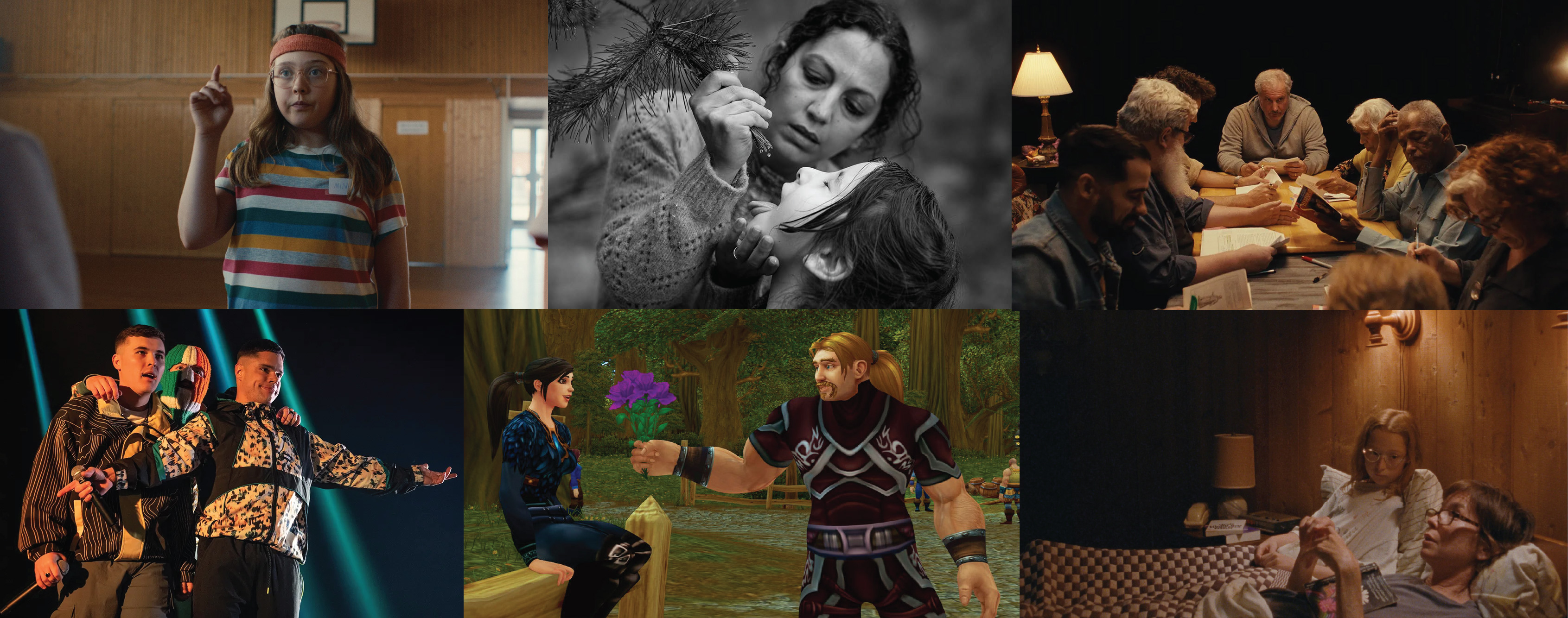
11. Dancing Queen, dir. Aurora Gossé. This coming-of-age dramedy from Norway was not promoted at all in the US but quietly arrived on Google Play early this year—thanks to my YouTube algorithm for suggesting it! Seventh-grade Mina (Liv Elvira Kippersund Larsson) has a crush on Edwin (Vilijar Knutsen Bjaadal), aka E.D. Win, a hip-hop dancer with a large social media following who has just transferred to her school. Despite having no dance experience, Mina decides to audition for his crew ahead of a local competition, and she enlists her grandma (Anne Marit Jacobsen) to train her, and her best friend Markus (Sturla Harbitz) to help her practice the partner work. The film is so endearing, even if a bit predictable in its beats.
12. Ghostlight, dir. Alex Thompson and Kelly O’Sullivan. Dan (Keith Kupferer) is a construction worker who’s grieving a grave loss and is unwilling to open up about it with his wife Sharon (Tara Mallen) and daughter Daisy (Katherine Mallen Kupferer). (The three actors are father-mother-daughter in real life.) One day he inadvertently stumbles into a rehearsal of a community theater production of Romeo and Juliet. The head of the troupe, Rita (Dolly De Leon), invites him to stay, which he reluctantly does. He’s never acted before, but he finds himself taking on a role in the play, which helps him connect with his emotions and with other people and begin his healing journey.
Streaming on AMC+.
13. Janet Planet, dir. Annie Baker. The free-spirited but weary Janet (Julianne Nicholson) lives with her eleven-year-old daughter, Lacy (Zoe Ziegler), in western Massachusetts, running an acupuncture practice out of their home. Lacy is lonely and quirky and craves her mom’s affection; Janet gives it but is usually also absorbed in some kind of interpersonal entanglement. Over the summer of 1991, during which the film is set, a succession of three visitors come in and out of Janet’s life: a live-in boyfriend, a woman trying to escape a cult, and said cult leader. Lacy tolerates these ephemeral presences but wishes her mom were more exclusively available to her. The film is about Lacy learning to share her mom with others and coming to grips with the fact that she is not the only person her mom needs. The last scene, where Lacy comes to this realization while watching her mom contradancing, gutted me!
Streaming on Max.
14. Green Border, dir. Agnieszka Holland. This film is a difficult watch. It dramatizes the humanitarian crisis precipitated in fall 2021 when Alexander Lukashenko, the dictator of Belarus, lured several thousand asylum seekers from the Middle East and Africa to his country with the promise of free transit to the European Union, then dumped them on the borders of Poland, Lithuania, and Latvia as payback for EU sanctions against Belarus. Green Border focuses on a Syrian refugee family of six (Jalal Altawil plays the father) and an Afghan woman (Behi Djanati Atai) they befriend on the plane ride over—their being tossed (like a football, as one character laments) back and forth across the militarized Polish-Belarussian border, cold and hungry, with neither country willing to receive them.
The film also follows two Poles: border guard Jan (Tomasz Wlosok), who contracts PTSD, and budding activist Julia (Maja Ostaszewska), who joins a group providing water, food, clothing, first aid, power banks, and legal counsel to those crossing the forested swampland into Poland. We see one aid worker cradling the head of a hypothermic refugee as she spoon-feeds him hot soup, and another tenderly rubbing ointment onto the swollen, blistered feet of a weary woman traveler. Sadly, government policy has made these tangible acts of loving care acts of political resistance and grounds for arrest. But there’s a double standard at play, as we see in the epilogue.
Streaming on Kanopy.
15. Juror #2, dir. Clint Eastwood. A taut legal thriller, Juror #2 is all about conscience. Family man Justin (Nicholas Hoult) finds himself on the jury of a murder trial, and when the details of the alleged crime are revealed, he realizes he may have been the unwitting perpetrator. He is torn between his integrity and his self-preservation instincts, between his loyalty to the law and his loyalty to his wife and soon-to-be-born child. What I like about the film is how it prompts you to consider what you would do in the same situation—let someone with less to lose and with lower morals take the fall (the defendant, a single man with gang involvement, is a known abuser of women, and the prosecution has a strong case against him), or own up to what you know and have your and your family’s lives upended.
Streaming on Max.
16. Kneecap, dir. Rich Peppiatt. UNESCO classifies the Irish language as “endangered,” as the number of native speakers has continued to decline ever since English became the national language during British rule. However, more recently there’s been an urban revival, owing in part to the proliferation of Irish-language immersion schools—and to the popularity of Kneecap, a hip-hop trio from West Belfast who rap mostly in Irish, for them a sign of national identity and pride. Formed in 2017, they’re a controversial group whose lyrics often contain Irish republican themes along with profanity and references to drugs and sex. Many young Irish people have embraced them and been inspired by their music to learn Irish.
Band members Liam Ó Hannaidh (stage name Mo Chara), Naoise Ó Caireallain (Móglaí Bap), and JJ Ó Dochartaigh (DJ Próvai) play versions of themselves in this riotous, fictionalized origin story that compelled me mostly because of its fresh take on the musical biopic genre and in how it addresses the politicization of language. Also, it’s funny. But expect irreverence.
Streaming on Netflix.
17. The Outrun, dir. Nora Fingscheidt. Based on the best-selling memoir by Amy Liptrot, The Outrun follows Rona (Saoirse Ronan), an alcoholic in her late twenties who drops out of her PhD program in biology and returns to the remote Orkney Islands of Scotland, where she grew up, to pursue recovery. Rona is closely attuned to the natural forces around her, which gives the film an elemental quality, and Ronan attacks the role with an admirable ferocity. It’s a vital portrait of addiction and the journey to and through sobriety. Unlike some other films that tackle the subject, it doesn’t revel in the character’s misery; it shows the destructiveness of addiction, for sure, but it also shows Rona finding happiness along the way in things other than drink, like dancing with neighbors, barking at seals, baking bread, collecting and drawing seaweed, or pretending she’s a sailor at sea.
18. We Live in Time, dir. John Crowley. In nonlinear fashion, this affecting rom dram traces the relationship of Tobias (Andrew Garfield) and Almut (Florence Pugh), from their initial meeting in a hospital hallway, to the birth of their daughter, to Almut’s death from cancer, and a hundred little moments in between. It’s a beautiful picture of committed romantic love and how it negotiates change, crisis, and conflicting aspirations, but also the many joys it holds.
19. The Remarkable Life of Ibelin, dir. Benjamin Ree. The subject of this Norwegian documentary is Mats Steen (1989–2014), a video gamer who was born with Duchenne disease, a rare form of muscular dystrophy. When he died at age twenty-five, his parents had thought he lived an isolated life. But then they started receiving emails from strangers, numbering in the hundreds, who knew Mats through the online role-playing game World of Warcraft, where Mats interacted with friends daily as the character Ibelin Redmoore.
To bring Mats’s story to life, the film starts out conventionally, with home video footage from and interviews with the family. But then it transitions into animated segments that re-create some of Mats’s personal experiences within the world of the game. An actor voices Mats using Mats’s own words, taken from gaming transcripts and blog posts. These segments are interspersed with in-person interviews with some of Ibelin’s fellow Starlight guild members. I appreciate how the film challenges the stereotype of video games as shallow, time-wasting, and solitary, showing how for Mats, who had limited mobility, they were a means of exercising agency and cultivating meaningful connections with people all over the world.
Streaming on Netflix.
20. A Different Man, dir. Aaron Schimberg. Part dark comedy, part psychological thriller, this film stars Sebastian Stan as Edward, a man living with neurofibromatosis, which causes noncancerous tumors to grow on nerve tissue. He undergoes an experimental procedure that undoes his facial disfigurement and thrusts him into an identity crisis, even more so when he meets a man named Oswald (Adam Pearson) who looks a lot like his presurgery self. He envies Oswald’s confidence and charisma and feels increasingly threatened by him when Oswald is cast to play a version of him in a stage play written by his former next-door neighbor Ingrid (Renate Reinsve). We’re made to wonder whether there’s something insidious about Oswald, or Edward’s insecurities are just acting up.
Writer-director Aaron Schimberg, who has a cleft palate, said this film arose in part from his own contradictory feelings about his disfigurement, and the odd experience of looking in a mirror after having had multiple surgeries and wondering if the face he sees is his own or one that was only created by doctors. He also said he wanted to write a role for Pearson, whom he had worked with before, that defies the two roles he is typically offered—either a sympathetic victim who’s deemed heroic simply for existing, or a horror villain—and that makes use of his naturally gregarious, extroverted personality.
Of the 102 films I’ve seen that were released in the United States in 2024, these are my top ten. I’ll reveal my top eleven through twenty in a “part 2” post in the next few days.
Although I typically draw spiritual, theological, or liturgical connections with the art I feature on this website, here I do not do that. I’ve chosen these films not based on any kind of Christian messaging or interpretive possibilities but because they are beautifully made films that resonated with me. They address themes such as family, friendship, simplicity and awe, repressive governments, growing up, grief, mortality, addiction, trauma, joy, disability, identity.
One thing I love about cinema, as holds true with all the arts, is how it can connect us more fully to God, others, the world, and our own selves. So while I don’t think you need to watch movies with a purpose in mind, if you find yourself hesitant to invest the time, perhaps you might consider that connective capacity.
If the film is currently streaming for free with a subscription service, I’ve noted that at the bottom of the entry. Otherwise, check your local theaters or online rental platforms.
Cautionary note: Different viewers have different sensitivities. If there’s a particular type of content you want to avoid, I’d advise you to check out the “Parents’ Guide” section of the film’s IMDb webpage, to which I’ve linked each film title.
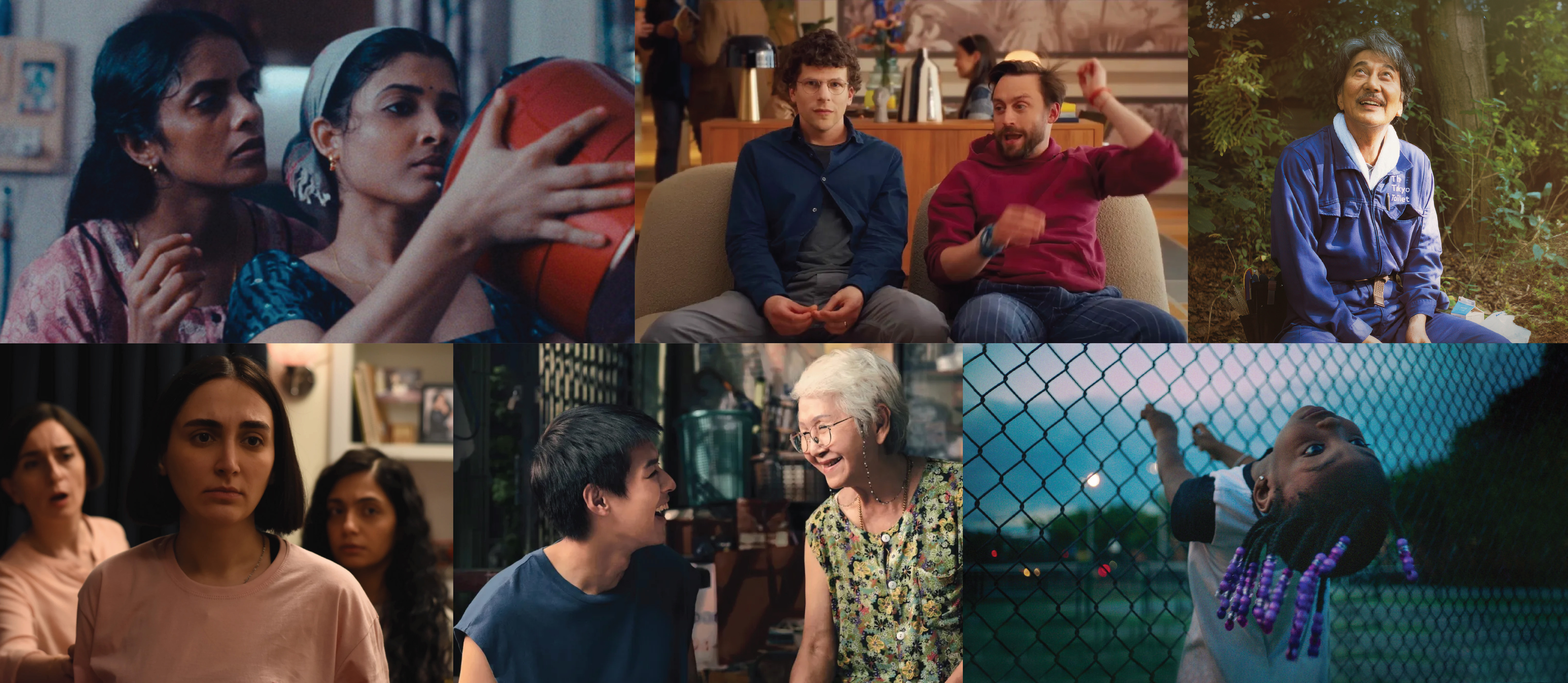
1. How to Make Millions Before Grandma Dies, dir. Pat Boonnitipat: From Thailand comes this tender story of a late teenage boy, M (Putthipong “Billkin” Assaratanakul), who quits his job as a video game streamer to become the live-in caretaker of his ailing amah (maternal grandmother) (Usha Seamkhum) in the hopes of inheriting her house when she dies. While initially motivated by self-interest, M develops genuine affection and gratitude for his grandma the more time he spends with her—getting up early with her each morning to make and sell congee at the street market, bringing her to the temple to pray, sitting with her during chemotherapy sessions (one of the most moving scenes is when he picks off the loose hairs she’s been shedding, one by one, from her sweater while she rests in her chemo chair). The balance of humor—conveyed especially through Amah’s feistiness—and sadness—loneliness, familial hurt and estrangement, terminal illness—is deftly handled and the emotional climax well earned.
2. Daughters, dir. Angela Patton and Natalie Rae. Pursuing the initiative of a group of young Black girls at Camp Diva Leadership Academy (now merged with Girls For A Change), Virginia-based community activist Angela Patton has helped organize a series of daddy-daughter dances in US prisons, a chance for K–12 girls to connect in person and make memories with their incarcerated fathers. This documentary captures one of those dances from 2019, following Aubrey, Santana, Raziah, and Ja’Ana over the course of eight years—before, during, and after the event. These girls and their fathers speak their sorrows, fears, insights, disappointments, and hopes, shedding light on the impact of parental incarceration and especially the rise, since 2014, of no-touch and even screen-only prison visits.
I appreciate that the film shows the complexity of the father-daughter bond, avoiding a simplistic portrait of that bond as either wholly resilient or frankly unmendable. The dance is not a triumph for all participants. While all at least have a desire to show up for each other, forgiveness and trust don’t always come easily. Nor does conversation, when you’ve been separated from someone for so long and barely know them.
Surely a contender for scene of the year is when the girls come down the hallway in their dresses, hand in hand and proud but nervous, to greet their fathers, who sit in a row of folding chairs in borrowed suits and ties. The men’s reactions are precious.
Streaming on Netflix.
3. Dìdi, dir. Sean Wang. Dìdi means “little brother” in Mandarin, and Chinese parents also use the term as an endearment for their younger sons. In this semiautobiographical dramedy from writer-director Sean Wang, it references the lead character Chris (Izaac Wang), a thirteen-year-old Taiwanese American boy growing up in Fremont, California. It’s 2008, the summer before high school, and all the awkwardness and anxieties of adolescent boyhood are upon him. He’s trying to fit in with a skater crowd and to figure out how to flirt with girls, and he’s navigating turbulent relationships with his mom (Joan Chen), who he feels is ashamed of him, and his sister (Shirley Chen), his only sibling, who’s getting ready to leave for college. Also living in the house is his nai nai (paternal grandmother) (Zhang Li Hua), played by Sean Wang’s actual grandma. The film is cringey in all the right ways, capturing that pubescent period we’ve all gone through of insecurity, immaturity, pressure, and desperation. Izaac Wang’s is one of my favorite performances of the year, especially for the vulnerability he lets us see in his character.
Streaming on Peacock.
4. Perfect Days, dir. Wim Wenders. This serene drama contains little plot, dialogue, or conflict and yet is absorbing to watch. It’s built around the daily routine of Hirayama (Kôji Yakusho), a custodial worker in Tokyo whose job is to clean public toilets. We watch him wake up, fold his bedding, water his plants, brush his teeth, put on his royal blue jumpsuit, and walk outside to greet a new day. He sanitizes toilet bowls, sweeps floors, and wipes mirrors, taking great pride and care in his work. He occasionally pauses to appreciate moments of beauty: children playing in the park, leaves glimmering in sunlight. He eats dinner at a restaurant where he’s friends with the proprietor. Then he reads at home by lamplight before falling asleep. His is a quiet life and a full one. His attentiveness and gratitude call us to the same.
Streaming on Hulu.
5. Sing Sing, dir. Greg Kwedar.Rehabilitation Through the Arts (RTA) is a program at New York’s Sing Sing Correctional Facility in which professional teaching artists lead year-round workshops inside the prison in theater, dance, music, creative writing, and visual arts. The drama Sing Sing spotlights the acting troupe as they put on a production of Breakin’ the Mummy’s Code, a time-traveling epic they helped come up with that involves an Egyptian prince, gladiators, pirates, cowboys, Robin Hood, and Hamlet. Starring Colman Domingo as the real-life John “Divine G” Whitfield (who was a founding member of RTA and who makes a cameo appearance), Clarence “Divine Eye” Maclin as himself, and an ensemble cast of other formerly incarcerated RTA participants, the film celebrates the transformative, therapeutic power of the arts, as the men find vulnerability, agency, creativity, confidence, connection, and release. It’s a real heart-warmer!
6.Nickel Boys, dir. RaMell Ross. Based on the Pulitzer Prize–winning novel by Colson Whitehead, this lyrical film is set in the Jim Crow era primarily at Nickel Academy, a state-run juvenile “reform school” (essentially a prison farm) in Florida, inspired by the real-life Dozier School for Boys that operated from 1900 to 2011, where hundreds of students were subjected to forced labor and physical and/or sexual abuse. The remains of several dozen boys have recently been unearthed from unmarked graves on the school grounds, many presumed to be victims of excessive punishment.
Nickel Boys centers on Elwood (Ethan Herisse), a high-achieving high schooler who gets sent to Nickel after hitching a ride in, unbeknown to him, a stolen car. There he becomes friends with Turner (Brandon Wilson). Despite the harrowing backdrop of their relationship, the boys share moments of leisure and joy, and for any violence that occurs, the director made the deliberate choice to portray it offscreen.
The film is shot almost entirely in double first-person POV, switching between the perspectives of Elwood and Turner. I had heard this beforehand and was skeptical that it would work for an entire movie, worried that it might come across as gimmicky, but on the contrary, it worked beautifully. I was mesmerized by the compositional poetics from the very beginning, by how the use of what the director calls “sentient perspective” allows us to get inside moments in a new way. (Shout-out to cinematographer Jomo Fray for, alongside director RaMell Ross, developing and executing such an evocative visual language; for an enthusiastic, in-depth conversation Fray has on his process, approach, and choices for the film, see here.) Before we meet Turner, a decade-plus earlier in the timeline, we see young Elwood’s face only in reflections—in the chrome plating of his grandma’s iron as he watches her do house chores, or through a window display of televisions that are broadcasting King’s “Our God Is Marching On” speech, before which Elwood stands transfixed. Then later we get to see him through Turner’s eyes. That characters look straight into the camera when they address the two mains creates an atypical intimacy and directness.
7. The Seed of the Sacred Fig, dir. Mohammad Rasoulof: Shot in secret and smuggled out of Iran, this thriller is about a family of four in Tehran who become increasingly divided as the Woman, Life, Freedom movement takes hold in 2022, demanding the end of compulsory hijab laws and other forms of oppression against women. Because the protest and crackdown scenes could not be re-created without attracting scrutiny, the director spliced in documentary footage that had been captured on various anonymous cellphones, some of which, I’ll warn, graphicly depicts police brutality and its aftermath.
In the film, the head of household, Iman (Missagh Zareh), works as an investigator in the country’s Islamic Revolutionary Court, signing death warrants against those who have violated sharia law, much to the chagrin of his daughters, Rezvan (Mahsa Rostami) and Sana (Setareh Maleki), who sympathize with the antigovernment protestors. Their mom, Najmeh (Soheila Golestani), tries to run interference between them and Iman and maintain normalcy, tradition, and respect in the home. But when Iman’s gun goes missing, chaos ensues; he becomes increasingly paranoid and unhinged.
Writer-director Mohammad Rasoulof has served jailtime before for his criticism of the Iranian government, and to avoid his latest eight-year prison sentence, he escaped the country illegally in 2024 and currently resides in self-exile in Berlin.
8. A Real Pain, dir. Jesse Eisenberg. After the recent death of their grandmother, a Holocaust survivor, two Jewish American cousins embark on a tour of Poland to visit her childhood home and connect with their heritage. David (Jesse Eisenberg) is straitlaced, shy, and anxious, whereas Benji (Kieran Culkin) is loud, uninhibited, fly-by-the-seat-of-his-pants, devil-may-care. This clash of personalities makes for a funny film, but we also come to see that behind Benji’s bluster there is, as the title gestures toward, “a real pain.” (The more frivolous meaning, of course, is that Benji is exasperating!) Both comedic and serious, the film succeeds in pulling off its dual tone while exploring relational dynamics and different ways of dealing with pain and trauma.
Streaming on Hulu.
9. All We Imagine as Light, dir. Payal Kapadia. Prabha (Kani Kusruti) and Anu (Divya Prabha) live together as apartment mates in multicultural Mumbai and work as hospital nurses. Prabha’s husband lives in Germany and rarely communicates with her, and Anu is dating a young Muslim man, against her Hindu parents’ wishes. When their friend Parvaty (Chhaya Kadam) becomes widowed, she is evicted from her shantytown, and they help her move back to her home village by the sea. The film is about sisterhood and longing—about these three women of different ages each pursuing a light-filled future in their own way.
10.Nowhere Special, dir. Uberto Pasolini. This warm, affectionate, tragic film set in Belfast was inspired by a newspaper headline: “Father dying of cancer spent his final months finding family for son.” When John (James Norton), a single dad who’s thirty-three, is diagnosed with brain cancer, he starts looking for a home for his four-year-old boy, Michael (Daniel Lamont). He partners with social workers to interview potential parents and tries to prepare Michael for what’s coming. A dead beetle in the park becomes an opportunity to teach him about death.
A premise like this could easily become over-the-top sentimental, but much to the film’s credit, and owing in part to the contained performances of the two leads, it does not. There’s both a sweetness and a sadness to it, as we watch father and son build ordinary memories before their imminent separation: they take naps together, wash their respective vehicles, enjoy ice cream cones in the park, watch dump trucks in action. As John becomes progressively weaker, Michael notices: he observes how his dad now needs to use two hands to pour a cup of OJ; he sees him wincing in pain when he thinks he’s not looking. Despite the heartbreaking scenario, the film is ultimately hopeful.
CALL FOR APPLICATIONS: 2025 Artist Residency at Village Church, Beaverton, Oregon: “Village Church is seeking an Artist in Residence for 11 months of 2025, February to December, to create a lasting, creative impact on the wider community and church. The artist will create original work, lead art showcases, inspire future generations, and use art as a bridge between the tech culture surrounding the church, with the spiritual and theological. This residency offers the chance to create art that reflects God’s beauty, promotes worship, and connects people in meaningful ways.”
Applicants must have a minimum of five years of experience. If chosen, you will receive a monthly stipend, free housing, and studio space and will have the cost of all art supplies covered. The pastor tells me that the original application deadline of January 15 is being extended.
+++
NEW(ISH) ALBUM: The Hymnal by Life in Grooveland: Released last April. From World Music Central: “Life in Grooveland’s The Hymnal reimagines traditional hymns with dynamic, world music-influenced rhythms, creating an album that brings together spirituality and groove. Produced and arranged by Nashville session drummer and percussionist Justin Amaral, this fascinating instrumental collection features ten exquisitely crafted duets presenting some of Nashville’s most talented and inventive musicians, including Jeff Coffin (Dave Matthews Band, Béla Fleck), Fats Kaplin (Mitski, Jack White), Paul Niehaus (Lambchop), and Billy Contreras (Ricky Skaggs). Amaral’s versatile drumming, which ranges from subtle to explosive, provides the backbone for each track, layering rhythm to amplify each hymn.” Thanks to blog reader Ted Olsen for bringing this to my attention!
+++
PODCAST EPISODE: “The Hillbilly Thomists: Bourbon, Bluegrass, and the Bible,”No Small Endeavor: I really enjoyed this! “There aren’t many Billboard-charting bluegrass bands made up entirely of Dominican friars, who play their shows clad in white tunics and rosaries. In fact, there is precisely one such band: the Hillbilly Thomists. ‘A Thomist is someone who follows the thought and theological teaching of Saint Thomas Aquinas,’ they explain. ‘We combine it with a little bit of humor about our human condition.’ In this episode, they talk about their theology and vocation, as well as how they manage life on the road as priests who have taken a vow of poverty. Plus, they give live performances of some of their finest songs.”
+++
NEW POEM: “Jesus, Son of Gop” by Sarah M. Wells: Exposing the ridiculousness of followers of the nonviolent Christ sanctioning violence, this satirical poem is a response to a politician’s egregious misappropriation of the apostle Paul’s “armor of God” language. It’s an alternate history that rewrites how Jesus’s arrest in the garden went down. Listen to Wells discuss the poem on The Reformed Journal Podcast.
+++
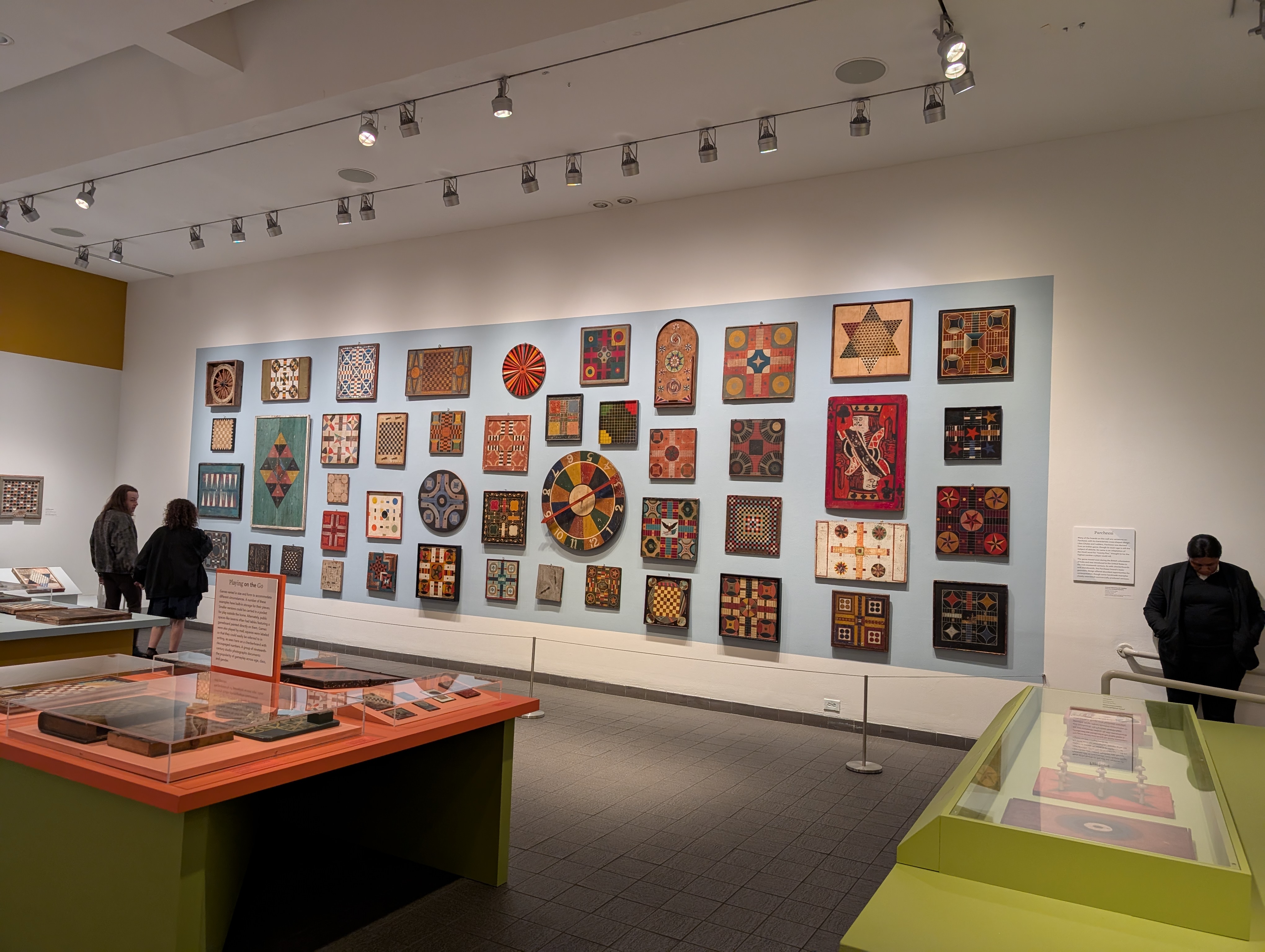
EXHIBITION: Playing with Design: Gameboards, Art, and Culture, September 13, 2024–January 26, 2025, American Folk Art Museum, New York City: I saw this show last weekend and was absolutely delighted by it! Curated by Emelie Gevalt with Austin Losada, it features over one hundred handmade gameboards, mostly nineteenth century, from the exuberant collection of Bruce and Doranna Wendel. Many are of familiar games I used to play as a child—Parcheesi (which I learned originated in India, its name an adaptation of the Hindi word for “twenty-five”), checkers, Chutes and Ladders—and others are creative variations on the typical racing board game. There is also a fortune-telling game, in the vein of the Magic 8 Ball! The objects on display—hand-carved and hand-painted and from the imaginations of common folk—are interesting both culturally and aesthetically.
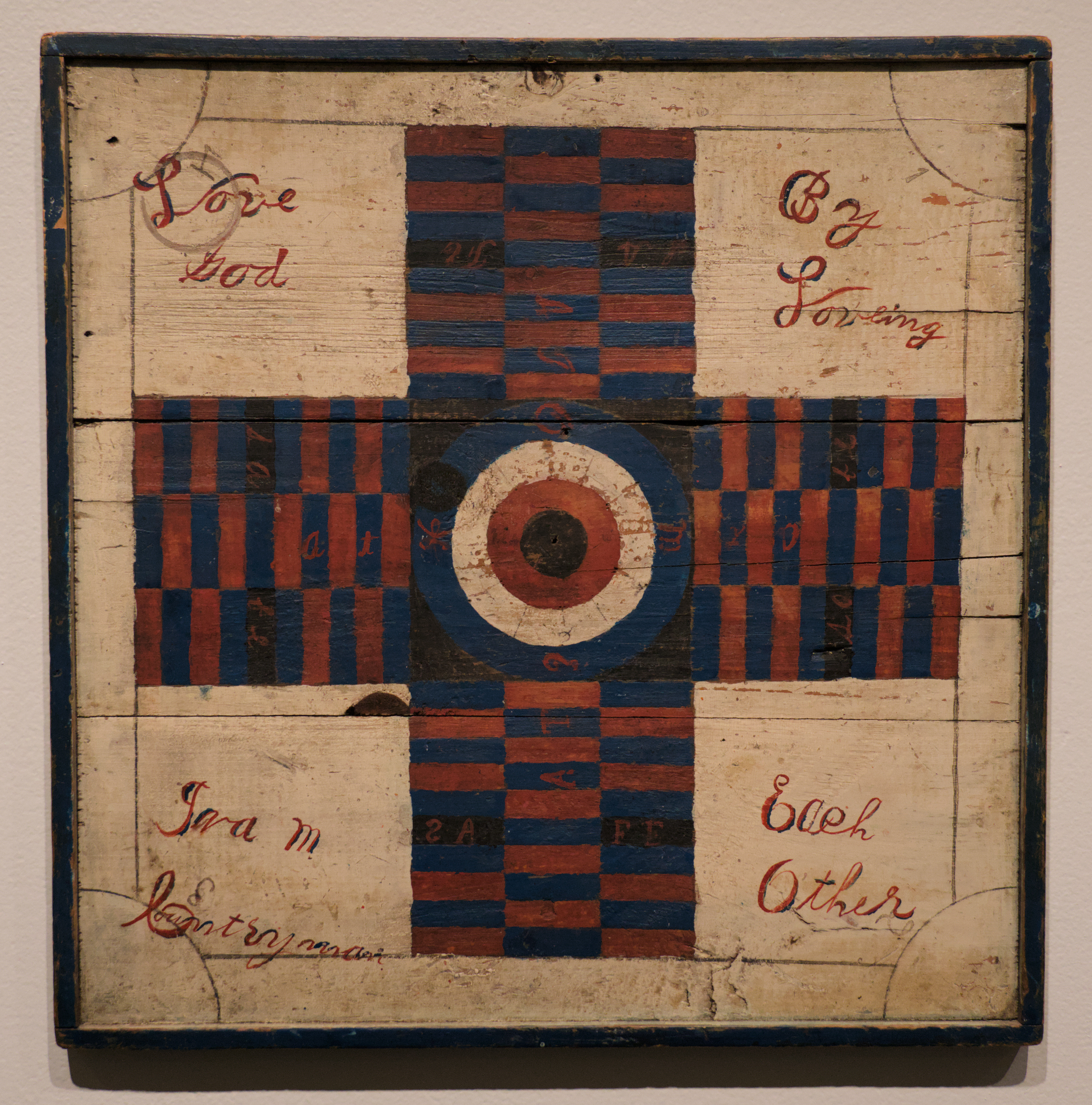
Two that made me chuckle contain religious references. “Gameplay, especially cards, was sometimes thought to encourage vice, in particular gambling or idleness,” the gallery label reads. So board makers sometimes incorporated spiritual aphorisms or precepts into the design to counteract the corrupting influence and remind players to uphold Christian virtues even in moments of leisure. A Parcheesi board instructs players to “Love God by loving each other”—and I can’t make out what the Chinese checkers board says, other than “The Lord . . . your . . . God . . .”
Possibly Ira M. Countryman or Jimmy Hall, Parcheesi Board, late 19th century. Paint on wood, 21 × 21 in. American Folk Art Museum, Gift of Doranna and Bruce Wendel, 2024.7.3. Photo: Victoria Emily Jones.Possibly George Clark, Chinese Checkers Board, late 19th or early 20th century. Paint on wood, 17 1/2 × 15 in. Collection of Doranna and Bruce Wendel. Photo: Victoria Emily Jones.
The American Folk Art Museum is one of the few FREE museums in New York, and I’ve enjoyed it so much every time I’ve been there. (See the blog post “The biblical imagination of folk sculptor Annie Hooper,” documenting one of my previous visits.) It’s small—only three galleries. It’s on the Upper West Side of Manhattan, right off the Lincoln Center subway stop.
+++
Interested to see what books I read in 2024? Goodreads has put together a “My Year in Books” page! Follow me on Goodreads if you want to stay apprised of my latest reads, want-to-reads, and star ratings.
From the compilation album To: Kate—A Benefit for Kate’s Sake, sung with Allison Moorer, 2005:
Once upon a time in a far-off land Wise men saw a sign and set out across the sand Songs of praise to sing, they traveled day and night And precious gifts to bring, guided by the light
They chased a brand-new star, ever towards the west Across the mountains far, but when they came to rest They scarce believed their eyes, they’d come so many miles And this miracle they prized was nothing but a child
Refrain: And nothing but a child could wash those tears away Or guide a weary world into the light of day And nothing but a child could help erase those miles So once again we all can be children for a while
Now all around the world, in every little town Every day is heard a precious little sound And every mother kind and every father proud Looks down in awe to find another chance allowed [Refrain]
Outro: Nothing but a little baby Nothing but a child
This is the final post in my 2024/25 Advent–Christmas series. Thanks for journeying with me! If you feel so led, please consider donating; I’ve been having trouble with the embedded Stripe form often rejecting credit cards and then WordPress disabling it (do any of you know of a secure but reliable credit card processor that does not require donors to make an account and that integrates well with WordPress?), but PayPal and Amazon are still options.
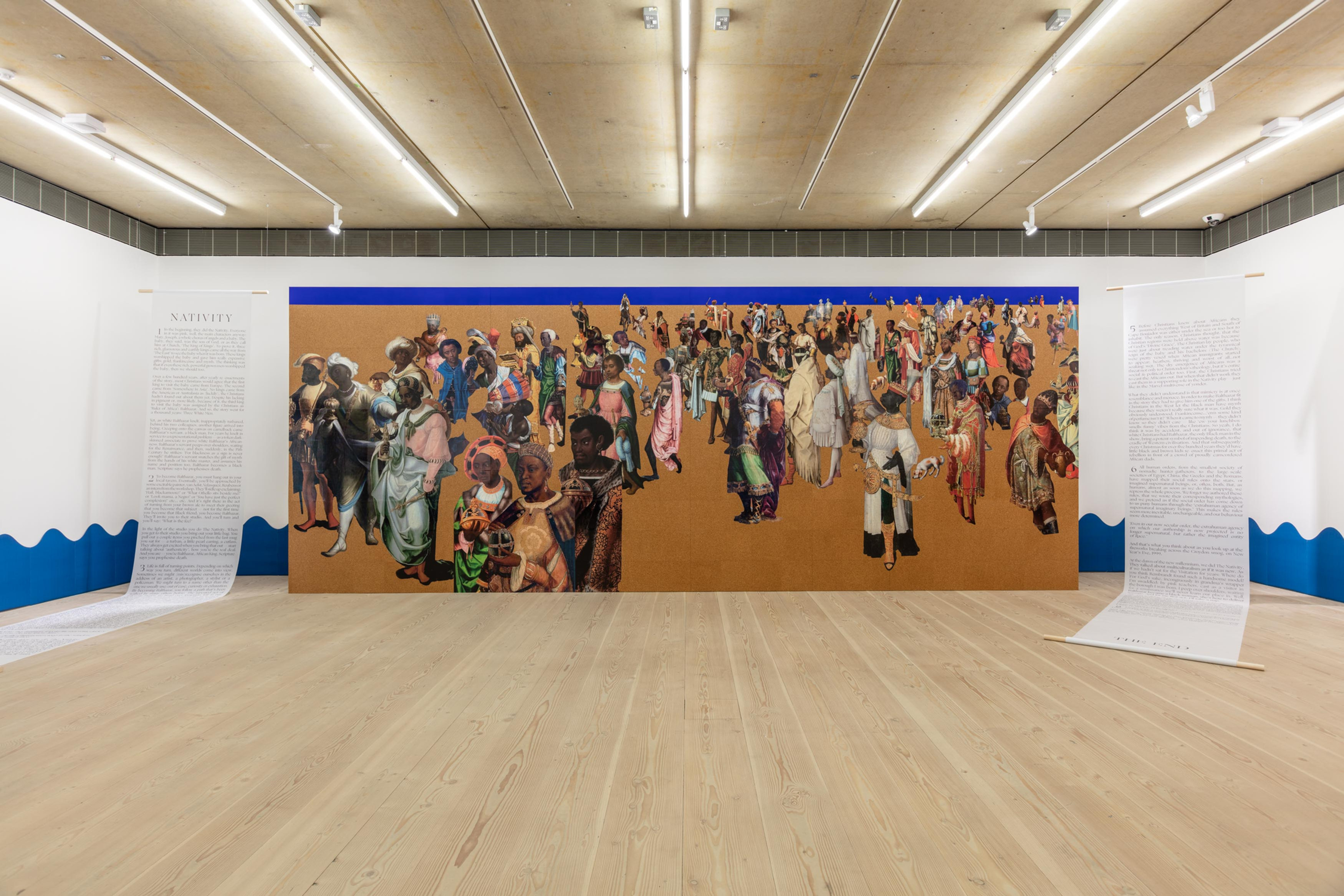
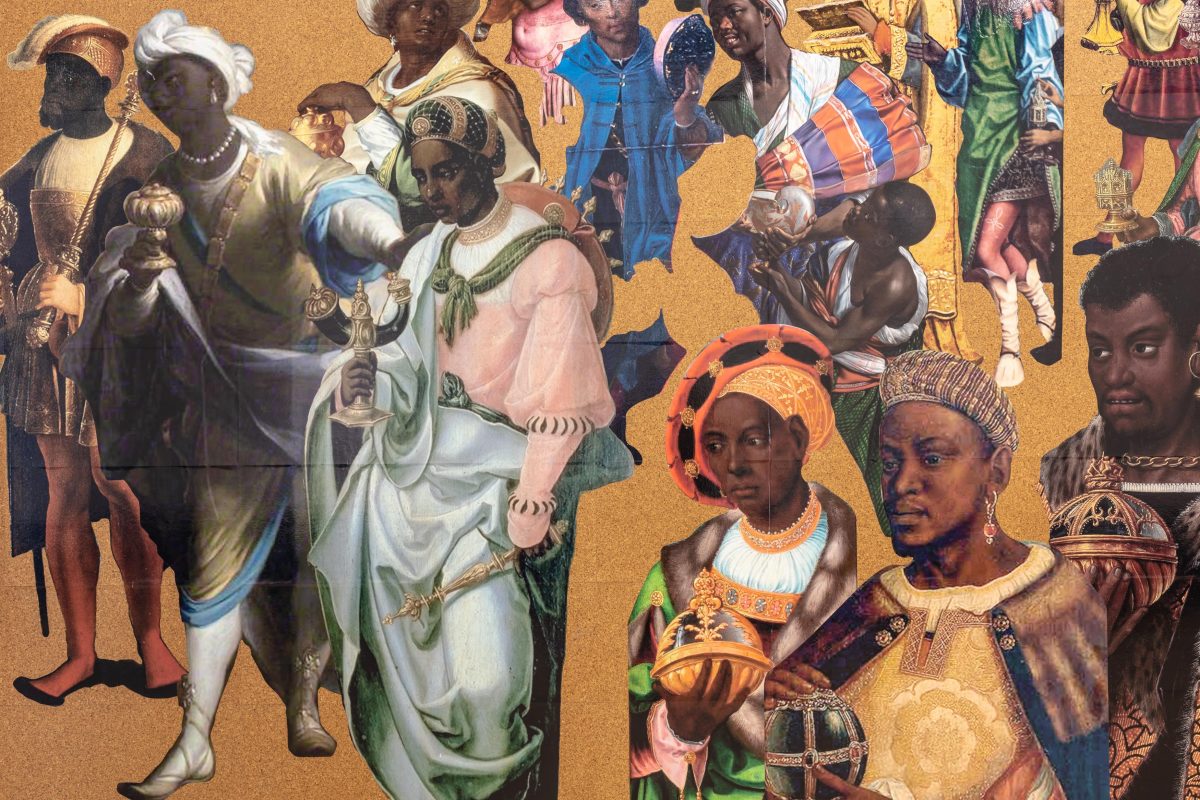
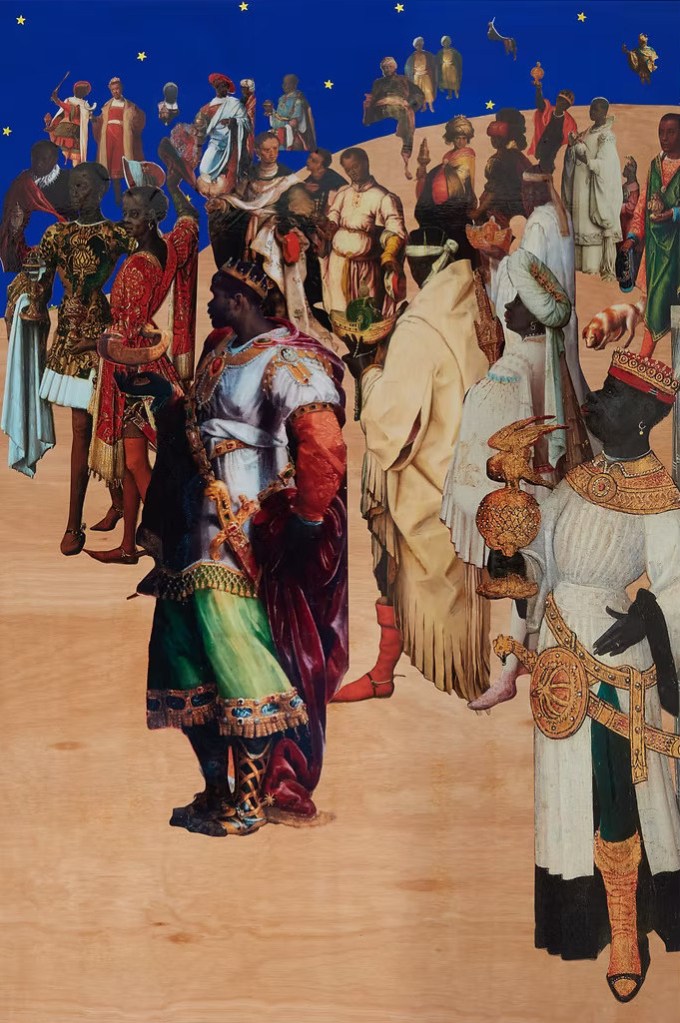
Rosa-Johan Uddoh (British, 1993–), Breaking Point, 2021. Billboard-style collage. Photo: Anna Lukala, from Practice Makes Perfect, Focal Point Gallery, Southend-on-Sea, England, May 18–August 28, 2021.Rosa-Johan Uddoh, Breaking Point (detail)
Rosa-Johan Uddoh is an interdisciplinary artist based in London who, “through performance, writing and multimedia installation, . . . explores places, objects and celebrities in British popular culture, and their effects on self-formation,” she writes on her website.
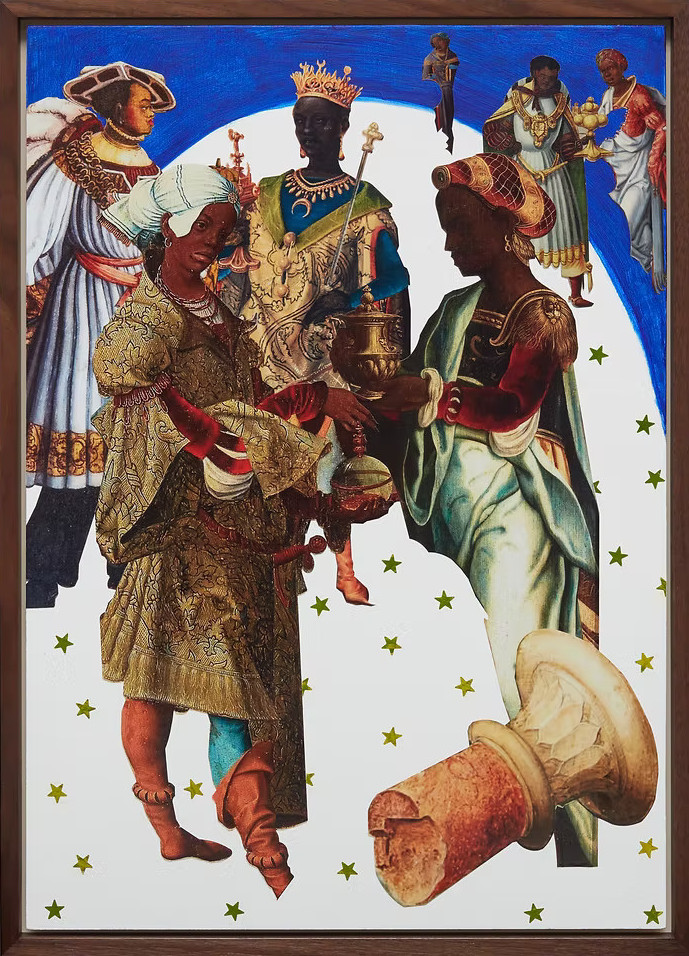
In her first institutional solo show, Practice Makes Perfect at Focal Point Gallery in Southend-on-Sea, she explored how the white European imagination constructed Blackness through the figure of Balthazar, who according to Christian tradition was one of the three magi who visited the infant Jesus, offering him the gift of myrrh. Since the fifteenth century Balthazar has typically been depicted as Black, as it was imagined that he came from Africa (whereas the other two magi were supposedly from Europe and Asia, the three known continents at the time). Uddoh notes that Balthazar is one of the first Black people of importance that British schoolchildren encounter, and in fact the first public performance she ever gave was as Balthazar in a primary-school Nativity play, a role she had been cast in by her teacher.
The centerpiece of the Practice Makes Perfect exhibition was Breaking Point, a billboard-sized mural that depicts 150 Black Balthazars extracted from European paintings from the late Middle Ages onward and rearranged into friendship groups. These groupings “allow Balthazar to escape the isolation associated with being the only Black character of importance in Christian iconography whilst also highlighting that the Black figures behind the artistic imagery were real sitters, which is also a testament to early African immigration into Europe, a phenomenon often overlooked in mainstream history.”
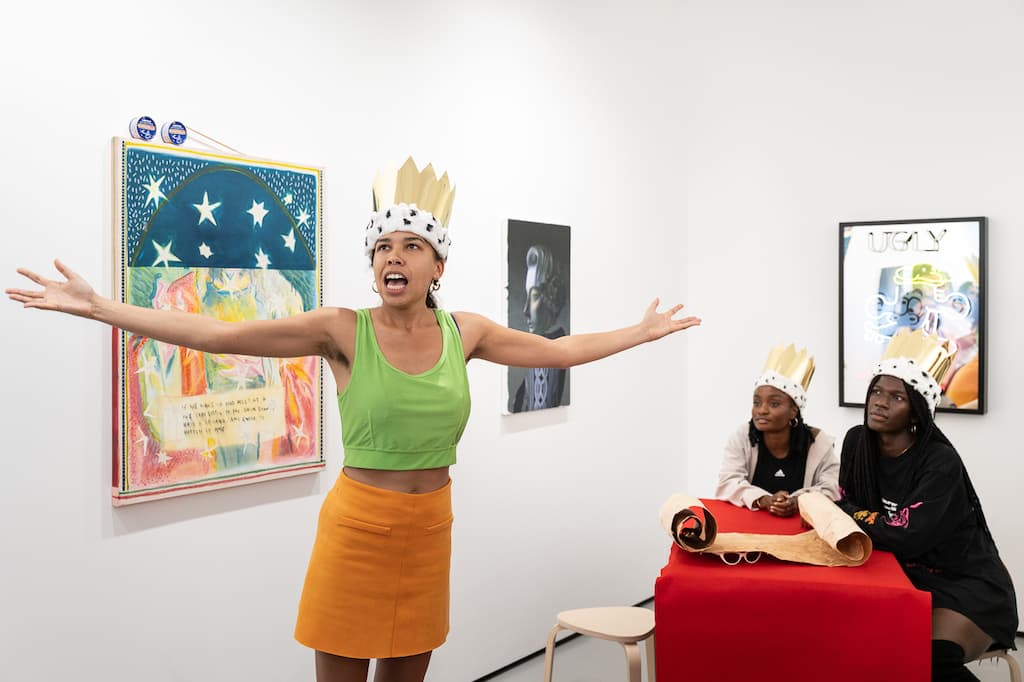
Installed on either side of Breaking Point was a scroll bearing a piece of experimental writing by Uddoh, titled Nativity. (She later performed this text in 2022 at the London art gallery Workplace, with Adeola Yemitan and Ebunoluwa Sodipo.) It opens, “In the beginning, they did the Nativity. Everyone in it was pink; well, the main characters anyway . . .”
Nativity, 2022, performance by Rose-Johan Uddoh with Adeola Yemitan and Ebunoluwa Sodipo at Workplace, London. Photo: Damian Griffiths.
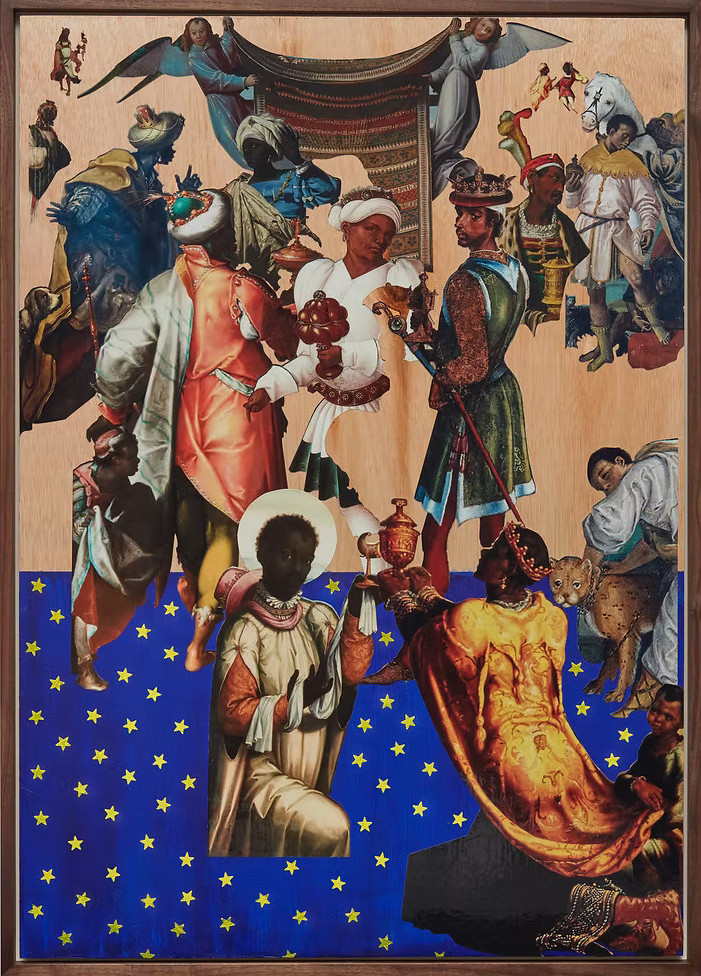
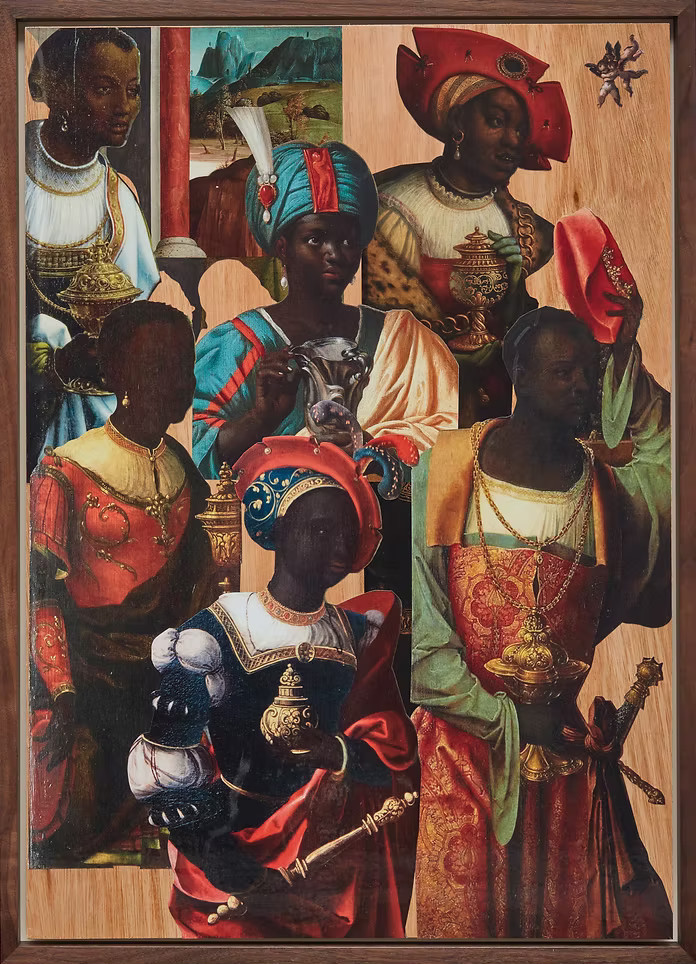
In 2022 Uddoh expanded this body of work with another solo show, Star Power at Workplace. It featured the series You Can Go Ahead and Talk Straight to Me and I Sell the Shadow to Support the Substance (scroll through select images below), the artworks made of acrylic and vinyl on board. The former title is a quote from Toni Morrison’s 1975 speech “A Humanist View,” given at Portland State University as part of a public forum on the theme of the American Dream. The latter is a quote from Sojourner Truth—she wrote the phrase on the bottom of a self-portrait she took, selling copies of it across America to raise funds for her abolitionist activism.
Lastly, here’s an amusing collage from Practice Makes Perfect:
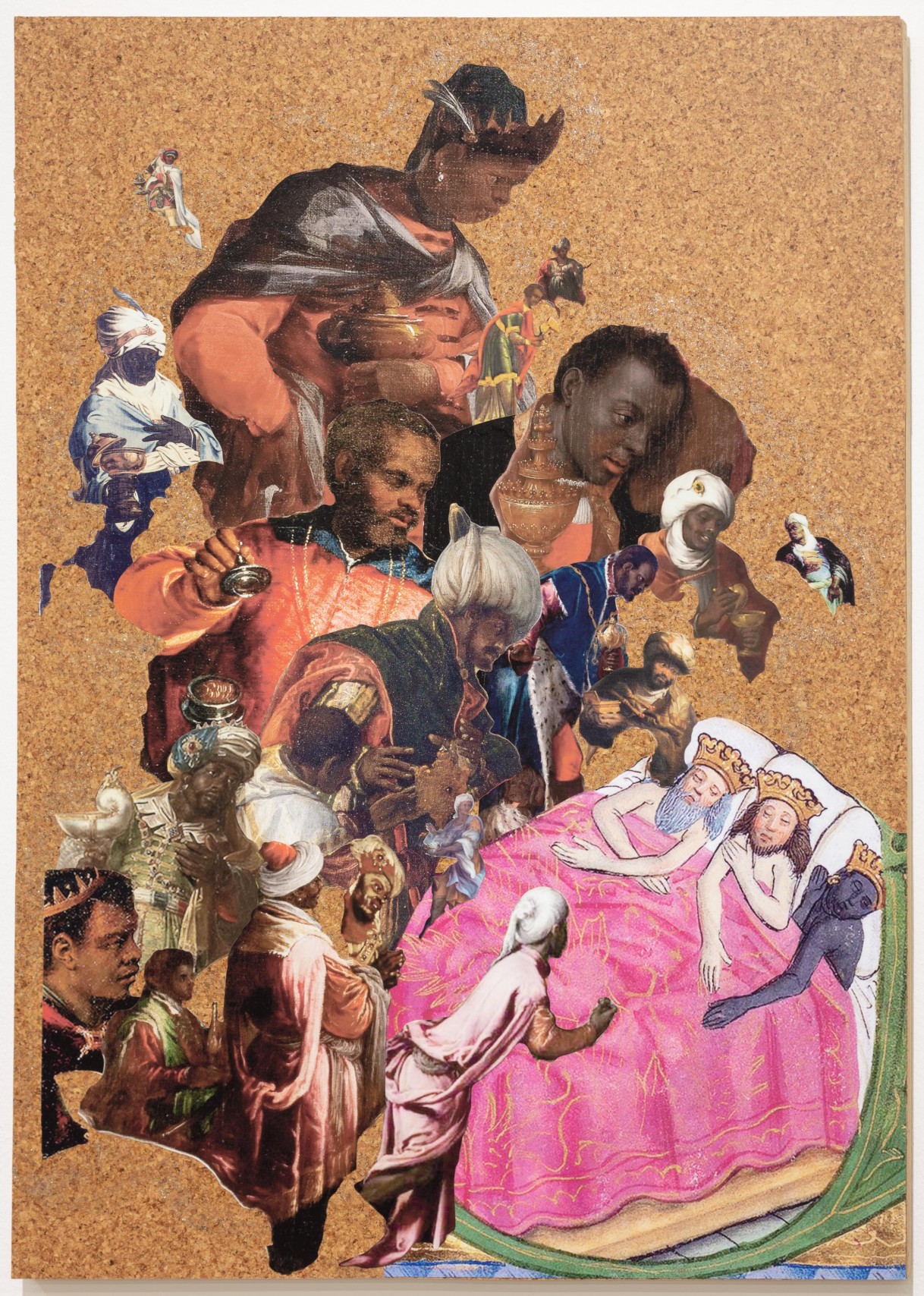
Rosa-Johan Uddoh, Get up mate, we’re going to the protest, 2021
The image of the three kings in bed is taken from the ca. 1480 Salzburg Missal. (In the original they’re inside an initial E, which introduces the text for the introit for the Feast of the Epiphany, “Ecce advenit dominator Dominus.”) In the Middle Ages it was common for artists to depict the magi in bed together when they receive the angelic warning not to reveal the location of the baby Jesus to King Herod, who intends to harm him (Matt. 2:12). There’s nothing sexual about it—it’s just a compositional practicality, to show the three men in one space, having the same dream at the same time.
In Uddoh’s playful remix, she has a slew of Balthazars leaning over the bed to wake up their sleeping comrade so that he can join them in a protest for racial justice.
LISTEN: The Ballad of the Brown King by Margaret Bonds, 1954, rev. 1960 | Words by Langston Hughes, 1954/60 | Arranged by Malcolm J. Merriweather for strings, harp, and organ, 2018 | Performed by the Dessoff Choirs and Orchestra, dir. Malcolm J. Merriweather, on Margaret Bonds: The Ballad of the Brown King and Selected Songs, 2019 (soloists: Laquita Mitchell, soprano; Noah Stewart, tenor; Lucia Bradford, mezzo-soprano; Ashley Jackson, harpist)
I encourage you to listen to all nine movements! (The piece is twenty-five minutes long.) But if you want just a taste for now, here are two selections: movements 1 and 7.
I. Of the Three Wise Men
Of the three wise men who came to the King One was a brown man, so they sing Alleluia, Alleluia
Of the three wise men who followed the star One was a brown king from afar Alleluia, Alleluia
. . .
VII. Oh, Sing of the King Who Was Tall and Brown
Oh sing of the king who was tall and brown Crossing the desert from a distant town Crossing the desert on a caravan His gifts to bring from a distant land His gifts to bring from a palm tree land Across the sand by caravan With a single star to guide his way to Bethlehem To Bethlehem where the Christ child lay
Oh sing of the king who was tall and brown And the other kings that this king found Who came to put their presents down In a lowly manger in Bethlehem town Where the King of kings a babe was found The King of kings a babe was found Three kings who came to the King of kings And one was tall and brown
Margaret Bonds (1913–1972) was an African American composer, pianist, arranger, and teacher, best remembered for her popular arrangements of African American spirituals and her frequent collaborations with her friend Langston Hughes, especially the cantata The Ballad of the Brown King.
Dedicated to Rev. Dr. Martin Luther King Jr., The Ballad of the Brown King honors the African king Balthazar of Christian tradition, a figure extrapolated from the Gospel of Matthew’s account of the “wise men from the east” who came to worship the Christ child and bestow gifts. Bonds wanted to celebrate the wisdom and devotion of this dark-skinned brother, and his active presence at the Nativity, giving “the dark youth of America a cantata which makes them proud to sing,” she wrote in a letter.
She commissioned Hughes to write the libretto. She wrote to him, “It is a great mission to tell Negroes how great they are.” Remember, this was at the burgeoning of the civil rights movement. There were very few images of Black wealth and admirability being projected by mainstream culture at the time. Balthazar was an exception.
Regardless of the racial accuracy, this narrative [of an African king participating in the story of Christ’s birth] gives African Americans a positive image rarely portrayed in history, books, and art. A brown sovereign, traveling in majesty and splendor? It is unheard of. African Americans are not just descendants of slaves; we come from great kings or queens that ruled kingdoms with sophisticated political and economic systems on the continent of Africa.
The initial version of The Ballad of the Brown King premiered in December 1954, but Bonds and Hughes later revised and expanded it. The new version premiered December 11, 1960, at the Clark Auditorium of the YWCA in New York, sung by the Westminster Choir of the Church of the Master. The concert was presented as a benefit for the Southern Christian Leadership Conference.
The cantata is made up of nine movements with parts for soprano, tenor, baritone, and choir. Stylistically, the work has been described as neo-Romantic, but it also draws on gospel, jazz, blues, and calypso traditions.
The only commercial recording ever made of it is the one released by Avie Records in 2019. Newly arranged by Malcolm J. Merriweather, the piece is performed there by the Dessoff Choirs and Orchestra under Merriweather’s direction.
Bonds had scored the cantata for full orchestra—brass, woodwinds, strings (including harp), and percussion. But because hiring an orchestra of that size is expensive and he wants to see this work more widely performed, including in church contexts, Merriweather arranged the piece for a pared-down ensemble of harp, strings, and organ, omitting the winds and brass (whose parts he essentially absorbed into the new organ part). He also enlivened the harp part to add texture.
For more context on Bonds and on this most popular cantata of hers, here’s a great thirty-minute conversation between John Banther and Evan Keeley from a 2022 episode of the Classical Breakdown podcast, produced by WETA Classical in Washington, DC:
BLOG POST: “On the Twelfth Day of Christmas: 12+ ways to keep celebrating with the rest of the world (loads of links!)” (Watch & Do for Twelfth Night and Epiphanytide) by Tamara Hill Murphy: In this blog post from 2019, spiritual director and writer Tamara Hill Murphy has compiled a wonderful roundup of resources for Twelfth Night (January 5) and the Feast of Epiphany (January 6), on such things as chalking the door, stargazing, making origami Christmas stars, baking a Three Kings Cake, Three Kings Day parades, Christmas tree bonfires, and more. She shares several videos, including this one of Denis Adide reading “The Journey of the Magi” by T. S. Eliot, shot in locations around Bristol:
I really love this unique rendition, which, with all its dissonance, is different from all the others I’m familiar with. James Johnson, one of the YouTube commenters on the video, writes: “I think this rendition is transporting. Listen to it. Close your eyes and you can feel the hot dry wind of the desert blowing in your face. You may wonder why make this trip at all, and then, that star. That amazing star. Yep, we can make it past a few more dunes, beyond Herod, and on to . . . ‘a manger’? And the rhythm section just pushes me on. . . . This earthly trinity, Melchior, Caspar, and Balthazar, are the hippest trio in Jerusalem and I want to go where they go, know what they know.”
This performance appears on the orchestra’s live album Big Band Holidays (2015) [previously].
+++
NEW ARTWORK: Christmas in the Air Raid Shelter by Olya Kravchenko: For Christmas 2024, with Russia still deploying cruise missiles and suicide drones against Ukraine, Ukrainian iconographer Olya Kravchenko constructed a three-dimensional painting that shows the Holy Family huddled in the basement of an apartment complex, hiding out from air raids. A large, bright star hovers overhead, showing the three magi to the spot where Jesus lies.
Olya Kravchenko (Ukrainian, 1985–), Christmas in the Air Raid Shelter, 2024. Plywood, tempera, and gilding, 67 × 40 × 25 cm.
This piece can be seen through January 26 at the eighty-fourth annual Krippenausstellung (Nativity Scene) exhibition at RELiGIO: Westfälisches Museum für religiöse Kultur (Westphalian Museum of Religious Culture) in Telgte, Germany, whose theme is “Heller Stern” (Bright Star).
+++
SONG: “Magi, Kings of Persia” by Michael Adamis, from the suite 4 Christmas Idiomela: Performed by Cappella Romana under the direction of Alexander Lingas, this choral piece by the Greek composer Michael Adamis (1929–2013) is a setting of an Eastern Orthodox liturgical text for Christmas that translates to:
The magi, kings of Persia, manifestly recognizing the King of heaven who was born on earth, arrived in Bethlehem, led by the radiant star, bearing choice gifts of gold, frankincense and myrrh; and falling down, they offered worship, for they beheld the Timeless One lying in the cave as a babe.
The video is from Cappella Romana’s 2020 Christmas concert.
+++
BLOG POST: “‘So glorious a gleam, over dale and down’” by Eleanor Parker: Medievalist Eleanor Parker shares two medieval English carols (text only; the original music does not survive) about the visit of the magi, a popular theme in that era. She translates them into modern English and provides commentary.
About 88 percent of the population of the Philippines is Christian—it’s the only Asian country where Christianity predominates—and Christmas is the most festive holiday of the year.
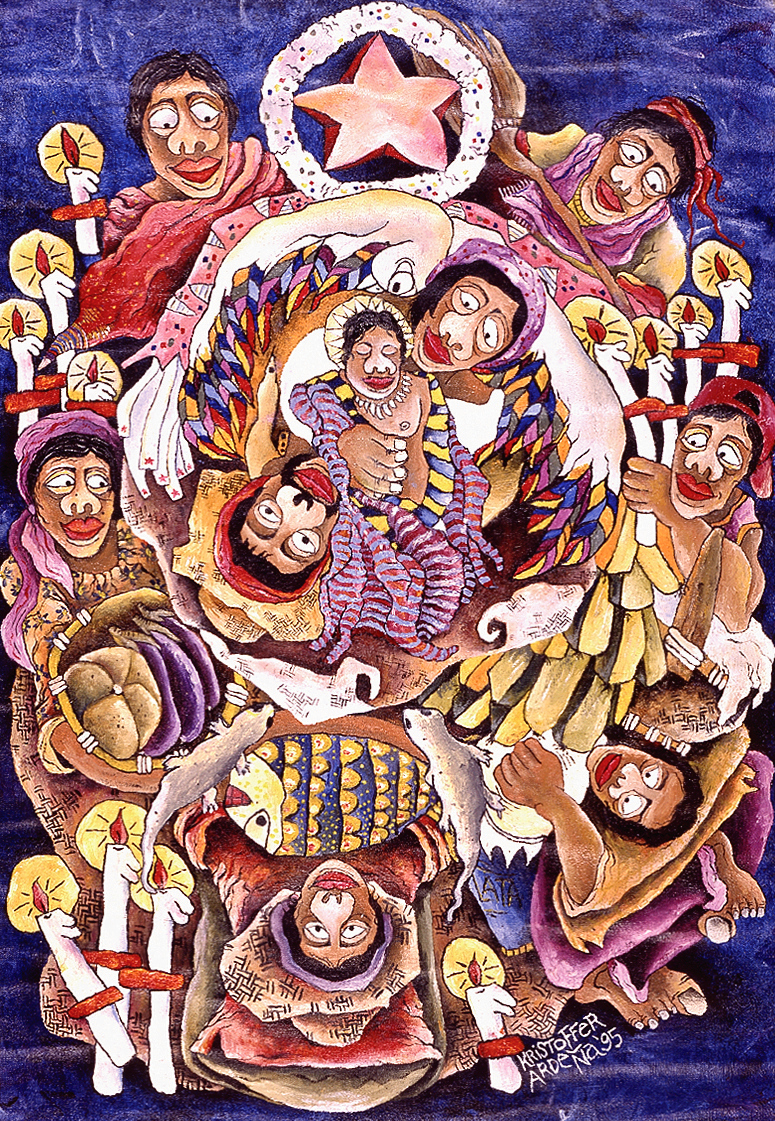
Filipino artist Kristoffer Ardeña celebrates the Christmas story and its ongoing impact in his painting Ang Kahulugan ng Pasko, which translates to “The Meaning of Christmas.” He wrote the following extended statement about it for the December 1996 issue of Image: Christ and Art in Asia, a publication of the Asian Christian Art Association. From what I can tell, this organization is no longer active.
Christmas—what does it really mean to us? Parties, extravagant decorations, frivolous gifts and all those materialistic things—do they manifest the true meaning of Christmas?
Sometimes we get so used to celebrating Christmas that we forget the truth behind it. In my painting Ang Kahulugan ng Pasko I want to express what Christmas means to me and to the ordinary people whom we hardly notice.
The Christmas lantern
The most popular Philippines Christmas symbol is the star lantern, or parol (see top of artwork). All that is needed to make a star lantern are ten long and five short bamboo sticks, string, starch and paper.
Although rice paper was traditionally used to cover the lantern, nowadays Japanese paper, foils or plastics are used and bulb lights have replaced the traditional candle inside the lantern.
The star lantern is a Filipino innovation of the Mexican piñata which was introduced to our country during the Spanish colonial period.
The five-pointed star lantern represents the star of Bethlehem. Stars produce the elements that make life possible, and in death they sow the seeds of new stars and planets across the heavens. The earth is built in part from the ashes of dead stars, and I think human beings are literally star children. We and all other life forms are collections of atoms forged in stellar furnaces.
It was through this star that the shepherds and the magi were guided, and it may well be the same star that calls us to remember and beckons us to search for the child in the manger—for he is the truth behind Christmas.
By living and dying, a star generates new worlds; the life and death of the infant that the star of Bethlehem symbolises created a new spiritual world.
The banig, or native handwoven mat
The banig is made from abacca, buri or other dried plant fibres woven together. Motifs and designs differ regionally. The banig is where gatherings happen. It is placed on the ground so that rituals, dialogues, recreation or mere eating sessions may occur. It calls us together, it draws us to gather.
The candles
The use of votive candles most probably came from the Roman practice of burning candles as a mark of respect to a person, and in this painting the candles symbolise respect for Christ. But there is more to a candle. It is believed that candles are also a form of prayer.
During fiestas and other holy occasions we offer candles, and we light candles during birthdays or when we visit our dear departed loved ones.
The bananas
During Christmas our front doors are adorned with three bunches of bananas still attached to their stalks. They are placed there during the Advent season and are not taken down before Epiphany. These bananas represent the Holy Family.
Whenever the visitors come to our home we offer them some of these bananas because we believe that these bananas have been blessed by God and that we should share His blessings with others.
I included these bananas as well as the star lantern in this painting because, just like my ancestors, I believe they add meaning to Christmas.
The people surrounding the Holy Family
(1) The northern tribesman of Luzon and the Metro Aide worker (the one who sweeps and keeps our streets clean). These two represent the people both near (the Metro Aide worker) and far (the tribesman) who have been guided by the star to bear witness to the birth of Jesus, just as the shepherds were led to the manger to pay homage to the king.
I chose the Metro Aide worker because I feel that we get used to his presence when he cleans our streets and we hardly take notice of him or thank him for what he does; yet here he is with his broom, giving praise and thanks.
(2) The fisherman, the vegetable vendor and the balut (duck egg) vendor. The Magi brought gold, incense and myrrh, and here are the fisherman with his best catch, the vegetable vendor with her freshest and best vegetables and the balut vendor with the best duck eggs to offer Jesus.
I placed these people in the painting rather than the rich and extravagantly dressed because I believe that Christmas is universal and for everybody. It is not only for the rich but for the modest poor people as well.
The offering we give to Jesus is not merely an act of human generosity; it is a religious act. It is an act which is sacramental and sacrificial. We have worked on these gifts, and we bring them to Jesus and offer them and offer ourselves.
(3) The comanchero. He is the “marine” of Christmas, the first to welcome and the last to go. He is the caroller. He sings and plays his instruments to the tune of Christmas songs to announce Christmas.
He uses ethnic as well as indigenous instruments—tambourines made of beer bottle caps, drums made of cans and cloth, maracas made of coconut shell with mango seeds inside. Just as the vendors offer their goods, he offers his songs to Jesus.
The dove and house lizards
Just as there were cows, horses and many farm animals, the dove and house lizards in this painting represent more than that. They are there to bear witness to this glorious event. The dove, which is the universal symbol of peace, unveils yet embraces the Holy Family.
With regard to the house lizards, I adhere to the superstition that every day at six in the evening they come down from the ceiling to kiss the floor in reverence to God. This belief tells me that we human beings, stewards of God’s creation, must do more than that.
La Sagrada Familia (The Holy Family)
In this painting I represented Joseph as a farmer and Mary as his wife. Jesus is wrapped in striped layette cloth distinctive to the Igorot tribe of Luzon, and as a sign of kingship he wears a necklace made of animal bones, which is characteristic of an Igorot chieftain.
LISTEN: “Ang Pasko Ay Sumapit” (Christmas Has Arrived) | Tagalog words by Levi Celerio, 1950, based loosely on a 1933 Cebuano carol text, “Kasadya Ning Takna-a,” by Mariano Vestil | Music by Vicente Rubi, 1933 | Performed by the Bayanihan Philippine Dance Company on A Philippine Christmas, 1964, reissued 1991
Ang Pasko ay sumapit
Tayo ay mangagsiawit
Ng magagandáng himig
Dahil sa ang Diyos ay pag-ibig

Nang si Kristo’y isilang
May tatlóng haring nagsidalaw
At ang bawat isá ay nagsipaghandóg
Ng tanging alay

Koro:
Bagong Taón ay magbagong-buhay
Nang lumigayà ang ating Bayan
Tayo'y magsikap upang makamtán
Natin ang kasaganaan!

Tayo’y mangagsiawit
Habang ang mundó'y tahimik
Ang araw ay sumapit
Ng Sanggól na dulot ng langit

Tayo ay magmahalan
Ating sundín ang Gintóng Aral
At magbuhát ngayon
Kahit hindî Paskô ay magbigayan!
Christmas has come
Come, let us go forth singing
Beautiful hymns
For God is love

When Christ was born
There were three kings who did visit
And each one did present
A unique offering

Refrain:
’Tis New Year, so we must reform our lives
That our nation might be joyful
Let us strive that we might achieve
Prosperity

Come, let us go forth singing
While the world is silent
The day has arrived
Of the Infant sent from heaven

Let us love one another
May we follow the Golden Rule
And from now on
Though it not be Christmas, let us keep giving [source]
I really like the recording above, which has rollicking instrumentation to back the voices, but here’s an a cappella performance that’s also good, from 2006, by the Philippine Madrigal Singers:
He has come, the Christ of God: Left for us his glad abode; Stooping from his throne of bliss To this darksome wilderness.
Refrain 1: He has come, the Prince of Peace: Come to bid our sorrows cease; Come to scatter with his light All the shadows of our night.
He, the mighty King, has come, Making this poor earth his home: Come to bear our sin’s sad load, Son of David, Son of God.
Refrain 2: He has come, whose Name of grace Speaks deliverance to our race: Left for us his glad abode, Son of Mary, Son of God.
Unto us a Child is born: Ne’er has earth beheld a morn, Among all the morns of time, Half so glorious in its prime.
Refrain 3: Unto us a Son is given: He has come from God’s own heaven, Bringing with him from above Holy peace and holy love.
While he was a worship pastor at Bayou City Fellowship in Houston, Ryan DeLange wrote a new tune for this nineteenth-century Christmas hymn by Horatius Bonar, a Scotsman who is best known for “Be Still, My Soul.” To hear DeLange discuss what drew him to this hymn, see season 2, episode 2 of the Hymnistry podcast, which aired December 5, 2016. He performs the song at 9:22 of the episode, and at 27:01, Pastor Jacob Breeze charges listeners to “keep the party going” for all twelve days of Christmas.
The 2016 video above is from Scarlet City Church in Columbus, Ohio. The singer is Janelle Jackson, and she’s accompanied on guitar by Rev. Mike Juday, who was the church’s music pastor at the time but who is now the associate rector of Village Church Anglican in Greenville, South Carolina.









 Art & Theology