LISTEN: “Advent ‘O’ Carol” by Joanna Forbes L’Estrange, 2018 | Performed by London Voices, dir. Ben Parry, on Winter Light, 2024
Refrain: O, O, O, O, O, O, O O, O, O, O, O, O, O
We long for your coming, O Wisdom; we long for your coming, O Lord. Come and teach us the way of understanding; you are the living Word. [Refrain]
We long for you, O Lord and Ruler; we long for your coming, O Lord. Come and stretch out your arms and redeem us; you are the living Word. [Refrain]
We long for you, O Root of Jesse; we long for your coming, O Lord. Come to deliver us and do not tarry; you are the living Word. [Refrain]
We long for you, O Key of David; we long for your coming, O Lord. Come and bring forth the captive from his prison, who sits in the shadow of death. [Refrain]
Dawn of the East, we long for your coming, O Lord. Come and lighten those who sit in darkness and in the shadow of death. [Refrain]
We long for you, O King of the Gentiles; we long for your coming, O Lord. Come and deliver man, whom you formed out of the dust of the earth. [Refrain]
O Emmanuel! When will you come? Come to save us, O Lord our God. [Refrain]
Tomorrow I will come.
Revealing different titles of the Messiah based on Isaiah’s prophecies, the seven so-called O Antiphons have been sung, one each from December 17 to 23, since at least as far back as the eighth century. For Christians outside the Roman Catholic Church, these antiphons are probably most familiar as the basis of the Advent hymn “O Come, O Come, Emmanuel.”
The British composer Joanna Forbes L’Estrange has lightly adapted them and set them to music for unaccompanied SATB choir. She offers the following note:
“Advent ‘O’ Carol” is inspired by the text and chants of the seven “O” Antiphons which traditionally would have been sung in the days immediately preceding Christmas (known as the Greater Ferias). The “O” refrain, which opens the piece and reoccurs between each of the seven verses, is based on the opening melodic chant of the Medieval antiphons, its 7/8 time signature reinforcing the piece’s connection to the number seven.
Ignoring the “O,” the first letter of each verse forms an acrostic which, when reversed, spells ERO CRAS, Latin for “I shall be (with you) tomorrow.” I have reworded this as “Tomorrow I will come” for the final resolution of the piece.
LOOK: Contours of Mary’s Dream by Lauren Wright Pittman
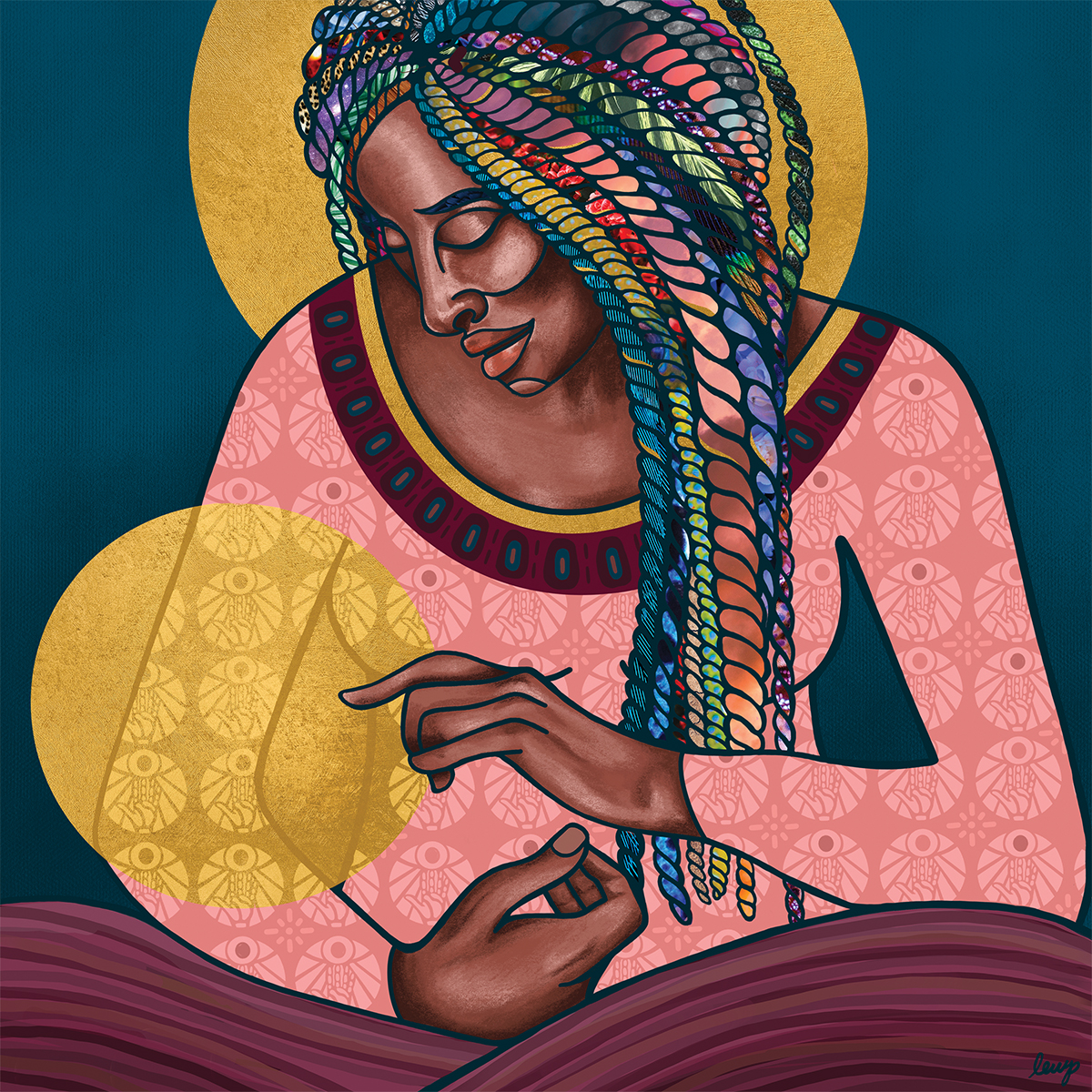
Lauren Wright Pittman (American, 1988–), Contours of Mary’s Dream, 2020. Digital painting with collage, 20 × 20 in. Used with permission.
Contours of Mary’s Dream by Rev. Lauren Wright Pittman of Knoxville, Tennessee, shows Mary, the mother of Jesus, bonding with her in utero son. She sits cross-legged and nimbed, tenderly caressing a hovering gold halo that represents the Holy One, the light of the world, taking shape inside her. Repeated in roundels, the design on her shirt is an upraised, open hand illuminated by sunrays, an allusion to the Magnificat, Mary’s praise song from Luke 1:46–55, which begins, “My soul magnifies the Lord!” A whole world of possibility opens up with God’s taking on flesh. Wright Pittman says,
I have this instinct to read the Magnificat alongside the first creation narrative in Genesis. I imagine Christ taking form in Mary’s womb much like I imagine all of creation emerging at the Creator’s voice. I collaged macrophotography of patterns, textures, and colors from creation—such as sunsets, bird’s feathers, fish scales, galaxies, leaves, planets, fur, water, etc.—and wove them into her hair. Jesus, the thread of creation, is being knit together in her womb. God’s dream for all creation is materializing as cells divide in her body; all the while she sings of a dream, still unrealized.
Creation–new creation, and Jesus the firstborn of both.
There’s wonder and excitement in the image, but there’s also a trace of loss, as the orb that Mary cradles could be seen as not only a potentiality that’s forming, a God-lit body coming to be, but also an absence, the vestigial essence of a boy wrenched from the protective arms of his mother. The artist said she was thinking of the painting Analogous Colors by Titus Kaphar that appeared on the cover of the June 15, 2020, issue of Time magazine, which reported on the nationwide protests in the US in the wake of George Floyd’s murder by a police officer. In Kaphar’s image, a grieving Black mother holds an empty silhouette of her infant close to her chest, alluding to the many African American women whose children’s lives have been taken by police and racist vigilantes.
“When I read the Magnificat, Kaphar’s image came into sharp relief,” Wright Pittman says. “How could I image Mary holding the contours of her dreams for the world, while also holding the contour of her loss? Mary’s son would be publicly murdered at the hands of the state. Mary’s song reverberates for all mothers who have had dreams for their children shattered by senseless violence.”
I originally wrote this description for the Advent 2022 edition of the Daily Prayer Project.
Jacob Riis (Danish American, 1849–1914), In the Home of an Italian Rag-Picker, Jersey Street, ca. 1890. Photograph, 7 15/16 × 9 3/4 in. (20.2 × 24.7 cm).
My soul magnifies the poor
the sore
the raw
and my spirit rejoices in God
my downcast
my outcast
my twig-bone wrong caste
for He regards the low estate
the no-go estate
the empty plate
and squats there with those generations.

For at Whose Name the cosmos shakes
and canyons quake
sought sanctuary within a womb
a young girl’s chaste, unopened room
a sparse, unblemished catacomb
and holy is He amongst the lame.

His mercy is on those who fear Him
hear Him
those near Him
in desert flapping bivouac or dehydrated barrio.

The night sky rolled out by His arm,
the preening proud ignore His balm
and slink towards the warlock charm
of their small ambitions;
and those on thrones end up alone
replaced by fly-pecked innocents.

He only eats with the hungry,
and if they don’t, He too refrains;
and as for the rich –
a table cannot be found for them.

My soul magnifies the poor
the sore
the raw
and my spirit rejoices in God
my outcast.
Stewart Henderson is a poet, song lyricist, and broadcaster. His children’s poems, taken from his three best-selling children’s collections (Poetry Emotion, All Things Weird and Wonderful, and Who Left Grandad at the Chip Shop?), are included in the UK’s national education curriculum. As a song lyricist, the music magazines Q and Mojo place his lyrics alongside those of Randy Newman and Radiohead. And as an award-winning presenter and producer of many documentaries for BBC network radio, he continues in the grand tradition, established by the likes of Dylan Thomas, Louis MacNeice, Cecil Day-Lewis, and others, of leading poets being commissioned to make primetime programs for Britain’s national broadcaster. Liverpool-born but long since residing on the southwest fringes of London, Henderson has been a regular participant, since its inception in 1974, in the Greenbelt Festival, an annual summer event in England dedicated to the arts, faith, and justice, for which Henderson served as a board director for twelve years.
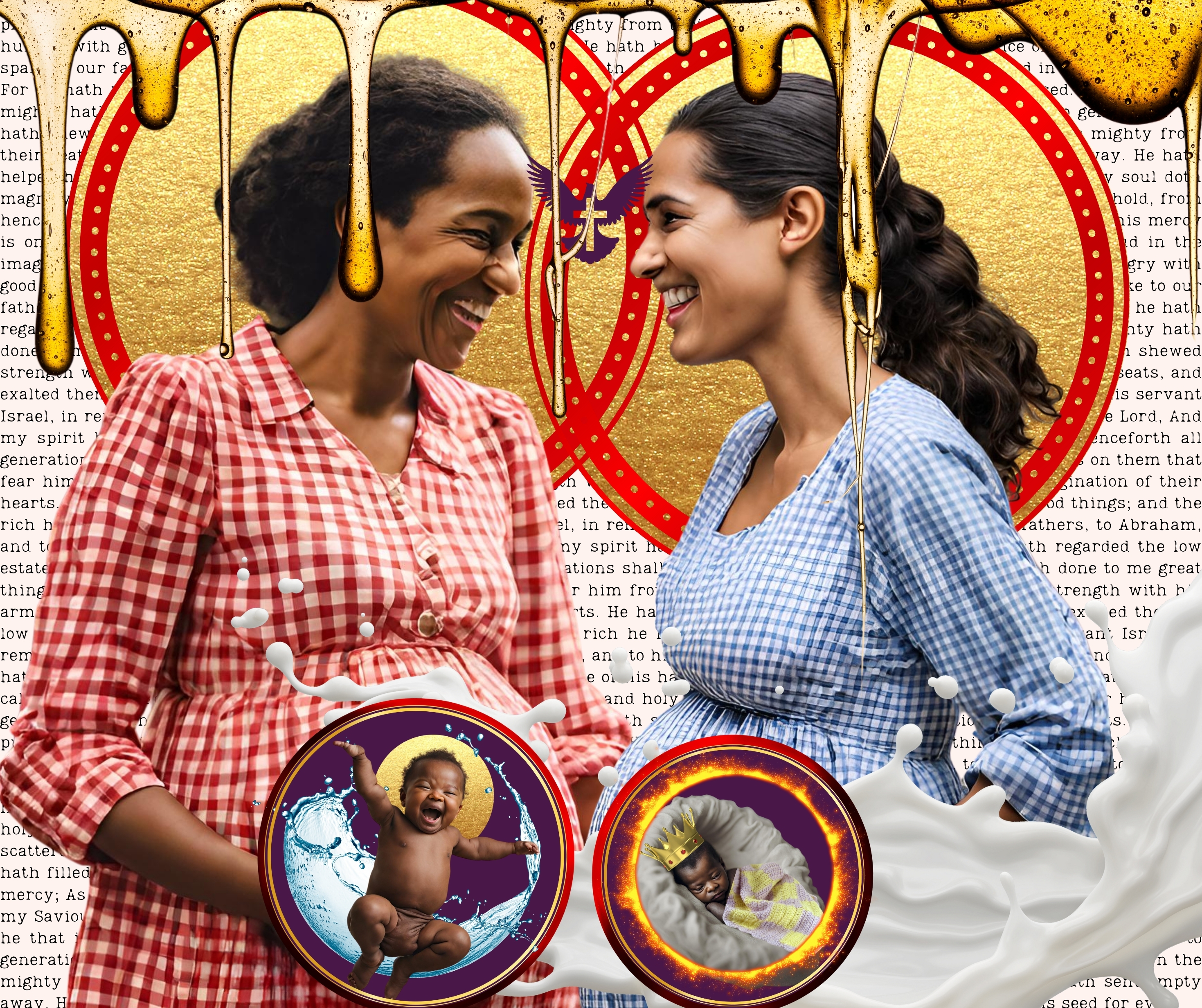
Beth Felker Jones (American, 1976–), Visitation, 2024. Digital collage with AI-generated elements.
Dr. Beth Felker Jones is a theologian who teaches at Northern Seminary near Chicago. This past year she has been making digital collages of biblical figures, especially women, with the assistance of AI technology. She shares them on her Substack, Church Blogmatics, and offers them for free with watermark or just $10 for a high-resolution, watermark-free download.
Her Visitation, she says, “imagines Mary’s visit to Elizabeth in Luke 1, flowing with milk and honey,” symbols of abundance and nourishment. (The promised land is often referred to in scripture using this poetic expression; see Exod. 3:8, Num. 14:8, Deut. 31:20, and Ezek. 20:15.) With the coming of a Savior, a great spiritual bounty awaits God’s people.
Luke the Evangelist describes Elizabeth as “filled with the Holy Spirit” (1:41). The Spirit is present in the center of this collage, silhouetted in purple, the color of Advent. His wings touch the women’s foreheads as if to bless or to join them together in celebration.
Luke also says that John the Baptist “leaped for joy” inside Elizabeth upon hearing Mary’s greeting (1:44), already recognizing that the one she bore was the Messiah. Jones shows this exultation of the in utero prophet. He splashes in the waters of his mama’s womb, as he will one day in the river Jordan, baptizing the repentant. Meanwhile, the great I AM, enfleshed as a preborn baby, sleeps inside a fiery ring in Mama Mary, crowned as king.
The words of Mary’s Magnificat form the backdrop of the scene.
LISTEN: “Among Us” by Nick Chambers, on Advent Songs by Incarnation Music (2023)
My soul will magnify The Lord who looked on my Lowliness with grace My soul will magnify My neighbor’s precious life I see Christ in their face
Refrain: God is among us In human disguise Born as one of us To open our eyes
My soul will magnify The Lord who took on my Lowliness in flesh My soul will magnify My neighbor’s desperate cry For in Christ they are blessed [Refrain]
Based on the Magnificat (Luke 1:46–55), “Among Us” by singer-songwriter Nick Chambers highlights how God’s becoming flesh helps us see the imago Dei (image of God) in our fellow humans. There’s an old Orthodox hymn that says, “Christ was born to raise the image that fell of old. Christ came to restore the beautiful image of God within humankind,” the image that had become obscured through sin.
With Mary, Elizabeth, and baby John, let us celebrate the Lord who brings salvation, raising up the lowly, restoring the broken, and reminding us of the dignity and belovedness of our embodied selves.
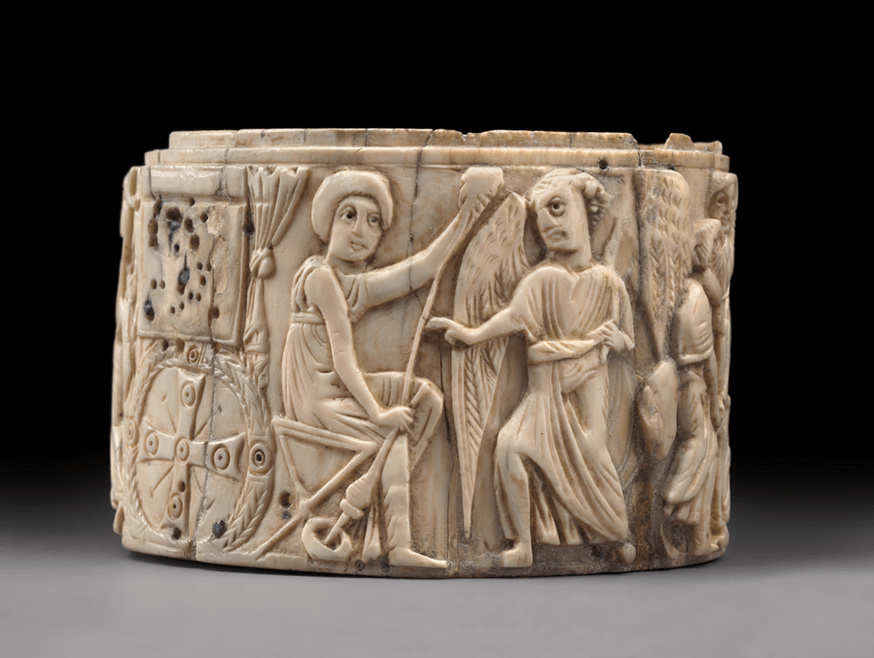
Pyxis with the Annunciation, Byzantine Empire (Minden?), 5th or 6th century. Ivory, height 7.9 cm, diameter 11.8 cm. Museum für Byzantinische Kunst, Bode-Museum, Staatliche Museen zu Berlin. [object record]
According to the Protoevangelium of James, an apocryphal infancy gospel from the second century, the Virgin Mary was raised in the Jerusalem temple from age three and was tasked with weaving the purple and scarlet thread of the veil that shrouded the holy of holies, the temple’s innermost sanctuary. One day while taking a break from this sacred labor to collect water from a well, the angel Gabriel approached her with a greeting: “Hail, favored one. The Lord is with you.” She looked around and saw no one, so she returned to her work indoors.
As she was engaged in her spinning, Gabriel reappeared and delivered the message he had been sent with: that Mary was chosen to bear the Son of God.
This account of the Annunciation gained special traction in the East, where the Virgin Annunciate is almost always shown with a spindle of scarlet thread in her hand, or less frequently, standing at a well—unlike in Western depictions, where she is typically shown holding a book.
The Byzantine art object pictured above is an ivory-carved pyxis (pl. pyxides), a cylindrical container used to store small items, such as jewelry or cosmetics. The Annunciation is one of three scenes represented, the other two being the Journey to Bethlehem and the Nativity (including Salome with her withered hand; see Prot. 19–20). The square to Mary’s left is where the lock case was originally mounted.
In the early fifth century, the prominent Byzantine theologian Proclus of Constantinople (ca. 390–446) developed Mary’s weaving into an extended theological metaphor of the Incarnation. He preached on Mary’s womb as a “workshop” containing the “awesome loom of the divine economy” on which the flesh of God was woven together, providing the bodiless divinity with form and texture. [1] “In the workshop of Mary’s womb, the vertical warp thread of divinity was bound to a weft of virgin flesh,” writes Fr. Maximos Constas (b. 1961), paraphrasing Proclus. [2]
Jesus’s flesh is a kind of clothing—the same we wear—made during Mary’s nine months of pregnancy:
The one who redeemed us was not a mere man. May this never be! But neither was he God denuded of humanity, for he had a body. And if he had not clothed himself with me, he could not have saved me, but in the womb of a virgin the one who pronounced the sentence against Adam clothed himself with me, who stood condemned, and there in her womb was transacted that awesome exchange, for taking my flesh, he gave me his spirit. [3]
Notes:
Nicholas Constas, “The Purple Thread and the Veil of Flesh: Symbols of Weaving in the Sermons of Proclus,” chap. 6 of Proclus of Constantinople and the Cult of the Virgin in Late Antiquity (Leiden and Boston: Brill, 2003), 317. The quotations are from Proclus’s Homily 1.I.21–25.
Constas, 357.
Proclus of Constantinople, Homily 1.VIII.122–27, qtd. Constas, 354.
I’m spinning the scarlet and purple—woman’s work But God is spinning the gold, I see Weaving a tiny thread like me Into the grand design to be The saving of the world
Chosen as the roving fiber—clean and combed Then dropped and spun and quickly wound Upon the spindle tightly bound To serve the One I’m wound around: The Savior of the world
Refrain: Son of the Most High, let it be, let it be Son of God, let it be, let it be to me
In the hands of the Master, I marvel at his ways He brings me into his weaving room My heart is stretched upon the loom The God-man knitted within my womb The Savior of the world [Refrain]
Bridge: First to hear, first to hear and believe First to love, first to love and receive The Son of God
Will they believe me? I wonder, who can say? But I will always answer yes Though a sword may pierce my breast The Father of my son knows best The Savior of the world [Refrain]
In “The Virgin, Spinning,” singer-songwriter Katy Wehr takes the weaving metaphor in a different direction than Proclus. Voiced by Mary, the song reflects on how God is weaving a grand tapestry of salvation, in which Mary is a thread.
The third Sunday of Advent is traditionally known as Gaudete (Joy) Sunday, a day of celebrating the joyful reality that God is near. Advent is characterized by our waiting and yearning for Christ, which can feel heavy, especially as we look around and within and see so much brokenness. But on this day we are reminded to embrace a spirit of joy as we wait and as we yearn—much like a child waits with eager anticipation to unwrap a gift, or lovers to be reunited after a time of separation.
The following ten songs help us to inhabit the gladsome aspects of the Advent season, paving the way to Christmas.
1. “First Song of Isaiah” by Jack Noble White (1976) | Arranged and performed by Advent Birmingham, feat. Annie Lee, on Canticles (2020): Here’s an upbeat rendition, with xylophone and ukelele, of Jack Noble White’s choral setting of Isaiah 12:2–6. “You shall draw water with rejoicing from the springs of salvation. . . . Cry aloud, inhabitants of Zion, ring out your joy!” In the Book of Common Prayer this text appears in the section “Morning Prayer, Rite 2,” where it is labeled Canticle 9, “The First Song of Isaiah: Ecce, Deus.”
2. “Rejoice Greatly, O Daughter of Zion” from Messiah by George Frideric Handel (1741) | Performed by Regula Mühlemann (2019): A setting of Zechariah 9:9–10, this aria from Handel’s most famous oratorio features coloratura in the vocals—that is, elaborate, fast-paced ornamentation, trills, runs, and wide leaps—that accentuates the prophecy’s joyful message of a coming king. It’s sung by the Swiss soprano Regula Mühlemann, accompanied by the Sächsische Staatskapelle Dresden under the direction of Alondra de la Parra. For a Broadway-style arrangement of this piece, see here.
3. “Joy (Elizabeth)” by Poor Bishop Hooper, on Firstborn (2018): This song by Jesse and Leah Roberts voices Elizabeth’s awe upon visiting with her younger relative Mary, who is newly pregnant with the Son of God. Elizabeth radiates such joy in the Messiah that her preborn son, John, catches it too, leaping in her womb.
4.“Joy” by Kirk Franklin and Donald Malloy| Performed bythe Georgia Mass Choir, feat. Dorothy Anderson and Kirk Franklin, on I Sing Because I’m Happy (1992): Sweet, beautiful, soul-saving joy! That’s what Jesus gives. The Georgia Mass Choir testifies with vigor, led by the Grammy-winning artist Kirk Franklin. In 1996 this song was adapted for Whitney Houston for the film The Preacher’s Wife, with Christmas-specific lyrics, but I really dig Dorothy Anderson’s solo work in this original recording.
5. “Rejoice” by Victory Boyd, on Glory Hour (2023): This anthem by singer-songwriter Victory Boyd is based on Nehemiah 8:10: “Do not be grieved, for the joy of the LORD is your strength.” Victory often incorporates scripture recitations into her songs, and here she speaks Psalm 27:1–6 as a bridge, which has thematic crossovers with the Nehemiah verse. In this live performance from the February 4, 2024, episode of the Hour of Power television program, she is accompanied by the Hour of Power Orchestra, conducted by Marc Riley.
6. “Joy” by Shakti, on Shakti with John McLaughlin (1976):Shakti is an acoustic fusion band that combines Indian music with elements of jazz; they were active in the 1970s and re-formed in 2020. Recorded at the Montreux Jazz Festival in 1976, this instrumental improvisation features John McLaughlin on guitar, L. Shankar on violin, Zakir Hussain on tabla (hand drums), and T. H. “Vikku” Vinayakram on ghatam (clay pot).
7. “There Will Be Joy” by Paul Zach and Kate Bluett (2022): “Sorrow has an ending / Something new is coming / Oh, there will be joy!”
8. “Come That Day” by Ken Wettig, on Behold and Become (2019): Ken Wettig served for eight years as pastor of Early Church, a Mennonite congregation in Harrisonburg, Virginia, before becoming a community minister at Coracle. This song he wrote is one that Early Church sings in its worship services. It celebrates the coming day of the Lord, when death will be no more and Christ will bring about total restoration. On that day, all chaos will be stilled, swords will be beaten into plowshares, the poor will be filled, and loved ones taken too soon will embrace one another once again. The song is an invocation: it beseeches Christ to come, to bring the promised consummation of his kingdom.
Wettig has given me permission to post the lead sheet for “Come That Day,” which he freely offers for noncommercial use. Click the link to download a PDF.
9. “Peace and Joy,” Shaker hymn (1893) | Performed by the Rose Ensemble, feat. Kim Sueoka, on And Glory Shone Around (2014): One of the less recognized roots of bluegrass and old-time music is the Shaker tradition. This hymn, performed here by the Rose Ensemble, hails from the late nineteenth-century Shaker community in Mount Lebanon, Columbia County, New York. It beckons us “Awake!” and hear the angels whispering forth the blessings of Christ. “Happy are they who gather these gifts” of peace and joy ushered in by the Incarnation. The fabulous soprano soloist is Kim Sueoka.
10. “Carol of the Bells” – Music by Mykola Leontovych (1914), based on a traditional Ukrainian folk chant | Words by Peter Wilhousky (1936) | Arranged by Isaac Cates and performed by Ordained on Carol of the Bells(2014): The composer, conductor, and pianist Isaac Cates plays piano accompaniment for his choir, Ordained, in this original arrangement of a Christmas classic. Dramatic and haunting, energizing too, “Carol of the Bells” is one of my favorite choral songs of the season—I never tire of hearing it! I love the build in volume and the interplay of voices in imitation of church bells.
Laura Lasworth (American, 1954–), Lily Among the Thistles, 2001. Oil on wood panel. From the Love’s Lyric series, based on the Song of Songs.
This still-life painting by Seattle-based artist Laura Lasworth shows a beautiful cut lily sharing a vase with a bouquet of twelve thorny, withered stems. The water in which they sit is red. The work’s title is taken from the Song of Songs 2:1–2: in Latin, “Ego flos campi, et lilium convallium. Sicut lilium inter spinas, sic amica mea inter filias,” or from the New Revised Standard Version:
I am a rose of Sharon, a lily of the valleys.
As a lily among brambles, so is my love among maidens.
While the Song of Songs, written in the wisdom tradition of Solomon, is first and foremost a collection of poems exploring the human experience of love and sexual desire, most Christians also interpret it as an allegory of the love between Christ and his church, or God and the individual soul. In that reading, Christ is the “lily of the valley” who speaks here.
Early Christian writers such as Origen, Hippolytus, Ambrose, Jerome, and Augustine associated the lily of Song of Songs 2:1 with Christ; in the Middle Ages, Venantius Fortunatus (ca. 530–610), Peter Damian (1007–1072), and Bernard of Clairvaux (1090–1153), among others, followed suit. I’m familiar with this floral metaphor for Jesus from a gospel song I grew up singing!
From the fourteenth century onward, in images of the Annunciation, Western artists commonly portrayed either a lily vase on a table, or the angel Gabriel presenting a lily to Mary. The lily became a symbol both Christological and Mariological, signifying the flowering of the Incarnation: God’s pure Son emerging from the virginal stem of Mary.
On December 10, Jonathan A. Anderson, a professor of theology and the arts at Regent College in Vancouver, gave the homily in chapel, using Luke 1:26–38 as his scripture text and exploring Lasworth’s Lily Among the Thistles in relation to it.
Thorns and thistles are an image of cursedness throughout scripture, starting in Genesis 3:17–18, Anderson points out. But in Lasworth’s painting, a lily rises up from the center of that cursedness. “If the thistles visually articulate the groaning of creation and the sorrows of humanity, the lily symbolically inaugurates a newness of life, somehow flowering right in the midst of this,” Anderson says. “The audacious proclamation of Advent is that the Son of God—the Creator and Healer of all things, our tree of life—was born into the brambles of human history and into the bloody heritages that still cry out daily from the ground.”
Anderson considers the polyvalence of Lily Among the Thistles:
In one sense, this is an icon of Christ’s appearance in human history. In another sense, this vase is also an individual heart—my heart, your heart—that has heard the Annunciation for itself amidst its own sorrows and deathliness. . . . Or we might also see this as an icon of creation, simultaneously groaning for the reconciliation of all things and blooming with new creation. And surely, it is an icon of the church, in which we harbor various fertility altars overgrown with thorns and thistles, and yet in which we are a people of the incarnation, people in whom new creation has begun, people through whom the light of the Spirit is already casting the shadows of the redemption of all things.
1. There sprang a Flower from out a thorn, To save mankind that was forlorn, As prophets spake before that morn: Deo Patri sit Gloria!
2. There sprang a well at Maid Mary’s foot, That turned all this world to good, Of her took Jesu flesh and blood: Deo Patri sit Gloria!
. . .
4. From diverse lands three kings were brought, For each one thought a wondrous thought, A King to find and thank they sought: Deo Patri sit Gloria!
5. Richly laden with gifts they fare, Myrrh, frankincense, and gold they bear, As clerks in sequence still declare: Deo Patri sit Gloria!
. . .
9. There shone a star in heaven bright, That the men of earth might read aright That this Child was Jesu, King of Might: Deo Patri sit Gloria!
This song is a choral setting by London-based composer Dominic Veall of a late medieval lyric that begins, “Ther ys a blossum sprong of a thorn”—or, as Jessie L. Weston modernizes it, “There sprang a Flower from out a thorn.” The recording omits stanzas 3, 6, 7, and 8, but you can read the full lyrics here. The Latin refrain translates to “Glory be to God the Father!”
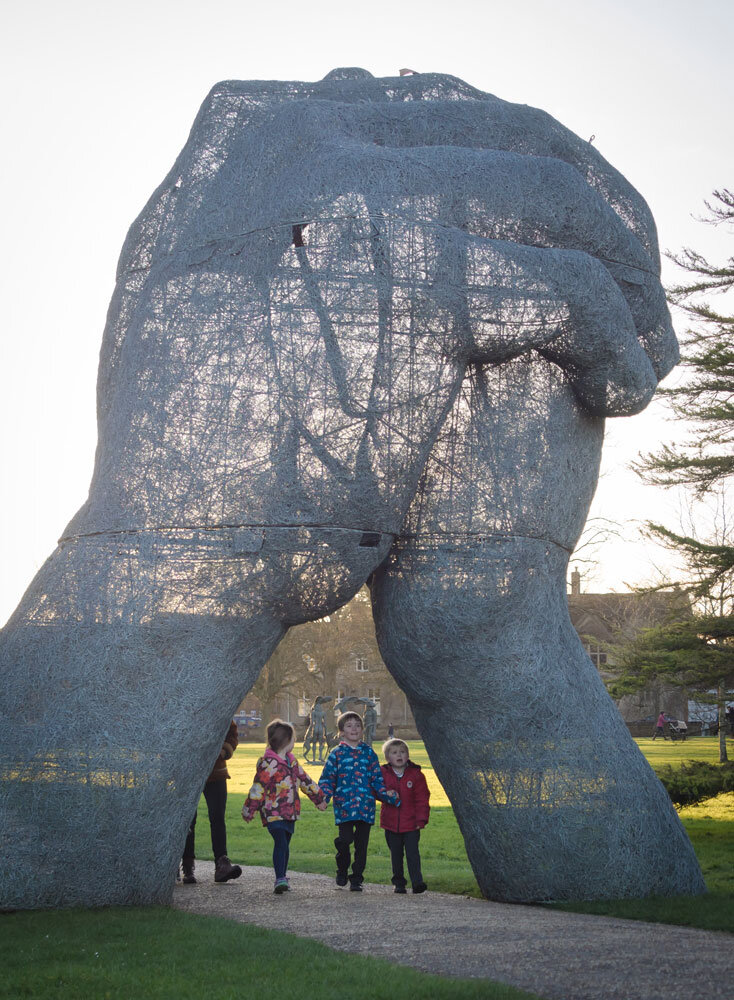
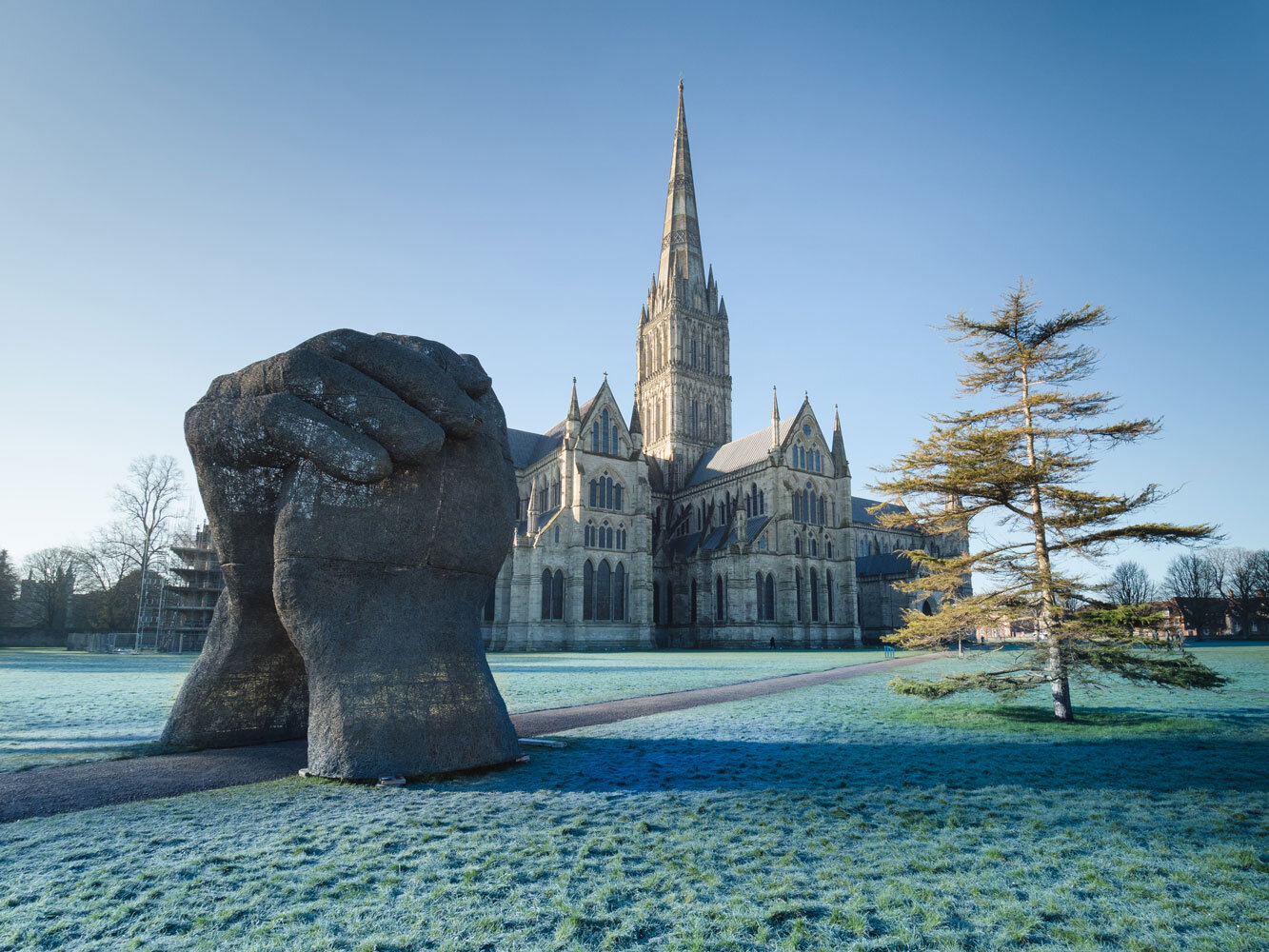
Sophie Ryder (British, 1963–), The Kiss, 2016. Galvanized steel wire, 579 × 590 × 380 cm. From the 2016 exhibition Sophie Ryder: Relationships at Salisbury Cathedral, England. Photo: Ash Mills.
A monumental wire sculpture of two hands “clasped in love, friendship or prayer,” The Kiss by Sophie Ryder was one of over twenty sculptures by the artist on display from February 12 to July 3, 2016, in the close and cloister of Salisbury Cathedral. It straddled the path from the High Street Gate to the West Door for the first week but was then moved to the North Lawn after too many oblivious texters bumped their heads on it (despite the six feet, four inches of clearance in the center).
Sophie Ryder: Relationships was curated by Jacquiline Creswell, who specializes in siting contemporary art in sacred spaces.
>> Traditional Welsh tune (AR HYD Y NOS) | Performed by Crystal Muro, Brenna Boncosky, and Ian Murrell with organist Phillip Kloeckner, First United Methodist Church at Chicago Temple, 2020
>> Music by Benjamin Brody, 2009 | Performed by musicians of First Congregational Church of Houston, 2020
View the present through the promise, Christ will come again. Trust despite the deepening darkness, Christ will come again. Lift the world above its grieving through your watching and believing in the hope past hope’s conceiving: Christ will come again.
Probe the present with the promise, Christ will come again. Let your daily actions witness, Christ will come again. Let your loving and your giving and your justice and forgiving be a sign to all the living: Christ will come again.
Match the present to the promise, Christ will come again. Make this hope your guiding premise, Christ will come again. Pattern all your calculating and the world you are creating to the advent you are waiting: Christ will come again.
Aaron Douglas (American, 1899–1979), The Judgment Day, 1939. Oil on tempered hardboard, 48 × 36 in. (121.9 × 91.4 cm). National Gallery of Art, Washington, DC. Photo: Victoria Emily Jones. [object record]
Born in Topeka, Kansas, in 1899, Aaron Douglas moved to New York in 1925 and became one of the leading artists of the Harlem Renaissance. He studied African art and European modernism, developing his own unique visual language that brought together influences from cubism, art deco, and African sculpture.
In his early career he worked as an illustrator for Black magazines, including The Crisis and Opportunity, and accepted a commission by the esteemed poet James Weldon Johnson to illustrate his collection God’s Trombones: Seven Negro Sermons in Verse. After the book’s publication in 1927, numerous other commissions followed, including large-scale murals. In 1944 Johnson established the art department at Fisk University in Nashville and taught there until his retirement in 1966.
The Judgment Day (1939) is based on one of Johnson’s illustrations for God’s Trombones, made to accompany a poem of the same title. It showcases his signature style of silhouetted figures and flat, hard edges.
In the painting, the archangel Gabriel stands astride earth and sea, summoning the living and the dead to judgment with a blast of his horn. He holds the key to the kingdom of heaven, which he’ll open to those who have repented of their sins and trusted in Christ. A bolt of lightning rips through the sky on the left, and on the right, a light ray shines down onto a praying figure who is ready for the great accounting.
LISTEN: “In That Great Gettin’ Up Morning,” African American spiritual | Arranged by Jester Hairston and performed by the Leonard De Paur Infantry Chorus, 1953
I’m a-gonna tell you ’bout the comin’ of the judgment (Fare thee well, fare thee well) I’m a-gonna tell you ’bout the comin’ of the judgment (Fare thee well, fare thee well) There’s a better day a-comin’ (Fare thee well, fare thee well) There’s a better day a-comin’ (Fare thee well, fare thee well)
Refrain: In that great gettin’ up morning Fare thee well, fare thee well In that great gettin’ up morning Fare thee well, fare thee well
Oh preacher, fold your Bible (Fare thee well, fare thee well) Preacher, fold your Bible (Fare thee well, fare thee well) For the last soul’s converted (Fare thee well, fare thee well) Oh, the last soul’s converted (Fare thee well, fare thee well) [Refrain]
Blow your trumpet, Gabriel (Fare thee well, fare thee well) Blow your trumpet, Gabriel (Fare thee well, fare thee well) Lord, how loud shall I blow it? (Fare thee well, fare thee well) Blow it right calm and easy (Fare thee well, fare thee well) Do not ’larm all my people (Fare thee well, fare thee well) Tell them all to come to judgment (Fare thee well, fare thee well) [Refrain]
Then you’ll see them coffins bustin’ (Fare thee well, fare thee well) Then you’ll see them corpses risin’ (Fare thee well, fare thee well) Then you’ll hear that rumblin’ thunder (Fare thee well, fare thee well) Then you’ll see that forkèd lightnin’ (Fare thee well, fare thee well) Then you’ll see the stars a-fallin’ (Fare thee well, fare thee well) Then you’ll see the world on fire (Fare thee well, fare thee well) Then he will call sinners (Fare thee well, fare thee well) Then he will call sinners (Fare thee well, fare thee well) [Refrain]
DANCE: “I Wanna Be Ready”: The African American spiritual “I Wanna Be Ready” forms the soundtrack to this iconic solo from Alvin Ailey’s contemporary ballet Revelations. The dancer in this first video is Amos Machanic:
In 2018, in honor of the Alvin Ailey American Dance Theater’s sixtieth anniversary, Matthew Rushing, who is currently the company’s interim artistic director, traveled to Ailey’s birthplace of Rogers, Texas, to dance “I Wanna Be Ready” at Mount Olive Baptist Church, one of the few landmarks of Ailey’s childhood that’s still standing in Rogers. He was accompanied live by five local singers. The performance was filmed, edited, and released on YouTube.
I’m so excited that in January, for the first time, I’m going to see AILEY live in New York! The company will be performing three pieces, including the brand-new Sacred Songs, choreographed by Rushing.
+++
SONGS:
>> “Time Is Running Out” by Adoration ’N Prayze: Adoration ’N Prayze was a female gospel quartet from Detroit that was active in the early nineties, consisting of Damita Bass, Marguerita Bass, Pamela Taylor, and Shontae Graham (later replaced by Audra “Dodi” Alexander). This original song is the title track of their first and only album, released in 1991. The live recording is from a concert they gave at Clowes Memorial Hall in Indianapolis in 1992.
>> “Oil in My Vessel,” traditional gospel song performed by Rani Arbo & daisy mayhem: Rani Arbo & daisy mayhem are a New England–based folk quartet made up of Rani Arbo (fiddle, guitar), Andrew Kinsey (bass, banjo, ukulele), Anand Nayak (electric and acoustic guitars), and Scott Kessel (percussion). This song they perform is based on a recording by Joe Thompson (1918–2012), who was raised in a Holiness Church in Alamance County, North Carolina. Thompson said the song was in his church hymnal, and that he learned it from his mom when he was about five years old (in the 1920s). Its refrain is a statement of intent to “be ready when the Bridegroom comes,” and its stanzas are taken from the seventeenth-century hymn “Must Jesus Bear the Cross Alone?” by Thomas Shepherd and, from the eighteenth century, “Amazing Grace” by John Newton.
+++
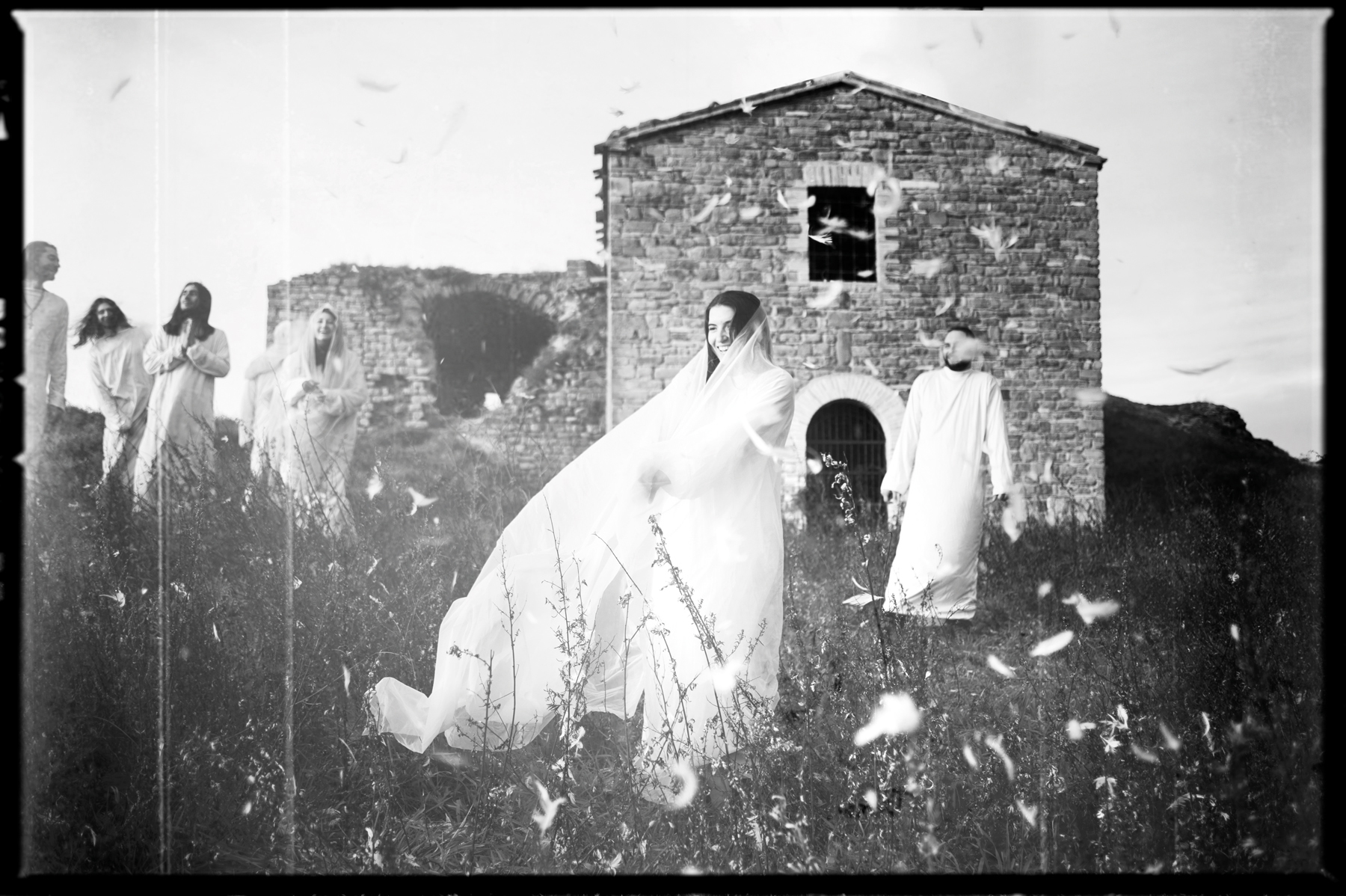
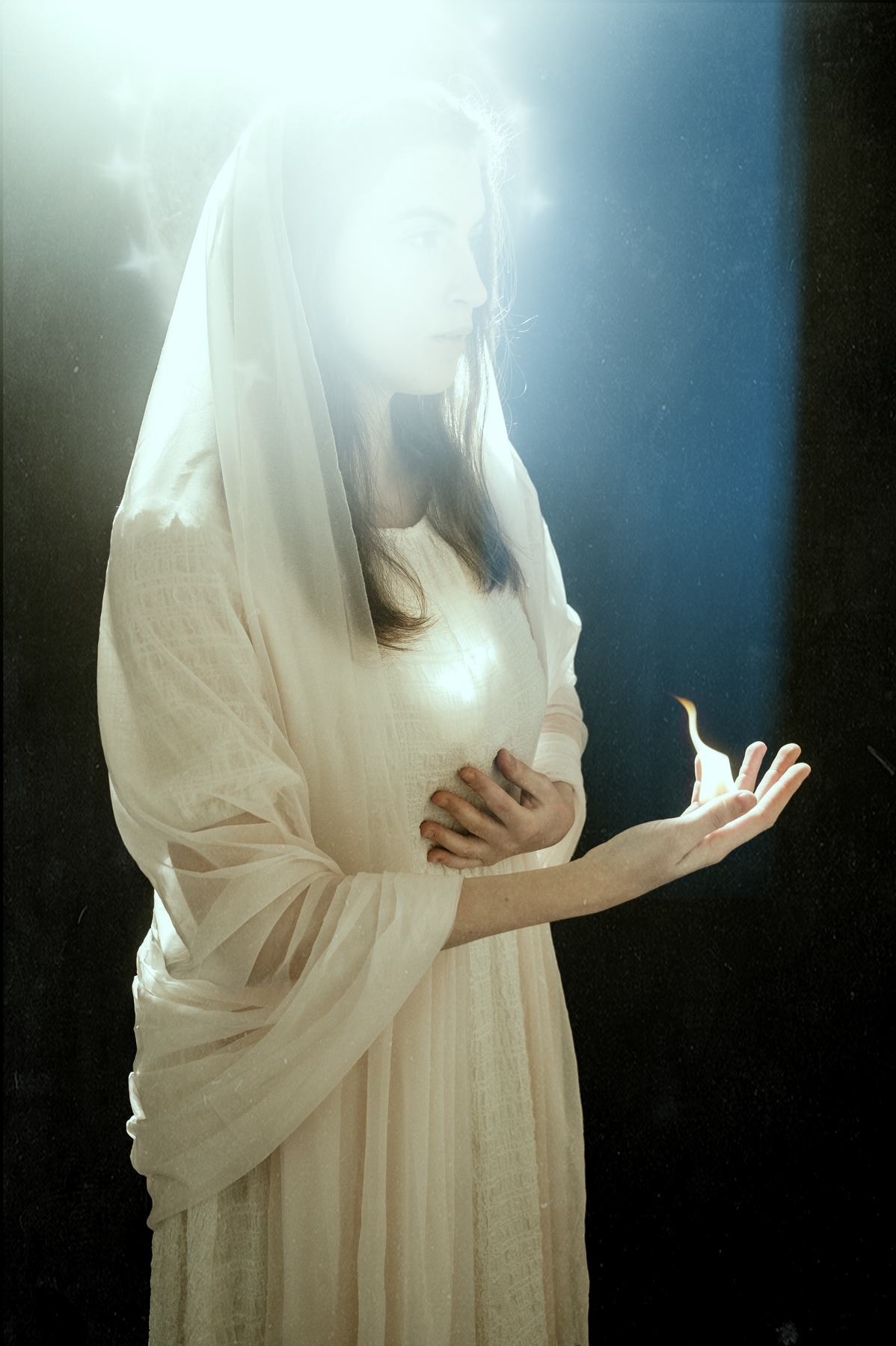
PHOTOGRAPH SERIES: Elogio all’Innocenza (In Praise of Innocence) by Gloria Mancini:Gloria Mancini is an Italian artist working mainly in photography. One of her recent series, divided into three parts, is based on Revelation 3:1–6 (Gli Innocenti, or The Innocents), 12:1 (La Donna Vestita di Sole, or The Woman Clothed with the Sun), and 5:1–7 (L’Agnello, or The Lamb). “Becoming small to become great has been the aim of my exploration of the Book of Revelation,” she writes in her artist’s statement. “Inspired by the visionary and magnetic power of the Kyrios (the Christ, the Lamb), I chose to focus my reflection on innocence as a fundamental and revolutionary value of being, reaffirming its virtue.” She says she is compelled by how in Revelation, it is a meek and vulnerable lamb who defeats evil.
Jesus’s message to the church in Sardis, a wealthy city in west-central Asia Minor, is so seldom (or not at all?) visualized in art history—I’m grateful to Mancini for drawing attention to this passage through her thoughtful work! Jesus tells the church to “wake up,” to “remember . . . what you received and heard; obey it and repent,” following the example of the few there “who have not soiled their clothes.” Those people, he says, “will walk with me, dressed in white, for they are worthy.” He admonishes the Sardis Christians to be watchful and to strengthen and perfect their good works so that they might conquer evil and their names be preserved in the book of life.
Mancini pictures the faithful remnant at Sardis praying, keeping watch, persevering in purity, and gamboling about in the life of the Spirit.
Gloria Mancini (Italian, 1992–), photograph from the Elogio all’Innocenza series, 2023Gloria Mancini (Italian, 1992–), photograph from the Elogio all’Innocenza series, 2023
The Woman Clothed with the Sun from Revelation 12, on the other hand, is widely represented in art, and since the twelfth century has been associated with the Virgin Mary, because the woman gives birth to a son who is pursued by the Dragon. In church tradition Mary is also likened to the burning bush in Exodus, because she bore the fire of divinity—God in Christ—within her but was not consumed. Mancini plays on both associations, showing Mary cautiously holding a flame, bringing it closer to her breast: she accepts the Incarnation and is set alight.
Gloria Mancini (Italian, 1992–), photograph from the Elogio all’Innocenza series, 2023
+++
ART SPOTLIGHT: “Yellow Silence: Miniature from the Silos Apocalypse (ca. 1100),”Public Domain Review: One of the most dramatic pauses in scripture comes about a third of the way through the book of Revelation. John has just described the nations’ loud and jubilant praises around the throne of God, and then he opens the next chapter, “When the Lamb broke the seventh seal, there was silence in heaven for about half an hour” (Rev. 8:1). This is the calm before the next storm of judgment breaks with the blowing of the seven trumpets, through which God purges the earth of evil.
While artists have historically relished the chance to visualize the rain of blood, fire, locusts, and such initiated by the trumpet blasts, the anonymous artist of a twelfth-century copy of an Apocalypse commentary from Spain saw fit to also visualize the sonic absence that preceded these spectacular occurrences. He did so with a rectangular swath of yellow.
Miniature from the Silos Apocalypse, northern Spain, 1091–1109. British Library, Add MS 11695, fol. 125v.
This swath calls readers to somber, speechless awe and reflection. God’s earlier word spoken to and through the prophet Zephaniah is appropriate here: “Be silent before the Sovereign LORD, for the day of the LORD is near” (Zeph. 1:7).
Click here to browse more images from the Silos Apocalypse.






.jpg)
 Art & Theology