Isaiah’s Vision of God: Two songs, two paintings

The Old Testament reading in the Revised Common Lectionary for this coming Sunday, Trinity Sunday, is Isaiah 6:1–8:

In the year that King Uzziah died, I saw the Lord sitting on a throne, high and lofty, and the hem of his robe filled the temple. Seraphs were in attendance above him; each had six wings: with two they covered their faces, and with two they covered their feet, and with two they flew. And one called to another and said,

Holy, holy, holy is the LORD of hosts;
the whole earth is full of his glory.

The pivots on the thresholds shook at the voices of those who called, and the house filled with smoke. And I said, “Woe is me! I am lost, for I am a man of unclean lips, and I live among a people of unclean lips, yet my eyes have seen the King, the LORD of hosts!”

Then one of the seraphs flew to me, holding a live coal that had been taken from the altar with a pair of tongs. The seraph touched my mouth with it and said, “Now that this has touched your lips, your guilt has departed and your sin is blotted out.” Then I heard the voice of the Lord saying, “Whom shall I send, and who will go for us?” And I said, “Here am I; send me!”

Wow. What a truly awesome passage!

I’d like to share two songs inspired by it as well as two visual artworks. The first song is a choral work by the English composer and organist Sir John Stainer (1840–1901), titled “I Saw the Lord.” It was performed by The Sixteen under the direction of Harry Christophers and appears on the ensemble’s 2009 album A New Heaven.

The first stanza is the King James Version of Isaiah 6:1–4, and the second stanza is the third verse of “Ave, colenda Trinitas,” an anonymous Latin hymn of the eleventh century, translated by John David Chambers (1803–1893).

I saw the Lord sitting upon a throne, high and lifted up,
and his train filled the temple.
Above it stood the seraphims: each one had six wings;
with twain he covered his face,
and with twain he covered his feet,
and with twain he did fly.
And one cried unto another,
Holy, holy, holy is the LORD of hosts:
the whole earth is full of his glory.
And the posts of the door moved at the voice of him that cried,
and the house was filled with smoke.

O Trinity! O Unity!
Be present as we worship thee,
And with the songs that angels sing
Unite the hymns of praise we bring.
Amen.

Christian biblical commentators have discerned in Isaiah 6 two Trinitarian references: the three “holys” pronounced by the angels (v. 3), and the use of both a singular and plural pronoun in God’s question in verse 8: “Whom shall I send, and who will go for us?” (emphasis mine; cf. Gen. 1:26). Unity in plurality. Further, the New Testament relates this passage to both Jesus (John 12:41) and the Holy Spirit (Acts 28:25). That’s why it’s commonly read on Trinity Sunday, and why Stainer has appended to it a Trinitarian hymn text.

Of Stainer’s musical setting, William McVicker writes,

It is often said that I saw the Lord was written with the acoustics of St Paul’s [Cathedral in London] in mind. It is scored for double choir with an independent organ part. The music’s drama is achieved by the simple, largely homophonic texture, and the interplay of the two chorus parts with that of the organ. Stainer breaks into an imitative texture at the words ‘and the house was filled with smoke’ and again in the final verse section, which is reminiscent of a Victorian part-song.

The music is grandiose, majestic, as one would expect for the encounter it frames, which involves robes, thrones, angelic attendants, shaking doorposts, smoke, and an all-pervasive divine glory.

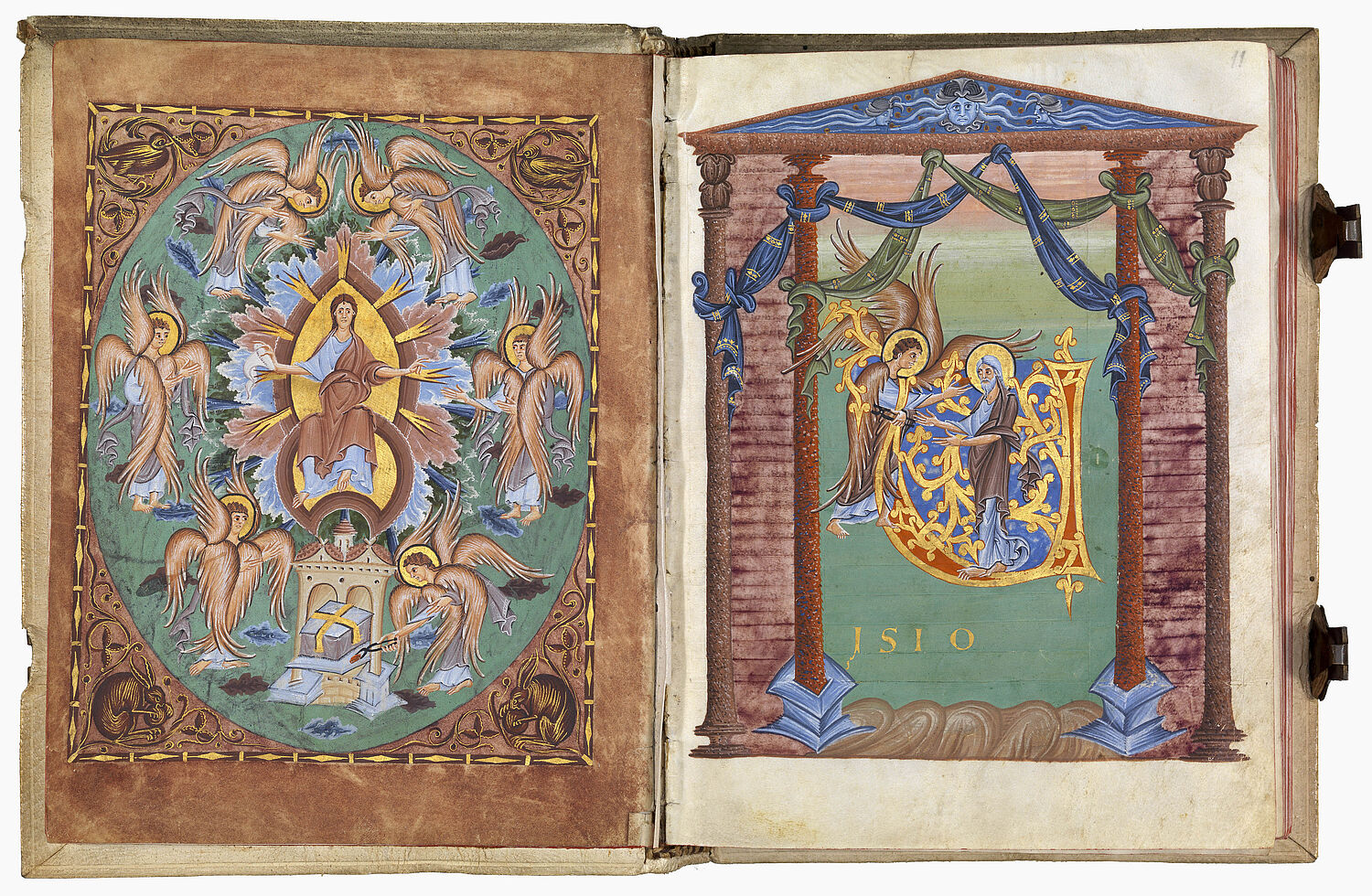
I suggest listening to Stainer’s choral piece as you look on the following page spread from a high medieval German manuscript produced in Reichenau. The manuscript is a copy of Jerome’s (Latin) commentary on Isaiah, with glosses added in the Alemannic dialect of Old High German, and these are the only two images inside.

Isaiah's Vision (Reichenau)
Miniature depicting the prophet Isaiah’s vision of God and decorative initial page showing the cleansing of the prophet, from an Isaias glossatus made in Reichenau, Germany, ca. 1000. Staatsbibliothek Bamberg, Msc.Bibl.76, fols. 10v–11r. [browse full manuscript]

The island monastery of Reichenau on Lake Constance in southern Germany was an important center of illuminated manuscript production in the Ottonian period (919–1024) of the Holy Roman Empire. The miniatures painted there are among the finest of the Middle Ages. (For another example, see the one I shared back in 2020.)

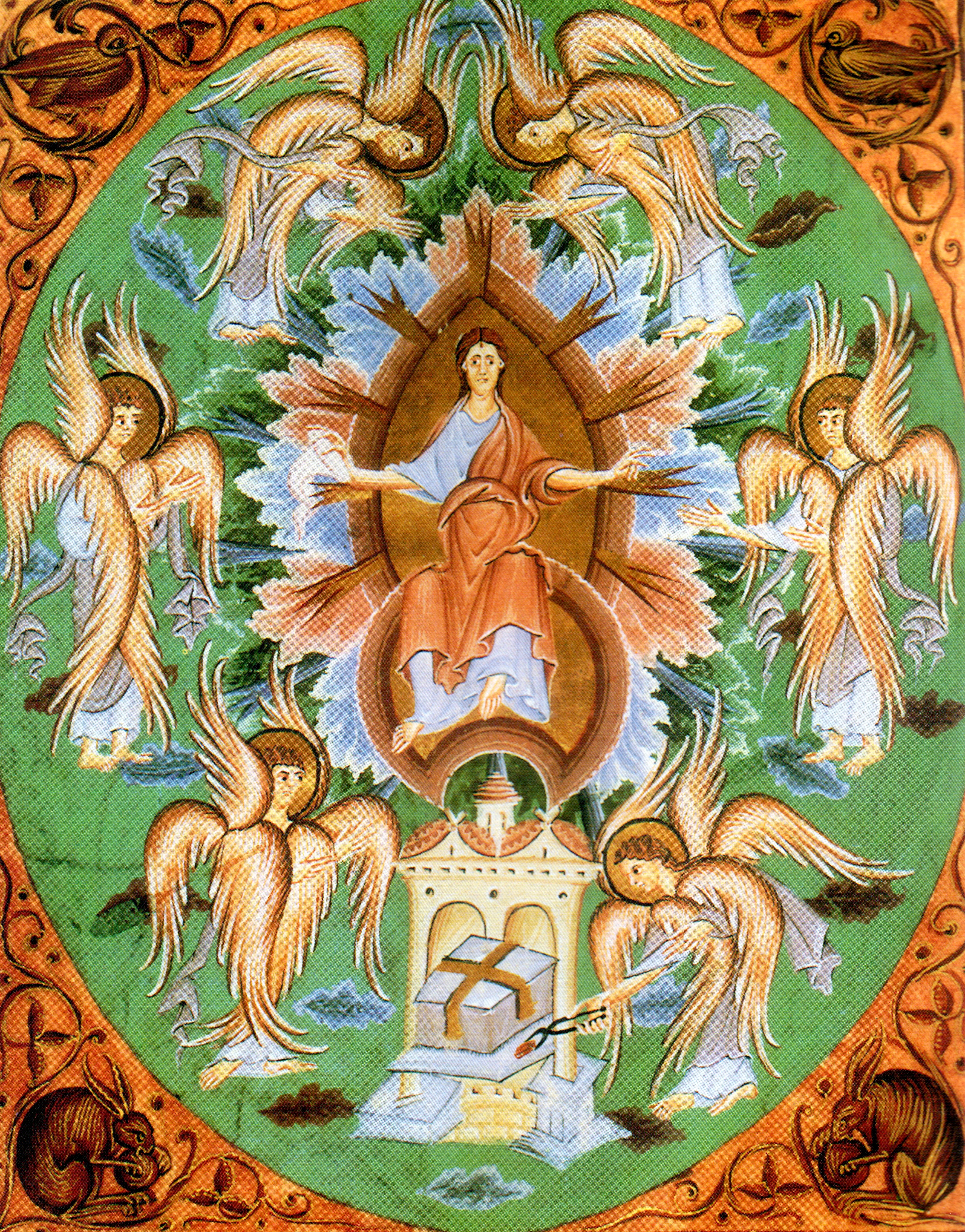
On folio 10v of the Isaias glossatus that’s kept at the Bamberg State Library, God in the form of Christ sits in a mandorla from which trifold bursts of light shine forth, backed by mauve and powder-blue billows of smoke. In his right hand he holds a scroll that represents the word he speaks to Isaiah in 6:9–13, and the words he will continue to supply him with throughout his ministry. Hovering above a smaller-scale temple, God is attended by six seraphim (lit. “burning ones”), one of whom removes a hot coal from the altar with tongs. All this takes place within a green oval, which is surrounded by a brown and gold decorative border of vine tendrils housing two birds and two hares.

Isaiah's Vision (Reichenau)

On the opposite page, folio 11r, the tong-bearing seraph touches the coal to Isaiah’s lips, purging his speech and thus fitting him for the office of prophet. This cleansing act is in response to Isaiah’s humble confession of sin, having beheld God’s holiness: “Woe is me! I am lost, for I am a man of unclean lips . . .” (v. 5). The artist shows Isaiah’s hands open and arms outstretched, welcoming God’s cleansing and accepting the call to service: “Here am I; send me!” (v. 8). Notice that this exchange takes place within the letter V, from the opening of Isaiah, “Visio Esaiae” (The vision of Isaiah . . .). The miniature is a historiated initial—that is, an enlarged letter at the beginning of a paragraph that contains a picture.

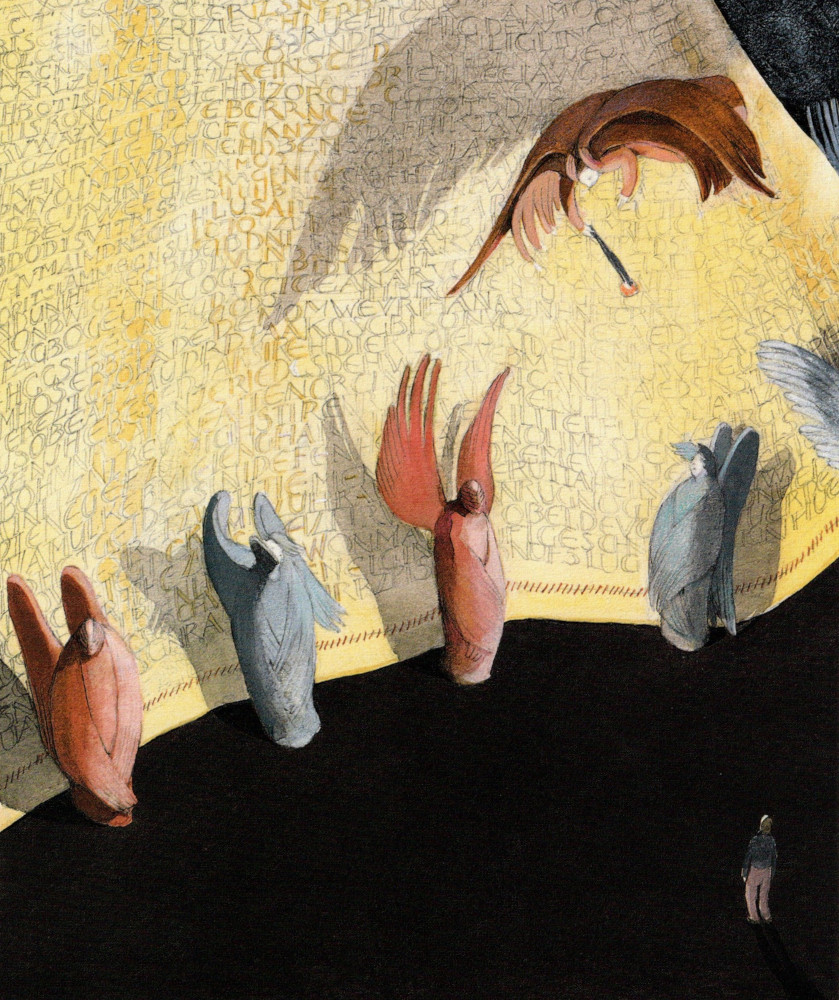
Now let’s shift gears to two Isaiah 6–based works that were made in a folksier idiom. Take in this pen, ink, and watercolor image by the award-winning Austrian illustrator Lisbeth Zwerger, from her book Stories from the Bible (North-South Books, 2002), originally published in German as Die Bibel in 2000:

Zwerger, Lisbeth_Isaiah's Calling
Lisbeth Zwerger (Austrian, 1954–), Isaiah’s Calling, 2000, an illustration from Stories from the Bible (North-South Books, 2002)

This book contains some of the most imaginative biblical artworks of the past century (I shared a sampling on Instagram), and I recommend it for all Christian bookshelves!

In contrast to the frontal wide shot given by the anonymous Reichenau artist, in Isaiah’s Calling Zwerger zooms in on just one detail of the scene, structured along a diagonal. Isaiah stands at the bottom right in the dark, dwarfed by the immense train of God’s robe, which is pure light. It contains letters that I can’t make out into words; can you? I would have assumed they spell out the passage from Isaiah 6 (in German?), but it’s possible they’re not meant to be intelligible—just a further indicator of God’s mysteriousness. The artist has also deliberately chosen not to show God’s face.

Five blue- and red-plumed seraphim—one mostly out of frame, save for one of his wings—stand at the hem of the royal garment, while a sixth flies down toward Isaiah with that burning coal.

At the hem of Christ’s robe is where the woman from Capernaum with the issue of blood finds healing (Luke 8:43–48), and it’s also here at God’s hem that Isaiah is made well, restored.

For a musical complement to Zwerger’s painting, I recommend the song “Lofty and Exalted” by Lenny Smith. It’s from 1993, but Smith didn’t release a recording until 2020, on the album Splendor and Majesty.

Lofty and exalted, reigning from your throne
The train of your robe fills the temple
Seraphim above you, calling out your name
Proclaiming how good and how lovely

Refrain:
Holy, holy, Lord
The earth is full of your glory
Holy, holy, Lord
The earth is full of your praise

“God’s real exalted status and prestige is that He loves being with the lowest of the low,” Smith writes on the song’s Bandcamp page. And in the YouTube description for the song, he reminisces, “Oh for the days when a bunch of us just got together in my basement and just played and sang for hours . . . to our hearts’ content. We had no ulterior motives at all. It was just fun and exhilarating. No audience or pastors or video cameras or aspirations to become worship leaders or famous artists. Oh for those simple, lovely days!”

Smith was involved in the Jesus Movement of the 1960s and ’70s. He has written some two hundred church songs, the most famous of which is “Our God Reigns.” I know him best for “But for You,” through the cover by the Welcome Wagon on their debut album.

Stylistically, this musical adaptation of Isaiah 6 is much different from John Stainer’s. The composition is simple, just a few chords and easily singable (it would work great congregationally), and the instrumentation consists of guitar and piano. It’s also exuberant in tone. Perhaps Stainer’s piece better holds the gravitas of Isaiah’s vision, but Smith’s captures its joy.

In his Prophecy of Isaiah: An Introduction and Commentary, J. Alec Motyer writes, paradoxically, that God’s “transcendent holiness is the mode of God’s immanence, for the whole earth is full of his glory” (77), reminding us that however otherworldly this mystic moment might have felt to Isaiah, the glory of God is profoundly thisworldly too, suffusing the everyday. “God’s glory isn’t ‘up there’ away from us,” writes SALT Project in their lectionary commentary for this Sunday, “but rather fills the whole earth and is intimately, actively involved in our lives, calling and sending us in service to God’s mission in the world.”

Smith gives permission for the use of “Lofty and Exalted” in church contexts; it’s #3248380 on CCLI, and the lead sheet can be found here.

Every artistic interpretation—visual, musical, or what have you—of a scripture text has the potential to open us up to the text in new ways. No single interpretation should become totalizing; we need all kinds! I’m so appreciative of those who take the time to sit with a Bible passage and then respond to it in paint or in song, whether that be medieval monks laboring away in the scriptorium with their gold leaf and color pigments or contemporary storybook illustrators with their watercolors, a Victorian organist knighted by the queen and serving a cathedral or folk musicians jamming with friends in informal, at-home worship.

Roundup: Korean-English worship, “God Breathed” by Ruth Naomi Floyd, John Witvliet on liturgical sincerity, and more

WORSHIP SERVICES:

In February I shared a few of the Vespers services offered at this year’s Calvin Symposium on Worship at Calvin University in Grand Rapids, Michigan, which I was privileged to attend. Here are two of the full-fledged services that give you a sense of what the larger corporate gatherings are like. (The theme was Ezekiel.) I love the cross-cultural sharing that goes on, learning new songs alongside others, getting refreshed by prayer and formed by liturgy, sitting under the teaching of wise ministers of God from various backgrounds, and taking Communion with friends new and old.

>> “God’s Glory Departs from Israel,” February 8, 2024 (with bilingual Korean-English music and liturgy): This worship service was led in Korean and English by the Woodlawn Christian Reformed Church Choir, directed by Chan Gyu Jang; the Living Water Church Worship Team, directed by Yohan Lee; and members of the Calvin University and Calvin Theological Seminary Korean communities. Rev. Dr. Anne Zaki from Evangelical Presbyterian Seminary in Cairo, Egypt, preached on Ezekiel 10–11.

This is an example of bilingual worship done really well! (I’ve seen it done poorly: with lack of communication of intention, one-sided involvement in the design or execution, inadequate pronunciation coaching for non-native speakers at the mic, unclear instructions that create confusion as to who is supposed to say or sing what, unintelligibility, etc.) I’m so grateful for all the creativity and thoughtfulness that went into creating this service—with a special shout-out to the bulletin designers and livestream technicians.

The bulletin provides this note on bilingual worship:

Two languages are intertwined together in this bilingual service. At times, words are spoken in one language, and their translation—unspoken—is provided on the righthand column; at times, the leaders demonstrate to the congregation how to sing or speak the words through transliteration; and at other times, the leaders and congregation converse in both languages, providing meaning to each other, so that no word sung or spoken is left unintelligible. We seek understanding and order in the sharing of our gifts.

In our pursuit, however, we practice patience and hospitality. In this service, we are called not only to speak and sing, but also to listen, to take turns. By listening, we create a room—a shelter—for travelers and strangers in this land, since language and music have power to transport one’s soul homeward. By taking turns, we practice the pace and posture of dialogue, even monolingual dialogue.

Beautiful! Here are three songs I’ll call out for special attention:

  • 9:14: “Joo-yeo, Come, O Lord” by Sunlac Noh: This song, which is particularly well suited for Advent, originated in the Anglican Church of Korea and was translated into English last year by Martin Tel (see podcast interview below). The version we sang at the symposium preserves two of the Korean titles for Jesus.
  • 23:36: 우리에게 향하신 (Woo-ri-e-ge Hyang-ha-shin) (Never-Ending Is God’s Love) by Jin-ho Kim, based on Psalm 117:2: Sung entirely in Korean, this was used as a refrain during the Assurance of Pardon and the Prayers of the People. A simple, repeated line, either sung or spoken, is a good way to involve non-native speakers of a given language.
  • 1:14:37: 주님 다시 오실 때까지 / Rise, My Soul, Till Jesus Comes Again” by Hyeong-won Koh: The closing song is a charge to continue in the way of Jesus, all the way Home. The vocalists on stage sang the song themselves in its original Korean the first time through, and then we all joined in in English for the second time.

All the song credits are provided in full in the YouTube video description.

>> “The Valley of Dry Bones,” February 8, 2024: Rev. Dr. Brianna K. Parker from Dallas, founder of Black Millennial Café, preached on the famous Ezekiel 37 passage, and the Calvin University Gospel Choir, directed by Nate Glasper, led music, along with guest artist Ruth Naomi Floyd.

I want to especially draw your attention to 23:31, where Floyd premieres an extraordinary new song of hers, “God Breathed.” It opens and closes with a flute, and in between are her powerful jazz vocals, singing an original poetic text based on Ezekiel 37, accompanied by James Weidman on piano. (Update: Here’s a standalone video of the song.)

+++

PODCAST EPISODE: “Fighting Back Against the Storms of Life with Martin Tel,” Psalms for the Spirit: Host Kiran Young Wimberly interviews Martin Tel, director of music at Princeton Theological Seminary and senior editor of Psalms for All Seasons: A Complete Psalter for Worship (2012), about the Psalms—the importance of psalm singing in his Dutch Reformed upbringing; the Psalms as a form of resistance and protest; the Psalms as a means of praying our own prayers and those of others; our need to overhear some psalms as being prayed against us (that is, have you considered that you might be someone else’s oppressor?); and ideas for framing a psalm with a refrain, such as these:

  • Combine the Charles Albert Tindley gospel song “The Storm Is Passing Over” with Psalm 57 (“In the shadow of your wings I will take refuge, until the destroying storms pass by . . .”). Sing into the storm.
  • Choose a Gospel passage of someone in deep lament (e.g., the ten lepers in Luke 17:11–19), surround it with Psalm 88, and have the congregation sing “Kum Ba Yah” (Gullah for “Come by Here”) in minor mode as a refrain (“Someone’s crying, Lord . . .”). A choir can hum the spiritual while the reader(s) read the scriptures.
  • Intersperse the verses of Psalm 14 (“Fools say in their heart, ‘There is no God.’ . . . They have all gone astray . . .”) with the refrain “Prone to wander, Lord, I feel it . . .” to help the congregation members see their own foolishness instead of assuming it’s someone else who’s the fool.

+++

ARTICLE: “The Mysteries of Liturgical Sincerity” by John Witvliet, Worship (reprinted Pray Tell), May 2018: Some Protestants accuse the more liturgically inclined Christians, like me, of not valuing sincerity in worship because we value prewritten prayers and other set forms. But just because something is scripted or done habitually does not make it “rote” or “empty.”

“Among my mostly Protestant students, no theme is more contested, misunderstood, or cherished” than sincerity, writes John D. Witvliet, director of the Calvin Institute of Christian Worship and professor of worship, theology, and congregational and ministry studies at Calvin University and Calvin Theological Seminary. In this article he explores several different definitions of sincerity, which vary widely across cultures, centuries, philosophical frameworks, and Christian traditions, and then offers six “corrective lenses” to common astigmatisms in the free-church Protestant way of viewing the world: outside-in sincerity, vicarious sincerity, trait sincerity, symbiotic sincerity, sincerity as gift, and aspirational sincerity.

This article is SO GOOD. I have been greatly influenced over the years by Dr. Witvliet’s teachings on liturgical formation, and I strongly encourage you all to read this piece.

+++

EKPHRASTIC POEMS:

An ekphrastic poem is a poem written in response to a work of visual art. Here are two examples I like from the past two years:

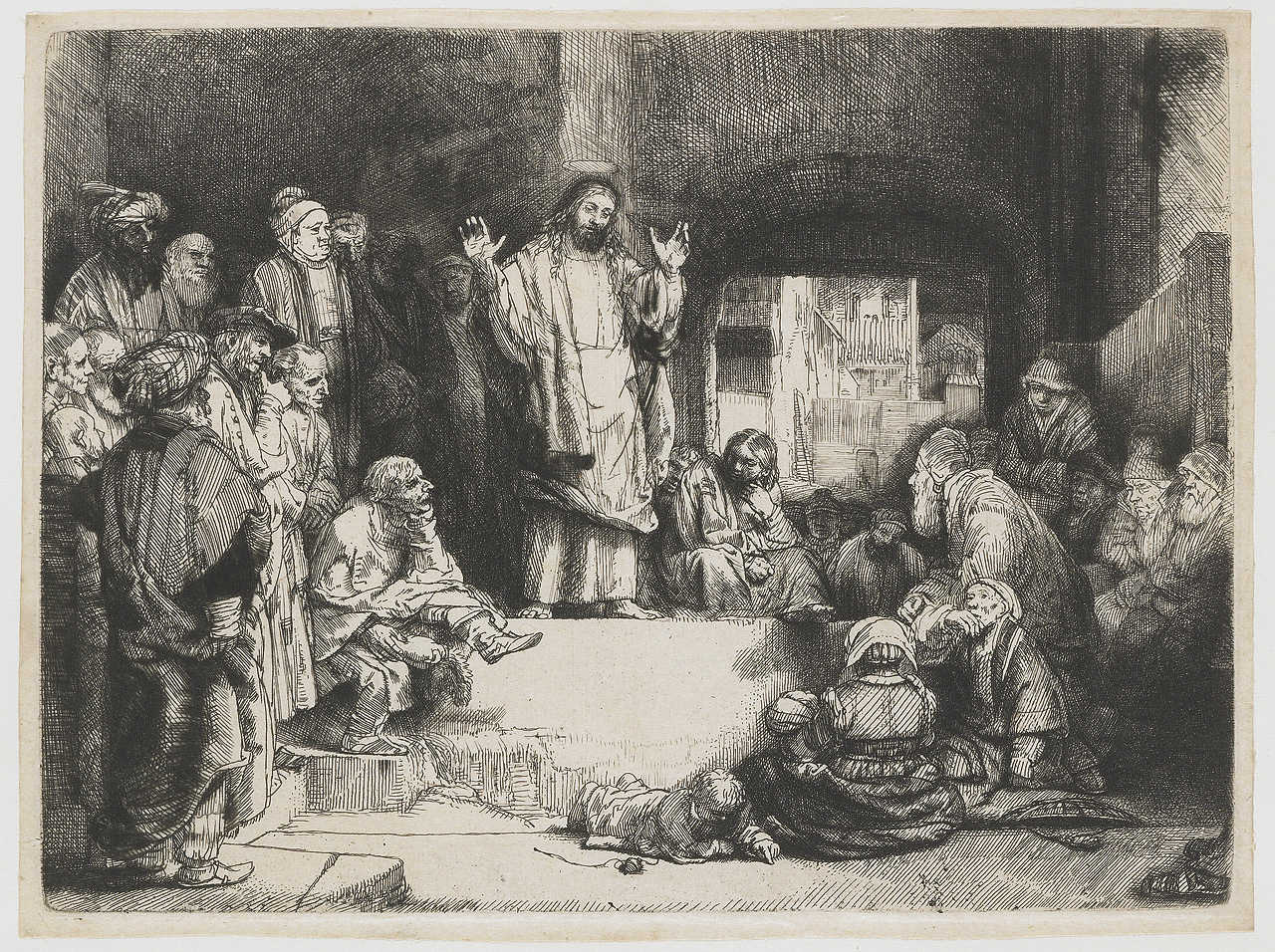
>> “Christ Preaching” by Keene Carter, Image: “I forgive the absent boy,” begins this poem based on a Rembrandt etching, directing our attention to the young child in the foreground who has turned away, disinterested, from Jesus’s sermon, drawing on the ground instead. Jesus gives grace to those in the crowd with averted gazes or who are distracted, simply continuing to preach on on the virtue of empathy—of seeing yourself in others—and on true life.

Rembrandt_Christ Preaching (1652)
Rembrandt van Rijn (Dutch, 1606–1669), Christ Preaching (La Petite Tombe), ca. 1652. Etching, engraving, and drypoint on paper, 6 1/4 x 8 5/16 in. (15.9 × 21.1 cm). National Gallery of Art, Washington, DC.

>> “L’Angélus” by Seth Wieck, Grand Little Things: The Angelus is a traditional Christian prayer whose name comes from its opening words in Latin, “Angelus Domini” (The angel of the Lord). For centuries it was prayed by the faithful three times a day—at 6 a.m., noon, and 6 p.m.—the times announced by the ringing of bells from church towers. In the nineteenth century Millet famously painted two peasant farmers at dusk pausing from their labor in the fields to bow their heads and pray the Angelus. Seth Wieck interprets the painting through poetry, homing in on the part of the prayer that says, “Let it be done to me according to thy word,” expressing an attitude of surrender to God’s will. Wieck imagines the hard life of the man and woman shown pulling up potatoes from the earth—the same earth in which, shortly hence, they’ll bury a child, lost to sickness. The poem becomes a meditation on death, harvest, and acceptance.

Millet, Jean-Francois_The Angelus
Jean-Franҫois Millet (French, 1814–1875), The Angelus, 1857–59. Oil on canvas, 55.5 × 66 cm. Musée d’Orsay, Paris.


DONATE

I am committed to keeping all Art & Theology posts freely available to all; no paywalls here. To help me make a part-time living developing content for the site, would you consider donating to the work, or supporting my research by buying me a book from my Amazon wish list? I appreciate it!

From “On Pentecost” by Romanos the Melodist (poem)

Pentecost (Ottonian)
The Descent of the Holy Spirit, from a benedictional made in Regensburg, Germany, ca. 1030–40. Tempera colors, gold leaf, and ink on parchment, 9 1/8 × 6 5/16 in. (23.2 × 16 cm). J. Paul Getty Museum, Los Angeles, Ms. Ludwig VII 1 (83.MI.90), fol. 47v. As is traditional in artistic depictions of this subject, the apostle Paul (with brown beard) is seated in a prominent position opposite Peter, receiving the Spirit like the other eleven apostles. Paul was not present at the event, but he was later mystically joined to it.

. . .

Peter, speaking like this to the apostles, roused them to prayer,
And standing in their midst, he spoke as follows:
“On bended knee let us beg and pray
That we shall make this chamber a church, for so it is and has become.
Let us be eager to cry unto God,
‘Send us thy good spirit
So that it may lead all of us to correct knowledge
Which thou hast prepared for those who worship and praise
The All-Holy Spirit.’”

When they heard this, those who had been called with him gathered together
As lambs in the presence of the shepherd, charmed by his speech;
And silently they specified what they desired,
And they held up to the Pantokrator the prayers which pressed for these things:
“To the Lord of angels and the King,
To the Ruler of humankind and the Maker of the world,
To the One who holds sway with his nod over those in heaven and earth,
Thy friends and servants cry to thee: ‘Quickly send us
The All-Holy Spirit.’”

Immediately after completing their prayers, they wrote their names under them,
And sealing them in faith, they sent them on high—
Prayers which the Master recognized and he said:
“Comforter, descend as thou dost wish, of thy own initiative, and without being summoned;
The disciples expect thee; they are the ones
Whom I gather together for thee and the Father,
The ones whom I educated when I said: ‘Teach the nations,
Extolling the Father, and worshiping the Son, and praising
The All-Holy Spirit.’”

God heard their wants, and his Comforter
Descended on those who were praying.
The Ineffable One was not removed from one place to the other,
Nor was there alteration, nor accommodation, nor did he endure diminution,
For he was above, and below, and everywhere;
For the divine nature is ineffable and not to be touched;
It is not seen by the eyes, but it is apprehended through faith;
It is not grasped in the hands; but it is felt in hearts of faith—
The All-Holy Spirit.

When the divine Pentecost was complete, the eleven chosen ones set up a din.
As they persevered in their prayers,
And as the passage read from Acts says,
When the sound of the powerful wind of the spirit suddenly came resounding from heaven,
The whole chamber was filled with fire.
Indeed, it amazed the beloved disciples rather too much.
When they saw the dwelling tossed like a boat, they cried:
“O Master, check the storm and send
The All-Holy Spirit.”

When the disciples recognized that the whole upper room was shaken as by an earthquake from the wind,
They all lowered their eyes in fear;
And lo! Another trembling still more to be shuddered at,
And one upon another marvel brought a second trembling in addition to the first fear,
For fiery tongues touched them anew
And began to appear on the heads of the chosen group.
Indeed, the fiery tongues did not burn their hair but lighted up their hearts
And sent them forth cleansed and purified—
The All-Holy Spirit.

Peter, seeing all the things which were happening, cried out: “Brothers,
Let us hold in reverence what we see, and let us not examine it.
Does anyone say what it is that has been done?
For what has been accomplished transcends belief and defies thought.
Spirit and fire are united—a true miracle;
Air and flame are joined together—awesome sight!
Along with winds, torches; along with dew, sparks of fire.
Who has seen, who has heard of this? Who is able to speak of what is produced by
The All-Holy Spirit?

“Do you, then, dearly beloved, stand and simply observe the fire
Which the One who is in heaven has sent from on high;
Do not fear, for the coals do not burn;
Do not be amazed that the fire does not burn, but as prudent men remember
How long ago the fire received kindly the three children,
How their bodies were not burned, nor their hair,
How the furnace revealed the three as four,
For it gave back those whom it received with interest, since it feared
The All-Holy Spirit.

“Then, brothers, let the One descended upon us cast out fear from our minds,
And make a show of love to the Ascended One.
Since he loved those whom he called,
Since all the things which he prophesied, he has fulfilled, and since he has done as he said,
Why, then, should we be afraid of a flame which does not burn?
Let us consider the fire as roses, which indeed it is.
It has been placed upon our heads like flowers,
And on our heads it has formed a crown, an ornament, and illumined us,
This All-Holy Spirit.”

. . .

This passage constitutes strophes 4–12 of a sixth-century Pentecost kontakion (poetic homily) by Romanos the Melodist, translated by Marjorie Carpenter in Kontakia of Romanos, Byzantine Melodist; I: The Person of Christ (Columbia: University of Missouri Press, 1970). For the original Greek, see #33 in the critical edition edited by Paul Maas and Constantine Athanasius Trypanis, Sancti Romani Melodi Cantica Genuina (Oxford: Clarendon Press, 1963).

Three details stand out to me: the prayers of the apostles for the Spirit being sent up like signed, sealed letters to the heavens, eliciting God’s affirmative response; the paradoxical mingling of dew and fire (two seemingly incompatible elements) in the Spirit’s descent, both refreshing and enflaming; and the image of the Pentecostal flames as roses that crown the apostles’ heads!

Romanos is known for his kontakia, a form of hymn in the Byzantine liturgical tradition that Romanos is believed to have introduced. The kontakion is basically a poetic sermon that was sung, containing highly dramatic features, including dialogue, but it was not staged. At its inception in the early sixth century and through the seventh, a kontakion consisted of a prologue (the prooimoion or koukoulion) followed by eighteen to thirty metrically identical strophes (oikoi or ikoi, i.e., stanzas; sing. oikos or ikos) linked by a refrain. (In the example above, the refrain is “The All-Holy Spirit.”) The first letter of each of the strophes often forms an acrostic.

Kontakia were written to be sung at the Daily Office, not Mass, on feast days. Unfortunately, none of the music Romanos wrote for his survives.

By the eighth century, the kontakion had become shortened, and it lost its homiletic character and its dialogue.


Romanos the Melodist (fl. 536–556 CE) was a preeminent Byzantine hymnographer and composer who is said to have written, in Greek, nearly a thousand kontakia, of which fifty-nine (text only) survive, his best known being on the Nativity of Christ. He was born in the late fifth century to a Jewish family in Emesa (modern-day Homs), Syria, but was baptized into Christianity as a young boy. He later moved to Berytus (Beirut) and was ordained a deacon of the Church of the Resurrection there. During the reign of Emperor Anastasius I (r. 491–518) Romanos moved to Constantinople and served as sacristan at Hagia Sophia, residing in that capital city until his death. He was sainted by the Greek Orthodox Church, which celebrates his feast on October 1. The famous Akathist Hymn to the Theotokos is attributed to him.

Pentecost roundup: “All Flesh” by Steve Thorngate, animated fabrics, and more

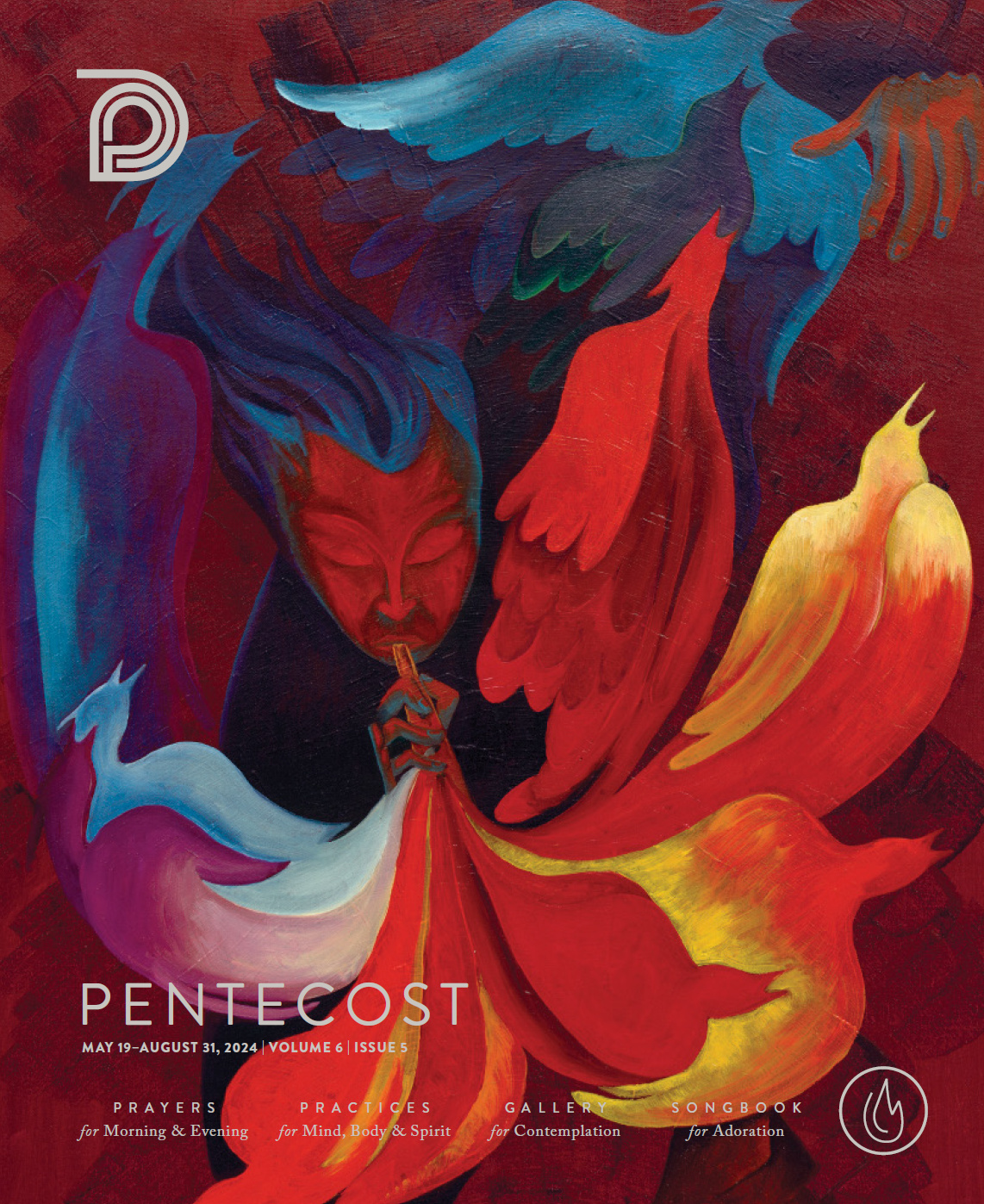
LIVING PRAYER PERIODICAL: Pentecost 2024: The latest edition of the Daily Prayer Project’s Living Prayer Periodical is available for purchase! Pentecost is this Sunday, May 19, so grab your copy soon. The booklet provides a distinct liturgy of scripture and prayer for each day of the week, through August 31, as well as art with accompanying reflections, songs, spiritual practice essays, and, new this issue, a poem! I curate the art and poetry for the DPP. The cover image is cropped from a painting by the Guatemalan artist Juan Francisco Guzmán (it’s reproduced in full in the interior). And the poem we feature, which I wrote a short commentary for to help readers engage it more meaningfully, is “Not Like a Dove” by Mary F.C. Pratt; I’m grateful to the directors for taking a risk with this unusual, even difficult, poem, which rewards those willing to sit with its imagery over time.

Pentecost LPP 2024

+++

SERMON (text only): “When the Spirit Comes” by N. T. Wright: Preached May 23, 2010, at Durham Cathedral, where he was bishop at the time, this Pentecost sermon by the esteemed N. T. Wright is a rousing call to stand, like Jesus, at the place where heaven and earth collide: in the Spirit. Here are two excerpts:

  • “The point about Pentecost is that it’s the point at which two worlds collide and look like they are now going to be together for keeps. The two worlds are of course heaven and earth. . . .
              The whole point of heaven and earth in Jewish thought is that they are meant to meet and merge. And the point of the gospel story as Luke has told it in his first volume is that Jesus had come to bring the life of heaven and earth together. That is the meaning of the ‘kingdom of God’. Thy kingdom come, he taught us to pray, on earth as in heaven. The disciples, we may presume, had been praying that prayer, among others, in the fifty days since Easter. And now the prayer is answered.”
  • “When the Spirit comes, the Spirit will prove the world wrong [in how things are run] . . . which is not a comfortable message, and it’s not meant to be. But if we can at least recognise that discomfort, and see it as the thing you should expect when the two worlds collide, we can put our shoulders back, take a deep breath – in other words, breathe in God’s breath – and get on with the task to which the New Testament commits us but in which . . . we feel a strange reluctance.
              Of course we can get it wrong, and of course we will find it awkward. But how much more wrong would it be not to try! How much more awkward, when God finally brings heaven and earth fully together, will it be to discover that we had continued to live in the split-level world when we were invited, by Ascension and Pentecost together, to dare and to risk the possibility of bringing them together in our own lives and in our own witness! Because of course none of this is in the last analysis ‘about’ us. If we are embarrassed at the heaven-and-earth conjunction, we are forgetting that we are not, after all, the centre of attention in all this. Jesus went on to say that the Spirit would glorify him, not us: he will take what belongs to Jesus and declare it to us and through us to the world.”

+++

MUSIC:

>> “All Flesh” by Steve Thorngate: This playfully serious song is rooted in Joel 2:28–29, which Peter quotes in his sermon at Pentecost: “I will pour out my spirit on all flesh; your sons and your daughters shall prophesy, your old men shall dream dreams, and your young men shall see visions. Even on the male and female slaves, in those days I will pour out my spirit.” Thorngate wrote it several years ago, but this recording, new this year, is the first he’s released, and it’s available only on Bandcamp for now.

>> “Ruach” by Delvyn Case, performed by the Mivos Quartet: Inspired by the story of Pentecost in Acts 2, this sacred concert work for string quartet, writes composer Delvyn Case, “bring[s] to our awareness many different ways ‘breath’ and ‘spirit’ can become sonically and dramatic present. Throughout the piece the performers are asked to make various kinds of breath sounds with their instruments and their own voices, blurring the line between music and sound. Overall, the piece emphasizes idea of the spirit as a powerful force that is surprising, shocking, and fundamentally resistant to control.”

>> “Sweet, Sweet Spirit” by Doris Akers, performed by Ruah Worship: Consisting of siblings Joshua Mine, Julia Mine, Erika Grace Izawa, and Marian Mine, Ruah Worship from Japan performs original worship songs as well as covers. I especially love their a cappella arrangements of Black gospel songs. Here they sing a song by Gospel Music Hall of Famer Doris Akers (1923–1995), about the sweetness of the Holy Spirit, who revives communities and fills them with love.

+++

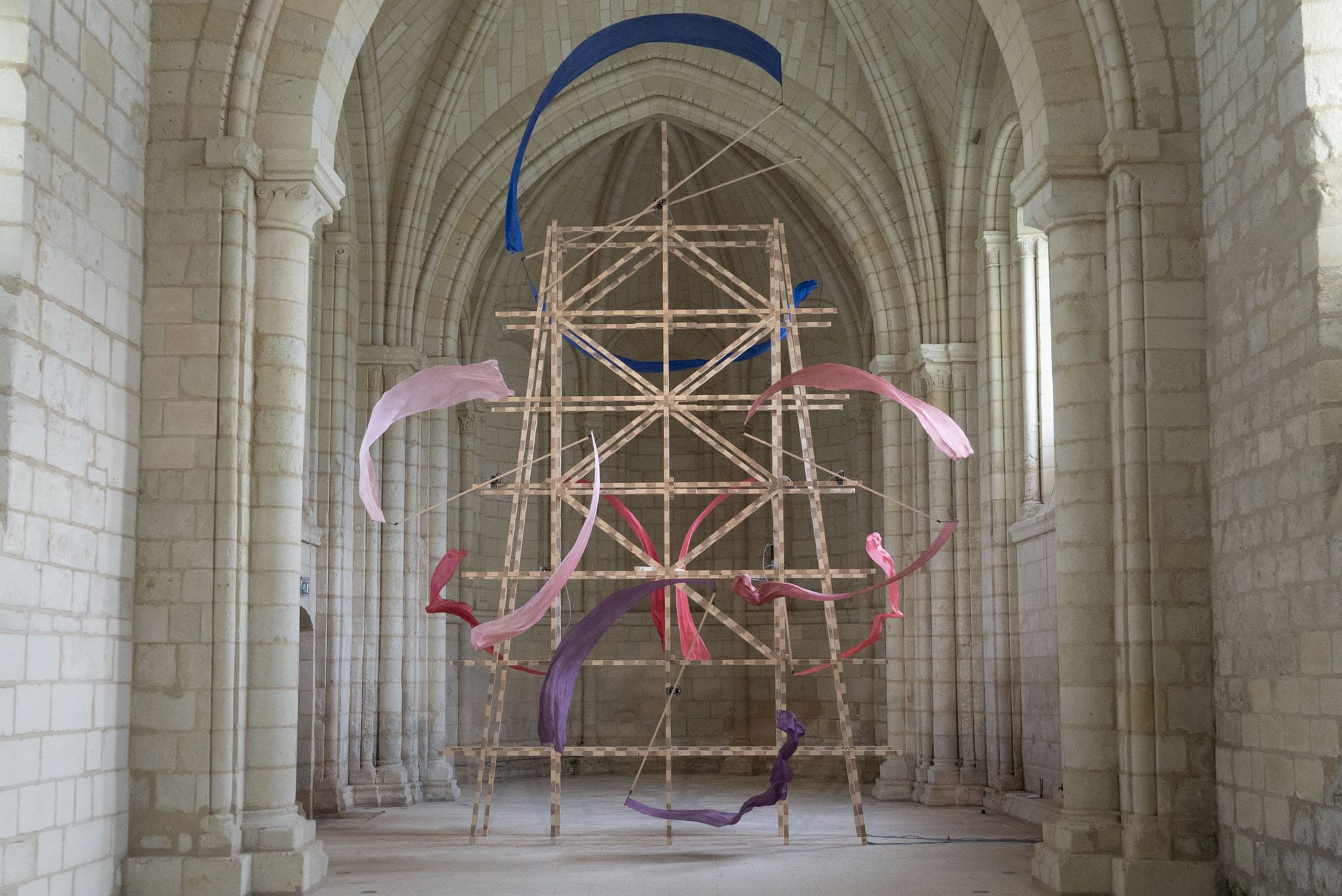
ART INSTALLATION: Fanions et Carillons by Pinaffo & Pluvinage: I learned of this kinetic sculpture by the French artist duo Marion Pinaffo (b. 1987) and Raphaël Pluvinage (b. 1986) in a Colossal article in February and thought of the movement of the Holy Spirit. Fanions et Carillons, French for “Pennants and Chimes,” was commissioned by Fontevraud Abbey and was on display earlier this year in one of the abbey’s twelfth-century chapels. Inspired by the historical striking clocks of churches, the automaton comes to life every half hour, sending fourteen pennants of blue, red, pink, and purple swinging and swirling.

Fanions et Carillons
Marion Pinaffo and Raphaël Pluvinage (aka Pinaffo & Pluvinage), Fanions et Carillons, 2023. Painted wood, motor, silk, electronic, 4 × 2 × 7 m. Temporary installation at the Chapelle St-Benoît, Abbaye Royale de Fontevraud, Anjou, Maine-et-Loire, France.

On their website, Pinaffo & Pluvinage write of the piece, “Although its mechanics are simple and rudimentary, using rotational or pendulum movements, it doesn’t produce the sound of bells, but rather animates fabrics. A set of 14 inert pennants awaken in turn to create ephemeral forms that mutate, respond and compose. Like a harmony of chimes creating a melody, this ensemble creates a choreography lasting a few minutes at regular intervals.” Whereas one might associate a certain rigidness and predictability with clocks, in this piece there’s a freedom, with the pennants moving at different rates and occasionally reversing direction.

+++

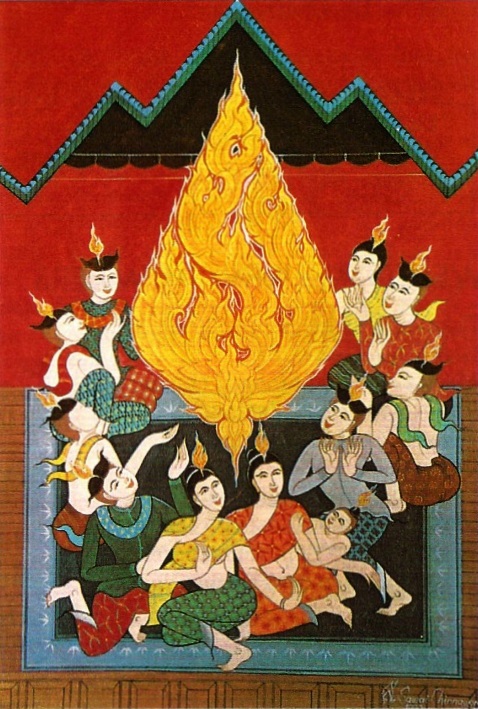
ARTICLE: “Painting Pentecost: Painter Sawai Chinnawong saturates the outpouring of the Spirit with the colors Thai art traditionally associates with the holy” by Amos Yong and Jonathan A. Anderson, Christian Century: Adapted from the book Renewing Christian Theology: Systematics for a Global Christianity (Baylor University Press, 2014), this article explores one of the Pentecost paintings of Thai Christian artist Sawai Chinnawong, who adopts and adapts a Thai Buddhist visual vernacular in terms of color choices, design elements, and the gestures and postures of figures. I’m appreciative of how the painting shows both men and women, and even a child, present at Pentecost and being recipients of the gift of the Spirit, as they surely were.

Chinnawong, Sawai_Pentecost
Sawai Chinnawong (Thai, 1959–), Pentecost, 1997. Acrylic on canvas.

(Related post: “Pentecost art from Asia”)

Some Christians are uncomfortable with art that transposes biblical events into other cultural contexts. But I think it’s a beautiful picture of the global character of the gospel, which has taken root in countries all over the world. As the authors write, in addition to celebrating a historic event, Chinnawong’s Pentecost “prompts us to see this as another event altogether: the outpouring of the Spirit in a room in 21st-century Bangkok rather than first-century Jerusalem. Chinnawong sets the scene here not out of disregard for the historical particularity of the original event but as a means of imagining and visually praying for the Spirit’s presence in his own historical moment. For Chinnawong, the Holy Spirit’s filling is not isolated to a single event, a particular moment, or one place but may be repeated at any time and place and for any people. Thus the circle of believers being filled with the Spirit is repeatedly repopulated and renewed.”

Joseph Stella’s flowering Madonnas and nature paintings

Last summer my husband and I drove up to Chadds Ford, Pennsylvania, to see the Joseph Stella: Visionary Nature exhibition at the Brandywine Museum of Art, which ran June 17–September 24, 2023. (Before that it was shown at the Norton Museum of Art in West Palm Beach, Florida, and the High Museum of Art in Atlanta.) It was lovely! There’s an accompanying catalog still available.

Joseph Stella (1877–1946) was born in the mountain village of Muro Locano in southern Italy, near Naples, and immigrated to New York at age eighteen, becoming a US citizen in 1923. He traveled much throughout his life—between his native country and his adopted country, but also for extended stays in Morocco, Chad, Algeria, France, and Barbados. In Paris in 1911–12 he met many of the leading artists of the European avant-garde, including Matisse, Picasso, and Modigliani, and was exposed to the full range of developments in modern art—postimpressionism, Symbolism, fauvism, cubism, surrealism, futurism, dadaism.

Though Stella absorbed some of these influences, he never aligned with a single group or movement. Art historian Abram Lerner says Stella is difficult to pin down, describing him as “a multiple stylist of unusual scope and energy,” both a modernist and a traditionalist. [1] In terms of content, his oeuvre is divided fairly evenly between urban industrial subjects—his most famous paintings are probably those from his series on the Brooklyn Bridge—and joyful and abundant nature.

Joseph Stella: Visionary Nature, curated by Stephanie Heydt and Audrey Lewis, spotlights the latter. Many of Stella’s paintings feature birds and foliage hieratically positioned around a central axis, such as Dance of Spring (Song of the Birds).

Stella, Joseph_Dance of Spring
Joseph Stella (Italian American, 1877–1946), Dance of Spring (Song of the Birds), 1924. Oil on canvas, 42 3/8 × 32 3/8 in. (107.6 × 82.2 cm). Kemper Museum of Contemporary Art, Kansas City, Missouri. Photo: Victoria Emily Jones. [object record]

Stella, Joseph_Dance of Spring (detail)
Dance of Spring (Song of the Birds) (detail)

Stella, Joseph_Dance of Spring (detail)
Dance of Spring (Song of the Birds) (detail)

“Here,” reads the wall text,

Stella assembles a classical temple of flora and fauna—in his own words, culled “from the elysian lyricism of the Italian spring.” Flowers rise from a pink lotus at the base of a central column, culminating in the curious combination of lupine and a longhorn steer’s head flower, a floral form that resembles a bull’s skull. Below perch three sparrows, the national bird of Italy and a favorite of Stella’s.

At over six square feet, Stella’s Flowers, Italy is an even more epic floral composition, a symphony of vitality and color.

Joseph Stella (Italian American, 1877–1946), Flowers, Italy, 1931. Oil on canvas, 74 3/4 × 74 3/4 in. (189.9 × 189.9 cm). Phoenix Art Museum, Arizona. Photo: Victoria Emily Jones.

From the wall text:

Order and symmetry are in constant tension with the spontaneity of organic ornamentation. The canvas overflows with colorful depictions of flowers and birds within a setting evoking Gothic architecture: pillars of gnarled tree trunks extend outward from the center, as if aisles of a cathedral. Lupine, gladiolas, and birds-of-paradise fill the vertical spaces with a spectrum of colors simulating stained glass windows. Like a congregation in the pews, a host of smaller flowers and plants are gathered below.

Stella, Joseph_Flowers, Italy (detail)
Flowers, Italy (detail)

Stella, Joseph_Flowers, Italy (detail)
Flowers, Italy (detail)

Despite the title, the flowers depicted are not all native to Italy; Stella culled them from his world travels, and some are his own mystical inventions.

Stella sought to portray the voluptuousness and spirituality of his Italian homeland. He was raised in the Catholic faith, and although he didn’t practice as an adult, he remained proud of that heritage. Devotion to the Virgin Mary was a prominent aspect of his religious experience growing up, and in the 1920s he began painting a series of Madonnas, three of which were part of this exhibition.

Art historian Barbara Haskell identifies some of the artistic influences on these paintings:

The garlands of fruits and flowers that surrounded his Madonnas and their embroidered garments of lacy floral patterns recalled the work of the fifteenth-century Venetian Carlo Crivelli, while their impassive countenances, downcast eyes, and long, slim hands folded under translucent cloaks owed a debt to the Dugento masters Cimabue and Duccio. Yet Stella’s paintings were equally influenced by the flat, naive, and colorful images of the Madonna that proliferated in the popular devotional images and folk art of Southern Italy . . . in prayer sheets and books, scapulars, and ex-votos as well as in the profusion of silk and plastic flowers on altars and religious images. [2]

Stella, Joseph_The Virgin
Joseph Stella (Italian American, 1877–1946), The Virgin, 1926. Oil on canvas, 39 11/16 × 38 3/4 in. (100.8 × 98.4 cm). Brooklyn Museum, New York. Photo: Victoria Emily Jones. [object record]

His 1926 Virgin from Brooklyn Museum is my favorite. It shows Mary enshrined among the fruits and flowers of the Mediterranean, with tendrils sweeping up and down her mantle and robe, adorning her neck like a necklace, sprouting out of her prayerful hands, and encircling the womb where she gestated Jesus. The Joseph Stella: Visionary Nature curators provided the following commentary in the wall text:

Eyes downcast and hands folded in a traditional Christian gesture of spiritual humility, Stella’s Madonna is set against the distinctive topography of Naples. Visible in the background is Mount Vesuvius, the smoldering volcano that erupted in AD 79 and a landmark of Southern Italy. The halo-like orb surrounding the Virgin’s head, seemingly nestled into the profiles of the mountains, transforms the modern Naples into a site of religiosity. Stella described “the Virgin praying [. . .] protected, on both sides, by almond blossoms, crowned above by the wreath of the deep and clear gold of the orange and lemon trees.”

Stella captures the wild beauty, the fecundity, the blossoming of Mary when the Holy Spirit plants his seed in her and she conceives God’s Word. Her acceptance of the divine call that the angel Gabriel relays to her produces life that redounds to all of humanity and indeed to the whole world. It’s why Mary’s cousin Elizabeth exclaims to her, “Blessed are you among women, and blessed is the fruit of your womb!” (Luke 1:42).

Stella, Joseph_The Virgin (detail)
The Virgin (detail)

Stella, Joseph_The Virgin (detail)
The Virgin (detail)

There’s a long tradition in Christianity of describing Mary’s conception of Jesus as a flowering and of honoring her with flowers. I’m reminded especially of the twelfth-century mystic Hildegard of Bingen’s many hymns and antiphons that celebrate Mary in such terms.

Yes your flesh held joy like the grass
when the dew falls, when heaven
freshens its green: O mother
of gladness, verdure of spring. [3]

Pierced by the light of God,
Mary Virgin,
drenched in the speech of God,
your body bloomed,
swelling with the breath of God. [4]

You glowing,
most green,
verdant sprout,

in the movement of the spirit,
in the midst of wise and holy seekers,
you bud forth into light.

Your time to blossom has come.

Balsam scented,
in you
the beautiful flower
blossomed. [5]

The Brooklyn Virgin could be read as an Annunciation image, the Incarnation taking place inside this young woman who said yes to God. The sailboats on the sea, their movement reliant on the wind, may allude to the Holy Spirit who blew onto the scene in a major way in Luke 1 to move salvation history forward.

Stella, Joseph_Virgin of the Rose and Lily
Joseph Stella (Italian American, 1877–1946), The Virgin (Virgin of the Rose and Lily), 1926. Oil on canvas, 57 1/2 × 44 3/4 in. (146.1 × 113.7 cm). Private collection, courtesy of Collisart, LLC, New York. Photo: Victoria Emily Jones. [object record]

The reference to outdoor religious processions with painted wooden Madonnas in southern Italy is more pronounced in Stella’s Purissima, in which the Mary figure, nearly life-size, is very stiff, statuesque. Co-curator Stephanie Heydt from the High Museum of Art introduces the work in this three-and-a-half-minute video:

Stella, Joseph_Purissima
Joseph Stella (Italian American, 1877–1946), Purissima, 1927. Oil on canvas, 76 × 57 in. (193 × 144.8 cm). High Museum of Art, Atlanta, Georgia. Photo: Victoria Emily Jones. [object record]

“Mater Purissima” (Purest Mother), or “Virgo Purissima” (Purest Virgin), is one of Mary’s titles in Catholicism. The artist gave the following description of the painting:

Clear morning chanting of Spring.

BLUE intense cobalt of the sky—deep ultramarine of the Neapolitan sea, calm and clear as crystal—and alternating with zones of lighter blue, the mantle multicolored (an enormous lily blossom turned upside down).

SILVER quicksilver of spring water, quilted with the rose, green, and yellow of the gown—greenish silver, very bright—mystic DAWN-white—of the Halo.

WHITE as snow for the two herons, whose gleaming white necks enclose, like a sacred shrine, the prayer of the VIRGIN.

YELLOW very light—for the edges of the mantle—to bring it out clearly with diamond purity, and reveal the hard firm modeling of the virginal breast. The lines of the mantle fall straight over the long hieratic folds of the gown, forming a frame—and the full, resonant yellow of unpeeled lemons at both sides of the painting like echoing notes of the propitious shrill laughter of SPRING.

VIOLET mixed with ultramarine for the zigzag motif in the panel along the edge of the mantle, and bright, fiery violet at the top of Vesuvius, near the white fountainhead of incense—light violet tinged with rose, for the distant Smile of Divine Capri.

GREEN soft, tender, like the new grass—intense green for the short pointed leaves that enclose the lemons—and a dark green, both sour and sweet, for the palms that fan out at the sides like mystic garlands.

PINK strong—rising to the flaming, pure vermilion borders—of the Rose, brilliant as a jewel, in contrast to the waxy pallor of the hands clasped in prayer—and infinitely subtle, delicately modulated rose for the small flowers that with the others of various colors weave of dreams and promises and splendid bridal gown of the “Purissima.” [6]

Like his Brooklyn Virgin, this painting is also set in the Bay of Naples, with Mount Vesuvius gently erupting in the right background, and the island of Capri rising up out of the sea on the left.

Stella, Joseph_Purissima (detail)
Purissima (detail)

Stella, Joseph_Purissima (detail)
Purissima (detail)

Three pink lilies create a frame around the Purissima, their long stalks rising up on either side of her, with one flower bending down to crown her head with its filaments and anthers. She is attended not by angels but by herons, along with other critters at her feet. This is a Madonna both earthy and supernal.

Here are a few more photos from the exhibition:

Stella, Joseph_Aquatic Life (Goldfish)
Joseph Stella (Italian American, 1877–1946), Aquatic Life (Goldfish), ca. 1919–22. Pastel on paper. American University Museum, Washington, DC. Photo: Victoria Emily Jones.

Stella, Joseph_Lyre Bird
Joseph Stella (Italian American, 1877–1946), Lyre Bird, ca. 1925. Oil on canvas, 54 × 30 1/8 in. (137.2 × 76.5 cm). Addison Gallery of American Art, Phillips Academy, Andover, Massachusetts. Photo: Victoria Emily Jones.

Stella, Joseph_Tree, Cactus, Moon
Joseph Stella (Italian American, 1877–1946), Tree, Cactus, Moon, ca. 1928. Gouache on paper, 41 × 27 in. (104.1 × 68.6 cm). Reynolda House Museum of American Art, Winston Salem, North Carolina. Photo: Eric James Jones. [object record]

Stella, Joseph_Banyan Tree
Joseph Stella (Italian American, 1877–1946), Banyan Tree, ca. 1938. Oil on canvas, 36 1/2 × 31 1/2 in. (92.7 × 78.7 cm). Myron Kunin Collection of American Art, Minneapolis, Minnesota. Photo: Victoria Emily Jones.

View additional select images in the exhibition’s press kit.


NOTES

1. Abram Lerner, foreword to Judith Zilczer, Joseph Stella: The Hirshhorn Museum and Sculpture Garden Collection (Washington, DC: Smithsonian Institution Press, 1983), 6.

2. Barbara Haskell, Joseph Stella (New York: Whitney Museum of American Art / Harry N. Abrams, 1994), 151.

3. From Hildegard of Bingen, “Hymn to the Virgin,” trans. Barbara Newman, in Symphonia: A Critical Edition of the “Symphonia armonie celestium revelationum” (Ithaca, NY: Cornell University Press, 1988, 1998), 123.

4. From Hildegard of Bingen, “Antiphon for the Virgin,” in Symphonia, 137.

5. From Hildegard of Bingen, “A Song to Mary,” rendered by Gabriele Uhlein, in Meditations with Hildegard of Bingen (Rochester, VT: Bear & Co., 1983), 119.

6. English translation from Irma B. Jaffe, Joseph Stella (Cambridge: Harvard University Press, 1970), 99–100. For the original Italian, see appendix 1, #29.

Marian roundup: Contemporized statuettes, Mary as an icon of literacy, and more

Since the Middle Ages, the Roman Catholic Church has celebrated May, a time of new growth, as “Mary’s month.” The calendrical placement of this celebration probably has to do in part with the fact that the ancient Greeks celebrated a festival to Artemis, the goddess of fecundity, in May; the ancient Romans, Flora, the goddess of flowers and spring. Because Mary, by the power of the Holy Spirit, conceived in her womb and brought to birth the life of the world, Jesus Christ, Christians see her as standing at the threshold of an eternal springtime.

[Related posts: “‘May is Mary’s month’: Hopkins poem meets Glasgow style”; “Bursting with God-News (Artful Devotion)”]

POLL QUESTION: Before moving on to the six roundup items below, if you are a regular reader of this blog or other media like it, would you please help me out by answering the following poll question? (I’m trying out this WordPress feature for the first time!) Over the years I’ve gathered a lot of compelling poems and artworks on the Annunciation, encompassing a variety of eras, styles, and perspectives, and I’d like to pursue the idea of turning one or the other, or both, into a book. Which kind of Annunciation-themed book would you be most inclined to buy? Keep in mind that a book with art would cost significantly more because it would be in full color and probably a larger hardcover. Also note that a book that combines art and poetry would obviously have fewer selections of each than a book dedicated fully to one or the other.

+++

UPCYCLED MARY STATUETTES: Soasig Chamaillard is a French artist who, since 2006, has been acquiring small, damaged statues of the Virgin Mary—either from garage sales or received donations—and restoring and transforming them, often with reference to children’s toy lines and media franchises, comic book heroes, or other pop-culture icons. Some are silly or irreverent; others, merely quirky. Here are two I like, which both modernize Mary, by her dress or her reading material. Click on the images to view detail photos of the final product, and see here and here for blog posts that document the transformation process.

Jeans Mary (before-after)
Before/After. Right: Soasig Chamaillard (French, 1976–), Jeans-Marie (Jeans Mary), 2015. Plaster, acrylic paint, resin, metal frame, height 48 cm.

Chamaillard, Soasig_New Bible (before-after)
Before/After. Right: Soasig Chamaillard (French, 1976–), Nouvelle Bible (New Bible), 2008. Plaster, acrylic paint, resin, digital print, height 40 cm.

The first shows Mary in high-waisted jeans and red Converse high-tops with rosettes on the tongues. The second one, a Madonna del Parto, shows her pregnant and reading the book J’élève mon enfant (Raising My Child) by Laurence Pernoud, picking up tips on being a new mom.

+++

ESSAY: “Mary: Evolution of a Bookworm” by Joel J. Miller: “It’s unlikely the historical Mary could read at all, but medieval Christians transformed her into an icon of literacy,” often showing her with a book in hand, whether as a child learning to read from her mother, Saint Anne; at the Annunciation, with the book of Isaiah, the Psalter, or a book of hours splayed open on her lap; or teaching her own child, Jesus, how to read. Drawing on the research of Laura Saetveit Miles, author of The Virgin Mary’s Book at the Annunciation: Reading, Interpretation, and Devotion in Medieval England [previously], Joel J. Miller discusses how images of Mary reading “rode a wave of rising female literacy and simultaneously encouraged its expansion.”

Annunciation (Brunswick Casket)
Ivory plate of the Annunciation from the Brunswick Casket, made in Metz, France, ca. 860–70. Herzog Anton Ulrich Museum, Braunschweig, Lower Saxony, Germany. This is the earliest known representation of the Virgin Mary with a book at the Annunciation.

Costa, Lorenzo_Annunciation
Lorenzo Costa (Italian, 1460–1535), Annunciation (Mary Reading), first third of 16th century. Oil on panel, 62 × 60.5 cm. Gemäldegalerie Alte Meister (Old Masters Picture Gallery), Dresden, Germany.

+++

CONVERSATION: “Sacra Conversazione” with Walter Hansen and Bruce Herman: In this written conversation from Image no. 62, artist Bruce Herman [previously] and patron Walter Hansen discuss the two large altarpieces Herman produced comprising six paintings on the life of the Virgin Mary: Miriam, Virgin Mother and Second Adam. The article is about the creative process and Herman’s collaboration with Hansen and with student apprentices in Orvieto, Italy, but it’s also about attempting to recover Mary’s image from a heap of the saccharine or overly exalted on the one hand, and ironic detachment on the other. Herman says,

I had vivid memories of Boston art critics and museum people back in the 1980s telling me that [religious] subject matter could only be approached ironically, but I had a persistent feeling that they were wrong. I’ve sensed for many years that the tradition of biblical imagery in art is far from exhausted—maybe simply stalled out due to loss of nerve or imagination. To me, much of the recent religious imagery we’ve inherited is fairly shallow. I know this might sound odd, given more than a thousand years of tradition, but I honestly believe that new insights are arrived at in every generation. Why can’t a contemporary artist paint the Virgin Mary without irony—and maybe even specifically attack the problematic nature of much Marian imagery? Why can’t a century of experimentation in painting yield something relevant to that tradition?

It’s an excellent conversation! You may have to subscribe to Image journal to access it, but it’s well worth it for all the wonderful content they put out quarterly and access to their archives.

Herman, Bruce_Miriam, Virgin Mother
Bruce Herman (American, 1953–), Miriam, Virgin Mother, 2007. Oil on wood with silver and gold leaf, 95 × 154 in. (241.3 × 391.2 cm).

Read more about the two altarpieces and view more photos at www.bruceherman.com/magnificat, and in the beautifully produced catalog magnificat, with a foreword by Hansen and essays by Rachel Hostetter Smith and John Skillen. The book also features four paintings from Herman’s related Woman series.

+++

ART VIDEOS:

What follows are my two favorite videos from the Visual Commentary on Scripture’s twelve-episode series “Unlocking Christian Art: The Virgin Mary,” in which theologian Ben Quash and art historian Jennifer Sliwka discuss religious artworks from museums in Berlin.

>> “Holy Kinship”: The subject of this video is a late medieval German limewood carving by Hans Thoman depicting Jesus’s extended family on his mother’s side. He and his mom, grandma, grandpa, step-grandpas, aunts, and cousins pose for this matriarchal family portrait that reflects a medieval legend (rejected by the Council of Trent) that Saint Anne was grandmother not just to Jesus but also, through two subsequent marriages, to five of the twelve apostles: James the Greater, Simon, Jude, James the Less, and John the Evangelist. Also included in this sculpture group are Elizabeth and Zechariah with their son, John the Baptist, and Emelia with her son Servatius of Tongeren, a fourth-century saint whom legends name a distant relative of Jesus. [view object record]

>> “Leave-Taking”: From the same period and general region as the above sculpture comes a painting by Bernhard Strigel (1460–1528) that shows Jesus taking leave of his mother just before his entry into Jerusalem the week of his death, a popular subject in northern Europe in the sixteenth century. The episode derives from a versified Marienleben (Life of Mary) from the early fourteenth century written by the Carthusian monk Philipp von Seitz, aka Bruder Philipp, from Middle Franconia. [view object record]

View more videos like this on the VCS YouTube channel.

+++

SONG: “Mary” by Patty Griffin: “Mary, you’re covered in roses, you’re covered in ashes, you’re covered in rain . . .” From the 1998 album Flaming Red by the country-folk artist Patty Griffin, the song “Mary” is a tribute to the woman who mothered Jesus and mothers us all. A compassionate presence who lives on in heaven at her son’s right hand, she feels the pain of other mothers who’ve lost their children. Griffin sings of Mary’s beautiful, big, humble, suffering, nurturing, pondering heart.

+++

POEM: “Christ’s Mother Reflects: His Childhood” by Micha Boyett: This is the last in a series of five Advent poems written from the perspective of Mary for John Knox Presbyterian Church in Seattle in 2010, the other four being on the subjects of the Annunciation, the boy who is snatched away by a dragon in Revelation 12, the Visitation, and the Nativity. Here, after Jesus’s death, Mary reflects back on his life—an early heartbreak of his, his contemplative nature, a question he once asked, his delight in scripture study, the hard choices he made, her own unfulfilled hope for normalcy on his behalf, the tearing of his flesh that mends us.

Easter Hymn from the Early Church

Watanabe, Soichi_To God Be the Glory
Soichi Watanabe (Japanese, 1949–), To God Be the Glory, 2009. Acrylic on canvas, 52 × 39 in. Collection of the Overseas Ministries Study Center at Princeton Theological Seminary.

This is the paschal feast,
the Lord’s passing from death to life:
so cries the Spirit.
No type or telling, this, no shadow.
Pasch of the Lord it is, and truly.

You have protected us, Jesus,
from endless disaster.
You spread your hands like a mother
and, motherlike, gave cover with your wings.
Your blood, God’s blood, you poured over the earth,
giving life, because you loved us.

The heavens may have your spirit, paradise your soul,
but oh, may the earth have your blood!

This feast of the Spirit
leads the mystic dance through the year.
New is this feast and all-embracing;
all creation assembles at it.

Joy to all creatures, honor, feasting, delight!
Dark death is destroyed
and life is restored everywhere.
The gates of heaven are open.
God has shown himself human,
humanity has gone up to God.
The gates of hell are shattered,
the bars of Adam’s prison broken.
The people of the world below have risen from the dead,
bringing good news:
what was promised is fulfilled.
From the earth has come singing and dancing.

This is God’s passing!
Heaven’s God, showing no stinginess,
has joined us together with God in the Spirit.
The great marriage hall is full of guests,
all dressed for the wedding,
no guest rejected for want of a wedding garment.
The paschal light is the bright new lamplight,
light that shines from the virgins’ lamps.
The light in the soul will never go out.
The fire of grace burns in us all,
spirit, divine, in our bodies and in our souls,
fed with the oil of Christ.

. . . . . . . . . . . . . . . . . . . . .

Join, then, all of you, join in this great rejoicing.
You who’ve been working the vineyard from the early hour
and you who came later,
come now and collect your wages.
Rich and poor, sing and dance together.
You who are hard on yourselves, you who are easy,
honor this day.
You who have fasted and you who have not,
make merry today.

The meal is ready: come and enjoy it.
The calf is a fat one: you will not go away hungry.
There’s kindness for all to partake of and kindness to spare.

Away with pleading of poverty:
the kingdom belongs to us all.
Away with bewailing of failings:
forgiveness has come from the grave.
Away with your fears of dying:
the death of our Savior has freed us from fear.
Death played the master: he has mastered death.
The world below had scarcely known him in the flesh
when he rose and left it plunged in bitter mourning.

Isaiah knew it would be so. [Isa. 14:9]
The world of shadows mourned, he cried, when it met you,
mourned at its being brought low, wept at its being deluded.
The shadows seized a body and found it was God;
they reached for earth and what they held was heaven;
they took what they could see: it was what no one sees.
Where is death’s goad? Where is the shadows’ victory?

Christ is risen: the world below [hell] is in ruins.
Christ is risen: the spirits of evil are fallen.
Christ is risen: the angels of God are rejoicing.
Christ is risen: the tombs are void of their dead.
Christ has indeed arisen from the dead,
the first of the sleepers.

Glory and power are his for ever and ever. Amen.

This text is a composite of excerpts from two Easter sermons spuriously attributed to John Chrysostom (ca. 347–407) and drawing inspiration from Hippolytus of Rome (ca. 170–ca. 235), which I adapted from Walter Mitchell’s English translation from the original Greek that appears in Adalbert Hamman, OFM, ed., Early Christian Prayers (Chicago: Regnery Gateway, 1961), 31–35. The source texts can be found in the Patrologia Graeca 59:741–46 and 59:721–24. They probably date to the fourth century.

Roundup: Exhibition at Ely Cathedral, Faith Ringgold video, Ascension Day hymn, and more

Each month I put together a collection of thirty songs on Spotify—an assortment of psalms, hymns, and spiritual songs, old and new. Here’s the playlist for May:

+++

PRESS RELEASE: “Belmont University Launches Creative Arts Collective for Christian Life and Faith”: Supported by a $32 million grant from the Lilly Endowment, Belmont University in Nashville announced on March 26 the launch of a major new nationwide initiative: the Creative Arts Collective for Christian Life and Faith. “Positioned at the intersection of faith and artistry, the Creative Arts Collective is a vibrant community dedicated to exploring the divine through the lens of creativity. We believe in the transformative power of the arts to connect us with God’s profound narrative, uplifting spirits, and uniting hearts in a shared journey of discovery.”

The executive director is Rick Rekedal, who worked for twenty years at DreamWorks Animation on such projects as Shrek, Trolls, Prince of Egypt, Madagascar, Kung Fu Panda, and How to Train Your Dragon.

I’m looking forward to seeing what they do in the coming year!

+++

ART EXHIBITION: “Am I my brother’s keeper?” by Sean Henry, Ely Cathedral, England, April 26–September 1, 2024: Curated by Jacquiline Creswell [previously], this new exhibition places twenty-eight painted, contemporary figures from the oeuvre of British sculptor Sean Henry in various spaces in and outside the historic Ely Cathedral. The exhibition is titled after Cain’s indifferent response to God in Genesis 4, after he has just murdered his brother—a question that prompts us to consider our moral responsibility to care for and support one another.

Henry, Sean_Am I my brother's keeper
Sean Henry (British, 1965–), T.P.O.L.R., 2005, bronze, and LM, 2014, bronze. From “Am I my brother’s keeper?,” an exhibition at Ely Cathedral, 2024. Photo courtesy of the cathedral.

Henry, Sean_Am I my brother's keeper
Sean Henry (British, 1965–), Hedda, 2018, ceramic. From “Am I my brother’s keeper?,” an exhibition at Ely Cathedral, 2024. Photo courtesy of the cathedral.

Henry “captures the human form with compassion, depicting the emotions, struggles, and joys that define us as human,” Creswell writes. “His figures also convey the vulnerability, strength and resilience that exist within each individual. They tell stories, evoke emotions and create connections with the viewer.” View more photos from the exhibition on Creswell’s Instagram page, and see also photos from the similar exhibition she curated for Salisbury Cathedral in 2011, Conflux: A Union of the Sacred and Anonymous.

+++

VIDEO INTERVIEW: “Faith Ringgold’s art of fearlessness and joy”: Faith Ringgold (1930–2024), the trailblazing artist best known for her story quilts documenting African American life, died this month at age ninety-three. This CBS Sunday Morning segment from 2021 is a good introduction to her and her work, which you can explore more of at www.faithringgold.com.

Ringgold, Faith_Church Picnic
Faith Ringgold (American, 1930–2024), Church Picnic Story Quilt, 1988. Tie-dyed, printed fabrics and acrylic on cotton canvas, 74 1/2 × 75 1/2 in. High Museum of Art, Atlanta.

Ringgold, Faith_The Flag Is Bleeding #2
Faith Ringgold (American, 1930–2024), The Flag Is Bleeding #2, from the American Collection series, 1997. Acrylic on canvas, painted and pieced border, 76 × 79 in. Pippy Houldsworth Gallery, London.

+++

HYMN FOR ASCENSION DAY (May 9):

“See the Conqueror mounts in triumph” is a ten-stanza hymn by Christopher Wordsworth, nephew of the great poet William Wordsworth, published in his collection The Holy Year in 1862. The Hymnology Archive provides the full lyrics, a revision history, a textual analysis, and sheet music for the tune Wordsworth preferred for it and the one Henry Smart wrote for it six years later. This is not a widely sung hymn, however. I’ve enjoyed hearing how contemporary songwriters have revitalized it through new tunes. Here are two examples:

>> Music by Jenny & Tyler, on Open Your Doors (2012): This married musical duo living in Nashville, Tennessee, uses a 6/8 time signature in their setting, and they’ve added a bridge.

>> Music by Wes Crawford, on Hymns for This World and the Next (2024): Wes Crawford, the worship pastor at Christ Church of Austin, released an album of thirteen retuned hymns this February, and “See the Conqueror” is one of them.

We need more Ascension hymns! Search this site’s “Ascension” tag to find a few more, as well as other Ascension Day content (sometimes mixed into roundups with other miscellany).

+++

ART COMPILATION: “Ascending Jesus—The Last Glimpse” by Aidan Kimmel: Fr. Aidan Kimmel has compiled eighteen medieval paintings depicting the Ascension of Christ, mostly from manuscripts. In several Jesus leaves behind footprints on the Mount of Olives. So delightful!

Ascension (medieval MS)
The Ascension, from a Bible moralisée made in Bruges, ca. 1455–60. The Hague, National Library of the Netherlands, KB, 76 E 7, fol. 219r. The foregrounded figures are Saint Peter and the Virgin Mary.

Easter Mystery by Maurice Denis (painting)

Last year when I was at the Art Institute of Chicago, I was transfixed by the pointillist painting Easter Mystery by the French artist Maurice Denis.

Denis, Maurice_Easter Mystery
Maurice Denis (French, 1870–1943), Easter Mystery (Mystère de Pâcques), 1891. Oil on canvas, 41 × 40 1/8 in. (104 × 102 cm). Art Institute of Chicago. Photo: Victoria Emily Jones. [object record]

It shows three women dressed in mourning clothes arriving at Christ’s tomb (one ascending the hill, one kneeling, and one prostrate), only to find an angel at its entrance, announcing that Christ has risen. In the midground, visible through a veil of trees, the hand of God bends down to feed a group of white-clad women the body of Christ, a consecrated wafer that gives them eternal life.

Jesus’s teaching in John 6:48–58 is instructive here:

“I am the bread of life. Your ancestors ate the manna in the wilderness, and they died. This is the bread that comes down from heaven, so that one may eat of it and not die. I am the living bread that came down from heaven. Whoever eats of this bread will live forever, and the bread that I will give for the life of the world is my flesh.”

The Jews then disputed among themselves, saying, “How can this man give us his flesh to eat?”

So Jesus said to them, “Very truly, I tell you, unless you eat the flesh of the Son of Man and drink his blood, you have no life in you. Those who eat my flesh and drink my blood have eternal life, and I will raise them up on the last day, for my flesh is true food, and my blood is true drink. Those who eat my flesh and drink my blood abide in me and I in them. Just as the living Father sent me and I live because of the Father, so whoever eats me will live because of me. This is the bread that came down from heaven, not like that which the ancestors ate, and they died. But the one who eats this bread will live forever.”

The Art Institute audio guide (#841) provides the following commentary on the painting:

Maurice Denis belonged to a group of young French artists who called themselves the Nabis after the Hebrew word for prophets. The Nabis were interested in imbuing their subject matter with a sense of mystery and otherness. For Denis, a devout Catholic, an ordinary landscape could be loaded with manifestations of the divine. Denis sets this scene in the village of Saint-Germain-en-Laye, west of Paris, where he lived. The large house in the background would later become his home. In the foreground, an angel emerges from a cave, as if to announce Christ rising, to the mourning Virgin Mary and Mary Magdalene. Behind them are white-clad figures who hasten toward an astonishing sight, the hand of God himself, appearing miraculously from the trees to offer the Eucharist.

Denis strived for simple, flattened forms that sometimes verge on abstraction. He believed this process reflected spiritual purification, and he looked to the work of early Italian Renaissance art, and especially to the work of the painter monk Fra Angelico for inspiration. But he and the other Nabis were also deeply influenced by avant-garde French art. Here, Denis explores the effects of the pointillist technique of building up the picture surface with tiny dots of paint.

A 1994 exhibition catalog for Maurice Denis, 1870–1943 at the Musée des beaux-arts in Lyon expands on the artist’s technique in Easter Mystery. “By treating the surface with a kind of pointillist technique,” it reads, “he accentuates the gentleness of the curves, increases the light everywhere as in a mosaic, and endows the whole composition with an effect of airy lightness. . . . A spring landscape seems to be scattered with regularly spaced dabs of green paint, which work like a prism, breaking the light up into coloured particles. Denis used this method widely in order [in the words of Jean-Paul Bouillon] ‘to embody the truths of love and faith in perceptible form – making a surface quiver.’”

The quivering surface contributes to the mystical quality of the painting, in which mortality is taken up into immortality. By our partaking of the Eucharist, Christ assimilates us into his risen, living body, over which death has no dominion.

Photo by Victoria Emily Jones

This painting is in the public domain, and you are free to use my photos if you wish. To view them in full resolution, right-click and open in a new tab (if viewing on a computer) or pinch to zoom (if viewing on a phone).

“An Easter Carol” by Christina Rossetti (poem)

Woman gathering flowers (Stabiae)
Woman gathering flowers, first century CE. Detached fresco, 38 × 32 cm, from the Villa Arianna in Stabiae, Campania, Italy, now in the Collection of the Museo Archeologico Nazionale di Napoli, Naples, Italy. The woman may be Primavera (a personification of spring) or Flora (the Roman goddess of flowers, fertility, and abundance), or simply a generic maiden at leisure.

Spring bursts today,
For Christ is risen and all the earth’s at play.

Flash forth, thou Sun,
The rain is over and gone, its work is done.

Winter is past,
Sweet Spring is come at last, is come at last.

Bud, Fig and Vine,
Bud, Olive, fat with fruit and oil and wine.

Break forth this morn
In roses, thou but yesterday a Thorn.

Uplift thy head,
O pure white Lily through the Winter dead.

Beside your dams
Leap and rejoice, you merry-making Lambs.

All Herds and Flocks
Rejoice, all Beasts of thickets and of rocks.

Sing, Creatures, sing,
Angels and Men and Birds and everything.

All notes of Doves
Fill all our world: this is the time of loves.

This poem was originally published in A Pageant, and Other Poems (London, 1881) and is in the public domain.

One of the most celebrated poets of the Victorian era, Christina Georgina Rossetti (1830–1894) was an English writer of Romantic, devotional, and children’s poems. She was the youngest of four siblings, among them the Pre-Raphaelite artist Dante Gabriel Rossetti, several of whose paintings she sat for, famously modeling for the Virgin Mary. A devout Anglican whose verse gives vivid expression to the life of faith and to spiritual longing, she is recognized as a saint by the Church of England and the Episcopal Church, who celebrate April 27 as her feast day.