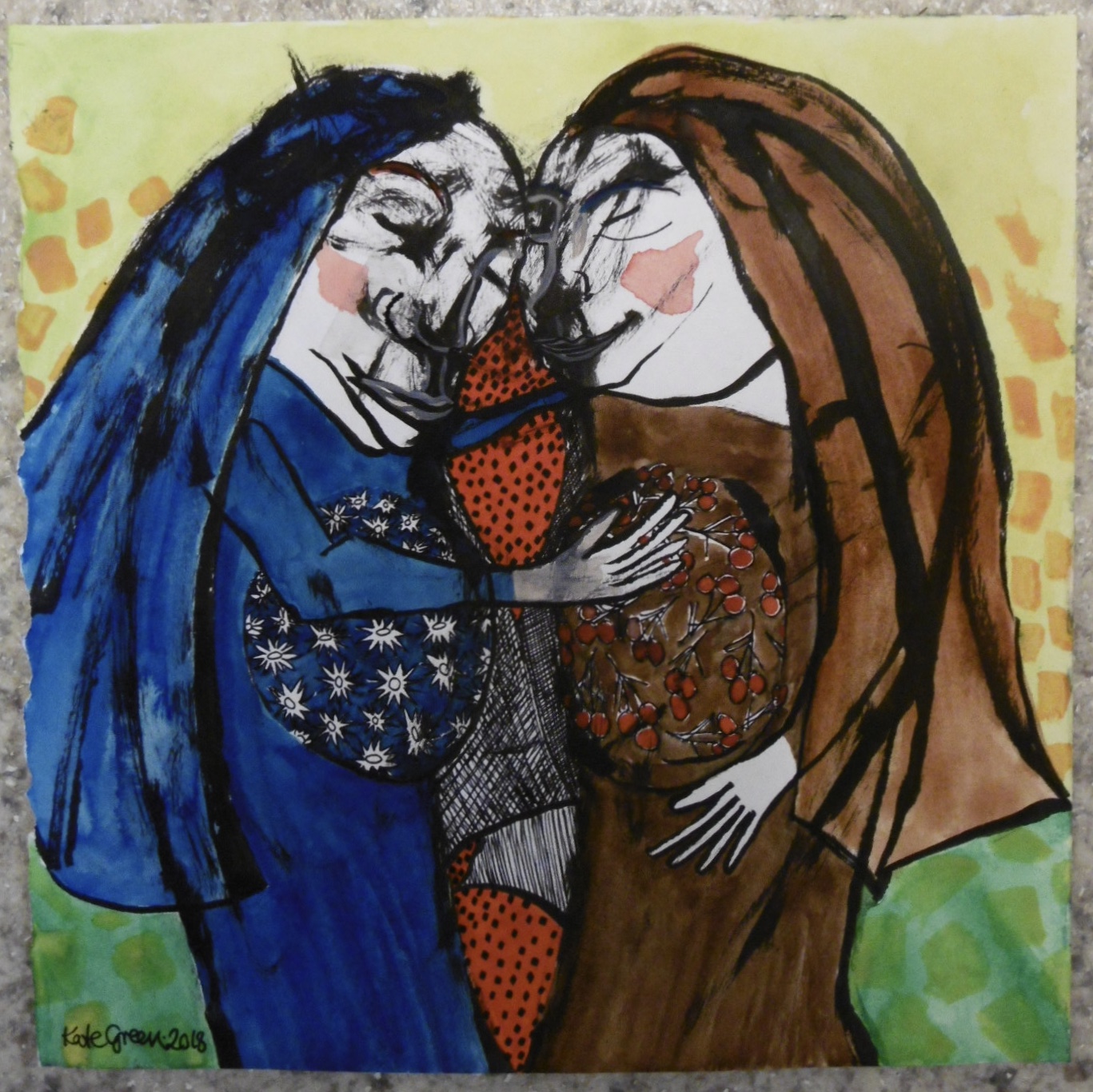
In those days Mary set out and went with haste to a Judean town in the hill country, where she entered the house of Zechariah and greeted Elizabeth. When Elizabeth heard Mary’s greeting, the child leaped in her womb. And Elizabeth was filled with the Holy Spirit and exclaimed with a loud cry, “Blessed are you among women, and blessed is the fruit of your womb. And why has this happened to me, that the mother of my Lord comes to me? For as soon as I heard the sound of your greeting, the child in my womb leaped for joy. And blessed is she who believed that there would be a fulfillment of what was spoken to her by the Lord.”
—Luke 1:39–45
LOOK: Mary and Elizabeth by Kate Green
Kate Green (British, 1965–), Mary and Elizabeth, 2018. Watercolor and ink on paper.
LISTEN: “Praise the Lord” by Phillip A. Peterson, written for and performed by Grace Seattle Experimental Orchestra on Oratorio of Prayers: Supplication, 2007
Praise to the Lord Who has visibly blessed your state Who has rained streams of love from the heavens
Consider What the Almighty can do He who meets you with such love
This post is part of a daily Advent series from December 2 to 24, 2023 (with Christmas to follow through January 6, 2024). View all the posts here, and the accompanying Spotify playlist here.
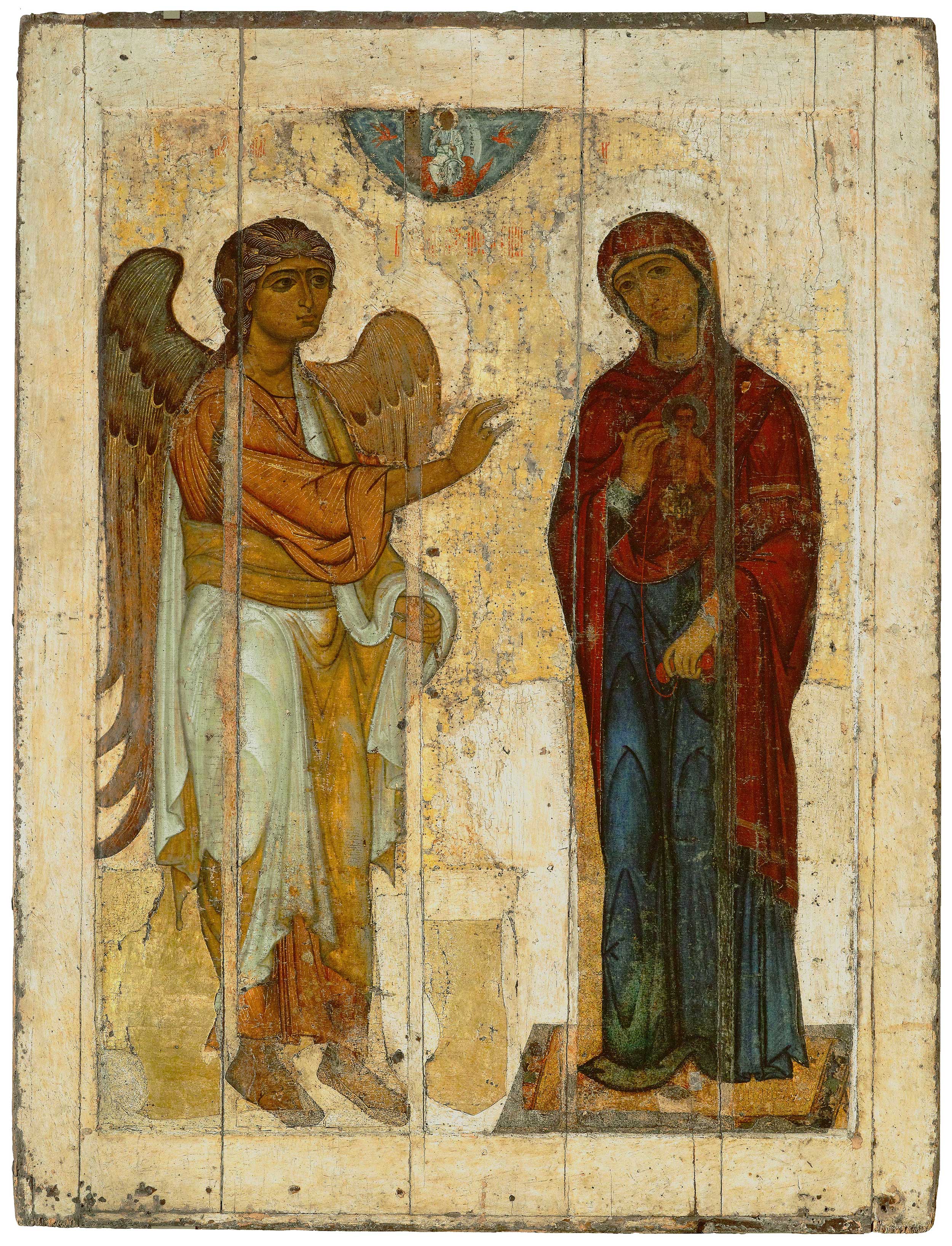
Ustyug Annunciation, Novgorod, ca. 1120–30. Tempera on wood, 23.8 × 16.8 cm. State Tretyakov Gallery, Moscow.
This icon is among the oldest extant Russian icons, being one of the few to have survived the Mongol invasion of Russia in the thirteenth century. Even though it was produced in the Novgorod region, it is called “Ustyug” because of its association with that village in local histories and hagiographies.
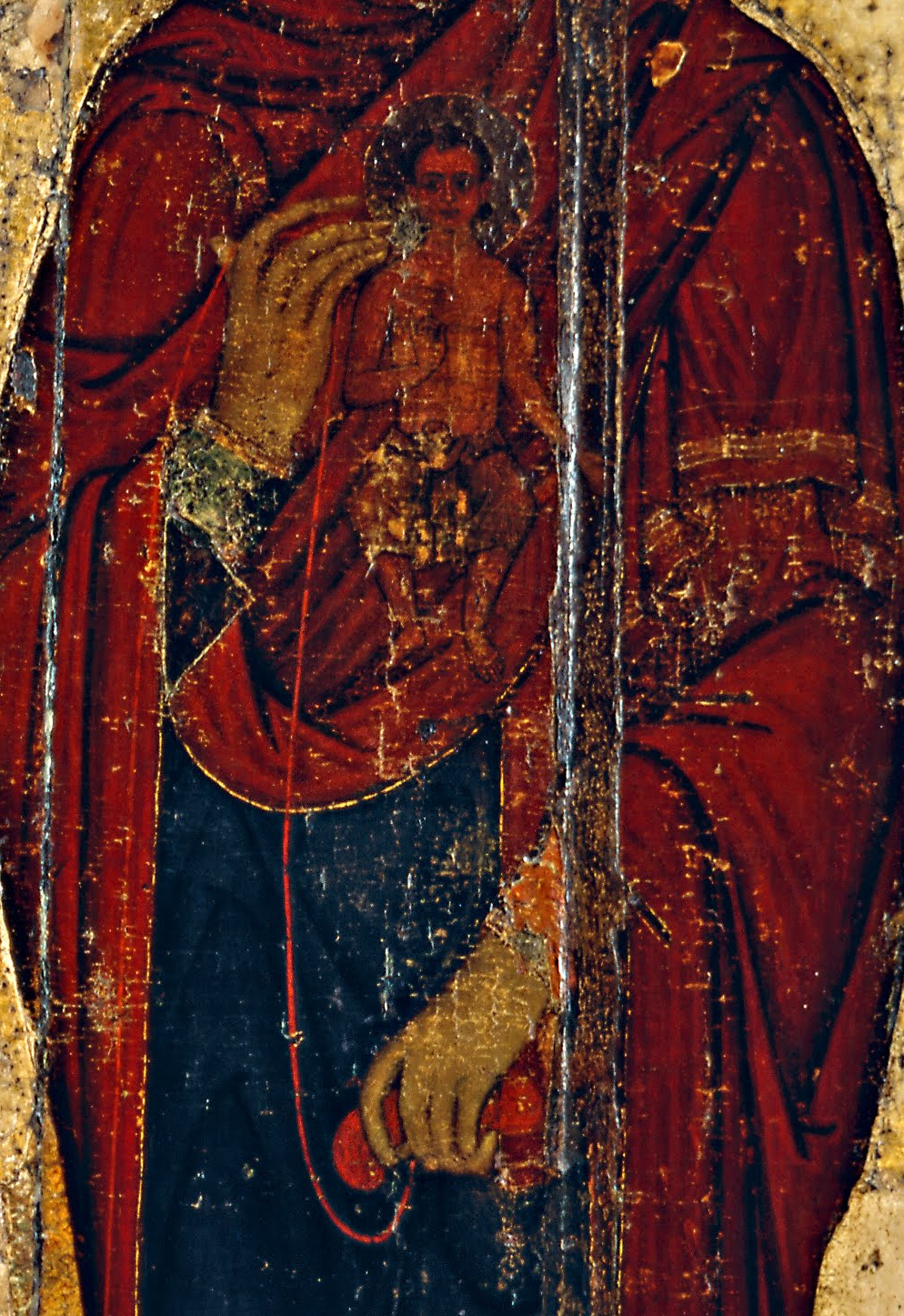
The icon shows the angel Gabriel approaching Mary with the news that she has been chosen to bear the Son of God into the world. In Mary’s left hand she holds a skein of scarlet thread, as tradition says she was one of the women responsible for weaving the veil of the temple in Jerusalem. Following the thread upward to her right hand, we see a remarkable detail in her midsection: a shadowy figure of Christ Emmanuel, fully formed within her and gesturing blessing. The iconographer has compressed together the moments of announcement and conception, suggesting that Mary’s miraculous pregnancy has already been effected.
At the top center, in a blue semicircle representing the heavens, sits the Ancient of Days, a symbolic depiction of God the Father. Fiery red cherubim and seraphim surround his throne. He holds a scroll in his right hand, while his left is raised in benediction. Earlier descriptions of the icon mention a ray of light emanating from God’s throne to Mary, traveled by the Holy Spirit in the form of a dove, but time has worn away this detail.
LISTEN: “Annunciation” piano quintet by Philip Glass, based on the Greek Orthodox communion hymn for the Feast of the Annunciation, 2018
>> Performed by Paul Barnes, Laurie Hamilton, Maria Newman, Scott Hosfeld, and David Geber at Symphony Space, New York, 2019:
Sharing a love of ancient chant traditions, pianist and Greek Orthodox chanter Paul Barnes [previously] and composer Philip Glass have engaged in collaborative projects ever since they first met on an airplane in March 1995. Most recently, Barnes facilitated the commission of a piano quintet by Glass—his first—based on the melody of the Greek Orthodox communion hymn for the Feast of the Annunciation, whose text is Psalm 132:13: “The Lord has chosen Zion, he has desired her for his dwelling place.” (Hear Barnes chant the hymn here.)
A piano quintet is a work of chamber music written for piano and four other instruments, usually a string quartet (two violins, one viola, one cello).
Glass’s “Annunciation” piano quintet premiered April 17, 2018, at the Lied Center for Performing Arts in Lincoln, Nebraska, with the Chiara String Quartet and Barnes on piano.
In the program notes for the piece, Barnes writes:
The work is in two parts. Part One opens with a meditative chromatic chord progression which eventually leads to the first entrance of the chant first stated in the piano. Glass develops this beautiful theme as it is shared by the various members of the quintet, culminating in an opulent neo-romantic closing section recapping the introductory chromatic chord progression. A partial restatement of the theme ends the movement with a brooding D minor coda.
Part Two is a poignant musical meditation on Part One revealing Glass’s innate ability to connect the transcendental ethos of the original chant with his own spacious approach to musical time. A particularly expressive section features the piano in soaring sparse octave melody over undulating eighth notes in the violin and cello. The work ends with an increasingly energetic and ecstatic 7/8 coda based on the opening chant transformed into scale passages that ascend and dissipate into a pianissimo chromatic flourish evocative of incense rising.
I studied Philip Glass’s experimental opera Einstein on the Beach in my Western music history survey course in college—Glass is one of the twentieth century’s most influential composers—and I was delighted to encounter this newer, religiously inspired work of his that Barnes planted the seeds for and is active in promoting and performing.
This post is part of a daily Advent series from December 2 to 24, 2023 (with Christmas to follow through January 6, 2024). View all the posts here, and the accompanying Spotify playlist here.
>> “Picturing Pregnancy in Early Modern Europe” by Rebecca Whiteley, Public Domain Review: Adapted from the book Birth Figures: Early Modern Prints and the Pregnant Body by Dr. Rebecca Whiteley (University of Chicago Press, 2023), this article explores how the womb and fetuses were depicted in medical book illustrations in Europe during the sixteenth and seventeenth centuries. Pregnancy is such a potent image for Advent, as we await the birth of Jesus—who, fully God and fully human, dwelled for nine months in his mother Mary’s uterus before emerging from her birth canal!
Woodcut illustration of a baby in the womb from De conceptu et generatione hominis (Zurich, 1554), the first Latin edition of a midwifery handbook by Jacob RueffWoodcut illustration of an open uterus from La commare o raccoglitrice . . . (Verona, 1642), a manual about pregnancy and childbirth by Girolamo Mercurio
>> “Rupy C. Tut’s Landscapes of Belonging” by Bridget Quinn, Hyperallergic: Bridget Quinn reviews Rupy C. Tut’s solo exhibition Out of Place that’s running at the Institute of Contemporary Art San Francisco through January 7. I love, love, love her art! It’s inspired by traditional Indian miniature painting and “is an effort to belong, to feel in place,” Tut says. Tut is a first-generation immigrant from India’s Punjab region who settled in California with her Sikh family at age twelve. Her Searching for Ancestors reminds me, visually but not thematically, of Jyoti Sahi’s Incarnation within the Anthill, and her Portrait of a Woman gives me some serious Marian vibes—as it did too the reviewer, who refers to this pregnant woman as “a kind of cross-cultural Madonna, reminiscent of the central mother figure, mandorla, and sun rays of Our Lady of Guadalupe so familiar across California via Mexico.”
Rupy C. Tut (Indian American, 1985–), Portrait of a Woman, 2023. Handmade pigments and shell gold on hemp paper, 57 × 37 in.
+++
INSTAGRAM POST: “Birthing // Love” by Elissa Yukiko Weichbrodt: Last Advent, art historian and educator Elissa Yukiko Weichbrodt (@elissabrodt) reflected on Janine Antoni’s Hearth ceramics, part of the artist’s Pelvic Vessels series, and on the biological reality that during the act of childbirth, both the mother’s and baby’s bodies are changed by one another. What might this mean for Advent?
Janine Antoni (Bahamian American, 1964–), Hearth, 2014. Set of three pit-fired ceramic vessels, 4 3/4 × 6 1/2 in., 4 3/4 × 7 7/8 in., 5 1/8 × 8 in.
+++
DEVOTIONAL COLUMN: “Jesus’ Bloody Birth” by Lauren F. Winner, Christian Century: “Jesus . . . is bloody in many senses,” writes Rev. Dr. Lauren Winner [previously]. One of those senses is that he came into this world covered in his mother’s blood. Something is lost in the Christmas story when we evade the details of childbirth, Winner says. I was alerted to this short reflection of hers from 2015 by its inclusion in the new book A Radiant Birth: Advent Readings for a Bright Season.
+++
PODCAST EPISODE: “The Incarnation and Health Care as Ministry” with Denise Hess, Hear Me Now Podcast, December 24, 2020: “There is a long tradition of faith-based healthcare. On this Christmas episode—filled with music, poetry, and conversation—we ask: How has the belief that God became human in the flesh inspire care for people and their bodies? Rev. Denise Hess [MDiv, BCC-PCHAC] of the Supportive Care Coalition (now part of the Catholic Health Association) joins host Seán Collins in a reflection on the Christian doctrine of the Incarnation and the ways it has inspired centuries of healthcare. They talk about the example of Jesus-as-healer, the crucial role women have served in promoting healthcare ministries, and the place suffering plays in our understanding of caring for the whole person.”
The conversation is interspersed with poetry readings and performances of carols by a violin-guitar-bass trio. Hess mentions this wonderfully shocking sentence from Chris Abani’s poem “The New Religion”: “what was Christ if not God’s desire / to smell his own armpit?” She also shares Brian Wren’s beautiful hymn text “Good Is the Flesh.” The podcast is a production of the Providence Institute for Human Caring.
LOOK: Virgin and Child with a Prophet catacomb fresco
Virgin and Child with a Prophet, 3rd century. Fresco in the Catacomb of Priscilla on the Via Saleria, Rome. Photo: Scala / Art Resource. [view wider shot]
Deep in the Catacomb of Priscilla in Rome, one of the early Christian underground burial places (named after the donor of the land), is an arched ceiling fresco of a woman breastfeeding her child under an apple tree. Beside her a man points up to a star that’s resting over their heads among the fruit.
Dating to the third century, this image is the earliest known depiction of the Virgin Mary, and one of the oldest of Christ. The identity of the third figure is less sure, but it’s most likely the Gentile prophet Balaam, who, in the power of God’s Spirit, prophesied to King Balak of Moab that “a star shall come out of Jacob, and a scepter shall rise out of Israel” (Num. 24:17).
Although this prophecy had a more immediate fulfillment in King David, it has also been interpreted in a messianic sense since as early as Justin Martyr (ca. 100–165), who wrote, “And that he [Christ] should arise like a star from the seed of Abraham, Moses showed beforehand when he said, ‘A star shall arise from Jacob, and a leader from Israel’” (Dialogue with Trypho, chap. 106).
Irenaeus (ca. 130–200) wrote that the star the magi followed to seek out the newborn Christ was the one prophesied by Balaam (Against Heresies, bk. 3, chap. 9.2), and Origen (ca. 185–254) maintained that Numbers 24:17 was the Hebrew Bible verse the magi found that instigated their journey (Against Celsus, bk. 1, chap. 60).
Arched ceiling detail from Gallery 3 of the Catacomb of Priscilla, Rome. The central image, in stucco, portrays a shepherd and two sheep, while at the far right, oriented in a different direction, is a fresco of the Virgin and Child. The artworks are damaged by age.
Other suggestions put forward as to the identity of the pointing figure in this catacomb fresco have been a magus; the Hebrew prophet Isaiah, who declared that “a virgin shall conceive” (Isa. 7:14) and enjoined his people to “arise, shine; for thy light is come, and the glory of the Lord is risen upon thee” (Isa. 60:1); and, from Hans-Ruedi Weber, John the Baptist, who “came as a witness to testify to the light, so that all might believe. . . . The true light, which enlightens everyone, was coming into the world” (John 1:6–9).
LISTEN: “There Shall a Star from Jacob Come Forth” (original title: “Es wird ein Stern aus Jacob aufgeh’n”), from Christus, Op. 97 | Original German text compiled by Christian Charles Josias von Bunsen, 1846, from Numbers 24:17 and the hymn “Wie schön leuchtet der Morgenstern” by Philipp Nicolai, 1599; English translation of lines 4–10 by Catherine Winkworth, 1863 | Music by Felix Mendelssohn, 1846–47, based on Nicolai’s hymn tune | Performed by the St. Olaf Choir, the St. Olaf Cantorei, the St. Olaf Chapel Choir, the Manitou Singers, Viking Chorus, and the St. Olaf Orchestra, dir. Robert Scholz, on Love Divine, Illumine Our Darkness: Christmas at St. Olaf, 2002
There shall a star from Jacob rise up, And a sceptre from Israel come forth, To dash in pieces princes and nations.
How brightly beams the morning star! With sudden radiance from afar, With light and comfort glowing! Thy word, Jesus, inly feeds us, Rightly leads us, Life bestowing. Praise, oh praise such love o’erflowing.
The musical work “Es wird ein Stern aus Jacob aufgeh’n” (There Shall a Star from Jacob Come Forth) is from an unfinished oratorio by Felix Mendelssohn (1809–1847), which the composer’s brother Paul gave the name Christus and published posthumously as Opus 97. The first performance took place in 1852.
The first three lines are taken from Numbers 24:17, while the latter portion is from the Lutheran hymn “Wie schön leuchtet der Morgenstern” (How Brightly Beams the Morning Star) by Philipp Nicolai, written in 1597 and first published in 1599 with the title “Ein geistlich Brautlied der gläubigen Seelen von Jesu Christo ihrem himmlischen Bräutigam, gestellet über den 45. Psalm des Propheten David” (A spiritual wedding song of the faithful soul about Jesus Christ, her heavenly groom, made over the 45th psalm of the Prophet David). The tune it was published with was adapted by Nicolai, it appears, from an older tune found in the Strasbourg Psalter of 1538—which is further adapted here by Mendelssohn.
In Mendelssohn’s piece, the first two lines about an emerging luminary from the lineage of Jacob are lovely and lofty, repeated in different and overlapping voices over the course of a minute-plus. But then the third line cuts in with emphatic force: “To dash in pieces princes and nations.” Its violence is jarring, very far from the peaceful sentiments we’re used to associating with this time of year! Even as it adds drama and interest to the composition, its militant language is unsettling.
But it does honor the larger context of Balaam’s prophecy:
So he [Balaam] uttered his oracle, saying,
“The oracle of Balaam son of Beor, the oracle of the man whose eye is clear, the oracle of one who hears the words of God and knows the knowledge of the Most High, who sees the vision of the Almighty, who falls down but with eyes uncovered: I see him but not now; I behold him but not near— a star shall come out of Jacob, and a scepter shall rise out of Israel; it shall crush the foreheads of Moab and the heads of all the Shethites [a Moabite tribe]. Edom will become a possession, Seir [an alternative name for Edom] a possession of its enemies, while Israel does valiantly. One out of Jacob shall rule and destroy the survivors of Ir [‘City’].”
(Num. 24:15–19)
The mercenary prophet Balaam had been hired by Balak, king of Moab, to curse Israel. See, the Israelites had escaped slavery in Egypt some forty years prior and were looking for land to settle. Having been refused passage through, they had just conquered Amorite country, which used to belong to Moab, and Balak feared Moab would be next.
Despite being a non-Israelite, Balaam heard words from Yahweh, Israel’s God. Balak recognized Balaam as an authority, as did others, and thought he might be persuaded for a fee to issue a prophecy in Moab’s favor. But Balaam told him he would speak only the words of Yahweh.
The passage above is the fourth and final oracle Balaam pronounced on this mission to Moab. In it he says that Moab and Edom would be conquered—a prophecy that came to pass with King David (2 Sam. 8:2–12; cf. Ps. 60:8).
Christians, as we have seen, often extract verses from longer Old Testament passages, prophetic or otherwise, and read into them messianic significance—pointers to Jesus Christ. Even the New Testament authors, and Jesus himself, did this. Did the Old Testament authors intend such meanings? Probably not in most places, not to the extent that premodern Christian interpreters suggested. (That’s not to say Jesus didn’t fulfill biblical prophecies. Quite the contrary!)
But many Christian biblical scholars acknowledge what’s been called the sensus plenior, or “fuller sense,” of scripture—a term popularized by Raymond E. Brown in his book The Sensus Plenior of Sacred Scripture (1955). Sensus plenior, Brown writes, is “that additional, deeper meaning, intended by God but not clearly intended by the human author, which is seen to exist in the words of a biblical text (or group of texts, or even a whole book) when they are studied in the light of further revelation or development in the understanding of revelation.”
Some people consider this kind of reading to be distortive. But others, including myself, consider it creative. Rabbinical literature often does the same thing: finds meaning in and beyond a scripture passage’s strict historical context that the original authors likely did not intend but that open up the text in new ways. Sensus plenior says that studying a book of the Bible only in its historical and immediate textual context and for what it would have meant to its original audience is limiting, incomplete. Of course, the opposite approach, which does run rampant in many Christian communities, is also problematic: divesting scripture passages of their contexts, reflexively backfilling all the Old Testament with “Jesus” at the expense of understanding the texts on their own terms.
I think the application of “To dash in pieces princes and nations” (a paraphrase from Balaam’s prophecy) to Jesus’s birth is confusing, as Jesus was nonviolent, rejecting conquest. Perhaps you could say that Christ’s rule would (rhetorically) dash Herod’s kingdom to pieces, as it challenged the modus operandi of empire. There’s a new caesar in town, a new king on the throne, and his law of love, his gospel of peace, trumps the laws and proclamations of all earthly rulers.
The last six lines of Mendelssohn’s song return to the sweet, gentle tones of the song’s opening, exulting in the radiant glory of Christ, the Morning Star (Rev. 22:16), who shines forth from the pages of God’s word.
This post is part of a daily Advent series from December 2 to 24, 2023 (with Christmas to follow through January 6, 2024). View all the posts here, and the accompanying Spotify playlist here.
Arcade, Main Chapel, Marianist Retreat and Conference Center, Eureka, Missouri. The chapel was designed by Br. Mel Meyer, SM. Photo: Kelly Kruse.
Behold the natural light filtered through the stained glass windows of this Marianist chapel in Eureka, Missouri, bathing the walls and flat arches in color.
LISTEN: “Come, My Way” | Words by George Herbert, 1633 | Music by Ralph Vaughan Williams, 1911; arr. Edward A. David, 2013 | Performed by Fr. Austin Dominic Litke, OP; Fr. Bob Koopman, OSB; and Leah Sedlacek of Blackfriar Music, 2013
Come, my Way, my Truth, my Life: such a way as gives us breath, such a truth as ends all strife, such a life as killeth death.
Come, my Light, my Feast, my Strength: such a light as shows a feast, such a feast as mends in length, such a strength as makes his guest.
Come, my Joy, my Love, my Heart: such a joy as none can move, such a love as none can part, such a heart as joys in love.
This phenomenal poem, “The Call,” is from The Temple by George Herbert (1633), a posthumously published collection of all his English-language poems. The famous British composer Ralph Vaughan Williams (1872–1958) set it to music in 1911, along with three of Herbert’s other religious poems (“Easter,” split into two parts, “Love [III],” and “Antiphon [I]”) for his composition Five Mystical Songs. Williams’s setting can be found in dozens of hymnals, usually under the title “Come, My Way, My Truth, My Life.”
In 2013, the media division of the Dominican Province of St. Joseph—one of four Dominican provinces in the United States, extending from New England to Virginia to Ohio—produced a music video featuring a new arrangement of the hymn by Edward A. David, who has a bachelor of music degree in classical piano performance from New York University. (He later went on to earn a master’s and doctorate in theology at Oxford and is now an ethicist.)
The project was inspired by Pope Francis’s call during the World Youth Day festivities in Rio de Janeiro in July 2013 to “take to the streets” in sharing the gospel. Scenes were filmed throughout New York City: at Brooklyn Bridge, Our Lady of Good Counsel Roman Catholic Church, Grand Central Station, Columbus Circle, and on the Staten Island ferry.
The filmmakers are graduates of NYU’s film school: A. Joshua Vargas, John S. Fisher, and Michael Crommett.
The singer in the video is Father Austin Litke, who at the time served as chaplain of NYU’s Catholic Center. He is currently an adjunct instructor at The Saint Paul Seminary and a visiting professor of Catholic studies at the University of St. Thomas.
For an acoustic performance by Ryan Flanigan, an Anglican church music director and the founder of Liturgical Folk, see here:
This post is part of a daily Advent series from December 2 to 24, 2023 (with Christmas to follow through January 6, 2024). View all the posts here, and the accompanying Spotify playlist here.Blackfriar Music’s and Ryan Flanigan’s recordings of “Come, My Way” are not on Spotify.
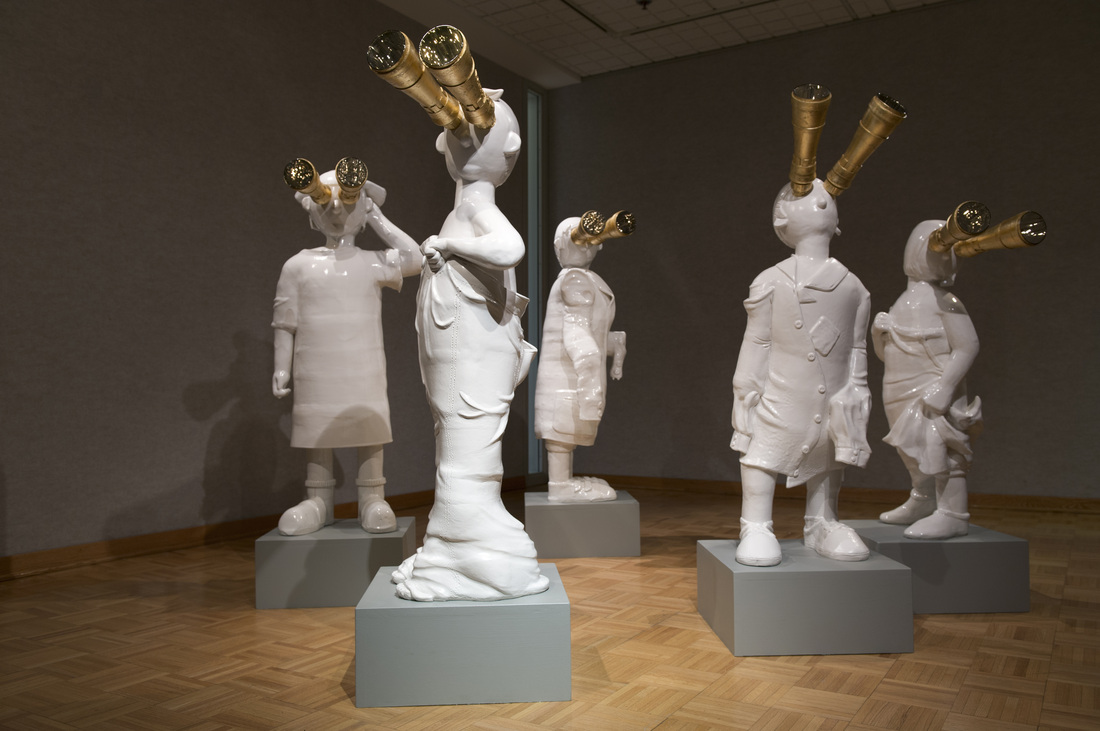
Namdoo Kim (Korean, 1985–), Golden Binoculars, 2013. Glass, ceramic, mixed media, each figure 42 × 20 × 20 in. Installation at the 2018 SOFA Chicago art fair (now Intersect Chicago).
Watchman, tell us of the night, what its signs of promise are. Traveler, o’er yon mountain’s height, see that glory-beaming star. Watchman, does its beauteous ray aught of joy or hope foretell? Traveler, yes; it brings the day, promised day of Israel.
Watchman, tell us of the night; higher yet that star ascends. Traveler, blessedness and light, peace and truth its course portends. Watchman, will its beams alone gild the spot that gave them birth? Traveler, ages are its own; see, it bursts o’er all the earth.
Watchman, tell us of the night, for the morning seems to dawn. Traveler, darkness takes it flight; doubt and terror are withdrawn. Watchman, let thy wanderings cease; hie thee to thy quiet home. Traveler, lo! the Prince of Peace, lo! the Son of God is come!
Unfolding in alternating couplets, this nineteenth-century hymn from England presents a dialogue between a traveler and a watchman—that is, someone stationed at a vantage to look out for coming invasions or things out of the ordinary. The traveler asks the watchman what he sees and what its meaning is; the watchman responds that he sees a glorious star ascending up over the mountains, portending blessing and peace not just for the land of its rising but for all peoples. A beneficent invasion!
This post is part of a daily Advent series from December 2 to 24, 2023 (with Christmas to follow through January 6, 2024). View all the posts here, and the accompanying Spotify playlist here.
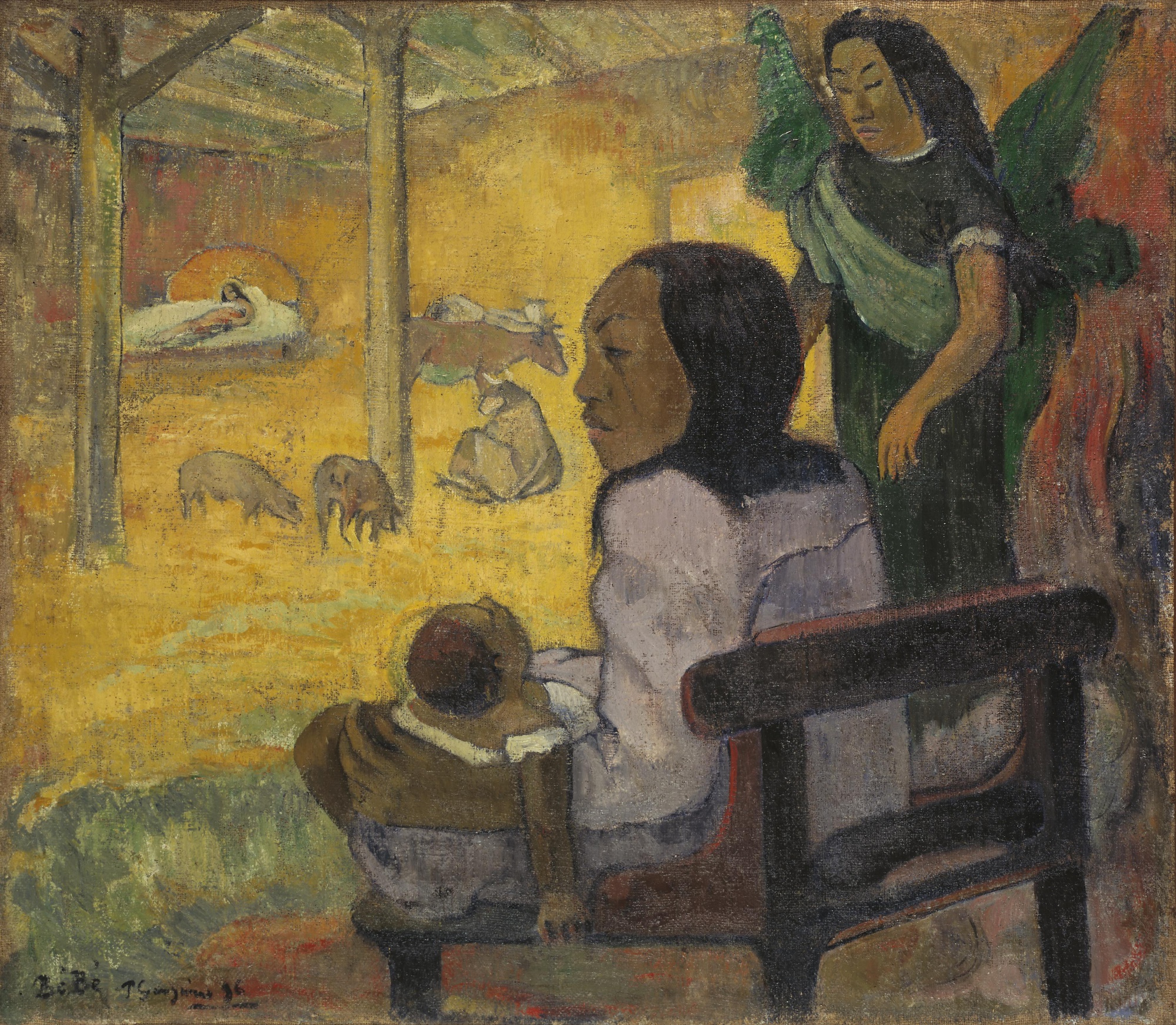
Paul Gauguin (French, 1848–1903), Be Be (The Nativity), 1896. Oil on canvas, 67 × 76.5 cm. State Hermitage Museum, St. Petersburg, Russia. A midwife holds the newborn Christ as his mother rests in the upper left corner.
O child of man,
Wombed in dark waters you retell
Millenniums, image the terrestrial span
From an unwitting cell
To the new soul within her intricate shell,
O child of man.

O child of man,
Whose infant eyes and groping mind
Meet chaos and create the world again,
You for yourself must find
The toils we know, the truths we have divined –
Yes, child of man.

O child of man,
You come to justify and bless
The animal throes wherein your life began,
And gently draw from us
The milk of love, the most of tenderness,
Dear child of man.

So, child of man,
Remind us what we have blindly willed –
A slaughter of all innocents! You can
Yet make this madness yield
And lift the load of our stock-piling guilt,
O child of man.
“Agnus Dei” is the seventh of nine titled sections of the poem “Requiem for the Living” by Cecil Day-Lewis, originally published in The Gate, and Other Poems (J. Cape, 1962) and compiled in The Complete Poems of C. Day Lewis (Stanford University Press, 1992).
Cecil Day-Lewis CBE (1904–1972) was one of the leading British poets of the 1930s, closely associated with W. H. Auden. He was born in Ireland of Anglo-Irish parents, his father a Church of Ireland clergyman, and was educated at Oxford, where he taught poetry from 1951 to 1956. In the 1940s he “turned from poetry of left-wing political statement to an individual lyricism expressed in more traditional forms” (Britannica) and served as poet laureate of England from 1968 until his death in 1972. In addition to writing poetry, he also wrote crime novels under the pseudonym Nicholas Blake, sixteen of which feature detective Nigel Strangeways. One of Day-Lewis’s four children is the actor Daniel Day-Lewis.
To him who loves us and freed us from our sins by his blood and made us a kingdom, priests serving his God and Father, to him be glory and dominion forever and ever. Amen.
Look! He is coming with the clouds; every eye will see him, even those who pierced him, and all the tribes of the earth will wail on account of him.
So it is to be. Amen.
—Revelation 1:5b–7
LOOK: The Last Judgment by Jan van Eyck
Jan van Eyck (Netherlandish, ca. 1390–1441), The Last Judgment, ca. 1436–38. Oil on canvas, transferred from wood, 22 1/4 × 7 2/3 in. (56.5 × 19.7 cm). Metropolitan Museum of Art, New York.
What is your reaction to this image? Terror? Awe? Gratitude? Disgust? Intrigue? Indifference?
I’m often repulsed by how the Last Judgment was interpreted by medieval and Renaissance artists, with graphic displays of torture intending to compel people to righteous living through fear. To be sure, the subject has made for some truly remarkable paintings, full of fantastical grotesqueries and masterfully executed—like this one—but I worry that the scare tactics such paintings use are not helpful and are even harmful.
Nonetheless, the Last Judgment is an unavoidable topic in scripture. The Bible refers several times to God as judge and describes a final accounting of sin upon Christ’s return, resulting in reward for the righteous and punishment for the unrighteous. It’s also in our creeds: “He [Jesus Christ] will come again to judge the living and the dead” (see 2 Tim. 4:1; 1 Pet. 4:5). Those who seek to be faithful to scripture must reckon with the idea of the Last Judgment. Advent, which is penitential in character, has historically been a period for the church to do that. As the Episcopal priest and author Fleming Rutledge points out in her published collection of Advent sermons, judgment is one of the four traditional themes of the season—the other three being death, heaven, and hell.
The early Northern Renaissance master Jan van Eyck’s Last Judgment from ca. 1436–38 is one of history’s most famous and most gruesome. “The diabolical inventions of Bosch and Brueghel,” writes art historian Bryson Burroughs, “are children’s boggy lands compared to the horrors of the hell [van Eyck] has imagined.”
The midground portrays the resurrection of the dead, who rise up out of their graves on land or at sea to be judged by Christ. One of the inscriptions on the frame is Revelation 20:13: “And the sea gave up the dead which were in it; and death and hell delivered up the dead which were in them: and they were judged every man according to their works.”
In the center Saint Michael the Archangel, dressed in his jewel-studded armor and with sword unsheathed, stands atop the giant batlike wings of Death personified, which are inscribed with the words CHAOS MAGNVM (“great chaos”) and UMBRA MORTIS (“shadow of death”). Death is a skeletal figure who excretes the damned through his bowels into hell’s dark slime, where bestial demons tear at, choke, devour, crush, and impale them. One man’s legs are being ripped apart at the anus.
Even kings and clergymen are part of the tragic death-heap—see the bishop’s miter, the cardinal’s galero, the royal crown. Not all who say, “Lord, Lord,” will enter heaven (Matt. 7:21); even the most outwardly pious will have their sins exposed on the last day, and those who prove to be hypocrites, who have harmed others and shamed God without repentance, will be thrown into the pit.
Shooting down like arrows into this pit is the double inscription ITE VOS MALEDICTI IN IGNEM ETERNAM (“Go, ye cursed, into everlasting fire”), taken from Matthew 25:41. And Deuteronomy 32:23–24, a warning from God via Moses to the people of God in their disobedience, is one of the inscriptions on the frame:
I will heap mischiefs upon them; I will spend mine arrows upon them. They shall be burnt with hunger, and devoured with burning heat, and with bitter destruction: I will also send the teeth of beasts upon them, with the poison of serpents of the dust.
Perhaps your chest is tightening right now, your stomach churning. How does this picture cohere with the God of love and mercy?
Look up.
See Jesus Christ, the Son of Man, coming in glory. See his glowing stigmata, beacons of love and mercy. He is dressed in a long, red, open mantle and is barefoot, revealing all five wounds. All around him, angels bear the instruments of his passion: the cross, the three nails, the crown of thorns, the lance, the sponge-tipped reed. See him flanked by all the ranks of the redeemed, including, on a larger scale, the Virgin Mary and John the Baptist, the first two witnesses of Jesus’s divinity.
VENITE BENEDICTI PATRIS MEI, read the inscriptions fanning out from Christ’s elbows: “Come, ye blessed of my Father” (Matt. 25:34). This good word is taken from Jesus’s parable of the sheep and the goats, in which he teaches that those who feed the hungry, clothe the naked, shelter the immigrant, care for the sick, and visit the imprisoned will be honored by God on the last day.
Another benediction is inscribed on the picture’s frame:
And I heard a loud voice from the throne saying,
“See, the home of God is among mortals. He will dwell with them; they will be his peoples, and God himself will be with them and be their God; he will wipe every tear from their eyes. Death will be no more; mourning and crying and pain will be no more, for the first things have passed away.” (Rev. 21:3–4 NRSV)
Van Eyck’s Last Judgment does not stand alone. For centuries it has been configured as a diptych (two-paneled artwork) with a Crucifixion on the left and is thus intended to be read in light of God’s supreme act of vulnerable love and self-giving:
Jan van Eyck (Netherlandish, ca. 1390–1441), The Crucifixion; The Last Judgment (with recently conserved frame), ca. 1436–38. Oil on canvas, transferred from wood, each panel 22 1/4 × 7 2/3 in. (56.5 × 19.7 cm). Metropolitan Museum of Art, New York.
Originally these two paintings very likely served as the wings of a triptych with a painted or sculpted centerpiece, or as the doors to a tabernacle or reliquary shrine. In 2019 the Metropolitan Museum of Art had the frames restored from their modern brass color to their original red.
So, what are we to make of this image today? Is there value in meditating on it?
I’ve presented it here, so I think it’s definitely worth knowing about. It’s a stunning art object that gives us a glimpse into the religious imagination of late medieval Christians. But I would also advise caution, especially to those who have been traumatized by hell teachings in the past. While Christians are called to cultivate a holy fear of God, a soberness around the weight of our sin and the power of God’s justice, this fear is not supposed to be the kind of fear that induces anxiety or paralyzes. That kind of fear will never lead us to love God.
We are never meant to think on hell apart from the grace Christ extends to us with his pierced and outstretched hands, which plead our case before God. Van Eyck holds both together in this painting, but the more visually immersive bottom half seems to indulge some pretty sick fantasies that could well generate an unhealthy fear of God if one were to stay stuck there, not to mention create the false impression that God is monstrously vindictive.
There is debate within Christianity, and has been since the patristic era, whether Jesus’s justice is merely punitive or ultimately restorative—that is, whether hell is a place of eternal conscious torment or a place where one is purged of evil and that will in the end be emptied. (There is biblical support for both views, which I won’t get into here.) There is also disagreement as to whether the Bible’s language about hell, such as its being a place of “fire” and “brimstone” (sulfur) (e.g., Rev. 21:8), is meant to be taken literally or figuratively.
Whatever the duration, physical nature, and ultimate purpose of hell, I want to emphasize that biblical passages about the Last Judgment ought not drive us to despair; they should drive us into the arms of Christ, who receives into his presence all those who trust in his merits and turn from their wickedness. The wounds that Christ so prominently displays in van Eyck’s painting are tokens of divine forgiveness as well as a model of the kind of selfless love we are to follow, a love vulnerable enough to receive injury but never to inflict it. Those who tumble into the depths of the underworld to be ravaged by externalizations of their own destructive evils have rejected the call to “do justice, love mercy, and walk humbly with [their] God” (Mic. 6:8). Many of them are ones who on earth bore much power but used it to abuse others or were neglectful.
For more on the characterization of Jesus as judge in the art and theology of the Middle Ages (whose influence was felt in the Renaissance and later eras), see chapter 2, “The Judge,” of Jesus through Medieval Eyes by Grace Hamman. “The promise of answering unanswered evil, acknowledging the recognized and unrecognized wrongs of the mortal world—everlasting justice and compassion—is ultimately what Christ the Judge signifies. It’s a promise, a prophecy, and a call for action now,” Hamman writes (28). She discusses how neighborliness and fear of God are twinned: “Am I seeing the immortal being, the image of God, Jesus himself, in every person I encounter?” medieval imagery prompted viewers to ask (37). “Jesus the Judge reminds us of our divine community and invites a fear that guides us to love our neighbor as we love ourselves. . . . Fear of Jesus the Judge becomes a gift for our practice of justice, in the radiant light of his justice. Such a fear softens flinty hearts” (21, 36). In the chapter Hamman does also acknowledge the complications and misuses of fear in the medieval church and its legacy today.
I urge you to consider the van Eyck diptych in light of the retuned hymn below as you meditate on Christ’s return and his role as judge.
LISTEN: “Lo! He Comes with Clouds Descending” | Words by Charles Wesley, 1758 | Music by Thomas Vito Aiuto, 2012 | Performed by the Welcome Wagon on Precious Remedies Against Satan’s Devices, 2012
Lo! he comes with clouds descending, once for favored sinners slain; thousand, thousand saints attending swell the triumph of his train.
Ev’ry eye shall now behold him, robed in dreadful majesty; those who set at naught and sold him, pierced, and nailed him to the tree, deeply wailing, deeply wailing, shall the true Messiah see.
Ev’ry island, sea, and mountain, heav’n and earth, shall flee away; all who hate him must, confounded, hear the trump proclaim the day: Come to judgment, come to judgment! Come to judgment, come away! Alleluia, alleluia! God appears on earth to reign.
The dear tokens of his passion Still his dazzling body bears, Cause of endless exultation To his ransomed worshippers. With what rapture, with what rapture Gaze we on those glorious scars! Alleluia, alleluia! God appears on earth to reign.
Yea, amen! Let all adore thee, high on thine eternal throne; Savior, take the pow’r and glory, claim the kingdom for thine own. O come quickly, O come quickly; everlasting God, come down. O come quickly, O come quickly; everlasting God, come down. O come quickly, O come quickly; everlasting God, come down.
I’m struck by the bright, celebratory, homey tone of the new tune Rev. Vito Aiuto gave this old Wesley hymn about Christ’s second coming. One might expect, with its verses about judgment, to have a dark or foreboding tone. But for those who are in Christ, his return, and even the day of judgment, will be an occasion of rejoicing!
Note that “dreadful” here is used in the archaic sense of inspiring awe or reverence.
This post is part of a daily Advent series from December 2 to 24, 2023 (with Christmas to follow through January 6, 2024). View all the posts here, and the accompanying Spotify playlist here.
LOOK: Look forward to the coming of God by Stanley Fung
Stanley Fung (馮君藍) (Chinese, 1961–), 期待上帝 (Look forward to the coming of God), 2002. Digital print on Hahnemühle fine art paper, 100 × 67.5 cm. [for sale]
LISTEN: “Keep Your Lamps,” African American spiritual | Performed by Cantus on That Eternal Day (2010)
Keep your lamps trimmed and a-burnin’ Keep your lamps trimmed and a-burnin’ Keep your lamps trimmed and a-burnin’ For this ol’ world is almost gone
Brothers, don’t get weary . . . This ol’ world is almost gone
Sisters, don’t stop prayin’ . . . This ol’ world is almost gone
Christian, your journey soon will be over . . . The time is drawing nigh
Keep your lamps trimmed and a-burnin’ . . . The time is drawing nigh
This post is part of a daily Advent series from December 2 to 24, 2023 (with Christmas to follow through January 6, 2024). View all the posts here, and the accompanying Spotify playlist here.
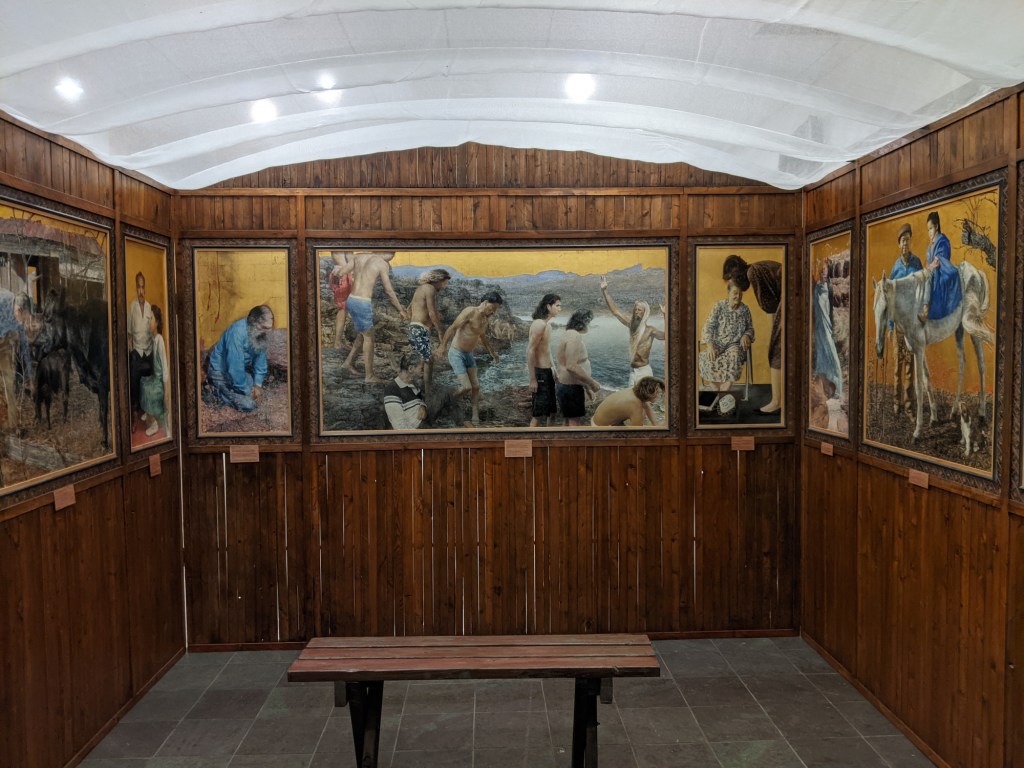
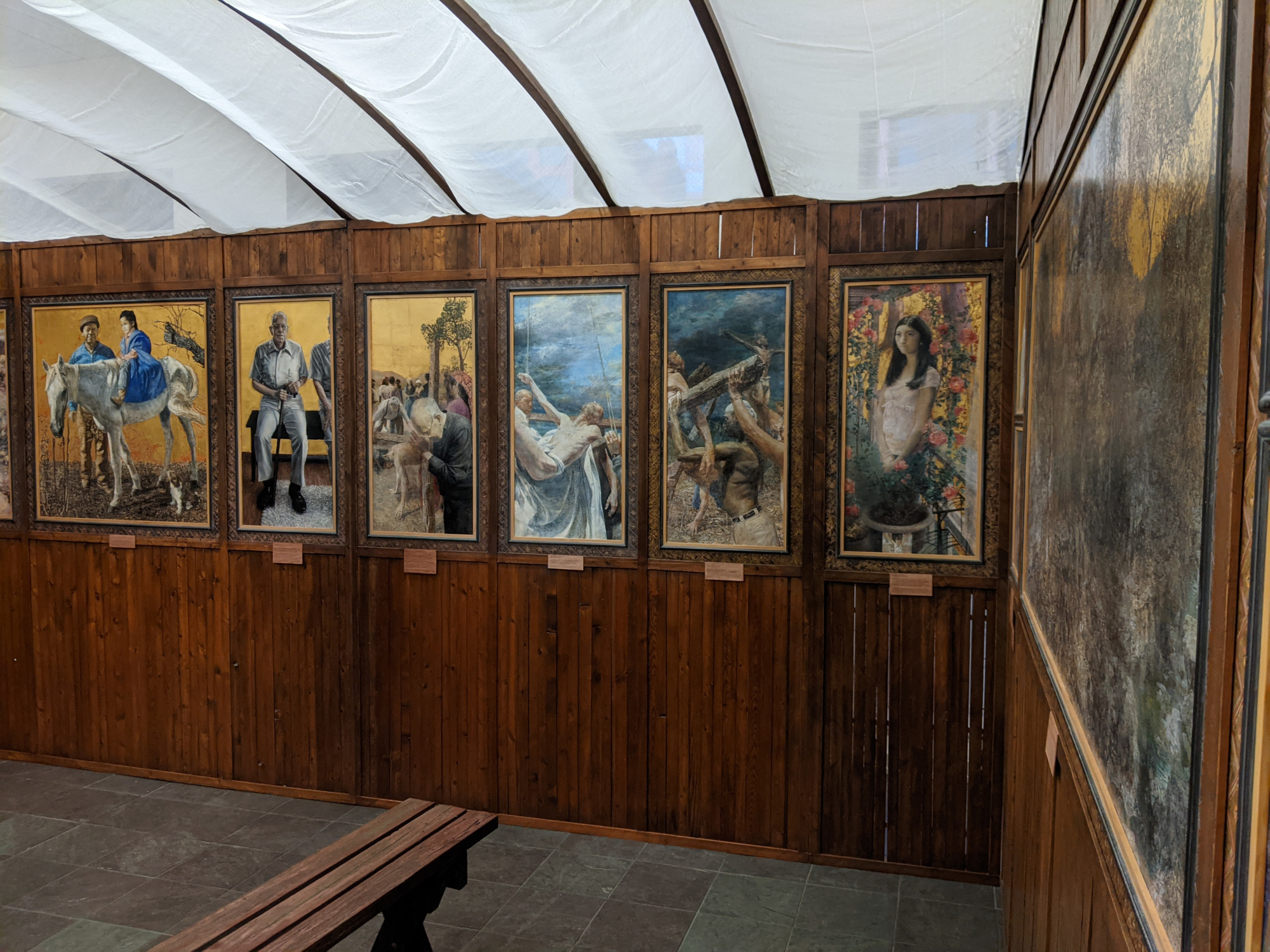
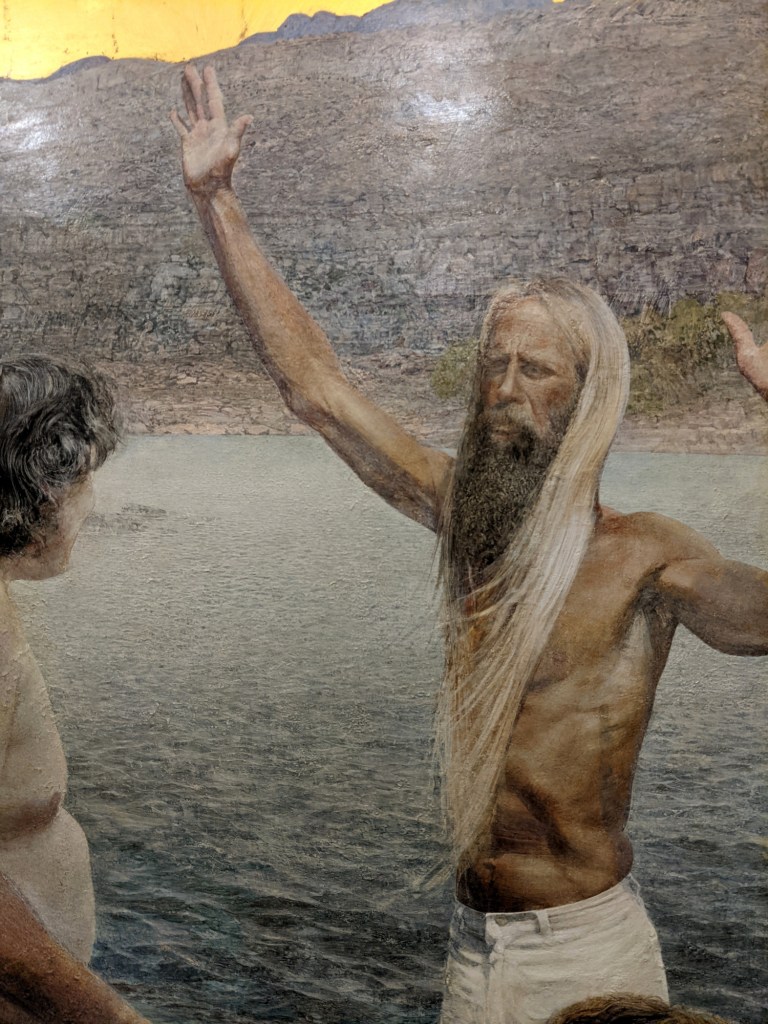
At the 2021 Christians in the Visual Arts (CIVA) conference in Austin, Texas, I got to experience local artist John Patrick Cobb’s Ikon Chapel, a traveling, custom-built wooden structure housing twenty of Cobb’s egg tempera paintings depicting his friends, family, and neighbors as saints and prophets in our modern world. The young and the elderly, farmers, water well drillers, artists, teachers, nurses, Holy Cross brothers, custodians, the unhoused, people with disability or mental illness—these are among those he honors in paint and gold leaf.
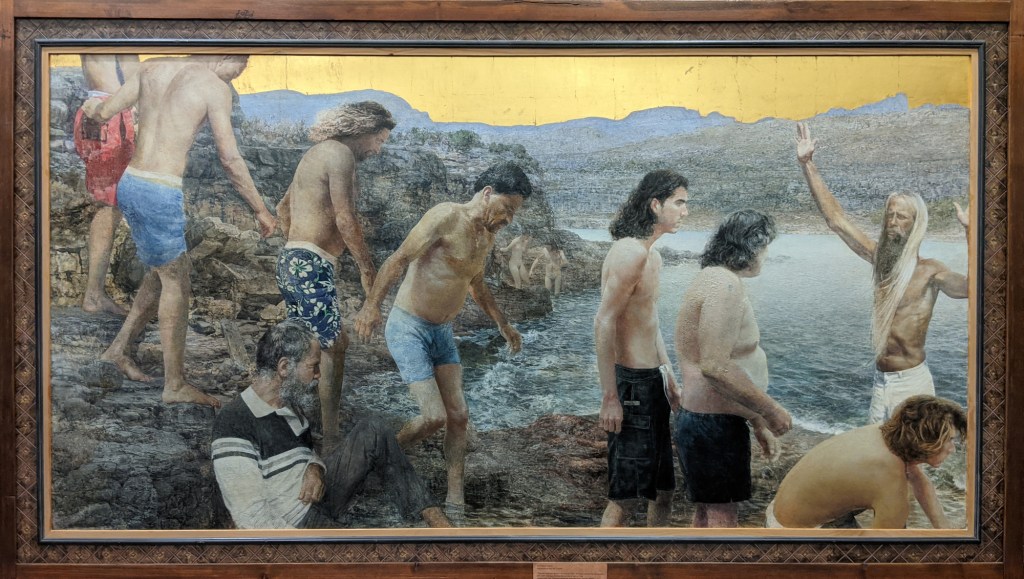
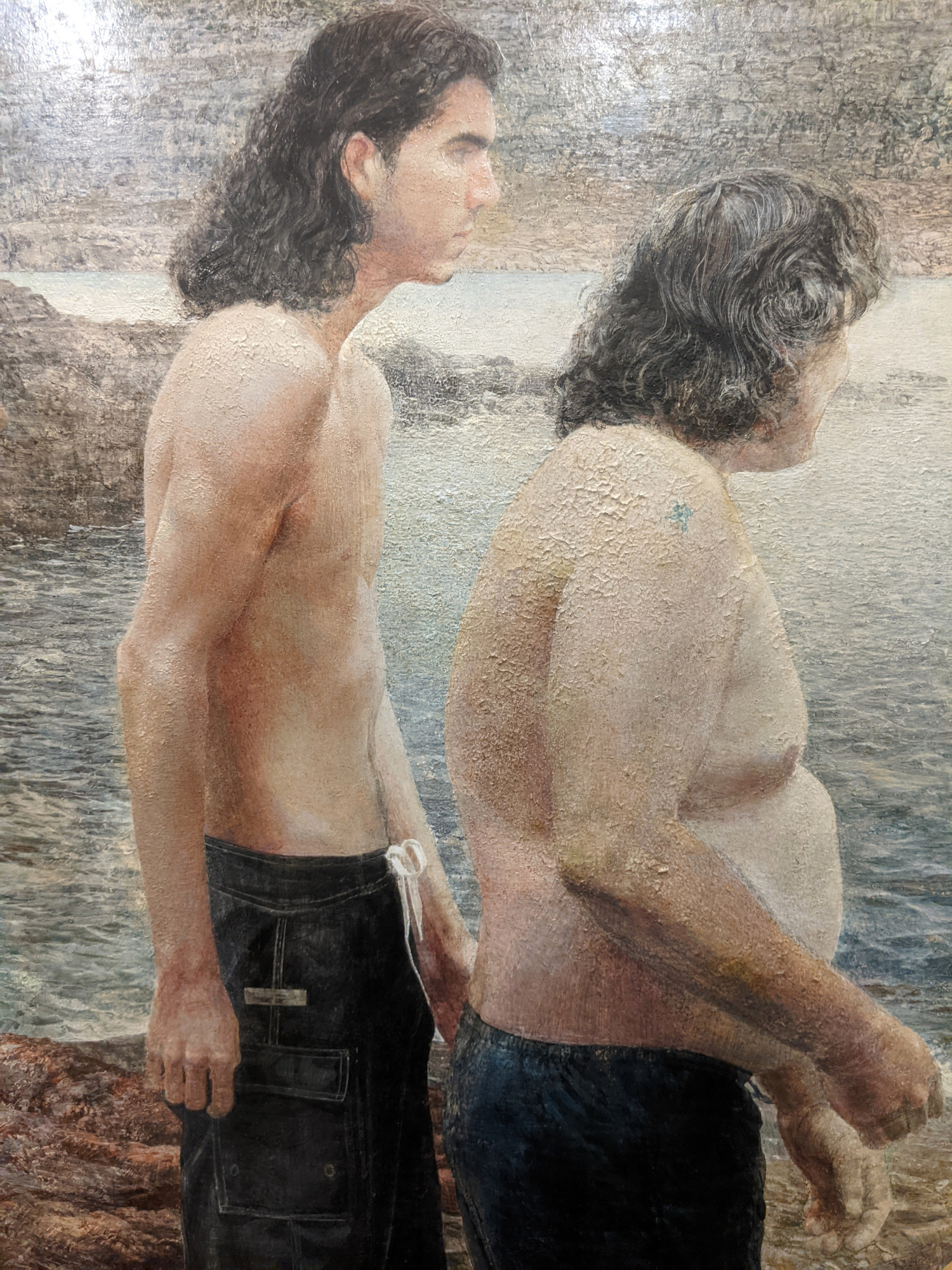
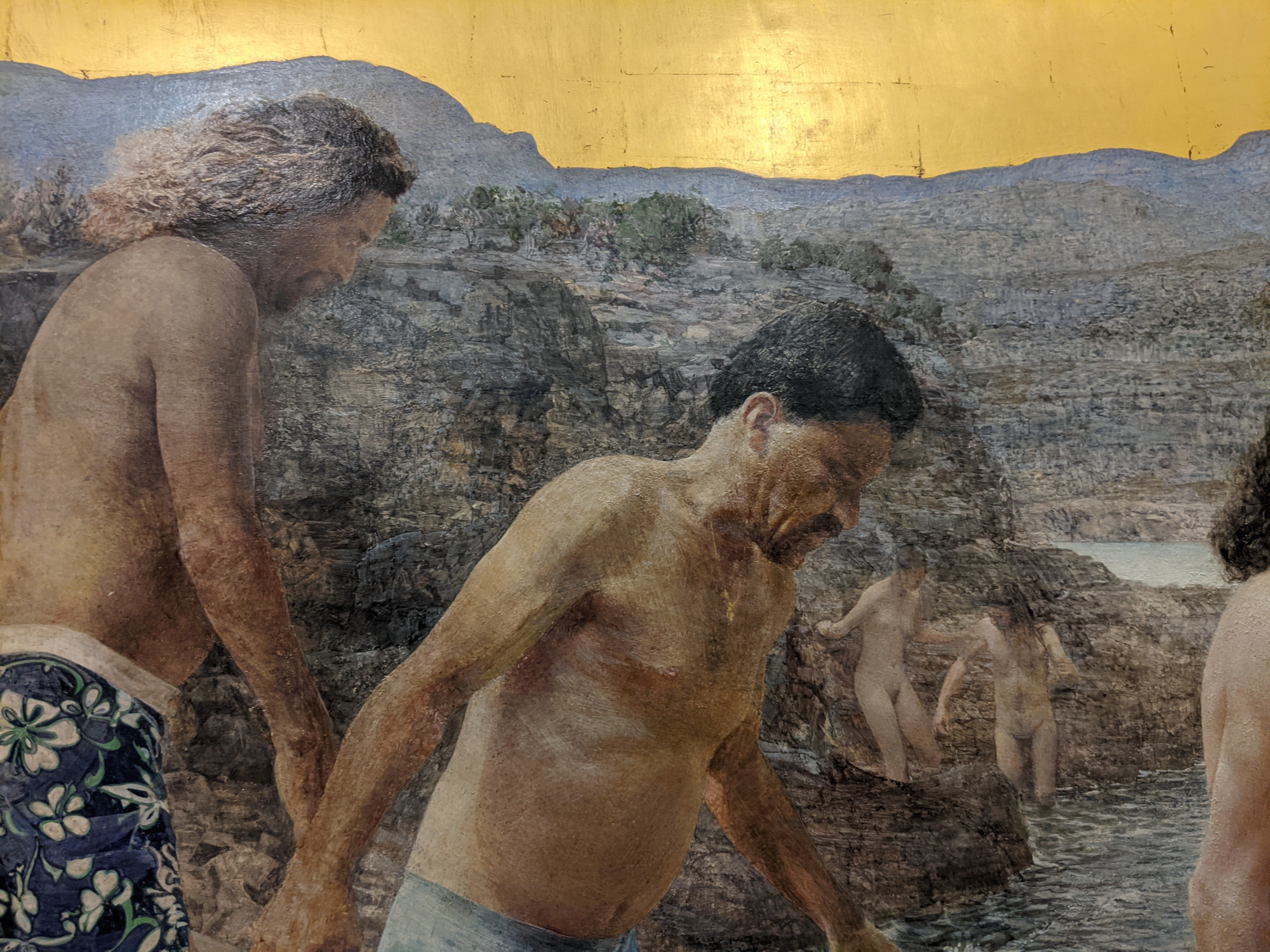
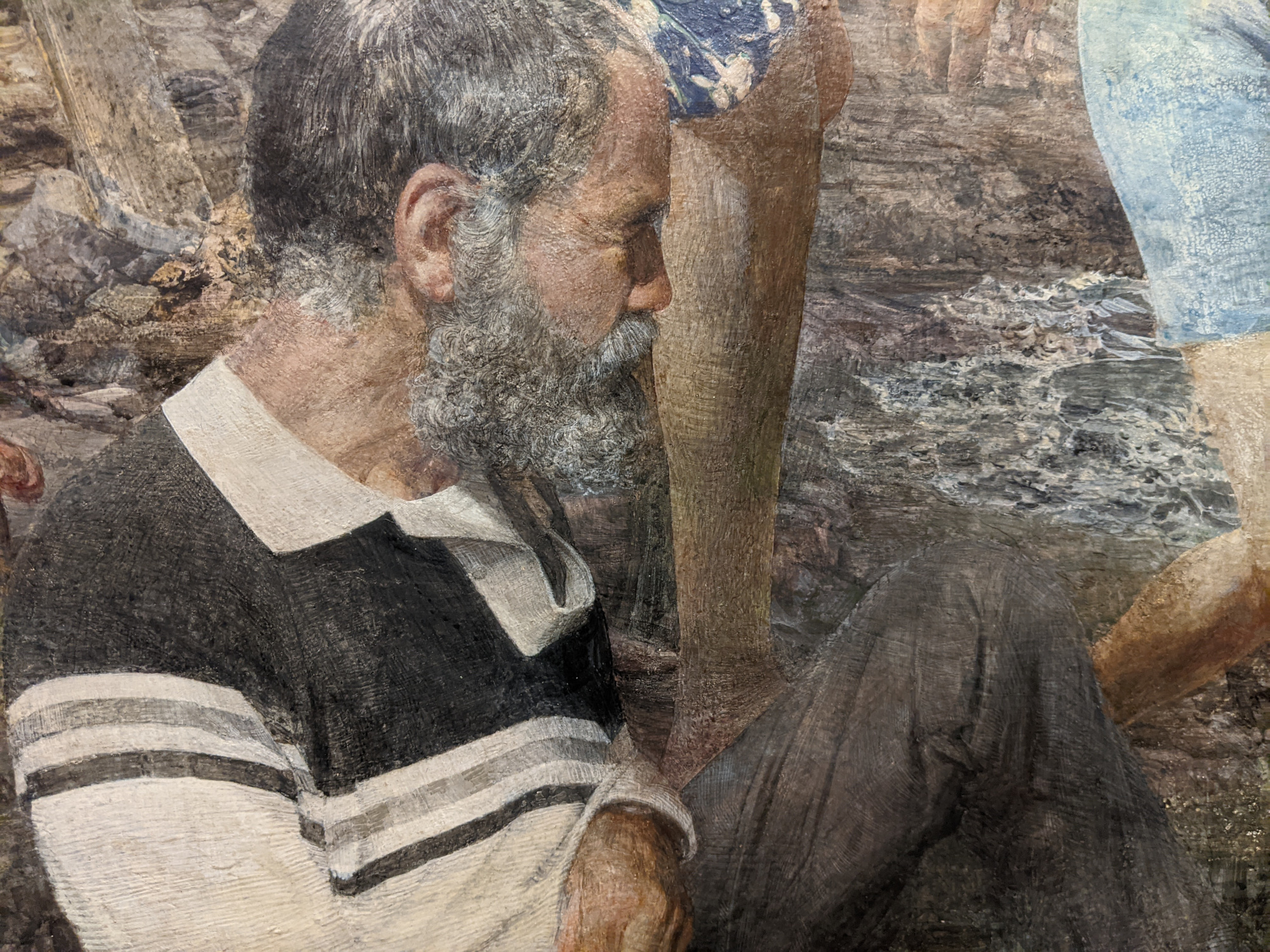
Ikon Chapel (detail) by John Patrick Cobb, as installed at the “Transcend” CIVA biennial conference, November 4–6, 2021, St. David’s Episcopal Church, Austin, Texas. Photo: Victoria Emily Jones.John Patrick Cobb (American, 1954–), Baptism by Water, 1999. Egg tempera and gold leaf on panel, 36 × 77 in. Photo: Victoria Emily Jones.
Baptism by Water is, along with its companion piece, Baptism by Fire, the largest painting in the series, at over six feet long. It is a lakeside scene portraying John the Baptist—the long-haired, bleach-blonde guy at the far right—calling folks to repentance. Several men climb down the rocky shoreline to enter the cleansing waters and be raised to new life. The models are all associated in real life with water—surfers, plumbers, fishermen. And this is a local setting: Hippie Hollow on Lake Travis in Central Texas, a famous nude swimming hole.
Jesus, says Cobb, is the young man with the black hair and black trunks. Cobb deliberately made him indistinguishable from the others to emphasize his full humanity. He looks beyond John the Baptist, perhaps mentally preparing for the solitary forty-day fast in the desert he’s about to embark on.
In the wall text in the Ikon Chapel, Cobb describes the seated, shirted man in the foreground as reminiscent of the Gerasene demoniac (Mark 5:1–20):
The figure in the near ground, clothed, was a man who lived in the nook of the sea wall in Galveston and slept in the nearby graveyard at 61st Street. On the worst winter days I would bring him a coffee, and finally asked him one day if I could include him in my painting. He would sometimes drink himself into a frenzy and yell and scream at the cars in horrific anger. His leg had been broken and had healed in a precarious angle. I felt as though if there were anyone who deserved the peace and the Holy Spirit, it would be him.
At the bottom right, one of the figures twists away, rejecting John’s call. The model’s name is Jonah, so Cobb wanted to use him as a Jonah figure, resisting (at least initially) the divine plan.
In the background Adam and Eve are skinny-dipping.
Detail, John the BaptistDetail, Jesus (left)Detail with Eve and Adam in backgroundDetail of a local unhoused man with a leg impairment and alcoholism, for whom the artist wishes God’s peace
I was fortunate enough to get to know Cobb a bit over lunch one day while I was in Austin, and then later at an outdoor gathering he and his wife, Tina, hosted on their property. At the time, he was preparing for an extended trip to Italy to restore some Renaissance frescoes in a village chapel.
To learn more about this remarkable body of work, see the book Chapel Ikons: Biblical Meditations on Living the Spiritual Life in the Modern World (Treaty Oak, 2020), which reproduces all twenty-five paintings in full color with detailed commentaries by William Y. Penn Jr. The postscript says that Cobb and Penn are looking for a permanent institutional home with resources to preserve the chapel ikons for public viewing and study and that if interested, you should contact wpenn@me.com.
Refrain: A voice cries out in the desert Come prepare the way of the Lord God is coming, make straight for him a highway Come prepare the way of the Lord
Every valley shall be exalted Every mountain shall be made low Then shall the Word of God be known All the earth shall proclaim The glory of the Lord [Refrain]
Go upon the highest mountain Zion, herald of good news Lift your voice, cry out with all your soul Jerusalem, proclaim Glad tidings in the Lord [Refrain]
Have no fear, O cities of Judah Here is your God See, the Lord is coming now with power Our God is here The mighty and the strong [Refrain]
Like a shepherd, he feeds his flock He gathers the lambs See, he carries them gently in his arms So tenderly With a mother’s love [Refrain]
This post is part of a daily Advent series from December 2 to 24, 2023 (with Christmas to follow through January 6, 2024). View all the posts here, and the accompanying Spotify playlist here. “A Voice Cries Out” is not on Spotify.