NEW ALBUM: Lent Hymns by Paul Zach: Released this month, Lent Hymns by Paul Zach comprises twelve songs, a mix of originals and classics, with contributions by IAMSON, Jessica Fox, Sara Groves, Jon Guerra, and Kate Bluett. The LP is available wherever music is streamed or sold. Here’s an Instagram video that excerpts “Draw Me In”:
KICKSTARTER: New Porter’s Gate album: This summer The Porter’s Gate, an interdenominational Christian music collective, is gathering songwriters to write and record musical settings of passages from The Message, a translation of the Bible by the late Eugene Peterson [previously] that uses contemporary idioms and phrases. The project is in partnership with the Eugene Peterson Center for Christian Imagination at Western Theological Seminary in Holland, Michigan. I’m so looking forward to this!
+++
SONGS:
>> “Вечірня молитва” (Vechirnya molytva) (Evening Prayer): A choral setting of a text from the Divine Service of the Eastern Orthodox Church, by contemporary Ukrainian composer Iryna Aleksiychuk. Performed in 2012 by the Female Choir of Kiev Glier Institute of Music, conducted by G. Gorbatenko. [HT: Global Christian Worship]
English translation:
Heavenly King, Comforter, Spirit of Truth, Who art everywhere present and fillest all things, Treasury of good things, and Giver of life: Come and abide in us, and cleanse us from every sin, And save our souls, O Good One! Holy God, holy Mighty, holy Immortal, Have mercy on us.
>> “Bare and Bones” by Candace Coker: Trinidad-born, Vancouver-based singer-songwriter Candace Coker sings the title track from her new album, Bare and Bones, with her boyfriend, Josiah Charleau. The video is shot at Bamboo Cathedral, a thousand-foot stretch of roadway in Tucker Valley in Chaguaramas, Trinidad and Tobago, where bamboo stalks bend toward each other across the road, creating a canopy.
>> “HigherHoly” by IAMSON:IAMSON is the artist name of singer-songwriter and music producer Orlando Palmer, based in Richmond, Virginia. He released this song as a single in 2020. The rap is performed by guest artist Marv (Marvin Hudgins II) of Chattanooga, Tennessee, and the animation in the video is by Kenya Foster.
>> “I Could Sing of Your Love Forever” (cover) by Mary Yang and Ger Vang: Mary Yang and Ger Vang are Hmong Christian musicians living in Milwaukee, Wisconsin. (The Hmong are an Indigenous people group from East and Southeast Asia.) Here they perform their bossa nova arrangement of this modern worship classic by Martin Smith of the English band Delirious?. Yang and Vang are part of the Fishermen’s Project, a band that releases mainly classic hymns translated into the Hmong language. [HT: Global Christian Worship]
Sister Kim Ok-soon (김옥순 수녀), The Bread of Life from Heaven (하늘에서 내려온 생명의 빵), 2014
Stars sing, light-years deep in silent space.
In a bottle’s neck God’s Ghost sings
as the wine is poured.
Out on the edge of eternity, the Father
sees the Lamb slain ere the world is formed.
A soft cough splits the silence of this room
light-years below the wheeling stars.
A hollow prayer; give it breath, O Ghost,
let roar a wind like that which shook
the bones in Vision Vale.
For vision, God spills bread crumbs on the board.
His stars sing, light-years deep in silent space.
Here, emblems speak a mystery of brokenness:
the shattering of him by whom all things consist.
Keith Patman is an occasional poet whose primary vocation is Bible translation. Since 1982 he has worked for Wycliffe Bible Translators, assisting with the translation of scripture into the languages of West and Central Africa. He lived in Cameroon from 1987 to 1995, working on a Nugunu New Testament, and now serves from the US as part of an international team providing tools and training to African translators. He currently lives in Waynesboro, Virginia, with his wife, Jaci, who is a Presbyterian minister. They have two grown children and six grandchildren.
I’ve received a few requests from followers to resume my monthly thirty-song playlists. I had previously thought I’d stick to publishing these during Ordinary Time, since I have longer, thematic playlists for the seasons of Advent, Christmas, Lent (our current place in the calendar), and Easter—which you can find on my Spotify profile. But I’m happy to oblige! Here’s a new playlist for March:
+++
ESSAY: “Victor Hugo’s Masterpiece of Impossibility” by Caitrin Keiper, Plough: A wonderful essay on how competing vows in the novel and musical Les Misérables reveal the paradox of grace. I’ve been captivated by this story of mercy, forgiveness, and transformation set in revolutionary France ever since I saw the 1998 film adaptation starring Liam Neeson in middle school. The faith-inspired actions of Bishop Myriel at the beginning set the life of the protagonist Jean Valjean, an escaped convict, on a trajectory that is beautiful to watch unfold, and the downfall of the law-obsessed Inspector Javert, who cannot bring himself to accept the grace offered him, is most tragic.
+++
PODCAST EPISODES:
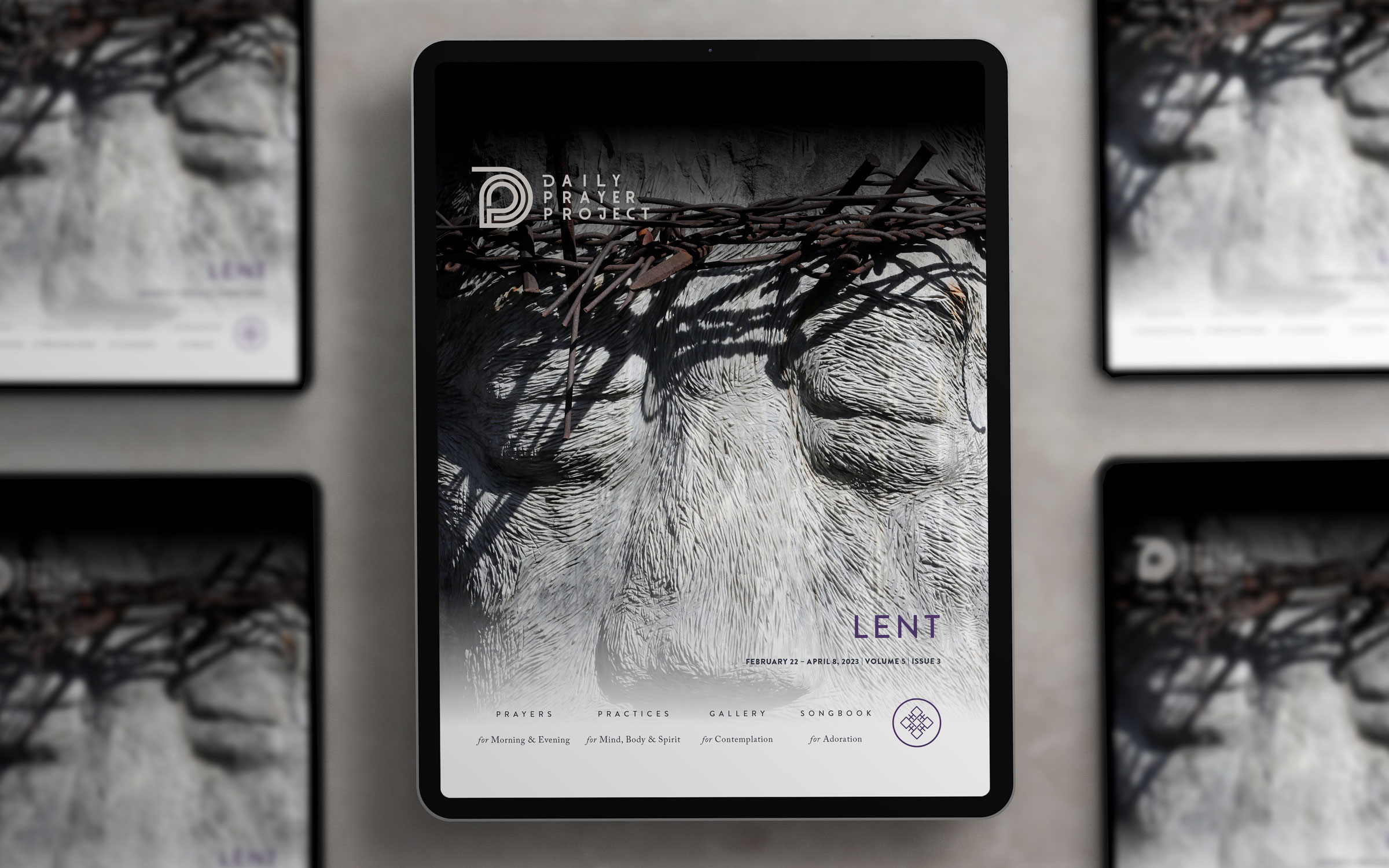
>> Season 2, episode 2, of Gather Round, on the DPP’s Lent 2023 Living Prayer Periodical: On the in-house podcast of Grace Mosaic in Washington, DC, three of my four Daily Prayer Project colleagues and I walk listeners through the latest edition of our prayer periodical, which covers the six weeks of Lent. The conversation starts at 3:46. Rev. Joel Littlepage, curator of the liturgies and songs, highlights a litany to the Servant-Christ from Andhra Theological College in Hyderabad, India, and a song by Pastor Antonio Rivera González of Mexico (see below). Ashley Williams, who commissions or secures reproduction rights for the practice-based essays and curates the photographs throughout, shares some teasers for “Calling Out to God in Lament” by Nina Barnes and “Intractable Sin, Preemptory Prayer” by Alicia Akins.
The Daily Prayer Project’s Lent 2023 booklet, featuring scripture, prayers, practical essays, art, and music from diverse contributors, is available in print and digital formats.
As curator of the art on the cover and in the Gallery section, I discuss the marble sculpture Condemned to Death by Chang Dong Ho (장동호) (see more by the artist), the mixed-media piece Gathering Fragments 1 by C. F. John, the photograph Untitled #10, Flushing, NY from the Stranger Fruit series by Jon Henry, and the painted woodcarving Qwi:qwelstom (Halkomelem, a Coast Salish language, for “Balance and Harmony”) by Don Froese.
At 32:44–35:06, our theological editor, Rev. Russ Whitfield, discusses a theological method that has informed our work at the DPP called triperspectivalism (or multiperspectivalism), which says that we can enrich our perspective, limited on its own, by looking at things from different angles, especially those revealed to us by other people and cultures. For a snippet of the Herman Bavinck quote, see here. What Russ says is SO GOOD! I believe our prayerbooks stand out from other similar projects in that they are deliberately cross-cultural—not because it’s trendy, but because there is so much beauty and wisdom we are missing by not availing ourselves of the many resources of the global church. Our content is also cross-historical.
There are subscription options for individuals (you receive a print edition and a digital download link) and groups (digital access, with bulk-printing options). You can also buy a single copy, but it’s cheaper to purchase a monthly subscription and then cancel after you receive your edition if you don’t wish to continue. We publish six editions a year, each following the same format but filled with new content for the given season.
>> “Lent: Season of Repentance, Renewal . . . and Rebellion” with Esau McCaulley, For the Life of the World: Here Rev. Dr. Esau McCaulley—associate professor of New Testament at Wheaton College, contributing opinion writer for the New York Times, and award-winning author of Reading While Black—talks about the Christian practice of Lent as a collective wisdom passed down through generations of Jesus followers, as well as a spiritual rebellion against mainstream American culture, which has its own established rhythms that shape how we spend our money, when we feast, and what we celebrate.
McCaulley spent the first twenty-one years of his life in the Black Baptist church and the past twenty in a high-liturgical tradition, both of which have been formative for him. One thing he appreciates about liturgy (both the yearly calendar and the elements within a worship service), he says, is how it helps him more fully inhabit the story of Christ. He construes Lent as a season of repentance and grace; he points out the justice practices of Lent; he walks through a Christian understanding of death, and the beautiful practice of stripping the altars on Maundy Thursday; and he’s emphatic about how Lent is a guided season of pursuing the grace to find, or perhaps return to, yourself as God has called you to be. These ideas are expanded upon in his new book, Lent: The Season of Repentance and Renewal, from IVP’s Fullness of Time series.
+++
SONGS:
>> “Divino compañero del camino” (O Lord, Divine Companion): Written in 1964 by Antonio Rivera of Mexico, this popular Spanish-language song is performed here by Karina Moreno and Joseph Espinoza. It’s based on Luke 24:28–32, from the postresurrection story of the walk to and supper at Emmaus, but its pilgrimage aspect—the idea of Jesus as a companion on our life journey—makes it appropriate for Lent. [HT: The Daily Prayer Project]
>> “Yeshu Ji Mere Paap Kshama Kar Do” (Lord Jesus, Forgive My Sins): A Hindi song of confession with words by the late Shri Jalal Masih and music by his granddaughter, Mercy Sharon Masih. Mercy sings it here with her father, Hanook Masih. For an English translation, click the “CC” button. [HT: Global Christian Worship]
+++
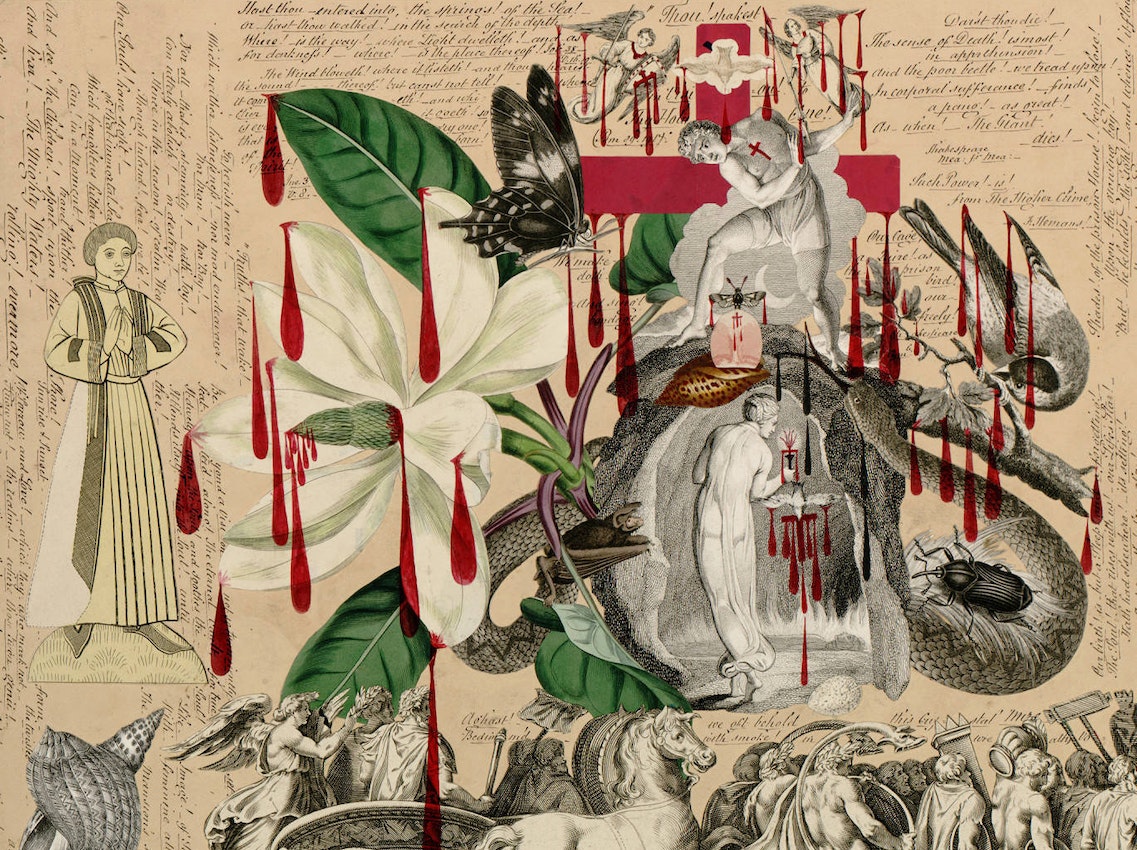
ARTICLE: “The Blood Collages of John Bingley Garland (ca. 1850–60),”Public Domain Review: Peruse the so-called Victorian Blood Book, an eccentricity made by the British politician and fishmonger John Bingley Garland as a wedding gift for his daughter Amy in 1854. It consists of forty-one collages whose sources are engravings by William Blake and various other religious artists, botanical and zoological illustrations, photographs of medieval tombs, and other images from nineteenth-century books, but with one distinguishing decorative addition by Garland’s hand: drops of blood in red India ink, presumably signifying the blood of Christ. The pages also bear extensive handwritten religious commentary.
Detail from a page of John Bingley Garland’s “Blood Book” (ca. 1850–60), featuring a cut-out from a reproduction of William Blake’s engraving The Soul exploring the recesses of the Grave.
The Blood Book transferred from the collection of novelist Evelyn Waugh to the Harry Ransom Center at the University of Texas at Austin upon Waugh’s death, and they identify it as “the single most curious object in the entire library.” Though modern eyes may see the collages as surreal or even grotesque, Garland’s descendants regarded them as nothing other than “a precious reminder of the love of family and Our Lord,” as they have written. The Harry Ransom Center has digitized the full book.
Aelbert Bouts (Netherlandish, ca. 1451/54–1549), Man of Sorrows, mid-1490s. Oil on oak wood, 14 15/16 × 10 7/16 in. (37.9 × 26.5 cm). Harvard Art Museums / Fogg Museum, Cambridge, Massachusetts.
ORIGINAL MIDDLE ENGLISH:

Vndo þi dore, my spuse dere,
Allas! wy stond i loken out here?
     fre am i þi make.
Loke mi lokkes & ek myn heued
& al my bodi with blod be-weued
     For þi sake.

Allas! allas! heuel haue i sped,
For senne iesu is fro me fled,
     Mi trewe fere.
With-outen my gate he stant alone,
Sorfuliche he maket his mone
     On his manere.

Lord, for senne i sike sore,
Forʒef & i ne wil no more,
With al my mith senne i forsake,
& opne myn herte þe inne to take.
For þin herte is clouen oure loue to kecchen,
Þi loue is chosen vs alle to fecchen;
Mine herte it þerlede ʒef i wer kende,
Þi suete loue to hauen in mende.
Perce myn herte with þi louengge,
Þat in þe i haue my duellingge.
Amen.
MODERN ENGLISH TRANSLATION:

“Undo thy door, my spouse dear,
Alas! why stand I locked out here?
     For I am thy mate.
Look, my locks and also my head
And all my body with blood bedewed,
     For thy sake.”

“Alas! alas! evil have I sped,
For sin Jesus is from me fled,
     My true companion.
Without my gate he standeth alone,
Sorrowfully he maketh his moan
     In his manner.”

Lord, for sin I sigh sore,
Forgive, and I’ll do so no more,
With all my might I forsake my sin,
And open my heart to take thee in.
For thy heart is cleft our love to catch,
Thy love has chosen us all to fetch;
My heart it pierced if I were kind,
Thy sweet love to have in mind.
Pierce my heart with thy loving,
That in thee I may have my dwelling.
Amen.
This poem appears in the 1372 “commonplace book” of the Franciscan friar John of Grimestone, who lived in Norfolk, England. Commonplace books were notebooks used to gather quotations and literary excerpts, with entries typically organized under subject headings. Preachers often kept them for homiletic purposes, gathering potential material for sermons. Grimestone’s is remarkable because it includes, in addition to much Latin material, 239 poems in Middle English. (English friars at the time regularly used vernacular religious verse in their sermons.) It is unknown whether Grimestone composed these verses himself or merely compiled them; likely, it is some combination. The first two stanzas of this particular poem are found, transposed, in another manuscript from almost a century earlier. Grimestone revised them slightly and added the third stanza.
Belonging to the Christ-as-lover tradition, “Undo thy door” is based primarily on Song of Solomon 5:2, cited in Grimestone’s manuscript: “I sleep, but my heart waketh: it is the voice of my beloved that knocketh, saying, Open to me, my sister, my love, my dove, my undefiled: for my head is filled with dew, and my locks with the drops of the night.” In a clever interpretation of the Old Testament source, the poet imagines the dewdrops on the Beloved’s brow as blood, thus identifying him with the thorn-crowned Christ. His bride is the human soul. Revelation 3:20 is provided as a further gloss by Grimestone: Jesus says, “Behold, I stand at the door, and knock: if any man hear my voice, and open the door, I will come in to him, and will sup with him, and he with me.”
So in the poem, the speaker is keeping company with sin and has locked out her true lover, Christ. Christ stands at the gate of her heart and implores her with great ardor to let him in and to send sin packing. Wet with the wounds of sacrifice, tokens of his love, he is persistent in his longing for her.
Christ’s entreaties provide the impetus for the speaker’s repentance, expressed in the final stanza, which changes awkwardly in form and meter. His love has pierced her to the core, undoing her resistance. She resolves to break the sin-lock—to turn away from wrongful deeds—and answer Christ’s call so that they can enjoy sweet union together, dwelling in one another’s love. It was his heart that opened first—it was cleft by the centurion’s spear as he hung on the cross—and she is compelled to respond with similar openness, receiving what he has given, requiting his desire.
SOURCES:
This poem is #6108 in the Digital Index of Middle English Verse. It is preserved in Edinburgh, National Library of Scotland, Adv.MS.18.7.21, fol. 121v. A shorter, earlier version, from the late thirteenth century, appears in London, Lambeth Palace Library 557, fol. 185v.
Modern English translation: David C. Fowler, The Bible in Middle English Literature (Seattle: University of Washington Press, 1984), 85–86
For further reading, see chapters 4–5 of Siegfried Wenzel, Preachers, Poets, and the Early English Lyric (Princeton, NJ: Princeton University Press, 1986), especially pages 140–41; and chapter 7, “The Theme of Christ the Lover-Knight in Medieval English Literature,” in Rosemary Woolf, Art and Doctrine: Essays on Medieval English Literature (London: The Hambledon Press, 1986), especially pages 109–10.
ONLINE EVENT: “Theodicy of Beauty” by Sarah Clarkson, March 6, 2:30 p.m. ET: “The question of suffering is one of the central, aching questions of faith. Too often, we meet suffering with an argument for God’s goodness, rather than an invitation to find and discover his goodness anew. Join me for an exploration of what it means to encounter and trust the beauty of God in our times of darkness, suffering, and pain. Drawing on my own story of mental illness and depression, I’ll explore what it means to engage with God’s goodness in a radically healing way, one that restores our capacity to imagine, hope, and create. We’ll use literature, art, and poetry to discern the ways that God arrives in our darkness to heal us, and also to restore us as agents of his loveliness in the midst of a broken world.”
This Crowdcast talk by Sarah Clarkson is based on her book This Beautiful Truth: How God’s Goodness Breaks into Our Darkness. Registration is $7 and includes a complimentary downloadable copy of “Encountering Beauty,” an arts-based reader’s guide to Clarkson’s book. I have appreciated her From the Vicarage: Books, Beauty, Theology newsletter and her wise, gentle reflections on spirituality, literature, and motherhood on Instagram @sarahwanders, so I’m looking forward to hearing from her on this topic!
+++
LECTURES (available on podcast platforms):
>> “The Loving Look” by Dr. Elissa Yukiko Weichbrodt: In this keynote address for the 2018 Beautiful Orthodoxy conference, art historian Elissa Yukiko Weichbrodt [previously], author of Redeeming Vision: A Christian Guide to Looking at and Learning from Art, discusses how contemporary art—which can sometimes be confounding or otherwise challenging—can drive us to confession, empathy, and love. Sharing her encounters with three contemporary artworks, she talks about art as a place where we can experience sanctification and common grace; how the Incarnation further vested our material world with significance; art as an invitation to embodied knowledge; art as part of how we order and understand our physical world; artworks as mirrors and shapers of culture; and how viewers, not just artists, are called to faithfulness.
She cites Esther Lightcap Meek’s Loving to Know: Covenant Epistemology, in which Meek says that all acts of coming to know are integrative; they become part of us. Knowledge is an act of covenantal care, Meek says. We don’t know in order to love; we love in order to know. Weichbrodt says, “For me, contemporary art—particularly art made by artists grappling with histories and experiences that have remained largely unseen, unknown, and unloved by the dominant culture—has served as a catalyst for faithful knowing.”
>> “The Arts as a Means to Love” by Dr. Mary McCampbell: In this lecture given for English L’Abri, Mary McCampbell [previously], an associate professor of humanities at Lee University, discusses some of the ideas from her book Imagining Our Neighbors as Ourselves: How Art Shapes Empathy. I appreciate how her writing and teaching embraces the arts of film and television alongside literature, such that not only are works like The Power and the Glory by Graham Greene, “A Good Man Is Hard to Find” by Flannery O’Connor, and Beloved by Toni Morrison explored, but so are, for example, the comedy-drama Lars and the Real Girl and the drama series Better Call Saul. Discrediting the recent odd assertion from a prominent evangelical corner that empathy is a sin, McCampbell affirms that empathy is, on the contrary, an essential Christian virtue, and one that the narrative arts are adept at forming in us, exposing us to people and stories outside our realms of experience and helping us recognize the image of God in unlikely places.
+++
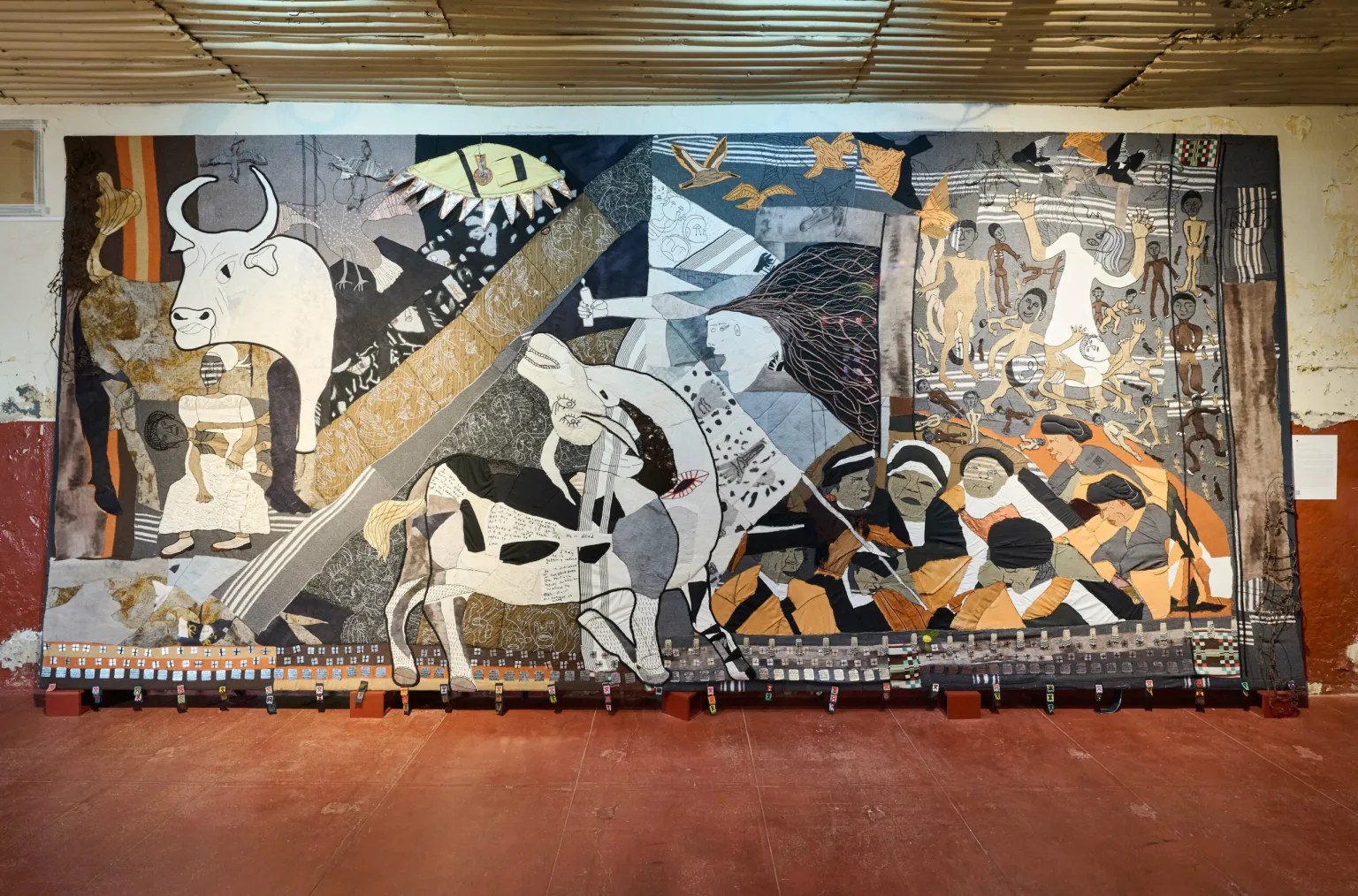
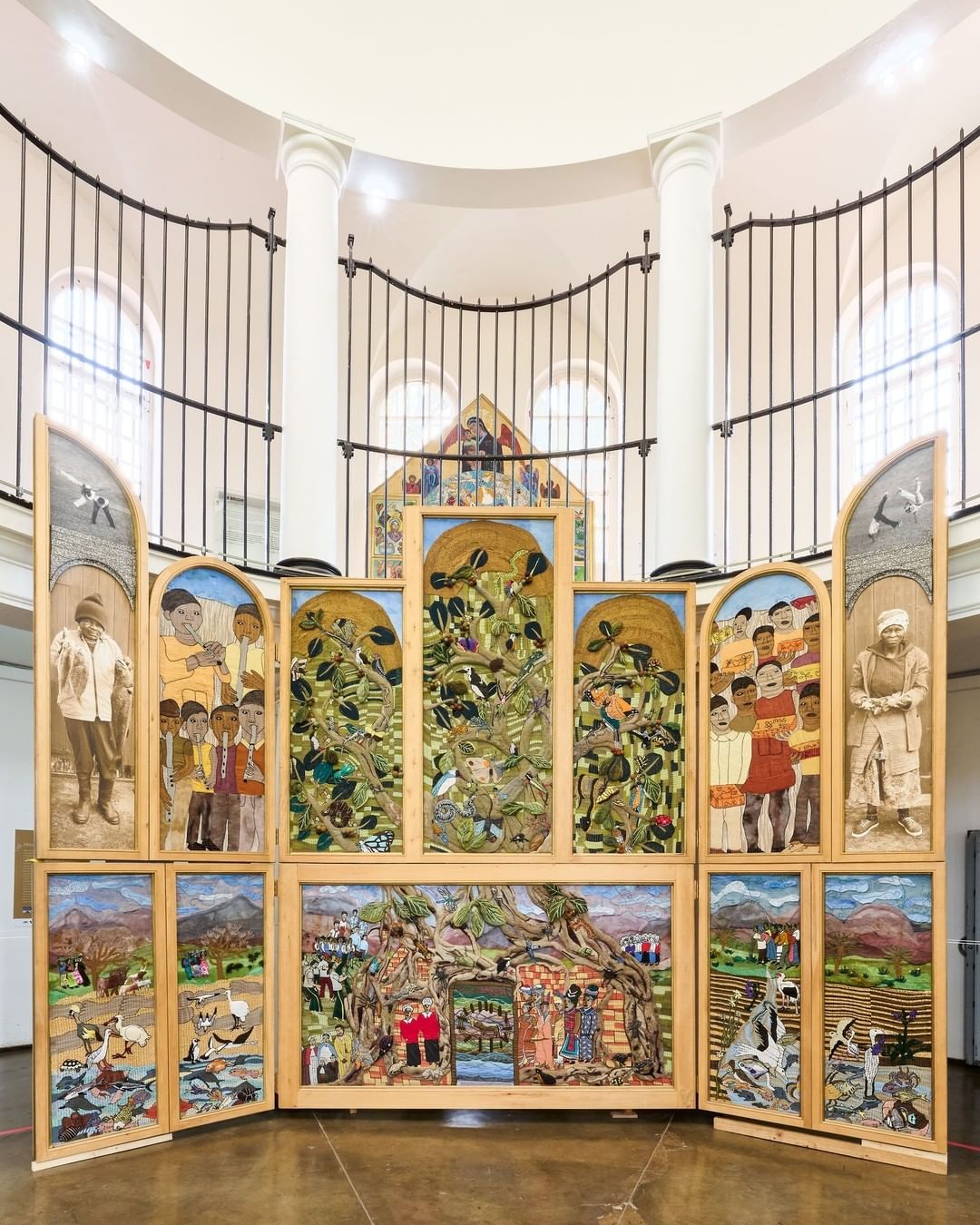
EXHIBITION REVIEW: “Mourning and Perseverance Stitched into South African Tapestries” by Alexandra M. Thomas: Through March 24 at Constitution Hill in Johannesburg, you can see Umaf’evuka, nje ngenyanga, dying and rising, as the moon does, a major retrospective of the work of the Keiskamma Art Project. Founded in 2000, the project archives the collective memory and oral histories of the rural Eastern Cape of South Africa through textile artworks, mainly by Xhosa women. Monumental and small-scale works tell stories of trauma, grief, hope, faith, resilience, and celebration. One of my favorite art research projects has been the one I did on the Isenheim-inspired Keiskamma Altarpiece in 2015, which resulted in the article “Sewing seeds of hope in South Africa”; this altarpiece is one of the many works on display. Let me call out just two others. The photos are from the current exhibition.
Keiskamma Guernica, 2010. Mixed media, including appliqué, felt, embroidery, rusted wire, metal tags, beaded AIDS ribbons, used blankets, and old clothes, 3.5 × 7.8 m. Collection of Javett Art Centre at the University of Pretoria, Tshwane, South Africa. Photo: Anthea Pokroy / Keiskamma Trust.Creation Altarpiece, 2007. Mixed media, including felt, embroidery, photographs, beadwork, wirework, and appliqué, 3.8 × 5.2 m (open). Collection of Unisa Art Gallery, Tshwane, South Africa.
Keiskamma Guernica, after Picasso’s famous antiwar painting, laments the limited access to HIV treatment in rural South Africa in the 2000s and the negligence of government hospitals, which resulted in many HIV/AIDS deaths. The piece repurposes the blankets and clothes of the deceased and serves as an expression of outrage as well as a form of commemoration. Creation Altarpiece, modeled loosely after the Ghent Altarpiece, exults in the region’s abundant wildlife and natural resources and in life-giving initiatives like Hamburg’s music education program, its capoeira group (a dance-like martial art), and the memory boxes made by orphaned children to remember their parents. The three top central panels depict a fig tree eating up an old hotel built by colonialists (a real-life scene observed in the nearby village of Bell!), and the bottom three show villagers of all kinds gathering around Christ, represented as a bull (whereas lambs were commonly sacrificed in ancient Israelite religion, traditional Xhosa religion calls for bull sacrifices).
SONG: “Kyrie” by Ngwa Roland:Ngwa Roland is a composer and the director of De Angelis Capella [previously], a Catholic choir from Yaoundé, Cameroon. Here is his choral setting of the Kyrie eleison (Greek for “Lord, have mercy”), an important Christian prayer used in liturgies around the world.
+++
ARTICLES:
>> “To One Kneeling Down No Word Came” by Jonathan Chan, Yale Logos:Jonathan Chan is a Singapore-based poet and essayist who graduated with a master’s degree in East Asian Studies from Yale in 2022. In this personal essay he reflects on the poetry of R. S. Thomas, a twentieth-century Anglican priest from Wales, particularly as it relates to the toil of prayer—prayer as a discipline requiring persistence and solitude. Thomas’s poems often express a sense of alienation from God, which is not what we might expect from a pastor, but, as Chan remarks, “God’s absence cultivates a desire for God’s presence.”
>> “Stabat Mater: How a 13th Century Lament Resonates Today” by Josh Rodriguez, Forefront: Back in July 2020, composer Josh Rodriguez [previously here and here] published this article on four modern settings of one of the most celebrated Latin hymns of all time, the twenty-stanza Stabat Mater Dolorosa (lit. “The sorrowful mother was standing”), about Mary mourning the death of her son Jesus. Written in the Middle Ages, it continues to inspire composers today, and it remains “a powerful vehicle for ‘grieving with those who grieve,’” Rodriguez writes. He spotlights the settings by James Macmillan, Julia Perry, Hawar Tawfiq, and Paul Mealor, analyzing some of the musical elements of each and quoting the composers in regards to the piece’s meaning to them.
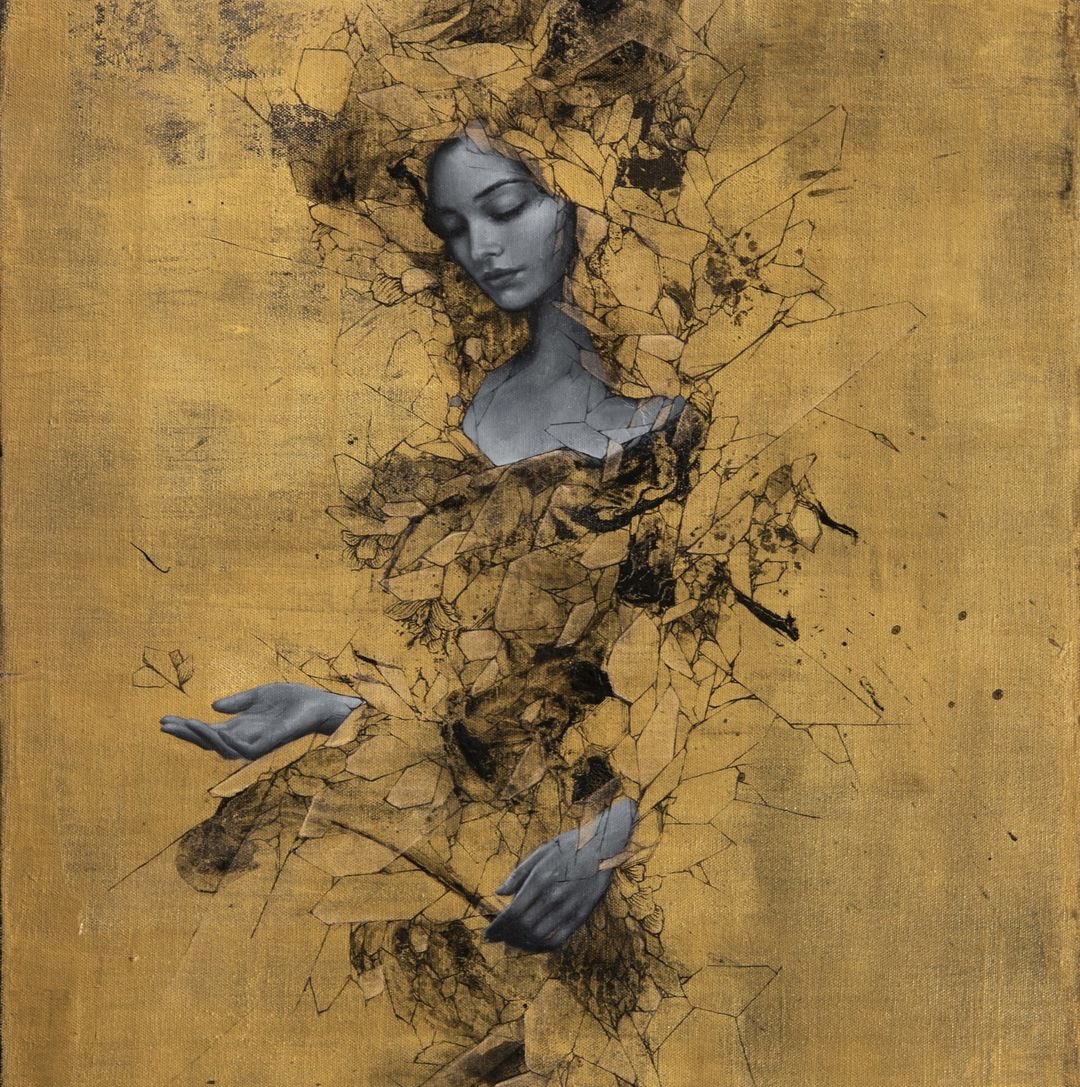
Aiden Kringen (American, 1992–), Opulence 4 (detail), 2022. Oil and acrylic on canvas, 36 × 18 in. [for sale]
I have no wit, no words, no tears;
My heart within me like a stone
Is numbed too much for hopes or fears;
Look right, look left, I dwell alone;
I lift mine eyes, but dimmed with grief
No everlasting hills I see;
My life is in the falling leaf:
O Jesus, quicken me.

My life is like a faded leaf,
My harvest dwindled to a husk:
Truly my life is void and brief
And tedious in the barren dusk;
My life is like a frozen thing,
No bud nor greenness can I see:
Yet rise it shall—the sap of Spring;
O Jesus, rise in me.

My life is like a broken bowl,
A broken bowl that cannot hold
One drop of water for my soul
Or cordial in the searching cold;
Cast in the fire the perished thing;
Melt and remould it, till it be
A royal cup for Him, my King:
O Jesus, drink of me.
One of the most celebrated poets of the Victorian era, Christina Georgina Rossetti (1830–1894) was an English writer of Romantic, devotional, and children’s poems. She was the youngest of four siblings, among them the Pre-Raphaelite artist Dante Gabriel Rossetti, several of whose paintings she sat for, famously modeling for the Virgin Mary. Her father was an Italian political exile to London and instilled in her a love of Dante Alighieri and the Italian language, which he taught at King’s College until being struck ill and rendered blind. He died when Christina was thirteen, and from then onward she suffered bouts of depression and physical illness. Loss and death, heaven, renunciation, the need for grace, and the perfection of divine love are recurring themes in her poetry. A devout Anglican whose verse gives vivid expression to the life of faith and to spiritual longing, she is recognized as a saint by the Church of England and the Episcopal Church, who celebrate April 27 as her feast day.
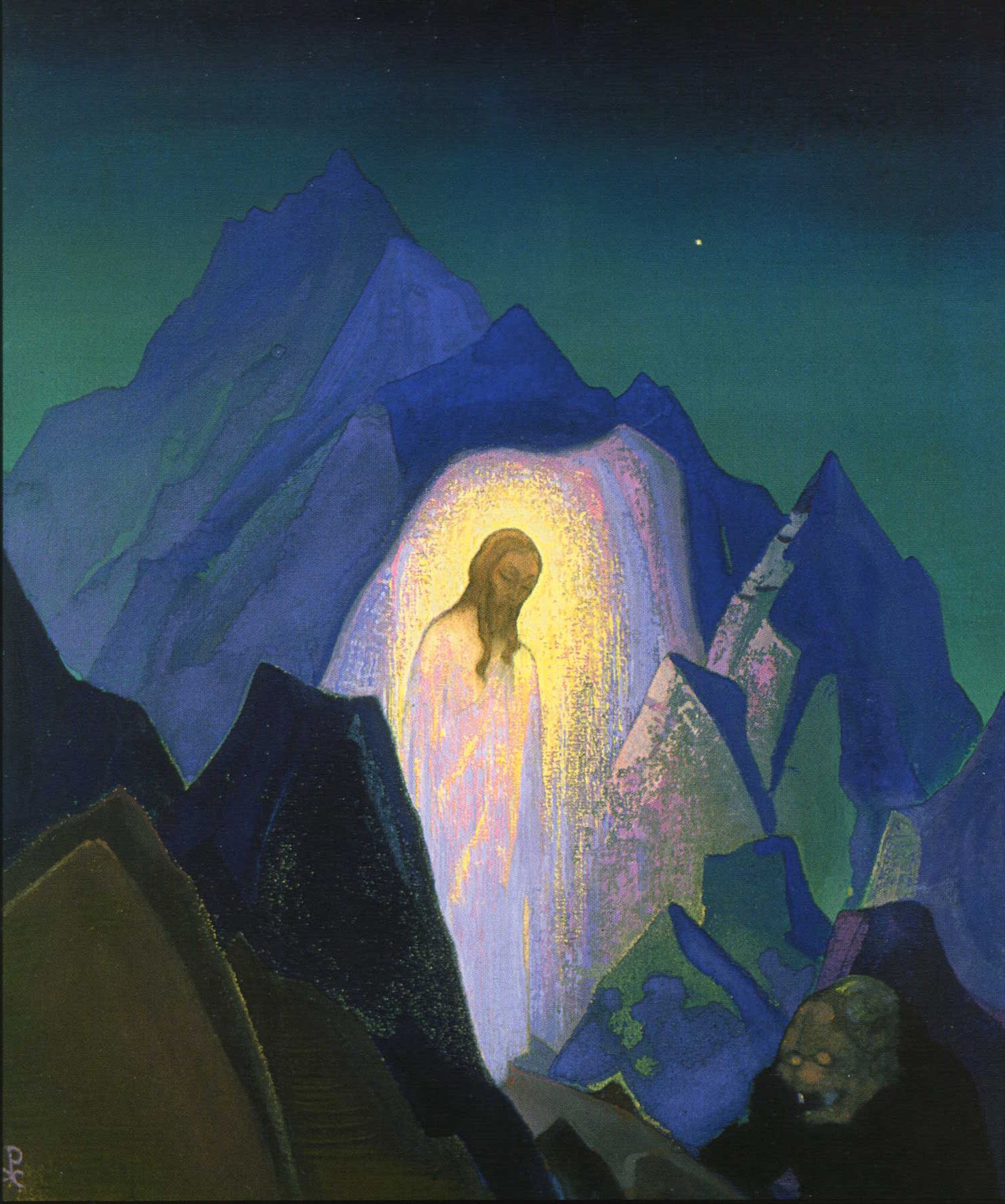
Nicholas Roerich (Russian, 1874–1947), Christ in the Desert, 1933. Tempera on canvas, 60 × 50.9 cm. Nicholas Roerich Museum, Moscow.
QUOTE:
The tradition of Lent means many different things to many different people. I honour the traditions and wisdom of the ages—and I’m interested in discerning what these practices mean [today].
At [my church], Lent is about learning from Jesus, particularly Jesus’ path through the real-life wilderness experiences we all face. We are interested in emulating and discovering a Jesus-shaped life in the hard things, the growing things, and the uncomfortable things. We believe not in an idealized plane of existence no one can quite attain; instead we believe in knowing and living out a Jesus way in the grey areas, the dirt and dust of our earthly lives here and now. . . .
Together and for you, this is our prayer (by Ann Siddall): “May this Lenten journey, with its stories about the hard places of Jesus’ experience, give strength and courage to all whose journey is far from easy. And may it inspire us to risk Christ’s Way of love as we share the journey with other travelers. We make this prayer in his name. Amen.”
>> “Ash Wednesday and the Practice of Truth-Telling” by Christine Valters Paintner: In this introduction to the season of Lent, spiritual writer and retreat leader Christine Valters Paintner discusses lament as a Lenten practice—lament as truth-telling, resistance, solidarity, and the release of God’s power. We need to touch those places of grief that we carry, and open ourselves in compassion to the grief of others. Paintner also unpacks the word “repentance,” visiting its Hebrew and Greek root words to further illuminate its meaning.
>> “Forty for 40: A Literary Reader for Lent” by Nick Ripatrazone:Nick Ripatrazone, the culture editor for Image journal and columnist at The Millions, offers suggestions and blurbs for forty stories, poems, essays, and books appropriate for Lent. Some pieces are inspired by feast days and Gospel readings, while others capture the discernment of the season. From Flaubert’s The Temptation of Saint Anthony and Hemingway’s one-act play Today Is Friday to Love & Salt: A Spiritual Friendship Shared in Letters and Karr’s “Disgraceland,” the selections are varied and intriguing. The dates are off because this was published in 2017, but the list is still valid, and many of the poems can be read online.
+++
LIVING ROOMEVENT: “Poetry of Lent”: On March 4, under the aegis of the local arts nonprofit the Eliot Society, I’m moderating an evening of crowdsourced Lenten poetry at a friend’s home in Crownsville, Maryland. If you’re in the Baltimore-Washington metro area, I’d love to see you there! The themes of this season are so expansive, and I’m looking forward to hearing what people share. Of course, I will have many poems in my back pocket as well. Some words I’ve been thinking of in preparation: pilgrimage; hunger; emptying; grace; greening; solitude; beloved; blood.
+++
SONGS:
>> “Circles” by Tow’rs: Tow’rs, an indie-folk band out of Flagstaff, Arizona, is made up of Gretta and Kyle Miller, drummer Dan Bagle, guitarist Kyle Keller, and cellist Emma Riebe. This song of theirs is about how God lovingly pursues us and clothes our shame.
>> “Parce Domini” by Jacob Obrecht:The Gesualdo Six perform a motet by the Flemish composer Jacob Obrecht (1457/58–1505), which sets a traditional Latin liturgical text based on Joel 2:17, 13.
Parce Domine, parce populo tuo quia pius es et misericors. Exaudi nos in aeternum, Domine.
Spare, O Lord, spare thy people, for Thou art gracious and merciful. Hear us for ever, O Lord.
+++
VISUAL COMMENTARY: “Handling Our Fragility, Seeking a Wise Heart” by Rachel Muers: As part of the Visual Commentary on Scripture project, theologian Rachel Muers has selected and comments on three artworks that resonate with Psalm 90 [previously], a song that combines communal lament with a meditation on wisdom. The psalm ends with the cry “Prosper for us the work of our hands—O prosper the work of our hands!”—which guided Muer in her curation. She gives us nine-thousand-year-old handprints on an Argentinian cave wall, a hospital drawing by Barbara Hepworth, and a cat’s-cradle sculpture by Mitzi Cunliffe. This mini-exhibition is a great way to enter into and engage with this typically Lenten psalm.
Cueva de las Manos (Cave of Hands), began ca. 7,000 BCE. Mural, UNESCO World Heritage Site, Santa Cruz, Argentina.
On a related note: For this Lent, the VCS is dipping into its archives to bring you “Lent Stations: Repentance and Forgiveness,” fourteen artworks with commentary (two per week) that relate to the stated theme. Follow the link to sign up.
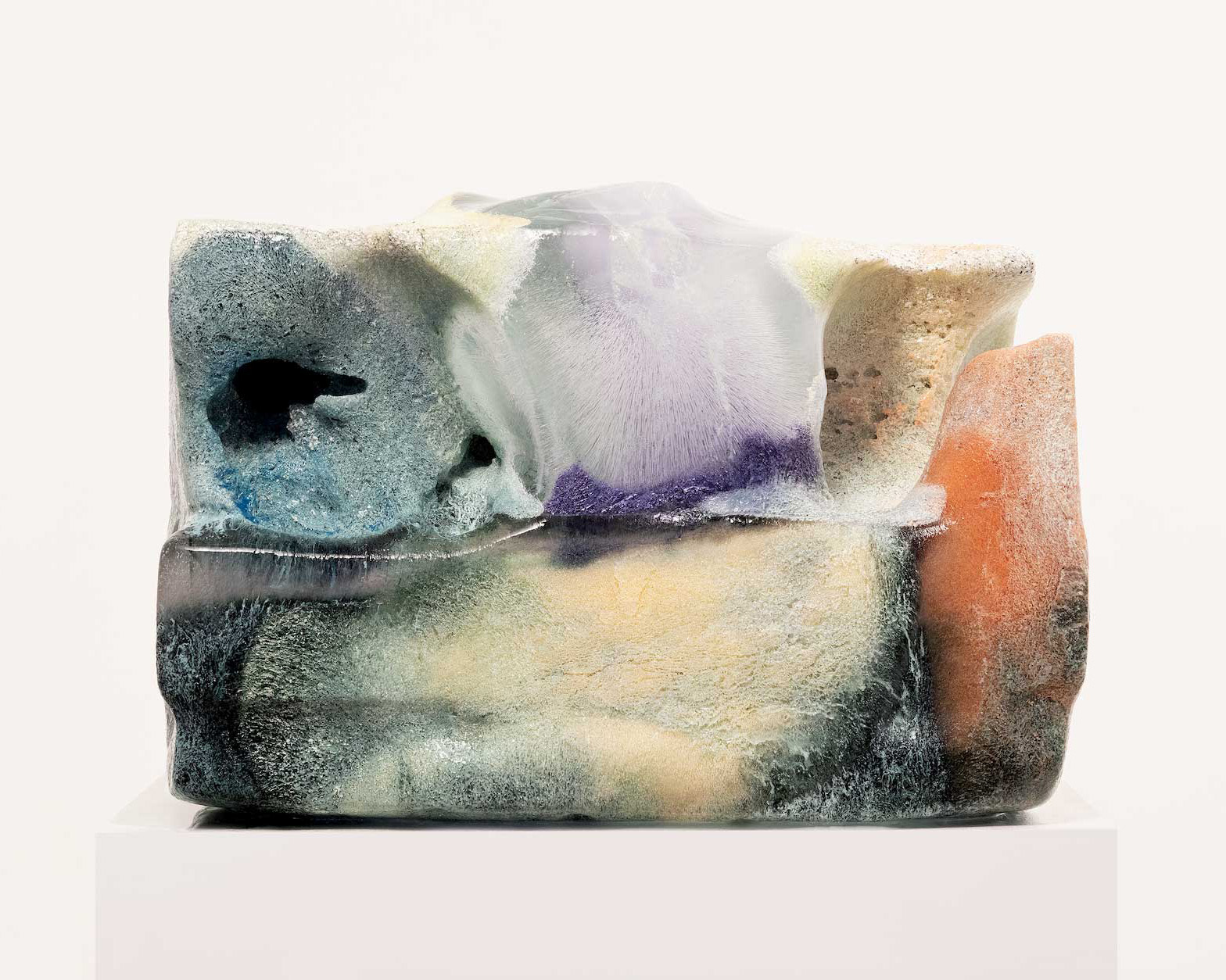
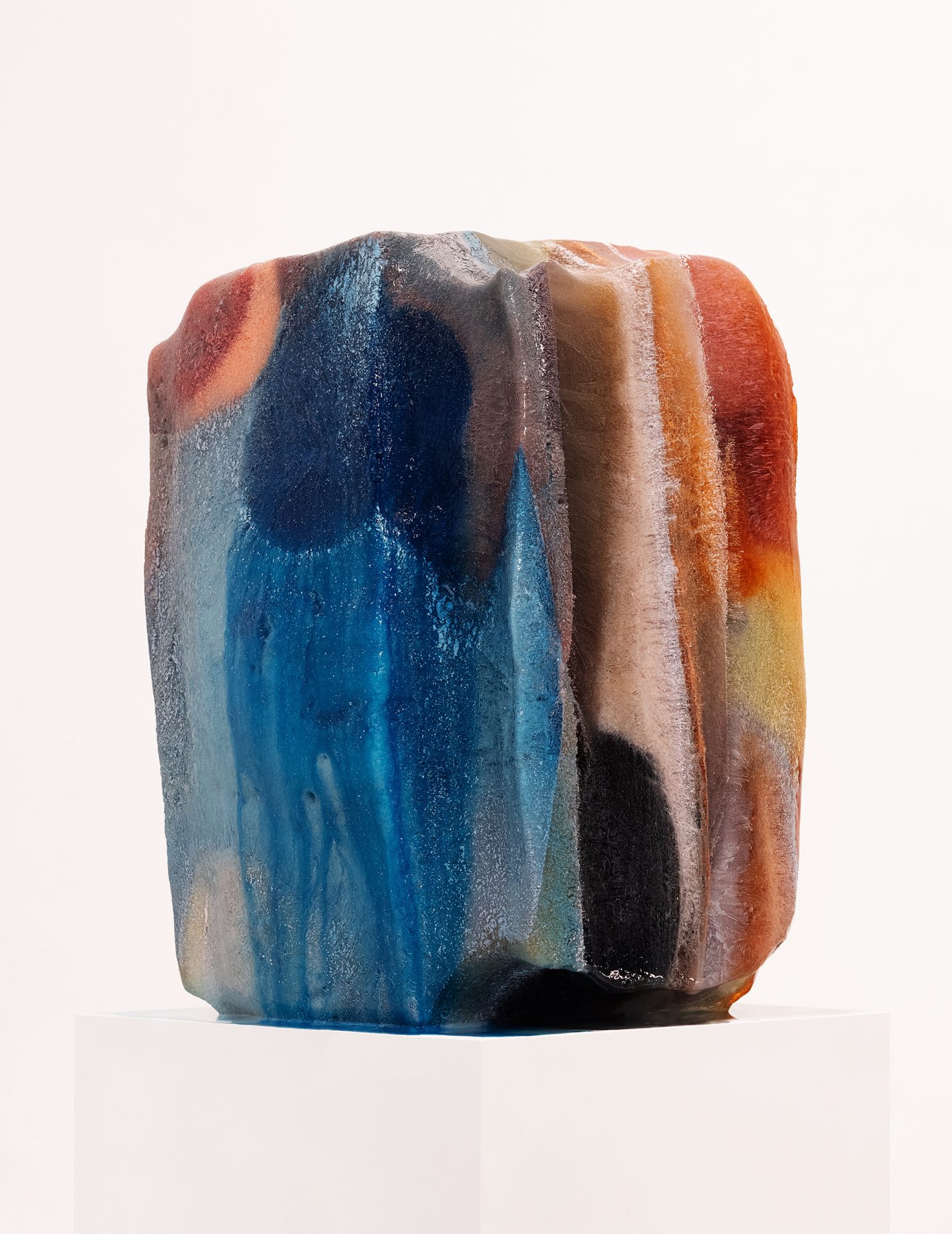
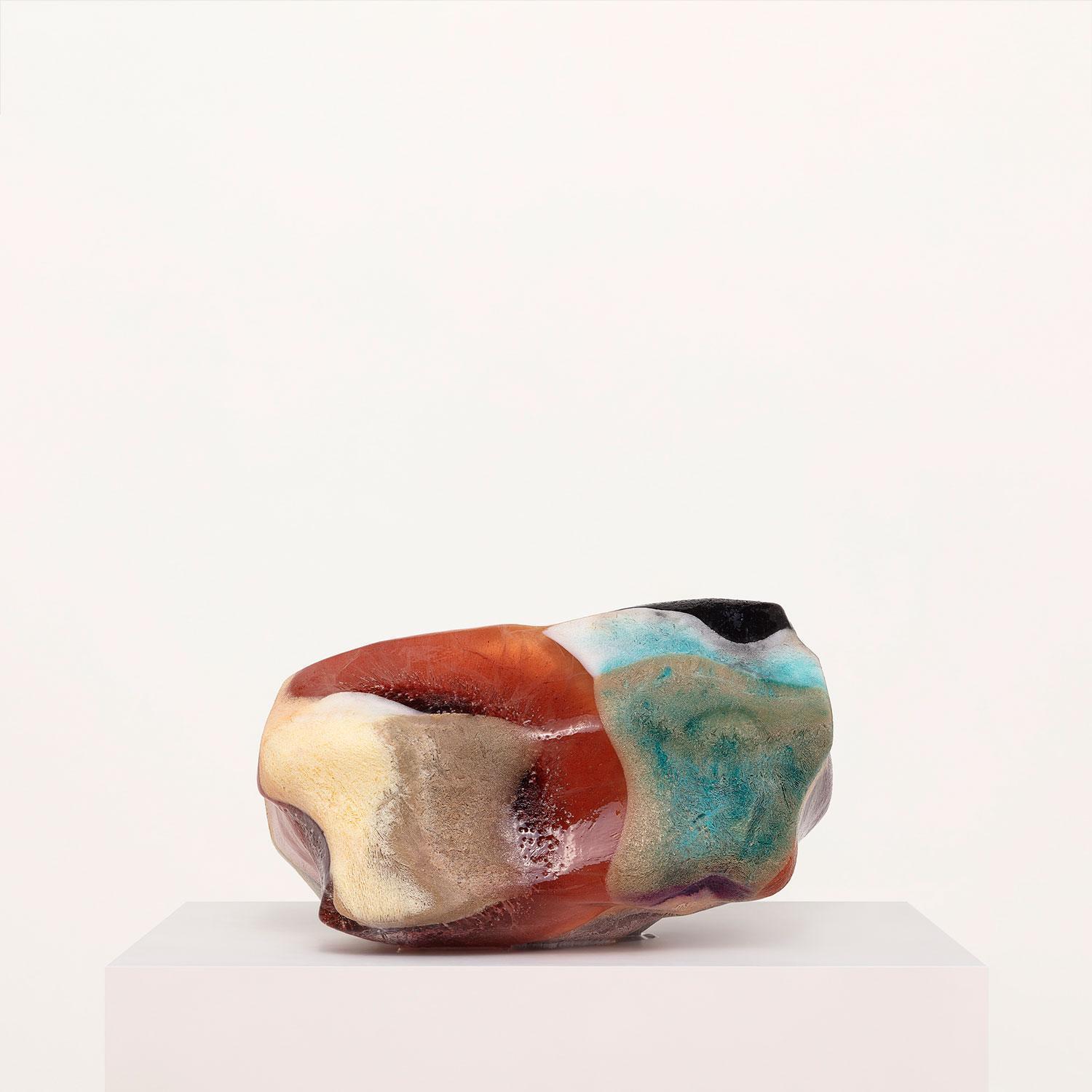
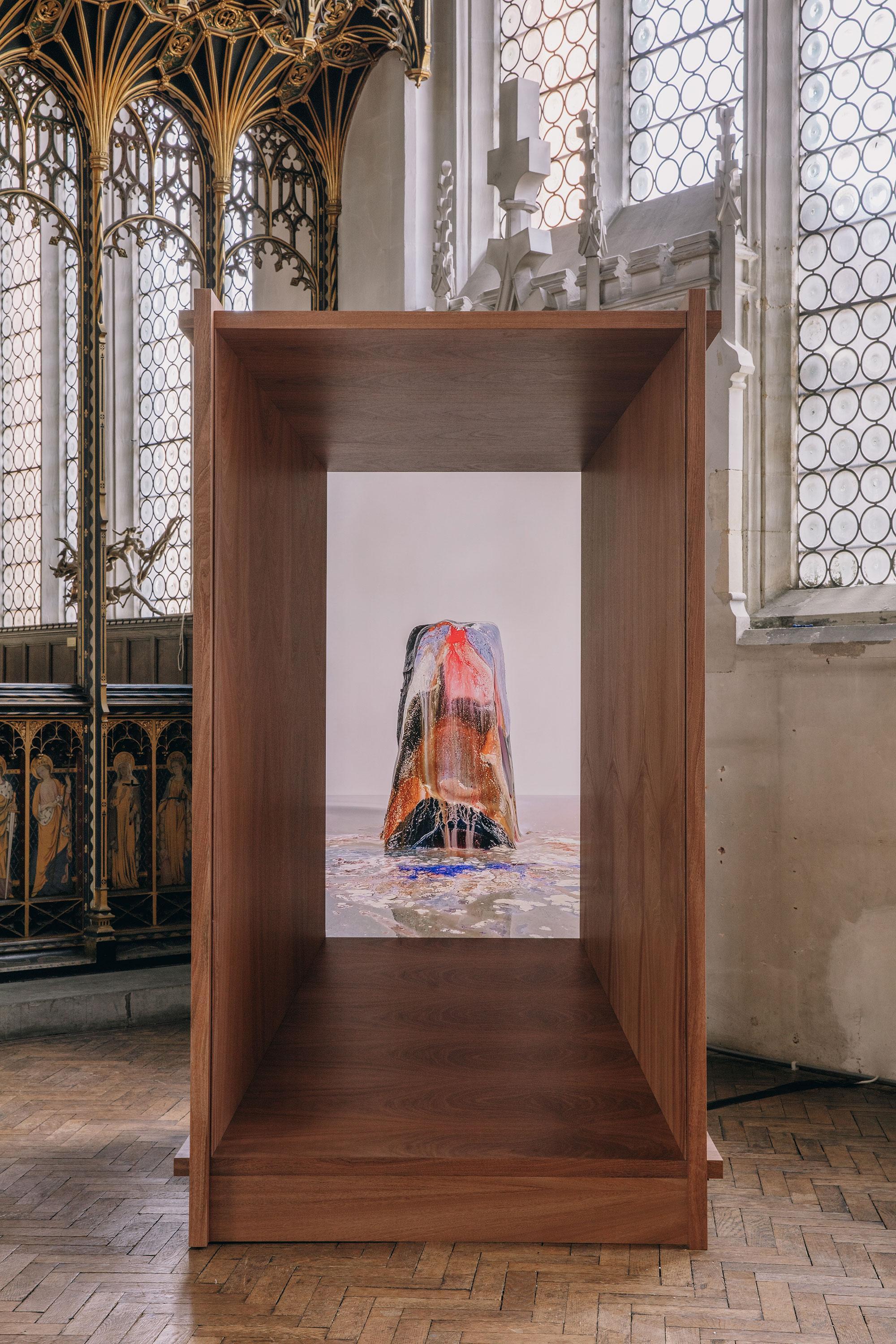
Dawn Ng is a Singaporean multidisciplinary artist whose practice deals with time, memory, and the ephemeral. For her recent body of work Into Air, Ng has crafted nearly 150 large sculptural blocks of frozen pigment and documented their dissolution in the form of photographs, film, and residue paintings. A poetic visual meditation on time and its passing, Into Air captures the metamorphosis of colored ice from solid to liquid to air, physicalizing transience. Presented by Sullivan+Strumpf, it premiered at a derelict ship factory in Singapore in January 2021 and from there traveled to Seoul, London, and Sydney. See the six-minute documentary below for more on the process and meaning behind the work.
Dawn Ng in her studio in Singapore, surrounded by studies and artworks from Into Air. Photo: Sean Lee. All photos courtesy of the artist.
Ng started working on Into Air in 2018, and it’s ongoing. The project encompasses three distinct series:
Clocks
Time Lost Falling in Love
Ash
Clocks is the name Ng gives to the photo portraits of her colored glacier blocks at various stages of disintegration. Weighing about 132 pounds each, the blocks were constructed from acrylic paints, dyes, and inks that she froze together in her studio. After removing each block from the freezer, she and her team photographed it from ten different angles every four hours until it entirely eroded. “Like kaleidoscopic lodestones, the portraits visualize the shape, colour and texture that time inhabits in an ephemeral form,” Ng writes.
Dawn Ng (Singaporean, 1982–), If I could find a souvenir just to prove the world was here, from CLOCKS, 2021. Archival pigment print, 115 × 149 cm.Dawn Ng (Singaporean, 1982–), Some will fall in love with life and drink it from a fountain that is pouring like an avalanche coming down the mountain, from CLOCKS, 2021. Archival pigment print, 153 × 118 cm.Dawn Ng (Singaporean, 1982–), Don’t they know it’s the end of the world, from CLOCKS, 2022. Archival pigment print, 95 × 95 cm.
Time Lost Falling in Love is the collective title of the time-lapse videos Ng filmed of the thawing blocks. The collapse of each block into a puddle of liquid took fifteen to twenty hours, a process compressed into twenty to thirty minutes for each film. Ng says she wants to portray the fluidity of time—time as a “riot of colors” that swell and ebb, that form rivers and pools. By speeding up the frame rate of the film, Ng manipulates time, fast-tracking the dissolution of the blocks while simultaneously providing a calming evocation of a waterfall in slow motion. Time melting on. Here’s Avalanche II:
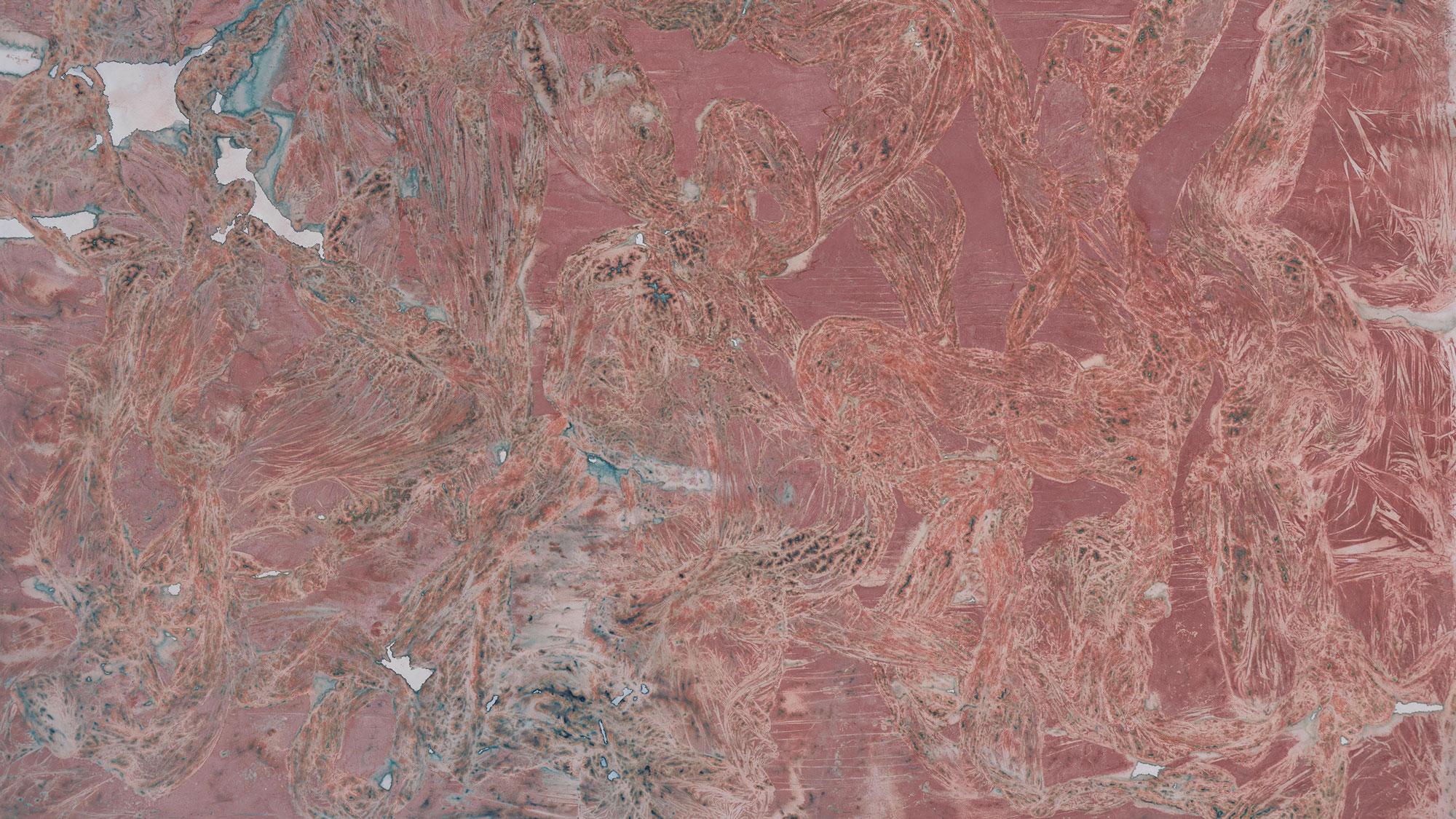
The third and final component of the Into Air project is Ash, a series of paintings created by blanketing the liquid remains of each melted pigment block with a large sheet of canvas-like paper. Ng leaves the paper there for weeks until all the liquid evaporates through it, creating marbled textures and thick buildups that she then peels away. Ng describes Ash as her attempt to “sieve time.”
Many of the photographs and residue paintings take their titles from song lyrics—by the Beatles, Genesis, the White Stripes, Death Cab for Cutie, Sufjan Stevens, and others.
Dawn Ng (Singaporean, 1982–), The Earth Laughs in Flowers I, 2020. Residue painting (acrylic, dye, ink) on paper, 165 × 142 cm.Dawn Ng (Singaporean, 1982–), Ever see, ever be, ever know my heart (detail), from ASH, 2022. Residue painting (acrylic, dye, ink) on paper, 199.5 × 150.3 cm.
There is an inescapable relationship between beauty and death. Death gives meaning to all of time. I don’t necessarily see death as something tragic, sad or final. It is that structure that gives true worth and true value to what comes before it. In Asia, especially as a Chinese Asian, we don’t like to talk about death. We feel it is bad luck. But in the paintings, I see death as something beautiful. Even in that last transition to nothingness, the pigments explode. They have a way of clinging on, they try to form tributaries, they flood a space. There is something very beautiful about that last gasp. It is not meek. It can be as strong as fireworks.
I would actually not use the word “nothingness” to describe the blocks’ final state. There’s definitely a “somethingness” still there after the melt! Behold the Ash paintings, which have a glory of their own. Although death is an end of sorts, it’s also a passing from this to that. Ng acknowledges as much. She even describes how “the melted pigments receive a form of resurrection through their incarnation as painterly formulae” in the Ash series. Resurrection!
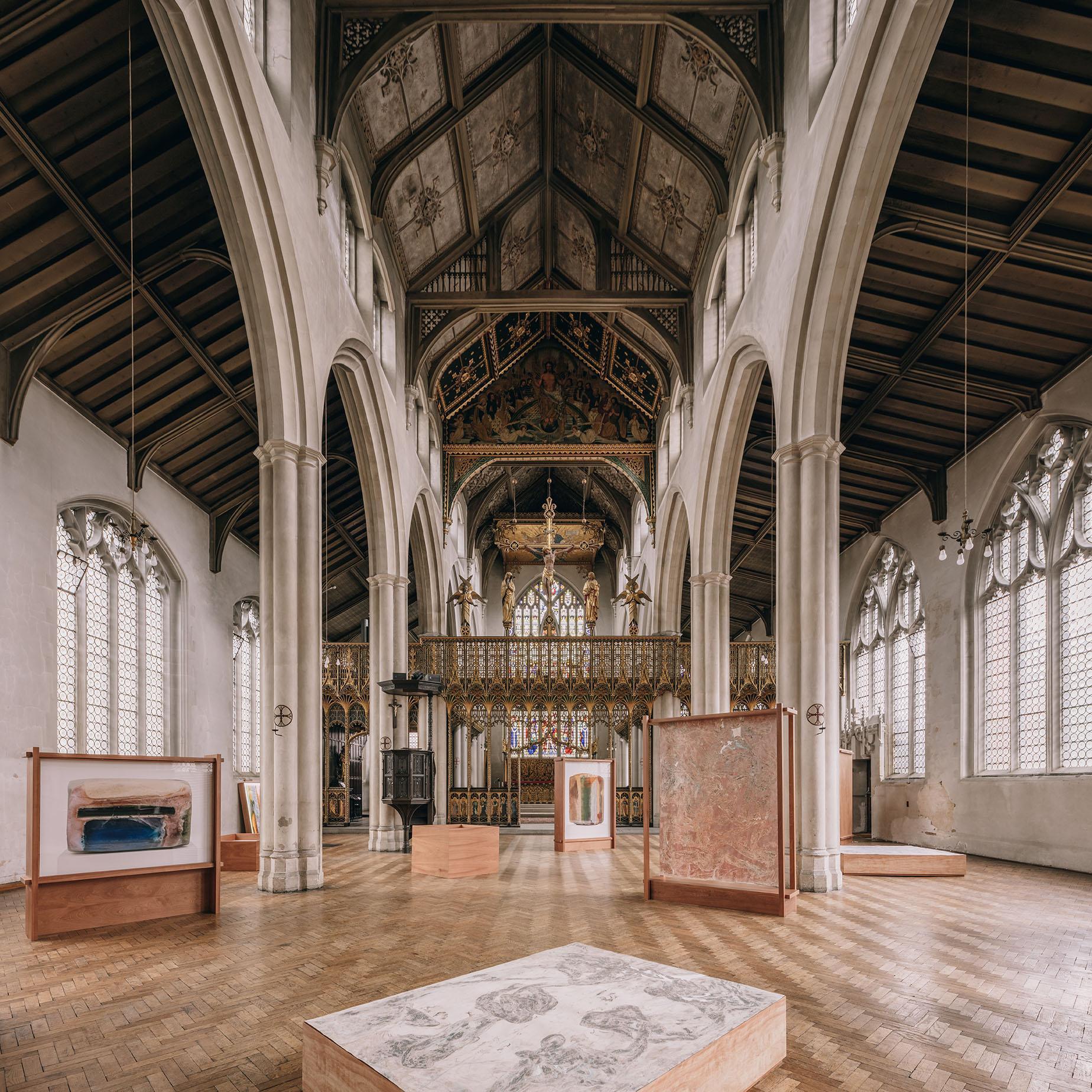
From July 7 to 23, 2022, Into Air was exhibited, under the curation of Jenn Ellis, at St Cyprian’s, Clarence Gate, a historic church in London’s Marylebone district. The midcentury pews, pulpit, and altar inside the Gothic revival interior inspired Ng to design, in collaboration with EBBA architects, new wooden box structures to house the works, some of which stand vertically, and others which lay parallel to the floor.
Exhibition view of Into Air by Dawn Ng, St Cyprian’s Church, London, July 7–23, 2022. Photo: James Retief.Installation shot of Waterfall VII, 2022. Single-channel 4K video, 25 mins, 24 sec. Photo: James Retief. [watch video]
By displaying these works inside a sacred space, their spiritual implications become even more pronounced.
Impermanence is a theme that shows up in the sacred texts of all major religions, not least in the Bible, where we humans are reminded again and again of our mortality. Our days are like grass, which sprouts up and then withers (Isa. 40:6–7; Ps. 103:15–16; 1 Pet. 1:24). Our lives, but a sigh (Ps. 90:9–10), a shadow (Ps. 102:11), a mist (James 4:14), a breath (Ps. 39:5; Job 7:7; 7:16). We are made of dust and return to dust (Eccles. 3:20).
And not only are we finite; so is the present order of things. Even heaven and earth will pass away, Jesus says (Matt. 24:35; Mark 13:31; Luke 21:33; cf. Heb. 1:10–12). But, crucially, God and God’s word stand forever (Isa. 40:8; Matt. 7:24–27). True stability and unchangingness can be found only in God, Christians believe. God is a Rock that does not crumble, a strong foundation on which to stand, in life and in death.
The brevity of life may sound like a fearsome reality, but actually, it can serve to make our moments here on earth more precious and purposeful. Because our lives are but a short span, we must make the most of them while we can. Christians believe that everyone will one day have to give an account of what we did with the time God gifted to us. Did we share it freely with others, or keep it all for ourselves? Did we use it to cultivate virtue or to pursue vice?
The exhibition at St Cyprian’s also involved the premiere of a site-specific choral work by the London-based Welsh composer Alex Mills. A direct response to Ng’s art, his composition is also called Into Air and lasts about twenty-five minutes, the length of Ng’s Waterfall VII.
“In the piece,” Mills writes,
five singers undergo a musical meditation where each moves through the music to the rhythm of their own breaths, one bar of music for every exhale. Musical structures slowly build and disintegrate, evolve and transform, melt and evaporate. Textures, harmonies and colours – some delicate, others more pronounced – appear, disappear and re-emerge. Combing different singers’ breathing patterns gives the piece an indeterminate quality: the piece will never be the same twice and may even be radically different from one performance to the next. As such, the piece is not a fixed musical object that can be ‘performed’. Instead, it is a transient, ephemeral and elusive moment in time to be experienced.
The first singer stands at a kneeler. The second, at a pulpit. They establish the solemn mood. Two male singers sing from the organ loft, and another stands behind the rood screen with his arms crossed over his chest, as if in prayer. Haunting and mesmerizing, the five voices reflect off the stone architecture and meld together, sometimes harmoniously, sometimes in dissonance.
To everything there is a season. Starting at around 10:35, Mills incorporates keywords from Ecclesiastes 3:1–8, a biblical passage made especially famous by the Byrds: “gather,” “scatter,” “heal,” “kill,” “dance,” “mourn.” The author of Ecclesiastes is describing the tide of events that make up a life.
Periodically throughout the performance, a metal singing bowl resounds—a tool commonly used to deepen meditation. It is struck alternately by Ng and Mills, who are seated cross-legged at the front side of the church.
Dawn Ng and Alex Mills at the premiere of Mills’s Into Air, St Cyprian’s Church, London, July 8, 2022. Photo: Damian Griffiths and Sarah Isabelle Tan.
Mills’s Into Air received a second performance just last week on February 8 at the launch of Music & Being, an initiative he founded with Jess Dandy. Music & Being is an open laboratory space in London exploring the intersection of art, music, psychology, spirituality, ecology, and movement.
As we near Ash Wednesday, the start of Lent, Ng’s and Mills’s works remind us of how time slips and slides and ultimately ceases, at least time as we know it. What will we do with our fleeting lives? As they dissipate, what will remain? When our breath stops, will a resonance linger?
Lent begins on Wednesday, February 22. I won’t be doing daily Lenten posts like I did last year, though I will be sharing seasonal content once or twice a week. If you want a set of new daily art-driven devotions that are freely accessible online, I’d encourage you to follow The Lent Project, run by the Center for Christianity, Culture, and the Arts at Biola University; each day features a scripture passage, a poem, a visual artwork, a piece of music, and a written reflection. I’d also direct you to my Lent Playlist (new additions at bottom) and Holy Week Playlist on Spotify.
Carl Spitzweg (German, 1808–1885), Ash Wednesday, 1860. Oil on canvas, 21 × 14 cm. Staatsgalerie Stuttgart, Stuttgart, Germany.
Another spiritual formation resource for Lent is the following series of Arts & Faith videos from Loyola Press, made in 2014–16. Each video features a three-minute commentary by Dr. Daniella Zsupan-Jerome on a historical artwork, chosen based on one of that day’s/week’s scripture readings from the Roman Catholic Mass Lectionary, which is currently in year A. Zsupan-Jerome is the director of ministry formation and field education at Saint John’s School of Theology and Seminary in Collegeville, Minnesota. Here she has crafted a “visual prayer experience” inspired by the Ignatian imagination. In his Spiritual Exercises, Saint Ignatius of Loyola, the founder of the Society of Jesus (the Jesuits), encourages Christians to apply the senses of sight, hearing, smell, touch, and taste to our reading of and meditation on the New Testament, imagining ourselves as present in the Gospel scenes.
Go to the “Arts & Faith: Lent” homepage, or see below, where the link on each artwork title will take you to a new tab where the corresponding video commentary is hosted on the Loyola website. I’ve included sample embeds of a few of the videos below.
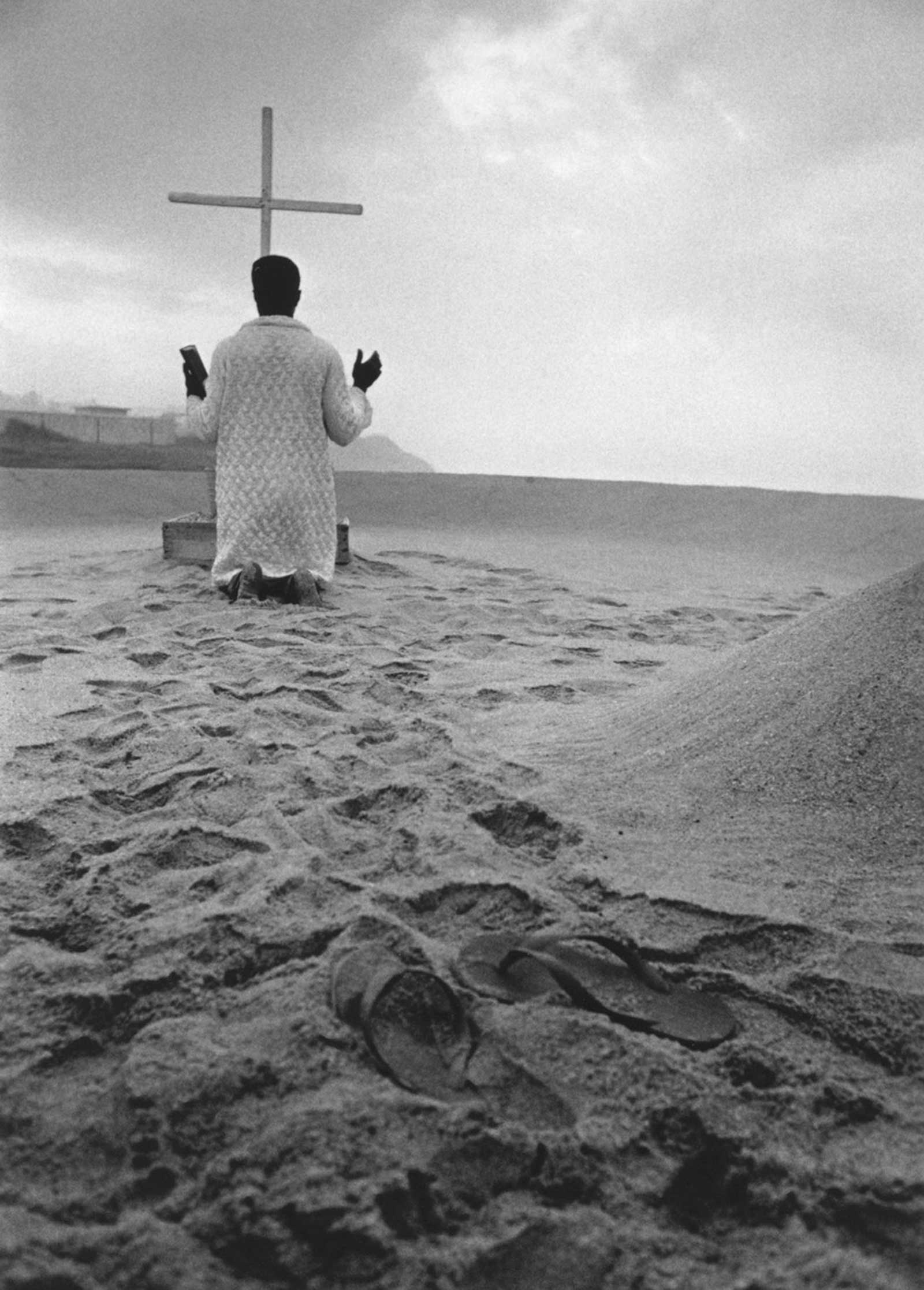
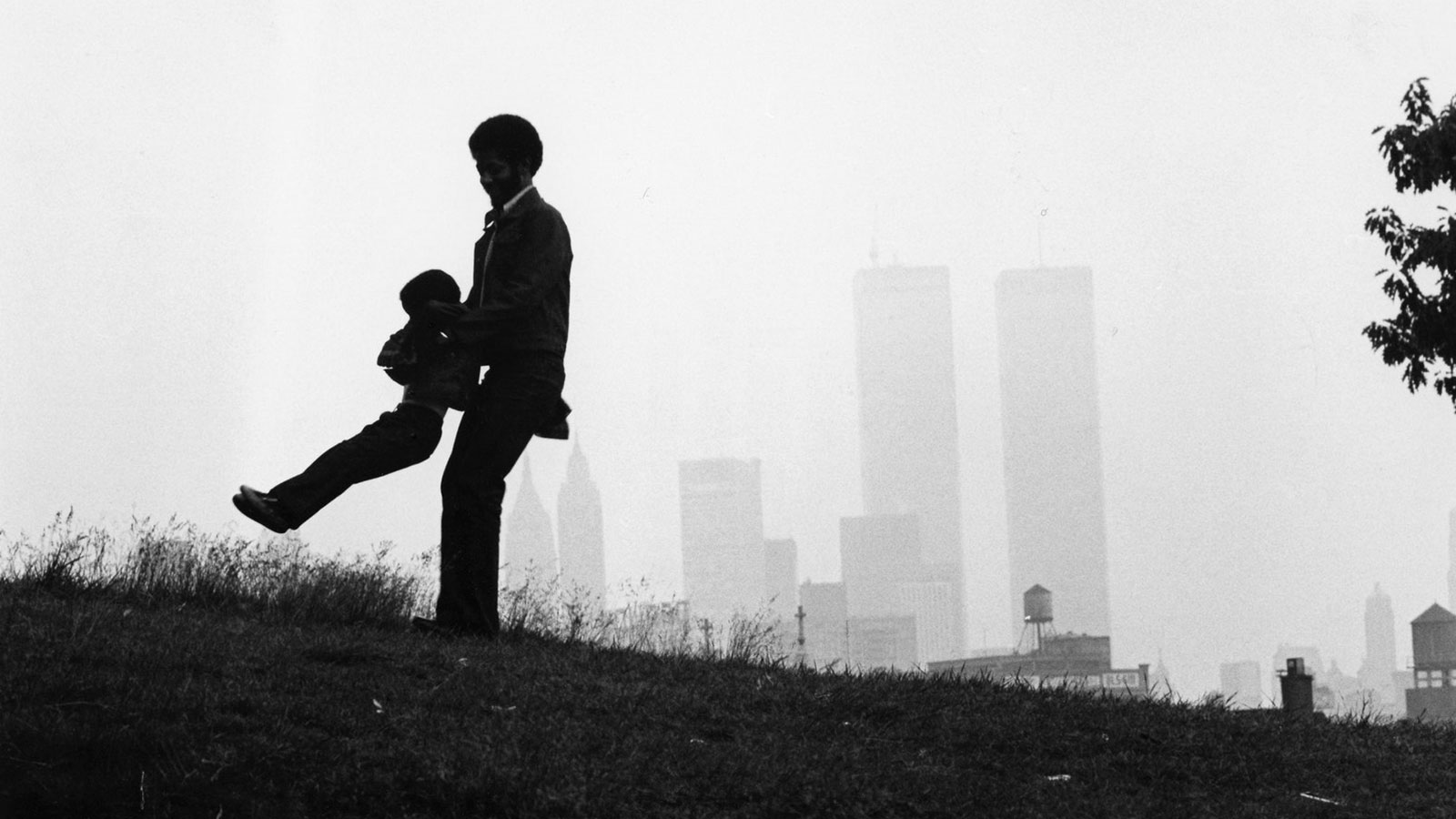
PHOTO COMPILATION: “Chester Higgins’s Life in Pictures”: Chester Higgins Jr. (b. 1946) is an American photographer whose work focuses on everyday Black life; “it is inside simple moments where I look for windows into larger meaning,” he says. He was a staff photographer for the New York Times for more than four decades, and his work is in the permanent collection of the Museum of Modern Art. This heavily illustrated New Yorker article is a good introduction to his oeuvre, in which religious belief and practice feature prominently. I found out about him through the photography compilation book Standing in the Need of Prayer: A Celebration of Black Prayer.
Chester Higgins (American, 1946–), Sunrise Prayer on Osu Beach, Accra, Ghana, 1973Chester Higgins (American, 1946–), Father Swinging Son, Brooklyn, 1972
+++
SONGS:
>> “El Shaddai” by Victory: On January 27 singer-songwriter Victory Boyd, who goes professionally by the mononym Victory, released her latest single, “El Shaddai.” El Shaddai is an ancient Hebrew name for God whose original meaning is unclear but which is often translated into English as “God Almighty”—although “God of the Mountains,” “the Full-Breasted God” (referring to God’s nourishment of God’s children), or “the All-Sufficient One” have also been posited. Its first appearance in the Bible is in Genesis 17:1, where God tells Abram, “’I am El Shaddai; walk before me, and be blameless.”
Read the lyrics in the YouTube video description.
>> “Come Unto Me” by Take 6: A friend recently introduced me to the American a cappella gospel sextet Take 6. Formed in 1980 on the campus of Oakwood College in Huntsville, Alabama, and still active, they incorporate sophisticated jazz harmonies into the tradition of Black gospel “quartet” singing. They are featured on Spike Lee’s Do the Right Thing soundtrack and have won ten Grammys.
This 1988 performance for a Heritage USA TV spot features the group’s six original vocalists: Claude V. McKnight III, Mark Kibble, Mervyn Warren, David Thomas, Cedric Dent, and Alvin Chea.
>> “He’s Got the Whole World in His Hands” by Peter Collins: I love what Peter Collins does with this African American spiritual! This video was his submission to Tyler Perry’s #HesGotTheWholeWorldChallenge from 2020 (which I featured here). It didn’t make the final cut, but I’m so glad it’s out there.
+++
LITERARY EXCERPT from The Color Purple by Alice Walker: This short passage from Alice Walker’s 1982 Pulitzer Prize–winning novel is taken from a conversation between the protagonist, Celie, and her friend Shug, about pleasure, gratitude, and grace. Shug refers to God as “it” (“God ain’t a he or a she”), and her statement about the necessity of enjoying God’s good creation and being open to surprise provides the source of the title.
I’m embarrassed to say that although I saw and really liked the 1985 Steven Spielberg film adaptation of The Color Purple, I’ve never read the book! I plan to rectify that before December, when another film adaptation—of the 2005 stage musical based on Walker’s novel—is coming out, directed by Blitz Bazawule. It stars Fantasia, H.E.R., Colman Domingo (Euphoria), Taraji P. Henson (Hidden Figures), Danielle Brooks (Orange Is the New Black), Jon Batiste, and more.
+++
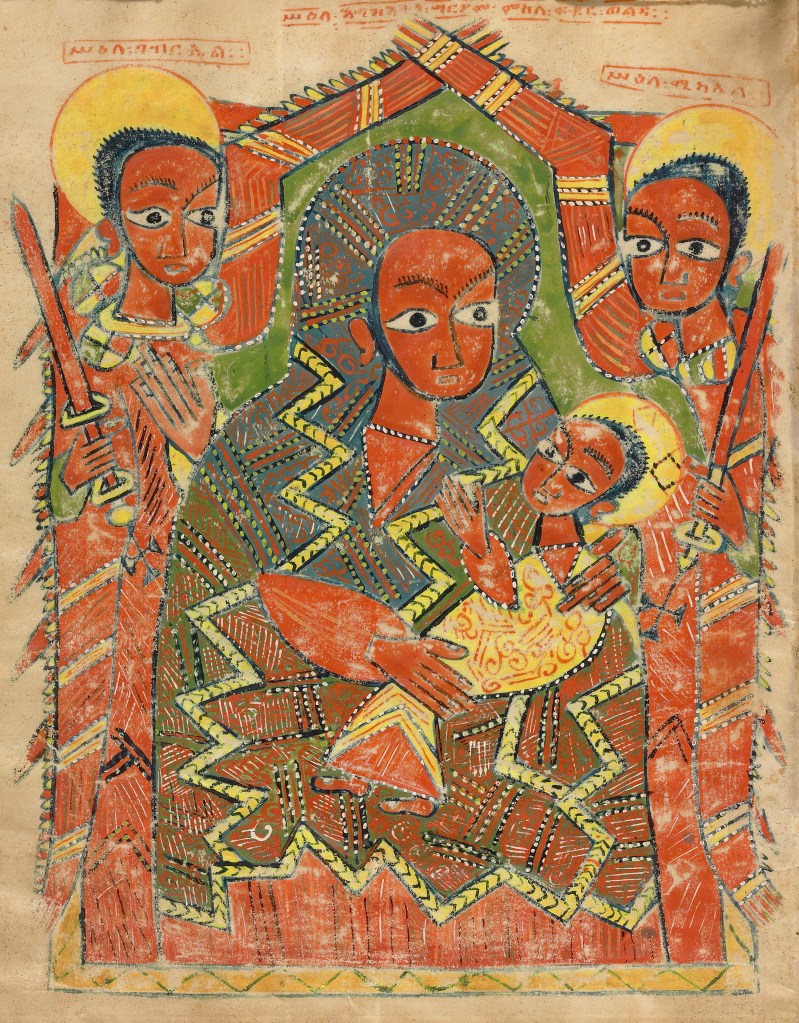
VIDEO: “Ethiopian Gospel Book”: In this six-minute instructional video, Dr. Beth Harris, executive director of Smarthistory, and Kelin Michael, a graduate curatorial intern of manuscripts at the Getty Museum, explore an early sixteenth-century Gospel book from Ethiopia. They discuss the book’s historical context and the formal qualities of its paintings, including the flatness of the figures and the colorful interlacing. They focus on a full-page illumination at the front of the Virgin and Child enthroned between two archangels, but they also touch on the book’s canon tables and its portrait of Saint John the Evangelist.
The Virgin and Child with the Archangels Michael and Gabriel, Ethiopia, ca. 1504–5. Tempera on parchment, 13 9/16 × 10 7/16 in. (34.5 × 26.5 cm). J. Paul Getty Museum, Los Angeles, Ms. 102, fol. 19v.









 Art & Theology