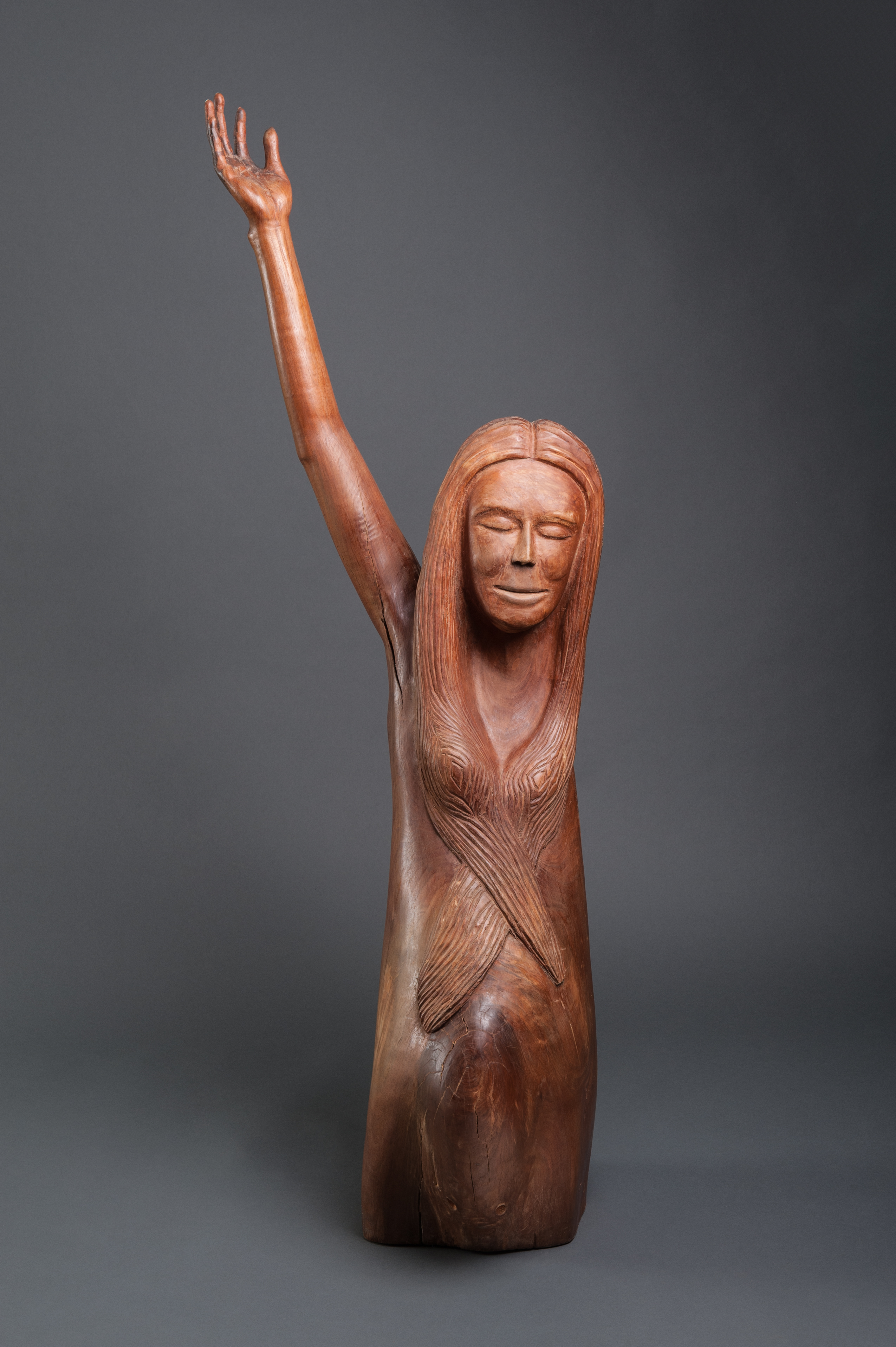
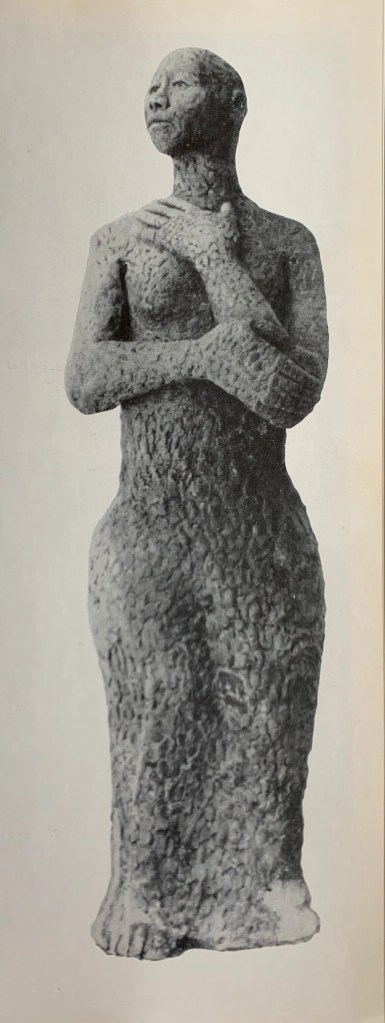
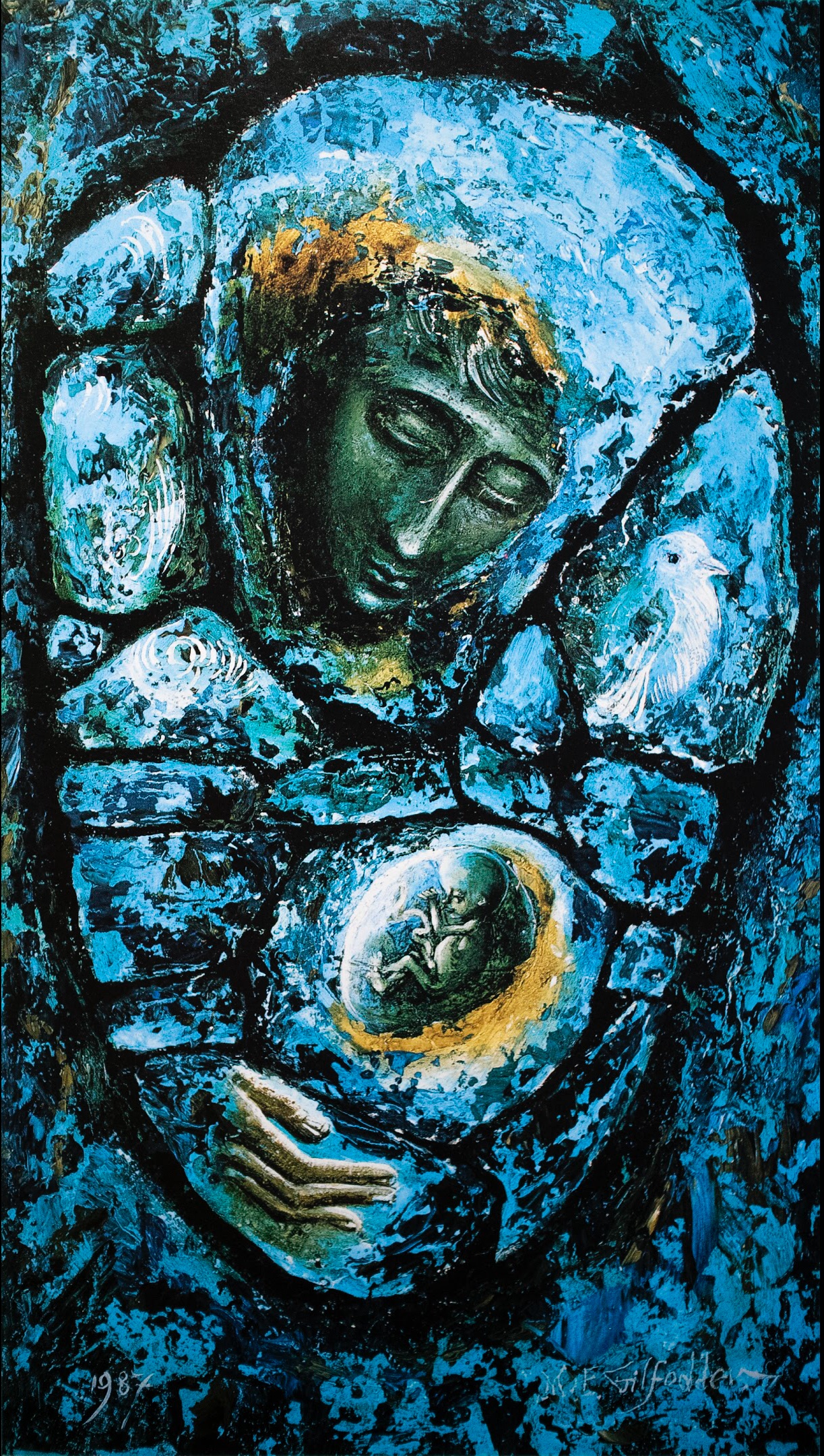
Bruno Walpoth (Italian, 1959–), Lontane speranza (Distant Hope), 2015. Nut wood, 80 × 41 × 32 cm.
LISTEN:“Come Light” by Gregory Thompson, on Lamentations by Bifrost Arts (2016)
Kindle the flint, the tinder Liven the hearth, the stone Shelter the dying lantern light Gladden the shadowed home Into this wilderness of shadows Come, Light original
Answer our famine yearning Nourish our blighted fields Raise all our fallen storehouses Leaven the bitter yield Into this emptiness, this hunger Come, Bread all-bountiful
Out of the blowing starlessness Over the frozen sea Into our barren midnight Up from the fruitless trees O come
Loosen the cloaks of journeymen Mend all the broken roads Wake us from fitful forest sleep Lighten the lonely load Into this pilgrimage, this journey Come, Home perpetual
Dr. Gregory Thompson is a minister, civil rights scholar, author, and producer whose work focuses on race and equity in the United States. He was the senior pastor of Trinity Presbyterian Church in Charlottesville, Virginia, when the music collectives Bifrost Arts and later the Porter’s Gate were founded by Trinity worship arts director Isaac Wardell, and Thompson’s leadership was deeply influential in that work. His contributions to those two music projects extend even to the writing or cowriting of some of the songs that made it onto the albums: “The Zacchaeus Song” (Justice Songs), “O Jerusalem” (Lament Songs), and of course “Come Light” (Lamentations). The latter two he sings on the recordings.
“Come Light” is poetry as prayer. Come, Light of Light, into our shadowy wilderness. Come, all-bountiful Bread; feed our hunger. Come lighten our loads and make straight our paths as we journey Home into your very heart. Such beautiful words, full of yearning, enhanced by the plaintive tune that carries them.
Zarina (Indian American, 1937–2020), Beyond the Stars, 2014. Woodcut printed on BFK light paper collaged with gold leaf and Urdu text, mounted on Somerset Antique paper, 24 × 23 in. Photo: Farzad Owrang.
Printmaker Zarina Hashmi, who preferred to identify herself professionally by her first name only, was born and raised in the small university town of Aligarh, India, and was displaced to Karachi, Pakistan, after the partition of India in 1947. She had a cosmopolitan education, studying woodblock printing in Bangkok and Tokyo and intaglio in Paris. At the beginning of her career she moved to New York, living and working there for forty years before finally moving to London in 2018 to be near family. She passed away two years later.
In Beyond the Stars Zarina shows, through the medium of woodcut, the glory of a night sky. Innumerable stars dot the black ink, as do a smattering of small 22-karat gold orbs that could be read as angels or as the divine presence made visible.
LISTEN: “All Shall Be Well” by Jill McFadden, on Good News by Ordinary Time (2016)
He called him into the night, said Abram, count the stars so bright Through you true peace will come To every tribe and tongue Though no one knows my Name Blessing is coming all the same
And all shall be well
Now many years went by Of withered hopes, unanswered cries Till one night a virgin heard A cry that broke the silence of God That star above them bright Had shone for Abram that night This child so weak, so small Brings peace and rest to all
And all shall be well (2×)
The years unending seem Here in this in between “Peace on earth, God’s will for men” Seems like it came and went The wars, they linger on The darkness overcomes We need not stars but sun Break in, O Coming One Sometimes we cannot tell That You will make all well
But all shall be well All shall be well
Jill McFadden is one-third of the sacred folk band Ordinary Time. She wrote the song “All Shall Be Well” for a Lessons and Carols service, to correspond with the Genesis 22 reading (cf. Gen. 15), where God tells Abraham, “I will indeed bless you, and I will make your offspring as numerous as the stars of heaven and as the sand that is on the seashore . . . and by your offspring shall all the nations of the earth gain blessing for themselves” (vv. 17–18).
This covenant extended down through the ages, reaching fruition many generations later in the person of Jesus of Nazareth, the Promised One from of old and on high, born to make all things well. As the song’s lyrics put it: “many years went by of withered hopes, unanswered cries, till one night a virgin heard a cry that broke the silence of God.” That is, the cry of Mary’s newborn son, whom the angel Gabriel called the “Son of the Most High” and said would establish a kingdom that has no end (Luke 1:32–33).
The Star of Bethlehem, the song says, was one of the millions present when God first promised to bless the world through Abraham’s seed, and now it burns particularly bright over the spot where that blessing is enfleshed in a brand-new and earthshaking way—for the babe in the manger is God incarnate.
But has all really been made well by God’s coming in Christ? There’s still violence and sin and pain and relational fracture. Where’s the peace?
The third stanza of “All Shall Be Well” entreats Christ’s second coming. It laments how peace and light seem elusive here on earth and asks God to make good on his ancient promise. Show us the blessing! Show us the new day, that universal redemption. We’ve received foretastes, but we want to sink our teeth into the whole magnificent meal.
The refrain is a reassurance rooted in God’s steadfast love and faithfulness: “All shall be well.” No matter how far-off that total wholeness feels for you, know that it’s written in the stars, so to speak. The God who created everything good will make it good again as he promised. Until then, we continue to hope and pray, work and wait.
If you would like a harmonized lead sheet, chord chart, and/or string parts for this song, email info@ordinarytimemusic.com, and Jill will make them freely available to you.
Yuri Yuan (Chinese American, 1996–), Norwegian Wood, 2020. Oil on canvas, 63 × 73 in.
This painting by New York–based artist Yuri Yuan shows a woman in a belted brown trench coat, her back to us, standing at the edge of a frozen pond. A small gust of snowy wind whips her hair and scarf. Though her face isn’t visible, she appears to be deep in thought.
Reflected on the pond’s surface is a man dressed in black. We don’t see his physical form, and his features are indistinguishable in the mirroring ice. Who is he? Does he wish to speak to the woman? Does he come with news, or an invitation, perhaps? Or simply to wait with her in silence?
There’s a mystic quality to the image that’s heightened by the incongruity between the environment and its reflection. In the upper left, the trees are barren and dusted with the white of winter, and indeed the woman is dressed for the cold. And yet in the trees’ reflection in the pond, they are in full foliage, leafy green, as if it were summer.
It’s as if two worlds are converging here in this wood. Or the woman foresees, with the eyes of her spirit, a lushness that has not yet come to pass.
Notice how the snowbanks piled up along the water’s edge could almost double as clouds, particularly in the bottom left, where the white mass meets the sky’s reflection. The heavens and the earth becoming one.
I chose this image to kick off the Advent season (which begins tomorrow) because it captures the sense of longing that the church leans into most especially during these four weeks, but also the sense of promise, the possibility, that’s just as characteristic of the season. In the eschatological reality that Israel’s prophets foresaw, the barren becomes verdant and the dead come to life. “The wilderness and the dry land shall be glad; the desert shall rejoice and blossom” (Isa. 35:1).
Strangely, Norwegian Wood is a painting of both absence and presence, distance and nearness.
If you like, imagine Yuan’s mystery man as God coming close—which is what the Incarnation is: God coming closer than close!
What invitation might God have for you this Advent? What heartache from the past year, or even further back, do you need to bear to the Healer? What hopes do you need to speak out loud?
We wait, we hope We yearn, prepare For who or how or what or where? Maybe the changing of the tide Maybe the turning of someone’s eye Maybe the falling of the snow Only heaven knows What happens when God comes close
We wait, we hope We yearn, prepare For who or how or what or where? Maybe the healing of a heart Maybe reunion of a drift apart Maybe a child’s coming home Only heaven knows What happens when God comes close
We wait, we hope We yearn, prepare For who or how or what or where? Maybe the song, a place to belong Maybe some faith, just a touch of grace Maybe love, it’s rarely what we think of Only heaven knows What happens when God comes close
This is the first post in a daily series that will extend to January 6. You are welcome to subscribe via email or RSS, but posts are optimized for viewing on a web browser. (And note that Gmail sends WordPress posts to your Social tab, unless you create a filter to tell it otherwise.) Links will be shared on Facebook and Twitter.
William L. Hawkins (American, 1895–1990), Nativity Scene, 1987. Oil on canvas, 48 × 48 in. Newark Museum of Art, Newark, New Jersey.
1.“Remembering that it happened once”by Wendell Berry: For the last forty-plus years, Kentucky farmer Wendell Berry has been writing what he calls “Sabbath poems,” which emerge from his spiritual practice of walking outdoors on Sundays without any to-do’s. “I go free from the tasks and intentions of my workdays,” he says, “and so my mind becomes hospitable to unintended thoughts: to what I am very willing to call inspiration.” This Sabbath poem from 1986 explores how the sacred permeates the mundane and how Christ is, in a sense, always being born. For an SATB choral setting by Doug Brandt, see here.
Source: A Timbered Choir: The Sabbath Poems 1979–1997 (Washington, DC: Counterpoint, 1998); compiled in This Day: Collected and New Sabbath Poems (Washington, DC: Counterpoint, 2014)
2.“BC:AD” by U. A. Fanthorpe: Ursula Askham Fanthorpe (1929–2009), CBE, FRSL, was an English poet who is well loved by both critics and the general public. She was also a practicing Quaker. Each year she wrote a new Christmas poem to send to friends, of which “BC:AD” is the best known. It considers Jesus’s birth as the pivotal point in history, dividing time into epochs, into “before” and “after.” At this nativity, kairos invaded chronos—and we’re still singing about it millennia later.
3.“Making the House Ready for the Lord”by Mary Oliver: For many of us who succumb to cultural pressures, December is a time of rushing around, making sure the house is decorated like a magazine, the Christmas cards sent out, the cookies baked to perfection, the gifts individually selected and bought and wrapped. But in all this flurry of activity, are we missing “the better part” (Luke 10:42)? The speaker of this poem, Martha-like, is busy making preparations for Jesus, who’s coming to visit, but as she’s cleaning, outdoor critters keep popping in. At first she bemoans their presence—they’re not on the guest list!—but eventually she comes to accept, even welcome, them, surrendering her fussy desire for orderliness to a charitable embrace of whatever is. And on another level, this poem is about how all of creation longs for Christ (Rom. 8:19–22); the animals, too, want to see him, want to join the party.
5.“Second Advent”by Anya Krugovoy Silver: Memorializing a friend (Ishiuan Hargrove) who died of metastatic brain tumors, “Second Advent” unsettlingly combines stark hospital-room and anatomical language with language that is soft, gentle, lyrical. Recounting one of Ishiuan’s several neurosurgeries, the poet remarks how her head was nimbed by surgical lights and then swaddled in gauze. The title refers to Ishiuan’s waking up on the second Sunday of Advent, but also to the hope of Christ’s second coming, when pain, disease, and sorrow will be done away with. Anya Silver was herself a cancer patient, an experience she wrote much about in her four volumes of poetry, before dying of breast cancer in 2018.
Source: Second Bloom (Eugene, OR: Cascade Books, 2017)
6.“The Nativity”by Henry Vaughan: “Peace!” rang the angels’ song the night of Christ’s birth—and yet what irony, that he who came to bring peace was himself no beneficiary of it in this life, being born among animals in a borrowed stable, then made a refugee, then later disbelieved, betrayed, mocked, tortured, and crucified. The darkness that bred such unwelcome of the Son of God still persists—violence, ignorance. Referencing the Genesis 1 creation narrative as well as the journey of the magi, the poem ends with an invocation for God’s light to manifest once again, leading us to Christ.
Source: Thalia Redivina: The Pass-Times and Diversions of a Countrey-Muse (London: Robert Pawlet, 1678). Public Domain.
7. [little tree] by E. E. Cummings: One of E. E. Cummings’s earliest published poems (it came out in the January 1920 issue of The Dial), “little tree” was intended to appear as one of five “chansons innocentes” in Cummings’s first book of verse, Tulips and Chimneys, but his editor, Thomas Seltzer, cut it (along with sixty-five others!). In it a young child consoles a recently felled evergreen tree—enlisted for the holiday festivities—with promises of glory and love. Though it runs the danger of being read as twee, Cummings remained fond of the poem and even had it printed and sent it as his family Christmas card in 1960, two years before he died.
8. “Messiah (Christmas Portions)”by Mark Doty: The speaker of this poem is unexpectedly transported by a local community choir performance of Handel’s Messiah. He marvels at how these ordinary, flawed neighbors of his can produce such beauty with their collective voices. The last line is probably a reference to the accompagnato and air sung by the bass toward the end of the oratorio, taken from 1 Corinthians 15:51–54—about how we will all be changed in a moment at the last trump, and the corruptible will put on incorruption.
9. “What the Body Knows” by Jean Janzen: The anonymous scribes and illuminators of the Book of Kells spent countless hours copying and beautifying God’s word amid Viking raids. In this ekphrastic poem, Jean Janzen reflects on the Gospel-book’s five whimsically painted folios of Luke’s genealogy of Christ, commenting on the continual inbreaking of God into our world and the “wild safety” of God’s love.
10.“Confession”by Leila Chatti: The Tunisian American poet Leila Chatti was raised by a Muslim father and a Roman Catholic mother, and both religious traditions have shaped her faith and her writing. Islam and Christianity hold many sacred figures in common, including Mary (Maryam), whose conception and delivery of Jesus (Isa) are narrated in the Quran 19:16–34. Chatti confesses to being more compelled by the Islamic characterization of Mary as grunting and sweating in the pangs of labor (in contrast to Catholic teaching, which says her birthing experience was effortless, her contractions painless, though the Bible itself doesn’t specify). Chatti finds comfort in picturing Mary not as someone exempt from the effects of the fall and set apart on a pedestal of supreme virtue, but as one who suffered the same physical and emotional toll as other childbearing women—and who probably did have the occasional selfish thought, which, in moments of intensity and vulnerability, she deigned to vocalize!
11. “Two Carols”by Evelyn Underhill: An English Anglo-Catholic writer and mystic, Evelyn Underhill meditates in this double poem on how Christ set foot on the long, hard road we travel to be a balm for our wounds and those of the earth. The epigraph to part 1 is from the Latin Vulgate of Song of Solomon 2:12: “The flowers appear on the earth.” What follows are several Catholic titles for Mary: rose without thorn, queen, generatrix. The epigraph to part 2 is a quotation of Romans 8:22: “The whole creation groaneth and travaileth in pain together until now.” The refrain, Dominus tecum!, translates to “The Lord is with you!,” words spoken by the angel Gabriel to Mary and, by virtue of the Incarnation, to all humanity. The other Latin phrases translate to “He who is in the heavens,” “A King is born,” and “Let the kingdom come!” Adveniat regnum!
Source: Immanence: A Book of Verses (London: J. M. Dent, 1912). Public Domain.
12. “The Christmas Babe”by Fr. John Banister Tabb: Written by a Catholic priest from Virginia, this simple quatrain marvels at the paradox of God’s simultaneous largeness and smallness.
Source: Poems (London: John Lane, 1894). Public Domain.
13.“Snowflakes” by Jennifer Grotz: When the world is viewed through a sacramental lens, we recognize God in commonplace wonders like falling snow, and such things can be a sort of wordless prayer that we offer back to God through our enjoyment of them.
14. [The Savior must have been a docile Gentleman]by Emily Dickinson: In these two compact stanzas, Dickinson reflects on how kind Jesus was (an understatement!) to have made the far journey to Bethlehem, “a rugged billion Miles” from heaven, especially in the cold month of December, all “for little Fellowmen.” She refers to him as “docile”—obedient, submissive—harking to Philippians 2, to his yielding to the will of the Father in the Incarnation, taking on human limitations, suffering, and death for the life of the world.
15.[Wilt thou love God, as he thee? Then digest](Holy Sonnet No. 15) by John Donne: A self-address to the soul, this poem by the English poet-priest John Donne, first published in 1633, two years after this death, celebrates the Triune God’s salvific workings: we’re adopted by the Father, redeemed by the Son, indwelt and regenerated by the Spirit. The closing couplet, referencing the imago Dei, packs a wallop: “’Twas much, that man was made like God before, / But, that God should be made like man, much more.”
Source: Poems (London: M.F. [Miles Fletcher], 1633). Public Domain.
16. “The Little Towns of Bethlehem”by John Terpstra: All over Canada, Christ is being reborn this Christmas, in the sense that the Story has taken root, is retold, and continues to have impact. The speaker imagines the Christ child “wrapped in cast-off flannel” in a boxcar stopped on the tracks in Esther, Alberta, or feeding at his mother’s breast in a broken-down car on the shoulder of a road in Englehart, Ontario—actual sights that one might encounter today. Localizing the Story can help us to see it afresh, and to see the sacred humanity of families experiencing homelessness or other hardships.
17. “Song of the Shepherds” by Richard Bauckham: Richard Bauckham, FRSE, FBA, is best known as a biblical scholar—he’s one of today’s tops, in fact—but he also writes poetry! (I featured one of his poems last year.) In this poem, the shepherds on Bethlehem’s hillsides recall an ancient tale about the stars singing at the creation of the universe, which they thought merely a poetic embellishment, until they experienced something of the like for themselves: “a song of solar glory” eclipsing the lesser lights and exorcising the dark, creating the world anew. Unforgettable.
18. “Those Magi”by Kathleen O’Toole: What exactly were the magi seeking? What compelled them to leave their treasure behind in that cattle shed? Whence their strength to defy Herod? Besides musing on these questions, the poem also contains a passing metaphor that I found striking and new: cow breath as incense.
19. “Carol of the Brown King”by Langston Hughes: Tradition names one of the wise men who visited the Christ child “Balthazar” and says he’s from Africa. Langston Hughes, a preeminent poet of the Harlem Renaissance, exults that there was “one dark like me—part of His Nativity.” This poem is included in Hughes’s musical play Black Nativity and is one of six Nativity poems by Hughes that make up a children’s book illustrated by Ashley Bryan.
20. “Mosaic of the Nativity: Serbia, Winter, 1993”by Jane Kenyon: I couldn’t find the particular church mosaic program that Kenyon is writing about, but here’s my interpretation. Set inside a Serbian Orthodox church during the Bosnian War, this poem imagines a mosaic of Christ Pantocrator hovering in the dome, lamenting the violence that goes on beneath. Under the gaze of the I AM is another mosaic, portraying Jesus’s birth, but also, in a way, Mary’s, as she herself is being reborn in Christ, her mind increasingly shaped in accordance to his. Nativity icons often show Mary framed by a red blanket that she’s reclining on at the mouth of a cave, which Kenyon reads as embryonic.
21. “Breath” by Luci Shaw: This poem reflects on the contraction of the infinite God who breathed the universe into existence into a finite human being needing oxygen, who, as is foreshadowed at his birth, will finally ex-pire (“breathe out” his last) on a cross before entering his “next dark cave,” a prelude to resurrection.
22.“Mary’s Vision”from medieval Ireland: Mary foresees the future suffering of her infant son and dialogues with him about it in this poem translated from Middle Irish by Eleanor Hull (the same woman whose versification of a medieval Irish lorica, working from a translation by Mary Elizabeth Byrne, gave us the hymn “Be Thou My Vision”!).
Source: The Poem-Book of the Gael (London: Chatto & Windus, 1912). Public Domain.
23.“Joseph at the Nativity”by Tania Runyan: Staring at the “shriveled pod” that Mary just birthed, Joseph grapples with his complicated feelings—doubt, embarrassment, jealousy, helplessness, confusion, pride—and with figuring out what role he should play in the life of this child going forward.
24.“Waiting in Line After Christmas”by Sharron Singleton: (Scroll down to fourth poem) Rather than exchanges of refunded money for unwanted items, Singleton ponders what a mutually life-giving exchange of intangibles might look like.
25. “Burning the Old Year”by Naomi Shihab Nye: Through the act of forgetting, we must destroy the worthless trivialities of the year, and we must let that which is solid, that which matters—the “stones”—be revealed and remain.
Jackson Beardy (1944–1984) was an Anishinaabe artist born on the Garden Hill Reserve in Manitoba. He belonged to the Woodland school of art [previously], adopting its distinctive style of Indigenous expression characterized by thick black outlines and vivid, compartmentalized color. His paintings draw on Ojibwe and Cree oral traditions and often express cosmological and spiritual concepts.
Beardy is one of twenty Canadian artists commissioned by the Canadian Conference of Catholic Bishops in 1975 to convey the Christian message using whatever idiom they wished. Beardy chose to portray the Virgin Mary pregnant with the Word, the sun’s fire pouring into her and yet she is not consumed. He provided the following artist’s statement:
It is my personal belief that a messenger from the Great Spirit came to earth in the form of His image after Him through a virgin birth in unrecorded history. Through this man, knowledge was passed on to man from the Great Spirit. Many of the teachings of this man have been kept by word of mouth through the ages by the elders of all tribes.
We see the virgin mother-to-be holding on to an embryo connected to the sun symbol (the Great Spirit) [center] who has deemed it necessary to send his messenger to his people. The mother is also connected to Mother Earth, who is nursing her [see the breast shape below]. She too is connected by a lifeline to the sun symbol. Around her are all the orders of creatures who come to see the messenger. He is born to explain their existence, [to restore] harmony between humanity and the elements, physically, mentally, and spiritually.
On the other side of the sun symbol we see an elder in prayer, ritually offering a bowl filled with sacred things. You can see the sun symbol is resting on his hunched frame, bearing him down with doubts, fear, depression, and all the ills of his time, his back to the very miracle he is praying for. It will take time for all to fully comprehend this phenomenon which has come to pass.
The four semicircles represent the elements of the air: snow, rain, tornadoes, heat. The moon [the blue circle] is painted above the elder. We regard the moon as our Grandmother who keeps vigil over all creatures during the night.
Though titled The Nativity, the painting is actually a prebirth scene, as Jesus is still in utero. Beardy shows the Christ child taking root in Mary’s womb (having been conceived by the power of the Great Spirit) and growing to full term as people and animals alike long for his arrival. They groan, they watch, they wrestle and seek. Creator Sets Free—as the First Nations Version of the New Testament translates the name Jesus—is almost here.
(Note: There’s a flipped version of this image floating around online. I confirmed with the CCCB that the file posted here, which I licensed directly from them, represents the correct orientation.)
Leaning into that Advent yearning, here is a performance of “O Come, O Come, Emmanuel” in Ojibwe—“Ondaas, Ondaas, Emaanooyen”—performed by E Halverson:
Now, I have a crowdsourcing request: I am searching for Advent or Christmas songs originally written in Indigenous Canadian or Native American languages, preferably by an Indigenous person. If you know of any, please let me know in the comments below, or in an email. Thanks!
Before I launch into the Advent content, I want to alert newcomers to, and remind old-timers of, my Thanksgiving Playlist on Spotify (introduced here), which is revised and expanded since last year. You can get an overview at this blog post. From Destiny’s Child to Yo-Yo Ma, Meister Eckhart to Mister Rogers, there’s a little something for everyone, I hope. And exemplifying the global nature of Christianity, there are songs in Hebrew, Luganda, Zulu, Swahili, Yoruba, Spanish, French, Hawaiian, Arabic, Korean, and Tamil.
+++
ESSAY: “All Creation Waits” by Gayle Boss: In the northern hemisphere, Advent is accompanied by a deepening of the dark and cold. In her bestselling and wholly unique Advent devotional, All Creation Waits, Gayle Boss provides twenty-five reflections that detail how wildlife—turtles, loons, black bears, and so on—adapts to these changing conditions. Animals know that the darkness is a door to a new beginning, and we would do well to embrace this wisdom. In the book, each day’s reading is paired with a woodcut illustration by David G. Klein.
The year of the book’s 2016 release, On Being published the introduction on its blog, where Boss answers, “Why animals for Advent?” and describes some of the inspiration behind and framing of the book. This year Paraclete Press released a hardcover gift edition with a new introduction and afterword.
Woodcut by David G. Klein, 2016. In All Creation Waits, Gayle Boss tells a story of how one year, a week into Advent, she found a manger in the woods, which local children had filled with hay for the animals, then shelled corn.
+++
SONG: “O Come, O Come, Emmanuel”: There are hundreds of arrangements and recordings of this most beloved Advent hymn. Last year I featured two that I particularly like, and I think I’ll start a trend on the blog by doing the same at the beginning of each Advent—sharing two new renditions of the song.
>> Anna Hawkins.Anna Hawkins is a singer-songwriter of Irish heritage living in New Zealand. In her version of “O Come, O Come, Emmanuel” from her album Divine (2015), she sings the first verse in Hebrew, honoring the lyrics’ rootedness in the Hebrew scriptures. The music video was shot in Israel (cinematography by Michael Hilsden from Aspiring Productions). [HT: Global Christian Worship]
חזור חזור עמנואל ופדה אסירי ישראל שבגולה נאנחים עד כי תבוא בן- האלוהים ,שמחו! שמחו! עמנואל יבוא לכם בני ישראל
Chazor, chazor Immanu-El Ufde asirei Israel Shebagola ne’enachim Ad ki tavo Ben Elohim Simchu, Simchu, Immanu-El Yavo lachem bnei-Israel
[English translation:] O come, O come, Emmanuel And ransom captive Israel That mourns in lonely exile here Until the Son of God appear Rejoice! Rejoice! Emmanuel Shall come to thee, O Israel
>> CeCe Winans, arr. Alvin Love III.CeCe Winans is a gospel legend. On Something’s Happening! A Christmas Album (2018), she collaborated with her son, Alvin Love III, who wrote the lush orchestral arrangements and produced the record. “O Come, O Come, Emmanuel” opens with a celesta, which sounds like a music box or twinkling stars and has long been associated with the supernatural. The accompaniment is played by the Zagreb Philharmonic Orchestra, conducted by Tim Akers.
+++
VISUAL MEDITATION: “I Corinthians 7:29-31: God Only Knows” by Lynn Miller: Rev. Dr. Lynn Miller is an author, ecclesiastical artist, workshop leader, and Presbyterian minister who holds a BFA in graphic design, an MA in art history, an MFA in creative writing, an MDiv, and a DMin. From 2014 to 2021 she ran the blog Art&Faith Matters, curating a diversity of images based on the liturgical calendar. In this post she guides us in looking at the surrealist painting At the Appointed Time by Kay Sage, which features a mysterious, draped figure or object and lines receding toward the horizon. “What do you see in the painting? What do you think about what you see? What do you wonder about this painting?” She posits a number of possible interpretations.
Kay Sage (American, 1898–1963), At the Appointed Time, 1942. Oil on canvas, 81.3 × 99.1 cm. Newark Museum of Art, Newark, New Jersey.
+++
PODCAST SERIES: “Whispered Light: Advent Reflections on Death, Judgement, Heaven and Hell” by Matt Simpkins: In this four-episode podcast series from December 2020, Rev. Matt Simpkins, an Anglican priest and musician from Essex, explores the four themes traditionally contemplated by Christians during Advent—death, judgment, heaven, and hell—through four old American folk songs. He performs the songs, giving their history and using them as a launchpad for spiritual and theological reflection, which also integrates discussion of the Psalms. He addresses misconceptions about these “last things,” tracing the thread of hope and redemption that runs through them all. Just twenty to thirty minutes each, the episodes are available on your favorite podcast app and on YouTube (links below).
Episode 1: “O Death” (aka “A Dialogue with Death”)
The season of Advent begins Sunday, November 27, this year and is followed by the Twelve Days of Christmas, culminating on Epiphany, January 6. During these six weeks I will be publishing daily posts, each centered on a visual artwork and a piece of music that I hope will promote contemplation and prayer around the seasons’ themes, around the narrative of Christ’s coming. If you’d like to receive these posts in your inbox, enter your email address on the Subscribe page. This will subscribe you to the blog as a whole, but you can always unsubscribe afterward if you want to stick around for just this one series.
Some people erroneously consider Advent to be simply an extension of Christmas. Not so! The two seasons are, of course, related, but Advent is a four-week period that focuses not just on Christ’s first coming and the signposts leading up to it, but also his second, as well as his coming, as Spirit, into our hearts, lives, and communities. It is an opportunity for us to lean into the deep longing we feel for God’s presence.
“Advent is a season of hope,” writes the Rev. Tish Harrison Warren, “and part of practicing hope is noticing where we need it”—so many of the Advent selections have a tone of lament. But still others are celebratory, marked by a joyful anticipation of the new dawn and all that it will usher in.
Included in this year’s edition of the Advent-Christmas series are a community art project in Lima; a jazz setting of a poem by Malcolm Guite, plus settings of Emily Dickinson and George MacDonald; ancient hymns from Prudentius of Spain and Ephrem of Syria; an antiphon by Hildegard of Bingen that references Mary as the New Eve; a light installation in an abandoned warehouse in Malaysia; a South African Nativity linocut with native wildlife; a Chinese watercolor on silk of the Annunciation to the Shepherds; a parable-inspired spiritual with roots in Jamaica; an acoustic-folk adaptation of Hannah’s song, a likely influence on Mary’s Magnificat; and more. The assurance that “All shall be well,” popularized by Julian of Norwich, bookends the series.
Oh, and there will be a “prelude” post on November 26.
Bridegrooms and oil lamps, clouds and snowdrifts, trumpets and butterflies, rivers and stairs—these are some of the images, verbal and/or visual, that we’ll encounter as we journey from Genesis to Revelation, from humanity’s fall and God’s covenant with Abraham to the incarnation of the promised Savior to the new heavens and the new earth, where that Savior reigns in love over all the redeemed.
Many of the songs will be drawn from my two Spotify playlists:
I look forward to walking with you all through this wonder-full, ancient, ongoing Story that enfolds us.
—Victoria
P.S. Want a better sense of what to expect before sharing or subscribing? You can peruse last year’s posts here and here.
I am committed to making all Art & Theology content free for everyone, but that means my income takes a hit. I have been working on this series since August, saying no to some paid freelance offers to make it happen. If you find the posts meaningful and it is within your means, would you please consider donating whatever amount you feel the product is worth? (You can use the form below, or PayPal.) I will also include a donation link at the bottom of the final post, if you’d rather wait and decide then. Thank you!
Mikael Owunna (Nigerian American, 1990–), Lébé and His Articulations, from the Infinite Essence series, 2019. Dye sublimation print, 60 × 40 in. (152.4 × 101.6 cm). Edition of 3 + 1AP. [for sale]
O Lord!
Thou hast given me a body,
Wherein the glory of thy power shineth,
Wonderfully composed above the beasts,
Within distinguished into useful parts,
Beautified without with many ornaments.
Limbs rarely poised,
And made for heaven:
Arteries filled
With celestial spirits:
Veins, wherein blood floweth,
Refreshing all my flesh,
Like rivers.
Sinews fraught with the mystery
Of wonderful strength,
Stability,
Feeling.
O blessed be thy glorious Name!
That thou hast made it
A treasury of wonders,
Fit for its several ages;
For dissections,
For sculptures in brass,
For draughts in anatomy,
For the contemplation of the sages.
Whole inward parts,
Enshrined in thy libraries,
Are:
The amazement of the learned,
The admiration of kings and queens,
The joy of angels,
The organs of my soul,
The wonder of cherubims.
Those blinder parts of refined earth,
Beneath my skin,
Are full of thy depths,
For:
Many thousand uses,
Hidden operations,
Unsearchable offices.
But for the diviner treasures wherewith thou hast endowed
My brains,
My heart,
My tongue,
Mine eyes,
Mine ears,
My hands,
O what praises are due unto thee,
Who has made me
A living inhabitant
Of the great world,
And the centre of it!
A sphere of sense,
And a mine of riches,
Which when bodies are dissected fly away.
The spacious room
Which thou has hidden in mine eye;
The chambers for sounds
Which thou has prepar’d in mine ear;
The receptacles for smells
Concealed in my nose;
The feeling of my hands;
The taste of my tongue.
But above all, O Lord, the glory of speech,
whereby thy servant is enabled with praise to
celebrate thee.
For
All the beauties in heaven and earth,
The melody of sounds,
The sweet odours
Of thy dwelling-place.
The delectable pleasures that gratify my sense,
That gratify the feeling of mankind.
The light of history,
Admitted by the ear.
The light of heaven,
Brought in by the eye.
The volubility and liberty
Of my hands and members.
Fitted by thee for all operations,
Which the fancy can imagine,
Or soul desire:
From the framing of a needle’s eye,
To the building of a tower;
From the squaring of trees,
To the polishing of kings’ crowns.
For all the mysteries, engines, instruments, wherewith the world is filled, which we are able to frame and use to thy glory.
For all the trades, variety of operations, cities, temples, streets, bridges, mariner’s compass, admirable pictures, sculpture, writing, printing, songs and music, wherewith the world is beautified and adorned.
Much more for the regent Life,
And power of perception,
Which rules within.
That secret depth of fathomless consideration
That receives the information
Of all our senses,
That makes our centre equal to the heavens,
And comprehendeth in itself the magnitude of the world;
The involved mysteries
Of our common sense;
The inaccessible secret
Of perceptive fancy;
The repository and treasury
Of things that are past;
The presentation of things to come;
Thy Name be glorified
For evermore.
For all the art which thou hast hidden
In this little piece
Of red clay,
For the workmanship of thy hand,
Who didst thyself form man
Of the dust of the ground,
And breathe into his nostrils
The breath of life.
For the high exaltation whereby thou hast glorified every body,
Especially mine,
As thou didst thy servant
Adam’s in Eden.
Thy works themselves speaking to me the same thing that was said unto him in the beginning,
WE ARE ALL THINE.
Thomas Traherne (1636/37–1674) was a country priest from England whose devotional writings, both prose and verse, are remarkable for their spiritual intensity. He wrote rapturously about the goodness, love, and mercy of God and the glories of God’s creation. He is sometimes classed as a Metaphysical poet, though his poems read more like Walt Whitman, with their long catalogs and ebullient joy. Traherne is most celebrated for his Centuries of Meditations, a collection of theological reflections that wasn’t published until 1908.
VIRTUAL ARTIST RESIDENCY: 2023 Inbreak Residency: Led by Dea Jenkins, the organization Inbreak, which promotes social healing through the arts, is hosting its third annual (virtual) residency, open to US-based artists of any discipline interested in exploring the intersections of art, faith, and race in the United States. The residency provides a collaborative environment and opportunities for artistic development and creative leadership growth, with group workshops, group feedback sessions, studio visits, and a curriculum featuring a curated selection of viewings, readings, and dialogue prompts. It culminates in a live or virtual exhibition.
Applications are due by November 20, 2022; you are required to submit work samples, an artist statement and/or short bio, and a community-focused project proposal. Four applicants will be selected for the 2023 cohort, which runs from January to May, and each given a $500 stipend.
+++
SONG: “Lux Aeterna”: “Lux Aeterna” (Eternal Light) is the Communion antiphon for the Roman Catholic Requiem Mass. The traditional Latin text has been set to music by many composers. Recorded at All Hallows’ Gospel Oak in London in May 2021, this performance by the Gesualdo Six is of the setting by Spanish Renaissance composer Cristóbal de Morales. I share it in anticipation of All Saints’ Day on November 1.
The lyrics translate as follows:
May eternal light shine upon them, Lord, with your saints forever, for you are good.
Grant them eternal rest, Lord, and may light perpetual shine upon them, with your saints forever, for you are good.
The video came out of the Interfaith Sacred Art Forum and the Sacred Art in Collections pre-1900 Network, both launched last year as part of the National Gallery’s Art and Religion research strand. In their inaugural 2021–22 season, the theme was “Crossing Borders,” and they have used two paintings in the museum’s collection as a foundation for wide-ranging events and activities. The theme for 2022–23 is “The Art of Creation,” and the two paintings around which conversations and activities are based are Rachel Ruysch’s Flowers in a Vase (1685) and Claude Monet’s Flood Waters (1896).
+++
VIDEO: “Introducing Annie Dillard” by Tish Harrison Warren: In this video from the Trinity Forum, Anglican priest and writer Tish Harrison Warren introduces the forum’s fall reading, the Pulitzer Prize–winning classic Pilgrim at Tinker Creek (1975) by Annie Dillard. The book comprises Dillard’s evocative reflections on her time spent wandering about and observing the lively woods, creeks, and natural world of Virginia’s Roanoke Valley while she convalesced from illness.
“She [Dillard] has taught me, in the words of Eugene Peterson, to pray with my eyes open,” Warren says. “She has taught me to notice God at work in the world in ways that I wouldn’t.”
I hear Dillard quoted all the time, but I’m embarrassed to say that I have not yet read this quintessential book of hers! Though I do own it. I have now pulled it off the shelf and put it in my “to read imminently” stack. 😊
+++
VISUAL MEDITATION: “The Taste of Palestine” by Meryl Doney, on the art of Sliman Mansour: Sliman Mansour is a Palestinian Christian artist whose work centers on the Palestinian struggle against the Israeli occupation. This ArtWay article is a great, concise introduction to his work, spotlighting four of his paintings: Picking Olives; The Flight to Egypt; Hagar; and The Holy Family in an Olive Grove.
Sliman Mansour (Palestinian, 1947–), The Flight to Egypt, 1984. Oil on canvas.
Last month my friend Becky Hadeed, food photographer and creator and host of The Storied Recipe podcast, released an episode called “Honoring the Women of Palestine,” where she interviews Mai of Almond and Fig. Mai discusses growing up in Palestine and shares some of the ways she seeks to connect with her Middle Eastern heritage from her kitchen in Chicago.
WEBSITE LAUNCH: The Foundation for Spirituality and the Arts: From a September 20 press release: “The Foundation for Spirituality and the Arts is pleased to announce the debut of our new website, fsa.art. Complementing in-person programming in Charleston and New York City, fsa.art functions as FSA’s online curatorial wing. It hosts both commissioned and curated content as well as a selection of features spotlighting significant artists, scholars, exhibitions, and publications from recent decades. We hope this site will be a valuable and inspiring resource that fosters dialogue, community, and innovation in the field of spirituality and the arts.”
FSA is “devoted to nurturing connections between spirituality and contemporary art. . . . By encouraging a mutual flow of creativity and faith from both artists and scholars, we hope to initiate fresh channels of spiritual enrichment from new depths of artistic expression. Nurturing innovative and experimental collaborations between a wide range of communities, we aspire to integrate estranged voices together in a spirit of harmony, openness, and inquisitiveness.”
At the heart of their programming is their annual series of residencies, open to visual artists, performers, composers, choreographers, curators, writers, and theologians. Visit their website to find out more, and follow them on Instagram @foundation.spirituality.arts. Below are four artworks I’ve encountered through their social media postings.
Tom Kristen (German, 1968–), Gemeinsam (Together), 2019. Jewish Synagogue and Community Center, Regensburg, Bavaria. Photo: Marcus Eben. Floating above the center’s atrium, this gilded bronze spiral text is taken from Rose Ausländer’s poem “Gemeinsam”: “Vergesst nicht, Freunde, wir reisen gemeinsam. . . . Es ist unsre gemeinsame Welt.” (“Don’t forget, friends: we travel together. . . . It is our common world.”)Bill Viola (American, 1951–), Still from Catherine’s Room, 2001. Color video polyptych on five flat panel displays, 18:39 minutes, performer: Weba Garretson. Photo: Kira Perov, courtesy Bill Viola Studio.Anila Quayyum Agha (Pakistani American, 1965–), Intersections, 2013. Lacquered wood and halogen bulb, 78 × 78 × 78 in. (cast shadows: 43.5 × 43.5 × 16 ft.). Installation view at Rice Gallery, Houston, Texas, 2015.Lee Mingwei (Taiwanese American, 1964–), Our Labyrinth, 2015–present. Photo: Stephanie Berger. In this performance work, single dancers, dressed in floor-length sarongs and wearing ankle bells, take turns sweeping a mound of rice in patterns on the floor in a designated gallery space. This iteration from 2020 at the Metropolitan Museum of Art was a collaboration with choreographer Bill T. Jones, and the performer in the photo is I-Ling Liu. [Watch on YouTube]
+++
LECTURE: “The New Visibility of Religion in Contemporary Art” by Jonathan A. Anderson: Religion is becoming more visible in contemporary art and more discussable, says artist, art critic, and theologian Jonathan Anderson in his September 17 talk sponsored by Bridge Projects in Los Angeles. Danh Vo, Kris Martin, Andrea Büttner, Deana Lawson, Arthur Jafa, Genesis Tramaine, Hossein Valamanesh, Theaster Gates, Zarah Hussain, Francis Alÿs, Louise Bourgeois, Sol LeWitt, Sean Kelly, Gerhard Richter, James Turrell—these are just some of the many contemporary artists who have engaged substantively with religion in their work, either through form or content or through the ways in which they frame the work’s central questions. Curators and art historians are recognizing this more and more, and it’s being reflected in exhibitions and scholarship. Anderson highlights several such instances from the past two decades, celebrating religion’s increased visibility but also pointing out where there’s room for improvement. The talk starts at 6:36:
At 28:58, Anderson outlines four interpretive horizons, or fundamental hermeneutics, within which religion is becoming visible, intelligible, and meaningful in contemporary art: anthropological (31:00), political (37:43), spiritual (42:51), and theological (48:42). He discusses the problems and possibilities of each—ways in which it has been productive or insightful, and ways in which it’s limiting. The fourth horizon, the theological, is the least developed in the art world and the most contested, he says.
He concludes,
A more concentrated and well-developed mode of theological inquiry has much to contribute to the history, theory, and criticism of contemporary art without being reductive, but instead opening much of what’s going on in contemporary art. And so going forward, I do envision a mode of study that keeps all these horizons in view, and a mode of discourse that keeps all these horizons in view, while especially developing the potential for the modes of critical writing capable of addressing theological conceptualities, genealogies, and implications that are in play in so much of the art being made today. And that involves thinking better from both directions, developing concepts and capacities—skills, really—where art criticism might operate with a more agile, historically sensitive understanding of religion and theology (a richer theological intelligence), and theology might operate with a more agile, historically sensitive understanding of art and criticism (a richer art historical intelligence, or visual intelligence).
The last half hour is Q&A. What he says at 1:03:59 is fascinating! If you enjoyed this talk, check out, too, the one he gave ten years ago, “The (In)visibility of Theology in Contemporary Art Criticism,” which I published detailed notes on and which became a chapter in the book Christian Scholarship in the Twenty-First Century: Prospects and Perils, edited by Thomas M. Crisp, Steve L. Porter, and Gregg A. Ten Elshof.
As a side note, Anderson teaches two courses at Duke Divinity School, where he is a postdoctoral associate in the DITA program: “Contemporary Art and Theology” and “Visual Art as Theology.” The latter looks at the history of primarily Christian art as a domain of primary theological reasoning and biblical commentary, done in visual-spatial terms rather than in verbal-written terms. His hope is that divinity students—future biblical scholars, theologians, pastors, etc.—will become more literate in the visual-spatial forms of theology. I mention this because it’s what I’m about too!
+++
PODCAST EPISODE: “Jacquiline Creswell: Curating in Sacred Spaces,”Exhibiting Faith: Hosted by critic and art historian David Trigg, this is the first episode of a brand-new podcast about the intersection of art and faith, featuring a range of guests for whom those two elements have played a significant role. First up is Jacquiline Creswell, a visual arts adviser and curator who has, since 2009, organized more than forty-five exhibitions in sacred spaces. She has been central to the development of the visual arts programs at Salisbury, Ely, and Chichester Cathedrals. She discusses some of the projects she has worked on and how they’ve been received by the congregation and the wider public, how the setting of an artwork can alter its meaning and the way people engage with it, the logistical challenges of placing art in historic churches, and more.
I was interested to learn that she is from a Jewish background, even though most of her jobs have been with Christian institutions. Check out the eight objectives she lists on her website, which have guided her curatorial work and which I find exciting; the first is “To present artwork which is engaging, that encourages a spiritual response and may at times challenge conventional perceptions.”
Nicholas Pope (British, 1949–), The Apostles Speaking in Tongues Lit By Their Own Lamps, 1996, installed 2014. Thirty-three figures in terracotta, metal, wick, paraffin, and flame. Trinity Chapel, Salisbury Cathedral. Photo: FXP, London.Jayson Haebich (born in Australia, living in Hong Kong and London), Star of Bethlehem, 2016. Interactive laser installation at Salisbury Cathedral, England.
New episodes of Exhibiting Faith are released once a month. The second (and latest) episode is an interview with Dubai-born, Birmingham-based textile artist Farwa Moledina, whose Women of Paradise (2022) scrutinizes the portrayal of Muslim women in the canon of Western art. Moledina also discusses her experience of Ramadan during lockdown and how it resulted in By Your Coming We Are Healed (2020), two sufras (floor mats for communal dining) made up of photographs of plated dishes submitted to her by participants in the virtual iftars she hosted, arranged according to Islamic design principles of symmetry, abstraction, and recurrence.
+++
SHORT FILM SERIES: At the Threshold: Theology on Film, dir. Sean Dimond:At the Threshold is the latest project from UNTAMED, a documentary film studio in Seattle that “pursue[s] stories of spiritual and narrative depth, with a bias for hope, risk, and redemption.” Filmed in Belgium, Germany, and the UK, it profiles six Christian theologians from Europe, each one humble, open-hearted, and reflective.
“The Open Narrative of Love” with Lieven Boeve, Leuven, Belgium: Boeve reflects on how God interrupts people’s self-enclosed stories. Christianity, he says, is itself an open narrative, not a closed one, and it leads us not away from the world but right into it. One of the filming locations in this short is a rural landscape in Borgloon where Pieterjan Gijs and Arnout van Vaerenbergh built Reading between the Lines, an open-air chapel created to imagine a church inseparable from the world around it.
“The Greater Part” with David Brown, St Andrews, Scotland: Brown talks about prayer, the Bible as part of a living tradition, the church’s call to be creatively other, and the only time he ever saw his father cry. He also cites some of the poets, novelists, and composers/singer-songwriters he admires.
“The Radiance” with Perry Schmidt-Leukel, Muenster, Germany: “The fractcal structure of religious diversity” is of deep interest to Schmidt-Leukel, a Christian who draws insights from Buddhism and who was criticized by Cardinal Joseph Ratzinger for doing so.
“Danseuse” with Ann Loades, Durham, England: A feminist theologian, Loades is one of only two people ever to be awarded a CBE for services to theology. The Christian tradition is responsible for the devaluation of women, she says, but that tradition also contains resources for its own transformation. She also discusses dance as prefiguring the resurrection body.
“To Imagine That” with Garrick Allen, Glasgow, Scotland: Allen sees the book of Revelation as being about how to live in a system that is unjust. “This is John’s response to an oppressive system, and it gives us space to rethink what a just system would look like in our world—to begin to imagine that.”
“Begin with the End” with Judith Wolfe, St Andrews, Scotland: “We have to take seriously the claim that we do not yet live in the world as it will be, and as we will be, and that we have to live towards an eschaton, a presence of God in the world, which is not only not yet apparent, but is not even comprehensible to us. So how do we live authentically in this life?”
From the studio: “Theology offers a home for the vast and the intimate. No question is foreclosed. Visually immersive, poetic, and global in scale, these narrative and theological short films invite viewers into a conversation about life and its limits which is as vibrant as it is challenging. This series isn’t about promoting theological ideas we necessarily agree with, but rather we are exploring the connections between vulnerable life, big questions, and the diversity of theological work being done today. It’s not that we are on the threshold of discovering God, but that perhaps God is already on the threshold of our lives, knocking to enter through our wounds, deepest desires, and questions.”