Advent, Day 17: Come, My Beloved

What is that coming up from the wilderness like columns of smoke, perfumed with myrrh and frankincense, with all the fragrant powders of a merchant?

—Song of Solomon 3:6 (KJV)

Arise, shine; for thy light is come, and the glory of the LORD is risen upon thee.

—Isaiah 60:1 (KJV)

Awake, awake; put on thy strength, O Zion; put on thy beautiful garments, O Jerusalem, the holy city. . . . Shake thyself from the dust; arise, and sit down, O Jerusalem: loose thyself from the bands of thy neck, O captive daughter of Zion. For thus saith the LORD, Ye have sold yourselves for nought; and ye shall be redeemed without money.

—Isaiah 52:1–3 (KJV)

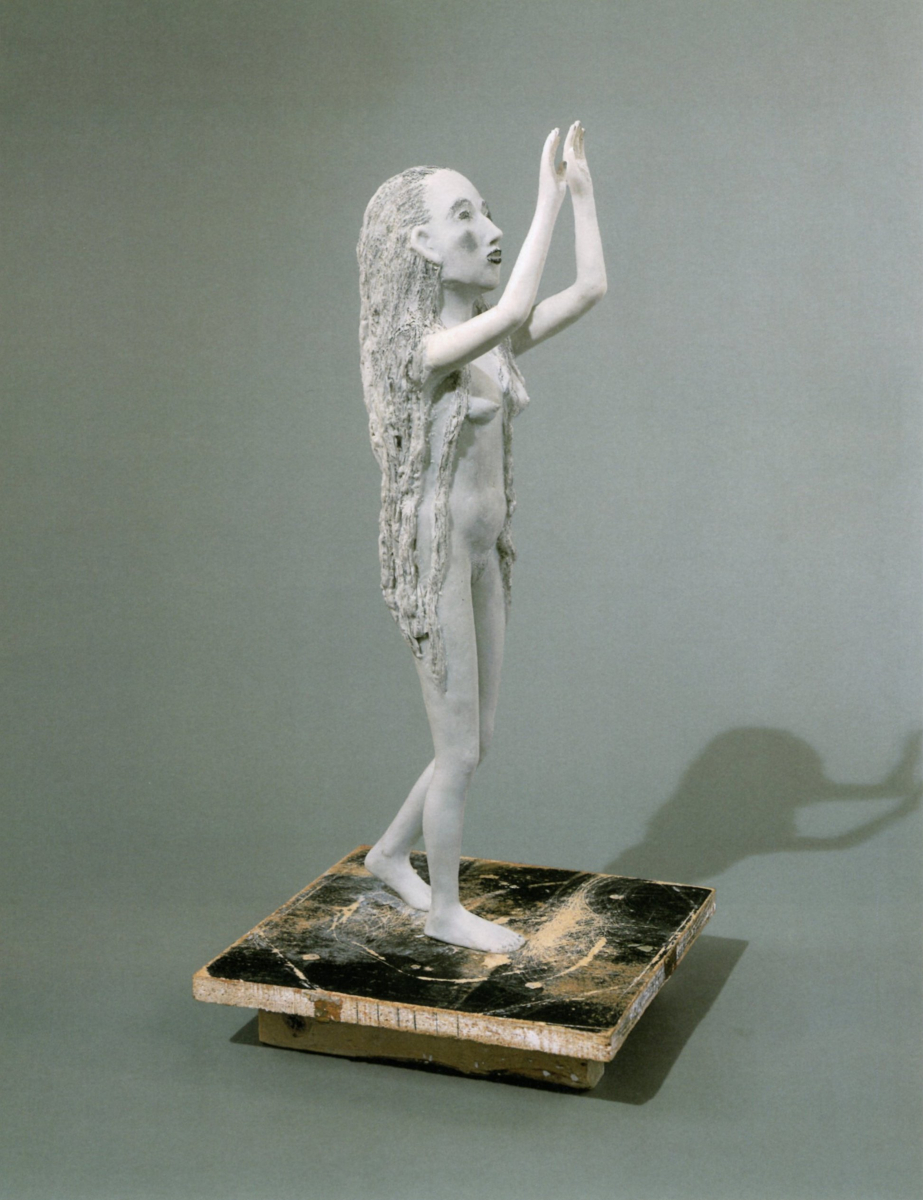
LOOK: Eve by Kiki Smith
Smith, Kiki_Eve
Kiki Smith (American, 1954–), Eve, 2001. Manzini (resin and marble dust) and graphite, 20 3/8 × 5 × 6 3/4 in. (51.8 × 12.7 × 17.1 cm). Source: Kiki Smith: A Gathering, 1980–2005, p. 247

Eve, the mother of all living, a representative of humanity. The crown of God’s creation, and yet she distrusted God’s word, transgressed his command, breaking what was intended to be an eternal communion. In this small sculpture, she looks up, raising her hands in front of her face—in a gesture of prayer or praise? Shielding her eyes from brightness? Could it be she sees redemption on the horizon?

LISTEN: “Lecha Dodi” (Come, My Beloved), traditional Jewish hymn | Words by Shlomo ha-Levi Alkabetz, based on verses from the Hebrew Bible, 16th century | Music by Maayan Tzafrir, 2021 | Sung by Maayan Tzafrir, 2021

(Turn on CC on the video to read the Hebrew lyrics alongside the English.)

ENGLISH TRANSLATION (supplied by 12 Tribes Music):

Rouse yourselves! Rouse yourselves! [Isa. 51:17]
Your light is coming; rise up and shine. [Isa. 60:1]
Awake! Awake! Utter a song.
The glory of God is revealed upon you.

Who is this that cometh up out of the wilderness,
Perfumed with myrrh and frankincense,
With all the fragrant powders of a merchant? [Song of Sol. 3:6]

Shake off the ashes! Rise up from the dust!
Put on your garments of splendor, my people. [Isa. 52:1]
Through the son of Yishai [Jesse] of Bethlehem,
Redemption draws near to my soul.

Awake! Awake! Utter a song,
Let me see thy countenance.
Awake! Awake! Utter a song,
Let me hear thy voice.

When I was a student at UNC–Chapel Hill, I was curious to learn more about the Jewish roots of my Christian faith. I reached out to the Jewish campus organization Hillel, and they invited me to attend their Shabbat dinner, hosted every Friday at sundown at a large house on Cameron Ave.

Most markedly, I remember, before eating, the communal singing of the piyyut (Jewish liturgical poem) “Lecha Dodi” as everyone turned to face the door. I had no idea what the words meant—they were in Hebrew—or what the orientation of bodies was communicating. The song was part of the group’s regular liturgy, familiar to the Jewish students who were gathered, so no introduction or explanation was given, no lyric sheet that I recall. Afterward I asked the rabbi what just happened. “We welcomed in the Shabbat bride,” she said. “The Shekinah.” (The Shekinah is a dwelling or settling of the divine presence. The word is a feminine noun in Hebrew.)

I was puzzled by this statement. It sounded so mystical, challenging my very literalistic sensibilities at the time. The words of the song, by the rabbi and Kabbalist Shlomo ha-Levi Alkabetz (1500–1576), are mostly a composite of scripture texts from the Song of Songs, Isaiah, and elsewhere. Rabbi Shlomo personifies Shabbat (the Sabbath) as a bride, and Israel as her mate. The song anticipates the everlasting Shabbat, ultimate redemption, as the people of Israel ask God to bring about messianic deliverance.

(Related posts: https://artandtheology.org/2024/12/10/advent-day-10-bridegroom-of-the-soul/; https://artandtheology.org/2019/11/26/salvation-is-him-artful-devotion/)

I was taken back to this experience from almost twenty years ago when recently, I came across a version of the “Lecha Dodi” distributed by 12 Tribes Music [previously]. There are hundreds of different tunes for Rabbi Shlomo’s text, from medieval Moorish to northern European folk; but 12 Tribes features a newer setting by the Israeli musician Maayan Tzafrir.

The YouTube video description provides some biographical background:

Maayan Tzafrir is a singer and musician who weaves Balkan and Middle Eastern musical traditions with her Jewish roots. In her music she combines ancient piyutim (chants) with folk melodies. Maayan’s original compositions are inspired by Greek, Bulgarian, Georgian, and Turkish traditions. Maayan is the founder and vocal leader of the Yearot Ensemble, a singer in the Greek band Tavernikos, founder of The Hebrew Balkan Choir, and conductor of various workshops, meetings, and tours focusing on Balkan traditional singing with a Hebrew and feminine spirit.

The lyrics provided for Tzafrir’s version differ slightly from the traditional lyrics. It appears that she uses verses 5 and 4, with complementary material in between.

As a Christian, I can’t help but hear these words in light of Jesus. Several of the Hebrew scripture texts for Jewish Shabbat overlap with the Hebrew scripture texts for the Christian season of Advent, which is itself a dedicated time of looking forward to the arrival of the Messiah, beseeching his coming to dwell.

The phrase “son of Jesse” is a reference to the royal Davidic line from which the Messiah will come—and, in Christian belief, did come, in Jesus of Nazareth, son of Mary, who has since ascended into heaven but has promised to return to bring about the fullness of God’s kingdom.

Awake! Sing! Redemption draweth nigh!
Roundup: Medieval reading recommendations, “Christ Our Lover,” and more

SUBSTACK POST: “Read something medieval this year” by Grace Hamman: One of the most frequently asked questions that medievalist Grace Hamman receives is: “What books should I read from the past?” She gives recommendations for the following six scenarios (including specific translations/editions!).

  1. I have never read anything medieval before! Where do I start?
  2. I have not read any medieval literature, but I did read Confessions in college. How about something a little later, a little more “medieval”?
  3. I want to read some medieval theology.
  4. I’ve read Bernard. Give me a theology deep cut!
  5. No thanks on the monastic theology. Give me poetry! Give me drama and beauty and weirdness!
  6. I’m a stubborn cuss / good millennial hipster / professional troublemaker. I want to read what no one else is reading casually. Make it super hard and dialectical and confusing (but awesome).

+++

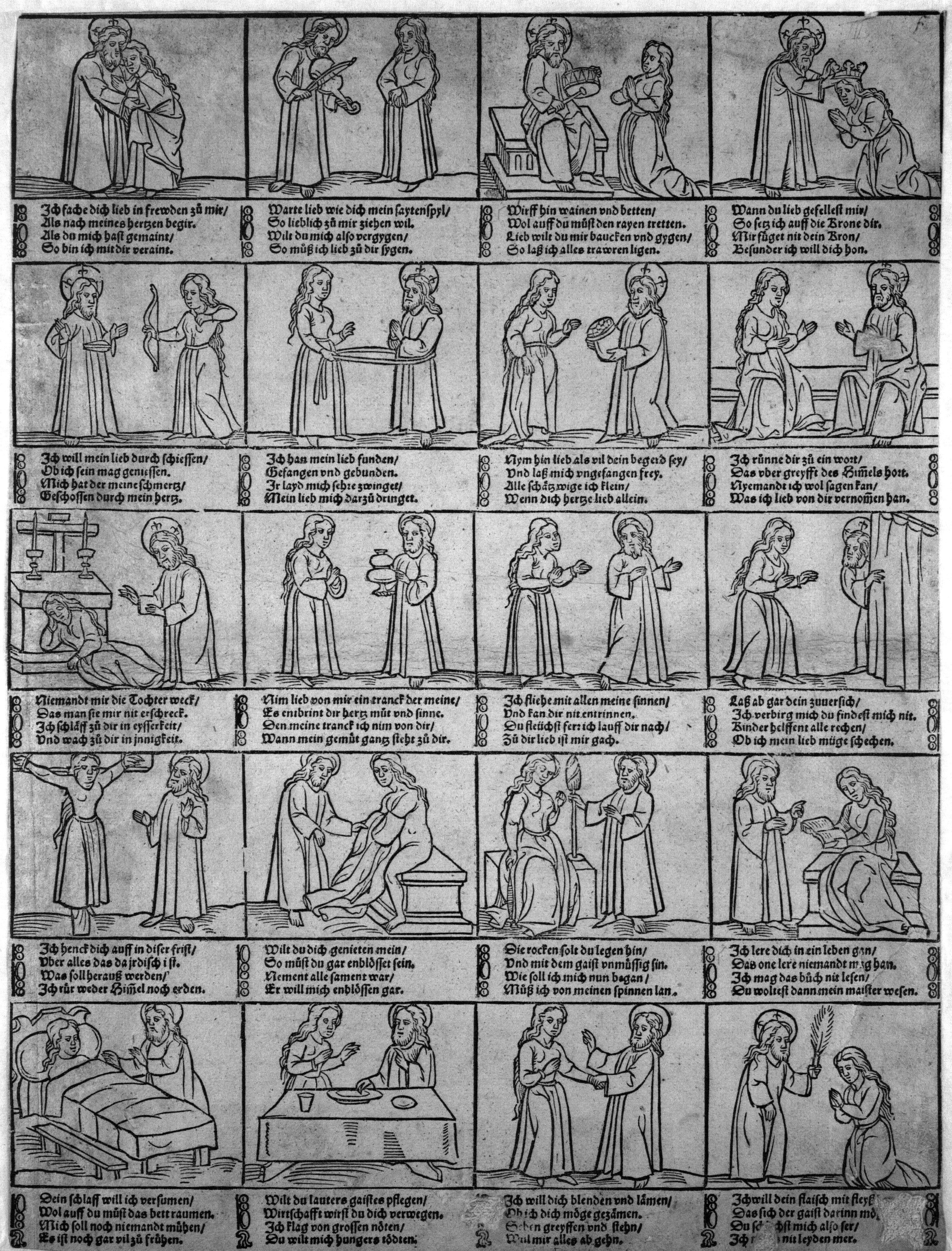
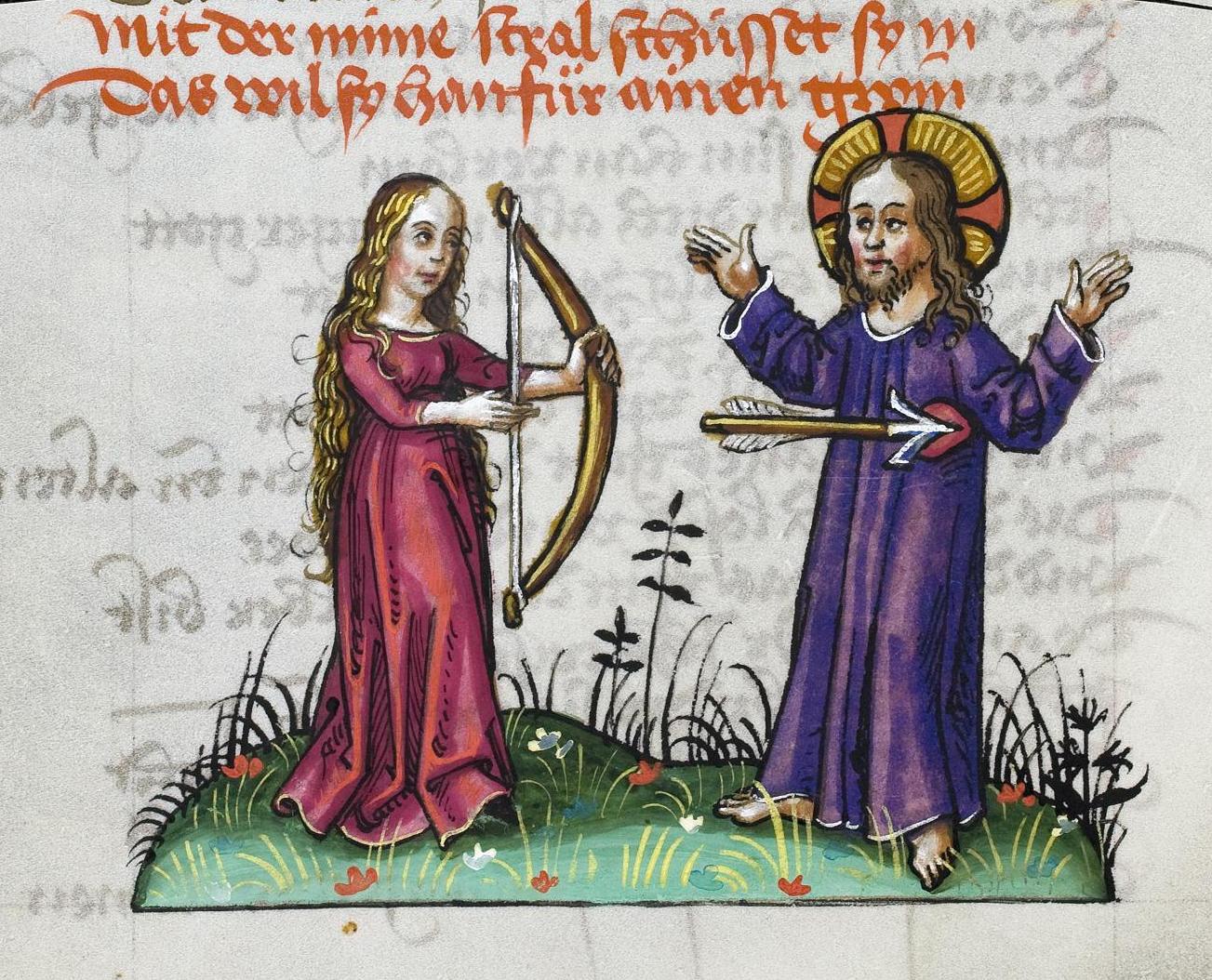
LECTURE: “Christ Our Lover: Medieval Art and Poetry of Jesus the Bridegroom” by Grace Hamman: Last fall I had the pleasure of inviting Dr. Grace Hamman (see previous roundup item) to my neck of the woods to speak for the Eliot Society, a Maryland nonprofit I serve on the board of. She gave this wonderful lecture on one of the popular medieval metaphors for Christ in theology and the arts, which was Jesus as bridegroom, or lover. For medieval people, “the union between God and the human soul was . . . a marriage made in mutual desire, joy, and even mutual submission,” she says. Hamman explores a few different pieces belonging to this tradition, including the fourteenth-century poem “Quia Amore Langueo” (Because I Languish for Love) and the fascinating fifteenth-century verse and image sequence Christus und die minnende Seele (Christ and the Loving Soul).

Christ and the Loving Soul (arrow of love)
Illustration by Rudolf Stahel (ca. 1448–1528) from a copy of Christus und die minnende Seele, Constance, Germany, ca. 1495. Karlsruhe, Badische Landesbibliothek, Cod. Donaueschingen 106, fol. 26v. Amber L. Griffioen provides this caption: “The Soul takes up her bow, draws her minne stral (or ‘arrow of love’), and goes on the hunt. She shoots and wounds Christ in the side, capturing him as her prize in order to ‘enjoy him’ forever.”

Christ and the Loving Soul broadsheet
Christus und die minnende Seele, from the printing house of Matthäus Franck in Augsburg, Germany, 1559–68. Woodcut, 35.5 × 27 cm. Munich, Bayerische Staatsbibliothek, Einblatt III, 52f.

+++

SONGS:

Inspired by Hamman’s talk, I’d like to turn your attention to the following two songs: one Jewish, the other Christian.

>> “Et Dodim Kala (Time for Lovers)”: The Hebrew text of this song, drawn from the biblical book the Song of Songs, is traditional Jewish (the video attributes it to Rabbi Haim Ben Sahl of the tenth century), and the music is a traditional gnawa melody (gnawa is a genre of Moroccan religious music marked by repetition). The performance is led by Lala Tamar on vocals and guembri (three-stringed bass plucked lute), and she’s joined by Ella Greenbaum and Imanouelle Harel on background vocals and krakebs (hand cymbals) and Tal Avraham on trumpet.

Tamar is an Israeli musician of Moroccan and Brazilian descent who performs Moroccan Jewish liturgical poems as well as contemporary music in Moroccan Arabic and Ladino.

Turn on closed captioning (CC) in the above video for the lyrics and their English translation, which is basically, “A time for lovers, my bride: / The vine has blossomed, / The pomegranates have budded.” The song is also available on Spotify.

>> “The Heavenly Courtier”: The anonymous words of this hymn were first published in 1694, and the tune is from The Christian Harmony (1805), a shape-note hymnal compiled by Jeremiah Ingalls. The song speaks of “Christ the glorious lover” who comes to earth “to woo himself a bride, resolving for to win her.” At first she’s resistant to his romantic entreaties, preferring instead the company of other lovers. But when she sees him for who he truly is—receives “one glimpse of [his] love and power”—she is overcome with ecstasy and accepts his proposal. The song ends with a wedding feast and mutual embrace. Read the full lyrics here, and listen to the Boston Camerata, directed by Joel Cohen, perform the piece on their album An American Christmas (1993); the vocalist is Joel Frederiksen.

I wouldn’t commend this hymn for a worship service, at least not without adaptation: while I’m on board with most of it, its Christ is in parts coercive, threatening violence, and there’s an overemphasis on the bride’s wretchedness and shame, with Christ the wooer breaking her down by revealing how “filthy” and unworthy she is. The Boston Camerata removes two of the more problematic verses, but I still think further tweaking needs to be done, more nuancing around the doctrines of sin and salvation (literarily, of course, preserving the extended metaphor!), to faithfully communicate the gospel through this song.

Regardless, I find it interesting as an artifact of early American Christian worship (it was sung congregationally in New England) and as an elaboration of the biblical picture of Christ the Bridegroom, not to mention poetically and musically charming. As I gathered from Grace Hamman’s lecture posted above, we can still appreciate creative works from the past and be moved or instructed by aspects of them without embracing them wholesale. It’s important for us Christians to be able to step outside our own cultural, historical, and denominational contexts with humble curiosity.

+++

2025 CALVIN SYMPOSIUM ON WORSHIP:

Calvin University’s annual Symposium on Worship was held last week. I wasn’t able to go this year, but I enjoyed tuning in virtually to the services that were livestreamed, now archived on the “Live” tab of the Calvin Institute of Christian Worship YouTube page. Here are two examples.

>> “Vesper: I Will Lift Mine Eyes,” led by Kate Williams and Tony Alonso: “Inspired by ancient and modern contemplative texts, this Vespers service is an invitation to come into the quiet and discover the eternal beauty of God’s consoling presence.” View the song credits in the YouTube video description.

>> “Worship Service: The Rich Man and Lazarus”: The Calvin University Gospel Choir, under the direction of Nate Glasper and with some songs guest-conducted by Raymond Wise, leads the musical portion of this service, and Rev. Dr. Dennis R. Edwards preaches on Luke 16:19–31, Jesus’s parable of the rich man and Lazarus. I especially enjoyed Wise’s original gospel song “Make a Joyful Noise” at 16:30, based on Psalm 100:1, and, also new to me, “Poor Man Lazarus” at 36:46, a traditional African American spiritual arranged by Jester Hairston. See additional song credits in the YouTube video description.