PODCAST: Poetry for All, hosted by Joanne Diaz and Abram Van Engen:Poetry for All “is for those who already love poetry and for those who know very little about it. In this podcast, we read a poem, discuss it, see what makes it tick, learn how it works, grow from it, and then read it one more time.” I’ve consistently enjoyed this podcast since its launch in 2020, having learned about it through cohost Abram Van Engen [previously], an academic who often writes and speaks about poetry for general Christian audiences. Here are some of my favorite episodes of the ninety-seven that have been released to date:
Three haiku by Kobayashi Issa, translated from the Japanese by Robert Hass: The first: “The snow is melting / and the village is flooded / with children.” Learn the characteristics of what Joanne Diaz calls “the perfect poetic form.”
“spring song” by Lucille Clifton: One of my favorite poems by one of my favorite poets. “This joyful poem caps a sequence of sixteen poems called ‘some jesus,’ which walks through biblical characters (beginning with Adam and Eve) and ends on four poems for Holy Week and Easter. [Clifton] wrote other poems on the Bible as well, including ‘john’ and ‘my dream about the second coming,’ which reimagine a way into biblical characters to make their stories fresh.”
“Elegy for My Mother’s Mind” by Laura Van Prooyen: This episode is unique in that it has the poet herself on to read and discuss the poem, which in this case navigates the complexities of memory, loss, and familial relationships.
“View but This Tulip” by Hester Pulter: Ashamedly, I had never heard of this seventeenth-century female poet before listening to this episode, so I’m grateful to guest Wendy Wall, cocreator of the award-winning Pulter Project website, for introducing me to her! “In this episode we discuss [Pulter’s] work with emblems, her scientific chemistry experiment with flowers, and her wonderment (both worried and confident, doubtful and awestruck) about the resurrection of the body and its reunification with the soul after death.”
“From Blossoms” by Li-Young Lee: A much-anthologized poem ostensibly about eating summer peaches, but more deeply, it’s about joy. “One of the things that draws me to this poem,” says Van Engen, “is that joy is actually very hard to write about . . . without it sounding naive or sentimental or withdrawn or unaware.”
“Primary Care” by Rafael Campo: Dr. Rafael Campo is both a poet and a practicing physician. Here he uses blank verse to explore the experience of illness and suffering.
+++
POEMS:
>> “For V. the Bag Lady, Great in the Kingdom of Heaven,” “Damascus Road,” “The Sower,” and “Crosses” by Paul J. Pastor: The Rabbit Room received permission to reproduce four poems from Paul J. Pastor’s [previously] new poetry collection, The Locust Years, which “explores a world of mystery and sorrow, desolation and love. Rooted in the Pacific Northwest, these poems offer readers an invitation to walk along a path pebbled with profound joy and deep loss.” I’ll be sharing another on the blog next week, courtesy of Wiseblood Books.
>>“Undone”by Michael Stalcup: The rise of blogging in the aughts and its descendant, Substacking, in the last few years has meant that poets and other writers can share their work directly with their reading publics and give them insight into their creative process if they wish. On his Substack, the Thai American poet Michael Stalcup [previously] recently shared one of his new poems that’s based on the story of the woman caught in adultery in John 8:1–11. He explains how the poem’s form, a blend of the Petrarchan sonnet and the chiasmus, contributes to its meaning.
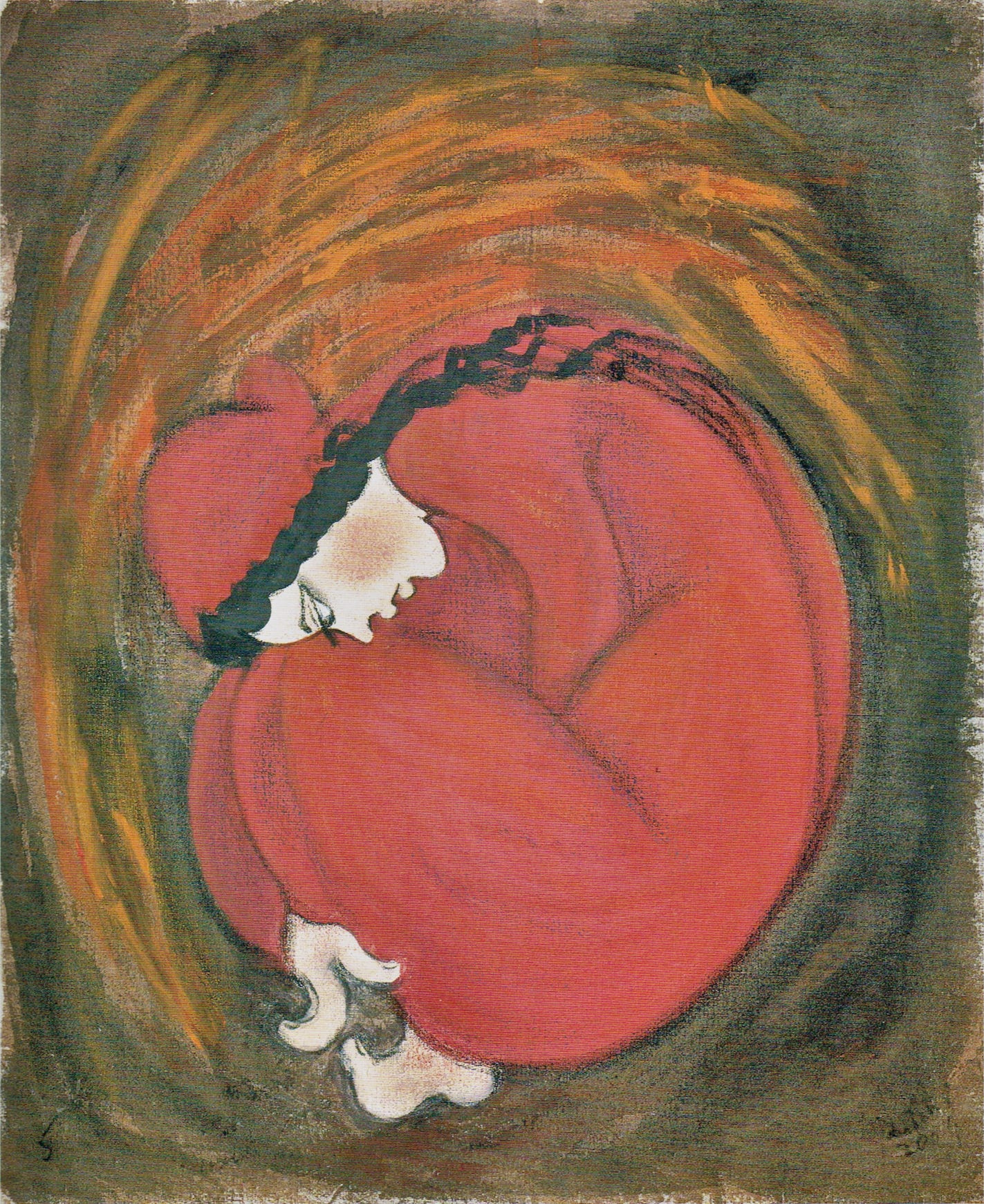
Nalini Jayasuriya (Sri Lankan, 1927–2014), Go, Sin No More, 2004. Mixed media on cloth, 23 × 19 in. Published in The Christian Story: Five Asian Artists Today, ed. Patricia C. Pongracz, Volker Küster, and John W. Cook (Museum of Biblical Art, 2007), p. 119.
Blessed be the paps which Thou hast sucked. —Luke 11:27
Suppose he had been Tabled at thy Teats, Thy hunger feels not what he eats: He’ll have his Teat ere long (a bloody one). The Mother then must suck the Son.
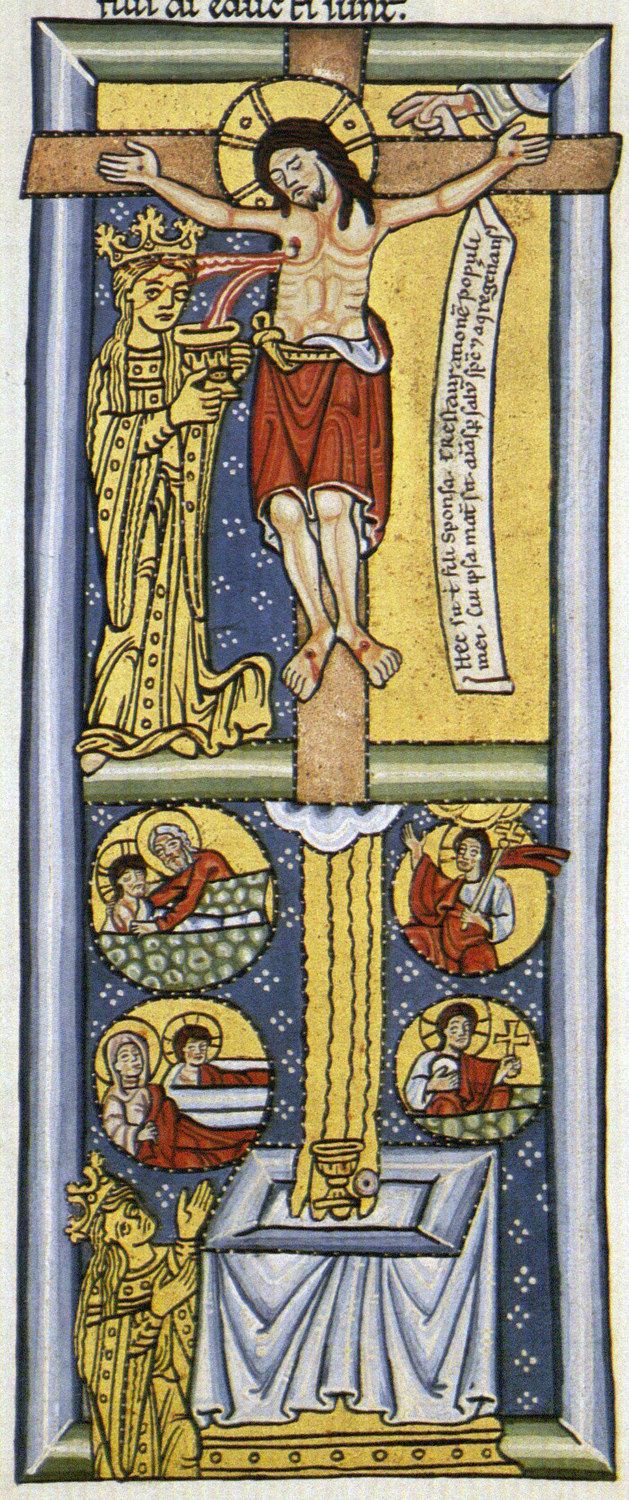
Scholar Kimberly Johnson [previously] unpacks these four lines about the body of Christ, who as an infant drank milk from his mother’s breast, and whose sacrificial death opened up his own breast whence flows the blood that nourishes us all. Johnson teases out the overlap of physical and spiritual in the poem, highlighting the maternal sharing of one’s own substance that links both couplets. At the eucharistic table, we are bidden to come and eat; or, in the stark metaphorical language of Crashaw, come and suck Christ’s bloody teat.
I plan to write an essay sometime about Christ as a nursing mother, as I’ve seen the image pop up in medieval writings and some visual art, including from Kongo and Ethiopia. In the meantime, here’s an illumination of the sixth vision in part 2 of Hildegard of Bingen’s Scivias (Know the Ways), painted under the supervision of Hildy herself. It shows the crucified Christ feeding Ecclesia (his bride, the church) with blood from his breast.
“The Crucifixion and the Eucharist,” from Scivias (Know the Ways) II.6, Rupertsberg Abbey, Germany, before 1179. Rupertsberg Codex, fol. 86r, Hildegard Abbey, Eibingen, Germany. The original manuscript from Hildegard’s lifetime was lost in 1945, but a faithful copy was made in 1927–33, which is the source of the color reproductions now available.
+++
ESSAY: “Only One Heart: The Poetry of Franz Wright as Emblem of God’s Grace” by Bonnie Rubrecht, Curator: “Are You / just a word? // Are we beheld, or am I all alone?” These three lines typify the poetry of Franz Wright (1953–2015), the Pulitzer Prize–winning author of Walking to Martha’s Vineyard, God’s Silence, and other collections. “Wright’s work is often described as confessional, colored by irony and humor. His irreverence, juxtaposed with honesty and humility, make his poetic voice unique in addressing God. Writers and poets often traffic in spiritual themes, but few modern poets echo the prophetic Old Testament tradition of crying out, approaching God with the concision and raw emotion that Wright does. He excels in voicing the concerns and ruminations of the human experience of suffering, while simultaneously shifting towards his own embodiment of grace.”
Van Engen answers questions from poet Shane McCrae and from the audience, addressing how to read a volume of poetry, how poetry produces an experience, the role of understanding and not understanding when it comes to poems, why Christians in particular should read poetry, hymns as poetry, how Adam’s naming creation in Genesis 2 relates to the task of the poet, his favorite poets, and the qualities of a good poem.
Two especially great questions from attendees were:
How do you imagine poetry nourishing discipleship and/or corporate worship, if used by a church leader?
What, if anything, would you like to see more of from Christian poets writing today?
Regarding the first, he says,
I often think that ministers in particular—and especially the heavier the preaching tradition, the more true this is—need creative literature—poetry, novels, and other things—to enliven what it is they’re doing from the pulpit. Not just to understand human life in all of its flourishing and misery, but to connect to people in different kinds of ways than pure principle and message can do.
He mentions the recurring summer seminar for pastors co-led by Dr. Cornelius “Neal” Plantinga, “Imaginative Reading for Creative Preaching,” to help participants explore the possibilities and homiletical impact of engaging in an ongoing program of reading novels, poetry, short fiction, children’s lit, and nonfiction outside the category of Christianity—not just to mine for sermon illustrations but also to develop a “middle wisdom” (“insights into life that are more profound than commonplaces, but less so than great proverbs”) and to deepen their perception of people.
+++
PODCAST EPISODE: “Opening Your Bible? Turn on Your Imagination” with Russ Ramsey and Sandra McCracken, The Gospel Coalition Podcast, May 8, 2020: This is a recording of a breakout session—“Reading Scripture with an Engaged Imagination”—from the Gospel Coalition’s 2019 National Conference in Indianapolis. Pastor Russ Ramsey (author of Rembrandt Is in the Wind: Learning to Love Art through the Eyes of Faith) and singer-songwriter Sandra McCracken (“We Will Feast in the House of Zion,” “Thy Mercy, My God”) discuss the role the imagination plays in reading scripture and understanding and conveying its truth.
Scripture calls for reading with a fully engaged imagination, Ramsey says, because that’s how literature works and that’s how people work. “How are you supposed to understand Scripture if you’re not trying to empathize or get into a situation and walk around inside of it?” he asks. They discuss wonder, mystery, and paradox—the unresolved dissonance and complexity present in many Bible stories—and the need to take a Bible story on its own terms instead of always trying to extract a moral or “life application” from it.
Though they don’t use the term, they’re basically advocating for Ignatian contemplation, aka the Ignatian method of Bible reading and prayer, in which you put yourself into the story and try to experience it with all your senses. Ramsey demonstrates with the story of Mary and the nard. “In those hours as Jesus is being arrested and tried and flogged and crucified, he smells opulent. And I think we’re supposed to get that, you know. We’re supposed to . . . especially a first-century reader is going to say, ‘He left a lingering scent as he went down the Via Dolorosa, and it was the scent of royalty. And it was the scent of extravagance.’”
Some of the names that come up along the way are Robert Alter, Ellen Davis, Eugene Peterson, and Frederick Buechner.
+++
IMMERSIVE ART EXPERIENCE:Rembrandt’s Christ in the Storm on the Sea of Galilee at Frameless in London: I’ve been seeing these kinds of exhibitions advertised more and more—ones that use animation and projection-mapping technology and dozens of loudspeakers strategically placed around the room to create a wall-to-wall, multisensory experience built around one or more masterpiece paintings. Some people say it’s gimmicky or overstimulating, but though I’ve never been to one, I generally think they look like fun! They’re not meant to be a substitute for seeing the actual artwork in person.
In the case of Rembrandt van Rijn’s Christ in the Storm on the Sea of Galilee, though, that’s not possible, as the painting was stolen from the Isabella Stewart Gardner Museum in Boston in 1990 and has not been recovered. In collaboration with their long-term partner Cinesite, Frameless recently developed an immersive art experience based on the painting—the Dutch master’s only seascape—in which visitors can get a sense of the terror and exasperation Jesus’s disciples must have felt that night they were caught at sea in a torrential wind- and rainstorm while Jesus lay calmly asleep in the boat’s stern (see Matt. 8:23–27; Mark 4:36–41; Luke 8:22–25). Here’s a making-of featurette for that experience, which garnered a nomination for a prestigious Visual Effects Society award earlier this year:
Frameless is permanently housed in the Marble Arch Place in London’s West End cultural district. Christ in the Storm is one of forty-two works of art they riff on across four galleries.
+++
POEMS:
Here are two poems published this month that each explores a different episode from the story of Jacob’s family in the book of Genesis—one of his wife Rachel stealing her father’s household gods as they flee to Canaan, and one of Jacob’s sons avenging the rape of their sister, Dinah. Both are examples of how poems can stimulate renewed engagement with scripture, as these were stories I had forgotten some of the details of, and the poems did not make sense until I revisited the relevant Bible passages. Poems can help us walk around inside the biblical narratives, both familiar and unfamiliar ones, and see things from the perspectives of different characters, especially ones who are not given a voice in scripture, such as a Shechemite woman taken captive by Jacob’s sons.
>>“Rachel, Cunning”by Patricia L. Hamilton, Reformed Journal: Read the poem first, then Genesis 29–31, then my commentary.
Voiced by Jacob’s second wife, Rachel, in this poem Rachel vents her jealousy over Jacob having first married her sister, Leah, who bore him six sons to her one at this point. This marriage was due to the trickery of her father, Laban, who also tried to cheat Jacob out of fair shepherding wages—so Rachel resents her father. As she prepares to secretly leave Paddan-aram for Canaan with Jacob, Leah, and their children, she steals her father’s teraphim (small images or cult objects used as domestic deities or oracles by ancient Semitic peoples).
In the biblical narrative, Rachel’s motive for stealing the idols is not given. Was she seeking to prevent Laban from consulting them to find out which way she and her family went? Was possession of the gods in some way connected to property inheritance, as some scholars have attested? Was she stealing a blessing from her ancestors? Did she take them for their monetary value? Or leaving her homeland, did she simply wish to take with her a little piece of home, for nostalgia’s sake?
I think the most likely reason is she still believed in these gods’ power—her allegiance to the God of Jacob had not yet been firmly established—and so she stole them for protection. That’s what Hamilton imagines in her poem: that Rachel sees them as “talismans against the spite of brothers,” averting the evil Jacob’s older twin brother, Esau, wished him for his having stolen their father’s blessing that belonged to him. (According to Genesis 27:41–45, before Jacob left for Paddan-aram, Esau had vowed to kill him.)
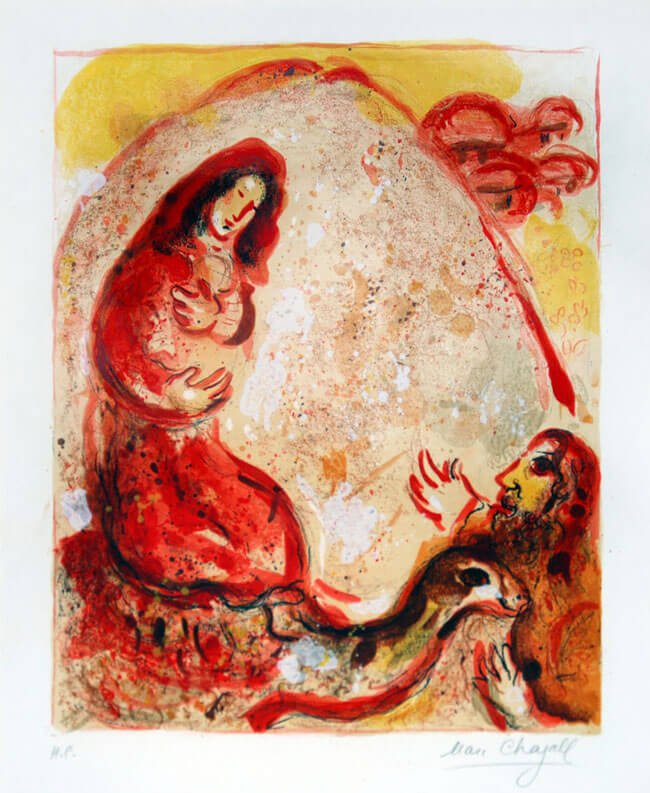
Marc Chagall (Belarusian French, 1887–1985), Rachel dérobe les idoles de son père (Rachel Hides Her Father’s Household Gods), from The Bible series, 1960. Original color lithograph on Arches wove paper, image size 14 × 10 1/2 in. (35.6 × 26.7 cm).
Caught between two tricksters—her husband and her father—Rachel herself becomes a trickster. When Laban catches up with their traveling party and searches among their possessions for the stolen gods, Rachel, who’s sitting on them, lies and says she cannot get up because she’s menstruating (Gen. 31:34–35). She deceives her deceitful father to keep her deceitful husband and her son Joseph safe from Esau’s rage, as she believes the gods will act in the interests of whoever possesses them. The poem explores the ever-thickening web of deceptions woven in Jacob’s and Rachel’s families and also reminds us that Rachel, remembered now as a great Jewish matriarch, was not raised in the then-still-developing Israelite religion, nor was her turn to Yahweh necessarily immediate upon her marriage to Jacob. I hear in the poem a lament for fraternal and sororal rivalries, and a subtle sad awareness of the vulnerabilities and pressures of women in patriarchal cultures, who are bought and sold in marriage, valued primarily for their childbearing capacities, and typically forced to rely on men for survival, often suffering the consequences of men’s mistakes. (In the poem at least, Rachel’s feeling of insecurity comes from Esau’s threat of vengeance.)
Based on a lithograph by Marc Chagall, this ekphrastic poem is one of twenty-four from the unpublished chapbook Voiced by Patricia Hamilton, all inspired by biblical artworks by Chagall. Hamilton is currently looking for a publisher to take on the collection.
>>“For the Circumcision of a Small City” by Emma De Lisle, Image: The deception continues in Genesis 34; like father, like sons. This poem is based on the episode of the massacre of the men at Shechem by Jacob’s sons Simeon and Levi to avenge the rape of their sister, Dinah. Shechem, meaning “shoulder,” was the name of both the city in Canaan where the rape took place and the Hivite prince’s son who committed the rape. Jacob and his family were sojourning there, having even bought land. After sexually assaulting Dinah, Shechem wanted to make her his wife. Dinah’s brothers were disgusted by this request, but they pretended they would entertain bride-price discussions on the condition that all the males in the city be circumcised. Shechem’s father agreed, and his position as ruler meant the people obeyed. A few days after the mass circumcision, while the men were still sore, Simeon and Levi attacked with swords, killing all the males in the city. Their brothers then joined them in capturing the men’s wives and children and plundering their wealth.
Emma De Lisle’s poem is written from the perspective of a woman of Shechem, taken captive in the slaughter. The women of the city scorned the lengths Shechem was willing to go to for the homely Dinah, barely old enough to have her period. “Jacob’s silence for you” alludes to Genesis 34:5, which says that when he found out about his daughter’s rape, “Jacob held his peace” until his sons returned from the fields. If he felt grief or outrage, it’s not apparent in the scripture text. His initial response was to say and do nothing, and then to defer to his sons, who exact an outsize punishment for the crime that Jacob admits after the fact disappointed him because when word spreads, it will negatively impact the hospitality of other Canaanite cities toward them.
Stanzas 4 and 5 refer to two of Jacob’s previous deceptions: donning goatskins on his hands and neck to impersonate his hairy brother, Esau, before their blind father, so as to steal the blessing of the firstborn (Gen. 27), and altering the breeding pattern of Laban’s flocks to increase the number of spotted sheep and goats (how this is accomplished is vague and has posed difficulties for interpreters) and so enrich himself, as the spotted animals were his agreed-upon wage (Gen. 30:25–43). The implication of this mention is, I think, that men will take what they feel is owed to them, whether by guile or force.
Sometimes women participate in this violence. The poetic speaker wonders whether Dinah will force her or the other captive women to bear children for her (future husband’s) family line, just as her mother, Leah, had used her slave, Zilpah, when her own womb had closed.
“The city bled one way // or another, before your brothers took interest,” the speaker says. Sexual violence was not new to them. The last sentence suggests that Dinah was not the only female victim of the lustful Shechem’s assault—the women of the city paid a price too, seeing their husbands, fathers, brothers, and sons murdered in retaliation and themselves taken prisoner.
+++
ORATORIO: The Book of Romans by Emily Hiemstra (2019): Consisting of musical settings of select passages from the apostle Paul’s letter to the Romans, this piece for SATB soloists, choir, and string orchestra was commissioned by Grace Centre for the Arts, a ministry of Grace Toronto Church, where it premiered October 22, 2019. (Hooray for churches that commission new art!) Read a statement from the composer on the Deus Ex Musica blog. The performers are Meghan Jamieson (soprano), Rebecca Cuddy (alto), Asitha Tennekoon (tenor), Graham Robinson (baritone), Lyssa Pelton (violin), Amy Spurr (violin), Emily Hiemstra (viola), and Lydia Munchinsky (cello).
Here is the video time stamp for each of the eight movements:
0:18: i. Who Has Known the Mind of the Lord? (Rom. 11:33–36)
3:56: ii. His Eternal Power and Divine Nature (Rom. 1:20)
SPOTIFY PLAYLIST: July 2024 (Art & Theology): This month’s “mixtape” includes a worship song by Daniel P. Cariño from Baguio, the Philippines; a 1954 recording from the streets of New Orleans of the itinerant preacher, singer, and guitarist Elder David Ross; a piano-violin arrangement of “Amazing Grace” by Carlos Simon; a nineteenth-century American folk hymn; an excerpt from Mendelssohn’s oratorio Elijah; a Jesus bhajan in Hindi from Toronto; a one-word song by choral-pop composer Michael Engelhardt; a brand-new Porter’s Gate single; and more.
+++
NEW BOOKS:
>> Diary of an Old Soul: Annotated Edition by George MacDonald, with introduction and notes by Timothy Larsen: At last, a keepsake edition of George MacDonald’s devotional poetry collection Diary of an Old Soul! Last week InterVarsity Press released a cloth-bound hardcover with ribbon bookmark, an introduction and sparing notes by the modern British religious history scholar Timothy Larsen, and, as MacDonald stipulated in the book’s first printing in 1880, a blank page facing each page of verse for readers to continue the conversation. C. S. Lewis gave a copy of Diary of an Old Soul to his future wife, Joy Davidman, as a Christmas gift in 1952, and it would make a wonderful Christmas gift still. For each day of the year MacDonald offers a seven-line poem that voices his spiritual longings, struggles, or joys; the Victorian tastemaker John Ruskin extolled the collection as proof that worthy religious poetry could still be written in the modern age. I highlighted my favorite selections from the book in a blog post last year, but on reading this new edition, new lines are standing out to me.
>> Word Made Fresh: An Invitation to Poetry for the Church by Abram Van Engen: Several Christians have told me they want to read more poetry and learn to better appreciate it but don’t know where to start. I usually recommend starting with an anthology, to get a taste of a wide range of styles and eras, and see if there are particular kinds they gravitate to. But now I’m thrilled I can recommend Abram Van Engen’s Word Made Fresh: An Invitation to Poetry for the Church, with a foreword by Shane McCrae. (Full disclosure: I was the copyeditor!) Endorsed by such luminaries as Christian Wiman and James K. A. Smith, the book is an excellent introduction to how and why to read poetry. Van Engen discusses sixty-two distinct poems, almost all of them reproduced in full, ranging from John Donne, Ben Jonson, and Frances Ellen Watkins Harper to Gwendolyn Brooks, Richard Wilbur, and Li-Young Lee and including, too, church hymns and biblical psalms, two forms of poetry with which Christian readers are likely already familiar. In part 1 he demonstrates six ways to read poetry: personally, for pleasure, inquisitively, like it’s a friend, considering form, and through erasure. In part 2 he answers the question “Why read poetry?”: to name creation, to tell the truth, to rejoice with those who rejoice, and to weep with those who weep. Van Engen insists that poetry is for everyone, and Word Made Fresh substantiates the claim.
PRINT INTERVIEW: “Through the Rent, Eternity Enters: A Conversation with Marilyn Nelson and Christian Wiman,” moderated by Abram Van Engen, Hedgehog Review: In December 2023, The Carver Project at Washington University in St. Louis brought together award-winning poets Marilyn Nelson and Christian Wiman for a discussion of poetry, faith, love, perception, ambition, humility, prayer, and grace, moderated by Abram Van Engen. Poets, I’ve noticed from attending conferences and reading or listening to interviews with them, tend to have an immense storehouse of wise quotes from other poets and thinkers at the ready, as this interview corroborates. There’s so much here to chew on!
+++
ESSAY: “Christianity and Poetry” by Dana Gioia, First Things: “This brief and inadequate historical survey,” writes poet and literary critic Dana Gioia, “is offered to demonstrate the powerful continuity of Christian poetry in English. Our literary canon is suffused with religious consciousness, which has expressed itself in ways beyond the imagination of theology and apologetics. Milton boasted that his Paradise Lost would ‘justify the ways of God to men,’ but his masterpiece was only one of countless poems that engaged, enlarged, and refined the spirituality of the English-speaking world. Christianity went so deeply into the collective soul of the culture that its impact continues even in our secular age.”
He proposes, “All that is necessary to revive Christian poetry is a change in attitude—a conviction that perfunctory and platitudinous language will not suffice, an awareness that the goal of liturgy, homily, and education is not to condescend but to enliven and elevate. We need to recognize the power of language and use it in ways that engage both the sense and the senses of believers.”
+++
CANTATA: Rejoice in the Lamb by Benjamin Britten, performed by VOCES8 and the VOCES8 Foundation Choir & Orchestra, dir. Barnaby Smith: “Rejoice in the Lamb (Op. 30) is a cantata for four soloists, SATB choir and organ composed by Benjamin Britten in 1943 and uses text from the poem Jubilate Agno by Christopher Smart (1722–1771). The poem, written while Smart was in an asylum, depicts idiosyncratic praise and worship of God by different things including animals, letters of the alphabet and musical instruments. Britten was introduced to the poem by W. H. Auden whilst visiting the United States, selecting 48 lines of the poem to set to music with the assistance of Edward Sackville-West. The cantata was commissioned by the Reverend Walter Hussey for the celebration of the 50th anniversary of the consecration of St Matthew’s Church, Northampton. Critics praised the work for its uniqueness and creative handling of the text.” (Wikipedia)
I know this poem from its famous passage about Jeoffry the cat, in which Smart celebrates his cat’s relationship with God: “For I will consider my Cat Jeoffry. / For he is the servant of the Living God duly and daily serving him. / For at the first glance of the glory of God in the East he worships in his Way. / For this is done by wreathing his body seven times round with elegant quickness. / For then he leaps up to catch the musk, which is the blessing of God upon his prayer. . . .” See 3:52 of the video.
SONG: “Wild Strawberries” by Nick Chambers: This song from 2020 expresses yearning to know the God whose beauty is revealed in nature and who is mysterious, “divinely robed in dark and radiant haze.” It’s based on a 1819 Swedish hymn by Johan Olaf Wallin that was quoted by the aging professor Isak Borg in Ingmar Bergman’s multi-award-winning film Wild Strawberries.
“In the gospel narratives,” Chambers writes, “the risen Jesus is always one step ahead, beckoning us further. We follow after tangible touches and traces he leaves behind—folded grave clothes and broken bread. He travels with us but isn’t always recognizable, still teaching his friends how to fish, readying breakfast on the beach. Wherever he appears and withdraws, the background becomes the foreground, inviting us to see and seek him everywhere. Resurrection cannot be confined; all creation is drawn into its trajectory.” Read more from Chambers in the YouTube video description.
SPOTIFY PLAYLIST: August 2022 by Victoria Emily Jones: Most months I compile thirty songs and other musical selections into a nonthematic playlist as a way to share good music, mostly from the Christian tradition but otherwise Christian-adjacent. This month’s list includes a traditional Black gospel song performed by Chris Rodrigues and professional spoon player Abby Roach (featured here); a Zulu song from South Africa about holding on to Jesus (bambelela = “hold on”); a song in the voice of Christ Our Mother by Irish singer-songwriter Sinéad O’Connor, from her album Gospel Oak; a portion of Barbados-born Judy Bailey’s Caribbean-style setting of the Anglican liturgy; a brass arrangement of a Golden Gate Quartet classic; Palestrina’s beautiful multivoiced setting of a Latin hymn by Bernard of Clairvaux; a future-looking song of celebration by country artist Naomi Judd, who passed away in April; a condensation of “In Christ Alone” by Texas soul artist Micah Edwards; and more.
The two videos below are from the list: a medley of the Twi praise chorus “Ayeyi Wura” (King of Our Praise) from Ghana and “Most High God” from Nigeria, led by Eric Lige at the 2018 Urbana missions conference, and a new arrangement by Marcus & Marketo of “I’ve Got a River of Life,” a song that I have fond memories of singing in children’s church as a kid (with hand motions!) (you can hear a more standard rendition here). The first line is derived from Jesus’s saying in John 7:38 (“Out of the believer’s heart shall flow rivers of living water”), and the refrain “Spring up, O well!” comes from Numbers 21:17, where the Israelites praise God for providing them water in the desert.
+++
Reading books is a key way that I grow intellectually and spiritually, and books are often where I find content to highlight on the blog, be it poems, visual art, people, or ideas. Because I’m not affiliated with an academic institution, I don’t have easy access to a lot of the books I need for my research, and I rely heavily on my personal library (as well as the Marina interlibrary loan system). If you’d like to support the work of Art & Theology, buying me a book from my wish list is a great way to do that! I’ll consider it a birthday gift, as my birthday is Saturday. 😊
+++
ESSAYS:
>> “Poetry’s Mad Instead” by Abram Van Engen, Reformed Journal: “I believe that poetry has a particular place in the church. I think it responds directly to the call and the invitation of God to ‘sing a new song,’” says Abram Van Engen, chair and professor of English at Washington University in St. Louis and cohost of the podcast Poetry for All. “And in the singing of poetry, the faithful can begin to understand and experience and engage God’s world afresh.” He adds, “Poets often invite us to practice thinking and noticing at a different pace. It is only at a slower speed of processing that we can begin to observe what we have too often missed or ignored.”
In this essay, Van Engen walks readers through the sonnet “Praise in Summer” by Richard Wilbur, which is what he begins with whenever he teaches poetry at church. He teaches you some of the poet’s tools so that you can feel more confident in approaching poems on your own.
>> “In Defense of Fiction: Christian Love for Great Literature” by Leland Ryken: An excellent article, by a professor emeritus of English at Wheaton College and author of The Christian Imagination: The Practice of Faith in Literature and Writing, A Complete Handbook of Literary Forms in the Bible, and more. “With so many valuable nonfiction books available to Christians, many wonder if reading fiction is worth the time. Others view fiction as a form of escapism, a flight from reality and the world of responsibility. But rightly understood, reading fiction clarifies rather than obscures reality. The subject of literature is life, and the best writers offer a portrait of human experience that awakens us to the real world. Fiction tells the truth in ways nonfiction never could, even as it delights our aesthetic sensibilities in the process. Reading fiction may be a form of recreation, but it is the kind that expands the soul and prepares us to reenter reality.”
+++
VISUAL MEDITATION: On Christ and the Samaritan Woman by Jacek Malczewski, by William Collen: William Collen introduced me to this unusual painting on the subject of Christ’s meeting with the woman at the well from John 4—a subject the artist painted several times (e.g., here, here, and here). Whereas Christ is traditionally shown pontificating to the woman with an air of formality, here there is an appealing casualness to their interaction, and the woman dominates the composition.
Jacek Malczewski (Polish, 1854–1929), Christ and the Samaritan Woman, 1912. Oil on plywood, 92 × 72.5 cm. Borys Voznytskyi Lviv National Art Gallery, Ukraine.



 Art & Theology