For the past month I’ve been working on an essay that brings together a selection of over three dozen art-historical images of Adam and Eve at Labor—a subject that appeared as early as the fifth century—and provides theological commentary. I wanted to publish it shortly before Labor Day on September 1. Unfortunately, it won’t be finished in time. Whenever I researched a particular image, it opened up further avenues of research, and I’ve realized that I need to spend much more time reading and reflecting on the topic, including consulting more commentaries on Genesis 3 and medieval theologies of work, before writing.
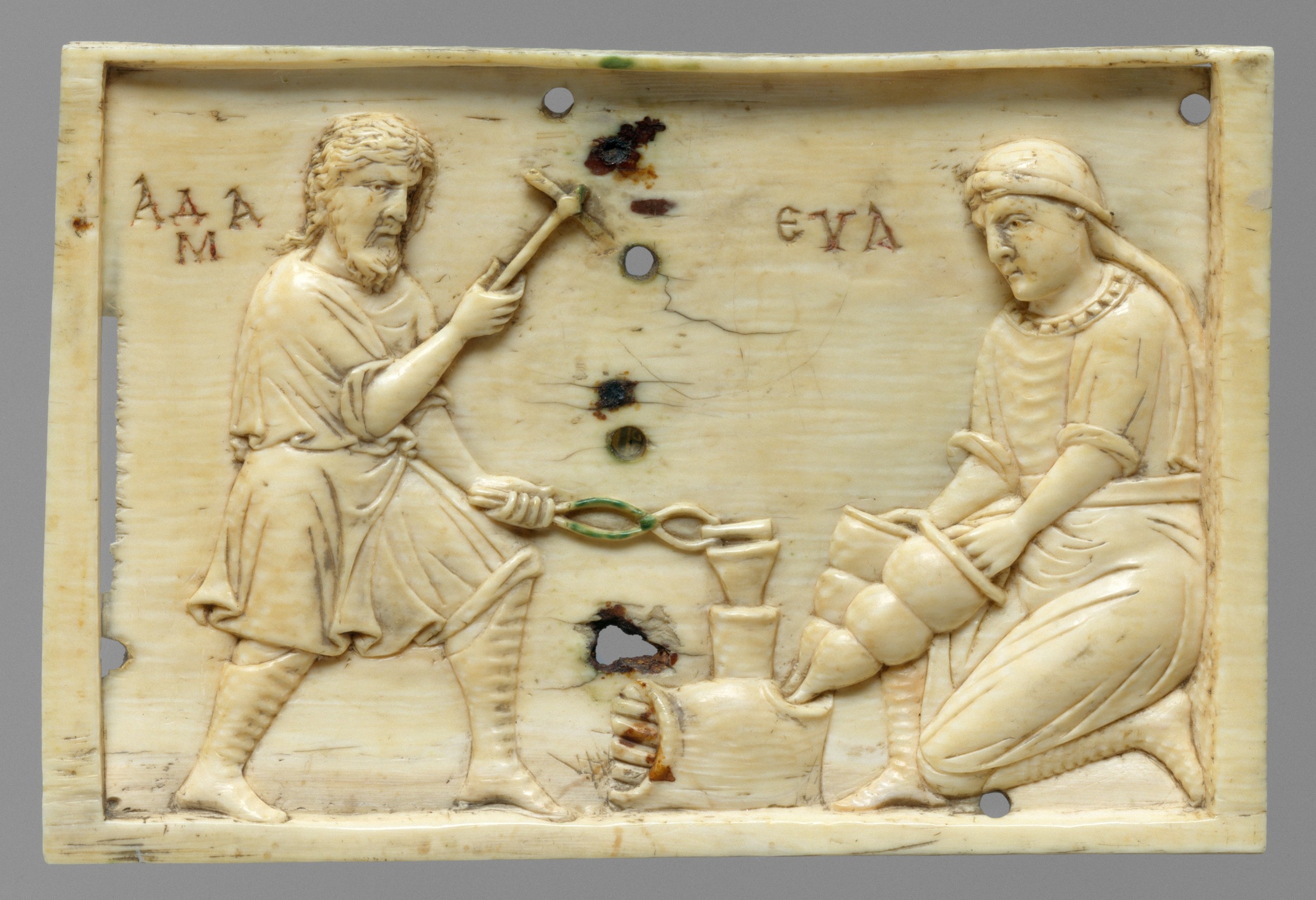
Instead, allow me to simply share a Byzantine ivory panel that amazed me when I encountered it on the website of the Metropolitan Museum of Art a few years ago, which I saw in person on my last visit in January—a small little thing, just a few inches wide, and easy to miss in the large glass case in Gallery 300, except that I was specifically looking for it.
Adam and Eve at the Forge, panel from a small box made in Constantinople, 10th or 11th century. Ivory, gilt, polychromy, 2 9/16 × 3 7/8 × 3/16 in. (6.5 × 9.9 × 0.5 cm). Metropolitan Museum of Art, New York.
It shows Adam hammering iron over an anvil while Eve operates the bellows! Husband and wife co-laboring in a forge—she supplying strong blasts of air to the furnace, he shaping the metal.
This panel struck me because one, I had never seen a medieval image of a female blacksmith before (other than as a personification of Nature, from The Romance of the Rose), and two, the vast majority of images of Adam and Eve at work after the fall show Eve spinning wool or flax and/or breastfeeding while Adam tills the soil, reflecting gendered ideas about the division of labor. Occasionally Eve is shown working the land or harvesting its fruits alongside Adam, as in the Ripoll Bible, a Salerno ivory, a relief carving on the facade of Modena Cathedral, and another ivory panel from this same box—work that men and women in agricultural societies definitely shared then as now. But more often the primordial couple is shown participating in separate spheres of work—the fields versus the home—albeit side by side.
In the Middle Ages, blacksmithing was the domain of men. Sometimes the daughters or wives of male smiths worked alongside them in family-run forges, but they were not permitted to join the guilds.
The Met ivory is a rare egalitarian picture of husband and wife engaged together in a muscular, creative task that contributes to their mutual survival and the betterment of society. Their resourcefulness, ingenuity, hard work, and cooperation are highlighted.
The detached panel is from a luxury box made for an elite Christian client in Constantinople for storing coins, jewelry, or other valuables. A small group of such boxes depicting scenes from the lives of Adam and Eve survives from the tenth and eleventh centuries. It’s possible the box that this smithing panel comes from was a wedding gift, as it espouses the virtue of teamwork in marriage. “Such caskets could have belonged to young couples embarking on a new life together,” writes Ioli Kalavrezou in The Glory of Byzantium: Art and Culture of the Middle Byzantine Era, A.D. 843–1261. “The story of Adam and Eve could have reminded them of the difficulties they would encounter but at the same time spurred them on to an industrious and, it was to be hoped, prosperous existence.”
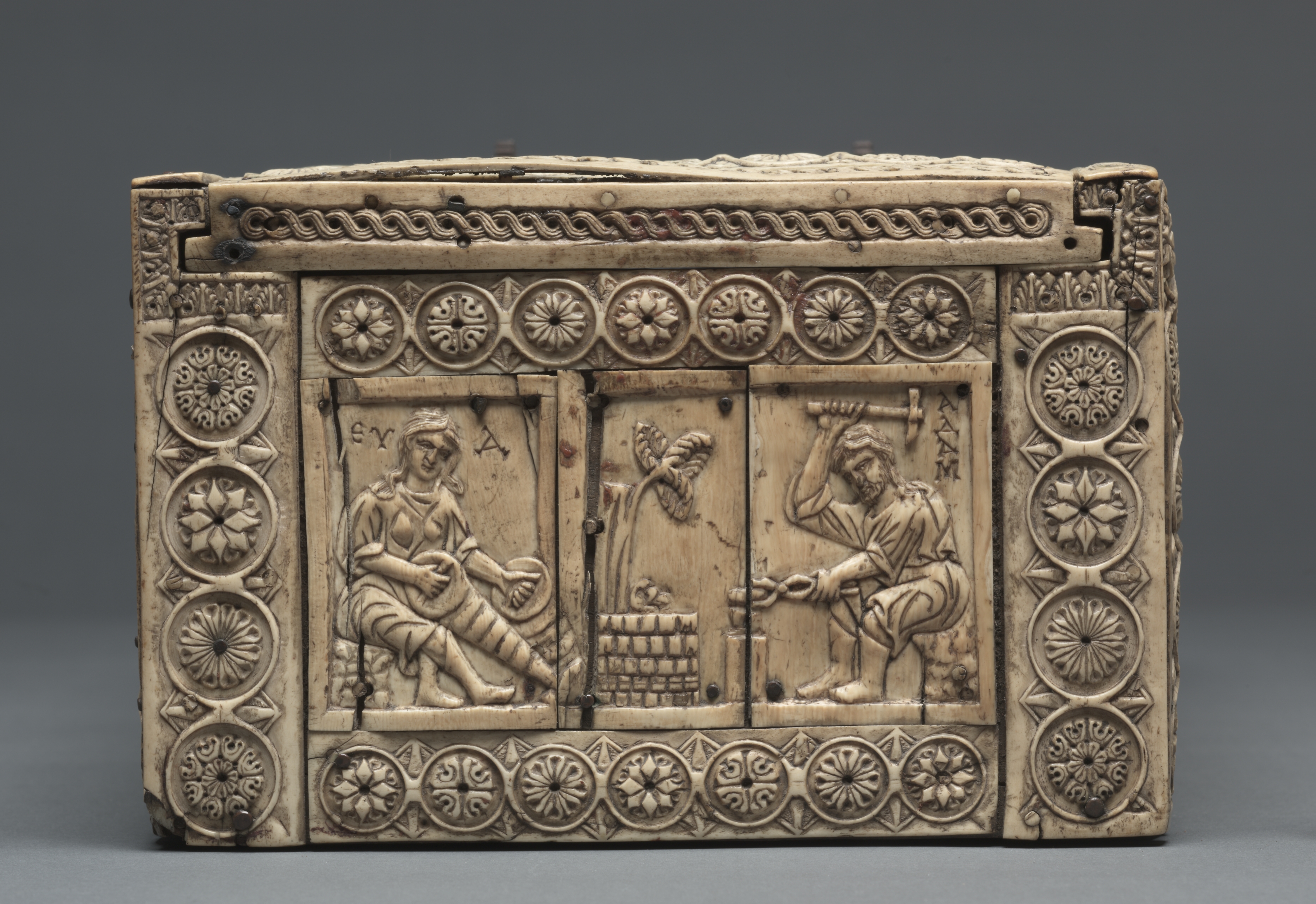
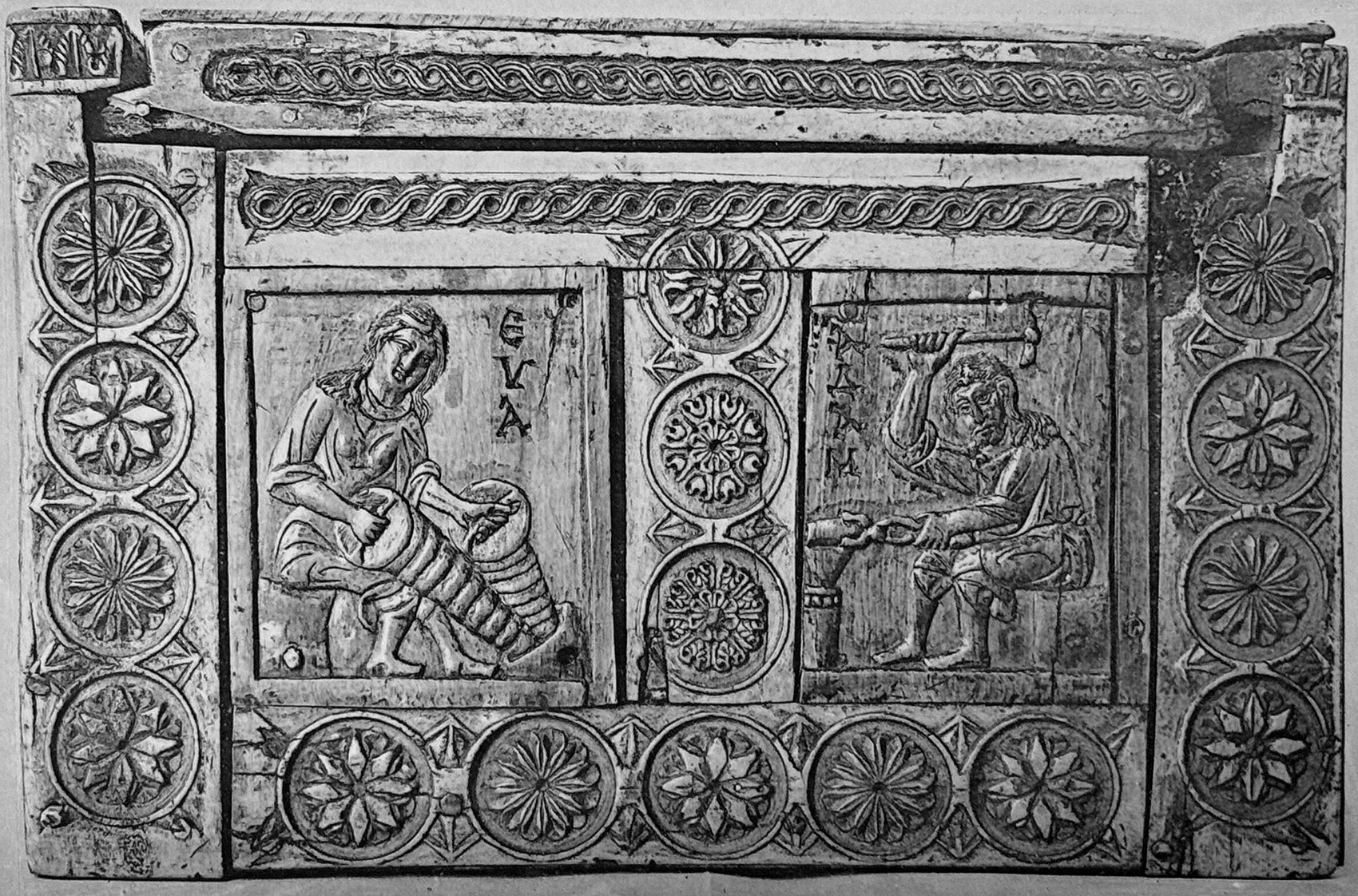
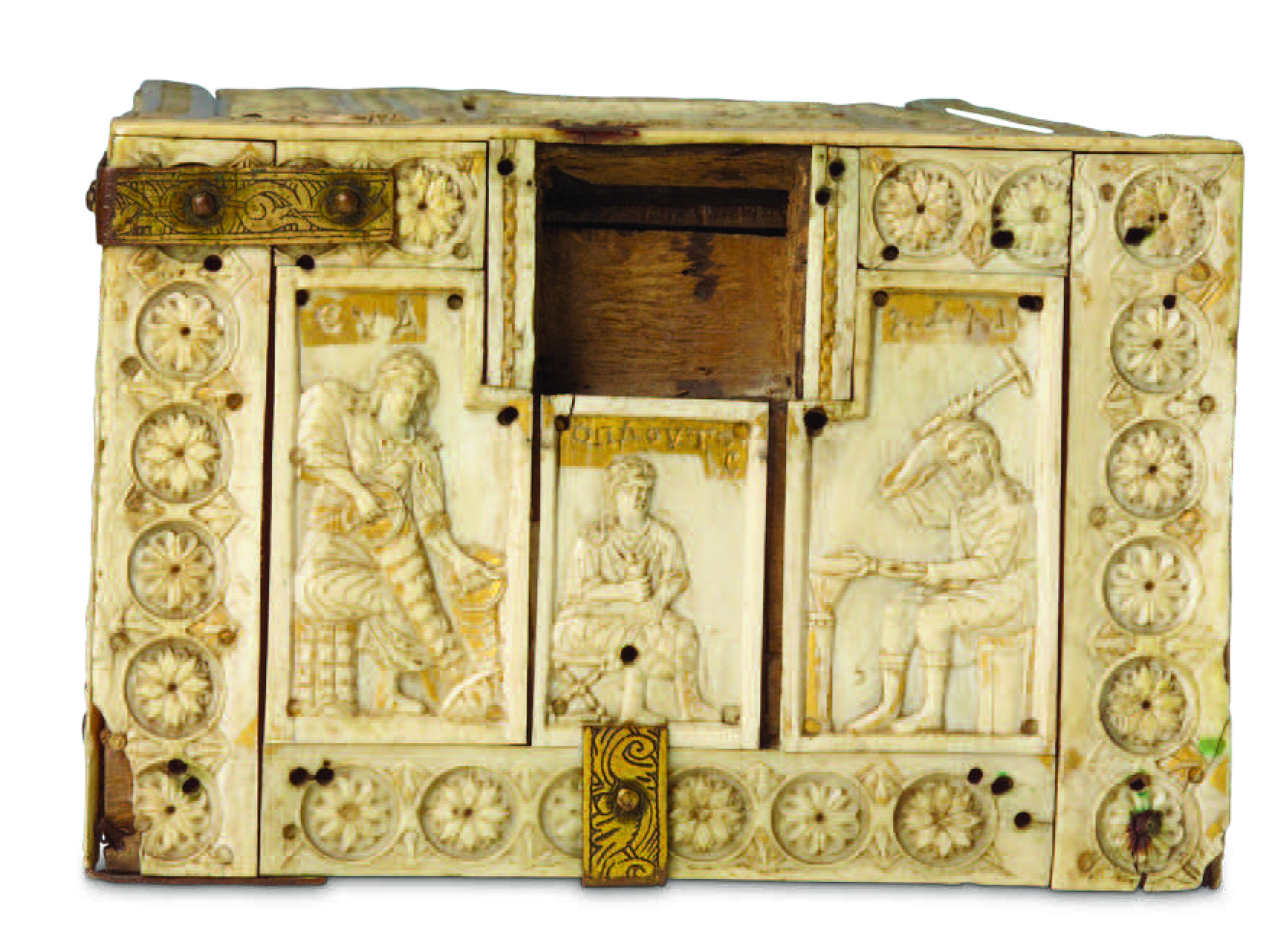
In the essay “The Origin of the Crafts According to Byzantine Rosette Caskets,” historian Justin Wilson examines Byzantine views about the origin of the primordial crafts (technai) of farming and metallurgy, especially by looking at select scenes from three related ivory boxes: from the Cleveland Museum of Art in Ohio in the United States, the State Hermitage Museum in Saint Petersburg, Russia, and the Hessisches Landesmuseum Darmstadt in Germany. All three contain a scene of Adam and Eve at the forge.
Right (short) side of a rosette casket with scenes of Adam and Eve, Constantinople, ca. 975–1025. Ivory, wood, overall 5 5/8 × 18 3/8 × 8 in. (14.3 × 46.7 × 20.3 cm). Cleveland Museum of Art, Ohio.Right (short) side of a rosette casket with scenes of Adam and Eve, Constantinople, ca. 975–1025. Ivory, wood, traces of gilding, overall 5 × 18 5/16 × 7 9/16 in. (12.7 × 46.5 × 19.3 cm). State Hermitage Museum, Saint Petersburg.Right (short) side of a rosette casket with scenes of Adam and Eve, Constantinople, ca. 1000–1025. Wood, ivory, overall 5 × 18 × 7 1/2 in. (12.5 × 46 × 19 cm). Hessisches Landesmuseum Darmstadt, Germany. Photo: Wolfgang Fuhrmannek.
For the anonymous artists of these boxes, Wilson writes, “blacksmithery symbolizes how human labor reshapes the world.”
The scene on the Darmstadt casket features a third figure between the couple: Plutus, the Greek god of wealth and abundance, holding a moneybag. In his 1899 study of the Adam and Eve chests, the classical archaeologist Hans Graeven proposed that Plutus signifies the valuable contents presumably kept inside the chest; art historian Josef Strzygowski agreed, suggesting that the god was meant to be read in relation not to Adam and Eve but to the chest’s lock (now missing), under which he was placed.
Wilson adds that Plutus, traditionally associated with good fortune, signals the prosperity of postlapsarian life—that although we lost Eden and must sweat and toil for our bread, humanity can still thrive. In the words of the late pastor Tim Keller in his book Every Good Endeavor, “Whenever we bring order out of chaos, whenever we draw out creative potential, whenever we elaborate and ‘unfold’ creation beyond where it was when we found it, we are following God’s pattern of creative cultural development,” and there’s blessedness in that.
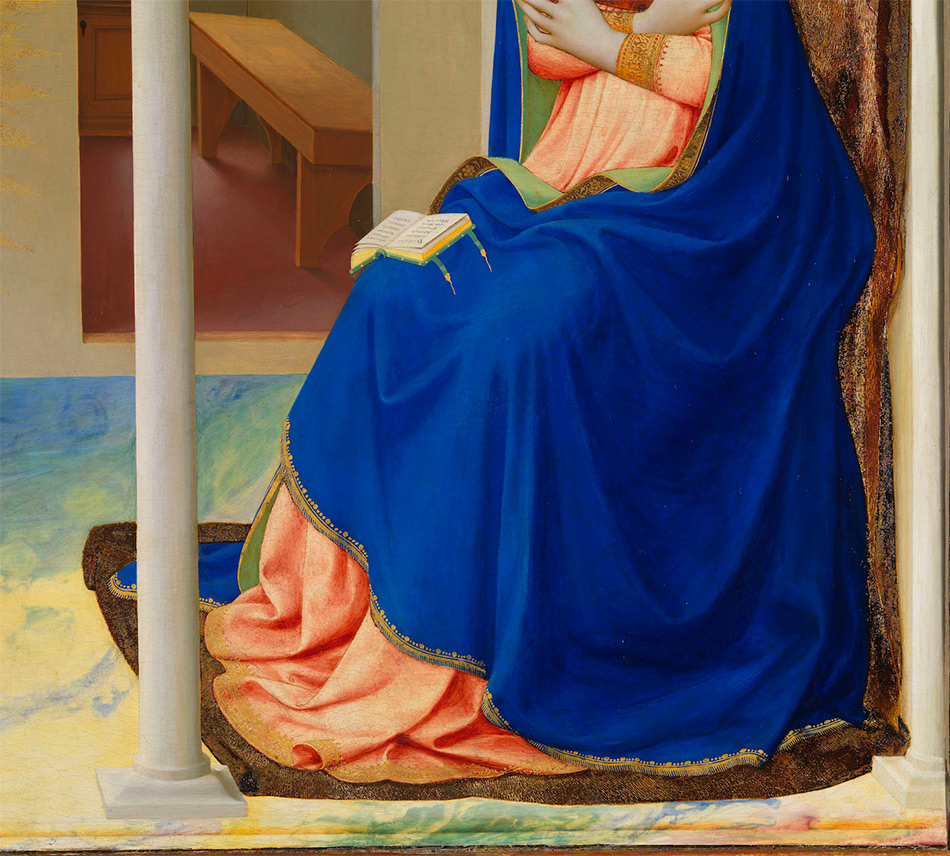
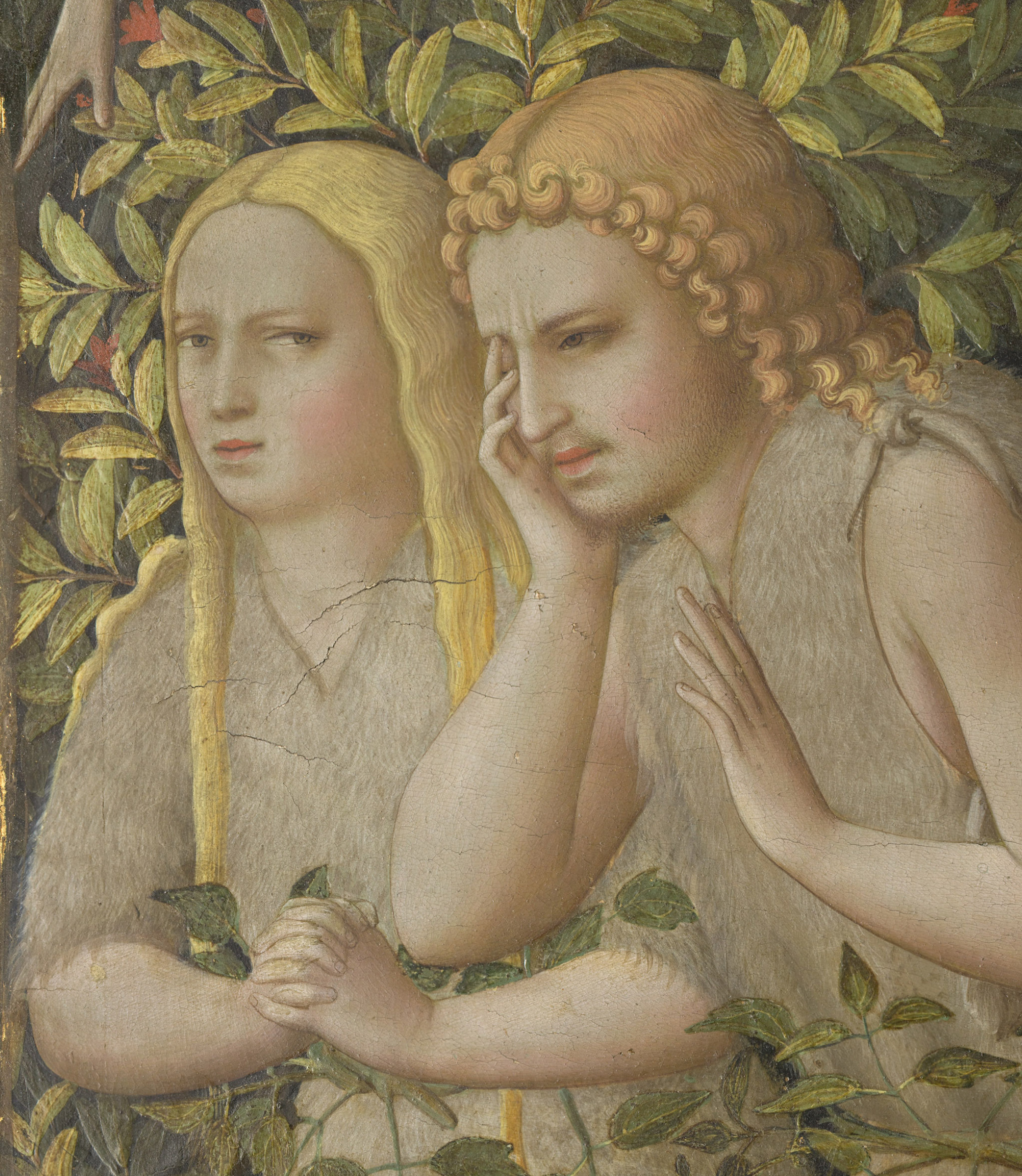
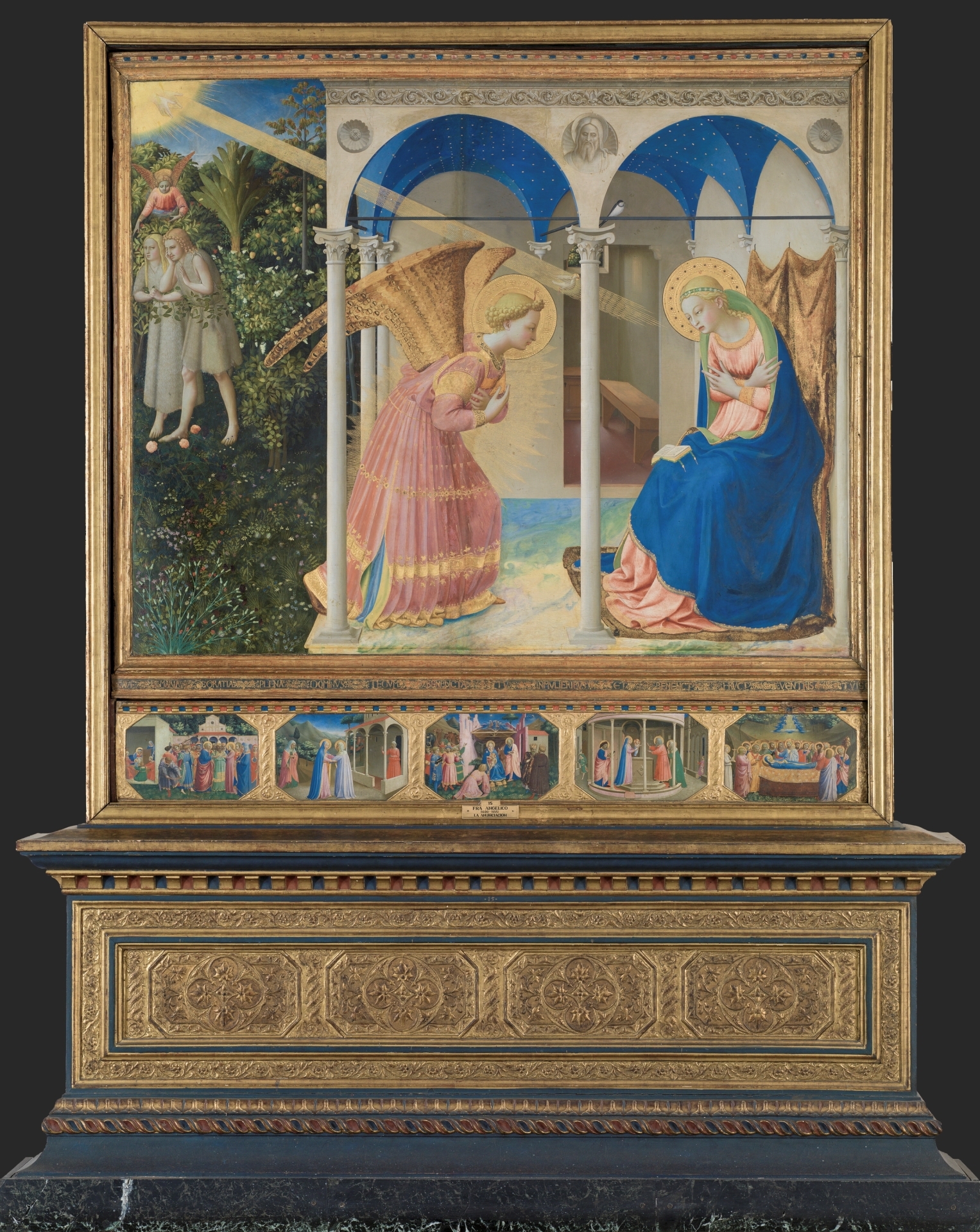
Fra Angelico (Italian, ca. 1395–1455), The Annunciation, ca. 1426. Tempera and gold on wood panel, 162.3 × 191.5 cm. Museo del Prado, Madrid.
The Annunciation was a favorite subject of the Early Renaissance artist Fra Angelico [previously], and he painted it multiple times throughout his career. Once was for an altarpiece for the convent of San Domenico in Fiesole, near Florence, now in the Prado Museum in Madrid.
In this version Mary sits on a draped chair under the portico of a domestic space, reading the scriptures, when suddenly this otherworldly being, dressed in rose and radiating, approaches. It’s the archangel Gabriel. His foot crosses the threshold of paradise into Mary’s space—the divine stepping into the human realm. Will you do it? he asks. Be mother to God?
Mary’s initial fear and perplexity eventually give way to glad acceptance. The artist compresses the episode—the arrival, the ask, the cogitation, the answer—into this singular freeze frame. When Mary says yes to God’s plan to become flesh of her flesh and so work out the salvation of the world, God releases his Spirit, who rides a stream of light from the heavens into her womb. At this miraculous moment, Jesus is conceived.
Gabriel crosses his hands over his chest in humble reverence, a gesture mirrored by Mary. Both are still before the profound mystery of the Incarnation.
Fra Angelico used ultramarine—the finest and most expensive of all pigments, made from lapis lazuli, a semiprecious stone imported to Europe from the Middle East—to paint Mary’s mantle as well as the star-studded ceiling above her. Blue represents heaven, and here Mary is clothed with it and overshadowed by it.
The male figure in the carved roundel above the central column is, I’d say (based on the unambiguous Montecarlo Altarpiece), the prophet Isaiah, who wrote centuries before the event that “the Lord himself shall give you a sign; behold, a virgin shall conceive, and bear a son, and shall call his name Immanuel” (Isa. 7:14).
But Fra Angelico goes even further back than the Old Testament prophets. On the left side of the panel he shows our foreparents, Adam and Eve, being cast out of paradise, having broken God’s trust. They blush in shame—they wince, they cover their face. By including this catalyzing event from salvation history in his painting of the Annunciation, the artist is telling a larger narrative. In particular, he is drawing connections, mainly contrastive, between Adam and Eve and Christ and Mary.
In his epistles, the apostle Paul talks about Christ as the Second Adam, or the New/Last Adam (Rom. 5:12–21; 1 Cor. 15:22–23, 45), who came to restore what was lost with the first Adam. Whereas Adam disobeyed God and caused sin to enter the world, Christ lived a life of perfect obedience to the Father, thereby redeeming humanity. The early church fathers, starting with Justin Martyr, Irenaeus, and Tertullian in the second century, extended this corollary with another: Mary as the Second Eve. Whereas Eve rejected God’s will, Mary embraced it, and her obedient yes, like Eve’s disobedient no, had repercussions for all of humanity. As the arts lecturer John Skillen puts it, our undoing in the Expulsion is undone by the Annunciation.
We see on the left an angel driving humanity out of Eden, but on the right, another angel welcomes humanity back in. And in a glorious reversal of the order of first creation, where Eve was created from Adam, here the Second Adam is created from the Second Eve, knit together from her DNA.
In the first issue of her Medievalish newsletter from last December, Dr. Grace Hamman discusses Fra Angelico’s Prado Annunciation in terms of chronos (ordinary time measured in seconds and hours) and kairos (moments outside of time). “Fra Angelico recognizes something that is easy to forget: because God is outside of time, not bound by chronology like us creatures, this painting offers a ‘God’s-eye view’ of salvation history,” she writes, portraying a simultaneity of “falls” that the fourteenth-century contemplative writer Julian of Norwich expounds on:
When Adam fell, God’s Son fell; because of the true union which was made in heaven, God’s Son could not be separated from Adam, for by Adam I understand all mankind. Adam fell from life to death, into the valley of this wretched world, and after that into hell. God’s Son fell with Adam, into the valley of the womb of the maiden who was the fairest daughter of Adam, and that was to excuse Adam from blame in heaven and on earth; and powerfully he brought him out of hell. (Revelations of Divine Love, chap. 51)
“There was never a moment,” Hamman continues, “even in the expulsion from Eden, that Emmanuel was not with us, if one is given the eyes of kairos.”
And the Annunciation is only the main panel. Along the predella (base) are depicted the Marriage of the Virgin, the Visitation, the Nativity, the Presentation of Christ in the Temple, and the Dormition (the “falling asleep,” or death, of Mary).
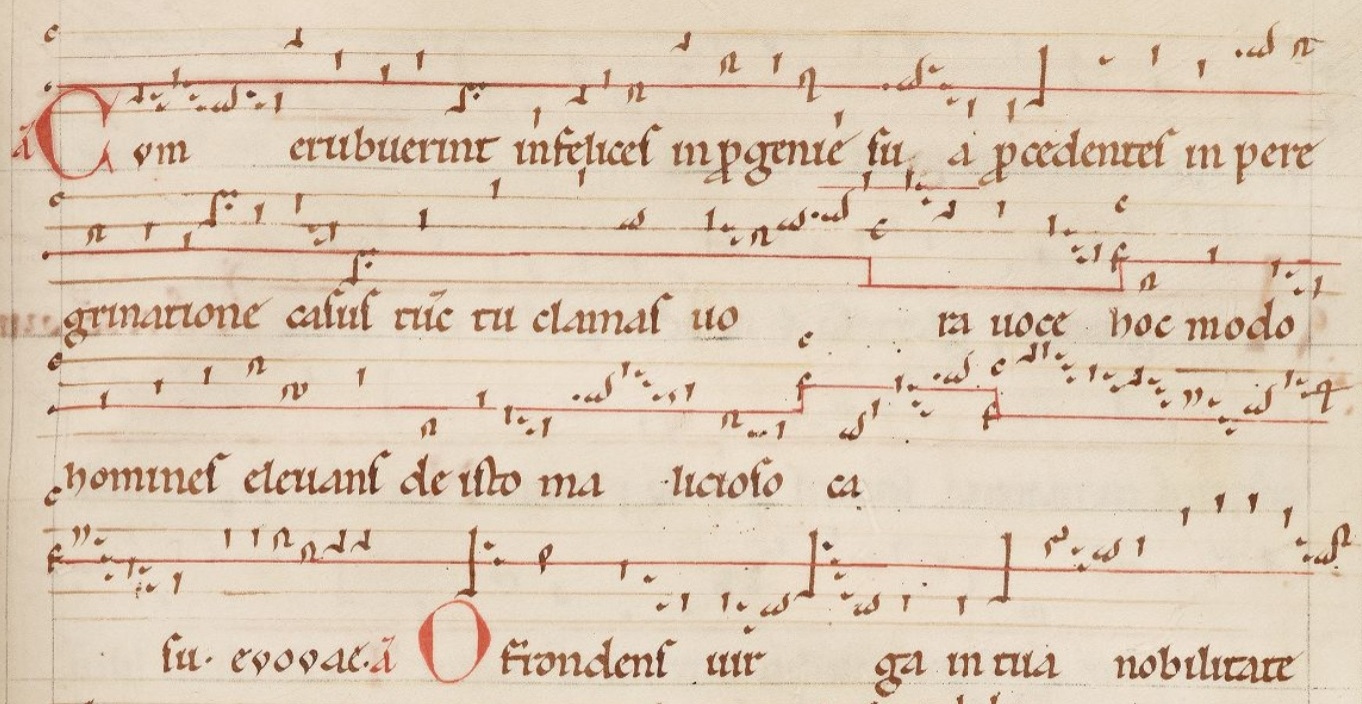
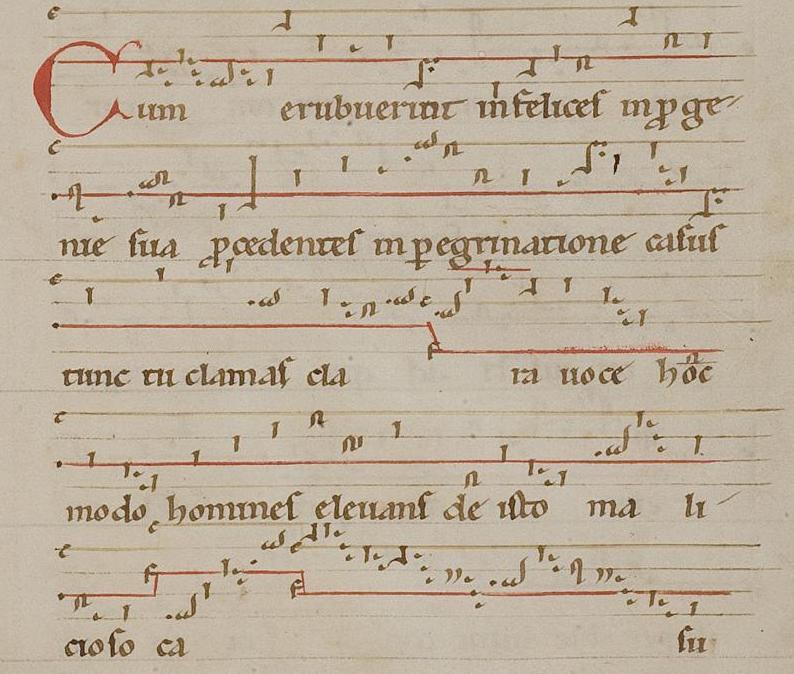
LISTEN: “Cum erubuerint infelices” (While Downcast Parents Blushed) by Hildegard of Bingen, ca. 1175 | Performed by La Reverdie on Sponsa Regis: La victoire de la Vierge dans l’œuvre d’Hildegard, 2003
Cum erubuerint infelices
in progenie sua,
procedentes in peregrinatione casus,
tunc tu clamas clara voce,
hoc modo homines elevans
de isto malicioso
casu.
While downcast parents blushed,
ashamed to see their offspring
wand’ring off into the fallen exile’s pilgrimage,
you cried aloud with crystal voice,
to lift up humankind
from that malicious
fall.

Trans. Nathaniel M. Campbell [source]
The Benedictine abbess Hildegard of Bingen (1098–1179) was a visionary theologian, poet, composer, singer, artist, gardener, and physician. She wrote on scientific and medical subjects in addition to theology, which she conveyed not only through prose but also through poetry, music, dramas, and illuminations. She was quite the medieval polymath!
I first learned about Hildegard in a Western music history survey course in college, in a unit centered on her Ordo Virtutum (Play of the Virtues). I couldn’t believe I had never heard about this amazing sister in the faith before. In 2012 she was formally canonized by the Roman Catholic Church—a long time coming!—and Pope Benedict XVI even named her a “doctor of the church,” a title given to saints who have made a significant contribution to theology or doctrine.
The corpus of surviving musical compositions by Hildegard is larger than that of any other medieval composer. More than half of these are antiphons, short free verses sung before and after each set of psalms during monastic prayer.
“Cum erubuerint” is one such antiphon. Hildegard would have sung it with her sisters at her monastery on the Rupertsberg and later the abbey at Eibingen as part of the Divine Office.
The song addresses the Virgin Mary, whose yes to Gabriel set into motion the Incarnation and thus humanity’s deliverance from spiritual exile.
As are many of Hildegard’s compositions, “Cum erubuerint” is highly melismatic—that is, it features long melodic phrases sung to one syllable. For example, I counted thirteen notes on the first syllable, “Cum”! The highest pitch occurs on clara (“clear”), referring to the definitive quality of Mary’s consent, bright and luminous, to this new thing that God is doing. An agent of God’s grace, Mary speaks a word that cuts through the mists of confusion through which we’ve been wandering, lost, uplifting us from the fall (casu), whose depths are underscored by that word’s being pitched the lowest. In her fiat, Mary is essentially saying, “Let there be light.”
Symphonia armonie celestium revelationum (Symphony of the Harmony of Celestial Revelations) is the title Hildegard gave to her collection of musical compositions, which are preserved in two manuscripts:
Dendermonde (D), Belgium, Sint-Pieters-en-Paulusabdij, Cod. 9 (ca. 1175). This one is considered by scholars to be the more authoritative. It was prepared under Hildegard’s supervision as a gift for the monks of Villers and contains fifty-seven songs.
Riesenkodex (R), Wiesbaden, Hessische Landesbibliothek, Hs. 2 (ca. 1180–85). This revised and enlarged edition, which includes seventy-five songs, was produced at the Rupertsberg scriptorium not long after Hildegard’s death.
Hildegard’s creations, compared with a contemporary hymn by Abelard or a sequence by Adam of St. Victor, will sound either primitive or unnervingly avant-garde. In a sense they are both. As a Benedictine, she was acquainted with a large repertoire of chant, but she lacked formal training and made no attempt to imitate the mainstream poetic and musical achievements of her day. Various scholars have hypothesized that she was influenced by German folksong, yet her compositions lack the two essential traits of a popular tune: it must be easy to remember and easy to sing. The difficult music of the Symphonia is sui generis. In [Sr. Maria Immaculata] Ritscher’s words, it is ‘gregorianizing but not Gregorian’ and impossible to classify in terms of any known contemporary movement. (27–28)
And regarding Hildegard’s lyrical texts:
Until the advent of modern vers libre, scholars were reluctant even to dignify Hildegard’s songs with the title of poetry. In style they are much closer to Kunstprosa, a highly wrought figurative language that resembles poetry in its density and musicality, yet with no semblance of meter or regular form. (32–33)
The above performance of “Cum erubuerint” is by La Reverdie, a medieval and Renaissance vocal ensemble that started in 1986 with two pairs of sisters from Italy.
But in addition, here are a few instrumental versions I particularly like:
>> Tina Chancey of the early music ensemble Hesperus plays the melody on kemenche, a bowed instrument from the Black Sea region of Turkey:
The song also appears, under the title “From This Wicked Fall,” on the Billboard-topping Vision: The Music of Hildegard Von Bingen (1994), a classical-electronic crossover album of seventeen of Hildegard’s works arranged by Richard Souther. In Souther’s version, nonlexical vocables (sung by soprano Emily Van Evera and mezzo-soprano Sister Germaine Fritz, OSB) replace the Latin text.
William-Adolphe Bouguereau (French, 1825–1905), The First Mourning, 1888. Oil on canvas, 79 9/10 × 98 2/5 in. (203 × 250 cm). Museo Nacional de Bellas Artes, Buenos Aires.
“After the Fig Leaves, Eve Cuts Her Hair”
So when they bury Abel, there is no veil
between her grief and her love. And there he stands,
so like his father, his cities yet unbuilt.
His father cuts open earth with bare hands,
leaving plough and shovel, the sharp edges
and the heavy handles, apart in furrowed field.
She calls each animal he resembles: mole, badger, fox.
He named them, once, and now she names him:
father unfathered, sonless, one son less. The sun hangs
round and clear, apple-red, above the dark tree line.
Once, when Cain was the only child in the world,
their fields withered and arrows flew fruitless.
Dull-eyed by the empty fire, beside the windless cedars,
he wailed at the dry breast. Much later,
after thunder dumbed the stars,
they faced the barren, muddied vale together. Adam said,
God made paradise, and we made this—
this is all we have to give him. He struck his staff
upon the seedless ground. Cain made two tiny fists.
Abel she cannot unsee as a splintered spear
of red lightning, reduced to kindling
on the perfumed grass, the churned earth
weeping red mud. Loss escapes her in a hiss
of distant fear: this time, the choice
for death has been made for her,
despite that it was life she’d sent into the world.
Her voiceless throat swells tight, dry as scales.
Her hair is short and stiff and gray. The world is young.
There will yet be other sons, and daughters more;
the seed of man must multiply. But this grief is older
than she knows, its gaze fixed far ahead
on what, someday, must be done. The wind’s voice
keens a long lament, a parent loss,
the form of sons’ deaths yet to come.
“After the Fig Leaves, Eve Cuts Her Hair” by LeighAnna Schesser was originally published in Presence: A Journal of Catholic Poetry 2018 and is used here by permission of the author. The poem will appear in Schesser’s first full-length poetry collection, Struck Dumb with Singing, to be published by Lambing Press in May 2020.
+++
LeighAnna Schesser’s poem “After the Fig Leaves, Eve Cuts Her Hair” explores parental grief following the death of a child—in particular, that of our primordial parents, Adam and Eve, who mourn the loss of their second-born son, Abel. Genesis 4:1–16 recounts how Abel was murdered by his older brother, Cain, in a fit of jealousy. This is the first human death in the Bible, and it was the direct result of sin.
The poem starts with the title, which flows with unbroken syntax into the first line: “After the fig leaves, Eve cuts her hair so when they bury Abel, there is no veil between her grief and her love.” The cutting of hair in response to death in the immediate family is a ritual practiced by women in many Native American tribes and Aboriginal people groups, where the act of severing, and the subsequent absence of, a cherished part of your self serves as a stark physical reminder of your loss. Similarly, after 9/11, many non-Native women in the US cut their hair as a sign of shock and sadness at the immense loss of life; one woman said, “I felt so different internally, I wanted something to express it externally.” Schesser imagines Eve taking part in some form of this ancient mourning ritual, wanting to leave her crying face exposed.
This is “after the fig leaves,” euphemistic shorthand for that landmark event earlier in her life in which she stole fruit from an off-limits tree and then, feeling shame for the first time, went to cover her nakedness with the first available foliage. The title/opening line, between that prepositional phrase and the first clause, skips over quite a long period of time—from the Genesis account, it sounds like at least two decades passed between Adam and Eve’s expulsion from Eden and the murder of Abel. But these two events are life-defining for Eve, so the chronology is collapsed.
“And there he stands / [. . .] his cities yet unbuilt.” The “he” here refers to Cain, who, after being confronted by God, went into exile “east of Eden,” to the land of Nod (Gen. 4:17). In his later life he built up the world’s first city, Enoch.
Like the burrowing species of animals he named, Adam digs into the earth with his bare hands—elemental. For this, the making of his son’s grave, he leaves aside plow and shovel as a sort of penance: he wants to feel directly the hard dirt, his body’s full labor and sweat, the effects of the curse he brought upon the world, which he feels implicates him in his son’s death. As he digs, the sun hangs above him “round and clear, apple-red,” a taunting reminder of his former trespass.
In the third stanza the speaker goes back to the time that’s elided in the poem’s opening, back to when Adam and Eve left God’s teeming garden and entered a dead world. They struggled to secure food for themselves. Eve gave birth to a baby boy, but soon her breast milk dried up. It was then that they resolved to get down to business and fight for a life in this inhospitable land. Even baby Cain expressed defiance against the odds with little fists as Adam broke new ground.
Snapping back to the present, Eve observes Abel’s limp body, bloody and broken and reddening the earth. “The churned earth / weep[s] red mud”—an arresting poetic image to match God’s in Genesis 4:11: “The ground . . . has opened its mouth to receive your brother’s blood from your hand,” he tells Cain. We are taken back again to the Fall through more figurative language, this time evoking the snake: fear “hiss[es]” in the distance; Eve’s throat is “dry as scales.” Eve, God’s child, chose death in the Garden, and now her child, the one to whom she gave life, has chosen death too. She now has a taste of the horror, disappointment, and sadness God must have felt.
“Though the world is young,” the poem continues, “this grief is older / than she knows.” Older, even, than God’s grief at the Fall. For another son, God’s “only begotten” (John 3:16), was destined to die millennia later—“the Lamb slain from the foundation of the world” (Rev. 13:8). In his foreknowledge God saw this death and mourned it immensely. His is the oldest grief.
+++
William-Adolphe Bouguereau’s painting The First Mourning shows the lifeless body of Abel sprawled out over Adam’s lap, and he and Eve ridden with grief. Adam clutches his broken heart, and Eve buries her face in her hands, sobbing uncontrollably. The only color in the bleak landscape is from the puddle of blood on the ground. In the background, smoke rises from an altar, mixing with the storm clouds in the sky; this is the remnant of Abel’s offering going up to God, the cause of Cain’s resentment that led him to commit murder.
By the time Bouguereau painted this scene in 1888, three of his five children had died of illness. (A fourth child of his would also die within his lifetime—twelve years later, at age thirty-two.) He knew the sorrow that accompanies such a traumatic event as seeing your kids leave this world before you do.
The iconography he uses is closely related to that of the Pietà, an image type that shows a grieving Virgin Mary holding her dead son, Jesus, on her lap following his crucifixion. The connection is intentional, as death—which Abel was the first person to experience—will ultimately be undone by the death and resurrection of Jesus. The writer of Hebrews says that “the sprinkled blood [of Jesus] speaks a better word than the blood of Abel” (Heb. 12:24), because Christ’s blood is redemptive, bringing us back to the Garden that we lost through sin.
Call to artists: I’d love to see you interpret Schesser’s poem visually: Eve shorn inside and out (her hair “short and stiff and gray”), wearing her grief openly; Adam animalistic, digging a grave by hand; Cain looking on; and the wind bearing their lament forward to the cross. If you pursue this suggestion, do let me know!
+++
LeighAnna Schesser is a Catholic writer and a homeschooling mom of four from Kansas, whose forthcoming book of poetry, Struck Dumb with Singing (out in May), “meditates on family, devotion, divine mysteries, and their rootedness in place.” Visit Schesser at her website, https://acanticleforhomestead.com/, where you will find, among other things, links to some of her other published poems and articles.
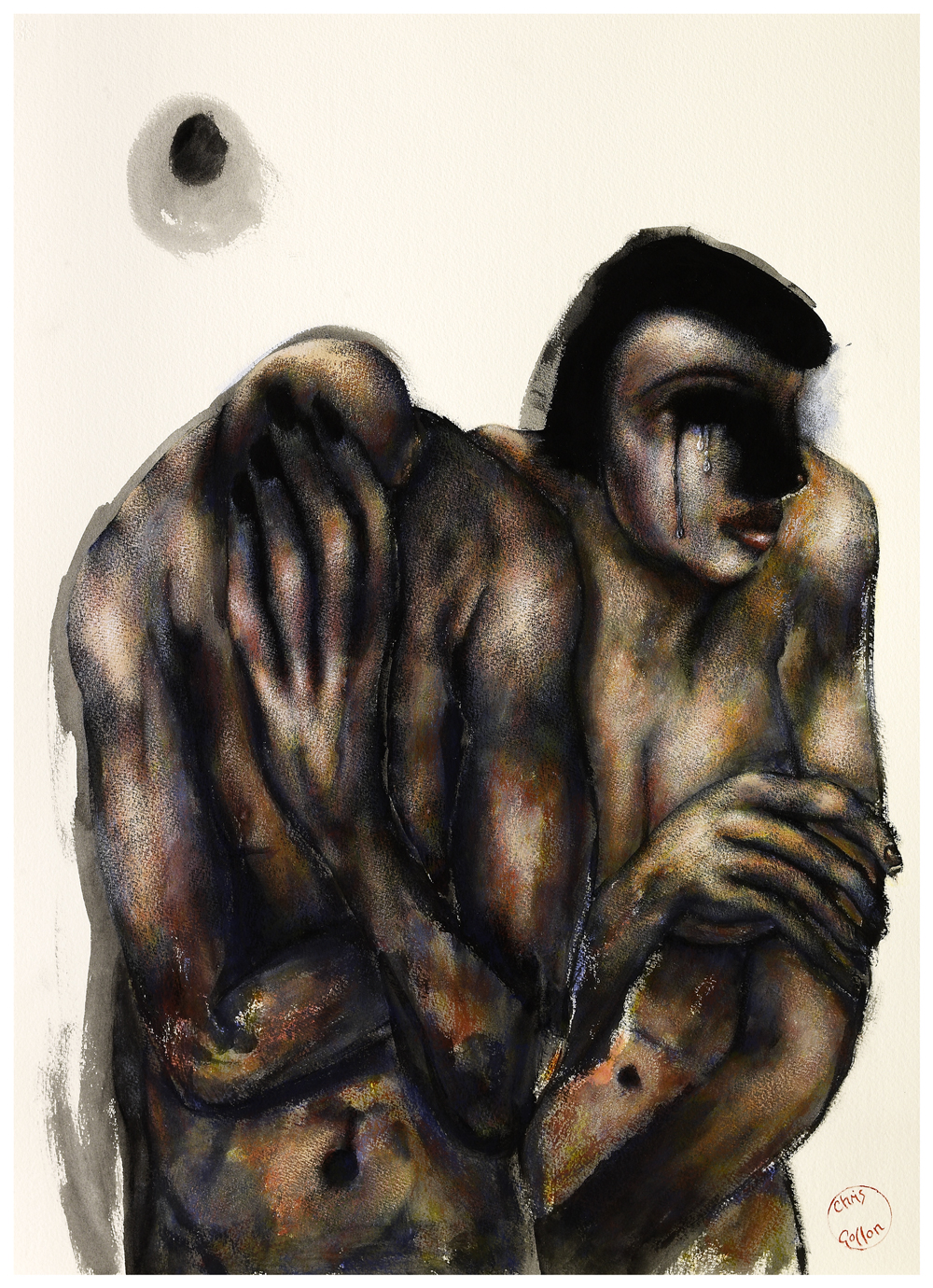
Chris Gollon (British, 1953–2017), Expulsion from Paradise, 2013. Acrylic on paper, 30 × 22 in. (76 × 56 cm).
So when the woman saw that the tree was good for food, and that it was a delight to the eyes, and that the tree was to be desired to make one wise, she took of its fruit and ate, and she also gave some to her husband who was with her, and he ate. Then the eyes of both were opened . . .
The fall, the fall, oh God, the fall of man
The fruit is found in every eye and every hand
Nothing, there is nothing yet, in truest form
We walk like ghosts upon the earth; the ground, it groans
How long, how long will you wait?
How long, how long till you save us all, save us all?
Turn your face to me, turn your face to me
Turn your face to me, turn your face to me
The light, the light, the morning light is gone
And all that’s left is fragile breath and failing lungs
The night, the night, the guiding night has come
Uniting lover with his bride, more precious than the dawn
How long, how long must we wait?
Turn your face to me, turn your face to me
Turn your face to me, turn your face to me
Because of the music behind “Turn your face to me”—soft and smooth, consonant, calm not frantic like the rest—I read this refrain as being spoken by God. The humans lament their fall, asking how long they must wait for salvation, and God gently responds: it’s available now, just turn your face to me.
The idea of “ghosts upon the earth” is inspired by C. S. Lewis’s allegorical novel The Great Divorce, in which a group of travelers from a “grey town” are taken by bus to heaven, a land that proves to be far more solid, more real, than even the travelers’ own bodies. “Sometimes it seems like the most real thing is what we can see and experience with our senses around us—this life, the tangible,” Michael Gungor said. “Ideas like love, like God, these things sometimes feel more disconnected and ethereal, like that’s the ghostly realm. But what if that’s wrong and God and love is actually what is most real, and we are more like ghosts walking upon the earth, hoping to become more real?”
To watch a live performance of Gungor’s “The Fall” from 2012, click here.
This post belongs to the weekly series Artful Devotion. If you can’t view the music player in your email or RSS reader, try opening the post in your browser.
To view all the Revised Common Lectionary scripture readings for the First Sunday of Lent, cycle A, click here.



 Art & Theology