Advent, Day 7: Behold!

A voice cries:
“In the wilderness prepare the way of the LORD;
    make straight in the desert a highway for our God.
Every valley shall be lifted up,
    and every mountain and hill be made low;
the uneven ground shall become level,
    and the rough places a plain.
And the glory of the LORD shall be revealed,
    and all flesh shall see it together,
    for the mouth of the LORD has spoken.”

—Isaiah 40:3–5

LOOK: Caiphas Nxumalo (South African, 1940–2002), John the Baptist, 1970. Linocut. Source: Christliche Kunst in Afrika, p. 278.

Nxumalo, Caiphas_John the Baptist

Caiphas Nxumalo was a printmaker and wood sculptor who studied at the Rorke’s Drift Art School from around 1968 to 1971 (sources vary on the precise years). He was associated with the African-initiated amaNazaretha Church in South Africa.

In this linoleum cut Nxumalo shows John the Baptist, the forerunner of Jesus, preaching repentance (bottom; Matt. 3:1–3), baptizing (Matt. 3:5–6), and eating wild honey (Matt. 3:4). The eye of God, which sees secret sins, burns bright and glorious. I’m not sure whether the people at the bottom are running away from John’s message of wrath or “turning around” from their wickedness to follow the true way. In Matthew’s account there are people from both categories of response.

The triangular frame rising from the base line was a common compositional device Nxumalo used to tell multiple components of a story, and in this context it’s especially appropriate, as it seems to me to allude to the valleys being lifted and the mountains being brought down low—a leveling of the landscape so that God’s glory can be plainly seen from any vantage point. (On another level, this Isaianic prophecy probably also refers to the proud being overthrown and the humble being exalted, as Mary sings about in her Magnificat.)

Advent is about the coming consummation of the kingdom of God in the day of the Lord. In Advent: The Once and Future Coming of Jesus Christ, Fleming Rutledge, who calls on the church to restore Advent’s focus on apocalyptic theology, describes John the Baptist as the central figure of Advent. She half-jokes that behind one of those cute little Advent calendar windows should be a coarse, fiery John shouting, “You brood of vipers!” (Matt. 3:7). “Irreducibly strange, gaunt and unruly, lonely and refractory, utterly out of sync with his age or our age or any age,” John the Baptist “arrives announcing the opening event of the end-time” (277, 13). As prophesied by Malachi at the end of the Old Testament and confirmed by Jesus in Matthew 11, “John the Baptist is the new Elijah, standing at the edge of the universe, at the dawn of a new world, the turn of the ages. That is his location as the sentinel, the premier personage of this incomparable Advent season—the season of the coming of the once and future Messiah” (277).

Like John, the church, Rutledge says, is also located on the frontier of the new age, between Jesus’s first and second advents, and we, too, are called to herald the Messiah, announcing, “Repent! For the kingdom of God is at hand.”

[Related posts: “Prepare the Way (Artful Devotion)”; “Turn and Live (Artful Devotion)”; “John the Baptist at the National Gallery, London”]

In those days John the Baptist came preaching in the wilderness of Judea, “Repent, for the kingdom of heaven is at hand.” For this is he who was spoken of by the prophet Isaiah when he said,

“The voice of one crying in the wilderness:
‘Prepare the way of the Lord;
    make his paths straight.’”

Now John wore a garment of camel’s hair and a leather belt around his waist, and his food was locusts and wild honey. Then Jerusalem and all Judea and all the region about the Jordan were going out to him, and they were baptized by him in the river Jordan, confessing their sins.

But when he saw many of the Pharisees and Sadducees coming to his baptism, he said to them, “You brood of vipers! Who warned you to flee from the wrath to come? Bear fruit in keeping with repentance. And do not presume to say to yourselves, ‘We have Abraham as our father,’ for I tell you, God is able from these stones to raise up children for Abraham. Even now the axe is laid to the root of the trees. Every tree therefore that does not bear good fruit is cut down and thrown into the fire.

“I baptize you with water for repentance, but he who is coming after me is mightier than I, whose sandals I am not worthy to carry. He will baptize you with the Holy Spirit and fire. His winnowing fork is in his hand, and he will clear his threshing floor and gather his wheat into the barn, but the chaff he will burn with unquenchable fire.”

—Matthew 3:1–12

LISTEN: “His Kingdom Now Is Come (Behold! Behold!)” by Paul Zach, Isaac Wardell, Leslie Jordan, Lorenzo Baylor, and Brian Nhira, on Justice Songs by the Porter’s Gate (2020) | CCLI #7158500

In my review of Justice Songs (and its companion album, Lament Songs), I wrote,

Justice Songs opens with a rousing call-and-response song, “His Kingdom Now Is Come (Behold! Behold!),” that combines material from the mystical prologue of John’s Gospel with an Isaianic prophecy commonly read during Advent [Isaiah 40:3–5]. . . . Verse 4, syncopated with hand claps, lists divine epithets like “God of justice” (Isa. 30:18). “Father of the fatherless” (Ps. 68:5), “Prince of Peace” (Isa. 9:6). “He’s troubling the water, and we’re marching through”—an oblique reference to the African American spiritual “Wade in the Water,” about the liberation of the Israelites through the miraculously parted Red Sea, the paradigmatic “day of the Lord.”

The refrain, “Behold!,” is a word used hundreds of times throughout scripture, and it means “to fix the eyes upon; to see with attention; to observe with care.” Jesus says in Luke 7:21, “Behold, the kingdom of God is in the midst of you.” May we behold with humility and excitement the age to come and respond with fruits of repentance.

Here’s a socially distanced performance of “His Kingdom Now Is Come” by the musicians of Whitworth Campus Worship for the Center for Congregational Song’s Election Day 2020 broadcast.

(Update, 12/9/20: Watch the Porter’s Gate perform this song in the studio on this Instagram video.)

This post marks the end of the first week of Advent. For many more Advent songs, see “Advent: An Art & Theology Playlist” on Spotify.

Advent, Day 6: Coming

LOOK: Elena Markova (Russian, 1967–), Christmas Dreams, ca. 2010. Acrylic on canvas, 27 9/16 × 35 3/8 in.

Markova, Elena_Christmas Dreams

Born in Kargopol, Russia, and now living in Oregon in the western US, artist Elena Markova is inspired by the spiritual traditions of her homeland and its vibrant folk art. Her lyrical paintings reflect her love of folk tales, myths, religious narrative, and the magic of the natural world.

LISTEN: “Advent Moon” | Words by Angier Brock and music by Cecilia McDowall, 2013 | Performed by the Choir of King’s College London and organist Michael Butterfield, on Advent Carols from King’s College London, 2019

I prefer the King’s College performance above, but you’ll need a Spotify account to listen. For an Oxford Choir performance from 2014, see SoundCloud:

Let the coming of the One
who arranges Orion and the Pleiades
begin in darkness.
Let the night be cold, with drifts of snow.
Let there be one lily blooming,
and whispered messages, and kneeling.

The fierce earth spins in expectation
beneath the long night’s moon, Advent moon.
Like the restless fox crossing frosted meadows,
the silvered owl in focused, silent flight,
each of us is hungry.
In rooms of untold longing,
we sing our seasoned carols,
watch, and wait.

Let the coming of the One
who kindles fires of hope,
whose faithfulness runs far beyond our sight,
be like the coming of a child.
Let there be milk, forgiveness, quiet arms.
Come quickly, Love, our dearest deep
and sweetest dawning.
Come, fill us with your light.

This choral anthem was a collaboration between lyricist and composer, commissioned by Bruton Parish Episcopal Church in Williamsburg, Virginia, where Angier Brock lives. (Cecilia McDowall lives in London.) It premiered at the church on December 1, 2013, sung by the Choirs of Bruton Parish. I’m blown away by the beauty of Brock’s text. The Creator of the constellations, descended from heaven to dwell with us—light in our darkness, food for our hunger, warmth in the cold. Reminds me a bit of Rowan Williams’s poem “Advent Calendar.” I will definitely be returning to this one each Advent!


For each day of the first week of Advent I am publishing one art-and-song pairing as an invitation for seasonal reflection.

Advent, Day 5: Peace

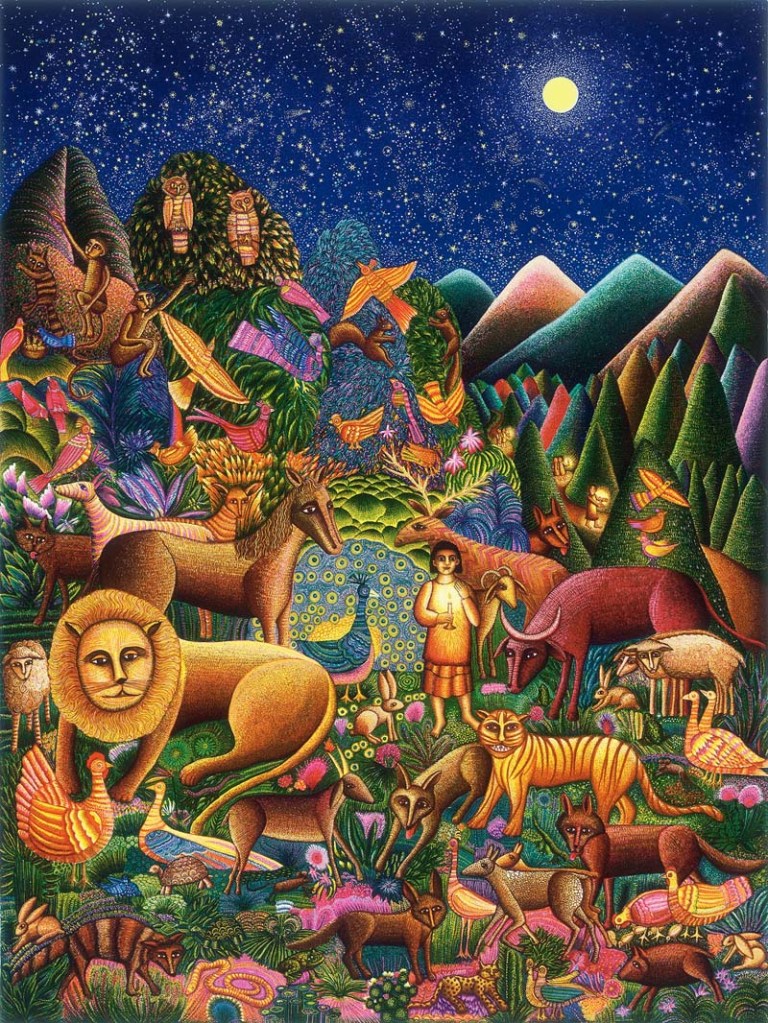
LOOK: John August Swanson (American, 1938–), Peaceable Kingdom, 1994. Serigraph, edition of 250, 30 × 22 1/2 in.

Swanson, John August_Peaceable Kingdom

John August Swanson, a Los Angeles–based artist of Mexican and Swedish heritage, says his style is “influenced by the imagery of Islamic and medieval miniatures, Russian iconography, the color of Latin American folk art, and the tradition of Mexican muralists.” In this forty-seven-color serigraph (limited-edition screen print), monkeys, frogs and lizards, mice and rabbits, owls and peacocks, a pig and a turtle accompany the wolves, lambs, leopard, goat, lion, ox, and snake of Isaiah 11, a vision of creation restored and at peace.

LISTEN: “O Day of Peace” | Words by Carl P. Daw Jr., 1982 | Music by Josh Garrels, on The Light Came Down, 2016

O day of peace that dimly shines
Through all our hopes and prayers and dreams
Guide us to justice, truth, and love
Delivered from our selfish schemes

May swords of hate fall from our hands
Our hearts from envy find release
Till by God’s grace our warring world
Shall see Christ’s promised reign of peace

Then shall the wolf dwell with the lamb
Nor shall the fierce devour the small
As beast and cattle calmly graze
A little Child shall lead them home

Then the meek shall learn to love
All creatures find their true accord
The hope of peace shall be fulfilled
For all the earth shall know the Lord

(Related post: “The Peaceable Kingdoms of Edward Hicks”)


For each day of the first week of Advent I am publishing one art-and-song pairing as an invitation for seasonal reflection.

Advent, Day 4: Waiting

LOOK: Grant Wright Christian (American, 1911–1989), Waiting for the Mail (mural study, Post Office in Nappanee, Indiana), 1937. Oil on canvas, 7 7/8 × 20 7/8 in. (20 × 53 cm). Smithsonian American Art Museum, Washington, DC.

Waiting for the Mail by Grant Wright Christian

LISTEN: “Every Valley (It’s Hard to Wait)” by Flo Paris Oakes, on Waiting Songs by Rain for Roots (2015)

When you write a letter to a friend
And you don’t when
You’ll hear back again
Well, it’s hard to wait
It’s hard to wait
So hard to wait

When the one you love
Leaves on a plane
And you know that she’ll
Come back someday
It’s hard to wait
It’s hard to wait
So hard to wait

There is gonna be a day
Every low valley He will raise
There is gonna be a day
Hills and mountains gonna be made plain
There is gonna be a day
Winding roads gonna be made straight
Comfort, comfort, comfort, comfort
It’s hard to wait
So hard to wait

When you plant a seed
In the garden bed
But you don’t see green
Growing up just yet
Oh, it’s hard to wait
It’s hard to wait
Comfort, comfort, comfort, comfort
It’s hard to wait
So hard to wait
There’s gonna be a day
But it’s hard to wait

Rain for Roots is a collective of musicians and songwriters who create scripture songs for kids and their grown-ups. Its core members are Sandra McCracken, Flo Paris Oakes, Katy Hutson Bowser, and Alice Smith. This December Rain for Roots is booking virtual, thirty-minute Advent singalongs with two or more of these ladies, to be hosted by churches, schools, and other groups. For more information, visit https://rainforroots.com/advent-singalong.


For each day of the first week of Advent I am publishing one art-and-song pairing as an invitation for seasonal reflection.

Advent, Day 3: Womb

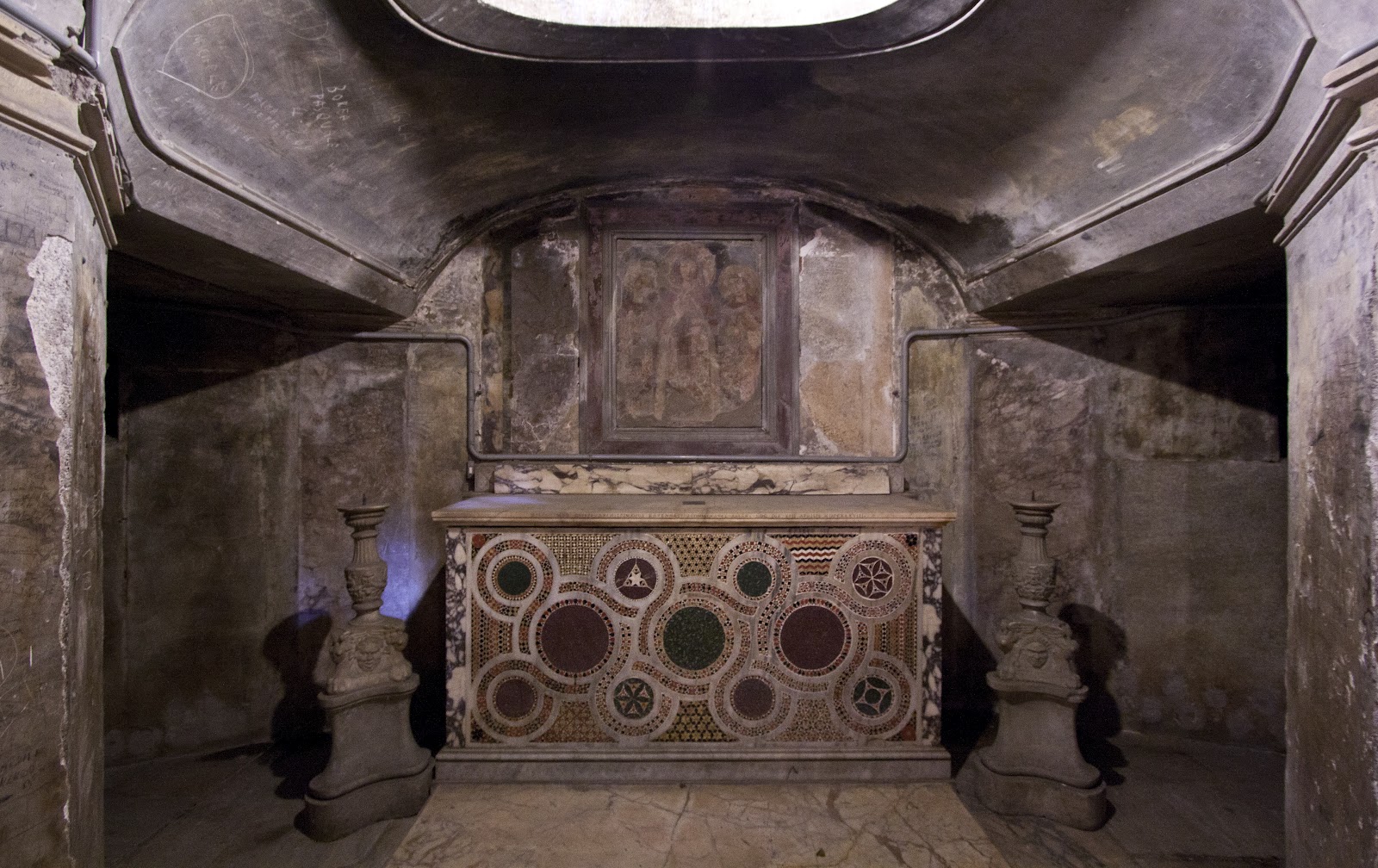
LOOK: Pregnant Madonna, 9th century, fresco, crypt of Santa Prassede, Rome

The Madonna del Parto (Our Lady of Parturition) is an iconic depiction of the Virgin Mary as pregnant, usually pointing to or cradling her belly, where God is being made flesh. The ninth-century fresco in the crypt of Santa Prassede in Rome is the earliest known depiction of a visibly pregnant Mary. I believe she is flanked by saints Praxedes (Italian Prassede) and Pudentiana (Italian Pudenziana), sisters and martyrs, since the painting is from a chamber that contains their relics. In the most famous Madonna del Parto image, however—by Piero della Francesca, ca. 1457—Mary is attended by two angels.

LISTEN: “In the Virgin’s Womb” by Kaitlyn Ferry | Performed by Sister Sinjin (Kaitlyn Ferry, Elizabeth Duffy, and Elise Erikson Barrett), on Incarnation (2016, re-released 2019)

In the Virgin’s womb He lay;
God made flesh, the mortal babe.
In her body she has held
That which heav’n cannot contain.

In the Virgin’s womb He lay;
Born to die, His flesh a grave.
In her arms she has held
He whom death could not hold down.


For each day of the first week of Advent I am publishing one art-and-song pairing as an invitation for seasonal reflection.

Advent, Day 2: Fire

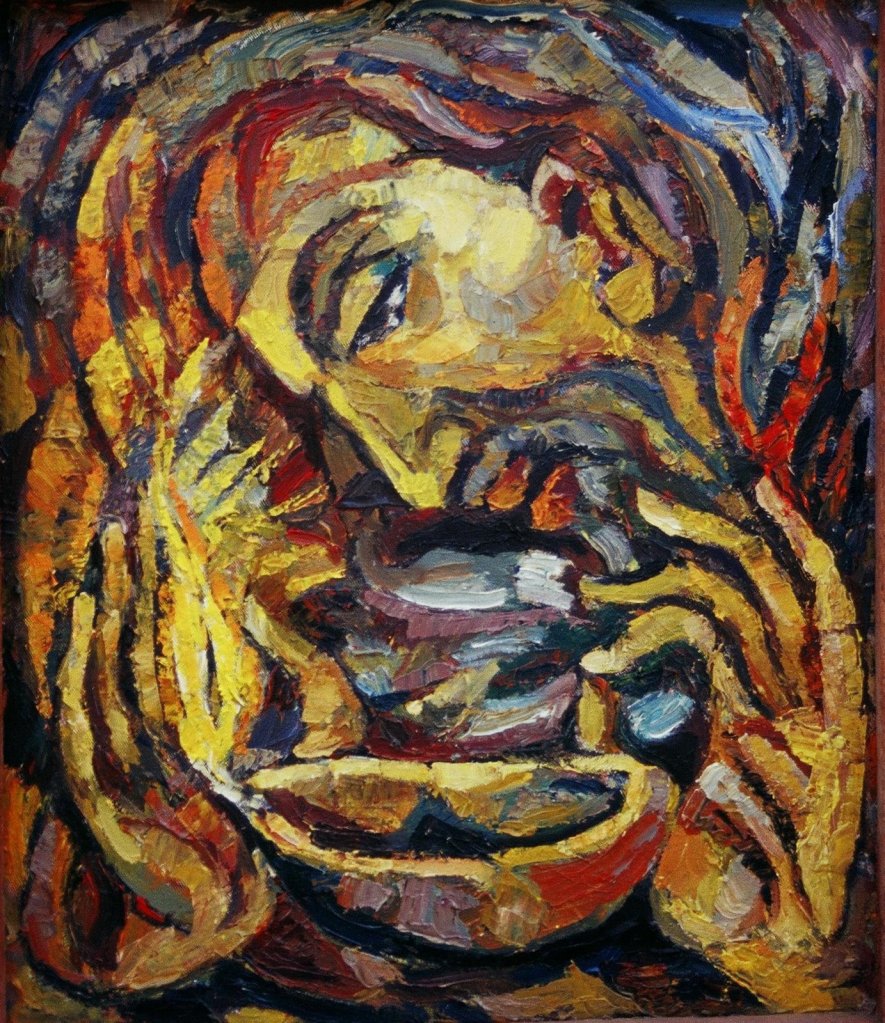
LOOK: Jyoti Sahi (Indian, 1944–), Jesus Offering the Light (Arathi), 2004. Oil on canvas. Private collection, California, USA. For commentary by the artist, visit his blog.

Sahi, Jyoti_Jesus Offering the Light

LISTEN: “Within Our Darkest Night” by Jacques Berthier (Taizé community), 1991 [sheet music]

Within our darkest night
You kindle the fire that never dies away
That never dies away

Update, 1/12/21: I just came across the following quote in an Advent devotional (which arrived on order from my library after Advent!), and I instantly thought of this blog post.

Light comes pretty inexpensively and maybe even too conveniently to us. With batteries in flashlights and the cool-to-the-touch fluorescent glow of chemical lights, Christ might well say to us anew: “You are the fire of the world.” Fire is heat and combustion—fuel actively being consumed and transformed into energy. “Fire!” is a cry for attention, and a warning for anyone who is unprepared. That must be what Our Lord had in mind when he said, “You are the light of the world.” We have grown accustomed to Advent being a season of light, but let’s agree to make this Advent a season of fire. Be consumed by the energy that dwells and is growing within. Let it burn in you. Let God use fire to purify the cosmos through you and make ready the Way of the Lord.

—Thomas Hoffman, A Child in Winter: Advent, Christmas, and Epiphany with Caryll Houselander, p. 61


For each day of the first week of Advent I am publishing one art-and-song pairing as an invitation for seasonal reflection.

Advent, Day 1: Wonder

For each day of the first week of Advent I will publish one art-and-song pairing as an invitation for seasonal reflection.

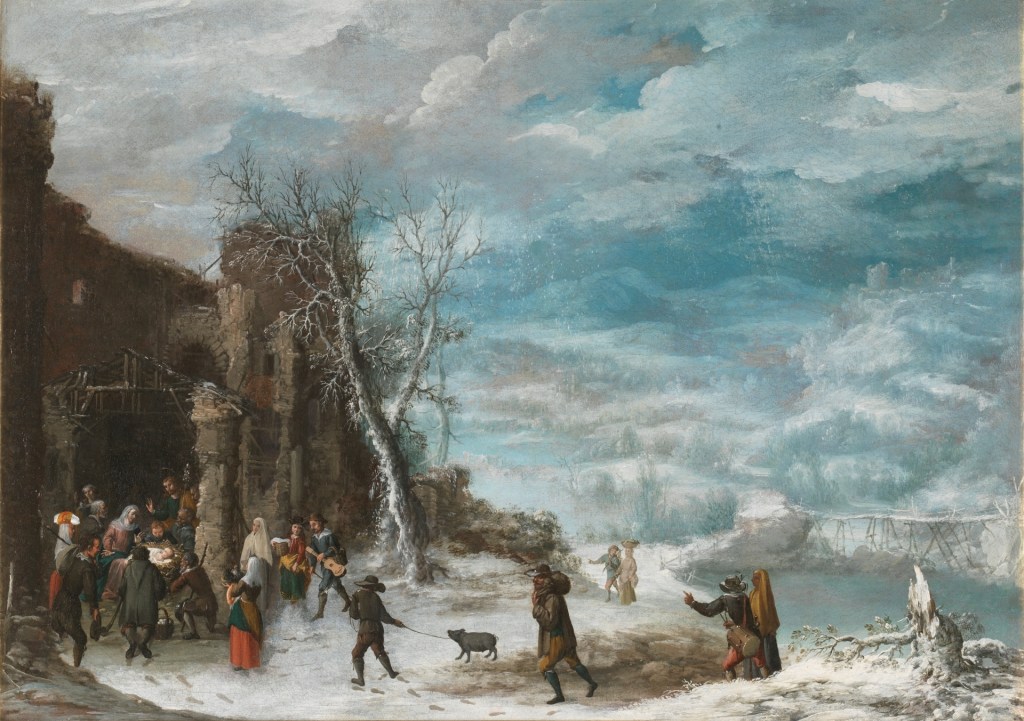
LOOK: Francisco Collantes (Spanish, 1599–1656), Winter Landscape with the Adoration of the Shepherds, 1630–50. Oil on canvas, 72.2 × 105.7 cm. Museo del Prado, Madrid. (Click on image to zoom in.)

Collantes, Francisco_Winter Landscape with the Adoration of the Shepherds

LISTEN: “Wonder (Advent)” | Words by Pedro de la Cruz | Music by Colleen Nixon | Performed by Marian Grace (Colleen Nixon and Jimmy Mitchell), on In the Bleak Midwinter, 2013

O blessed Mary and dearest Joseph
Allow me to journey with you
To Bethlehem
I am a lowly pilgrim making my way
To the center of history
The birth of Christ the Lord
With unspeakable awe and expectant wonder
I long to behold
I long to behold
I long to behold
The promised Messiah
Time will stand still forever
Divided by the entry
Of the Creator into his creation