
Advent, Day 2: From the Ruins

Every warrior’s boot used in battle
    and every garment rolled in blood
will be destined for burning,
    will be fuel for the fire.
For to us a child is born,
    to us a son is given,
    and the government will be on his shoulders.
And he will be called
    Wonderful Counselor, Mighty God,
    Everlasting Father, Prince of Peace.

—Isaiah 9:5–6 NIV

LOOK: Nativity by Irenaeus Yurchuk
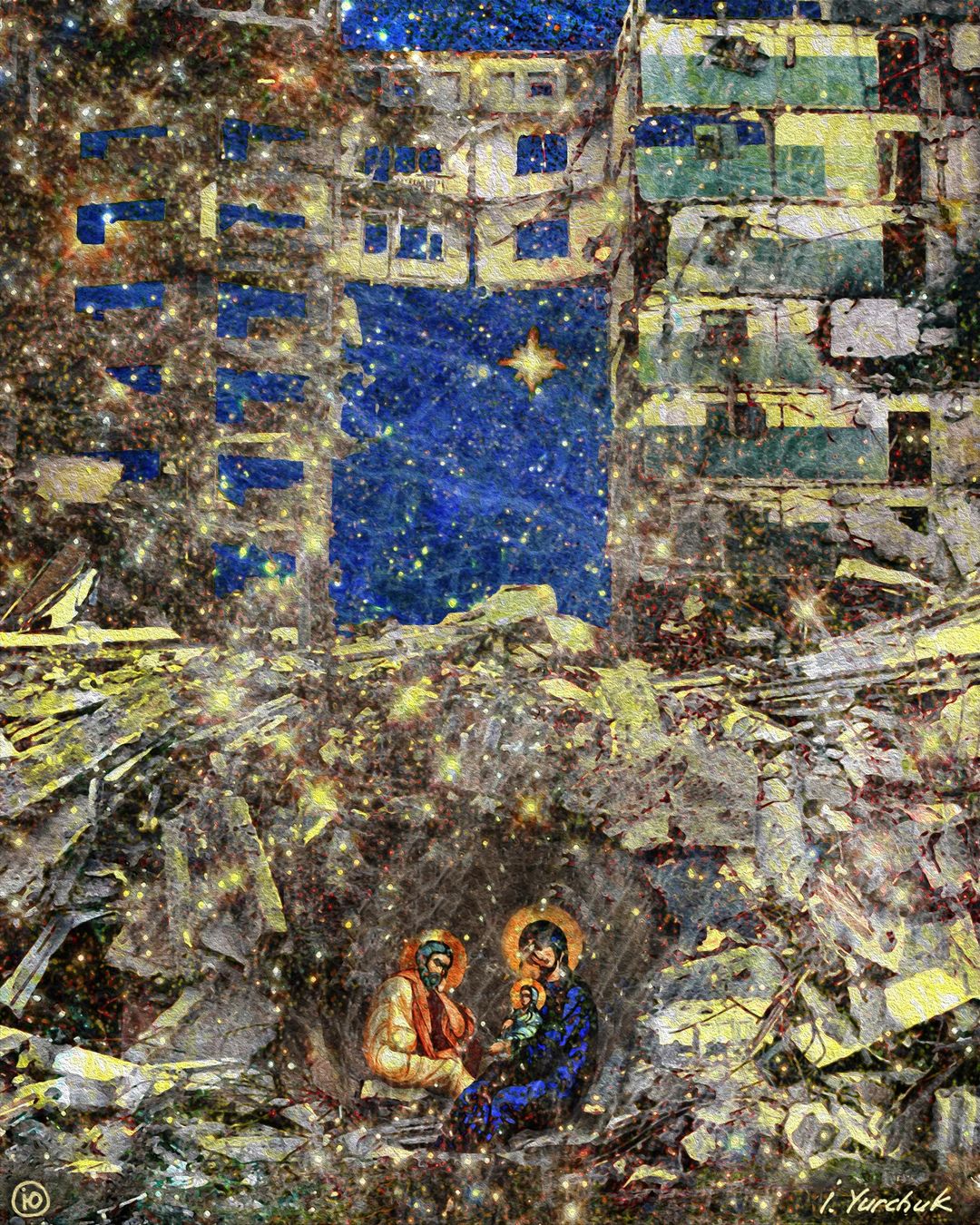
Yurchuk, Irenaeus_Nativity
Irenaeus Yurchuk (Іриней Юрчук), Nativity, 2022. Mixed media on canvas. Used with permission.

Irenaeus Yurchuk was born in Ukraine during World War II and raised in central New York, where he still resides. He worked professionally as an urban planner until 2010, when he turned to art full-time.

“Over the years my work has evolved to combine multiple-image photography with drawing and painting, using a variety of digital editing and physical montage techniques,” Yurchuk says. “This includes adjusting inkjet images by applying acrylics, watercolors, pastels, markers, colored pencils together with selected collage materials to achieve a desired effect.”

Yurchuk’s Nativity is a response to Russia’s 2022 military invasion of Ukraine. This is no facile depiction of that historic birth, no cozy winter idyll. It is a war-zone Nativity. It shows the Holy Family, rendered in iconic style, sheltering at night in the rubble of a bombed-out apartment complex. Surrounded by fallen steel beams, concrete, and broken glass, Mother Mary holds the newborn Jesus while a downcast Joseph sits beside them with head in hands. Though their circumstances are dire, through the building’s shell shines one particularly bright star, signifying hope in the horror.

One of the biblical names for Jesus is Emmanuel, Hebrew for “God with us.” By showing the Christ child being born amid the ruins of a contemporary Ukrainian city, Yurchuk reinforces the ongoing relevance of the Incarnation, meditating on God’s descent into our world of woe to dwell with and to deliver. Jesus is “God with us” in our suffering. When everything around us is crumbling, God is there too, hurting alongside and calling all oppressors to account.

Do you recall the famous Christmas text from Isaiah, further immortalized by Handel, that begins “Unto us a child is born . . .”? Well, it is immediately preceded by a prophecy of war’s final demise, of soldiers’ uniforms and accoutrements and all their bloody violence being consigned to one great big burning trash heap. In the new world government established by Christ, the Prince of Peace, tyrants will be overthrown (Luke 1:51–52), and the nations will study war no more (Isa. 2:4). 

May this artwork and the song below prompt you to intercede for those suffering under war today, in Ukraine and elsewhere.

LISTEN: “Drive Out the Darkness” by Paul Zach, Isaac Wardell, Dan Marotta, and John Swinton, on Lament Songs by the Porter’s Gate (2020)

Refrain:
Come, O come
Be our light
Drive out the darkness
Come, Jesus, come

Every year under the thorn
Every wrong that we have known
Every valley will be raised
Ancient ruins will be remade [Refrain]

Every weapon made for war
Every gun and every sword
Will be melted in the flame
To be used for gardening [Refrain]

In the emptiness of grief
Through the night of suffering
In the loss and in the tears
God of comfort, O be near [Refrain]

Coda:
Come, and end all the violence
Come, do not be silent
Come, we cling to your promise
Come, you’ll break all injustice
Come, Jesus, come

For my review of the Lament Songs album by the Porter’s Gate, see here.

In addition to these words that the Porter’s Gate has given us to pray, I commend to you this prayer by Rev. Kenneth Tanner, which he posted October 13 in response to recent atrocities in Israel and Gaza (I’ve been returning to it a lot over the past month):


This post is part of a daily Advent series from December 2 to 24, 2023 (with Christmas to follow through January 6, 2024). View all the posts here, and the accompanying Spotify playlist here.
Advent, Day 1: Rend the Heavens!

O that you would tear open the heavens and come down!

—Isaiah 64:1a

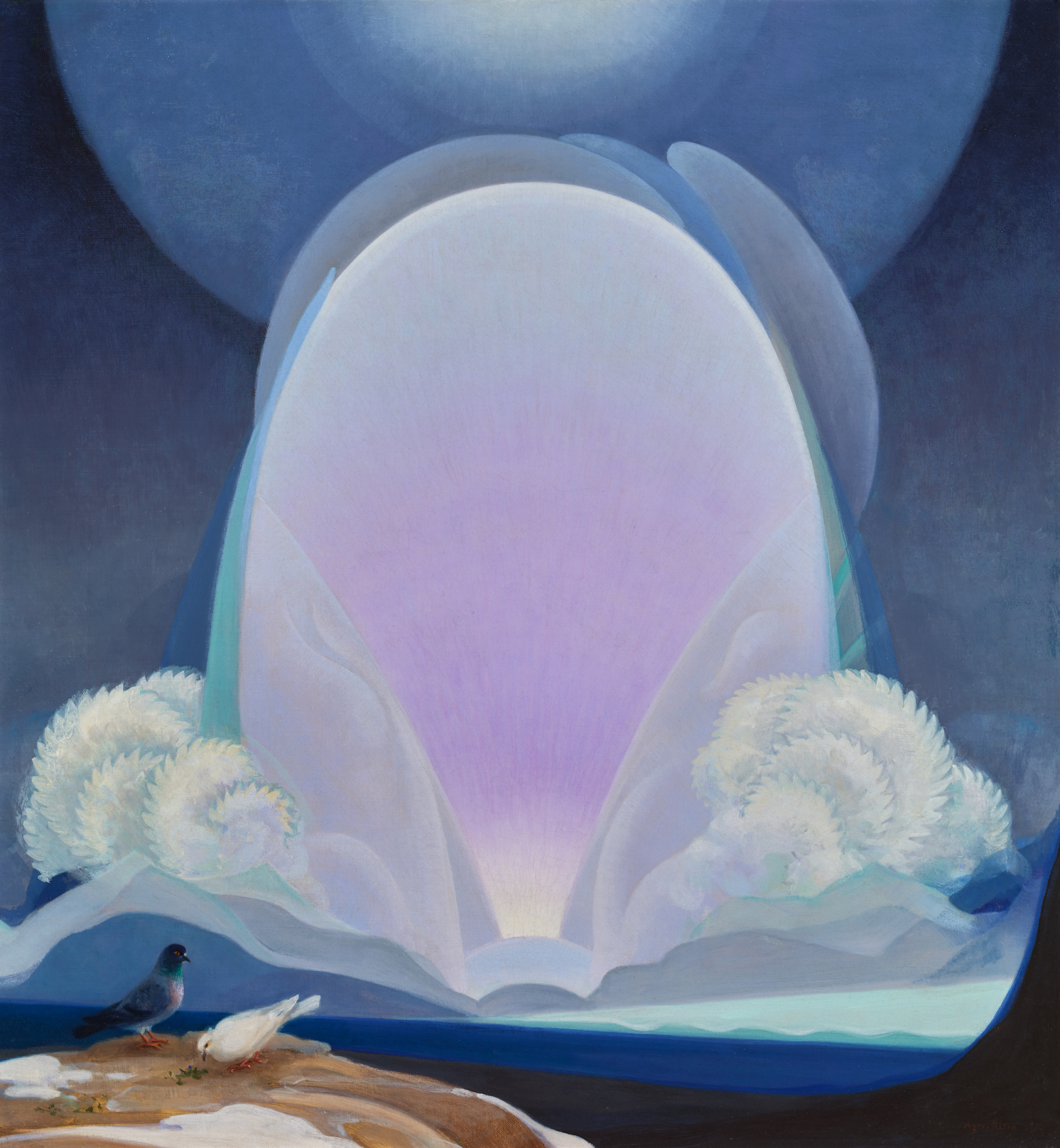
LOOK: Winter by Agnes Pelton

Pelton, Agnes_Winter
Agnes Pelton (American, 1881–1961), Winter, 1933. Oil on canvas, 30 × 28 in. Crocker Art Museum, Sacramento, California.

Agnes Pelton was part of the Transcendental Painting Group, an artists’ collective founded in the American Southwest in 1938 on the principles of creating a pure abstract painting style imbued with spiritual intent. Clayton Schuster, writing for Hyperallergic, describes one of Pelton’s metaphysical landscapes:

Pelton’s Winter (1933) depicts a pigeon and dove on a cliff in the foreground, with a great blooming cloud in the distance. The arched lavender cloud against the dark sky seems to suggest the narrow path toward a new beginning, as a pale glow at the top of the painting symbolizes hidden truths. Within the cloud are delicate lines hinting at two hills. The cloud seems to glow where the hills nearly meet and delineate the valley. It is as if Pelton has excavated a road from the cloud and revealed the path to paradise.

Pelton shows us a new way opening. The sky has been rent, and light breaks in. To either side of the central bulbous form are tooth-edged wheels in motion. At the bottom left, the snow is melting at the emerging warmth, revealing tiny green shoots on the ground. The two doves perhaps signify a coming peace.

Full of mystical yearning, this painting shouts “Advent!” to me. It evokes in my mind not only the Isaianic exclamation cited above—the basis for today’s featured song (below)—but several other Advent scriptures as well, such as Isaiah 40:3–5 (pave a straight path for God through the desert; every hill, every valley . . .), Psalm 98:8–9 (“let the hills sing together for joy at the presence of the Lord, for he is coming . . .”), and Revelation 1:7 (“Look! He is coming with the clouds”; cf. Matthew 24:30: “they will see ‘the Son of Man coming on the clouds of heaven’ with power and great glory”).

Pelton was not a Christian—she rejected organized religion—but her artworks are so wonderfully expansive in the associations and interpretations they invite.

For more on the artist, see the wonderful book Agnes Pelton: Desert Transcendentalist, a catalog of a recent major retrospective of her work organized by the Phoenix Art Museum.

LISTEN: “O Savior, Rend the Heavens Wide” (original title: “O Heiland, reiß die Himmel auf”) | Original German words by Friedrich Spee, 1622; translated into English by Martin L. Seltz, 1965, ©1969 Concordia Publishing House | Tune: O HEILAND, REISS DIE HIMMEL AUF, from Gesangbuch, Augsburg, 1666 | Performed by Koiné on Anno Domini, 2009 [sheet music]

O Savior, rend the heavens wide;
Come down, come down with mighty stride;
Unlock the gates, the doors break down;
Unbar the way to heaven’s crown.

O Morning Star, O radiant Dawn,
When will we sing your morning song?
Come, Son of God! Without your light
We grope in dread and gloom of night.

Sin’s dreadful doom upon us lies;
Grim death looms fierce before our eyes.
O come, lead us with mighty hand
From exile to our promised land.

There shall we all our praises bring
And sing to you, our Savior King;
There shall we laud you and adore
Forever and forevermore.

The German hymn text “O Heiland, reiß die Himmel auf” (O Savior, Rend the Heavens Wide) is by Friedrich Spee (1591–1635), a German Jesuit priest, professor, and poet best known for opposing the European witch trials and the use of torture. Written during the Thirty Years’ War, it was first published in Würzburg in 1622 in the collection Das Allerschönste Kind in der Welt (The Most Beautiful Child in the World).

Four-plus decades later, in 1666, a Dorian-mode melody was published anonymously with the text in the Rheinfelsisches Deutsches Katholisches Gesangbuch (German Catholic Hymnal). Then in 1863, Johannes Brahms arranged that melody as a motet for unaccompanied mixed choir (op. 74, no. 2):

The hymn entered English-speaking churches in the twentieth century when Martin L. Seltz (1909–1967) translated it.

The original chorale tune is still in use, but I’ve also heard some churches using the 2003 retune by Nathan Partain. Here’s a live recording of that version from Trinity Church Seattle, sung by Partain, back when he was the church’s music director (it was called Green Lake Presbyterian Church at the time):

The hymn also appears, with updated arrangement, on Partain’s 2019 album The Beauty to Come. The chord charts, lead sheets, and string scores for this album and two others can be downloaded for free from Partain’s website.


This post is part of a daily Advent series from December 2 to 24, 2023 (with Christmas to follow through January 6, 2024). View all the posts here, and the accompanying Spotify playlist here.

Advent Prelude: Guide Us

LOOK: Milky Way by Frida Hansen

Hansen, Frida_Milky Way
Frida Hansen (Norwegian, 1844–1931), Melkeveien (Milky Way), 1898. Tapestry, 260 × 345 cm. Museum für Kunst und Gewerbe (Museum of Arts and Crafts), Hamburg, Germany.

This art nouveau tapestry by Norwegian artist Frida Hansen received a gold medal at the world’s fair in Paris in 1900. It shows angelic figures unfolding a starry veil over the night sky. They glide forward above a band of Hebrew script that references the creation of the stars in Genesis 1.

The God who brought light in darkness in the beginning is bringing light again as we enter a new liturgical year.

Comprising the first five weeks of that new year, Advent-Christmas-Epiphany is a time of starlight, promise, and revelation. The first of the triad, Advent, is particularly concerned with themes of longing, waiting, lament, and future-oriented hope. We make ready our hearts to receive Christ—he who came to us first as a babe in a manger, in a vulnerable body like ours, to teach and suffer and redeem, and who is coming back one day in unveiled power and majesty to bring the fullness of God’s heavenly kingdom to earth.

Two millennia ago, God hung a special star in the sky for the magi to follow, guiding them on their way to the Christ child. May God similarly illumine our way to Christ as we seek him this season, giving us eyes to see and ears to hear the gospel of God-with-us and cultivating in us an eager readiness for Christ’s return.

I think of Hansen’s crowned young ladies as ushering us into the deep, dark blue of Advent to behold the signs that sparkle in scripture, foretelling a wondrous future.

For an excellent illustrated article about Hansen’s life and work, see “Frida Hansen: A leading star in European textile art” by Anne Sommerin Simonnæs.

LISTEN: “Star of Wonder” by Sara Groves, on O Holy Night, 2008; adapted and arranged from the refrain of “We Three Kings” by John Henry Hopkins, 1857

Star of wonder, star of light
Star of royal beauty bright
Guide us
O guide us
Won’t you guide us


Want to follow along with the music on Spotify? Most of the songs in this Advent blog series, and many more besides, can be found on the Art & Theology Advent Playlist.