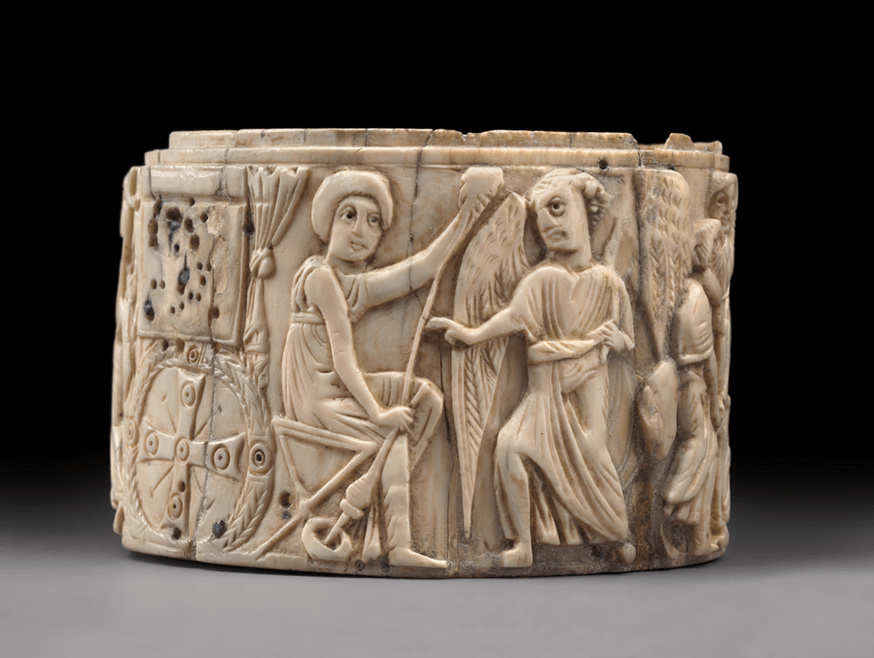
Pyxis with the Annunciation, Byzantine Empire (Minden?), 5th or 6th century. Ivory, height 7.9 cm, diameter 11.8 cm. Museum für Byzantinische Kunst, Bode-Museum, Staatliche Museen zu Berlin. [object record]
According to the Protoevangelium of James, an apocryphal infancy gospel from the second century, the Virgin Mary was raised in the Jerusalem temple from age three and was tasked with weaving the purple and scarlet thread of the veil that shrouded the holy of holies, the temple’s innermost sanctuary. One day while taking a break from this sacred labor to collect water from a well, the angel Gabriel approached her with a greeting: “Hail, favored one. The Lord is with you.” She looked around and saw no one, so she returned to her work indoors.
As she was engaged in her spinning, Gabriel reappeared and delivered the message he had been sent with: that Mary was chosen to bear the Son of God.
This account of the Annunciation gained special traction in the East, where the Virgin Annunciate is almost always shown with a spindle of scarlet thread in her hand, or less frequently, standing at a well—unlike in Western depictions, where she is typically shown holding a book.
The Byzantine art object pictured above is an ivory-carved pyxis (pl. pyxides), a cylindrical container used to store small items, such as jewelry or cosmetics. The Annunciation is one of three scenes represented, the other two being the Journey to Bethlehem and the Nativity (including Salome with her withered hand; see Prot. 19–20). The square to Mary’s left is where the lock case was originally mounted.
In the early fifth century, the prominent Byzantine theologian Proclus of Constantinople (ca. 390–446) developed Mary’s weaving into an extended theological metaphor of the Incarnation. He preached on Mary’s womb as a “workshop” containing the “awesome loom of the divine economy” on which the flesh of God was woven together, providing the bodiless divinity with form and texture. [1] “In the workshop of Mary’s womb, the vertical warp thread of divinity was bound to a weft of virgin flesh,” writes Fr. Maximos Constas (b. 1961), paraphrasing Proclus. [2]
Jesus’s flesh is a kind of clothing—the same we wear—made during Mary’s nine months of pregnancy:
The one who redeemed us was not a mere man. May this never be! But neither was he God denuded of humanity, for he had a body. And if he had not clothed himself with me, he could not have saved me, but in the womb of a virgin the one who pronounced the sentence against Adam clothed himself with me, who stood condemned, and there in her womb was transacted that awesome exchange, for taking my flesh, he gave me his spirit. [3]
Notes:
Nicholas Constas, “The Purple Thread and the Veil of Flesh: Symbols of Weaving in the Sermons of Proclus,” chap. 6 of Proclus of Constantinople and the Cult of the Virgin in Late Antiquity (Leiden and Boston: Brill, 2003), 317. The quotations are from Proclus’s Homily 1.I.21–25.
Constas, 357.
Proclus of Constantinople, Homily 1.VIII.122–27, qtd. Constas, 354.
I’m spinning the scarlet and purple—woman’s work But God is spinning the gold, I see Weaving a tiny thread like me Into the grand design to be The saving of the world
Chosen as the roving fiber—clean and combed Then dropped and spun and quickly wound Upon the spindle tightly bound To serve the One I’m wound around: The Savior of the world
Refrain: Son of the Most High, let it be, let it be Son of God, let it be, let it be to me
In the hands of the Master, I marvel at his ways He brings me into his weaving room My heart is stretched upon the loom The God-man knitted within my womb The Savior of the world [Refrain]
Bridge: First to hear, first to hear and believe First to love, first to love and receive The Son of God
Will they believe me? I wonder, who can say? But I will always answer yes Though a sword may pierce my breast The Father of my son knows best The Savior of the world [Refrain]
In “The Virgin, Spinning,” singer-songwriter Katy Wehr takes the weaving metaphor in a different direction than Proclus. Voiced by Mary, the song reflects on how God is weaving a grand tapestry of salvation, in which Mary is a thread.
Laura Lasworth (American, 1954–), Lily Among the Thistles, 2001. Oil on wood panel. From the Love’s Lyric series, based on the Song of Songs.
This still-life painting by Seattle-based artist Laura Lasworth shows a beautiful cut lily sharing a vase with a bouquet of twelve thorny, withered stems. The water in which they sit is red. The work’s title is taken from the Song of Songs 2:1–2: in Latin, “Ego flos campi, et lilium convallium. Sicut lilium inter spinas, sic amica mea inter filias,” or from the New Revised Standard Version:
I am a rose of Sharon, a lily of the valleys.
As a lily among brambles, so is my love among maidens.
While the Song of Songs, written in the wisdom tradition of Solomon, is first and foremost a collection of poems exploring the human experience of love and sexual desire, most Christians also interpret it as an allegory of the love between Christ and his church, or God and the individual soul. In that reading, Christ is the “lily of the valley” who speaks here.
Early Christian writers such as Origen, Hippolytus, Ambrose, Jerome, and Augustine associated the lily of Song of Songs 2:1 with Christ; in the Middle Ages, Venantius Fortunatus (ca. 530–610), Peter Damian (1007–1072), and Bernard of Clairvaux (1090–1153), among others, followed suit. I’m familiar with this floral metaphor for Jesus from a gospel song I grew up singing!
From the fourteenth century onward, in images of the Annunciation, Western artists commonly portrayed either a lily vase on a table, or the angel Gabriel presenting a lily to Mary. The lily became a symbol both Christological and Mariological, signifying the flowering of the Incarnation: God’s pure Son emerging from the virginal stem of Mary.
On December 10, Jonathan A. Anderson, a professor of theology and the arts at Regent College in Vancouver, gave the homily in chapel, using Luke 1:26–38 as his scripture text and exploring Lasworth’s Lily Among the Thistles in relation to it.
Thorns and thistles are an image of cursedness throughout scripture, starting in Genesis 3:17–18, Anderson points out. But in Lasworth’s painting, a lily rises up from the center of that cursedness. “If the thistles visually articulate the groaning of creation and the sorrows of humanity, the lily symbolically inaugurates a newness of life, somehow flowering right in the midst of this,” Anderson says. “The audacious proclamation of Advent is that the Son of God—the Creator and Healer of all things, our tree of life—was born into the brambles of human history and into the bloody heritages that still cry out daily from the ground.”
Anderson considers the polyvalence of Lily Among the Thistles:
In one sense, this is an icon of Christ’s appearance in human history. In another sense, this vase is also an individual heart—my heart, your heart—that has heard the Annunciation for itself amidst its own sorrows and deathliness. . . . Or we might also see this as an icon of creation, simultaneously groaning for the reconciliation of all things and blooming with new creation. And surely, it is an icon of the church, in which we harbor various fertility altars overgrown with thorns and thistles, and yet in which we are a people of the incarnation, people in whom new creation has begun, people through whom the light of the Spirit is already casting the shadows of the redemption of all things.
1. There sprang a Flower from out a thorn, To save mankind that was forlorn, As prophets spake before that morn: Deo Patri sit Gloria!
2. There sprang a well at Maid Mary’s foot, That turned all this world to good, Of her took Jesu flesh and blood: Deo Patri sit Gloria!
. . .
4. From diverse lands three kings were brought, For each one thought a wondrous thought, A King to find and thank they sought: Deo Patri sit Gloria!
5. Richly laden with gifts they fare, Myrrh, frankincense, and gold they bear, As clerks in sequence still declare: Deo Patri sit Gloria!
. . .
9. There shone a star in heaven bright, That the men of earth might read aright That this Child was Jesu, King of Might: Deo Patri sit Gloria!
This song is a choral setting by London-based composer Dominic Veall of a late medieval lyric that begins, “Ther ys a blossum sprong of a thorn”—or, as Jessie L. Weston modernizes it, “There sprang a Flower from out a thorn.” The recording omits stanzas 3, 6, 7, and 8, but you can read the full lyrics here. The Latin refrain translates to “Glory be to God the Father!”
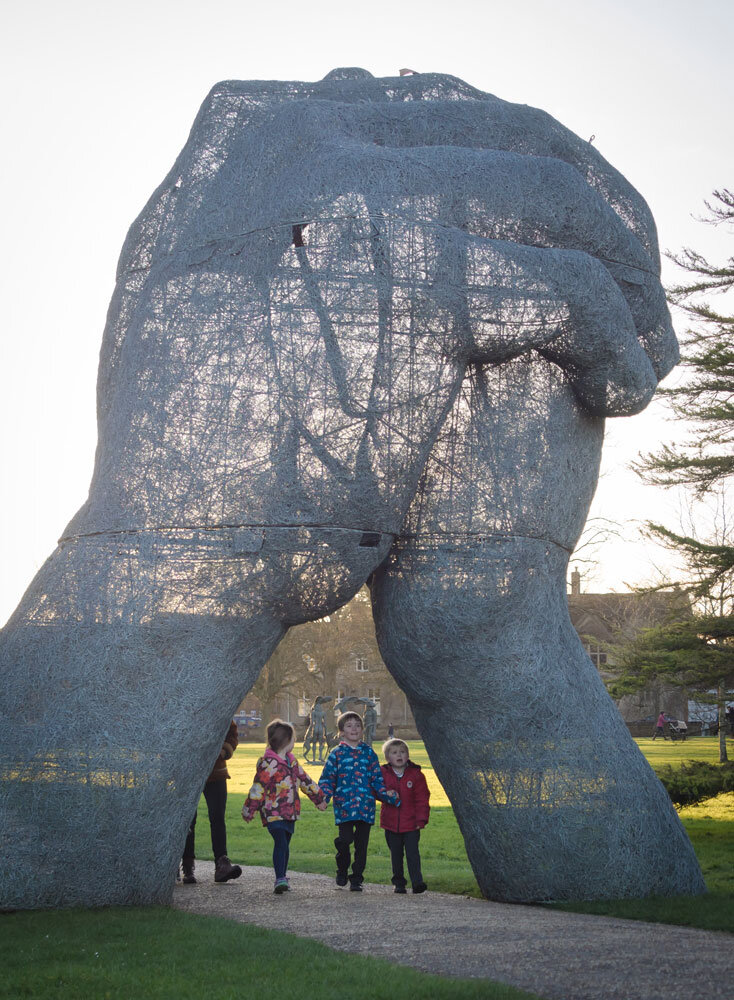
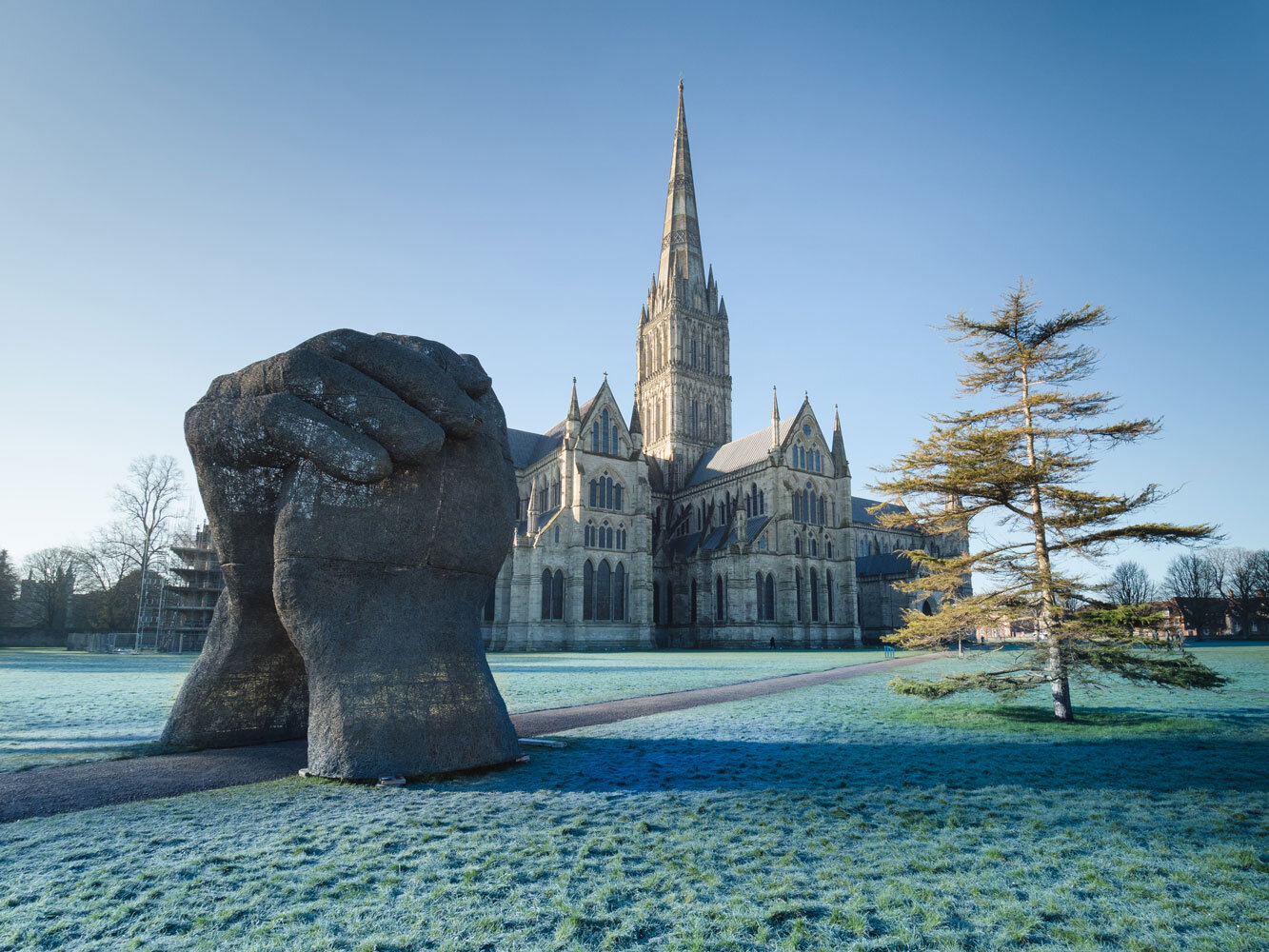
Sophie Ryder (British, 1963–), The Kiss, 2016. Galvanized steel wire, 579 × 590 × 380 cm. From the 2016 exhibition Sophie Ryder: Relationships at Salisbury Cathedral, England. Photo: Ash Mills.
A monumental wire sculpture of two hands “clasped in love, friendship or prayer,” The Kiss by Sophie Ryder was one of over twenty sculptures by the artist on display from February 12 to July 3, 2016, in the close and cloister of Salisbury Cathedral. It straddled the path from the High Street Gate to the West Door for the first week but was then moved to the North Lawn after too many oblivious texters bumped their heads on it (despite the six feet, four inches of clearance in the center).
Sophie Ryder: Relationships was curated by Jacquiline Creswell, who specializes in siting contemporary art in sacred spaces.
>> Traditional Welsh tune (AR HYD Y NOS) | Performed by Crystal Muro, Brenna Boncosky, and Ian Murrell with organist Phillip Kloeckner, First United Methodist Church at Chicago Temple, 2020
>> Music by Benjamin Brody, 2009 | Performed by musicians of First Congregational Church of Houston, 2020
View the present through the promise, Christ will come again. Trust despite the deepening darkness, Christ will come again. Lift the world above its grieving through your watching and believing in the hope past hope’s conceiving: Christ will come again.
Probe the present with the promise, Christ will come again. Let your daily actions witness, Christ will come again. Let your loving and your giving and your justice and forgiving be a sign to all the living: Christ will come again.
Match the present to the promise, Christ will come again. Make this hope your guiding premise, Christ will come again. Pattern all your calculating and the world you are creating to the advent you are waiting: Christ will come again.
Aaron Douglas (American, 1899–1979), The Judgment Day, 1939. Oil on tempered hardboard, 48 × 36 in. (121.9 × 91.4 cm). National Gallery of Art, Washington, DC. Photo: Victoria Emily Jones. [object record]
Born in Topeka, Kansas, in 1899, Aaron Douglas moved to New York in 1925 and became one of the leading artists of the Harlem Renaissance. He studied African art and European modernism, developing his own unique visual language that brought together influences from cubism, art deco, and African sculpture.
In his early career he worked as an illustrator for Black magazines, including The Crisis and Opportunity, and accepted a commission by the esteemed poet James Weldon Johnson to illustrate his collection God’s Trombones: Seven Negro Sermons in Verse. After the book’s publication in 1927, numerous other commissions followed, including large-scale murals. In 1944 Johnson established the art department at Fisk University in Nashville and taught there until his retirement in 1966.
The Judgment Day (1939) is based on one of Johnson’s illustrations for God’s Trombones, made to accompany a poem of the same title. It showcases his signature style of silhouetted figures and flat, hard edges.
In the painting, the archangel Gabriel stands astride earth and sea, summoning the living and the dead to judgment with a blast of his horn. He holds the key to the kingdom of heaven, which he’ll open to those who have repented of their sins and trusted in Christ. A bolt of lightning rips through the sky on the left, and on the right, a light ray shines down onto a praying figure who is ready for the great accounting.
LISTEN: “In That Great Gettin’ Up Morning,” African American spiritual | Arranged by Jester Hairston and performed by the Leonard De Paur Infantry Chorus, 1953
I’m a-gonna tell you ’bout the comin’ of the judgment (Fare thee well, fare thee well) I’m a-gonna tell you ’bout the comin’ of the judgment (Fare thee well, fare thee well) There’s a better day a-comin’ (Fare thee well, fare thee well) There’s a better day a-comin’ (Fare thee well, fare thee well)
Refrain: In that great gettin’ up morning Fare thee well, fare thee well In that great gettin’ up morning Fare thee well, fare thee well
Oh preacher, fold your Bible (Fare thee well, fare thee well) Preacher, fold your Bible (Fare thee well, fare thee well) For the last soul’s converted (Fare thee well, fare thee well) Oh, the last soul’s converted (Fare thee well, fare thee well) [Refrain]
Blow your trumpet, Gabriel (Fare thee well, fare thee well) Blow your trumpet, Gabriel (Fare thee well, fare thee well) Lord, how loud shall I blow it? (Fare thee well, fare thee well) Blow it right calm and easy (Fare thee well, fare thee well) Do not ’larm all my people (Fare thee well, fare thee well) Tell them all to come to judgment (Fare thee well, fare thee well) [Refrain]
Then you’ll see them coffins bustin’ (Fare thee well, fare thee well) Then you’ll see them corpses risin’ (Fare thee well, fare thee well) Then you’ll hear that rumblin’ thunder (Fare thee well, fare thee well) Then you’ll see that forkèd lightnin’ (Fare thee well, fare thee well) Then you’ll see the stars a-fallin’ (Fare thee well, fare thee well) Then you’ll see the world on fire (Fare thee well, fare thee well) Then he will call sinners (Fare thee well, fare thee well) Then he will call sinners (Fare thee well, fare thee well) [Refrain]
LOOK: Jesus as Bridegroom of the Soul from the Rothschild Canticles
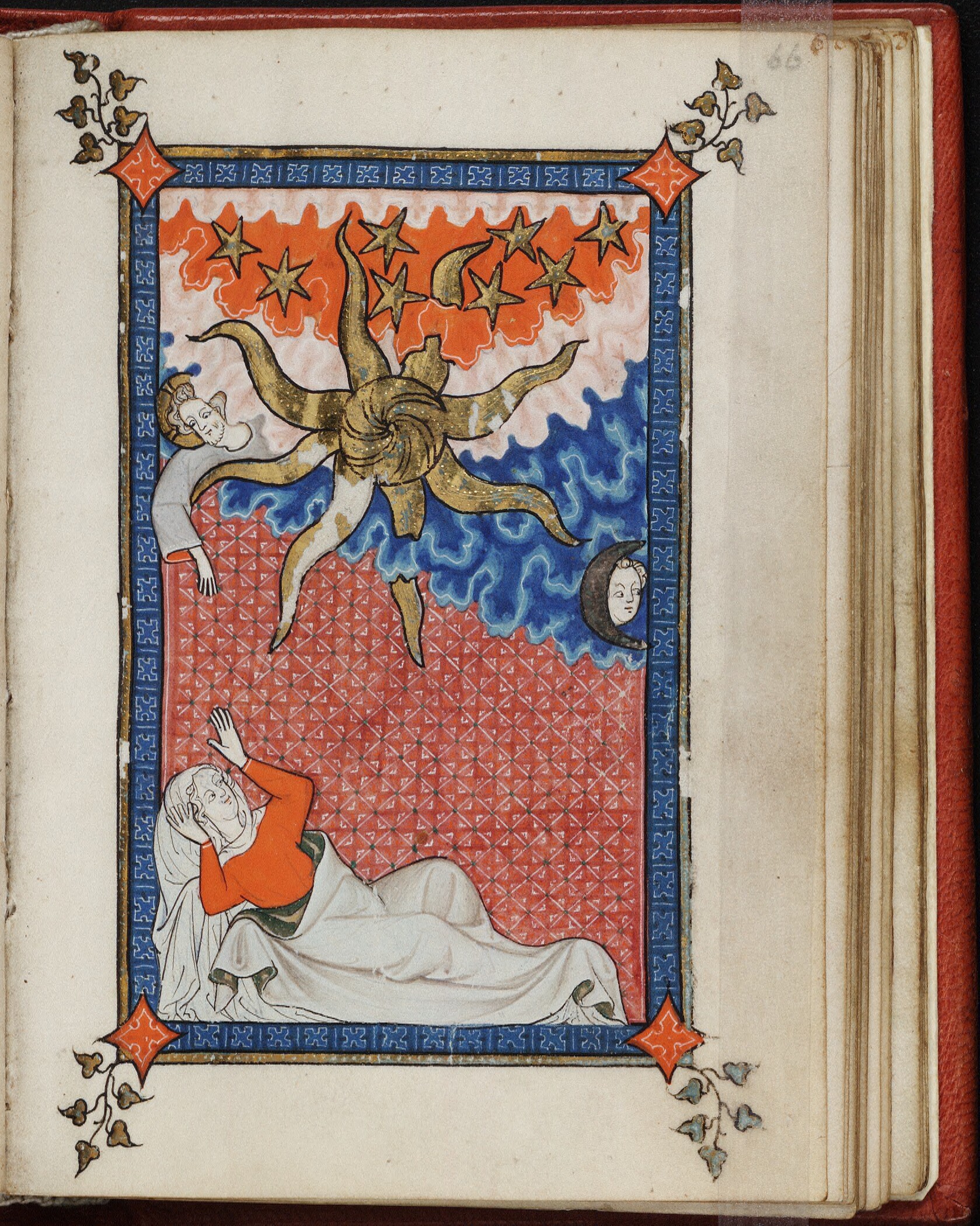
Jesus as Bridegroom of the Soul, from the Rothschild Canticles, Flanders or Rhineland, ca. 1300. Beinecke Library, Yale University, MS 404, fol. 66r.
The Rothschild Canticles from early fourteenth-century Flanders or the Rhineland (whose innovative Trinity miniatures I wrote about in 2021) is a cento of biblical, liturgical, and patristic citations accompanying an extraordinary program of images. Much of the content reflects the bridal mysticism that was popular at the time, emphasizing spiritual oneness with Christ. The compiler, artist(s), scribe(s), and original recipient of the manuscript are not known, but it was very likely made by a male monastic for a nun or canoness to use in her private devotions.
The miniature on folio 66r is the first in a five-miniature sequence (of which four survive) on the theme of mystical union. It shows the human soul, represented as a woman, about to receive her Bridegroom, Christ, in the marriage bed. Art historian Jeffrey Hamburger writes that in this image, “Christ emerges from the heavens with the energy of a cosmic explosion[,] . . . as a dramatic sunburst dissolving the mists. . . . Christ is the sun, its brightness, the light of the visio Dei. Just as sunlight generates heat, so Christ provokes desire.” [1] The artist uses that whirling sun with its tentacle-like rays as an attribute of Christ throughout the manuscript.
At her lover’s luminous descent, the Bride awakes from her sleep and raises her arms in ecstasy.
The face peeking out from behind the crescent moon on the right may be an angel, whose gaze directs us forward to the next scene, which shows the Bride reclining outdoors amid sprouting vines, “languish[ing] with love” (Song 2:5), and then being led into a wine cellar by the Bridegroom, to be inebriated by his sweet goodness (Song 2:4) .
The corresponding text on the facing page of this image, set inside a bedchamber, incorporates the following excerpts:
“I call you into my soul, which you are preparing for your reception, through the longing which you have inspired in it.”—Augustine, Confessions X.1
“God comes from Lebanon, the Holy One from the shady and thickly covered mountain.”—Habakkuk 3:3, used in medieval Advent liturgies
“I passed by you again and looked on you; you were at the age for love.”—Ezekiel 16:8
Plus miscellaneous adaptations of lines from the Song of Songs
In the Middle Ages it was common for Christian mystics, such as Mechthild of Magdeburg and Gertrude of Helfta, to describe and picture spiritual union in terms of physical union, as they “realized that bodily language better conveys the power, intensity, and personality of desire than overly spiritualized language does,” writes medievalist Grace Hamman. [2] And not only was the church, a corporate body, perceived as the bride of Christ, but so was the individual soul. The consummation of the marriage between Christ and his beloved was seen as eschatological, yes—coming at the end of time—but such intimate closeness and pleasure was also seen as something that could be enjoyed now on some level, as devotees commune with Christ through prayer, scripture reading, and the celebration of the Eucharist.
For the nun who used this book, it must have aided her in cultivating a deep love for Christ and strengthened her longing for that full and final coming together, when Christ will return to be with his bride.
LISTEN: Wachet auf, ruft uns die Stimme, BWV 140 by Johann Sebastian Bach, 1731| Words by Philipp Nicolai, 1599 (movements 1, 4, 7), and an anonymous other | Melody of movements 1, 4, and 7 by Philipp Nicolai, 1599
Here are two listening options—the first from an album, and the second a live performance that you can hear as well as watch.
>> Performed by the Monteverdi Choir and the English Baroque Soloists, dir. John Eliot Gardiner, on Bach: Cantatas BWV 140 and 147 (1992)
>> Performed by the Choir and Orchestra of the J. S. Bach Foundation, dir. Rudolf Lutz (soloists: Nuria Rial, Bernhard Berchtold, Markus Volpert), Evangelisch-Reformierte Kirche Trogen, Switzerland, 2008 (**The copyright owner has disallowed video embeds, but you can watch the video directly on YouTube by clicking the link below.)
In the libretto that follows, the capital letters in parentheses indicate which voice parts are singing that movement: soprano, alto, tenor, or bass.
1. Choral (SATB)
Wachet auf, ruft uns die Stimme,
der Wächter sehr hoch auf der Zinne,
wach auf, du Stadt Jerusalem.
Mitternacht heißt diese Stunde,
sie rufen uns mit hellem Munde,
wo seid ihr klugen Jungfrauen?
Wohlauf, der Bräut’gam kömmt,
steht auf, die Lampen nehmt,
Alleluia!
Macht euch bereit
zu der Hochzeit,
ihr müsset ihm entgegen gehn.

2. Rezitativ (T)
Er kommt, er kommt,
der Bräut’gam kommt,
ihr Töchter Zions, kommt heraus,
Sein Ausgang eilet aus der Höhe
in euer Mutter Haus.
Der Bräut’gam kommt, der einen Rehe
und jungen Hirschen gleich
auf denen Hügeln springt
und euch das Mahl der Hochzeit bringt.
Wacht auf, ermuntert euch,
den Bräut’gam zu empfangen;
dort, sehet, kommt er hergegangen.

3. Duett (SB) (Dialog - Seele, Jesus)
Wenn kömmst du, mein Heil?
 – Ich komme, dein Teil. –
Ich warte mit brennenden Öle.
Eröffne den Saal
  – Ich öffne den Saal –
zum himmlischen Mahl.
Komm, Jesu.
  – Ich komme, komm, liebliche Seele. –

4. Choral (T)
Zion hört die Wächter singen,
das Herz tut ihr vor Freuden springen,
sie wachet und steht eilend auf.
Ihr Freund kommt von Himmel prächtig,
von Gnaden stark, von Wahrheit mächtig,
ihr Licht wird hell, ihr Stern geht auf.
Nun komm, du werte Kron’,
Herr Jesu, Gottes Sohn,
Hosianna!
Wir folgen all
zum Freudensaal
und halten mit das Abendmahl.

5. Rezitativ (B)
So geh herein zu mir,
du mir erwählte Braut!
Ich habe mich mit dir
von Ewigkeit vertraut.
Dich will ich auf mein Herz,
auf meinen Arm gleich wie ein Sigel setzen,
und dein betrübtes Aug’ ergötzen.
Vergiß, o Seele, nun
die Angst, den Schmerz,
den du erdulden müssen;
auf meiner Linken sollst du ruhn,
und meine Rechte soll dich küssen.

6. Duett (SB) (Dialog - Seele, Jesus)
Mein Freund ist mein,
  – und ich bin dein, –
die Liebe soll nichts scheiden.
Ich will mit dir
  – du sollst mit mir –
im Himmels Rosen weiden,
da Freude die Fülle, da Wonne wird sein.

7. Choral (SATB)
Gloria sei dir gesungen,
mit Menschen- und englischen Zungen,
mit Harfen und mit Zimbeln schon.
Von zwölf Perlen sind die Pforten,
an deiner Stadt sind wir Konsorten
der Engel hoch um deine Thron.
Kein Aug’ hat je gespürt,
kein Ohr hat je gehört
solche Freude,
des sind wir froh,
io, io,
ewig in dulci jubilo.
1. Chorus (SATB)
Awake, calls the voice to us
of the watchmen high up in the tower;
awake, you city of Jerusalem.
Midnight the hour is named;
they call to us with bright voices;
where are you, wise virgins?
Indeed, the Bridegroom comes;
rise up and take your lamps,
Alleluia!
Make yourselves ready
for the wedding,
you must go to meet him.

2. Recitative (T)
He comes, he comes,
the Bridegroom comes!
O daughters of Zion, come out;
his course runs from the heights
into your mother’s house.
The Bridegroom comes, who like a roe
and young stag
leaps upon the hills;
to you he brings the wedding feast.
Rise up, take heart,
to embrace the Bridegroom;
there, look, he comes this way.

3. Duet (SB) (Dialogue - Soul, Jesus)
When will you come, my Savior?
  – I come, as your portion. –
I wait with burning oil.
Now open the hall
  – I open the hall –
for the heavenly meal.
Come, Jesus!
  – I come, come, beloved soul! –

4. Chorale (T)
Zion hears the watchmen sing,
her heart leaps for joy within her,
she wakens and hastily arises.
Her glorious beloved comes from heaven,
strong in mercy, powerful in truth;
her light becomes bright, her star rises.
Now come, precious crown,
Lord Jesus, the Son of God!
Hosanna!
We all follow
to the hall of joy
and hold the evening meal together.

5. Recitative (B)
So come in to me,
you my chosen bride!
I have to you
eternally betrothed myself.
I will set you upon my heart,
upon my arm as a seal,
and delight your troubled eye.
Forget, O soul, now
the fear, the pain
which you have had to suffer;
upon my left hand you shall rest,
and my right hand shall kiss you.

6. Duet (SB) (Dialogue - Soul, Jesus)
My friend is mine,
  – and I am yours, –
love will never part us.
I will with you
  – you will with me –
graze among heaven’s roses,
where complete pleasure and delight will be.

7. Chorale (SATB)
Let Gloria be sung to you
with mortal and angelic tongues,
with harps and even with cymbals.
Of twelve pearls the portals are made;
in your city we are companions
of the angels high around your throne.
No eye has ever perceived,
no ear has ever heard
such joy
as our happiness,
io, io,
eternally in dulci jubilo! [in sweet rejoicing]
Bach wrote this cantata during his time as cantor (music director) at St. Thomas Church in Leipzig, Germany, a post he served from 1723 until his death in 1750. (Imagine having Bach write and lead music for your church. During his first few years at St. Thomas, he composed a new cantata nearly every week for Sunday worship! His productivity is uncanny.) It premiered the twenty-seventh Sunday after Trinity Sunday, the final week of the liturgical year, on November 25, 1731, to correspond to the day’s assigned Gospel reading.
Bach scored the work for three vocal soloists—soprano (playing the Soul), tenor (the Watchman), and bass (Jesus)—a four-part choir, and an instrumental ensemble consisting of a horn, two oboes, taille, violino piccolo, strings, and basso continuo, including bassoon. Musicologist William G. Whittaker calls it “a cantata without weaknesses, without a dull bar; technically, emotionally and spiritually of the highest order. Its sheer perfection and its boundless imagination rouse one’s wonder time and time again.”
The first time I ever heard Bach’s Cantata 140 was in the Western music history course I took my first year of college. Our professor played a recording of the opening movement in class, then told us to go home and listen to the other six for homework—we would discuss them the next day. Sitting before my laptop at my dorm room desk, ensconced in my headphones, I was transported.
Bach’s Wachet auf, ruft uns die Stimme (Awake, calls the voice to us) is based on a chorale (congregational hymn) of the same name by the German Lutheran pastor, poet, and composer Philipp Nicolai, which conflates the parable of the ten virgins in Matthew 25 with the bridal theology of the Prophets and Revelation. The hymn appears in some English-language hymnals under the title “Wake, Awake, for Night Is Flying” (Catherine Winkworth) or “Sleepers, Wake! A Voice Astounds Us” (Carl P. Daw). Bach used the hymn’s three stanzas, both text and tune, for movements 1, 4, and 7.
The words of movements 2, 3, 5, and 6 are possibly by Picander (the pseudonym of Christian Friedrich Henrici), a frequent literary collaborator of Bach’s. Tender and rapturous, they draw on the imagery of the Song of Songs to describe the marriage of Christ and the human soul.
It’s a remarkable work. I encourage you to listen to it in one sitting—it’s twenty-eight minutes long—while you follow along with the lyrics. Revel in the love of Christ for you, his bride. Get excited for the sweet union to come.
As a bonus, here’s a gorgeous performance of the Nicolai hymn that forms the core of Bach’s cantata. It was arranged by F. Melius Christiansen in 1925 and performed in 2018 by the St. Olaf Massed Choirs under the direction of Anton Armstrong, using William Cook’s 1871 English translation:
Wake, awake, for night is flying, the watchmen on the heights are crying. Awake, Jerusalem, arise! Midnight’s solemn hour is tolling, his chariot wheels are nearer rolling; he comes; prepare, ye virgins wise. Rise up, with willing feet, go forth, the Bridegroom meet. Hallelujah! Bear through the night your well-trimmed light, speed forth to join the marriage rite.
Hear thy praise, O Lord, ascending from tongues of men and angels blending with harps and lute and psaltery. By thy pearly gates in wonder we stand, and swell the voice of thunder in bursts of choral melody. Hallelujah! No vision ever brought, no ear hath ever caught, such bliss and joy. We raise the song, we swell the throng, to praise thee ages all along.
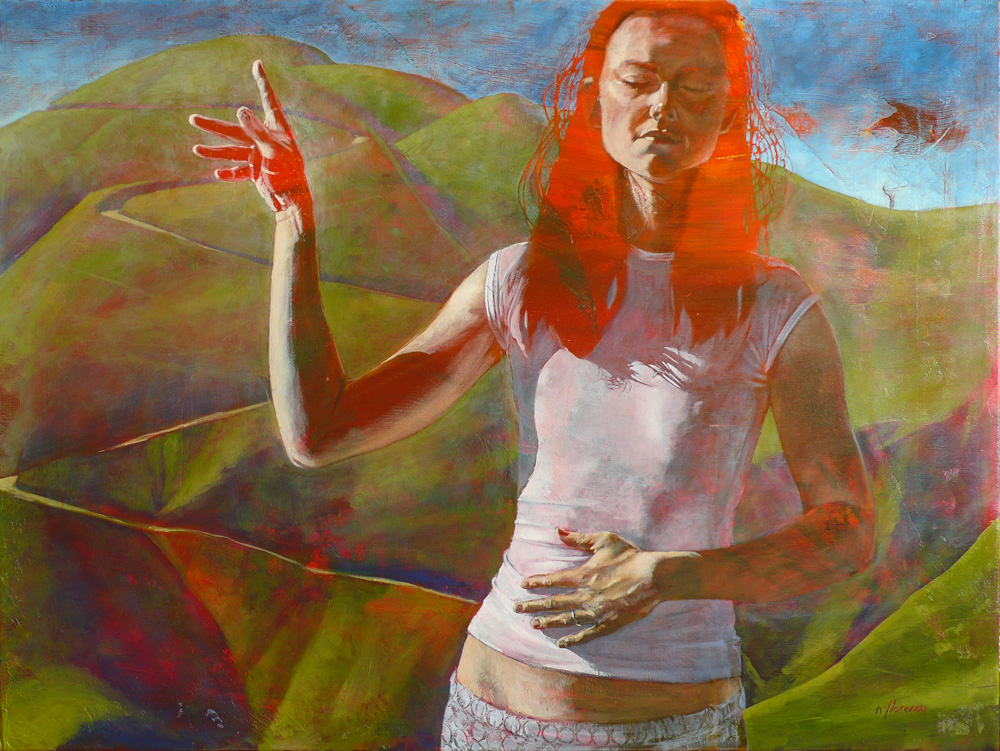
LOOK: Shine Forth Upon These Clouded Hills by Nathan Florence
Nathan Florence (American, 1972–), Shine Forth Upon These Clouded Hills. Oil on canvas, 30 × 40 in.
LISTEN: “Pave Every Road” by Caroline Cobb, on A Home and a Hunger: Songs of Kingdom Hope (2017)
Pave every road with repentance Bring the proud heart low Let the humble heart sing Break down all your walls, your defenses Swing wide your gates For the coming of the king
Lo, he has come to rebuild the ruins Lo, he has come, set them captives free I know he has come to bind up the broken It’s the year of his favor The year of Jubilee
People livin’ in the darkness Lift up your heads and see the sun I see a new day dawnin’ It brings good news for everyone
I see the sun risin’ I see the sun risin’ I see the sun risin’
One day we’ll all hear a trumpet He will return with reckoning I’ll follow my king into glory Who here is comin’ with me? Who here is comin’ with me? Who here is comin’ with me? Yeah!
I see the sun risin’ I see the sun risin’ I see the sun risin’
Get up, get ready Get up, get ready Get up, get ready For the king to come
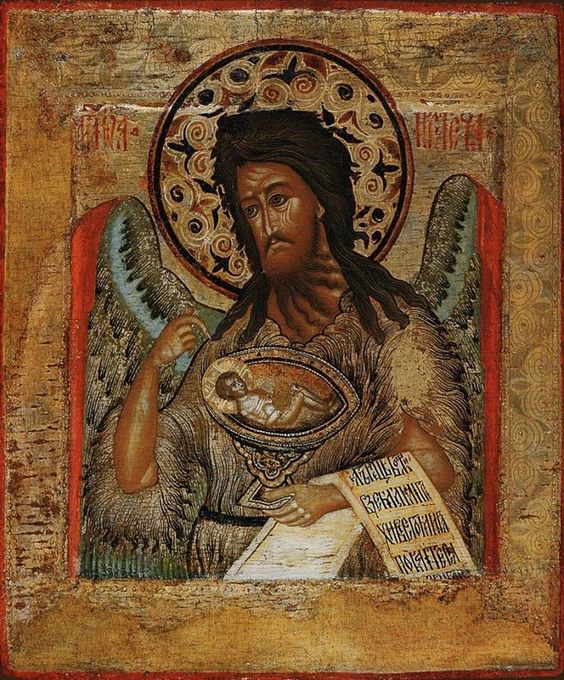
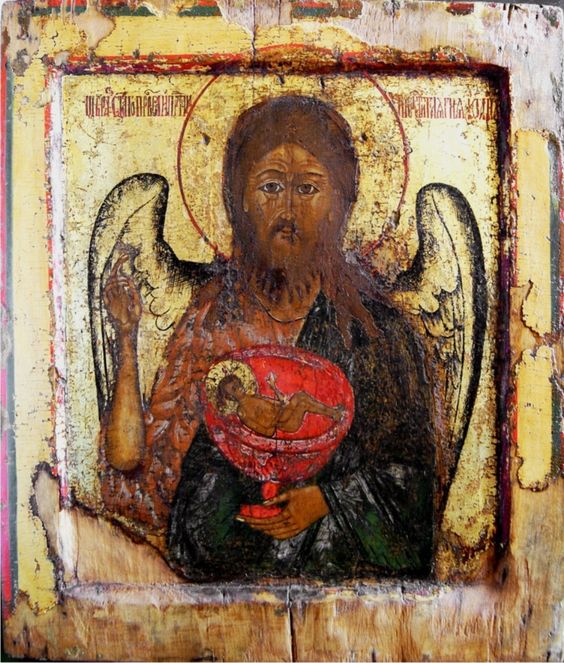
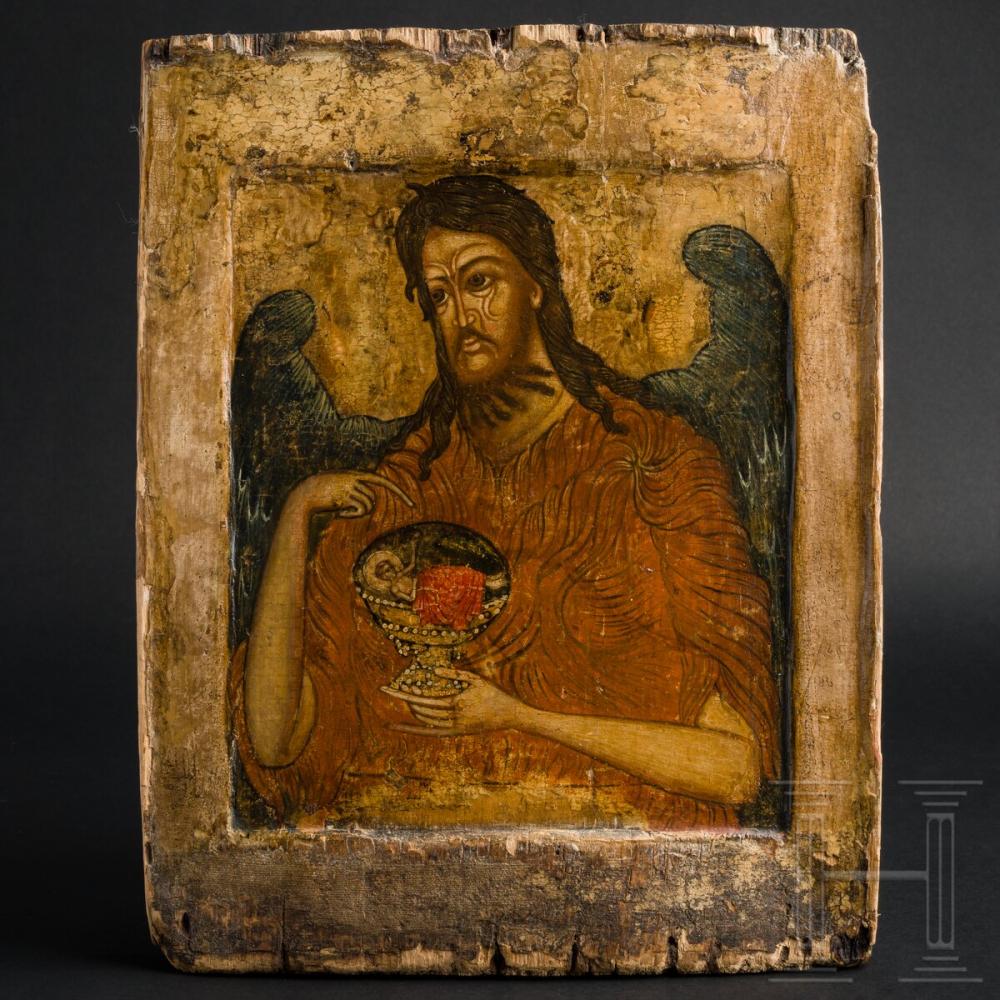
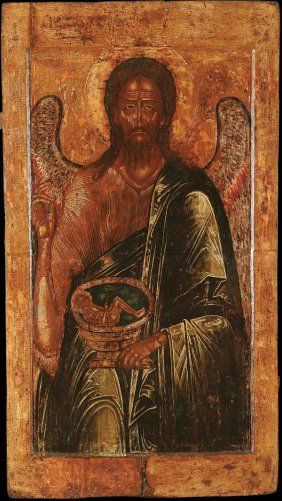
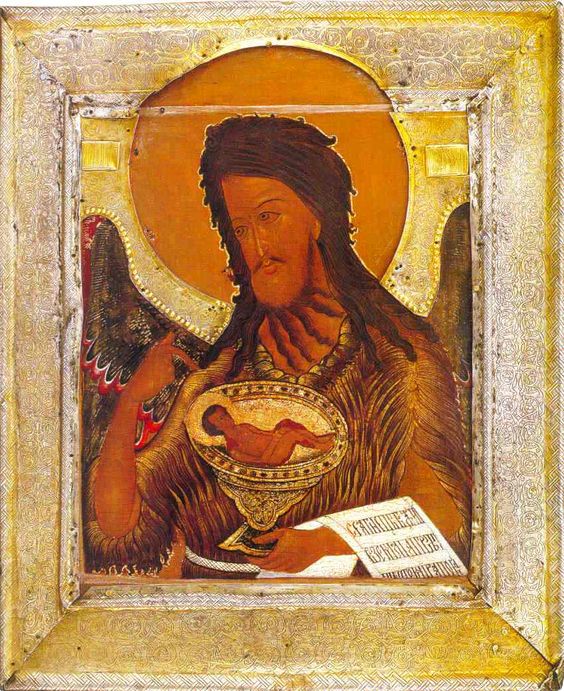
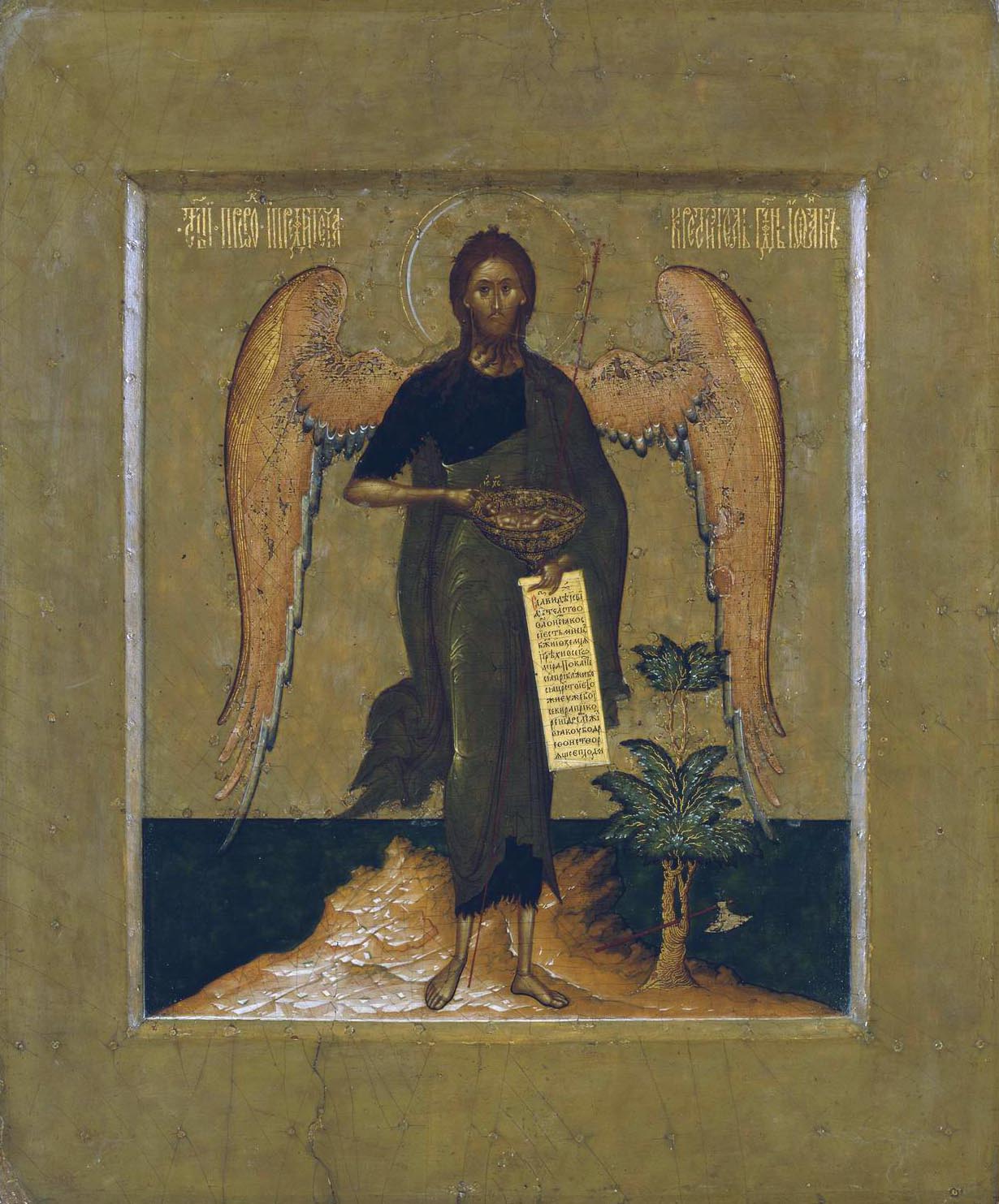
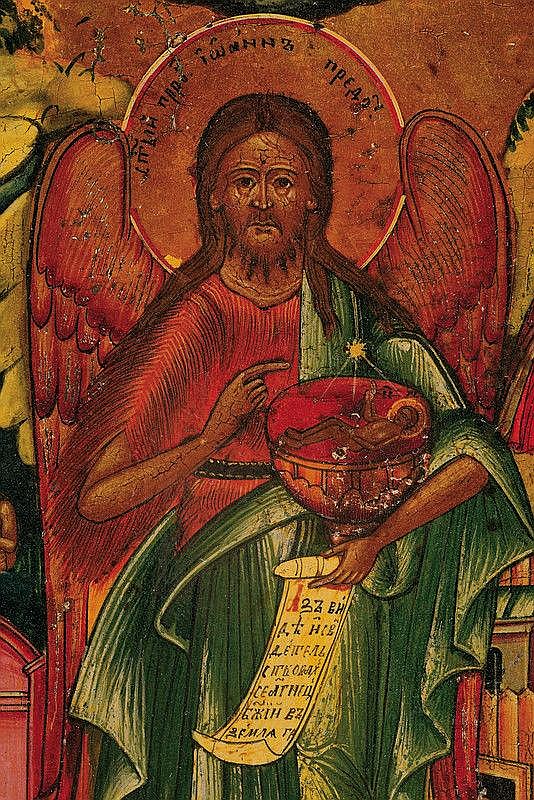
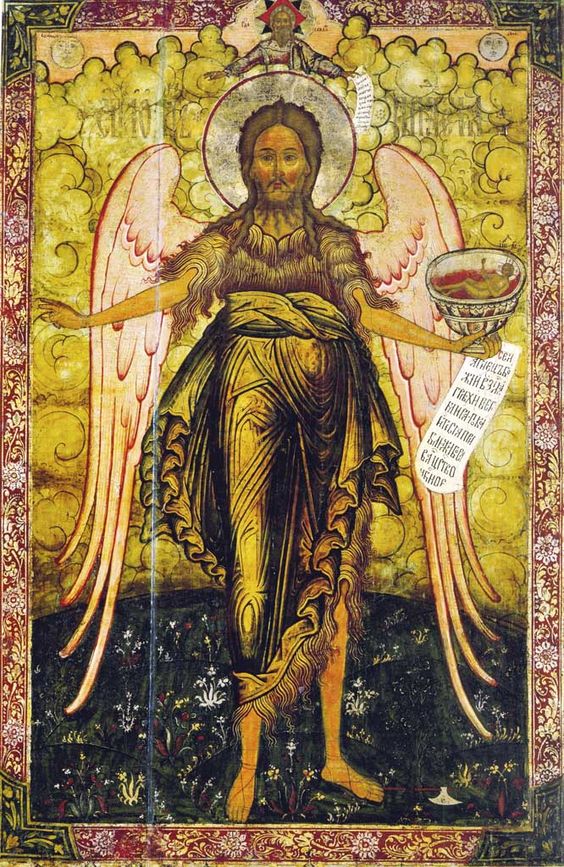
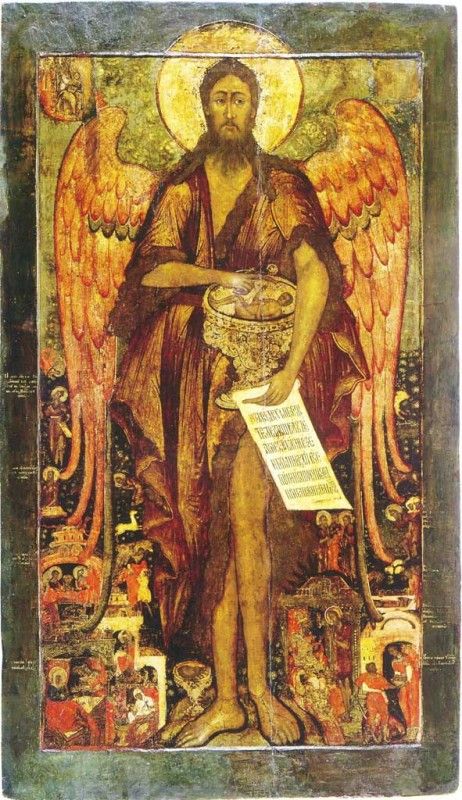
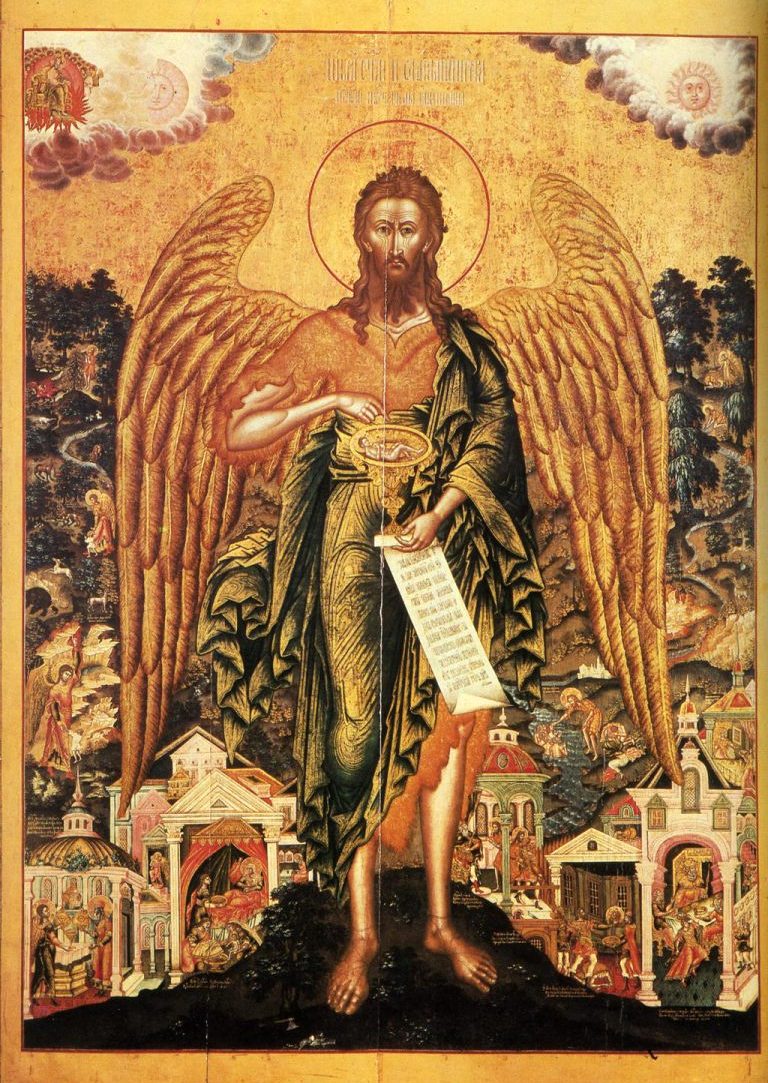
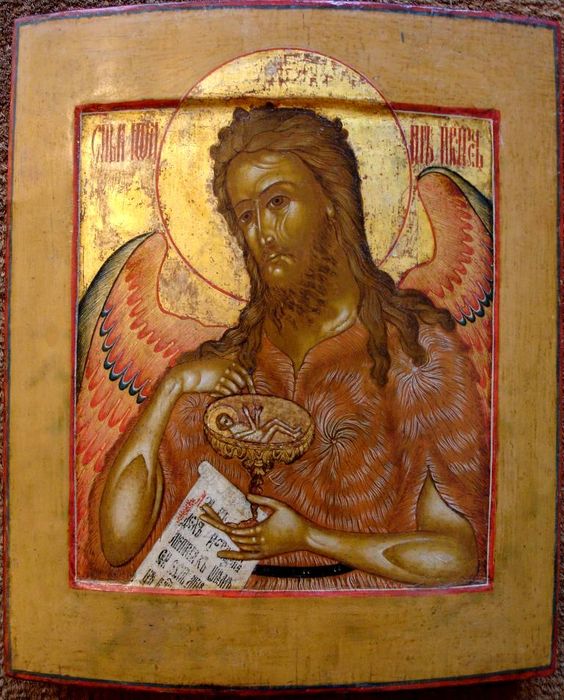
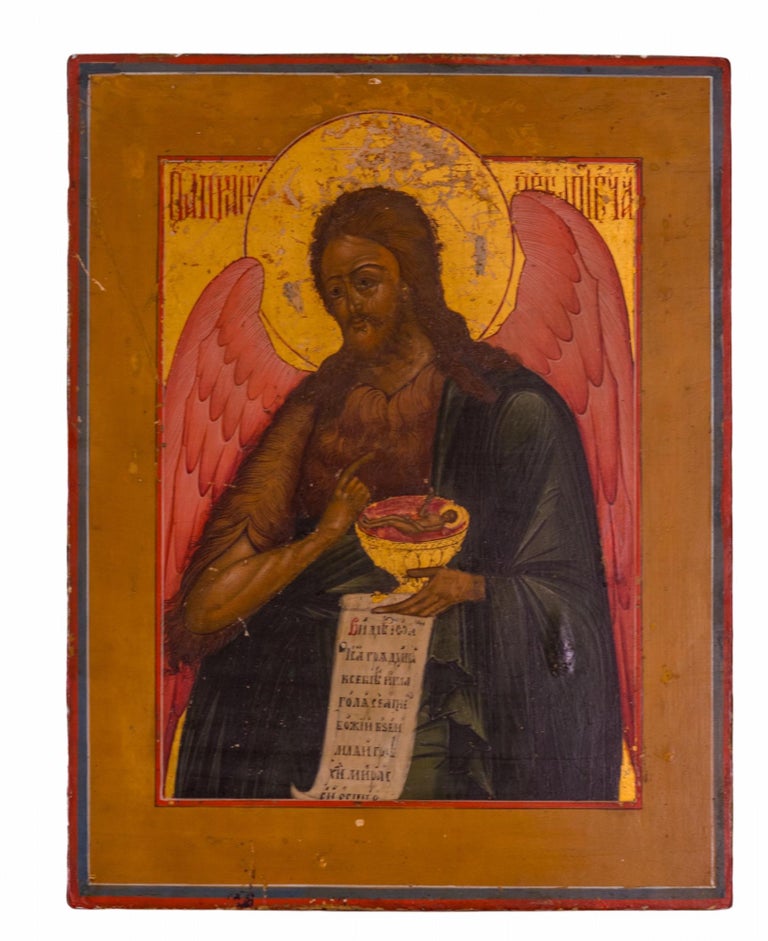
John the Baptist, Angel of the Desert, Russia, 17th or 18th century
John the Baptist served as a bridge between the old and new covenants, calling on people to repent of their sins and produce good fruit in preparation for the arrival of the Messiah. “The kingdom of heaven is at hand!” he vigorously proclaimed on the banks of the river Jordan. “Get ready.”
Eastern Orthodox icons sometimes portray John the Baptist with wings, as the word “angel” means “messenger.” God had announced through his prophet Malachi, “See, I am sending my messenger [mal’āḵ] to prepare the way before me, and the Lord whom you seek will suddenly come to his temple. The messenger of the covenant in whom you delight—indeed, he is coming, says the LORD of hosts” (Mal. 3:1). The Hebrew word, mal’āḵ, that is translated as “messenger” in this passage is translated elsewhere in the Old Testament as “angel.” Christian commentators see this prophecy as fulfilled in John the Baptist.
The iconography of John the Baptist as Angel of the Desert/Wilderness first started appearing in the sixteenth century and is present only in the East. In addition to having two wings, he wears camel skins, an allusion to his asceticism (Matt. 3:4). He usually holds an unfolded scroll bearing his words from Matthew 3:2—“Repent, for the kingdom of heaven has come near”—as well as a poteiron (liturgical chalice) in which lies a naked Christ Emmanuel, evoking the Eucharist. John points to Christ, the source of our salvation.
Sometimes it is John’s own severed head that lies in the chalice instead. This variation references his martyrdom, commemorated each year on August 29.
I’ve compiled a range of John the Baptist, Angel of the Desert icons that include the Christ child in a eucharistic cup. They are all from seventeenth-, eighteenth-, or nineteenth-century Russia; many are in private collections, and a few are in the State Tretyakov Gallery in Moscow.
What is the crying at Jordan? Who hears, O God, the prophecy? Dark is the season, dark our hearts, and shut to mystery.
Who, then, shall stir in this darkness, prepare for joy in the winter night? Mortal, in darkness we lie down, blindhearted, seeing no light.
Lord, give us grace to awake us, to see the branch that begins to bloom; in great humility is hid all heaven in a little room.
Now comes the day of salvation; in joy and terror the Word is born! God comes as gift into our lives; oh let salvation dawn!
The “crying at Jordan” in the first line of this modern hymn refers not to weeping but to a loud uttering—that of John the Baptist preparing the way for the Messiah through the preaching of repentance. When, in response to John’s ministry, the priests and Levites asked him who he was, he declared, “I am the voice of one crying out in the wilderness, ‘Make straight the way of the Lord,’ as the prophet Isaiah said” (John 1:23; cf. Isa. 40:3; Matt. 3:3).
The third stanza refers to Mary’s pregnancy, echoing the closing couplet of the poet John Donne’s “Annunciation” sonnet: “Thou hast light in dark, and shutst in little room, / Immensity cloistered in thy dear womb.” This is an idea that many Christians, both before and after Donne, have mused on and marveled at.
Thank you to my friend Peggy, who introduced me to this remarkable Advent hymn!
Taken near Mars Desert Research Station in Hanksville, Utah, in 2019, this photograph shows yellow and purple flowers peeping up through the dry cracks of a desert floor. It’s a superbloom, “a rare desert botanical phenomenon in which an unusually high proportion of wildflowers whose seeds have lain dormant in desert soil germinate and blossom at roughly the same time. The phenomenon is associated with an unusually wet rainy season” [source]. View more photos here.
Even the wilderness and desert will be glad in those days The wasteland will rejoice and blossom with spring crocuses Yes, there will be an abundance of flowers and singing for joy The deserts will become as green as the mountains of Lebanon As lovely as Mount Carmel or the plain of Sharon There the Lord will display his glory The splendor of God With this news, strengthen those who have tired hands And encourage those who have weak knees Say to those with fearful hearts: Be strong and do not fear Your God is coming He is coming to save you
This electronica chant sets to music a popular Advent scripture: Isaiah 35:1–4. Sung by Tara Ward [previously] of the Opiate Mass, it was recorded live on December 4, 2010, at Immanuel Lutheran Church in Seattle.
The name [The Opiate Mass] is a nod both to the Christian liturgical form and to Karl Marx’s assessment that religion is the opiate for the masses. Perhaps it is. Or perhaps the common desire for comfort, rest, escape, or relief are more complicated and mysterious than we know.
In our pursuit of creating spaces of beauty and awe, we find ourselves partial to cathedrals, antiquity, ambience, pipe organs, samplers, synthesizers, incense, tongues, silence, joy, meditation, ambiguity, the abstract. We strive to avoid pretense, hype, cliché, certainty, celebrity, egotism, greed, noise.
Blessed are the meek, for they will inherit the earth.
—Matthew 5:5
LOOK: The Bruised Sky by Claudia Alvarez
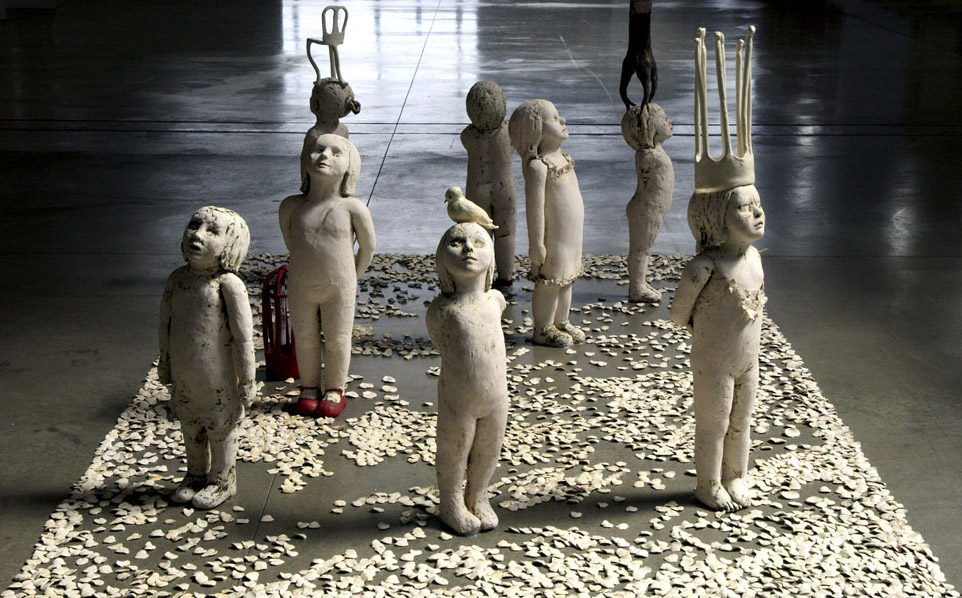
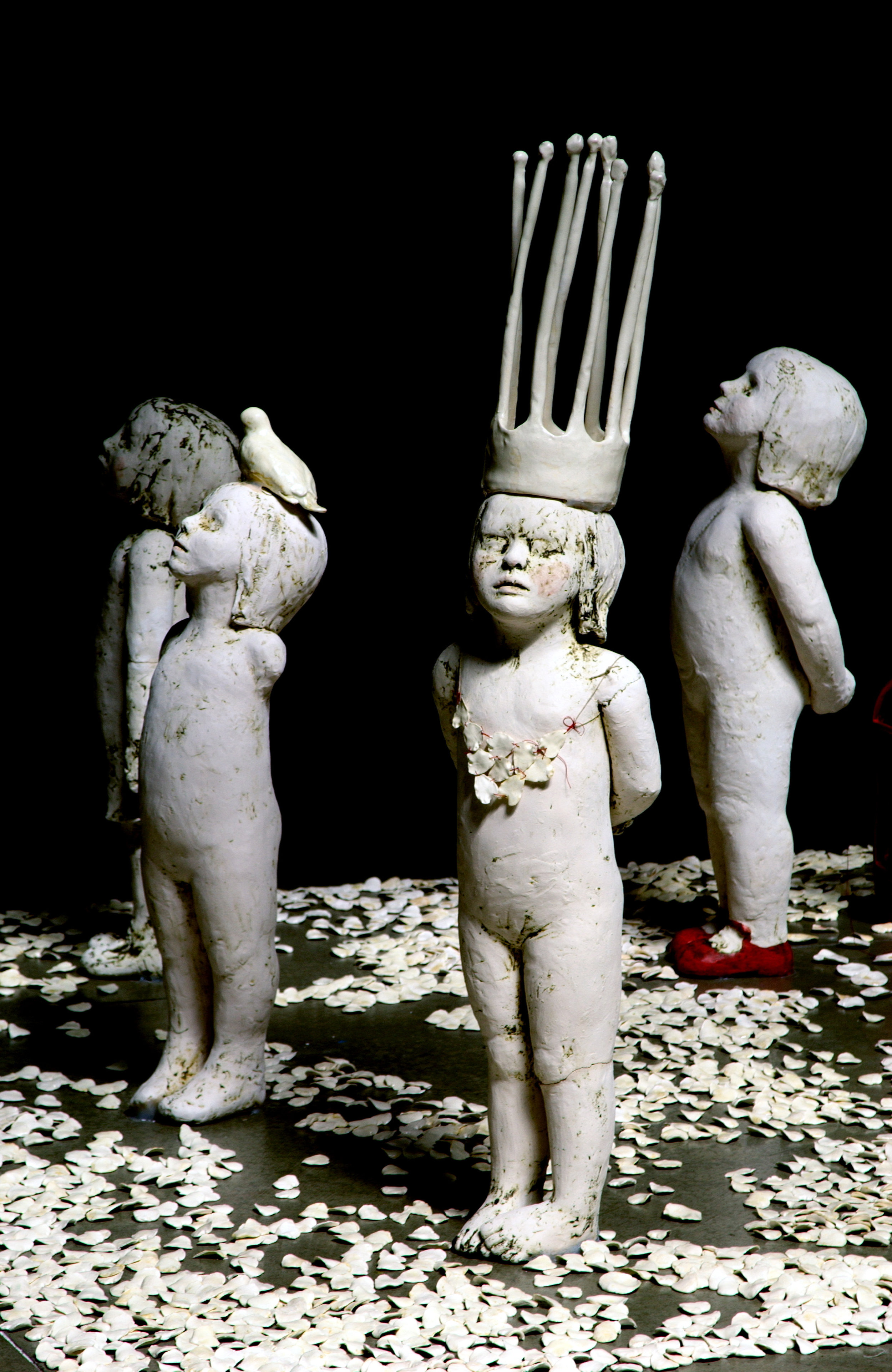
Claudia Alvarez (Mexican American, 1969–), The Bruised Sky, 2005. Porcelain and ceramic, 46 in. × 8 ft. × 14 ft. Photo from an exhibition at California College of the Arts, San Francisco. Click on image to view more.
LISTEN: “The Gentle Strong” by David Benjamin Blower, on The Book of Bare Life and Returns: Praying the Psalms in the Anthropocene (2023)
Fret ye not, little heart At the wheels that want and take and hurt O forsake their heartless rage For the wheels shall all lay down and be covered in moss And the trees shall take back all the towers
Refrain: And the gentle strong shall inherit the land Be ancestors of the better days at hand No wealth but life No wealth but life All shall pass right
Be not forged in their fires Who live as though living were a war on life Put your feet in the soil And speak to the Yon thy delights and thy heart’s desires And your justice wax still as the noon [Refrain]
David Benjamin Blower [previously] from Birmingham, England, is one of the most original, thoughtful, and compelling songwriters of faith working today. His songs contain unique poetic images, never resort to cliché, and often embody Advent vibes in their weary hope and their yearning for shalom. This subdued track from his 2023 album addresses the “gentle strong,” another word for the “meek” who are lifted up by Jesus in the Beatitudes.
Gentleness or meekness is not a trait that’s typically rewarded in modern Western cultures. Last month, for example, the people of the United States elected a brash, crude, violent, and egotistical man into our nation’s highest office. It seems to me that many voters mistake his loudness and self-importance for strength.
But the kingdom of God is not like the kingdoms of this world. In God’s kingdom, the gentle strong flourish under the benevolent rule of Jesus Christ, who himself models gentle strength.
Blower’s song gives us images of renewal: Of wheels that used to drive and crush becoming still and growing moss. Of trees overtaking our skyscrapers, reclaiming the land—organic growth and abundance, supporting human and nonhuman life. Of the meek entering at last into their inheritance.
The better days are at hand; may we do our part in bringing them to birth. May we be forged in a different fire: not ire or selfish ambition but love. May we embrace life and the things that make for life. May we keep in constant conversation with “the Yon”—the One who is above and beyond and yet, paradoxically, immanent, a friend who’s always close by. May we be consistently grounded in doing justice, loving mercy, and walking humbly with our God.
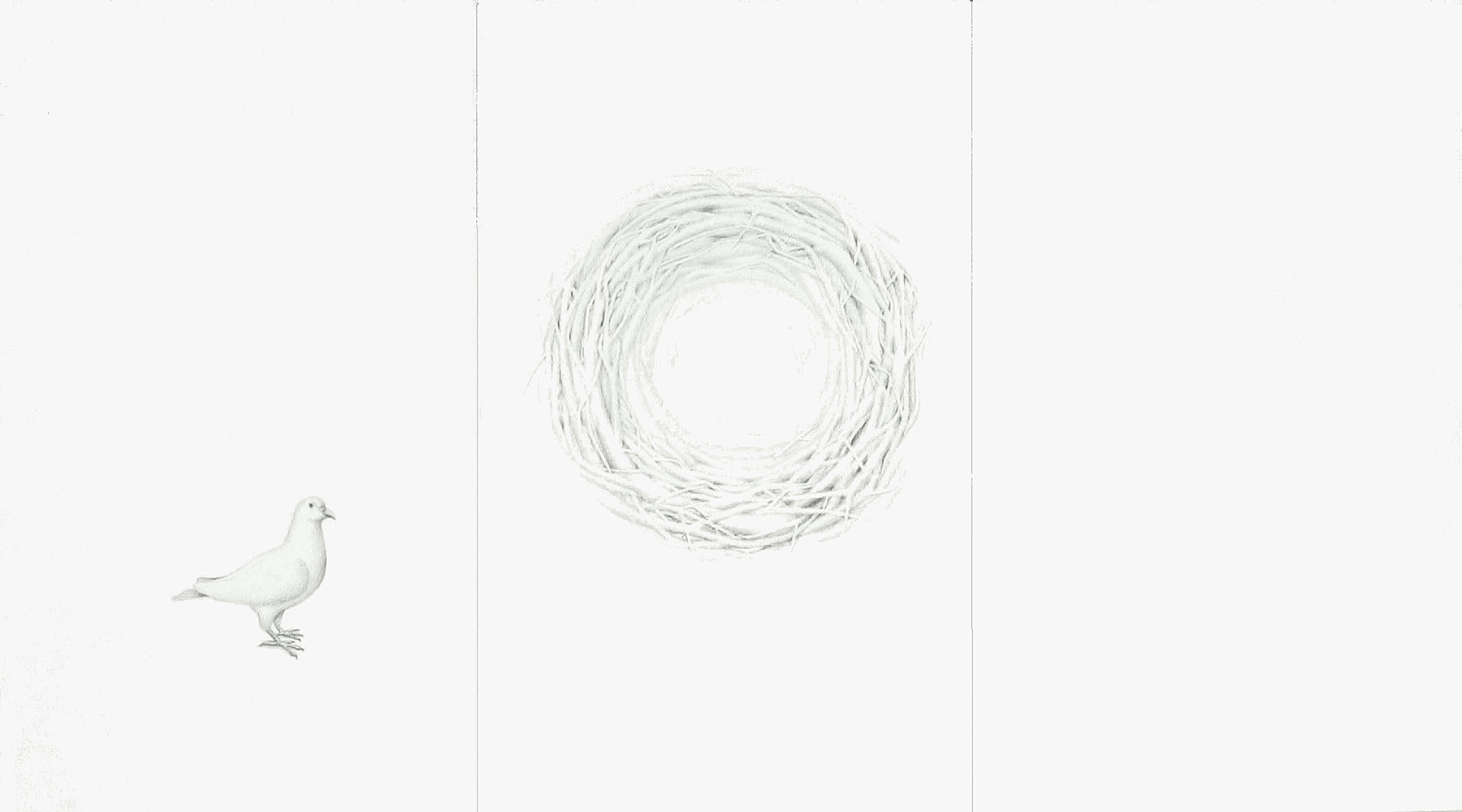
Carola Faller-Barris (German, 1964–), Bethlehem, 2009. Pencil on paper on MDF board, 100 × 180 cm. [HT]
LISTEN: “Peace” | Words by Gerard Manley Hopkins, 1879, and Wilfred Owen, 1917 | Music by Peter Bruun, 2017 | Performed by the Svanholm Singers, dir. Sofia Söderberg, on Exclusive, 2019
When will you ever, Peace, wild wooddove, shy wings shut, Your round me roaming end, and under be my boughs? When, when, Peace, will you, Peace? I’ll not play hypocrite To own my heart: I yield you do come sometimes; but That piecemeal peace is poor peace. What pure peace allows Alarms of wars, the daunting wars, the death of it?
Out there, we’ve walked quite friendly up to Death,— Sat down and eaten with him, cool and bland,— Pardoned his spilling mess-tins in our hand. We’ve sniffed the green thick odour of his breath,— Our eyes wept, but our courage didn’t writhe. He’s spat at us with bullets and he’s coughed Shrapnel. We chorussed when he sang aloft, We whistled while he shaved us with his scythe.
Oh, Death was never enemy of ours! We laughed at him, we leagued with him, old chum. No soldier’s paid to kick against His powers. We laughed,—knowing that better men would come, And greater wars: when each proud fighter brags He wars on Death, for lives; not men, for flags.
O surely, reaving Peace, my Lord should leave in lieu Some good! And so he does leave Patience exquisite, That plumes to Peace thereafter. And when Peace here does house He comes with work to do, he does not come to coo, He comes to brood and sit.
The text of this choral work by the Danish composer Peter Brunn combines two British poems: “Peace” by Gerard Manley Hopkins and “The Next War” by Wilfred Owen. Let’s look at each one separately, and then together.
“Peace” by Gerard Manley Hopkins
When will you ever, Peace, wild wooddove, shy wings shut, Your round me roaming end, and under be my boughs? When, when, Peace, will you, Peace? I’ll not play hypocrite To own my heart: I yield you do come sometimes; but That piecemeal peace is poor peace. What pure peace allows Alarms of wars, the daunting wars, the death of it?
O surely, reaving Peace, my Lord should leave in lieu Some good! And so he does leave Patience exquisite, That plumes to Peace thereafter. And when Peace here does house He comes with work to do, he does not come to coo, He comes to brood and sit.
The Jesuit poet-priest Gerard Manley Hopkins (1844–1889) wrote this curtal sonnet on October 2, 1879, after finding out he was reassigned from his role as curate at St. Aloysius’s church in Oxford to curate at St. Joseph’s in the industrial town of Bedford Leigh, near Manchester. He was apprehensive about this move to a place he described as “very gloomy” and unclean. The following decade, the last of his life, he would be plagued by melancholic dejection, which his later poems reflect. In addition to the internal disquiet he was experiencing in the fall of 1879, there was also an external lack of peace, as Great Britain was at war on three fronts—in southern Africa (against the Zulu kingdom), Afghanistan, and Ireland.
The speaker of the poem addresses Peace, an elusive dove, begging him to come settle down to nest, to incubate his eggs. “Brooding” here, writes J. Nathan Matias, is not a morose act but a generative, warmly creative one, birthing life.
Though the dove appears in scripture as a symbol of God the Spirit, in the last three lines of this poem he could be God the Son, the Prince of Peace. The people waited for generations upon generations for his arrival. And when he came, he was not all talk. He came with serious work to do; he came to hatch a newborn world.
This poem expresses yearning for peace in our hearts and in our lands—a permanent, holistic peace that only Christ can bring.
“The Next War” by Wilfred Owen
“War’s a joke for me and you, While we know such dreams are true.” —Siegfried Sassoon
Out there, we’ve walked quite friendly up to Death,— Sat down and eaten with him, cool and bland,— Pardoned his spilling mess-tins in our hand. We’ve sniffed the green thick odour of his breath,— Our eyes wept, but our courage didn’t writhe. He’s spat at us with bullets and he’s coughed Shrapnel. We chorussed when he sang aloft, We whistled while he shaved us with his scythe.
Oh, Death was never enemy of ours! We laughed at him, we leagued with him, old chum. No soldier’s paid to kick against His powers. We laughed,—knowing that better men would come, And greater wars: when each proud fighter brags He wars on Death, for lives; not men, for flags.
One of the premier poets of World War I, Wilfred Owen (1893–1918) was a British soldier whose poems lament the horrors of trench and gas warfare. His cynicism and transparency about war stood in stark contrast to the confidently patriotic verse written by earlier war poets.
Owen wrote “The Next War” while being treated for “shell shock” (PTSD) at Craiglockhart War Hospital in Edinburgh; he sent it in a letter to his mother dated September 25, 1917, writing the following week that he wanted her to show it to his youngest brother, Colin—for him “to read, mark, learn.” Owen was discharged from the hospital two months later and returned to the front lines of France, where he was killed in action on November 4, 1918, a week before the armistice, at age twenty-five.
He opens his ironic-toned sonnet with an epigraph from “A Letter Home” by Siegfried Sassoon, a fellow war poet he met at Craiglockhart, who became a friend and a mentor to him. (Bruun omits the epigraph in his choral work so that there’s a seamless transition between poems.) “Dreams will triumph, though the dark / Scowls above me,” Sassoon writes earlier in his poem, a poem that acknowledges the bleakness of war but, imagining the rebirth of a friend slain in battle, clings to the hope that it will soon be over and we can laugh it off.
Owen undercuts the optimism and solace in these lines with what follows in his own poem. The speaker of “The Next War”—which it’s pretty clear is the poet himself—personifies Death as a comrade whose intimate presence is normal among soldiers. He spits bullets, coughs shrapnel, and breathes stinking odors, and yet they ally themselves with him, sing Death’s song, go with him into battle.
Soldiers only delude themselves if they think they fight against Death, Owen asserts; they fight with him. Their nations’ governments will say they’re heroes, taking up arms to save lives and secure peace, but Owen rejects the idea that there’s anything noble, glorious, or effective about war. Soldiers kill men “for flags”—merely serving national interests—and their doing so never puts an end to war but only leads to another.
By bringing together these two texts, sandwiching Owen between Hopkins, Bruun gives a more hopeful framing to Owen’s disillusioned reflections on war, ending with the final image of a brooding dove. I like how the two poems play off one another. For example, Hopkins’s rhetorical question of “What pure peace allows / . . . the death of [peace]?” stands in starker relief when read in conjunction with Owen’s criticism of the ostensible rationale for war.
Bruun still honors Owen’s experience of being made far too familiar with death, his endurance of mortar blasts and mustard gas and all-around carnage, to no apparent end. Owen’s text starts at 2:11 of the video, where a menacing, march-like cadence enters. We feel the anxiety and the darkness of battle. The specificity of the poem resists us metaphorizing war—that is, applying the poem to a situation of inner turmoil (battling inner demons) only. This is physical combat between nations, which, of course, has severe psychological repercussions on the participants.
But at 5:33 the hushed tones of Hopkins return. Bruun had been attracted to Hopkins’s poem “Peace” for some time. In 2010 he wrote a setting of it for solo voice and flute, clarinet, horn, percussion, glockenspiel, violin, violoncello, and contrabass, and in 2016 he published a new setting, with Owens now inserted, as the second in a five-song cycle called Wind Walks for mixed choir and accompaniment, all five texts taken from Hopkins. He then adapted the song for the male-voice chamber choir the Svanholm Singers from Sweden, which is what I feature here.
The pointed and repeated “When” at the opening of Bruun’s piece, a word that Hopkins repeats three times in his poem, is powerful, an echo of the familiar biblical refrain, “How long, O Lord?” If we read Peace as Christ, then the poem is a prayer, asking Christ to come home to us, to our world—to spread his wings over it and nurture it back to life.
In Hebrew thought, shalom, “peace,” is not a passive thing, merely the absence of war. It’s the active presence of God and an all-encompassing state of completeness, soundness, health, safety, and prosperity.
Shalom is what we long for, especially during Advent. It’s what scripture promises will come someday—but now, its lack is keenly felt. It may occasionally flit and hover nearby, but then it flies off again.
As the church, may we embrace “Patience exquisite, / That plumes to Peace thereafter,” as we await Christ’s return, in the meantime preparing his way through acts of righteousness and reconciliation.




 Art & Theology