Advent, Day 4: Swords into Plowshares

One day

[. . .]

God
will come forward

to settle the conflicts between us
finally          the one
true witness

even the finality of holocaust
will melt away
like lowland snow

the military hardware
translated into monkey bars
where children play

the hardened postures
crumbled
like ancient statues

children will wave through the gunholes
of tanks
rumbling off to the junkyard

people will find hands
in theirs
instead of guns

learn to walk
into their gardens
instead of battle

Oh House of Israel
let’s walk in the sunlight ways
of his presence

—Isaiah 2:2–5, translated by David Rosenberg in A Poet’s Bible: Rediscovering the Voices of the Original Text (New York: Hyperion, 1991)

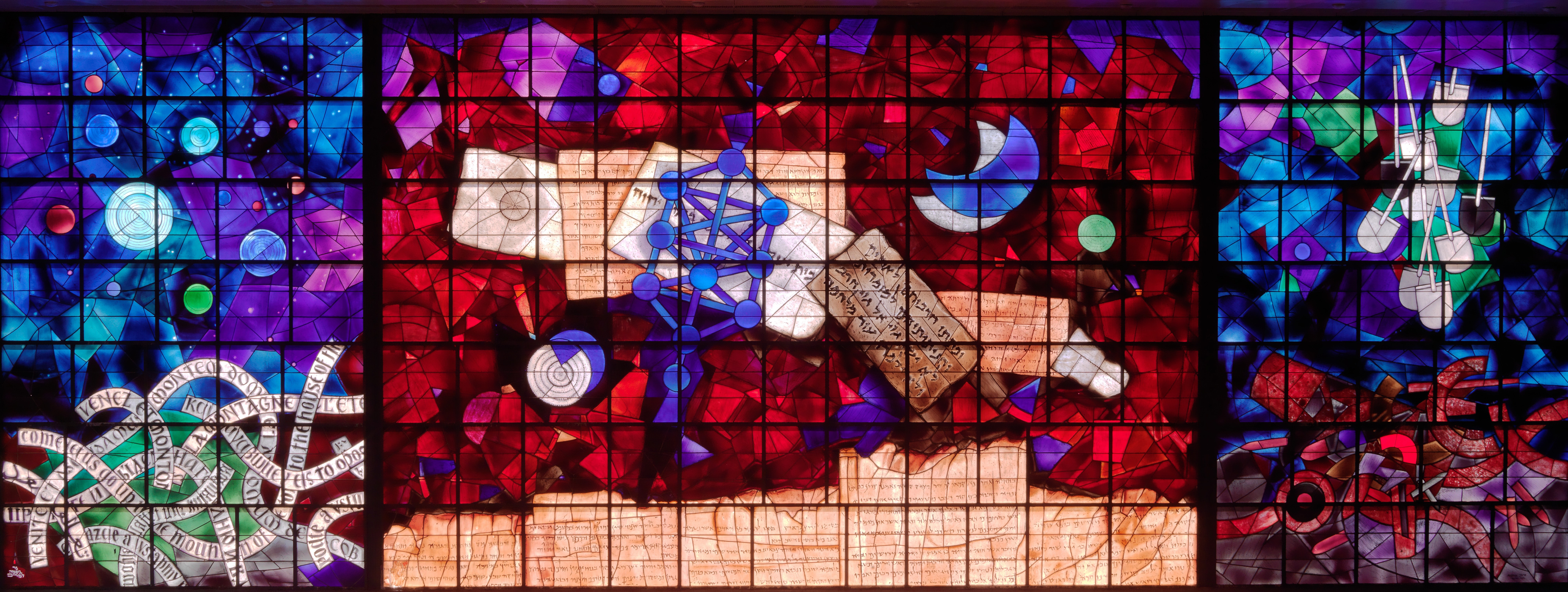
LOOK: Isaiah’s Vision of Eternal Peace by Mordecai Ardon
Ardon, Mordecai_Isaiah's Vision of Eternal Peace
Mordecai Ardon (Israeli, 1896–1992) (designer) and Charles Marq (French, 1923–2006) (fabricator), Isaiah’s Vision of Eternal Peace, 1982–84. Stained glass, 6.5 × 17 m. Old National Library of Israel building, Givat Ram campus, Hebrew University of Jerusalem. Photo: Hanan Cohen.

Born in 1896 to a Jewish family in the village of Tuchów in what is today Poland, Mordecai Ardon studied art in Germany under Paul Klee and Wassily Kandinsky. When the Nazis came to power in 1933, he moved to Jerusalem, becoming a teacher in 1935 at Palestine’s chief art academy, the Bezalel School of Arts and Crafts, which he directed from 1940 to 1952. Known for their vibrant tones and stirring rhythms, Ardon’s paintings often explore the connections between the visible and the invisible and reflect his interest in mysticism and antiquity.

From 1982 to 1984 Ardon carried out a commission by the National Jewish University and Library (now the National Library of Israel) in Jerusalem to develop a monumental triptych of stained glass. His painted designs were translated into the medium of stained glass by the French master glazier Charles Marq, a frequent collaborator of Marc Chagall’s. The result is titled Isaiah’s Vision of Eternal Peace.
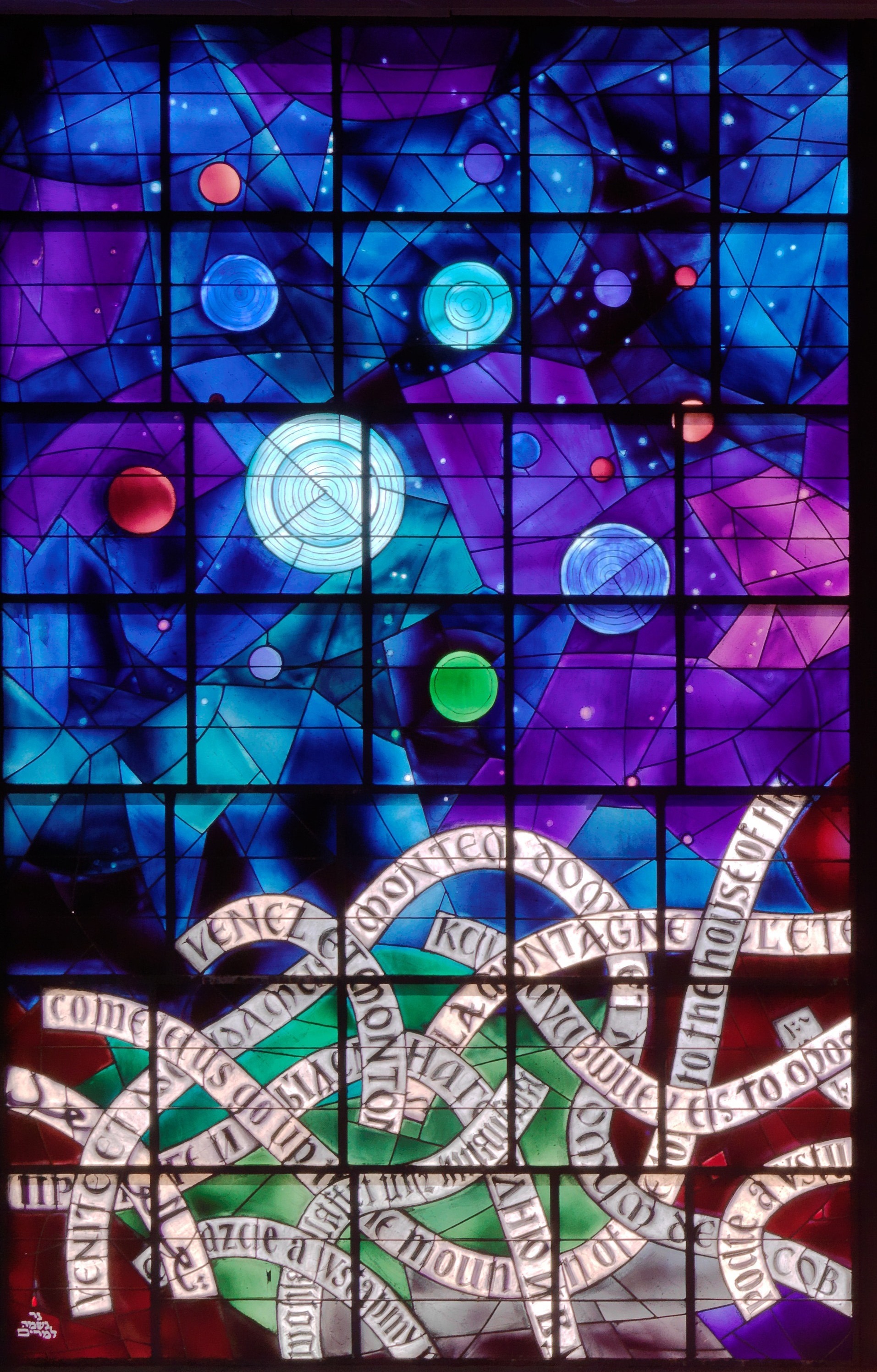
Ardon, Mordecai_Isaiah's Vision of Eternal Peace (left)

The left panel illustrates Isaiah 2:2–3:

In days to come the mountain of the LORD’s house shall be established as the highest of the mountains and shall be raised above the hills; all the nations shall stream to it. Many peoples shall come and say, “Come, let us go up to the mountain of the LORD, to the house of the God of Jacob, that he may teach us his ways and that we may walk in his paths.”

Winding like roads, the white bands contain the boldfaced line in various languages—I can detect English, Russian, Polish, Arabic, Latin, and French—representing the peoples of the world streaming to Jerusalem.
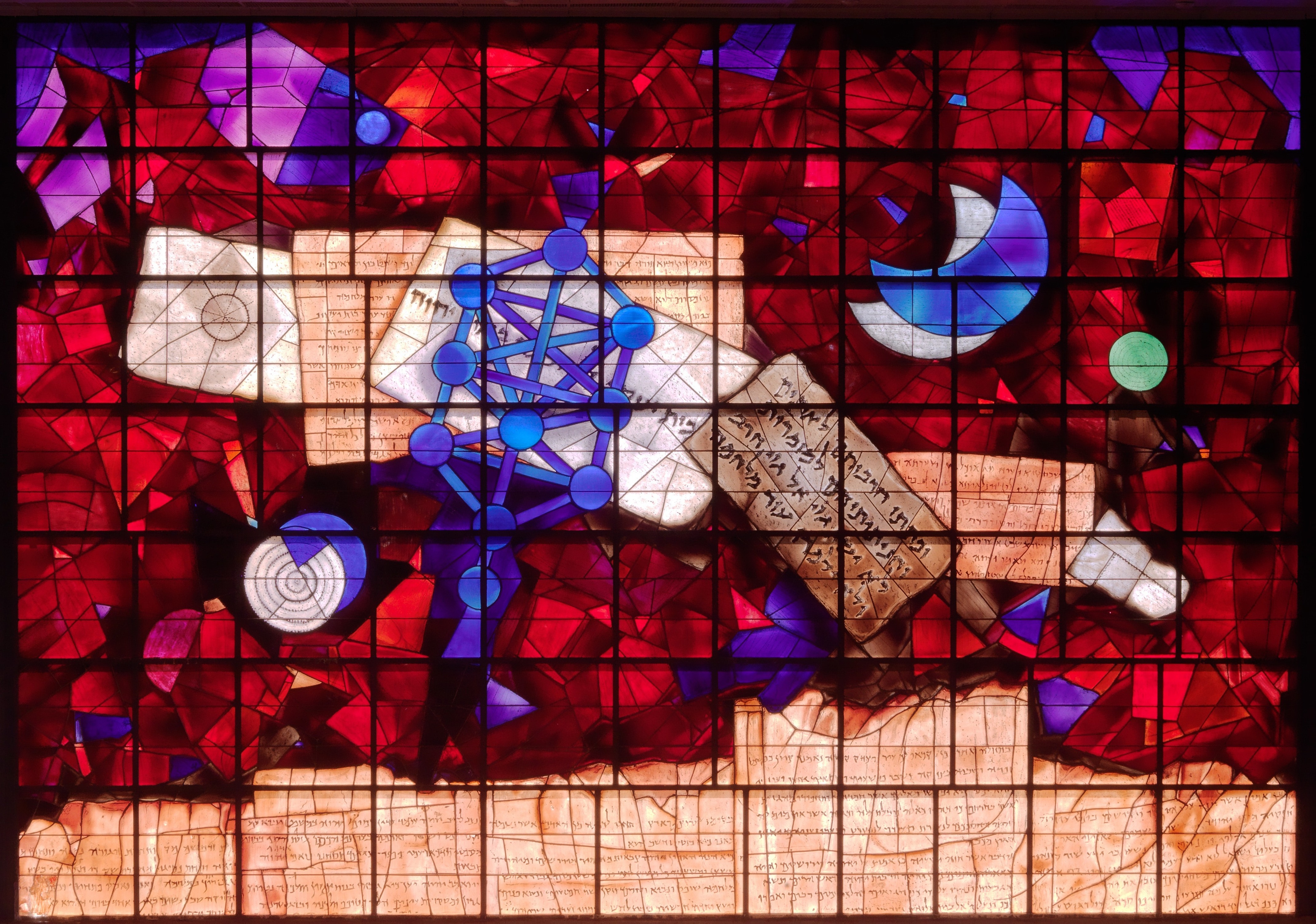
Ardon, Mordecai_Isaiah's Vision of Eternal Peace (center)

The center panel depicts a merging of the earthly and heavenly Jerusalems. At the bottom stand the city walls, made up of the seventeen sheets of parchment that comprise the Great Isaiah Scroll from Qumran, dating to around 100 BCE. Floating above are Kabbalistic symbols, including the Tree of the Sefirot, signifying the Divine Presence. There are also several Hebrew texts from Jewish history that I can’t identify.
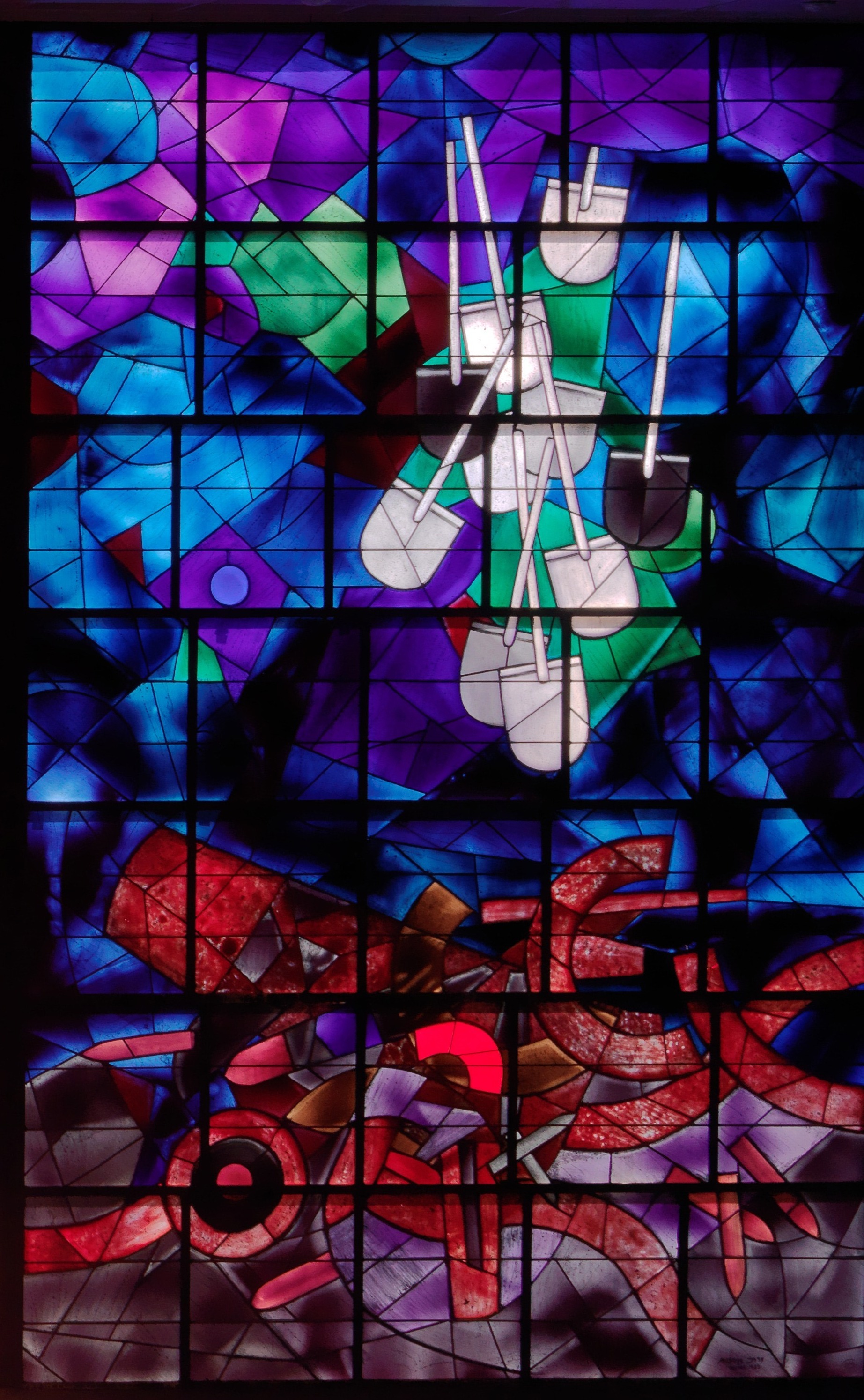
Ardon, Mordecai_Isaiah's Vision of Eternal Peace (right)

The right panel visualizes the fulfillment of Isaiah 2:4: “. . . they shall beat their swords into plowshares and their spears into pruning hooks; nation shall not lift up sword against nation; neither shall they learn war any more.” All the machinery of war—tanks and fighter jets, guns and bullets—lies in a garbage heap at the base, and shovels emerge overhead as the weapons are transformed into farming tools.

This glasswork covers an entire wall of the old National Library of Israel building on the Givat Ram campus of Hebrew University. The library moved into a new building in October 2023, situated between the Knesset and the Israel Museum in the heart of Jerusalem. But Ardon’s window remains in its original building at HUJI, which has become a multipurpose space.

LISTEN: “Lo Yisa Goy (Study War No More)” (ֹא יִשָּׂא גוֹי) | Traditional Jewish folk song, arr. Linda Hirschhorn and Fran Avni | Performed by Vocolot, on Behold! (1998)

לֹא יִשָּׂא גוֹי אֶל גוֹי חֶרֶב
לֹא יִלְמְדוּ עוֹד מִלְחָמָה

(Transliteration:
Lo yisa goy el goy cherev
Lo yilmadu od milchama)

(Translation:
Nation will not take up sword against nation
Nor will they train for war anymore)

And into plowshares [they’ll] beat their swords
Nations shall learn war no more

The lyrics of this traditional Jewish antiwar song come from the original Hebrew of Isaiah 2:4, a text held sacred by both Jews and Christians. The song looks with prayerful hope toward the day when global peace will be a reality.

If this is the glorious end state to which we all are headed, the future that God has envisioned and charted for us, then why do we participate in violence now? When governments try to control people through violence, and those people respond with violence, that response only provokes violent retaliation, and so the cycle continues on and on—militancy and death. The line between aggressor and defender becomes blurred. We’ll never get closer to the Isaiah 2 ideal by asserting ourselves with weapons.

May the people of God be a people who refuse violence even when the state commands it, even when we’ve been hit tremendously hard and the urge for payback is intense. May we not become what we fear, inflicting terror because we have been terrorized. And may God bring peace and healing to people and nations who have been victims of war; so too perpetrators of war. To those just trying to survive and be free in this fallen world as best they know how.

The first chapter of Isaiah, which precedes the famous “swords into plowshares” chapter, contains this word from the Lord to his people:

When you stretch out your hands,
I will hide my face from you;
even though you make many prayers,
I will not listen;
your hands are full of blood.
Wash yourselves clean, make yourselves clean;
remove the evil of your doings
from before my eyes;
cease to do evil,
learn to do good;
seek justice,
rescue the oppressed,
defend the orphan,
plead for the widow.

—Isaiah 1:15–17

So let us renounce our vindictiveness and “wash ourselves clean.” And then let us sing this song (1) as a prayer that the Messiah, whom Christians recognize to be Jesus of Nazareth, would come to actualize this beautiful vision of peace, but (2) also as a pledge, committing ourselves to the path of life—to, in the words of the apostle Paul, “overcom[ing] evil with good” (Rom. 12:21).

I like Vocolot’s “Lo Yisa Goy” arrangement best; it has a celebratory mood, as if the coming peace is in sight. But what follows is a handful of others that carry more of a lamentful tone, which is also appropriate as we consider the persistence of war and how short we fall of God’s plan for human flourishing that’s never at the expense of others.

For harp and voice by Estela Ceregatti of Brazil, 2020:

A cappella by the American Midwest female vocal trio Rock Paper Scissors, 2010:

For strings, by La Roche Quartett from Germany, 2018:

A virtual choir under the direction of Andrea Salvemini, 2020:

The last performance employs an increasing number of instruments as the song progresses: guitar, recorder, keyboard, cello, percussion, and accordion. It also includes steps to an Israeli circle dance performed by participants in isolation because this was during the days of COVID quarantines; elsewhere online you can find communal performances where the circle is closed.

Some versions add these two lines as a verse, adapted from Micah 4:4:

And every man ’neath his vine and fig tree
Shall live in peace and unafraid

Advent, Day 3: True Liberty

LOOK: Nativity by Josué Sánchez Cerrón

Sánchez Cerrón, Josué_Nativity
Josué Sánchez Cerrón (Peruvian, 1945–), Nativity, 1982. Acrylic on canvas, 88 × 144 cm. © missio Aachen.

LISTEN: “Toda la Tierra” (All Earth Is Waiting) by Alberto Taulé, 1972 | Spanish text and music by Alberto Taulé © 1972, 1993 Centre de Pastoral Litúrgica, Barcelona, admin. OCP Publications; English translation by Gertrude C. Suppe © 1989 United Methodist Publishing House

Below are two performances of this Advent song. The first is by a man and woman from the Parroquía Divino Niño Jesús in Morelia, Mexico, and the second is by the choir Tallo De Amor, from Mexico City:

Toda la tierra espera al Salvador
y el surco abierto, la obra del Señor;
es el mundo que lucha por la libertad,
reclama justicia y busca la verdad.

Dice el profeta al pueblo de Israel:
“De madre virgen ya viene Emmanuel,”
será “Dios con nosotros,” semilla será,
con él la esperanza al mundo volverá.

Montes y valles habrá que preparar;
nuevos caminos temenos que trazar.
él está ya muy cerca, venidlo a encontrar,
y todas las puertas abrid de par en par.

En una cueva Jesús apareció,
pero en el mundo está presente hoy.
Vive en nuestros hermanos, con ellos está;
y vuelve de nuevo a darnos libertad.

ENGLISH TRANSLATION:

All earth is waiting to see the Promised One,
and the open furrows, the sowing of the Lord.
All the world, bound and struggling, seeks true liberty;
it cries out for justice and searches for the truth.

Thus says the prophet to those of Israel:
“A virgin mother will bear Emmanuel,”
for his name is “God with us,” our brother shall be,
with him hope will blossom once more within our hearts.

Mountains and valleys will have to be made plain;
open new highways, new highways for the Lord.
He is now coming closer, so come all and see,
and open the doorways as wide as wide can be.

In the lowly stable the Promised One appeared,
yet, feel his presence throughout the earth today,
for he lives in all Christians and is with us now;
again, with his coming he brings us liberty.

Trans. Gertrude C. Suppe

Alberto Taulé (1932–2007) from Barcelona, Spain, was a Roman Catholic priest and a composer of liturgical music who “believed that every parish should have a dynamic, evolving repertoire”—that “quality music and the regular introduction of new songs are vital to a parish’s spiritual health,” as his Catholic Online obituary reads. Working in the wake of the Second Vatican Council (1962–65), which sanctioned the use of vernacular languages and musical styles in the Mass, Taulé wrote new worship songs that could be grafted into the preexisting liturgical structure, used during the entrance procession, the offertory, the Eucharist, or the closing.

In Spanish-speaking church communities around the world, “Toda la Tierra” is sometimes used as the entrance song for one of the four Advent Sundays. Since the United Methodist Church commissioned an English translation from Gertrude C. Suppe and added the song (with bilingual lyrics) to its hymnal in 1989, it has become more widely known in English-speaking communities as well.

The Evangelical Lutheran Church in America published a different English translation by Madeleine Forell Marshall in the 2006 edition of its hymnal, Evangelical Lutheran Worship; hers preserves the aabb rhyme scheme of the original Spanish and begins with the line “All earth is hopeful, the Savior comes at last!”

The Spanish verb esperar means both “to wait” and “to hope” and is thus especially fitting to describe the action of the church during Advent.

Advent, Day 2: Where the Light Is Gone

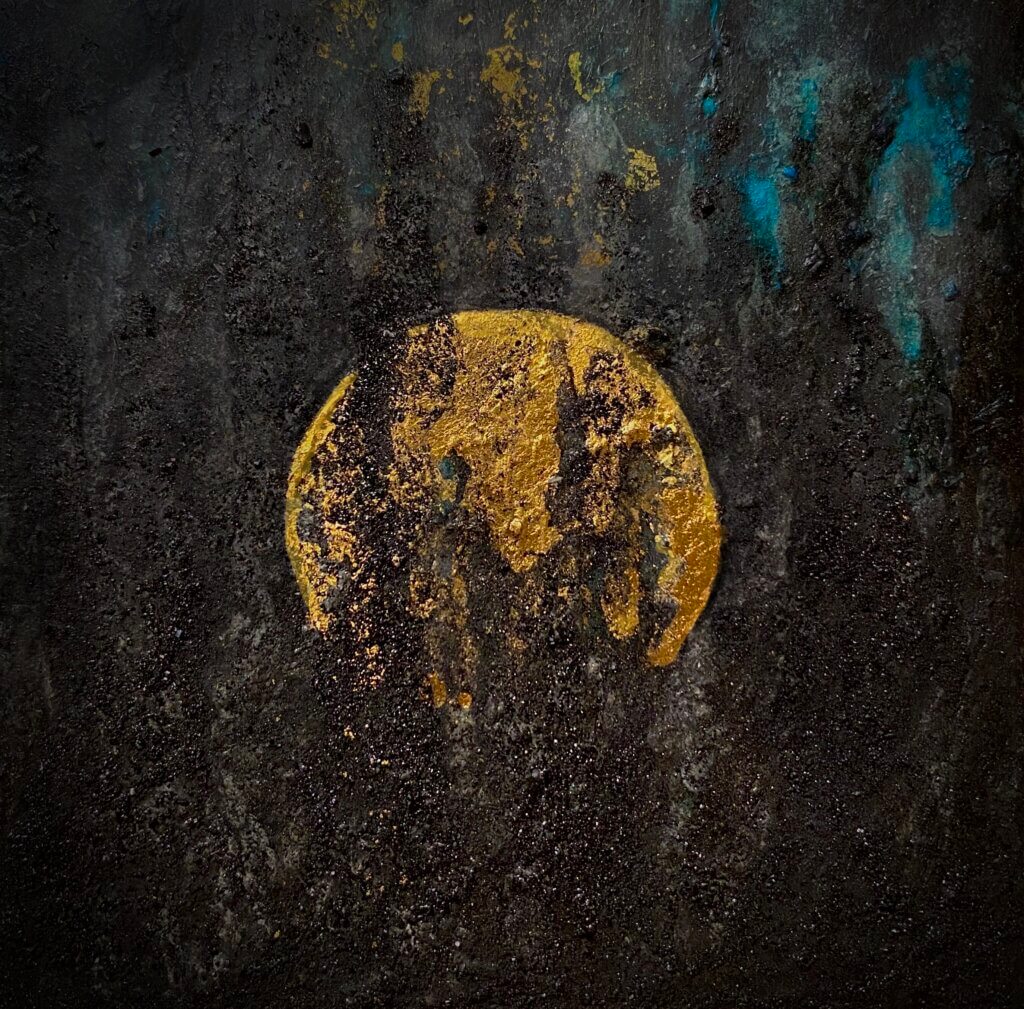
LOOK: Incarnation by Tim Joyner

Joyner, Tim_Incarnation
Tim Joyner (American, 1987–), Incarnation, 2021. Foraged pigment on board-mounted paper, 4 × 4 in.

Tim Joyner is an artist who works primarily with natural pigments and inks derived from locally foraged materials, such as stone, lichen, and seaweed. He is also the worship director at Trinity Church Congregational in Bolton, Massachusetts, where he lives with his wife and four kids.

Incarnation is a painting he made during Advent 2021. He describes its makeup and meaning in a Rabbit Room blog post:

The painting . . . is pretty dark for an Advent piece. It’s primarily Lamp Black (a pigment that I associate with longing and prayer because I make it from the discarded stubs of vigil candles), with some even darker Jet Black. There’s some white from Jingle Shells and a bit of Verdigris, but those are there mostly to make the black pigment look even blacker. Even the orb of gold leaf in the very center of the painting is obscured enough that it mostly just draws attention to the rising movement of dark pigment.

This painting is a reminder to myself that, yes, at the end of all this waiting there is an arrival. But it’s not me arriving at the other end of darkness or doubt, brokenness or betrayal. It is the Christ Child who arrives. He meets us here. And rather than chasing away all that it means to be human—including the pain and the longing unfulfilled—and banishing it forever, He wraps Himself in it. We find Christ not on the other side of our longing, but within it.

LISTEN: “Where the Light Is Gone” by the Wood Drake Sessions, 2023

Refrain:
Where the light is gone
There to us be born

Come, O come, light the shadows
Unto us like an arrow
Make a way, O Emmanuel
Through the night, through the night

In the scars that we carry
From the wars of our families
Make a way, do not tarry
In the night, in the night [Refrain]

In the weight of addiction
In the shame of its mission
Make a way from the prison
In the night, in the night [Refrain]

In the years of our sorrow
When the griefs leave us hollow
Make a way, we lie fallow
In the night, in the night

Final Refrain:
Where the light is gone
There to us be born
Where the light is gone
There may Christ be born

The Wood Drake Sessions is Paul Ranheim of Colorado and Kirk Sauers of Georgia. This song, they write,

asks for Christ to be born into the aches of our world and the longing of our hearts.

Although the Son of God came into our world to joyfully dwell with us, the Christmas season, for many, is often painful, lonely, and despairing as the realities of broken families, stinging disappointments, personal addictions, and profound grief confront us in a poignant way.

Our desire in writing this song is to connect the birth of Christ to these very real, dark areas of our everyday lives. It is a prayer for the hope of the Messiah to be “born” into the places where no light seems to exist.

Advent, Day 1: Wait

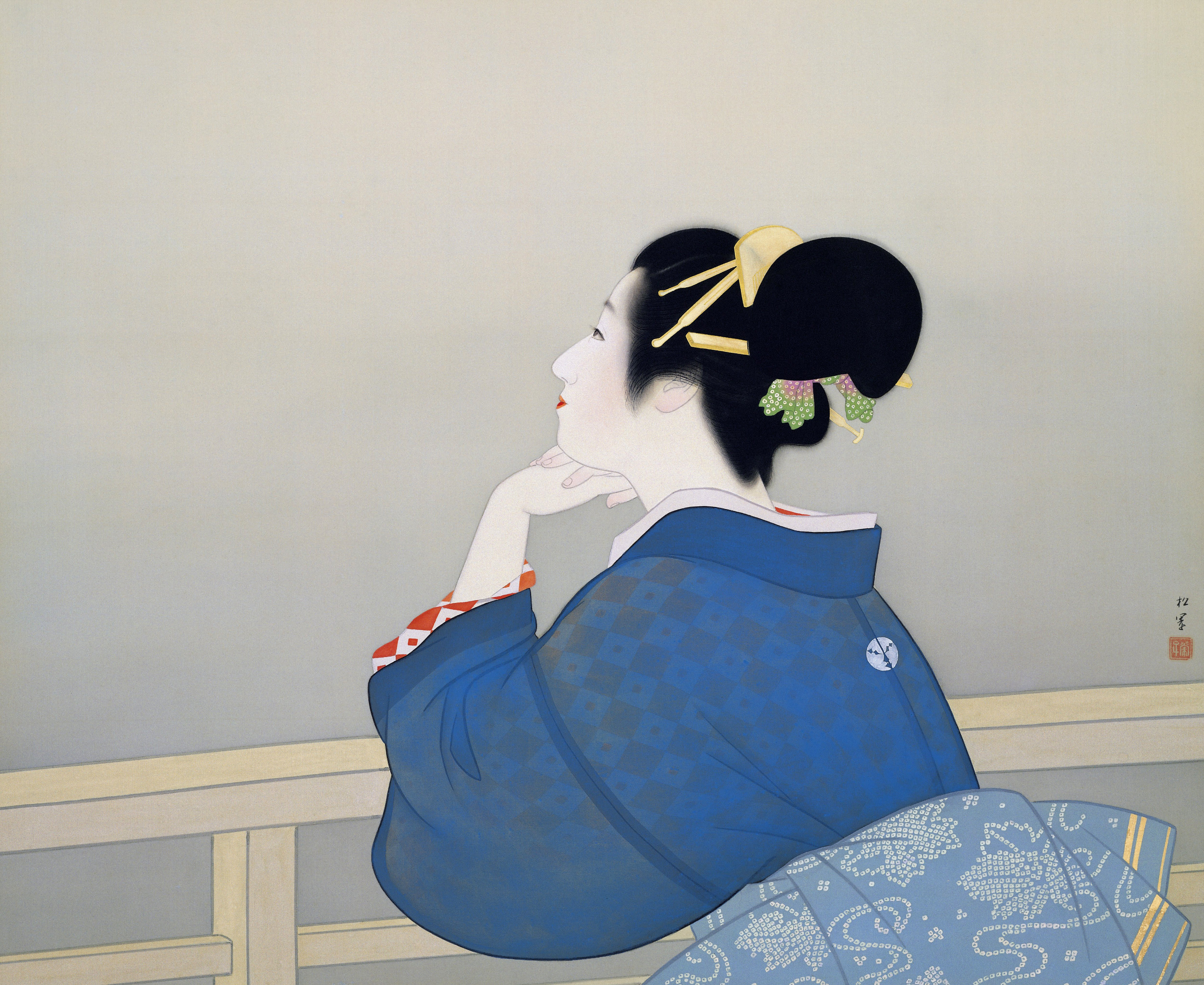
LOOK: Woman Waiting for the Moon to Rise by Uemura Shōen

Uemura Shoen_Woman Waiting for the Moon to Rise
Uemura Shōen (Japanese, 1875–1949), Woman Waiting for the Moon to Rise, 1944. Nihonga watercolor on silk, 73 × 86 cm. Adachi Museum of Art, Yasugi, Japan.

Uemura Shōen, the pseudonym of Uemura Tsune (1875–1949), was a Japanese artist active in the first half of the twentieth century, known primarily for her bijin-ga paintings of beautiful women in the nihonga style. A mold-breaking artist of exceptional skill, “she won international awards and accolades, defied social norms as a single mother of two, and dived into the world of professional painting at a time when women weren’t welcome.” In 1948 she became the first woman to be awarded Japan’s prestigious Order of Culture.

Uemura painted Woman Waiting for the Moon to Rise during World War II, showing a young woman leaning against a bridge railing on a foggy evening, her chin resting on her folded hands and her face looking ahead wistfully. Though the title tells us she’s waiting for the moon to rise, perhaps she’s also waiting for the war to end, for peace to be restored.

LISTEN: “Wait for the Lord” by Jacques Berthier of the Taizé Community, on Alleluia (1988)

Wait for the Lord, whose day is near.
Wait for the Lord: be strong, take heart!

The text of this simple chant comes mainly from Psalm 27:14: “Wait for the LORD; be strong, and let your heart take courage; wait for the LORD!” The chant was written as a responsorial refrain to the reading of another psalm, Psalm 37. As the hymnal Lift Up Your Hearts (2013) instructs congregations: sing the Taizé refrain; read Psalm 37:1–5, sing; read Psalm 37:6–9, sing; read Psalm 37:10–11, 39–40, sing. Like this:

Wait for the Lord, whose day is near.
Wait for the Lord: be strong, take heart!

Do not fret because of the wicked;
    do not be envious of wrongdoers,
for they will soon fade like the grass,
    and wither like the green herb.

Trust in the LORD, and do good;
    so you will live in the land, and enjoy security.
Take delight in the LORD,
    and he will give you the desires of your heart.

Commit your way to the LORD;
    trust in him, and he will act.

Wait for the Lord, whose day is near.
Wait for the Lord: be strong, take heart!

He will make your vindication shine like the light,
    and the justice of your cause like the noonday.

Be still before the LORD, and wait patiently for him;
    do not fret over those who prosper in their way,
    over those who carry out evil devices.

Refrain from anger, and forsake wrath.
    Do not fret—it leads only to evil.
For the wicked shall be cut off,
    but those who wait for the LORD shall inherit the land.

Wait for the Lord, whose day is near.
Wait for the Lord: be strong, take heart!

Yet a little while, and the wicked will be no more;
    though you look diligently for their place, they will not be there.
But the meek shall inherit the land,
    and delight themselves in abundant prosperity.

The salvation of the righteous is from the LORD;
    he is their refuge in the time of trouble.
The LORD helps them and rescues them;
    he rescues them from the wicked, and saves them,
    because they take refuge in him.

Wait for the Lord, whose day is near.
Wait for the Lord: be strong, take heart!

Psalm 37 encourages trust and patience in God, who will one day vindicate the righteous and put wickedness to bed.

Advent Prelude: Out of Darkness

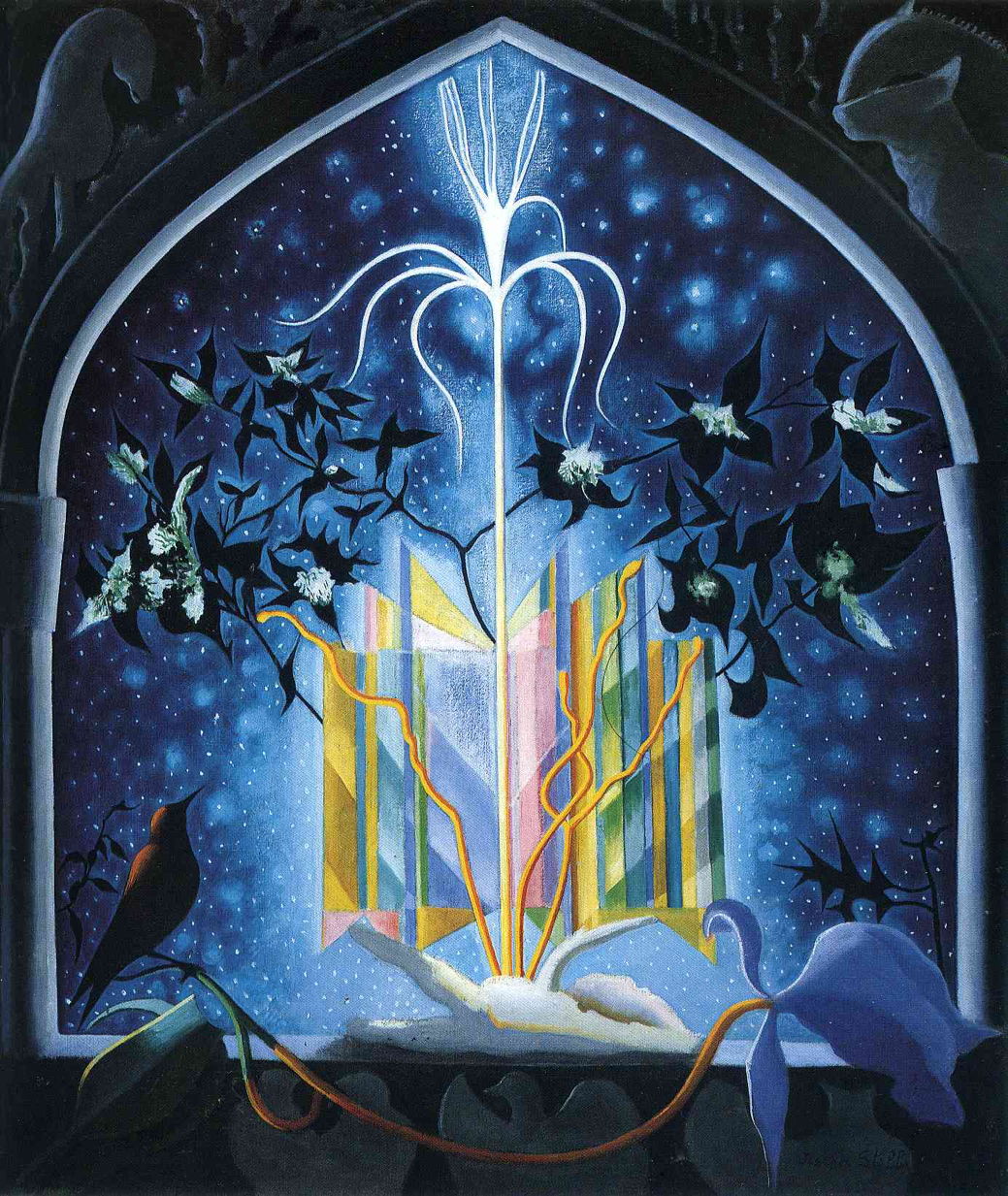
LOOK: Serenade: A Christmas Fantasy by Joseph Stella

Stella, Joseph_Serenade: A Christmas Fantasy
Joseph Stella (Italian American, 1877–1946), Serenade: A Christmas Fantasy (La Fontaine), 1937. Oil on canvas, 43 1/8 × 37 1/8 in. (109.5 × 94.3 cm). Hirshhorn Museum and Sculpture Garden, Washington, DC.

Joseph Stella (1877–1946) [previously] was an Italian American painter who became an important figure in modern art. His Serenade: A Christmas Fantasy is not overtly religious, but it does incorporate a few elements traditionally associated with Christmastime—a starry night sky, a holly branch, an ox and ass, a dove—and has a mystical quality. In the center, a flower emerges from what appears to be a conch shell, its pistil and stamen glowing. The flower’s stem shoots up past an abstract, mobile-like object that could be shards of colorful glass or pieces of cut paper. It’s a visionary composition that is open to multiple readings.

Art historian Judith Zilczer comments on the painting in the exhibition catalog Joseph Stella: The Hirshhorn Museum and Sculpture Garden Collection (Smithsonian Institution, 1983):

Serenade: A Christmas Fantasy typifies Stella’s mature symbolist style. Framed by an arch, a fantastic tree form bisects the composition and serves as the central image of the painting. The colors of the iridescent prism surrounding the central axis recall the abstract geometric style of Stella’s Futurist canvases.

The meaning of Stella’s complex imagery remains elusive. The ox and ass in the upper right spandrel traditionally appear together in paintings of the Nativity. The image of the dove in the center of the lower border is the symbol of the Holy Ghost. These Christian symbols are consistent with the painting’s subtitle, A Christmas Fantasy. The painting is also known as The Fountain (La Fontaine). The treelike form in the center may represent an abstraction of a jet of water. The image of the fountain often served as an attribute of the Virgin Mary, who was regarded as the “fountain of living waters.” It is possible that in this canvas Stella has fused the image of the tree of life with the fountain as the symbol of the Virgin. The nightingale perched on the tendril [of the purple iris] in the lower left is the source of the serenade. (54)

I see in Serenade the promise of Advent—light emerging out of darkness, wondrous new life growing out of dormancy. There’s a coming fullness here, a blossoming. The chromatic spectrum refracted by the center object evokes a rainbow, the sign of God’s covenant with all living creatures in Genesis 9.

LISTEN: “Wonder” by MaMuse (Sarah Nutting and Karisha Longaker), on Prayers for Freedom (2018)

Oooh, I wonder
Oooh, I wonder
Oooh, I wonder
What is to come out of this darkness

I’ve been moving, moving, moving, moving through the darkness
Moving, moving, moving, moving through the darkness
I wonder when the light is cracking open

Oooh, I wonder
Oooh, I am filled with wonder
Oooh, I wonder
What is to come out of this darkness

I thought this candle had long gone out
I thought that it had long gone out
But today, today, today, today I can see
There’s still a flickering, flickering

Oooh, I wonder
Oooh, I wonder
Oooh, I wonder
What is to come out of this darkness

Burn, burn, burn, burning on the inside
Burn, burn, burn, burning like a bright light
Burn, burn, burn, burning on the inside
This light’s still burning, burning bright

I thought this candle had long gone out
I thought that it was long gone out
I thought that this candle had long gone out
But today, today, today, today I can see
There’s more than a flickering

Oooh, I wonder
Oooh, I am filled with wonder
Oooh, I wonder
What is to come out of this darkness

This song was written by MaMuse [previously], an acoustic folk duo who I’d say are “spiritual but not religious,” several years ago on the winter solstice. Watch a live video recording from January 2019 at the Chico Women’s Club in Chico, California, the two’s hometown.

Advent is sometimes mischaracterized as glum, but actually, joyfulness is a key aspect of the season. There’s a somberness, for sure, but it’s married with excitement for what’s coming.

I hope to capture this dual tone of Advent in my selection of art and music over the next twenty-four days. This is the first post in a daily series that will run to the end of Advent on December 24, and then for the duration of Christmas, from December 25 to January 6. Many of the songs in the series can be listened to on the Art & Theology Advent Playlist, Christmastide Playlist, and Epiphany Playlist on Spotify.

In the liturgical calendar, Advent-Christmas-Epiphany is known as the cycle of light. Many churches and families light candles around an Advent wreath, progressively more until Christmas, symbolizing the Light of the World getting nearer, dispelling more of the darkness.

May you be blessed this Advent season as you wonder and explore what is to come out of December’s darkness. May you discern with delight those places where “the light is cracking open,” where God is shining through.