Advent, Day 20: New Jerusalem

And I saw the holy city, the new Jerusalem, coming down out of heaven from God, prepared as a bride adorned for her husband.

—Revelation 21:2

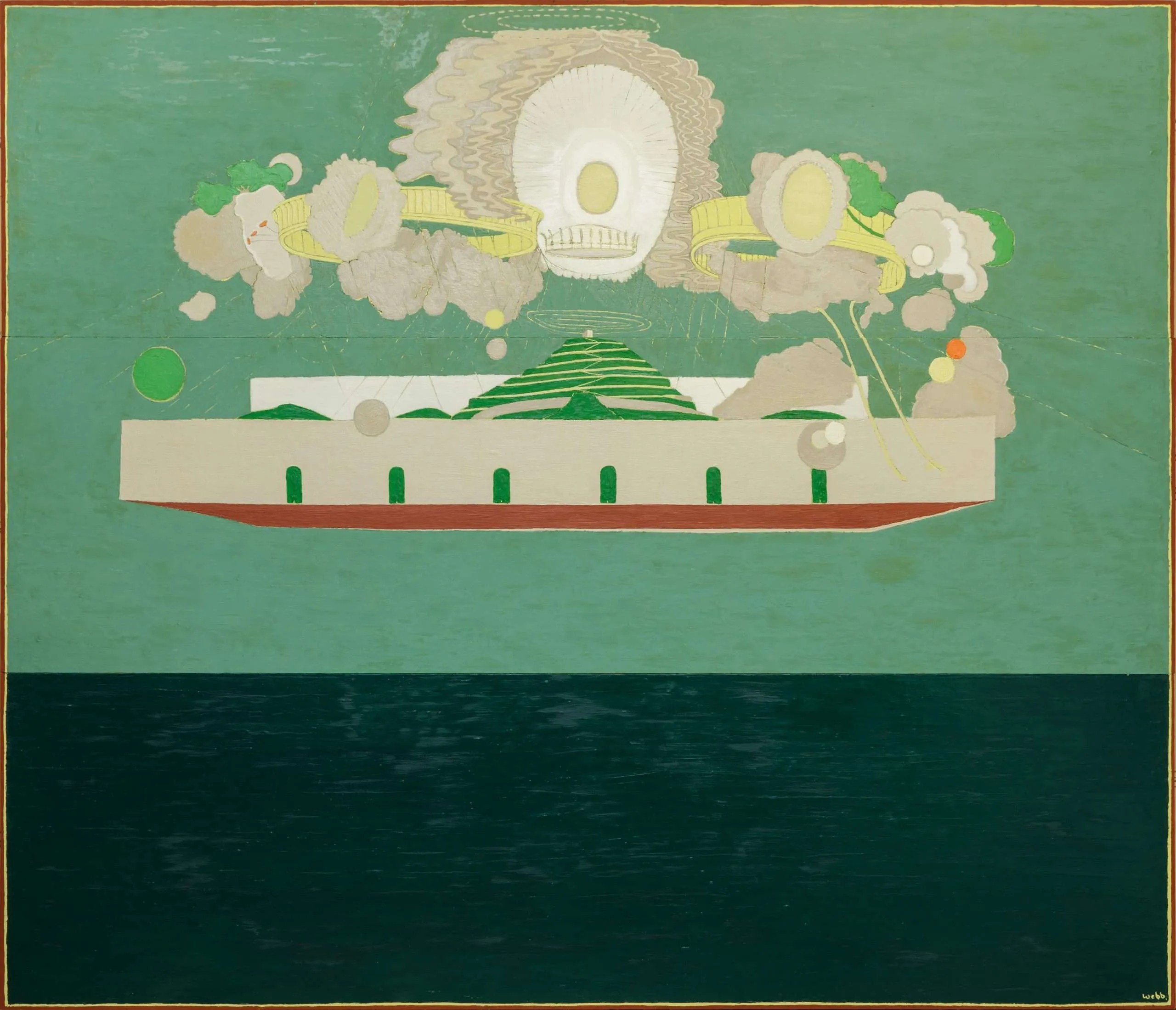
LOOK: Epiphany of the Other by Richard Kenton Webb

Webb, Richard Kenton_Epiphany of the Other
Richard Kenton Webb (British, 1959–), Epiphany of the Other, 2023. Oil pigment on plywood, 183 × 214 cm.

(Related posts: https://artandtheology.org/2017/10/10/grief-and-loss-will-be-undone-artful-devotion/; https://artandtheology.org/2021/12/13/advent-day-16/)

LISTEN: “How Long, Dear Savior” (NORTHFIELD) | Words by Isaac Watts, 1707 | Music by Jeremiah Ingalls, 1805 | Performed by the Boston Camerata, dir. Anne Azéma, 2020

How long, dear Savior, O how long
Shall this bright hour delay?
Fly swifter round, ye wheels of time,
And bring the promised day.

From the third heav’n where God resides,
That holy, happy place,
The new Jerusalem comes down
Adorned with shining grace.

An American Christmas is one of the Boston Camerata’s most popular programs. “It features a generous selection of carols, New England anthems, Southern folk hymns, and religious ballads for the season from the early years of the American republic, and from a wide range of early tune books and manuscripts”—including the shape-note hymn “How Long, Dear Savior” from The Christian Harmony (Exeter, New Hampshire, 1805), an arrangement of a stanza from Isaac Watts’s  “Lo! what a glorious sight appears” to the fuguing tune NORTHFIELD. The Boston Camerata adds a stanza from the same Watts hymn.

The Grace Doherty Library at Centre College in Danville, Kentucky, which owns a first edition of The Christian Harmony, provides biographical information about its compiler, Jeremiah Ingalls, to whom several of the tunes inside are attributed:

A native of Massachusetts who moved to Vermont around 1800, Jeremiah Ingalls (1764-1828) at various times worked as a farmer, cooper, and tavern keeper, in addition to serving as a choirmaster in the Congregational church, teaching singing school and composing music. Ingalls’ Christian Harmony contains many lively melodies, patterned after the secular songs and dances of the day. Such tunes were quite popular among the camp-meeting revival folk. In his hymn “Innocent Sounds,” Ingalls argues for the appropriateness of adopting these melodies for religious use.

The above performance of “How Long, Dear Savior” by the Boston Camerata was filmed at Boston’s historic Old North Church during the 2020 pandemic. To hear the song in a non-concert context, see this video taken at a Sacred Harp singing convention in Texas in 2011:

The “third heaven” refers to the dwelling place of God outside the universe. Beginning in the intertestamental period (ca. 420 BCE–ca. 30 CE), it was a common Jewish belief that God stacked the heavens in layers—as many as seven, but most typically three, sometimes delineated as: Earth’s atmosphere (the first heaven; i.e., the realm of the birds and clouds), interplanetary or interstellar space (the second heaven; i.e., the realm of the sun and stars), and God’s own abode, over and above what we can conceive (the third heaven). The term “third heaven” appears in Jewish apocalyptic and rabbinic texts such as the Testament of Levi 2, the Apocalypse of Moses 37:5, 2 Enoch 8:1, and 3 Baruch 4:7. The apostle Paul also uses it in 2 Corinthians 12:2–4 to describe one of his visionary experiences.

Advent, Day 19: New Day

A new day will dawn on us from above
because our God is loving and merciful.
He will give light to those who live in the dark
and in death’s shadow.
He will guide us into the way of peace.

—the Jewish priest Zechariah, father of John the Baptist, in Luke 1:78–79 (GOD’S WORD Translation)

LOOK: New Morning by David Blow

Blow, David_New Morning
David Blow (American, 1944–), New Morning, 2014. Digitally altered photograph, 28 × 40 in.

David Blow is a nature photographer from Hickory Creek, Texas. “I have developed a language using graphic shapes, colors, and patterns to express a feeling and vibration that I see in my photographs,” he writes on his website. “I am expressing the superstring theory that nothing is static, and that all things vibrate. I am contemplating how we experience nature with more than our sight, rather with all our senses simultaneously. Such as the meditative sounds we hear and see from viewing birds and animals, and the spiritual feeling we have when we are in nature.”

New Morning,” Blow says, “presents a transcendent vision of a new day, serene and harmonious, where we are entirely at one with each other and the source of our being, God. There is a hushed air of reverence in the cathedral-like canopy of tree branches with pairs of doves perched in their branches as a faint yellow light penetrates the blanket of clouds above. These deeply moving experiences of oneness with something larger than ourselves provide us with a glimpse of that wholeness and rest we can only find in God.”

I’m attracted to the rhythmic quality of the image, and the mirror effect that evokes kaleidoscopic viewing. I’m held in a sense that this scene is unfolding dynamically into another.

LISTEN: “There’s a New Day Coming” by Menahan Street Band, feat. Saundra Williams, 2019

There’s a new day coming
Oh, yes, it is
There’s a new day coming
A new day

Ooh, ooh (nah, huh)
Ooh, ooh (mmm)
Ooh, ooh (yeah)
Ooh, ooh
Ooh, ooh (oh, yeah)
Ooh, ooh
Ooh, ooh (oh, woo)
Oh, it’s coming

It’s coming
It’s coming

Menahan Street Band is a Brooklyn-based funk and soul band formed in 2007 by Tommy Brenneck, Dave Guy, Leon Michels, Nick Movshon, Homer Steinweiss, and Mike Deller. (The latter stepped down as a permanent member in 2017.) They are part of the widely acclaimed Daptone Records roster.

The group originally recorded the tune of “There’s a New Day Coming” as a single backing track for the singer Charles Bradley (1948–2017), but it was put aside, unused, after Bradley’s death. Band member Tommy Brenneck later revivified it by adding some simple new lyrics, and the group released the new song on a 45 rpm record, with “Tommy Don’t” on the flip side, in 2019. It features Saundra Williams (of Saun & Starr) on lead vocals.

Advent, Day 18: Day Star

We have also a more sure word of prophecy; whereunto ye do well that ye take heed, as unto a light that shineth in a dark place, until the day dawn, and the day star arise in your hearts.

—2 Peter 1:19 (KJV)

(Related post: https://artandtheology.org/2023/12/19/advent-day-17-yonder-come-day/)

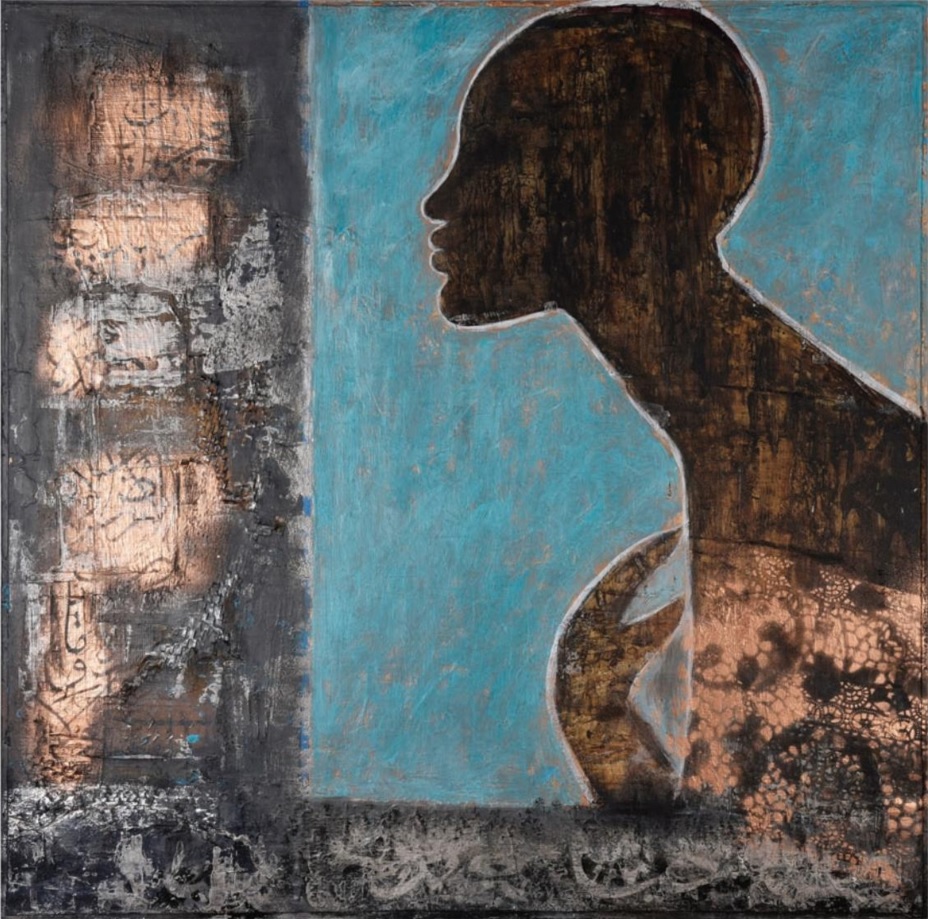
LOOK: Shather Alfairooz (Gold Specks of Turquoise) by Nabeela Al Khayer

Al Khayer, Nabeela_Gold Specks of Turquoise
Nabeela Al Khayer, Shather Alfairooz (Gold Specks of Turquoise), 2017. Mixed media on wood, 80 × 80 cm.

The Bahraini artist Nabeela Al Khayer likes to play with color, fabric, and photographs in her work, often writing poetic notes in Arabic in the borders. She uses resin, oil, acrylic, and watercolors to create texture and movement.

I learned about Al Khayer through CARAVAN [previously], an international nonprofit dedicated to building bridges through the arts, fostering peace, harmony, and wholeness in the world. It was founded in 2009 by Paul G. Chandler, an Anglican clergyman and US citizen. Al Khayer was one of thirty-one contemporary women artists from the Middle East featured in CARAVAN’s exhibition I AM, which opened at the National Gallery of Fine Arts in Amman, Jordan, in 2017. In her statement, she writes that Shather Alfairooz (Gold Specks of Turquoise) “depicts the intangible human emotions that carry in their midst layers of pain, suffering, and love.”

The mixed-media work shows a silhouetted woman in profile, gazing straight ahead at a column of light. She, too, appears to be softly lit from within. Her cupped hand, raised toward her chest, may be a spiritual gesture—perhaps she’s inviting God in, or acknowledging a warm interior sensation.

LISTEN: “Day Star” by the Brothers of Abriem Harp, on Again I Glorify: Demos and Outtakes on the Road to Last Days (2018)

O Day Star, in my heart arise
Cloak my thoughts with thy love
O Day Star, in my heart arise
Greet me as the mourning dove

Sing to me a song of mercy
Sing to me a song of love
O Day Star, in my heart arise
Wake me with the morning light

O Son of mercy, Son of love
Warmth of grace felt from above
Awake my spirit with a song
Let my heart sing at the dawn

Sing, I sing to call you holy
Sing, I sing to praise your name
O Jesus, let this be my song
Let my heart to you belong

The Brothers of Abriem Harp are Joe Kurtz, Josh Compton, Matt Kurtz, and John Finley. This song is an outtake from their excellent album Last Days, which I reviewed here.

Advent, Day 17: Come, My Beloved

What is that coming up from the wilderness like columns of smoke, perfumed with myrrh and frankincense, with all the fragrant powders of a merchant?

—Song of Solomon 3:6 (KJV)

Arise, shine; for thy light is come, and the glory of the LORD is risen upon thee.

—Isaiah 60:1 (KJV)

Awake, awake; put on thy strength, O Zion; put on thy beautiful garments, O Jerusalem, the holy city. . . . Shake thyself from the dust; arise, and sit down, O Jerusalem: loose thyself from the bands of thy neck, O captive daughter of Zion. For thus saith the LORD, Ye have sold yourselves for nought; and ye shall be redeemed without money.

—Isaiah 52:1–3 (KJV)

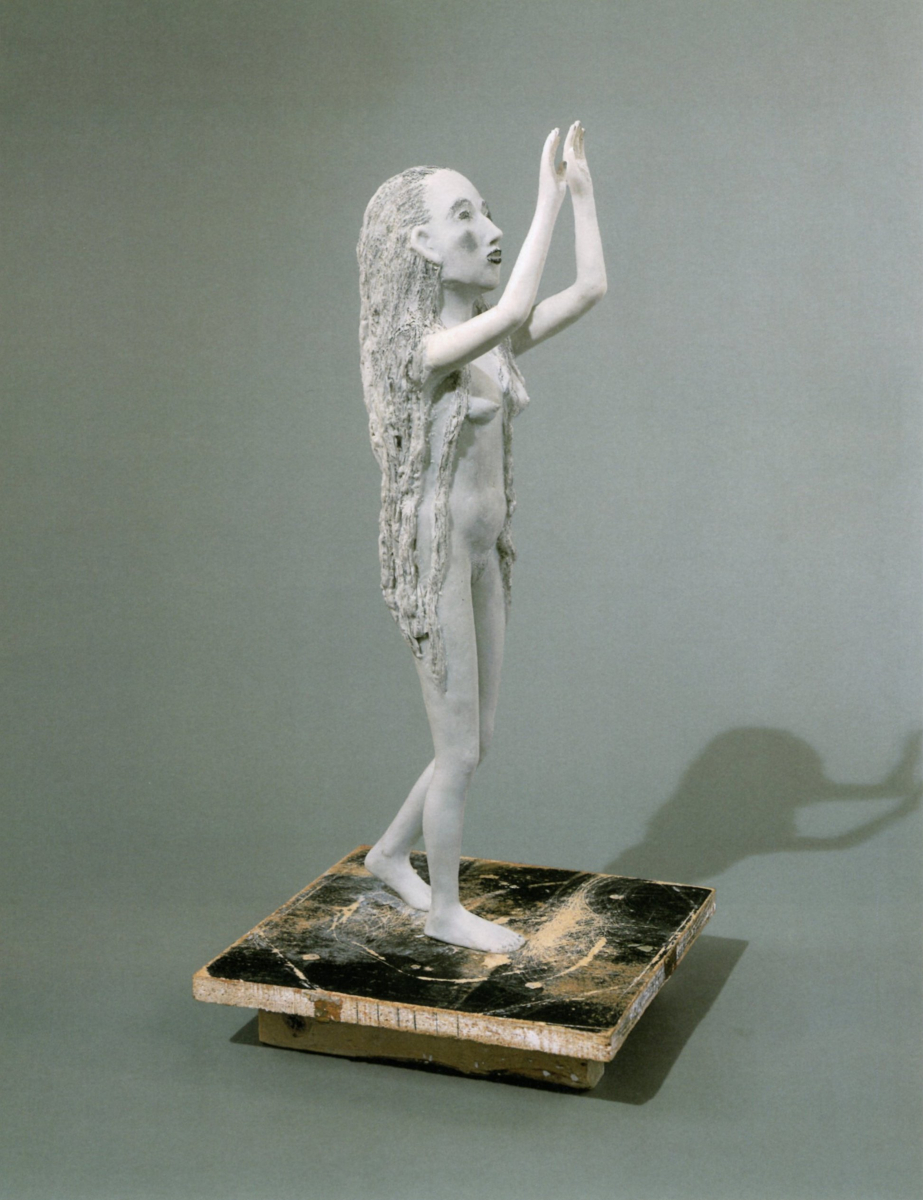
LOOK: Eve by Kiki Smith

Smith, Kiki_Eve
Kiki Smith (American, 1954–), Eve, 2001. Manzini (resin and marble dust) and graphite, 20 3/8 × 5 × 6 3/4 in. (51.8 × 12.7 × 17.1 cm). Source: Kiki Smith: A Gathering, 1980–2005, p. 247

Eve, the mother of all living, a representative of humanity. The crown of God’s creation, and yet she distrusted God’s word, transgressed his command, breaking what was intended to be an eternal communion. In this small sculpture, she looks up, raising her hands in front of her face—in a gesture of prayer or praise? Shielding her eyes from brightness? Could it be she sees redemption on the horizon?

LISTEN: “Lecha Dodi” (Come, My Beloved), traditional Jewish hymn | Words by Shlomo ha-Levi Alkabetz, based on verses from the Hebrew Bible, 16th century | Music by Maayan Tzafrir, 2021 | Sung by Maayan Tzafrir, 2021

(Turn on CC on the video to read the Hebrew lyrics alongside the English.)

ENGLISH TRANSLATION (supplied by 12 Tribes Music):

Rouse yourselves! Rouse yourselves! [Isa. 51:17]
Your light is coming; rise up and shine. [Isa. 60:1]
Awake! Awake! Utter a song.
The glory of God is revealed upon you.

Who is this that cometh up out of the wilderness,
Perfumed with myrrh and frankincense,
With all the fragrant powders of a merchant? [Song of Sol. 3:6]

Shake off the ashes! Rise up from the dust!
Put on your garments of splendor, my people. [Isa. 52:1]
Through the son of Yishai [Jesse] of Bethlehem,
Redemption draws near to my soul.

Awake! Awake! Utter a song,
Let me see thy countenance.
Awake! Awake! Utter a song,
Let me hear thy voice.

When I was a student at UNC–Chapel Hill, I was curious to learn more about the Jewish roots of my Christian faith. I reached out to the Jewish campus organization Hillel, and they invited me to attend their Shabbat dinner, hosted every Friday at sundown at a large house on Cameron Ave.

Most markedly, I remember, before eating, the communal singing of the piyyut (Jewish liturgical poem) “Lecha Dodi” as everyone turned to face the door. I had no idea what the words meant—they were in Hebrew—or what the orientation of bodies was communicating. The song was part of the group’s regular liturgy, familiar to the Jewish students who were gathered, so no introduction or explanation was given, no lyric sheet that I recall. Afterward I asked the rabbi what just happened. “We welcomed in the Shabbat bride,” she said. “The Shekinah.” (The Shekinah is a dwelling or settling of the divine presence. The word is a feminine noun in Hebrew.)

I was puzzled by this statement. It sounded so mystical, challenging my very literalistic sensibilities at the time. The words of the song, by the rabbi and Kabbalist Shlomo ha-Levi Alkabetz (1500–1576), are mostly a composite of scripture texts from the Song of Songs, Isaiah, and elsewhere. Rabbi Shlomo personifies Shabbat (the Sabbath) as a bride, and Israel as her mate. The song anticipates the everlasting Shabbat, ultimate redemption, as the people of Israel ask God to bring about messianic deliverance.

(Related posts: https://artandtheology.org/2024/12/10/advent-day-10-bridegroom-of-the-soul/; https://artandtheology.org/2019/11/26/salvation-is-him-artful-devotion/)

I was taken back to this experience from almost twenty years ago when recently, I came across a version of the “Lecha Dodi” distributed by 12 Tribes Music [previously]. There are hundreds of different tunes for Rabbi Shlomo’s text, from medieval Moorish to northern European folk; but 12 Tribes features a newer setting by the Israeli musician Maayan Tzafrir.

The YouTube video description provides some biographical background:

Maayan Tzafrir is a singer and musician who weaves Balkan and Middle Eastern musical traditions with her Jewish roots. In her music she combines ancient piyutim (chants) with folk melodies. Maayan’s original compositions are inspired by Greek, Bulgarian, Georgian, and Turkish traditions. Maayan is the founder and vocal leader of the Yearot Ensemble, a singer in the Greek band Tavernikos, founder of The Hebrew Balkan Choir, and conductor of various workshops, meetings, and tours focusing on Balkan traditional singing with a Hebrew and feminine spirit.

The lyrics provided for Tzafrir’s version differ slightly from the traditional lyrics. It appears that she uses verses 5 and 4, with complementary material in between.

As a Christian, I can’t help but hear these words in light of Jesus. Several of the Hebrew scripture texts for Jewish Shabbat overlap with the Hebrew scripture texts for the Christian season of Advent, which is itself a dedicated time of looking forward to the arrival of the Messiah, beseeching his coming to dwell.

The phrase “son of Jesse” is a reference to the royal Davidic line from which the Messiah will come—and, in Christian belief, did come, in Jesus of Nazareth, son of Mary, who has since ascended into heaven but has promised to return to bring about the fullness of God’s kingdom.

Awake! Sing! Redemption draweth nigh!

Advent, Day 16: A Great Light

The people who walked in darkness
    have seen a great light;
those who lived in a land of deep darkness—
    on them light has shined.
. . . . . . . . . . . . . . . . . . . . . . . . . .
For a child has been born for us,
    a son given to us;
authority rests upon his shoulders,
    and he is named
Wonderful Counselor, Mighty God,
    Everlasting Father, Prince of Peace.
Great will be his authority,
    and there shall be endless peace
for the throne of David and his kingdom.
    He will establish and uphold it
with justice and with righteousness
    from this time onward and forevermore.
The zeal of the LORD of hosts will do this.

—Isaiah 9:2, 6–7

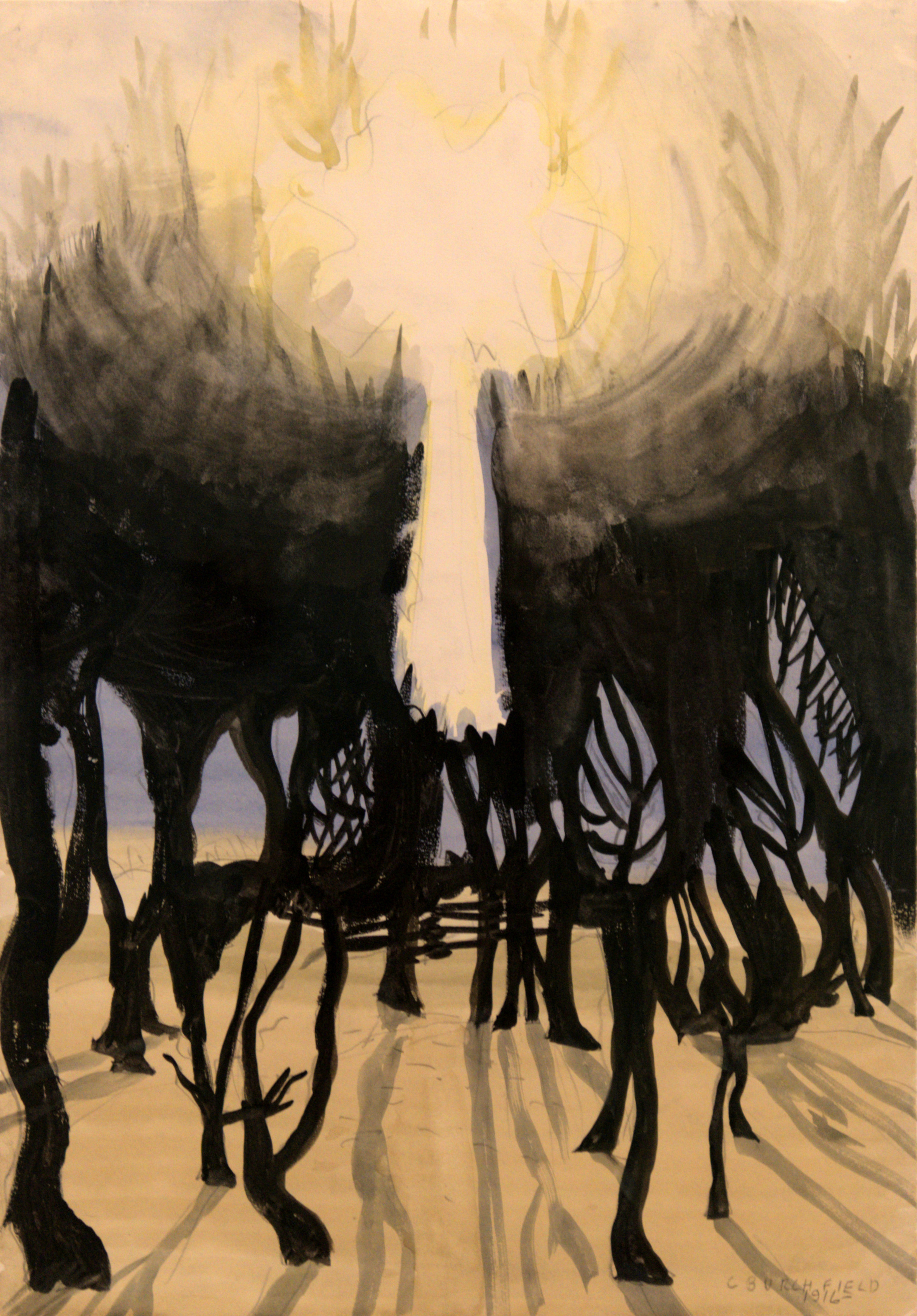
LOOK: Sunlight in Forest by Charles Burchfield

Burchfield, Charles_Sunlight in Forest
Charles Burchfield (American, 1893–1967), Sunlight in Forest, 1916. Watercolor and graphite pencil on paper, 20 × 13 15/16 in. (50.8 × 35.4 cm). Whitney Museum of American Art, New York Photo: Victoria Emily Jones. [object record]

LISTEN: “Isaiah’s Prophecy” | Words by Joanna Forbes L’Estrange, after Isaiah 9:2, 6–7 | Music by Alexander L’Estrange | Performed by London Voices, dir. Ben Parry, with Richard Gowers on organ, on Winter Light (2024)

The people who walked in darkness,
who live in a land of dark,
the people who walked in darkness,
have seen a great light.

Refrain:
And all because a child is born!
To us a son is given.

He’ll be the Wonderful Counselor,
the Everlasting Father.
He’ll be the Wonderful Counselor,
he’ll be the Prince of Peace. [Refrain]

He’ll reign on the throne of David,
establishing and upholding it.
He’ll reign on the throne of David
from then and evermore.

Ending:
And all because a child is born!
And all because a son is giv’n!
The people who walked in darkness
will walk, will walk in the light—
walk in the light!

This work by the British choral composer Alexander L’Estrange has a steady, funky groove, with a time signature that alternates between 7/8, 4/4, and 3/4.

“The contrast between ‘the people who walked in darkness’ and the ‘child is born’ is highlighted by the shift from the harmonic minor tonality of the verses to the major tonality of the refrain,” L’Estrange writes in his composer’s note. “Enjoy the moment at the end of each refrain where the organist stops playing and the choir sings ‘to us a son is given,’ taking us back to the minor for the next verse.”

The score is available from GIA Publications.

Advent, Day 15: Promise

LOOK: the rain bows and the rainbows by Katy Mixon

Mixon, Katy_The rain bows and the rainbows
Katy Mixon (American, 1984–), The rain bows and the rainbows (one day we will switch sides), 2018. Oil paint and used hand rags on muslin, 100 × 138 in.

I saw this quilt by Katy Mixon in December 2021 at the exhibition Break the Mold: New Takes on Traditional Art Making at the North Carolina Museum of Art. I was struck first by its prismatic color, and then by its title—which, the artist told me, comes from a dream she had after her close friend died. To bow, long o, is to bend into a curve; as a noun, a bow is a weapon used to propel an arrow, or a knotted ribbon typically worn by young girls. To bow, short o (as in “ow”), is to incline in respect or submission. The multiple meanings of this homograph open the title to different readings.

But the overall meaning points to the multihued arc that appears in the sky after a rainfall, as sunlight refracts through water vapor.

In the Judeo-Christian tradition, the rainbow is a sign of God’s covenant with Noah and has come to symbolize divine promise more generally, or hope—after the bleakness, beauty.

Mixon’s making process involves upcycling rags, which is itself a kind of redemptive act, saving used scraps and piecing them together into a new whole.

“Katy Mixon’s ‘quilts’ began as an outgrowth of her painting process,” the NCMA exhibition text read. “She routinely wipes her hands, palette knives, and other tools with baby wipes, which she then tosses into her studio’s garbage can. ‘One day [I] looked at the trash and realized it was full of all this hastily discarded color,’ she notes. She began saving the vibrant detritus with no specific purpose in mind, but after remembering her grandmother’s homemade quilts and discovering the famed African American quiltmakers of Gee’s Bend, Alabama, Mixon had a plan for her colorful scraps. ‘For me, the quilted works are alternate endings in the painting’s life cycle,’ Mixon says. ‘Painting as a practice, with the used rags as kaleidoscopic evidence.’”

Describing her technique, Mixon told me: “I compose the pieced tops and work with local longarm quilters to add the batting and backing. I finish each piece with hand stitching, often using crewel embroidery to define brush marks and tonal variations.”

LISTEN: “Joyful” | Words by Kate Bluett | Music by Paul Zach | Performed by Paul Zach with Taylor Leonhardt and Nick Dahlquist, on Christmas Hymns (2022)

The MP3 file of the song is embedded here with Paul Zach’s permission.

Come, O Lord, and make us joyful
as you came to Mary’s womb;
buried deep beneath our sorrows,
where our hopes take root and bloom.
Be the promise that sustains us
through the seasons of the years,
’til at last we see your radiance
when you shine beyond our tears.

Come, O Lord, and show your mercy
as you came in Bethlehem;
let us see the sunlight bursting
through the shadows once again.
Let us hear the song of glory
where the silence held us fast.
We will come to you rejoicing
from the shackles of the past.

Come, O Lord, as living water;
make our deserts green again,
where the wellspring of our laughter
will refresh us like the rain.
After all the years of waiting
for the promise long foretold,
come at last, and let the day break
in the morning of your joy!

Advent, Day 14: Visitation

LOOK: The Visitation by Paulina Krajewska

Krajewska, Paulina_Visitation2
Paulina Krajewska (Polish, 1976–), The Visitation, 2016. Tempera on panel, 35 × 25 cm.

Krajewska, Paulina_Visitation
Paulina Krajewska (Polish, 1976–), The Visitation, 2016. Tempera on panel, 35 × 25 cm.

LISTEN: “Curious Woman” by Tow’rs, on The Holly & the Ivy (2020)

I feel the flames, oh Madonna
I feel the heat of your child
Birthing from all heaven’s glory
Clothed in the brown skin of God
I see a light in the desert
I see it blazing on high
Burning down all preconceived
Notions of who you would be

Refrain:
Call it a sweet, oh, a sweet premonition
We saw no defeat as we labored the weight of the fire
Curious woman, the revolution is your joy

I’ve kept my hopes locked away
I’ve kept my scars in a jar
I thought that love had a limit
Careful not to reach too far
Flipping that table of lies
Breached but I’m breathing just fine
Dear woman, please recognize
Divinity held inside [Refrain]

I feel the flames, oh Madonna
I feel the heat of your child
Birthing from all heaven’s glory
Clothed in the brown skin of God

Advent, Day 13: Bendita seas, María

LOOK: Annunciation by Pablo Sanaguano

Sanaguano, Pablo_Annunciation
Pablo Sanaguano (Ecuadorian, 1964–), Annunciation, 1994. Acrylic on chipboard, 43 × 40 cm. © missio Aachen. [artist’s Facebook page]

In this outdoor Andean Annunciation scene, the angel Gabriel arrives with a gust of wind before Mary, who has a satchel of freshly harvested corn slung over her shoulders. He wears llama or alpaca pants, part of the traditional male dress in the highlands of Ecuador. With his right hand he gestures toward the heavens, and with his left he gestures toward her, as if to say, “Heaven’s coming down to earth—God wants to be made human in you.”

He smiles. She smiles. Her face is illumined by beams of divine grace. She extends her arms to embrace her new vocation as Mother of God.

LISTEN: “Bendita seas, María” (Blessed Are You, Mary) by Ariel Glaser, on Tercer Milenio, 1997 | Performed by Jimena Muñoz with Brother Alex, 2020

En un silencio profundo tejías plegarias
a un Dios que escuchaba tus simples palabras,
pequeña María entregada a su amor.
Y en una tarde tranquila rompiendo el silencio,
las alas de un ángel, sonaban al tiempo
que te saludaba de parte de Dios.​

Estribillo 1:
¡Bendita seas, María, entre toda mujer!
¡Has encontrado gracia a los ojos de Dios!
María, Madre suplicante, ayúdame
también a escucharlo a Él.

Fue la palabra más dulce que tocó la tierra,
la que te propuso cumplir la promesa
de que nacería nuestro Salvador.
«Hágase en mí como has dicho;» respondiste al ángel,
y el Santo Espíritu descendió al instante.
Te habías convertido en Madre de Dios.​

Estribillo 2:
Bendita seas María, hija del Padre,
Esposa del Espíritu, Madre del Emanuel.
María, Madre de Jesús, ayúdame,
también a decir amén.

ENGLISH TRANSLATION (my own):

In profound silence you wove prayers
to a God who heard your simple words,
little Mary, surrendered as you were to his love.
And on a quiet afternoon, breaking the silence,
the wings of an angel sounded
as he greeted you on behalf of God.

Refrain 1:
Blessed are you, Mary, among all women!
You have found favor in the eyes of God!
Mary, supplicating mother, help me
to listen to him too.

It was the sweetest word that touched the earth,
the one that offered you the promise
of the birth of our Savior.
“Let it be done to me according to your word,” you replied to the angel,
and the Holy Spirit descended instantly.
You had become the Mother of God.

Refrain 2:
Blessed are you, Mary, daughter of the Father,
wife of the Spirit, mother of Emmanuel.
Mary, mother of Jesus, help me
also to say amen.

This song marvels at Mary’s unique calling while recognizing that we, too, are called to say yes and amen (“let it be”) to God’s will in our lives, which includes being filled with Christ.

The first two lines of the first refrain combine Elizabeth’s exclamation to Mary in Luke 1:42 (“Blessed are you among women!”) with Gabriel’s declaration in Luke 1:30 (“You have found favor with God”).

The epithets in the second refrain highlight Mary’s relationship to the three persons of the Trinity. She is a child of God the Father, as we all are. But she was also wed to God’s Spirit, experiencing a unique and nonsexual union that resulted in the conception of Jesus, the Son of God. Jesus received his flesh from Mary, and she mothered him from his birth to his death. The title Theotokos—God-bearer, or Mother of God—was formally affirmed for Mary at the Council of Ephesus in 431 and is held true by all three branches of Christianity.

The songwriter, Ariel Glaser, is from Argentina. He describes himself as “a catechist who sings,” teaching Catholic doctrines in schools and churches through traditional methods and song. He and his wife are members of the Convivencia con Dios (CcD), a charismatic Catholic movement made up of both laypeople and religious, both men and women, responding to Jesus’s call in John 17: “Father, may they all be one as you and I are one!” Follow Glaser on Facebook.

The singer, Jimena Muñoz, has been singing and playing guitar since age twelve. In addition to making gospel-centered music, she is also a professor of sacred sciences (a field in Catholic institutions that includes theology, canon law, philosophy, biblical studies, church history, and liturgy), and a pastoral coordinator for CEF (Centro Educativo Franciscano) La Rioja.

Advent, Day 12: Wise and Foolish Virgins

LOOK: The Wise and Foolish Virgins, Norwegian tapestry

Wise and Foolish Virgins (Norway)
The Wise and Foolish Virgins, Norway, 17th century. Wool, bast fiber, 83 1/2 × 61 in. (212.1 × 154.9 cm). Minneapolis Institute of Art, Minneapolis, Minnesota.

The golden age of Norwegian tapestry (billedvev) spans roughly 1550 to 1800. Of all the woven subjects during this period, the Wise and Foolish Virgins was the most popular. The art historian Thor B. Kielland registered a total of seventy-five such tapestries from the seventeenth century alone. Draped over a bed, they would have provided warmth, decoration, and moral instruction. I love their aesthetic!

Jesus’s parable of the wise and foolish virgins comes from Matthew 25. Ten young women are members of a bridal party, and they’re awaiting the arrival of the bridegroom so that the celebration can start. In the tapestry pictured here, the top figures represent the wise virgins, whose oil-filled lamps indicate their readiness to accompany the bridegroom to the wedding feast. Those in the lower register, however, foolishly allowed their lamps to burn out; they weep into their handkerchiefs because the feasting started when they were out replenishing their oil supply, and now they’re too late.

That’s Christ the bridegroom in the upper right.

If I’m honest, this parable is uncomfortable for me. I don’t like that the neglectful women are locked out of the party. I don’t want anyone who wants in to be turned away. I want the bridegroom to show them grace, as the landowner did the day laborers who worked the vineyard for only one hour, giving them the same wage as those who worked for nine. But the parable of the virgins, with its stark sense of finality, is one of Christ’s teachings, so I want to grapple with it, not simply ignore it to suit my own proclivities.

I learned much about the existing body of Ten Virgins tapestries from rural Norway from Laura Berlage’s webinar “Dressing the Wise and Foolish Virgins: What Tapestry Can Teach Us About Women, Dress, and Culture in 16th and 17th Century Norway,” presented on July 17, 2023. She says the tapestries were made by women (unlike those produced by the guilds in Flanders and Paris), for women (they were used as bridal coverlets and included in dowries). They preached preparedness for young wives. “Good comes to those who are prepared,” Berlage elaborates; “you can’t get to heaven by borrowing someone else’s spiritual work.”

Regarding the headwear, Berlage clarifies: “The crowns the virgins wear are not because they’re princesses. There is a special tradition in Norway of wearing a crown at your wedding, which is an ancient nod to the Norse goddess Freja (later said to be an emblem of the Virgin Mary).”

Over time, Berlage says, the original meaning of the parable got lost, such that weavers no longer differentiated between the two sets of virgins, for example. She calls this phenomenon “image decay” and compares it to the telephone game.

For a shorter, less academic lesson on the ten virgins in Norwegian tapestry, see the six-minute video “Woven Wise and Foolish Virgins” by Robbie LaFleur:

LISTEN: “Himmelriket Liknas Vid Tio Jungfrur” (The Kingdom of Heaven Is Like Unto Ten Virgins) | Words from Then Swenska Psalmboken (The Swedish Hymnbook), 1697 | Traditional melody from Mockfjärd, collected by Nils Andersson in 1907 from Anders Frisell | Performed by Margareta Jonth on the album Religious Folk-Songs from Dalecarlia, 1977, reissued 1994

Himnelriket liknas vid tio jungfrur
som voro av olika kynne.
Fem månde oss visa vår tröga natur
Vårt sömnig och syndiga sinne.
Gud nåde oss syndare arma.

Vår brudgum drog bort uti främmande land
Och månde de jungfrur befalla
Sig möta med ljus och lampor i hand
Enär som han ville dem kalla.
De fävitske dröjde för länge.

De ropa: O Herre, o Herre låt opp,
Låt oss icke bliva utslutna!
Men ute var nåden, all väntan, allt hopp
Ty bliva de arma förskjutna
Till helvetets jämmer och pina.

Så låter oss vaka och hava det nit
Att tron och vår kärlek må brinna.
Vi måge här följa vår brudgum med flit
Och eviga salighet finna.
Det himmelska bröllopet. Amen.
The kingdom of heaven is like unto ten virgins
Who were of different character.
Five showed us our slothful nature,
Our sleepy and sinful selves.
God have mercy on us poor sinners.

Our bridegroom traveled in foreign lands
And ordered the virgins
To meet him with lighted lamp in hand
Whenever he called them.
The foolish ones waited too long.

They cry, “O Lord, O Lord, open up,
Let us not be locked out!”
But it was too late for mercy, for waiting, for hope,
For the poor souls were cast
Into hell’s wailing and torment.

So let us watch and show zeal
That faith and our love may burn.
Let us follow our bridegroom diligently
And find eternal bliss,
The heavenly wedding. Amen.

Trans. William Jewson (source: liner notes)

Advent, Day 11: He’ll Outshine the Sun

His face was like the sun shining with full force.

—Revelation 1:16

[. . .] make ready for the Face that speaks like lightning,
Uttering the new name of your exultation
Deep in the vitals of your soul.
Make ready for the Christ, Whose smile, like lightning,
Sets free the song of everlasting glory
That now sleeps, in your paper flesh, like dynamite.

—Thomas Merton, from “The Victory” (1946)

LOOK: Portrait of Jesus by Hatigammana Uttarananda

Uttarananda, Hatigammana_Portrait of Jesus
Hatigammana Uttarananda (Sri Lankan, 1954–), Portrait of Jesus, 1996. Oil on canvas, 72 × 61 cm. © missio Aachen.

Hatigammana Uttarananda is a Sri Lankan Buddhist monk, artist, and scholar. His friendship with Fr. Aloysius Pieris, SJ—a Jesuit priest, liberation theologian, and founding director of the Tulana Research Centre for Encounter and Dialogue in Kelaniya—led him to study the Christian Gospels and to portray some of its stories in his paintings.

In his semiabstract Portrait of Jesus, Christ’s face gives off a deep radiance. He is both enlightened and enlightening.

“Bikku Uttarananda portrays Jesus with lowered eyelids, the enlightened one who has found the true meaning of life and is united in compassion with the suffering of all beings,” writes the Christian theologian Wesley Ariarajah in Christ for All People: Celebrating a World of Christian Art. “The rays of the light of life burst through his forehead; the colours are those of the saffron robes of the Buddhist monk and the fire of self-giving.”

LISTEN: “When Jesus Comes,” African American spiritual | Arranged by Alice Parker, 1988, and performed by The Musicians of Melodious Accord on Listen, Lord: A Cantata, Two Suites, and Eight Spirituals, 2010

When Jesus comes, he’ll outshine the sun
Outshine the sun
Outshine the sun
When Jesus comes, he’ll outshine the sun
Look away beyond the moon

When Jesus comes, we’ll sing Hosiana! . . .

When Jesus comes, we’ll shout Hallelujah! . . .

If you want to see King Jesus, keep prayin’ on . . .

Alice Parker (1925–2023) was an American composer, arranger, conductor, and teacher whose arrangements of hymns, spirituals, and folk songs of American, French, Spanish, Hebrew, and Ladino origin have become part of the repertoire of choirs around the world. In addition to arrangements, she also wrote original works, including operas, song cycles, cantatas, choral suites, and hymns. In 1985 she founded the professional choir Melodious Accord, with whom she released fourteen albums.

For the African American spiritual “When Jesus Comes,” she cites her source as The Negro Sings a New Heaven, a collection compiled by Mary Allen Grissom (University of North Carolina Press, 1930).