LOOK: the rain bows and the rainbows by Katy Mixon
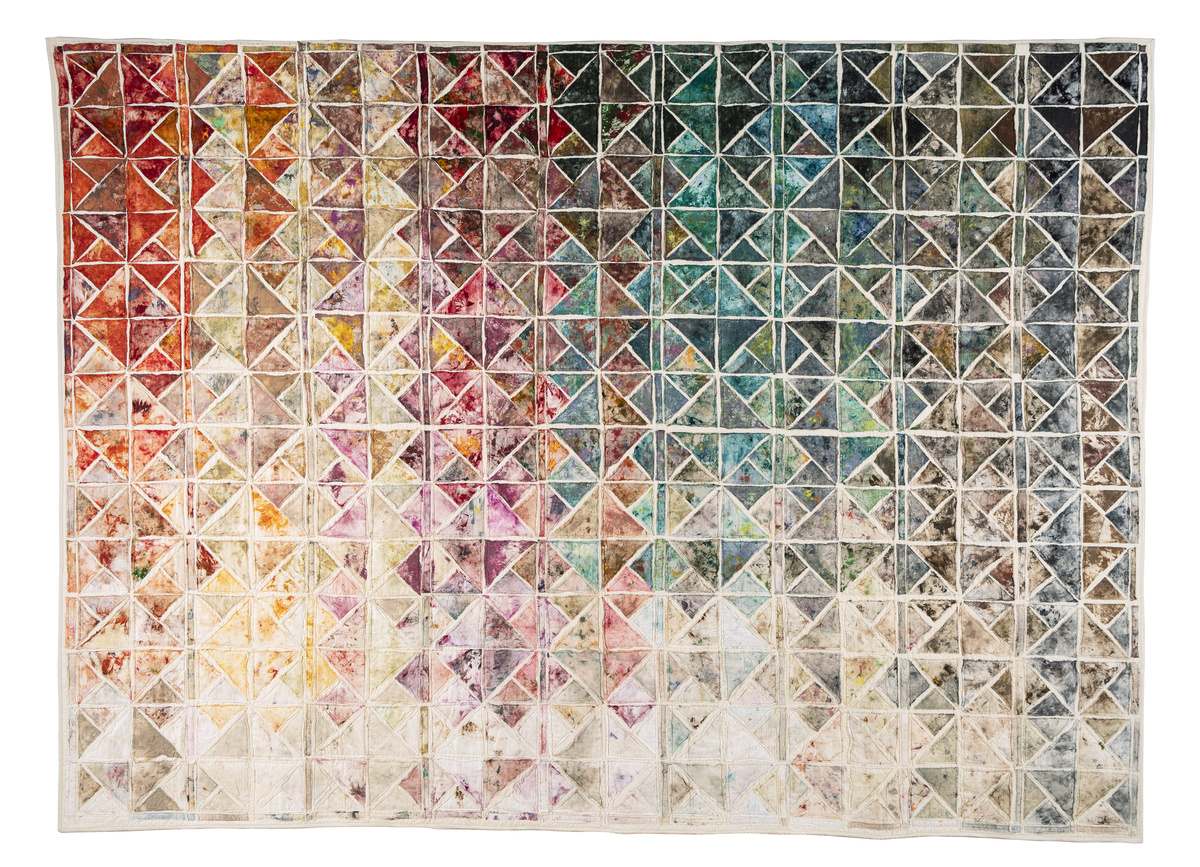
Katy Mixon (American, 1984–), The rain bows and the rainbows (one day we will switch sides), 2018. Oil paint and used hand rags on muslin, 100 × 138 in.
I saw this quilt by Katy Mixon in December 2021 at the exhibition Break the Mold: New Takes on Traditional Art Making at the North Carolina Museum of Art. I was struck first by its prismatic color, and then by its title—which, the artist told me, comes from a dream she had after her close friend died. To bow, long o, is to bend into a curve; as a noun, a bow is a weapon used to propel an arrow, or a knotted ribbon typically worn by young girls. To bow, short o (as in “ow”), is to incline in respect or submission. The multiple meanings of this homograph open the title to different readings.
But the overall meaning points to the multihued arc that appears in the sky after a rainfall, as sunlight refracts through water vapor.
In the Judeo-Christian tradition, the rainbow is a sign of God’s covenant with Noah and has come to symbolize divine promise more generally, or hope—after the bleakness, beauty.
Mixon’s making process involves upcycling rags, which is itself a kind of redemptive act, saving used scraps and piecing them together into a new whole.
“Katy Mixon’s ‘quilts’ began as an outgrowth of her painting process,” the NCMA exhibition text read. “She routinely wipes her hands, palette knives, and other tools with baby wipes, which she then tosses into her studio’s garbage can. ‘One day [I] looked at the trash and realized it was full of all this hastily discarded color,’ she notes. She began saving the vibrant detritus with no specific purpose in mind, but after remembering her grandmother’s homemade quilts and discovering the famed African American quiltmakers of Gee’s Bend, Alabama, Mixon had a plan for her colorful scraps. ‘For me, the quilted works are alternate endings in the painting’s life cycle,’ Mixon says. ‘Painting as a practice, with the used rags as kaleidoscopic evidence.’”
Describing her technique, Mixon told me: “I compose the pieced tops and work with local longarm quilters to add the batting and backing. I finish each piece with hand stitching, often using crewel embroidery to define brush marks and tonal variations.”
LISTEN: “Joyful” | Words by Kate Bluett | Music by Paul Zach | Performed by Paul Zach with Taylor Leonhardt and Nick Dahlquist, on Christmas Hymns (2022)
The MP3 file of the song is embedded here with Paul Zach’s permission.
Come, O Lord, and make us joyful as you came to Mary’s womb; buried deep beneath our sorrows, where our hopes take root and bloom. Be the promise that sustains us through the seasons of the years, ’til at last we see your radiance when you shine beyond our tears.
Come, O Lord, and show your mercy as you came in Bethlehem; let us see the sunlight bursting through the shadows once again. Let us hear the song of glory where the silence held us fast. We will come to you rejoicing from the shackles of the past.
Come, O Lord, as living water; make our deserts green again, where the wellspring of our laughter will refresh us like the rain. After all the years of waiting for the promise long foretold, come at last, and let the day break in the morning of your joy!
I feel the flames, oh Madonna I feel the heat of your child Birthing from all heaven’s glory Clothed in the brown skin of God I see a light in the desert I see it blazing on high Burning down all preconceived Notions of who you would be
Refrain: Call it a sweet, oh, a sweet premonition We saw no defeat as we labored the weight of the fire Curious woman, the revolution is your joy
I’ve kept my hopes locked away I’ve kept my scars in a jar I thought that love had a limit Careful not to reach too far Flipping that table of lies Breached but I’m breathing just fine Dear woman, please recognize Divinity held inside [Refrain]
I feel the flames, oh Madonna I feel the heat of your child Birthing from all heaven’s glory Clothed in the brown skin of God
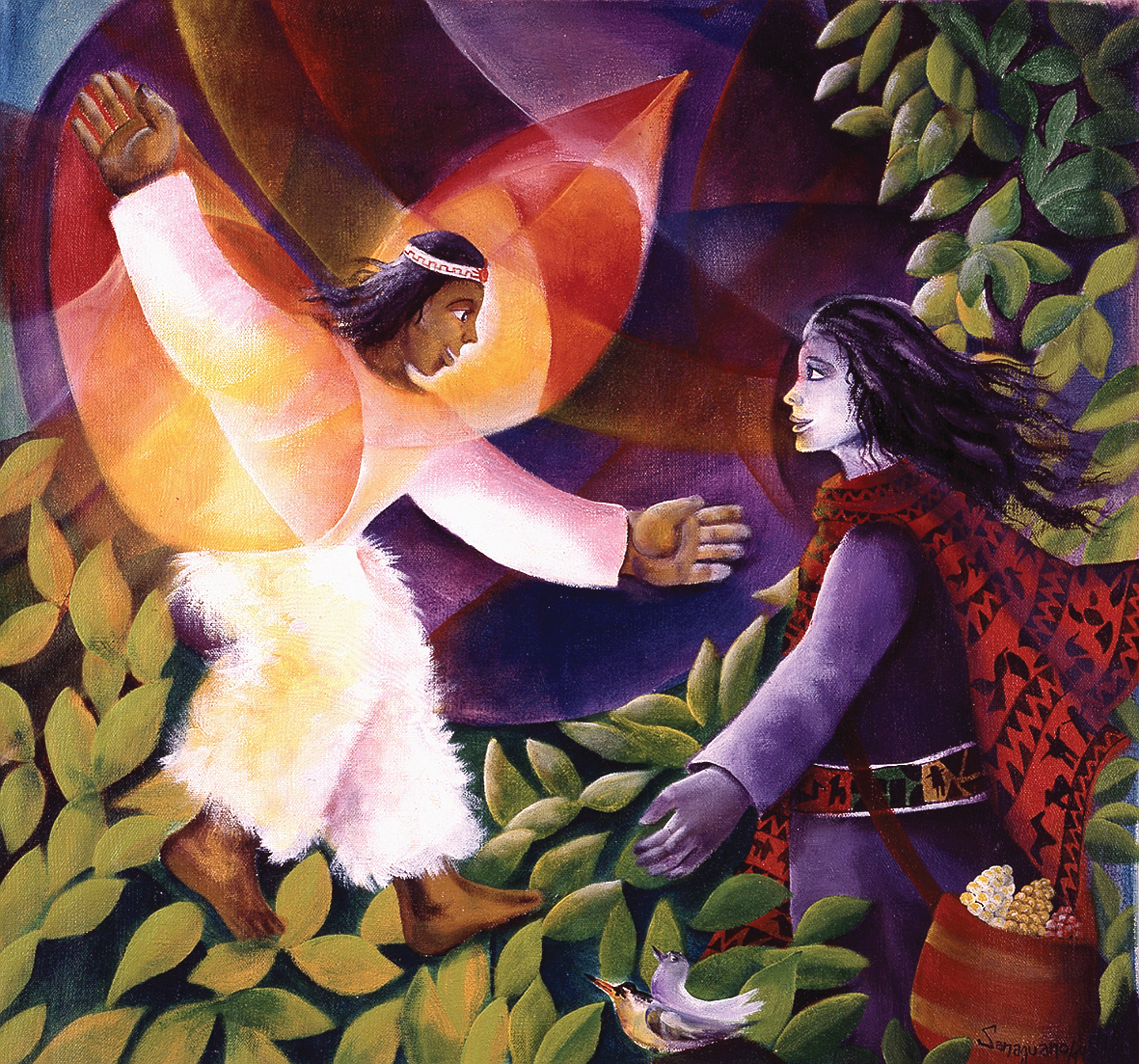
In this outdoor Andean Annunciation scene, the angel Gabriel arrives with a gust of wind before Mary, who has a satchel of freshly harvested corn slung over her shoulders. He wears llama or alpaca pants, part of the traditional male dress in the highlands of Ecuador. With his right hand he gestures toward the heavens, and with his left he gestures toward her, as if to say, “Heaven’s coming down to earth—God wants to be made human in you.”
He smiles. She smiles. Her face is illumined by beams of divine grace. She extends her arms to embrace her new vocation as Mother of God.
LISTEN: “Bendita seas, María” (Blessed Are You, Mary) by Ariel Glaser, on Tercer Milenio, 1997 | Performed by Jimena Muñoz with Brother Alex, 2020
En un silencio profundo tejías plegarias a un Dios que escuchaba tus simples palabras, pequeña María entregada a su amor. Y en una tarde tranquila rompiendo el silencio, las alas de un ángel, sonaban al tiempo que te saludaba de parte de Dios.
Estribillo 1: ¡Bendita seas, María, entre toda mujer! ¡Has encontrado gracia a los ojos de Dios! María, Madre suplicante, ayúdame también a escucharlo a Él.
Fue la palabra más dulce que tocó la tierra, la que te propuso cumplir la promesa de que nacería nuestro Salvador. «Hágase en mí como has dicho;» respondiste al ángel, y el Santo Espíritu descendió al instante. Te habías convertido en Madre de Dios.
Estribillo 2: Bendita seas María, hija del Padre, Esposa del Espíritu, Madre del Emanuel. María, Madre de Jesús, ayúdame, también a decir amén.
ENGLISH TRANSLATION (my own):
In profound silence you wove prayers to a God who heard your simple words, little Mary, surrendered as you were to his love. And on a quiet afternoon, breaking the silence, the wings of an angel sounded as he greeted you on behalf of God.
Refrain 1: Blessed are you, Mary, among all women! You have found favor in the eyes of God! Mary, supplicating mother, help me to listen to him too.
It was the sweetest word that touched the earth, the one that offered you the promise of the birth of our Savior. “Let it be done to me according to your word,” you replied to the angel, and the Holy Spirit descended instantly. You had become the Mother of God.
Refrain 2: Blessed are you, Mary, daughter of the Father, wife of the Spirit, mother of Emmanuel. Mary, mother of Jesus, help me also to say amen.
This song marvels at Mary’s unique calling while recognizing that we, too, are called to say yes and amen (“let it be”) to God’s will in our lives, which includes being filled with Christ.
The first two lines of the first refrain combine Elizabeth’s exclamation to Mary in Luke 1:42 (“Blessed are you among women!”) with Gabriel’s declaration in Luke 1:30 (“You have found favor with God”).
The epithets in the second refrain highlight Mary’s relationship to the three persons of the Trinity. She is a child of God the Father, as we all are. But she was also wed to God’s Spirit, experiencing a unique and nonsexual union that resulted in the conception of Jesus, the Son of God. Jesus received his flesh from Mary, and she mothered him from his birth to his death. The title Theotokos—God-bearer, or Mother of God—was formally affirmed for Mary at the Council of Ephesus in 431 and is held true by all three branches of Christianity.
The songwriter, Ariel Glaser, is from Argentina. He describes himself as “a catechist who sings,” teaching Catholic doctrines in schools and churches through traditional methods and song. He and his wife are members of the Convivencia con Dios (CcD), a charismatic Catholic movement made up of both laypeople and religious, both men and women, responding to Jesus’s call in John 17: “Father, may they all be one as you and I are one!” Follow Glaser on Facebook.
The singer, Jimena Muñoz, has been singing and playing guitar since age twelve. In addition to making gospel-centered music, she is also a professor of sacred sciences (a field in Catholic institutions that includes theology, canon law, philosophy, biblical studies, church history, and liturgy), and a pastoral coordinator for CEF (Centro Educativo Franciscano) La Rioja.
LOOK: The Wise and Foolish Virgins, Norwegian tapestry
The Wise and Foolish Virgins, Norway, 17th century. Wool, bast fiber, 83 1/2 × 61 in. (212.1 × 154.9 cm). Minneapolis Institute of Art, Minneapolis, Minnesota.
The golden age of Norwegian tapestry (billedvev) spans roughly 1550 to 1800. Of all the woven subjects during this period, the Wise and Foolish Virgins was the most popular. The art historian Thor B. Kielland registered a total of seventy-five such tapestries from the seventeenth century alone. Draped over a bed, they would have provided warmth, decoration, and moral instruction. I love their aesthetic!
Jesus’s parable of the wise and foolish virgins comes from Matthew 25. Ten young women are members of a bridal party, and they’re awaiting the arrival of the bridegroom so that the celebration can start. In the tapestry pictured here, the top figures represent the wise virgins, whose oil-filled lamps indicate their readiness to accompany the bridegroom to the wedding feast. Those in the lower register, however, foolishly allowed their lamps to burn out; they weep into their handkerchiefs because the feasting started when they were out replenishing their oil supply, and now they’re too late.
That’s Christ the bridegroom in the upper right.
If I’m honest, this parable is uncomfortable for me. I don’t like that the neglectful women are locked out of the party. I don’t want anyone who wants in to be turned away. I want the bridegroom to show them grace, as the landowner did the day laborers who worked the vineyard for only one hour, giving them the same wage as those who worked for nine. But the parable of the virgins, with its stark sense of finality, is one of Christ’s teachings, so I want to grapple with it, not simply ignore it to suit my own proclivities.
I learned much about the existing body of Ten Virgins tapestries from rural Norway from Laura Berlage’s webinar “Dressing the Wise and Foolish Virgins: What Tapestry Can Teach Us About Women, Dress, and Culture in 16th and 17th Century Norway,” presented on July 17, 2023. She says the tapestries were made by women (unlike those produced by the guilds in Flanders and Paris), for women (they were used as bridal coverlets and included in dowries). They preached preparedness for young wives. “Good comes to those who are prepared,” Berlage elaborates; “you can’t get to heaven by borrowing someone else’s spiritual work.”
Regarding the headwear, Berlage clarifies: “The crowns the virgins wear are not because they’re princesses. There is a special tradition in Norway of wearing a crown at your wedding, which is an ancient nod to the Norse goddess Freja (later said to be an emblem of the Virgin Mary).”
Over time, Berlage says, the original meaning of the parable got lost, such that weavers no longer differentiated between the two sets of virgins, for example. She calls this phenomenon “image decay” and compares it to the telephone game.
For a shorter, less academic lesson on the ten virgins in Norwegian tapestry, see the six-minute video “Woven Wise and Foolish Virgins” by Robbie LaFleur:
LISTEN: “Himmelriket Liknas Vid Tio Jungfrur” (The Kingdom of Heaven Is Like Unto Ten Virgins) | Words from Then Swenska Psalmboken (The Swedish Hymnbook), 1697 | Traditional melody from Mockfjärd, collected by Nils Andersson in 1907 from Anders Frisell | Performed by Margareta Jonth on the album Religious Folk-Songs from Dalecarlia, 1977, reissued 1994
Himnelriket liknas vid tio jungfrur
som voro av olika kynne.
Fem månde oss visa vår tröga natur
Vårt sömnig och syndiga sinne.
Gud nåde oss syndare arma.

Vår brudgum drog bort uti främmande land
Och månde de jungfrur befalla
Sig möta med ljus och lampor i hand
Enär som han ville dem kalla.
De fävitske dröjde för länge.

De ropa: O Herre, o Herre låt opp,
Låt oss icke bliva utslutna!
Men ute var nåden, all väntan, allt hopp
Ty bliva de arma förskjutna
Till helvetets jämmer och pina.

Så låter oss vaka och hava det nit
Att tron och vår kärlek må brinna.
Vi måge här följa vår brudgum med flit
Och eviga salighet finna.
Det himmelska bröllopet. Amen.
The kingdom of heaven is like unto ten virgins Who were of different character. Five showed us our slothful nature, Our sleepy and sinful selves. God have mercy on us poor sinners.
Our bridegroom traveled in foreign lands And ordered the virgins To meet him with lighted lamp in hand Whenever he called them. The foolish ones waited too long.
They cry, “O Lord, O Lord, open up, Let us not be locked out!” But it was too late for mercy, for waiting, for hope, For the poor souls were cast Into hell’s wailing and torment.
So let us watch and show zeal That faith and our love may burn. Let us follow our bridegroom diligently And find eternal bliss, The heavenly wedding. Amen.
His face was like the sun shining with full force.
—Revelation 1:16
[. . .] make ready for the Face that speaks like lightning, Uttering the new name of your exultation Deep in the vitals of your soul. Make ready for the Christ, Whose smile, like lightning, Sets free the song of everlasting glory That now sleeps, in your paper flesh, like dynamite.
—Thomas Merton, from “The Victory” (1946)
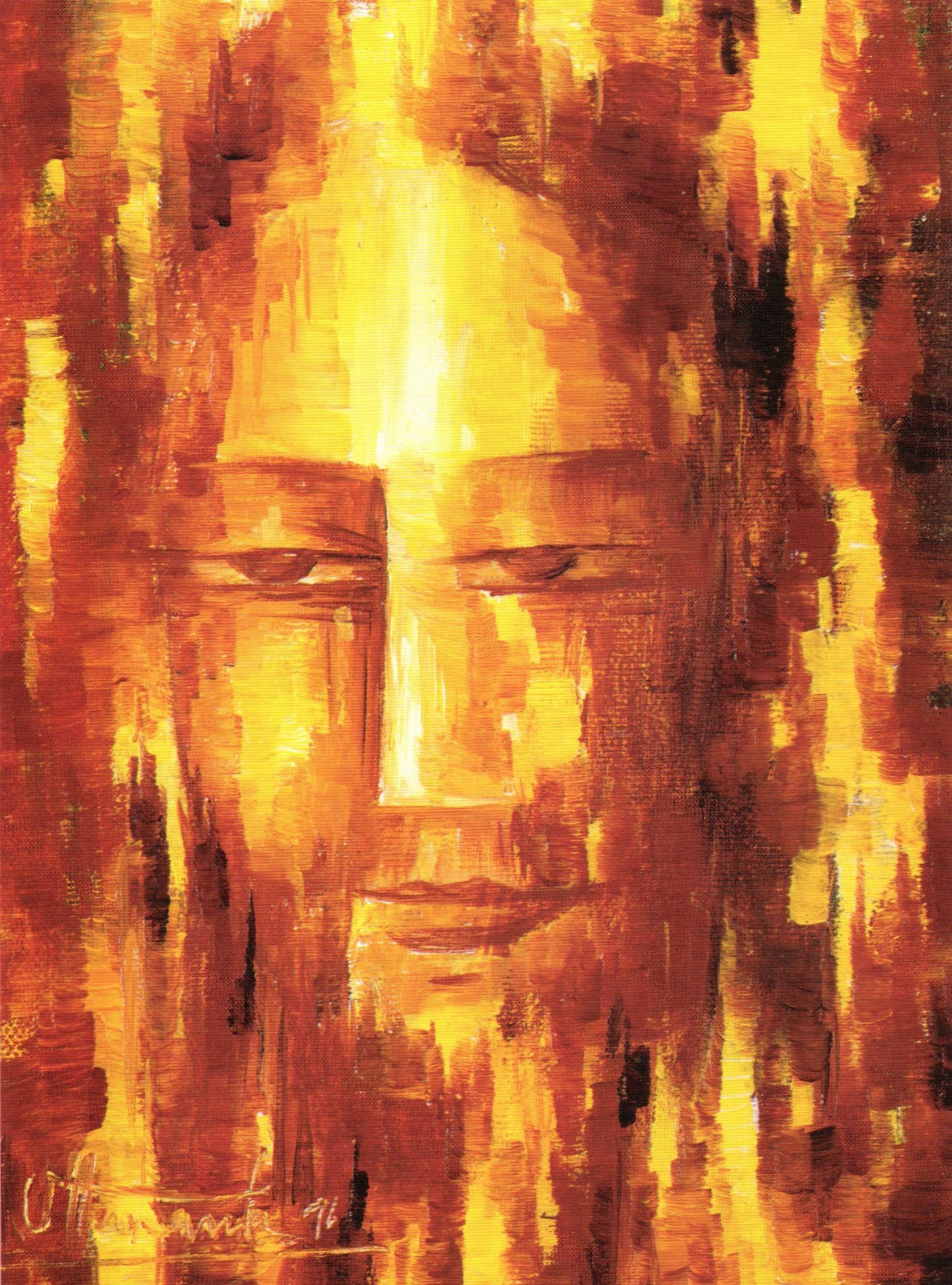
LOOK: Portrait of Jesus by Hatigammana Uttarananda
Hatigammana Uttarananda is a Sri Lankan Buddhist monk, artist, and scholar. His friendship with Fr. Aloysius Pieris, SJ—a Jesuit priest, liberation theologian, and founding director of the Tulana Research Centre for Encounter and Dialogue in Kelaniya—led him to study the Christian Gospels and to portray some of its stories in his paintings.
In his semiabstract Portrait of Jesus, Christ’s face gives off a deep radiance. He is both enlightened and enlightening.
“Bikku Uttarananda portrays Jesus with lowered eyelids, the enlightened one who has found the true meaning of life and is united in compassion with the suffering of all beings,” writes the Christian theologian Wesley Ariarajah in Christ for All People: Celebrating a World of Christian Art. “The rays of the light of life burst through his forehead; the colours are those of the saffron robes of the Buddhist monk and the fire of self-giving.”
LISTEN: “When Jesus Comes,” African American spiritual | Arranged by Alice Parker, 1988, and performed by The Musicians of Melodious Accord on Listen, Lord: A Cantata, Two Suites, and Eight Spirituals, 2010
When Jesus comes, he’ll outshine the sun Outshine the sun Outshine the sun When Jesus comes, he’ll outshine the sun Look away beyond the moon
When Jesus comes, we’ll sing Hosiana! . . .
When Jesus comes, we’ll shout Hallelujah! . . .
If you want to see King Jesus, keep prayin’ on . . .
Alice Parker (1925–2023) was an American composer, arranger, conductor, and teacher whose arrangements of hymns, spirituals, and folk songs of American, French, Spanish, Hebrew, and Ladino origin have become part of the repertoire of choirs around the world. In addition to arrangements, she also wrote original works, including operas, song cycles, cantatas, choral suites, and hymns. In 1985 she founded the professional choir Melodious Accord, with whom she released fourteen albums.
For the African American spiritual “When Jesus Comes,” she cites her source as The Negro Sings a New Heaven, a collection compiled by Mary Allen Grissom (University of North Carolina Press, 1930).
I saw one like a son of man coming with the clouds of heaven. And he came to the Ancient One and was presented before him.
—Daniel 7:13
“Immediately after the suffering of those days
the sun will be darkened, and the moon will not give its light; the stars will fall from heaven, and the powers of heaven will be shaken.
“Then the sign of the Son of Man will appear in heaven, and then all the tribes of the earth will mourn, and they will see ‘the Son of Man coming on the clouds of heaven’ with power and great glory. And he will send out his angels with a loud trumpet call, and they will gather his elect from the four winds, from one end of heaven to the other.”
—Matthew 24:29–31
“. . . you will see the Son of Man seated at the right hand of Power and coming on the clouds of heaven.”
—Matthew 26:64
Look! He is coming with the clouds; every eye will see him, even those who pierced him, and all the tribes of the earth will wail on account of him.
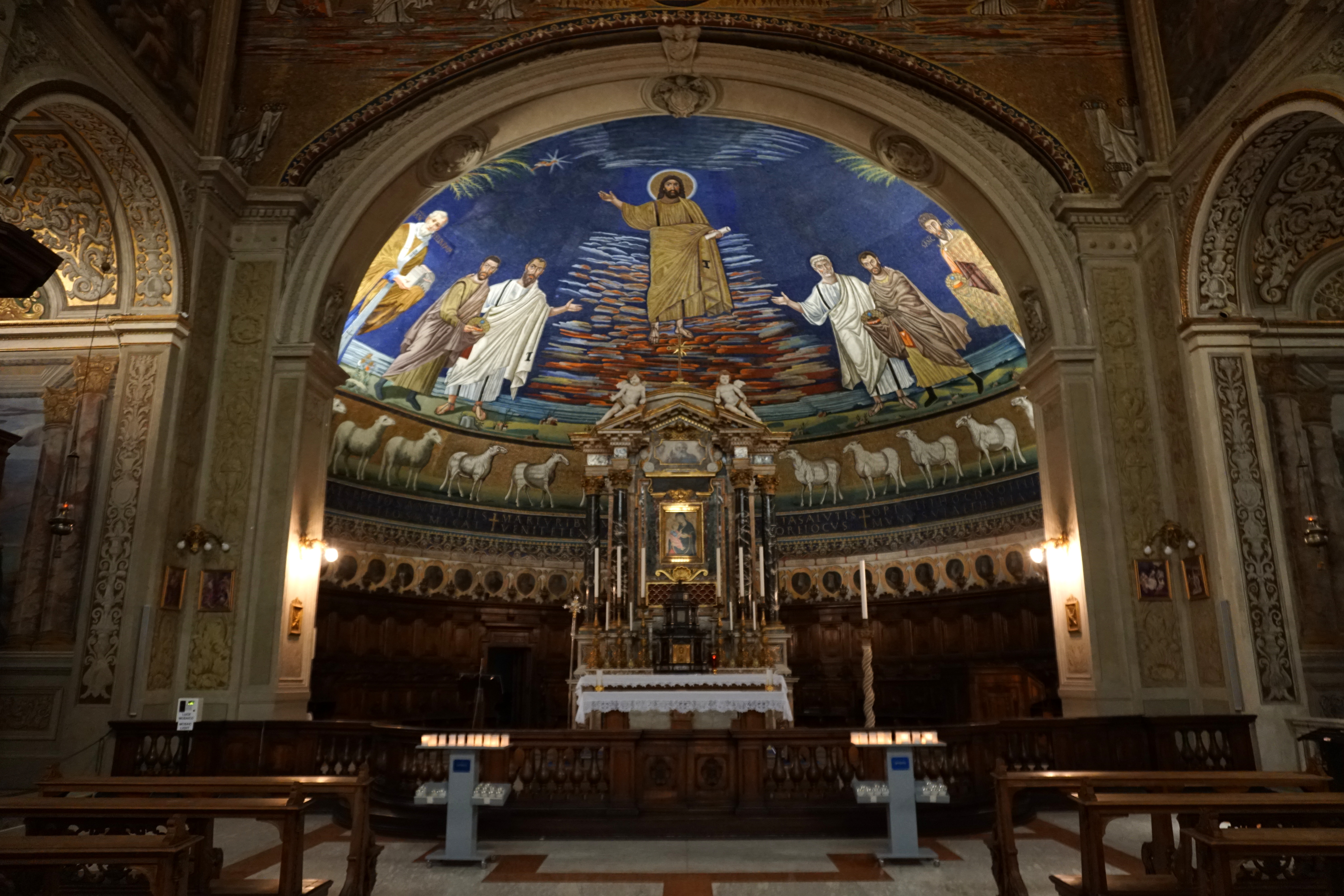
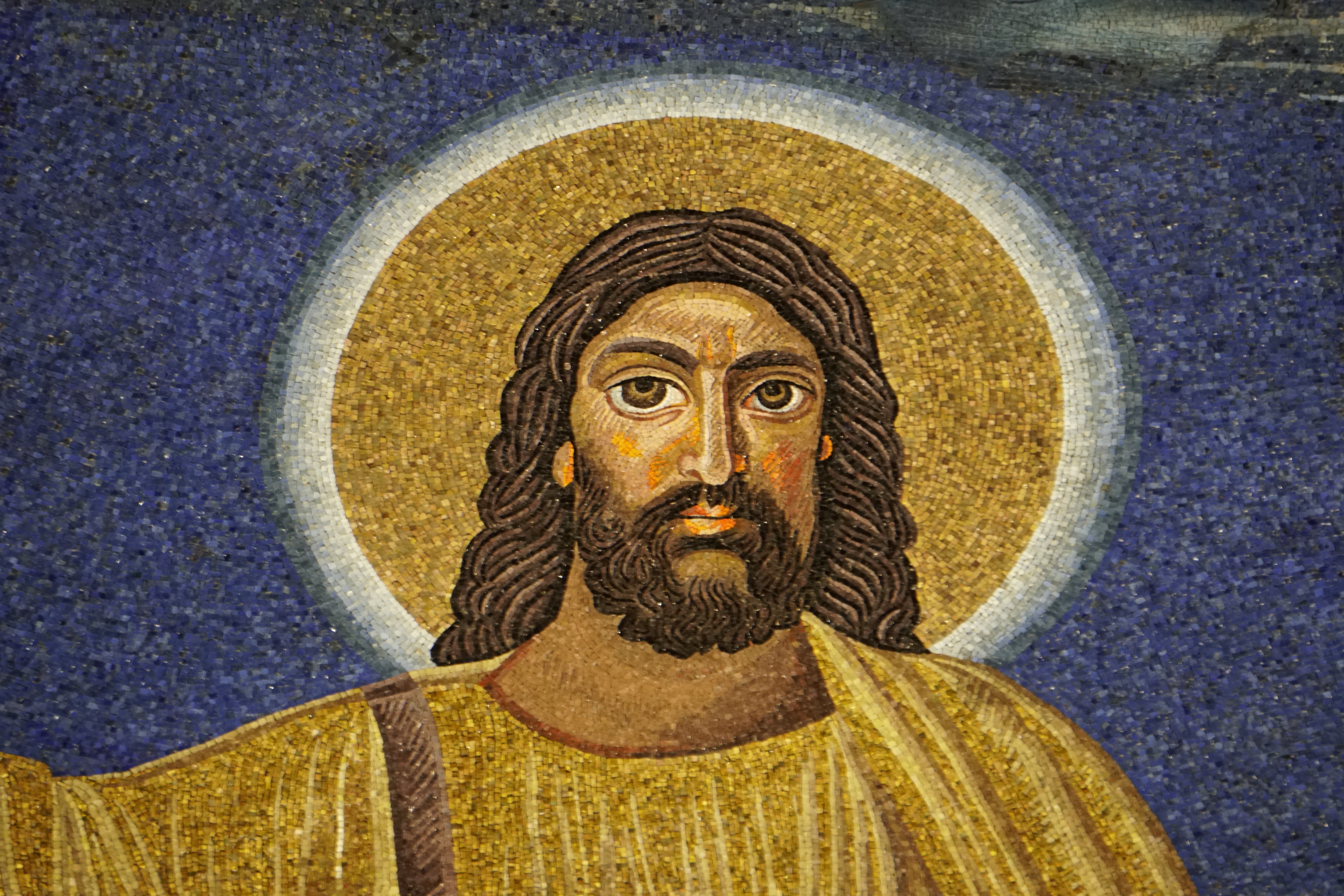
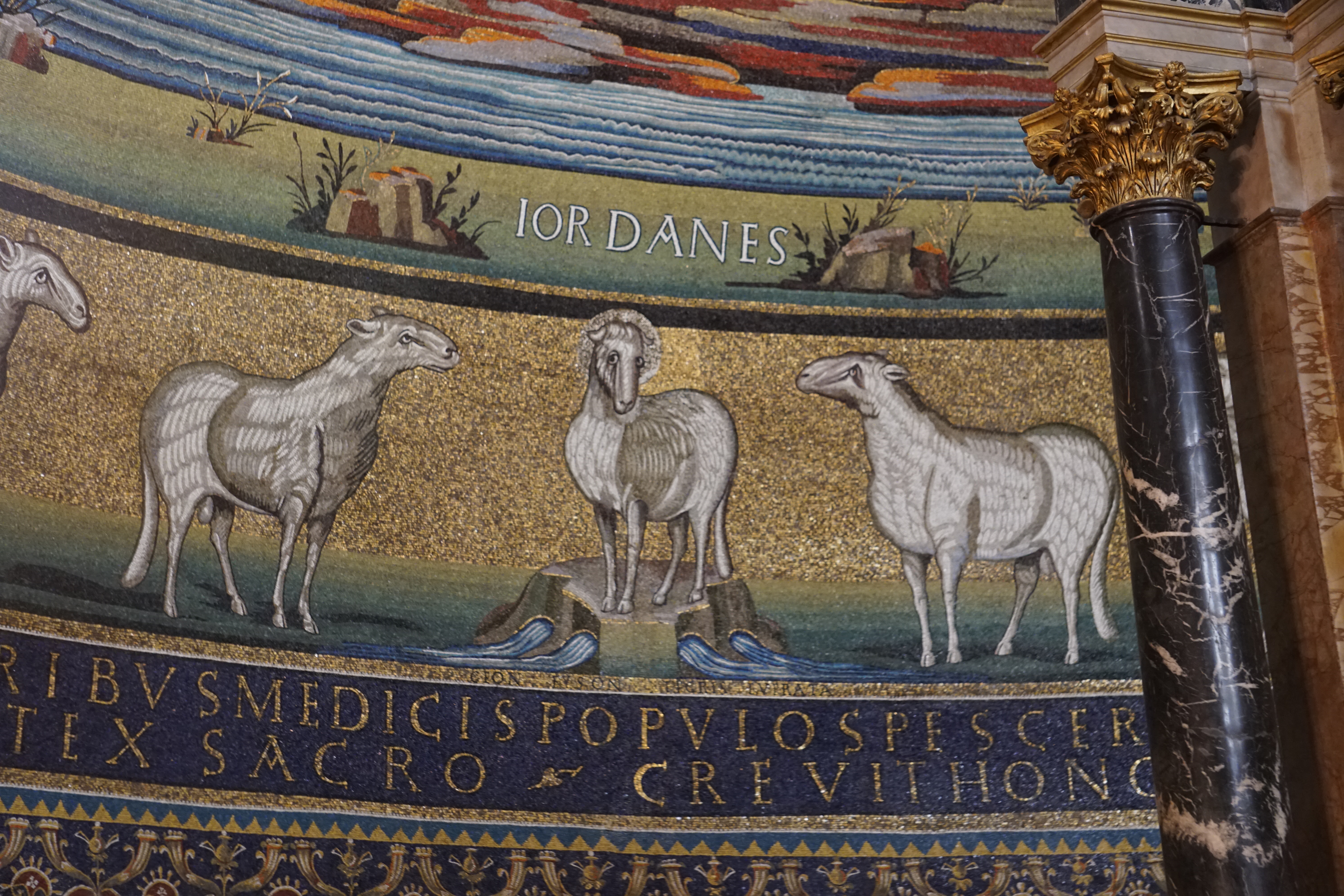
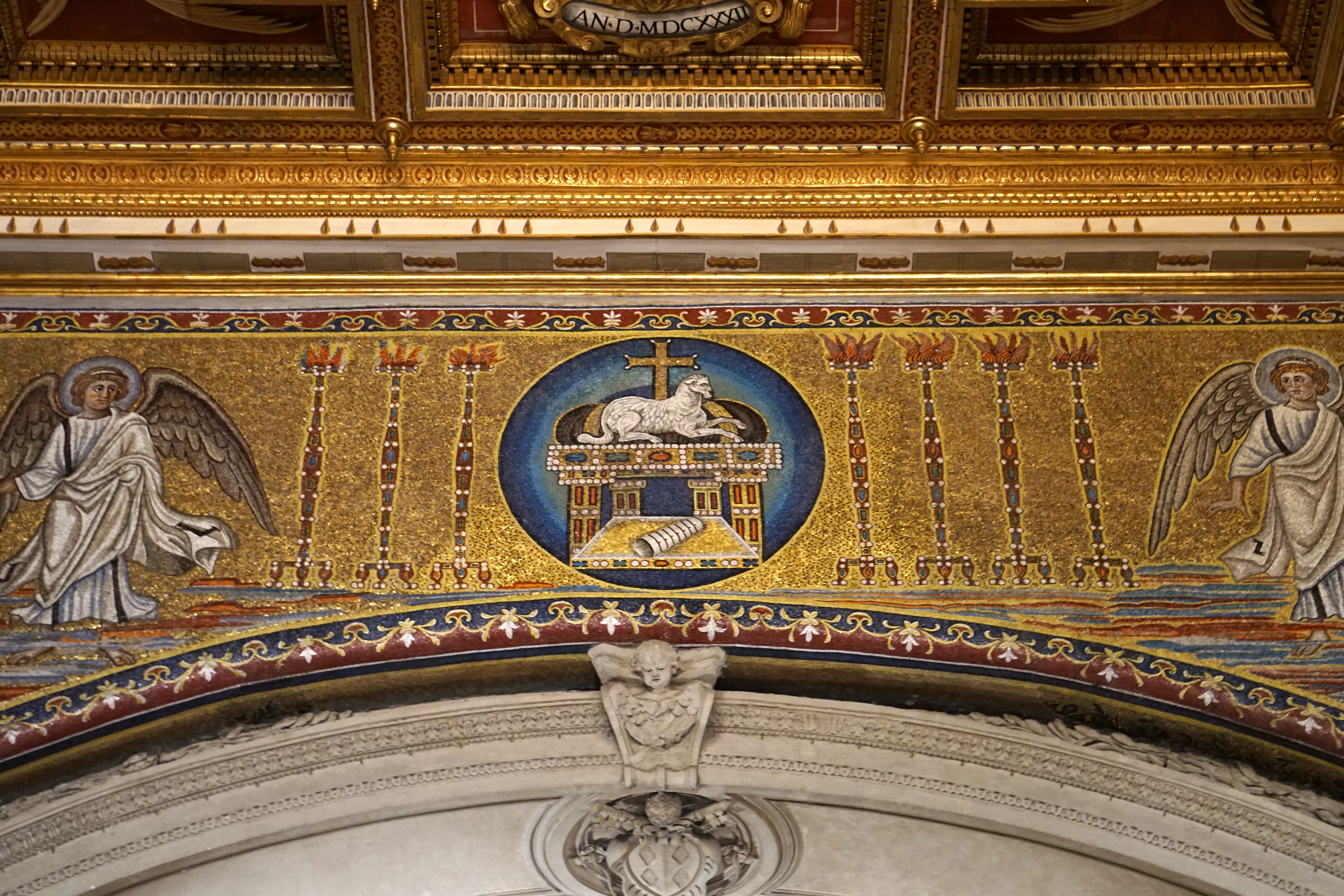
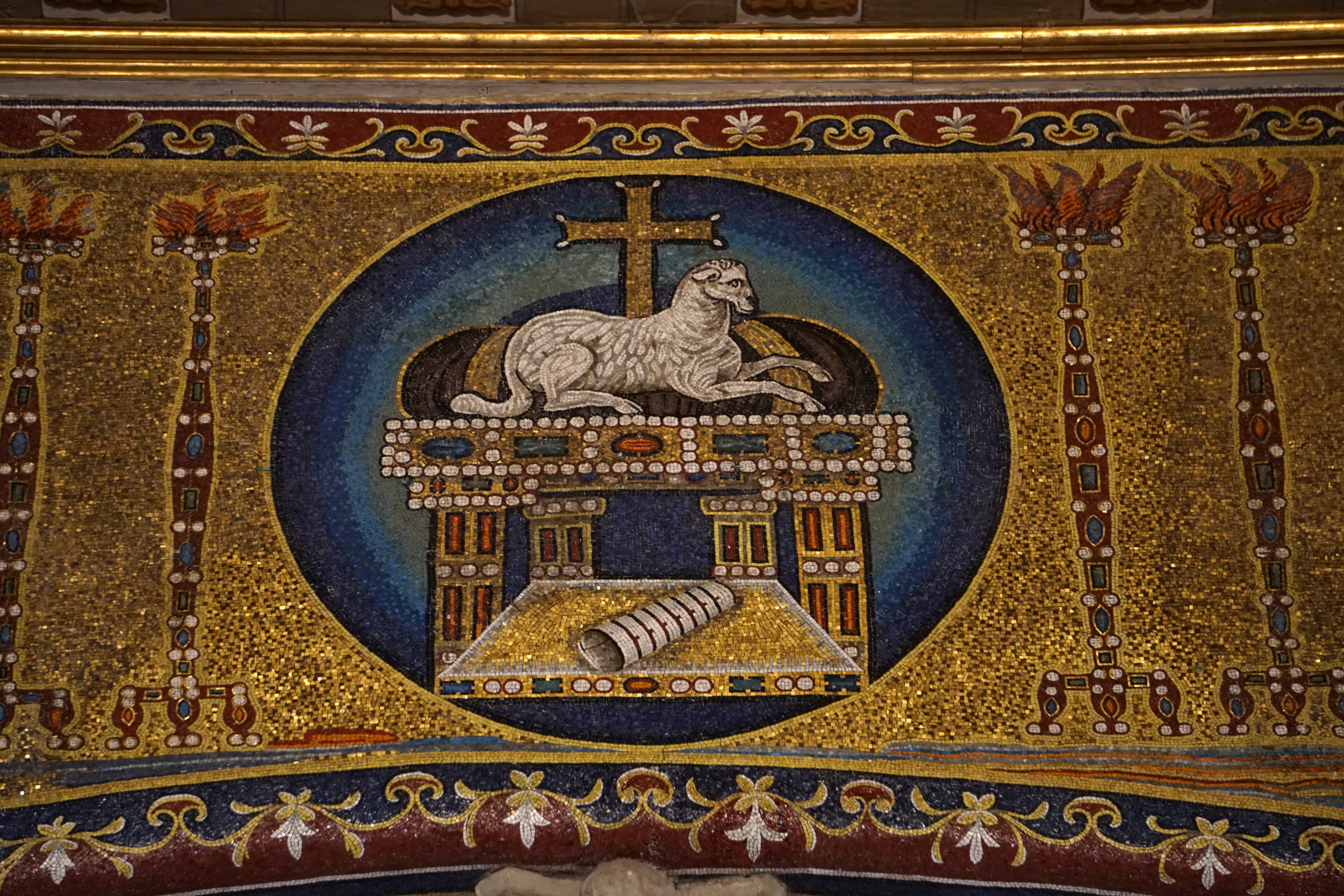
LOOK: Apse mosaic, Basilica of Saints Cosmas and Damian, Rome
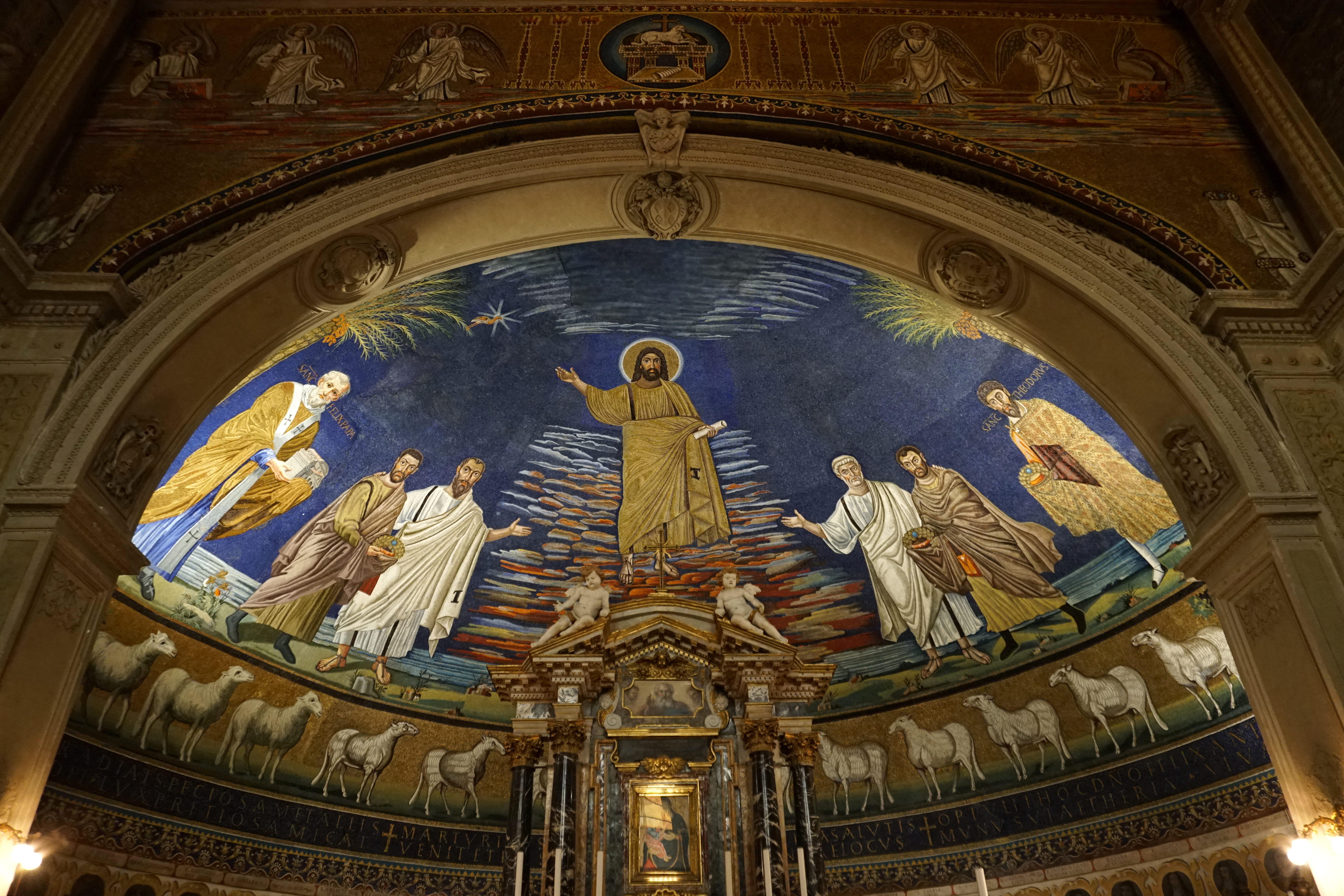
The Second Coming of Christ, ca. 526–30. Mosaic, Basilica of Santi Cosma e Damiano (Saints Cosmas and Damian), Rome. All photos by Victoria Emily Jones.
This Roman-Byzantine mosaic decorates the apse (large semicircular recess at the east end of a church) of a basilica in Rome dedicated to the Christian martyr-saints Cosmas and Damian, twin brothers from third-century Arabia. Cosmas and Damian (Cosma and Damiano in Italian) were physicians who, out of love for Christ and humanity, treated their patients free of charge. They were killed in the Diocletian persecution, one of the Roman Empire’s attempts to squelch Christianity.
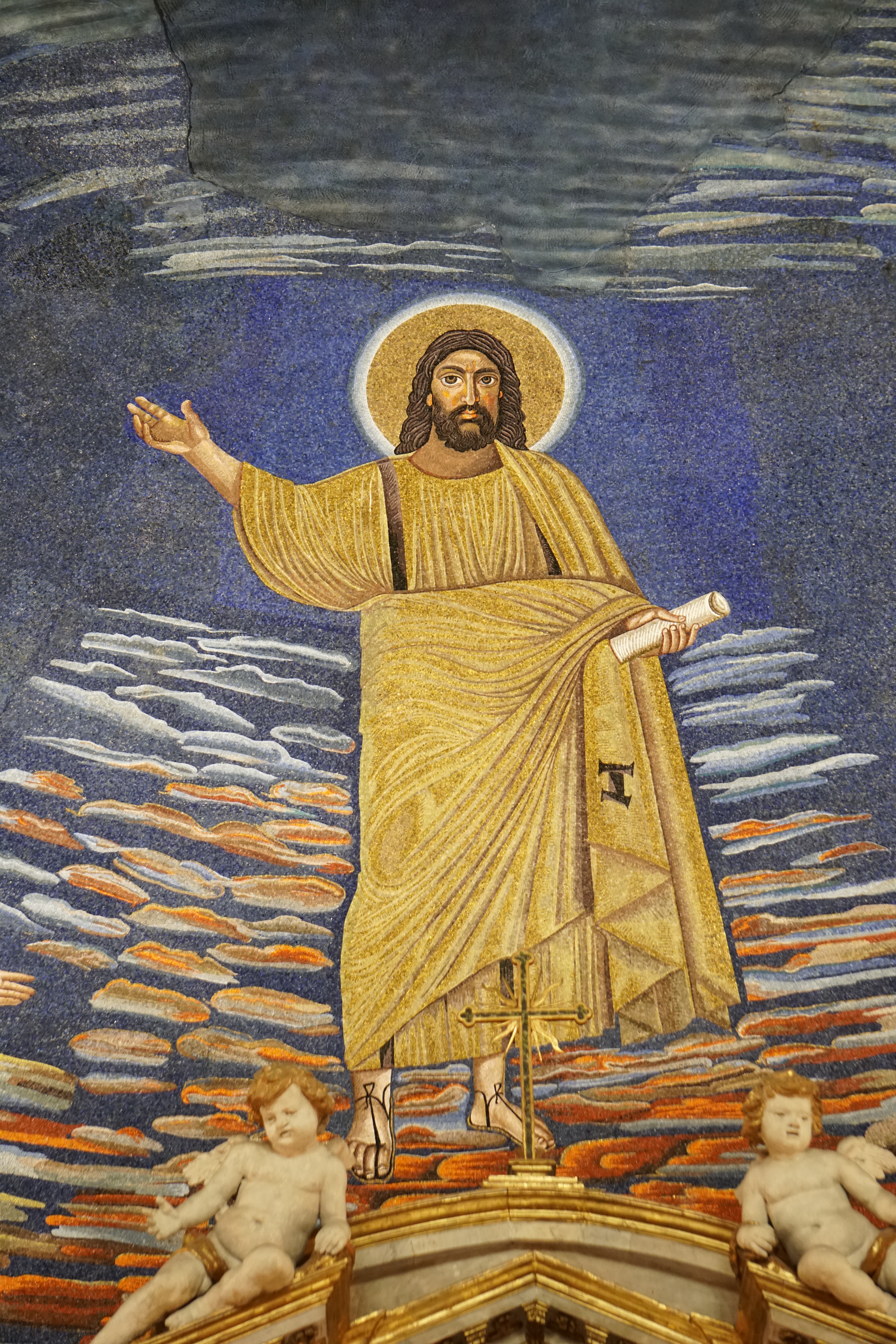
Situated behind the altar—and partially obscured by a hideous Baroque altarpiece with putti that was added in the seventeenth century—the mosaic depicts the parousia, the second coming of Christ. Christ is bearded and notably dark-skinned, and he wears a golden toga edged with purple. In his left hand he holds a rolled-up scroll, and his right hand he raises to indicate a phoenix in a palm tree—a mythological bird that rose from its own ashes, a potent symbol of resurrection that was adopted by the early Christians.
Descending from the heavens on dramatically colored clouds, Christ is portrayed as a triumphant ruler worthy of worship.
He is flanked by Peter and Paul, who present Cosmas and Damian. The figures on the extreme left and right are Pope Felix IV (r. 526–30), who paid to convert a pagan temple into the present church and to have it decorated with mosaics, and Theodore, another martyr under Diocletian. Cosmas, Damian, and Theodore lay down the crowns of their martyrdom before Christ, and Felix does the same with a model of the church he built.
The inscription at the base of the mosaic tells us that “Felix has offered this gift worthy of the lord bishop so that he may live in the highest vault of the airy heavens.” (If you balk at that, I do too; that you can buy your way to heaven, that you can earn favor with God or remit your punishment for sin through expensive gifts, is a false belief that still persists today in some corners of popular culture and even the church. I’m grateful for wealthy donors to the church throughout history, whose funds have enabled, among other things, the creation of beautiful art—but I must reckon with the fact that sometimes their motives were misguided and self-serving.)
Below the primary scene is a band of twelve sheep, which represent the apostles, or the Christian flock more generally. They process toward the Agnus Dei (Lamb of God), who stands on a rock from which flow the four rivers of paradise.
Based on further imagery from the book of Revelation, the arch that frames the apse depicts the Lamb seated upon the throne, a scroll with seven seals laid before him. He is flanked by seven lampstands, angels, and (not pictured) symbols of the Four Evangelists.
Refrain: God is coming on the clouds Yes, he said God is coming on the clouds Yes, he said May be morning, noon, or night Better get all your business right God is coming on the clouds Yes, he said
When the clouds turn dark as night And there ain’t no light in sight When the world begins to tremble Won’t that be an awful night You better get in a hurry My Lord is coming soon Oh, he’s coming on the clouds Yes, he said [Refrain]
Oh Lord, please give me power Stay with me every hour I just been waiting here praying For your Holy Ghost power God, you been my friend I know you freed me from sin Yeah, you coming on the clouds Yes, he said [Refrain]
“See, I am sending my messenger ahead of you, who will prepare your way, the voice of one crying out in the wilderness: ‘Prepare the way of the Lord; make his paths straight,’”
so John the baptizer appeared in the wilderness, proclaiming a baptism of repentance for the forgiveness of sins. And the whole Judean region and all the people of Jerusalem were going out to him and were baptized by him in the River Jordan, confessing their sins. Now John was clothed with camel’s hair, with a leather belt around his waist, and he ate locusts and wild honey. He proclaimed, “The one who is more powerful than I is coming after me; I am not worthy to stoop down and untie the strap of his sandals.I have baptized you with water, but he will baptize you with the Holy Spirit.”
—Mark 1:1–8
LOOK: Waiting for the Messiah by Sister Kim Ok-soon
LISTEN:“Hallelujah Sang the People” by Bruce Spelman, on You Don’t Know What You’re Paddling In (1972); reissued on the anthology album All God’s Children: Songs from the British Jesus Rock Revolution, 1967–1974 (2023)
John the Baptist came onto the earth He came by natural birth Though his parents, they were old and they were gray John the Baptist called unto the crowds: “There’s gonna come a day When Christ the Savior comes down from the clouds!”
John the Baptist went down to the stream His thoughts were like a dream Yet he was sure that Christ was soon to come The people gathered round at Jordan’s side Where they could be baptized And no one who came there would be denied
Refrain: “Hallelujah!” sang the people God the Son is coming down “Hallelujah!” sang the people Our Savior’s coming down
Jesus Christ will come down to the earth A lowly man by birth And yet he truly is the Son of God He will come to earth to set us free From sin and misery Oh, and still his life will end in tragedy
But his message will be heard abroad The teaching of the Lord And the people will believe the words he speaks He must surely be the holy Son The prophet said he’d come The Father, Son, and Spirit, all are one [Refrain ×2]
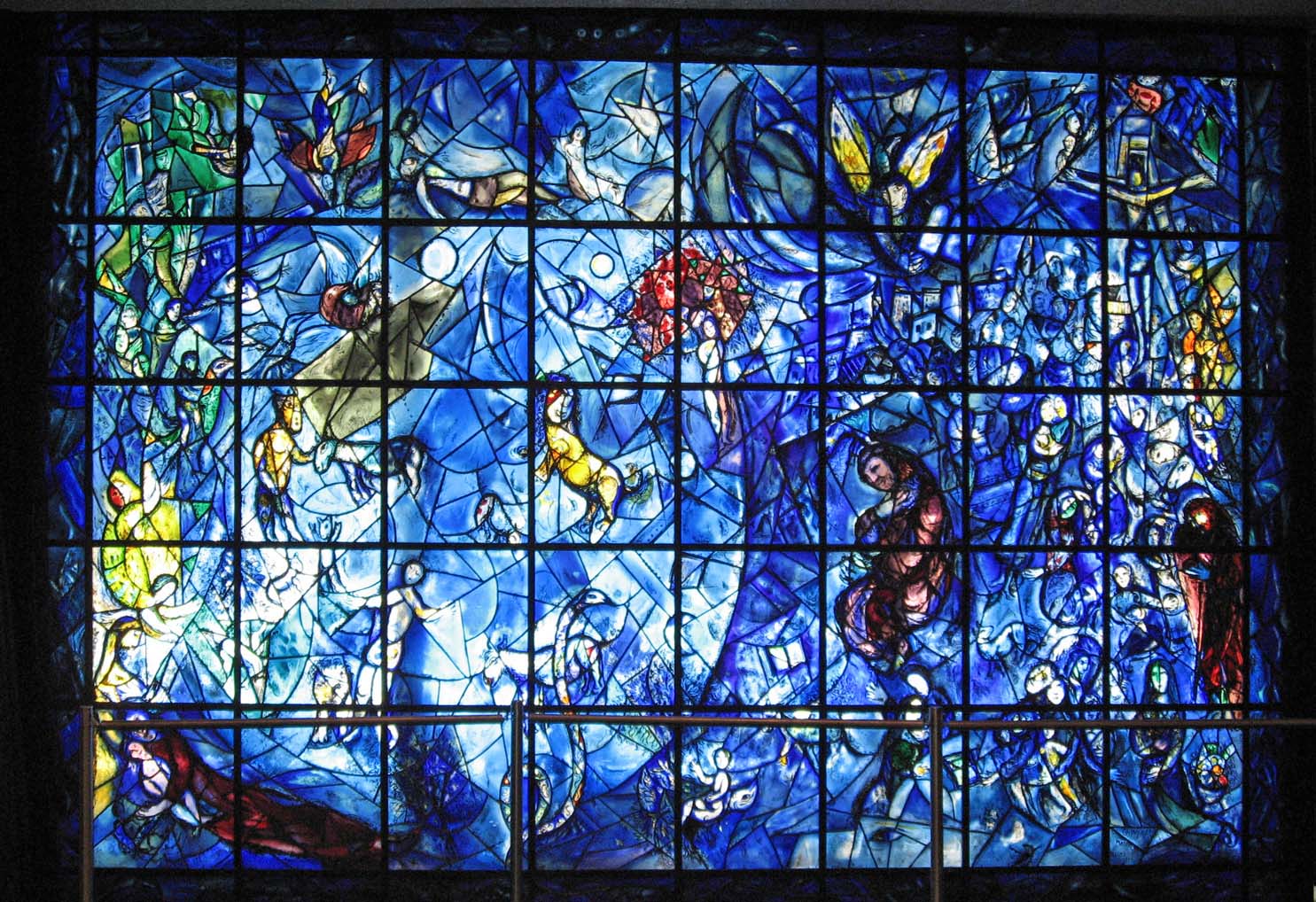
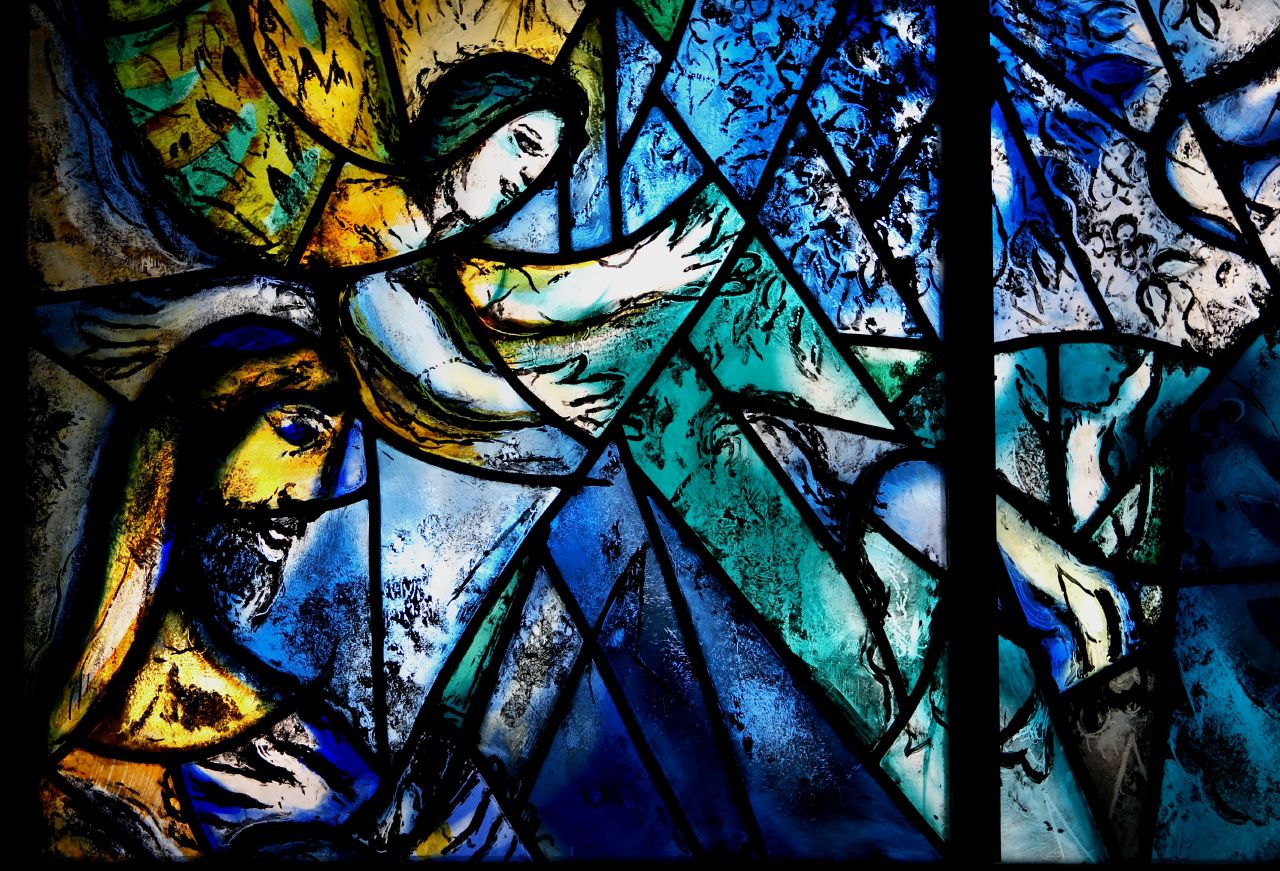
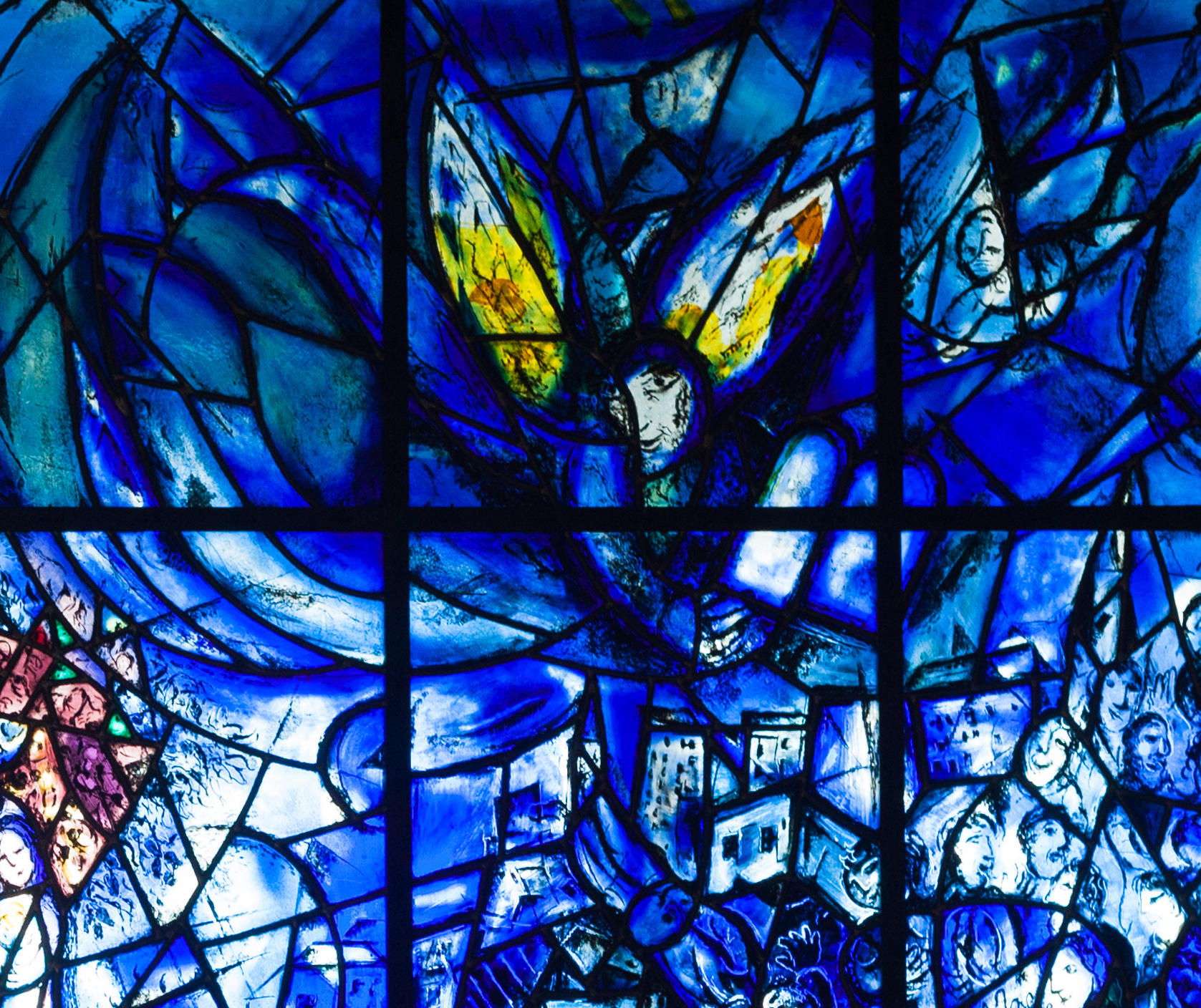
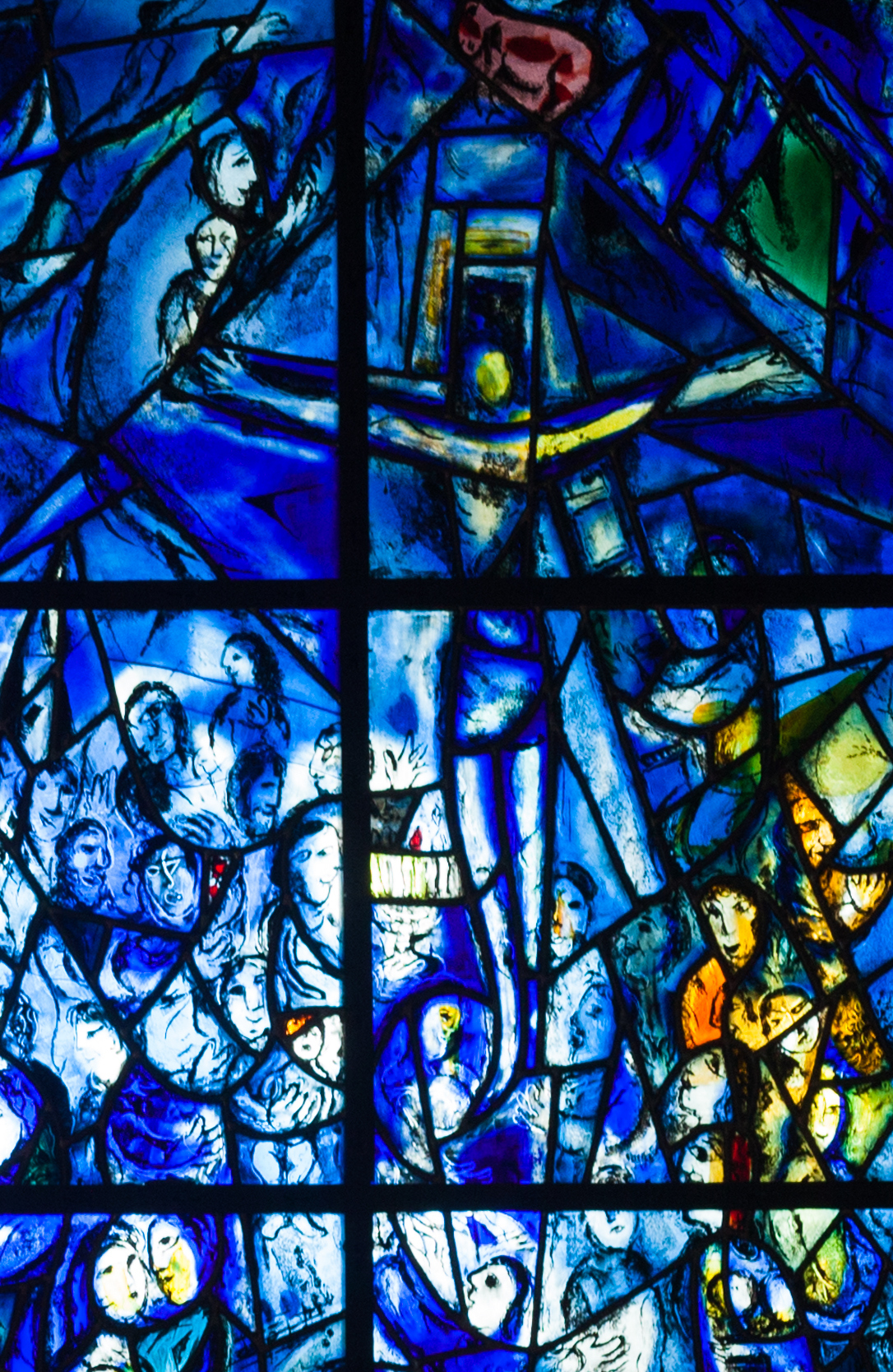
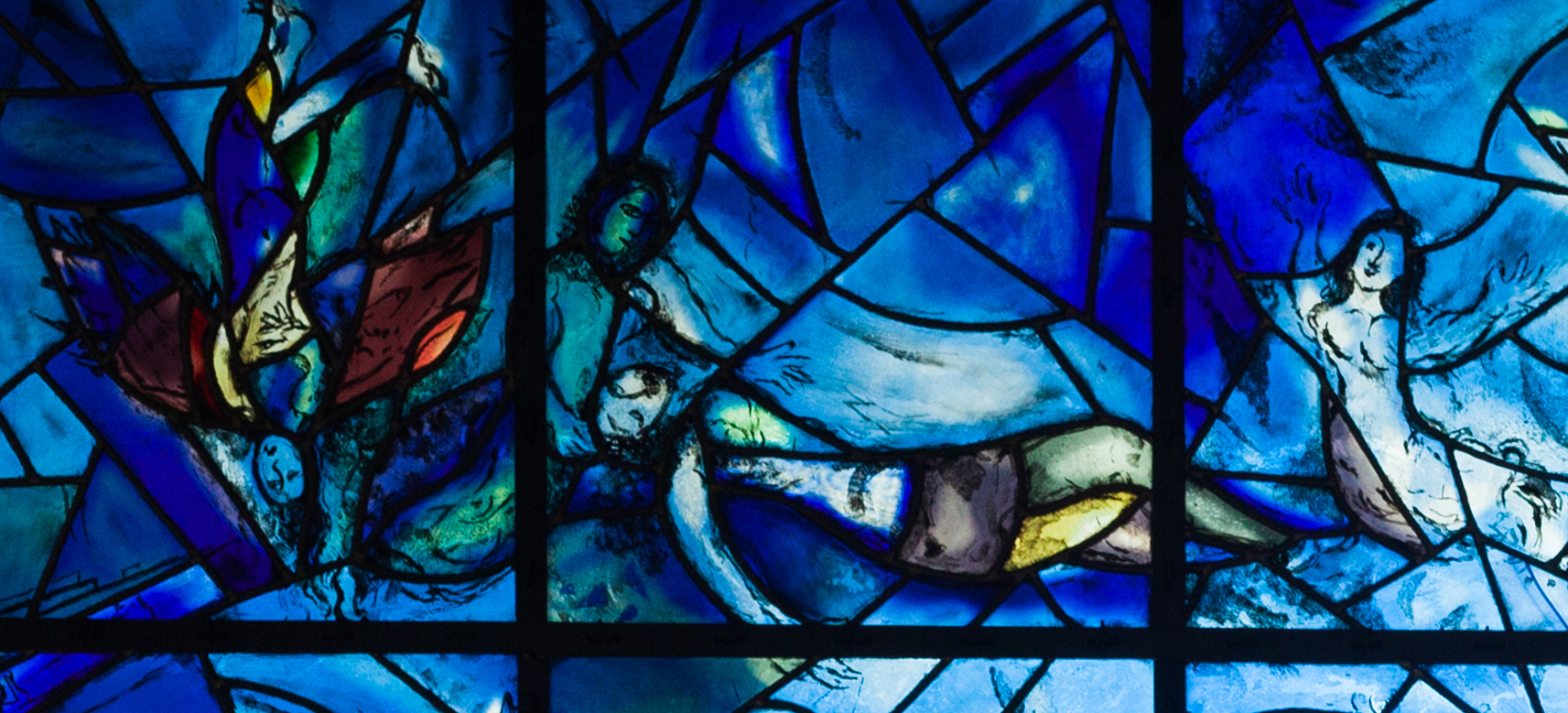
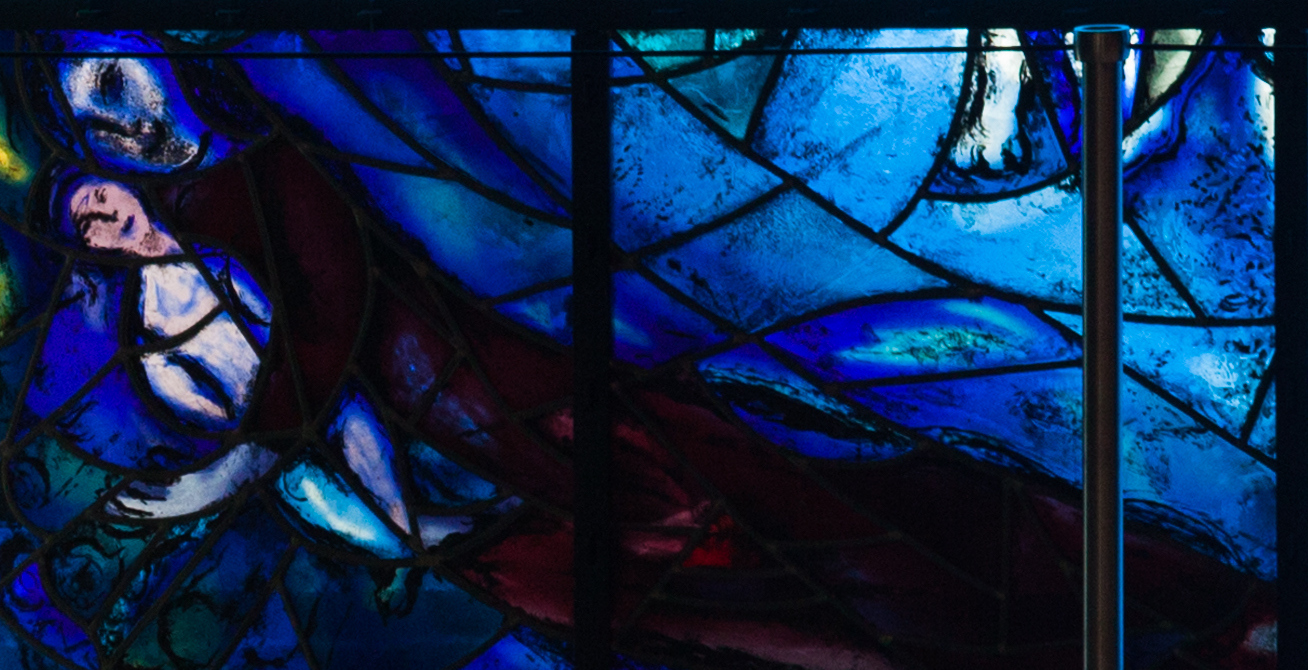
Marc Chagall (Russian/French, 1887–1985), Peace Window, 1964. Stained glass, 12 × 15 ft. Public lobby, General Assembly Building, United Nations Headquarters, New York. Manufactured by Brigitte Simon and Charles Marq.
This stained glass window by Marc Chagall was commissioned as a memorial for the Swedish diplomat Dag Hammarskjöld (1905–1961), who served as the second secretary-general of the United Nations, and for the fifteen other UN staff and peacekeepers who died with him when their plane crashed on the way to a peace negotiation for the Congo Crisis in Northern Rhodesia. The artist’s handwritten dedication reads, “A tous ceux qui ont servi les buts et principes de la Charte des Nations Unies et pour lesquels Dag Hammarskjöld a donné sa vie” (To all who served the purposes and principles of the United Nations Charter, for which Dag Hammarskjöld gave his life).
Chagall’s design was executed by master glassmakers Brigitte Simon and Charles Marq of Atelier Simon-Marq.
Chagall was born in 1887 into a Hasidic Jewish family in Vitebsk, Russia (now Belarus). He moved to Paris in 1910 to develop his art, becoming a French citizen in 1937. When Nazis took over the country, threatening Chagall’s safety, he was successfully extricated to the United States with the help of Alfred Barr, director of the Museum of Modern Art in New York. He returned to France for good in 1948. His impressive body of work, marked by a spiritual vivacity, includes—in addition to stained glass—paintings, drawings, book illustrations, stage sets, ceramics, and tapestries.
His 1964 Peace Window in New York City—not to be confused with his similar but much larger Peace Window of 1974 in the Chapel of the Cordeliers in Sarrebourg, France—is full of biblical allusions.
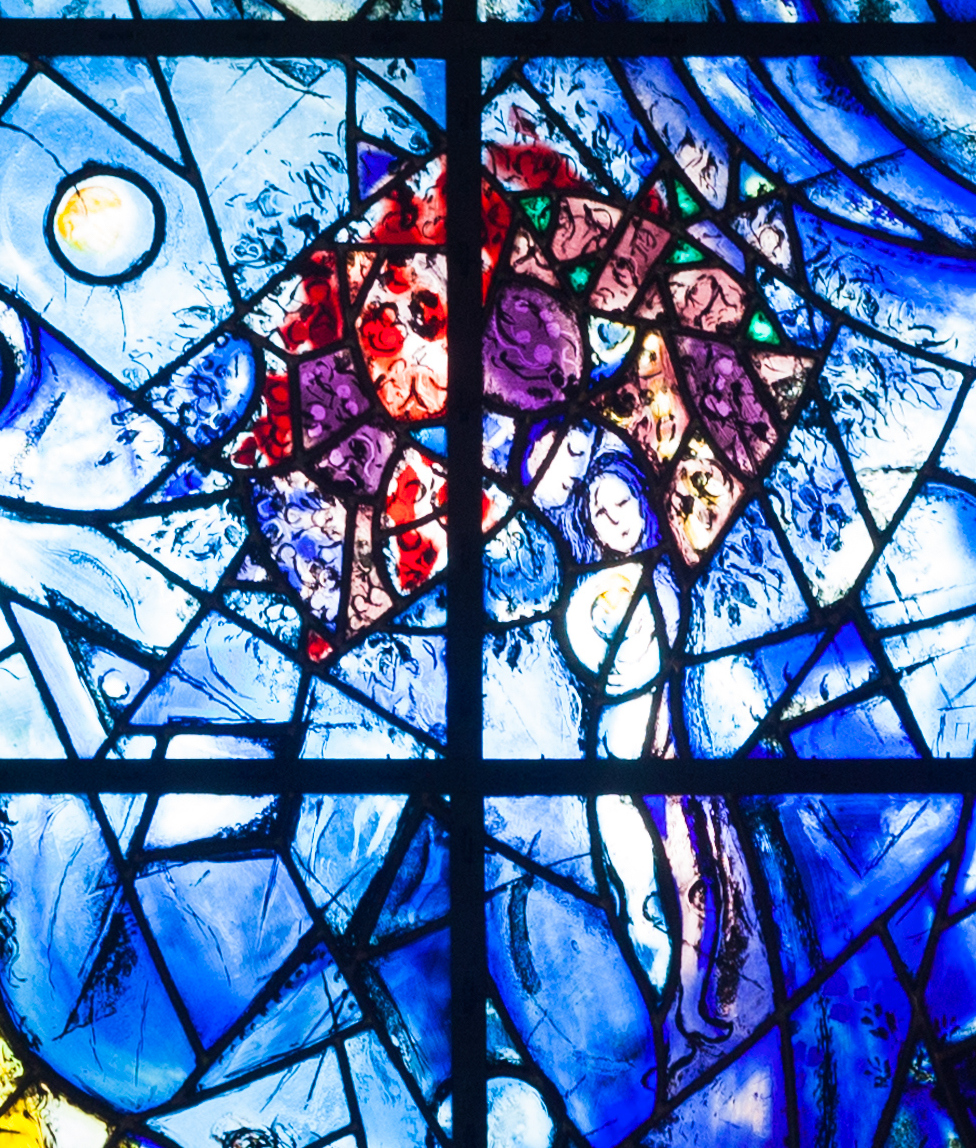
My eyes are drawn first to the red and purple bouquet in the center, under which stands an amorous couple. Who are they? What do they represent? I can think of several possibilities:
1. Adam and Eve. In the sketch Chagall made for the window, the woman is very clearly naked, though she’s less obviously so in the final window. That Eve, pre-fall, is traditionally portrayed unclothed, and that Chagall’s later Peace Window unequivocally portrays Adam and Eve within a red tree, lends credence to the interpretation of these figures as our primordial foreparents, in which case the flowering mass would stand for the tree of life in the garden of Eden (Gen. 2:9).
2. The Annunciation—the angel Gabriel coming to Mary to announce that she had been chosen to birth and mother God’s Son. The male head is bodiless, emerging from the crimson bloom (suggesting, perhaps, a supernatural entity), and there’s a yellow glow at the woman’s breast, perhaps signifying the conception of Christ. What’s more, the woman appears to be cradling something—her pregnant belly?
3. God and the human soul, or Christ and his church. One traditional Jewish interpretation of the poetic book of scripture known as the Song of Solomon is that it celebrates the love between humanity and the Divine. Medieval Christians, similarly, spoke of the book as an allegory of the future marriage of Christ and the church, his bride, drawing too on the New Testament book of Revelation, which culminates in a mystical union, a picture of cosmic harmony, heaven and earth inseparably joined.
4. The kiss of Justice and Peace. Psalm 85:8–11, a common Advent text, speaks of the divine attributes that coalesce to accomplish salvation (in the Christian reading, in the Incarnation):
Let me hear what God the LORD will speak, for he will speak peace to his people, to his faithful, to those who turn to him in their hearts. Surely his salvation is at hand for those who fear him, that his glory may dwell in our land.
Steadfast love and faithfulness will meet; righteousness and peace will kiss each other [emphasis mine]. Faithfulness will spring up from the ground, and righteousness will look down from the sky.
5. The kiss of Joy. Beethoven’s Ninth Symphony was a favorite of Dag Hammarskjöld’s, and its performance, at least the “Ode to Joy” chorus in its final movement, is a United Nations Day concert tradition. Hammarskjöld described the work as “a jubilant assertion of life,” championing universal peace and brotherhood. One of the lines from Friedrich Schiller’s text that Beethoven set exclaims that “Joy . . . kiss[es] . . . the whole world!”
I suspect some or all of these ideas were at play when Chagall designed the window. Or even just romantic love in general (with other types of love portrayed elsewhere in the composition), as he often painted himself and his wife Bella kissing or embracing.
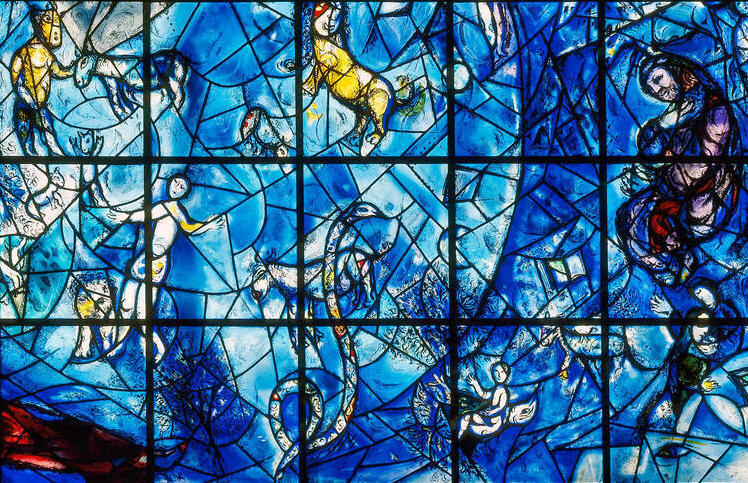
After this tableau, my eyes go to the large male figure cloaked in purple just right of center. I take him to be the prophet Isaiah, beholding a vision of wild animals and children cavorting together in harmony (see Isaiah 11). A boy, for example, reaches his hand out toward a viper and is not harmed.
But it’s also possible that’s meant to be Isaiah at the bottom left of the window, his face illumined by the beauty spread out before him, which an angel gestures to, guiding the prophet’s imagination:
On the top right, another angel delivers the Ten Commandments to the people of God.
Next to this communication of God’s word is the death of God’s Word in the flesh, Jesus Christ, around whom the crowds have gathered. A man ascends a ladder propped against the cross, the ladder being a multivalent symbol harking back to Jacob’s dream at Bethel and evoking notions of descent and ascent.
Vignettes below include a couple embracing with an infant in hand, a woman being fed at a table (the Eucharist?), a family reading a book (probably the Bible), a woman making music, and another bearing flowers.
At the top left is a lamentation scene that evokes those of Christ deposed from the cross. A man in a loincloth lies dead or wounded on the ground, his head cradled by a loved one, while at his feet another mourner throws her arms up in grief. This is the cost of human violence.
By contrast, in the bottom left corner, a mother cradles her child, evoking scenes of the nativity of Christ—of Mary with her newborn son.
All these characters—human, animal, and divine—are sprawled across a warm azure background, playing out love, suffering, death, peace, joy, and reconciliation.
LISTEN: “Oracles” by Steve Bell, on Keening for the Dawn (2012)
O ancient seer, your vision told Of desert highways streaming home To the mountain of the Lord Where nations sound a righteous song forevermore
And on that mountain men will forge From cruel implements of war The tools to till and garden soil The rose will bloom and faces shine with gladdening oil
And it will surely come to pass Justice will reign on earth at last The wolf will lie down with the lamb No beast destroy, no serpent strike the child’s hand
And God himself will choose the sign A frightened woman in her time Will bear a son and name him well God with us! O come, O come, Emmanuel!
I remain confident of this: I will see the goodness of the LORD in the land of the living. Wait for the LORD; be strong and take heart and wait for the LORD.
—Psalm 27:13–14 (NIV)
LOOK: The Waiting by Charlotte Mann Lee
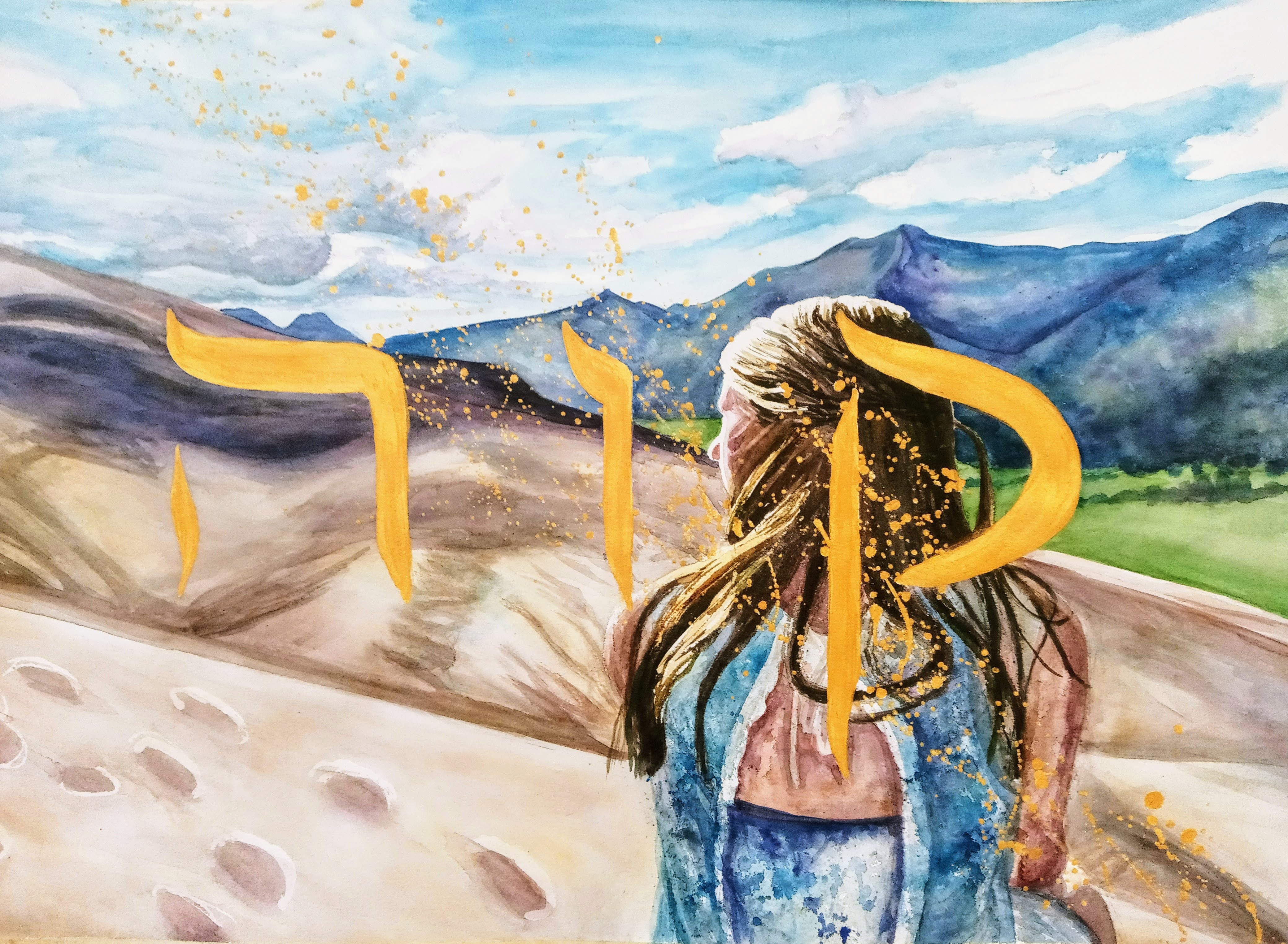
Charlotte Mann Lee (American, 1996–), The Waiting, 2021, from the Desert series. Watercolor and gold pigment on paper, 18 × 24 in. (45.7 × 61 cm).
Artist Charlotte Mann Lee is a friend of mine from Maryland. Her watercolor The Waiting, a self-portrait at Great Sand Dunes National Park in Colorado, is inspired by the final verse of Psalm 27 (quoted above). The Hebrew verb קָוָה (qavah), meaning “to wait for, or to look expectantly,” stretches across the scene, a breeze scattering its gold flecks to the sky. A majestic vista lies just over the sand.
“In the desert times of life, when the soul is dry and weary, the barren landscape seemingly endless before us, waiting is difficult,” Lee writes. “What we know to be true may be in conflict with our current experience. There is an ongoing tension between what we see and feel currently in our suffering, and what God promises in His Word.” It’s that tension she seeks to convey here, as well as “the hope that anchors [the Christian] amidst trials and struggles in the desert”: God in Christ.
LISTEN: “Psalm 27” by Psalm Project Africa, on Sing Psalms, vol. 1 (2013)
Of this I’m sure I’ll see God’s goodness My soul will rest in The land of the living Be strong in the Lord
Refrain: The Lord is my light And my salvation Whom shall I fear Shall I be afraid The Lord is my light And my salvation Whom shall I fear Shall I be afraid The Lord is my life
One thing I need One thing I ask you To dwell in your house Each day of my life Delighting in you [Refrain]
In troubled times He keeps me secure He covers me He lifts my head Above the storm [Refrain]
A program of the Reformed Student Organisation in Kampala, Uganda, Psalm Project Africa was a collective of songwriters and musicians who led workshops at African churches and colleges, encouraging Christians to sing the Psalms in African styles. It appears they were active from 2013 to 2017, releasing three albums of psalm settings within that period.
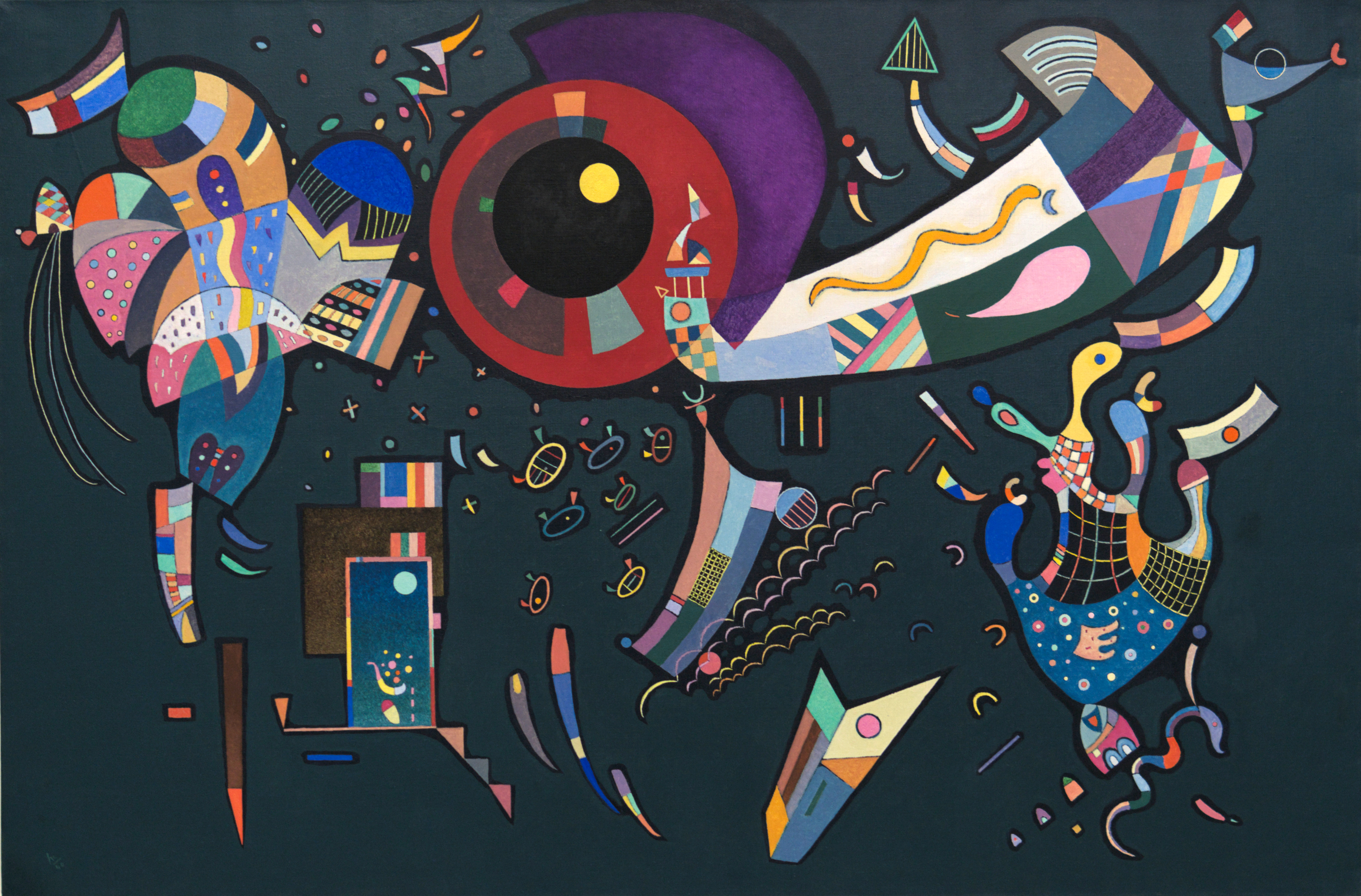
Wassily Kandinsky (Russian, 1866–1944), Around the Circle (Autour du cercle), 1940. Oil and enamel on canvas, 38 1/4 × 57 5/8 in. (97.2 × 146.4 cm). Solomon R. Guggenheim Museum, New York. Photo: Victoria Emily Jones. [object record]
I saw this vibrant abstract painting by the pioneering Russian French artist Wassily Kandinsky at the Guggenheim in 2022. The museum label stated:
Around the Circle, one of Kandinsky’s last major paintings, is a milestone in the artist’s circular journey. It reflects not only contemporary concerns but also his abiding interest in the belief systems and folklore of Russian and Siberian cultures. The dominant red circle at top center; the form cresting the undulating lines of “sacred waters” below; and a third, upside-down stylized humanoid form at bottom right have all been interpreted as potential allusions to shamans, or spiritual leaders and healers, in states of transformation. At bottom left, a lunar orb glows in the expanse beyond an open doorway, which is connected to a set of stairs with no physical support. This could be a portal to the cosmos, or some otherwise indeterminate space beyond the picture plane, in a probable nod to alternate dimensions or to the capacity for mystical ascendance.
What do I see? Color. Confetti, streamers, celebration. A rocket ship. Stars. Birds. Waves. A falling man. A doorway. An eye.
Advent is a dual-toned season that combines lament and penitence—an honest accounting of the brokenness of the planet, global and personal relationships, systems, and our own selves—with joyful expectation of Christ’s glorious intervention. In my annual Advent selections I seek to honor this characteristic balance between darkness and light.
Today’s art selection leans into the light—into the bubbling joy for what is just over the horizon, or just through the door. I think of the Magnificat of the Mother of God, a praise song in which, pregnant with Christ, she exults in the powerful being thrown down and the humble uplifted. She sings of the marvelous salvation wrought by God.
Let us rejoice with her in the righteousness to come.
LISTEN: “Maranatha” by David Benjamin Blower, on Hymns for Nomads, vol. 1 (2018)
Let the trees all clap their hands And the stones all jump for joy Let the earth shake off its bonds Let the peoples all rejoice
Refrain: Maranatha, our Maker Who maketh all things right Maranatha, our Healer Come rise, O healing light
Let the peoples all delight In the messianic light Let the whole earth be glad At the making all things right [Refrain]
Let the poor be lifted up From the ashes and the dust Let the proud climb down from their thrones And we all shall be reconciled at once [Refrain]


 Art & Theology