Advent, Day 23: Holy One, Jesus Come

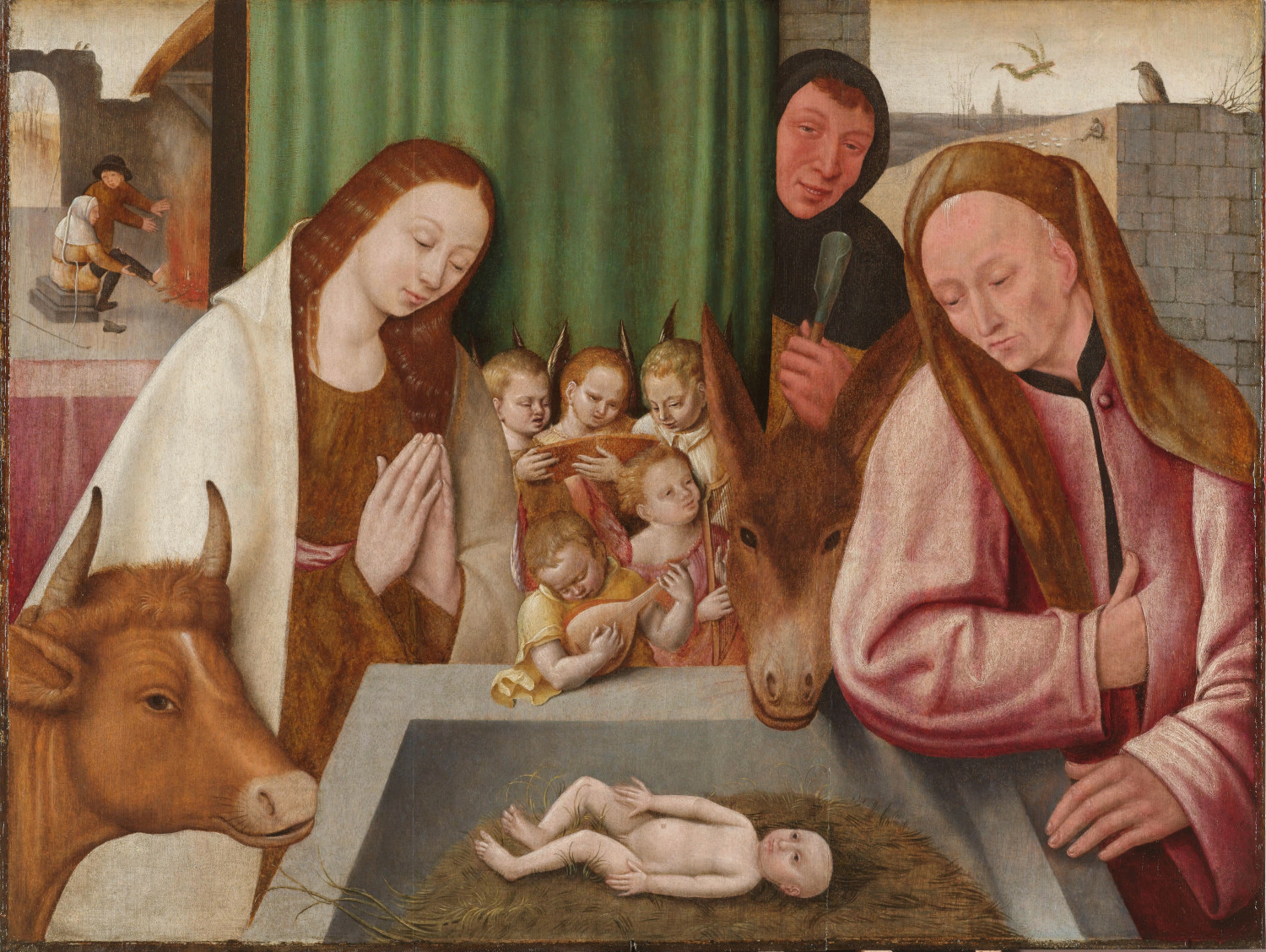
LOOK: Nativity, Netherlands, 16th century
Bosch, Hieronymus (after)_Nativity
Unidentified artist (in the style of Hieronymus Bosch), Nativity, southern Netherlands, ca. 1550–1600. Oil on panel, 58 × 76 cm. Rijksmuseum, Amsterdam.

This painting in the style of Bosch shows Mary and Joseph adoring their newborn son, Jesus, who’s naked and bedded down in straw. A small angelic ensemble stands at the head of the manger with lute, harp, and songbook, softly serenading the family, while a shepherd sneaks a peek from behind a green curtain. It is as if we, the viewer, are standing opposite the shepherd on the other side of the manger, also looking down at the Christ child. Are we similarly rapt with wonder?

I love how the ox and the ass meet our gaze, acknowledge our presence!

I’m not sure of the significance of Joseph’s hand-in-jacket gesture (its association with stateliness wasn’t established until some two centuries later, from what I can tell), but it’s likely supposed to connote reverence or humility, as do Mary’s prayerful hands.

In the left background, two men warm their hands and feet outside by a fire, while at the right, an angel appears to another shepherd on a hillside, announcing the Messiah’s birth.

LISTEN: “Holy One, Jesus Come” by Andy Bast, on The Hymns of St. Ephrem for Advent by Pillar Church (2014)

The lyrics of this song are loosely based on Ephrem the Syrian’s Nativity Hymn #2 from the fourth century. (All nineteen Nativity hymns by this early Christian poet-theologian are a treasure!)

Blessed is he
Both hidden and seen
Blessed is he
Who left the height of majesty

You magnify all, come magnify me
That I may tell about
The glory of your birth
Proclaim your grace to all the earth
Holy One, Jesus, come!

Blessed is he
Who gave us all
Blessed is he
Who gave us all that he has gained

O Father of all, your glorious day
You gave not seraphim
Nor sent the cherubim
You gave your only Son instead
Holy One, Jesus, come!

All glory to thee, entirely
Glory to thee, from every tongue, entirely
Your birth is enough
For all of us

Great one became a child
Pure one became defiled
O Living One, laid in the tomb
In you we are renewed
Your washing washed us through
Let us obtain life by your death
Holy One, Jesus, come!

The Incarnation, the enfleshment of God in the person of Jesus, encompasses the God-man’s birth and death, as does this song. Salvation was wrought not through Jesus’s birth alone, or life alone, or death alone, or resurrection alone, but through all of it together.

At first I got tripped up on the line “Pure one became defiled,” because Jesus did not become defiled in the sense of succumbing to sin or moral corruption. However, in his ministry, he did touch lepers, bleeding women, and corpses, which, according to the Jewish purity laws at the time, would have made him ritually unclean. Looking back on these healings and raisings, Christians would say that rather than these people’s uncleanness transferring to him, his cleanness transferred to them. But the public perception was that he was defiling himself.

And then, of course, there’s 2 Corinthians 5:21: “For our sake God made the one who knew no sin to be sin, so that in him we might become the righteousness of God.” And Galatians 3:13: “Christ redeemed us from the curse of the law by becoming a curse for us—for it is written, ‘Cursed is everyone who hangs on a tree.’” What it means that Jesus “became sin” or “became a curse” has been the subject of much theological discussion! But suffice it to say that Jesus’s death on the cross involved not only physical debasement but also his bearing, in a metaphysical sense, the full weight of humanity’s transgressions.

Andy Bast is a singer-songwriter from Holland, Michigan. He is a musician and writer for the Christian collective Bellwether Arts and a regular contributor to Cardiphonia projects.

Advent, Day 22: Bus Stop Nativity

LOOK: Bus Stop Nativity by Andrew Gadd

Gadd, Andrew_Bus Stop Nativity
Andrew Gadd (British, 1968–), Bus Stop Nativity, 2008. Oil on canvas, 188 × 122 cm.

Painted by Royal Academy gold medal winner Andrew Gadd, Bus Stop Nativity depicts the Holy Family huddled together at night under a bus shelter, trying to stay warm. Some passersby look on with curiosity—two even kneel down on the snowy sidewalk—while others go about their business with total indifference.

This painting was commissioned by the Church Advertising Network in the UK, now ChurchAds.net, and displayed on posters at over one thousand bus stops in December 2008, printed with the text “Be Part of the Action. Church, 25-12.” (A gentle provocation to attend a Christmas service on December 25.)

Francis Goodwin, the chair of the Church Advertising Network, said, “We are very used to the Renaissance image of the Nativity. But what would it look like if it happened today? Where would it take place? We want to challenge people to make them reassess what the birth of Jesus means to them.”

Bus Stop Nativity identifies Jesus with today’s urban poor. He was born not in a comfortable palace with fine clothes and other material wealth and security, but in vulnerability and need, to working-class parents who were inconveniently out of town at the time of delivery, forced to make do with less-than-ideal accommodations. When it came time for Mary to present a purification offering in the temple forty days after giving birth, she couldn’t afford the requisite lamb, so she brought two turtledoves instead (a provision made in Lev. 12:8). Not only was Jesus not monied; he also spent his early years as a refugee in Egypt, a flight prompted by Herod’s direct threat on his life. With limited resources, his parents had to make a home for him away from home, not knowing for some time when it would be safe to return to Galilee.

That this was Jesus’s family background and experience—that he lived on the margins of society, not at its center—has always been a significant facet of the Incarnation, because it means that God knows bodily what it is to feel want and uncertainty and to be overlooked. When in his adulthood Jesus preached “Blessed are the poor,” he was affirming that God is with those of lower socioeconomic means. He is one of them.

LISTEN: “Hush Child (Get You Through This Silent Night)” from the movie Black Nativity (2013) | Written by Taura Latrice Stinson, Kasi Lemmons, and Taylor Gordon | Performed by Jennifer Hudson, Jacob Latimore, Luke James, and Grace Gibson

Silent night
Holy night
Poverty on the rise
Wealthy reverend in designer clothes
Homeless children with frostbitten toes
Sleeping in the street

I ain’t tryna be philosophical
But it’s not logical
Some folks out here freezing, others chilling like it’s tropical

The indifference is mad crazy
Like poverty’s contagious
My hands are dirty, but I’m still worthy
Step in my shoes and walk in some mercy

They say this is your punishment for such poor judgment
But you must’ve lost your mind
How you gon’ feed it when you barely eating?
Get ready for the welfare line
I ain’t tryna hear it
You make the bed, lay in it
But I’m way too strong for you to break my spirit

Is it me?
Am I the cause of all my mother’s misery?
This cloud of secrecy on my paternity
Did my very birth destroy my whole family?

I’m just a sinner, I know who I am
Just a beginner, I’m not yet a man
Send me a signal, I’ll follow your light
Just help me through this silent night

Hush child, it’ll be alright
I’ll get you through this silent night
Hush child, it’ll be alright
I’ll get you through this silent night

This ain’t living
I got a mouth to feed
But I can’t make these ends meet
Got an eviction notice
But my Lord don’t hear my prayers
I never been this scared
The silence is too loud for me
Life just ain’t fair

Is anyone out there?
Does anyone care?
Is anyone listening?
Is anyone there?
Just let me know that I’m a part of your plan
That you’re watching over and know who I am

From where we are now
How do we find our way?
Alone in the darkness, scared
With no place to stay

Hush child, it’ll be alright
I’ll get you through this silent night
Hush child, it’ll be alright
I’ll get you through this silent night

Hush child, it’ll be alright
We’ll do this together

Sleep in heavenly peace

This song is a dream sequence from the 2013 film Black Nativity, directed by Kasi Lemmons (good soundtrack, cheesy movie). The two characters who initiate the song are Maria (Grace Gibson) and Jo-Jo (Luke James), a homeless couple in New York City expecting their first child, who are caroling door-to-door. Fifteen-year-old Langston (Jacob Latimore), who has been sent to live temporarily with his estranged grandfather while his mom, Naima (Jennifer Hudson), figures out how to make ends meet for the two of them back in Baltimore, interjects with a rap expressing his frustration with economic inequality and the struggle he has seen and lived.  

The pregnant couple sings the refrain, “Hush child . . . ,” to each other and to their unborn child, and Naima sings it to Langston. But in between, all four address God in lament: God, are you there? God, why don’t you fix these inequities? I’m exhausted. Tired of being a have-not and always having to hustle, to no avail. When are you going to provide like you said you would? The night is “silent” because God is not answering, it seems. Still, the characters continue to pray their pain and grasp after hope.

Though Lemmons’s Black Nativity was marketed as being based on Langston Hughes’s 1961 musical of the same name, its only resemblance is that it is a Christmas-themed drama with Black sacred music (only two songs are held in common; most in the movie are contemporary gospel or original hip-hop/R&B). To listen to the original Broadway cast recording of *Hughes’s* Black Nativity on Spotify, click here.

Advent, Day 21: Make a Womb

LOOK: Advent by Gerda Smelik

Smelik, Gerda_Advent
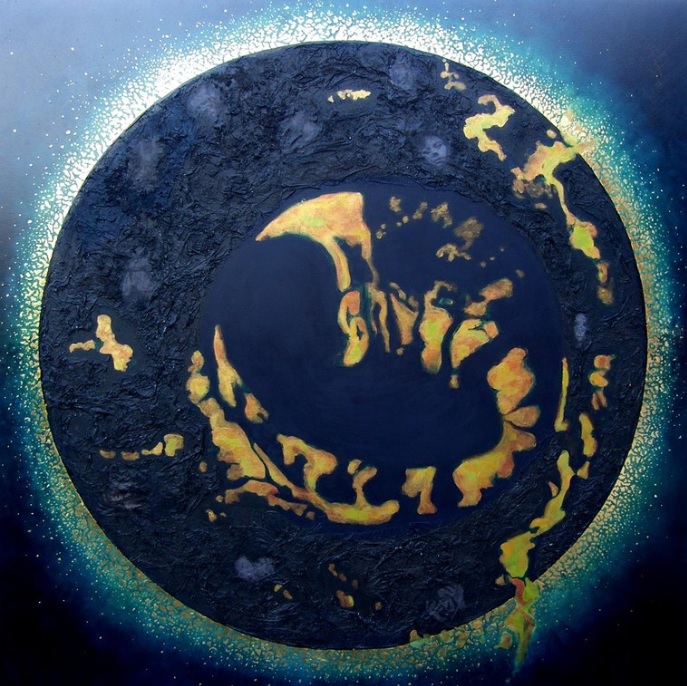
Gerda Smelik (Dutch, 1964–), Advent, 2006. Acrylic, oil paint, gold leaf, paper, wood chips, sand, glue, and photographs on canvas, 160 × 160 cm.

Dutch artist Gerda Smelik says about this mixed media piece:

Advent, a period of reflection and expectation, is portrayed by a globe with a fetus inside. The dark colours stand for the brokenness of life; the light around the fetus and the rays of gold around the globe already announce a better world. When you look at the painting up close, you discover that the suffering of the world is depicted by means of portraits of people in danger and distress.

LISTEN: “O Come, O Come, O Hidden Spring of Light” | Words by Malcolm Guite, 2011 | Music by Joshua Stamper, on PRIMEMOVER, 2021

Make a womb of all this wounded world
And make a womb of all this wounded world

Come to be born, to bear us to our birth
Make these rags of time our swaddling bands
O hidden spring of light
Come to us Wisdom, come unspoken Name
Come Root, and Key, and King, and holy Flame
O quickened little wick so tightly curled
Be folded with us into time and place
Unfold for us the mystery of grace

Make a womb of all this wounded world
And make a womb of all this wounded world

This jazz composition by Joshua Stamper, featuring vocalist Kristin Slipp, rearranges lines from Malcolm Guite’s sonnet “O Emmanuel,” which appears in Waiting on the Word: A Poem a Day for Advent, Christmas and Epiphany. (I shared the poem here, and another compelling Advent musical composition by Stamper here.)

“O Come, O Come, O Hidden Spring of Light” is from Stamper’s PRIMEMOVER, a double album of experimental jazz and classical chamber works commissioned by Resurrection Philadelphia from 2015 to 2021 for services marking holy days and seasons in the church calendar: Ash Wednesday, Good Friday, Easter, Pentecost, and Advent.

PRIMEMOVER is “a meditation on the Divine benediction over our corporeal world,” Stamper writes. “The hovering One . . . has bounded into our wounded world and unbound us from our own trajectory. . . . The abstract is made concrete.”

And, he continues, “It might just be the only record out there featuring everyone from members of the Dirty Projectors to Marilynne Robinson to Beyoncé-collaborators to the former Archbishop of Canterbury to avant-classical violin players from the Czech Republic.”

I love to see churches commissioning smart, exploratory, unconventional music like this!

Advent, Day 20: Of Little Lambs and Atomic Bombs

LOOK: Escape by Nicolas V. Sanchez

Sanchez, Nicolas_Escape
Nicolas V. Sanchez (Mexican American, 1983–), Escape, 2017. Oil on canvas, 61 × 76 cm.

LISTEN: “Do You Hear What I Hear” | Words by Noël Regney, 1962 | Music by Gloria Shayne, 1962 | Performed by Foreign Fields, 2016

Said the night wind to the little lamb
Do you see what I see?
Way up in the sky, little lamb
Do you see what I see?
A star, a star, dancing in the night
With a tail as big as a kite

Said the little lamb to the shepherd boy
Do you hear what I hear?
Ringing through the sky, shepherd boy
Do you hear what I hear?
A song, a song high above the trees
With a voice as big as the sea

Said the shepherd boy to the mighty king
Do you know what I know?
In your palace warm, mighty king
Do you know what I know?
A Child, a Child shivers in the cold
Let us bring him silver and gold

Said the king to the people everywhere
Listen to what I say!
Pray for peace, people, everywhere
Listen to what I say!
The Child, the Child sleeping in the night
He will bring us goodness and light

Bing Crosby’s recording of “Do You Hear What I Hear?” from 1963 was one of the tracks on the Christmas compilation album that we played on Christmas mornings in my house growing up. As a kid, I knew nothing of the gravitas of the carol, thinking it was only about a cute little lamb, a shepherd boy, and a humble king who go to see the newborn baby Jesus. While this is the ostensible narrative of the song, embedded in the lyrics is a fear of apocalyptic disaster, as it was written during the Cuban Missile Crisis, which lasted from October 16 to November 20, 1962. Involving the Soviet deployment of ballistic missiles to newly communist Cuba, which could hit much of the eastern United States in minutes (this in response to the US stationing missiles in Turkey, in range of Soviet territory), this thirty-five-day confrontation is the closest the Cold War came to escalating into a full-scale nuclear war. Though this particular crisis was averted, nuclear-related tensions and anxiety would continue to flare up for years to come.

“Do You Hear What I Hear?” is by the songwriting duo Noël Regney and Gloria Shayne, who were married at the time. Regney studied at music conservatories in Strasbourg, Salzburg, and Paris, but World War II interrupted his education. Despite being a Frenchman from Alsace, he was drafted by force into the Nazi army—but he soon deserted and joined a group of French resistance fighters. He survived the war and began his music career. Touring internationally with singer Lucienne Boyer, he eventually settled in Manhattan in 1952, working for television shows as an arranger, composer, and conductor. It was in New York that he met musician Gloria Shayne, who would become his wife.

The two collaborated together on a number of original songs, but “Do You Hear” is by far their most popular. In a reversal of their usual roles, Regney wrote the lyrics and Shayne wrote the music. The song, as the writers have said in interviews, is a plea for peace amid the imminent threat of nuclear annihilation.

Released December 7, 1962, the debut recording with the Harry Simeone Chorale sold over a quarter million copies, and Crosby’s cover the following year made the song an international hit.

The song traces the passing along of the good news of the birth of a savior: the wind tells the lamb, the lamb tells the shepherd, the shepherd tells the king, and the king tells the world. These character types are common in stories about Christ’s nativity, but not all the ones in the song map directly onto the ones mentioned in the Gospels of Matthew and Luke. The king is neither Herod nor one of the magi, but rather an aspirational figure—a world leader who wields his power responsibly, calling all nations to the way of goodness, peace, and light represented by the infant sleeping in the cold, God incarnate. Jesus is never named as the child, but his identity can be inferred from the context.

The song is structured as a series of interrogatives: do you see a star, do you hear a song, do you know the child who shivers? The last stanza, though, is an imperative: pray for peace.

Once we recognize the world events that informed the writing of “Do You Hear,” some of the lines take on a double meaning. For example, the star with “a tail as big a kite” is not just a celestial body leading the way to the Christ child, but also a nuclear missile. The “song” that rings through the sky “with a voice as big as the sea” is, on one level, a hearty angelic choir, but on another, it’s the thunderous clap of a bomb dropping, the blast echoing out in waves. The menace, the terror, is veiled beneath sentimental language and imagery. But it’s there for those with ears to hear, beckoning us to repentance—to turn from our violence, our lust for power and supremacy, our arsenal building, and to instead embrace the peaceable kingdom of Christ.

“Do You Hear What I Hear?” has been covered many, many times over its sixty years of existence. I’m partial to the cover by the electronic folk duo Foreign Fields of Nashville, consisting of Eric Hillman and Brian Holl. It eliminates the marchlike rhythm of the original as well as the choir and orchestra and, with just a guitar and solo vocals, captures well the sense of longing and lament. “He will bring us goodness” is sung six consecutive times, as if the singer is trying to convince himself of the truth of that promise, to bolster his hope through repetition.

“Out of the Ash” by William Everson (poem)

Phoenix (Aberdeen Bestiary)
Phoenix, from the Aberdeen Bestiary (Aberdeen University Library MS 24, fol. 56r), England, ca. 1200

Solstice of the dark, the absolute
Zero of the year. Praise God
Who comes for us again, our lives
Pulled to their fisted knot,
Cinched tight with cold, drawn
To the heart’s constriction; our faces
Seamed like clinkers in the grate,
Hands like tongs—Praise God
That Christ, phoenix immortal,
Springs up again from solstice ash,
Drives his equatorial ray
Into our cloud, emblazons
Our stiff brow, fries
Our chill tears. Come Christ,
Most gentle and throat-pulsing Bird!
O come, sweet Child! Be gladness
In our church! Waken with anthems
Our bare rafters! O phoenix
Forever! Virgin-wombed
And burning in the dark,
Be born! Be born!

From The Veritable Years: Poems 1949–1966 by William Everson (Brother Antoninus). Copyright © 1998 by Jude Everson and the William Everson Literary Estate. Used with the permission of Black Sparrow Books, an imprint of David R. Godine, Publisher, Inc., godine.com.

William Everson (1912–1994) was an American poet who gained fame in the San Francisco literary renaissance of the 1950s, being classified as part of the Beat movement. Deeply influenced by the poetry of Robinson Jeffers, he wrote about the California landscape, nonviolence, the biblical narrative, and erotic love. He was married twice before converting to Catholicism in 1948, and in 1951 he entered the Dominican Order as Brother Antoninus. However, to pursue a romantic relationship with the woman who would become his third wife, he renounced his monastic vows in 1969, returning to secular life but maintaining his Christian faith and his poetic vocation. He also wrote literary criticism, taught at university, and founded a small press. His collected poems are published in three volumes.

Advent, Day 19: Healing Wings

LOOK: Ronde au Soleil (Sun Circle) by Pablo Picasso

Picasso, Pablo_Sun Circle
Pablo Picasso (Spanish, 1881–1973), Ronde au Soleil (Sun Circle), 1959. Color lithograph on Arches wove paper, 19 1/2 × 17 1/2 in. (49.5 × 44.5 cm).

In this color lithograph, writes the Masterworks Fine Art gallery in San Francisco,

figures frolic happily in a circle, reminiscent of the sardana, a traditional Catalonian dance that appears in Picasso’s body of work. Some figures clutch flowers in their hands, others hold hands, signifying the strong bonds that can exist between people, and many also throw their hands over their heads with joy. Flowers fill the center of the circle as well, as if those dancing have been tossing them into the middle. None of the people are detailed with any facial features, but Picasso has done an inspiring job of bringing intense feeling through simple lines. The dancers abound with feeling, from their joyfully moving feet, to their hands opened wide towards the sky. Above the circle of youths is a glowing yellow sun, emblazoned with the outline of a white dove . . . [that] encapsulates the feeling of the dancers – both the hope that bursts forth from them, and also the freedom that the hope implies.

LISTEN: “But for You Who Fear My Name” by Lenny Smith, 1975 | Arranged and performed by The Welcome Wagon on Welcome to The Welcome Wagon, 2008

But for you who fear my name
The sun of righteousness will rise
With healing in his wings
And you shall go forth again
And skip about like calves
Coming from their stalls at last

You shall be my very own
On the day that I
Caused you to be my special home
I shall spare you as a man
Has compassion on his son
Who does the best he can

Written in God’s voice by way of the prophet Malachi, this song is by Leonard Earl Smith Jr. of Philadelphia; it appears on his 2000 album Deep Calls to Deep with the title “But For You.” Vito and Monique Aiuto, who comprise the Brooklyn-based duo The Welcome Wagon, recorded their own homespun arrangement, replete with stomps and claps, for their 2008 debut album Welcome to The Welcome Wagon.

The song is based on Malachi 4:2 and 3:17:

But for you who revere my name the sun of righteousness shall rise, with healing in its wings. You shall go out leaping like calves from the stall. . . .

They shall be mine, says the LORD of hosts, my special possession on the day when I act, and I will spare them as parents spare their children who serve them.

“Fear” in the song’s first verse is used in the archaic sense of to give reverence to or to be in awe of. God records the names of those who fear him in a “book of remembrance,” states Malachi 3:16.

I love the image in Malachi of baby cows being released from their pens to frolic freely in the fields, to skip and to play, which are likened in their joy to God’s redeemed on the last day when the “sun of righteousness” arises on them at last—when they are liberated.

The English language makes possible a wordplay on “sun” that is not in the original Hebrew, such that we can identify the bright solar orb with God’s Son, Jesus, who sheds his light upon us. (Get it? Sun/Son.) The “wings” of the sun are its rays.

You may recognize this poetic image from “Hark, the Herald Angels Sing”:

Hail the heaven-born Prince of Peace!
Hail the Sun of Righteousness!
Light and life to all He brings, risen with healing in His wings.

The second verse of “But for You Who Fear My Name” opens by celebrating how God has made his home among us—in the flesh in the person of Jesus, and then by sending his Spirit to reside in those who believe. Malachi is referring specifically to Israel as God’s people, his treasured possession, but the New Testament writers apply those epithets more broadly to the new people God was forming through the work of Christ—that is, the church (e.g., 1 Pet. 2:4–10).

The song then references God’s parental mercy and grace in fully embracing us children who want to please him but who fail so many times.

Advent, Day 18: Will There Really Be a Morning?

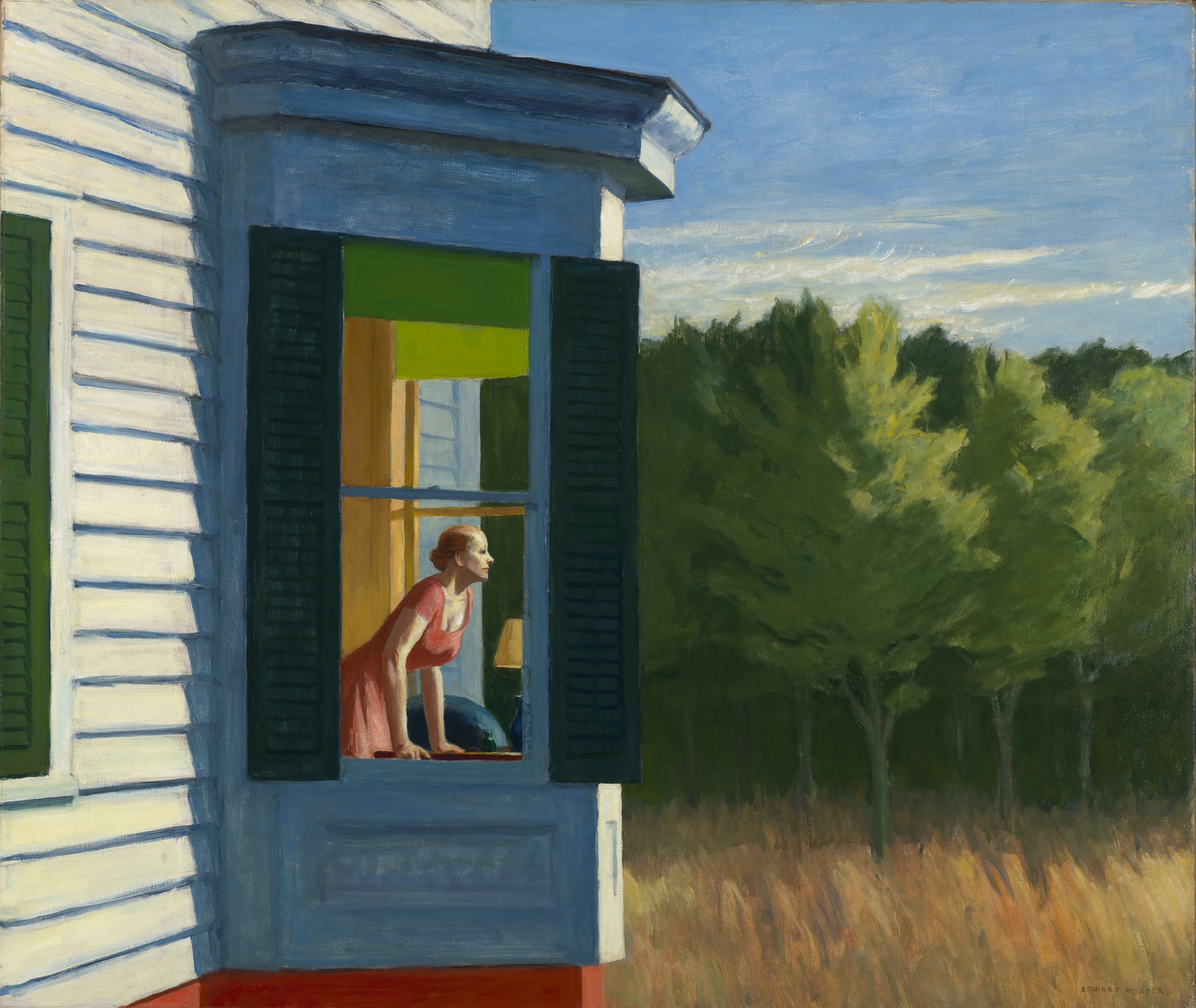
LOOK: Cape Cod Morning by Edward Hopper

Hopper, Edward_Cape Cod Morning
Edward Hopper (American, 1882–1967), Cape Cod Morning, 1950. Oil on canvas, 34 1/8 × 40 1/4 in. (86.7 × 102.3 cm). Smithsonian American Art Museum, Washington, DC.

LISTEN: “Will There Really Be a Morning” | Words by Emily Dickinson, 1860 | Music by Julie Lee, 2011

Will there really be a “morning”?
Is there such a thing as “Day”?
Could I see it from the mountains
If I were as tall as they?

Has it feet like Water lilies?
Has it feathers like a Bird?
Is it brought from famous countries
Of which I have never heard?

Oh some Scholar! Oh some Sailor!
Oh some Wise Man from the skies!
Please to tell a little Pilgrim
Where the place called “morning” lies!

Advent, Day 17: When Morning Dawns

LOOK: Alpha and Omega by Larain Briggs

Briggs, Larain_Alpha and Omega
Larain Briggs (British, 1960–), Alpha and Omega, 2019. Oil over acrylic underpainting on stretched canvas, 100 × 100 cm.

“Behold, I am coming soon. . . . I am the Alpha and the Omega, the first and the last, the beginning and the end.”

—Revelation 22:12–13

This apocalyptic landscape painting by British artist Larain Briggs was on display at London’s gallery@oxo as part of the 2021 Chaiya Art Awards exhibition “God Is . . .” Briggs’s creative practice is centered on Jungian theory, and in Alpha and Omega she addresses the current “metacrisis,” the complexity of global issues (ecological, cultural, economic, etc.) that interrelate and present an existential threat of unknown magnitude. “The archetypal imagery in the book of Revelation offers the means to understand and process the dark times in which we live,” Briggs told me.

In the exhibition catalog Briggs explains, “Although I perceived the painting to be a vision of the end, it is full of light and hope. The end can equally be viewed as a beginning.”

When I saw this work, I was intrigued. Its title evokes Jesus’s self-declaration in the book of Revelation as the first and the last, and visually, it appears that something significant is in process.

In the center of the composition a faint circular form rests on a heavily textured, curved platform of cloud and smoke (“Behold, he is coming with the clouds . . .” [Rev. 1:7]). At this focal point, turbulence resolves into tranquility and darkness gives way to light. I see the image as the earth being transfigured by the arrival of the King.

The body of water at the bottom may be a reference to the “sea of glass mingled with fire” in Revelation 15:2.

LISTEN: “The King Shall Come” | Words by John Brownlie, based on miscellaneous Greek sources, 1907 | Music: American folk tune from Kentucky Harmony, 1816; arr. Minna Choi, 2020 | Performed by Tiffany Austin, 2020

The King shall come when morning dawns
And light triumphant breaks;
When beauty gilds the eastern hills
And life to joy awakes.

Not as of old, a little child
To bear, and fight, and die,
But crowned with glory like the sun
That lights the morning sky.

O brighter than the rising morn,
When He victorious rose,
And left the lonesome place of death,
Despite the rage of foes;—

O brighter than that glorious morn
Shall this fair morning be,
When Christ, our King, in beauty comes,
And we His face shall see.

The King shall come when morning dawns
And earth’s dark night is past;—
O haste the rising of that morn,
That day that aye shall last.

And let the endless bliss begin,
By weary saints foretold,
When right shall triumph over wrong,
And truth shall be extolled.

The King shall come when morning dawns,
And light and beauty brings;—
Hail! Christ the Lord; Thy people pray,
‘Come quickly, King of kings.’

“The King Shall Come” expresses hopeful longing for the return of Christ, which will bring about a new and lasting morn and the final passing of “earth’s dark night.” Stanza 2 contrasts Jesus’s first coming in suffering and struggle and sacrifice, his glory mostly veiled, with his second, when his glory will be unmistakable, his rule uncontested. The victory of that day, the hymnist writes, will be even more exhilarating than that of Christ’s resurrection, because it is total.

This hymn was written in the early twentieth century by the Scottish Presbyterian minister John Brownlie (1859–1925), who cites inspiration from the hymns of the Greek Orthodox Church. It was originally published in 1907 in Hymns from the East. In the introduction Brownlie writes, “The hymns are less translations or renderings, and more centos and suggestions. . . . The Greek has been used as a basis, a theme, a motive.” He differentiates this approach from that used in his previous volumes, which contain “truthfully rendered translations from the originals.”

Though the hymn is often attributed to an anonymous ancient Greek writer, most scholars consider it an original text by Brownlie that reflects his wide knowledge of Greek hymnody, as no Greek original has ever been found. It’s possible that the lines are a composite and expansion of fragments found in the Greek, but really, it’s a pastiche that nods to the centrality of light in Orthodox theology. 

This wistful arrangement by City Church San Francisco worship arts assistant Minna Choi is performed by guest artist Tiffany Austin, a Bay Area jazz vocalist. The other musicians are Adam Shulman on piano, Jeff Marrs on drums, Jason Muscat on bass, and Wil Blades on organ. Their version omits stanzas 5–6, as do several hymnals.

For more Advent songs from City Church, see “Come, Oh Redeemer, Come,” “Come Light Our Hearts,” “I Wait,” and (from the kids in the congregation!) “O Come, Messiah, Come.” For Christmas music, see the church’s past Lessons and Carols services on YouTube; last year I did a write-up on the one from 2020.

Advent, Day 16: Great Day Coming

When the Son of Man comes in his glory and all the angels with him, then he will sit on the throne of his glory. All the nations will be gathered before him, and he will separate people one from another as a shepherd separates the sheep from the goats, and he will put the sheep at his right hand and the goats at the left.

Then the king will say to those at his right hand, “Come, you who are blessed by my Father, inherit the kingdom prepared for you from the foundation of the world, for I was hungry and you gave me food, I was thirsty and you gave me something to drink, I was a stranger and you welcomed me, I was naked and you gave me clothing, I was sick and you took care of me, I was in prison and you visited me.”

Then the righteous will answer him, “Lord, when was it that we saw you hungry and gave you food or thirsty and gave you something to drink? And when was it that we saw you a stranger and welcomed you or naked and gave you clothing? And when was it that we saw you sick or in prison and visited you?”

And the king will answer them, “Truly I tell you, just as you did it to one of the least of these brothers and sisters of mine, you did it to me.” Then he will say to those at his left hand, “You who are accursed, depart from me into the eternal fire prepared for the devil and his angels, for I was hungry and you gave me no food, I was thirsty and you gave me nothing to drink, I was a stranger and you did not welcome me, naked and you did not give me clothing, sick and in prison and you did not visit me.”

Then they also will answer, “Lord, when was it that we saw you hungry or thirsty or a stranger or naked or sick or in prison and did not take care of you?”

Then he will answer them, “Truly I tell you, just as you did not do it to one of the least of these, you did not do it to me.” And these will go away into eternal punishment but the righteous into eternal life.

—Matthew 25:31–46

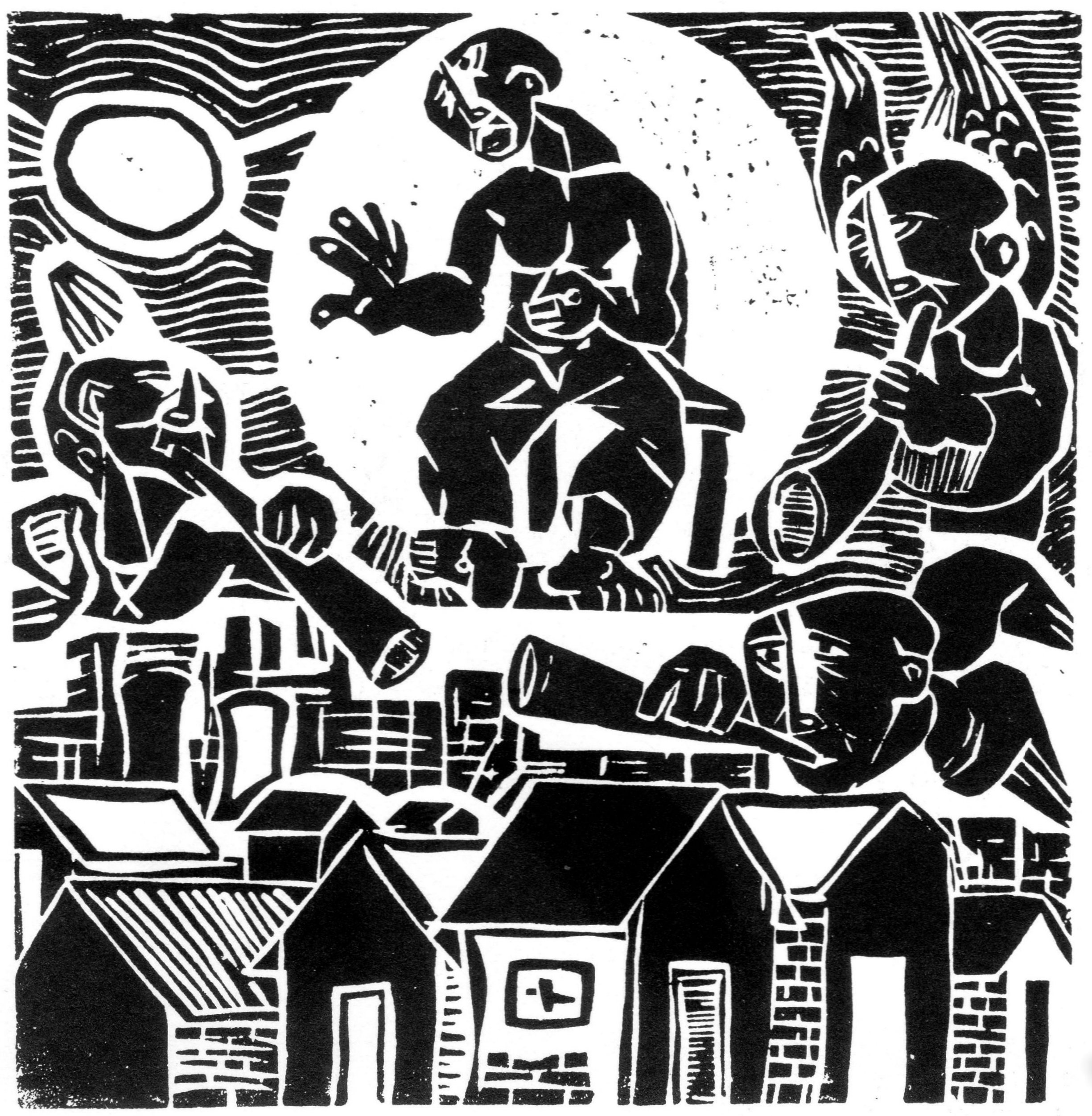
LOOK: The Last Judgment by Nathaniel Mokgosi

Mokgosi, Nathaniel_Last Judgment
Nathaniel Mokgosi (South African, 1946–2016), The Last Judgment, 1980. Linocut. Source: Christliche Kunst in Afrika, p. 274

LISTEN: “There’s a Great Day Coming” by Will Thompson, 1886 | Arranged for six trumpets by Terry Everson, 2019 | Performed by Snarky Puppy, 2019 [HT: Global Christian Worship]

There’s a great day coming,
A great day coming,
There’s a great day coming by and by,
When the saints and the sinners shall
Be parted right and left—
Are you ready for that day to come?

Refrain:
Are you ready? Are you ready?
Are you ready for the judgment day?
Are you ready? Are you ready?
For the judgment day?

There’s a bright day coming,
A bright day coming,
There’s a bright day coming by and by.
But its brightness shall only come
To them that love the Lord—
Are you ready for that day to come? [Refrain]

There’s a sad day coming,
A sad day coming,
There’s a sad day coming by and by,
When the sinner shall hear his doom,
“Depart, I know ye not!”
Are you ready for that day to come? [Refrain]

Texas-bred and New York–based, Snarky Puppy is a jazz-soul-funk music collective consisting of some twenty-five members in regular rotation. “At its core, the band represents the convergence of both black and white American music culture with various accents from around the world. Japan, Argentina, Canada, the United Kingdom, and Puerto Rico all have representation in the group’s membership.” The trumpeters for this song are Michael “Maz” Maher, Jon Lampley, Justin Stanton, Yay Yennings, Kyla Moscovich, and John Culbreth.

Advent, Day 15: Great Joy River

Then I saw a new heaven and a new earth, for the first heaven and the first earth had passed away, and the sea was no more. And I saw the holy city, the new Jerusalem, coming down out of heaven from God . . .

It has a great, high wall with twelve gates, and at the gates twelve angels, . . . and the twelve gates are twelve pearls. . . .

I saw no temple in the city, for its temple is the Lord God the Almighty and the Lamb. And the city has no need of sun or moon to shine on it, for the glory of God is its light, and its lamp is the Lamb. The nations will walk by its light, and the kings of the earth will bring their glory into it. Its gates will never be shut by day—and there will be no night there. . . .

Then the angel showed me the river of the water of life, bright as crystal, flowing from the throne of God and of the Lamb through the middle of the street of the city. On either side of the river is the tree of life with its twelve kinds of fruit, producing its fruit each month, and the leaves of the tree are for the healing of the nations. Nothing accursed will be found there any more. But the throne of God and of the Lamb will be in it, and his servants will worship him; they will see his face, and his name will be on their foreheads. And there will be no more night; they need no light of lamp or sun, for the Lord God will be their light, and they will reign forever and ever.

—Revelation 21:1–2, 12, 21–25; 22:1–5

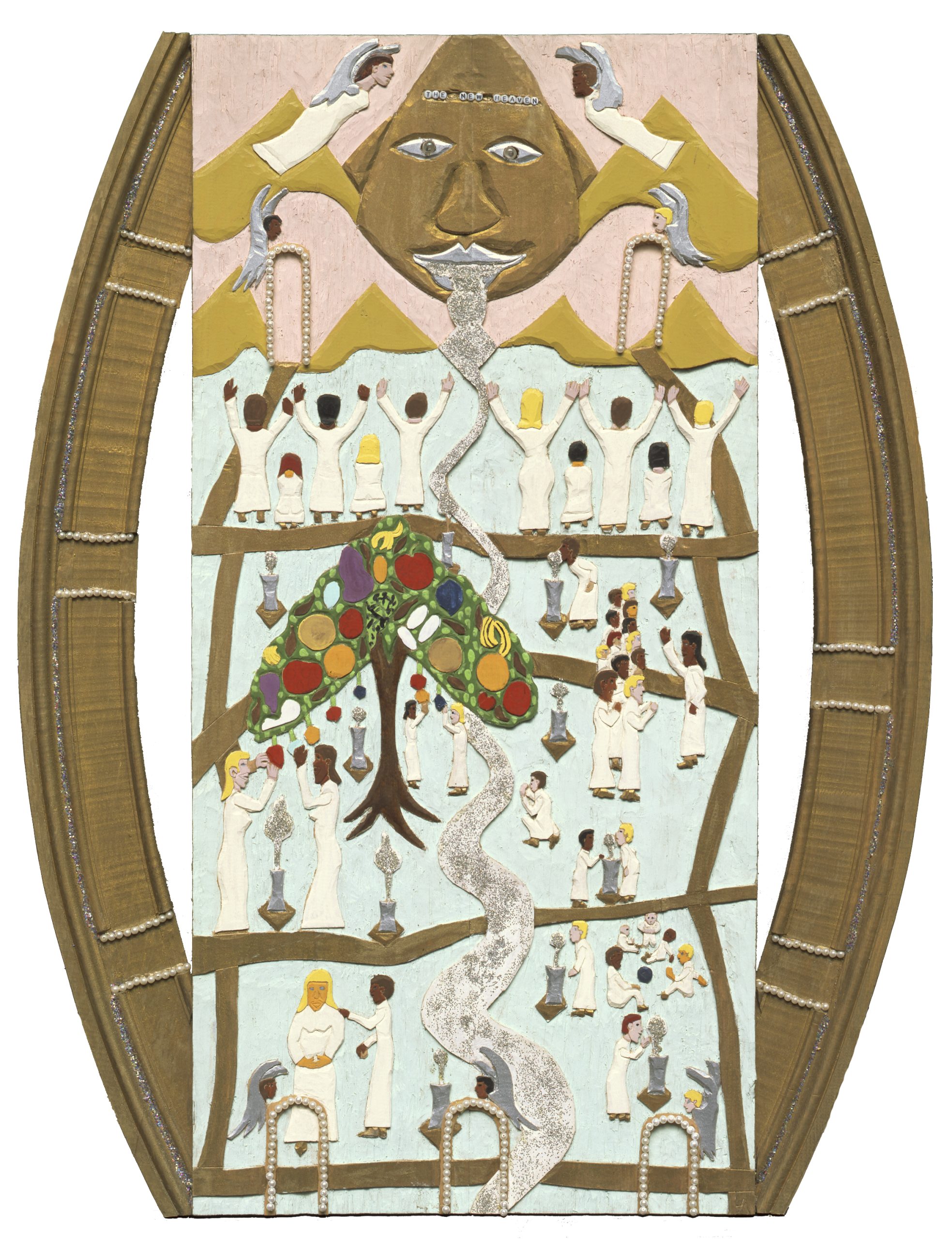
LOOK: The New Heaven by Leroy Almon

Almon, Leroy_The New Heaven
Leroy Almon (American, 1938–1997), The New Heaven, 1984. Carved wood, light bulbs, artificial pearls, glue, glitter, plastic letters, paint, 36 × 28 in. (91.4 × 71.1 cm). Toledo Museum of Art, Ohio. [object record]

This mixed-media depiction of heaven by African American folk artist Leroy Almon draws on imagery from the book of Revelation, showing centrally a crystal-bright river, the water of life, flowing forth from the mouth of God (Rev. 22:1–2). It courses through the paradisal scene, past the tree with its twelve fruits and healing leaves, and is pumped into twelve fountains, from which Black and white people drink together. Across lines of race, the new-city dwellers unite in worship, fellowship, and play. Notice the group of children with the ball in the bottom register!

For a framing device, Almon has used two wooden doors that bow out, as if the scene in all its fullness cannot be contained; as if the borders of the new city must bend to embrace the multitudes and their joy. The shape communicates an expansiveness that is the heart of God.

God is shown as majestic, mountain-like, and yet bearing a tender expression. The plastic beads on his forehead are printed with letters that read, “THE NEW HEAVEN,” and his eyes (not lit in this photo) are battery-powered light bulbs! He is, as John the Revelator tells us, the unending light dispelling all darkness. 

Almon was born in 1938, so for about the first three decades of his life, he lived in a country where racial segregation was enforced legally in many states and socially in others. By and large, Blacks and whites were made to live in separate neighborhoods, attend separate schools, swim in separate pools, eat at separate restaurants, drink from separate water fountains, pass through separate public building entrances, wait in separate waiting rooms, sit in separate sections of the bus and the theater and even (woe is us) the church, and so on. Even after the passage of the Civil Rights Act in 1964, mandating desegregation, racial prejudices and hostilities continued to persist, as they do today. And because sinful human beings create and run systems (criminal legal, economic, educational, medical, etc.), it’s no surprise that the sin of racism can be found there as well.

Almon longed to see racial justice and (re)conciliation, and he knew Jesus has the power to make it happen. Almon’s preaching ministry went hand-in-hand with his art making. Through both, he shared the good news that Jesus, through his life, death, and resurrection, calls us to a new way of being in the world, which involves repentance of sin and turning to the divine light of love that knows no bounds. His New Heaven envisions a world saved and transformed by Christ’s love, where power is shared equally, forgiveness sought and granted, and friendship is the order of the day, as is a shared rejoicing in the greatness of God. In The New Heaven, Black and white praise Jesus side-by-side, eat at the tree of life together, and put their lips to the same bubbling fount of living water.

And not only are relationships healed and humanity restored to its original harmony in the new heaven, but also personal sorrows and hardships are no more. Physically, mentally, emotionally, spiritually, socially, we flourish in the light of God that never dims.

For more on Leroy Almon, see this Art & Theology Lenten devotional post from earlier this year.

LISTEN: “Great Rejoicing” by Thad Cockrell, on To Be Loved (2009) | Performed by Rain for Roots, feat. Sandra McCracken and Skye Peterson, on Waiting Songs (2015)

There’s gonna be a great rejoicing (2×)

The troubles of this world
Will wither up and die
That river of tears made by the lonely
Someday will be dry
There’s gonna be a great rejoicing

There’s gonna be a great joy river (2×)

Questions of this world
Someday will be known
Who’s robbing you of peace
And who’s the giver

There’s gonna be a great joy river

Someday you will find me
Guarded in His fortress
Open heart and wings
That never touch the ground
Someday we will gather
In a grand reunion
Debts of this old world
Are nowhere to be found
Nowhere to be found

There’s gonna be a great rejoicing (5×)

We are now halfway through Advent! Many of the songs featured in this Advent series, including today’s, appear on my Advent Playlist. I also have a companion Christmastide Playlist, which has been revised and expanded since last year to include some choral selections.