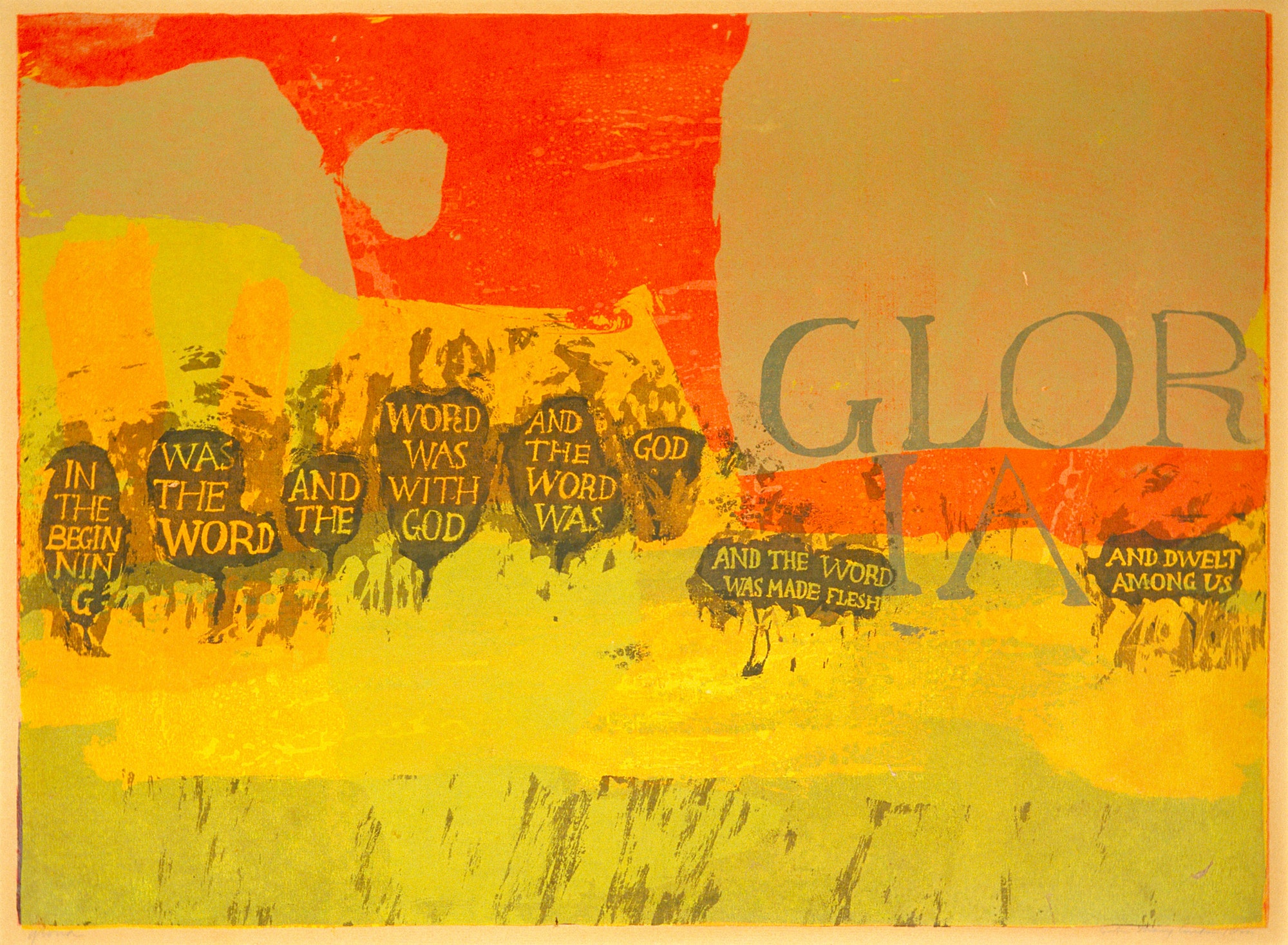
Corita Kent (1918–1986) was an artist, educator, and advocate for social justice. At age 18 she entered the religious order Immaculate Heart of Mary, eventually teaching in and then heading up the art department at Immaculate Heart College. Her work evolved from figurative and religious to incorporating advertising images and slogans, popular song lyrics, biblical verses, and literature. Throughout the ’60s, her work became increasingly political, urging viewers to consider poverty, racism, and injustice. In 1968 she left the order and moved to Boston. After 1970, her work evolved into a sparser, introspective style, influenced by living in a new environment, a secular life, and her battles with cancer. She remained active in social causes until her death in 1986. At the time of her death, she had created almost 800 serigraph editions, thousands of watercolors, and innumerable public and private commissions.
LISTEN: “God in Flesh, Our Hope Divine” by The Brilliance (David Gungor and John Arndt), on Advent, vol. 2 (2012; reissued 2021)
God of heaven, Lord of earth We beseech thee Born of Mary, virgin birth Lord, we greet thee God in flesh, our hope divine Alleluia Babe of heaven, God’s own son Alleluia
Star of David, Son of Man God be with us Suff’ring servant, wounded lamb Bring peace to us Broken flesh, our hope divine Alleluia Lifted up for all mankind Alleluia
Gloria, gloria, gloria in excelsis Deo! (×2)
Root of Jesse which shall stand Lord, we need thee Banner o’er the nations We receive thee Glorious resting place for all Alleluia Jew and Gentile, welcome home Alleluia
Gloria, gloria, gloria in excelsis Deo! (×2)
“Come, Lord Jesus,” people sing We are yearning Give us back the garden We are longing On that day we’ll see thy face Alleluia This whole realm in your embrace Alleluia
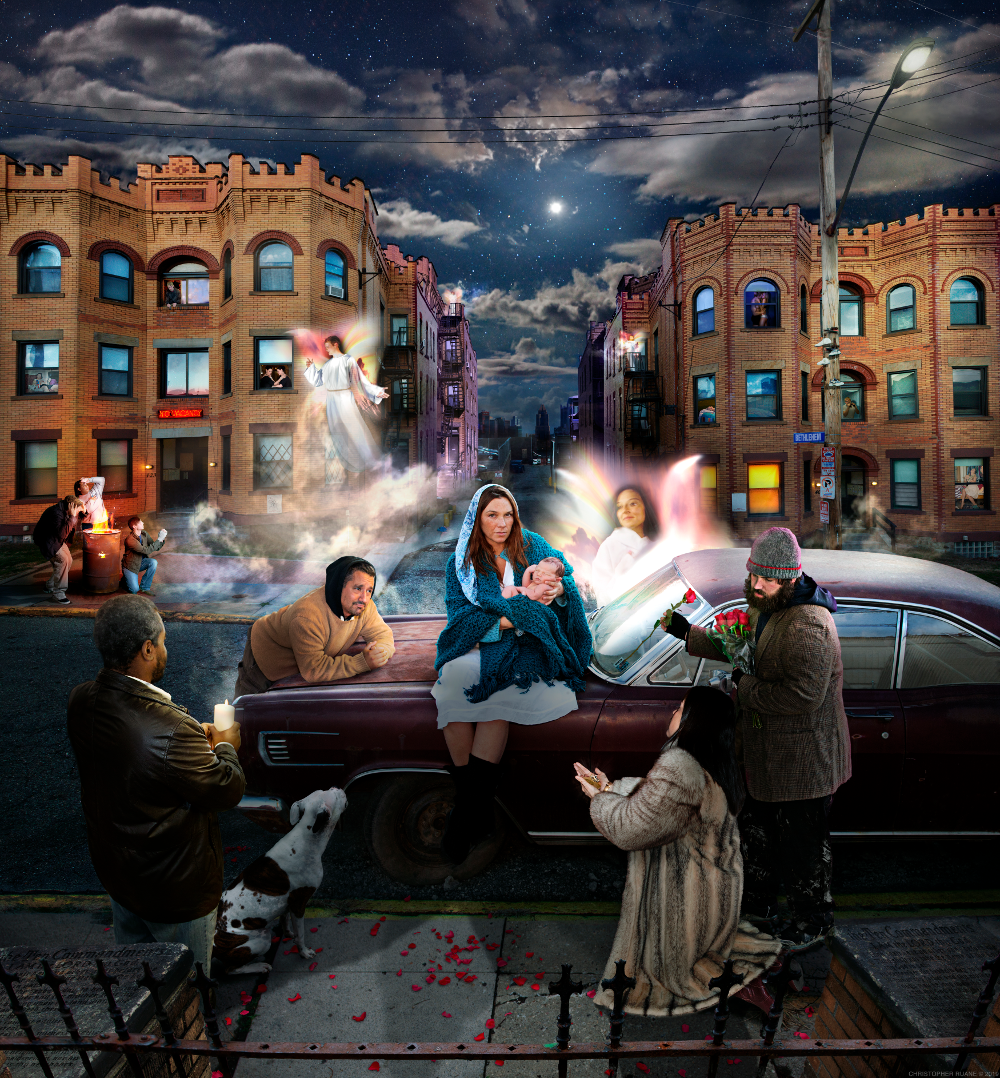
Christopher Ruane (American, 1981–), The Nativity, 2014. C-print, 52 × 48 in. Click the link to zoom in.
This image by photographer and composite artist Christopher Ruane sets the Nativity of Christ on an urban street corner marked “Bethlehem” and casts racially diverse models in the biblical roles. Mary sits on the hood of an old beat-up car holding her sweet newborn with a protective grip—she has presumably just given birth in the backseat. She’s wrapped in a blue afghan, the color traditionally associated with the Virgin. Joseph leans over, gazing proudly at his new baby son. Instead of the traditional cow and donkey looking on, there’s a spotted dog.
In the foreground are the three “wise men,” which here are two men and a woman, offering their gifts to the family. One man brings a candle; another, a rose. A wealthier woman in a fur coat brings gold jewelry. They stand or kneel on the sidewalk before this miracle baby who will be their deliverer, the way strewn with flower petals.
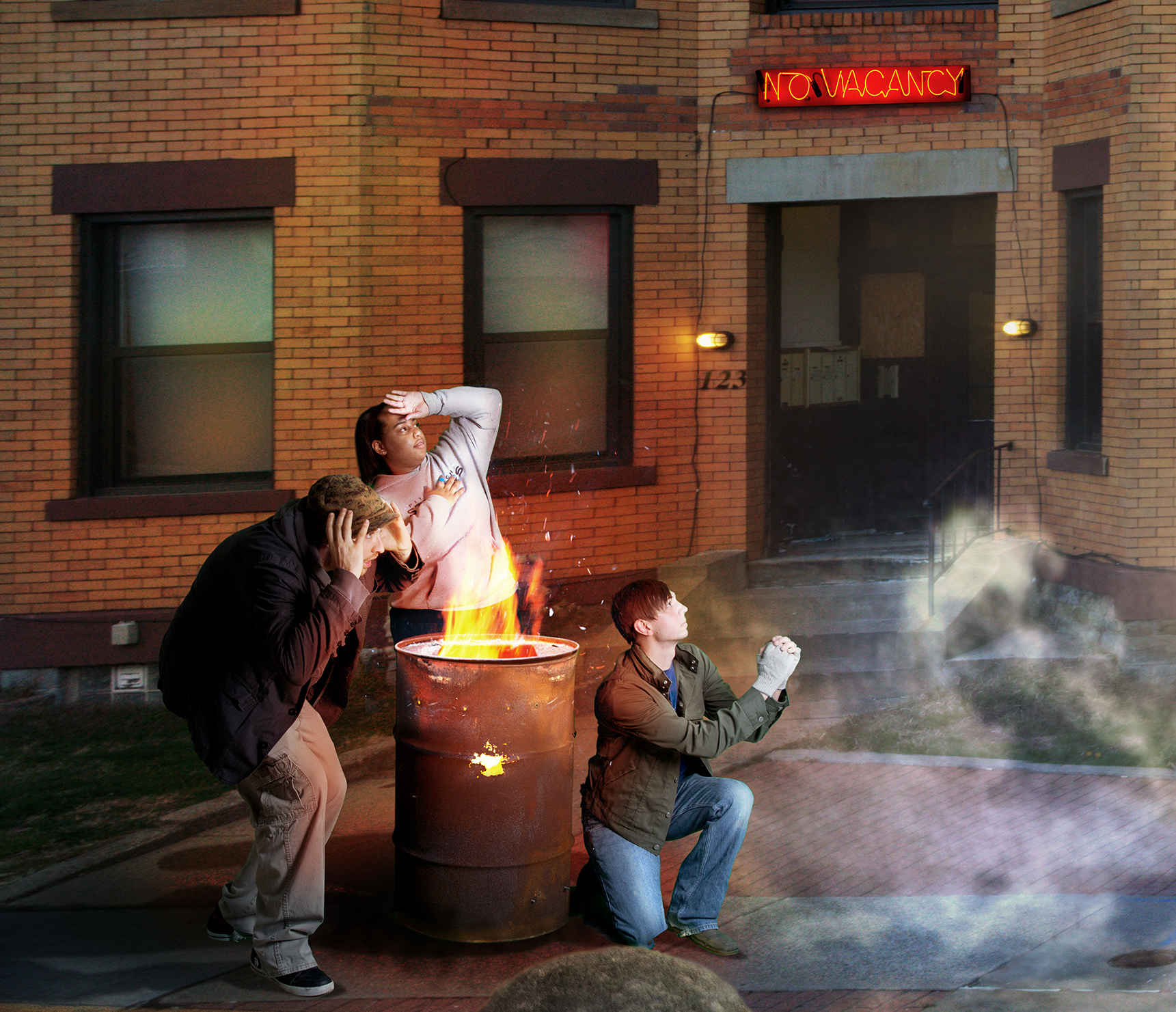
In the middle ground are three young unhoused people around a trashcan fire, standing in for the shepherds. A cloud of steam rises up out of a manhole before their eyes and coalesces with a heavenly apparition, come to personally announce to them the Messiah’s birth.
In the windows of the apartment building in the background are various people occupied with various activities. In one room a couple is engaging in sexual foreplay. Across the way, a man is vegging out in front of a TV. One woman, whose closet is spilling over with clothes, is hugging her collection of designer shoes.
These represent different values or dependencies—for example, materialism, a literal clinging to one’s possessions. But there’s also pain.
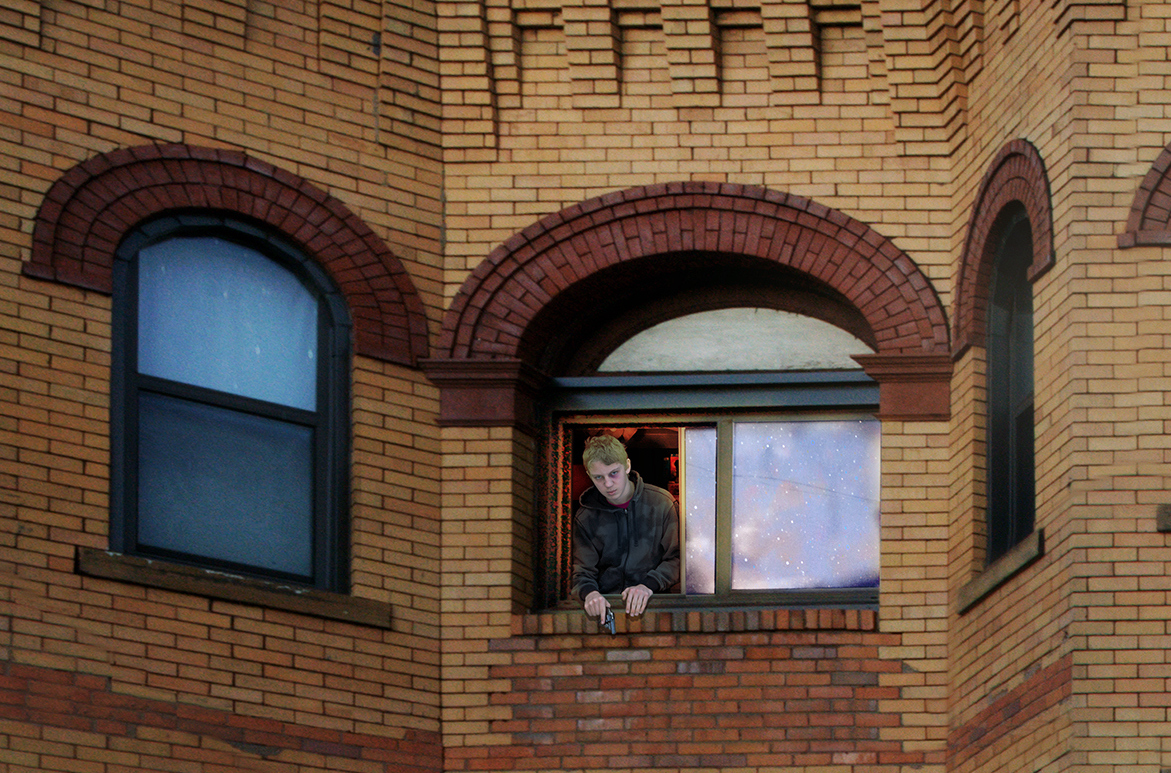
On the top floor there’s a young man in a hoodie with a black eye. Maybe he’s abused by his father. Or bullied at school. Or in too deep with a gang. Either way, he is bitter and angry and scared and distrustful and has a gun.
Christ was born into this world of hurt and false loves. He came to call us out of the darkness of these and into light, to give us abundant life in God. The bright star above beckons us all to follow the light to the feet of Jesus, Emmanuel, God-with-us.
Three wise men ridin’ hard through the cold Lost on some big city street with no place warm to go They are lookin’ for a manger, or a sign in the lights But they’re a long way from Bethlehem tonight
But they heard about a savior And a preacher in the park Who will camp with the homeless Where they shiver in the dark He’ll deliver salvation To the weary and the cold And he’ll bring joy, joy, joy to the wanderin’ soul
The cleaning lady sighs as she closes up the gate This job don’t quite pay the bills, and she’s always workin’ late But all in a moment comes a light from above It’s an angel speaking words of joy and love
And he tells her of a savior And a preacher in the park Who will camp with the homeless Under bridges in the dark He’ll deliver salvation To the weary and the cold And he’ll bring joy, joy, joy to the wanderin’ soul
Four in the mornin’ at the Tradewinds Motel The register reads, “All Full Up,” and the clerk thinks, “Just as well” But out in the toolshed by an old Coleman lamp A little family makes its meager camp
And the wise men bring presents And the angels gather round The cleaning lady slips in through the door without a sound And an old black dog looks on with the rest At the little babe upon his mother’s breast
And there comes a savior (Joy to the world) And a preacher in the park (The Lord is come) And he camps with the homeless (Let earth) Where they shiver in the dark (Receive her king) He delivers salvation To the weary and the cold (Let every heart sing) And he brings joy, joy, joy to the wanderin’ soul He brings joy, joy, joy to the wanderin’ soul
The American folk singer-songwriter Dave Carter was one half of the duo Dave Carter and Tracy Grammer, active from 1998 until Carter’s unexpected death in 2002. His songs have been covered by Joan Baez, Judy Collins, Willie Nelson, and others, and Grammer posthumously released several previously unreleased songs by Carter, including “American Noel.” She and Carter recorded the song sometime between 1999 and 2001 for a series of employee holiday gift compilations commissioned by the president of a hardware store chain.
Like Ruane’s digital photomontage, “American Noel” imagines the Incarnation happening on the margins of a modern American city, attracting low-wage workers and transients, among others. Jesus pitches his tent among the exhausted and despairing, “the weary and the cold,” coming not as an outsider to struggle but as one who will know it firsthand. His childhood, to say nothing of his adulthood, is marked by sudden flight from his homeland to escape a tyrannical king and by an upbringing in a country not his own.
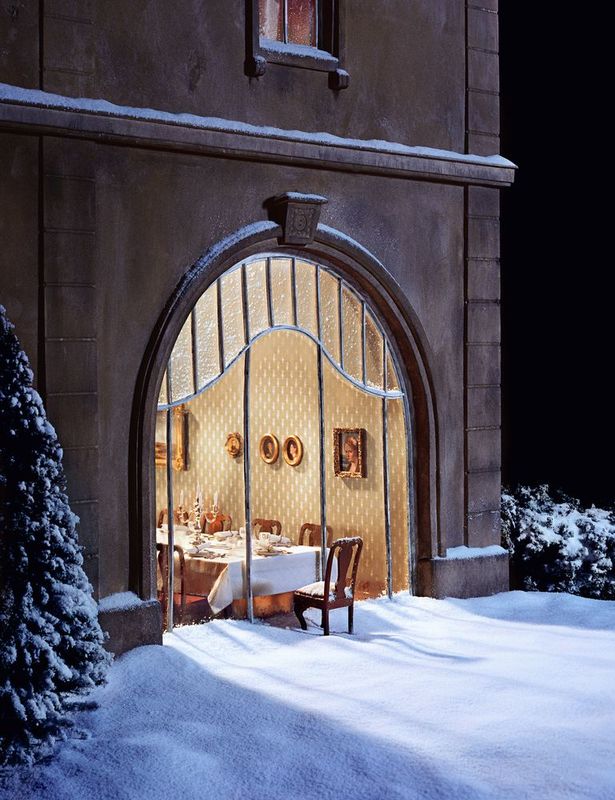
Frank Kunert (German, 1963–), Geschlossene Gesellschaft (Closed Society), 2011. C-print, 40 × 30 cm. Edition of 50 + 3 ap.
LISTEN: “The Ditchling Carol” (Roud 3216) | Words by William Robert Spencer, 1811 | Music by Peter Parsons, before 1901 | Performed by Waterson:Carthy on Broken Ground (1999; reissued 2013)
Be merry all, be merry all With holly dress the festive hall Prepare the song, the feast of all To welcome Merry Christmas
And all remember, gentles gay For you who bask in fortune’s ray The year is all a holiday The poor have only Christmas
When you with velvets mantled o’er Defy December’s tempest’s roar Oh spare one garment from your store To clothe the poor at Christmas
And all remember, gentles gay For you who bask in fortune’s ray The year is all a holiday The poor have only Christmas
When you the costly banquet deal To guests who never famine feel Oh spare one morsel from your meal To feed the poor at Christmas
And all remember, gentles gay For you who bask in fortune’s ray The year is all a holiday The poor have only Christmas
From blazing logs of fuel awhile Your homes are within summer’s smile Oh spare one log from off the pile To warm the poor at Christmas
And all remember, gentles gay For you who bask in fortune’s ray The year is all a holiday The poor have only Christmas
So shall each note of mirth appear More sweet to heaven than praise or prayer And angels in their carols there Shall bless the poor at Christmas
And all remember, gentles gay For you who bask in fortune’s ray The year is all a holiday The poor have only Christmas
This carol from Ditchling in East Sussex has a very Dickensian feel to it. More sobering than the usual Christmas fare, it contrasts the lavish holiday feasts of the well-off with the poverty that exists outside their doors. Think Lazarus and the rich man. The poor rely on the feelings of goodwill and generosity that Christmas engenders, but as this song acknowledges, the needs persist year-round. Those whom God has blessed with good fortune would do well to share it—not just with family and friends of like socioeconomic status but with neighbors of all classes, and not just during the “season of giving” but on a continuing basis.
Peter Parsons (1825–1901), a Ditchling shoemaker and leader of the village glee club, found the poem above on a broadside ballad sheet from the early nineteenth century and was moved to write a tune for it. I encountered the carol through a nineties recording by Norma Waterson, her husband Martin Carthy, and their daughter Eliza Carthy, who have been at the forefront of the English folk music scene for decades.
I would go even further than the lyrics do and say, don’t just give the poor a morsel or a log; invite them in! What might radical hospitality look like for you this Christmas? How might your merriment expand to embrace those who are typically excluded?
“There will be signs in the sun, the moon, and the stars, and on the earth distress among nations confused by the roaring of the sea and the waves. People will faint from fear and foreboding of what is coming upon the world, for the powers of the heavens will be shaken. Then they will see ‘the Son of Man coming in a cloud’ with power and great glory. Now when these things begin to take place, stand up and raise your heads, because your redemption is drawing near.”
Then he told them a parable: “Look at the fig tree and all the trees; as soon as they sprout leaves you can see for yourselves and know that summer is already near. So also, when you see these things taking place, you know that the kingdom of God is near. Truly I tell you, this generation will not pass away until all things have taken place. Heaven and earth will pass away, but my words will not pass away.
“Be on guard so that your hearts are not weighed down with dissipation and drunkenness and the worries of this life, and that day does not catch you unexpectedly, like a trap. For it will come upon all who live on the face of the whole earth. Be alert at all times, praying that you may have the strength to escape all these things that will take place, and to stand before the Son of Man.”
—Luke 21:25–36
LOOK: Country Gospel Music by Robert Gwathmey
Robert Gwathmey (American, 1903–1988), Country Gospel Music, 1971. Oil on canvas, 40 × 50 in. Private collection.
LISTEN: “I Believe in Being Ready” | Appalachian spiritual, 19th century | Performed by Rising Appalachia on Leylines (2019) [see also this performance at the Yuba River in Northern California]
I believe in being ready I believe in being ready I believe in being ready For the time is drawing near
Brothers, sisters, please get ready Brothers, sisters, please get ready Brothers, sisters, please get ready For the time is drawing near
Oh there’ll be signs and wonders Oh there’ll be signs and wonders Oh there’ll be signs and wonders For the time is drawing near
We’ll turn round and just start over We’ll turn round and just start over We’ll turn round and just start over For the time is drawing near
I believe in being ready I believe in being ready I believe in being ready For the time is drawing near
I believe in being ready I believe in being ready I believe in being ready For the time is drawing near
For the time is drawing near For the time is drawing near
Whereas the Great Awakening may have brought about the first American break from established religious musical form, the Second Awakening and the rise of evangelical religious fervor, mostly in the Pennsylvania backcountry and southern mountains, left us with the spiritual folk songs, or folk hymns, that have a lingering legacy in West Virginia. This musical form developed during the period from the 1780s to the 1830s. The camp meeting was an old-world form brought by the Scots-Irish to America. The new spirituals that developed along with this form of worship on the frontier directly contributed to the religious fervor generated through the camp meeting.
“One might well remember, for example, that the camp meetings began and remained in nature surroundings, in the wilderness,” wrote [George Pullen] Jackson. Camp meetings in America (also called bush meetings, field meetings, and, today, brush-arbor revival or tent meetings) spawned a new emotion which materialized in song as the spiritual. At this point the chorus was introduced to the songs and became an identifying mark.
Choruses were repetitive, and verses were simplified for easy memorization by illiterate participants and where songbooks were nonexistent. Often only the introduction of a new person, as in mother, father, sister, and brother, differentiated one verse from another. Additional verses suggest more people such as sinner, preacher, playmates, etc. But it is the music—the old folk tunes clinging to all the sensitive and moving traits that attract many to folk music—that has caught the attention and held the fancy of West Virginians for as long as two centuries. These folk hymns are the predecessors to the “gospel hymns” that began about 1870 in the Protestant churches and continue to be sung today.
The song is more commonly called “When This World Comes to an End” and has been recorded under that title in this millennium by, for example, Tim O’Brien, Ashley Cleveland, and David Powell. We know of it thanks to Maggie Hammons Parker (1899–1987) from Pocahontas County, West Virginia, whose family participated in camp meetings in the early twentieth century. Parker sang the song as she remembers it for Alan Jabbour on a 1970 field recording, with the following lyrics. For more information, see the 1973 American Folklife Center publication The Hammons Family: A Study of a West Virginia Family’s Traditions.
I believe in being ready, I believe in a-being ready, I believe in being ready, When this world comes to an end.
Oh, sinners, do get ready, Oh, sinners, do get ready, Oh, sinners, do get ready, For the times is a-drewing near.
Oh, there’ll be signs and wonders, Yes, there’ll be signs and wonders, Oh, there’ll be signs and wonders, When this world is to an end.
Oh, the sun, she will be darkened, Yes, the sun, she will be darkened, Oh, the sun she will be darkened, When this world is to an end.
Oh, the moon, she will be a-bleeding, Yes, the moon, she will be bleeding, Oh, the moon, she will be bleeding, When this world is to an end.
I believe in a-being ready, I believe in being ready, I believe in being ready, When this world is to an end.
Oh, the stars, they’ll all be a-falling, Yes, the stars will all be falling, Oh, the stars will all be falling, When this world is to an end.
Oh, sisters, do get ready, Oh, sisters, do get ready, Oh, sisters, do get ready, For the times is a-drewing near.
Oh, fathers, do get ready, Yes, fathers, do get ready, Oh, fathers, do get ready, When this world is to an end.
Oh, mothers, do get ready, Yes, mothers, do get ready, Oh, mothers, do get ready, For the times is a-drewing near.
For there’ll be them signs and wonders, Yes, there’ll be them signs and wonders, There will be them signs and wonders, When this world comes to an end.
For their 2019 recording of the song, the band Rising Appalachia adapted the lyrics and retitled the song after its first line. “Drawn to its haunting, modal melody and stark lyrics,” they write, “we put the heavy drum pulse of the bodhran behind it to rattle the ribcage. It is both apocalyptic and soothing to call forth and sing these words.”
Rising Appalachia was founded in 2004 by sisters Leah and Chloe Smith, who grew up in Atlanta, absorbing the city’s emerging hip-hop scene as well as traveling with their family to fiddle camps across the Southeast on weekends. Their music is a blend of folk, world, and urban. “Rising Appalachia has come out of this idea that we can take these traditions of southern music—that we’ve been born and raised with—and we can rise out of them, creating all these different bridges between cultures and stories to make them feel alive,” Leah says. “Our music has its foundation in heritage and tradition, but we’re creating a music that also feels reflective of the times right now. That’s always been our work.”
The Smiths are joined on the album Leylines by longtime band members David Brown (upright bass, baritone guitar) and Biko Casini (world percussion, n’goni) and by two new members: West African musician Arouna Diarra (n’goni, talking drum) and Irish musician Duncan Wickel (fiddle, cello). Special guests on the album include singer-songwriters Ani DiFranco and Trevor Hall and jazz trumpeter Maurice Turner.
“Then the kingdom of heaven will be like this. Ten bridesmaids took their lamps and went to meet the bridegroom. Five of them were foolish, and five were wise. When the foolish took their lamps, they took no oil with them; but the wise took flasks of oil with their lamps. As the bridegroom was delayed, all of them became drowsy and slept. But at midnight there was a shout, ‘Look! Here is the bridegroom! Come out to meet him.’ Then all those bridesmaids got up and trimmed their lamps. The foolish said to the wise, ‘Give us some of your oil, for our lamps are going out.’ But the wise replied, ‘No! there will not be enough for you and for us; you had better go to the dealers and buy some for yourselves.’ And while they went to buy it, the bridegroom came, and those who were ready went with him into the wedding banquet; and the door was shut. Later the other bridesmaids came also, saying, ‘Lord, lord, open to us.’ But he replied, ‘Truly I tell you, I do not know you.’ Keep awake therefore, for you know neither the day nor the hour.”
—Matthew 25:1–13
LOOK: Byzantine fresco of the Parable of the Ten Virgins
Parable of the Ten Virgins, ca. 1600. Fresco, Chapel of the Virgin, Monastery of Saint John the Theologian, Chora, Patmos, Greece.
LISTEN: “ها هوذا الختن” (“Behold the Bridegroom”), a troparion (short hymn) in Arabic from the Antiochian Orthodox Church in Syria
من الليل تبتكر روحي إليك يا الله لإنّ أوامرك نورٌ على الأرض.
ها هوذا الختن يأتي في نصف الليل فطوبى للعبد الذي يجده مستيقظا، أما الذي يجده متغافلا فهو غير مستحق. فانظري يا نفسي ألا تستغرقي في النوم ويغلق عليك خارج الملكوت وتسلمي إلى الموت، بل كوني منتبهة صارخة : قدوس قدوس قدوس أنت يا الله، من أجل والدة الإله ارحمنا.
English translation:
My spirit seeks you early in the night watches, for your commandments are a light on the earth. Alleluia, alleluia, alleluia.
Behold, the Bridegroom is coming in the middle of the night, and blessed is the servant he shall find awake and watching; but unworthy is the one he shall find neglectful. Beware, therefore, O my soul. Be not overcome by sleep, lest you be given over to death and shut out from the kingdom. But return to soberness and cry aloud, “Holy, holy, holy are you, our God.” Through the Theotokos, have mercy on us.
In Orthodox churches the parable of the ten virgins is read, and “Behold the Bridegroom” sung, on Tuesday of Holy Week. In the West, however, the parable is associated more with Advent, since its focus is on Christ’s return.
And I saw the holy city, the new Jerusalem, coming down out of heaven from God, prepared as a bride adorned for her husband. And I heard a loud voice from the throne saying,
“See, the home of God is among mortals. He will dwell with them; they will be his peoples, and God himself will be with them; he will wipe every tear from their eyes. Death will be no more; mourning and crying and pain will be no more, for the first things have passed away.”
And the one who was seated on the throne said, “See, I am making all things new.”
—Revelation 21:2–5a
LOOK: The New Jerusalem by Sassandra
Jacques Richard Sassandra (French, 1932–), The New Jerusalem (Rev. 21:1–4a), 1970–80. Paper collage with AquaLac, 86 × 110 cm.
Jacques Richard, whose artist name is Sassandra, was born in 1932 to a French missionary family in Sassandra, Ivory Coast, where he spent his youth. Upon returning to France, he studied art, followed by theology, and soon became an art teacher in Paris public schools while also maintaining a studio art practice of drawing, painting, collaging, and woodblock printing.
It shows the hands of God lovingly lowering the heavenly city to earth—the two realms reunited at last. The cross is at the center, forming the trunk of the tree of life, and the Holy Spirit spreads her wings over all.
LISTEN: “New World Coming” by Barry Mann and Cynthia Weil, 1969 | Performed by Nina Simone on Here Comes the Sun, 1971
There’s a new world comin’ And it’s just around the bend There’s a new world comin’ (joy, joy, joy . . .) This one’s comin’ to an end
There’s a new voice callin’ And you can hear it if you try And it’s growing stronger With every day that passes by (yeah, yeah, yeah . . .)
There’s a brand-new mornin’ Rising clear and sweet and free There’s a new day dawning That belongs to you and me
Yes, a new world’s comin’ You know the one I’m talking about The one we’ve had visions of And it’s comin’ in peace, comin’ in joy Comin’ in peace, comin’ in joy Come in peace, come in joy Comin’ in love
And I saw another sign in heaven Great and marvelous Seven angels having the seven last plagues For in them is filled up the wrath of God And I saw, as it were, a sea of glass mingled with fire And them that had gotten the victory over the beast And over his image And over his mark And over the number of his name Stand on the sea of glass Having the harps of God all around them
There’s a new world comin’ And it’s just around the bend There’s a new world comin’ This one’s comin’ to an end
There’s a new voice callin’ And you could hear it if you would just give it a try And it’s growing stronger With every day that passes by
And there’s a brand-new mornin’ Rising clear and sweet and free There’s a new day dawning That belongs to you and me
Yes, a new world’s comin’ The one we’ve had visions of
Comin’ in peace, yeah Comin’ in joy, yeah Comin’ in peace now, yeah Comin’ in love now, yeah Comin’ in peace now, yeah Comin’ in joy now, yeah Comin’ in peace now, yeah Comin’ in love, yeah Comin’ in peace . . . Comin’ in joy . . . Comin’ in love (joy)
This song, as you may have noticed, includes a recitation of Revelation 15:1–2:
Then I saw another portent in heaven, great and amazing: seven angels with seven plagues, which are the last, for with them the wrath of God is ended.
And I saw what appeared to be a sea of glass mixed with fire, and those who had conquered the beast and its image and the number of its name, standing beside the sea of glass with harps of God in their hands. (NRSV)
After a cosmic battle between good and evil, peace, love, and joy come to roost.
Jesus began his public teaching ministry by reading the following passage from an Isaiah scroll at his local synagogue:
The Spirit of the Lord is upon me, because he has anointed me to bring good news to the poor. He has sent me to proclaim release to the captives and recovery of sight to the blind, to let the oppressed go free, to proclaim the year of the Lord’s favor. (Luke 4:18–19)
Some theologians call this the Nazareth Manifesto. It’s Jesus’s inauguration speech, if you will, where he lays out his platform, his values, his mission.
The freedom that Jesus came to bring is not just spiritual, although it is at least that. It is also physical. He came to liberate us body and soul—from sin and its many ugly manifestations, both personal and systemic, that prevent us and others from thriving.
As we await Christ’s second advent, we can look forward to this promise: freedom is coming.
Jessie B. Telfair (American, 1913–1986), Freedom Quilt, Parrott, Georgia, United States, 1983. Cotton, with pencil, 74 × 68 in. American Folk Art Museum, New York.
When Jessie Telfair invoked the power of a single word repeated over and over in this quilt, she knew the word would reverberate through the history of the United States, back to the “peculiar institution” of slavery and the freedom that she was still struggling to attain in the 1960s at the beginning of the Civil Rights movement. The making of the quilt was incited by an incident she suffered in those years, when registering to vote was enough to cost this African American woman her job in a school kitchen. The bitterness of that experience still burned years later, and fellow quiltmakers urged her to express the pain through her art. Worked in the colors of the American flag, the quilt cries freedom. In a subtle metaphor, Telfair has set each repeated letter in its own block; all are visually related, but no two are alike.
LISTEN: “Freedom Is Coming” from South Africa, third quarter of 20th century | Performed by Kate Marks and friends on Circle of Song: Chants and Songs for Ritual and Celebration, 1999
Freedom is coming Freedom is coming Freedom is coming Oh yes, I know!
Jesus is coming Jesus is coming Jesus is coming Oh yes, I know!
This South African freedom song originated during the apartheid era (1948–1994). It’s one of the many songs collected by Swedish musician Anders Nyberg when he traveled with his choir Fjedur to South Africa in 1978 at the invitation of the South African Lutheran Church. Upon his return, “Freedom Is Coming” and other South African freedom songs and hymns were published in Sweden and soon after in the United States in the collection Freedom Is Coming: Songs of Protest and Praise from South Africa (Utryck, 1984), which is still in print. Fjedur’s performance of “Freedom Is Coming” at the Budapest Assembly of the Lutheran World Federation in 1984 was instrumental in disseminating the song around the world, and afterward it started appearing in more hymnals.
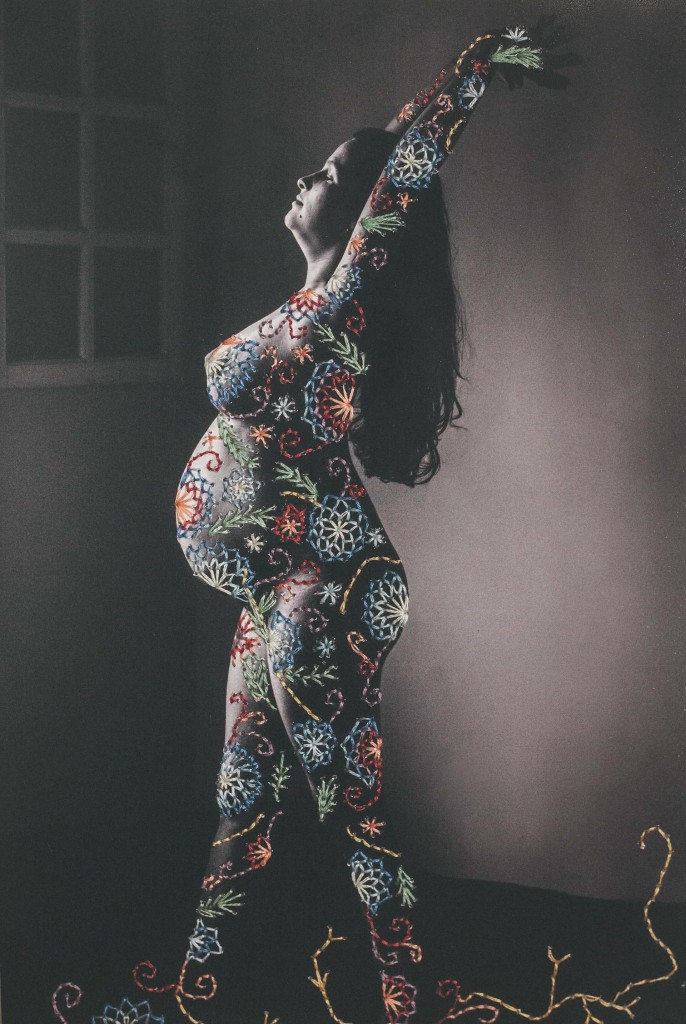
Rest, little guest,
Beneath my breast.
Feed, sweet seed,
At your need.
I took Love for my lord
And this is my reward—
My body is good earth,
That you, dear plant, have birth.
Anna Wickham is the pen name of British/Australian modernist poet Edith Alice Mary Harper (1883–1947). “After Annunciation”was originally published in the January 1917 issue of Poetry magazine and is in the public domain.
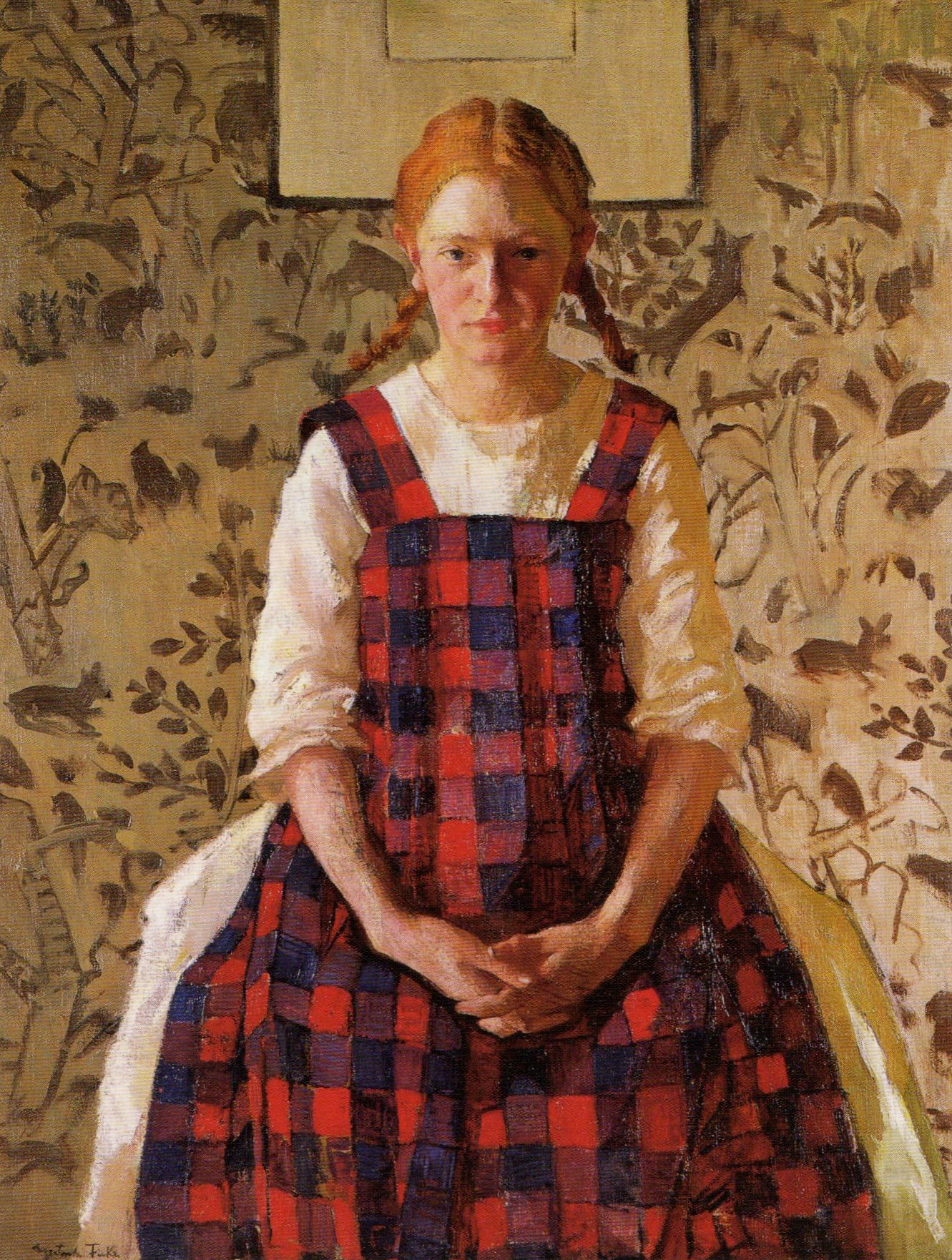
Fiske did not intend to present this Mary as the Virgin Mary, but because they share a name, the viewer begins to notice similarities. Images of the young Virgin Mary present her as innocent and demure, with her head lowered humbly, eyes downcast, and hands drawn to her chest. In Fiske’s portrait, the girl’s innocence is suggested by her youth. Though she may be a teenager, the braids in her hair and the pinafore she wears tie her to childhood. This Mary also slightly bows her head and modestly holds her hands close to her body. In addition, the Virgin’s traditional colors, royal blue and blood red, appear in the long dress worn by Fiske’s Mary. The Virgin’s head is usually framed by a halo; in Fiske’s portrait, a framed picture placed directly behind her Mary’s head creates a haloing effect. (248)
LISTEN: “Ave Maria (The Song for Mary)” by Jason Gray, on Christmas Stories: Repeat the Sounding Joy (2012)
She picks the flowers in the morning Tucks just a few in her hair The joy of her mother and father As she spins around unaware She carries her song in the evening And the dreams of all little girls She carries the bread to the table She carries the hope of the world
Ave Maria Ave Maria
Angels can carry glad tidings Or burdens to bear in the dark Love can take both fear and wondering And hold them inside the same heart You carried hope and a promise You carried shame and disgrace Which was the heavier burden That drew lines in a little girl’s face
Ave Maria, gratia plena Maria, gratia plena Maria, gratia plena Ave, ave dominus Dominus tecum Benedicta tu in mulieribus Et benedictus Et benedictus fructus ventris Ventris tui, Jesus
Held by the love you were holding Is this what it means to be blessed To carry your hope through the darkness As it carries you into your rest
When Nichole Nordeman, Cason Cooley, and I were conceptualizing this song, the idea was that musically it would be something like Michael Bublé meets Elvis and that lyrically it would zoom in on very personal details of what it might have been like in Mary’s world and then zoom out to the broad historical view, going back and forth between personal/intimate/rooted in the story that belonged to Mary alone, and then timeless/big picture/rooted in the story that belongs to all of humanity.
As a kid growing up Protestant, I sometimes felt like I didn’t quite know what to do with Mary—it seemed to my young mind that maybe she belonged more to my Catholic friends, so I felt tentative around the idea of her. But she has since become very dear to my heart and an inspiration to me—the progenitor of all who are called to bear Christ to the world.
My hope was to write a song that would contain both a very earthy picture of Mary intermingled with an otherworldly reverence of the mother of Christ. I love getting to sing it every year.
Hear Gray discuss the song further in this two-minute video, especially the double-sided nature of being “chosen”:
The refrain is, of course, a traditional Roman Catholic prayer in Latin, set to the famous tune by Franz Schubert (who actually wrote the tune for a Walter Scott poem!). Taken from the words of the angel Gabriel and, later, Elizabeth to Mary, it translates to “Hail Mary, full of grace, the Lord is with thee; blessed art thou among women, and blessed is the fruit of thy womb, Jesus.”
I love how Gray’s adaptation of the Ave Maria captures Mary’s youthful innocence and the sense of her being forever changed by God’s call on her life.





 Art & Theology