Shower, O heavens, from above, and let the skies rain down righteousness; let the earth open, that salvation may spring up, and let it cause righteousness to sprout up also; I the LORD have created it.
—Isaiah 45:8
Let us know, let us press on to know the LORD; his appearing is as sure as the dawn; he will come to us like the showers, like the spring rains that water the earth.
—Hosea 6:3
LOOK: Appalachian Rhapsody in Blues: or, He Will Come to Us Like the Spring Rains by Grace Carol Bomer
LISTEN: “Rorate caeli” by William Byrd, 1605 | Performed by The Gesualdo Six, directed by Owain Park, 2020
Rorate caeli desuper, et nubes pluant justum: aperiatur terra, et germinet salvatorem.
Benedixisti, Domine, terram tuam: avertisti captivitatem Jacob.
Gloria Patri, et Filio, et Spiritui Sancto. Sicut erat in principio, et nunc, et semper, et in saecula saeculorum. Amen.
English translation:
Drop down, ye heavens, from above, and let the skies pour down righteousness: let the earth open and bring forth a Savior.
Lord, thou hast blessed thy land: thou hast turned away the captivity of Jacob.
Glory be to the Father, and to the Son, and to the Holy Ghost. As it was in the beginning, is now, and ever shall be, world without end. Amen.
The text of “Rorate caeli” (Let the heavens) is taken from the Vulgate translation of Isaiah 45:8. It “is frequently sung to plainsong at Mass and in the Divine Office during Advent, where it gives expression to the longings of Patriarchs and Prophets, and symbolically of the Church, for the coming of the Messiah. Throughout Advent it occurs daily as the versicle and response after the hymn at Vespers” [source].
William Byrd’s five-voice motet adds an additional verse from Psalm 85:1 (84:1–2 in the Vulgate), followed by the Gloria Patri.
This video performance is part of the Gesualdo Six’s 2020 Advent Sessions YouTube series.
It is you who light my lamp; the LORD, my God, lights up my darkness.
—Psalm 18:28
“I have come as light into the world, so that everyone who believes in me should not remain in the darkness.”
—John 12:46
LOOK: Self-Portrait by Stamatis Laskos
Stamatis Laskos (Greek, 1985–), Self-Portrait, 2021. Oil on canvas, 110 × 80 cm.
LISTEN: “Lighten the Darkness” | Words by Frances Mary Owen (1842–1883) | Music by Sam Connour, 2017 | Performed by Lowana Wallace with Matt Froese, 2017
Lighten the darkness of our life’s long night, Through which we blindly stumble to the day. Shadows mislead us; Father, send Thy light To set our footsteps in the homeward way.
Lighten the darkness of our self-conceit, The darkness that we love so well, Which shrouds the path of wisdom from our feet, And lulls our spirits with its baneful spell.
Lighten our darkness when we bow the knee To all the gods we ignorantly make And worship, dreaming that we worship Thee, Till clearer light our slumbering souls awake.
Lighten our darkness when we fail at last, And in the midnight lay us down to die; We trust to find Thee when the night is past, And daylight breaks across the morning sky.
For more Advent songs by Sam Connour, see the album St Fleming of Advent, released under the moniker Lo Sy Lo.
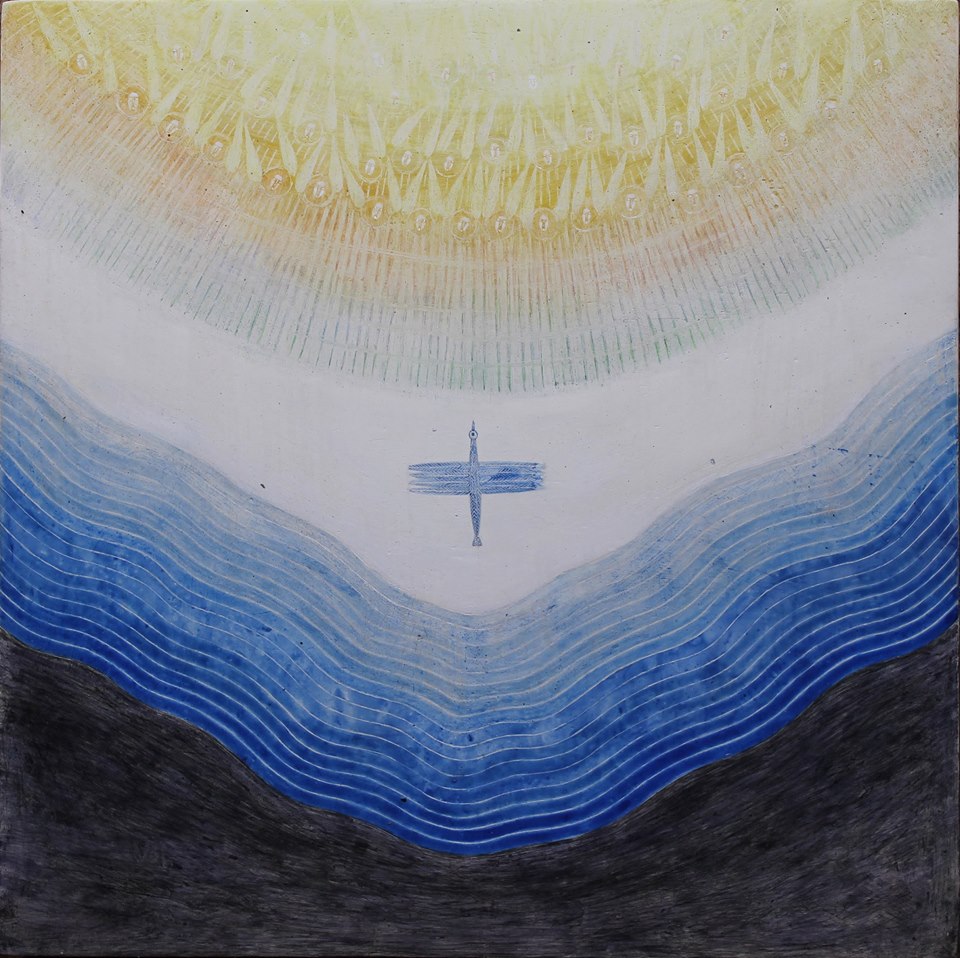
Natalya Rusetska (Ukrainian, 1984–), First Day of Creation, 2017. Egg tempera on gessoed wood board, 30 × 30 cm.
LISTEN: “Let There Be” by Michael and Lisa Gungor, on Ghosts Upon the Earth (2011)
Darkness hovering Grasping everything it sees Void, empty Absent life and absent dream
Let there be Let there be Let there be Let there be
Angels toil and crack open scrolls of ancient dreams Countless worlds of his Brilliant stars and breath and stream
Let there be Let there be Let there be Let there be Let there be Let there be Let there be light
Let there be light Where there is darkness Let there be light Where there is nothing Let there be light
The opening track on Gungor’s Ghosts Upon the Earth, “Let There Be” narrates God’s creation of the universe. What starts out as ethereal becomes increasingly more solid as the floating notes on piano and guitar coalesce into chords and meld with the cellos. Represented by a small choir, the Triune community voices its fiat: “Let there be . . .” A synthesized xylophone and tremolos from the strings suggest lively activity—“angels toil”—as the cosmos begins to take shape. In the second refrain the voices crescendo to a thunderous climax, a drum beating loud and steady as if laying down a foundation.
While this song is most fundamentally about the Genesis 1 creation story, it can also be read in light of John’s Gospel prologue, where he describes Jesus as light coming into the world, and similarly, Luke’s Annunciation narrative, where “ancient dreams” put down in prophetic scrolls are fulfilled in the conception of Christ in Mary’s womb, initiating a new epoch.
The Advent season begins in darkness. Taking stock of this darkness, we ask for God’s light to break in once again—into our hearts and lives, our communities, our world.
In the beginning the Spirit hovered over the void and breathed life into it. Millennia later the Spirit hovered over a virgin’s empty womb and did it again, making the Word flesh. And into our present lack, into our chaos, the Spirit still is coming, re-creating, so that Christ, the light, might be born in us.
Here’s a recent cover of “Let There Be” by IAMSON, which he combines with another Gungor song, “Crags and Clay”:
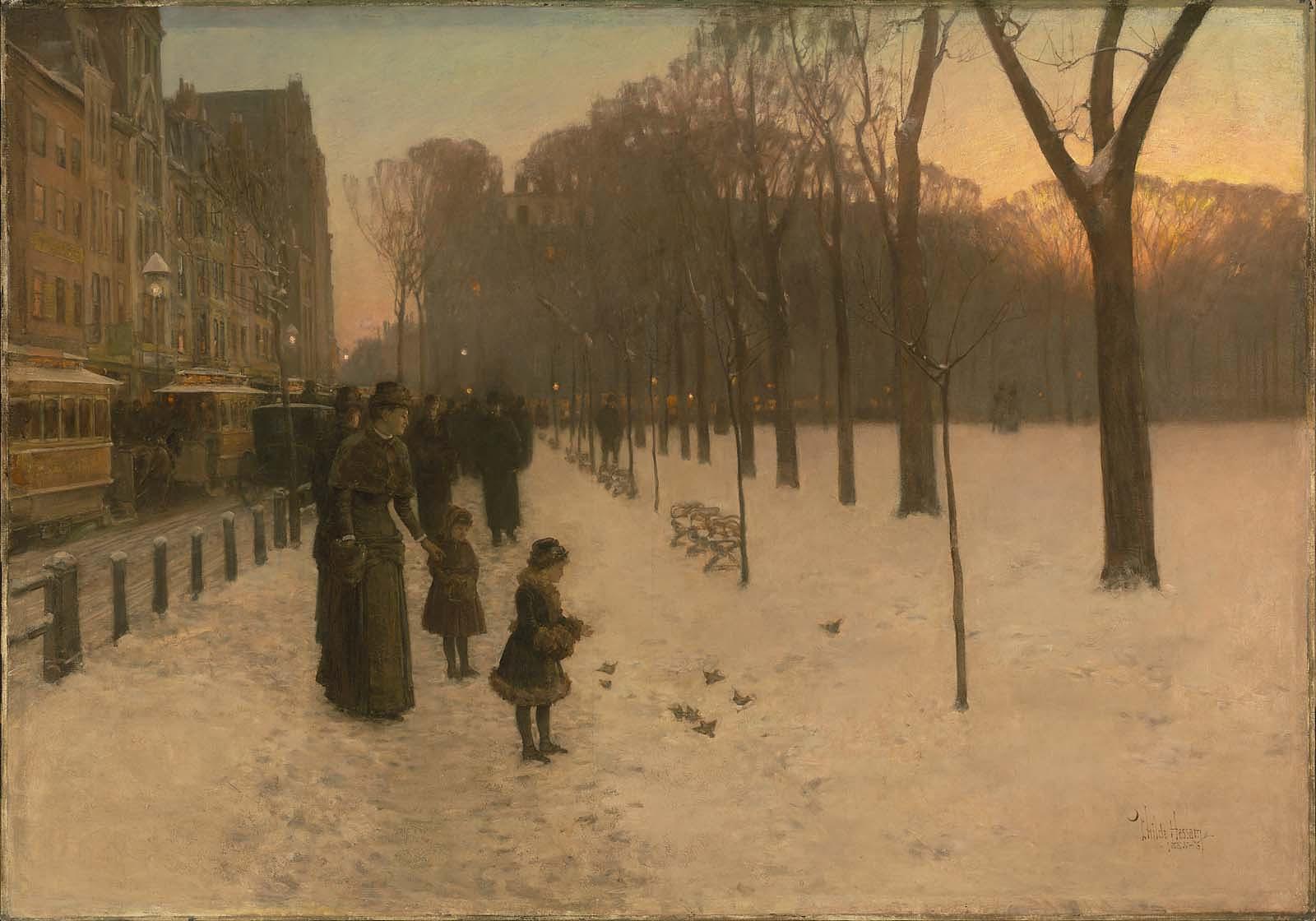
LOOK: At Dusk (Boston Common at Twilight) by Childe Hassam
Childe Hassam (American, 1859–1935), At Dusk (Boston Common at Twilight), 1885–86. Oil on canvas, 42 × 60 in. (106.9 × 152.4 cm). Museum of Fine Arts, Boston.
LISTEN: “Psalm 25” by Poor Bishop Hooper, 2020 [free download]
Nobody who waits for you will see disgrace Teach me all your righteous paths Make known your ways to me, Lord
Lead me by your truth, my God And teach me now I’ll wait for you the whole day long You are the God of my salvation
You’ve shown your love from ages past It existed from antiquity through history Forgotten of my sinful youth For your goodness, God My eyes are always on you
Jesse and Leah Roberts, whose musical alias is Poor Bishop Hooper, adapted Psalm 25:3–7, 15 last year as part of their EveryPsalm project, an initiative to release one original psalm-based song every Wednesday. They are currently up to Psalm 100.
I’ve paired the song with a painting by turn-of-the-century American Impressionist Childe Hassam, of a rosy dusk on the outskirts of the central park in downtown Boston. The sun is descending behind the elm trees, the gaslights have been lit, and the ground is blanketed in snow. On Tremont Street on the left, trolley cars and carriages wheel busily past, while on the adjacent walkway a mother and her two young daughters have stopped to feed the birds.
Moodwise, the painting and song complement each other, the twinkling of Roberts’s piano corresponding to the play of pink light on Hassam’s canvas—and both bespeaking God’s goodness. I present the image here as an invitation to, like this family, find moments of quiet enjoyment and reflection amid the bustle of December.
The scene evokes warm memories for me, as my husband and I, then newlyweds, walked this path every Sunday to church for the five years we lived in Boston. Ten minutes from Park Street Station to the hotel where our congregation met, crunching through the snow in our insulated boots in wintertime, the natural sights and sounds of the Common preparing us for worship.
Advent begins November 28, and this year I will be publishing short daily posts that pair a visual artwork with a piece of music, most accompanied by brief commentary. (I did a trial run last Advent.) The primary purpose is to invite spiritual contemplation on the season’s themes, allowing artists to be our guide. I’ve been planning out the series since August—and ended up procuring ideas to last for three Advents!—and I’m really looking forward to presenting it. The daily posts in this format will extend through the twelve days of Christmas as well.
Contemporary singer-songwriters are heavily represented in the music selections, but there is also a Shaker hymn, an Appalachian spiritual, a Renaissance motet, a Byzantine troparion, a South African freedom song, sixties electronica, and a Victorian carol from Sussex. Many of these songs can be found on the Advent playlist I compiled. For the artworks, in addition to paintings there are a few installations, photographs, collages, a lithograph, a serigraph, a stencil print, a quilt, and a mosaic.
The recurring theme throughout, sometimes inherent to the artwork and in other cases brought about by a particular reading of it, is looking forward with hope and readiness to the coming of Christ, to the Light who will dispel darkness and bring justice and peace. “A new world is coming, and it’s just around the bend,” sings Nina Simone. May we welcome it with eager longing.
If you’d like to receive each post in your inbox, subscribe to the blog by entering your email address where prompted in the sidebar. I will also link to the posts on Facebook and Twitter. (Update: If you’re on your computer and you don’t see a sidebar, it’s probably because you’re viewing this post from the homepage; click on the post’s URL, and you should see the Subscribe button at the right. If you’re viewing this on your phone, the Subscribe button is at the bottom of the page, below the comments. Because this website is not self-hosted, WordPress does not allow me to manually add email addresses to the subscription list, nor to create a dedicated subscription tab—sorry!)
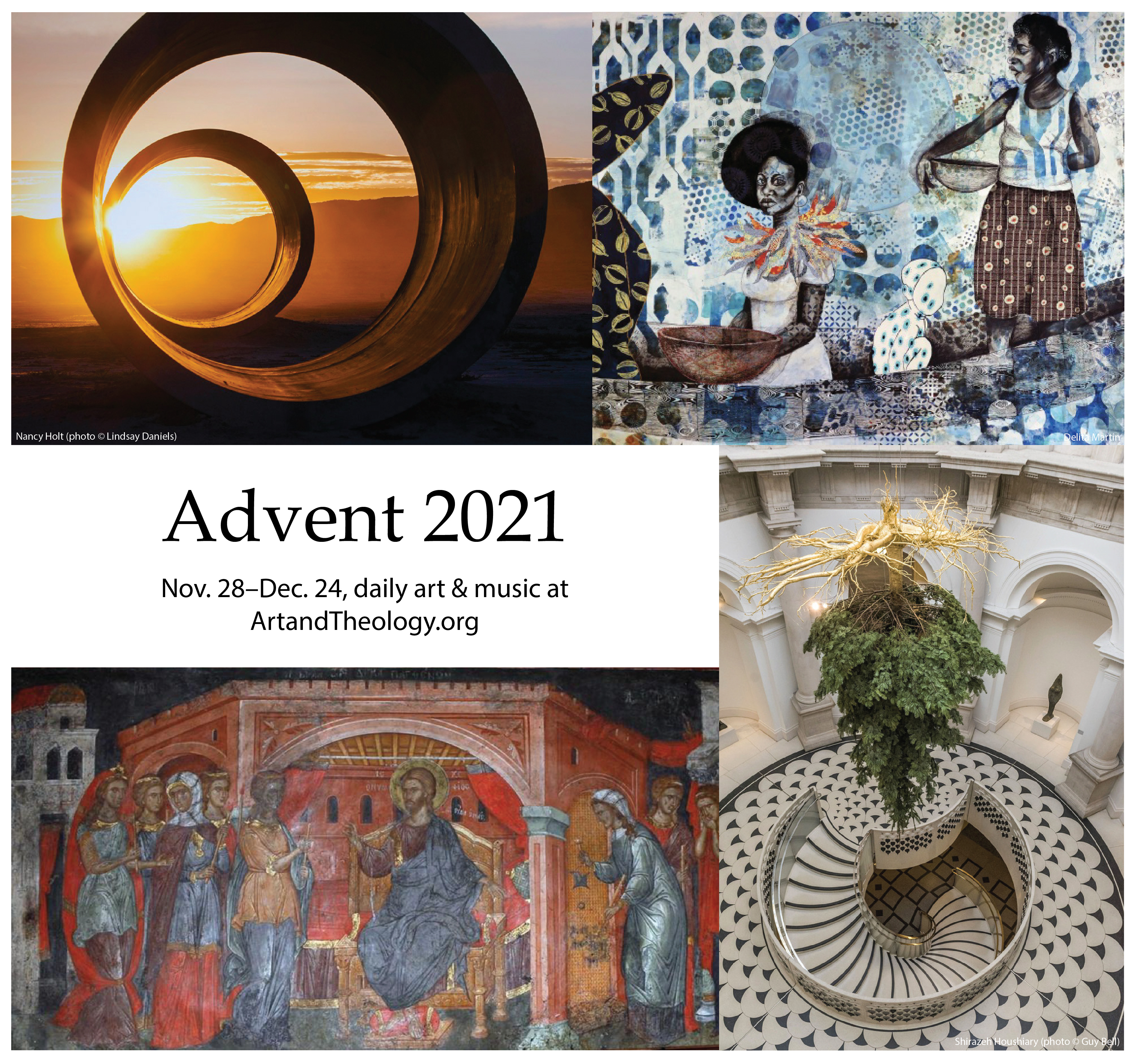
Art credits: In the poster above, clockwise from top left, are Sun Tunnels by Nancy Holt, a detail of Night Travelers by Delita Martin, Christmas Tree by Shirazeh Houshiary, and a fresco from the Monastery of Saint John the Theologian in Chora on the island of Patmos.
Advent is just around the corner, and here is some topical content for the season. (Much more to come!)
PODCAST EPISODES:
>>“On Journeying: Travel, Traditions, and Turning to the Psalms with Tsh Oxenreider,”Sacred Ordinary Days, December 22, 2020: Host Jenn Giles Kemper interviews author, travel guide, and fellow podcaster Tsh Oxenreider about her book Shadow and Light: A Journey into Advent. The liturgical calendar is a gift, not a burden, Oxenreider says; it provides scaffolding for our year and connects Christians to one another across time and place, in addition, of course, to promoting encounters with God and God’s story. Oxenreider provides book and music recommendations for the Advent season and shares one of her family’s favorite simple Advent traditions.
>>“The Annunciation and Art with Victoria Emily Jones,”Old Books with Grace, November 17, 2021:Old Books with Grace, hosted by Dr. Grace Hamman [previously], a specialist in medieval literature, is one of my favorite podcasts, so I was beyond excited to be invited on as a guest! In this conversation, Grace and I discuss four paintings and three poems that respond to the momentous event known as the Annunciation, where Gabriel tells Mary that she has been chosen to bear God’s Son. While the feast of the Annunciation is celebrated on March 25, we thought it nonetheless appropriate at this time just before Advent to consider how Mary welcomes Jesus, since we are preparing to welcome him ourselves. Available on YouTube and on all podcast streaming platforms.
Grace just wrapped up a fascinating series on Sir Gawain and the Green Knight, and for the four weeks of Advent she will be taking a closer look at four familiar Christmas carols from different eras, examining their history, theology, and language and recommending an Advent practice inspired by each carol. Follow Old Books with Grace on Instagram or Twitter.
NEW ALBUM: Advent Songs by the Porter’s Gate:The Porter’s Gate [previously] released a new album on November 12, a collection of ten original songs for Advent. The contributing songwriters are Nicholas Chambers, Paul Zach, Kate Bluett, Isaac Wardell, Liz Vice, Latifah Alattas (Page CXVI), and Tenielle Neda. Chambers, Zach, Vice, Alattas, and Neda are also featured as vocalists, as are Molly Parden, Jonathan Ogden, and Lauren Plank Goans. My favorites: “The Reign of Mercy,” “Mary’s Lullaby (Black Haired Boy),” “Simeon’s Song.”
+++
PAINTING + SHORT FILM: In 2017 Holy Family HTX, a church in Houston, commissioned artist-in-residence Lanecia Rouse Tinsley to create nine liturgical paintings, one for each major season of the church year. Called the Parament Collection, these six-by-six-foot pieces rotate throughout the year, signaling the change of season and inviting the congregation into a space of contemplation around seasonal themes.
The first painting in the cycle, Advent, is a minimalist composition predominantly in ultramarine, evoking Yves Klein’s blue monochromes; Tinsley says that, like Klein, she wants to “impregnate” the viewer with blue, which for her signifies hope. Blue (or alternatively, purple) is the primary color of Advent, but pink and white (for Gaudete Sunday and Christmas Eve, respectively) are also associated with it, which Tinsley makes reference to in her painting. At the white bar at the top, you can see a faint mark left by Hurricane Harvey; her studio flooded when the storm hit in August 2017, and this then-blank canvas suffered some water damage, but Tinsley made the conscious decision to use it to further press into the Advent theme of suffering. She lined the canvas in black, inspired by a line from Andy Warhol’s film Sunset: “Black means infinity.” All our longings, Tinsley says, are held within infinity.
The nine-minute film posted above is one of nine in a series by Chap Edmonson, titled Decoded, in which Tinsley discusses her Parament Collection piece by piece. View all nine films here.
+++
I also wanted to remind you about the Art & Theology Advent playlist I compiled on Spotify. Besides the ones mentioned above, here are the songs I’ve added to the mix since last Advent:
“Wonder” by MaMuse
“Better Days” by Chrisinti
“Peace Train” by Cat Stevens
“Peace” by Peter Bruun (a setting of a Gerard Manley Hopkins poem)
“Magnificat primi toni” by Palestrina
“From This Wicked Fall” (Cum erubuerint) and “The Flower Gleams” (Hodie aperuit) by Hildegard of Bingen, arr. Richard Souther
“Mary” by Buffy Sainte-Marie
“Like Mary” by Jess Ray and Langdon
“Restoration Song (Hold On)” by Son of Cloud
Nine songs by Tom Wuest
“Lighten Our Darkness” by Joel Clarkson
“For the Long Night” by Dan + Claudia Zanes
“La Luz” by Brother Isaiah
“Sunrise Song” and “Clouds of Waiting, Clouds of Returning” by Jacob Goins
“Break of Dawn” and “You Always” by Antoine Bradford
In September 2019 I visited Atlanta, Georgia, and one of the two art stops I made was the Clark Atlanta University Art Museum, whose purpose is “to collect, preserve, research, and exhibit fine art works that document the role of African Americans in American history and culture.” When I got there I was bummed to see that the museum was closed in preparation for three exhibitions that were to open that Sunday. But graciously, even though the signage and lighting hadn’t been installed and some of the objects were still being moved around, the curator allowed me in for a little glimpse.
I was stopped in my tracks by a mixed media sculpture in the gallery of recent acquisitions: Float by Alfred Conteh.
Alfred Conteh (American, 1975–), Float, 2014. Steel, epoxy dough, thermoadhesive plastic, atomized steel dust, atomized bronze dust, urethane plastic, steel chain, 93 × 46 × 35 in. Clark Atlanta University Art Museum, Atlanta, Georgia. Photo: Victoria Emily Jones.
It shows a Black female Christ figure rising up in a whirl of energy, her hat blown aloft. Wounds are visible on her hands and feet, but these are taken up into new, greening life. At the bottom is a broken chain, indicating that she has been set free. The piece expresses the exhilaration of emancipation, of being shackled no more.
I would classify Float as a resurrection image, which its staging reinforces. To its far left is a wooden crucifix by Dilmus Hall, followed by The Mourners by Frederick C. Flemister, from 1942. (Note that the two crucifix photos in this post are courtesy of the Souls Grown Deep Foundation, who donated the pieces to the museum.)
Dilmus Hall (American, 1896–1987), Untitled, n.d. Wood, wood putty, plastic beads, and paint, 12 × 9 in. Clark Atlanta University Art Museum, Atlanta, Georgia. Photo: Stephen Pitkin / Pitkin Studio.Frederick C. Flemister (American, 1916–1976), The Mourners, 1942. Oil on canvas, 39 3/4 × 31 1/4 in. Clark Atlanta University Art Museum, Atlanta, Georgia. Photo: Victoria Emily Jones.
Drawing on iconography of the Lamentation over the Dead Christ, Flemister’s The Mourners shows a mother holding the corpse of her grown son, who has just been deposed from a lynching tree. Behind her a woman in a pink dress throws up her arms in grief, and a preteen boy runs into his own mother’s arms for comfort. Like many artists before and after him, Flemister connects the killings of innocent Black men to the killing of Jesus—not because their deaths are salvific but because both they and Jesus were unjustly “crucified,” and because Black men bear God’s image, which the visual conflation reminds us of. As Jesus told his disciples, “Truly, I say to you, as you did it to one of the least of these my brothers, you did it to me” (Matt. 25:40).
Death and resurrection, suffering and hope, are the theme of this temporary exhibition. A second wooden crucifix, by Thornton Dial Jr., adorns the opposite wall. It’s titled I’ll Be Back, which, as the sculpture was made a few years after The Terminator came out, may be a playful reference to Arnold Schwarzenegger’s famous line, but it is first and foremost an affirmation that Jesus will return to earth, as promised, to fully set things right. (By the way, I wonder if Conteh, in making Float, was inspired by the hubcap component of another of Dial’s crucifixes . . .)
Thornton Dial Jr. (American, 1953–), I’ll Be Back, 1988. Wood, metal, barbed wire, string, fabric, industrial sealing compound, enamel, nails, 35 × 32 × 6 3/4 in. Clark Atlanta University Art Museum, Atlanta, Georgia. Photo: Stephen Pitkin / Pitkin Studio.
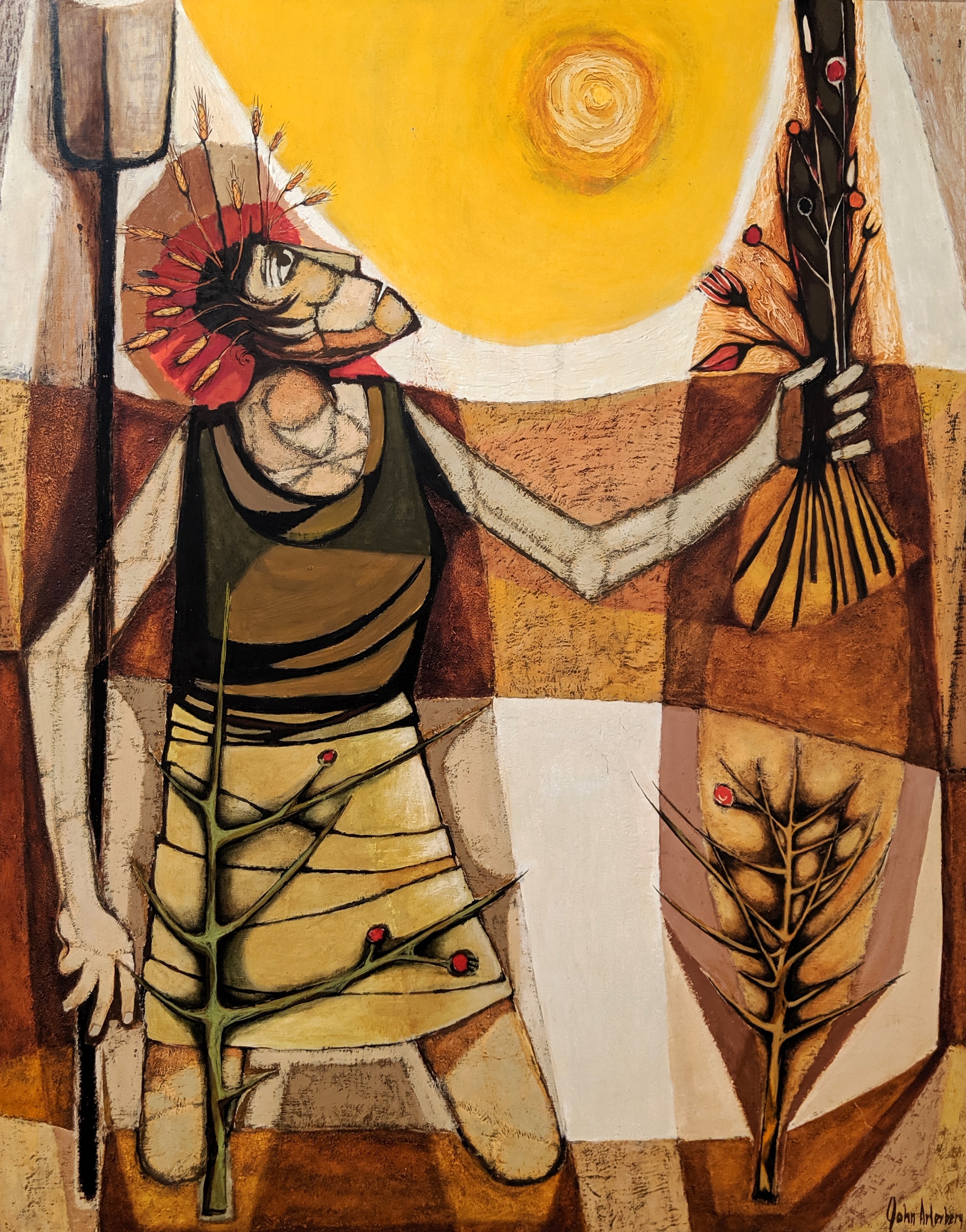
The last piece in the room is Ceres by John W. Arterbery. Ceres was the Roman goddess of agriculture, grain crops, and fertility, the equivalent of the Greek mother-goddess Demeter. In Arterbery’s painting she wears a crown of sprouting wheat stalks and holds a pitchfork in one hand and a leafless plant with buds and berries in the other. I think the flowers may be poppies, as Ceres is associated with those.
John W. Arterbery (American, 1928–1977), Ceres, 1963. Oil on Masonite, 60 × 47 1/2 in. Clark Atlanta University Art Museum, Atlanta, Georgia. Photo: Victoria Emily Jones.
It appears as though Arterbery is depicting the imminence of spring, when Ceres will be reunited with her daughter Proserpine (Persephone) and life will grow and flourish. It shows Ceres looking toward the sun in anticipation of such a time. Read in conjunction with the other pieces in the room, Ceres could be interpreted as an Advent image—a waiting for the final fulfillment of God’s good purposes for his creation, which includes a definitive end to suffering and oppression and a universal thriving.
The Clark Atlanta University Art Museum is typically open Tuesday through Friday from 11 a.m. to 4 p.m., as well as by appointment, but you may want to email ahead of time (cauArtMuseum@gmail.com) to confirm. It’s definitely worth a visit, though I can’t guarantee that the works featured here will be on display. If you wish to browse photos of pieces from the museum’s collection, see In the Eye of the Muses: Selections from the Clark Atlanta University Art Collection (2012).
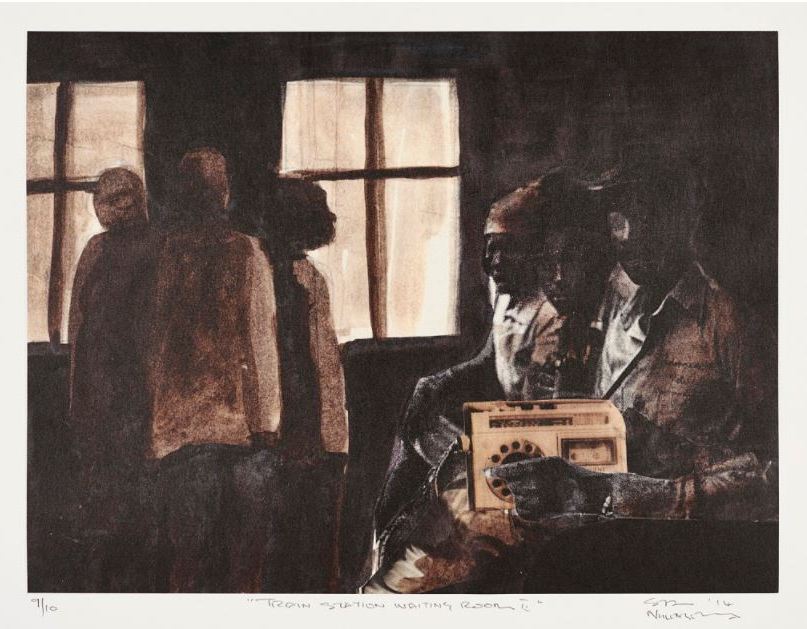
In the drab waiting-room the failed travellers, resigned, sleep on the hard benches, inured to postponement and foul coffee. Hope has given up on them.
There are also the impatient, pacing platforms, and the driven, purple with frustration, abusing their mobiles, for the hardest part of waiting is the not doing.
Truly to wait is pure dependence. But waiting too long the heart grows sclerotic. Will it still be fit to leap when the time comes? Prayer is waiting with desire.
Two aged lives incarnate century on century of waiting for God, their waiting-room his temple, waiting on his presence, marking time by practicing
the cycle of the sacrifices, ferial and festival, circling onward, spiralling towards a centre out ahead, seasons of revolving hope.
Holding out for God who cannot be given up for dead, holding him to his promises – not now, not just yet, but soon, surely, eyes will see what hearts await.
Richard Bauckham, FRSE, FBA, is a renowned English biblical scholar and theologian, whose many published works include The Theology of the Book of Revelation (1993) and Jesus and the Eyewitnesses (2006). He’s also a hobbyist poet! I’ve published this poem with his permission. It’s inspired by Luke 2:22–38, which describes two elderly Jews, “righteous and devout,” who had been “waiting for the consolation of Israel,” the Messiah, for many years and finally encountered him at the temple one day in the infant Jesus of Nazareth. This “Presentation at the Temple,” as the episode is called, is commemorated yearly by Christians on February 2, Candlemas.
Bauckham’s definition of prayer—“waiting with desire”—is the most succinct, and probably the best, I’ve ever heard. His poem enjoins us to assume the same “waiting with desire” posture as Simeon and Anna as we look fervently toward the Christ’s second coming, when God will dwell with humanity face to face once again, this time everlastingly.
(Update, December 2022: This poem now appears in Bauckham’s first volume of poetry, Tumbling into Light, published by Canterbury Press.)
PANEL DISCUSSION: “Religious Art,” organized by the Forum for Philosophy: I posted about this live online event a month ago, and now that it’s passed, I want to share the video recording. Theologian Ben Quash (King’s College, London), curator Lieke Wijnia (Catharijneconvent Museum, Utrecht), and art historian Mehreen Chida-Razvi (Khalili Collections, London) discuss the relationship between art and religion, how art can function within religious practice, how to exhibit religious art in a museum, and artworks as sites of conversation across religious traditions.
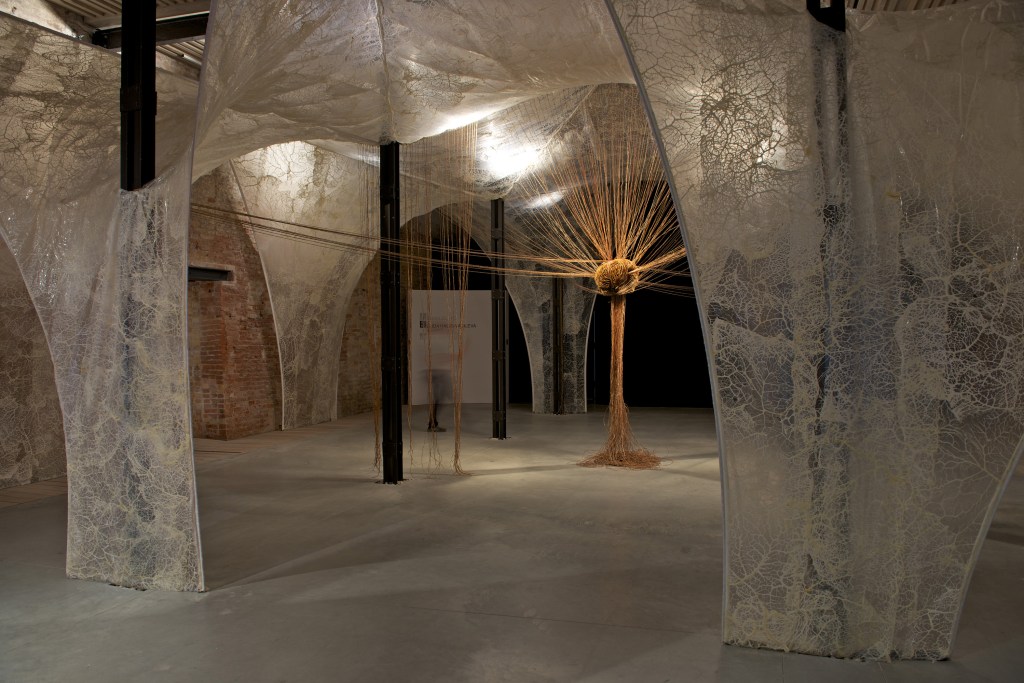
Quash opens by proposing different categories of “religious art”: art for religion, art about religion, art with religion, and art instead of religion. The three unpack those a bit, discussing the intentions of the artist or patron versus how the artwork is perceived by the viewer. Quash mentions Haruspex by Elpida Hadzi-Vasileva (a fascinating installation commissioned by the Vatican for the 2015 Venice Biennale, a contemporary artist’s response to “In the beginning . . . the word became flesh”; read Quash’s essay and an artist interview), the East Window at St Martin-in-the-Fields by Shirazeh Houshiary, the Raphael Cartoons, and Aaron Rosen’s 2016 Stations of the Cross exhibition throughout the city of London, which shows the permeability of the boundaries between sacred and secular. (I participated, as viewer/pilgrim, in a 2019 iteration of the Stations project in Amsterdam.)
Elpida Hadzi-Vasileva (Macedonian, 1971–), Haruspex, 2015. Organic materials. Installation at the Pavilion of the Holy See at the 56th Venice Biennale.
In reference to Hadzi-Vasileva’s canopy of pig’s caul fat, Quash says that challenge or provocation can be a meaningful thing to happen in a religious context:
Works that ambush you are also religiously important, because a sort of religious art that only gives you what you already expect and want quickly becomes kitsch. It’s just a reward of your expectations. And that shouldn’t be what religious art does, it seems to me. It should actually want to take you somewhere else, just as good religion should—it should be transformative, not merely confirming where you already are. So there’s a role for these sorts of artworks within religion as well as outside it.
Chida-Razvi shares slides of Islamic architectural spaces, devotional objects, and manuscript illuminations, including a Mughal painting that exemplifies the interfaith dialogue going on at the court of Akbar in Lahore, and Wijnia shares her experience curating objects people pray with for museum display and (forthcoming) an exhibition on Mary Magdalene. Such great content!
+++
ADVENT SONGS:
“He Comes,” words by Kate Bluett, music by Paul Zach: A lovely new Advent hymn, performed here by Paul Zach.
“The Heavens Shake” by Reindeer Tribe:Reindeer Tribe is a group of friends based in Los Angeles who get together each year to make a live Christmas album, a mix of originals and traditional, sometimes retuned, carols. They bring their voices, instruments, and arrangements and jam together for a long weekend in a big living room. (COVID-19 put the kibosh on this year’s gathering.) This original song, perfect for Advent, is on their 2014 album, A Great Light. “For thus says the LORD of hosts: Yet once more, in a little while, I will shake the heavens and the earth . . .” (Haggai 2:6).
+++
ARTICLE: “We don’t need to be afraid of the Christmas tree’s pagan roots” by Damian Costello, America: Dr. Damian Costello specializes in the intersection of Catholic theology, Indigenous spiritual traditions, and colonial history. In this article he considers how the Christmas tree pictures Christ as the new Yggdrasil (the giant ash tree at the center of the Norse cosmos), and the spiritual character of nature. The second half—about “the hidden agency of trees”—stretches my categories for sure, and I wonder if it’s a bit overwrought, but I’m intrigued by the links Costello draws between the Psalms, Anishinaabe spirituality, and the theology of the Catholic saint John Henry Newman. The article reminds me of Luci Shaw’s poem “Perfect Christmas Tree.”
+++
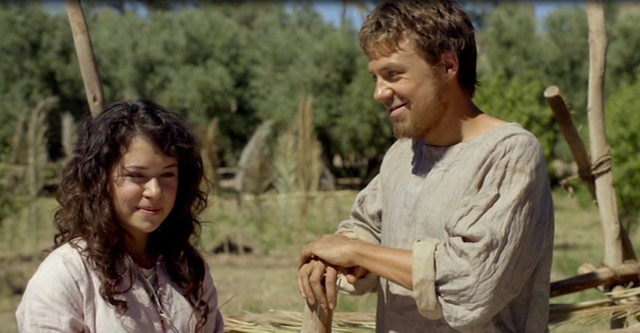
FILM: The Nativity (2010), written and directed by Tony Jordan: I’m always skeptical of film adaptations of the Bible because so many are poorly done. But I gave this four-part BBC miniseries (streaming on Amazon Prime) a shot, and, other than a really cheesy moment during the birthing scene, I thought it was quite good! Writer-director Tony Jordan is not a Christian but approaches the story with the reverent curiosity of a dramatist. He said he never connected with the nativity story until he worked on this project and started to see the very real humans beneath the auras tradition has given the “holy couple”—he saw their earthiness and complexity and began to imagine their emotional lives, especially their reactions to the disruptions they encountered. He said the relationship between Mary and Joseph was key to him. Many storytellers assume that because the marriage was arranged (or because, according to apocryphal sources, Joseph was an old man), there was no passion in their relationship, that they were bound together more by duty than by love, but Jordan, without overly romanticizing, imagines otherwise. The warmth between Mary and Joseph in the first half, which they have to work to regain after news of Mary’s pregnancy hits Joseph like a ton of bricks, is a hallmark of the movie.
Tatiana Maslany (Orphan Black) is probably my favorite Mary I’ve seen onscreen. (I also like Andrew Buchan [Broadchurch] as Joseph.) Jordan says most people see Mary as “a one-dimensional character with a halo round her head,” but actually, “she’s not saccharine. Just a nice kid—real but fallible.” He shows her as virtuous but not a goody-goody, fun-loving and confused and scared and courageous all at once, stepping into her new role by faith without seeing the full picture and even discipling Joseph into that faith. Maslany plays the part brilliantly, endearingly. The film addresses the isolation Mary felt, being rejected not only by her fiancé at first but also by the synagogue leadership and disbelieved, too, by the community she had grown up in. I’ve seen many actors portray Mary as detached, transcending all her difficult circumstances with calm, unshaken resolve. This Mary, by contrast, experiences hurt and fear and yet endures, which, I suspect, is closer to the historical reality. This in no way undermines her faith.
I was delighted by the Annunciation scene, where Gabriel comes to Mary as an ordinary man, much like the angels who visited Abraham generations earlier. He is not wearing ermine or carrying a scepter or standing on a rock above Mary with a booming voice and a heavenly glow. He’s simply a stranger who startles her, even more so when he relays his news. He speaks gently, colloquially. The moment of conception is portrayed as sudden and visceral; Mary feels Light enter her and reacts with a sort of joyful shock.
The trailer and posters, I will say, make the film seem pretty conventional. It does follow some conventions, but it’s also fresh, and while it has some flaws, I think it’s a very worthy use of two hours—it brings this ancient story to life in compelling ways.
PHOTO ESSAY:“Advent 2020: Comfort My People”: Community development and relief worker Kezia M’Clelland, a child protection in emergencies specialist, works in areas of disaster and conflict. Every December she compiles a set of news photographs published in The Guardian that year, pairing each with an Advent scripture. (I introduced her in a 2017 Advent roundup.) Text and image amplify each other and prompt deeper reflection on the themes of the season as well as an awakening to global crises and/or injustices. The photos in this year’s compilation include a schoolteacher bringing plastic-wrapped hugs to her quarantined students in Rio de Janeiro, flooded roadways in Honduras following Hurricane Eta, a Syrian family from Ariha breaking their Ramadan fast amid the rubble of their home, a Palestinian boy from the Khan Younis refugee camp standing on a pile of scrapped car parts, the aftermath of the Beirut port explosion in August (caused by improperly stored ammonium nitrate), a protester outside Dallas City Hall in the US insisting that all citizens’ presidential election votes be counted, and others.
Photo: Pilar Olivares / Reuters [via], set to Isaiah 40:1 by Kezia M’ClellandPhoto: Aaref Watad / AFP [via], set to Isaiah 40:4 by Kezia M’Clelland
M’Clelland adds one new photo for each day of Advent and then releases them all in video slideshow form on December 24. Here are her photo compilations from 2019 (“Good News of Great Joy”) and 2018 (“Peace on Earth”):
SONG: “He Who Made the Starry Skies”: For optimal acoustics, three Bruderhof women from the Fox Hill Community in Walden, New York, trek on over to a silo to sing a fifteenth-century processional carol written by the nuns of St. Mary’s, Chester, in England, a medieval nunnery of which nothing now survives. Both the words and music have been preserved in a ca. 1425 manuscript known as The Chester Mysteries. The original is in Latin (and is titled “Qui creavit coelum”), but singers Alina McPherson, Melinda Goodwin, and Coretta Marchant opt for an English translation. I am providing the sheet music here, courtesy of the Bruderhof Historical Archives. [HT: Tamara Hill Murphy]
He who made the starry skies (Lully, lully, lu) Sleeping in a manger lies (Lully, lully, lu) Ruler of all centuries (Lully, lully, lu)
Joseph brings the swaddling clothes (Lully, lully, lu) Mary wraps the babe so mild (Lully, lully, lu) In the manger puts the child (Lully, lully, lu)
Humbly clad, the King of kings (Lully, lully, lu) Joy of heav’n to earth now brings (Lully, lully, lu) Sweet above all earthly things (Lully, lully, lu)
Mary, ask thy little son (Lully, lully, lu) That he give us of his joy (Lully, lully, lu) Now and through eternity (Lully, lully, lu)
The Bruderhof is an Anabaptist Christian movement of more than three thousand people committed to peacemaking, common ownership, and proclamation of the gospel. They have twenty-eight settlements on four continents, made up of families and singles. Perhaps you know them through their publishing house, Plough. Their website reads, “Love your neighbor. Take care of each other. Share everything. Especially in these challenging times, we at the Bruderhof believe that another way of life is possible. We’re not perfect people, but we’re willing to venture everything to build a life where there are no rich or poor. Where everyone is cared for, everyone belongs, and everyone can contribute. We’re pooling all our income, talents, and energy to take care of one another and to reach out to others. We believe that God wants to transform our world, here and now. This takes a life of discipleship, sacrifice and commitment; but when you truly love your neighbor as yourself, peace and justice become a reality. Isn’t that what Jesus came to bring for everyone?”
+++
UPCOMING (ONLINE) CHRISTMAS CONCERTS:
“A Family Holiday Singalong with Dan and Claudia Zanes,”Tuesday, December 15, 6 p.m. EST: Presented by the Lebanon Opera House in New Hampshire, this multicultural concert will feature Christmas, Hanukkah, or New Year’s songs from France, Wales, Germany, America, Puerto Rico, Korea, Tunisia, and Haiti. You can download the set list, which includes lyrics and chords, at the registration link I’ve posted. Dan and Claudia Zanes are a musical couple from Baltimore (my neck of the woods!), and I’ve really enjoyed the daily song videos they’ve been releasing on YouTube since COVID started. Here they are in 2018 with Pauline Jean, singing “Ocho Kandelikas,” a Hanukkah song written by Flory Jagoda in the 1980s in the Judeo-Spanish language known as Ladino. (Update: Concert video available here.)
ARTICLE: “Making Space for a Multicultural Christmas” by Michelle Reyes: “How can each of us celebrate Christmas at the intersection of our faith and our culture, while welcoming differing cultural perspectives on Christ’s birth?” asks Dr. Michelle Reyes, VP of the Asian American Christian Collaborative and editorial director of Pax, in this Gospel Coalition article. She briefly discusses four different cultural traditions that highlight unique aspects of Jesus’s birth narrative: posadas in Central America, Kiahk in Egypt, parols (star-shaped lanterns) in the Philippines, and Día de los Reyes [previously] in Puerto Rico, Mexico, and other Hispanic countries.
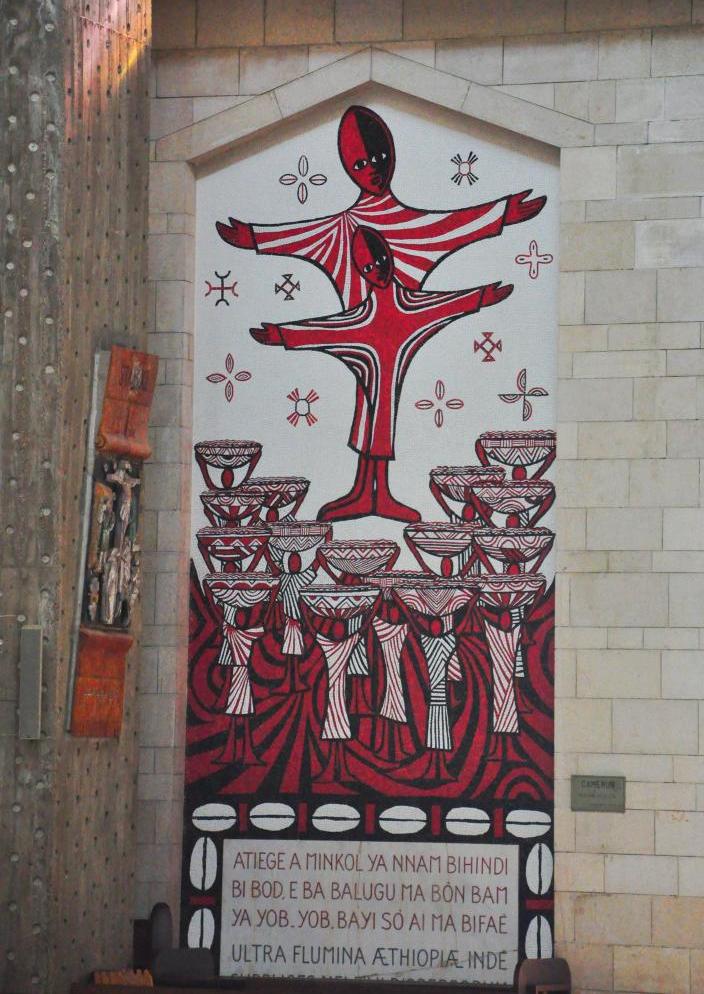
PODCAST EPISODE: “God’s Global Family,” BibleProject:BibleProject, a nonprofit ed-tech organization and animation studio, produces one of my favorite podcasts, hosted by biblical scholar Tim Mackie and Jon Collins. (I found episodes 6–11 of their recently wrapped “Character of God” series, on the wrath of God, particularly illuminating.) “Family of God” is the name of the series they’re in now. In this first episode they discuss how Christianity is the most multiethnic religious movement in history, and how our humanity cannot be fully realized without understanding, appreciating, and being connected to the identity of every other culture. I link to it here because it dovetails nicely with the Reyes article and because I want to introduce you to the podcast, if you’re not already familiar with it, but also because Mackie spends time talking about the Basilica of the Annunciation in Nazareth, with its many culturally specific portrayals of Mary and Jesus from around the world.
As you know, diversity in biblical imagery, especially images of Jesus, is important to me, so I was delighted to hear this popular podcast tip their hat to this pilgrimage site in Israel that features a range of visual interpretations of the incarnation. You can view a compilation of the church’s national mosaics at BibleWalks.com. Most of them are not of high artistic quality, but I appreciate the initiative of inviting the nations to contribute their own localized representations. Above, I posted three that I particularly like.







 Art & Theology