Fragment of a Roman Christian fresco, 8th–9th century. Dumbarton Oaks Museum (BZ.1938.59), Washington, DC. Photo: Victoria Emily Jones.
Stand up and raise your heads, because your redemption is drawing near.
—Luke 21:28
+++
This upcoming Sunday marks the beginning of Advent, a yearly church season of waiting, watching, hoping, praying, and preparing for the coming of the Savior.
There are theological reasons for observing a serious Advent without being swallowed up prematurely by the Christmas rush. Advent offers an unparalleled opportunity to take a fearless inventory of the darkness in our world and in our hearts, into which the True Light will come.
The season of Advent is an opportunity both to discover the nature of our enfeebled waiting muscles as well as our tired practices of anticipation and to discipline our hearts and minds, bodies and lives so that we might become, together, a people who wait with hope, who anticipate with faith, and who welcome the arrival of the Lord with courage in our hearts.
This carol, likely from the sixteenth century, was traditionally sung by beggars, travelers, and the “roaming folk” of England around Christmastime. Because of its strong moralism, it has fallen out of favor, but interest in it revived somewhat when it was recorded by the Watersons on their 1965 album Frost and Fire. Their version is based on one of those found in the 1914 edition of the Journal of the Folk-Song Society, compiled by Ralph Vaughan Williams and Cecil Sharp from the West Midlands and counties adjoining Wales. James Elkington’s rendition adds a blues tilt, as his “masterful picking style tumbles and curls around the mournful melody,” accompanied by organ and slide guitar.
Christmas is now drawing near at hand
Come serve the Lord and be at his command
God a portion for you will provide
And give a blessing to your soul besides
Down in the garden, where the flowers grow in ranks
Get down on your bended knees and give the Lord thanks
Down on your knees and pray both night and day
Leave off your sins and live from pray to pray
So proud and lofty is some sort of sin
Which many take delight and pleasure in
Whose conversation doth God smirch as lie
And yet he shakes his sword before he strikes
So proud and lofty do some people go
Dressing themselves like players in a show
They patch, paint, and dress with idle stuff
As if God had not made ’em fine enough
Well, even little children learn to curse and swear
They can’t rehearse one word of godly prayer
Teach them better, oh teach them to rely
On Christ, the sinner’s friend, who reigns on high
This post belongs to the weekly series Artful Devotion. If you can’t view the music player in your email or RSS reader, try opening the post in your browser.
To view all the Revised Common Lectionary scripture readings for the First Sunday of Advent, cycle C, click here.
Congrats to the three winners of the Wounded in Spirit book giveaway. Thank you all for entering. I will be giving away another free book, from Eerdmans, sometime in the next month or two, so stay tuned!
+++
A bear and a cow share a snack of grass, and a child pets a leopard without consequence, in this charming little detail from Edward Hicks’s 1834 Peaceable Kingdom in the National Gallery of Art.
ADVENT ART VIDEO:The Peaceable Kingdom by Edward Hicks: This year I was invited to make a guest contribution to art historian James Romaine’s annual Art for Advent video series on YouTube. For 2018, he is spotlighting paintings from the National Gallery of Art in Washington, DC, my neck of the woods. I chose to write about The Peaceable Kingdomby the nineteenth-century Quaker preacher-artist Edward Hicks, which visualizes the prophecy of Isaiah 11 about predators and prey lying down together in friendship, and a little child leading them. But Hicks’s image of “peace on earth” is not as simplistic as it may seem at first; there is tension. See the video below, and be sure to check back on the Seeing Art History YouTube channel next week for subsequent videos. For more on Hicks and this favorite subject of his, see this post of mine from 2016. Thank you to Rain for Roots for letting me use their wonderfully playful musical rendition of Isaiah 11 from their family Advent album Waiting Songs.
+++
PODCAST EPISODE: “Mary Poppins,”Technicolor Jesus, episode 49: “If you want a movie that really shows the foolishness of the gospel next to what the world thinks is wise and is turned on its head . . . if you want a movie about the great reversals that are present in the kingdom of God, you don’t need to look any further than MaryPoppins,” says Pastor Becca Messman. The oppressive orderliness booming over people’s lives “is contrasted with something unpredictable and joyful—the wind, dancing chimney sweeps, and this beautiful bird woman giving her crumbs away.” The movie is about what happens when both adults and kids relax into joy.
It’s also about charity. Last year Niles Reddick wrote an article about Mary Poppins as the first female Christ figure in American film, and “Feed the Birds” as a “song-parable” that serves as the linchpin of the movie. While the world would have us pile up our coins in a bank vault, Jesus calls us, against the world’s wisdom, to give them away.
I love this movie. My mom says that from a young age she would play it for me, and I would sit mesmerized for the entire 139 minutes. I remember trying to soothe my baby brother many a time by singing “Let’s Go Fly a Kite.” Once we were elementary school–age, we would eagerly await the “Step in Time” scene, at which point we would rush to grab brooms from the garage, using them as props as we danced along with Dick Van Dyke—which sometimes ended in injury . . . Now as an adult, I can appreciate some of the movie’s deeper themes, and pick up on its resonances with the upside-down nature of Christ’s kingdom. Can’t wait to see the new Mary Poppins Returns next month!
+++
WRITING CONTEST FOR UK TEENS:“Write on Art”: In an effort to get teenagers learning and writing about art, Art UK and the Paul Mellon Centre for Studies in British Art are co-sponsoring “Write on Art” for the second year in a row. Any kid between the ages of 15 and 18 who is enrolled in a UK school (Years 10–13) is eligible to enter to win up to £500 by submitting a short personal write-up (400–600 words) on any artwork in the UK’s national collection. “With a disturbing decline in the teaching of art and art history in schools, our Write on Art competition . . . is designed to highlight the importance of art as an academic discipline.” The website includes tips on how to write about art, including where to find relevant vocabulary and other resources. All entries must be submitted by January 31, 2019.
+++
BOOK REVIEW:On Reading Well: Finding the Good Life through Great Books by Karen Swallow Prior, reviewed by Nick Roark: In September, Brazos Press released Prior’s latest book on reading widely and well, which received a starred review and a Best Book of 2018 in Religion from Publishers Weekly. I’m a big fan of her previous Booked: Literature in the Soul of Me, so I’m really looking forward to this one. “Covering authors from Henry Fielding to Cormac McCarthy, Jane Austen to George Saunders, and Flannery O’Connor to F. Scott Fitzgerald, Prior explores some of the most compelling universal themes found in the pages of classic books, helping readers learn to love life, literature, and God through their encounters with great writing. In examining works by these authors and more, Prior shows why virtues such as prudence, temperance, humility, and patience are still necessary for human flourishing and civil society.”
Purchase the book between now and Christmas, and receive a piece of free downloadable art by Ned Bustard. Instructions are on her website, https://karenswallowprior.com/.
+++
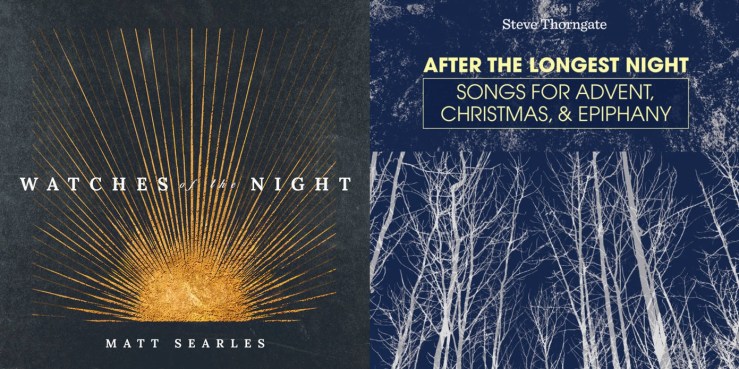
NEW ADVENT/CHRISTMAS ALBUMS
Watches of the Night by Matt Searles: “Christian believers are like watchmen, longing to see the first rays of dawn. We long for the darkness of this world to be finally taken away, and the light of Christ to rise in all its splendour. This album is intended to help us as we wait; to lament the brokenness of this world, but to look to the riches of that which is to come. It is an album of longing, but also of profound hope. Light has dawned. Christ has been raised. But we await the full revelation of him in glory. We are still watchmen. Still waiting.
“This is not a loud album. It is one I hope you might be able to listen to if you lie awake unable to sleep, as I so often find the case. I pray it is an album that might help you – like David in Ps 63:6 – to meditate on God in the watches of the night. An album that will orient you to the future, and help you increasingly be someone whose mind is set on the city that is to come. Songs to help you fix your eyes on Christ, and long above all else for his return when we see him face to face.”
After the Longest Night: Songs for Advent, Christmas, and Epiphanyby Steve Thorngate: These fourteen songs are a mix of originals, including settings of the Lukan Canticles (the songs of Zechariah, Mary, and Simeon), and traditionals: “Creator of the Stars of Night,” “What Child Is This,” “Bright Morning Stars,” and “Let the Light of Your Lighthouse Shine on Me.” Best $7 I’ve spent in a while! (Purchase even includes lead sheets.)
My friends at Paraclete Press are offering a free copy of this brand-new book to three lucky readers of Art & Theology. Entry rules are below.
For many, the holiday season is difficult to get through, as it stirs up painful reminders of loss or reveals fractures in present relationships. Author David Bannon knows. Wounded in Spirit: Advent Art and Meditations grew out his grief over the death of his twenty-six-year-old daughter, as well as his brokenness over his criminal past.
The book comprises twenty-five daily readings, each centered on an artist who walked through his own dark valley, groping for the light—and producing extraordinary art in the process. Most of these valleys were ones of death—death of children, parents, siblings, spouse. Some of the featured artists struggled with mental illness, the stigma of illegitimacy, or racial discrimination; others led violent or lascivious lives, and had grave personal sins to overcome. The premise of the book, though, is that Christ meets us in our fallibility and sorrow; he is our hope, our peace. “In their [the artists’] wounds, in our wounds, we may once again encounter ‘God with us.’”
Illustrated in full color and with a foreword by Philip Yancey, Wounded in Spirit combines painting reproductions, commentaries, Bible verses, and quotes about beauty and suffering that prepare us to welcome the coming Messiah in the fullness of his glory and healing grace. Artists include Caravaggio, Murillo, Dürer, Cranach, Friedrich, Tanner, van Gogh, Gauguin, and more. Most of the artwork subjects are biblical, but not all; there are a few landscapes, self-portraits, allegories, and genre scenes as well.
HOW TO ENTER
Clicking on the entry button below will bring you to the entry form on the Rafflecopter website. You can enter up to three times by: subscribing to Art & Theology (to receive semiweekly posts by email), following @artandtheology on Twitter, and/or visiting Art & Theology’s Facebook page. (If you are already an email subscriber or a Twitter follower, you still qualify.)
The contest ends Sunday, November 25, at 12 a.m. Eastern Time. Three winners will be randomly selected and contacted by email later that day for shipping address information, using the email address provided on the entry form.
Unfortunately, this contest is restricted to US addresses only. My sincerest apologies to my international readers!
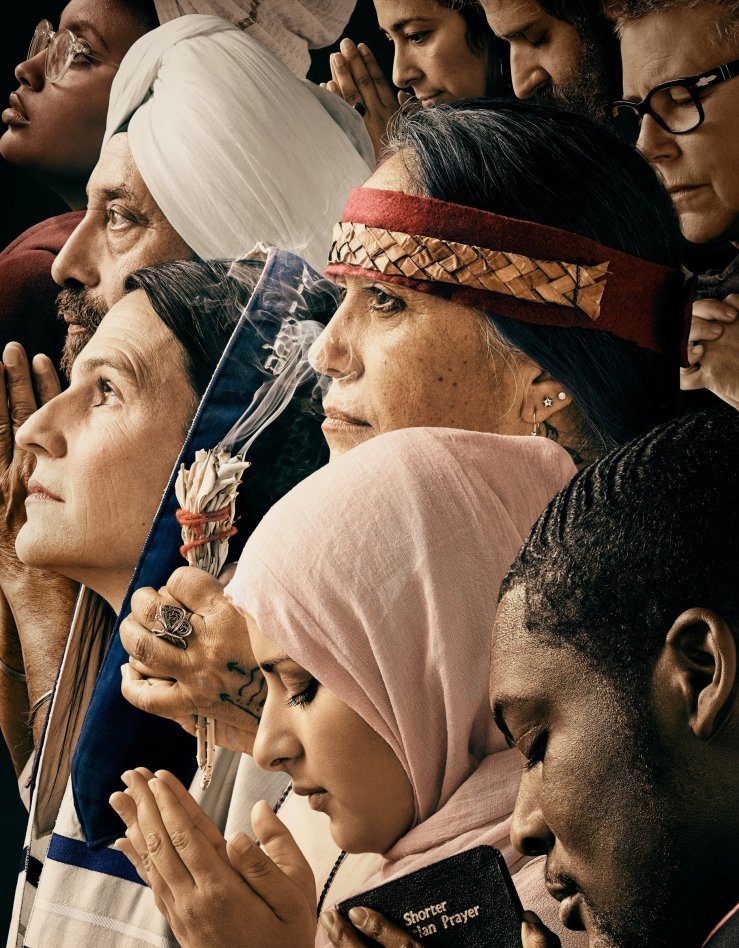
Hank Willis Thomas (American, 1976–) and Emily Shur (American), Freedom of Worship, 2018. While Norman Rockwell’s illustration of the same name contains specific representations of Protestantism, Catholicism, and Judaism, this reinterpretation goes even further to include Islam, Native American spirituality, and Sikhism.
NEW PHOTOGRAPH SERIES:“The Four Freedoms” by Hank Willis Thomas and Emily Shur: In his 1941 State of the Union address, President Franklin D. Roosevelt insisted that people in all nations share Americans’ entitlement to four basic freedoms: freedom of speech, freedom of worship, freedom from want, and freedom from fear. This famous speech became the basis for Norman Rockwell’s set of four illustrations, originally published in the Saturday Evening Post in 1943, that have become some of history’s most iconic representations of the American idea.
Artist Hank Willis Thomas and photographer Emily Shur decided to reimagine these scenes with a cast that’s more representative of American diversity. One of the eighty-two final images they created is published on the cover of the current issue of Time magazine. It and others will form the backbone of a national billboard campaign by the nonpartisan organization For Freedoms to encourage civic engagement. “We believe that if artists’ voices replace advertising across the country, public discourse will become more nuanced,” their website says.
+++
IN CONCERT: Eric and I went to see brother-sister folk duo The Oh Hellos (Tyler Heath and Maggie Heath Chance) in Baltimore earlier this month and had a great time. My favorite song from their set list was “Soldier, Poet, King,” which describes Jesus’s coming in all three roles—perfectly appropriate for the upcoming Advent season! Jesus, the Word of God, comes to tear down Satan’s kingdom and establish his just rule in our lives and world (1 John 3:8b; Rev. 19:11–16). The final verse affirms Jesus’s status as Messiah, the waited-for “Anointed One,” and celebrates his power marked by humility, even unto death. The blood he wears into battle is his own.
There will come a soldier
Who carries a mighty sword
He will tear your city down
O lei o lai o lord
There will come a poet
Whose weapon is his word
He will slay you with his tongue
O lei o lai o lord
There will come a ruler
Whose brow is laid in thorn
Smeared with oil like David’s boy
O lei o lai o lord
The Oh Hellos’ nationwide tour continues through the end of the year, so visit their website to see if they’ll be stopping near you.
+++
NEW ALBUM: Crumbs by Liturgical Folk: Liturgical Folk (previously here and here) released its third album this month, which “build[s] on the themes of eucharist and the mission of the church to bring peace and reconciliation to the world.” The title comes from the track “Prayer of Humble Access,” a verbatim setting from the “Holy Eucharist Rite I” in the Book of Common Prayer that alludes to the story of the Syrophoenician woman.
Most of the song texts on the album come from that traditional Anglican prayer-book and were set to music by Ryan Flanigan, though a few texts are contemporary. “Lord, Lord, Lord,” for example, was written in the wake of the August 9, 2014, shooting of Michael Brown in Ferguson, Missouri, and amid the subsequent escalation of racial tensions in the country. “As a privileged, white, middle class, American man,” Flanigan wrote,
I felt for the first time in my life the systemic injustice against black males in our country. What I found most troubling, besides death itself, was the response of some white, privileged people to the shooting, particularly the response of some Christians on social media and the News. When we should have been mourning with those who mourn, confessing our fears and sins, and seeking reconciliation, many of us turned a blind eye or, worse, assumed a posture of defensiveness and denial. I wrote this song as a corporate confession of sin to God and our fellow men, a plea for God to forgive us and restore our broken trust with him and with those we’ve failed to love.
+++
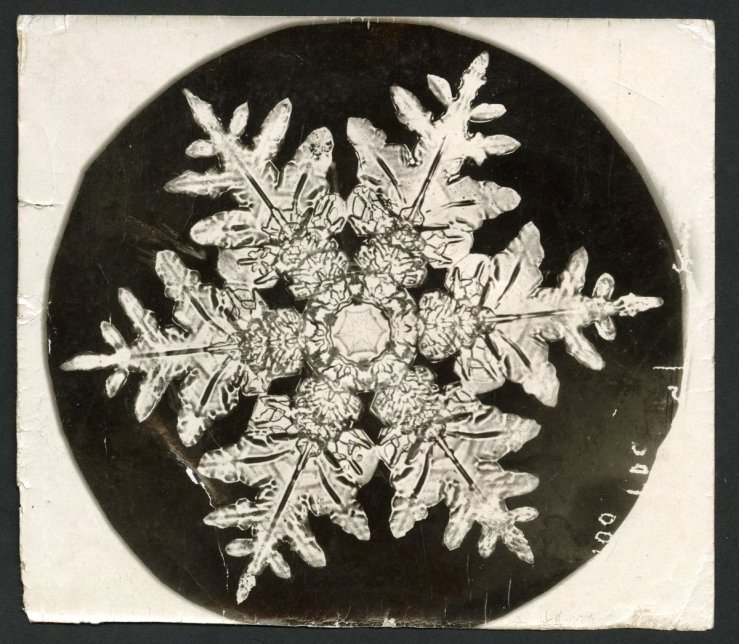
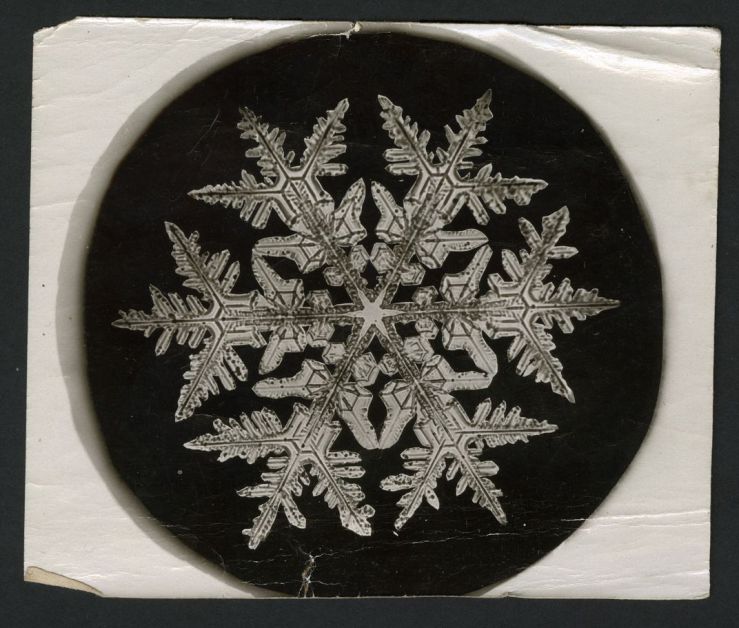
WORLD’S FIRST SNOWFLAKE PHOTOS:“The Man Who Revealed the Hidden Structure of Falling Snowflakes”: Maryland saw its first snow of the season this week, as did most of the East Coast, which means Twitter saw a flurry of snowflake images! The Smithsonian posted about Wilson “Snowflake” Bentley (1865–1931), whose perfection of innovative photomicrographic equipment and techniques (which included chilled velvet and a turkey feather) enabled him to photograph thousands of individual snowflakes without their melting, providing valuable scientific records of snow crystals and their many types.
The first person to photograph a single snowflake, . . . Wilson A. Bentley used a microscope with his bellows camera—plus years of trial and error—to get a photo of one flake in 1885. But he didn’t stop there. Bentley went on to take thousands more, . . . which helped support the belief that no two snowflakes are alike. In 1903, he sent 500 prints of his snowflakes to the Smithsonian, hoping they might be of interest to our Secretary. The images are now part of the Smithsonian Archives.
+++
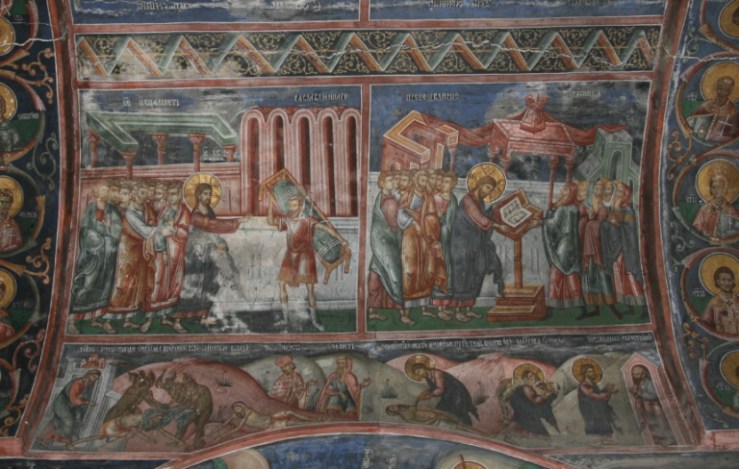
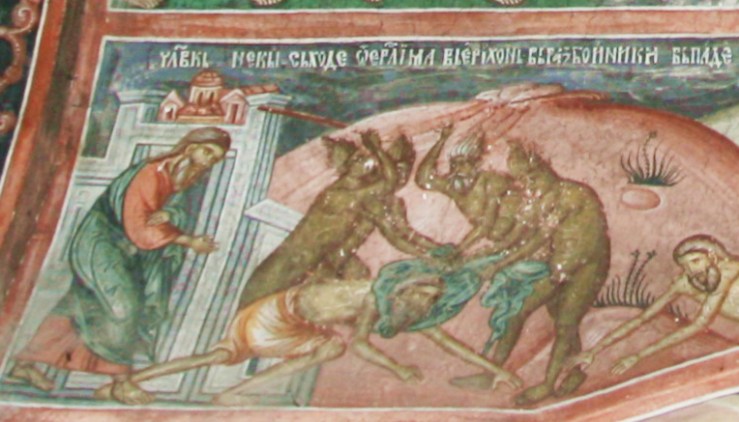
BALKAN ICON:“Transforming a Parable: The Good Samaritan”: Run by David Coomler, a museum researcher, Icons and Their Interpretations discusses aspects of traditional Russian, Greek, and Balkan iconography, inviting people to submit photos of icons for identification of subject or meaning, and translation of inscriptions. Recently he wrote about a fourteenth-century Serbian Orthodox fresco that, like many of the church fathers, promotes an allegorical reading of the parable of the good Samaritan. In this interpretation, the man en route to Jerusalem is Adam, or Everyman, who is beaten by demons; the priest and the Levite represent the law of Moses and the priesthood of Aaron, which cannot help the wounded man. But the “good Samaritan,” Jesus, stoops down to save, carrying the man not on a beast of burden but on his own back, to an “inn,” the church. He hands two “coins,” the Bible and tradition, to the innkeeper, and promises to return. See further image details and commentary at the web link above.
Parable of the Good Samaritan (see bottom register), 14th century. Fresco in the narthex of the Patriarchal of Pech, a Serbian Orthodox monastery in Kosovo.
+++
OBITUARY: Christian composer Kurt Kaiser dies at 83: On November 12, Kaiser passed away at his home in Waco, Texas, after a six-decade-long career in composing, playing, arranging, and producing Christian music. A Gospel Music Hall of Famer and a progenitor of CCM, he’s best known for his song “Pass It On,” but I know him for “Oh How He Loves You and Me,” two renditions of which are posted below; the first is a solo performance by Vanessa Williams with gospel piano accompaniment by Richard Smallwood, and the second is performed a capella in four-part harmony by Kaoma Chende with the use of overdubbing.
The angel Gabriel awakes the dead on Resurrection Day in this medieval stained glass tondo from the Musée de Cluny in Paris. Photo: Spencer Means.
And just as it is appointed for man to die once, and after that comes judgment, so Christ, having been offered once to bear the sins of many, will appear a second time, not to deal with sin but to save those who are eagerly waiting for him.
—Hebrews 9:27–28
+++
SONG: “Get Happy” | Words by Ted Koehler, 1930 | Music by Harold Arlen, 1930 | Performed by the Puppini Sisters, on Hollywood(2011)
See also the Judy Garland version from Summer Stock (1950), below, which the American Film Institute ranked #61 in its survey of top tunes in American cinema.
+++
“The Day of Judgment” by Henry Vaughan
O day of life, of light, of love!
The only day dealt from above!
A day so fresh, so bright, so brave,
’Twill show us each forgotten grave,
And make the dead, like flowers, arise
Youthful and fair to see new skies.
All other days, compared to thee,
Are but Light’s weak minority;
They are but veils, and cypress drawn
Like clouds, before thy glorious dawn.
O come! arise! shine! do not stay,
Dearly loved day!
The fields are long since white, and I
With earnest groans for freedom cry;
My fellow-creatures too say “Come!”
And stones, though speechless, are not dumb.
When shall we hear that glorious voice
Of life and joys?
That voice, which to each secret bed
Of my Lord’s dead,
Shall bring true day, and make dust see
The way to immortality?
When shall those first white pilgrims rise,
Whose holy, happy histories
—Because they sleep so long—some men
Count but the blots of a vain pen?
Dear Lord! make haste!
Sin every day commits more waste;
And Thy old enemy, which knows
His time is short, more raging grows.
Nor moan I only—though profuse—
Thy creature’s bondage and abuse;
But what is highest sin and shame,
The vile despite done to Thy name;
The forgeries, which impious wit
And power force on Holy Writ,
With all detestable designs,
That may dishonor those pure lines.
O God! though mercy be in Thee
The greatest attribute we see,
And the most needful for our sins,
Yet, when Thy mercy nothing wins
But mere disdain, let not man say
“Thy arm doth sleep,” but write this day
Thy judging one: descend, descend!
Make all things new, and without end!
This post belongs to the weekly series Artful Devotion. If you can’t view the music player in your email or RSS reader, try opening the post in your browser.
To view all the Revised Common Lectionary scripture readings for Proper 27, cycle B, click here.
Advent begins December 2, and Christian resource providers have already started releasing content for the season so that you can start adapting and programming it into your church services or family devotional practices, if desired. Here are three sets plus a Kickstarter campaign that caught my eye.
from SALT PROJECT
Photo by SALT Project
SALT Project is a faith-based media company dedicated to creating beautiful visual content, especially video, for churches and other clients. Below are three of the five videos they’ve put together for Advent, which can be purchased and customized for church use. The videos feature a few products, like illustrated Advent calendar notecards (with daily tasks like “Deliver sweets to a neighbor” or “Write a thank-you letter to God”) and coloring pages and posters inspired by Mary’s Magnificat, available for download from SALT’s online shop.
I love their aesthetic! (These videos make me really excited for Advent.) I also appreciate how the devotional activities can be done either as an individual, a family, or a congregation. Click here to see a roundup of all five videos, and be sure to also check out Advent in Full Color, a devotional booklet that features poetry by Mary Oliver and Howard Thurman, daily practices, scripture texts, meditations on the season’s key theological themes, and coloring pages.
The cover story of the September 2018 issue of Reformed Worship magazine is “Advent in Narnia: An Invitation to Biblical Explorations Beyond the Wardrobe” by Cindy de Jong, which chronicles how seven different churches, including the author’s, used The Chronicles of Narnia last year to draw out some of the themes of Advent. In most cases this involved a six-week sermon series, or a service of lessons and carols, that integrated references to C. S. Lewis’s classic tale. At first I was skeptical of keying sermon series to a work of fiction, allegorical though it may be, but it turns out the worship service plans (reproduced in the article) were intelligently done, letting scripture drive and Narnia serve as a supplement to amplify God’s truth. One contributor even mentioned the need to be careful to not let Narnia be the focus; it can provide structural support but should not constitute the core of the sermon nor the worship service.
“The whole of Advent is this,” de Jong writes: “awaiting the birth of the Christ child in the same way we wait for the return of Christ’s kingdom. The whole of The Lion, the Witch, and the Wardrobe covers the same: waiting for Aslan and waiting for the triumph of Narnia.” Service plans, including songs, sermon titles and notes, Narnia references, and confessions, are included in the article with varying specificity. Though all drawing on the same text, there is a surprising diversity of approaches. Also included are ideas for how to decorate the sanctuary, how to engage children, and how to introduce the book and the sermon series to the congregation. Two additional books that are recommended are Advent in Narnia: Reflections for the Season by Heidi Haverkamp and The Lion’s World: A Journey into the Heart of Narnia by Rowan Williams.
Besides this eleven-page article, this month’s issue also includes an Advent reading for three voices by Joyce Borger, titled “What If . . . ?,” that reflects on the Flight to Egypt in light of today’s immigration debates, as well as an Advent worship service series that includes calls to worship, Advent readings, scripture texts, sermon themes and outlines, and song suggestions for five weeks’ worth of Sundays.
+++
from ADAM FARBIARZ via KICKSTARTER
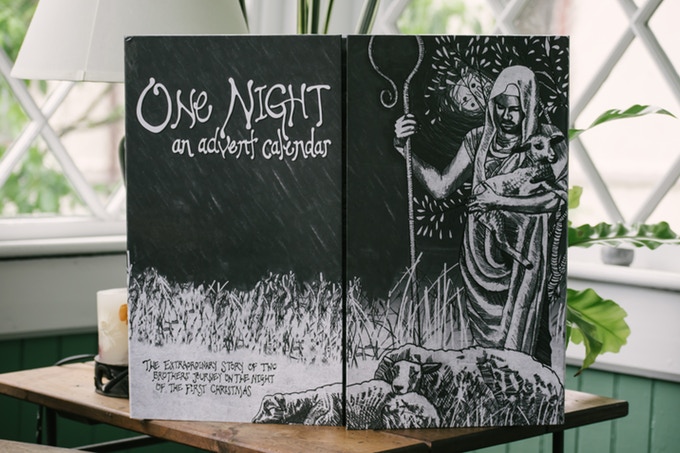
Designed for daily use during December, One Night: An Advent Calendar is a large foldout storybook that reimagines Luke’s nativity narrative through the eyes of a shepherd. Printed on heavyweight paper wrapped around millboard, the product takes the form of a freestanding triptych with twenty-four numbered doors that open to reveal snippets of story. I’ve seen the mock-up, and it looks like a really quality endeavor, something for the whole family to enjoy (it’s pitched to adults but accessible to children). Help the creative team fund printing costs by contributing to their Kickstarter campaign in exchange for your own calendar in the mail by the end of November. Text and direction by Adam Farbiarz, illustrations by Rachael Clarke Hendel, hand lettering by Rachel Farbiarz, and design by Lizzie Stone.
+++
from THE HOMELY HOURS
These resources were published over the last few years, but I just found out about them this summer. Run by churchwomen from Christ the King Anglican Church in Dayton, Ohio, The Homely Hours is a website created out of a desire to encourage a deeper integration of the life of the church into the life of the home. It’s treated not so much as a blog (it’s not continually updated) as it is a repository, so search through the tabs and archives for creative ideas to celebrate the liturgical seasons in the domestic sphere.
>> Rozhdestvo (The Nativity) (1996), written and directed by Mikhail Aldashin: I am blown away by this wordless animated short from Russia. Using a naive art style washed in sepia tones and set to a soundtrack of Bach and Beethoven, it tells the story of how angels, humans, and animals came together on the first Christmas to worship the newborn Christ. It opens with Gabriel peeking out from behind a tree at Mary hanging laundry, then chasing her down a footpath to tell her what God is up to. For every person and critter he encounters, Gabriel flashes open the book of God’s word, pointing them to the shalom it prophesies and inviting them to enter in. By the end, shepherds, fishermen, kings, rabbits, lambs, and lion are participating in a round dance outside the stable, while an angel orchestra (which includes violins and timpani!) plays from the rooftop.
An emphasis on the sweet humanity of the holy couple—scared, tired, joyful, loving—makes this film especially endearing, and the roles given to animals reminds us that under Christ, all creation will be redeemed. I’m adding this to my annual Christmas watchlist! [HT: ArtWay]
>> O Little Town of Bethlehem (2012), dir. Tim Parsons: Commissioned by St. Paul’s Arts and Media (SPAM) in Auckland, New Zealand, this film tells the story of Christ’s Nativity through the voices of those who currently live in and around his birthplace of Bethlehem. A Palestinian shepherd, taxi driver, street vendor, midwife, peace activist, and antiquities dealer are among those interviewed, each reflecting on the significance of Christ’s story and providing a window into Middle Eastern culture. Some are Christian, others are Muslim (the Koran has its own account of the virginal conception and birth of Jesus—or Isa, as he is known in that tradition).
Though filmed five years ago, the living conditions captured in this video still exist. The West Bank’s 440-mile wall, built by Israel on seized land, plows through front yards, farms, and university campuses and restricts the movement of Palestinians—to water, work, prayer, and hospitals. Since the establishment of the modern State of Israel in 1948, many Palestinians have been displaced from their homes and live in refugee camps. The director said he didn’t want to make the film political but that he couldn’t avoid filming these realities. The hopes and prayers expressed by the film’s subjects we should adopt as our own this Christmas as we reflect on the birth of Hope, Peace, Joy, and Love two thousand years ago in this little Palestinian town.
+++
SONGS:
>> “Glory in the Darkest Place” by Brittany Hope: Last December Brittany Hope Kauflin (whose professional name drops the “Kauflin”) wrote “a song for those in darkness this Christmas season,” video-recording it at home with her sister McKenzie and her dad Bob. The outpouring of appreciation she received made her recognize the demand for soft and somber Christmas songs that probe for the light—as for many people, the holidays are characterized more by sadness than by celebration. Now the song is available, along with seven others in the same vein, on the album Glory in the Darkest Place. To read an introduction to the song by Bob Kauflin and/or to download the chord chart, piano score, and lyrics, click here. [HT: Bruce Benedict]
>> “Hellige Natt” (O Holy Night),arr. Eirik Hegdal, feat. Kirsti Huke: This innovative Norwegian jazz arrangement of the Christmas classic “O Holy Night” is performed inside the medieval Nidaros Cathedral in Trondheim by the Norwegian University of Science and Technology (NTNU) Jazz Ensemble and the NTNU Chamber Orchestra. An impressive space whose grandeur is matched by this rich, expressive performance. [HT: Global Christian Worship]
+++
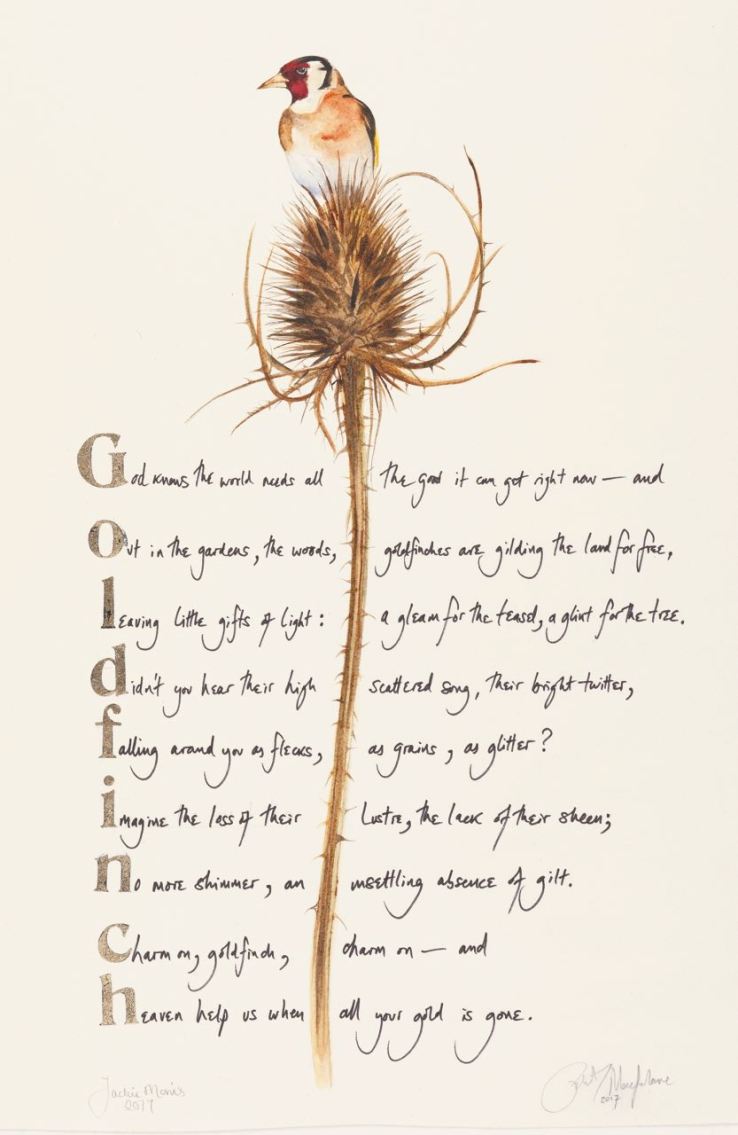
ILLUMINATED POEM: “Goldfinch” by Robert Macfarlane, illuminated by Jackie Morris: Nature writer Robert Macfarlane’s critically acclaimed book The Lost Words: A Spell Book, illustrated by Jackie Morris and published this October, is a joyful celebration of the nature words that were dropped from the 2008 edition of the Oxford Junior Dictionary. Aiming to “enchant nearby nature again” for both kids and adults, it comprises a series of acrostic poems whose main letters are gilded in gold leaf.
Poem by Robert Macfarlane. Art by Jackie Morris.
I’m pleased to see that Macfarlane’s collaboration with Morris has continued with his latest “Goldfinch”—a “‘charm’ about hope, harm, gift & darkness.” Handwritten over a painting by Morris, the poem begins
God knows the world needs all the good it can get right now—and
out in the gardens, the woods, goldfinches are gilding the land for free,
leaving little gifts of light . . .
The piece is reproduced in the latest issue of Elementum Journal, and the original has sold. Hear Morris read the poem in the SoundCloud player above.
Click here to read an interview with Macfarlane and Morris on the making of The Lost Words, and here to read Macfarlane’s response to a 2002 study that found that four- to eleven-year-old Brits are better at identifying Pokémon characters than native species of plants and animals, like oak tree and badger. Also, check out his other books, like Landscape, The Old Ways: A Journey on Foot, The WildPlaces, and Mountains of the Mind.
Many of the artworks and resources I share on these roundup posts I discover through the individuals, organizations, or publications I follow on social media or via RSS. If I’m not introduced to the content directly by its maker, I will try to indicate an “HT” credit, shorthand for “hat tip,” meaning thank you, X, for bringing this to my attention! All descriptions and commentary, however, are my own, unless set in quote marks.
“Art for Advent 2017” (Dr. James Romaine): For the third year in a row, my friend James Romaine, an art historian, is releasing four videos in which he discusses historically significant artworks keyed to the season of Advent. Last year he looked at works from the Met Cloisters; this year he’s focusing on paintings by the African American artist Henry Ossawa Tanner (1859–1937). If you want to learn more about Tanner, see Romaine’s essay on him in the recently published book Beholding Christ and Christianity in African American Art, which Romaine coedited; I own a copy and look forward to reviewing it on the blog in the new year! (Update: Here’s the book review.)
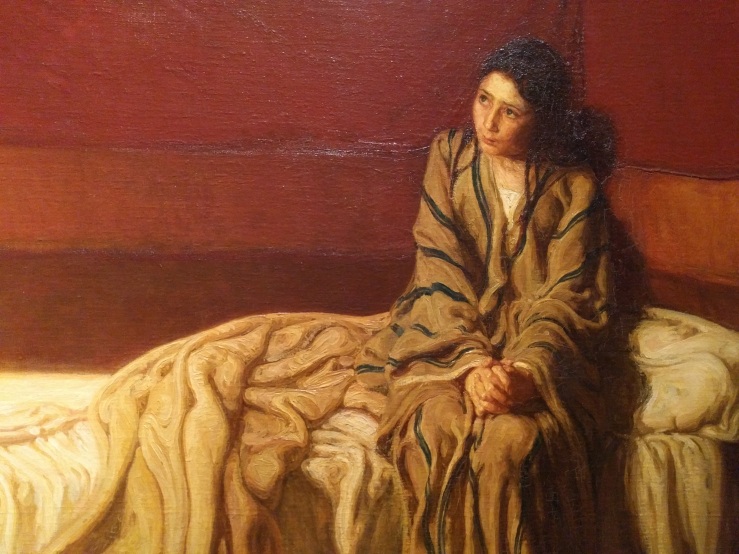
Henry Ossawa Tanner (American, 1859–1937), The Annunciation (detail), 1898. Oil on canvas, 57 × 71 1/4 in. (144.8 × 181 cm). Philadelphia Museum of Art. Photo: Victoria Emily Jones.
Romaine’s first “Art for Advent 2017” video covers Tanner’s Annunciation, which has been the header image of this website for the last two months. I saw the painting in person for the first time this summer at the Philadelphia Museum of Art, and it transfixed me. (Along with Rogier van der Weyden’s Crucifixion, it was my favorite piece on display.) It was the first major painting of a biblical subject that Tanner completed following his six-week trip to the Holy Land, undertaken as part of his search for historically authentic imagery.
To view “Art for Advent” videos from previous years, visit Romaine’s Seeing Art History YouTube channel.
+++
“The Joyous Mysteries” (The Liturgists): Meditating on the five “Joyous Mysteries” of Christ’s childhood—the Annunciation, the Visitation, the Nativity, the Presentation in the Temple, and the Finding of Christ in the Temple—is a Catholic devotional practice, part of “praying the rosary,” that some Protestants have found spiritually helpful and have adapted to their own quiet times with God.
To draw us into the movements of the Christmas story, The Liturgistsinvited four visual artists to create a work based on one of the first four Joyous Mysteries. They then shot two videos for each artwork—one an “Artist Narrative,” where the artist talks about his or her work and process, and the other an “imago divina” meditation led by Mike McHargue (“Science Mike”), which guides us through looking at and responding to the artwork. The videos are backed by original instrumental compositions by Tim Coons of Giants & Pilgrims and one by Jon Leverkuhn, which you can download for free on Bandcamp. You can also purchase signed, limited edition art prints for $35 each, or $95 for a full set.
Here is the list of videos; I’ve embedded my two favorites (I’m partial to figurative art):
The Advent Project published yearly by Biola University’s Center for Christianity, Culture, and the Arts (CCCA) is an online devotional that brings together daily scripture readings, visual art, music, poetry, and written reflections for the seasons of Advent and Christmas (which this year is December 3–January 6). Introduced in 2013, it is the only recurrently published art-forward Advent/Christmas devotional I know of, and I recommend it highly. It is in large part what inspired my year-round “Artful Devotion” series and the Advent art booklet I published digitally last year.
With so many different elements, design matters a lot, and I’m super-impressed by what Biola has come up with. The homepage is laid out as a gridded calendar with thumbnail images; click on a date, and you’re brought to a new viewing mode in which a large image and a music player are set in a fixed position on the left while the right sidebar contains scrollable text, separated into two tabs—the main content, and biographical information about the artists. This design enables the image to remain before your eyes so that you can continue to reference it as you read on (something that, frustratingly, I cannot achieve with Art & Theology’s long-scrolling format), and it also relegates the bios to “back matter.” It’s all very organized and easily navigable.
This initiative is an outworking of the CCCA’s mission to explore the rich interrelationships between contemporary art making, theology, and religious tradition. Be sure to check out the other sections of their website; they offer plenty of free resources, including an archive of past Advent (and Lent!) devotionals, and a calendar of events, such as lectures, workshops, symposia, art exhibitions, concerts, film screenings, and more.
Below is one of my favorite Advent Project entries from last year, reproduced by kind permission of the CCCA. Centered on Mary’s Magnificat, it brings together the work of an Italian Renaissance painter, a contemporary British video artist (who I’ve written about before), a modern Bohemian Austrian poet, and a minimalist composer working with Spanish, Latin, and English texts. Adjunct professor of philosophy Evan Rosa (who is a superb writer!) reflects on how scandalous Mary’s humility is for power-hungry Western Christians—just as it would have been for the Greco-Roman world in which she lived. He concludes with a prayer that invites us to move from self-magnification to the magnification of God.
Due to this blog’s design limitations, I had to adapt the following content from its original format. To view the devotion on the Biola website, click here. I have excluded biographical information for the song performers and poet.
+++
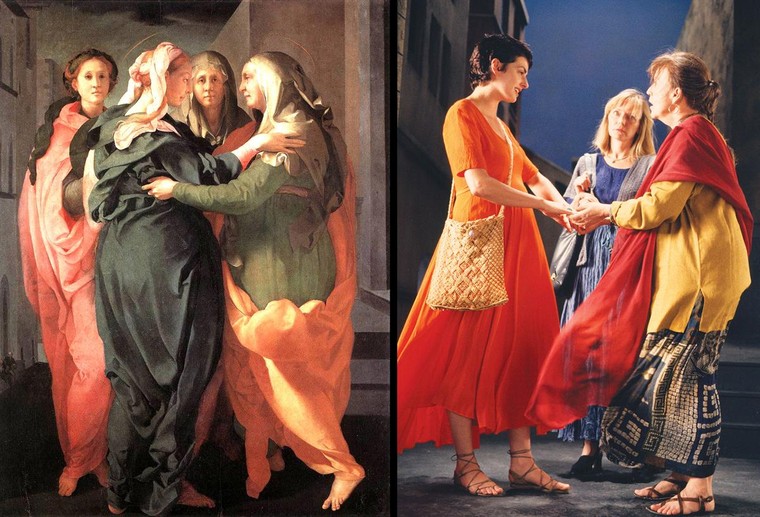
ARTWORKS: The Visitation by Pontormo; The Greeting by Bill Viola
Left: Jacopo da Pontormo, The Visitation, 1528, oil on canvas, Church of San Francesco de Michele, Carmignano, Italy. Right: Bill Viola, The Greeting, 1995, still image from a large-screen video installation.
About the Artist and Artwork #1:
Jacopo Carucci(1494–1557), usually known asPontormo, was an Italian Mannerist painter and portraitist from the Florentine School. His work represents a profound stylistic shift from the calm perspectival regularity that characterized the art of the Florentine Renaissance. He is famous for his use of twining poses, coupled with ambiguous perspective; his figures often seem to float in an uncertain environment, unhampered by the forces of gravity. Pontormo’s painting The Visitation, completed in 1528, now adorns the altar of a side chapel in a small church called the Pieve di San Michele in Carmignano, a town west of Florence, Italy. The setting for this painting is the visitation of the Virgin Mary on her older pregnant cousin Elizabeth, the wife of Zacharias. Elizabeth and Mary, who are painted in profile, gracefully embrace each other as they exchange glances of mutual affection and share in the news of Mary’s pregnancy. They dominate the canvas as they stand on the threshold of Zacharias’s house.
About the Artist and Artwork #2:
Bill Viola(b. 1951) is internationally recognized as one of today’s leading artists. He has been instrumental in the establishment of video as a vital form of contemporary art, and in so doing has helped to greatly expand its scope in terms of technology, content, and historical reach. His works focus on universal human experiences—birth, death, the unfolding of consciousness—and have roots in both Eastern and Western art as well as spiritual traditions.
Bill Viola’s large-screen video installation The Greeting was inspired by TheVisitation, painted by Italian Mannerist artist Jacopo Pontormo. Viola’s video sequence echoes the drama of Pontormo’s Visitation, but transforms the moment into an enigmatic contemporary narrative. In this still frame, three women are dressed in long, flowing garments and stand in an Italianate architectural setting similar to that in Pontormo’s painting. The woman in the orange dress, her stomach visibly swollen, has just entered the scene from the left, interrupting a conversation and perhaps whispering to the older woman the news of her pregnancy. This encounter was filmed in less than a minute, but Viola has slowed the video down to ten minutes. The use of extreme slow motion draws attention to the nuances of the women’s gestures and glances, and intensifies the psychological dynamic of the exchange.
Sunday will mark the start of Advent and a new liturgical year (cycle B in the Revised Common Lectionary). In this season we dwell on the “three comings” of Christ—into human history, into our hearts, and at the eschaton. We cry out with Asaph the psalmist, “Shine forth!”
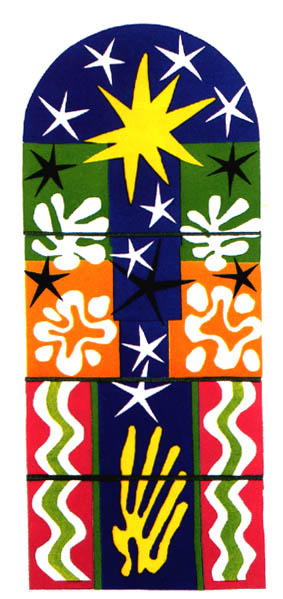
Henri Matisse (French, 1869–1954), Maquette for Nuit de Noël, 1952. Gouache on paper, cut and pasted, mounted on board, 271.8 × 135.9 cm (107 × 53.5 in.). Museum of Modern Art, New York.
Give ear, O Shepherd of Israel,
you who lead Joseph like a flock.
You who are enthroned upon the cherubim, shine forth.
Before Ephraim and Benjamin and Manasseh,
stir up your might,
and come to save us!
Restore us, O God;
let your face shine, that we may be saved!
—Psalm 80:1–3
+++
SONG: “Holy Love Come Down” by David Isaac Rivers, from Psalms (2016)
This post belongs to the weekly series Artful Devotion. If you can’t view the music player in your email or RSS reader, try opening the post in your browser.
To view all the Revised Common Lectionary scripture readings for the First Sunday of Advent, cycle B, click here.









 Art & Theology