Last month I saw the exhibition Elizabeth Catlett: A Black Revolutionary Artist at the National Gallery of Art in Washington, DC, an impactful display of over two hundred prints and sculptures from throughout Catlett’s illustrious seven-decade career. Organized in partnership with the Brooklyn Museum of Art, where it first opened last year, the show focuses on Catlett’s advocacy, through her art and her on-the-ground activism, against poverty, racism, war, and gender oppression—her promotion of human dignity and freedom for all. Her work especially celebrates the beauty and strength of African American working-class women.
The exhibition title comes from a speech Catlett delivered in May 1970 by phone from Mexico to attendees at the Conference on the Functional Aspects of Black Art at Northwestern University outside Chicago, which she could not attend in person because the United States refused her entry to the country on the grounds of her allegedly dangerous politics: “I have been, and am currently, and always hope to be a Black revolutionary artist, and all that it implies,” Catlett stated.
Born in 1915 in Washington, DC, and raised there, Catlett witnessed class inequality, racial discrimination, and US imperialism firsthand, which formed her consciousness and influenced the direction her art would go. After graduating from Howard University, she spent time teaching in Durham (North Carolina), New Orleans, and Harlem and studying art in Iowa and Chicago before permanently settling in Mexico in 1946, becoming a Mexican citizen in 1962. She married the Mexican printmaker and muralist Francisco Mora in 1947, and they had three children together, all sons.
Black motherhood is a recurring subject in Catlett’s work, starting with her MFA thesis project in 1941 at the University of Iowa, a limestone sculpture of a mother and child that won first prize at the America Negro Exposition in Chicago that year but that is now lost. “Black women have been cast in the role of carrying on the survival of Black people through their position as mothers and wives, protecting and educating and stimulating children and Black men,” Catlett said. “We can learn from Black women. They have had to struggle for centuries.”
The social justice framework of the current retrospective exhibition leaves plenty of room for Catlett’s depictions of mothers with their children. What follows are photos I took of some such works.
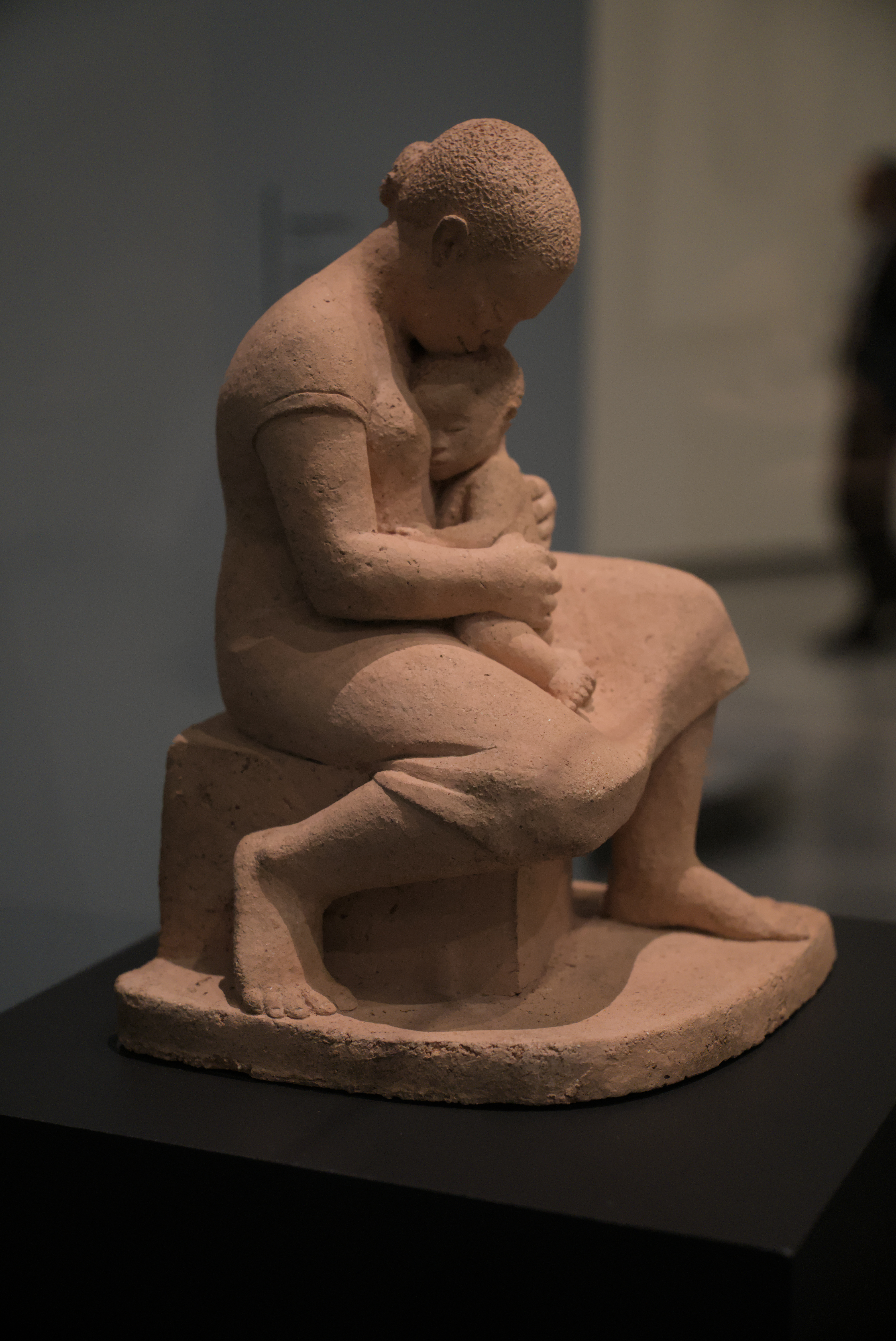
Elizabeth Catlett (American, active in Mexico, 1915–2012), Mother and Child, 1956. Terracotta, 28.6 × 17.8 × 17.8 cm (11 1/4 × 7 × 7 in.). Museum of Modern Art, New York.
My favorite is a terracotta sculpture made just a year after the lynching of fourteen-year-old Emmett Till, whose mother Mamie Till’s response was an important catalyst of the civil rights movement. It brings two bodies—that of mother and infant son—into one volume. Art historian Leah Dickerman remarks on
the uncanny way that it seems both intimate and monumental at once. Intimacy lies in the way the weight of the child’s face presses against the mother’s breast, the mother’s right leg pushed back to stabilize her balance and her head nestled against the child’s scalp, breathing in that smell. Tenderness, both affectionate and shielding, is conveyed so keenly it almost aches. . . . Catlett seems to capture, somehow, the idea of remembering something fleeting, the sculpture a tiny memorial to loving protection that cannot be maintained.
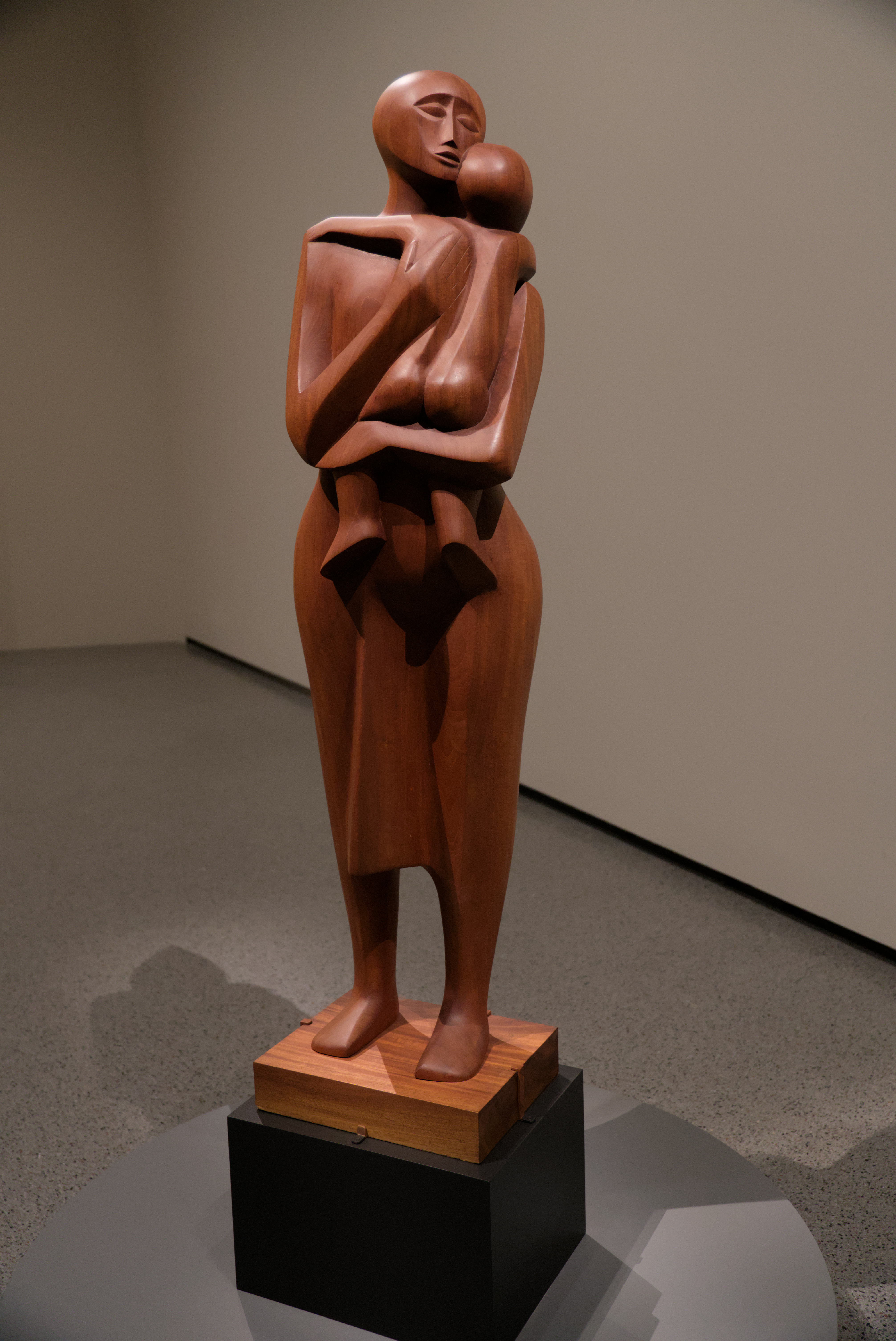
Platformed across from this sculpture is another, in mahogany, this one modernist, abstracted:
Elizabeth Catlett (American, active in Mexico, 1915–2012), Mother and Child, 1970. Mahogany, 49.5 × 33 × 21 cm (19 1/2 × 13 × 8 1/4 in.). Currier Museum of Art, Manchester, New Hampshire.
It shows a mother holding her baby in a swaddle, his or her head gleefully poking out from the folds. While the baby seems happy, the mother seems stressed, as she turns her head away and grabs her head with her hand, which I interpret as her taking a deep breath to compose herself for several more hours of caregiving before bedtime.
Another mahogany sculpture is borrowed from the New Orleans Museum of Art:
Elizabeth Catlett (American, active in Mexico, 1915–2012), Mother and Child, 1983. Mahogany, 134.6 × 33 × 33 cm (53 × 13 × 13 in.). New Orleans Museum of Art, Louisiana.
The adjacent wall text quotes art historian Melanie Anne Herzog, author of Elizabeth Catlett: An American Artist in Mexico:
Becoming a mother, Catlett told me, was her most creative endeavor. She returned to the theme of maternity throughout her career in sculptures that illuminate the intimate physical bond between mother and child, a child’s comfort in its mother’s embrace, and the anguish of mothers who know they cannot protect their children from future harm. Catlett’s boldly corporeal rendering of maternity centers Black and Brown women in her depiction of this universal theme. I feel the fierce tenderness of this stately standing figure cradling her child, its body melded with hers. Her pensive expression and resolute stance call us to reflect on what she has endured and what her child, too, will encounter in the world that awaits.
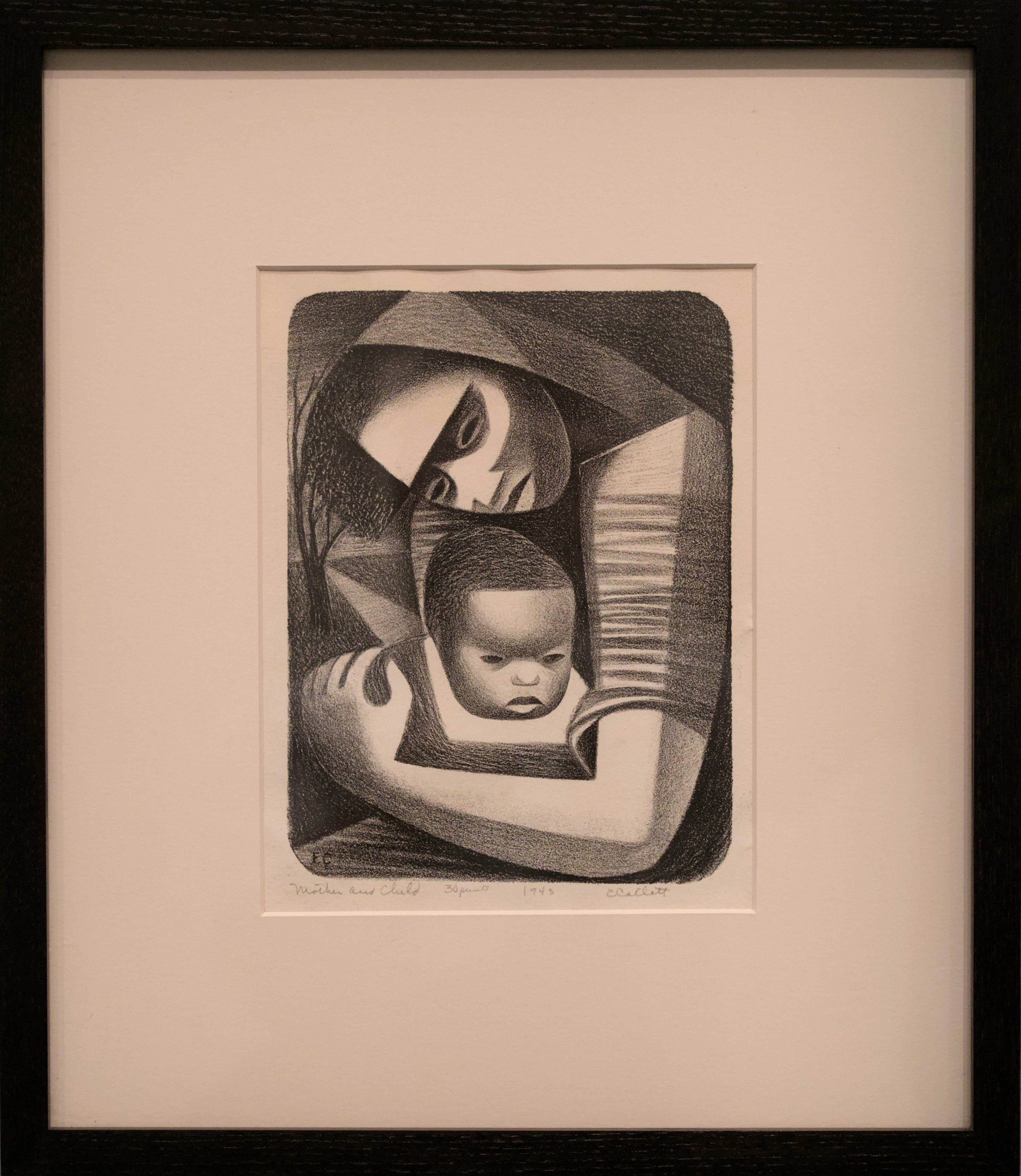
One of Catlett’s earliest prints of the mother-child subject is a lithograph from 1944:
Elizabeth Catlett (American, active in Mexico, 1915–2012), Mother and Child, 1944, printed 1945. Lithograph, image: 19.7 × 14.3 cm (7 3/4 × 5 5/8 in.); sheet: 31.4 × 23.8 cm (12 3/8 × 9 3/8 in.). Canton Museum of Art, Canton, Ohio.
The label notes how it “recasts Christian Madonna and Child iconography in the context of a racially segregated United States. A leafless tree in the background and the mother’s protective clutch hint at the brutal history of lynching and violence against Black people.”
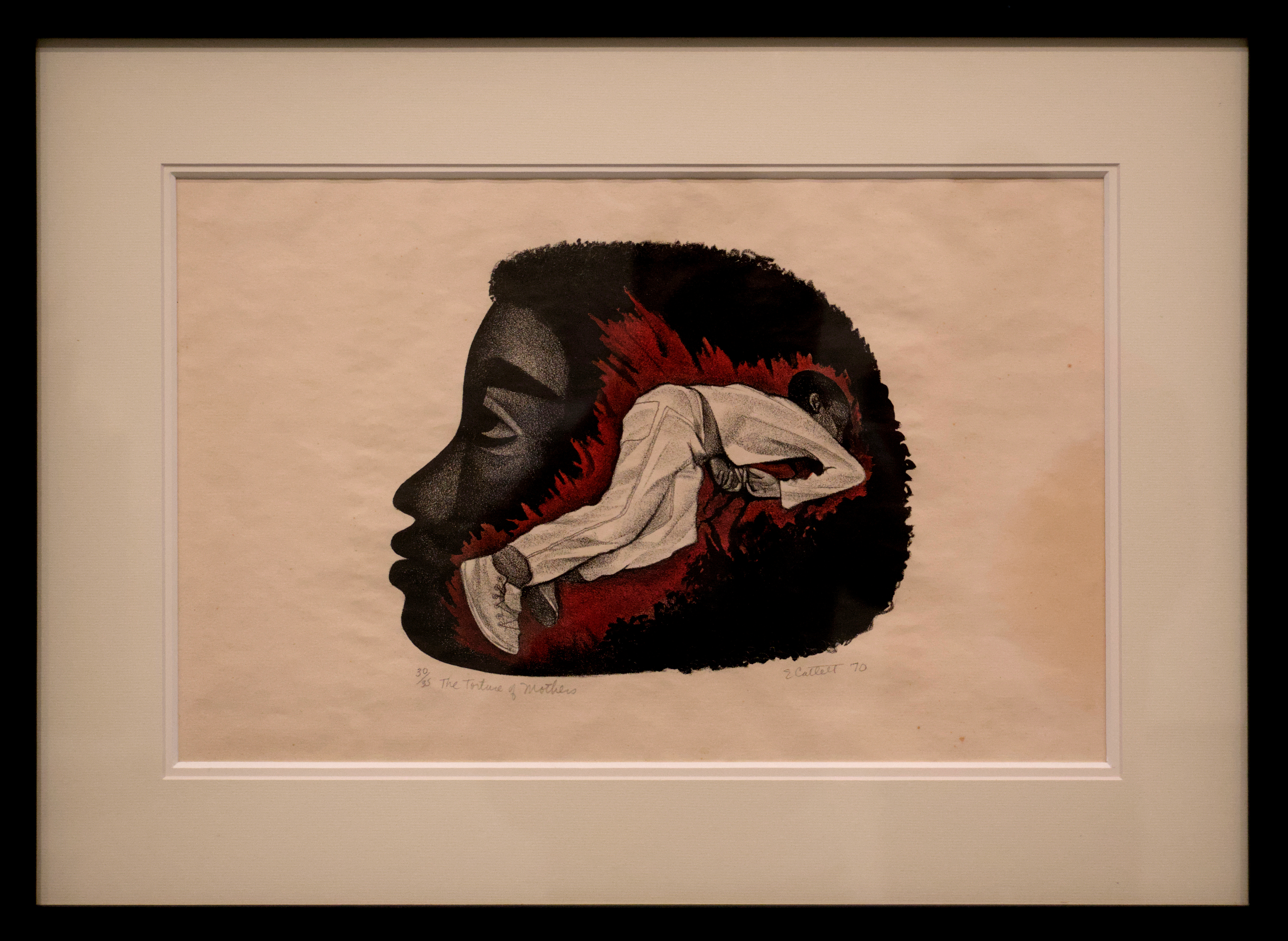
Even after her move to Mexico, Catlett remained connected to the Black liberation struggle in the US. Her Torture of Mothers from 1970 is based on the photograph by Bud Lee published on the cover of Life magazine’s July 28, 1967, issue, showing a twelve-year-old Black boy lying in a pool of his own blood in the middle of a street in Newark, New Jersey, having been shot by two stray police bullets. The police were trying to suppress the riots that had erupted in protest of the beating of a Black cab driver in Newark by two white police officers, and while Joe Bass Jr. was outside playing with his friends, he got caught in the crossfire.
Elizabeth Catlett (American, active in Mexico, 1915–2012), Torture of Mothers, 1970. Hand-colored lithograph, sheet: 38.1 × 56.5 cm (15 × 22 1/4 in.); framed: 48.3 × 66 cm (19 × 26 in.). Collection of Juanita and Melvin Hardy.
“Catlett’s composition visualizes the emotional toll such events have on Black mothers and women of color more broadly,” the gallery label reads—mothers whose minds are continually haunted by the racial violence, sometimes even state-authorized, that threatens the safety of their boys. “While Catlett was tracking police brutality in the US, she was also aware of similar state violence against Mexican youth, including the mass shooting of student protestors in 1968 by police at the Universidad Nacional Autónoma de México where Catlett taught.”
Several of the mothers in Catlett’s art are posed in a protective embrace that seeks to shield their children from harm. The arms of her 1982 Madonna, for example, wrap around a son and a daughter, though her averted eyes look worried:
Elizabeth Catlett (American, active in Mexico, 1915–2012), Madonna, 1982. Lithograph, sheet: 76.2 × 56.5 cm (30 × 22 1/4 in.). Stanley Museum of Art, University of Iowa, Iowa City.
In African American families, children are often raised by their grandmothers. Reflecting adaptability and support, such kinship care is memorialized in These Two Generations, which shows in profile a young boy and the primary maternal figure and caregiver in his life: his grandma.
Elizabeth Catlett (American, active in Mexico, 1915–2012), These Two Generations, 1979, printed 1987. Lithograph, image: 48.3 x 55.7 cm (19 x 21 15/16 in.); sheet: 56.7 x 76.2 cm (22 5/16 x 30 in.); framed: 69.9 x 80 cm (27 1/2 x 31 1/2 in.). Collection of Otis and Harryette Robertson.
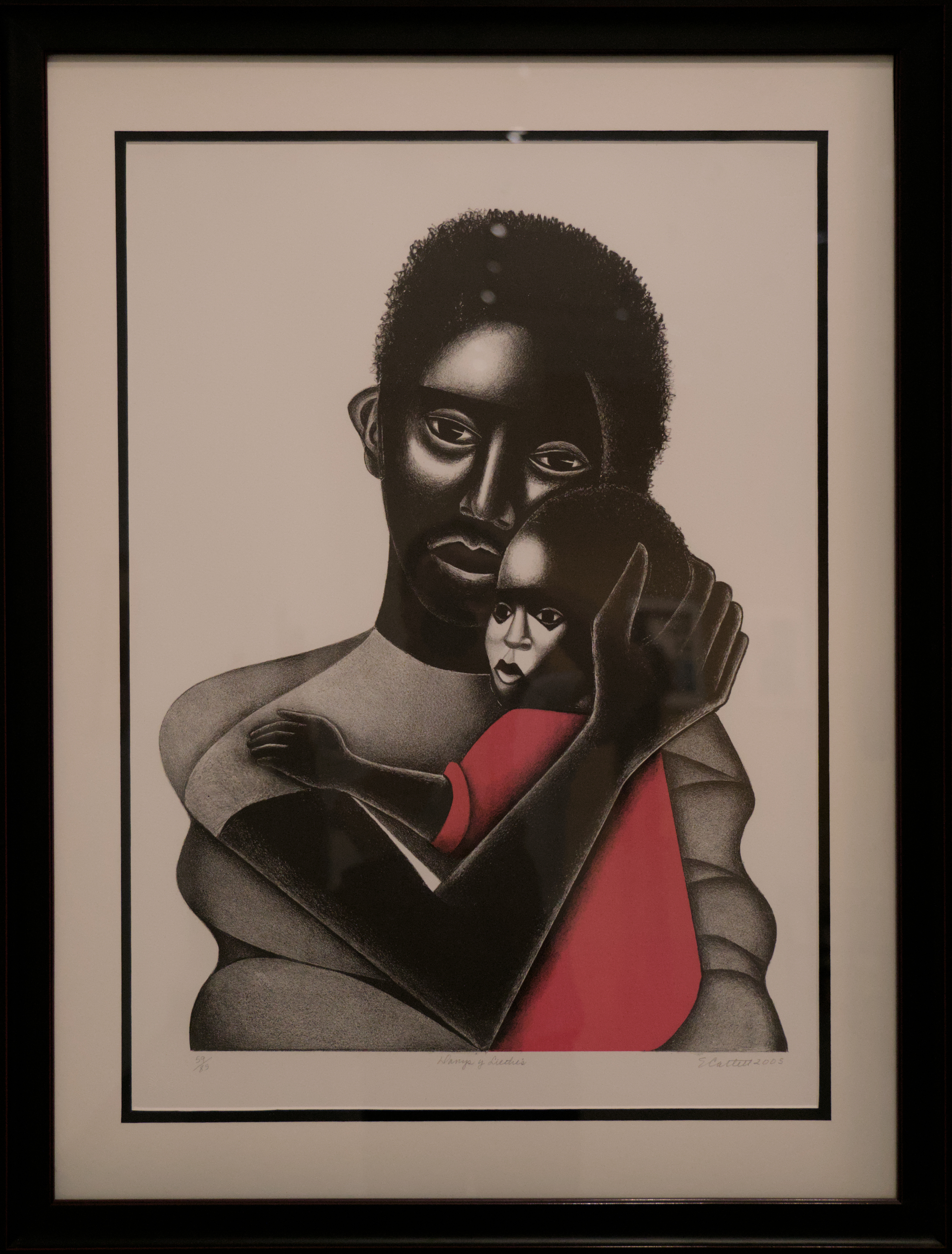
Skipping ahead to this millennium, the exhibition includes Danys y Liethis, a portrait of the artist’s niece and great-niece:
Elizabeth Catlett (American, active in Mexico, 1915–2012), Danys y Liethis, 2005. Offset lithograph, sheet: 71 × 50.8 cm (27 15/16 × 20 in.); framed: 91.4 × 71.1 cm (36 × 28 in.). Collection of Barbara J. Luke.
Lastly, suspended from the ceiling at the exhibition’s entrance/exit, is Catlett’s most unique mother-child sculpture, Floating Family:
Elizabeth Catlett (American, active in Mexico, 1915–2012), Floating Family, 1995. Mexican primavera wood, overall length: 304.8 cm (120 in.). Collection of the Chicago Public Library.
In many of her depictions of motherhood, Catlett unifies the mother and child into a single form, emphasizing their intimacy. But I’ve been thinking about her large-scale sculpture Floating Family, which usually hangs above the circulation desk at the Legler Branch of the Chicago Public Library. Here, mother and daughter are still tethered together, but instead of standing upright they are now perfectly horizontal. Are they maple seed pods, spinning and falling to the earth to plant something new? Or a rotor, lifting upwards, leaving gravity behind? Despite the seeming precarity of the moment, the mother’s face is calm and set, and the daughter looks up at her, trusting.
I imagine that it does something different in the context of a library than as the closing object in a museum retrospective. For me in October, after seeing so many sculptures of mothers cuddling their children close, this work evoked the particular terror and thrill of parenting adolescents. Now, it suggests more than that: the labor and love we give not only our children but our communities and the way that hope can sometimes feel like a free fall.
New Mount Pilgrim commemorates the Maafa, the Great Migration, and martyrs of urban violence and instills hope with trilogy of rose windows, which include an African Christ
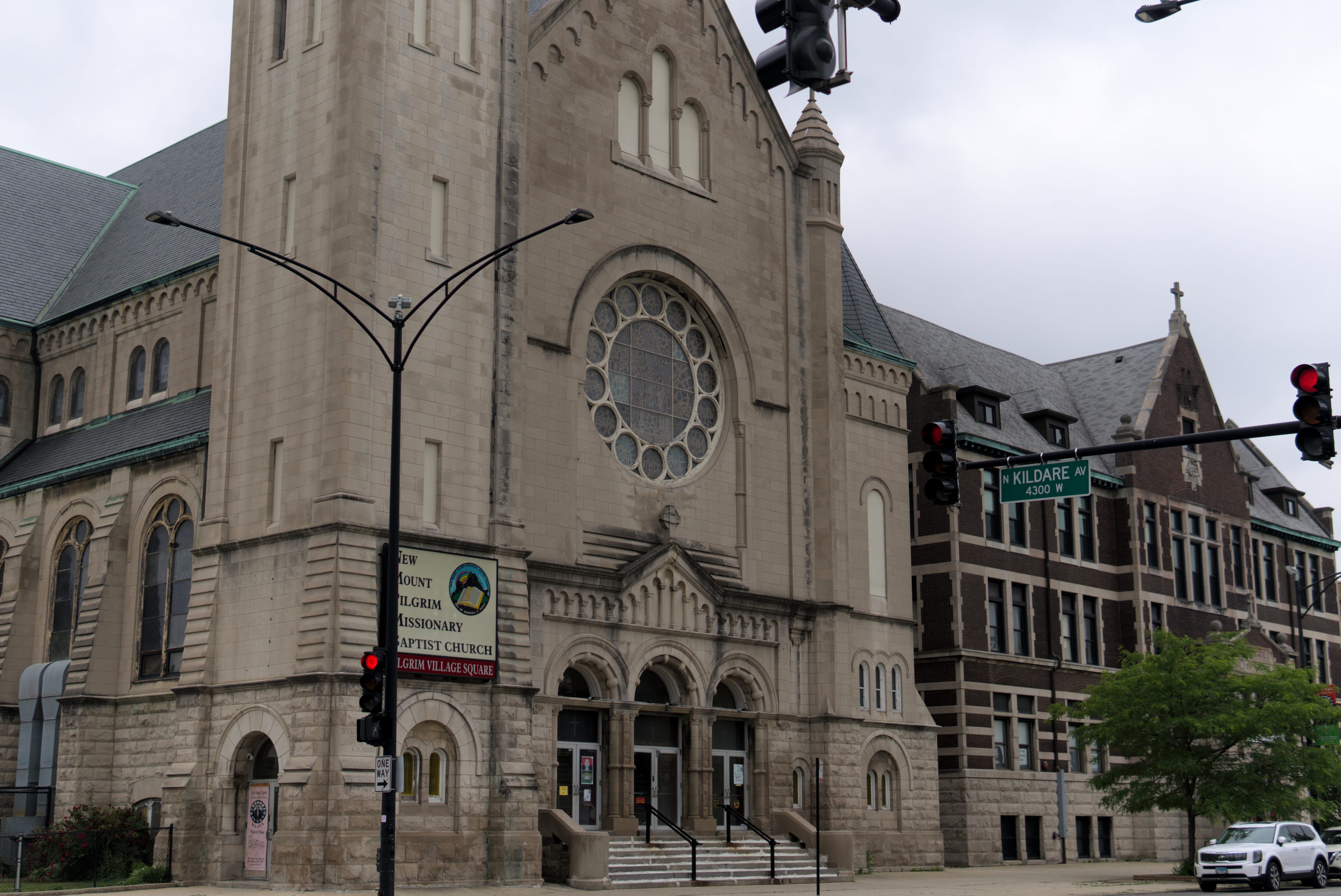
Designed by Charles L. Wallace and built in 1910–11, the French Romanesque–style church at 4301 West Washington Boulevard in Chicago’s West Garfield Park neighborhood was originally home to one of the largest Irish Catholic parishes in the city: St. Mel’s (named after Mél of Ardagh, a nephew of St. Patrick from the fifth century). They had the interior decorated with stained glass windows made by the studio of F. X. Zettler in Munich, portraying biblical figures and other saints—all as Caucasian, as was customary at the time and, frankly, still is. St. Mel’s, which merged with Holy Ghost Catholic Church in 1941 (whose parishioners were mainly of German descent), was a flourishing congregation. But in the late 1960s, white people began leaving the neighborhood as Black people moved in, and St. Mel’s membership waned until eventually the church closed its doors in 1988.
After the building had stood vacant for several years, in 1993, the Catholic Archdiocese of Chicago sold it to New Mount Pilgrim Missionary Baptist Church, a local Black congregation founded in 1950. The church leaders found that, due to lack of maintenance, the three large rose windows had structural issues that needed to be addressed. Rather than repairing the windows, they decided to replace them with new ones that better reflected the faith stories of their own parishioners—their history, heritage, and aspirations as a community. Rev. Dr. Marshall E. Hatch Sr., who had become the church’s pastor just a month after they moved into the new building and still serves in that role, developed the concepts for the windows with input from the congregation and started fundraising. All three were fabricated by Botti Studio of Architectural Arts in nearby Evanston, Illinois.
The Maafa Remembrance Window
The most striking and theologically profound of the three new windows, and the one I flew to Chicago to see last summer, is the Maafa Remembrance window on the wall to the left of the front altar. Because the church is oriented south rather than the traditional east, this is, directionally speaking, the East Rose Window; it purposefully faces the Atlantic Ocean. It was dedicated December 17, 2000, the church’s fiftieth anniversary year. It replaced an image of the Assumption of Mary (which you can view here); read more about the church building’s original windows on the website of art historian Rolf Achilles.
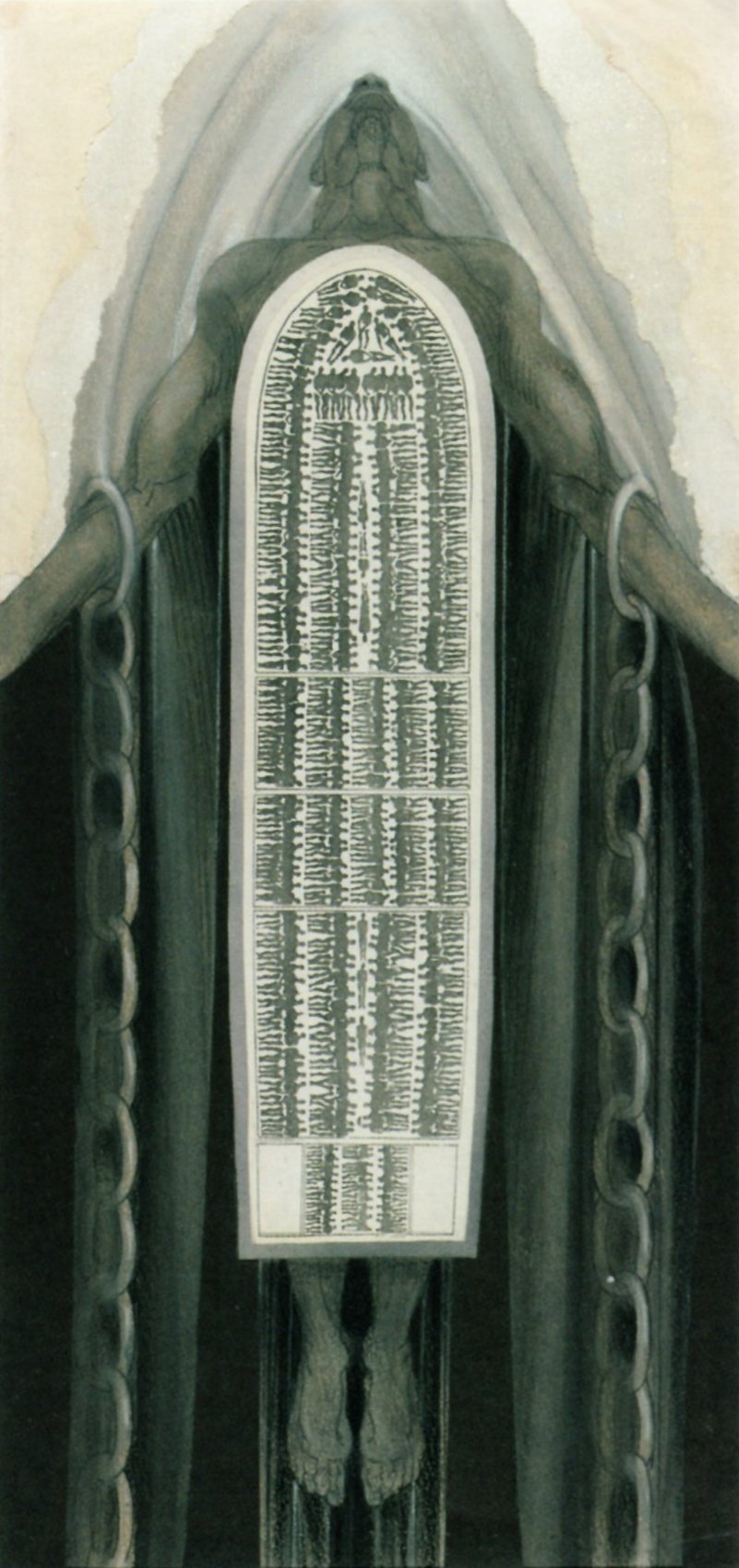
Maafa Remembrance, 2000, based on an illustration from The Middle Passage by Tom Feelings. Stained glass, diameter 25 feet. New Mount Pilgrim Missionary Baptist Church, West Garfield Park, Chicago. Photo: Victoria Emily Jones.Six of the twelve apostles are pictured in these stained glass windows inherited by New Mount Pilgrim from the building’s former owner, St. Mel’s Catholic Church. They appear beneath the newer Maafa Remembrance window, commissioned to counterbalance the preponderance of sacred white personages with sacred Black ones and to tell a narrative of liberation. Photo: Victoria Emily Jones.
Maafa (mah-AH-fah) is a Swahili word meaning “great disaster” or “great tragedy.” Since the late 1980s it has been used to refer to the transatlantic slave trade of the sixteenth through nineteenth centuries, during which an estimated 12.5 million African men, women, and children were kidnapped from their homes and forcibly brought to the Americas to work plantations without pay (by and large), building the wealth of their white enslavers. Some scholars prefer the term “African Holocaust” or “Black Holocaust” to describe this historic atrocity.
Based on an illustration by Tom Feelings from his extraordinary book The Middle Passage: White Ships / Black Cargo (Dial, 1995), the East Rose Window commemorates the Maafa through an evocation of the Middle Passage, the second leg of the triangular trade route. On this harrowing two- to three-month voyage across the Atlantic Ocean, which ships made many times over chattel slavery’s multicentury duration, at least two million enslaved Africans died of malnutrition, dehydration, disease, captor-inflicted violence, or suicide.
The closeness of the place, and the heat of the climate, added to the number in the ship, which was so crowded that each had scarcely room to turn himself, almost suffocated us. This produced copious perspirations, so that the air soon became unfit for respiration, from a variety of loathsome smells, and brought on a sickness among the slaves, of which many died, thus falling victims to the improvident avarice, as I may call it, of their purchasers. This wretched situation was again aggravated by the galling of the chains, now become insupportable; and the filth of the necessary tubs, into which the children often fell, and were almost suffocated. The shrieks of the women, and the groans of the dying, rendered the whole a scene of horror almost inconceivable.
In Feelings’s image, an African Christ figure stretches his chained arms out, as if on the cross. His body is constituted by the famous schematic representation of the crowded lower deck of the Brookes slave ship’s human cargo hold, first created in England in 1788 and widely disseminated throughout the nineteenth century. The perspective is such that we’re looking down on a body-as-slave-ship gliding through the waters—but it’s also a crucifixion. The Son of God carries the suffering of the sons and daughters of God, feeling it in his own body. He wears the slave ship like a giant wound that will forever mark him because it has marked his ecclesial body, the church.
The window functions, on one level, as a lament. Consider it in light of the following poem by Lucille Clifton, which draws out the cruel irony of the actual names some ostensibly Christian slave ship owners gave their vessels.
“slaveships” by Lucille Clifton
loaded like spoons into the belly of Jesus where we lay for weeks for months in the sweat and stink of our own breathing Jesus why do you not protect us chained to the heart of the Angel where the prayers we never tell and hot and red our bloody ankles Jesus Angel can these be men who vomit us out from ships called Jesus Angel Grace Of God onto a heathen country Jesus Angel ever again can this tongue speak can these bones walk Grace Of God can this sin live
The speaker of the poem, an enslaved African, addresses Jesus, questioning why he allows them to be so brutally treated—stolen from their homeland, marched to the coast in chains, claustrophobically packed in ship holds for maximum profitability, and spat out onto auction blocks in a barbarous country that appears to practice the devil’s ways more than God’s. How can God abide such sin? What kind of grace is it that transports them into oppression?
Christian Wiman brilliantly unpacks this poem, noting Clifton’s cunningly subtle tweak of a prophetic passage from Ezekiel that promises resurrection, both of individuals and of a nation. Underneath its acerbity, there’s a certain hopefulness to the poem—a hope that this sin will die, this suffering be transformed. In both Ezekiel’s vision of the valley of dry bones and Clifton’s poem, Wiman writes,
the Word comes streaming again through, and by means of, the word. In terms of the poem, Jesus (the man) is on board Jesus (the ship), but he is in the hold, just as, when the worship services took place above the captured slaves on the Gold Coast of Africa, God, if he was anywhere, was underneath it all, shackled and sweating and merged with human terror.
Emmanuel, God-with-us.
Clinging to this truth, the psalmist declares, “If I make my bed in hell, behold, thou [God] art there” (Psalm 139:8b). In his great compassion, God descends with us into the depths, and bears us up.
The Maafa Remembrance window plays with the themes of descent and ascent. As Emmanuel, Jesus was below deck, in the miserable belly of the thousands of slave ships that traversed the Atlantic, suffering with those chained inside. Christ’s arms are draped with chains, notes Marshall Hatch Jr., the pastor’s son and cofounder and executive director of the MAAFA Redemption Project (more on that below), “but he’s rising. And at some point those chains will break. That’s the hopefulness that shines through.”
Thus, the window commemorates both tragedy and triumph. It honors those who died on the Middle Passage and through the institution of slavery more broadly while also honoring those who persevered all the way to freedom. Hatch Jr. says this Christ is “carrying within himself the memories of those who lost their lives on the journey to America. But also he’s carrying the legacy of those who survived. And we are that living legacy,” descendants of the Middle Passage.
The border around the window’s central image calls parishioners to “REMEMBRANCE.” They must remember their history, the Great Catastrophe their ancestors endured, and, having faced the truth, commit to ending slavery’s legacy of racism in America’s civic, social, and religious spheres and in their own psyches.
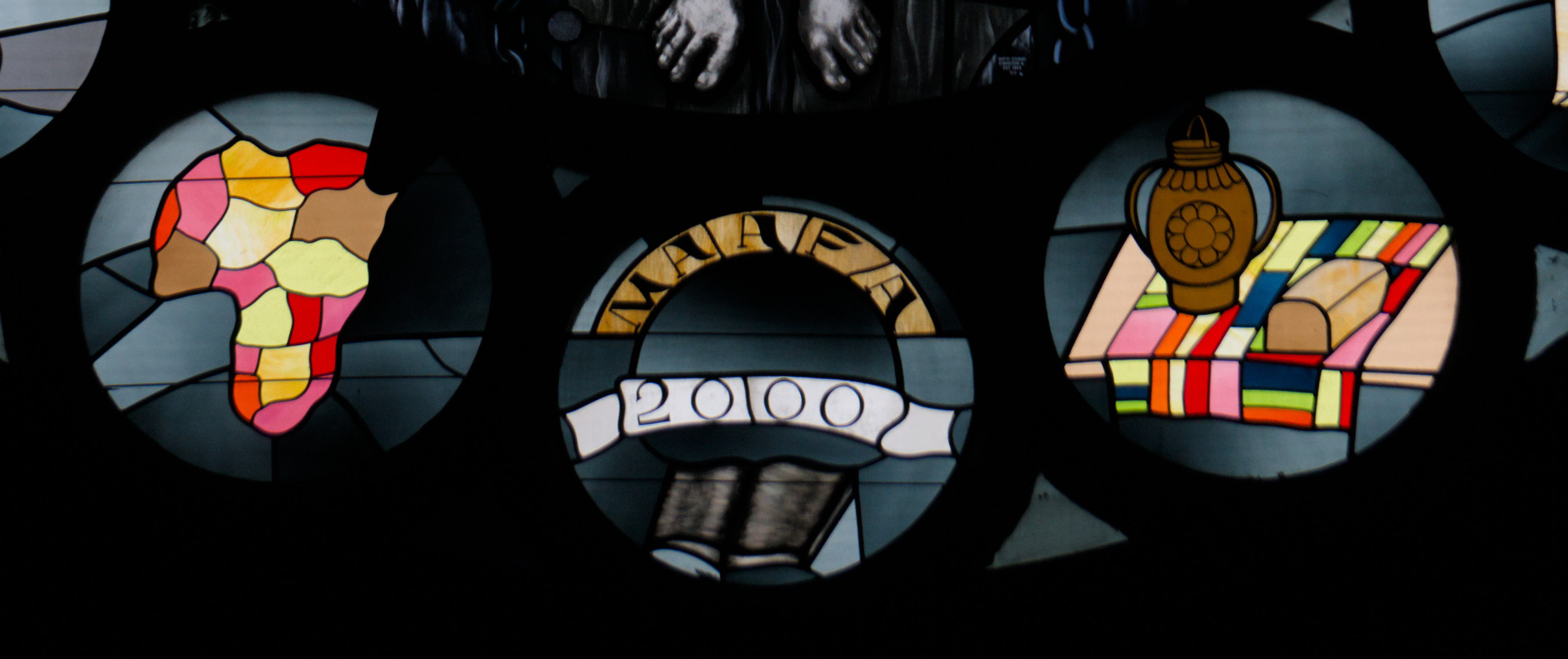
Two of the roundels in the bottom border show a map of Africa and a Communion table laid with kente cloth, a loaf of bread, and a flask of wine. The roundel between these two displays the open word of God, which guides Christians forward in our work of justice and reconciliation.
Art historian Cheryl Finley features New Mount Pilgrim’s Maafa Remembrance window in her book Committed to Memory: The Art of the Slave Ship Icon (Princeton University Press, 2022), which traces the origins of the Brookes schematic and its proliferation in mass culture and art. She identifies the window, twenty-five feet in diameter, as the largest example of the “slave ship icon” in the world and writes that, like the cross of Christ, the slave ship embodies both death and rebirth. It is “a site of death, of dying Africans, and of new life, of a people who would persevere in the face of slavery and unspeakable cruelty to become a free people who helped define the modern era” (6).
“The children will need to know that this symbol, this window, is a representation of not only the pain but also the possibilities of a great and mighty God,” Rev. Dr. Gregory Thomas told the Chicago Tribune in 2000. Thomas was a theology professor at Harvard Divinity School, where Hatch Sr. served a fellowship sabbatical semester in 1999 and first encountered Feelings’s Middle Passage book.
In the window, slavery is interpreted in light of the paradox of the cross. Theologian James H. Cone famously interpreted another, later icon of Black suffering—the lynching tree—in light of the same in his essential book The Cross and the Lynching Tree (Orbis, 2011). He opens the book by explaining why and how the cross has held such power for the Black church:
The cross is a paradoxical religious symbol because it inverts the world’s value system with the news that hope comes by way of defeat, that suffering and death do not have the last word, that the last shall be first and the first last.
That God could “make a way out of no way” in Jesus’ cross was truly absurd to the intellect, yet profoundly real in the soul of black folk. Enslaved blacks who first heard the gospel message seized on the power of the cross. Christ crucified manifested God’s loving and liberating presence in the contradictions of black life—that transcendent presence in the lives of black Christians that empowered them to believe that ultimately, in God’s eschatological future, they would not be defeated by the “troubles of this world,” no matter how great and painful their suffering. Believing this paradox, this absurd claim of faith, was only possible through God’s “amazing grace” and the gift of faith, grounded in humility and repentance. There was no place for the proud and the mighty, for people who think that God called them to rule over others. The cross was God’s critique of power—white power—with powerless love, snatching victory out of defeat. (2)
A powerful reclamation of Christian iconography, New Mount Pilgrim’s Maafa Remembrance window weds Black history and Christian theology to offer its predominantly African American congregation a communal symbol that honors what they’ve been through as a people and reminds them that they worship a risen Christ who breaks chains and brings life out of death.
The North Star / Great Migration Window
The East Rose Window covered in the previous section is narratively the first in the trilogy of newly commissioned windows, but the first of the three to be fabricated and installed, earlier in 2000, was the North Rose Window, called the North Star or Great Migration window. It commemorates those who traveled north on the Underground Railroad to escape slavery, and, a few generations later (from about 1910 to 1970), as part of a mass movement to escape Jim Crow oppression.
North Star / Great Migration, 2000. Stained glass, diameter 25 feet. New Mount Pilgrim Missionary Baptist Church, West Garfield Park, Chicago. Photo: Victoria Emily Jones.
The North Star window shows a Black family unit, the father, in purple robe, lifting his newborn up to the heavens in a gesture of gratitude and pride. The child is backlit by the North Star, a beacon to freedom. The scene recalls the famous naming ceremony in the 1977 Roots miniseries, based on the best-selling novel by Alex Haley, in which Omoro Kinte, a Mandinka man living in The Gambia, carries his firstborn son, Kunta Kinte, to the edge of the village, raises him into the starry night sky, and exclaims, “Behold, the only thing greater than yourself!” This declaration affirms the child’s inherent worth and directs him toward worship of his Creator God.
During New Mount Pilgrim’s baby dedication ceremonies, the pastor raises the child in like manner while the parents vow to bring up the child in the nurture and admonition of the Lord and the congregation vows to support them in this task. This physical gesture of lifting up signifies surrender to God and hope that the next generation will carry the flame of faith out into the city of Chicago and the wider world. Because the North Star window is situated across from the pulpit, over the choir loft and organ, it is in full view of the dedicants.
Baby dedication ceremony, New Mount Pilgrim Missionary Baptist Church. Photo courtesy of Partnering for Community Impact.View from the pulpit of New Mount Pilgrim, facing the North Star window and the main entrance to the church. Photo courtesy of the church.
The inscription below the family in the window reads, “Lift holy hands,” a phrase taken from 1 Timothy 2:8, and the roundels in the border spell out the name of the church. The three portraits at the bottom are of the church’s longest-serving pastors: (from right to left) Rev. J. H. Johnson, the church’s first elected pastor; Rev. James R. McCoy, who served from 1965 to 1993; and Rev. Dr. Marshall Hatch Sr., who has served since 1993. Hatch Sr.’s father and McCoy both participated in the Great Migration, having moved to Chicago from Aberdeen, Mississippi, and so did the majority of the church’s founding members.
The North Star window fills the space previously occupied by a window depicting Saint Cecilia, a Roman virgin martyr.
The Sankofa Peace Window
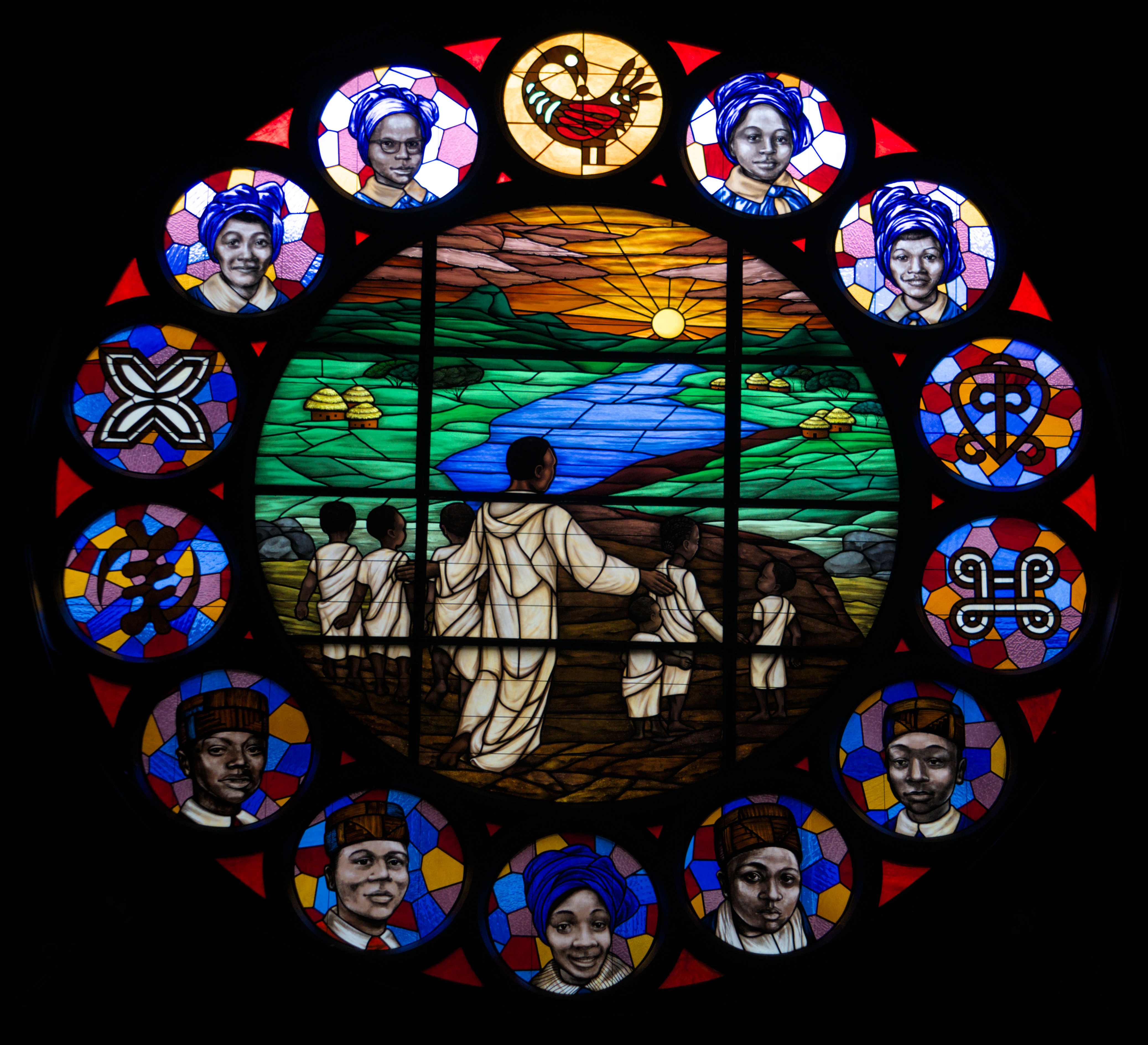
The West Rose Window, known as the Sankofa Peace window, was the final one to be installed, replacing the clear panes that were there for over two decades. (New Mount Pilgrim sold the original window depicting Mary and the Christ child blessing and accepting the rosary from a male and female saint, to raise funds for the new one.) The Sankofa Peace window was dedicated on February 24, 2019 (watch the service here and view photos here), the year that marked the four hundredth anniversary of race-based slavery in America.
Sankofa Peace, 2019. Stained glass, diameter 25 feet. New Mount Pilgrim Missionary Baptist Church, West Garfield Park, Chicago. Photo: Victoria Emily Jones.
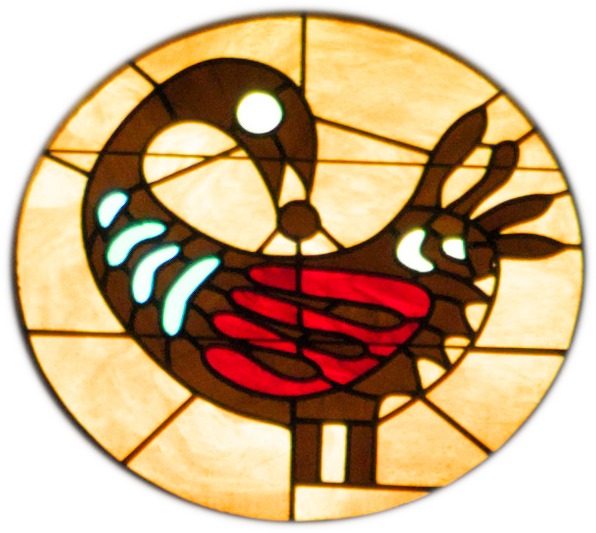
Sankofa is a Twi word from the Akan people of Ghana that means “go back and retrieve it,” a phrase that encourages learning from the past to inform the future. It comes from the proverb “Se wo were fi na wosan kofa a yenkyiri”—“It is not wrong to go back for that which you have forgotten,” to return to one’s roots to reclaim lost identity. The concept of Sankofa is traditionally symbolized by a mythical bird with its head turned backward while its feet face forward, carrying a precious egg in its mouth, which represents the knowledge of the past on which wisdom is based.
The Sankofa bird appears in the top center roundel of the window.
Hatch Jr., who preached at the window’s dedication service, discussed Sankofa as a spiritual discipline, highlighting how it can refer not only to returning to one’s cultural roots, but also to God, our Source. “Sankofa is the process of training my soul to reach back and remember the grace and the glory of God,” he says, which can fuel us for the forward journey. He quotes the famous gospel hymn that says, “My soul looks back in wonder how I got over.” We must regale one another with stories of where we’ve been and how far God has brought us, and remind ourselves and each other where we’re heading.
Besides the Sankofa bird, the other four adinkra symbols that New Mount Pilgrim chose to include in the window’s border are:
These are key guiding principles of the church, part of their missional purpose and identity. They seek liberation and peace for all, through the power of God, following the path of the Savior who is Love, who brings us back to who we most truly are.
One way the Sankofa Peace window looks backward while moving forward is through the memorialization of murdered Black American youth, from the civil-rights-era South and twenty-first-century Chicago. The portraits at the top depict the four girls who were killed by the Sixteenth Street Baptist Church bombing in Birmingham, Alabama, in 1963: Carole Robertson (age fourteen), Addie Mae Collins (fourteen), Denise McNair (fourteen), and Cynthia Wesley (eleven).
The five teens at the bottom, selected by members of New Mount Pilgrim’s youth leadership committee, were victims of Chicago violence from the previous decade or so. From left to right, they are:
Derrion Albert(1994–2009), age sixteen. On his way home from school, he got caught in the middle of a brawl between two rival factions of students and was beaten to death with a railroad tie. The crime was captured on cellphone video.
Laquan McDonald (1997–2014), age seventeen. He was shot sixteen times by a police officer while he was walking away.
Hadiya Pendleton (1997–2013), age fifteen. She was killed by a stray bullet while hanging out in a park with friends after her final honors exams.
Blair “Bizzy” Holt (1990–2007), age sixteen. He was fatally shot on a CTA bus while shielding his friend from gang gunfire.
Demetrius “Nunnie” Griffin Jr. (2000–2016), age fifteen. A lifelong member of New Mount Pilgrim, he was burned to death in a trash can in a West Side alley. His death was ruled a homicide, but his killer(s) have not been found. He had told his mother that a gang had been trying to recruit him.
All nine children are dressed in traditional African headwear.
Even as the window laments these unjust deaths, it also provides a vision of restoration. The central scene shows Jesus as the Good Shepherd, leading his children to green pastures and still waters lined with thatched-roof homes—an Edenic place of peace and rest. One might view this as the afterlife (Hatch Sr. told me the children are “going back to the Father’s estate”); but it could also be seen as a picture of Christ leading us into a future on this side of the parousia, where all God’s children are safe and thrive on earth as it is in heaven.
Hatch Sr. told me the window is about recovering a village mentality right in the heart of the city, embracing values like hospitality, family, mutual support, elder respect, and the protection and uplift of children. Whereas the North Star window visualizes the literal lifting up of a child, the Sankofa Peace window calls parishioners to do it metaphorically, through the building of strong community and advocacy for policies that prevent violence and tragedy.
The MAAFA Redemption Project
As a tangible outworking of the communal values expressed in its three rose windows, in 2017 New Mount Pilgrim established a workforce, social, and spiritual development program for young Black men in West Garfield Park, which is still running strong. (It graduated its seventh cohort last month!) Called the MAAFA Redemption Project, it is predicated on the belief that redemption and transformation must begin with the individual, and then that personal transformation can effect family and community transformation. The program emphasizes the importance of, as its website says, “remembering the past in order to create a more just and verdant present and future.”
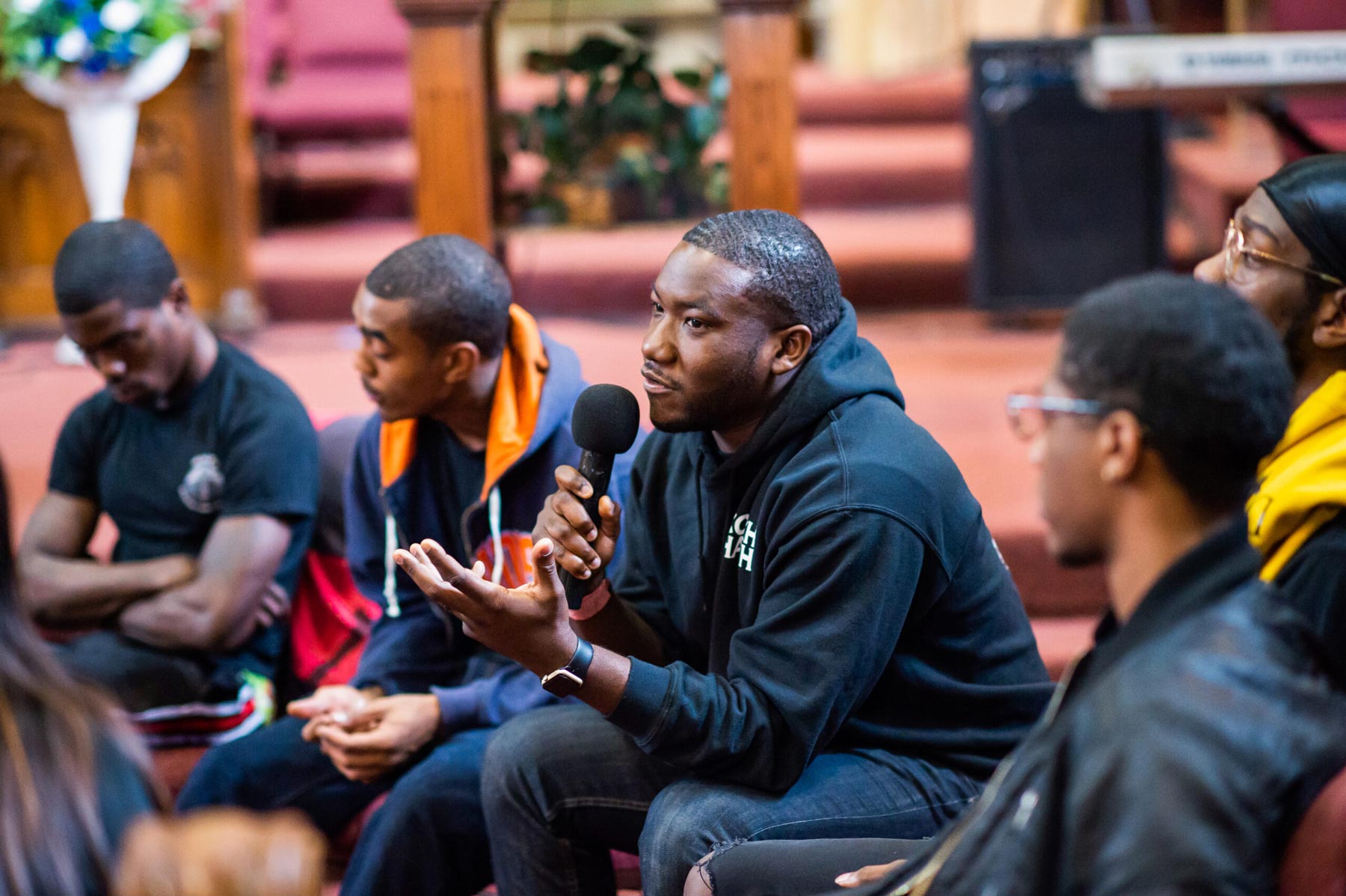
Marshall Hatch Jr., director of the MAAFA Redemption Project (a ministry of New Mount Pilgrim MB Church), speaks with a group of participants about their experiences as young Black men living in West Garfield Park.
Using a dual direct-service and community-building approach, the program provides housing, job training, educational opportunities, psychotherapy, counseling, and wrapround social services to the young men who enroll. These supports are supplemented with programming that focuses on the arts, cultural identity development, spiritual enrichment, transformative travel, civic empowerment, and life coaching and mentoring.
The square-mile neighborhood of West Garfield Park has the highest rate of gun violence in Chicago and is one of the most crime-dense populations in the nation. The MAAFA Redemption Project seeks to recruit men between the ages of eighteen and thirty who are a part of this gun culture or at risk of becoming so, recognizing that young people are a neighborhood’s greatest resource for change. The project affirms the dignity and promise of the neighborhood’s Black and Brown youth and aims to instill hope in them, empowering them in activism against gun violence and the conditions that create it.
“The young people who come to us are tired of the subculture that only produces death, despair, and falling into the trap of the criminal justice system,” says Marshall Hatch Jr., the cofounder and executive director of the MAAFA Redemption Project. “They want something different for themselves and their loved ones.”
He continues, “We want to create the space for young men to see themselves differently, to reimagine themselves as men and leaders, pillars of this neighborhood. And so our goal is to embrace the truths that they give us of their experience but also challenge them to overcome, just as their ancestors overcame; to develop the inner resources to persevere and to challenge the system so that their sons, their daughters, don’t have to fight the same fights.”
The video storytelling unit NBC Left Field ran a wonderful segment in November 2018 that features the work of MAAFA Redemption Project:
I also recommend the feature-length documentary All These Sons (2021), directed by the Oscar-nominated Bing Liu and Joshua Altman (Minding the Gap) and streaming for free on Tubi, Amazon, and other services. MAAFA Redemption Project is one of the two Chicago antiviolence programs profiled, the other being the South Side’s Inner-City Muslim Action Network (IMAN) run by Billy Moore.
Most recently, MAAFA Redemption Project has partnered with other groups to build and share ownership of the Sankofa Wellness Village, a series of interconnected capital projects and social enterprises sited along the Madison and Pulaski corridor in West Garfield Park. Winner of the Chicago Prize awarded by the Pritzker Traubert Foundation, the village will be a sprawling, $50 million campus that will bring critical health, financial, and recreational resources back into the disinvested neighborhood, including a wellness center, a credit union, an art center, a business incubator and entrepreneurial support center, and pop-up fresh food markets.
The Sankofa Wellness Village breaks ground later this summer and is expected to open in late 2025.
Having identified the arts as an unmet need and desire of West Garfield Park residents, MAAFA Redemption Project has taken the reins on what will be called the MAAFA Center for Arts and Activism. They are working to restore the old St. Barnabas Episcopal Church to provide a space where residents can engage in intergenerational art making, relationship building, community organizing, political education, and civic empowerment.
Rendering of the future MAAFA Center for Arts and Activism in West Garfield Park, Chicago. Credit: Moody Nolan/Bureau Gemmel
“We’re part of a continuum of that liberation narrative of God,” Hatch Sr. says, referring to his church’s commitment to see their neighborhood flourish.
When in the nineties they inherited a grand church full of Eurocentric stained glass and other decoration from the Irish Catholic community that worshipped there previously, New Mount Pilgrim Missionary Baptist Church had some decisions to make. How would they honor the history of that sacred space while also making room for their own histories? What adjustments would have to be made to accommodate their different ecclesial and theological tradition? They made a few changes to the sanctuary, but they left most of it intact. The most significant change is the three new rose windows they commissioned to replace the old ones that were buckling. Once the first two were installed, Pastor Marshall Hatch Sr. told me, the space really started to feel like home.
Hatch Sr. spoke to me about “the power of art to reclaim an identity” for youth involved in or susceptible to gang violence. For sure, many local youth have been inspired by the Maafa Remembrance image in particular, which MAAFA Redemption Project uses as its logo, and thus it’s been widely visible throughout the neighborhood. And yet while the “under thirty” demographic is a particular focus of the church’s outreach efforts, the identity-forming power of art holds true for folks of any age. When a West Garfield Park resident enters the New Mount Pilgrim sanctuary for whatever reason—prayer, worship, respite, connection, religious education, compulsion from a family member—they can hopefully see themselves reflected in the imagery of the rose windows, and, in conjunction with the church’s music and preaching ministries, experience healing and revival.
Their culture, their history, their stories are sacralized in stained glass and integrated into the larger story of redemption God is telling.
Perhaps, from viewing the windows, they feel a deep identification with Christ in his crucifixion, or a sense of God’s presence with them in their suffering; perhaps they are dazzled by the dignity and endurance of their ancestors, or are compelled by the freedom Christ offers; perhaps that was one of their friends whose face shines down from the wall, or the niece or nephew of a friend, and they are turned toward somber remembrance of the lost life and moved to concrete action to reduce the city’s violence; perhaps they’re emboldened by the reminder that Christ goes with them as they seek transformation, as they bring to bear the gospel in this present age, in their own lives and the life of their community.
Visit the Church
Address: New Mount Pilgrim Missionary Baptist Church 4301 W. Washington Blvd. Chicago, IL 60624 (To see the windows in the sanctuary, I made a weekday appointment ahead of time with office manager Rochelle Sykes by calling the church at 773-287-5051. She let me in through the side door.)
The Middle Passage: White Ships / Black Cargo by Tom Feelings (Dial, 1995). This is an important work that every American should own a copy of. It consists of fifty-four powerful grayscale drawings that tell the story of the transatlantic slave trade’s Middle Passage. There’s no written narrative, but there is a brief introduction by the historian John Henrik Clarke. The book caught the attention of Marshall Hatch Sr. while he was a scholar-in-residence at Harvard Divinity School in 1999 and led him to reach out to Feelings for permission to have a stained glass window made based on one of the illustrations.
Committed to Memory: The Art of the Slave Ship Icon by Cheryl Finley (Princeton University Press, 2022). Thank you to Marshall Hatch Sr. for recommending this book to me. Finley, an art historian, explores how an eighteenth-century engraving of a slave ship became a cultural icon of Black resistance, identity, and remembrance, its radical potential rediscovered in the twentieth century by Black artists, activists, writers, filmmakers, and curators who have used it as a medium to reassert their common identity and memorialize their ancestors. It’s heavily illustrated and an insightful read, academic in tone but very accessible.
Painting the Gospel: Black Public Art and Religion in Chicagoby Kymberly N. Pinder (University of Illinois Press, 2016). This is where I first found out about the Maafa Remembrance window at New Mount Pilgrim. It’s one of sixty-some Black-affirming religious images from Chicago churches and their neighborhoods made between 1904 and 2015 that Pinder, an art historian, features, focusing on their intersection with the social, political, and theological climates of the times. Read my review here.
“Voices from Chicago’s Most Violent Neighborhood” by Andy Grimm, Chicago Sun-Times, 2023. The Sun-Times spent months last year talking to residents of West Garfield Park about why they’ve chosen to stay despite the rampant violence, and they’ve presented some of these stories in a well-designed, interactive web feature. One of the remarks that stands out to me is: “The most dangerous residents of the neighborhood are also the most endangered.”
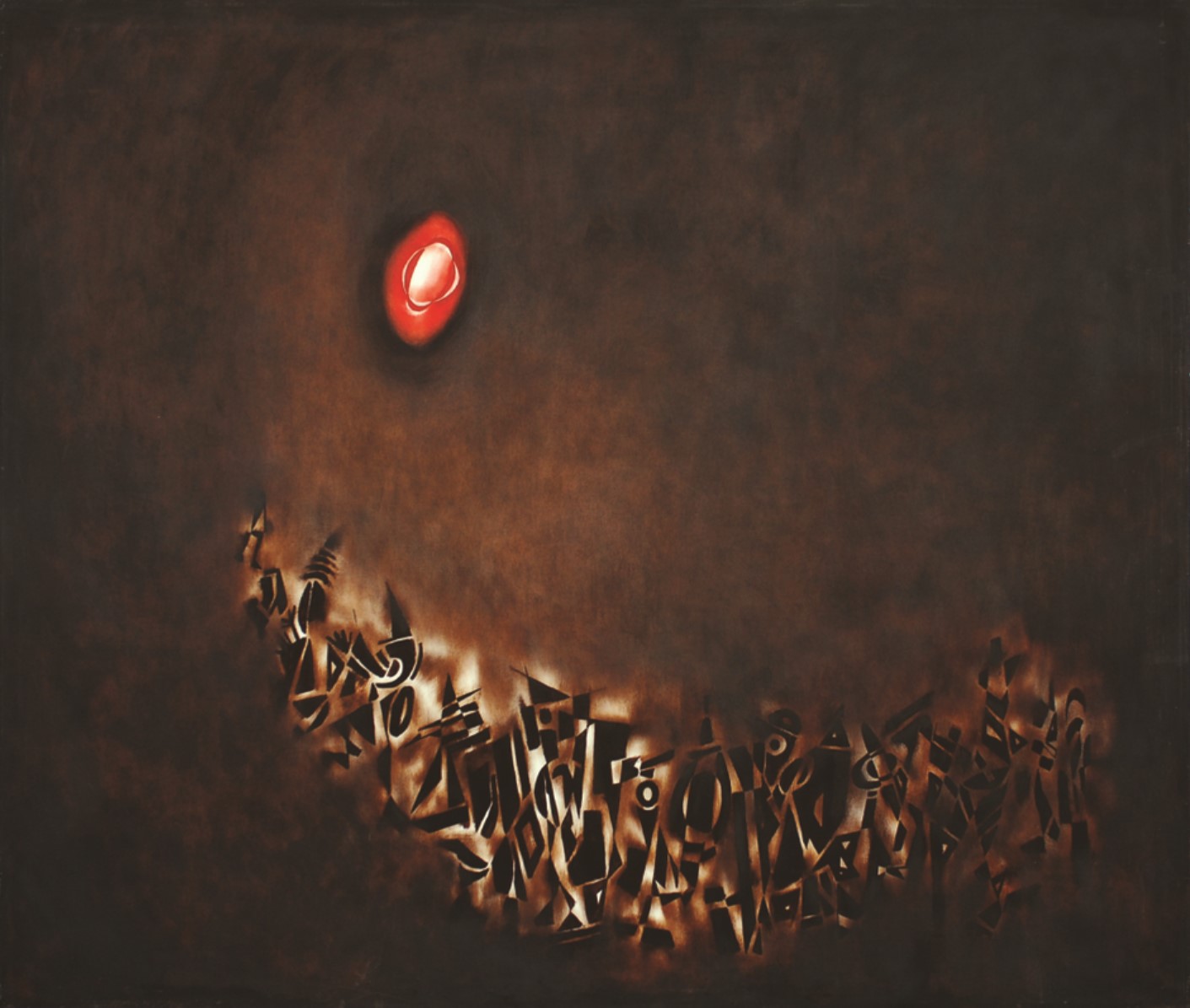
Born in Harlem to Black Bermudian immigrants, Norman Lewis began his art career making social realist paintings but after World War II turned increasingly to abstraction. He is known for his rhythmic lines and shapes.
New World A’Coming is one of his later works. In it “a crowd of figures, abstracted in geometric frenzy, gather in processional unity under the glow of a crimson sun,” the Bill Hodges Gallery writes. “Enveloped in a burnt-umber haze, the dark silhouette of the congregation is accented by a bright white glow that seems to emanate from within the crowd”—they are a holy people. The upward curve suggests movement, ascent. It’s as if the people are dancing their way to a new dawn.
“New World a-Comin’” by the famous African American jazz pianist, composer, and bandleader Duke Ellington is a single-movement work for piano and ensemble. Ellington premiered the earliest version with his eponymous jazz orchestra at Carnegie Hall on December 11, 1943, with himself on piano. He edited and reprised the piece throughout the years, orchestrating it for symphony orchestra in 1966 (the score is lost) and sometimes performing it as a piano solo without accompaniment. He never made a definitive studio recording of “New World a-Comin’” in its original form, and he never wrote down the piano part.
Above is a recording of the live premiere performance. But here it is, below, with the symphony orchestration, recorded in 1970 with the Cincinnati Symphony Orchestra, directed by Erich Kunzel, and again featuring Ellington as soloist. This recording appears on the album Duke Ellington: Orchestral Works (released on CD in 1989):
Of all the renditions, though, Harvey G. Cohen writes in his book Duke Ellington’s America that Ellington’s unaccompanied solo performance at the Whitney Museum of Art in 1972 may be the most poignant; it’s “searching and delicate,” Cohen says (239).
If you want to see a video recording, here’s Ellington soloing it up at a sacred music concert at Grace Cathedral in San Francisco on September 16, 1965 (view the full concert):
The title of this piece comes from the Peabody Award–winning book New World A-Coming: Inside Black America by the prominent Black journalist Roi Ottley, which documents the daily lives of African Americans in Harlem during the 1920s and ’30s as well as their hope for a better future.
In his 1976 memoir Music Is My Mistress, Ellington wrote, “I visualized this new world as a place in the distant future where there would be no war, no greed, no categorization, no non-believers, where love was unconditional, and no pronoun was good enough for God” (183).
“Musically,” writes Los Angeles Philharmonic content director Ricky O’Bannon, “that hope takes the form of a virtuoso showpiece for Ellington at the piano—unusual for the bandleader and a more-than-capable pianist who preferred showing off his skills as a composer. The beautiful theme and variations are supported with rich overtones and chords that Ellington scholar Mark Tucker describes as reminiscent of Ravel to the point it ‘might be called Fox-Trots Nobles et Sentimentales’ and is first-rate Ellington. Other parts might be evocative of the Romantic sweetness of Rachmaninoff.”
This post is part of a daily Advent series from December 2 to 24, 2023 (with Christmas to follow through January 6, 2024). View all the posts here, and the accompanying Spotify playlist here.
In September 2019 I visited Atlanta, Georgia, and one of the two art stops I made was the Clark Atlanta University Art Museum, whose purpose is “to collect, preserve, research, and exhibit fine art works that document the role of African Americans in American history and culture.” When I got there I was bummed to see that the museum was closed in preparation for three exhibitions that were to open that Sunday. But graciously, even though the signage and lighting hadn’t been installed and some of the objects were still being moved around, the curator allowed me in for a little glimpse.
I was stopped in my tracks by a mixed media sculpture in the gallery of recent acquisitions: Float by Alfred Conteh.
Alfred Conteh (American, 1975–), Float, 2014. Steel, epoxy dough, thermoadhesive plastic, atomized steel dust, atomized bronze dust, urethane plastic, steel chain, 93 × 46 × 35 in. Clark Atlanta University Art Museum, Atlanta, Georgia. Photo: Victoria Emily Jones.
It shows a Black female Christ figure rising up in a whirl of energy, her hat blown aloft. Wounds are visible on her hands and feet, but these are taken up into new, greening life. At the bottom is a broken chain, indicating that she has been set free. The piece expresses the exhilaration of emancipation, of being shackled no more.
I would classify Float as a resurrection image, which its staging reinforces. To its far left is a wooden crucifix by Dilmus Hall, followed by The Mourners by Frederick C. Flemister, from 1942. (Note that the two crucifix photos in this post are courtesy of the Souls Grown Deep Foundation, who donated the pieces to the museum.)
Dilmus Hall (American, 1896–1987), Untitled, n.d. Wood, wood putty, plastic beads, and paint, 12 × 9 in. Clark Atlanta University Art Museum, Atlanta, Georgia. Photo: Stephen Pitkin / Pitkin Studio.Frederick C. Flemister (American, 1916–1976), The Mourners, 1942. Oil on canvas, 39 3/4 × 31 1/4 in. Clark Atlanta University Art Museum, Atlanta, Georgia. Photo: Victoria Emily Jones.
Drawing on iconography of the Lamentation over the Dead Christ, Flemister’s The Mourners shows a mother holding the corpse of her grown son, who has just been deposed from a lynching tree. Behind her a woman in a pink dress throws up her arms in grief, and a preteen boy runs into his own mother’s arms for comfort. Like many artists before and after him, Flemister connects the killings of innocent Black men to the killing of Jesus—not because their deaths are salvific but because both they and Jesus were unjustly “crucified,” and because Black men bear God’s image, which the visual conflation reminds us of. As Jesus told his disciples, “Truly, I say to you, as you did it to one of the least of these my brothers, you did it to me” (Matt. 25:40).
Death and resurrection, suffering and hope, are the theme of this temporary exhibition. A second wooden crucifix, by Thornton Dial Jr., adorns the opposite wall. It’s titled I’ll Be Back, which, as the sculpture was made a few years after The Terminator came out, may be a playful reference to Arnold Schwarzenegger’s famous line, but it is first and foremost an affirmation that Jesus will return to earth, as promised, to fully set things right. (By the way, I wonder if Conteh, in making Float, was inspired by the hubcap component of another of Dial’s crucifixes . . .)
Thornton Dial Jr. (American, 1953–), I’ll Be Back, 1988. Wood, metal, barbed wire, string, fabric, industrial sealing compound, enamel, nails, 35 × 32 × 6 3/4 in. Clark Atlanta University Art Museum, Atlanta, Georgia. Photo: Stephen Pitkin / Pitkin Studio.
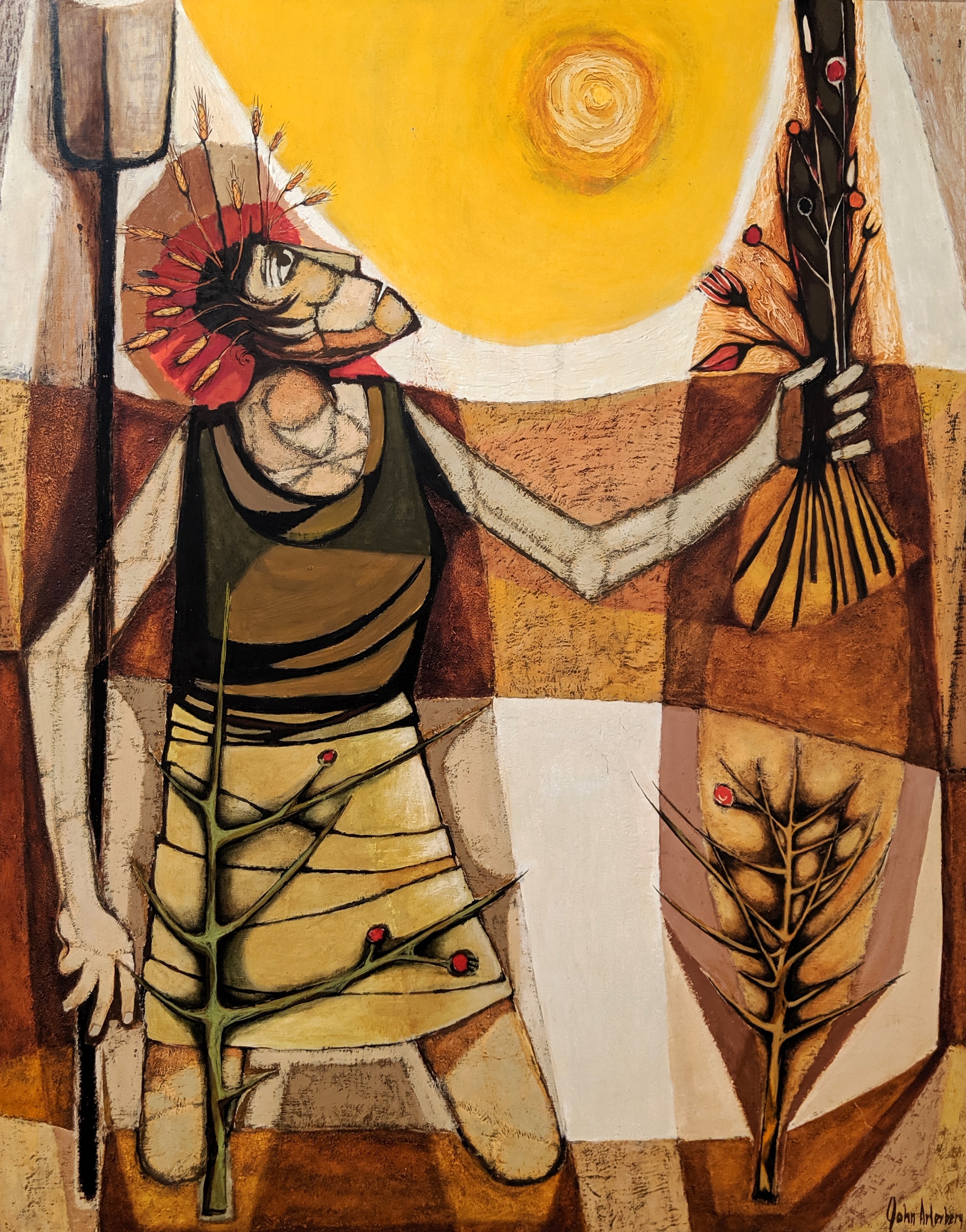
The last piece in the room is Ceres by John W. Arterbery. Ceres was the Roman goddess of agriculture, grain crops, and fertility, the equivalent of the Greek mother-goddess Demeter. In Arterbery’s painting she wears a crown of sprouting wheat stalks and holds a pitchfork in one hand and a leafless plant with buds and berries in the other. I think the flowers may be poppies, as Ceres is associated with those.
John W. Arterbery (American, 1928–1977), Ceres, 1963. Oil on Masonite, 60 × 47 1/2 in. Clark Atlanta University Art Museum, Atlanta, Georgia. Photo: Victoria Emily Jones.
It appears as though Arterbery is depicting the imminence of spring, when Ceres will be reunited with her daughter Proserpine (Persephone) and life will grow and flourish. It shows Ceres looking toward the sun in anticipation of such a time. Read in conjunction with the other pieces in the room, Ceres could be interpreted as an Advent image—a waiting for the final fulfillment of God’s good purposes for his creation, which includes a definitive end to suffering and oppression and a universal thriving.
The Clark Atlanta University Art Museum is typically open Tuesday through Friday from 11 a.m. to 4 p.m., as well as by appointment, but you may want to email ahead of time (cauArtMuseum@gmail.com) to confirm. It’s definitely worth a visit, though I can’t guarantee that the works featured here will be on display. If you wish to browse photos of pieces from the museum’s collection, see In the Eye of the Muses: Selections from the Clark Atlanta University Art Collection (2012).
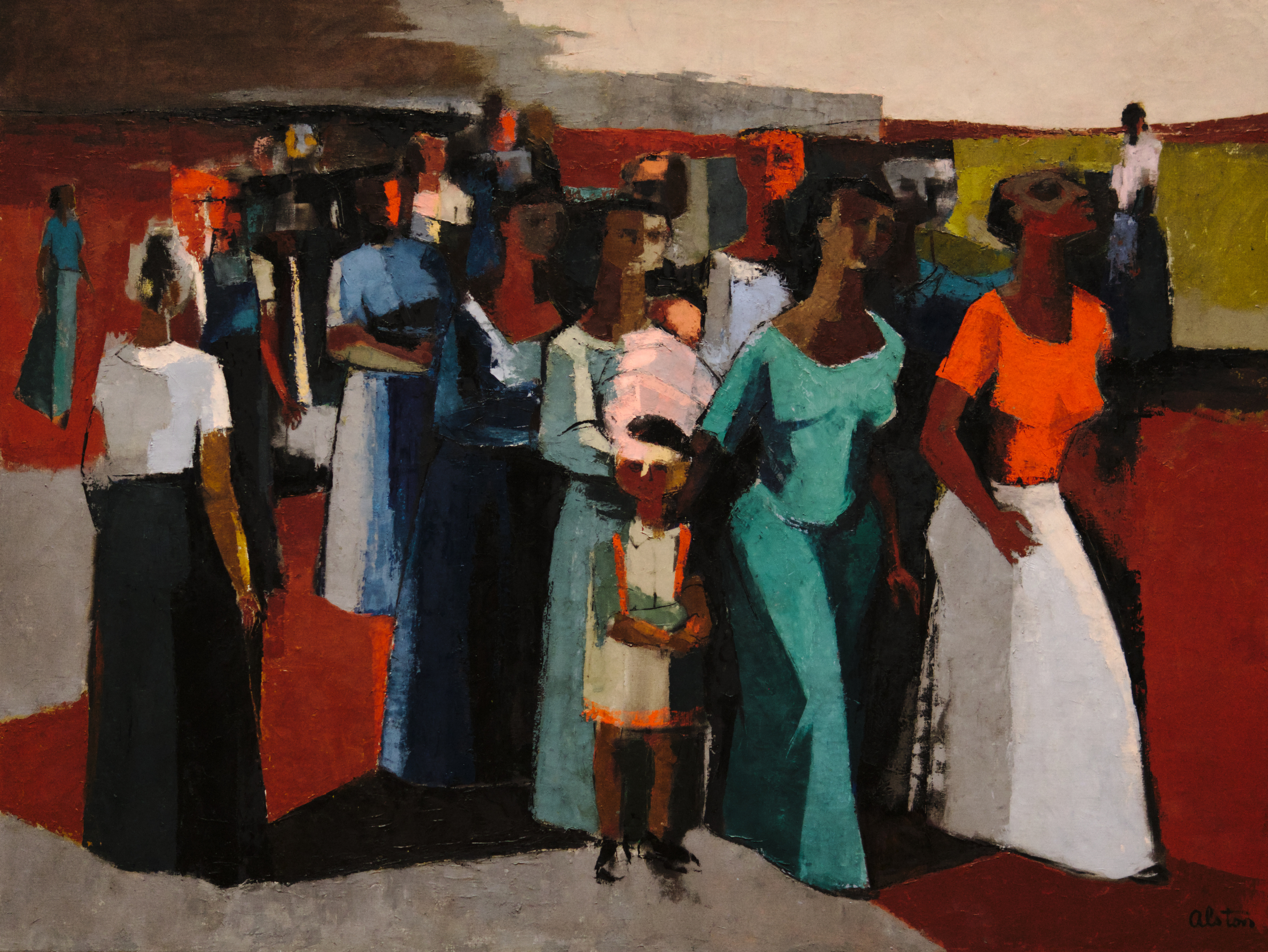
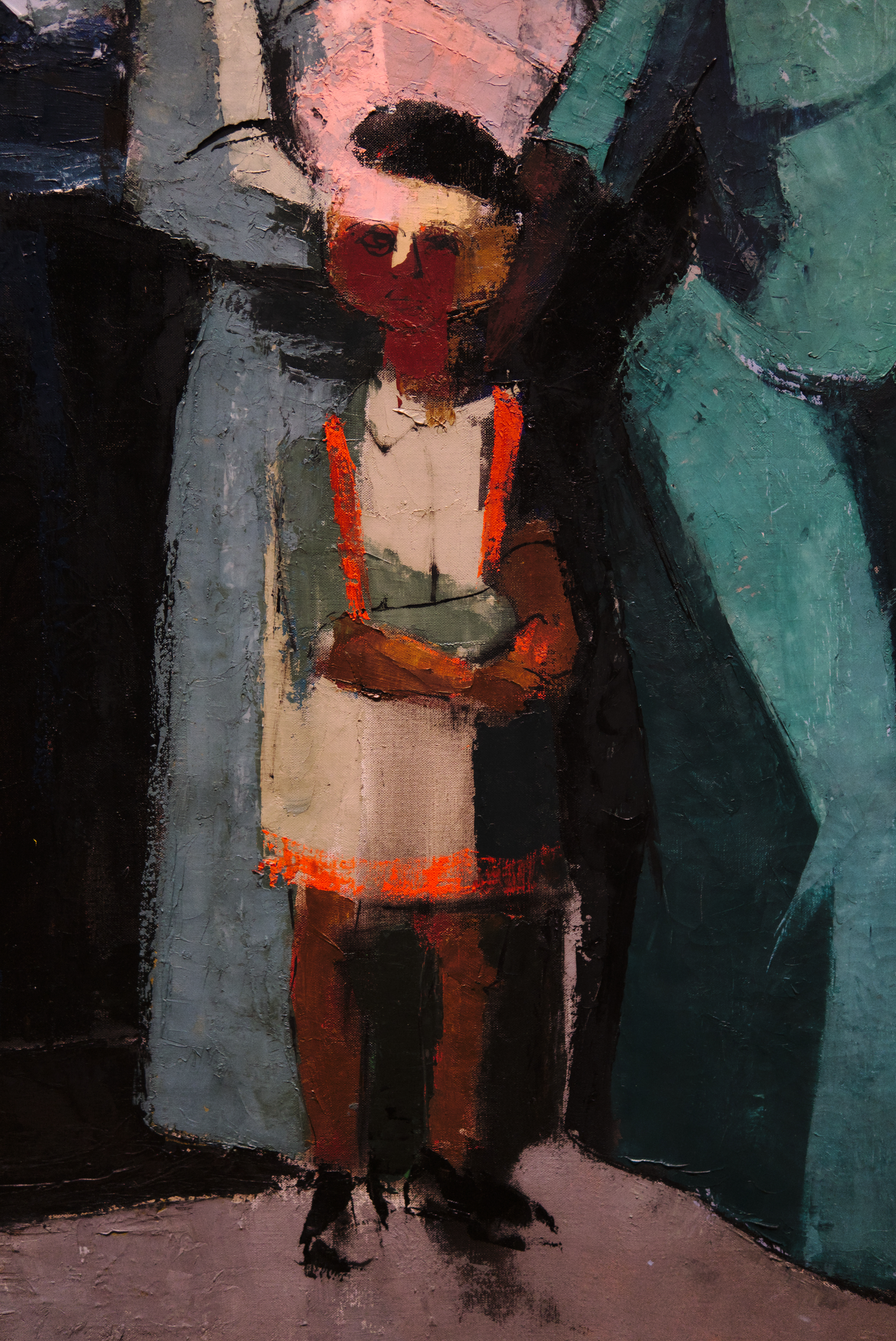
Charles Alston (American, 1907–1977), Walking, 1958. Oil on canvas, 48 3/8 × 64 3/4 in. (122.9 × 164.5 cm). Smithsonian National Museum of African American History and Culture, Washington, DC. Photo: Victoria Emily Jones.
If God is for us, who can be against us? . . . Who shall separate us from the love of Christ? Shall tribulation, or distress, or persecution, or famine, or nakedness, or danger, or sword? . . . No, in all these things we are more than conquerors through him who loved us.
Goodness is stronger than evil
Love is stronger than hate
Light is stronger than darkness
Life is stronger than death
Victory is ours through Him who loves us
First published in An African Prayer Book (Doubleday, 2006), this text is by Desmond Tutu, the famous South African Anglican cleric and theologian known for his work as an anti-apartheid and human rights activist. It has been set to music by several composers, most popularly John Bell but also James Whitbourn, David Schwoebel, Thomas Keesecker, and others. My favorite setting is the one in the video above, sung by an ecumenical choir from churches in and around Ridgewood, New Jersey, at the 2012 Hymn Festival at West Side Presbyterian Church. A few weeks ago I emailed the church’s music minister asking who the composer is but haven’t heard back, and extensive online searching has yielded no results. If you know who wrote the music, please do share! I’d also love to get my hands on some sheet music.
In the epistle reading from Sunday’s lectionary, the apostle Paul is writing to the church in Rome regarding religious persecution, assuring them that in Christ they have the power to face and overcome tribulations, distresses, and attacks of the enemy. Tutu extends that idea into the context of racial persecution, state-sponsored or otherwise. We must actively resist such injustice in the name of him who is Goodness, Love, Light, and Life. When we walk together in the Spirit on the side of these virtues, we will ultimately prevail against all counterforces.
+++
“A pivotal figure within the Harlem Renaissance, Charles Henry Alston was passionately dedicated to empowering African Americans through cultural enrichment and artistic advancement. Throughout his distinguished career as an artist and an educator, he continually sought to reclaim and explore racial identity with its complicated implications. Inspired by the modern idiom of Modigliani and Picasso, as well as African art, Alston’s work addresses both the personal and communal aspects of the black experience.” (Read more)
Alston’s Walking was inspired by the Montgomery bus boycott of 1955–56, a massive protest campaign against racial segregation in public transit, organized by black women’s political groups and facilitated through churches. The boycott was a seminal event in the civil rights movement in the US, coming years before the Selma to Montgomery marches in Alabama in 1965. “The idea of a march was growing,” Alston recalled of the time of the painting, 1958. “It was in the air . . . and this painting just came. I called it Walking on purpose. It wasn’t the militancy that you saw later. It was a very definite walk—not going back, no hesitation.”
This post belongs to the weekly series Artful Devotion. If you can’t view the music player in your email or RSS reader, try opening the post in your browser.
To view all the Revised Common Lectionary scripture readings for Proper 12, cycle A, click here.
Romare Bearden (American, 1912–1988), New Orleans: Ragging Home (from the Of the Blues series), 1974. Collage of plain, painted, and printed papers, with acrylic, lacquer, graphite, and marker, mounted on Masonite panel, 36 1/8 × 48 in. (91.8 × 121.9 cm). North Carolina Museum of Art, Raleigh. Photo: Victoria Emily Jones.
You will say in that day:
“I will give thanks to you, O LORD,
for though you were angry with me,
your anger turned away,
that you might comfort me.
“Behold, God is my salvation;
I will trust, and will not be afraid;
for the LORD GOD is my strength and my song,
and he has become my salvation.”
With joy you will draw water from the wells of salvation. And you will say in that day:
“Give thanks to the LORD,
call upon his name,
make known his deeds among the peoples,
proclaim that his name is exalted.
“Sing praises to the LORD, for he has done gloriously;
let this be made known in all the earth.
Shout, and sing for joy, O inhabitant of Zion,
for great in your midst is the Holy One of Israel.”
For another Artful Devotion featuring the Uptown Worship Band, see “Exalted Trinity.”
This post belongs to the weekly series Artful Devotion. If you can’t view the music player in your email or RSS reader, try opening the post in your browser.
To view all the Revised Common Lectionary scripture readings for Proper 28, cycle C, click here.
This is part two of a three-part series based on some of my art encounters at the Christians in the Visual Arts conference held June 13–16, 2019, at Bethel University. This post covers a handful of notable artworks I was introduced to through slides; part three will cover art I experienced in person through the conference’s exhibitions and auction. Read part one, about the Sacred Spaces tour of Minneapolis, here.
In his introductory remarks to the 2019 CIVA conference, Chris Larson cited Lauren Bon’s Artists Need to Create on the Same Scale That Society Has the Capacity to Destroy, the eponymous work of the Brooklyn Rail–curated exhibition running through November 24 at the church of Santa Maria delle Penitenti in Venice, a collateral event of the Venice Biennale. It’s a great rallying quote, one that I hadn’t heard before but that I can really get behind.
Lauren Bon (American, 1962–), Artists Need to Create on the Same Scale That Society Has the Capacity to Destroy, 2006. Neon, edition 1 of 12. Photo: Joshua White, courtesy of the Metabolic Studio, Los Angeles.
The theme of the conference was “Are We There Yet,” a deliberately broad question which I took as referring to the conversation between serious art and serious faith, which CIVA has been heavily engaged in over its forty-year history. We talked about where “there” is and unpacked other aspects of the conference title, but I’m sidestepping those discussions to focus on the visual.
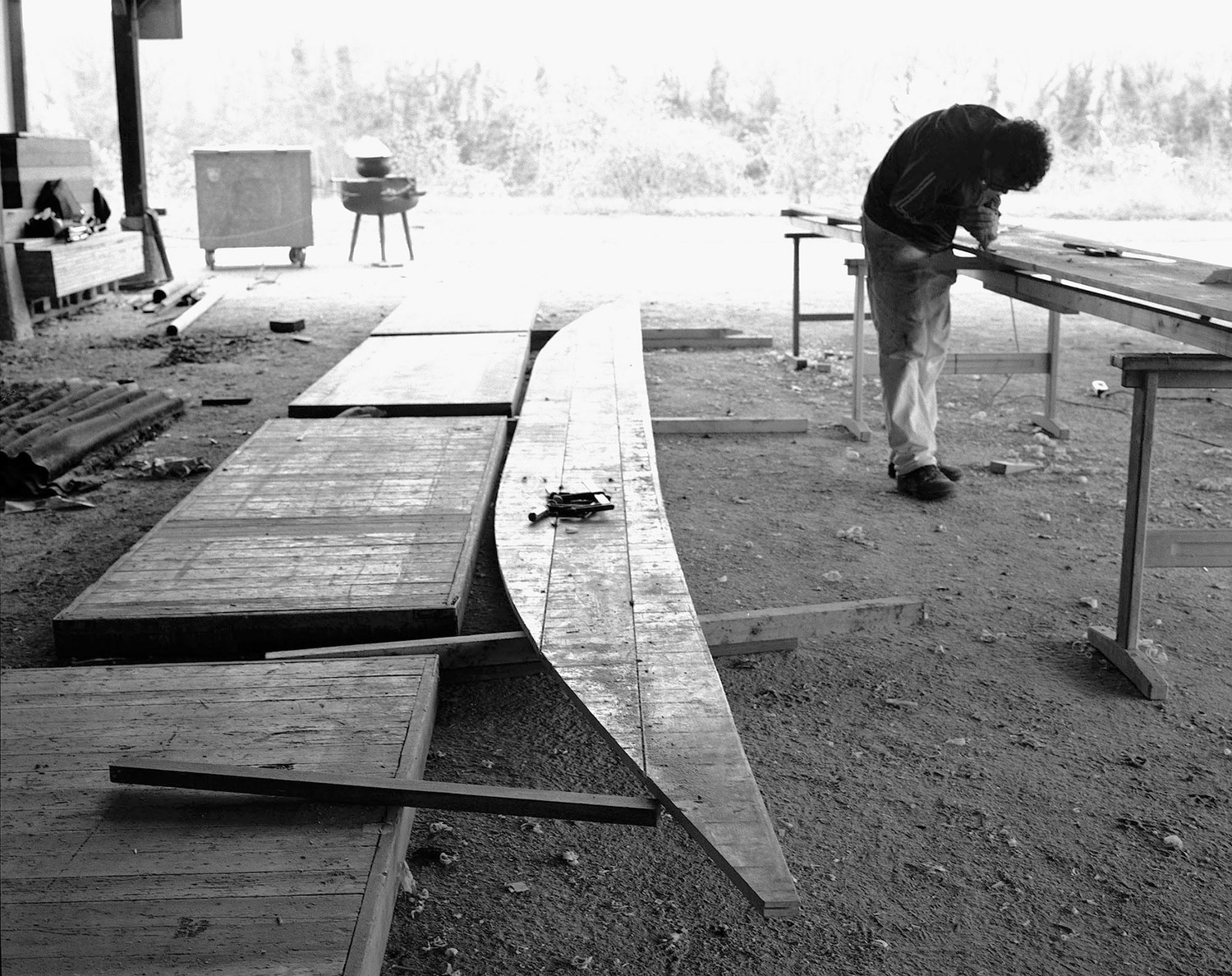
Wayne Roosa oriented our gathering by introducing us to two conceptual art projects by Simon Starling that offer opposing archetypes of the journey. The first, more aspirational one is Shedboatshed(Mobile Architecture No. 2), which involved the movement of a wooden shed from one Swiss riverside location to another. “This journey of 8 km downstream from Schweizerhalle to the centre of Basel was undertaken through the temporary mutation of the shed into a boat. This boat, a copy of a traditional Weidling, was made only with wood from the shed and was subsequently used as a transport system for the remaining parts of the structure. The shed already included an oar of the type used on Weidlings nailed to its facade as decoration. In its new location, the Museum für Gegenwartskunst, the boat was then dismantled and once again re-configured into its original form, but for a few scars left over from its life as a boat, it stands just as it once did several kilometres up-stream” [source].
Simon Starling (British, 1967–), Shedboatshed (Mobile Architecture No. 2 (production still), 2005. Wooden shed, 390 × 600 × 340 cm.
Simon Starling (British, 1967–), Shedboatshed (Mobile Architecture No. 2), 2005. Wooden shed, 390 × 600 × 340 cm. Installation at Museum für Gegenwartskunst, Basel, Switzerland.
“What I’m doing in a gallery situation,” says the artist, “is presenting a journey that I’ve been on, a process I’ve undertaken, and I’m asking for people to look at that in reverse. The circularity of many of the projects is a device to tell a story and it means that if you’re making a work about process, if you start and end in the same place, then somehow the journey becomes the important thing.” I think of lines from T. S. Eliot’s “Little Gidding”: “What we call the beginning is often the end / And to make an end is to make a beginning. / The end is where we start from”—and further down, “And the end of all our exploring / Will be to arrive where we started / And know the place for the first time.”
The second Starling work we considered was Autoxylopyrocycloboros, “a four-hour entropic voyage made across Loch Long [in Scotland] on a small wooden steamboat fuelled by wood cut piece-by-piece from its own hull.” This theatre of destruction ends with the boat’s debris floating—or sinking, as it were—in the water, Starling and his crewmate bobbing in their life vests somewhere out of frame. (The journey is presented in gallery settings as a series of thirty-eight color transparencies.) The title is an extrapolation of “ouroboros,” the mythical serpent who eats his own tail.
Simon Starling (British, 1967–), Autoxylopyrocycloboros, 2006. 38 color transparencies, 6 × 7 cm each.
Roosa suggested that as we navigate the waters, we can either self-destruct, eating ourselves alive, or we can deconstruct and then reconstruct. As an organization, we ought to be committed to the latter—taking apart the structure we started with and putting it back together.
+++
Over two and a half days of conference, there were several artists’ panels that brought to the fore some truly exciting work. I especially enjoyed hearing artists Sedrick and Letitia Huckaby, a married couple, discuss their different artistic media, styles, content choices, and creative processes, and the way their work interacts with the other’s. Both explore themes of family, faith, and African American heritage.
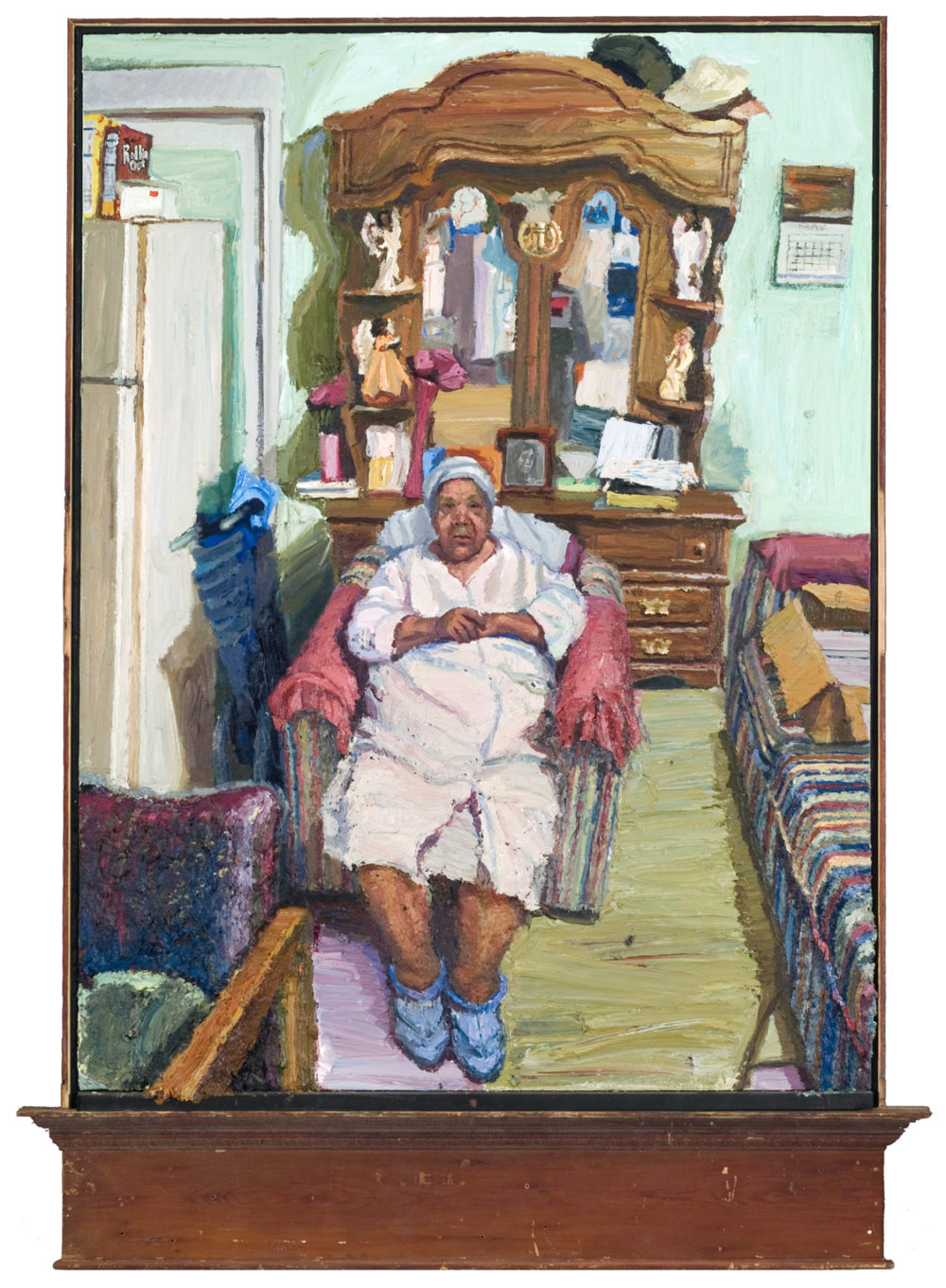
Sedrick Huckaby is a painter, draftsman, printmaker, and sculptor known for his portraits. His earliest body of work is a series of impasto paintings of his maternal grandmother, Hallie Beatrice Welcome Carpenter (“Big Momma”), inside her old wood-framed house in Fort Worth, Texas. These are so tender—they show her resting, drinking coffee, reading her Bible, getting ready for church, talking with family. After Big Momma died, he continued making in absentia portraits of her by depicting accessories she wore or household spaces that bear her imprint—The Shoes She Wore, The Altar Dresser. Sedrick is now renovating Big Momma’s house to serve as a creative project space for the neighborhood.
Sedrick Huckaby (American, 1975–), Sitting in Her Room, 2008. Oil on canvas in rustic wood framework, 48 × 36 in.
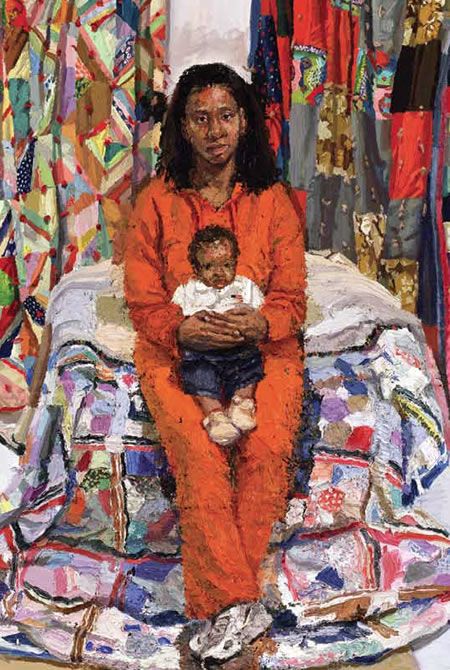
Family has long been the primary subject of Sedrick’s art. I love the 2006 portrait he painted of his wife seated at the foot of their bed and holding their firstborn son, Rising Sun. Mother and child are surrounded by family quilts, made by aunts and grandmothers. The opening between the two wall-hanging quilts forms a square halo around Letitia’s head.
Sedrick Huckaby (American, 1975–), Letitia and Rising Sun, 2006. Oil on canvas, 54 × 36 in.
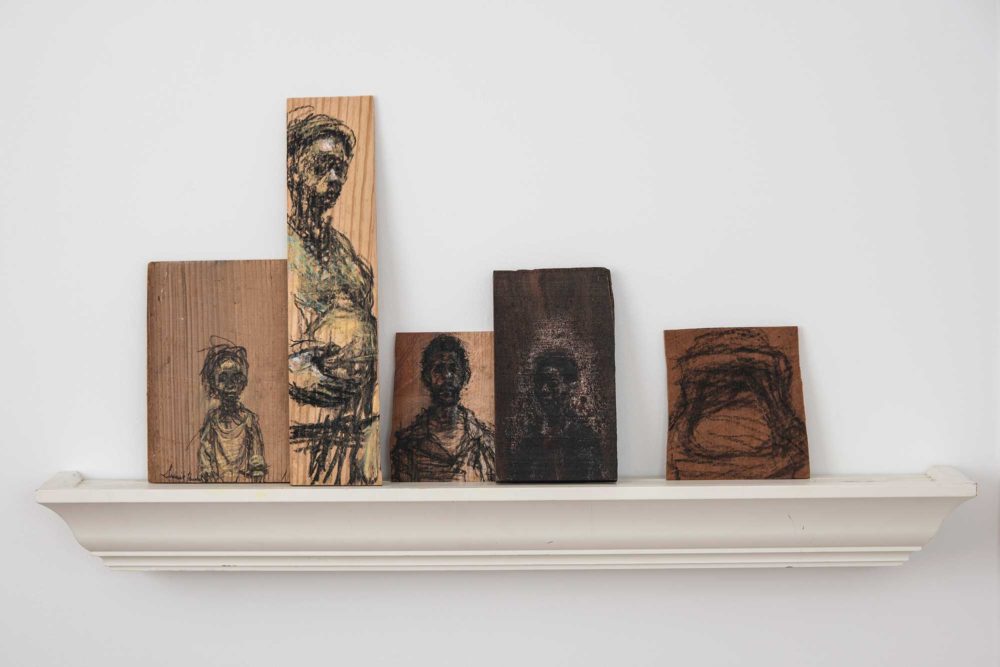
Sedrick Huckaby (American, 1975–), About Family, 2016. Charcoal and chalk on wood, 13 × 23 7/8 in.

























 Art & Theology