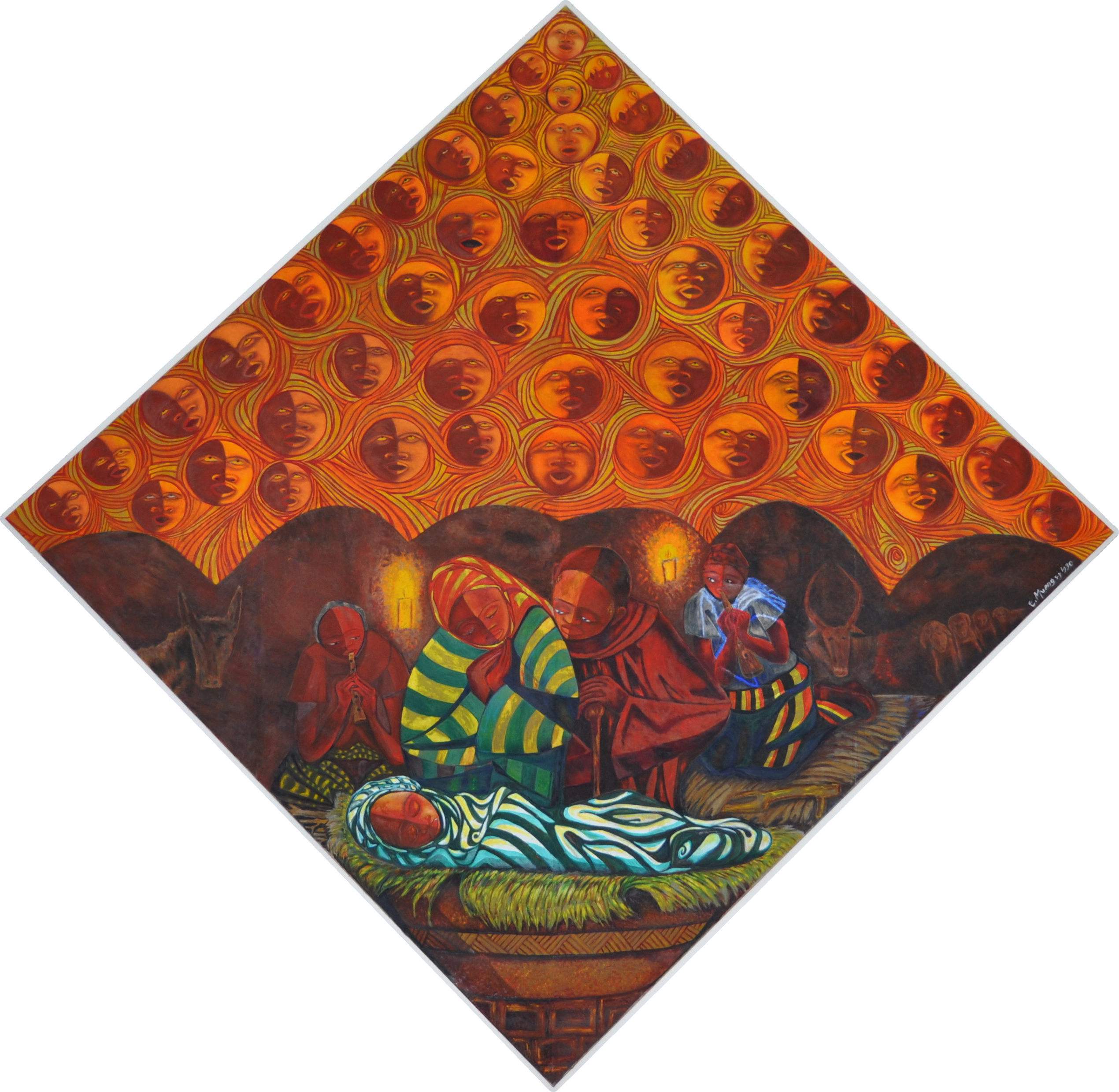
Fr. Engelbert Mveng, SJ (Cameroonian, 1930–1995), The Birth of Jesus, 1990. Central scene of mural at Our Lady of Africa Catholic Church, Chicago. All photos courtesy of the church.
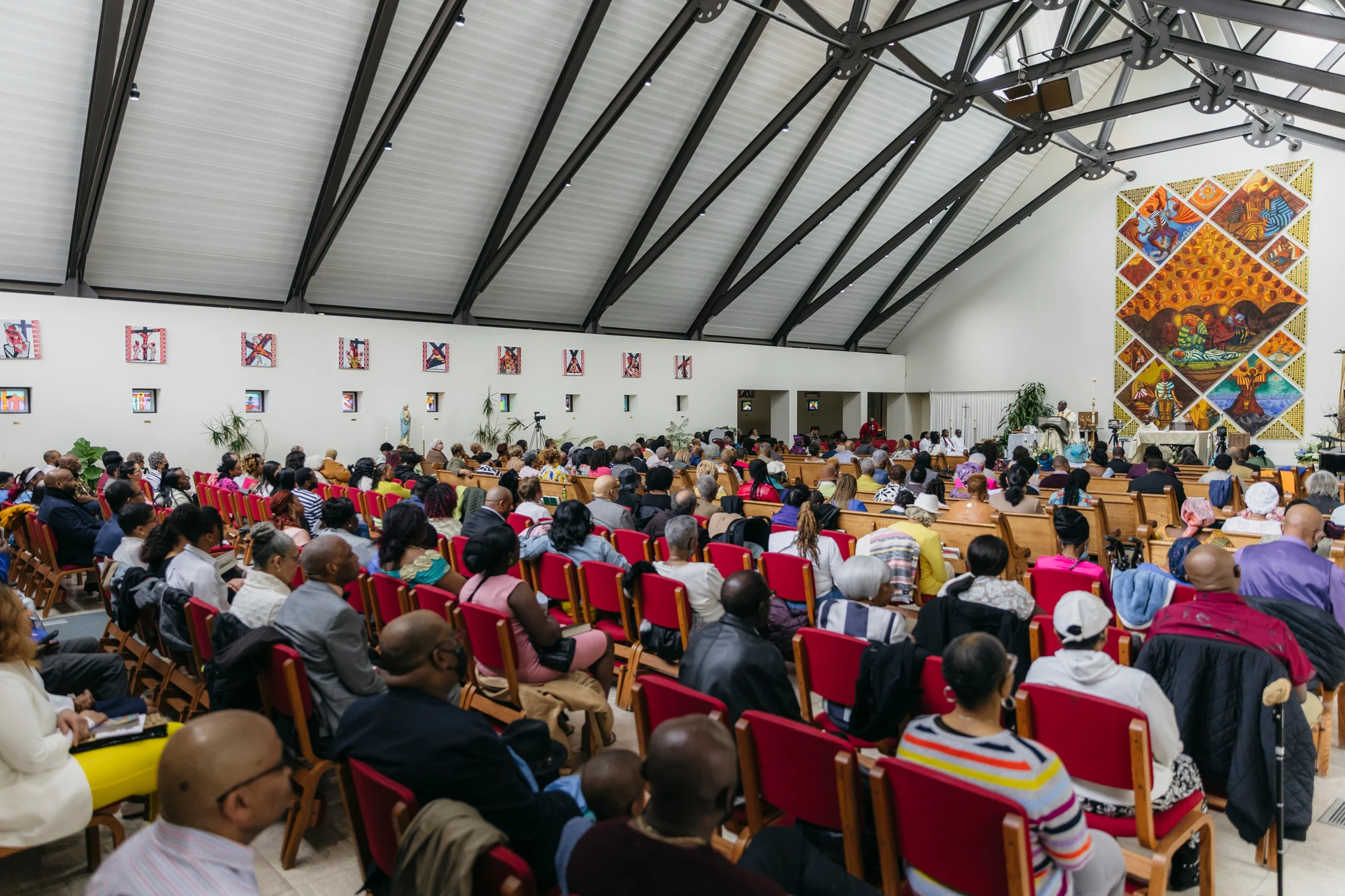
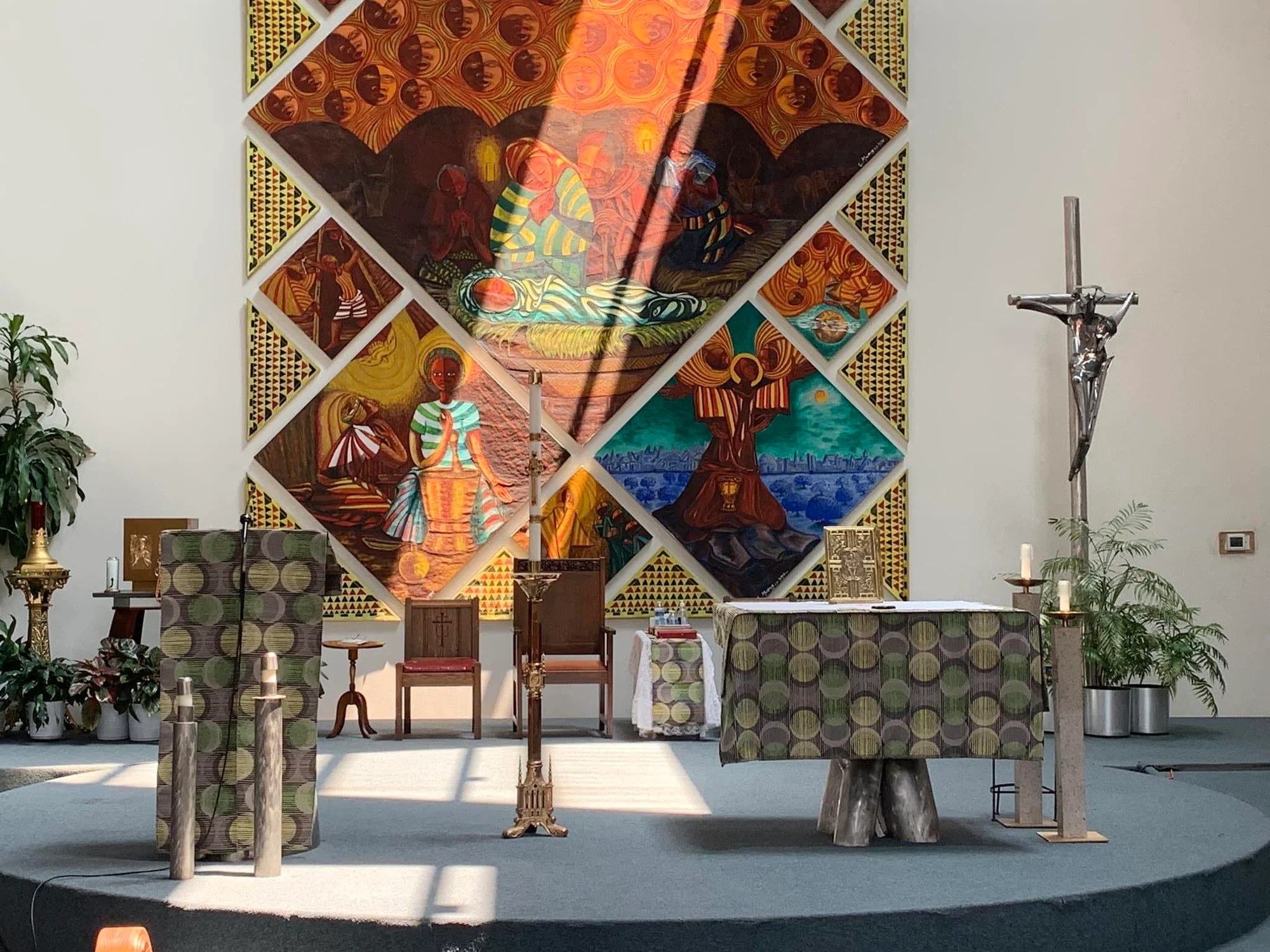
When Holy Angels Catholic Church on the south side of Chicago was rebuilt following a 1986 fire, the historic church commissioned the Cameroonian Jesuit priest, artist, and historian Engelbert Mveng (1930–1995) to paint a mural for behind the altar. He chose to represent moments of angelic intervention in biblical history. (See a close-up of the full mural here.)
The mural’s focal point is a Nativity scene, set in a hilly African landscape that’s pulsing with joy. The infant Jesus lies asleep on a grassy bed, adored by his parents and flanked by candles, pipers, and some curious animal onlookers. Caught up in the sky’s vibrant swirls are forty-nine disembodied angel heads, singing their Gloria.
In July 2021, Holy Angels merged with the faith communities of Corpus Christi, St. Ambrose, St. Anselm of Canterbury, and St. Elizabeth of Hungary in the Bronzeville/Kenwood area of Chicago to become Our Lady of Africa Parish, housed at the former Holy Angels church. The altar mural remains installed on the east end, a key visual feature of the worship space.
LISTEN: “He Came Down,” traditional Cameroonian carol | Transcribed and arranged by John L. Bell of the Iona Community, 1986 | Arranged and performed by Marty Haugen on Welcome the Child, 1992 [sheet music]
He came down that we may have life He came down that we may have life He came down that we may have life Hallelujah, forevermore!
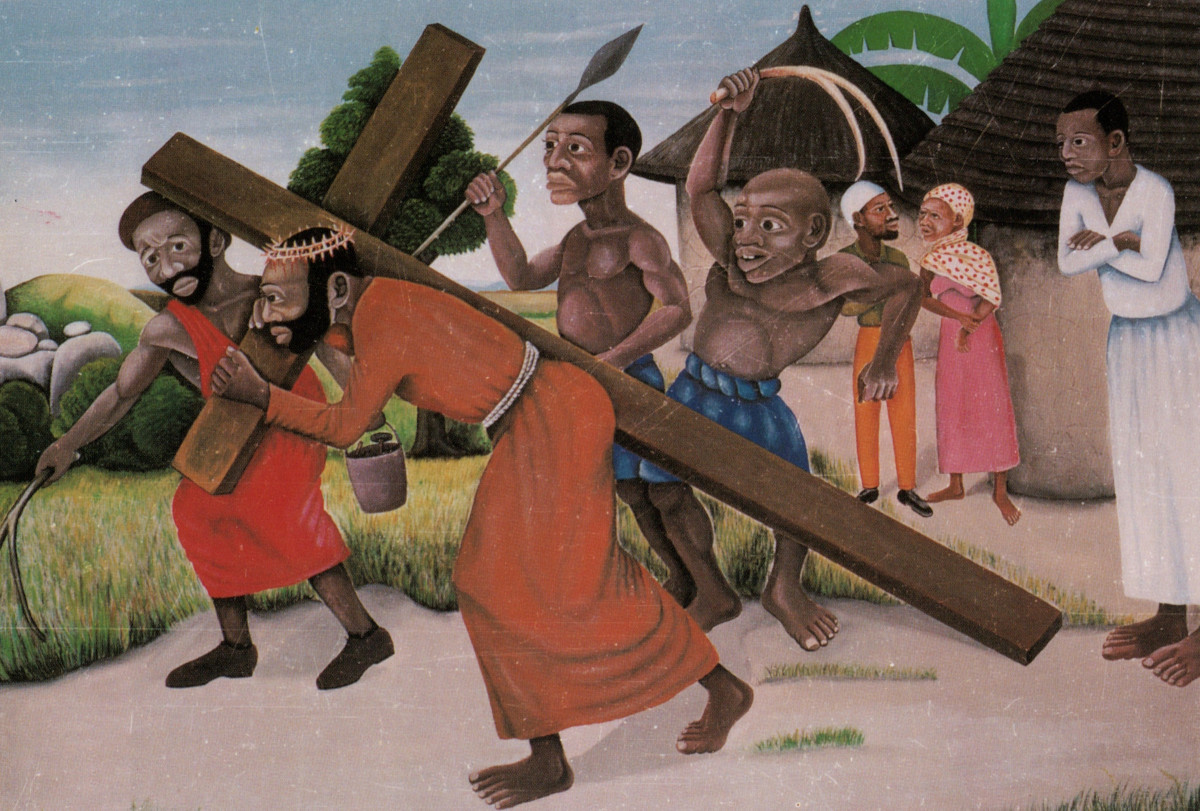
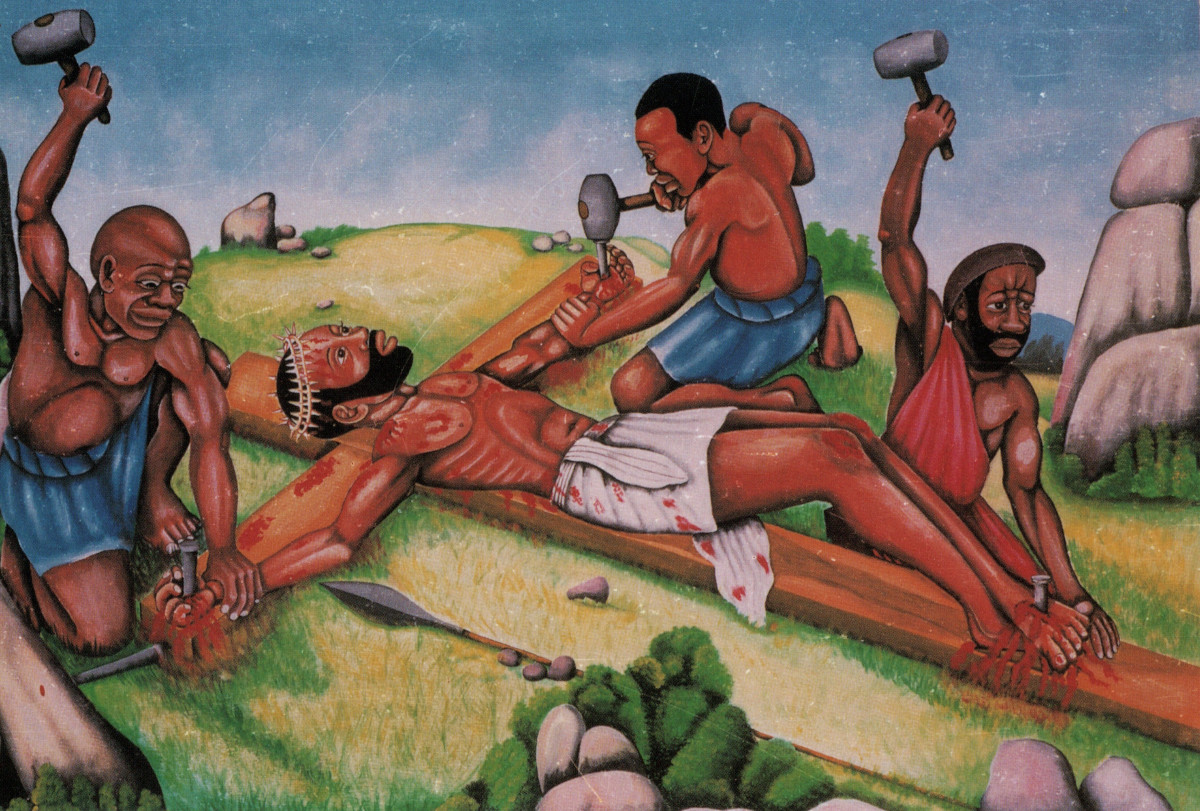
LOOK: Stations of the Cross #2 and #11 by Charles Ndege
Charles S. Ndege (Tanzanian, 1966–), Station II: Jesus Takes Up His Cross. Wall painting from St. Joseph Mukasa Balikuddembe Church, Nyakato (Mwanza region), Tanzania. Source: Were You There? Stations of the Cross by Diana L. HayesCharles S. Ndege, Station XI: Jesus Is Nailed to the Cross
The cement walls of St. Joseph Mukasa Balikuddembe Church in Nyakato, Tanzania, bear a series of murals by the Tanzanian artist Charles Ndege depicting the Stations of the Cross, set around the southern shores of Lake Victoria.
I couldn’t find what year the murals were painted, but the earliest would be 1995, as they are mentioned (and one is reproduced) in the book Towards an African Narrative Theology by the American Maryknoll missionary priests Joseph Healey and Donald Sybertz, which came out in 1996.
I found out about Ndege’s Stations from the book Were You There? Stations of the Cross (Orbis, 2000), a small paperback that reproduces all fourteen scenes in full color and features reflections by the African American Catholic theologian Diana L. Hayes. I recommend it.
See how they done my Lord See how they done my Lord (Can’t you) See how they done my Lord Lord, have mercy on me
Well, they whipped him all night long They whipped him all night long (Tell me) Whipped him all night long Lord, have mercy on me
Well, they whipped him up a hill They whipped him up a hill (Tell me) Whipped him up a hill Lord, have mercy on me
Well, they nailed him to the cross They nailed him to the cross (Tell me) Nailed him to the cross Lord, have mercy on me
Well, two thieves was hanging beside him Two thieves was hanging beside him (Tell me) Two thieves was hanging beside him Lord, have mercy on me
This song is sung by six unidentified men incarcerated at the Louisiana State Penitentiary, known colloquially as Angola Prison, one of the largest maximum-security prisons in the United States. A lament reflecting on Christ’s passion, it’s one of a series of Black gospel songs and spirituals recorded at the prison by the folklorist and musicologist Harry Oster in the late 1950s.
“How they done him” is slang for “how they wronged him” or “how they treated him badly.”
I can’t help but wonder if the singers identified with the abuse Christ suffered and found comfort in knowing that God himself walked the road before them and is with them in their own ways of sorrow. Perhaps (instead or too) they saw themselves in the penitent thief mentioned in the last stanza, who acknowledged the justice of his own sentence and asked Jesus to remember him in God’s kingdom.
The song’s refrain, “Lord, have mercy,” is a common one in liturgical churches, one that invokes God’s mercy in light of personal and corporate sins. It’s a plea for God’s compassion and forgiveness, and for relief.
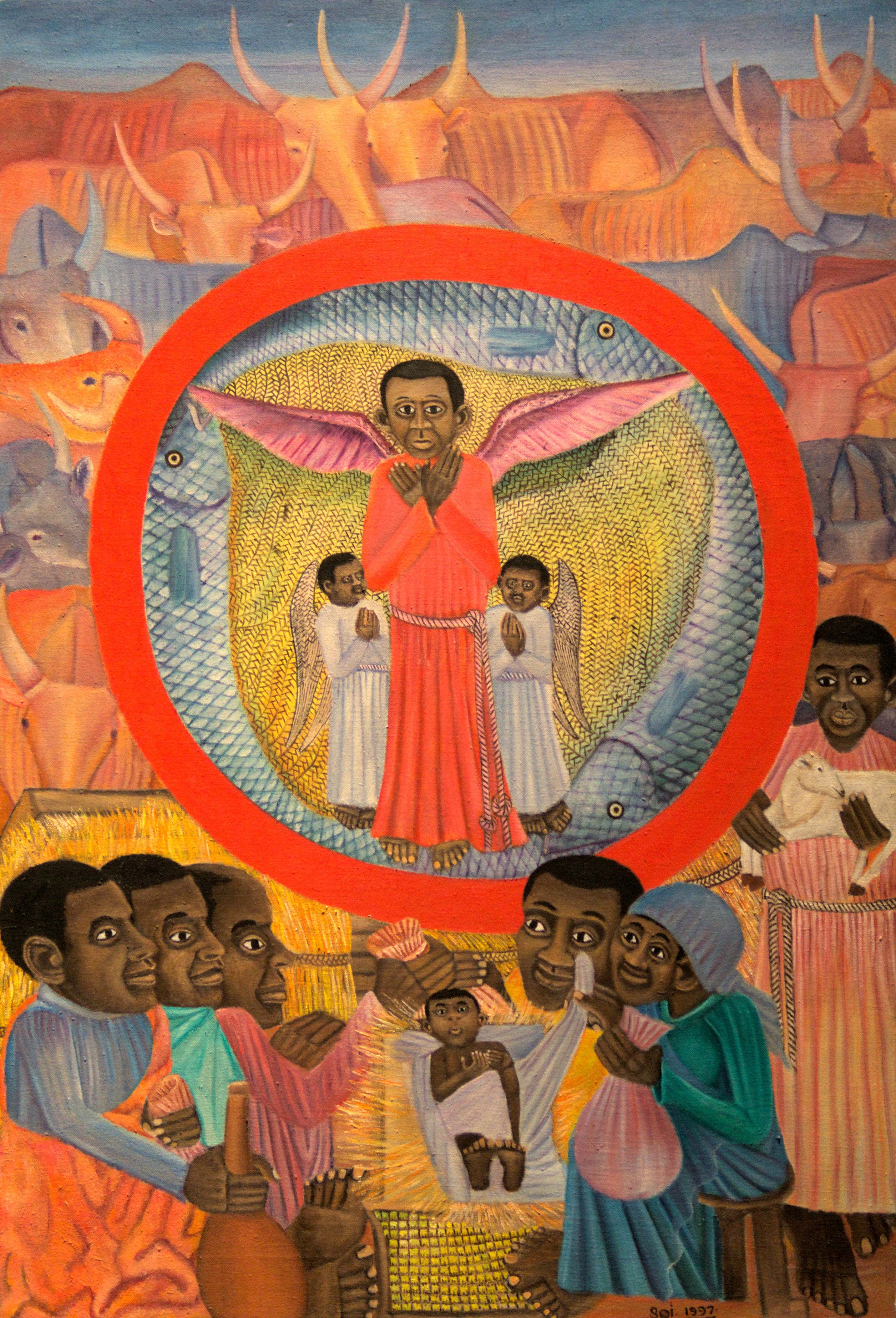
LOOK: Birth of Jesus with Magi and Celestial Observers by Ancent Soi
Ancent Soi (Kenyan, 1939–2022), Birth of Jesus with Magi and Celestial Observers, 1997. Oil on canvas, 34 × 23 in. (86.4 × 58.4 cm). North Carolina Museum of Art, Raleigh. Photo: Victoria Emily Jones. [object record]
LISTEN: “Nyathi Onyuol” (A Child Is Born) | Traditional Luo spiritual, arr. Enrico Oweggi, 1990 | Performed by the Nairobi Chamber Chorus, 2021
Isaya ne okoro k’owacho niya “Kuomwa nyathi onyuol.” Nyathi ma wuoyi, no luonge Hono, Jabura, Nyasaye ma Jateko, Wuonwa, Emmanuel.
Chieng’o nogo piny neolil piny neo kuwe, Sulwe ne rieny, Nyathi n’o nyuol. Kanyna n’oting’o Maria, yawa, kodhiyoe piny mar Daudi kwargi kanyna n’oting’o Maria yawa Maria ne pek Yesu Jawar Kar nindo n’otamo Maria yudo Bethlehem ne opon’g ting ma pek Josef chwore n’o manyo ot tone ot otamo Kuom hawi Josef n’onyis kund dhok Gotieno nogo muoch neoyako Maria.
Isaya ne okoro . . .
ENGLISH TRANSLATION:
Isaiah prophesied and said: “Unto us a child is born!” He shall be called Wonderful Counselor, the Mighty God, our Father, Emmanuel!
On that day it was dark and silent. There was no place in Bethlehem for Mary and Joseph. By chance they were shown a shed, and that night Mary gave birth to the child.
Isaiah prophesied . . .
This song of unknown authorship is written in the Luo language of the Luo people, who traditionally live on the shores of Lake Victoria in western Kenya and northern Tanzania. It was popularized by Muungano National Choir, who recorded it on their 1990 album Missa Luba: An African Mass—10 Kenyan Folk Melodies, as arranged by one of their members, Enrico Oweggi (sometimes rendered “Owegi”).
The Luo lyrics and loose English translation above are sourced from the liner notes of Christmas a Cappella: Songs from Around the World by Chicago a Capella (2008).
>> “Jack’s Bookshelf: Julian of Norwich” with Dr. Grace Hamman, Pints with Jack: The “Jack’s Bookshelf” podcast series explores the authors and books that influenced the life and writings of C. S. Lewis. Hosted by David Bates, this episode covers Julian of Norwich (ca. 1343–after 1416), an English anchorite and mystic who authored what editors call Revelations of Divine Love or The Showings, the first English-language book by a woman. The most famous quote from this work is “Sin is behoovely, but all shall be well, and all shall be well, and all manner of thing shall be well.” Medieval scholar Grace Hamman [previously] unpacks the quote and discusses other key passages and themes from Julian, as well as what little we know of her biography. An excellent introduction!
>> “Ben Myers—The Divine Comedy,”Life with God: One of the many gifts my parents have given me over the years was a four-month study-abroad stay in Florence during my junior year of college, where one of my courses was devoted to reading and studying—in its original Italian and in the author Dante Alighieri’s hometown!—the masterful trilogy of narrative poems known as La Divina Commedia, or The Divine Comedy in English. Moving through hell, purgatory, and heaven, it is an allegory of the soul’s journey toward God. I enjoyed hearing Dr. Benjamin Myers [previously], director of the Great Books Honors Program at Oklahoma Baptist University, discuss this deeply influential work from the early fourteenth century, and sharing one of his own poems, “Listening to Reggae at the Nashville Airport.”
+++
VIRTUAL TOURS OF CATHEDRALS:
Cathedrals are, among other things, repositories of sacred art. I’m so appreciative of digitization initiatives that seek to make some of those treasures available to global publics online. Here are two admirable examples.
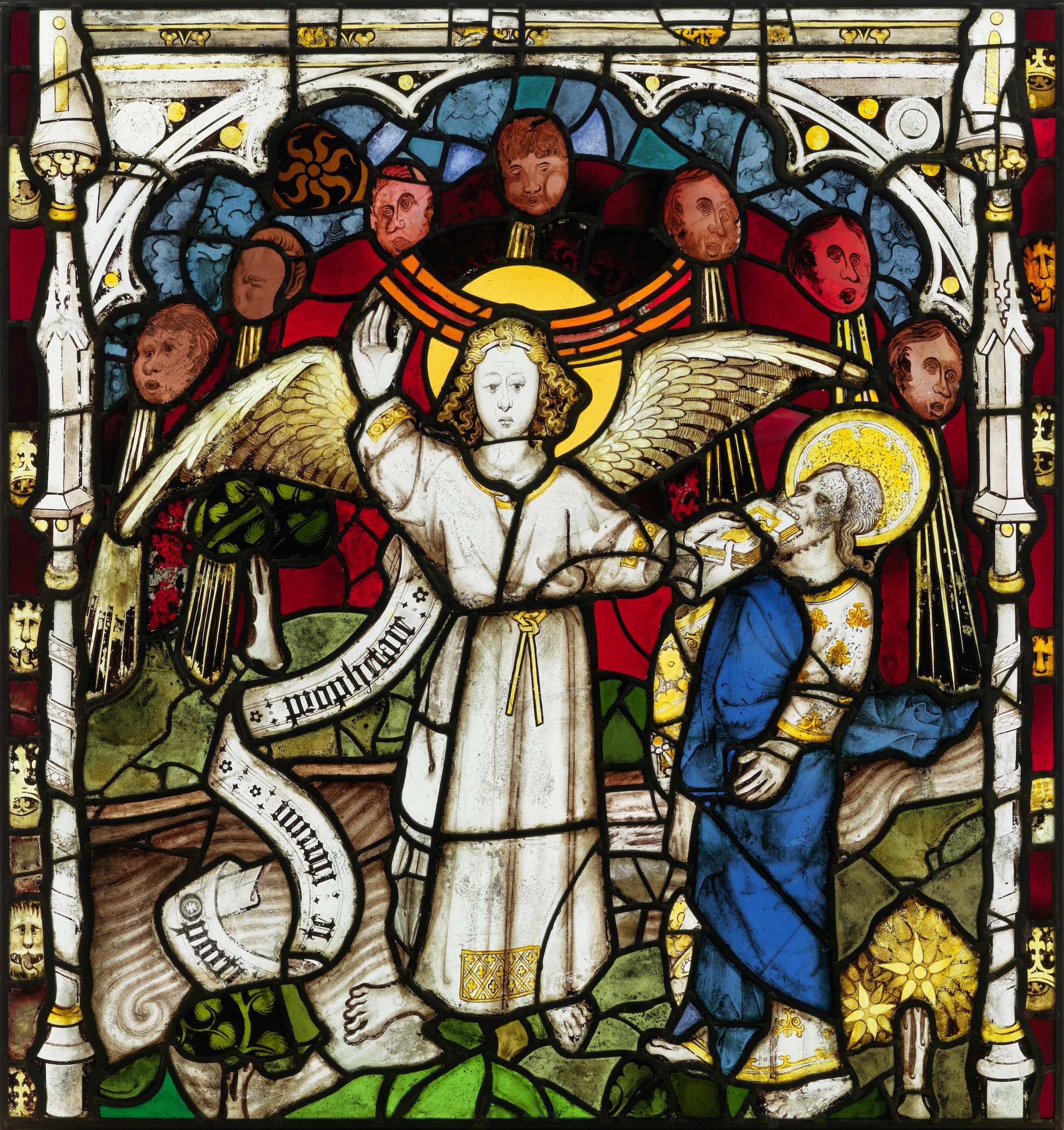
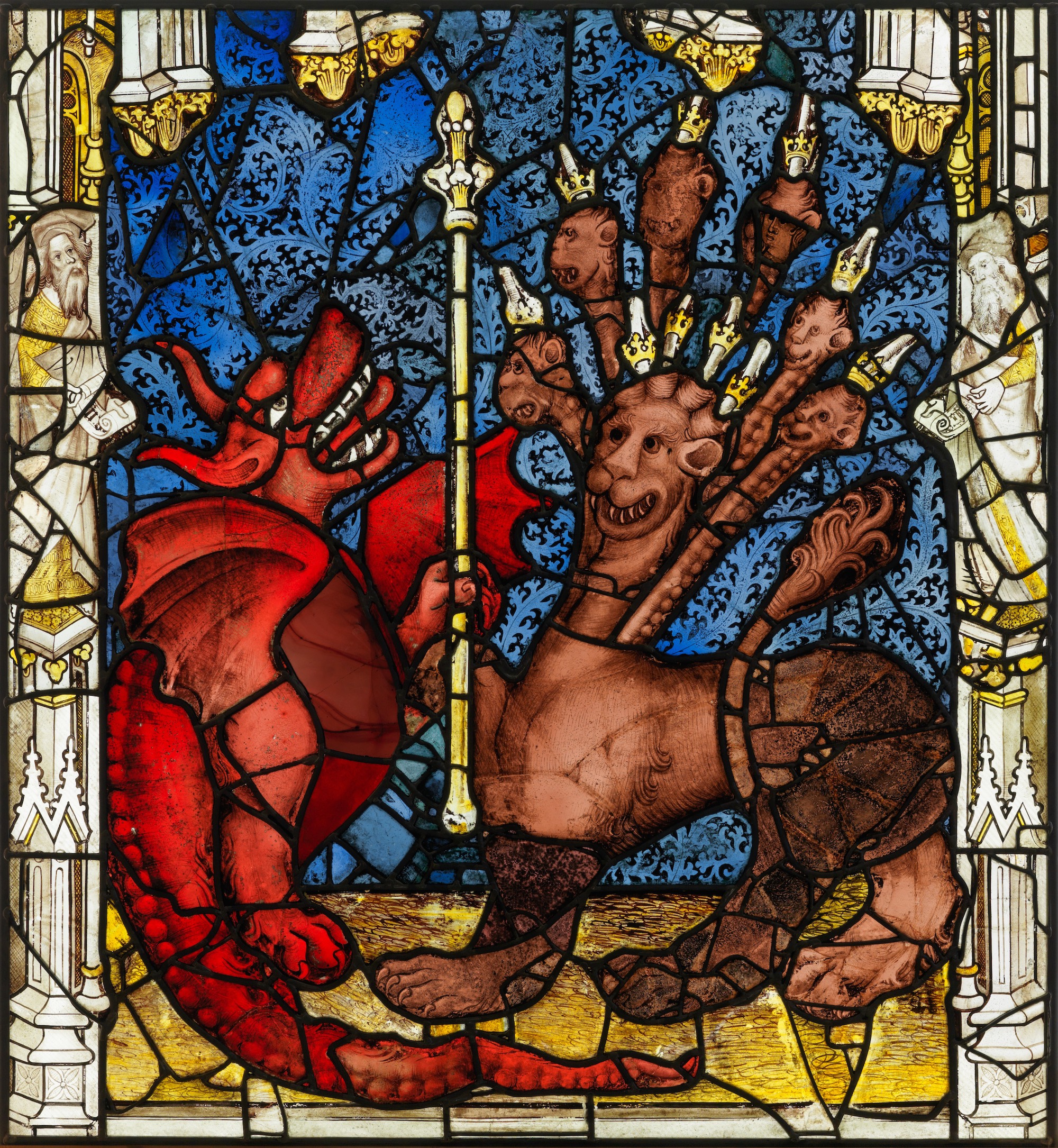
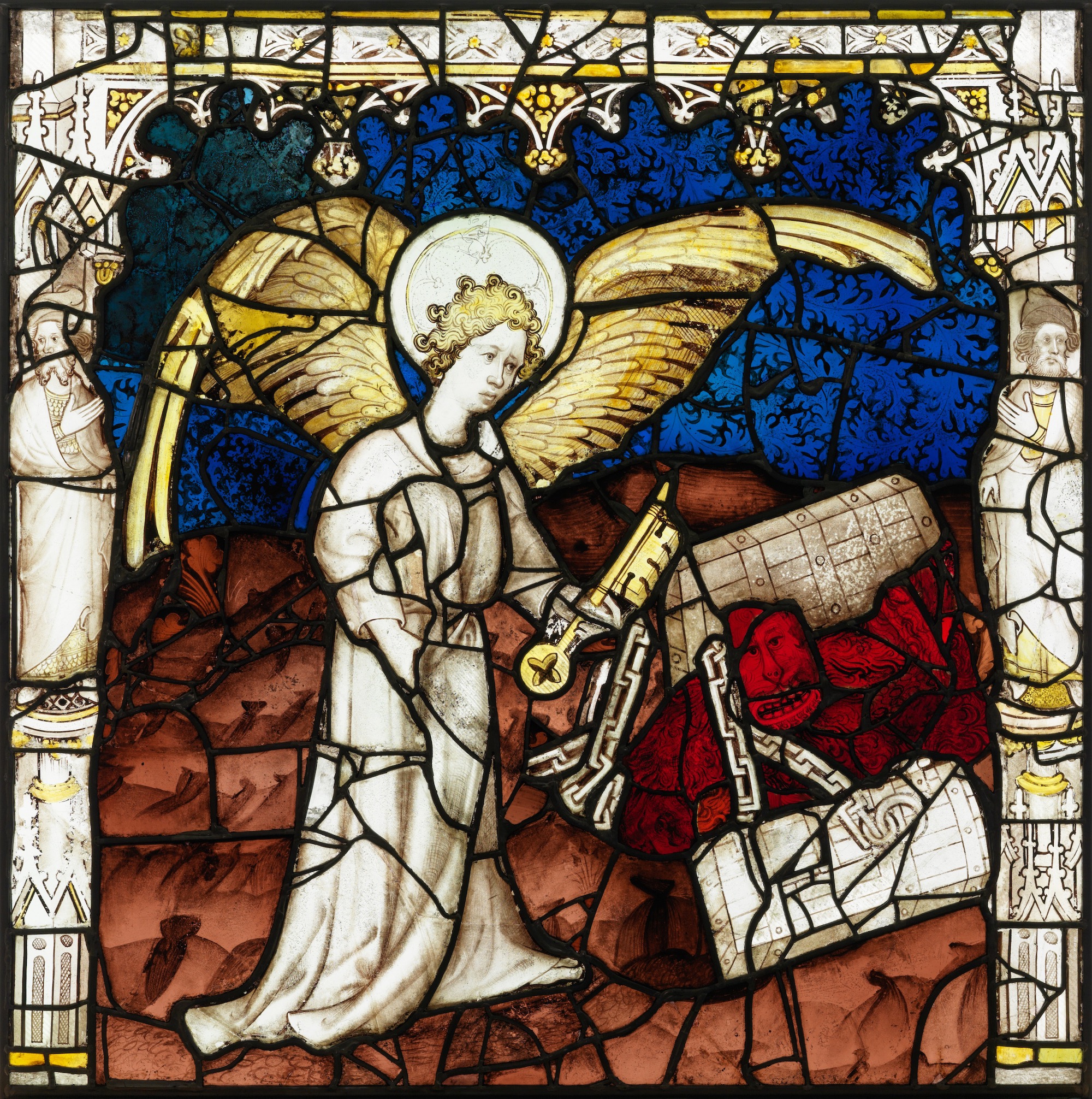
>> The York Minster Stained Glass Navigator:York Minster in northeastern England has the largest collection of medieval stained glass in the UK, with the earliest pieces dating from the late twelfth century. On behalf of the Chapter of York, the York Glaziers Trust is undertaking to photograph it all. These photos are available for viewing online through the cathedral’s “Stained Glass Navigator,” which enables you to hover over panels to identify the scenes, zoom in for higher resolution, and see where each panel in situated in the context of the window’s larger narrative.
I especially recommend exploring the extraordinary Great East Window, which depicts the beginning and the end of all things. The top section opens with the seven days of creation, followed by other select scenes from the Old Testament, but the bulk of the window—and my favorite sequence—consists of scenes from the book of Revelation. The bottom row depicts historical and legendary figures associated with the history of York Minster.
John Thornton of Coventry (British, fl. 1405–1433), St. John Takes the Book from the Angel (Rev. 10:8–11), 1405–8. Stained glass panel from the Great East Window, York Minster, York, England. Photo courtesy of the York Glaziers Trust.John Thornton of Coventry (British, fl. 1405–1433), The Dragon Gives Power to the Beast (Rev. 13:1–3), 1405–8. Stained glass panel from the Great East Window, York Minster, York, England. Photo courtesy of the York Glaziers Trust.John Thornton of Coventry (British, fl. 1405–1433), Satan Chained in the Bottomless Pit (Rev. 20:1–3), 1405–8. Stained glass panel from the Great East Window, York Minster, York, England. Photo courtesy of the York Glaziers Trust.
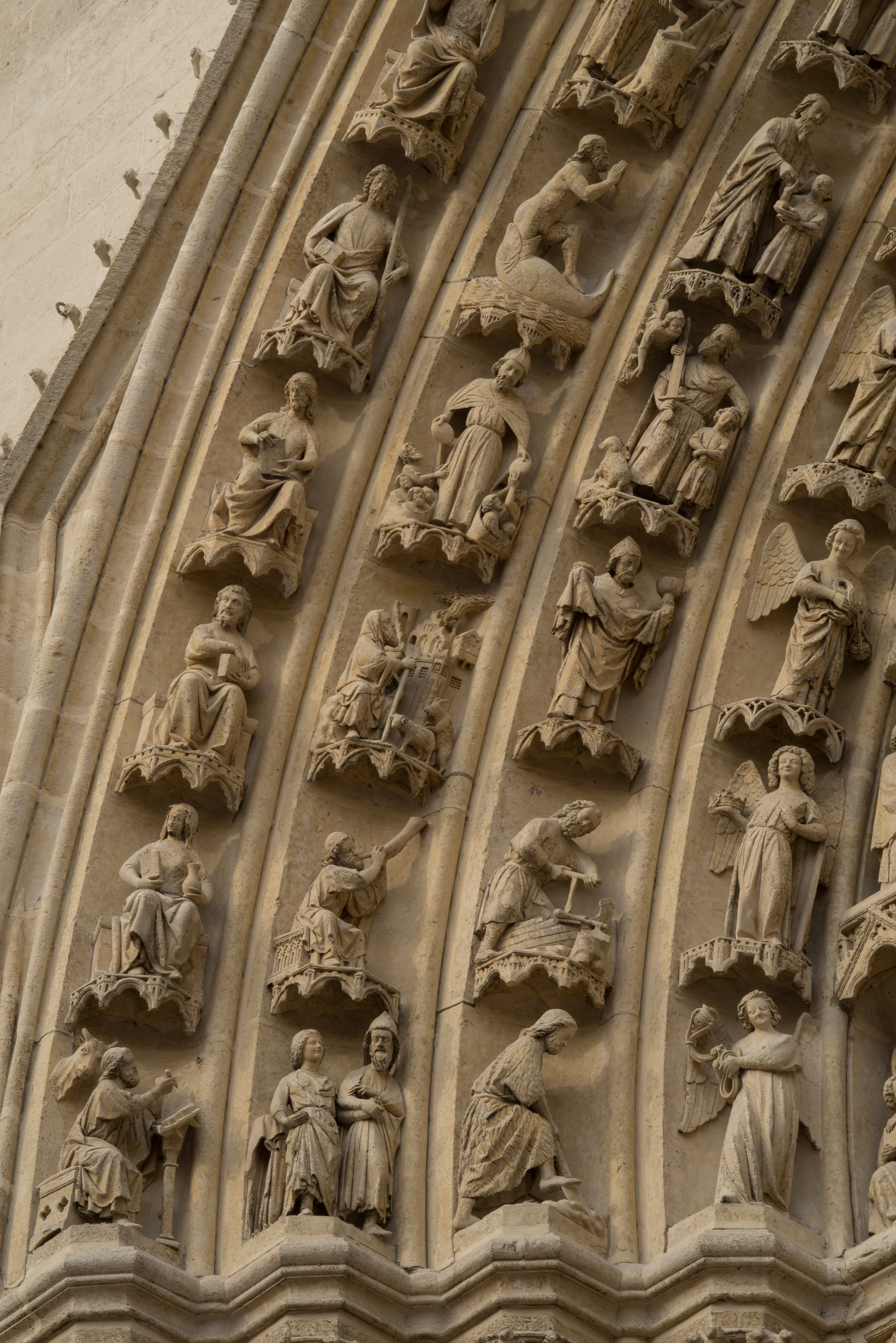
>> Life of a Cathedral: Notre-Dame of Amiens: Located in the heart of Picardy in northern France, Amiens Cathedral is one of the largest Gothic churches of the thirteenth century, renowned for the beauty of its three-tier interior elevation, its prodigious sculpted decoration, and its stained glass. This website put together by Columbia University’s Media Center for Art History offers a detailed virtual tour of the cathedral, drawing attention to its architectural features and artworks, from the many stone relief sculptures over its four portals (my favorite) to the octagonal labyrinth that adorns the marble floor in the nave to the early sixteenth-century misericords in the choir stall.
Detail of voussoirs from the south transept portal of St. Honoré at Amiens Cathedral, ca. 1240, featuring Adam working the ground, Noah building the ark, Jonah being disgorged from the fish, Hosea marrying Gomer, and other biblical figures and vignettes
+++
SONG: “Adon Olam,” performed by the Maqamat Masters, feat. Nissim Lugas: The well-loved text of this traditional Hebrew prayer in five stanzas probably originated in medieval Spain, having been first found in a thirteenth-century siddur (Jewish prayer book) from Andalusia. Drawn from the language of the Psalms, it praises God for both his transcendence and his immanence. He is incomparably great, the ruler over all, and yet he’s also a personal God, a refuge for those who call on him. The prayer’s title and opening phrase translates to “Master of the Universe” or “Eternal Lord.”
Various tunes have been used for the singing of this prayer over the centuries. The Maqamat Masters perform it here with a melody based on the traditional Armenian folk tune NUBAR NUBAR, arranged by Elad Levi and Ariel Berli. They also add to the prayer a few lines from the ghazals of the Persian Sufi poet Saadi (1210–ca. 1292), about the burning fire of God’s love; Lugas sings this Farsi passage from 3:06 to 4:08.
“Maqamat Masters is a unique group of musicians that coalesced around their work together teaching at the Maqamat School of Eastern Music in Safed, Israel,” 12 Tribes Music writes. “Each of the musicians is a master in a different traditional musical genre from the Middle East, and they bring their personal voices and decades of explorations together, to create a magical, new and innovative sound.”
+++
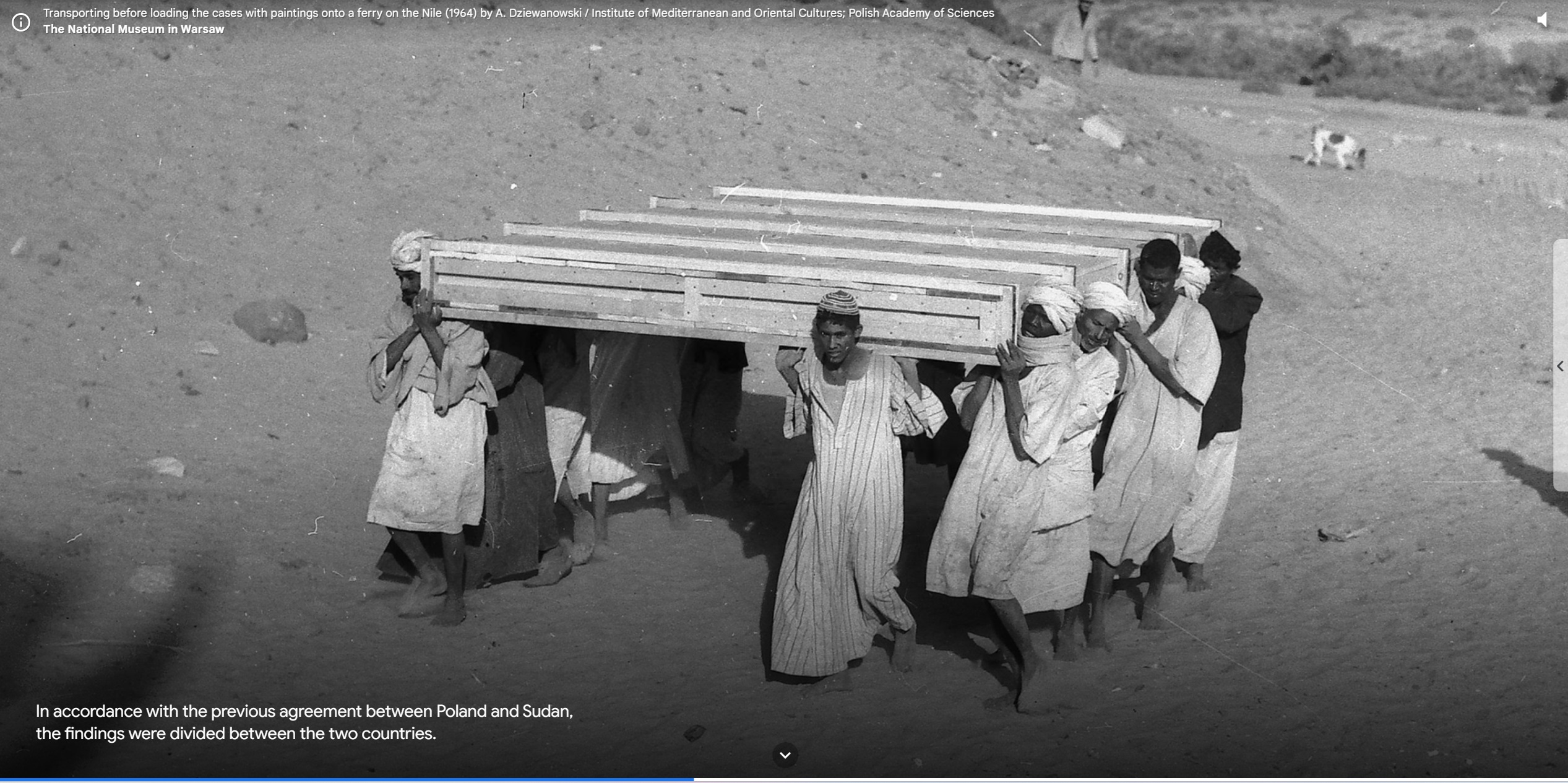
VIRTUAL EXHIBITION: The Faras Gallery: Treasures from the Flooded Desert: In 1960, Faras, a small town in Sudan near the Egyptian border, was one of the archaeological sites designated for flooding by the waters of the Nile to create Lake Nasser. Responding to an international call by UNESCO to preserve the area’s cultural heritage before it would be buried beneath the new reservoir, a Polish team led by Professor Kazimierz Michałowski proceeded with salvage excavations in 1961–64. Their efforts uncovered the wonderfully preserved ruins of a medieval cathedral, active from the eighth to fourteenth centuries (it was built on the remains of an early seventh-century church) and containing over 150 religious paintings, a trove of Nubian Christian art. By agreement with Sudan, half of the findings went to Poland’s National Museum in Warsaw, while the other half are kept in Sudan’s National Museum in Khartoum.
Wall Painting with Bishop Marianos under the protection of Christ and the Mother of God, early 11th century, excavated from Faras Cathedral in modern-day Sudan. Secco tempera on plaster, 247 × 155.5 cm. National Museum, Warsaw.
Curated by Paweł Dąbrowski and Magdalena Majchrzak and hosted by Google Arts & Culture, this virtual exhibition spotlights the wall paintings and artifacts from Faras that are housed in Warsaw. It discusses the importance of the discovery of the cathedral and the technical challenges of detaching the paintings (tempera on dry mud plaster) from the walls. It also includes digital reconstructions of the cathedral’s interior and exterior in 3D stereoscopy, as well as video elements. Here is one of the four videos from the exhibition:
The risen Christ bounds victoriously over the abyss—using his cross like a pole vault!—in this scratched painting by the Congolese artist André Kamba Luesa (1944–1995). The flaming pit of hell has been conquered, cleared. And crossing over from death to life, Christ brings us with him. That’s why the men, women, and children lift high their hands in celebration. His victory is ours!
The Gospel of Matthew describes the Crucifixion-Resurrection event as causing a geological quaking; “the earth shook and the rocks were split” (Matt. 27:51; cf. 28:2). Kamba Luesa portrays this frightening phenomenon in his Resurrection. And yet he also uses warm reds, oranges, and yellows to convey the radiant joy of resurrection. The sky is awash in a soft glow. The Son rises with the sun, its orb a halo behind his head.
As is common in Christian art, the artist connects the Resurrection to his own cultural context. His Jesus is African and wears traditional printed cloth, just like those who praise him from the sides. As much as Jesus’s rising was a historical happening that took place some two thousand years ago outside Jerusalem, it is also an ongoing reality whose implications continue to reverberate as the life of God is made manifest in believers all over the globe.
I originally wrote this art commentary for the Daily Prayer Project’s Easter 2023 prayer periodical.
Mfurahini, haleluya, mkombozi amefufuka. Amefufuka, haleluya, msifuni sasa yu hai.
Refrain: Tumwimbie sote kwa furaha. yesu ametoka kaburini. Kashinda kifo, haleluya; haleluya, Yesu yu hai.
. . .
[I can’t find the Swahili lyrics to verses 2–5]
This Easter text was written in Swahili by Rev. Bernard Kyamanywa (born 1938), a Tanzanian Lutheran pastor, while a student at Lutheran Theological College Makumira (now Tumaini University Makumira). He set it to a tune from the Haya people of northwestern Tanzania, an ethnic group he belongs to.
The English version of the song, “Christ Has Arisen, Alleluia,” is relatively popular throughout the world. Here’s a video of Christ the King Choir in Molyko Buea, Cameroon, singing the song in English:
Christ has arisen, alleluia! Rejoice and praise him, alleluia, For our Redeemer burst from the tomb, Even from death, dispelling its gloom.
Refrain: Let us sing praise to him with endless joy; Death’s fearful sting he has come to destroy, Our sins forgiving, alleluia. Christ has arisen, alleluia!
For three long days the grave did its worst Until its strength by God was dispersed. He who gives life did death undergo; And in its conquest his might did show. [Refrain]
The angel said to them, “Do not fear! You look for Jesus who is not here. See for yourselves the tomb is all bare; Only the grave cloths are lying there.” [Refrain]
“Go spread the news: He’s not in the grave; He has arisen this world to save. Jesus’ redeeming labors are done; Even the battle with sin is won.” [Refrain]
Christ has arisen; he sets us free; Alleluia, to him praises be. Jesus is living! Let us all sing; He reigns triumphant, heavenly King. [Refrain]
Trans. Howard S. Olson, 1977 (admin. Augsburg Fortress)
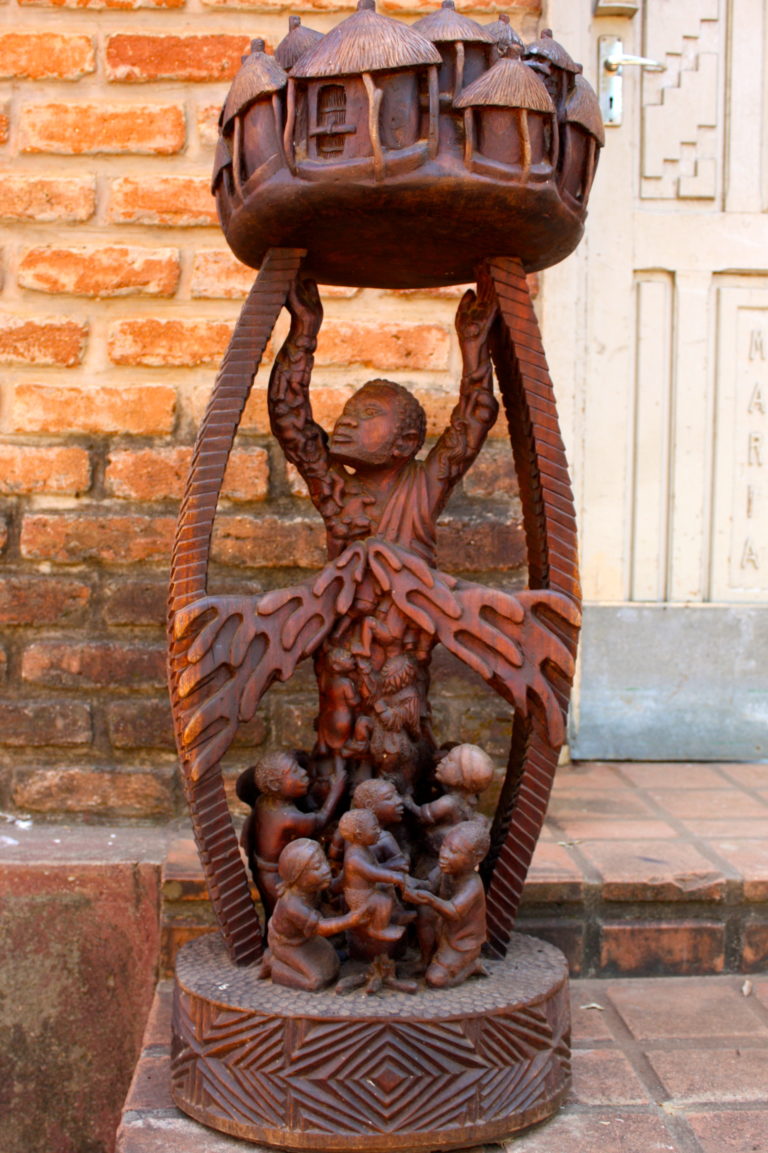
Thomas Mpira, Paschal Candlestand, 1990. Tangatanga wood, height 104 cm. Mua Parish Church, Mua, Malawi.
This large Paschal candlestand was made by Thomas Mpira, a master carver at the Kungoni Centre of Culture and Art in Mua, Malawi. Founded in 1976 by Father Claude Boucher Chisale, this center employed over 120 carvers at its height and is remarkable for how it synthesizes Christian faith and African culture. It is still active, with many locally produced artworks put on display at the center’s Chamare Museum. Others, like this one, are used in the liturgies at the Mua parish church in the diocese of Dedza, whose services are in Chichewa.
Traditionally, the Paschal candle is lit during the Easter Vigil on the night of Holy Saturday, representing the light of Christ’s resurrection expelling the darkness. It is raised and leads a procession, with the lighting blessing referencing
Christ, that Morning Star, who came back from the dead, and shed his peaceful light on all humanity, [God’s] Son, who lives and reigns for ever and ever.
The candle is then placed on the stand and remains lit at all worship services throughout the Easter season, and during baptisms and funerals at any time of the year.
The central figure of Mpira’s carving is the risen Christ, his body constituted of people who’ve been incorporated by his death and resurrection into the “celestial village” he holds aloft, the kingdom of God. From his Sacred Heart gushes a river of life that waters a Chewa village, where a newborn is being passed over a fire to welcome him into the community. (Some Chewa Christians have adapted this ritual such that the child is passed over a lit candle at baptism.) Powerful and regenerating, Christ’s Spirit pours out over the villagers and their daily lives.
The arched forms that support the top of the stand are stylized rainbows, symbolic of God’s promise.
LISTEN: “Vidi aquam”(Wolof: “Gis Na Deh”) by the Monks of Keur Moussa Abbey, from Keur Moussa: Sacred Chant and African Rhythms from Senegal (1997)
English translation:
I saw water flowing out of the temple, from its right side, alleluia: And all to whom this water came were saved, And they exclaim, “Alleluia, alleluia!”
Glory to the Father and to the Son and to the Holy Spirit: As it was in the beginning, now and forever.
I saw water flowing out of the temple, from its right side, alleluia: And all to whom this water came were saved, And they exclaim, “Alleluia, alleluia!”
“Vidi aquam” (“I saw the water”) is a joyful Easter chant for the asperges ritual at the beginning of Mass, in which the altar, the clergy, and the congregation are sprinkled with holy water. The Latin word “asperges” is taken from Psalm 51:3, “Asperges me hyssopo” (Thou shalt sprinkle me with hyssop), which is intoned during the rite for most of the year—except during Eastertide, when this text is replaced with one based on Ezekiel 47, in which the prophet sees a sanctifying flood issuing forth from the temple in Jerusalem:
Then he brought me back to the entrance of the temple; there water was flowing from below the entryway of the temple toward the east. . . . Wherever the river goes, every living creature that swarms will live . . . (vv. 1, 9)
This sensory ritual celebrates the cleansing power of Christ, from whose speared side, on the cross, gushed water and blood, a fount of life.
The monks of Keur Moussa Abbey in Senegal use a Wolof translation of the Vidi aquam, which they’ve set to music inspired by a diola melody from Casamance, southern Senegal. In this recording, they sing accompanied by two tom-toms.
When the Son of Man comes in his glory and all the angels with him, then he will sit on the throne of his glory. All the nations will be gathered before him, and he will separate people one from another as a shepherd separates the sheep from the goats, and he will put the sheep at his right hand and the goats at the left.
Then the king will say to those at his right hand, “Come, you who are blessed by my Father, inherit the kingdom prepared for you from the foundation of the world, for I was hungry and you gave me food, I was thirsty and you gave me something to drink, I was a stranger and you welcomed me, I was naked and you gave me clothing, I was sick and you took care of me, I was in prison and you visited me.”
Then the righteous will answer him, “Lord, when was it that we saw you hungry and gave you food or thirsty and gave you something to drink? And when was it that we saw you a stranger and welcomed you or naked and gave you clothing? And when was it that we saw you sick or in prison and visited you?”
And the king will answer them, “Truly I tell you, just as you did it to one of the least of these brothers and sisters of mine, you did it to me.” Then he will say to those at his left hand, “You who are accursed, depart from me into the eternal fire prepared for the devil and his angels, for I was hungry and you gave me no food, I was thirsty and you gave me nothing to drink, I was a stranger and you did not welcome me, naked and you did not give me clothing, sick and in prison and you did not visit me.”
Then they also will answer, “Lord, when was it that we saw you hungry or thirsty or a stranger or naked or sick or in prison and did not take care of you?”
Then he will answer them, “Truly I tell you, just as you did not do it to one of the least of these, you did not do it to me.” And these will go away into eternal punishment but the righteous into eternal life.
—Matthew 25:31–46
LOOK: The Last Judgment by Nathaniel Mokgosi
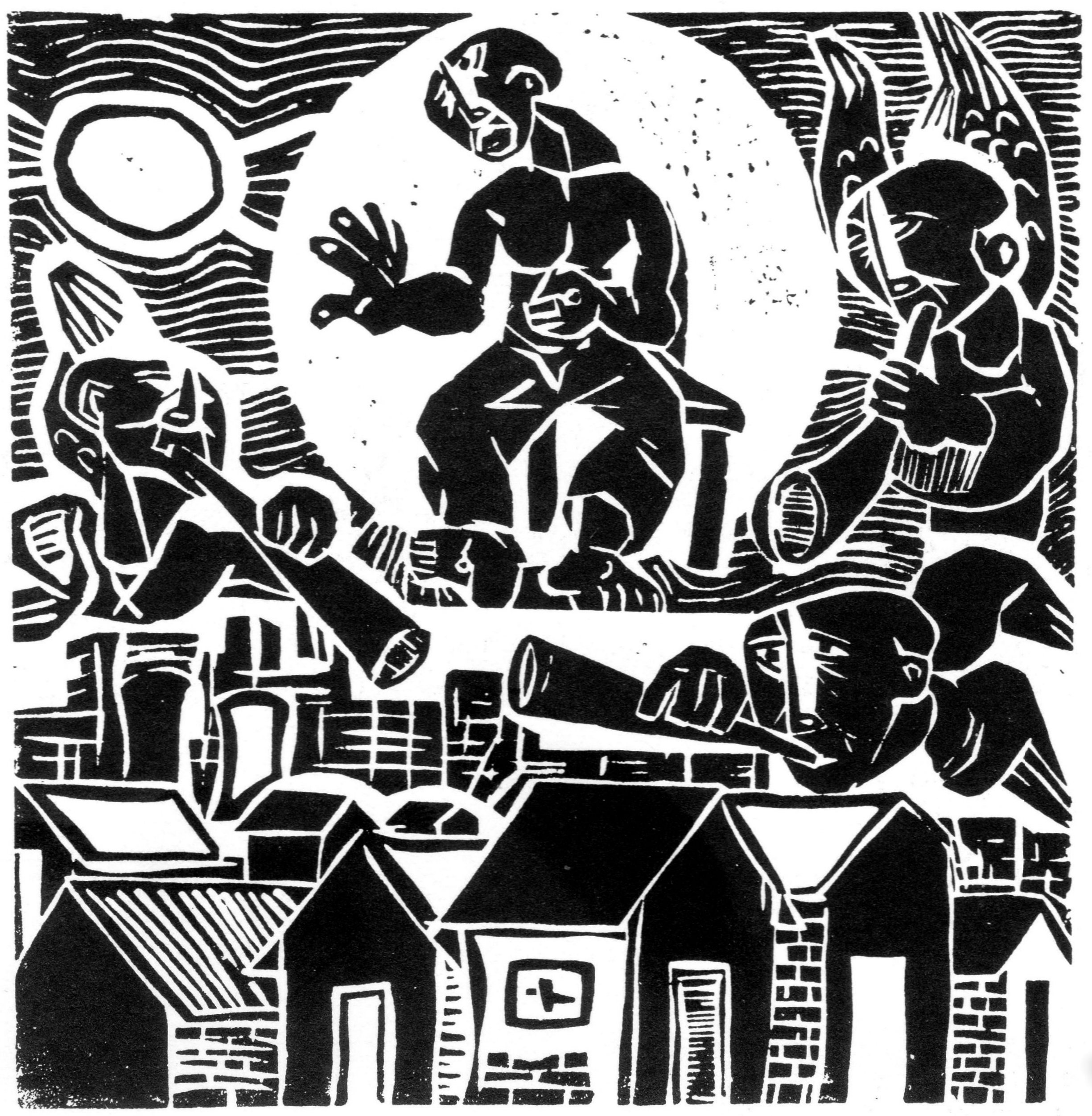
Nathaniel Mokgosi (South African, 1946–2016), The Last Judgment, 1980. Linocut. Source: Christliche Kunst in Afrika, p. 274
There’s a great day coming, A great day coming, There’s a great day coming by and by, When the saints and the sinners shall Be parted right and left— Are you ready for that day to come?
Refrain: Are you ready? Are you ready? Are you ready for the judgment day? Are you ready? Are you ready? For the judgment day?
There’s a bright day coming, A bright day coming, There’s a bright day coming by and by. But its brightness shall only come To them that love the Lord— Are you ready for that day to come? [Refrain]
There’s a sad day coming, A sad day coming, There’s a sad day coming by and by, When the sinner shall hear his doom, “Depart, I know ye not!” Are you ready for that day to come? [Refrain]
Texas-bred and New York–based, Snarky Puppy is a jazz-soul-funk music collective consisting of some twenty-five members in regular rotation. “At its core, the band represents the convergence of both black and white American music culture with various accents from around the world. Japan, Argentina, Canada, the United Kingdom, and Puerto Rico all have representation in the group’s membership.” The trumpeters for this song are Michael “Maz” Maher, Jon Lampley, Justin Stanton, Yay Yennings, Kyla Moscovich, and John Culbreth.
Samuel Songo (Rhodesian, 1929–ca. 1977), The Prodigal Son, 1954. Soapstone, h. 26 cm. Source: Christliche Kunst in Afrika, p. 254.
Samuel Songo was a Shona artist who lived and work in what is today Zimbabwe. He used a wheelchair and had only partial use of his right hand, so he worked mainly with his left, executing stone carvings, wood reliefs, and paintings on both religious and secular subjects. He was associated with the Cyrene Mission School, where he began as a student and then became an instructor. He played a significant role in advancing modern art in Zimbabwe.
LISTEN: “When I Was Distant” by Matt Moore and Matte Cassidy of City Church Music, 2018 | Performed by Salina Turner, Allison Negus, and Joel Negus, 2020
When I was distant from my Lord Opposing his plans and ignoring his word My stubborn desire left me at war When I was distant from my Lord
When I was reckless on my own Avoiding the ruin my choices had sown A prodigal lost and far from home When I was reckless on my own
There in the shadow of my sin Unable to dwell with my Maker again Ashamed and afraid and wearing thin There in the shadow of my sin
Then came my loving Savior’s plea: “Lay down your burdens; find rest in me; All faint and all weary, come and see.” Then came my loving Savior’s plea
When I was distant, God came near Enduring the evil, the torment and fear That beauty and wonder could appear When I was distant, God came near
This song was part of the Digital Vespers service for Good Friday 2020 at City Church in Cleveland Heights, Ohio. To view the full service, click here.
A voice cries: “In the wilderness prepare the way of the LORD; make straight in the desert a highway for our God. Every valley shall be lifted up, and every mountain and hill be made low; the uneven ground shall become level, and the rough places a plain. And the glory of the LORD shall be revealed, and all flesh shall see it together, for the mouth of the LORD has spoken.”
—Isaiah 40:3–5
LOOK: Caiphas Nxumalo (South African, 1940–2002), John the Baptist, 1970. Linocut. Source: Christliche Kunst in Afrika, p. 278.
Caiphas Nxumalo was a printmaker and wood sculptor who studied at the Rorke’s Drift Art School from around 1968 to 1971 (sources vary on the precise years). He was associated with the African-initiated amaNazaretha Church in South Africa.
In this linoleum cut Nxumalo shows John the Baptist, the forerunner of Jesus, preaching repentance (bottom; Matt. 3:1–3), baptizing (Matt. 3:5–6), and eating wild honey (Matt. 3:4). The eye of God, which sees secret sins, burns bright and glorious. I’m not sure whether the people at the bottom are running away from John’s message of wrath or “turning around” from their wickedness to follow the true way. In Matthew’s account there are people from both categories of response.
The triangular frame rising from the base line was a common compositional device Nxumalo used to tell multiple components of a story, and in this context it’s especially appropriate, as it seems to me to allude to the valleys being lifted and the mountains being brought down low—a leveling of the landscape so that God’s glory can be plainly seen from any vantage point. (On another level, this Isaianic prophecy probably also refers to the proud being overthrown and the humble being exalted, as Mary sings about in her Magnificat.)
Advent is about the coming consummation of the kingdom of God in the day of the Lord. In Advent: The Once and Future Coming of Jesus Christ, Fleming Rutledge, who calls on the church to restore Advent’s focus on apocalyptic theology, describes John the Baptist as the central figure of Advent. She half-jokes that behind one of those cute little Advent calendar windows should be a coarse, fiery John shouting, “You brood of vipers!” (Matt. 3:7). “Irreducibly strange, gaunt and unruly, lonely and refractory, utterly out of sync with his age or our age or any age,” John the Baptist “arrives announcing the opening event of the end-time” (277, 13). As prophesied by Malachi at the end of the Old Testament and confirmed by Jesus in Matthew 11, “John the Baptist is the new Elijah, standing at the edge of the universe, at the dawn of a new world, the turn of the ages. That is his location as the sentinel, the premier personage of this incomparable Advent season—the season of the coming of the once and future Messiah” (277).
Like John, the church, Rutledge says, is also located on the frontier of the new age, between Jesus’s first and second advents, and we, too, are called to herald the Messiah, announcing, “Repent! For the kingdom of God is at hand.”
In those days John the Baptist came preaching in the wilderness of Judea, “Repent, for the kingdom of heaven is at hand.” For this is he who was spoken of by the prophet Isaiah when he said,
“The voice of one crying in the wilderness: ‘Prepare the way of the Lord; make his paths straight.’”
Now John wore a garment of camel’s hair and a leather belt around his waist, and his food was locusts and wild honey. Then Jerusalem and all Judea and all the region about the Jordan were going out to him, and they were baptized by him in the river Jordan, confessing their sins.
But when he saw many of the Pharisees and Sadducees coming to his baptism, he said to them, “You brood of vipers! Who warned you to flee from the wrath to come? Bear fruit in keeping with repentance. And do not presume to say to yourselves, ‘We have Abraham as our father,’ for I tell you, God is able from these stones to raise up children for Abraham. Even now the axe is laid to the root of the trees. Every tree therefore that does not bear good fruit is cut down and thrown into the fire.
“I baptize you with water for repentance, but he who is coming after me is mightier than I, whose sandals I am not worthy to carry. He will baptize you with the Holy Spirit and fire. His winnowing fork is in his hand, and he will clear his threshing floor and gather his wheat into the barn, but the chaff he will burn with unquenchable fire.”
—Matthew 3:1–12
LISTEN: “His Kingdom Now Is Come (Behold! Behold!)” by Paul Zach, Isaac Wardell, Leslie Jordan, Lorenzo Baylor, and Brian Nhira, on Justice Songs by the Porter’s Gate (2020) | CCLI #7158500
Justice Songs opens with a rousing call-and-response song, “His Kingdom Now Is Come (Behold! Behold!),” that combines material from the mystical prologue of John’s Gospel with an Isaianic prophecy commonly read during Advent [Isaiah 40:3–5]. . . . Verse 4, syncopated with hand claps, lists divine epithets like “God of justice” (Isa. 30:18). “Father of the fatherless” (Ps. 68:5), “Prince of Peace” (Isa. 9:6). “He’s troubling the water, and we’re marching through”—an oblique reference to the African American spiritual “Wade in the Water,” about the liberation of the Israelites through the miraculously parted Red Sea, the paradigmatic “day of the Lord.”
The refrain, “Behold!,” is a word used hundreds of times throughout scripture, and it means “to fix the eyes upon; to see with attention; to observe with care.” Jesus says in Luke 7:21, “Behold, the kingdom of God is in the midst of you.” May we behold with humility and excitement the age to come and respond with fruits of repentance.
Here’s a socially distanced performance of “His Kingdom Now Is Come” by the musicians of Whitworth Campus Worship for the Center for Congregational Song’s Election Day 2020 broadcast.
(Update, 12/9/20: Watch the Porter’s Gate perform this song in the studio on this Instagram video.)
VISUAL MEDITATION: “At the Whipping Post” by Victoria Emily Jones: Last year the Museu de Arte de São Paulo (MASP) ran a major retrospective on Djanira da Motta e Silva, “a central artist in Brazilian mid-century modernism” (Rodrigo Moura). ArtWay’s editor asked me to choose a painting of hers to write about—I chose the one she submitted to the 1955 “Christ of Color” contest, showing Jesus as an enslaved African being scourged in the historic center of Salvador de Bahia, the first colonial capital of Brazil.
Djanira da Motta e Silva (Brazilian, 1914–1979), Largo do Pelourinho, Salvador, or Cristo na coluna (Christ at the Column), 1955. Oil on canvas, 81 × 115 cm. Private collection, Rio de Janeiro, Brazil. Photo: Jaime Acioli.
+++
LECTURE: “Is Christianity a White Man’s Religion?” by Dr. Vince L. Bantu: I first encountered Vince Bantu in a Conversing (Fuller Studio) podcast episode on African American identity and the church. (He joined the Fuller faculty last year as assistant professor of church history and Black church studies.) In this video from January 2018, he returns to his alma mater, Wheaton College, to discuss the history of Christianity in Africa—which some people are surprised to learn predates colonialism. “To study ancient African history is to study Christianity. They go together,” he says. “If you want to study Ethiopian literature, . . . you’re going to be reading a whole bunch of Christian literature. Same thing in Nubian. Same thing in Coptic.” While the Anglo-Saxons were still worshipping Odin and Thor, Bantu says, Black Africans were building churches, establishing seminaries, and writing Christian theological treatises!
The talk starts at 11:34 and really kicks into gear at around 24:00. Q&A starts at 52:40 and includes discussion of a three-point spectrum of approaches to culture, mission as “cultural sanctification,” and internalized theological racism. Take note of Bantu’s response, at 1:09:35, to the question “What do we do with this information?”
“Christianity is and always has been a global religion,” Bantu reminds us. Unfortunately, people tend to associate it most with western Europe. That’s because Rome, the dominant culture for some time, essentially said, “Christianity belongs to us,” instituting a theological hegemony. The West proclaimed itself the guardian of the Christian faith, declaring heretical churches in other regions that didn’t express theology the same way they did, with no regard for differences in language and philosophical frameworks.
I appreciate how Bantu teaches Christian history in part through art and architecture, which are material witnesses to the faith and sometimes even modes of theology. He shows photos of churches and monasteries and their interior decoration. Most fascinating to me is a tenth-century wall painting he photographed at the Great Monastery of Saint Anthony in Old Dongola (present-day Sudan), a Nativity scene that shows Africans wearing animal crest masks and worshipping Christ with traditional instruments. (You can view some photos here. See also The Wall Paintings from the Monastery on Kom H in Dongolaby Malgorzata Martens-Czarnecka, or the freely accessible essay by the same author, “The Christian Nubia and the Arabs.”)
Great is your name, Lord Jesus Christ Praise to your name, Lord Jesus Christ Power to your name, Lord Jesus Christ Praise to your name, exalted Jesus Christ
Hallelujah, hallelujah Hallelujah, hallelujah Hallelujah, hallelujah Praise to your name, exalted Jesus
“I Am Thine (Plague Hymn)”: Made especially timely by the current COVID-19 pandemic, this hymn text was written in 1519 by Swiss Reformer Ulrich Zwingli while convalescing from the bubonic plague, having caught it ministering to others. This year Zac Hicks wrote a new melody for it, and it’s sung here by Leif Bondarenko. Released by Advent Birmingham.
+++
BIBLICAL ART DATABASE: Visual Midrash: “Visual Midrash is an online bilingual (Hebrew and English) collection of Bible art and commentary, sponsored by the TALI Education Fund in Israel. At present, the site contains more than 1100 art images relating to 33 different subjects from all three divisions of the Hebrew Bible – including such figures as Abraham, Jacob, Moses, David, the women of the Book of Judges, the scrolls of Ruth and Esther and much more. Among the images are objects from the Ancient Near East; frescoes from the ancient synagogue of Dura Europos; medieval illuminated manuscripts; paintings, sculptures, lithographs, and nearly 100 other art media from Michelangelo to Rembrandt to Chagall to contemporary artists.” I’ve had fun browsing! Below is just a small sampling of images from the site.
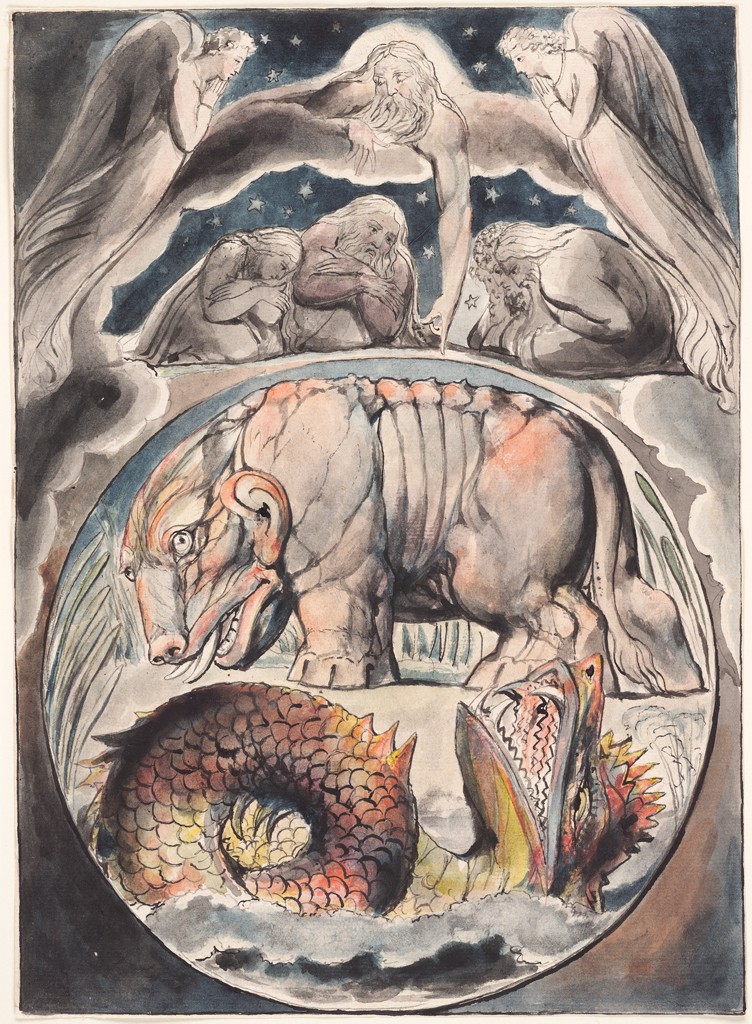
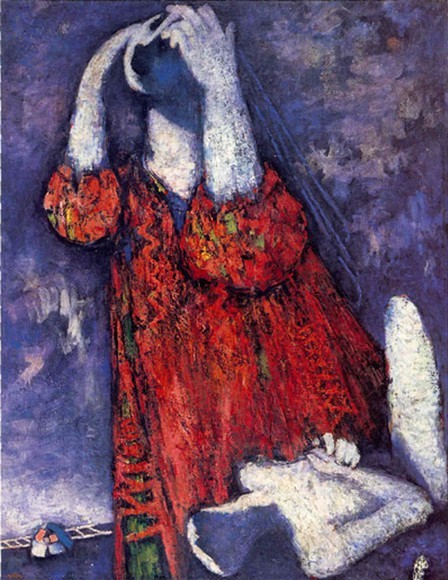
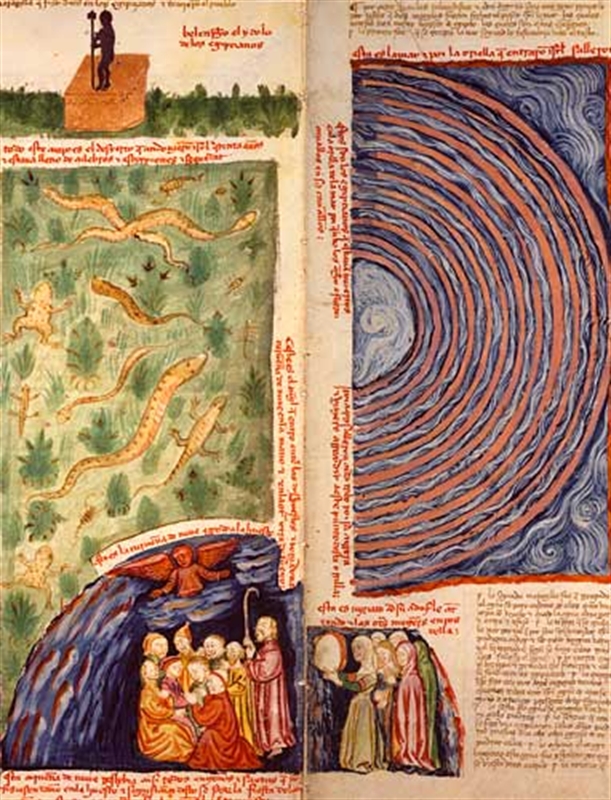
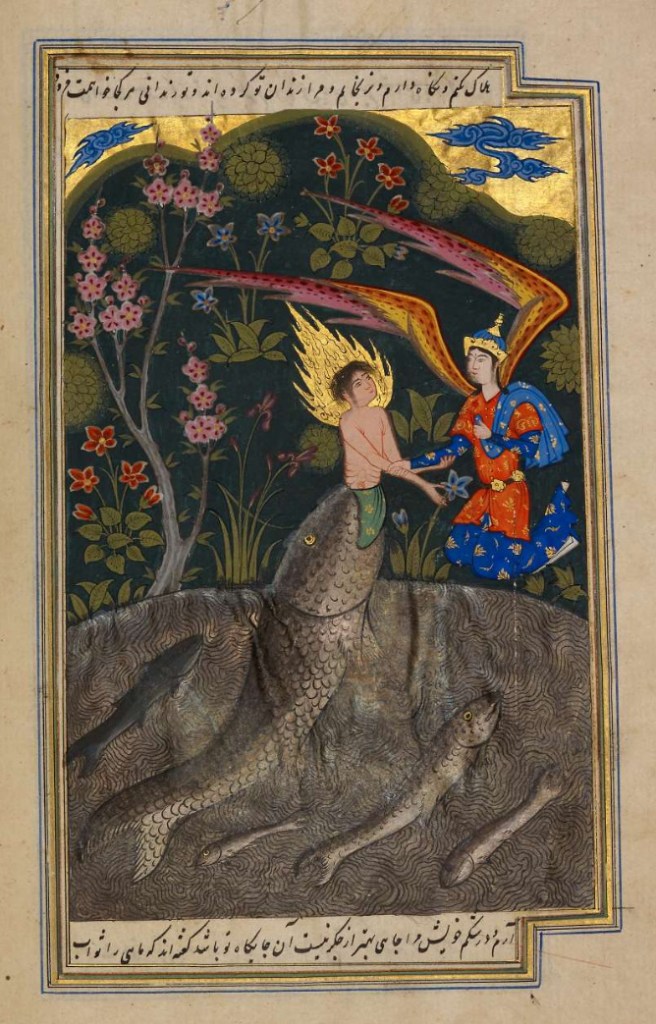
William Blake (British, 1757–1827), Behold Now Behemoth, Which I Made With Thee (The Book of Job) (Linnell set), 1821. Watercolor, black ink, and graphite on off-white antique laid paper, 27.5 × 20 cm. Harvard Art Museums/Fogg Museum, Cambridge, Massachusetts. [HT]Mordecai Ardon (Israeli, 1896–1992), Sarah, 1947. Oil on canvas, 138 × 108 cm. Jewish National and University Library, Jerusalem.“The Finding of Moses,” wall painting made in 244 CE, from Dura-Europos Synagogue in Syria. Preserved at the National Museum of Syria, Damascus. [HT]“Crossing of the Red Sea,” Spain, 1430. Illumination from the Alba Bible (fol. 68v–69r), Liria Palace, Madrid.“Jonah,” Iran, 1577. Illumination from the Qisas al Anbiya (Diez A Fol. 3, fol. 142v), Staatsbibliothek, Berlin. [HT]






 Art & Theology