I saw one like a son of man coming with the clouds of heaven. And he came to the Ancient One and was presented before him.
—Daniel 7:13
“Immediately after the suffering of those days
the sun will be darkened, and the moon will not give its light; the stars will fall from heaven, and the powers of heaven will be shaken.
“Then the sign of the Son of Man will appear in heaven, and then all the tribes of the earth will mourn, and they will see ‘the Son of Man coming on the clouds of heaven’ with power and great glory. And he will send out his angels with a loud trumpet call, and they will gather his elect from the four winds, from one end of heaven to the other.”
—Matthew 24:29–31
“. . . you will see the Son of Man seated at the right hand of Power and coming on the clouds of heaven.”
—Matthew 26:64
Look! He is coming with the clouds; every eye will see him, even those who pierced him, and all the tribes of the earth will wail on account of him.
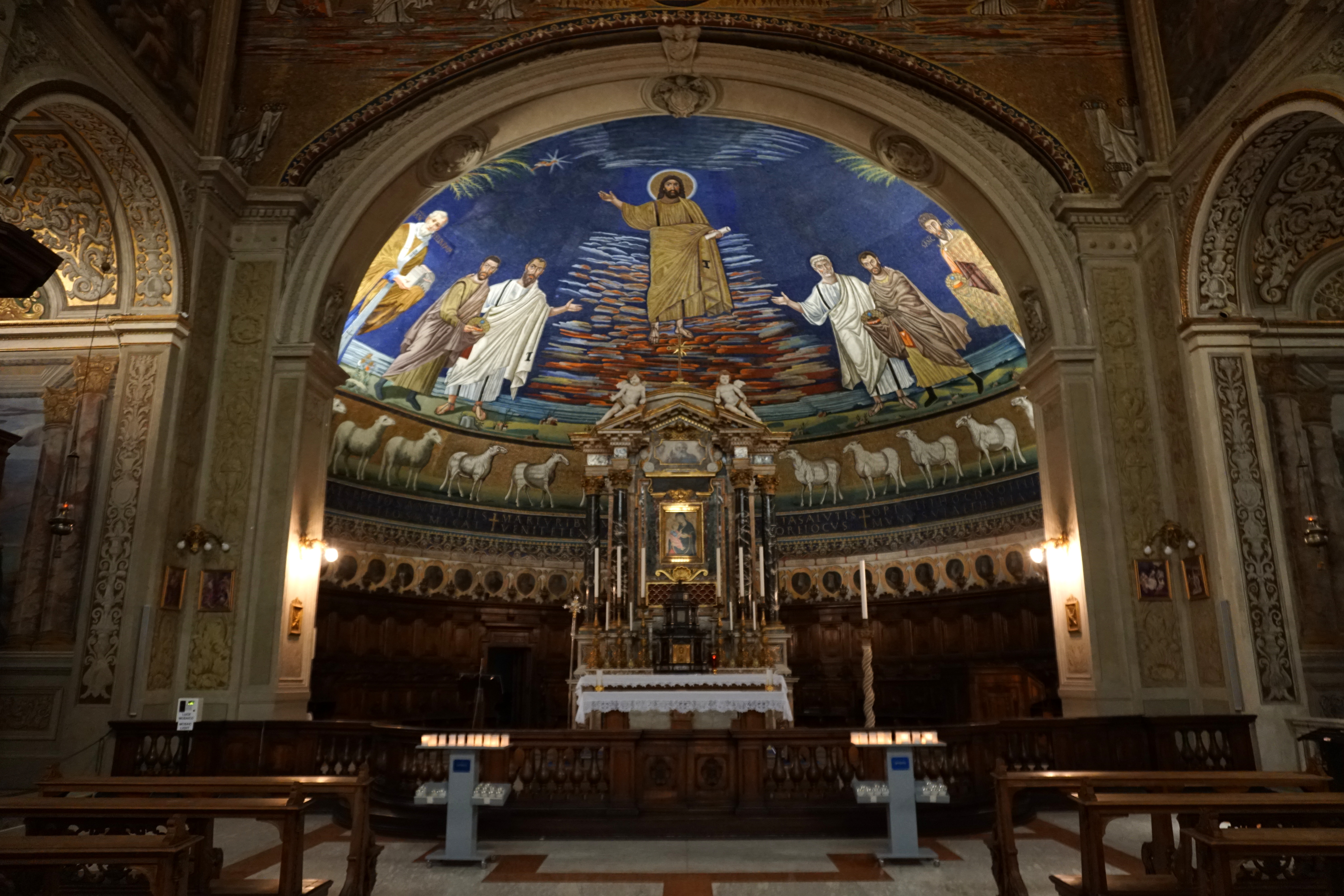
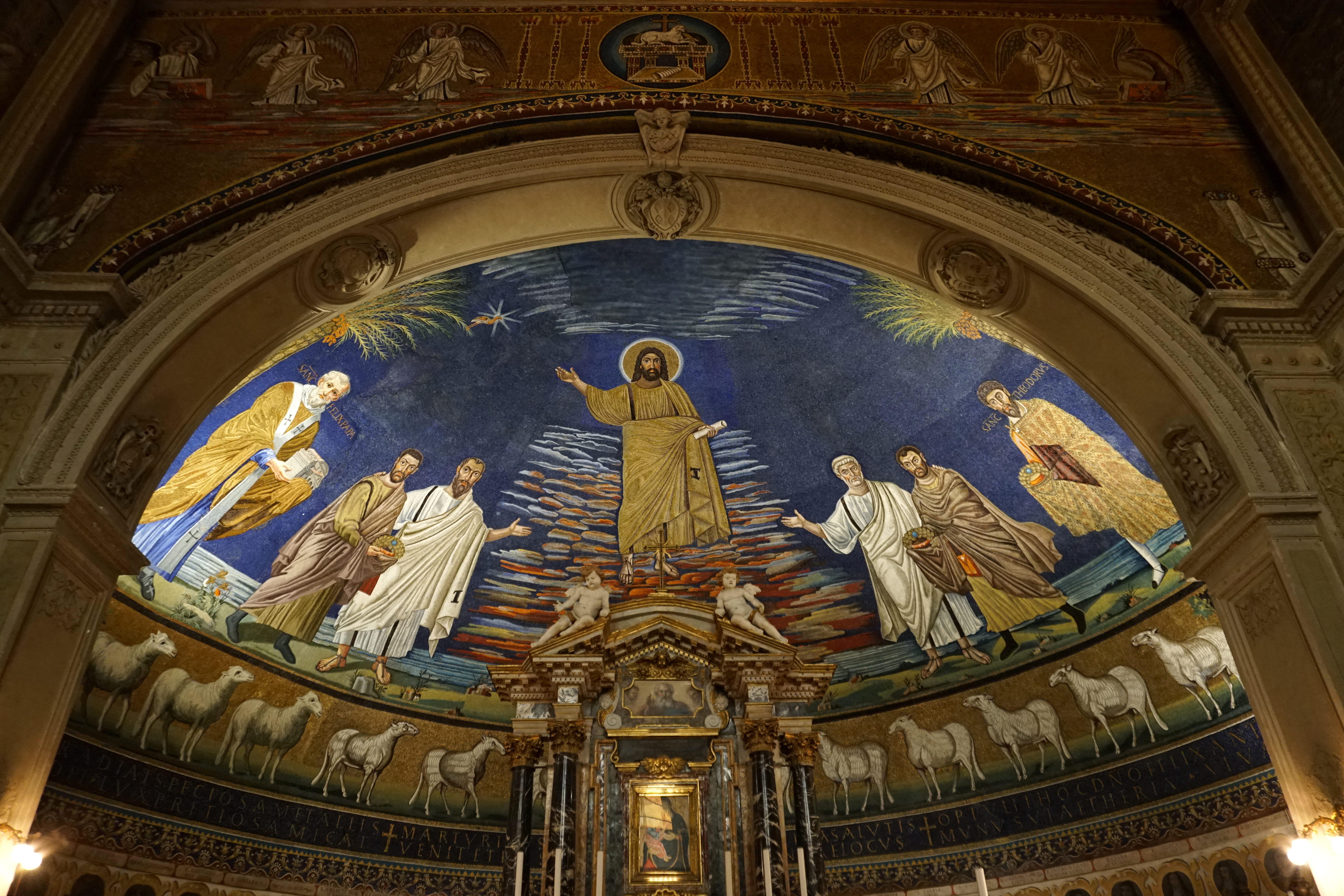
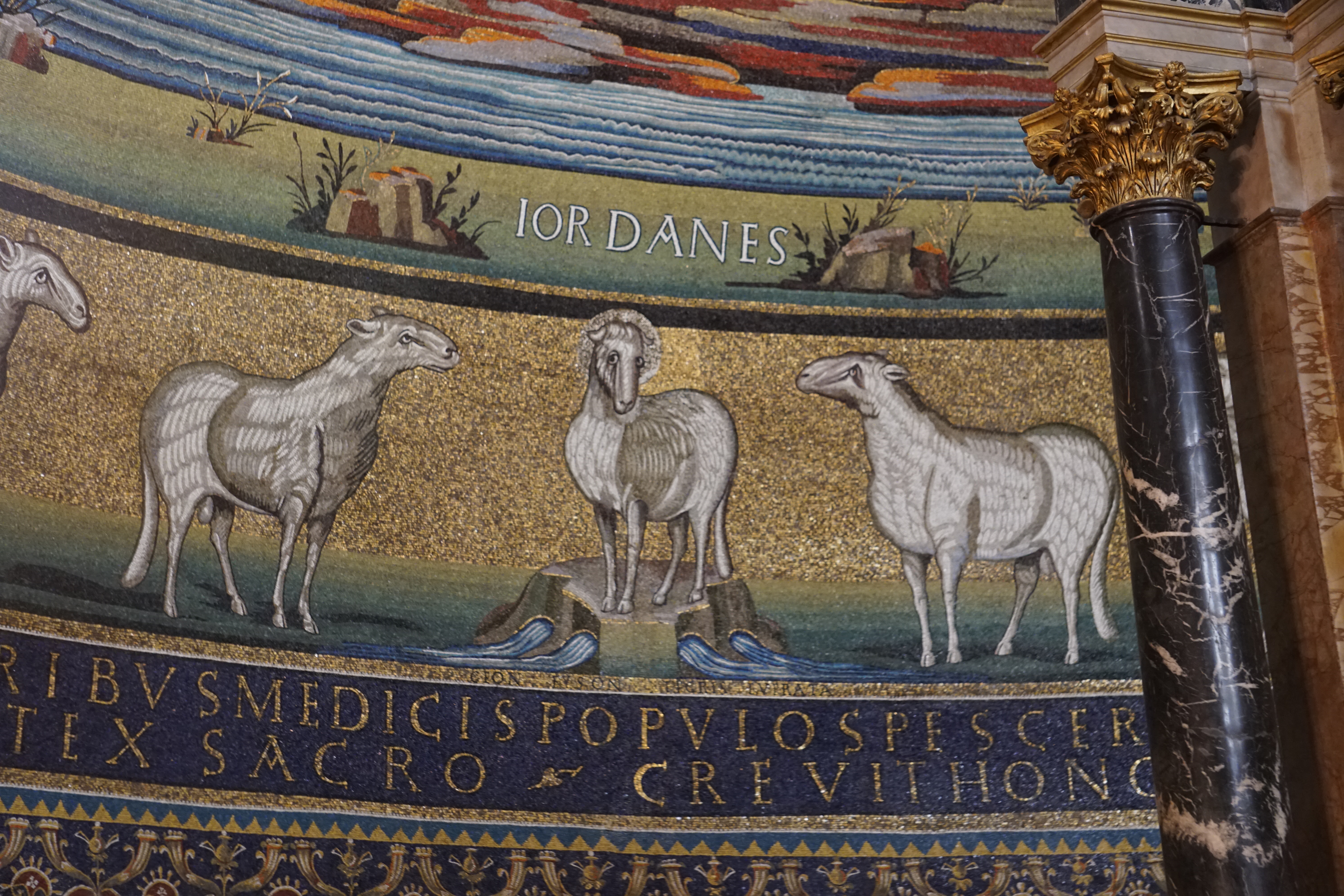
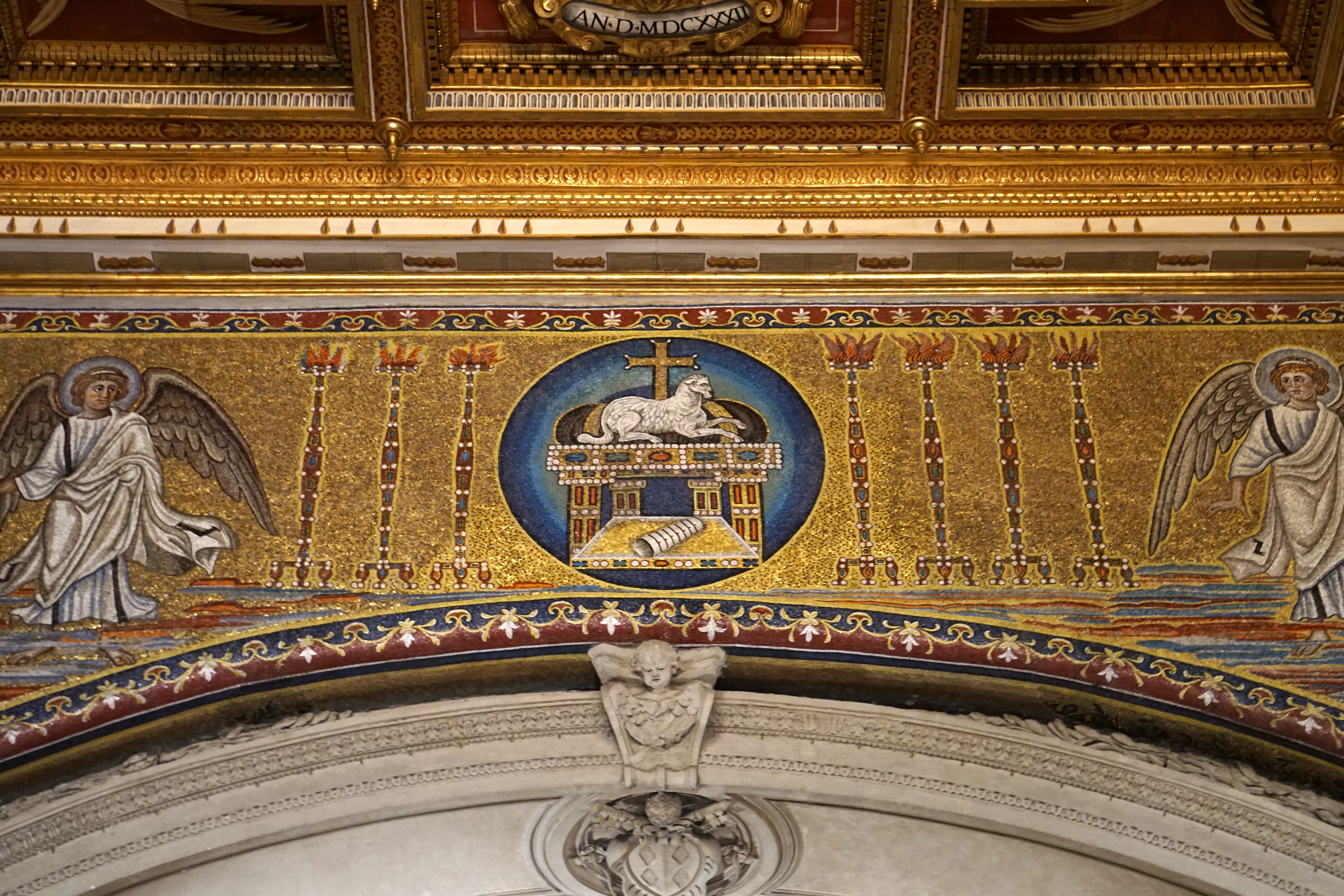
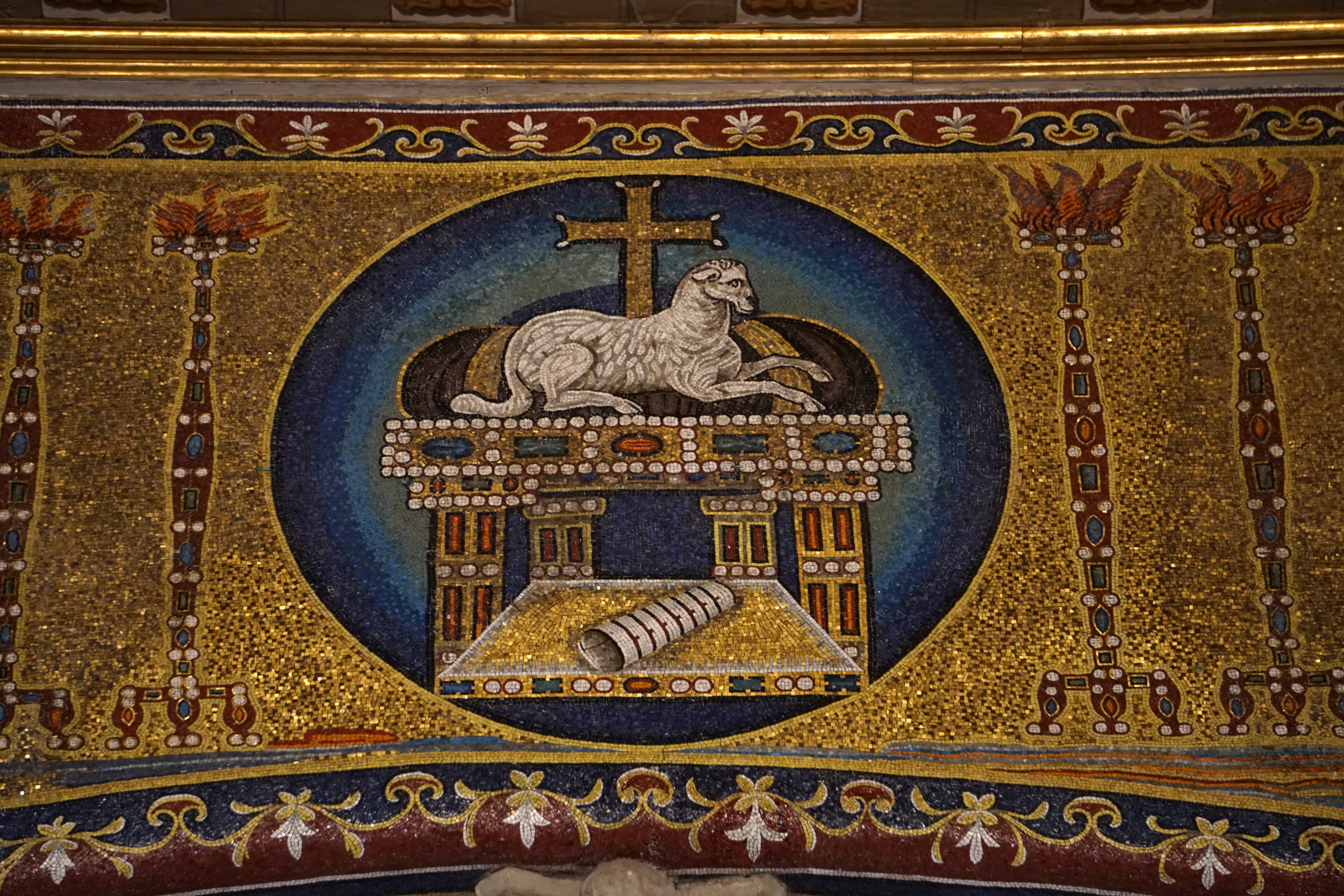
LOOK: Apse mosaic, Basilica of Saints Cosmas and Damian, Rome
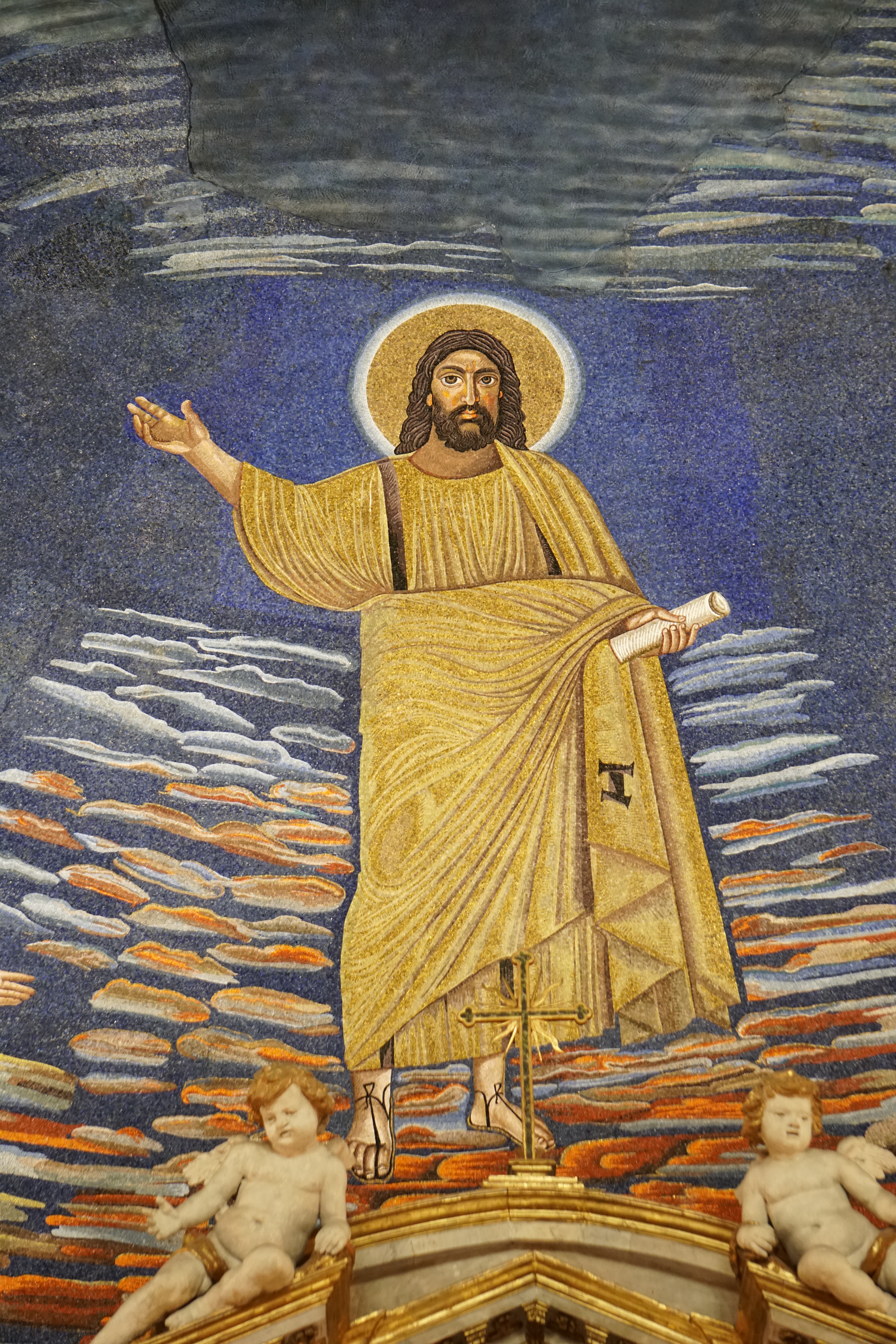
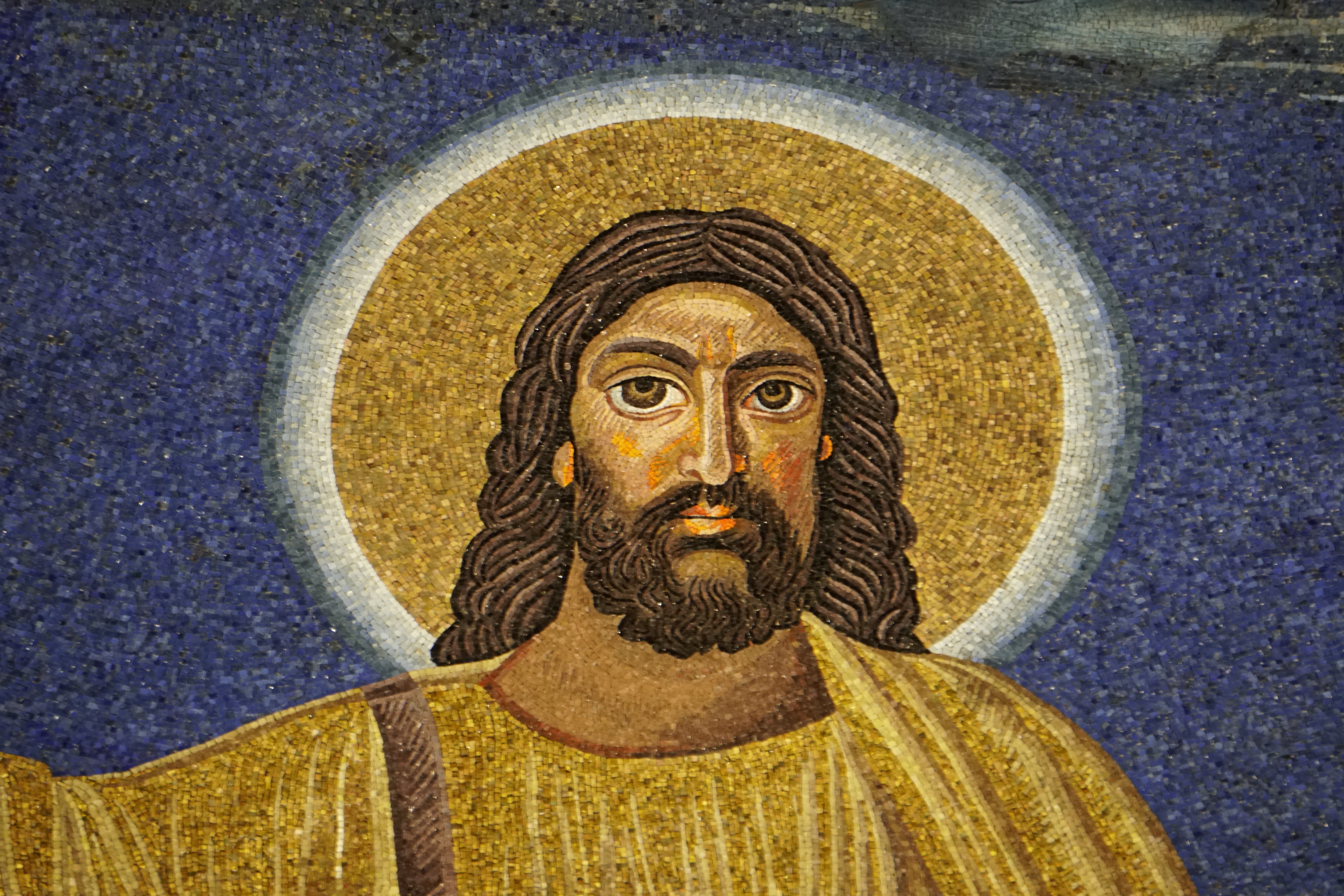
The Second Coming of Christ, ca. 526–30. Mosaic, Basilica of Santi Cosma e Damiano (Saints Cosmas and Damian), Rome. All photos by Victoria Emily Jones.
This Roman-Byzantine mosaic decorates the apse (large semicircular recess at the east end of a church) of a basilica in Rome dedicated to the Christian martyr-saints Cosmas and Damian, twin brothers from third-century Arabia. Cosmas and Damian (Cosma and Damiano in Italian) were physicians who, out of love for Christ and humanity, treated their patients free of charge. They were killed in the Diocletian persecution, one of the Roman Empire’s attempts to squelch Christianity.
Situated behind the altar—and partially obscured by a hideous Baroque altarpiece with putti that was added in the seventeenth century—the mosaic depicts the parousia, the second coming of Christ. Christ is bearded and notably dark-skinned, and he wears a golden toga edged with purple. In his left hand he holds a rolled-up scroll, and his right hand he raises to indicate a phoenix in a palm tree—a mythological bird that rose from its own ashes, a potent symbol of resurrection that was adopted by the early Christians.
Descending from the heavens on dramatically colored clouds, Christ is portrayed as a triumphant ruler worthy of worship.
He is flanked by Peter and Paul, who present Cosmas and Damian. The figures on the extreme left and right are Pope Felix IV (r. 526–30), who paid to convert a pagan temple into the present church and to have it decorated with mosaics, and Theodore, another martyr under Diocletian. Cosmas, Damian, and Theodore lay down the crowns of their martyrdom before Christ, and Felix does the same with a model of the church he built.
The inscription at the base of the mosaic tells us that “Felix has offered this gift worthy of the lord bishop so that he may live in the highest vault of the airy heavens.” (If you balk at that, I do too; that you can buy your way to heaven, that you can earn favor with God or remit your punishment for sin through expensive gifts, is a false belief that still persists today in some corners of popular culture and even the church. I’m grateful for wealthy donors to the church throughout history, whose funds have enabled, among other things, the creation of beautiful art—but I must reckon with the fact that sometimes their motives were misguided and self-serving.)
Below the primary scene is a band of twelve sheep, which represent the apostles, or the Christian flock more generally. They process toward the Agnus Dei (Lamb of God), who stands on a rock from which flow the four rivers of paradise.
Based on further imagery from the book of Revelation, the arch that frames the apse depicts the Lamb seated upon the throne, a scroll with seven seals laid before him. He is flanked by seven lampstands, angels, and (not pictured) symbols of the Four Evangelists.
Refrain: God is coming on the clouds Yes, he said God is coming on the clouds Yes, he said May be morning, noon, or night Better get all your business right God is coming on the clouds Yes, he said
When the clouds turn dark as night And there ain’t no light in sight When the world begins to tremble Won’t that be an awful night You better get in a hurry My Lord is coming soon Oh, he’s coming on the clouds Yes, he said [Refrain]
Oh Lord, please give me power Stay with me every hour I just been waiting here praying For your Holy Ghost power God, you been my friend I know you freed me from sin Yeah, you coming on the clouds Yes, he said [Refrain]
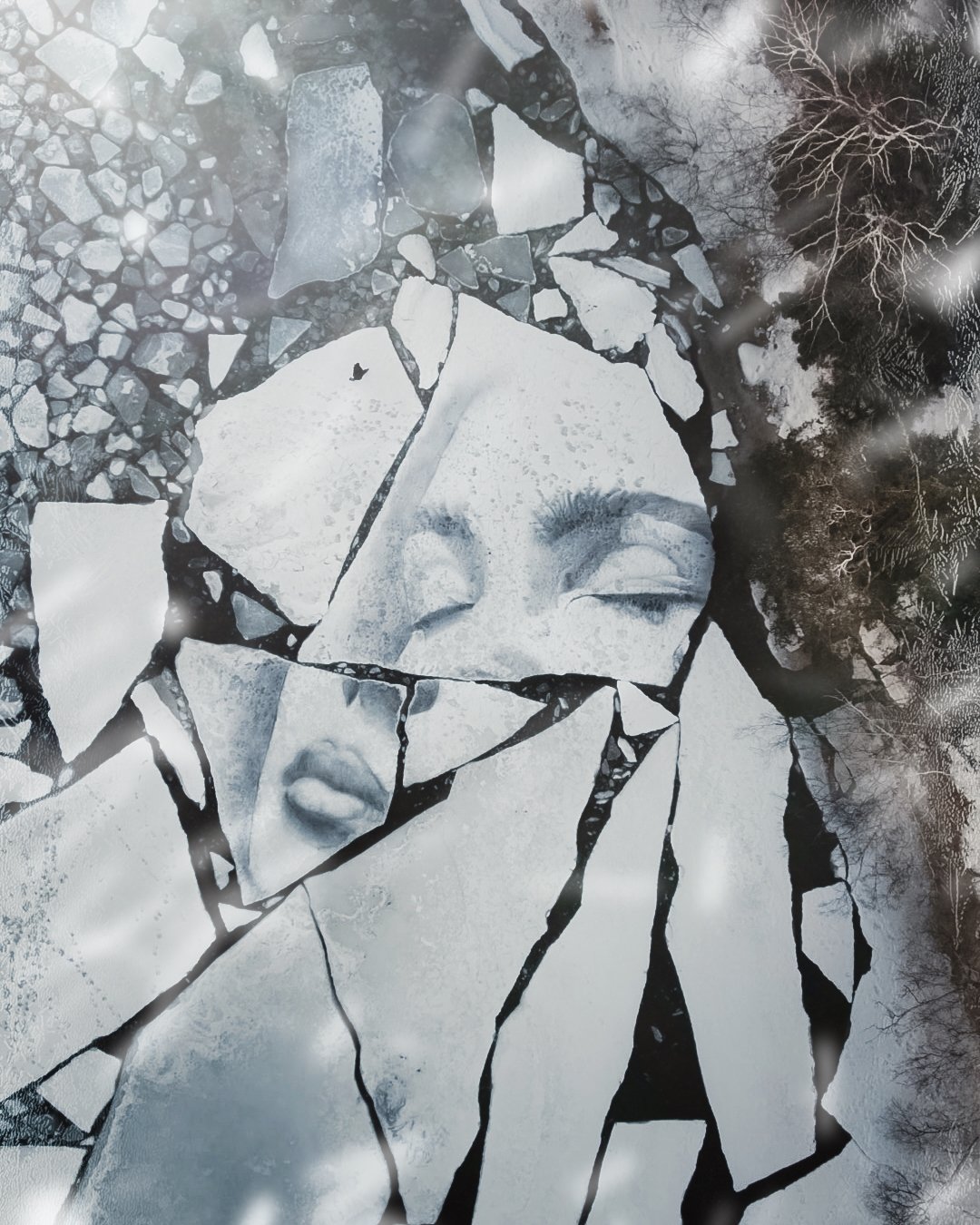
ART PROJECT: Fractured by David Popa: “Fractured is a project located on various ice floes in southern Finland. By use of only earth, charcoal and the source water, a series of portraits were created on fractured ice floes that remained for only a brief time. The pieces were documented via aerial drone video, photography and photogrammetry and hold a tactile form as limited-edition prints as well as in digital form through 1/1 NFTs. The project evolved as a response to the ongoing conflict in Ukraine, which has only further highlighted the fractured state of the world in which we live. During the project, the ice fractured completely unexpectedly at unpredictable times, leaving the artist at odds as to whether continuing the work was even worthwhile. From the ground, one would never be able to decipher any silver linings within the chaos; however, from above, the fragments hold a harmony and beauty that is imperceptible from any other perspective. The work offers a means to point the viewer not to despair and chaos, but rather questions where we must look to mend the broken fragments of our lived reality and perhaps how the fragments can be used to create an entirely new mosaic from the scattered vestiges.”
David Popa (American, 1997–), from the Fractured series, 2023. Iron oxide black earth pigment and charcoal on floating ice.
Explore more of the artist’s work at www.davidpopaart.com. For a printed interview with Popa (featuring many of his amazing photos of his amazing land art), see www.yatzer.com/david-popa.
+++
POEMS: Seven Reimagined Psalms from the Darkling Psalter by Andy Patton:The Darkling Psalter is a project by Andy Patton (MA, Trinity Evangelical Divinity School) to write new creative renditions of the Bible’s 150 psalms. The Rabbit Room recently featured seven of these: Psalms 5, 10, 12, 14, 25, 27, 30.
+++
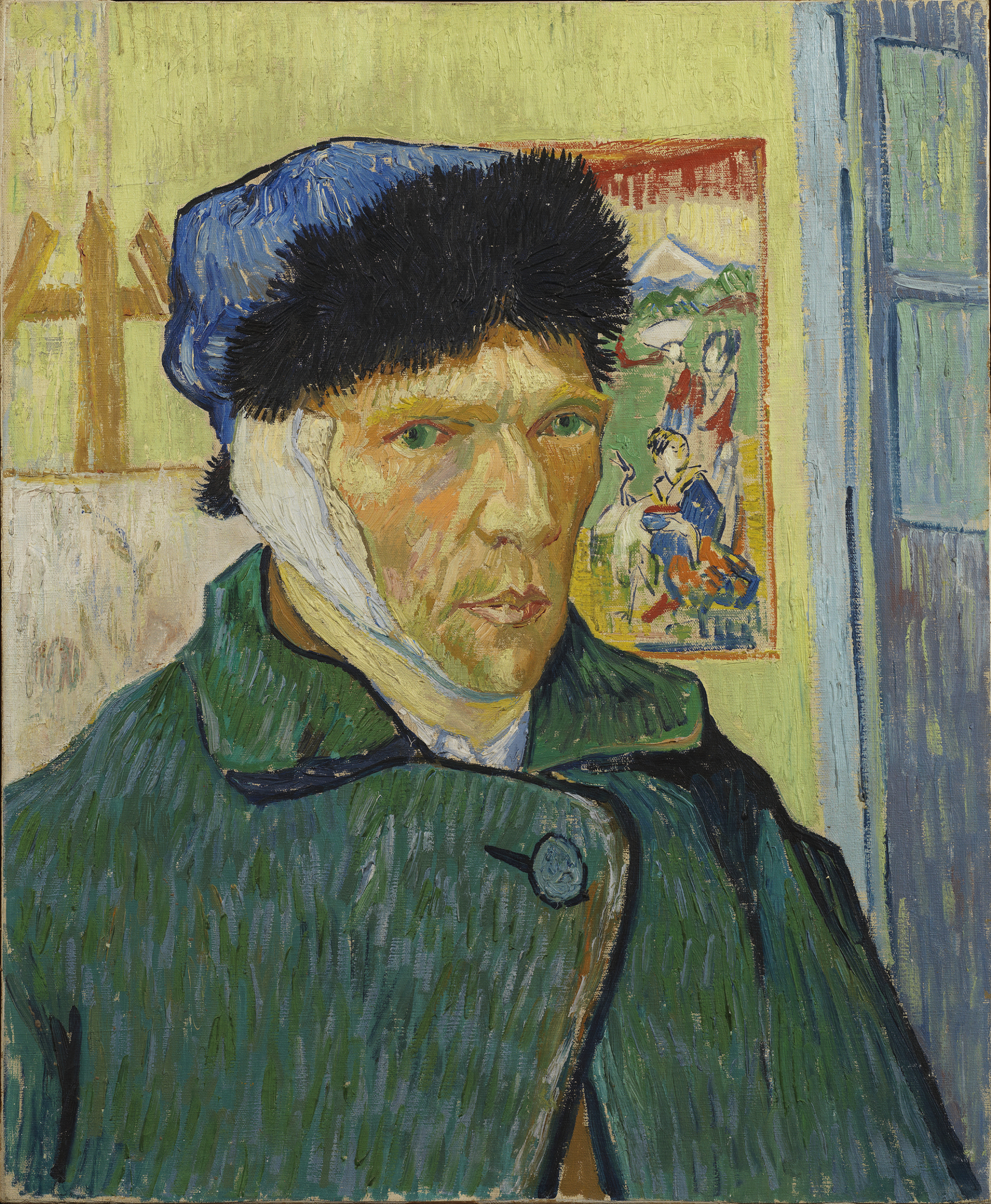
PODCAST INTERVIEW: “Van Gogh Has a Broken Heart, with Russ Ramsey,”Makers & Mystics: I appreciated this recent conversation in which pastor, writer, and arts enthusiast Russ Ramsey discusses his latest book, exploring the struggles and sorrows of a handful of historical artists and how they are reflected in their art.
Vincent van Gogh (Dutch, 1853–1890), Self-Portrait with Bandaged Ear, 1889. Oil on canvas, 60 × 49 cm. Courtauld Gallery, London.
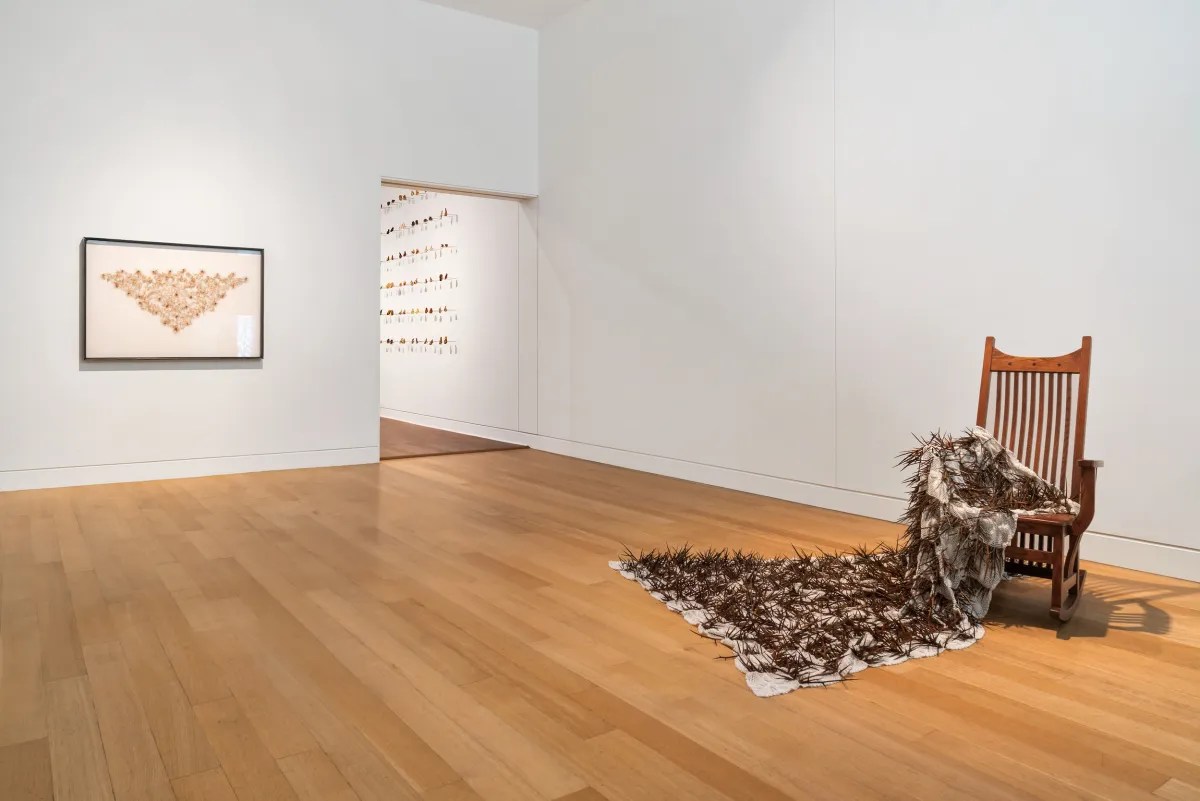
EXHIBITION REVIEW: “Selva Aparicio’s Memorials to Loss and Renewal” by Lori Waxman, Hyperallergic: Mounted last year by the DePaul Art Museum in Chicago, the first solo show of the Barcelona-born artist Selva Aparicio featured works that “offer a merciful focal point for grief.” Aparicio, Waxman writes, “treats unwanted things with extreme sensitivity, personally gathering and storing them over many years, eventually renewing them with remarkable vision.” She reproduced the twice-destroyed rose window of the Basilica de Santa Maria del Pi using lettuce leaves discarded by her neighborhood market; she filled the interior of an upright piano with wasp nests; she constructed over two dozen pairs of decorative ears out of moss, shells, seed pods, animal hair, and other materials for her late cat, Momo, whose ears were removed due to illness; using strands of hair from herself, her mother, and her niece, she sewed a mourning veil, the kind traditionally worn by widows, out of 1,365 cicada wings.
Exhibition view: Selva Aparicio: In Memory Of, DePaul Art Museum, Chicago, 2024. Left: Velo de luto (Mourning Veil) (2020), formed from 1,365 Magicicada wings; right: Solace (2023–24), crochet cotton blanket woven through with honey locust thorns.
I didn’t get to see this exhibition in person, but I’m compelled by what I saw and read of it online—how it deals so tenderly with suffering, death, remembrance, and hope.
+++
SONGS:
>> “Parce mihi Domine” (Spare Me, O Lord): A musical setting of the Latin translation of Job 7:16b–21, this motet by the Spanish Renaissance composer Cristòbal de Morales “captures the sense of desolation and abandonment that is expressed by Job, a dark condition akin to the forsakenness that our Lord experienced on the cross,” writes church music director Ken Myers. In 1994 the Hilliard Ensemble recorded the piece in collaboration with the Norwegian saxophonist Jan Garbarek for their album Officium, a jazz-classical fusion that became one of ECM’s most successful releases, selling over 1.5 million copies.
The video below features a different set of musicians paying tribute to this “unexpected . . . alliance of austere vocal music and wandering saxophone” (Elodie Olson-Coons). Filmed December 18, 2015, at the Chiesa di Sant’Anna (Church of St. Anne) in Cagliari, Italy, the performance is by the vocal ensemble Cantar Lontano (under the direction of Marco Mencoboni) and saxophonist Gavino Murgia. [HT: Global Christian Worship]
After losing his health, wealth, and children, the Old Testament character Job laments openly before God. “I will not restrain my mouth,” he says. “I will speak in the anguish of my spirit; I will complain in the bitterness of my soul” (Job 7:11). He views God as his tormentor and begs God to leave him alone (“spare me”). Adopting Job’s voice, the four singers of the Morales piece sing the following biblical passage:
Parce mihi Domine, nihil enim sunt dies mei. Quid est homo, quia magnificas eum? Aut quid apponis erga eum cor tuum? Visitas cum diluculo, et subito probas illum. Usquequo non parcis michi, nec dimittas me, ut glutiam salivam meam? Peccavi. Quid faciam tibi, o custos hominum? Quare posuisti me contrarium tibi, et factus sum michimet ipsi gravis? Cur non tollis peccatum meum, et quare non aufers iniquitatem meam? Ecce nunc in pulvere dormio; et si mane me quesieris, non subsistam.
English translation (NRSVUE):
Let me alone, for my days are a breath. What are humans, that you make so much of them, that you set your mind on them, visit them every morning, test them every moment? Will you not look away from me for a while, let me alone until I swallow my spittle? If I sin, what do I do to you, you watcher of humanity? Why have you made me your target? Why have I become a burden to you? Why do you not pardon my transgression and take away my iniquity? For now I shall lie in the earth; you will seek me, but I shall not be.
>> “Lamb of God” by The Many: From the EP Have Mercy (2021) by The Many [previously], “an uncommon, intentionally diverse collective making music for people to sing together about peace and justice and a world where all belong.” This song is an adaptation of the ancient Christian liturgical prayer known as the Agnus Dei. The music is by Gary Rand, and the lyrics are by Gary Rand and his daughter, Lenora Rand. Click here to purchase an individual MP3 recording or sheet music, or visit the group’s Bandcamp page.
Lamb of God, with love poured out you suffer with the world. Have mercy. Have mercy. Lamb of God who suffers with the world, grant us peace, grant us peace.
“The wild animals honor me, the jackals and the owls, because I provide water in the wilderness and streams in the wasteland . . .”
—Isaiah 43:20 (NIV)
This verse from the prophetic book of Isaiah supplies the title of artist Josh Tiessen’s Streams in the Wasteland series. Comprising seventeen paintings of wild animals inhabiting abandoned cities, it took six years to complete, from 2015 to 2021. In this body of work Tiessen weds a biblical imagination with his passion for wildlife conservation to promote ecological ethics, or what Christians call “creation care”—the biblical imperative to be benevolent stewards of the environment and all its creatures. He says he wants to represent “the majesty, particularity, and beauty of animals” (Streams in the Wasteland, p. 33)—to evoke wonder, love, and empathy, and a greater sense of responsibility.
“The whole creation has been groaning,” the apostle Paul writes in Romans 8, seeking to “be liberated from its bondage to decay and brought into the freedom and glory of the children of God.” Creation has been damaged in large part by humanity’s sin, which has caused deforestation, land degradation, ozone depletion, and species endangerment and extinction, among other harms. Instead of enjoying the full flourishing God intended, the natural world suffers.
Streams in the Wasteland engages with the question, What would the liberation of animals from the bondage to decay look like? Some of Tiessen’s creative visual responses:
An Indian temple elephant breaks free of its shackles, no more to be prodded and paraded for the people’s religious festivals.
Released from aquarium amusement parks where they were exploited for entertainment, a pod of orcas journeys down a canyon river into the ocean past their ancestors’ skeletal remains, which will one day rise.
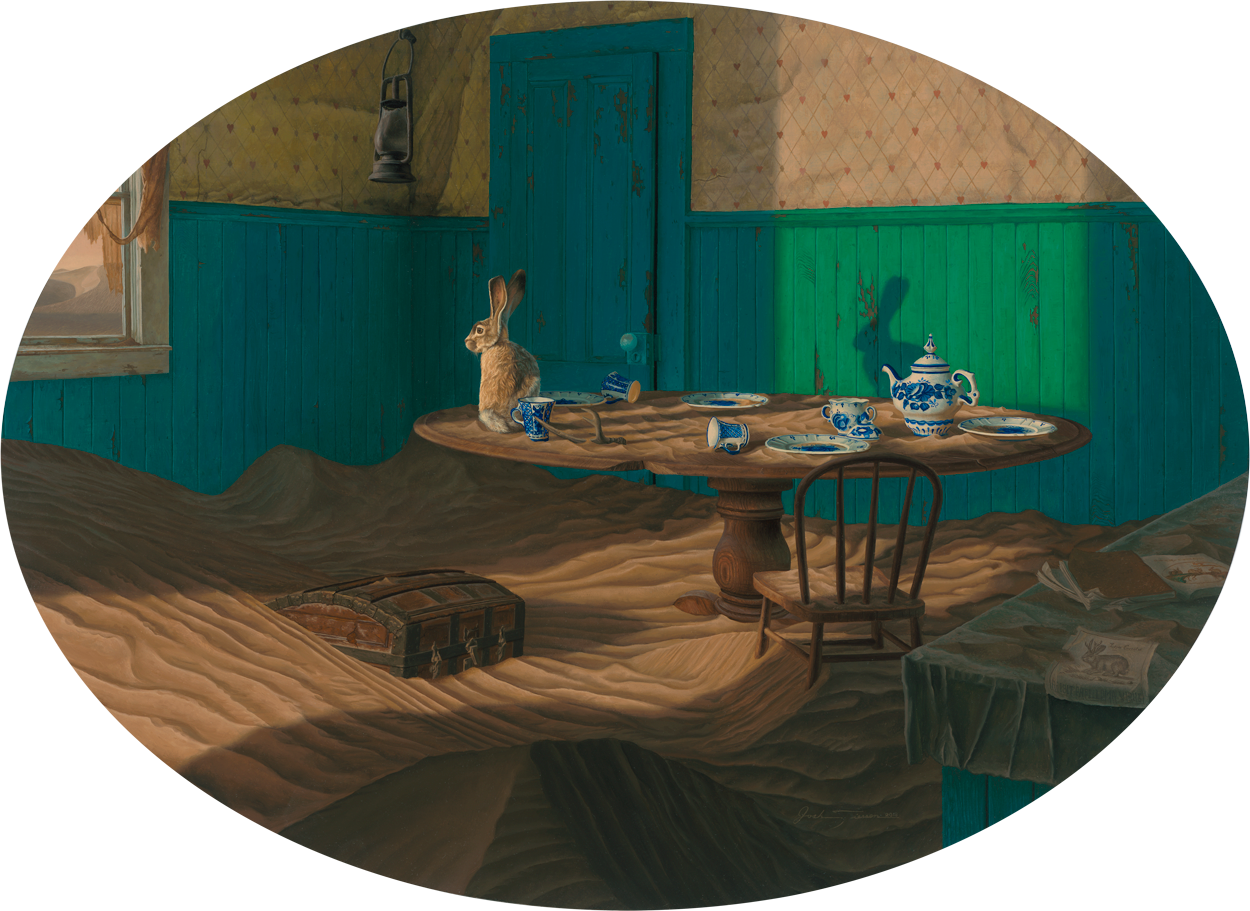
A jackalope—the mythical horned rabbit of North American folklore—sheds its antlers, a passing shadow of the old world. Rabbits with hornlike protrusions on or near their heads have actually been found in nature, the cancerous growths a result of a papillomavirus.
Josh Tiessen (Canadian, 1995–), Liberation of the Jackalope, 2018. Oil on braced Baltic birch, 21 × 29 in.
Tiessen calls his style “narrative hypersurrealism,” as he renders the animals with technical precision and great attention to naturalistic detail (hyperrealism) but places them in a postapocalyptic context, revealing strange beauty in the unexpected (surrealism). And in contrast to traditional wildlife art, Tiessen’s art tells a story. For Streams in the Wasteland, that story is one of reclamation and healing—but also one of warning for those who neglect God’s laws.
In preparation for this series, Tiessen wrote a research paper on zoological motifs in the book of Isaiah. He found that in several prophecies of judgment, God gives animals dominion over human civilization—an ironic reversal, the “weak” shaming the powerful.
Babylon, the jewel of kingdoms, the pride and glory of the Babylonians, will be overthrown by God like Sodom and Gomorrah. She will never be inhabited or lived in through all generations; there no nomads will pitch their tents, there no shepherds will rest their flocks. But desert creatures will lie there, jackals will fill her houses; there the owls will dwell, and there the wild goats will leap about. Hyenas will inhabit her strongholds, jackals her luxurious palaces. Her time is at hand, and her days will not be prolonged.
In addition to Babylon, Isaiah indicts other unjust nations: in Cush the fruit of the vine “will all be left to the mountain birds of prey” (18:6), and in Edom “the desert owl and screech owl will possess it; the great owl and the raven will nest there” (34:11). Concerning the kingdom of Judah: moles and bats will take over idols of silver and gold (2:20), lambs will feed on the food of the rich (5:17), and Jerusalem will become void of human activity and instead be “the delight of donkeys, a pasture for flocks” (32:14). It’s not just nocturnal animals and scavengers that crop up, but also harmless ones like foals and sheep.
Returning to the opening quote of this article, we see that Isaiah describes an eschatological reality in which God’s abundant provision elicits thanksgiving and praise from the animal kingdom. But they are Israel’s foil: whereas the animals are sensible of God’s goodness, God’s people are not. “Yet you have not called on me, Jacob. . . . You have burdened me with your sins and wearied me with your offenses” (43:22, 24).
Tiessen understands such animals “as the Creator’s special agents worthy of intrinsic value and a role in history. I caught a glimpse of Isaiah’s larger vision for animals serving as co-workers with the Creator to confront humanity, calling from within the ruins of human moral decay” (Streams in the Wasteland, p. 22).
Therefore, in Streams in the Wasteland, a barn owl stakes its place on a plinth of a Gothic cathedral alongside sculptures of the saints, meerkats lounge on a chaise inside a Baroque manor, lar gibbons swing from the entryway of a university, and a pack of spotted hyenas wanders through Bodie, a California Gold Rush boomtown known for its sin, now a ghost town.
Josh Tiessen (Canadian, 1995–), Occidental Babylon, 2017. Oil on braced Baltic birch, 52 × 75 in.
I’m very familiar with the Isaiah passages where creatures are presented as blessings of Edenic hope for the future, existing peaceably with humans (e.g., Isa. 11:6–9), but I had never really stopped to consider all the places where they are said to overtake what we deem human domains. Such passages are certainly more uncomfortable for us humans!
Though humans’ neglect or mistreatment of animals is not specifically what prompts God’s pledged use of animals to shame the rebellious nations, surely our disregard for the creation mandate in Genesis—to rule the earth with care and compassion—is a form of rebellion against God. And so Tiessen extends his reading of Isaiah to address that call in particular, which is echoed in other parts of scripture, such as Proverbs 12:10: “The righteous care for the needs of their animals.” By placing animals in human habitations, Tiessen compels us to remember our obligations to our nonhuman neighbors.
Perhaps my favorite painting from Tiessen’s series is Whale Hymn. The setting is the ruined shell of St. Dunstan-in-the-East, a twelfth-century church that once towered over the city of London but that was irreparably bombed during World War II. It has since been converted into a public garden. In his futuristic vision, Tiessen imagines it surrounded by floodwaters, a humpback whale swimming by. This giant of the deep sings its song to the Creator in the same place where generation after generation of Christians sang their praises until human violence rendered the building unusable.
Josh Tiessen (Canadian, 1995–), Whale Hymn, 2015. Oil on braced Baltic birch, 36 × 48 in.
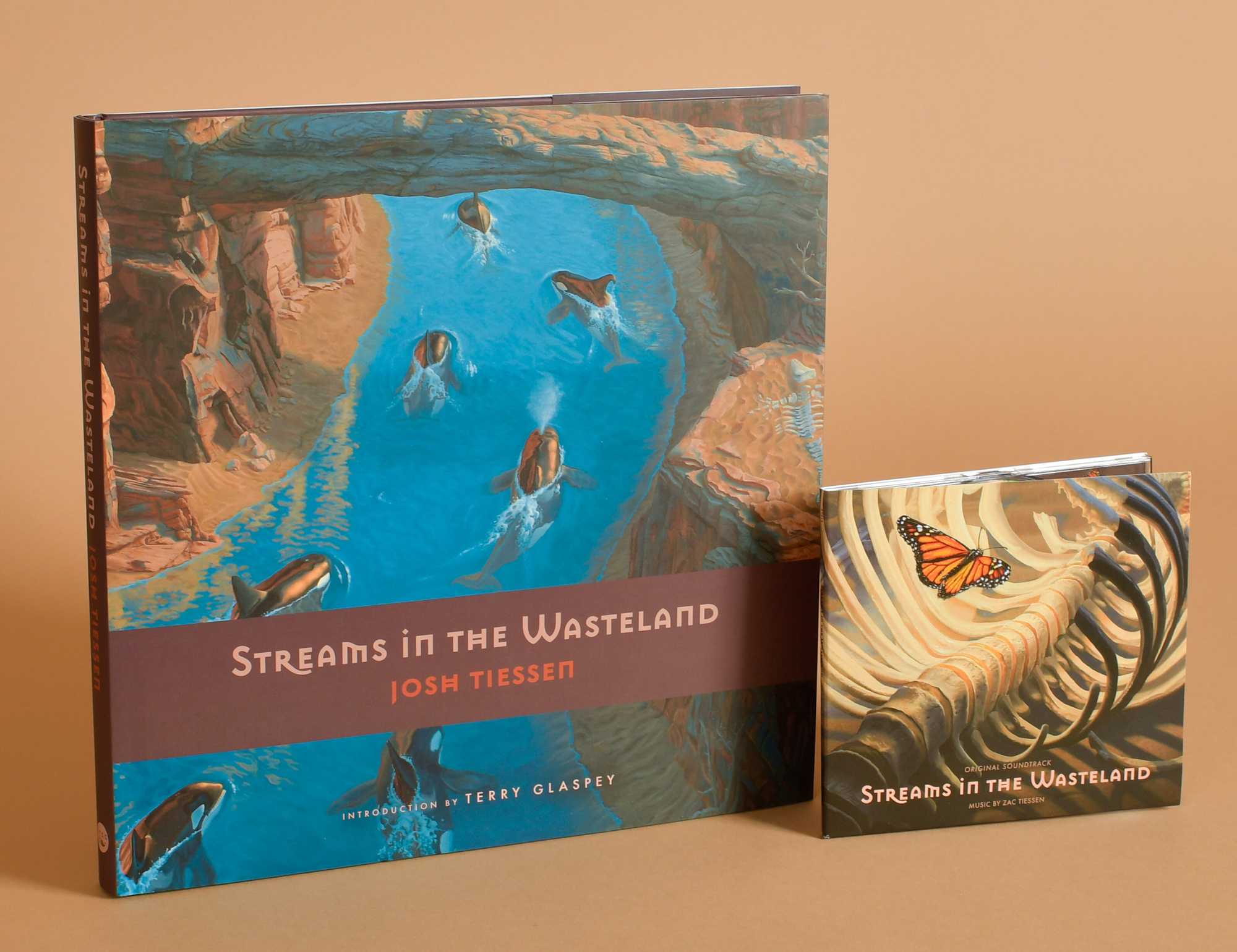
Isaiah is not the only biblical source of inspiration for Tiessen. Ezekiel’s vision in the valley of dry bones inspired Can These Bones Live?, which shows a monarch butterfly gliding through the ribcage of a human skeleton, and its sequel, Rise Up—the only two paintings with human figures.
Tiessen was born in 1995 in Moscow to Canadian missionary parents. His Russian nanny, Lena Zhuk, taught him drawing basics, like perspective and shading, and, when he showed aptitude, bought him his first set of tempera paints, brushes, large heavy paper, and other materials. When he and his family moved back to Canada, Valerie Jones, a fellow church member and artist, noticed his talent and got him his first public art exhibition at age eleven. Then when Tiessen was fifteen, Canadian wildlife artist Robert Bateman took him on as a student and mentee. He graduated from high school at age sixteen and began exhibiting throughout North America while working on a bachelor’s of religious education in arts and biblical studies at Emmanuel Bible College in Kitchener, Ontario, which he earned in 2020. His professional memberships include Artists for Conservation, the Society of Animal Artists, and the International Guild of Realism.
He currently lives in Stoney Creek, Ontario.
Tiessen has self-published a hardcover, glossy-paged, full-color book that collates all the works from Streams in the Wasteland, providing commentary on them (additional to that on his website), which includes engagement with scholarly interpretations of the Isaiah passages. Through sketches and more, he sheds light on his artistic process and also provides autobiographical information. The book comes with a CD of instrumental compositions by his brother Zac Tiessen that respond to each of the paintings—an atmospheric soundscape. It would make a great gift.
The culmination of the series is Agnus Dei, a triptych featuring all the animals in the individual paintings gathering around a horned altar where the Lamb of God lies slain. Tiessen drew inspiration from Jan van Eyck’s Adoration of the Mystic Lamb, Francisco de Zurbarán’s Agnus Dei, and the paintings of Caspar David Friedrich featuring abandoned abbeys, churches, and cemeteries in winter.
Instead of saints from the Homo sapiens species surrounding the Lamb in worship, Tiessen shows a giant panda, a double-wattled cassowary, a narwhal, and other animals paying homage to Christ. They, too, are drawn up into God’s awesome story of redemption. They, too, participate in the “new thing” God is doing.
“My painting is . . . a critique of the human-centric bias within Western art history,” Tiessen writes. “This is best seen in Renaissance paintings where animals seldom appear, and if they do, it is simply for allegorical purposes. By enlisting wild animals as protagonists with intrinsic value amidst the wasteland of human existence, I endeavor to revise Western art history through a zoological lens, liberating the Judeo-Christian worldview from its perversion at the hands of anthropocentric Greek philosophy.”
This final image shows animals liberated from the effects of the fall, honoring the One whose atoning death and resurrection reconciles all to God (Col. 1:19–20).
To see which of these paintings are available for purchase—either the originals or reproductions or notecards—visit https://www.joshtiessen.com/store.
For as the lightning comes from the east and flashes as far as the west, so will be the coming of the Son of Man.
—Matthew 24:27
Then I saw heaven opened, and there was a white horse! Its rider is called Faithful and True, and in righteousness he judges and makes war. His eyes are like a flame of fire, and on his head are many diadems; and he has a name inscribed that no one knows but himself. He is clothed in a robe dipped in blood, and his name is called The Word of God.
—Revelation 19:11–13
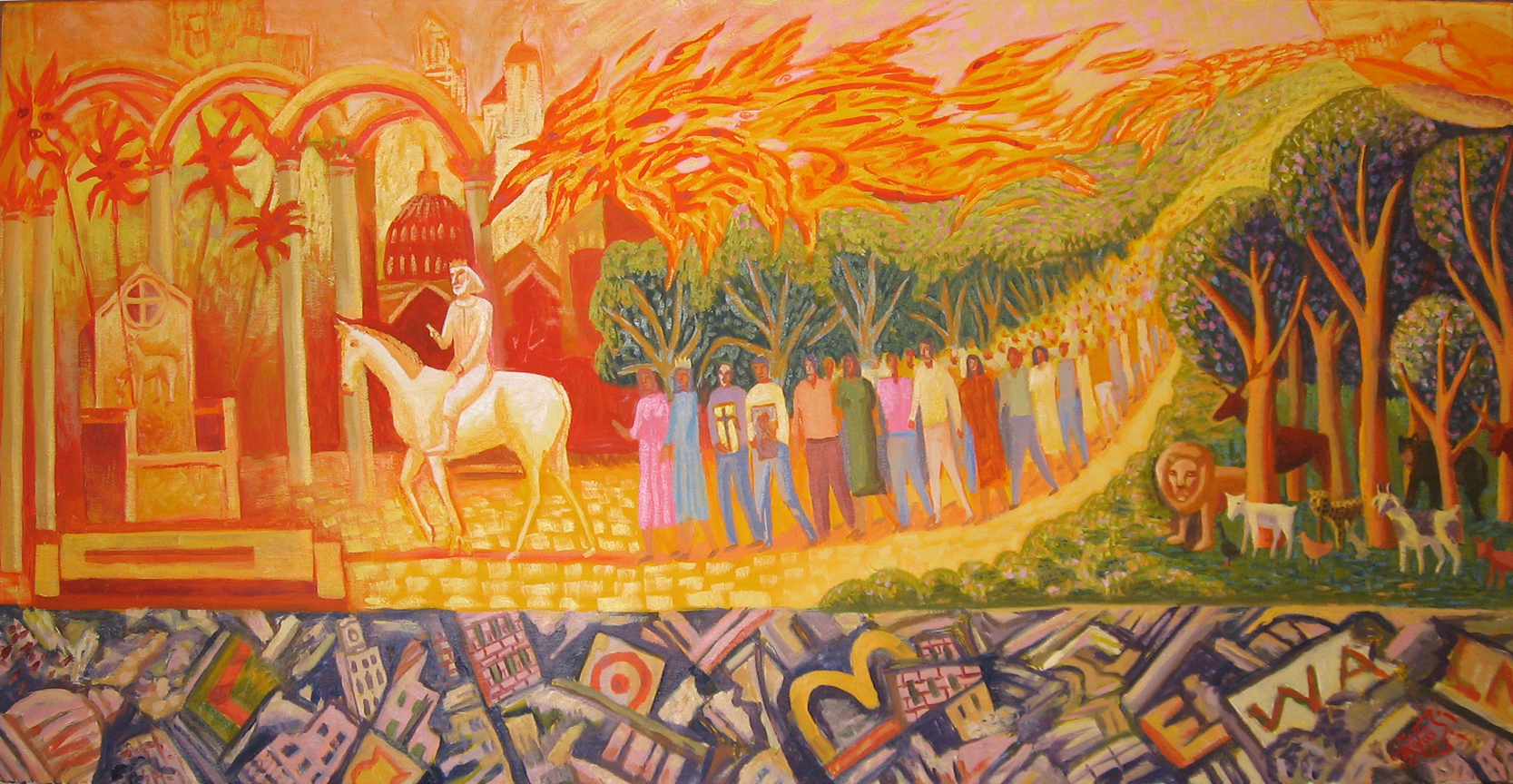
LOOK: Jesus Rides a White Horse by James B. Janknegt
There are hundreds of thousands of musical works, from a range of genres, inspired by Christ’s passion, especially his death on the cross, which, along with the resurrection, is the centerpiece of the Christian faith. I’ve curated just a sampling of these on Spotify, from across time periods and countries, to serve as an aural guide through the final week of Jesus’s life. The drama begins with Christ’s triumphal entry into Jerusalem on a donkey, where he’s hailed with hosannas, and then continues with a last supper shared with his disciples, an agonized prayer in Gethsemane followed by betrayal and arrest, then, all in one day, multiple trials (religious and civil), conviction by mob, a public execution, and burial. Many of the playlist selections are narrative in character, while some have a more theological bent. My hope is that these pieces aid you in observing this most holy of weeks, walking with Christ through the shadows, taking in how “he himself bore our sins in his body on the tree, that we might die to sin and live to righteousness. By his wounds [we] have been healed” (1 Pet. 2:24).
To add the playlist to your account, open the Art & Theology Holy Week Playlist link, then click on the More (…) icon and select “Save to Library.”
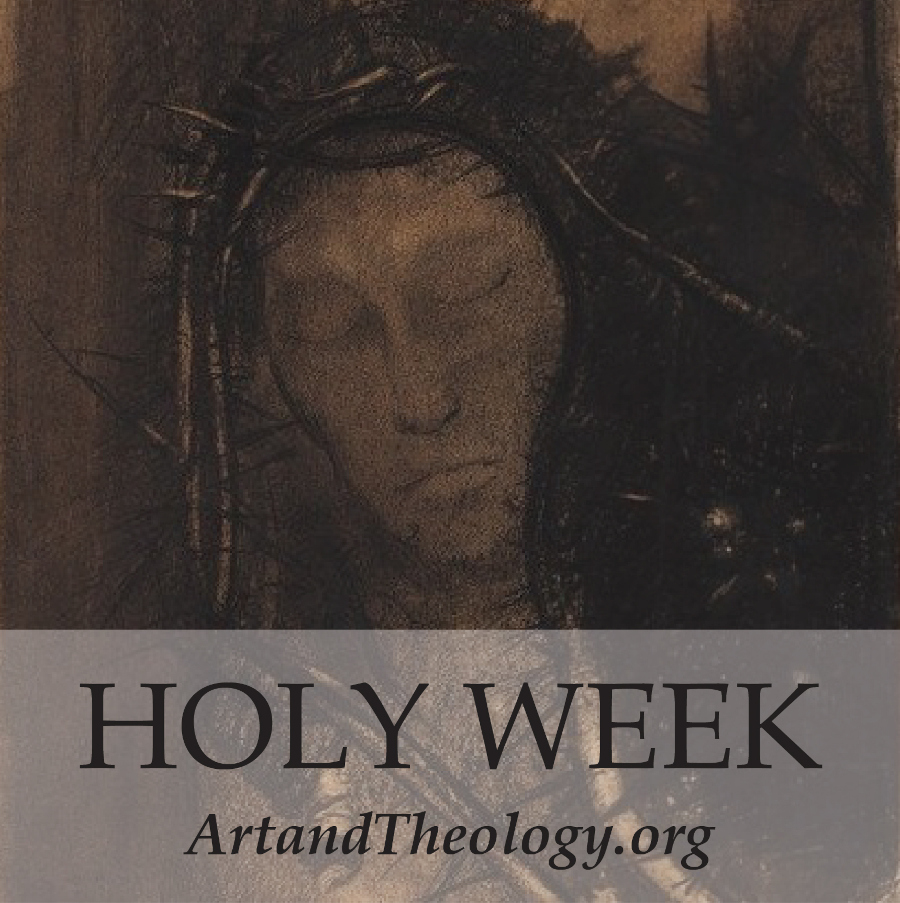
[Playlist cover art: Odilon Redon, Christ, ca. 1895, charcoal, chalk, pastel, and pencil on paper, Museum of Modern Art, New York]
The playlist is a mixture of classical and popular (indie-folk, gospel) music. In this post I want to provide a little context for some of the pieces, by which I mainly mean translations of all the non-English lyrics. Because of what you see here, you might get the wrong impression that the list is almost entirely classical; actually, it’s only about half.
The opening track, “Herr, unser Herrscher” (Lord, Our Ruler), is a unique arrangement of the opening chorus from Johann Sebastian Bach’s St. John Passion, a Good Friday oratorio in German.
Herr, unser Herrscher, dessen Ruhm
In allen Landen herrlich ist!
  Zeig uns durch deine Passion,
  Daß du, der wahre Gottessohn,
  Zu aller Zeit,
  Auch in der größten Niedrigkeit,
  Verherrlicht worden bist!
Lord, our ruler, whose fame
In every land is glorious!
  Show us, through your passion,
  That you, the true Son of God,
  Through all time,
  Even in the greatest humiliation,
  Have become transfigured! [source]
Unique, because the Baroque choir and orchestra are accompanied by an ensemble of Gabonese musicians who contribute their own rhythmic profile, along with solo percussionists Sami Ateba from Cameroon and Naná Vasconcelos from Brazil. The recording, rereleased on the compilation album Babel (2008), is originally from Lambarena: Bach to Africa (1995), a collaboration between French composer and producer Hughes de Courson and Gabonese composer and guitarist Pierre Akendengué, synthesizing two disparate sound worlds. (“Bombé / Ruht wohl, ruht wohl, ihr heiligen Gebeine” is another highlight from the album. For weeks I debated whether to include it on this playlist—adding it, taking it off, adding it back again—ultimately deciding to leave it off, the reason being that it overlays Bach’s choral rondo with music and invocations to the dead from a Bwiti religious ritual. Though sonically compelling and worth listening to, I felt that it might impede some Christians’ ability to engage this list in a devotional way; so I opted for a traditional Western classical recording instead.)
Other selections from Bach’s St. John Passion are:
>> “Christus, der uns selig macht”
Christus, der uns selig macht,
Kein Bös’ hat begangen,
Der ward für uns in der Nacht
Als ein Dieb gefangen,
Geführt für gottlose Leut
Und fälschlich verklaget,
Verlacht, verhöhnt und verspeit,
Wie denn die Schrift saget.
Christ, who makes us blessed,
committed no evil deed,
for us he was taken in the night
like a thief,
led before godless people
and falsely accused,
scorned, shamed, and spat upon,
as the scripture says. [source]
>> “Petrus, der nicht denkt zurück”
Petrus, der nicht denkt zurück,
Seinen Gott verneinet,
Der doch auf ein' ernsten Blick
Bitterlichen weinet.
Jesu, blicke mich auch an,
Wenn ich nicht will büßen;
Wenn ich Böses hab getan,
Rühre mein Gewissen!
Peter, who did not recollect,
denied his God,
who yet after a serious glance
wept bitterly.
Jesus, look upon me also,
when I will not repent;
when I have done evil,
stir my conscience! [source]
>> “O große Lieb”
O große Lieb, O Lieb ohn alle Maße,
Die dich gebracht auf diese Marterstraße!
Ich lebte mit der Welt in Lust und Freuden,
Und du mußt leiden.
O great love, O love beyond measure,
that brought you to this path of martyrdom!
I lived with the world in delight and joy,
and you had to suffer. [source]
>> “Ruht wohl, ihr heiligen Gebeine”
Ruht wohl, ihr heiligen Gebeine,
Die ich nun weiter nicht beweine,
Ruht wohl und bringt auch mich zur Ruh!
Das Grab, so euch bestimmet ist
Und ferner keine Not umschließt,
Macht mir den Himmel auf und schließt die Hölle zu.
Rest well, you blessed limbs;
now I will no longer mourn you.
Rest well and bring me also to peace!
The grave that is allotted to you
and encloses no further suffering
opens heaven for me and closes off hell. [source]
For Bach’s St. Matthew Passion—one of the most celebrated works of classical sacred music ever written, right up there with Handel’s Messiah—I’ve drawn from the abridged English version (rather than the original German), translated by the Rev. Dr. John Troutbeck and performed in 1962 by the New York Philharmonic and Collegiate Chorale under the direction of Leonard Bernstein. I chose just a few pieces from it, not wishing to replicate the whole thing; as you can see, I tend to favor chorales over arias.




 Art & Theology