
“River” by Eugene McDaniels (song)

There’s a river somewhere
That flows through the lives of everyone
I know it flows through the valleys
And the mountains and the meadows of time
Yes, it do

There’s a star in the sky
That shines in the lives of everyone
You know it shines in the valleys
And the mountains and the meadows of time
Yes, it do

There’s a voice from the past
That speaks through the lives of everyone
You know it speaks through the valleys
And the mountains and the meadows of time
Yes, it do

There’s a smile in your eyes
That brightens the lives of everyone
It brightens the valleys
And the mountains and the meadows of time
Yes, it do

There is a short song of love
That sings through the lives of everyone
You know it sings through the valleys
And the mountains and the meadows of time
Yes, it do

There’s a river somewhere
That flows through the lives of everyone
I know it flows through the valleys
And the mountains and the meadows of time
Yes, it do

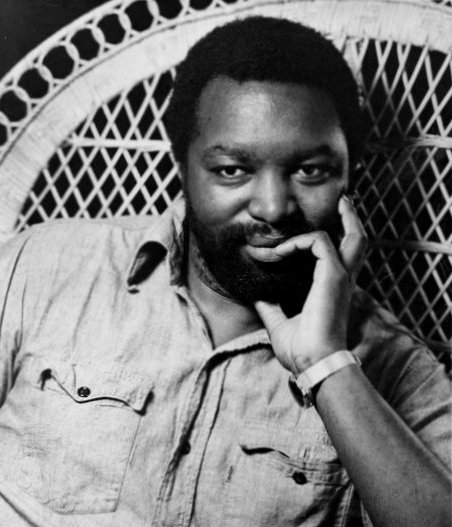
The folk-funk song “River” is by the American singer-songwriter and music producer Eugene McDaniels (1935–2011). He first recorded it with his band Universal Jones on a self-titled album (the group’s only output) in 1972, and he recorded it again, with a synth, on his solo album Natural Juices in 1975.

McDaniels grew up in Omaha, Nebraska, singing gospel music in church. He gained fame in the early 1960s as a clean-cut soul singer—he went by “Gene” at the time—and then surprised everyone in 1970 and 1971 with Outlaw and Headless Heroes of the Apocalypse, containing antiwar, antiestablishment songs performed in a much more experimental style. Universal Jones (1972) is innocuous by comparison, though it still embraces the counterculture. The genres of folk, rock, jazz, gospel, soul, funk, and even proto-rap—often creatively mixed—are all represented in McDaniels’s oeuvre.

Universal Jones cover
From left to right: Eugene McDaniels, Sister Charlotte, Leon Pendarvis, Maurice McKinley, Bob Woos

In the Bible, water connotes blessing, refreshment, life, hope, and abundance. “Flowing streams,” writes the Rev. J. Stafford Wright, “are parables of the flowing life of God.” Wright was referring in particular to one of Ezekiel’s visions, where an unnamed guide leads the prophet through a river that issues forth from the temple in Jerusalem (Ezek. 47:1–12). The guide says,

This water flows toward the eastern region and goes down into the Arabah, and when it enters the sea, the sea of stagnant waters, the water will become fresh. Wherever the river goes, every living creature that swarms will live, and there will be very many fish once these waters reach there. It will become fresh, and everything will live where the river goes.

He then goes on to describe the verdant trees on either side of the riverbank:

Their leaves will not wither nor their fruit fail, but they will bear fresh fruit every month, because the water for them flows from the sanctuary. Their fruit will be for food and their leaves for healing.

Sounds a lot like John’s eschatological vision in Revelation 22, where a river flows down from God’s throne, watering the tree of life, which is for the healing of nations. There are also similar passages in the Minor Prophets: “A fountain shall flow from the house of the LORD” (Joel 3:18); “And in that day it shall be that living waters shall flow from Jerusalem” (Zech. 14:8). God is understood as the source of these waters, which signify an invisible, spiritual reality.

(Related posts: https://artandtheology.org/2022/04/02/lent-28/; https://artandtheology.org/2022/12/11/advent-day-15-great-joy-river/)

When Jesus comes onto the scene, he talks about “rivers of living water” flowing out of the hearts of believers (John 7:38–39), “spring[s] of water welling up to eternal life” (John 4:13–14). God dwells in humanity, and thus the life God gives springs up from within us and vitalizes the wider world.

I don’t know whether McDaniels had any of these biblical texts in mind when he wrote “River.” But a river, a star, a voice, a song of love—these signal to me the Divine moving, shining, speaking, singing into the lives of humanity. Through the ups and downs of history, the ancient will has worked and is continuing to work, revealing itself to those who look, listen, and follow. Ecclesiastes 3:11 says that God has “set eternity in the human heart.” We possess a moral consciousness and spiritual yearning.

To me, “River” is about recognizing the blessing poured out on the world from the heart of God, about tuning in to the unseen truths embedded in the fabric of the universe. It speaks of God’s all-brightening smile (God’s pleasure in his creation), his whispers of our belovedness, and the river-flow of his goodness.

The song has been covered a handful of times over the years and across the globe, including by:

Further, in 1975 the California bluesman J. C. Burris adapted it both lyrically and musically and recorded it under the title “River of Life” on his album Blues Professor:

Bernice Johnson Reagon, a song leader and civil rights activist, uses Burris’s lyrics in her cover on River of Life: Harmony One (1986), overdubbing her voice singing multiple parts in an a cappella tour de force:

There’s a river somewhere
That flows through the life
Of everyone
And it flows through the mountains
And down through the meadow
Under the sun

There’s a star in the sky
That brightens up the life
Of everyone
They can see the life of happiness
Along with the future
Of the lonely one

Yes, it is

There’s a voice from the valley
That speaks to the mind
Of everyone
And it talks about the future
Along with the joy
Of the sorrowed one

Put a smile on your face
And brighten up the day
For everyone
And live your life of happiness
Along with the sick and lonely
And sorrowed one

Yes, it is

There’s a river somewhere
That flows through the life
Of everyone
And it flows from the mountain
Down through the meadow
Under the sun

There’s a sky full of diamonds
That brightens up the life
Of everyone
Then they can see the life of happiness
Along with the future
Of the lonely one

Yes, it is

The main revision by Burris comes at the end of each verse, where he mentions the lonely, the sick, and the sorrowful. They have a special place of belonging in God’s heart and plans. Jesus’s ministry was to such as these. Blessed are the poor and those who mourn, he said, for theirs is the kingdom of heaven.

Burris encourages us to come alongside those who are hurting with love and inclusion, and to look with them into God’s promised future, where the oppressed are liberated, the sick are healed, the silenced go out singing, and mourning is turned to dancing. Contra the cynicism of “the Preacher” who penned Ecclesiastes, there is something new under the sun! For those with eyes to see it, God is in the process of making all things new (Rev. 21:5).

Abby the Spoon Lady, Americana percussionist

Abby Roach, known as Abby the Spoon Lady, is an American roots musician from Kansas, specializing in playing the spoons. It’s a skill she picked up in her late twenties while hopping freight trains around the United States and staying in homeless encampments. (A Peruvian man named Gil taught her.) Since then she has made a living performing primarily on the streets, creating a variety of sounds and rhythms with the simple castanet-like instrument. Her repertoire consists of early jazz, gospel, ragtime, country blues, jug band, Western swing, and Appalachian folk.

Abby grew up in Wichita but left her hometown at age twenty-five to start a new life. “Homeless by choice,” she used Nashville as a hub for a while until the police started discouraging busking in 2012. She spent 2013 to 2019 in Asheville, North Carolina, where she struck up a musical partnership with singer-guitarist Chris Rodrigues. The two are featured in Erin Derham’s Buskin’ Blues (2015) (watch for free!), an hour-long documentary about the street performance culture in Asheville, and they recorded an album together, Working on Wall Street (2017), titled after the picturesque side street where they regularly performed.

In Asheville Abby hosted a weekly radio broadcast at WPVM 103.7 FM and became president of the Asheville Buskers Collective, advocating for the interests of the busking community to the city council and local businesses. 

“The real reason that street performance is important, and the reason it should be preserved, is because it turns our sidewalks into our front porch,” Abby says. “Since the invention of the air conditioner, we have all gone inside. Nobody’s sharing anything anymore. Nothing’s raw anymore. And when you do experience any kind of culture, it’s through a lens of some sort—on a screen. What street performance provides is a live avenue where people can experience, witness, and even sometimes partake in these cultures, and have it put in front of them.”

In 2019 Abby moved back to Kansas, purchasing a little green bus that she converted into a mobile home and, more recently, a house in Winfield, which she is fixing up. She releases YouTube videos through what she calls Spooniversal Studios, sharing music and stories, and travels the US, performing outside in downtown areas, at festivals, and at small music venues. Besides Rodrigues, she has also performed with the Tater Boys (Tub Martin and Dusty Whytis), the Steel City Jug Slammers, Matt Kinman, Les Blackwell, and others. Though the spoons are her primary instrument, she also plays the mountain dulcimer and the musical saw.

Abby doesn’t romanticize the nomadic life; she says it’s dangerous (especially for women), dirty, tiring, and often lonely. People love to ask her about her train-hopping days, and while she does have tales to regale, she emphatically warns folks not to ride freight trains—you don’t need to do that to be free, she says.

Below are filmed performances of some of the traditional gospel songs Abby has done over the past five years, starting with “Angels in Heaven” (aka “I Know I Been Changed”), which went viral in 2017 and currently has over 59 million views! Her beagle, Willie, often appears in the videos.

“John the Revelator,” which intersperses a refrain about the apostle John writing the Apocalypse with verses about Adam hiding from God in Eden, Jesus in Gethsemane the night of his arrest, and Jesus on Easter morning commissioning Mary Magdalene to preach the Resurrection:

“Jesus on the Mainline,” about how Jesus is always available to talk to:

“Don’t Let the Devil Ride,” not giving sin a foothold:

“Soldier in the Army of the Lord”:

“Gospel Plow,” a call to perseverance:

“Laid My Burden Down”:

“Ain’t No Grave” (a version of this song appears on Abby’s 2020 album with the Tater Boys, In the Dirt and Thriving):

“He’s Got the Whole World in His Hands”:

“I Feel the Lord Stretching Out in Me” (“I feel the Lord stretching out in me. I cleaned up my house, and I kicked the devil out. I feel the Lord stretching out in me!”):

You can support Abby the Spoon Lady through PayPal or Venmo (@SPOONIVERSALSTUDIOS), or by purchasing merchandise. View her travel schedule here, and follow her on Facebook and Twitter.

American Folk Songs for Christmas, compiled by Ruth Crawford Seeger

Ruth Crawford Seeger (1901–1953) was a pioneering American folk music specialist who selected, transcribed, and placed songs from the vast collections of the Lomax family and others into published works for use in primary schools and homes. Her mission was, in her own words, “to give back to the people songs that belong to them.” [1]

A conservatory-trained musician and budding modernist composer who spent a Guggenheim year in Europe, Ruth shifted her career goals in 1936 when a move to Washington, DC, brought her into proximity of the Archive of American Folk Song and ignited her passion for the homespun music of her own country. Work songs, love songs, prison songs, dance songs, hollers, chants, spirituals, blues, Cajun tunes, ballads with archaic tonal textures—all these and more were preserved on hundreds of aluminum and acetate discs or magnetic tape and wire at the initiative of traveling ethnomusicologists but at the time were mostly unknown outside the small communities of which they were a part.

Ruth’s relocation to the nation’s capital was prompted by her music scholar husband Charles Seeger’s being hired onto the Works Progress Administration’s Federal Music Project, a New Deal program to employ musicians, conductors, and composers during the Great Depression and to promote music appreciation and training. Charles’s job was to set up music recreation programs across the US—to get every American singing, playing an instrument, or both. Ruth absorbed his enthusiasm and through his work came to know the folk song collectors John A. Lomax and his son, Alan, who frequently brought folk singers from their recording sessions at the Library of Congress to evening singing sessions and instrumental jams at the Seegers’s Silver Spring, Maryland, home. [2]

Ruth began transcribing and arranging some of the music she was hearing from guests and at traditional music festivals, and John Lomax took notice, enlisting her transcription expertise for two publication projects. She spent many hours at an Ansley turntable, notating texts, melodies, and rhythms so that the musical treasures created and sung in various pockets of the country and collected by her colleagues could be available in print for children’s education and home entertainment, deepening American cultural awareness and celebration.

Ruth keenly felt an urgency to save American folk songs from extinction. Toiling deep in the archives of the Library of Congress alongside the famed father, son, and daughter musicologist team of John Avery Lomax, Alan Lomax, and Bess Lomax Hawes, she sifted through their 10,000 field recordings of native singers and transcribed songs. She helped the Lomaxes produce two sweeping surveys of “people’s music,” Our Singing Country (1941) and Best Loved American Folk Songs (1947), creating notated versions for over 300 folk songs (the second anthology with the help of both her husband Charles Seeger and her stepson Pete Seeger). Fluent in both languages of music, formal and primitive, she moved easily from avant-garde elite to New Deal populist and became the bridge between modern urban and rural traditional music. . . .

American Folk Songs for Christmas (1953) was Ruth Crawford Seeger’s third songbook in a trilogy of inspired generosity: American Folk Songs for Children (1948) and Animal Folk Songs for Children (1950), in addition to an earlier book of piano arrangements, Twenty-Two American Folk Tunes (1937). Tragically, her life was cut short when she died of cancer the very same year this Christmas anthology was published. But Ruth raised her children Mike, Peggy, Penny, and stepson Pete with such a powerful passion for and knowledge of traditional musical forms, few would dispute that the American folk revival started on her knee. [3]

Of all the contributions of Ruth Crawford Seeger, I’m perhaps most grateful for her American Folk Songs for Christmas (Doubleday, 1953; Loomis House, 2013), a book of simple piano arrangements of Christmas or Christmas-adjacent songs from the American folk tradition. Direct expressions of everyday people, these fifty-five songs—and one fiddle tune!—were not widely known until Ruth compiled and arranged them for mass publication. Thirteen of them she transcribed from traditional recordings in the Library of Congress, while the others come from folklore journals and collections, shape-note hymnals, and singers themselves. Ruth hoped this songbook would “supplement the already rich international store of traditional Christmas song,” [4] expanding schoolkids’ and families’ usual Christmas repertoire to include some of these homegrown gems.

Although at least half the selections will still be unfamiliar to the general public, several have become beloved classics, especially some of the African American spirituals, like “Go Tell It on the Mountain,” “Children, Go Where I Send Thee,” and “Rise Up, Shepherd, and Follow.” While Ruth wasn’t the only one drawing attention to these songs—the lengthy Acknowledgments section cites the publisher, society, institution, and/or individual each song was sourced from—she was certainly an important popularizer.

Twenty of these songs were released in 1957 on an album of the same title, American Folk Songs for Christmas, performed by Ruth’s daughters Peggy, Barbara, and Penny Seeger and with children from the South Boston Music School. In 2013 the songs were revitalized with the release of The Sounding Joy: Christmas Songs in and out of the Ruth Crawford Seeger Songbook by Elizabeth Mitchell and friends. Both albums were put out by Smithsonian Folkways, the nonprofit record label of the Smithsonian Institution.

One of my favorites is “Baby Born Today,” a “shout” song from McIntosh County, Georgia, that was traditionally sung at Watch Night services at Black churches on Christmas Eve, the lyrics traded back and forth from leader to group. [5] Folklorist Robert W. Gordon learned it from Mary C. Mann, a deaconess in the Episcopal Church, when doing field recordings in Darien, Georgia, in 1926.

Another African American Christmas spiritual is “Sing Hallelu,” which is from St. Helena Island, South Carolina. It’s sung here by Elizabeth Mitchell and her husband, Daniel Littleton, accompanied on harp by Elizabeth Clark-Jerez.

Found on Port Royal Island, South Carolina, in 1861, where it was in current use, “Heard from Heaven Today” was reported to be sung regularly in church by the entire congregation with a swaying bodily movement, rhythmical tapping of hands and feet, head nodding, and so forth. It was first published in Slave Songs of the United States by William Francis Allen, Charles Pickard Ware, and Lucy McKim Garrison (1867). It’s in Ruth’s Christmas songbook but is on neither the Seeger Sisters’ nor the Mitchell album; here’s a nice recording by Nowell Sing We Clear:

Ruth Crawford Seeger’s transcription of “January, February (Last Month of the Year),” aka “When Was Jesus Born,” is based on a 1939 field recording of Betty May Bowman and a group of African American women prisoners from the state penitentiary in Parchman, Mississippi. (Other field recordings of the song from the late thirties and early forties are from Alabama and Georgia, so it was relatively common throughout the South.) It has since been widely covered by gospel artists, including the Fairfield Four, Sister Rosetta Tharpe, the Blind Boys of Alabama, the Staples Singers, and Liz McComb. The recording for The Sounding Joy features Amy Helm on lead vocals, as in this video:

Of course the precise date of Jesus’s birth is not known, but dating forward nine months from the Feast of the Annunciation, it came to be celebrated in the West on December 25. Out of overconcern for the song’s questionable declaration that Jesus was born “on the last month of the year . . . on the twenty-fifth day of December,” some Christians have chosen to scrap the song, which is a shame, because I see it simply as an acknowledgment of this very special event on our calendars that we commemorate each year at the same time. We need not be so literalistic.

American Folk Songs for Christmas, the songbook, contains eight shape-note, aka Sacred Harp, songs, a distinctively American brand of sacred choral music that originated in New England and was later carried on in the southern United States. These are less improvisatory, more set. The text of “Cradle Hymn” is actually by the great English hymn-writer Isaac Watts, and it appeared in William Walker’s Southern Harmony (1835) with the Kentucky folk tune RESTORATION. It’s a lullaby that contrasts the comfort and security of the speaker’s own child with the more precarious conditions into which Jesus was born.

Hush, my dear, lie still and slumber;
Holy angels guard thy bed;
Heav’nly blessings without number
Gently falling on thy head.

How much better thou’rt tended
Than the Son of God could be,
When from heaven he descended,
And became a child like thee.

Soft and easy is thy cradle,
Coarse and hard thy Savior lay,
When his birthplace was a stable,
And his softest bed the hay.

“Babe of Bethlehem” is another hymn from Southern Harmony, sung here, unaccompanied, by Peggy Seeger:

(Alternatively, here’s a choral arrangement performed by the Taverner Consort, Choir & Players.)

Despite the book’s title, some of the songs have no direct link to Christmas and are more generically about God’s provision or shepherding or about nature (e.g., “Oh, Watch the Stars”). Some seem to me to be about death, like the lovely “In the morning when I rise, (I’m gonna) tell my Jesus howdy-o” and the widely recorded Appalachian spiritual whose first verse is “Bright morning stars are rising . . . Day is a-breaking in my soul.” “Shine Like a Star in the Morning,” too, joyfully anticipates heaven.

The songbook—both the original edition and the reissue—is illustrated by two-time Caldecott Medal winner Barbara Cooney. The illustrations are in black-and-white, and unfortunately all the figures, save for a few in a procession of children on one of the page spreads, respectfully drawn, are Anglo American, despite the collection’s strongest songs being from Black America. I don’t think this should detract from the usefulness of the resource, but I mention it for those who are sensitive to issues of representation.

On a related note, I will just add, for clarification, that these songs are from Anglo and African American traditions. There are other ethnic groups and peoples and communities in America who have been making Christmas music for a long time but are not represented in this collection, and that is largely because it is intentionally restricted to English-language songs—a sensible choice, I think, and still an immensely rich store. Keep in mind that the songbook is from 1953, and it does not claim to be comprehensive. But as America continues to become even more multicultural, I find that caveats are in order, as it’s not entirely clear from the book’s marketing.

Many of the songs from American Folk Songs for Christmas are featured in “Christmastide: An Art & Theology Playlist,” including brilliant renditions from Odetta: Christmas Spirituals (1960), in addition to some of the recordings featured above, plus others.

These traditional American carols from before the commercialization of Christmas are part of a national heritage of folk song. Many have been passed down orally for generations, others had been written out, and each time they’re shared they’re reinterpreted, but they still retain their original integrity. “The most important mission of the Library of Congress is to cultivate and sustain an American Memory,” writes folklorist Carl Lindahl [6], and thanks in part to Ruth Crawford Seeger, a good number of the folk songs in its archive have been rescued from obscurity and brought back into use. These Christmas songs are still lesser known than those of European origin, but I’ve seen some integrated into playlists, hymnals, caroling excursions, concerts, and children’s pageants and am encouraged!


Notes

  1. Ruth Crawford Seeger, American Folk Songs for Christmas (New York: Doubleday, 1953; Northfield, Minnesota: Loomis House, 2013), 7.
  2. Sarah H. Watts, “American Folk Songs for Children: Ruth Crawford Seeger’s Contributions to Music Education,” Journal of Research in Music Education 56, no. 3 (October 2008): 243–44.
  3. Natalie Merchant, from the liner notes to The Sounding Joy: Christmas Songs in and out of the Ruth Crawford Seeger Songbook by Elizabeth Mitchell and friends (Washington, DC: Smithsonian Folkway Recordings, 2013), 10–11.
  4. Crawford Seeger, 7.
  5. Watch Night is one of several old-time American Christmas traditions Ruth describes in her introduction to the songbook, along with mumming in Boston, fireworks in the South and West, wild-turkey shoots in Texas, and so on.
  6. Carl Lindahl, ed. American Folktales from the Collections of the Library of Congress, 2 vols. (Armonk, New York: M. E. Sharpe, 2004), xxiii.