Art deco Wisdom sculpture at Rockefeller Center

(All Art & Theology posts are optimized for viewing in a web browser—ideally on a computer, but they should also display adequately on a phone. If you’re receiving this post by email, simply click on the hyperlinked title at the top of the message for a better reading experience.)

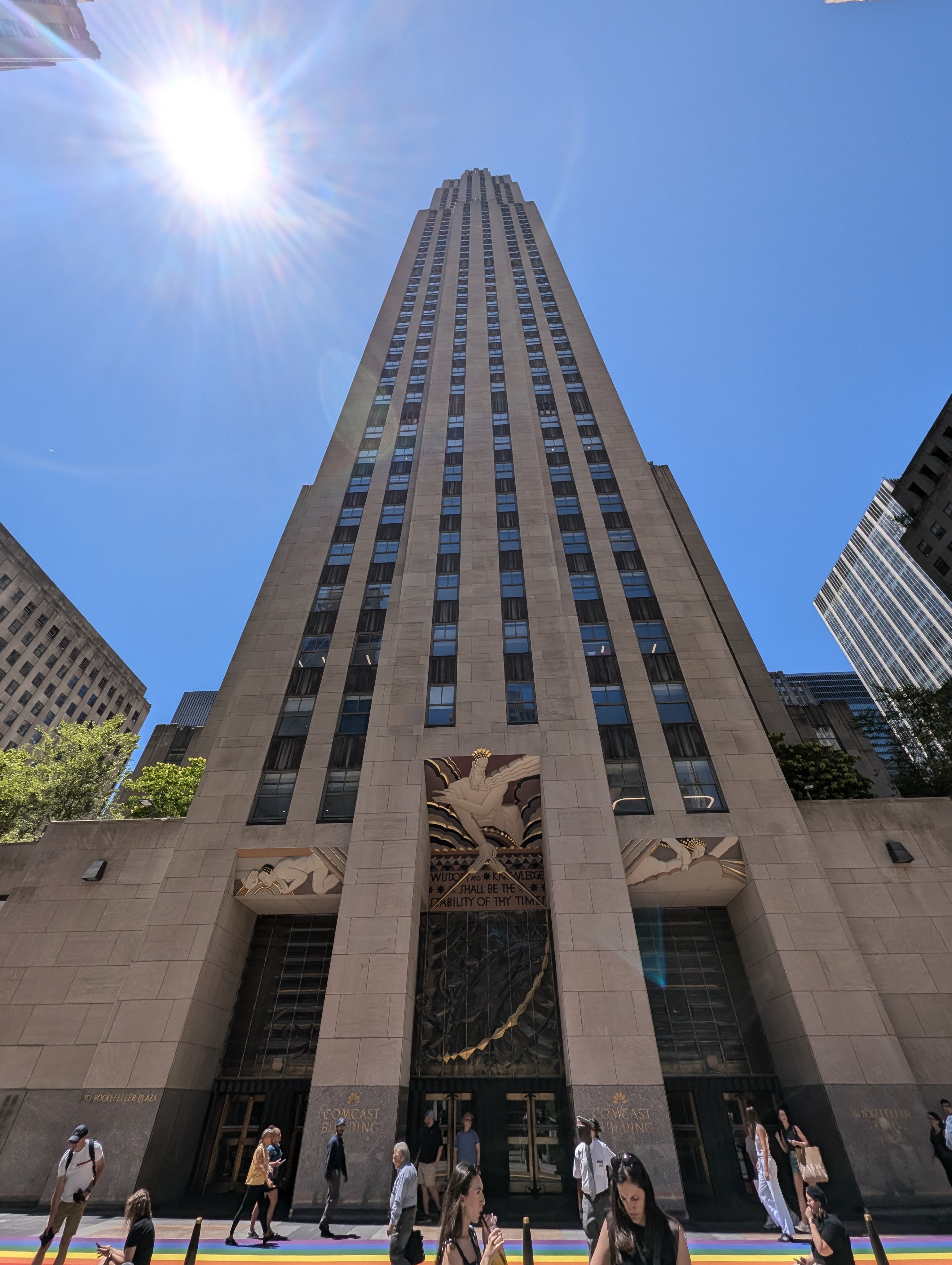
30 Rock. Home to NBC Studios and a slew of other business offices, it’s an iconic skyscraper in midtown Manhattan, towering 850 feet and capped by the ticketed Top of the Rock Observation Deck. It forms the backdrop to the famous ice-skating Rink at Rockefeller Center and, in December, New York City’s largest Christmas tree. Designed by architect Raymond Hood, it was originally named the RCA Building (1933–1988) after its main tenant, and then the GE Building (1988–2015), but since 2015 it has been the Comcast Building.

In June I stopped by to take in the art deco sculptures on the exterior, particularly the three limestone bas-reliefs over the main entrance, depicting Wisdom in the center, flanked by Sound on the left and Light on the right. This sculpture group was carved by Lee Lawrie (1877–1963) and painted and gilded by Léon-Victor Solon (1873–1957), who designed the color scheme for Rockefeller Center. Underneath is a trifold screen comprising 240 rectangular blocks of glass cast in eighty-four different molds, executed by Corning Glass Works.
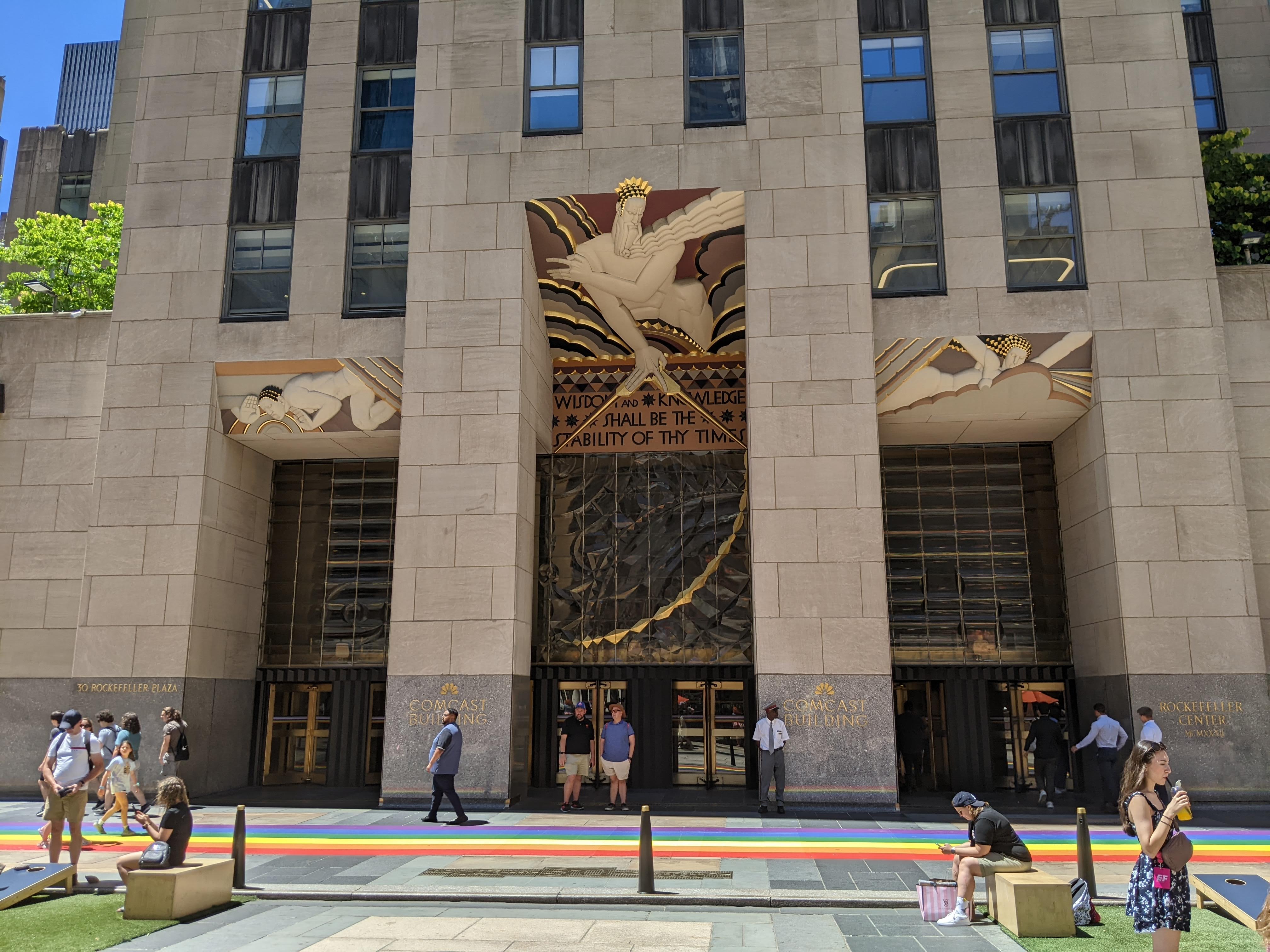
Lawrie, Lee_Wisdom, with Light and Sound
Lee Lawrie (American, 1877–1963), Wisdom, with Light and Sound, 1933. Polychromed limestone, 240 cast-glass bricks. Comcast Building, 30 Rockefeller Plaza, New York City. Photo: Victoria Emily Jones.

Comcast Building, Rockefeller Center (photo: Victoria Emily Jones)

I wanted to see how the iconography works, as I knew the central lintel to feature a Bible verse. It’s an excerpt from Isaiah 33:6: “And wisdom and knowledge shall be the stability of thy times, and strength of salvation: the fear of the LORD is his treasure” (KJV). In this oracle from the eighth century BCE, the prophet Isaiah is speaking to the people of Israel as they face threats from Assyria. He assures them that a wealth of salvation, wisdom, and knowledge is theirs as long as they revere God.

It’s not surprising that for this commercial building built in 1933, the biblical quote is truncated to exclude mention of God—the ancient prophet’s words are appropriated to suit a modern corporate context in religiously pluralistic America. Instead of (explicitly) honoring a divine source of wisdom and knowledge, the decorative program celebrates human ingenuity, which is practiced by workers inside the building in the fields of media, medicine, law, and finance, among others.

So what of the imagery that this Bible verse captions?

An old undated brochure for Rockefeller Center, presumably published in the 1930s, provides commentary:

The central figure of this work represents the genius which interprets to the human race the laws and cycles of the cosmic forces of the universe, and thus rules over all of man’s activities. On the right of the central panel is represented Light, and on the left, Sound—two of these cosmic forces. The compass of the genius marks, on the glass screen below, the cycles of Light and Sound.

Although there are other cosmic forces which govern the universe, Mr. Lawrie selected those of Light and Sound because they are an active and vital part of everyday life, and particularly because within contemporary times great discoveries have been made by means of them, and man’s technical knowledge of the laws of these two forces has been vastly enlarged.

The official title of the sculpture group is Wisdom, a Voice from the Clouds, with Light and Sound. A commanding presence, Wisdom, depicted as a nude male with a long windswept beard, measures, discerns, harnesses, creates. With his right hand he wields a compass to scribe a circle, and with his left he shoves back clouds of ignorance. He embodies humanity’s accumulated philosophical and scientific knowledge and creative power. The male and female figures on either side of him “herald the advent of radio (sound) and the motion picture industry and television (light), two industries that were achieving global significance as the Center was being built,” the Rockefeller Center website says. Circles emanate from Sound’s mouth, and electrical signals from Light’s raised arms.
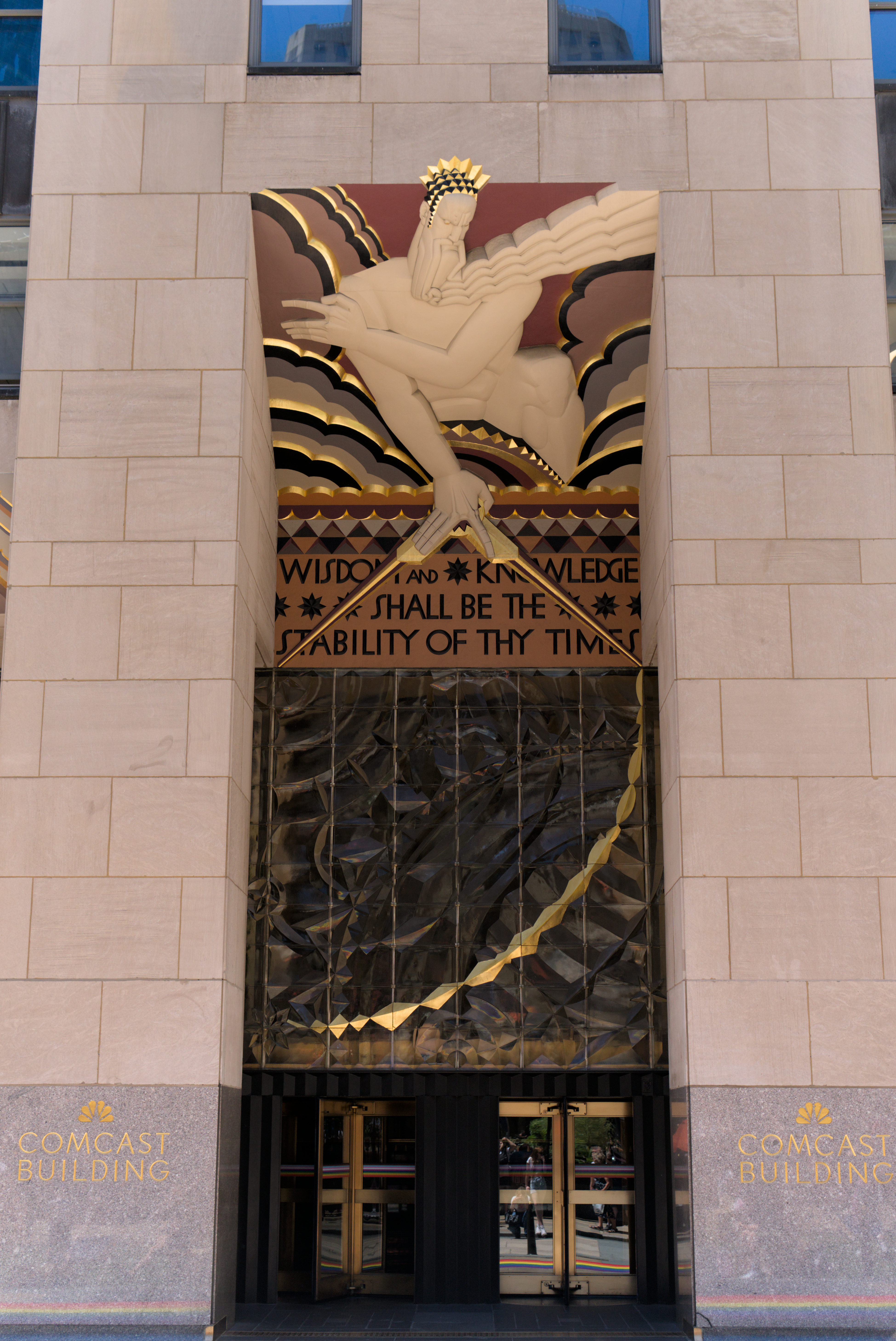
Lawrie, Lee_Wisdom (photo: Victoria Emily Jones)
Lawrie, Lee_Wisdom (upward view) (photo: Victoria Emily Jones)

It’s a humanistic artwork, exuding optimism and complemented throughout the Center by other works such as the four lobby murals by José Maria Sert collectively titled Man’s Intellectual Mastery of the Material Universe (1934), which picture the evolution of machinery, the abolition of slavery, the suppression of war, and the conquest of disease; American Progress (1937), another mural, by Sert; Lee Lawrie’s bronze Atlas (1937), showing the titular Titan holding the celestial vault on his shoulders; and Paul Manship’s gilded bronze Prometheus (1934), depicting the Titan champion of humanity who stole fire (representing technology and culture) from the gods and gave it to humans.

In the art at Rockefeller Center, human agency and advancement are emphasized, but the Christian God is not entirely absent from the narrative they collectively tell. Frank Brangwyn’s Man’s Search for Eternal Truth (1933) in the south corridor of the 30 Rock lobby addresses the importance of Jesus’s teachings in the Sermon on the Mount, particularly on love and brotherhood, depicting modern folks gathered around an elevated Christ figure and an inscription that reads, “Man’s ultimate destiny depends not on whether he can learn new lessons or make new discoveries and conquests, but on his acceptance of the lesson taught him close upon two thousand years ago.”

A key visual influence on Lawrie’s Wisdom sculpture was William Blake’s Ancient of Days, a hand-colored relief etching that shows a white-bearded nude male crouching in a heavenly sphere with a large golden compass, creating the world. This is Urizen, a mythological deity invented by Blake to personify reason and law.
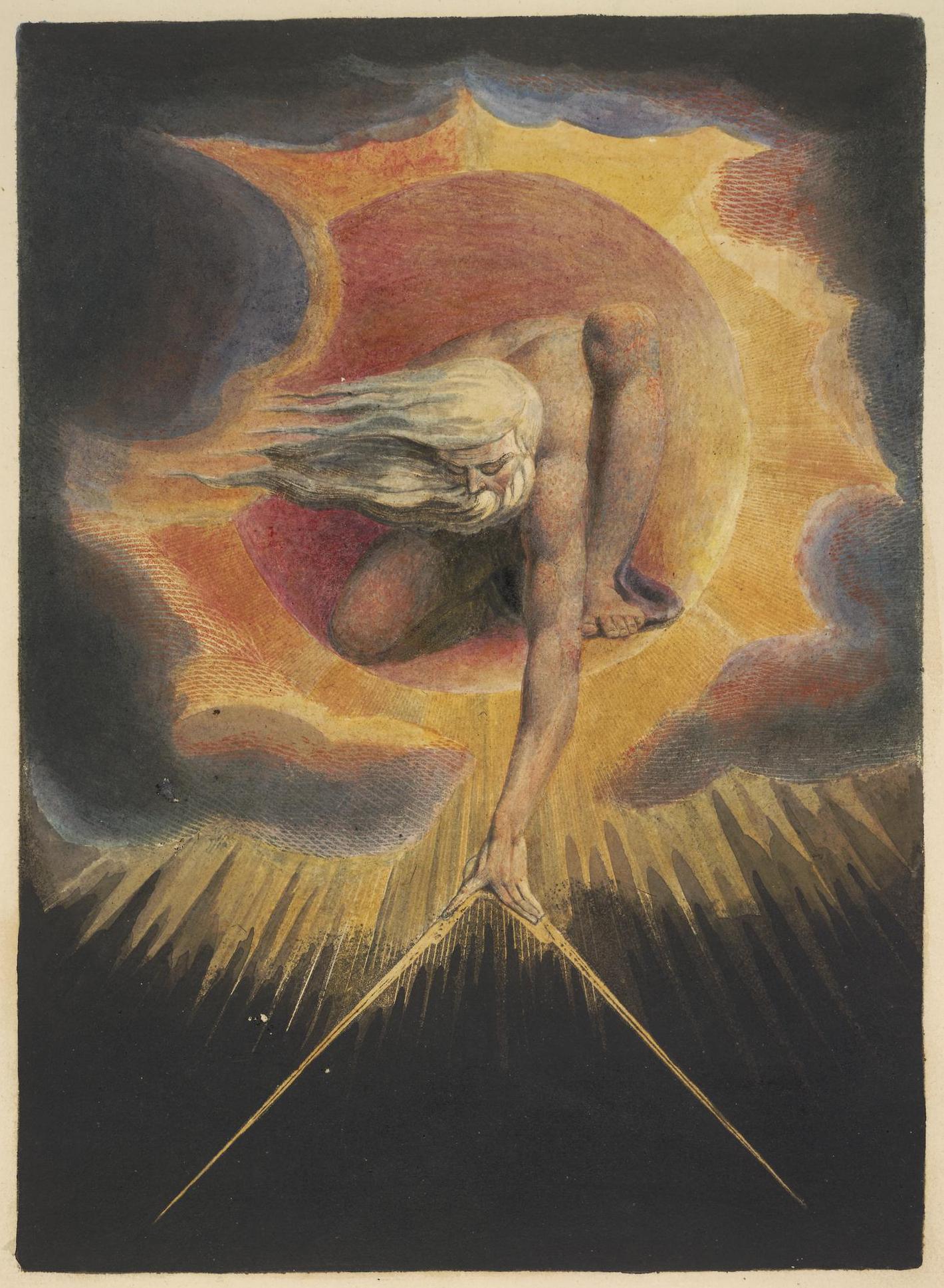
Blake, William_Ancient of Days
William Blake (British, 1757–1827), The Ancient of Days, 1794. Relief etching with watercolor, 23.3 × 16.8 cm. This hand-colored print is the frontispiece to Blake’s poem Europe, a Prophecy, copy D, owned by the British Museum in London.

Urizen is a reconfigured version of Yahweh in the Old Testament. The title of Blake’s print is taken from a prophetic vision of the Divine in the book of Daniel: “As I looked, thrones were set in place, and the Ancient of Days took his seat. His clothing was as white as snow; the hair of his head was white like wool. His throne was flaming with fire, and its wheels were all ablaze” (Dan. 7:9 NIV).

This verse has inspired centuries’ worth of iconography picturing God as an old man—because hey, he’s ancient (in fact, he’s the oldest being there is, as he has always existed), and Daniel saw him with white hair! Also, age and wisdom are traditionally correlated.

Depictions of God the Father as a fully anthropomorphized, aged being with white hair didn’t show up until the late Middle Ages and didn’t become a trend until the Renaissance.

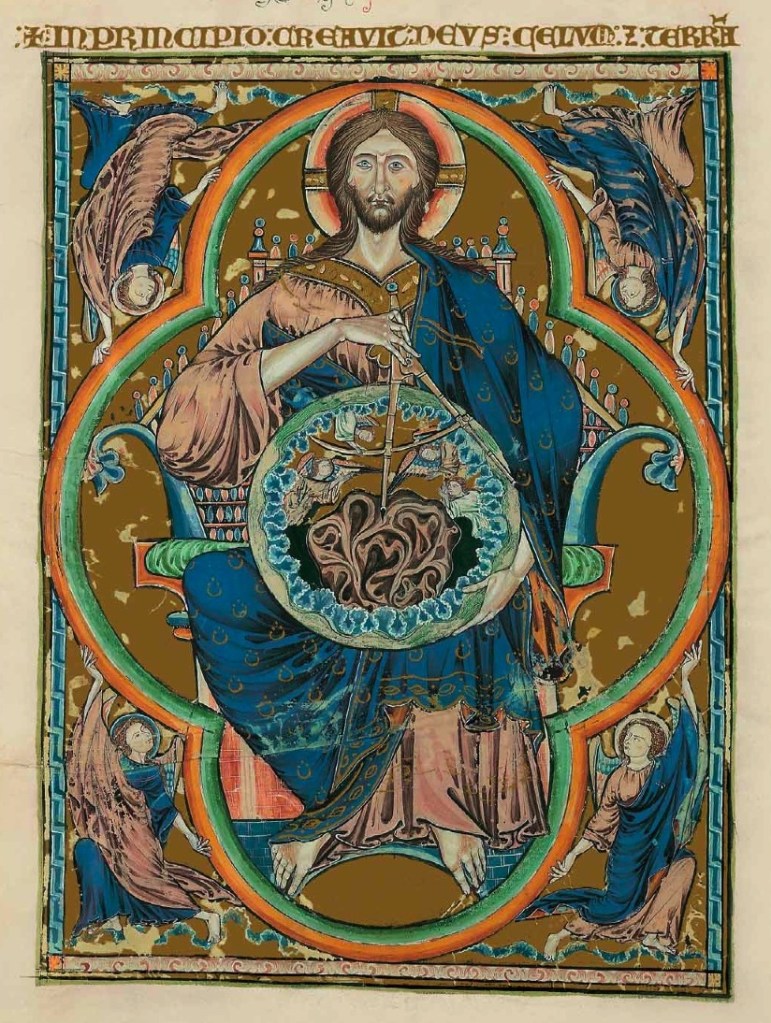
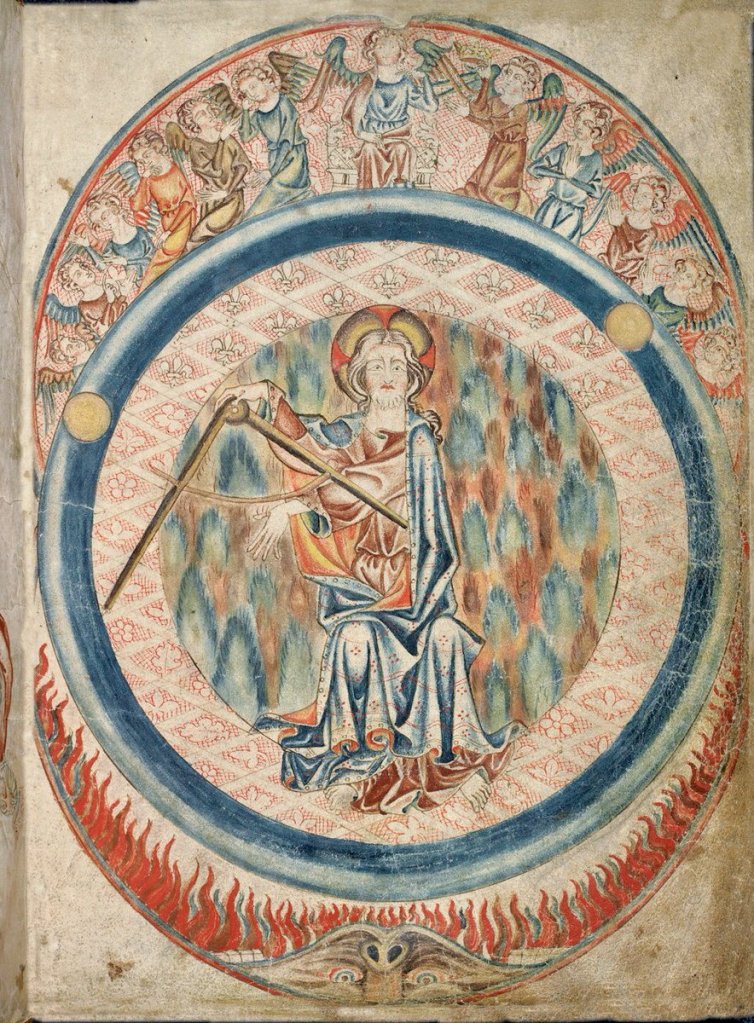
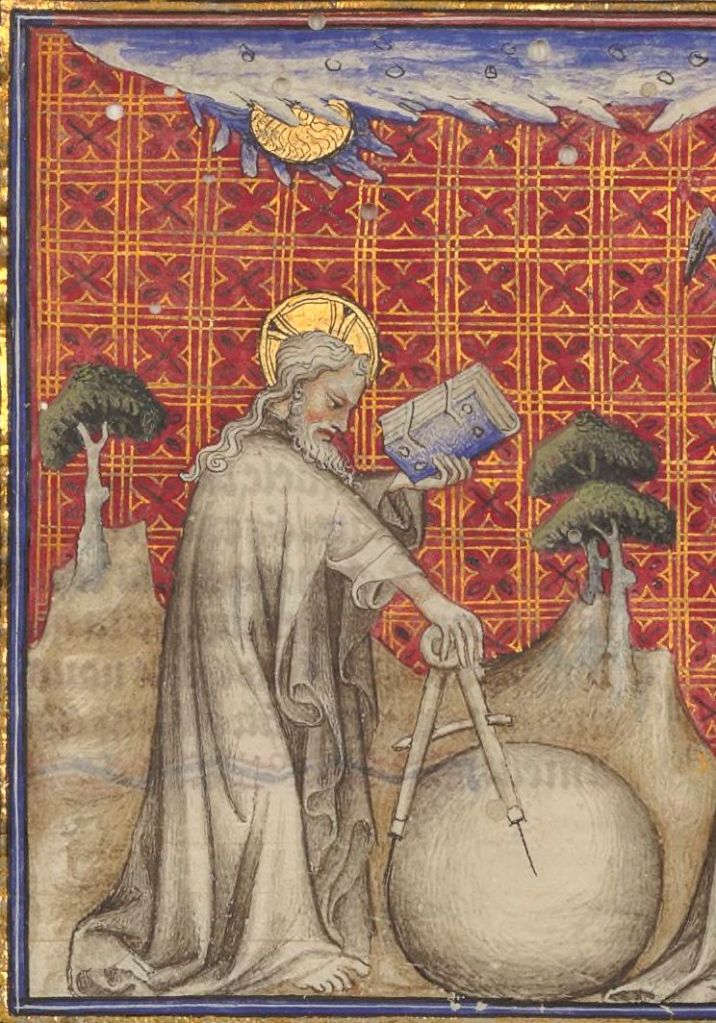
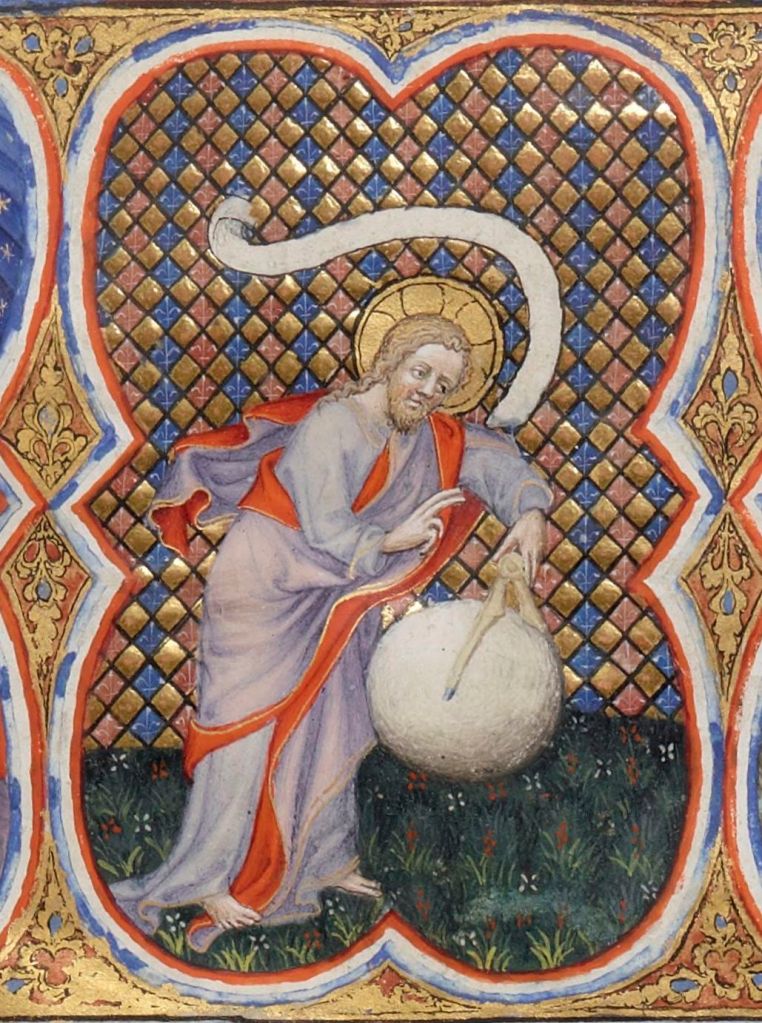
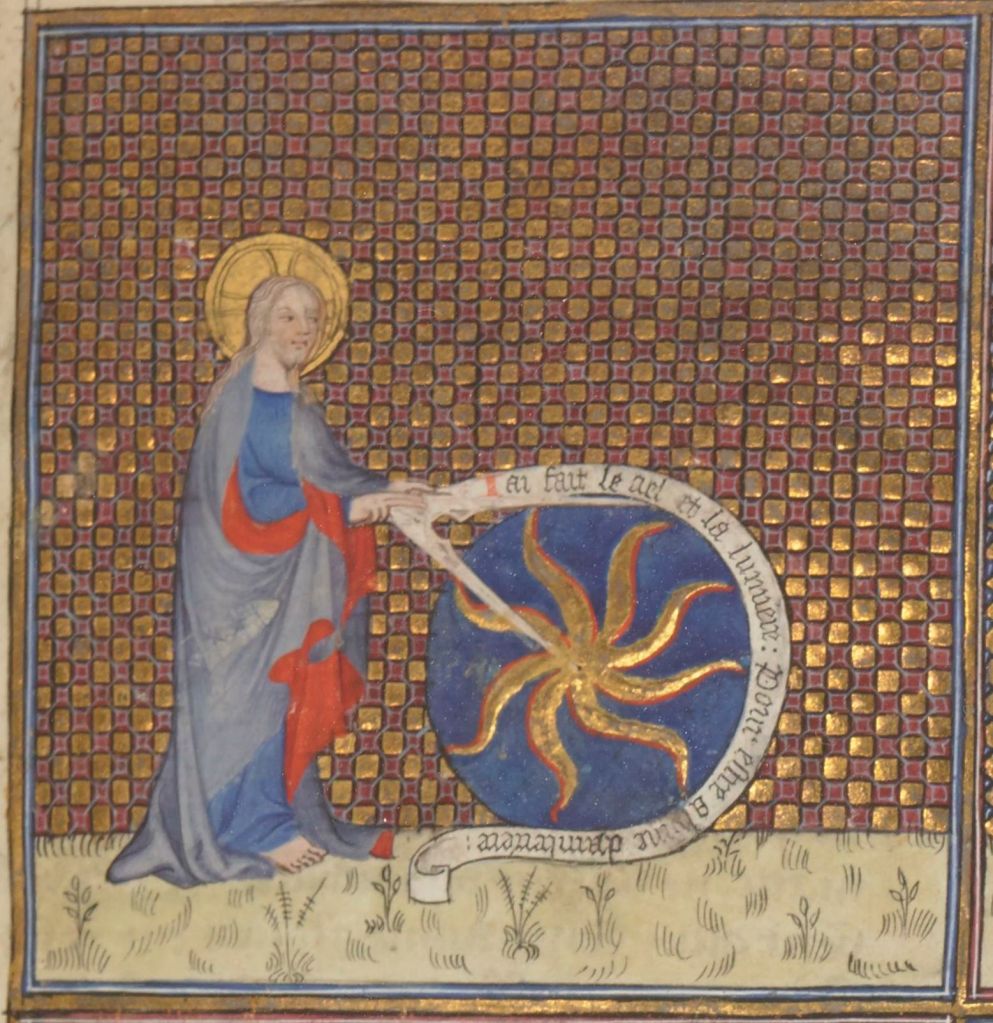
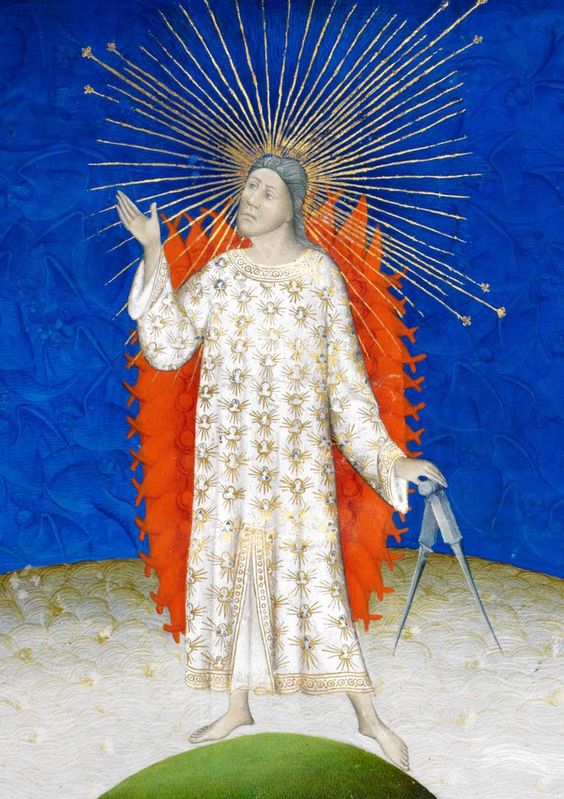
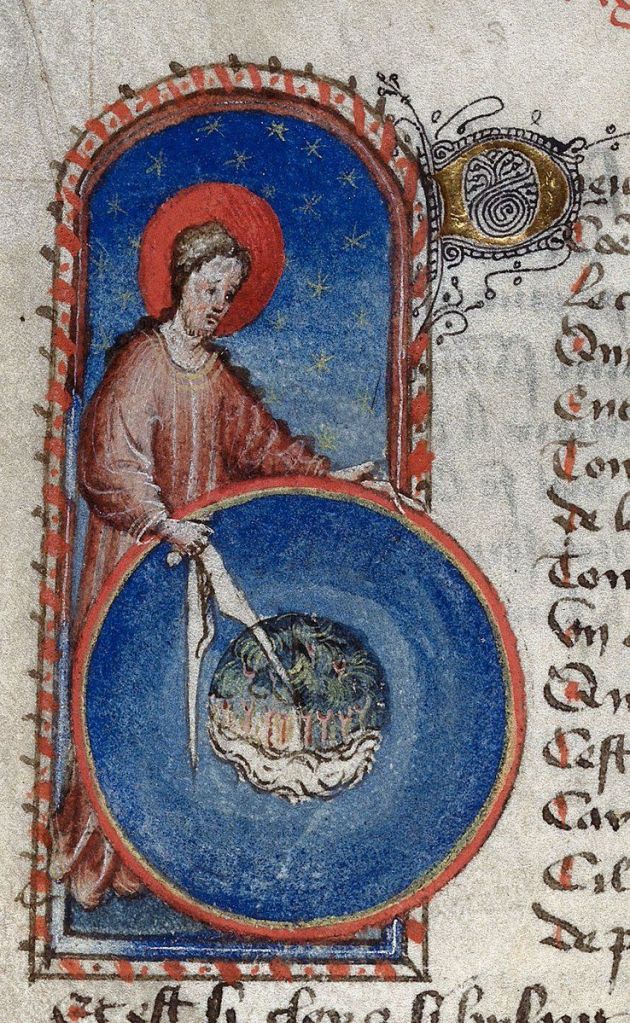
When medieval artists portrayed scenes from Genesis 1 and 2, they typically cast Christ in the role of Creator, intentionally avoiding depicting the first person of the Trinity, who is spirit, but also drawing on New Testament references like John 1:1–4 and Colossians 1:15–17 that describe Christ as participating in the creation of the universe. They often gave him a compass, an architectural tool, to show him marking out the planet Earth and celestial bodies with studied precision. Christ is sometimes identified with the person of Wisdom in Proverbs 8, who proclaims that “when he [God] prepared the heavens, I was there: when he set a compass upon the face of the depth . . .” (v. 27 KJV, emphasis mine).
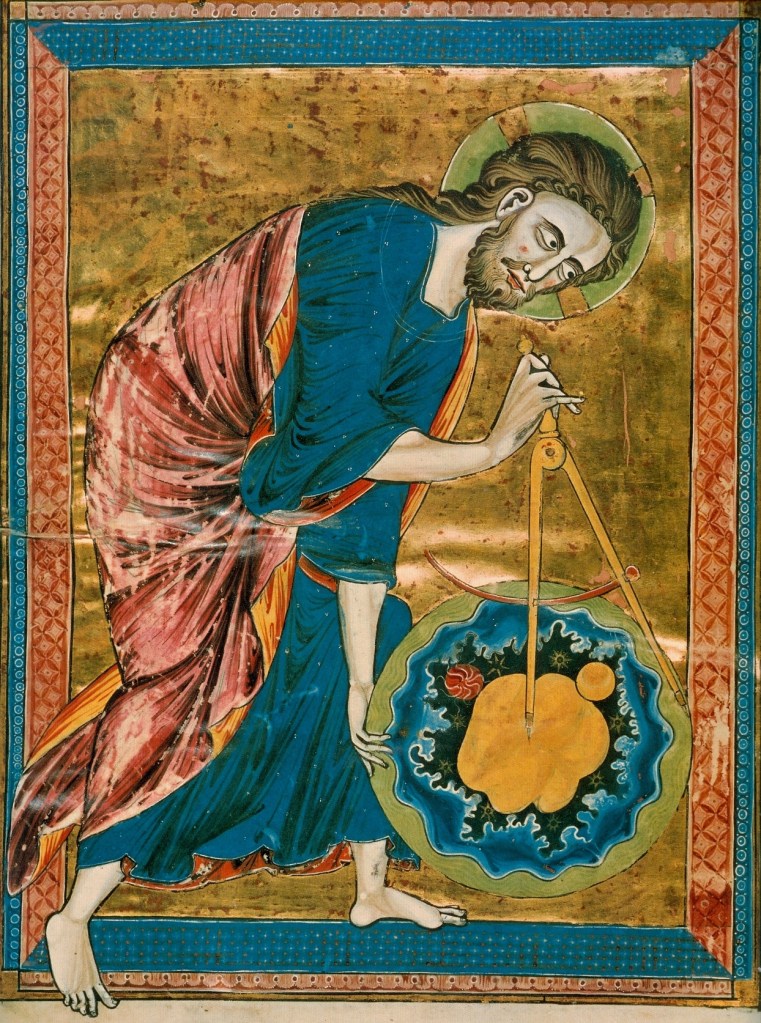
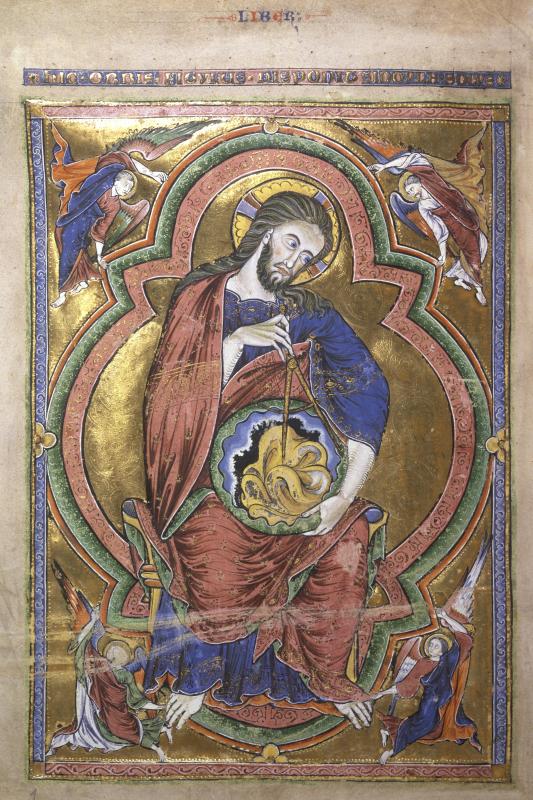
In his epic poem Paradise Lost, John Milton describes how the “Omnific Word” created all that is:

. . . . . . . . . . . . . . . . . . . . . . . . . . . . and in his hand
He [Jesus] took the golden compasses, prepared
In God’s eternal store, to circumscribe
This universe, and all created things:
One foot he centered, and the other turned
Round through the vast profundity obscure,
And said, “Thus far extend, thus far thy bounds,
This be thy just circumference, O world.” (VII.224–31)

In his making of Ancient of Days, Blake was no doubt influenced by the many visual and literary depictions of God as architect of the universe, as compass-wielding geometer, that came before. And so Lawrie, too, implicitly drew on this heritage when he sculpted the majestic figure of Wisdom for the main building of Rockefeller Center.

At first glance, you might interpret the prominent trio at the Center’s entrance as God creating the heavens and the earth, assisted by angels. But while Christian iconography factored into the design, and a Judeo-Christian sacred text forms the inscription, the sculpture group is mainly meant to represent the promise of science and technology.

Construction began at 30 Rockefeller Plaza during the Great Depression (though the Center was conceived prior to that national economic crisis, in 1927); John D. Rockefeller Jr. said he wanted to build a place where New Yorkers could come and surround themselves with art and motifs that celebrated the best of the human spirit. When you step off West 49th or 50th Street into the plaza that’s featured in so many New York City–set movies and TV shows, Rockefeller’s wish was that you’d feel hopeful and energized.

When I was there, during Pride Month (hence the temporarily rainbow-painted sidewalk), the mood was indeed uplifting, with locals and tourists alike passing through with ice-cream cones and lemonades and conversation. It being summer, the Rink was transformed into an al fresco dining area with umbrella-topped tables providing some relief from the heat.

While my faith in humanity’s future is rooted in God and not ultimately our own capabilities, I am obviously grateful for and supportive of progress and achievement. God wants us to grow in knowledge and skill and to use them responsibly and imaginatively to better the world.

In his essay “On Fairy-Stories,” J. R. R. Tolkien says that we humans are “sub-creators” under God, expressing the image of our Creator by exercising creativity. While he was talking specifically about writers creating fantasy worlds, the principle applies to people in any vocation, whether you’re making a book, a bed, or a nanochip. God bids us, “Create!” That we would see ourselves in Lawrie’s Wisdom, crowned and bearing power and authority, is therefore not necessarily arrogant or sacrilegious, as the cultural mandate in Genesis 1:28 charges humans with the noble task of cultivating the stuff of creation, including discovering and leveraging the physical laws of nature, for the flourishing of all.  

You can browse more of the art at Rockefeller Center at www.rockefellercenter.com/art. And for a well-photographed New York Times article featuring Lawrie’s artwork and some of the others on the premises, see “Rockefeller Center’s Art Deco Marvel: A Virtual Tour” by Michael Kimmelman.

Landmark exhibition “Ethiopia at the Crossroads” explores cross-cultural influences on Ethiopian art

All photos in this post, except for the last one (of the processional icon), are my own.

(Note: WordPress seems to have disabled the feature that allows you to expand an image upon clicking, but if you’re reading on a computer, you can right-click an image and open it in a new tab to view it in full resolution; if you’re reading on a phone, you can pinch to zoom.)

Located in the Horn of Africa and with access to the Red Sea, Nile River, Mediterranean Sea, and Indian Ocean, Ethiopia stands at the nexus of historical travel, trade, and pilgrimage routes that brought it into contact with surrounding cultures and influenced its artistic development. Coptic Egypt, Nubia, South Arabia, Byzantium, Armenia, Italy, India, and the greater African continent were among those influencers. But Ethiopia not only absorbed influences; it transmitted them too.

A major art exhibition is centering Ethiopia’s artistic traditions in a global context. For Ethiopia at the Crossroads at the Walters Art Museum in Baltimore (running through March 3), curator Christine Sciacca has brought together more than 220 objects from the Walters’ own extraordinary Ethiopian art collection and private and institutional lenders both domestic and international. Icons, wall paintings, processional crosses and hand crosses, illuminated Gospel books and psalters, sensuls (chain manuscripts), healing scrolls, and more are on display throughout the galleries, whose walls have been painted bright green, yellow, and red—the colors of the Ethiopian flag. To round off the exhibition, guest curator Tsedaye Makonnen, an Ethiopian American multidisciplinary artist, was tasked with curating a few works from contemporary artists of the Ethiopian diaspora.

Ethiopia at the Crossroads exhibition view

The majority of objects are Christian, made for liturgical or private devotional use. Ethiopia is one of the world’s oldest Christian nations: in the early fourth century, persuaded by a missionary from Syria, King Ezana of Aksum embraced Christianity, and it has been the dominant religion of Ethiopia ever since. But the exhibition does also include some Islamic and Jewish objects.

One of the first works you’ll encounter is a mural that would have originally been mounted on the outer wall of an Ethiopian Orthodox church sanctuary (mäqdäs), portraying the Nativity, the Presentation of Christ in the Temple, and the Adoration of the Magi.

Nativity, Presentation of Christ in the Temple, and Adoration of the Magi, Ethiopia, 18th century. Glue tempera on overlapping canvas pieces mounted to a new stretched canvas, 49 3/16 × 66 15/16 in. (124.9 × 170 cm). Walters Art Museum, Baltimore. [object record]

Remarkably, at the Nativity, there is a feast taking place, and Jesus is feeding his mother with what looks like a Communion wafer! As the theologian Lester Ruth has said, “The sound from most baby beds is a cry to be fed. But the cry from the manger is an offer to feed on his body born into this world.”

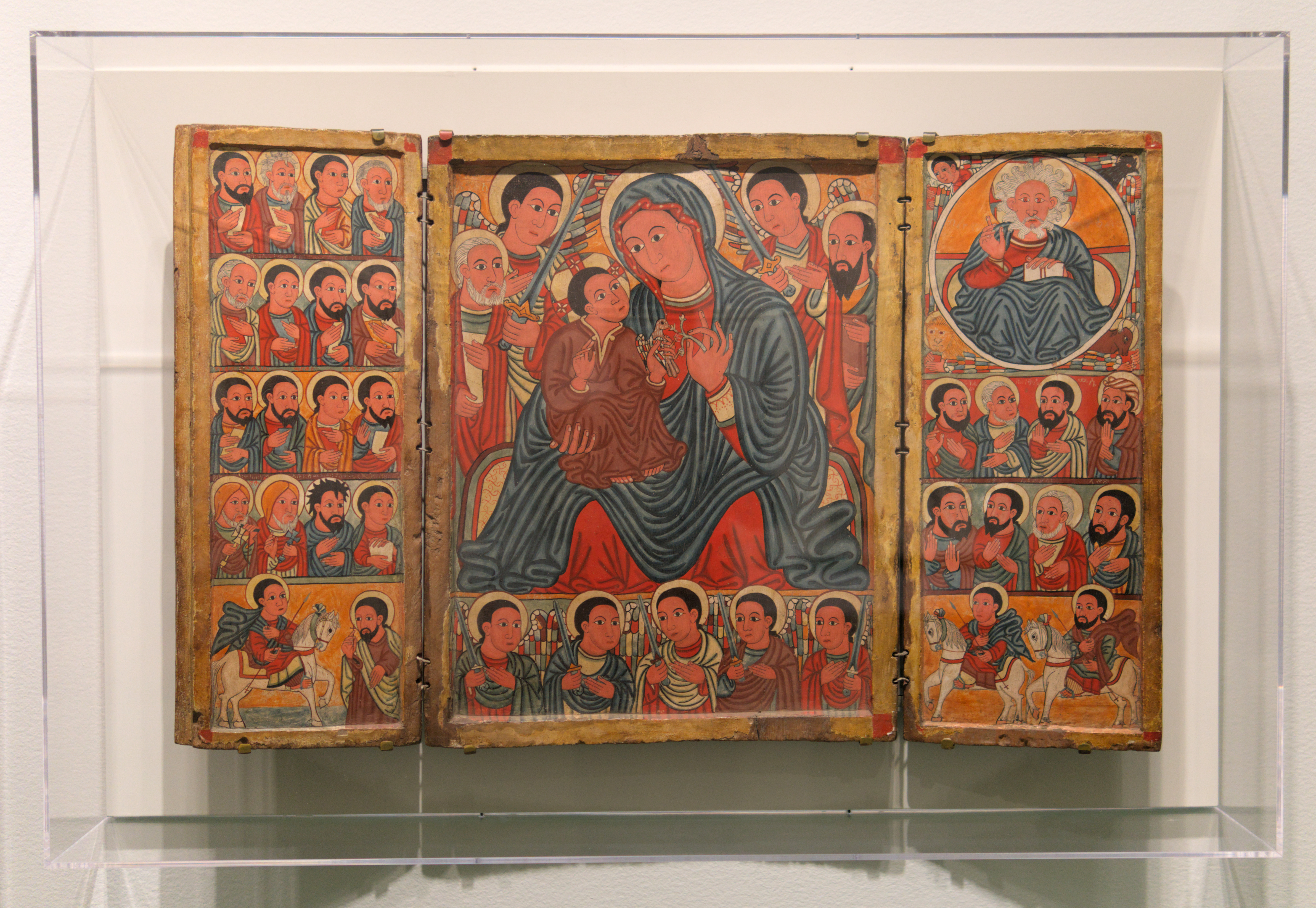
One of history’s most famous Ethiopian painters is Fre Seyon, who worked at the court of Emperor Zara Yaqob (r. 1434–1468) and was of the first generation of Ethiopian artists who painted icons on wood panels. He was also a monk. He likely introduced one of the characteristic features of Ethiopian icons of the Virgin and Child: the archangels Michael and Gabriel flanking them with drawn swords, acting as a kind of honor guard.

Fre Seyon triptych
Fre Seyon (Ethiopian, active 1445–1480), Triptych Icon with the Virgin Mary and Christ Child Flanked by Archangels and Saints (center), Twelve Apostles and Saints (left), and Prophets and Saints (right), mid- to late 15th century. Tempera on gesso-primed wood. Institute of Ethiopian Studies, Addis Ababa University, acc. no. IESMus4186.

My two favorite details of this triptych by Fre Seyon are (on the right wing) the image of the Ancient of Days surrounded by the tetramorph, his wild gray locks being blown about, and in the center, the bird that Christ holds, its feet grasping at a three-branched twig. On a literal level, the bird is a plaything for the boy that charmingly emphasizes his humanity (in the late Middle Ages, at least in Europe—I’m not sure about in Ethiopia—it was common for young children to keep tame birds as pets). On another level, the bird may be symbolic. In traditional Western art, Jesus sometimes holds a goldfinch, a bird with distinctive red markings that’s fond of eating thistle seeds and gathering thistle down and thus came to be read as a prefiguration of Christ’s thorny, blood-spilt passion. I’m not sure whether Fre Seyon intended a symbolic significance for this bird.

The Ancient of Days, enthroned in the tetramorph

Here’s another triptych from the exhibition, this one from a century and a half later:

Virgin and Child triptych
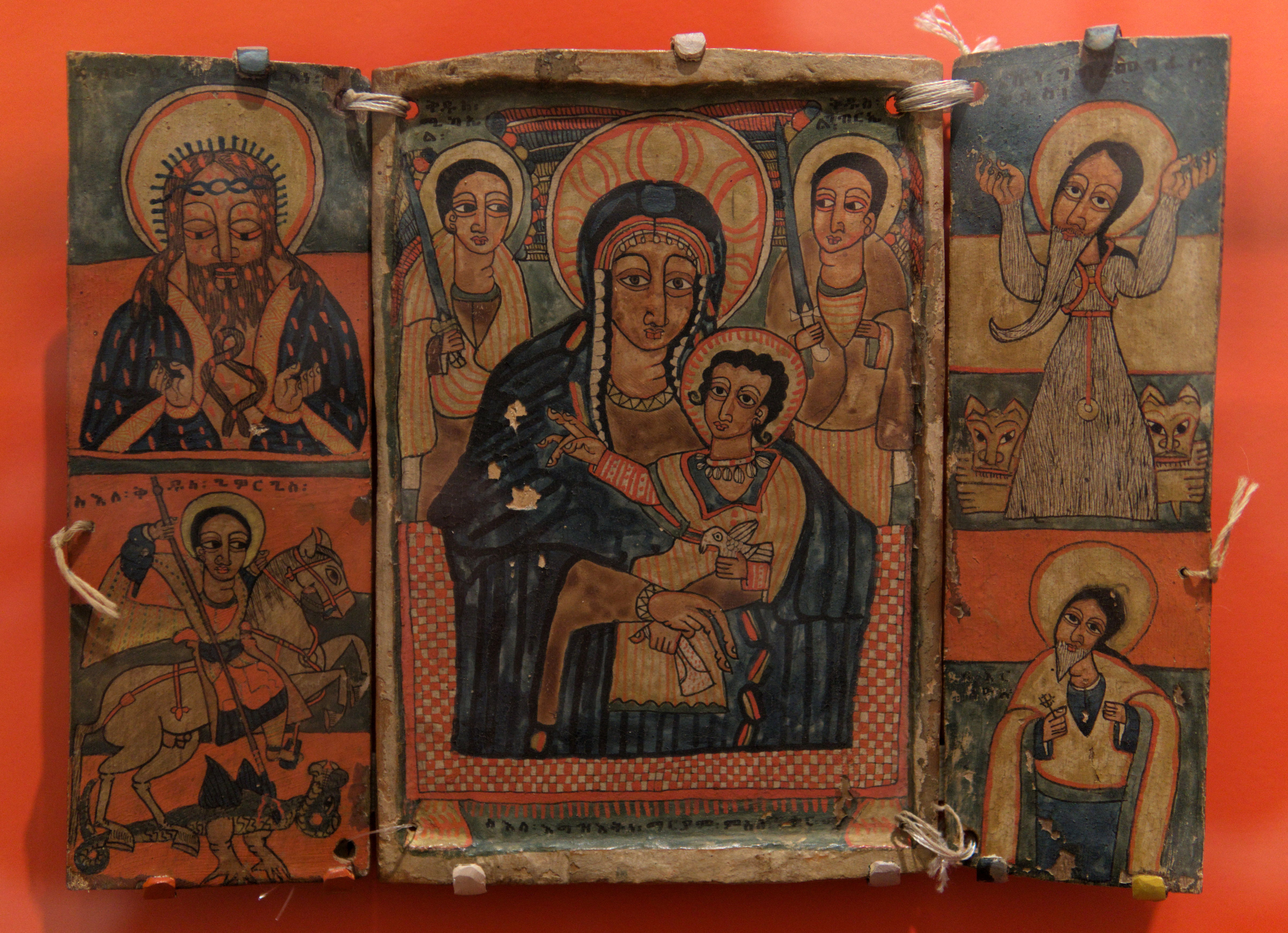
Triptych Icon with the Virgin Mary and Christ Child Flanked by Archangels, Scenes from the Life of Christ, Saint George, and Saints Honorius, Täklä Haymanot, and Ewostatewos, Ethiopia (Tigray), early 17th century. Glue tempera on panel, 16 3/4 × 22 5/16 in. (42.5 × 56.7 cm). Walters Art Museum, Baltimore. [object record]

The composition of the Virgin and Child is based on prints of a painted icon from Santa Maria Maggiore in Rome brought to Ethiopia by Portuguese Jesuit missionaries—but it innovates. As the wall text notes, “Mary’s cloak stretch[es] out in either direction to embrace the scene of Christ Teaching the Apostles below. Umbrella-like, Mary appears as both the protector and personification of the church.”

Harrowing of Hell

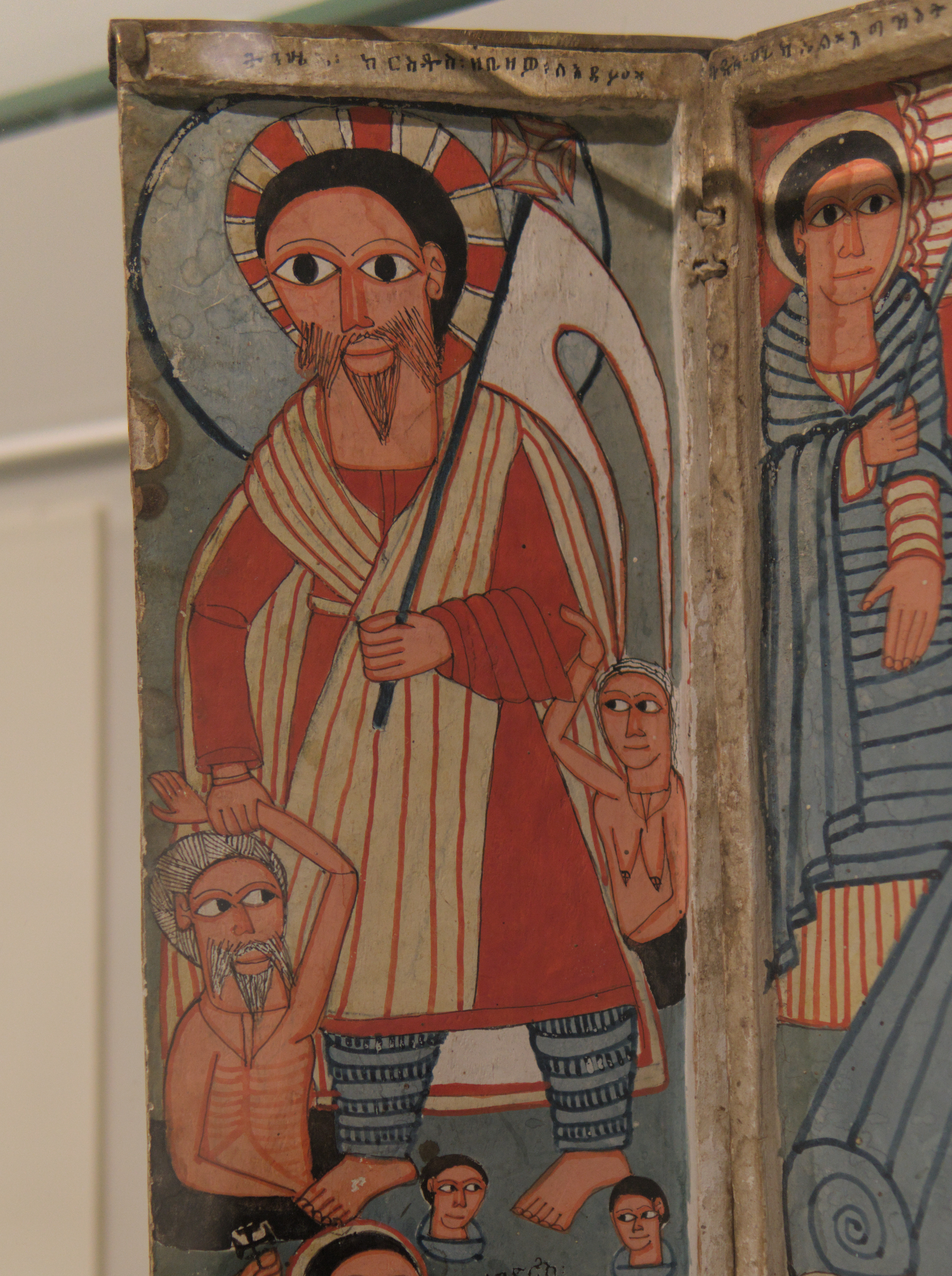
On the right wing, angels hold up chalices to collect the blood that flows from Jesus’s wounds on the cross, while below that, Joseph of Arimathea and Nicodemus carry Jesus’s wrapped corpse to the tomb. On the left wing is one of my favorite traditional religious scenes: the Harrowing of Hell, or Christ’s Descent into Limbo, in which, on Holy Saturday, Jesus enters the realm of his dead to take back those whom Death has held captive, first of which are our foreparents Adam and Eve. Below that scene is an image of the dragon-slaying Saint George, a late third-century figure from the Levant or Cappadocia who is the patron saint of Ethiopia.

At the bottom center is a scene of Christ teaching the twelve apostles, plus two Ethiopian saints. They all hold hand crosses, like those carried by Ethiopian priests and monks.

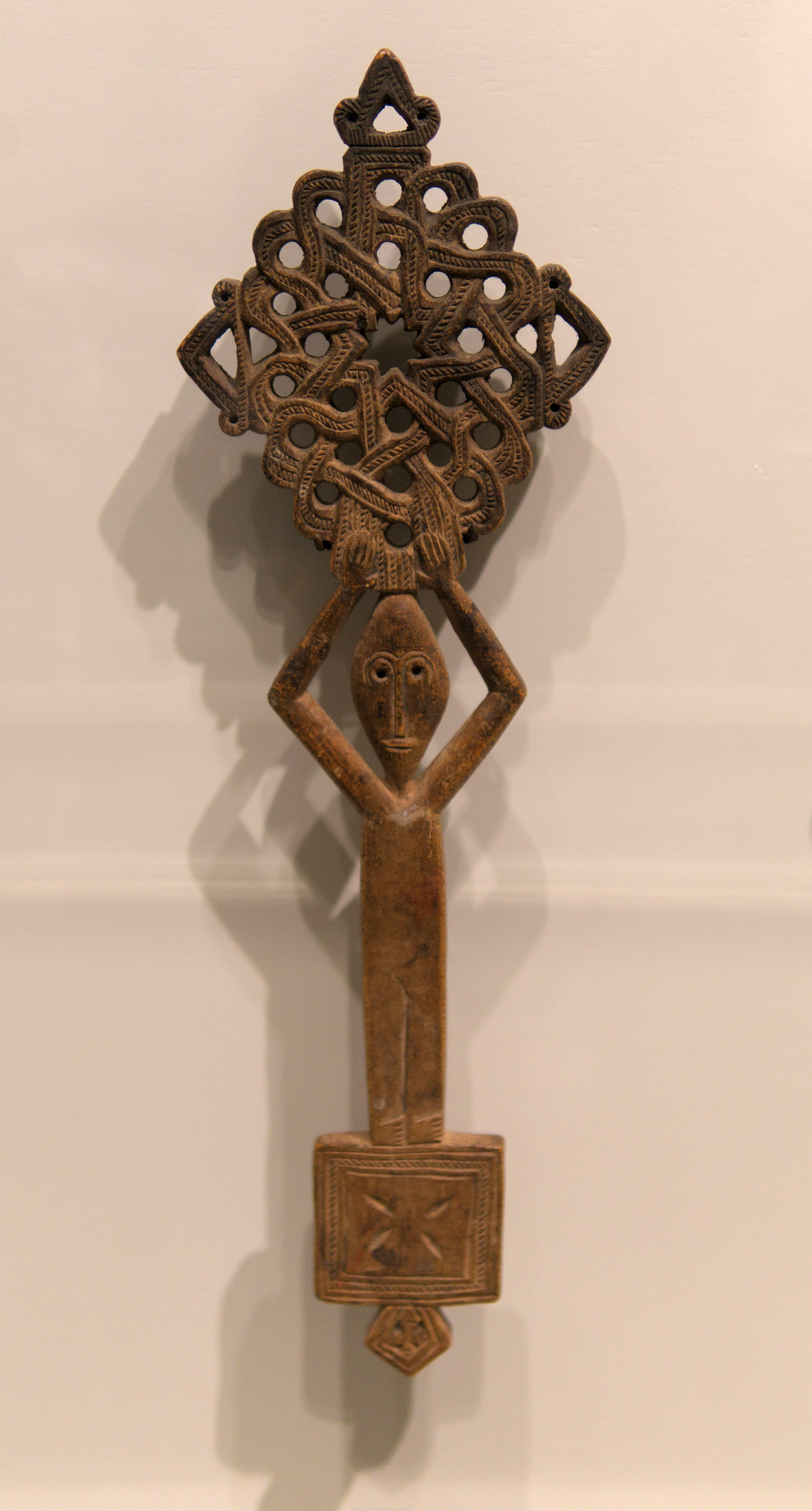
Hand Cross with Figure
Hand Cross with Figure, Ethiopia, probably 18th–19th century. Wood, 13 3/8 × 4 3/16 × 9/16 in. (34 x 10.7 × 1.4 cm). Walters Art Museum, Baltimore. [object record]

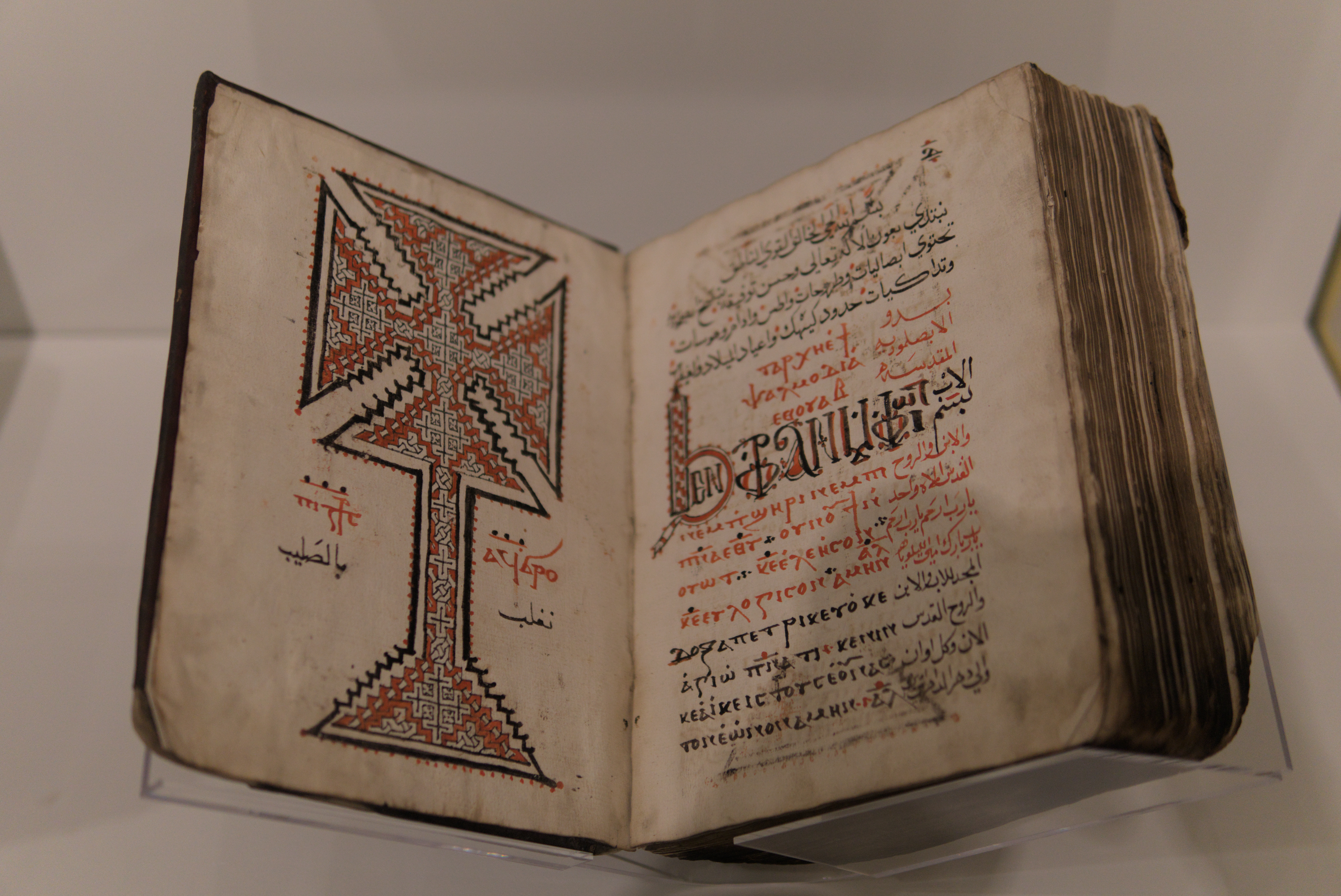
Coptic-Arabic Book of Prayer
Coptic-Arabic Book of Prayer, Egypt, 18th century. Tempera and ink on parchment, 11 3/4 × 9 in. (29.8 × 22.8 cm). Melikian Collection. [object record]

One of the hallmarks of the exhibition is its multisensory nature: attendees are immersed not only in the sights of Ethiopia but also in the sounds and smells. Scratch-and-sniff cards invite people to take a whiff of frankincense, which would have filled the censer on display. Or to smell berbere, a hot spice blend that would have been stored in the woven baskets nearby.

Frankincense

This olfactory element was produced by the Institute for Digital Archaeology, which, as part of its efforts to record and preserve ephemeral culture, has launched an ambitious program to preserve the heritage of smells. “The aim is to provide the technical means for documenting the aromas of today for the benefit of future generations – and to find new methods and opportunities for experiencing the odors of the past.”

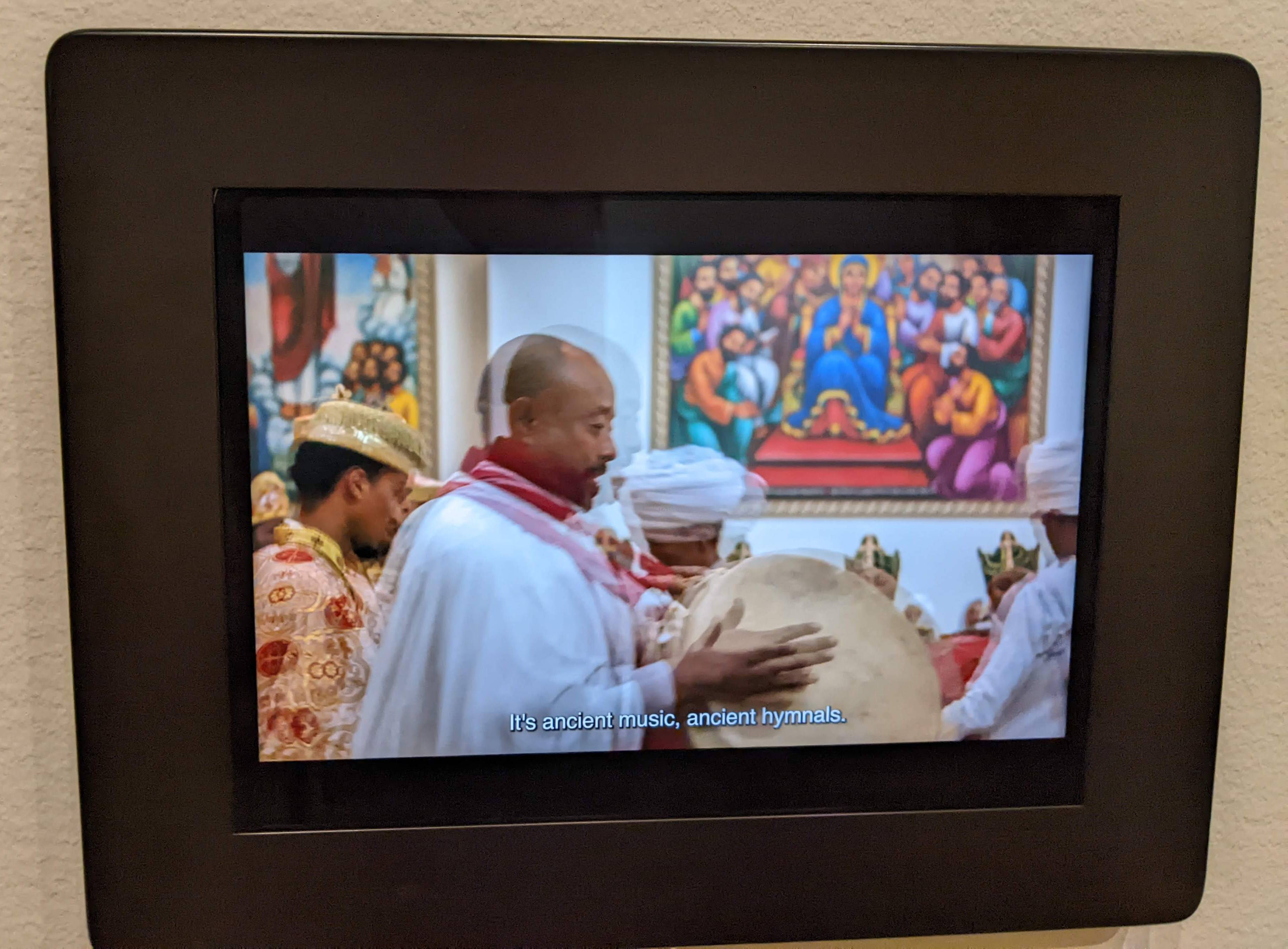
Also in the exhibition there are screens where you can watch videos of Ethiopian Orthodox worship, including music and liturgies, where you will see some of the objects in use. You can also listen to interviews with members of the local Ethiopian diaspora community. (The Washington metropolitan area has the largest Ethiopian population outside Ethiopia.)

Further contextualizing the objects and enhancing the sense of place, pasted onto the wall is a blow-up photograph of a Christian holy-day celebration wending through the streets. This serves as a backdrop to two physical artifacts present in the room: a qämis (dress) and a debab (umbrella).

Dress and umbrella
Left: Dress (qämis), Ethiopia, 20th century(?), cotton, Peabody Essex Museum, E72559. Right: Umbrella (debab), Ethiopia, 20th century, silk and velvet, Peabody Essex Museum, E68713.

The inscriptions on many of the Ethiopian icons and manuscript illuminations, which identify the figures and scenes, are in Ge‘ez (aka classical Ethiopic), an ancient South Semitic language that originated over two thousand years ago in what is now northern Ethiopia and Eritrea. It’s no longer spoken in daily life, but it is still used as the language of the Ethiopian Orthodox Church and taught to boys in Sunday school. I really wish I could read it, as it would be a great help in interpreting the Ethiopian images I come across in my studies!

Contrary to what some may assume, Ethiopians in the medieval era were not an isolated people. They traveled—to Rome, to Jerusalem, and so forth. Evidence of Holy Land pilgrimage is suggested by an early fourteenth-century Gospel book that includes the domed Church of the Holy Sepulcher as the backdrop for Christ’s resurrection:

Crucifixion and Resurrection
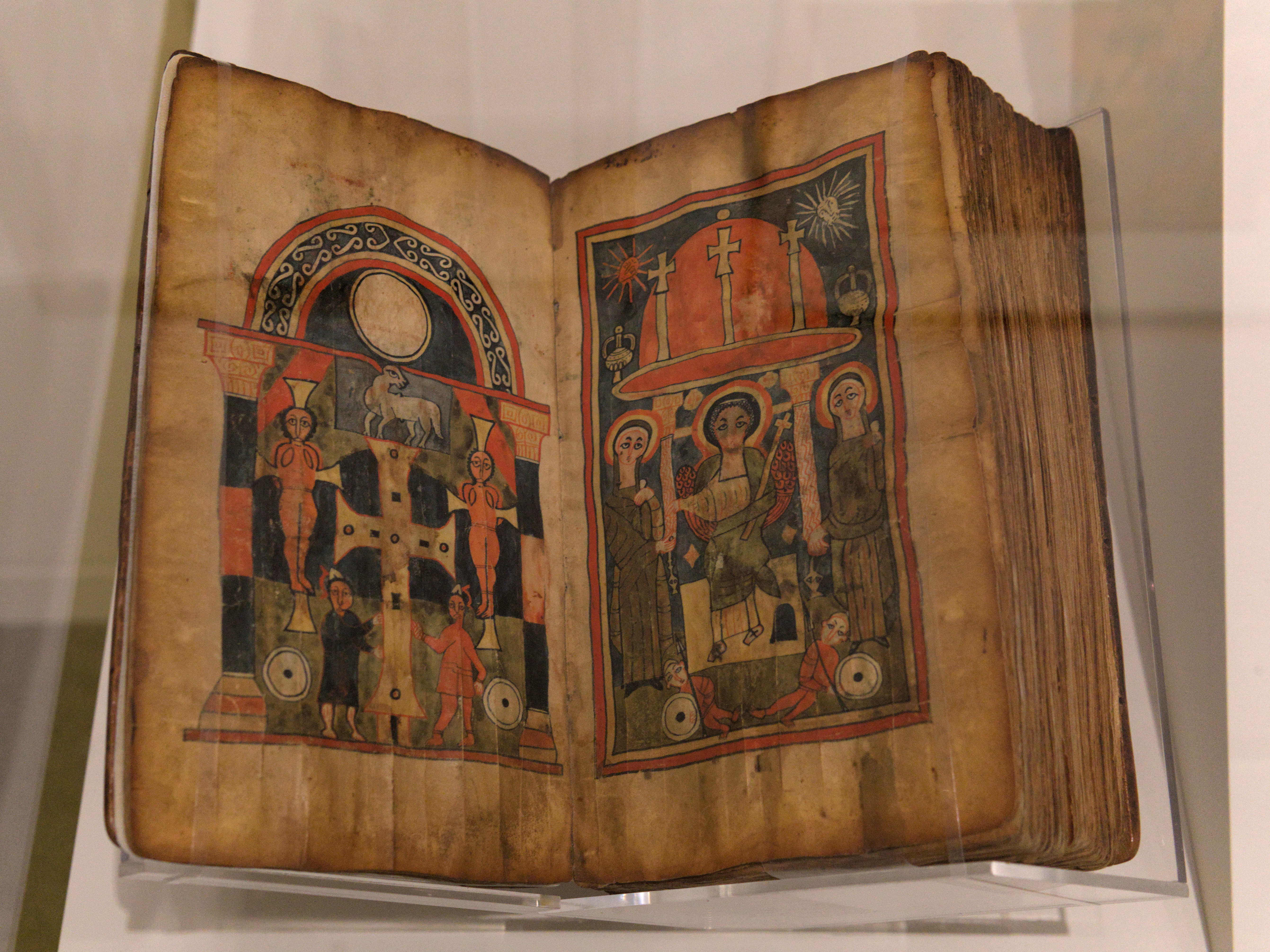
Gospel Book with the Crucifixion and Christ’s Resurrection, Ethiopia (Tigray), early 14th century. Ink and paint on parchment, 10 1/2 × 6 11/16 in. (26.7 × 17 cm). Walters Art Museum, Baltimore, W.8.36, fols. 6v–7r. [object record]

This is an extraordinary book, one of the oldest surviving Ethiopian manuscripts and the oldest in North America. Ethiopian artists weren’t yet depicting Jesus on the cross, so to represent the Crucifixion, this artist has painted a living lamb surmounting a bejeweled cross, with the two thieves crucified on either side.

Also from the fourteenth century, a manuscript opened to a page spread of Christ’s Entry into Jerusalem:

Triumphal Entry
Christ’s Entry into Jerusalem, folios added from an earlier Gospel book to a Ta’ammera Maryam manuscript, Ethiopia, 14th century. Tempera and ink on parchment. Private collection.

I like how the scene extends across both pages, creating a sense of forward progression, and the two onlookers above the city gate.

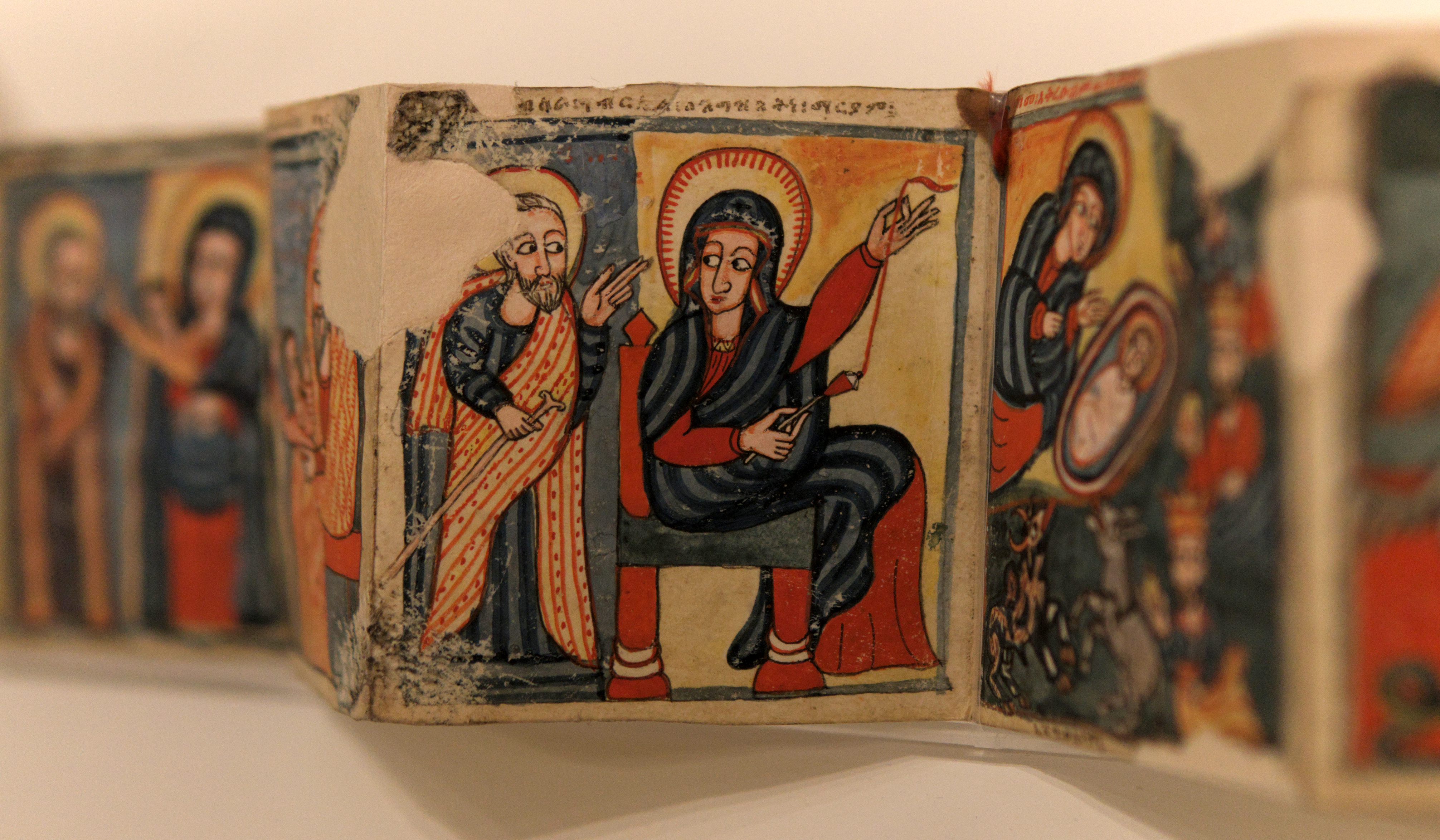
One of my favorite objects from the exhibition is a sensul from Gondar depicting ten scenes from the life of Mary. A sensul is an Ethiopian chain manuscript, in this case pocket-size, created out of a single folded strip of parchment attached to heavy hide boards at each end, which creates a small book when folded shut. Here’s a detail showing the Annunciation:

Annunciation (from a sensul)
Annunciation, from a Gondarine sensul (chained manuscript), Ethiopia (Gondar), late 17th century. Ink and paint on parchment, each panel 3 5/8 × 3 1/8 in. (9.2 × 9 cm). Walters Art Museum, Baltimore. [object record] [GIF]

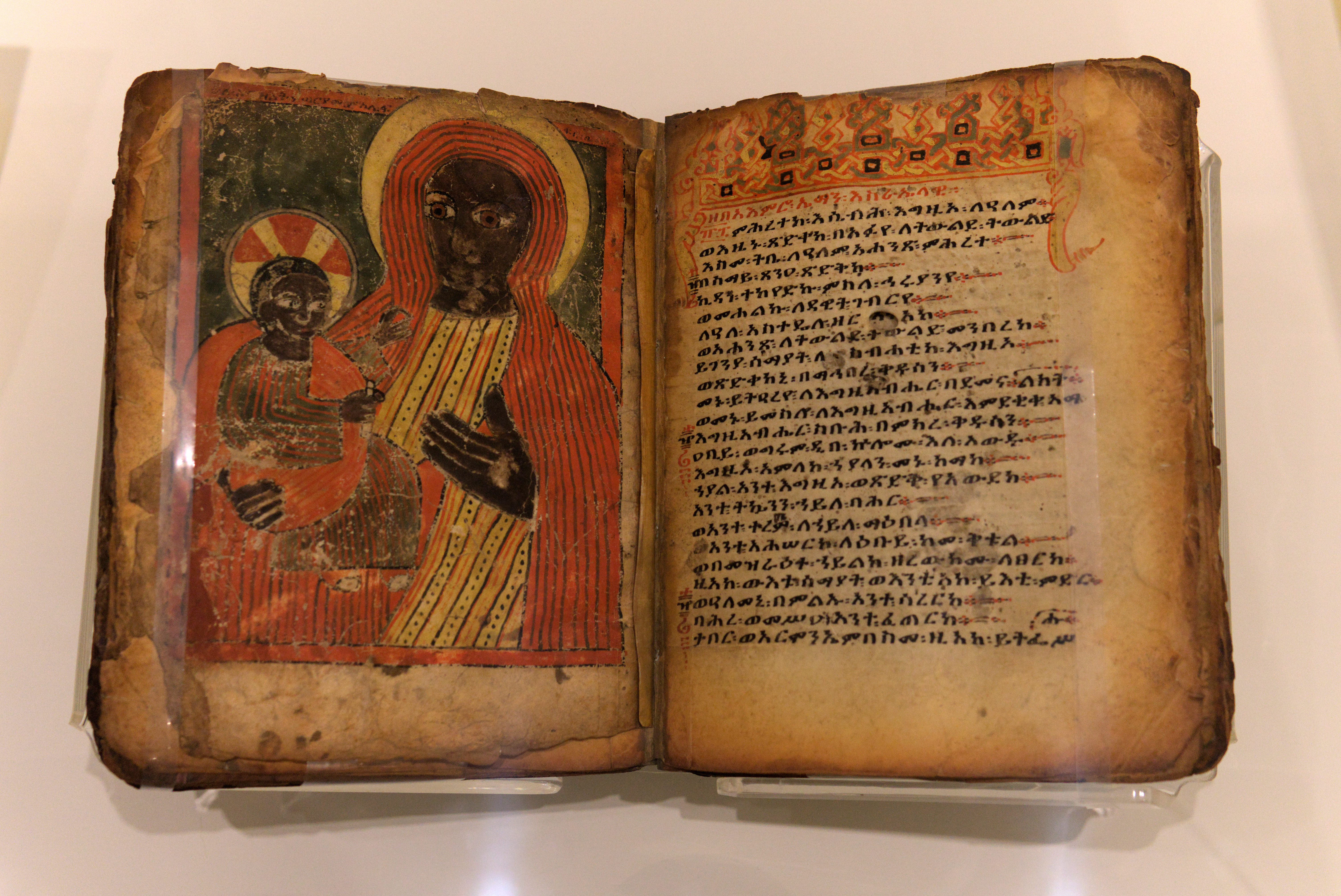
It’s a common misconception that Ethiopians have always depicted biblical figures as dark-skinned to reflect the local population. Such treatment didn’t become normative until the eighteenth century, although some earlier artists did choose black complexions for holy persons:

Virgin and Child
Virgin and Child, from a Psalter with the Wəddase Maryam (Praise of Mary) and Mähalǝyä Näbiyyat (Canticles of the Prophets), Ethiopia, 15th century. Ink and pigments on parchment with wooden boards, open: 8 7/8 × 6 11/16 × 3 15/16 in. (22.5 × 17 × 10 cm). Toledo Museum of Art, Ohio. [object record]

Portrait of John the Evangelist
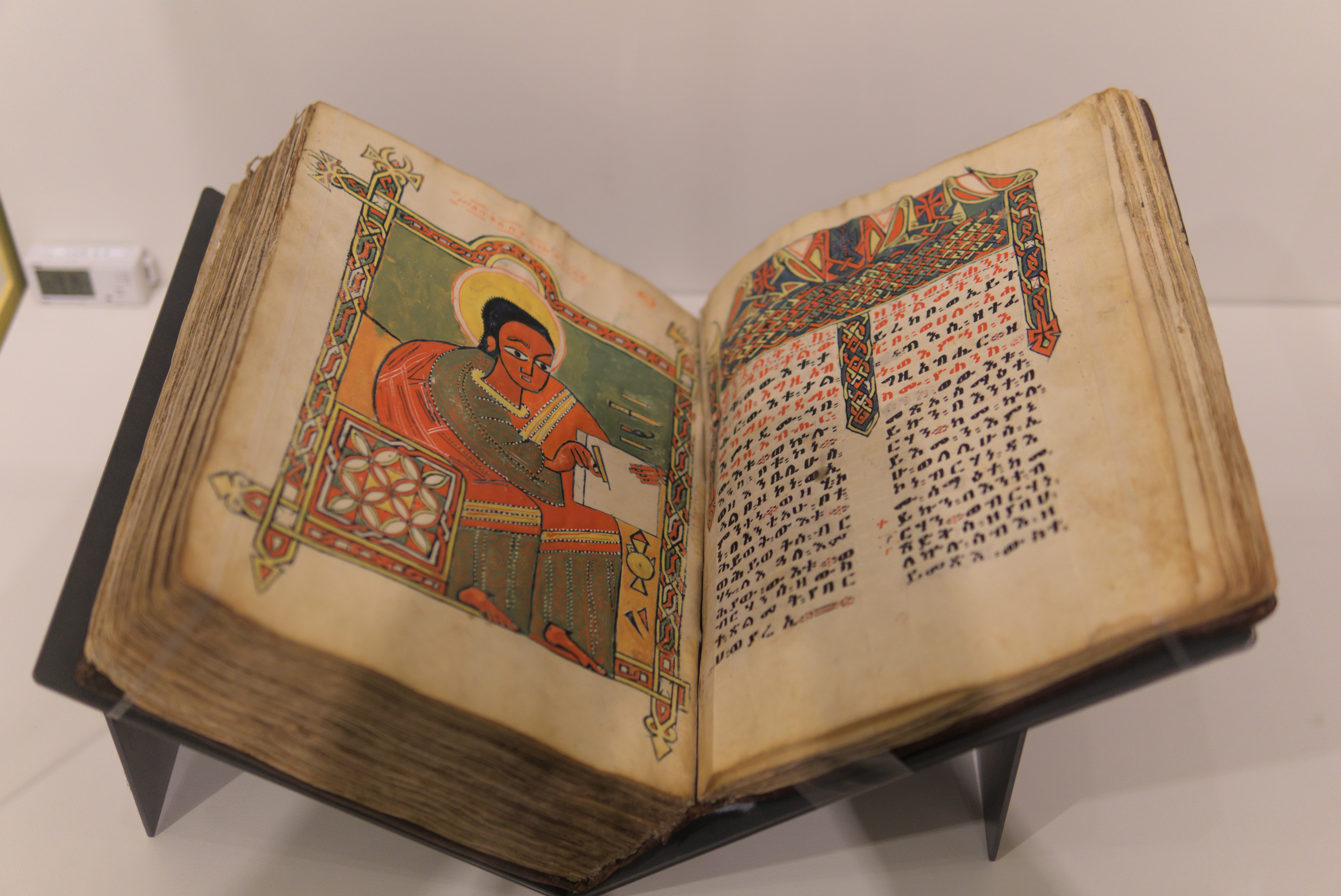
The Opening of the Gospel of John, from a Gospel book, Ethiopia, ca. 1504–5. Tempera on parchment, 13 9/16 × 10 7/16 in. (34.5 × 26.5 cm). J. Paul Getty Museum, Los Angeles, Ms. 102, fols. 215v–216r. [object record]

Virgin and Child triptych
Triptych Icon with the Virgin Mary and Christ Child Flanked by Archangels (center), the Kwer‘atä re’esu (Man of Sorrows) and Saint George (left), and Saint Gäbrä Mänfäs Qeddus and Abba Arsanyos (right), Ethiopia (Gondar), late 17th–early 18th century. Tempera on gesso-primed wood. Institute of Ethiopian Studies, Addis Ababa University, acc. no. IESMus3492.

In the triptych shown above, not only is the infant Jesus depicted as Black, but he also wears a necklace made of cowrie shells, which are traditionally given to Ethiopian children for protection!

My favorite artwork from the exhibition is probably this triptych:

Crucifixion triptych
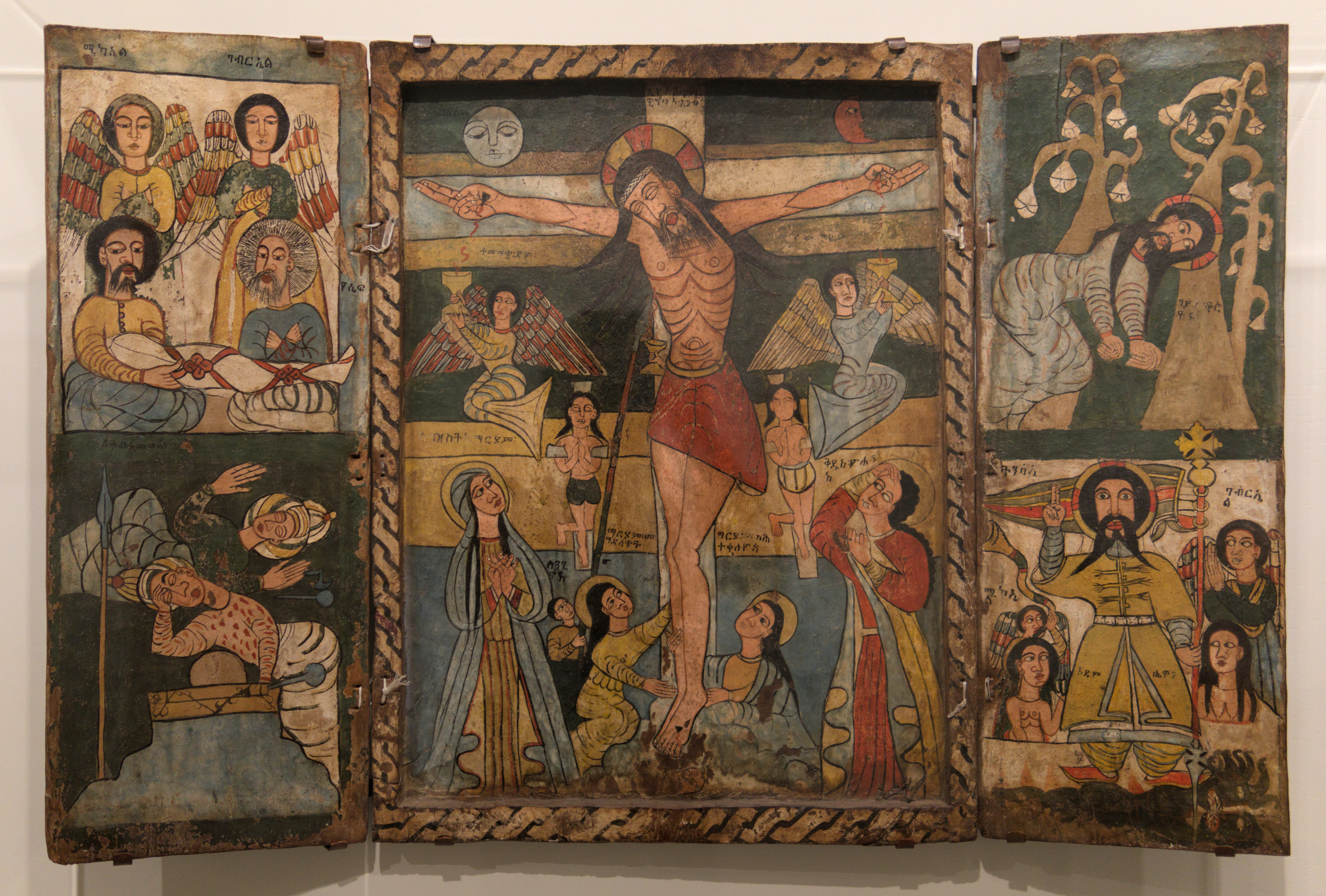
Triptych Icon with the Crucifixion (center), Entombment and Guards at the Tomb (left), and Temptation in the Wilderness and the Resurrection of Christ (right), Ethiopia, late 16th century. Tempera on gesso-primed wood. Institute of Ethiopian Studies, Addis Ababa University, acc. no. IESMus4126.

Its central panel depicts the Crucifixion, Christ’s head bowed in death and his fingers gesturing blessing, even as his palms are nailed. At the top, the sun and the moon mourn his passing. As we saw before, angels catch the blood that drips from his body (notice the cute little hand sticking out from behind his torso!). At the base, the two larger-scale figures are the Virgin Mary and St. John, while next to Mary on a smaller scale is Longinus, the centurion who pierces Christ’s side with a spear.

The left wing shows the Entombment of Christ, with two guards, wearing pointed turbans, sleeping at their post. The right wing shows a scene that the label identifies as “Temptation in the Wilderness” (presumably a translation of the inscription on the tree) but that looks to me more like an Agony in the Garden. Below that is the Resurrection, with Christ holding a victory banner, standing atop Hades. An angel blows a shofar and the dead rise up out of their graves, following Christ, the firstfruits of the resurrection (1 Cor. 15:20–22). Christ wears a short-sleeved, knee-length jacket with frog closures, and bunched sleeves and trousers, both of which reflect clothing from regions east of Africa.

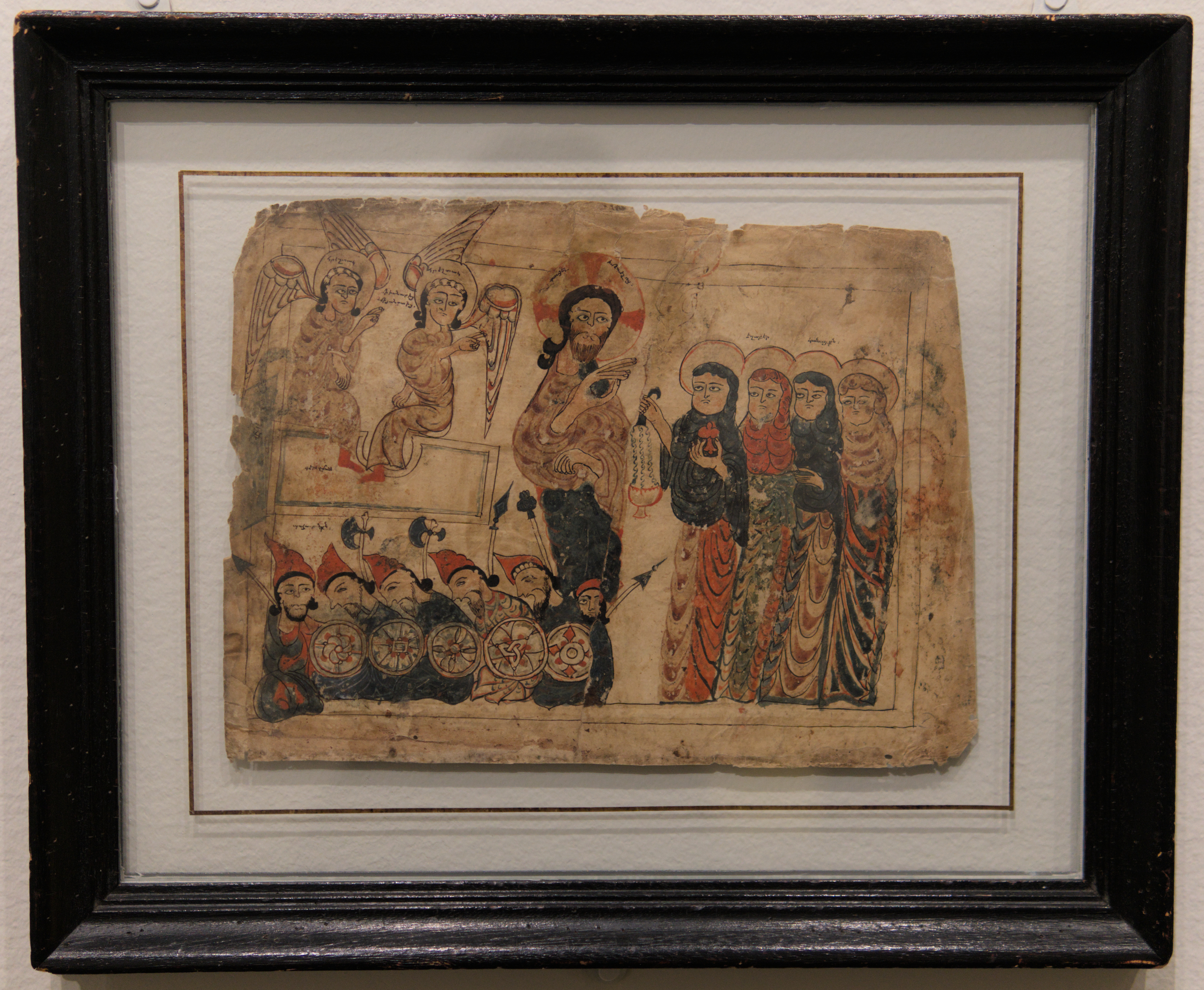
The wall text notes the fine, wavy lines used to render the figures’ draperies, perhaps influenced by Armenian artists from the Lake Van region.

Armenian Resurrection
Yovsian of Vaspurakan (Armenian), Leaf from a Gospel book with the Resurrection of Christ and Visit of the Women to the Tomb of Christ, ca. 1350. Tempera on cotton paper. Private collection.

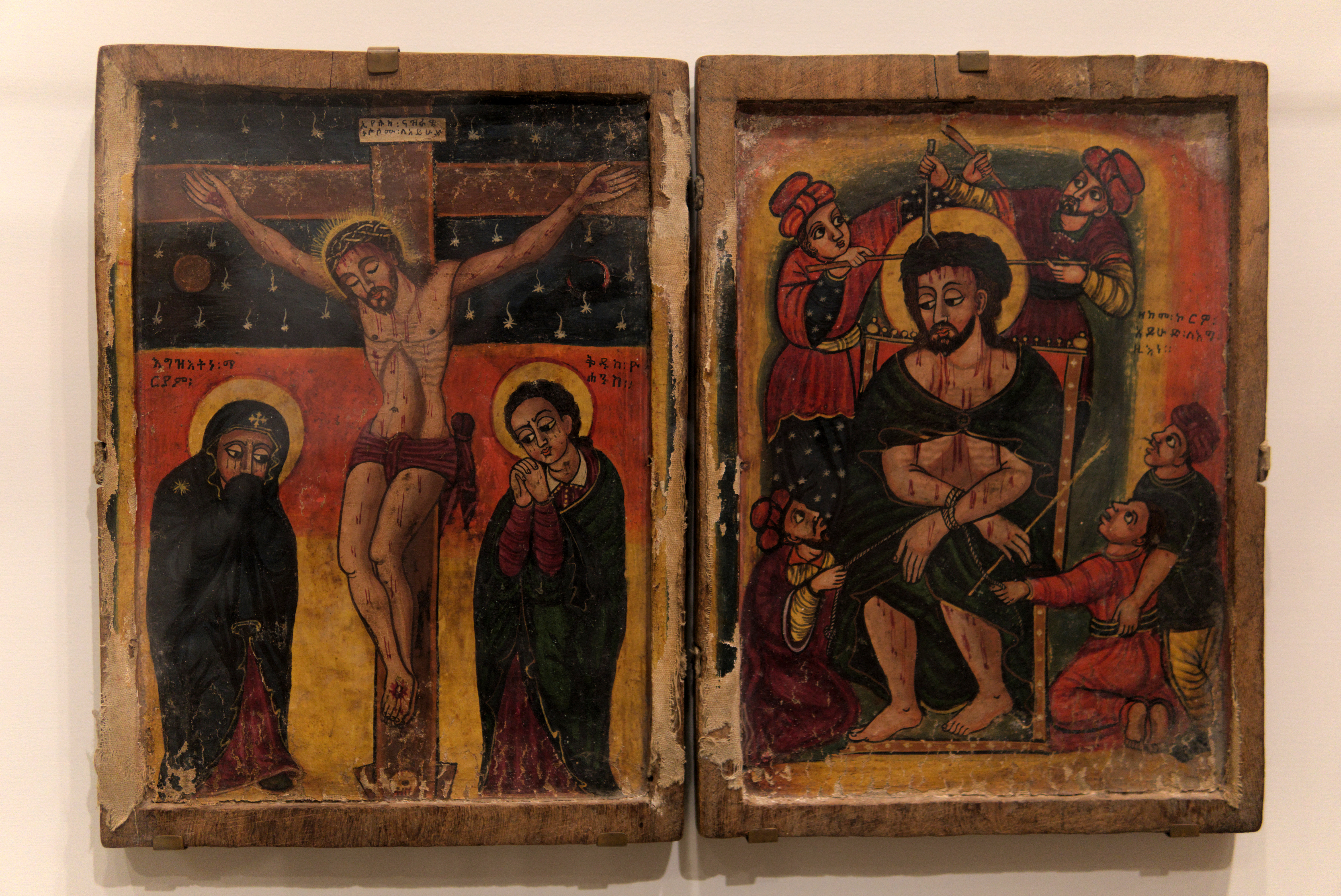
Here’s another Crucifixion, this one painted in what’s called the Second Gondarine style, characterized by smoothly modeled figures, often with darker skin tones, and wide horizontal bands of red, yellow, and green filling the background:

Crucifixion-Mocking diptych
Diptych Icon with the Crucifixion (left) and the Mocking of Christ (right), Ethiopia, late 17th–early 18th century. Wood, polychrome, 13 1/2 × 9 7/8 in. (34.3 × 25.1 cm). Virginia Museum of Fine Arts, Richmond. [object record]

The squiggles behind Christ at the top left may simply be a decorative motif, but to me they look like falling stars, an apocalyptic sign, and as if the sky is weeping.

The right panel of the diptych shows Christ being cruelly fitted with a crown of thorns.

Two other passion images I want to share are a Last Supper wall painting and an Entombment from a disbound album.

Last Supper
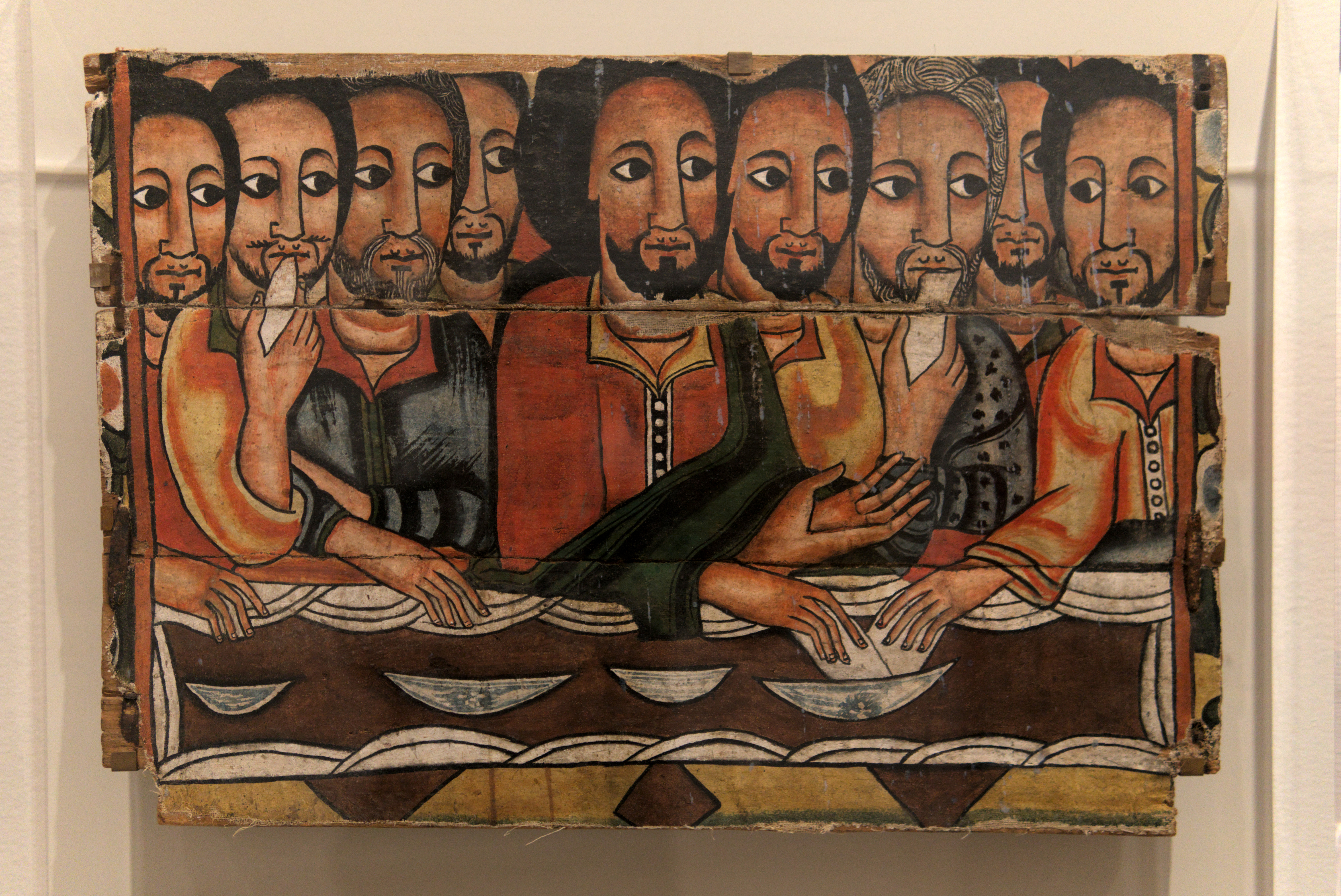
Last Supper, Ethiopia, 18th century. Tempera on linen, mounted on panel, 16 3/4 × 24 in. (42.6 × 61 cm). Virginia Museum of Fine Arts, Richmond. [object record]

Entombment
Album Leaf with the Entombment of Christ, Ethiopia (Sawa?), late 17th century. Pigments on vellum. Minneapolis Institute of Art, 2009.39.3y. [object record]

In the Last Supper, Jesus and Judas both dip their bread (injera!) into the same bowl and exchange a knowing glance.

In the Entombment, Jesus, wrapped in white linen, is lowered into the ground, mourned by several of his women followers. The portrayal of his mother Mary’s weeping, her hands covering her eyes and her face stained with tears, is particularly poignant. This leaf is from a set of forty-four, now matted separately but originally arranged in series and likely painted on several long sheets of parchment that were sewn together and folded accordion-style to form a sensul.

One of the most extraordinary objects on display is a rare folding processional icon that adopts the form of a fan, from the late fifteenth century:

Processional icon (Ethiopia)
Folding Processional Icon in the Shape of a Fan, Ethiopia, late 15th century (Stephanite). Ink and paint on parchment, thread, extended: 24 1/4 × 154 1/8 × 4 3/4 in. (61.6 × 391.4 × 12 cm). Walters Art Museum, Baltimore. Photo courtesy of the museum. [object record]

Thirty-eight identically sized figures span the surface of this elongated parchment: the early Christian martyrs Julitta (Juliet) and Cyricus, St. George, St. John the Baptist, the archangel Michael, the Virgin Mary, the archangel Raphael, St. Paul, the Ethiopian artist-priest Afnin, and unidentified Old Testament patriarchs and prophets. There would have been a wooden handle attached to either end that, when pulled together, created a double handle for a giant wheel to be displayed during liturgical processions and church services (see here). As the museum website notes, “The Virgin Mary, whose hands are raised in a gesture of prayer, is then at the top of the wheel. By depicting Mary in the company of saints and angels, the icon powerfully evokes the celestial community of the church.”

This is just a sampling of all the wonderful art objects that are a part of the Ethiopia at the Crossroads exhibition. I’ll share more photos on Instagram (@art_and_theology) in the coming weeks.

I strongly encourage you to go see this! I think it would be enjoyable for children as well, especially Christian children, who will be able to identify many of the painted stories. For Christians, it’s an opportunity to connect with our artistic heritage and with African church history. If you can’t catch the exhibition at the Walters in Baltimore before it closes March 3, it will be traveling to the Peabody Essex Museum in Salem, Massachusetts (April 13–July 7, 2024), and the Toledo Museum of Art in Ohio (August 17–November 10, 2024).

Also, a catalog is coming out in April, where you will find photos of all the artworks in addition to illuminating essays.