Salvador Dalí (Spanish, 1904–1989), The Angel, 1947. Ink and watercolor on paper, 12 3/4 × 10 1/4 in. Hallmark Art Collection, Kansas City, Missouri.
In 1947, Hallmark commissioned the famous modern artist Salvador Dalí to create a small set of original paintings for its Gallery Artists line of Christmas cards to hit the market in 1948. The Angel is one of them. Painted in his typical surrealist style, it shows a headless angel playing a lute, the snowy mountains in the background mimicking wings. At the bottom right, the newborn Christ lies naked on the ground, cushioned by straw and adored by his mother. On the left a shepherd sits on a tree stump, also playing a lute, its soundboard blending into the landscape in the background. At the warmth of their song, the snow begins to melt away.
LISTEN: “Celestial Hearts,” traditional Yorkshire carol | Arranged and performed by Kate Rusby on Holly Head (2019)
Come, let us all rejoice To see this happy morn We’ll tune our hearts and raise our voice We’ll tune our hearts and raise our voice Tune our hearts and raise our voice Upon this Christmas morn Upon this Christmas morn
Go, humble swain, said he To David’s city fly A promised infant born today A promised infant born today A promised infant born today Does in a manger lie Does in a manger lie
Now angels all on high Sing heav’nly peace on earth Goodwill to men and angels’ joy Goodwill to men and angels’ joy Goodwill to men and angels’ joy Resound across the earth Resound across the earth
With looks and hearts serene Go see the babe, your king A host of angels then was seen A host of angels then was seen A host of angels then was seen The shepherds heard them sing The shepherds heard them sing
From one of England’s most popular folk singers, Kate Rusby, comes a modern interpretation of the Yorkshire carol from Worrall and Oughtibridge known as “New Celestial” (Roud 17724). Rusby arranged this version with her husband and producer Damien O’Kane, adapting the traditional lyrics.
This post is part of a daily Christmas series that goes through January 6. View all the posts here, and the accompanying Spotify playlist here.
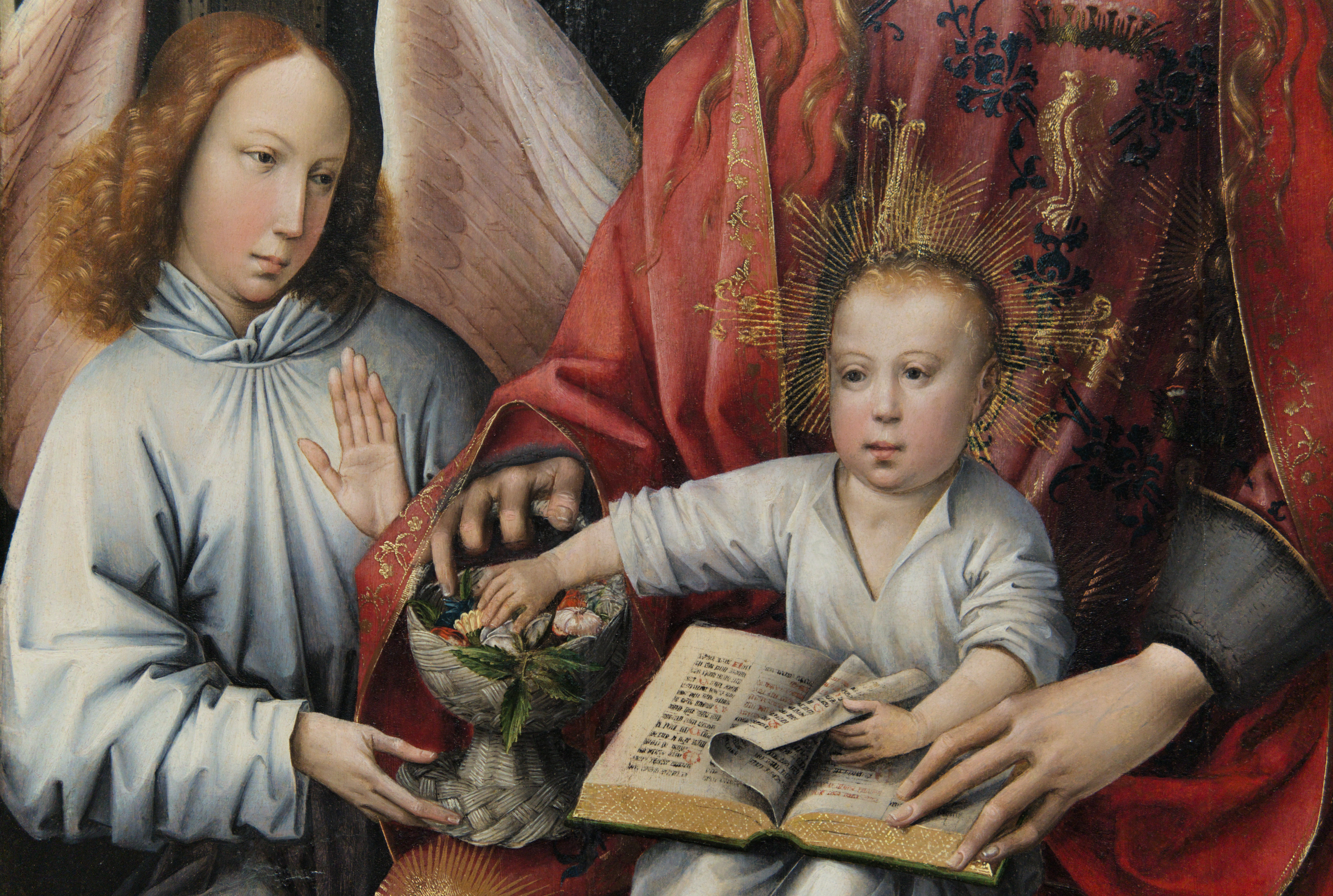
Isn’t this such a charming detail?—the infant Christ sticking his chubby little hand into a footed wicker bowl of flowers (potpourri?). I suppose the angel who holds it out to him wishes him to delight in the fragrance, this wee one whose senses are still so new. But what is its symbolic significance? Northern Renaissance painters often imbued ordinary objects with religious meaning. Perhaps it simply gestures to the aroma of Christ himself, his sweet, invigorating nature? At first I thought of myrrh, one of the gifts of the magi, traditionally interpreted as a foreshadowing of Christ’s death, as it was used to anoint his body in burial (John 19:39)—but myrrh is a yellow sap-like resin, and the bowl’s contents are neither that nor extracted oils. I don’t know; what do you think?
Compare this to the painting known as The Holy Family of Francis I(after the name of its original owner) by Raphael of Italy, which shows an angel providing a scented cover of flowers over the young mother and child.
Colijn de Coter (Netherlandish, active ca. 1480–1525), Virgin and Child Crowned by Angels, 1490–95. Oil on panel, 151.9 × 88.6 cm (59 13/16 × 34 7/8 in.). Art Institute of Chicago. Photo: Victoria Emily Jones. [object record]
The larger context of the Netherlandish painting is Christ sitting on his mother’s lap in a contemporary bourgeois interior as she is being crowned Queen of Heaven, royal by association with the newborn king. (The embroidered inscription on the hem of her mantle reads, “ORA PRO NOBIS / AVE REGINA / CELOR[U]M MATER REGIS ANG[E]LORUM,” which translates to, “Pray for us. Hail, queen of heaven, mother of the king of angels.”) He’s reading the scriptures—so devout!—but seems momentarily distracted by something out of frame. His expression is serene. (Sidebar: Is it just me who’s anxious by how sloppily he’s turning that page? Not the creases! I mean, I know he’s just a baby, but . . .)
I believe the text is pseudo-Hebrew—both here, and in the scroll on the floor. European Christian artists sometimes imitated Hebrew script in their paintings to reference Jesus’s Jewishness; they were not learned in the language and had no direct textual models in front of them, so the best they could do was make marks that evoke that linguistic heritage.
It’s possible that the scroll is meant to represent Mary’s Magnificat, but it’s hard to say. It lies unrolled beside a neck-handled pewter vase filled with three blue lilies and bearing bosses of what look to me like a Virgin and Child and the prophets.
And look at the golden embroidery of the two turtledoves perched in one of the folds of Mary’s garment! (It recurs in a few places.) This is a reference to the animal offering she brought to the temple for her postpartum purification, a ritual prescribed by ancient Jewish ceremonial law (Luke 2:22–24; cf. Lev. 12:1–8).
The textures in this painting are fabulous. The realistic, detailed rendering of surface textures—of fur, feathers, hair, paper, foodstuffs, metals, jewels, wood, wool, velvet—is one of the hallmarks of Northern Renaissance art—that is, art from fifteenth- and sixteenth-century Holland and Flanders, regions north of Italy. This greater illusionism was made possible by the use of oil paint, which also enabled richer, denser color than its precursor, egg tempera.
Northern Renaissance art is what made me fall in love with art history as a late teen. I had never encountered this painting before in my studies, so it was such a joy to stumble upon it earlier this year on a visit to the Art Institute of Chicago.
Jonah Swallowed and Jonah Cast Up, commentary by Victoria Emily Jones: My latest visual meditation for ArtWay was published Sunday—it’s on two third-century Jonah sculptures from Asia Minor that likely decorated a family fountain. Early Christians read the story allegorically (at least on one level), as pointing forward to the death and resurrection of Christ. The “great fish” is portrayed as a ketos, a sea-monster of Greek myth.
“Jonah Swallowed” and “Jonah Cast Up,” made in Asia Minor, probably Phrygia, 280–90 CE. Marble, 50.4 × 15.5 × 26.9 cm (left) and 41.5 × 36 × 18.5 cm (right). Cleveland Museum of Art, Ohio.
Run by Marleen Hengelaar-Rookmaaker, the faith-based website ArtWay has been publishing a new visual meditation every Sunday for years, as well as a lot of other content from a variety of contributors. To subscribe to the weekly email, click here. Here are just a few VMs published in the past year that I particularly enjoyed:
Manu-Kahu by Brett a’Court, commentary by Rod Pattenden: Pattenden begins, “This striking image of an airborne Christ is from New Zealand painter Brett a’Court. It is part of his investigations into a way of bringing together the spiritual insights of the indigenous culture of the Maori people and that of Christianity brought to New Zealand by British settlers. In cultural terms it is a hybrid image. This is something that occurs when two cultures are in a process of mutual re-assessment. That sort of conversation is full of conflict and critique but also allows for the potential for new forms to arise that express the best of both traditions. A Christ figure flying in the sky like a kite, is such a form. It is a new thing, a potential heresy or aberration, but one full of potential for new insight and spiritual refreshment.”
Brett a’Court (New Zealand, 1968–), Manu-Kahu, 2007. Oil on canvas.
Knife Angel by Alfie Bradley, commentary by Rachel Wilkerson: This twenty-seven-foot-tall sculpture, welded from 100,000 knives collected in confiscations and amnesties around the UK, confronts the issue of knife violence. The artist cleaned and dulled the blade of each knife he received and engraved personal messages on all the wings’ “feathers,” messages sent by families affected by knife violence.
Cathedra by Barnett Newman, commentary by Grady van den Bosch: I saw this painting in Amsterdam last spring and was surprised by how it compelled me. (I don’t typically gravitate to abstract art.) After spending some time up close—I supposed this was a Newman, and Newman says his paintings need to be experienced up close—I looked at the label and saw that it has a religiously inflected title: Cathedra. The word is Latin for “seat,” and in Christianity it refers specifically to the bishop’s chair inside a church (churches that had a cathedra were called cathedrals). But Newman was of Jewish descent, and van den Bosch writes that Cathedra is meant to represent the throne of God. “And above the firmament that was over their heads was the likeness of a throne, as the appearance of a sapphire stone . . .” (Ezek. 1:26).
Barnett Newman (American, 1905–1970), Cathedra, 1951. Oil and acrylic on canvas, 243 × 543 cm. Stedelijk Museum, Amsterdam, Netherlands. Photo: Victoria Emily Jones.
As someone who loves historical Christian art, including its many Christ Pantocrators, I must nevertheless admit that there is something so right about modern artists’ often apophatic approach to evoking the Divine. While I do believe God imaged Godself in the person of Jesus Christ and is therefore representable, I understand the argument some make that abstraction is a better visual language for spiritual subject matter or encounter. I accept both/and. Whether God is shown as a rich, blue expanse that invites and envelops, or a heroic nude emerging from the jaws of death, or a Man of Sorrows head with a harrier hawk’s body, I think we can learn a little something from the diversity of representations, which are not mutually exclusive. Not all representations need be embraced, but nor do unfamiliar, difficult, or even shocking ones need be automatically dismissed.
Click on the link for more on how to read Newman’s color field paintings, including his signature “zips.”
The course aims to help Christians develop critical tools for watching television and a vocabulary that is as rich and thoughtful as the medium itself, so that we can engage it constructively. (It need not be mindless entertainment!) Callaway explores television as a technology, a narrative art form, a commodity, and a portal for our ritual lives. He’s interested in how stories are told in this episodic, audiovisual format, and what that means for the Story we tell. The course is not about what Christians should watch, but how Christians should watch, leaving ample room for individual viewers to set their own boundaries, ethical and otherwise. (Callaway acknowledges that TV can form as well as de-form us.) He discusses empathy building and access to other perspectives, knowing your sensibilities, how being offended can be useful, watching in community, seeing God in all places, being aware of how your desires and imagination are being shaped, Christians in Hollywood (and Christian characters on TV), and the culture shaping TV and TV shaping culture, among other things.
The course is fairly broad in its approach; it does not analyze particular shows or episodes, though some specific examples are mentioned in conversations, and students are encouraged to form discussion groups with friends or family members and apply what they’re learning to shows of their choice. I really appreciated the assigned PBS docuseries America in Primetime (somewhat outdated because made in 2011 but very good nonetheless), whose four episodes explore character types throughout the history of TV, from the fifties to today: “The Independent Woman,” “Man of the House,” “The Misfit,” and “The Crusader.” From taking this course I realized how many acclaimed TV shows I’ve never seen. I’ve got a lot of homework to do!
Other arts courses offered by Fuller Formation are
POEM: “My Mother’s Body” by Marie Howe, read with commentary by Pádraig Ó Tuama: As Mother’s Day is Sunday, I thought I’d share this wonderful, sad-sweet, mother-themed episode of the new Poetry Unbound podcast from On Being Studios. Pádraig Ó Tuama introduces Marie Howe’s “My Mother’s Body,” in which a middle-age woman, caring for her dying mother, thinks back to the time when her mother was just a twenty-four-year-old girl giving birth to her. The speaker in the poem is Howe.
She imagines being in her mother’s womb, experiencing the rhythm of her mother’s heartbeat. (What an exercise, to imagine yourself as your mother’s baby!) Now decades later, her mother is dying—that heart is failing, and the kidneys too. The uterus has been removed. Toggling between the two time frames, the poem is both a celebration of the strength of women’s bodies and a lament for its vulnerabilities, especially in old age. Howe marvels at how her mother’s body was capable of such a wonder as giving and sustaining life, and now to see that once-vibrant form breaking down grieves her. In some sense their roles have switched as daughter mothers mother, combing her hair, changing her soiled bedsheets.
The poem opens with “Bless my mother’s body” and ends with “Bless this body she made . . .” In the progression of pronouns in the last two lines—my, her, our—is a recognition of how our mothers always remain a physical part of us. They are in our cells. “My Mother’s Body” is a thank-you and a letting go.
ARTICLE: “5 Contemporary Poets Christians Should Read” by Mischa Willett:“There is so much good crop still being pulled from the fertile fields of theologically inflected verse,” writes poet Mischa Willett—so don’t stop short, content merely with Donne and Hopkins! This is an excellent short list of contemporary poets of faith, with summaries of key themes and recommendations for which volume(s) to start with. Willet was recently on The Ride Home with John and Kathy to discuss this topic, and he wrote a follow-up post on his blog.
+++
MUSIC VIDEO: “I Am a Poor Wayfaring Stranger”: One of the most poignant scenes in last year’s 1917 is when, after a harrowing journey across No Man’s Land, Lance Corporal William Schofield—exhausted, disoriented—reaches a wood and encounters a fellow British soldier singing the spiritual “Wayfaring Stranger” [previously] to a battalion that sits at somber attention, for they’re about to go into battle. This official music video from Sony splices together clips from the movie with studio footage of the actor and singer Jos Slovick.




 Art & Theology