Roundup: Animal church service, “Life/Blood” installation, and more

Have you been delighted or inspired by the Art & Theology blog this year or its Instagram offshoot, @art_and_theology? If so, please consider donating to the work through a secure online form or PayPal, or by buying me a book from my Amazon wish list (my address is privately stored). Thank you to my five regular monthly supporters, and others who have blessed me with one-off donations of funds and books. These gifts not only provide important material assistance but also serve as an emotional boost, a validation that my work has value and is worth continuing.

My blog-related expenses this year have included a replacement of my old laptop, a conference registration and travel fees, a trip to New York, museum admissions, books, licensing fees for two images (I occasionally pay for images when good photos are not available online), and the yearly WordPress Premium fee to keep this site ad-free and mapped to a custom domain. Donations will go toward covering these, and if there is any left over, toward a new camera lens that will enable me to take wider shots, great for cathedrals and for larger artworks in tight quarters.


SPOTIFY PLAYLIST: October 2024 (Art & Theology): Every month I create a digital mixtape of Christian and Christian-adjacent music that deserves attention, consisting of old and brand-new recordings alike. Two hours of beautiful, soulful expressions of praise, prayer, and lament for your ears and heart.

+++

VIDEO: Animal Service at Ely Cathedral: On September 22, Ely Cathedral in England held its annual animal service, attended by some 450 animal lovers and their pets and service animals, mainly dogs. “Our annual Animal Service is an opportunity to give thanks for the animal companions with whom we share our lives and our planet, to bring them into our Cathedral, to ponder how best to care for animals and to ask God to bless them.” Marley the donkey, from the Donkey Sanctuary, led a procession up the nave. The liturgy was led by Canon James Garrard, and, in addition to several congregational hymns, including “All Creatures of Our God and King,” the cathedral’s children’s choir, the Ely Imps, sang “The Barnyard Song” by Rhonda Gowler Greene and “Look at the World” by John Rutter.

In addition to a special prayer of confession, act of commitment, and benediction, the service included this litany from the Book of Common Prayer:

God said, “Let the waters bring forth living creatures, and let birds fly across the sky.”

We thank you for the teeming life of the seas,
And the flight of the birds.
Help us to protect the environment
So that all life may flourish.
God of life: Hear our prayer.

God said, “Let the earth bring forth living creatures of every kind.”

We rejoice in the variety of animal life.
Grant us grace to treat all animals with respect and care;
To protect endangered species,
To preserve the variety of habitats,
And to honor the delicate balance of nature.
God of life: Hear our prayer.

Heavenly Father, you have filled the world with beauty.
Open our eyes to behold your gracious hand in all your works,
That, rejoicing in your whole creation,
We may learn to serve you with gladness,
For the sake of him through whom all things were made,
Jesus Christ our Lord.
God of life: Hear our prayer.

Two volunteer representatives from the charity Medical Detection Dogs were invited to share about the work of dogs who are trained to detect the odor of human disease.

Several churches worldwide hold animal services around this time of the year, the Feast of St. Francis (known for his love and care of animals) being on October 4. These are usually in addition to the regular Sunday morning worship service and are not eucharistic. UMC’s Discipleship Ministries provides a sample liturgy for “A Service for the Blessing of Animals.” Many such services are held outdoors, such as the one organized annually by Washington National Cathedral, which is taking place this Sunday, October 6, at 2 p.m.

+++

ART INSTALLATION VIDEOS + PHOTOS: In July I mentioned the Vessel art trail organized by Art + Christianity, which places contemporary artworks in rural churches along the Welsh-English border (see here). On commission from A+C, Mud and Thunder has taken some wonderful photos and video of the seven sites on the trail, including interview footage with the artists. What follows are videos for Life/Blood by Lou Baker, Grace Vessel by Jane Sheppard, and Centre by Steinunn Thórainsdóttir. (The remaining videos are on pieces by Lucy Glendinning, Andrew Bick, Barbara Beyer, and Robert George.)

The art trail continues through October 31. Visit https://artandchristianity.org/vessel to view in situ photographs, and see the following links for information on free creative workshops led by the participating artists: on making sculptures of found natural materials, working with clay as a meditative practice, social knitwork, and drawing.

+++

POEMS:

>> “There’s a Special Providence” by Seth Wieck, Texas Poetry Assignment: Seth Wieck [previously] is a writer from Amarillo, Texas. Published the week of the last US presidential inauguration, this poem muses on the impermanence of earthly empires, contrasting such with the steady, indifferent labor of birds, which continues on through administration changes and the passing of generations. The title and opening line are a clever rhyming twist on a line from the final act of Shakespeare’s Hamlet, “There’s a special providence in the fall of a sparrow.” For the poetic speaker, there’s a sense of comfort in God’s sovereignty and an orientation toward Christ’s lordship that puts election poll results, though not negligible, in proper perspective.

In a Substack post from February 2021, Wieck wrote, “I am no politician’s acolyte; they’re public servants, not saviors. I catch some heat in private conversation when I say that I couldn’t care less about national politics. That’s not a true statement, but the tense conversations in which I claim my ambivalence usually leave me no room for nuance. Those conversations demand my total wide-eyed attention to the firehouse of information being created by national elections. But as Mary Oliver said, ‘The beginning of devotion is attention.’ Forgive me if I am unwilling to develop devotion for those people whose only interest in my community is the exploitation of our devotion and resources.”

>> “Jesus Heals a Paralytic” by Ryan Keating, Reformed Journal: Ryan Keating is a pastor on the Mediterranean island of Cyprus (he preaches in Turkish and English), an academic writer and poet, and the owner of Exile Coffee and Wine. This poem retells the miracle from Mark 2:1–12 in the voice of the paralyzed man whom Jesus heals. Whereas many artists depict the episode with ropes used as a lowering mechanism, Keating says it’s much more likely, given the typically low ceilings of Middle Eastern homes, that the man would have been received by “a net of hands” raised up by the people in the room.

The poem repeats the word “temple” three times, remarking how the man was “suspended / in a temple by a temple / and landed on holy ground / as a temple . . .” The temple is the place where the crowd is gathered because Jesus is in it, and the four faith-filled friends who bring the paralyzed man there themselves constitute a temple, and the man too becomes a temple, a dwelling-place of God, after being made whole by Jesus. Drawing on Old Testament imagery of the garden of Eden and the exodus, the final stanza is one of restoration. The sea of people parts as the man steps outside into a garden, his friends buoyed by amazement.

+++

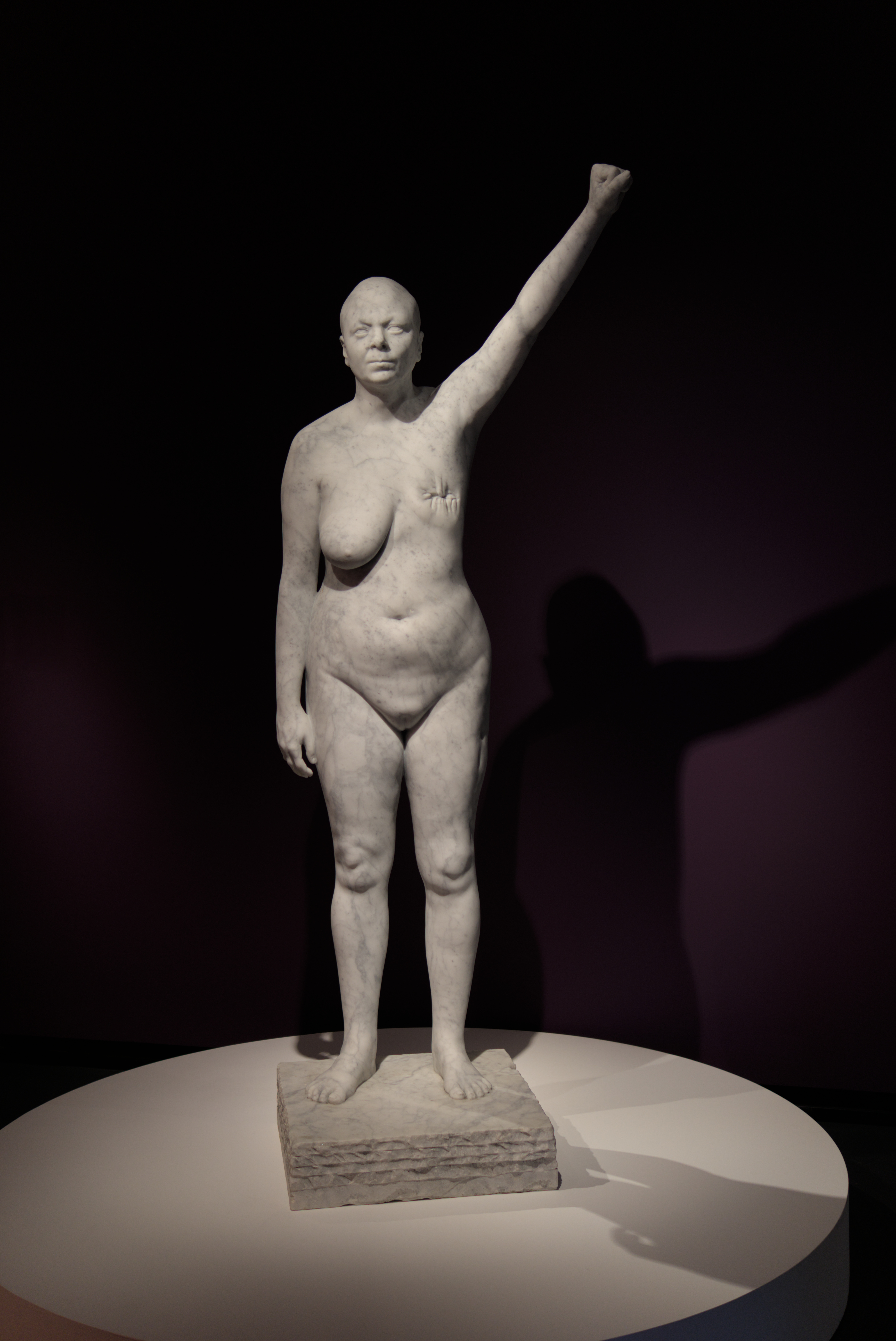
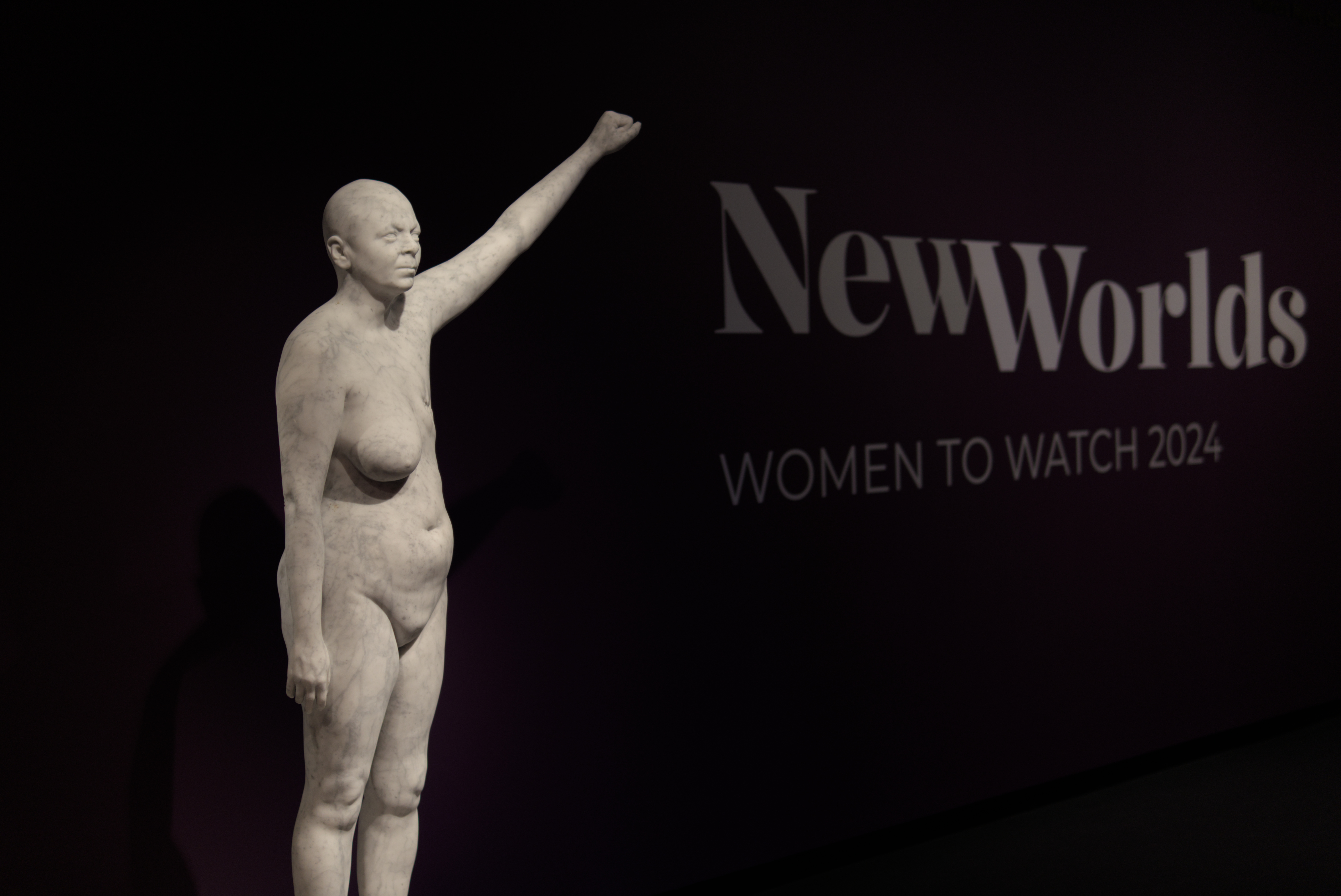
ARTWORK: Intra-Venus by Marina Vargas: October is Breast Cancer Awareness Month, so I wanted to share an artwork I encountered on the subject this summer at the New Worlds: Women to Watch 2024 exhibition at the National Museum of Women in the Arts. Intra-Venus is a nude self-portrait in marble by Spanish artist and breast cancer survivor Marina Vargas, frankly depicting her body after a mastectomy, chemotherapy, and radiation. Owning her scars and her baldness, she uses the language of classical sculpture to monumentalize a common female experience. (The chance of a woman in the US getting breast cancer in her lifetime is 1 in 8, and more than 100,000 US women undergo some form of mastectomy each year; global statistics are harder to come by.) Vargas lost the use of her left arm for a time during treatment, but here she shows herself with her left arm raised in triumph. The sculpture highlights the heroism of women who endure breast cancer and the dignity of their changed form.
Vargas, Marina_Intra-Venus
Marina Vargas (Spanish, 1980–), Intra-Venus, 2019–21. Carrara marble, 77 1/2 × 26 3/4 × 26 in. Photo: Victoria Emily Jones.

Vargas, Marina_Intra-Venus

Animal liberation and the kingdom of God: Streams in the Wasteland painting series by Josh Tiessen

“The wild animals honor me,
    the jackals and the owls,
because I provide water in the wilderness
    and streams in the wasteland . . .”

—Isaiah 43:20 (NIV)

This verse from the prophetic book of Isaiah supplies the title of artist Josh Tiessen’s Streams in the Wasteland series. Comprising seventeen paintings of wild animals inhabiting abandoned cities, it took six years to complete, from 2015 to 2021. In this body of work Tiessen weds a biblical imagination with his passion for wildlife conservation to promote ecological ethics, or what Christians call “creation care”—the biblical imperative to be benevolent stewards of the environment and all its creatures. He says he wants to represent “the majesty, particularity, and beauty of animals” (Streams in the Wasteland, p. 33)—to evoke wonder, love, and empathy, and a greater sense of responsibility.

“The whole creation has been groaning,” the apostle Paul writes in Romans 8, seeking to “be liberated from its bondage to decay and brought into the freedom and glory of the children of God.” Creation has been damaged in large part by humanity’s sin, which has caused deforestation, land degradation, ozone depletion, and species endangerment and extinction, among other harms. Instead of enjoying the full flourishing God intended, the natural world suffers.

Streams in the Wasteland engages with the question, What would the liberation of animals from the bondage to decay look like? Some of Tiessen’s creative visual responses:

  • An Indian temple elephant breaks free of its shackles, no more to be prodded and paraded for the people’s religious festivals.
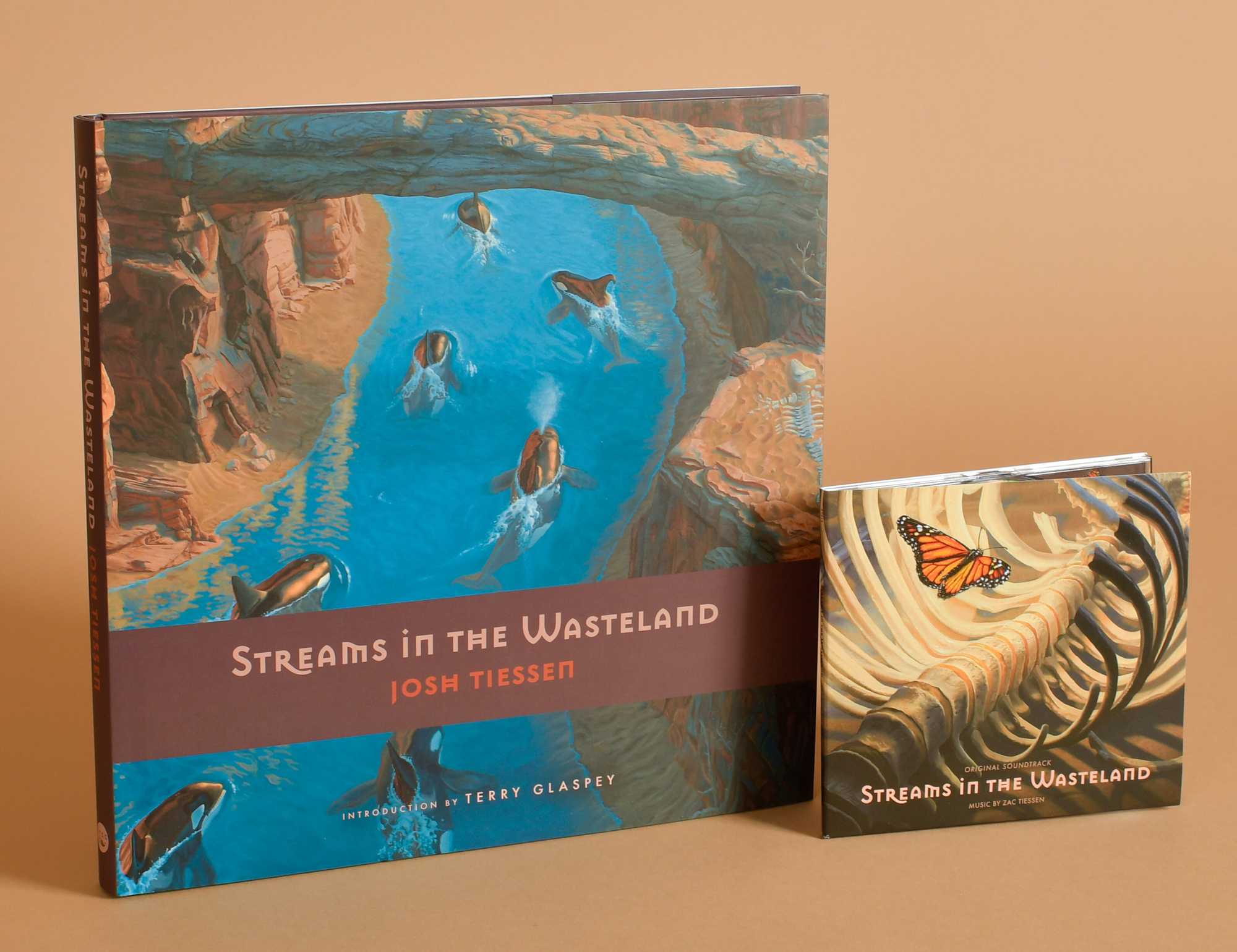
  • Released from aquarium amusement parks where they were exploited for entertainment, a pod of orcas journeys down a canyon river into the ocean past their ancestors’ skeletal remains, which will one day rise.
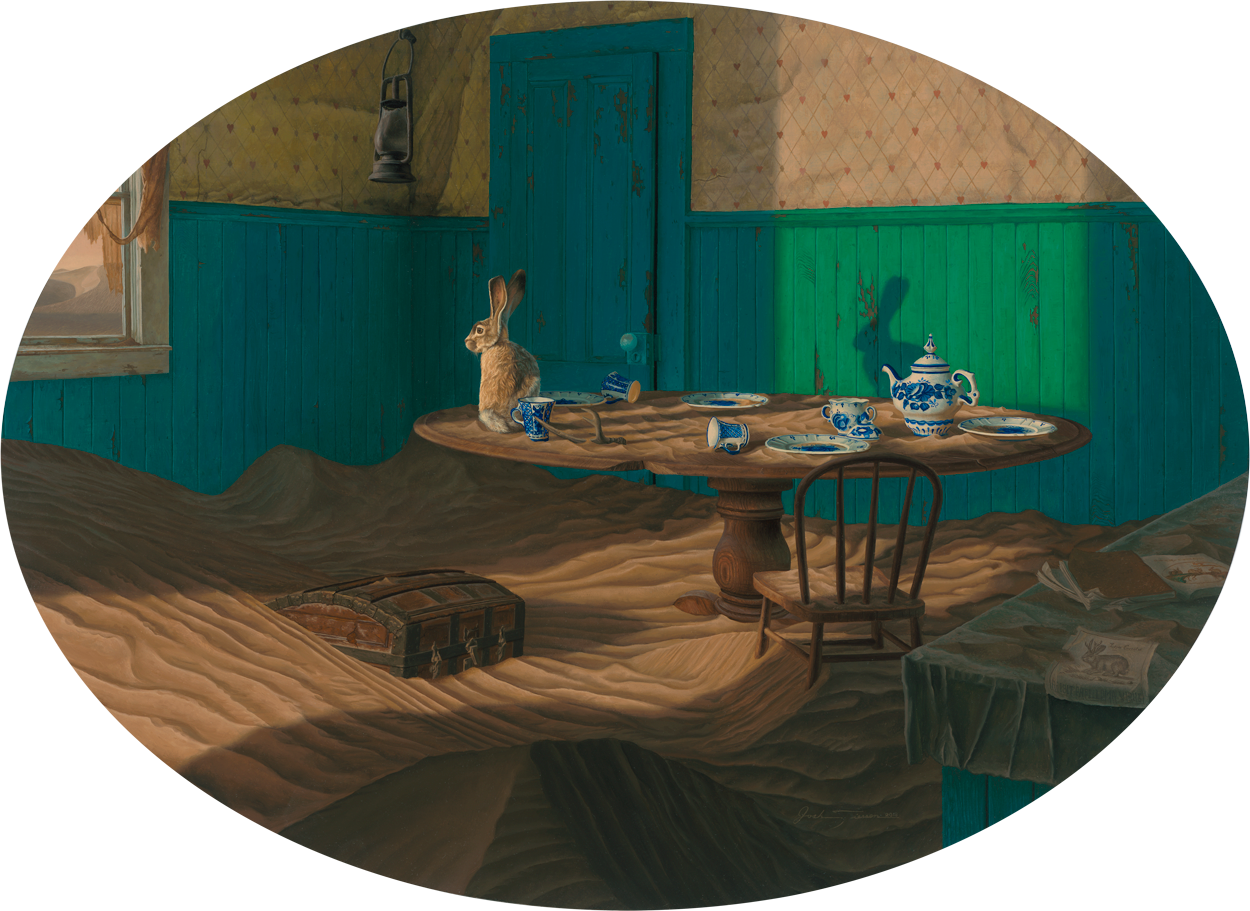
  • A jackalope—the mythical horned rabbit of North American folklore—sheds its antlers, a passing shadow of the old world. Rabbits with hornlike protrusions on or near their heads have actually been found in nature, the cancerous growths a result of a papillomavirus.
Tiessen, Josh_Liberation of the Jackalope
Josh Tiessen (Canadian, 1995–), Liberation of the Jackalope, 2018. Oil on braced Baltic birch, 21 × 29 in.

Tiessen calls his style “narrative hypersurrealism,” as he renders the animals with technical precision and great attention to naturalistic detail (hyperrealism) but places them in a postapocalyptic context, revealing strange beauty in the unexpected (surrealism). And in contrast to traditional wildlife art, Tiessen’s art tells a story. For Streams in the Wasteland, that story is one of reclamation and healing—but also one of warning for those who neglect God’s laws.

In preparation for this series, Tiessen wrote a research paper on zoological motifs in the book of Isaiah. He found that in several prophecies of judgment, God gives animals dominion over human civilization—an ironic reversal, the “weak” shaming the powerful.

Take Isaiah 13:19–22, for example:

Babylon, the jewel of kingdoms,
    the pride and glory of the Babylonians,
will be overthrown by God
    like Sodom and Gomorrah.
She will never be inhabited
    or lived in through all generations;
there no nomads will pitch their tents,
    there no shepherds will rest their flocks.
But desert creatures will lie there,
    jackals will fill her houses;
there the owls will dwell,
    and there the wild goats will leap about.
Hyenas will inhabit her strongholds,
    jackals her luxurious palaces.
Her time is at hand,
    and her days will not be prolonged.

In addition to Babylon, Isaiah indicts other unjust nations: in Cush the fruit of the vine “will all be left to the mountain birds of prey” (18:6), and in Edom “the desert owl and screech owl will possess it; the great owl and the raven will nest there” (34:11). Concerning the kingdom of Judah: moles and bats will take over idols of silver and gold (2:20), lambs will feed on the food of the rich (5:17), and Jerusalem will become void of human activity and instead be “the delight of donkeys, a pasture for flocks” (32:14). It’s not just nocturnal animals and scavengers that crop up, but also harmless ones like foals and sheep.

Returning to the opening quote of this article, we see that Isaiah describes an eschatological reality in which God’s abundant provision elicits thanksgiving and praise from the animal kingdom. But they are Israel’s foil: whereas the animals are sensible of God’s goodness, God’s people are not. “Yet you have not called on me, Jacob. . . . You have burdened me with your sins and wearied me with your offenses” (43:22, 24).

Tiessen understands such animals “as the Creator’s special agents worthy of intrinsic value and a role in history. I caught a glimpse of Isaiah’s larger vision for animals serving as co-workers with the Creator to confront humanity, calling from within the ruins of human moral decay” (Streams in the Wasteland, p. 22).

Therefore, in Streams in the Wasteland, a barn owl stakes its place on a plinth of a Gothic cathedral alongside sculptures of the saints, meerkats lounge on a chaise inside a Baroque manor, lar gibbons swing from the entryway of a university, and a pack of spotted hyenas wanders through Bodie, a California Gold Rush boomtown known for its sin, now a ghost town.

Tiessen, Josh_Occidental Babylon
Josh Tiessen (Canadian, 1995–), Occidental Babylon, 2017. Oil on braced Baltic birch, 52 × 75 in.

I’m very familiar with the Isaiah passages where creatures are presented as blessings of Edenic hope for the future, existing peaceably with humans (e.g., Isa. 11:6–9), but I had never really stopped to consider all the places where they are said to overtake what we deem human domains. Such passages are certainly more uncomfortable for us humans!

Though humans’ neglect or mistreatment of animals is not specifically what prompts God’s pledged use of animals to shame the rebellious nations, surely our disregard for the creation mandate in Genesis—to rule the earth with care and compassion—is a form of rebellion against God. And so Tiessen extends his reading of Isaiah to address that call in particular, which is echoed in other parts of scripture, such as Proverbs 12:10: “The righteous care for the needs of their animals.” By placing animals in human habitations, Tiessen compels us to remember our obligations to our nonhuman neighbors.

Perhaps my favorite painting from Tiessen’s series is Whale Hymn. The setting is the ruined shell of St. Dunstan-in-the-East, a twelfth-century church that once towered over the city of London but that was irreparably bombed during World War II. It has since been converted into a public garden. In his futuristic vision, Tiessen imagines it surrounded by floodwaters, a humpback whale swimming by. This giant of the deep sings its song to the Creator in the same place where generation after generation of Christians sang their praises until human violence rendered the building unusable.

Tiessen, Josh_Whale Hymn
Josh Tiessen (Canadian, 1995–), Whale Hymn, 2015. Oil on braced Baltic birch, 36 × 48 in.

Isaiah is not the only biblical source of inspiration for Tiessen. Ezekiel’s vision in the valley of dry bones inspired Can These Bones Live?, which shows a monarch butterfly gliding through the ribcage of a human skeleton, and its sequel, Rise Up—the only two paintings with human figures.

Tiessen was born in 1995 in Moscow to Canadian missionary parents. His Russian nanny, Lena Zhuk, taught him drawing basics, like perspective and shading, and, when he showed aptitude, bought him his first set of tempera paints, brushes, large heavy paper, and other materials. When he and his family moved back to Canada, Valerie Jones, a fellow church member and artist, noticed his talent and got him his first public art exhibition at age eleven. Then when Tiessen was fifteen, Canadian wildlife artist Robert Bateman took him on as a student and mentee. He graduated from high school at age sixteen and began exhibiting throughout North America while working on a bachelor’s of religious education in arts and biblical studies at Emmanuel Bible College in Kitchener, Ontario, which he earned in 2020. His professional memberships include Artists for Conservation, the Society of Animal Artists, and the International Guild of Realism.

He currently lives in Stoney Creek, Ontario.

Tiessen has self-published a hardcover, glossy-paged, full-color book that collates all the works from Streams in the Wasteland, providing commentary on them (additional to that on his website), which includes engagement with scholarly interpretations of the Isaiah passages. Through sketches and more, he sheds light on his artistic process and also provides autobiographical information. The book comes with a CD of instrumental compositions by his brother Zac Tiessen that respond to each of the paintings—an atmospheric soundscape. It would make a great gift.

The culmination of the series is Agnus Dei, a triptych featuring all the animals in the individual paintings gathering around a horned altar where the Lamb of God lies slain. Tiessen drew inspiration from Jan van Eyck’s Adoration of the Mystic Lamb, Francisco de Zurbarán’s Agnus Dei, and the paintings of Caspar David Friedrich featuring abandoned abbeys, churches, and cemeteries in winter.

Instead of saints from the Homo sapiens species surrounding the Lamb in worship, Tiessen shows a giant panda, a double-wattled cassowary, a narwhal, and other animals paying homage to Christ. They, too, are drawn up into God’s awesome story of redemption. They, too, participate in the “new thing” God is doing.

“My painting is . . . a critique of the human-centric bias within Western art history,” Tiessen writes. “This is best seen in Renaissance paintings where animals seldom appear, and if they do, it is simply for allegorical purposes. By enlisting wild animals as protagonists with intrinsic value amidst the wasteland of human existence, I endeavor to revise Western art history through a zoological lens, liberating the Judeo-Christian worldview from its perversion at the hands of anthropocentric Greek philosophy.”

This final image shows animals liberated from the effects of the fall, honoring the One whose atoning death and resurrection reconciles all to God (Col. 1:19–20).

To see which of these paintings are available for purchase—either the originals or reproductions or notecards—visit https://www.joshtiessen.com/store.

Creation Psalm (Artful Devotion)

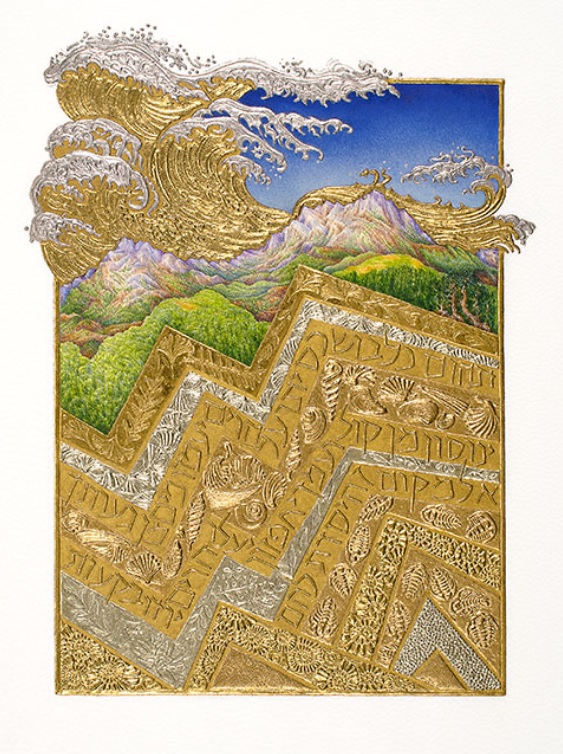
And the Mountains Rose by Barbara Wolff
Barbara Wolff (American), “And the Mountains Rose” (vv. 5–8), from Psalm 104: You Renew the Face of the Earth, 2006–10. Contemporary pigments and precious metals on goatskin. Morgan Library and Museum, New York. MS M.1190, fol. 2.

Bless the LORD, O my soul!
O LORD my God, you are very great!
You are clothed with splendor and majesty,
covering yourself with light as with a garment,
stretching out the heavens like a tent.
He lays the beams of his chambers on the waters;
he makes the clouds his chariot;
he rides on the wings of the wind;
he makes his messengers winds,
his ministers a flaming fire.

He set the earth on its foundations,
so that it should never be moved.
You covered it with the deep as with a garment;
the waters stood above the mountains.
At your rebuke they fled;
at the sound of your thunder they took to flight.
The mountains rose, the valleys sank down
to the place that you appointed for them.
You set a boundary that they may not pass,
so that they might not again cover the earth.

You make springs gush forth in the valleys;
they flow between the hills;
they give drink to every beast of the field;
the wild donkeys quench their thirst.
Beside them the birds of the heavens dwell;
they sing among the branches.
From your lofty abode you water the mountains;
the earth is satisfied with the fruit of your work.

You cause the grass to grow for the livestock
and plants for man to cultivate,
that he may bring forth food from the earth
and wine to gladden the heart of man,
oil to make his face shine
and bread to strengthen man’s heart.

The trees of the LORD are watered abundantly,
the cedars of Lebanon that he planted.
In them the birds build their nests;
the stork has her home in the fir trees.
The high mountains are for the wild goats;
the rocks are a refuge for the rock badgers.

He made the moon to mark the seasons;
the sun knows its time for setting.
You make darkness, and it is night,
when all the beasts of the forest creep about.
The young lions roar for their prey,
seeking their food from God.
When the sun rises, they steal away
and lie down in their dens.
Man goes out to his work
and to his labor until the evening.

O LORD, how manifold are your works!
In wisdom have you made them all;
the earth is full of your creatures.
Here is the sea, great and wide,
which teems with creatures innumerable,
living things both small and great.
There go the ships,
and Leviathan, which you formed to play in it.

These all look to you,
to give them their food in due season.
When you give it to them, they gather it up;
when you open your hand, they are filled with good things.
When you hide your face, they are dismayed;
when you take away their breath, they die
and return to their dust.
When you send forth your Spirit, they are created,
and you renew the face of the ground.

May the glory of the LORD endure forever;
may the LORD rejoice in his works,
who looks on the earth and it trembles,
who touches the mountains and they smoke!
I will sing to the LORD as long as I live;
I will sing praise to my God while I have being.
May my meditation be pleasing to him,
for I rejoice in the LORD.
Let sinners be consumed from the earth,
and let the wicked be no more!
Bless the LORD, O my soul!
Praise the LORD!

—Psalm 104

+++

SONG: “Psalm 104” | Text: Psalm 104:1–5 (Hebrew) | Traditional Jewish Babylonian melody, arranged by Yonnie (Jonathan) Dror | Performed by Yamma Ensemble, 2012

An ancient setting of the first five verses of Psalm 104, composed by the Jewish diaspora community in Babylon and passed down aurally, is refreshed through this modern arrangement by Yamma Ensemble, whose instrumentation blends the old and the new. It opens with a virtuosic oud solo by Sefi Asfuri. At 1:13, the other instrumentalists come in, creating rhythmic complexity: Yonnie Dror (clarinet and flute), Aviad Ben Yehuda (darbuka), and Avri Borochov (double bass). The lead vocalist, Talya G.A Solan, enters at 2:00. At 3:48, all the instruments drop out, and male vocals are added.

While this particular performance is from 2012, an earlier one, from 2011, can be heard on the album Yamma under the title “Bless the Lord, O My Soul.” The lyrics are on YouTube.

Yamma Ensemble presents original contemporary Hebrew music in which group members stay true to the character of the Middle East, the region where they were born and raised. The soulful, exotic music is accompanied by ancient musical instruments (kopuz, duduk, ney, oud, shofar, hand drums), which are typical of the Middle East. In addition to this unique art, Yamma also performs the traditional music and material of the various Jewish diasporas. We present songs of the Jewish communities from Yemen, Babylon, and Sefarad, as well as Hasidic music, with the fascinating forms and rhythms that have been preserved by generations of Jewish traditions. [source]

To hear more from Yamma Ensemble, visit their Facebook page and YouTube channel. If you like their music, consider supporting them on Patreon.

+++

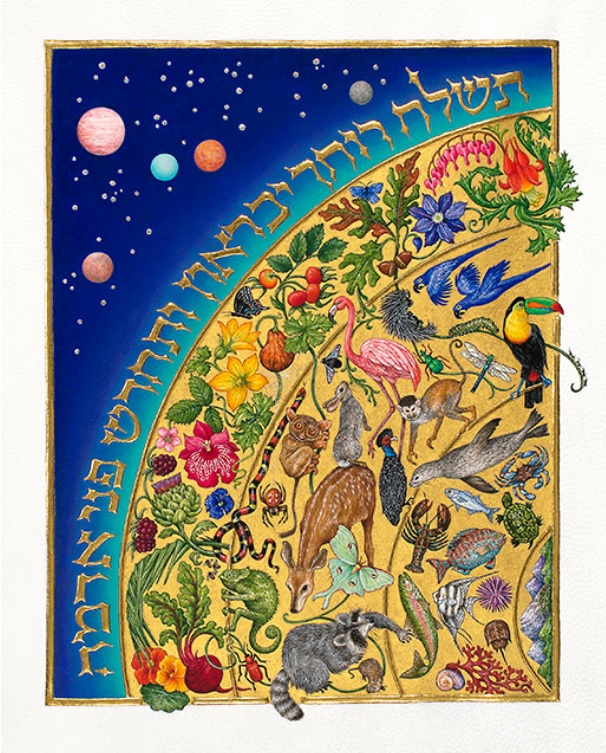
The manuscript illumination above is one of ten from Barbara Wolff’s unbound cycle Psalm 104: You Renew the Face of the Earth. The artist writes (in the third person),

The 104th Psalm is a song in celebration of all creation. The psalmist marvels at the infinite variety of life on earth. With words that reflect a deep awareness of our finitude and an implicit faith in the eternity of creation, we are reminded of the intricate web which connects all living creatures. In the ten illuminations which comprise Psalm 104: You Renew the Face of the Earth, Barbara Wolff has attempted to reflect some of the light and brilliance of this word picture of the cosmos and illuminate its profound sense of reverence for all creation. In a number of the paintings she has portrayed flora and fauna which the ancient Psalmist would certainly have known, and which still may be found in the land of Israel today. She has included the flowers and grasses of its fields and forests, birds which pass through the land each spring and fall, and sea creatures of the Mediterranean, from a precious Murex snail to the great whales.

Among the Branches They Sing by Barbara Wolff
Barbara Wolff (American), “Among the Branches They Sing” (v. 12), from Psalm 104: You Renew the Face of the Earth, 2006–10. Contemporary pigments and precious metals on goatskin. Morgan Library and Museum, New York. MS M.1190, fol. 3.

To Bring Forth Bread by Barbara Wolff
Barbara Wolff (American), “To Bring Forth Bread” (v. 14), from Psalm 104: You Renew the Face of the Earth, 2006–10. Contemporary pigments and precious metals on goatskin. Morgan Library and Museum, New York. MS M.1190, fol. 4.

Leviathan Whom Thou Hast Formed by Barbara Wolff
Barbara Wolff (American), “Leviathan Whom Thou Hast Formed” (vv. 25–26), from Psalm 104: You Renew the Face of the Earth, 2006–10. Contemporary pigments and precious metals on goatskin. Morgan Library and Museum, New York. MS M.1190, fol. 8.

You Renew the Face of the Earth by Barbara Wolff
Barbara Wolff (American), “You Renew the Face of the Earth” (v. 30), from Psalm 104: You Renew the Face of the Earth, 2006–10. Contemporary pigments and precious metals on goatskin. Morgan Library and Museum, New York. MS M.1190, fol. 9.

Prior to pursuing a career in fine art, Wolff spent many years illustrating natural science texts, honing her eye to see and her hands to reproduce the miniscule details of different plant, animal, and insect species. In the early 2000s, on a whim, she took a course on medieval manuscript illumination, learning, among other things, how to work with parchment, gesso, mineral pigments, and precious metal leaf (silver, gold, and platinum). “It just changed by life,” she said. She has since devoted the bulk of her time to illuminating Jewish texts, a focus made possible by individual and institutional patrons. Her Psalm 104 and Rose Haggadah were commissioned by philanthropists Daniel and Joanna S. Rose and subsequently donated to the Morgan Library and Museum in New York City. Other patrons of hers include the Israel Museum and the Jewish Theological Seminary of America.

Joanne Palmer, reviewing Wolff’s work for the Jewish Standard, writes,

Psalm 104 is about beauty. It is about other things as well, true, but it starts with beauty and returns to it as a touchstone. It describes the world with rapturous metaphor. God, who is “clothed with glory and majesty,” who covers himself with “light as with a garment, who stretches out the heavens like a curtain,” has made the world in his image.

When you [see Wolff’s illumination cycle], you are surrounded by the wild precise beauty of that creation, in rich, lush, exquisite, witty, masterfully detailed, controlled miniatures. To [view these paintings] is to be stunned by beauty.

To view all ten illuminations from Wolff’s Psalm 104 cycle and to purchase facsimiles, visit http://www.artofbarbarawolff.com/projects.php?psalm. To learn more about the materials Wolff uses and to read commentaries on individual folios, see the links below.

Further Reading:

“Hebrew Illumination for Our Time: The Art of Barbara Wolff,” Morgan Library and Museum press release, January 5, 2015.

Holly Cohen, “A conversation with Barbara Wolff,” Letter Arts Review 26:1 (Winter 2012): 47–58.

Mark Michael Epstein, ed., Skies of Parchment, Seas of Ink: Jewish Illuminated Manuscripts (Princeton, NJ: Princeton University Press, 2015). Wolff contributed a chapter to this book, and folio 9 from her Psalm 104 graces the front cover.


This post belongs to the weekly series Artful Devotion. If you can’t view the music player in your email or RSS reader, try opening the post in your browser.

To view all the Revised Common Lectionary scripture readings for Proper 24, cycle B, click here.