LOOK:Sprites Dancing in the Dark Night by Wang Xin
Wang Xin, Sprites Dancing in the Dark Night, Chongming District, Shanghai, China, 2024
For this photograph, Wang Xin won the Royal Meteorological Society’s Standard Chartered Weather Photographer of the Year 2024. The society provides this description:
As multiple thunderstorms raged around Shanghai, Xin traveled to the Chongming District and adopted a trial-and-error approach by setting up the camera and waiting. After a few hours, a “faint red figure” flashed in Xin’s eyes, and this remarkable image was captured. The elusive sprites only last a few milliseconds, so Xin used a four-second exposure to achieve this photo.
Sprites occur due to electrical discharge, but unlike ordinary lightning, they occur well above cumulonimbus clouds, approximately 50 miles above the ground, in a layer of the atmosphere known as the mesosphere. Due to their fleeting nature, sprites are still not well understood, but they have been observed to occur after a strong, positive lightning bolt between the cloud and ground. The red color comes from changes in the energy of the electrons of nitrogen atoms high in the atmosphere.
LISTEN: “Angels from the Realms of Glory” | Words by James Montgomery, 1816 | Music by Henry Thomas Smart, 1867 | Performed by Hunter Fraser on Fraser Family Christmas, vol. 1, 2022
Angels from the realms of glory, wing your flight o’er all the earth; ye who sang creation’s story, now proclaim Messiah’s birth.
Refrain: Come and worship, come and worship, worship Christ, the newborn king.
Shepherds, in the field abiding, watching o’er your flocks by night: God with man is now residing; yonder shines the infant light. [Refrain]
Sages, leave your contemplations; brighter visions beam afar. Seek the great Desire of nations; ye have seen his natal star. [Refrain]
Saints before the altar bending, watching long in hope and fear: Suddenly the Lord, descending, in his temple shall appear. [Refrain]
Mark Cazalet (b. 1964) is a contemporary artist based in London whose work centers on color and balances empiricism and lyricism. He works across media—painting, drawing, printmaking, and (in collaboration with fabricators) stained glass, etched and engraved glass, printed enamel on glass, tapestries, and mosaics. A major part of his career has been fulfilling ecclesiastical commissions and making sacred art. But all of his work, regardless of subject matter, is shot through with a sacramental impulse.
Last year Cazalet made a series of twelve “Advent Stations” that move circuitously through the story of Jesus’s first coming, marked as it was by mystery, vulnerability, risk, and glory. These include modernized versions of scenes you’d find in traditional Infancy of Christ cycles, such as the Annunciation to Mary, the Annunciation to the Shepherds, the Dream of the Magi, and the Flight to Egypt, but also new ones, drawing us into the grand sweep—sometimes rushing, sometimes quiet—of gospel hope. “The overarching theme,” he told me, “is pregnancy, birth, nurturing, waiting, escape, migration, and finally, in the mistle thrush’s morning song, the greeting of the new day’s limitless potential.”
The artist’s choice of substrate is unique: He painted his stations in oil on domestic wooden objects, such as bread boards, meat and cheese boards, children’s lunch trays, washboards, chapati rolling boards, and a baker’s peel. By using these ordinary boards mainly from home kitchens, Cazalet further situates the biblical Advent story in the everyday. That many of the boards are used for preparing or serving bread underscores Jesus’s self-declaration as “the living bread that came down from heaven,” whose flesh Christians eat ritually as a means of interabiding (John 6).
Cazalet’s Advent Stations debuted last December at his home church, St Martin’s in Kensal Rise, London, where they were installed one per week from Advent through Candlemas. The project was a collaboration with fellow parishioners Richard Leaf, who wrote a poem for each station, and Pansy Cambell, who calligraphed the poems.
That exhibition spawned interest from Chelmsford Cathedral in Essex, where all the artworks and poems are on display from December 1, 2025, through February 2, 2026. The cathedral is already home to two commissioned works of Cazalet’s: the monumental multipanel painting The Tree of Life and an engraved and etched glass window depicting St. Cedd.
The word “station” in the title of Cazalet’s recent series refers to a stopping place along a route. In the Middle Ages, the Roman Catholic Church developed a devotional practice known as the Stations of the Cross, which breaks down the passion of Christ into fourteen distinct episodes fit for contemplation. The idea was that those who could not travel physically to Jerusalem for Lent to walk the Via Dolorosa (the processional route Jesus took to Golgotha) could at least walk the path in spirit, using a series of images as prompts to pause, pray, and reflect.
Used by Christians in various denominations, this practice has been adapted for other seasons of the church year. While there are no official Advent Stations or Stations of the Nativity, Cazalet has come up with twelve.
All photos in this article are by the artist and are used with his permission.
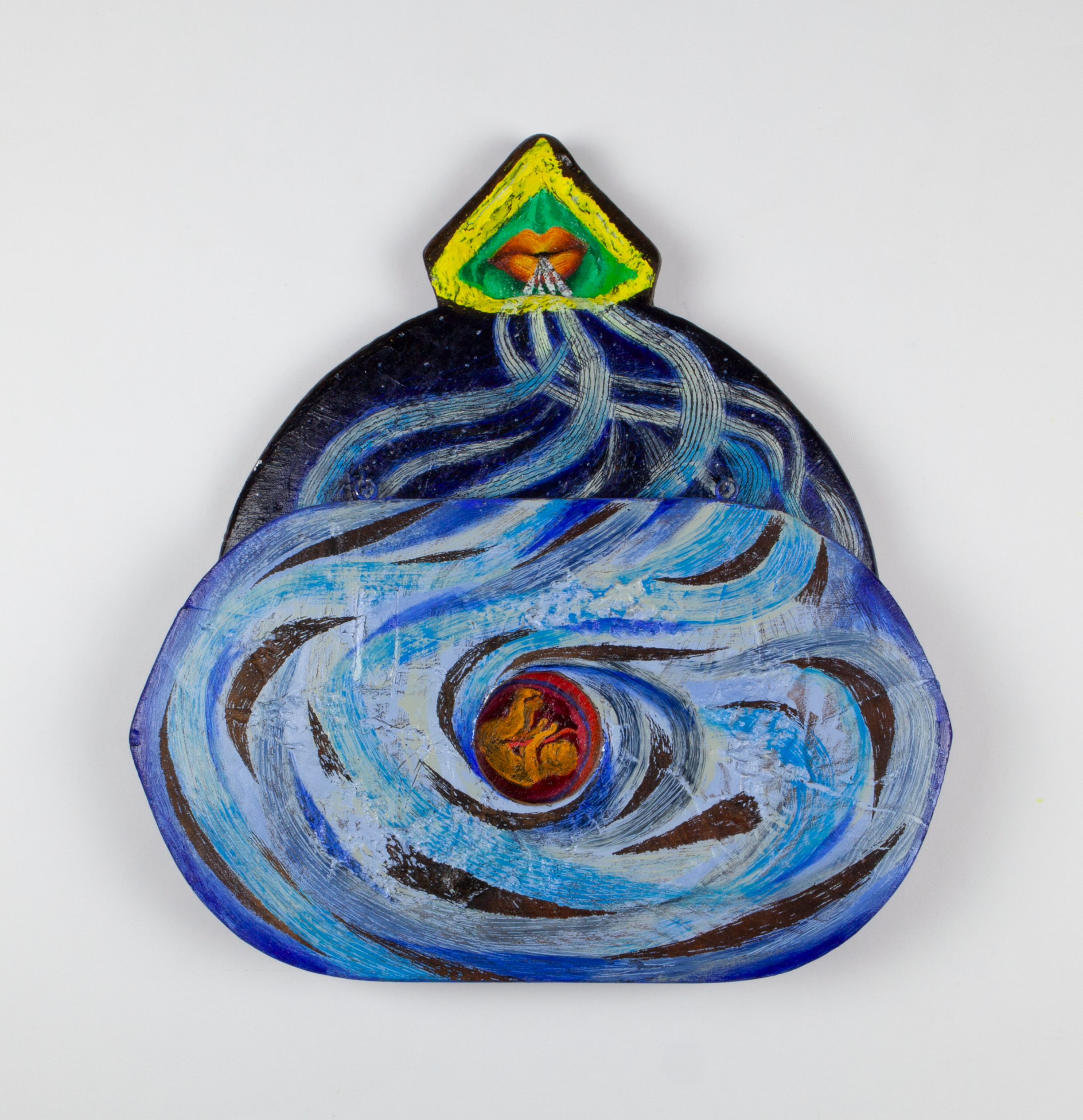
Advent Station 1: The Breath of God
Mark Cazalet, Advent Station 1: The Breath of God (closed), 2024
A mystical visualization of the Word becoming flesh, the first station has two configurations. In its closed form, it shows the mouth of God blowing through space, the divine breath coalescing around a woman’s uterus to form an embryo, the child who will be called Jesus. Wisps of blue swirl dynamically around this firstborn of new creation.
The triangular shape evokes the Trinity, as the Incarnation was an act involving Father (initiator), Son (enfleshed one), and Holy Spirit (overshadower / inseminating agent).
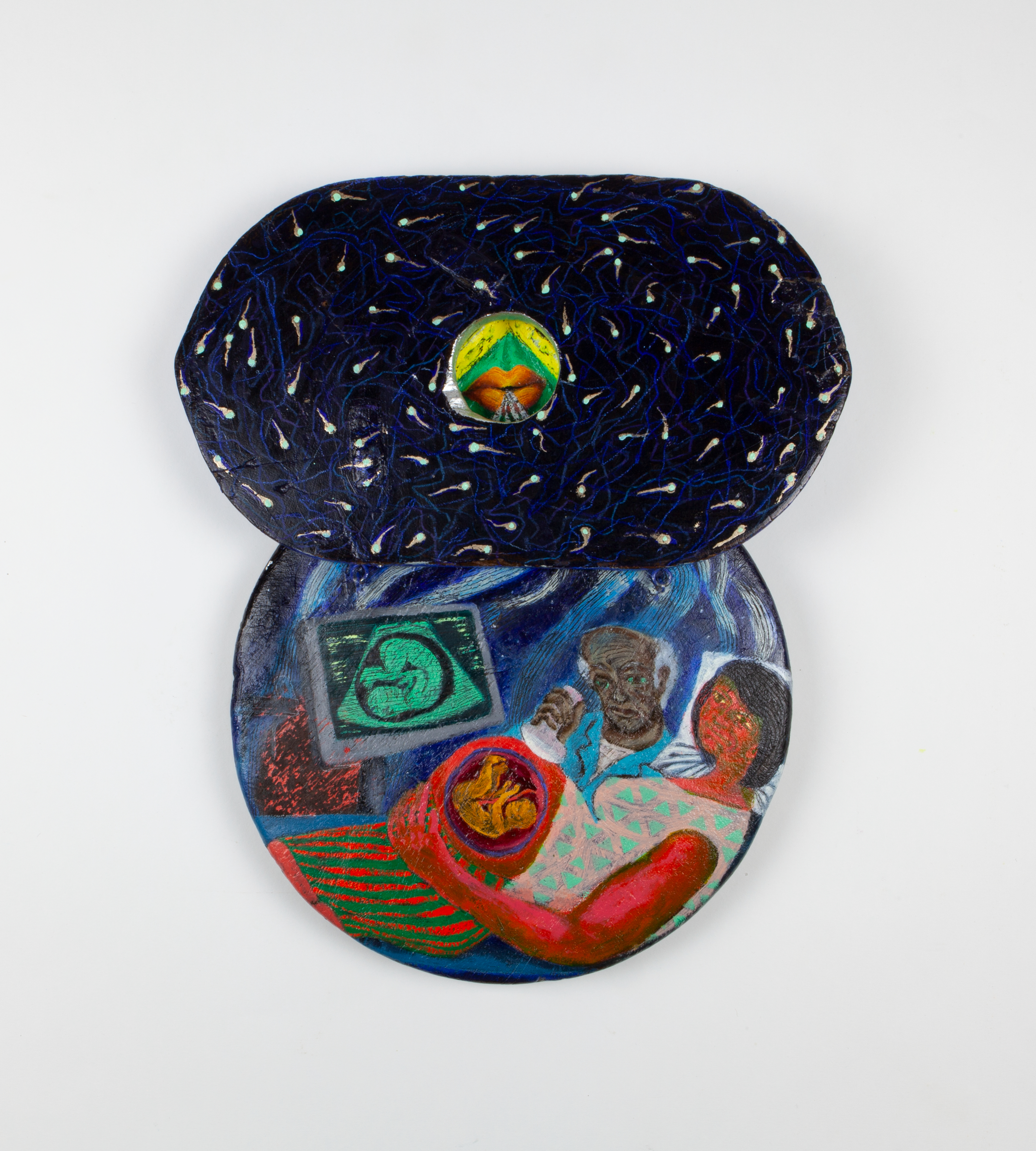
Mark Cazalet, Advent Station 1: The Breath of God (open), 2024
In the exhibition, an attached ribbon instructs viewers, “Lift me.” When you do, the bottom board flips up to reveal a pool of swimming sperm cells, as God created the male gamete needed to make a male child and supernaturally (nonsexually) deposited it into Mary, where it fertilized one of her eggs.
The virginal conception of Christ is a mystery beyond knowing; no amount of scientific head-scratching will bring us closer to understanding the mechanics, nor do we need to. But I like the reminder from this unusual artistic interpretation that all the necessary human genetic material was present—Mary supplying hers, and God supplying the rest. Jesus was not some kind of alien transplanted into a human womb, but rather was made up of all the human stuff we are, and grew by stages inside his mother over a period of nine months. And yet, while fully human, he’s also—marvel of marvels—fully God.
On the round board below, we see that the isolated uterus from the first view belongs to Mary, who lies in bed while Joseph serves as ultrasound technician, shining a light that discloses the still-developing Christ child on a video monitor.
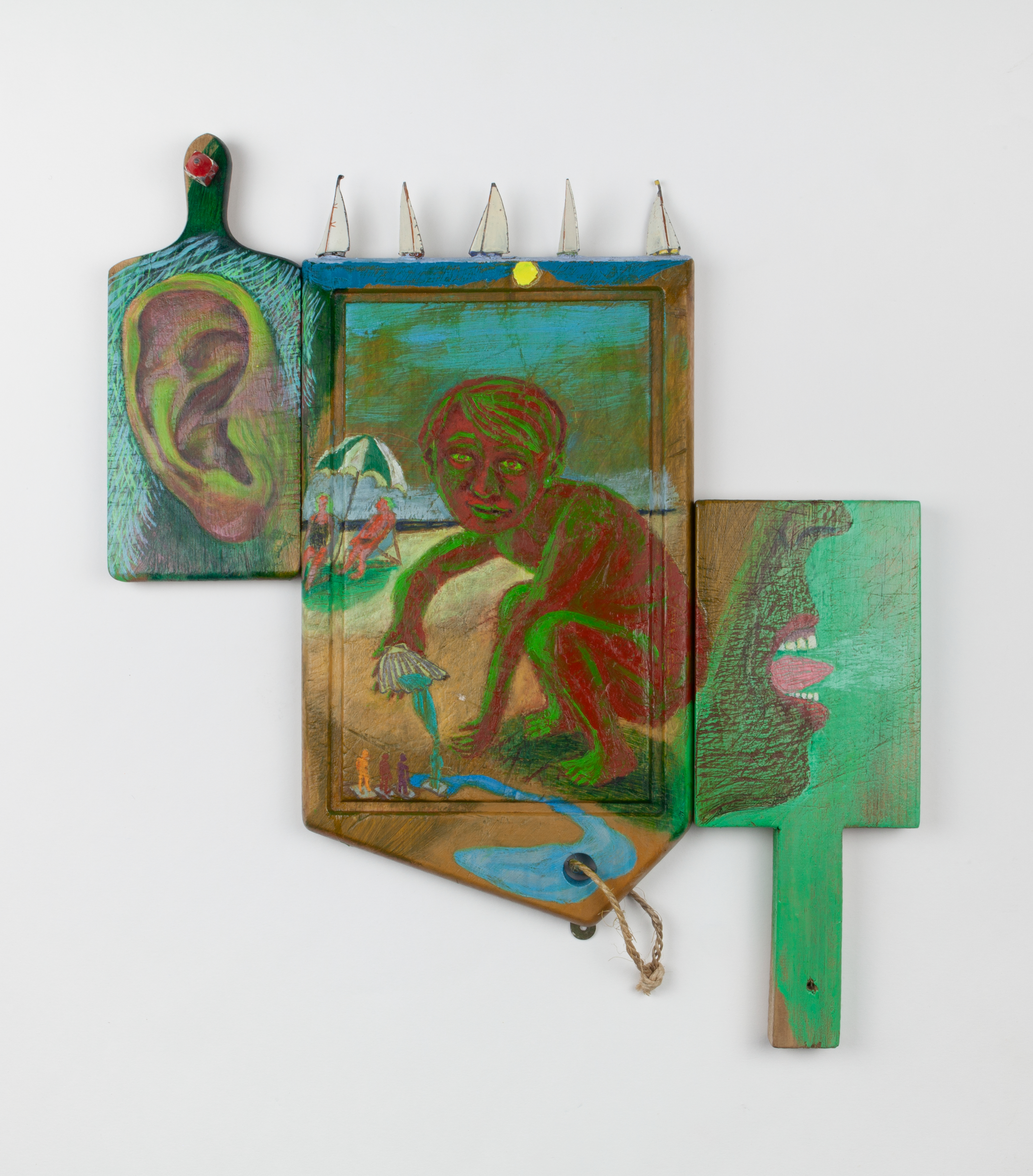
Advent Station 2: John the Baptist on the Beach
Mark Cazalet, Advent Station 2: John the Baptist on the Beach, 2024
The breath/wind motif is subtly carried over into this second Advent station, with sailboats lining the top of the center board.
This scene shows a young John the Baptist playing on the beach, with his parents, Zechariah and Elizabeth, lounging in swimsuits under a nearby umbrella. John crouches in the sand, pouring water from a seashell (the implement he uses to baptize Jesus in many traditional paintings, most famously Piero della Francesca’s) onto toy figurines who have queued up for the affusion. The water cuts a mini river through the sand, alluding to the Jordan.
The two side panels, which show a close-up of an open ear and an open mouth, likely refer to, in his prophetic ministry as an adult, John’s hearing the word of God and proclaiming it. His is “the voice of one crying out in the wilderness: ‘Prepare the way of the Lord; make his paths straight’” (Mark 1:3). John is regarded as an Advent figure because, by preaching repentance from sin, he prepared the people for the coming of the Messiah.
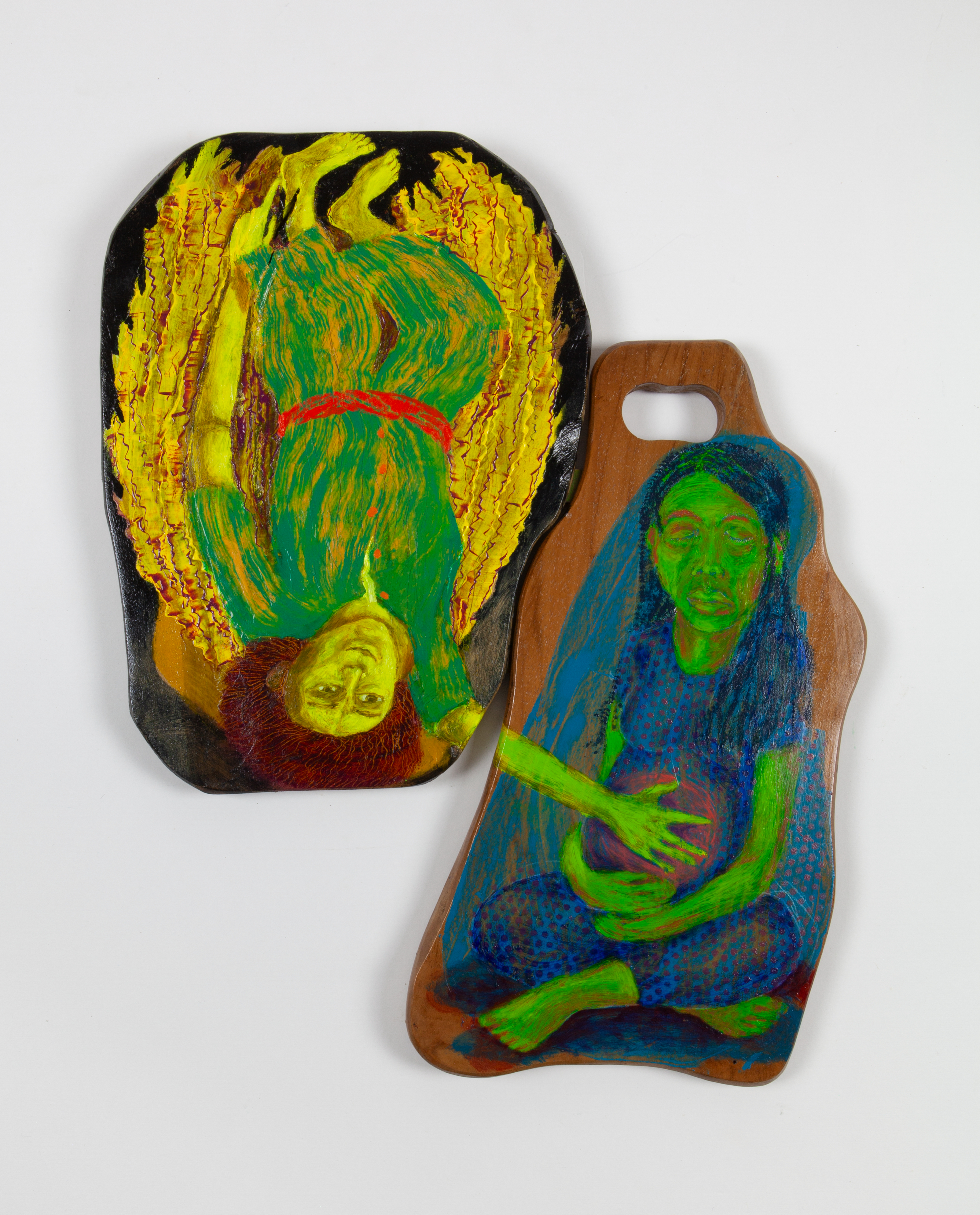
Advent Station 3: The Annunciation
Mark Cazalet, Advent Station 3: The Annunciation, 2024
The Annunciation, portraying the angel Gabriel’s message to Mary that she has been chosen to bear God’s Son, is one of the most frequently depicted biblical scenes of all time. How could any artist possibly make it new?
Cazalet refreshes the encounter by showing Gabriel dipping down headfirst from the heavens, the unconventional orientation perhaps a playful allusion to the topsy-turvy nature of Christ’s kingdom. He reaches across the gap to touch the belly of Mary, a young Black woman in a polka-dot dress who is seated on the floor with her eyes closed, rapt in prayer. This consensual touch is what effects the Incarnation.
Mary wears blue and even exudes a blue aura, blue being her traditional color, associated with heaven (the sky realm) and hope. Gabriel’s skin has a golden sheen—the color of divinity, purity, holiness. The coming together of blue and yellow creates green, symbolizing life, growth, and renewal.
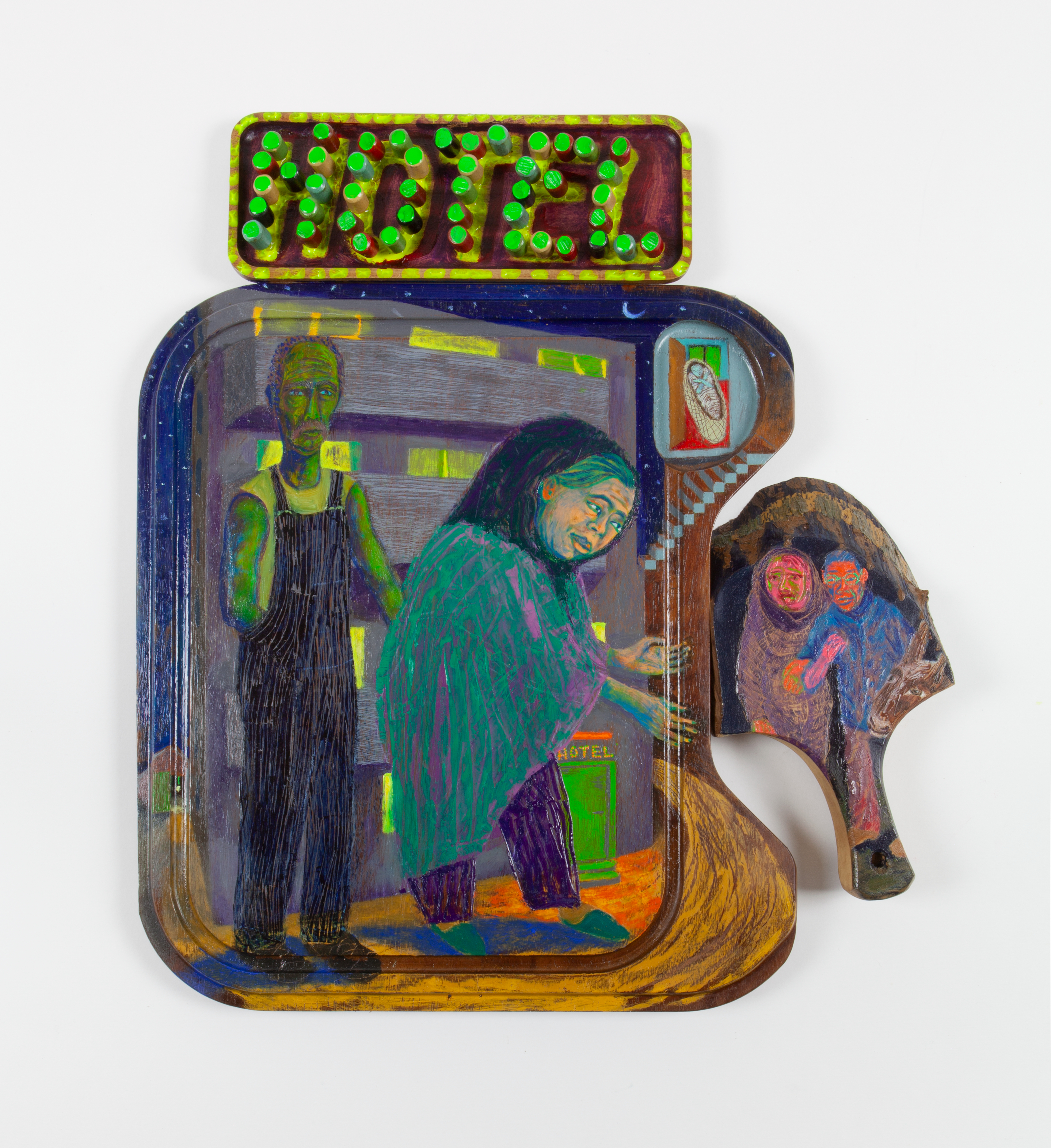
Advent Station 4: Bethlehem Motel
Mark Cazalet, Advent Station 4: Bethlehem Motel, 2024
The innkeeper couple in Bethlehem are a cultural invention, biblical scholars tell us, spawned by a misleading English translation of Luke 2:7, which says “there was no room for them [Mary and Joseph] in the inn” (KJV). The Greek word translated “inn,” kataluma, more properly means “guest room”: Because the census had brought many out-of-towners to the area, the guest rooms of Joseph’s relatives were full, but they made space for the pregnant couple in the lower room of the house where animals were kept for the night.
Despite the lack of an innkeeper character in scripture, it has become a popular element in storytelling about the Nativity in art, song, and sermons, as it prompts us to consider whether we are making room for Christ in our busy, overcrowded lives. And not just Christ, but anyone in need—of shelter or other forms of care.
Cazalet shows Mary and Joseph approaching a motel door as the female owner, sympathetic, comes out to greet them. A niche above their heads, hovering like a thought bubble, shows what the couple desires: a place to give birth and to lay their son.
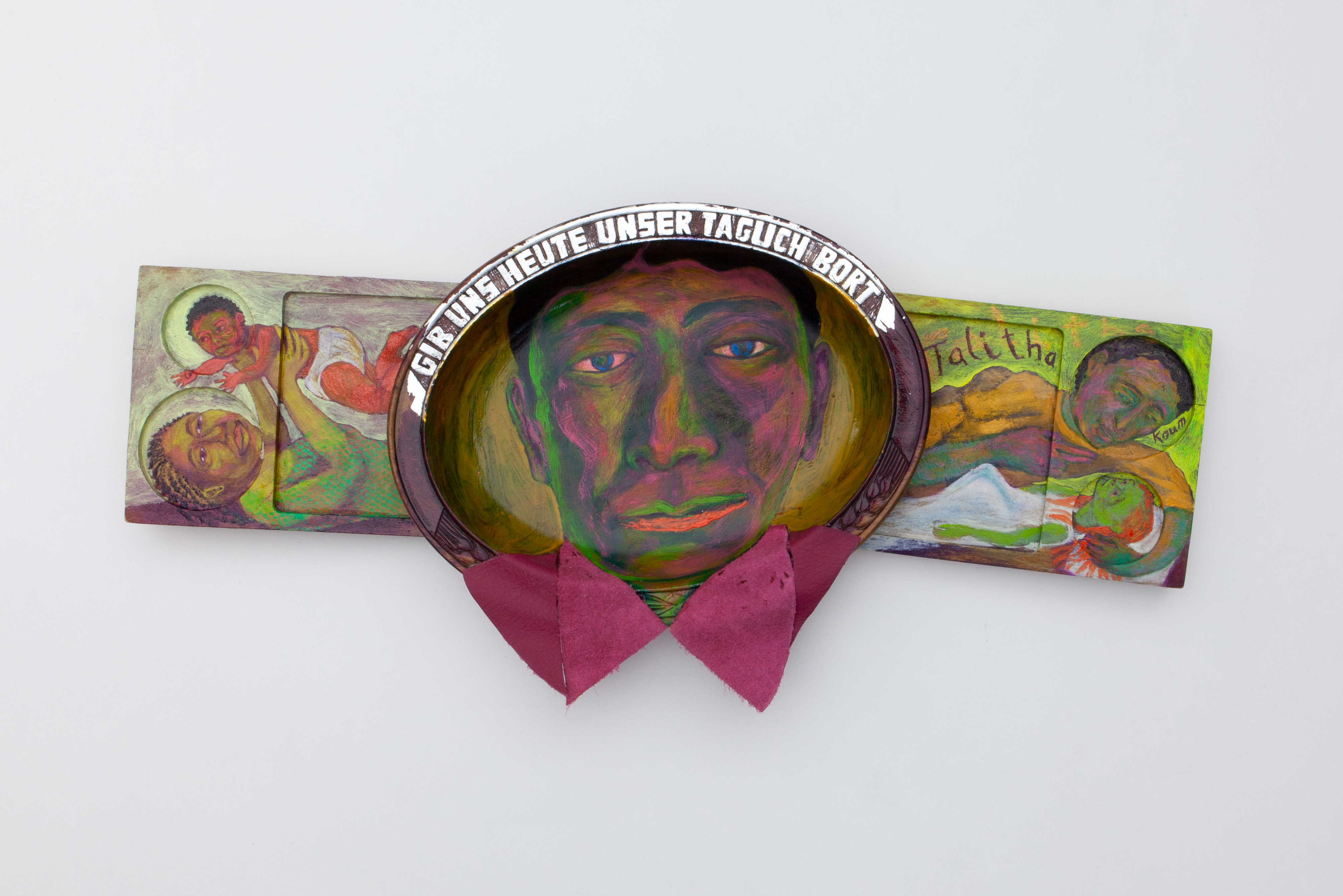
Advent Station 5: The Incarnation (A Blessing Conferred)
Mark Cazalet, Advent Station 5: The Incarnation (A Blessing Conferred), 2024
The fifth station features an unconventional combination of images. The left board shows Mary lying on her back, holding the wiggly infant Christ above her. She beams with maternal love.
On the right board, an adult Christ, similarly positioned, leans over the dead daughter of the synagogue leader Jairus. “Talitha koum,” Jesus gently instructs, cradling the girl’s head—Aramaic for “Little girl, get up” (Mark 5:41). With his words, she rises back to life.
The central image, a Head of Christ, is painted on a wooden bread plate from Germany—these plates were sometimes also used as church collection plates—whose rim reads, “Gib uns heute unser täglich brot” (Give us this day our daily bread). Carved sheaves of wheat poke out from under Jesus’s pink cloth collar.
“My intention is that Mary’s love for her son as she raised him taught him the care and compassion to want to help a child in extremis,” Cazalet told me. “The man is formed by the mother’s love, and our childhoods set the pattern of our response to others.”
Notice how, from behind the Christ head, the two adjoining boards emerge like wings, suggesting freedom.
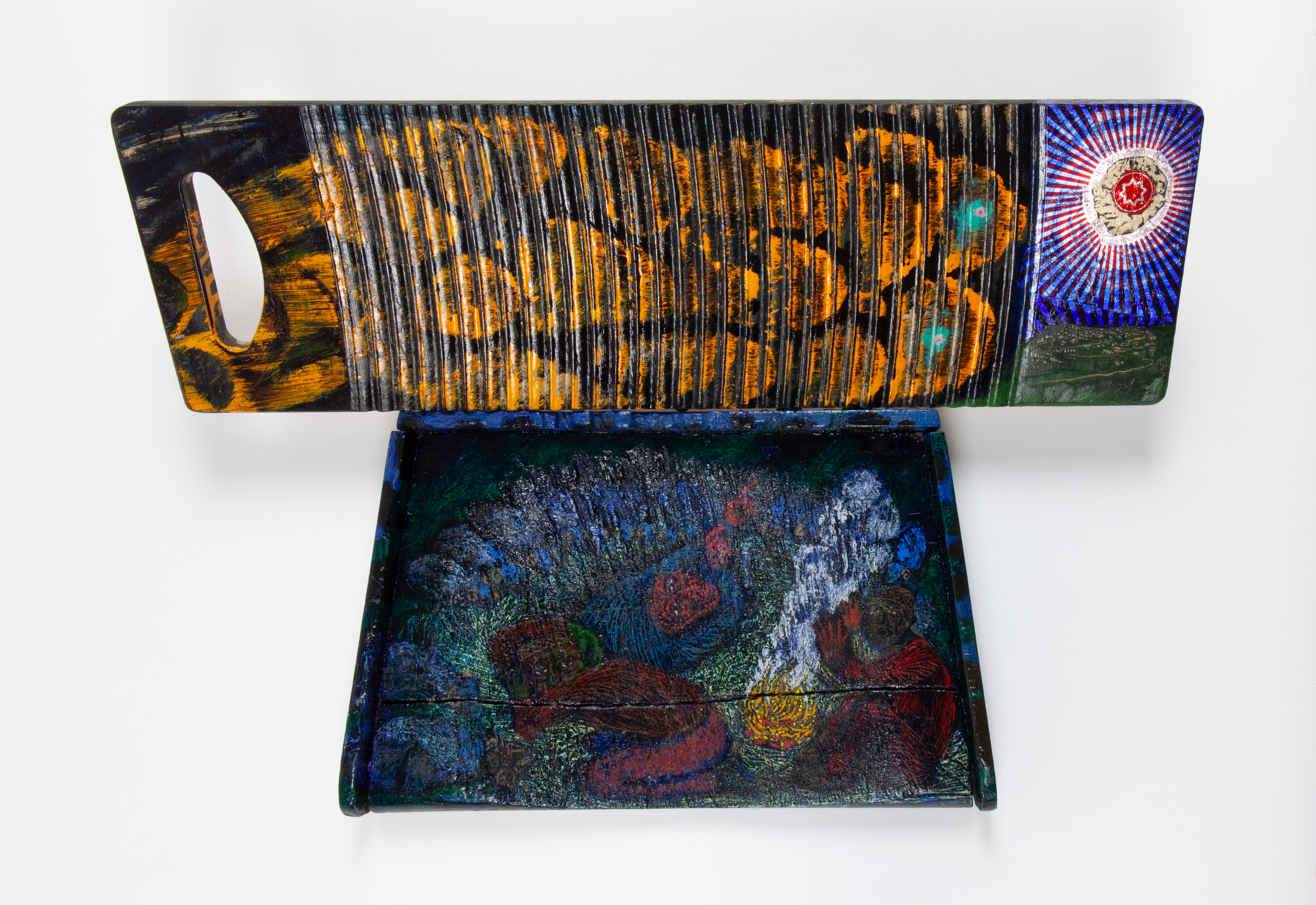
Advent Station 6: The Shepherds See the Star
Mark Cazalet, Advent Station 6: The Shepherds See the Star, 2024
The sixth station portrays the glory of the Lord rippling across the night sky above three shepherds tending their flocks. Content and unassuming, they are gathered round a warm fire when suddenly, an angel appears to announce to them the birth of Christ. One of the shepherds cowers in fear while another gesticulates toward a brightly beaming star in the near distance—rendered with a Tunnock’s milk chocolate tea cake wrapper.
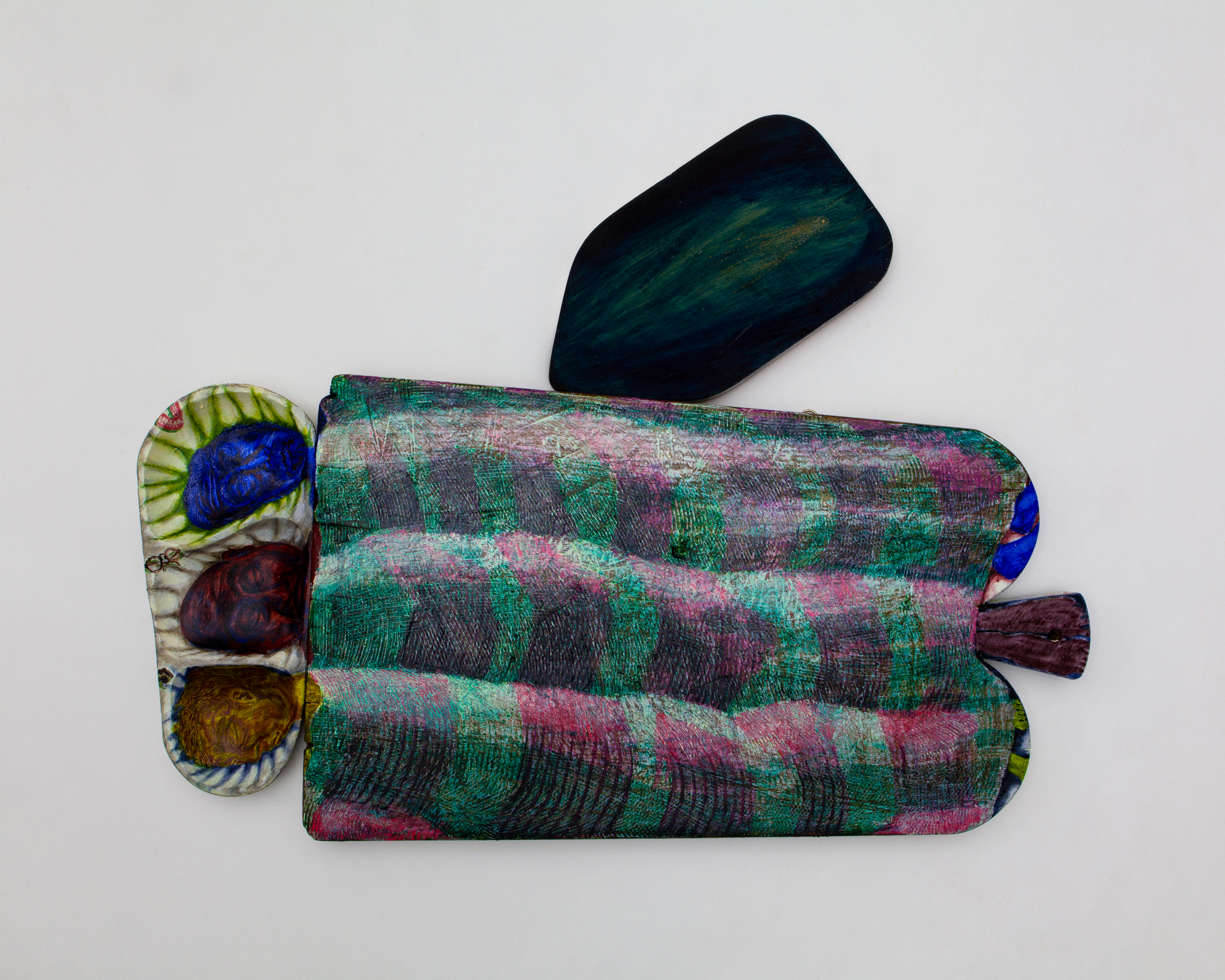
Advent Station 7: The Magi Dreaming
Mark Cazalet, Advent Station 7: The Magi Dreaming, 2024
Having followed a star to Jerusalem from their home back east, the magi enter the court of Herod to inquire where they can find the newborn king of the Jews whom the star heralds, to pay him homage. Herod hadn’t heard of such a king, but immediately he feels threatened—“king of the Jews” is his title—and, unbeknown to the visiting dignitaries, decides to crush this young rival. After consulting with Jewish scholars, he discerns Bethlehem as the birthplace. He divulges this information to the magi and asks them to report back once they’ve found the child so that he, too, can honor him. He hides his true motive under a lie.
The magi have a transformative encounter with Jesus in Bethlehem. Falling asleep after that momentous day, they receive a warning from God not to return to Herod. So they avoid him on their way back home.
As in medieval visual treatments of the Dream of the Magi, Cazalet has the magi sharing a bed. (There’s nothing salacious about it—it’s just a compositional practicality, to show the three men in one space, having the same dream at the same time.) Their toes peep out from under the covers. That surface, by the way, is flat—Cazalet skillfully creates the illusion of convexity through painting, suggesting bodies underneath.
Beside the magi’s heads are three small personal objects: earbuds, glasses, and dentures, which allude to the proverbial principle “See no evil, hear no evil, speak no evil.” “I was musing if this trinity of pilgrim searchers were perhaps aspects of the one true pilgrim, parts of a single whole disciple,” the artist told me.
Advent Station 8: Herod Syndrome
Mark Cazalet, Advent Station 8: Herod Syndrome, 2024
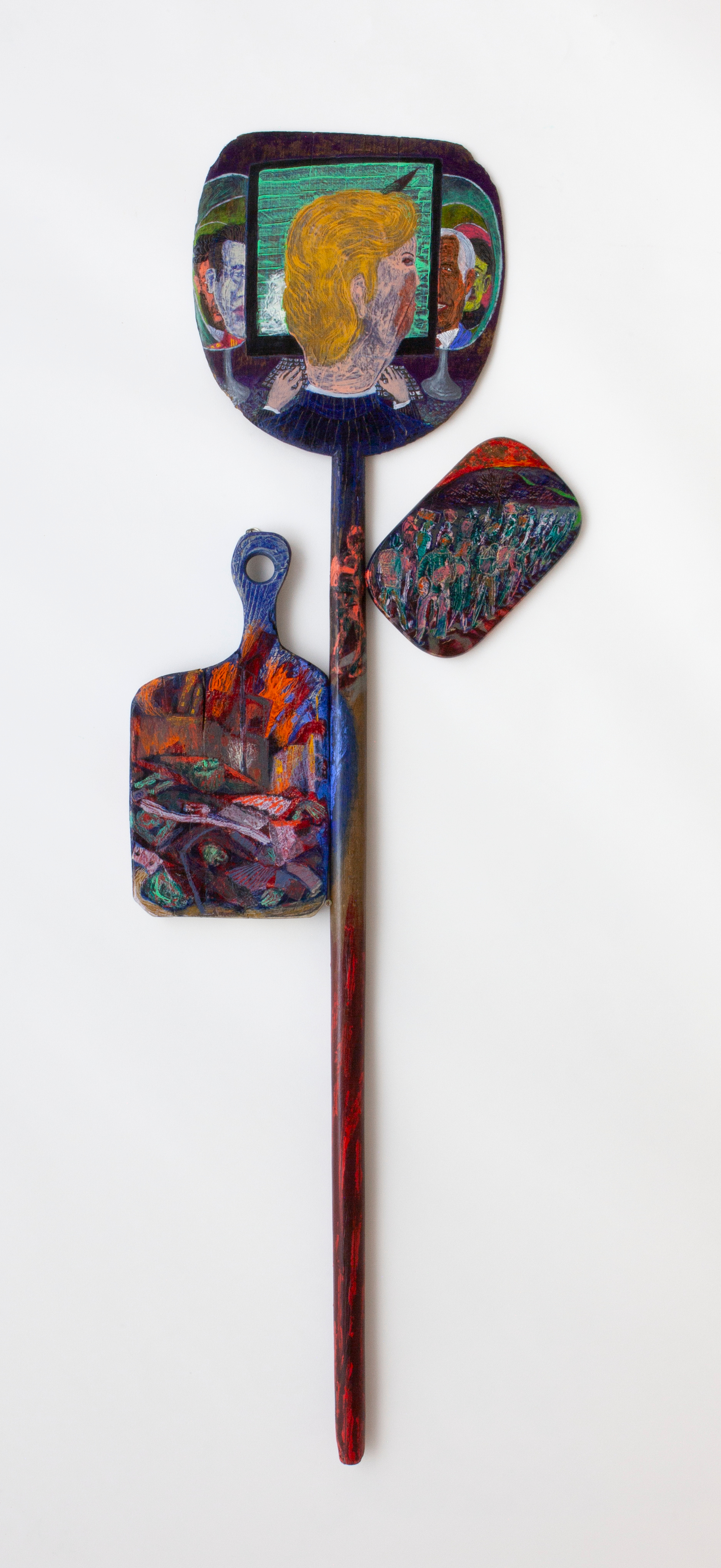
Thwarted by the magi, Herod fumes with rage. He will not be dethroned by this so-called messiah. So he orders his soldiers to kill all the boys in Bethlehem aged two and under, thinking that Jesus will be among them. In his self-obsession, he cares nothing for the good of the people; he cares only for the consolidation of his own power.
Station 8 is Cazalet’s modern take on the Massacre of the Innocents. At the helm of a computer keyboard is a presidential figure launching a missile on whomever he has deemed the enemy, while other likeminded autocrats—I believe that’s Saddam Hussein, Kim Jong Un, Vladimir Putin, and Adolf Hitler—look over his shoulder approvingly, their faces reflected endlessly in mirrors using a technique called mis en abyme (“put in the abyss”). This panel, the transferring surface of a baker’s peel, sits at a height to emphasize the pompousness of rulers like Herod, who see themselves as above others and above the law.
Such an attitude can have dire consequences. “Below we see the devastation of a civilian population, defenceless against the technological onslaught,” Cazalet describes, “and the perpetual streams of migrants fleeing who knows where to be vilified as more foreign mouths to feed.”
The power mania that gripped Herod, that led to his lashing out in violence, is still alive and well today in national and global politics.
Advent Station 9: The Flight to Egypt (Forced Migration)
Mark Cazalet, Advent Station 9: The Flight to Egypt (Forced Migration), 2024
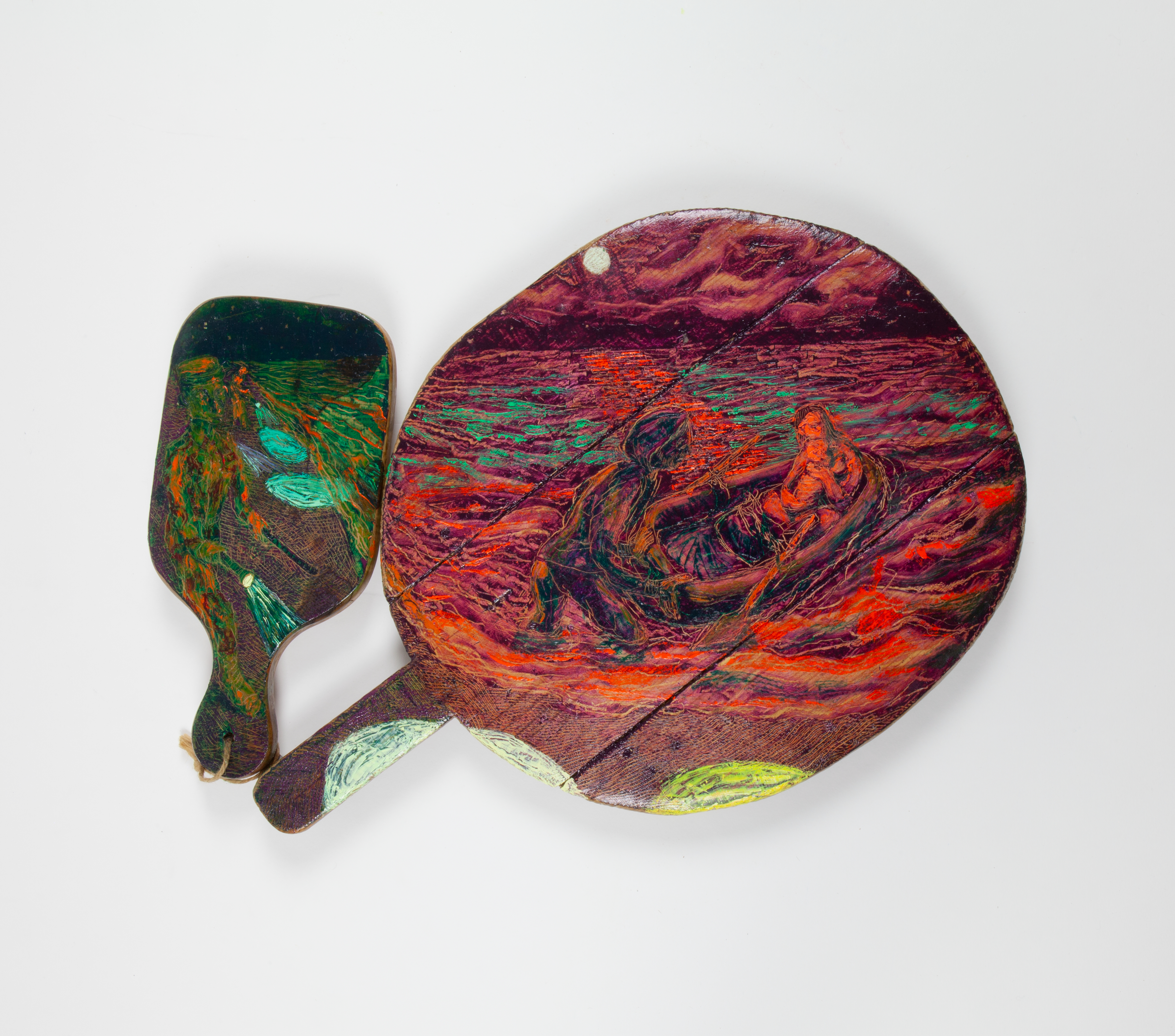
To protect their son from Herod’s murder decree, Mary and Joseph flee with him across the border to Egypt. Cazalet reimagines their flight through the lens of today’s refugee crisis. In station 9, the Holy Family boards an inflatable raft, braving choppy seawaters in search of asylum. They’re bathed in a menacing red.
On the adjoining panel, border patrol officers, with flashlights and batons, stand on the shore, seeking to bar the entry of strangers into their land.
Advent Station 10: The Exiles Return
Mark Cazalet, Advent Station 10: The Exiles Return, 2024
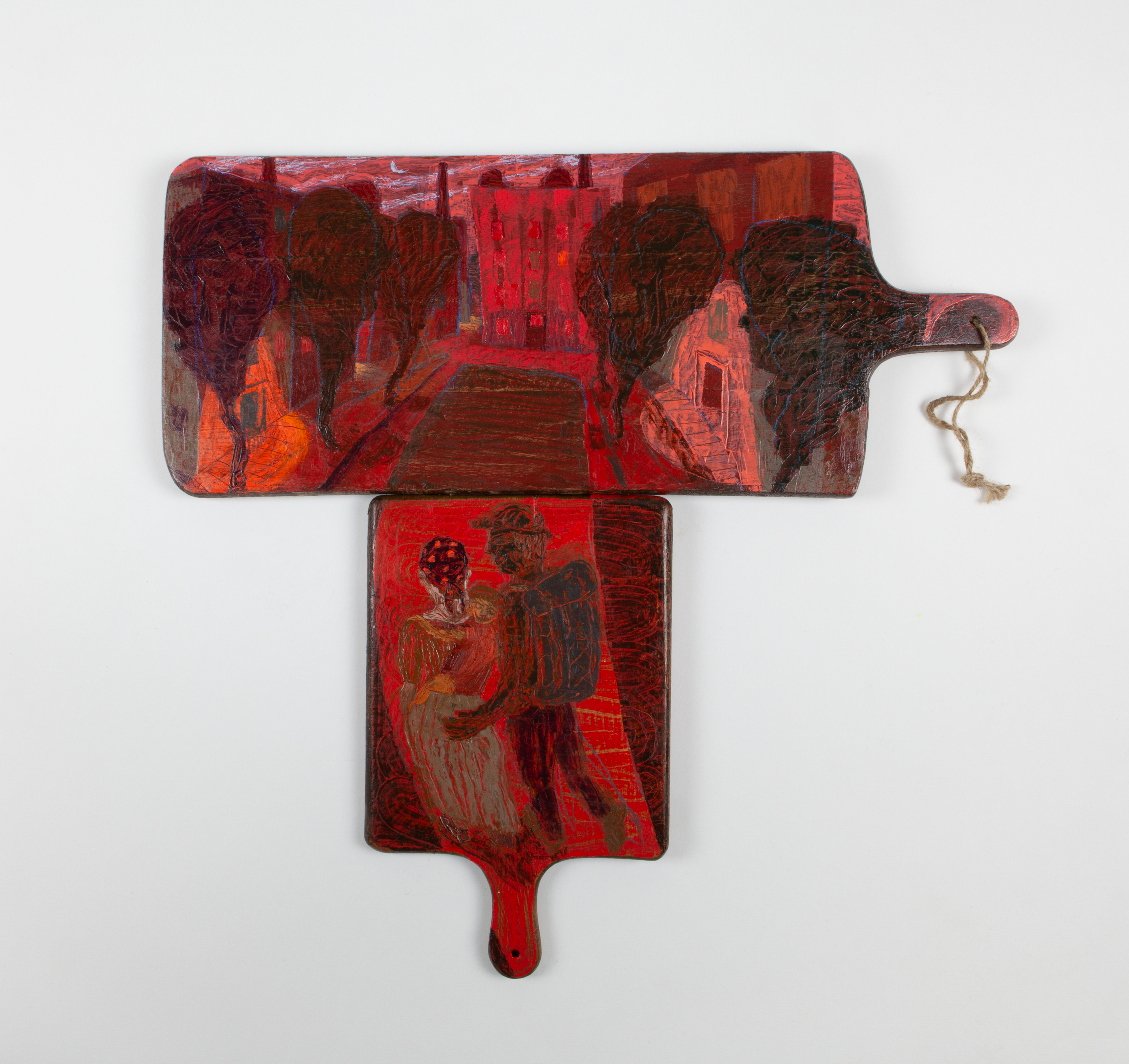
Egypt grants refuge to the Holy Family, and they settle there for an undisclosed period of time—until Joseph receives word from an angel that it’s safe to return to their homeland.
Station 10 shows the family arriving at sunset in their beloved Nazareth, all their belongings reduced to what could fit in a single backpack. As they approach a tree-lined boulevard, Jesus clings to his mother’s back, looking behind at where they’ve come from. He has not yet known this town but will come to love it. He will call it home until his ministry beckons him beyond it more than two decades later.
Advent Station 11: Faithful Waiting and Watching (Anna and Simeon)
Mark Cazalet, Advent Station 11: Faithful Waiting and Watching (Anna and Simeon), 2024
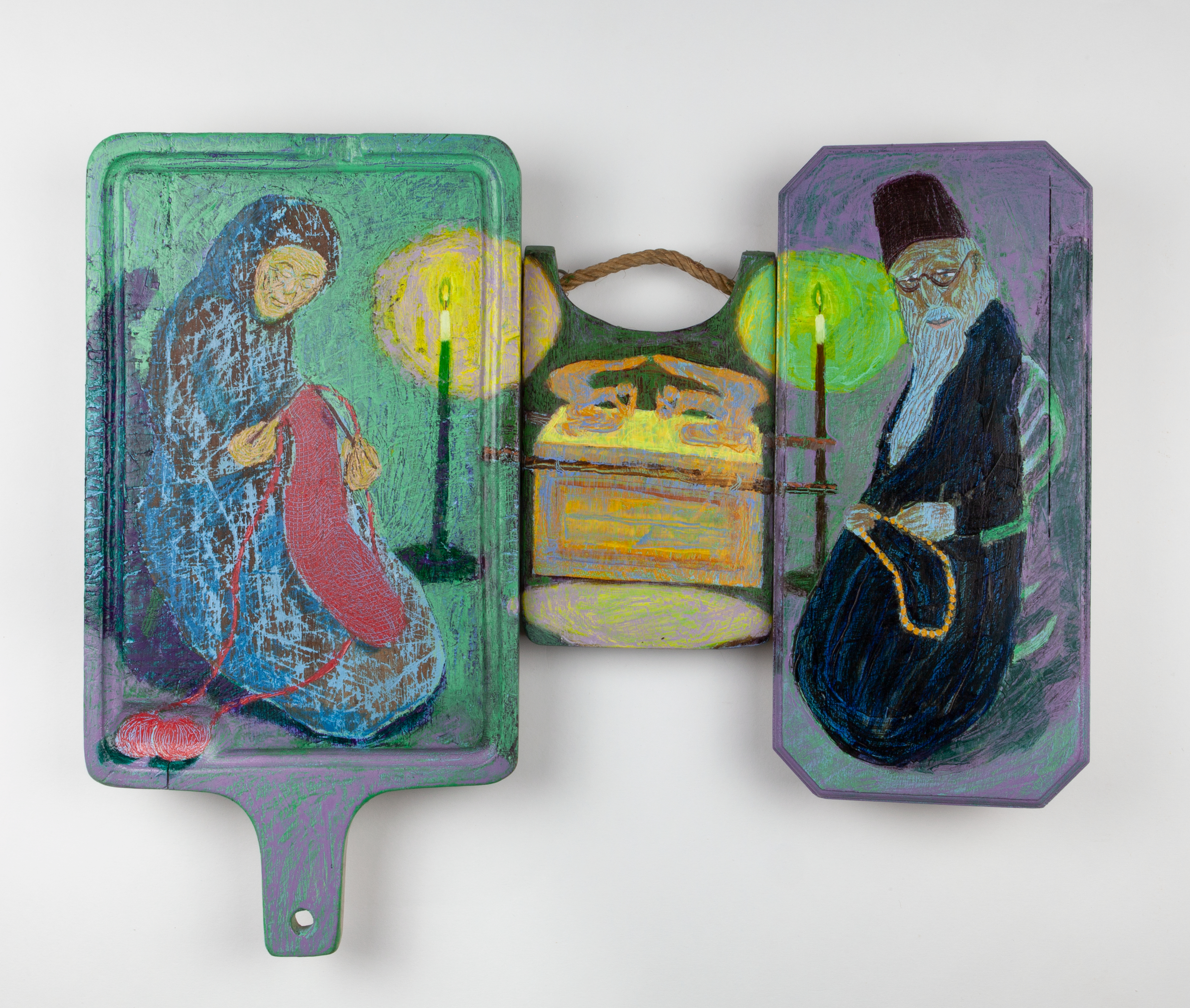
This is my favorite of all the stations. While the Presentation of Christ in the Temple is standard fare in Christian art—showing Mary handing Jesus to Simeon, a devout Jew interpreted by most artists as a priest, forty days after Jesus’s birth, with Joseph and the prophet Anna standing off to the side—Cazalet isolates the elderly Anna and Simeon, zeroing in on their faithful act of waiting for the Messiah.
Illuminated by candlelight, Anna knits a scarf, communing with God in the solitude, while Simeon fingers a string of prayer beads. Their eyes are weary and downcast, and yet they possess a steadfast hope that their Savior is on his way.
Linking their two spaces is the ark of the covenant, a sacred wooden storage chest plated in gold and topped by two hammered-gold cherubim. Containing the tablets of the law, Aaron’s rod, and a pot of manna, the ark was kept in the holy of holies, the innermost sanctum of the temple, where it signified God’s presence.
Waiting can often feel useless—like nothing’s happening or will ever happen. But Anna and Simeon continued to wait on the Lord, to count on his promise. And finally, before they died, they were granted the grace to see and to hold the One they had so fervently longed for: the Christ, Emmanuel, “God with us.”
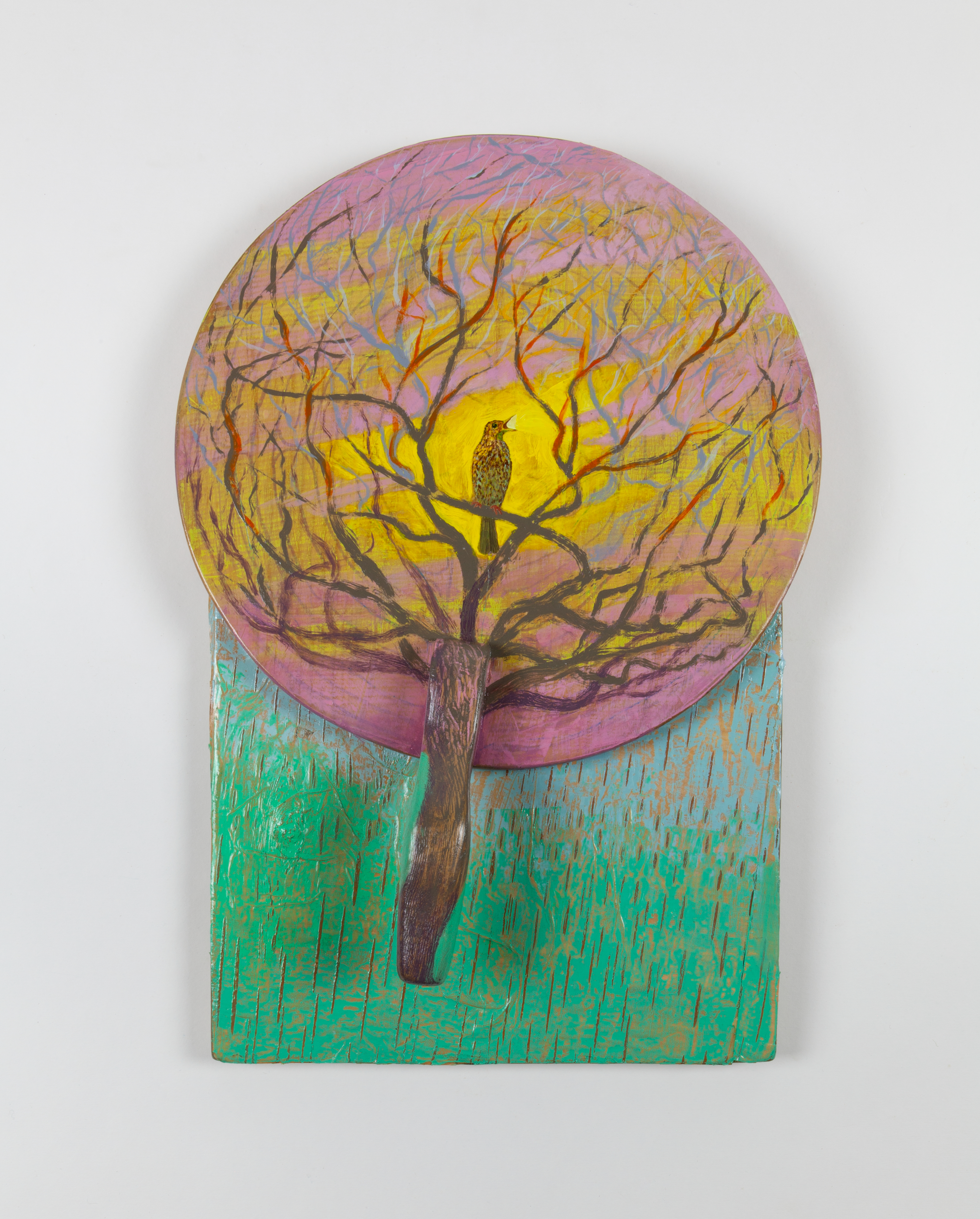
Advent Station 12: The Mistle Thrush Greets the New Day
Mark Cazalet, Advent Station 12: The Mistle Thrush Greets the New Day, 2024
The Advent path we’ve just walked has included an unplanned pregnancy, persecution, and displacement but also miracles, play, and surprise.
Cazalet’s Advent Stations end with a bird in a tree, singing its heart out as a pink and yellow dawn spreads across the sky. The twisted branches become streamers, blowing as if in celebration. (There’s that breath of God again!) Out of the bird’s beak shoots light.
The board that forms the grassy ground is incised with knife marks, perhaps suggesting woundedness—although maybe it’s a turning over of the soil to promote new growth.
The flame-like hues in and around the tree evoke the burning bush of Exodus 3, from which God spoke his name: I AM THAT I AM.
This Advent tree, bare yet lively, calls us to embrace each new day as a gift from the One who is and was and is to come, remembering how Christ came to show us who God is and to feel and heal our brokenness, and he will come again to make all things new.
The Advent Stations by Mark Cazalet, with accompanying poems by Richard Leaf rendered in calligraphy by Pansy Cambell, are on display at Chelmsford Cathedral in eastern England through February 2, 2026. They are available for sale, but until they’re purchased, Cazalet wants to show them in other churches and cathedrals. They’re tentatively scheduled for exhibition in Southwark Cathedral in London during Advent 2026.
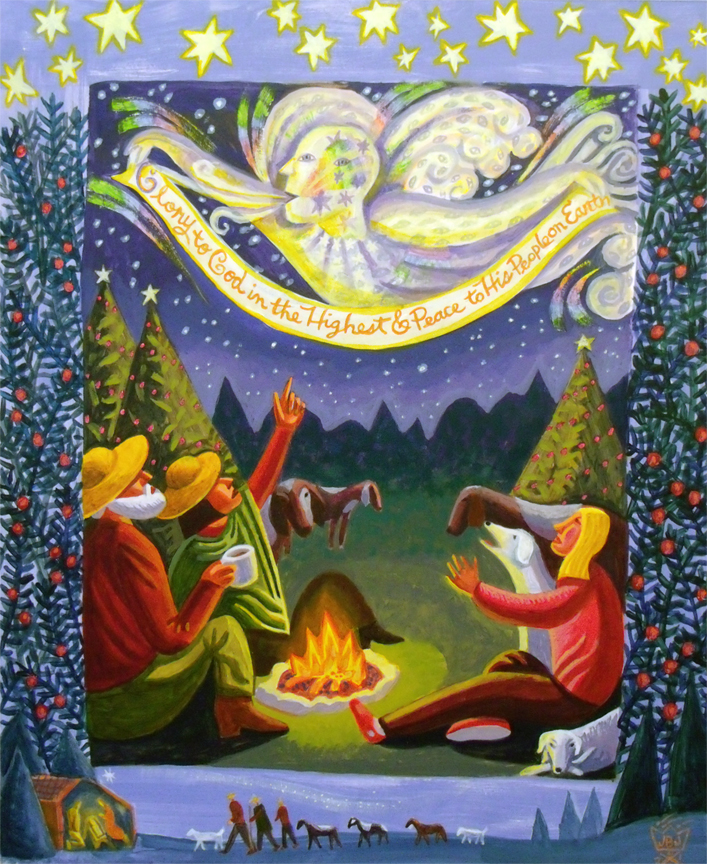
James B. Janknegt (American, 1953–), Shepherds, 2011. Acrylic on paper, 17 × 13 in.
LISTEN: “Hark! Hark What News” | English folk carol from Cornwall or South Yorkshire, 17th or 18th century | Performed by Maddy Prior and the Carnival Band, on Gold, Frankincense & Myrrh, 2001
Hark! Hark what news the angels bring: Glad tidings of a newborn King. Born of a maid, a virgin pure, Born without sin, from guilt secure.
Hail, mighty Prince, eternal King! Let heaven and earth rejoice and sing! Angels and men with one accord Break forth in songs: “O praise the Lord!”
Behold! he comes, and leaves the skies: Awake, ye slumbering mortals, rise! Awake to joy, and hail the morn, The Savior of this world was born!
Echoes shall waft the strains around Till listening angels hear the sound, And all the heavenly host above Shall join to sing redeeming love.
Salvador Dalí (Spanish, 1904–1989), The Angel, 1947. Ink and watercolor on paper, 12 3/4 × 10 1/4 in. Hallmark Art Collection, Kansas City, Missouri.
In 1947, Hallmark commissioned the famous modern artist Salvador Dalí to create a small set of original paintings for its Gallery Artists line of Christmas cards to hit the market in 1948. The Angel is one of them. Painted in his typical surrealist style, it shows a headless angel playing a lute, the snowy mountains in the background mimicking wings. At the bottom right, the newborn Christ lies naked on the ground, cushioned by straw and adored by his mother. On the left a shepherd sits on a tree stump, also playing a lute, its soundboard blending into the landscape in the background. At the warmth of their song, the snow begins to melt away.
LISTEN: “Celestial Hearts,” traditional Yorkshire carol | Arranged and performed by Kate Rusby on Holly Head (2019)
Come, let us all rejoice To see this happy morn We’ll tune our hearts and raise our voice We’ll tune our hearts and raise our voice Tune our hearts and raise our voice Upon this Christmas morn Upon this Christmas morn
Go, humble swain, said he To David’s city fly A promised infant born today A promised infant born today A promised infant born today Does in a manger lie Does in a manger lie
Now angels all on high Sing heav’nly peace on earth Goodwill to men and angels’ joy Goodwill to men and angels’ joy Goodwill to men and angels’ joy Resound across the earth Resound across the earth
With looks and hearts serene Go see the babe, your king A host of angels then was seen A host of angels then was seen A host of angels then was seen The shepherds heard them sing The shepherds heard them sing
From one of England’s most popular folk singers, Kate Rusby, comes a modern interpretation of the Yorkshire carol from Worrall and Oughtibridge known as “New Celestial” (Roud 17724). Rusby arranged this version with her husband and producer Damien O’Kane, adapting the traditional lyrics.
This post is part of a daily Christmas series that goes through January 6. View all the posts here, and the accompanying Spotify playlist here.
LOOK: The Angel Brings Good News to the Shepherds by Luke Hua Xiaoxian
Luke Hua Xiaoxian (華效先), The Angel Brings Good News to the Shepherds (天使向牧人傳佈嘉訊), 1948. Chinese watercolor on silk, mounted as hanging scroll, 47.5 × 53 cm (painting) / 123 × 65.5 cm (mounting). Collection of the Ricci Institute for Chinese-Western Cultural History at Boston College (formerly at the University of San Francisco).
LISTEN: “Pengyou, Ting!” | Words: Anonymous, ca. 1935 | Traditional Chinese melody, arr. Carolyn Jennings, 1994 | Performed by Calvin University’s Capella, dir. Pearl Shangkuan, 2021
Pengyou, ting zhe hao xin xi: Yesu jiangshi wei jiu ni Benlai ta shi tian shang shen Te lai wei jiu shi shang ren
Pengyou, ting zhe hao xin xi: Yesu jiangshi wei jiu ni Yesu Judu, Yesu Jidu Jiangsh wei jiu wo, jiu ni!
English translation:
Listen, friend! Good news: Jesus came to earth for you! Came from heaven where he was Lord! Came to save, to save us all!
Listen, friend! Good news, hear this great good news! Jesus Christ came to earth for you! For me, for you!
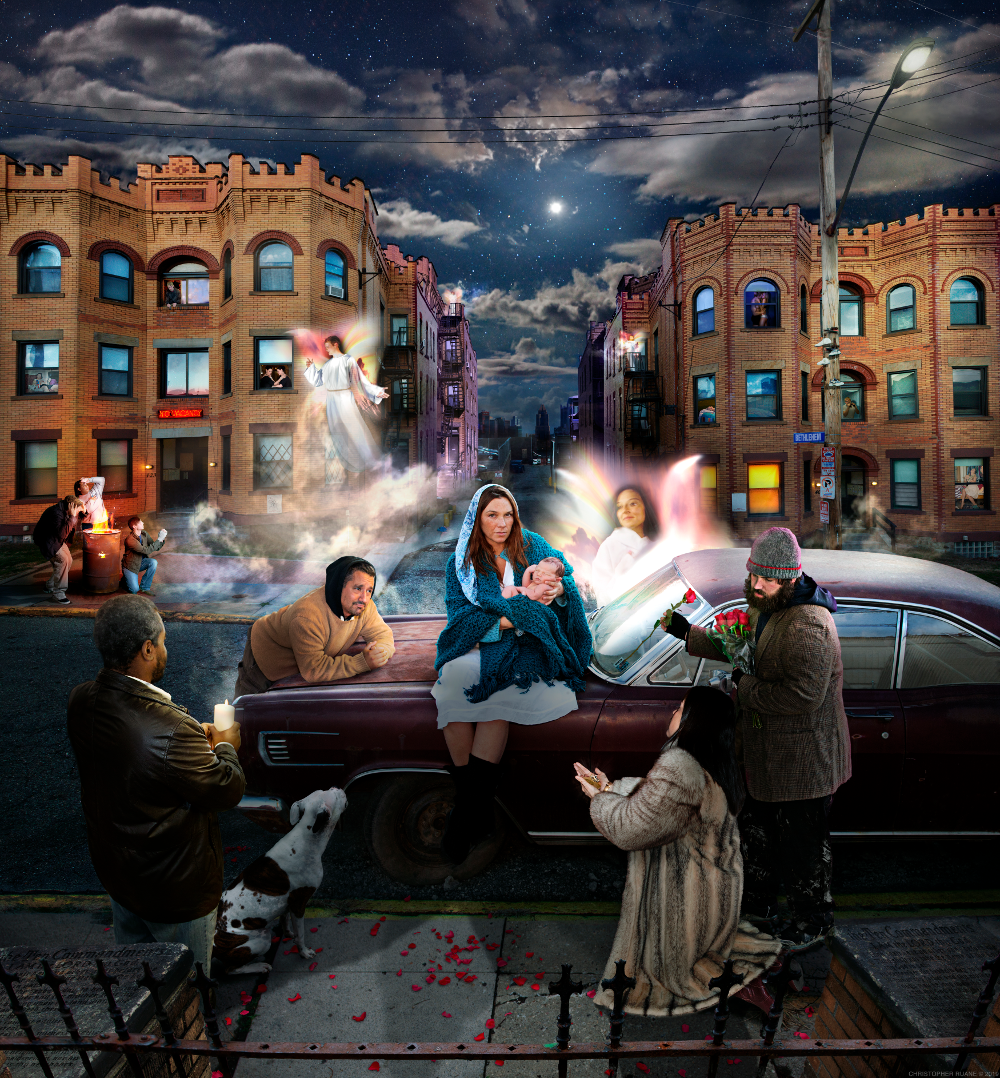
Christopher Ruane (American, 1981–), The Nativity, 2014. C-print, 52 × 48 in. Click the link to zoom in.
This image by photographer and composite artist Christopher Ruane sets the Nativity of Christ on an urban street corner marked “Bethlehem” and casts racially diverse models in the biblical roles. Mary sits on the hood of an old beat-up car holding her sweet newborn with a protective grip—she has presumably just given birth in the backseat. She’s wrapped in a blue afghan, the color traditionally associated with the Virgin. Joseph leans over, gazing proudly at his new baby son. Instead of the traditional cow and donkey looking on, there’s a spotted dog.
In the foreground are the three “wise men,” which here are two men and a woman, offering their gifts to the family. One man brings a candle; another, a rose. A wealthier woman in a fur coat brings gold jewelry. They stand or kneel on the sidewalk before this miracle baby who will be their deliverer, the way strewn with flower petals.
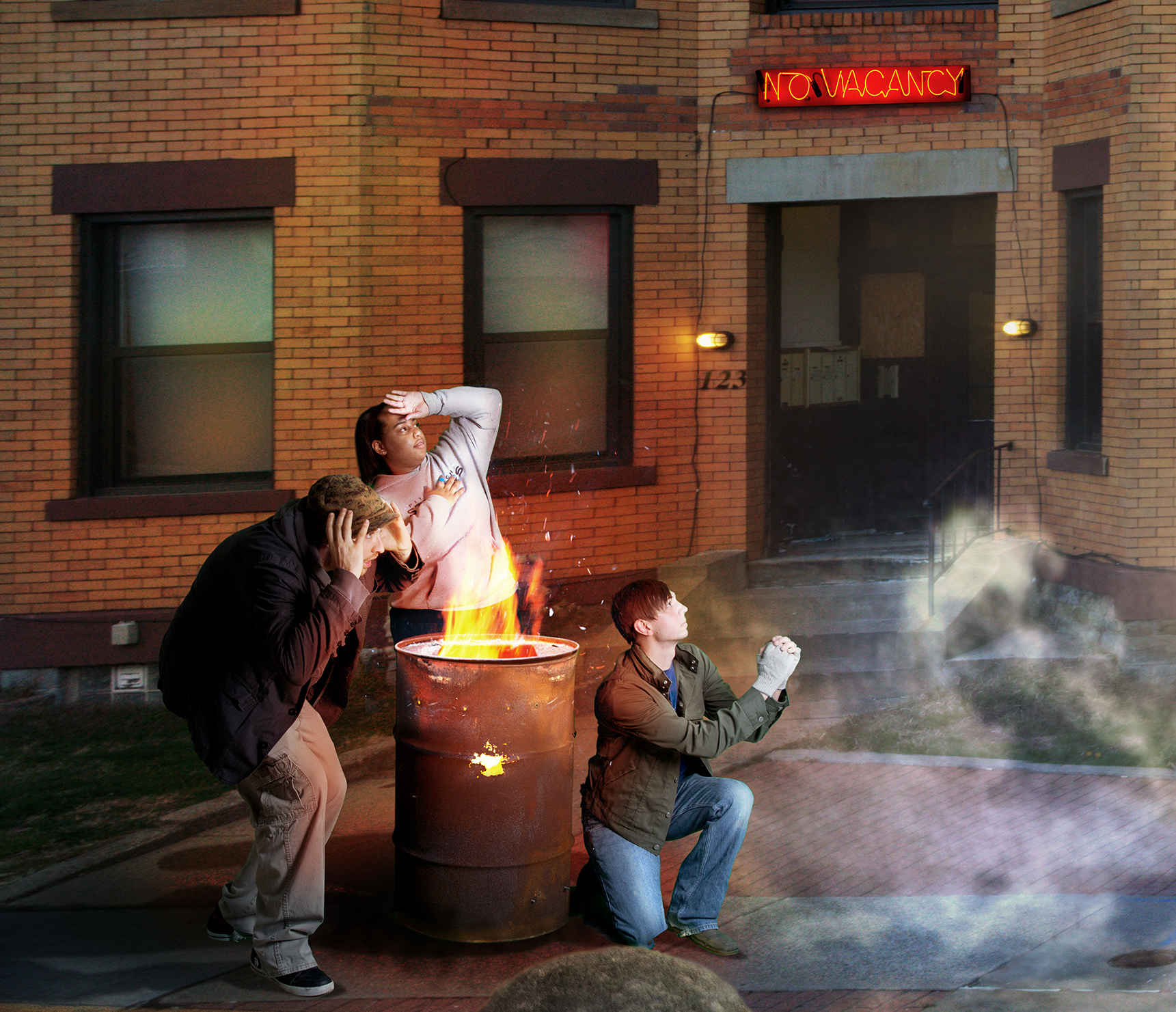
In the middle ground are three young unhoused people around a trashcan fire, standing in for the shepherds. A cloud of steam rises up out of a manhole before their eyes and coalesces with a heavenly apparition, come to personally announce to them the Messiah’s birth.
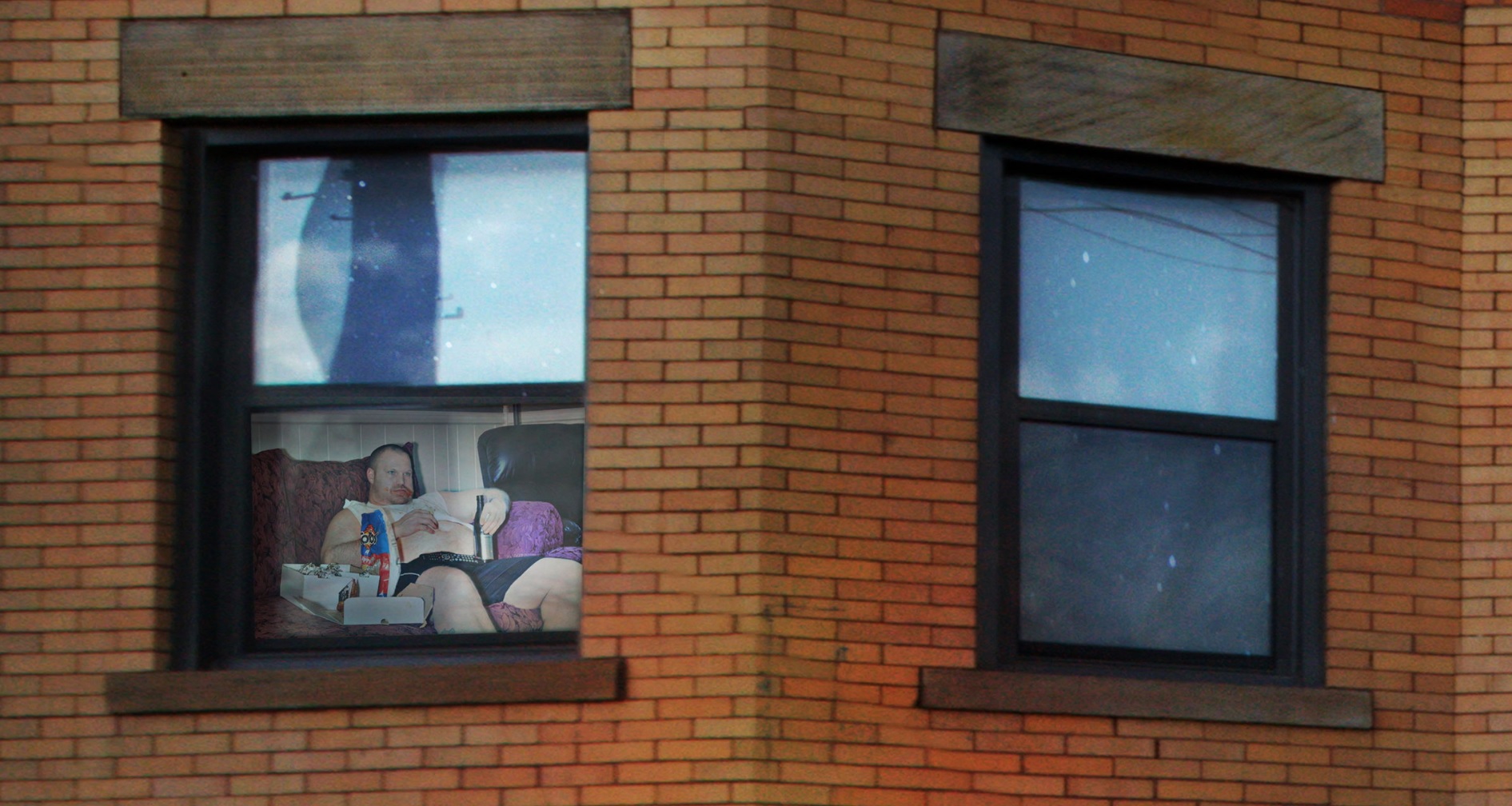
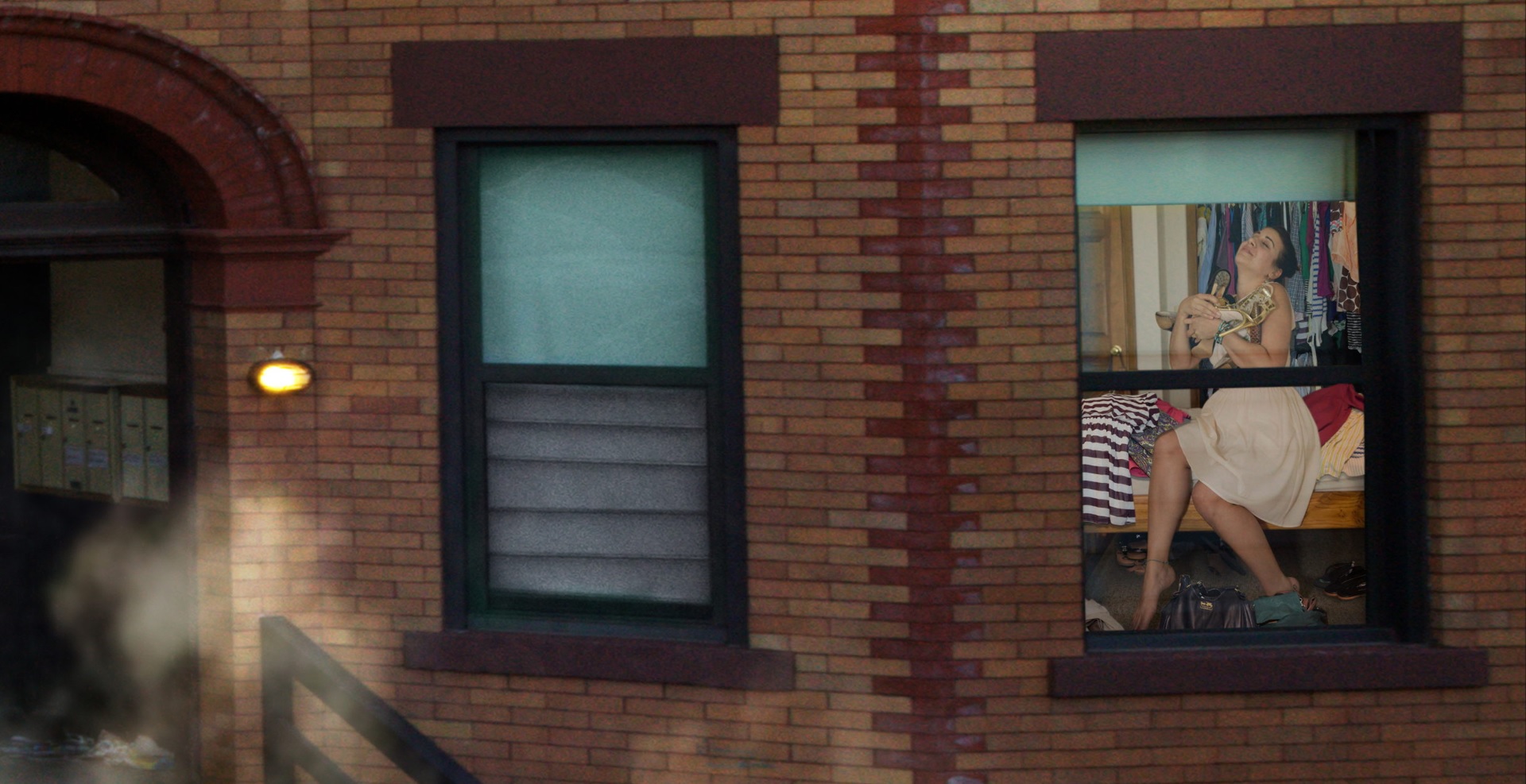
In the windows of the apartment building in the background are various people occupied with various activities. In one room a couple is engaging in sexual foreplay. Across the way, a man is vegging out in front of a TV. One woman, whose closet is spilling over with clothes, is hugging her collection of designer shoes.
These represent different values or dependencies—for example, materialism, a literal clinging to one’s possessions. But there’s also pain.
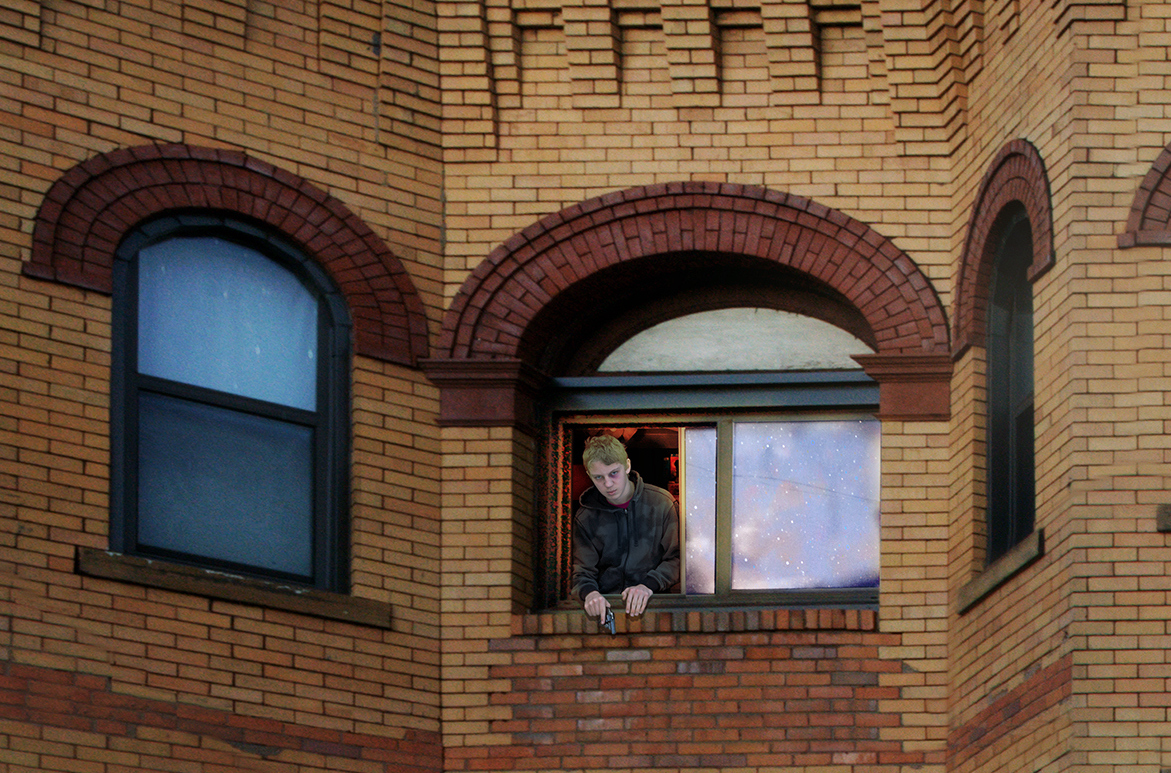
On the top floor there’s a young man in a hoodie with a black eye. Maybe he’s abused by his father. Or bullied at school. Or in too deep with a gang. Either way, he is bitter and angry and scared and distrustful and has a gun.
Christ was born into this world of hurt and false loves. He came to call us out of the darkness of these and into light, to give us abundant life in God. The bright star above beckons us all to follow the light to the feet of Jesus, Emmanuel, God-with-us.
Three wise men ridin’ hard through the cold Lost on some big city street with no place warm to go They are lookin’ for a manger, or a sign in the lights But they’re a long way from Bethlehem tonight
But they heard about a savior And a preacher in the park Who will camp with the homeless Where they shiver in the dark He’ll deliver salvation To the weary and the cold And he’ll bring joy, joy, joy to the wanderin’ soul
The cleaning lady sighs as she closes up the gate This job don’t quite pay the bills, and she’s always workin’ late But all in a moment comes a light from above It’s an angel speaking words of joy and love
And he tells her of a savior And a preacher in the park Who will camp with the homeless Under bridges in the dark He’ll deliver salvation To the weary and the cold And he’ll bring joy, joy, joy to the wanderin’ soul
Four in the mornin’ at the Tradewinds Motel The register reads, “All Full Up,” and the clerk thinks, “Just as well” But out in the toolshed by an old Coleman lamp A little family makes its meager camp
And the wise men bring presents And the angels gather round The cleaning lady slips in through the door without a sound And an old black dog looks on with the rest At the little babe upon his mother’s breast
And there comes a savior (Joy to the world) And a preacher in the park (The Lord is come) And he camps with the homeless (Let earth) Where they shiver in the dark (Receive her king) He delivers salvation To the weary and the cold (Let every heart sing) And he brings joy, joy, joy to the wanderin’ soul He brings joy, joy, joy to the wanderin’ soul
The American folk singer-songwriter Dave Carter was one half of the duo Dave Carter and Tracy Grammer, active from 1998 until Carter’s unexpected death in 2002. His songs have been covered by Joan Baez, Judy Collins, Willie Nelson, and others, and Grammer posthumously released several previously unreleased songs by Carter, including “American Noel.” She and Carter recorded the song sometime between 1999 and 2001 for a series of employee holiday gift compilations commissioned by the president of a hardware store chain.
Like Ruane’s digital photomontage, “American Noel” imagines the Incarnation happening on the margins of a modern American city, attracting low-wage workers and transients, among others. Jesus pitches his tent among the exhausted and despairing, “the weary and the cold,” coming not as an outsider to struggle but as one who will know it firsthand. His childhood, to say nothing of his adulthood, is marked by sudden flight from his homeland to escape a tyrannical king and by an upbringing in a country not his own.
When I was at the Museum Catharijneconvent in Utrecht, Netherlands, in 2019, one of the standout pieces I saw was an early fifteenth-century altarpiece from the Middle Rhine region of Germany. The central section, which I imagine would have been a sculpted Crucifixion scene, has been lost, and the surviving panels are arranged in a modern frame.
Altarpiece from the Middle Rhine, ca. 1410. Tempera on panels. Museum Catharijneconvent, Utrecht, Netherlands. Photo: Ruben de Heer.
Ten panels depicting eight scenes from the life of the Virgin Mary decorate what would have originally been the interior wings—that is, visible when the altarpiece was open.
I’ll describe the first four, as they’re my favorites.
All photos in this post are from the museum’s website, which courteously provides them in high resolution under an open-access policy, promoting scholarship and digital engagement. The Annunciation image is a composite I made from two separate photos.
The Annunciation
In the Annunciation, Mary sits in her bedroom beside a window in front of an open pink chest (her dowry chest?), quietly reading the scriptures, when the angel Gabriel slips in through an open door, holding a banderole that bears his greeting: Ave gratia plena d[omi]n[u]s tecum (“Hail, favored one, the Lord is with you,” Luke 1:28). He then goes on to tell her that she has been chosen to bear God’s Son into the world.
What will Mary say? Four little angels look on in eager anticipation from a tower in the panel above, while in the room two angels already start rolling out the royal treatment, holding up a gilt-brocaded velvet “cloth of honor” behind the young maiden in recognition of her high calling.
A thin column divides Gabriel’s space from Mary’s, creating a sense of threshold. It marks a boundary that is about to be crossed. The separation between God and humanity will be broken down by the Incarnation.
Mary ultimately responds to the surprise invitation with acceptance: Ecce ancilla d[omi]ni fiat michi s[e]c[un]d[u]m verbu[m] t[uu]m (“Behold the handmaid of the Lord, be it unto me according to thy word,” Luke 1:38).
Mary’s yes triggers the release of a thick stream of light—it looks to me like a golden conveyor belt!—from the heart of God the Father, who is peering down through an upper window. Riding that stream is a haloed dove (the Holy Spirit) followed by a tiny yet fully formed infant Christ who’s holding a cross and headed straight toward Mary’s womb.
“Weeee!!!”
The homunculus (“little human”) motif in Annunciation images, though relatively rare, always makes me chuckle. It’s one way artists came up with to visualize the unvisualizable mystery of Christ’s conception, one that includes the Second Person of the Trinity as an actor in the event and shows a very literal descent. Not long after the motif started appearing in the fourteenth century, it was disapproved of by theologians, such as Antoninus of Florence and Molanus, and it was finally banned in the eighteenth century by Pope Benedict XIV as being heretical, since it suggests that Jesus did not take his body from Mary.
For brief commentary on this particular scene by Msgr. Herman Woorts, a Dutch art historian and an auxiliary bishop in the Roman Catholic Church, see this video produced by Katholiekleven.nl:
(To translate the Dutch into your language, click the “CC” button on the player, then the cog icon, and select Subtitles→Auto-translate.)
The Visitation
In the Visitation panel, Jesus and John the Baptizer are visible in their mothers’ wombs, each encased in a mandorla (almond-shaped aureole). This visual device of showing the cousins in utero was not uncommon at the time, especially in the Low Countries; art historian Matthew J. Milliner amusingly calls it “ultrasound Jesus”! Here you can actually see little John kneeling before his cousin in adoration.
Elizabeth has emerged from a door at the right, whose frame is labeled “Civitas Juda,” City of Judah (and notice the dog in the doorway! a traditional symbol of faithfulness). As she and Mary embrace each other in celebration of their miraculous pregnancies and imminent salvation, scrolls unfurl with their words from the Gospel of Luke: Et unde michi hoc q[uo]d mater d[omi]ni mei venit ad me (“And why is this granted to me that the mother of my Lord should come to me?” Luke 1:43), at right, and at left, Magnificat a[n]i[m]a mea d[omi]n[u]m. Et exultavit sp[iritu]s meus i[n] deo salutalutari (sic) meo (“My soul magnifies the Lord, and my spirit rejoices in God my Savior,” Luke 1:46–47). The scrolls provide a delicate, wing-like framing around the two women.
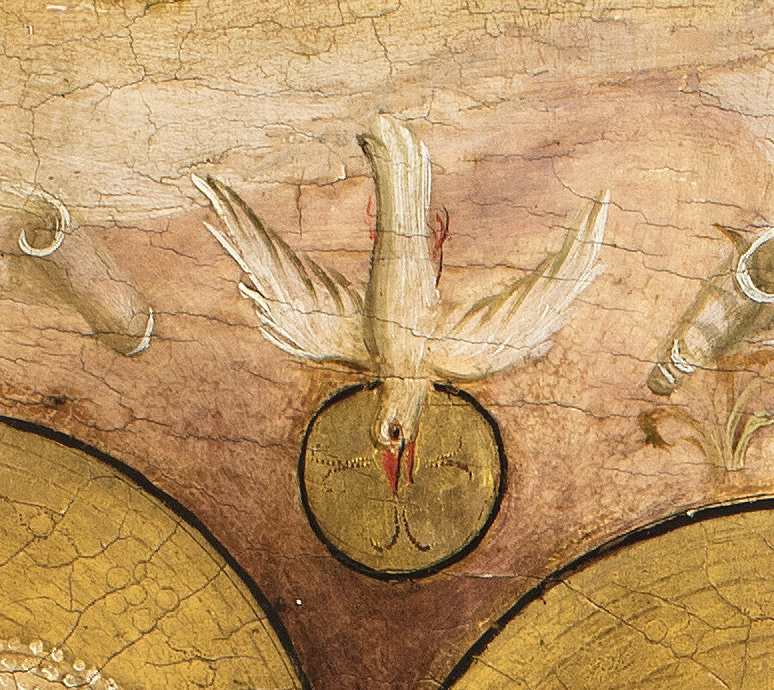
And at their head, in the center, an open-beaked dove descends, signifying the Holy Spirit—an extremely rare appearance in Visitation images. This is God breathing on his daughters, blessing their ministries, receiving their praise. Like the prophets of old, they are filled with God’s power and truth spills forth from their lips.
At their feet flows a spring of water, a possible allusion to Isaiah 35:6b–7a: “waters shall break forth in the wilderness, / and streams in the desert; / the burning sand shall become a pool, / and the thirsty ground springs of water.” Not to mention the Living Water that is Christ (see John 4).
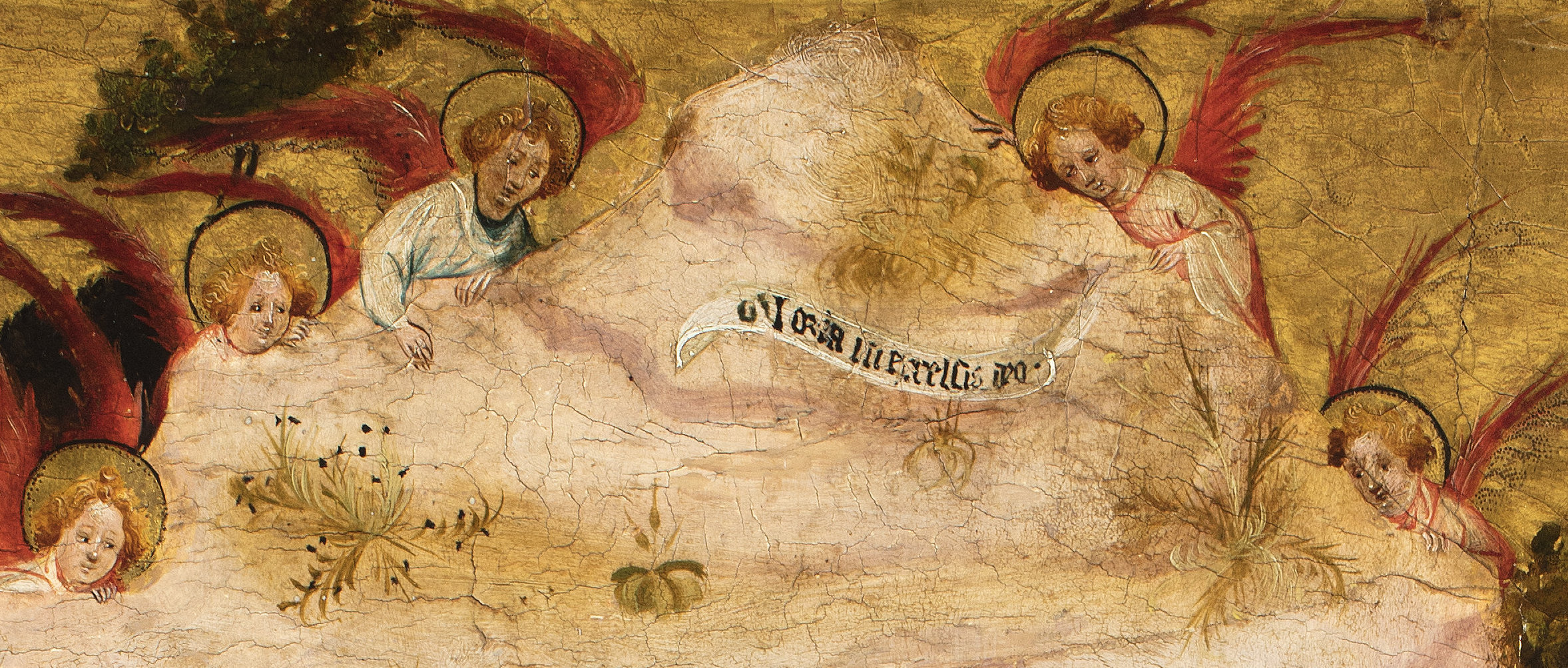
Another charming detail of this panel is the angels, with their wispy red wings, peeking in at this intimate moment from behind rocks. I’m reminded of the epistle of 1 Peter, whose author says that the mysteries of salvation are “things into which angels long to look!” (1:12). Here they seem to whisper their song that will be exclaimed at full blast on the night of Jesus’s birth: Gloria in exelsis deo (“Glory to God in the highest,” Luke 2:14).
The Nativity
Poor Joseph is often overlooked as a player in the Christmas story, and yet he, too, faithfully responded to a (quite terrifying!) divine calling: to be the adoptive father of Jesus, raising him as his own. Though he initially had doubts about Mary’s story of supernatural conception—who wouldn’t?—an angel set him straight, and he ultimately acted in love and loyalty to Mary, and to God. He was an advocate and a provider for his family, looking out for their best interests all along the way.
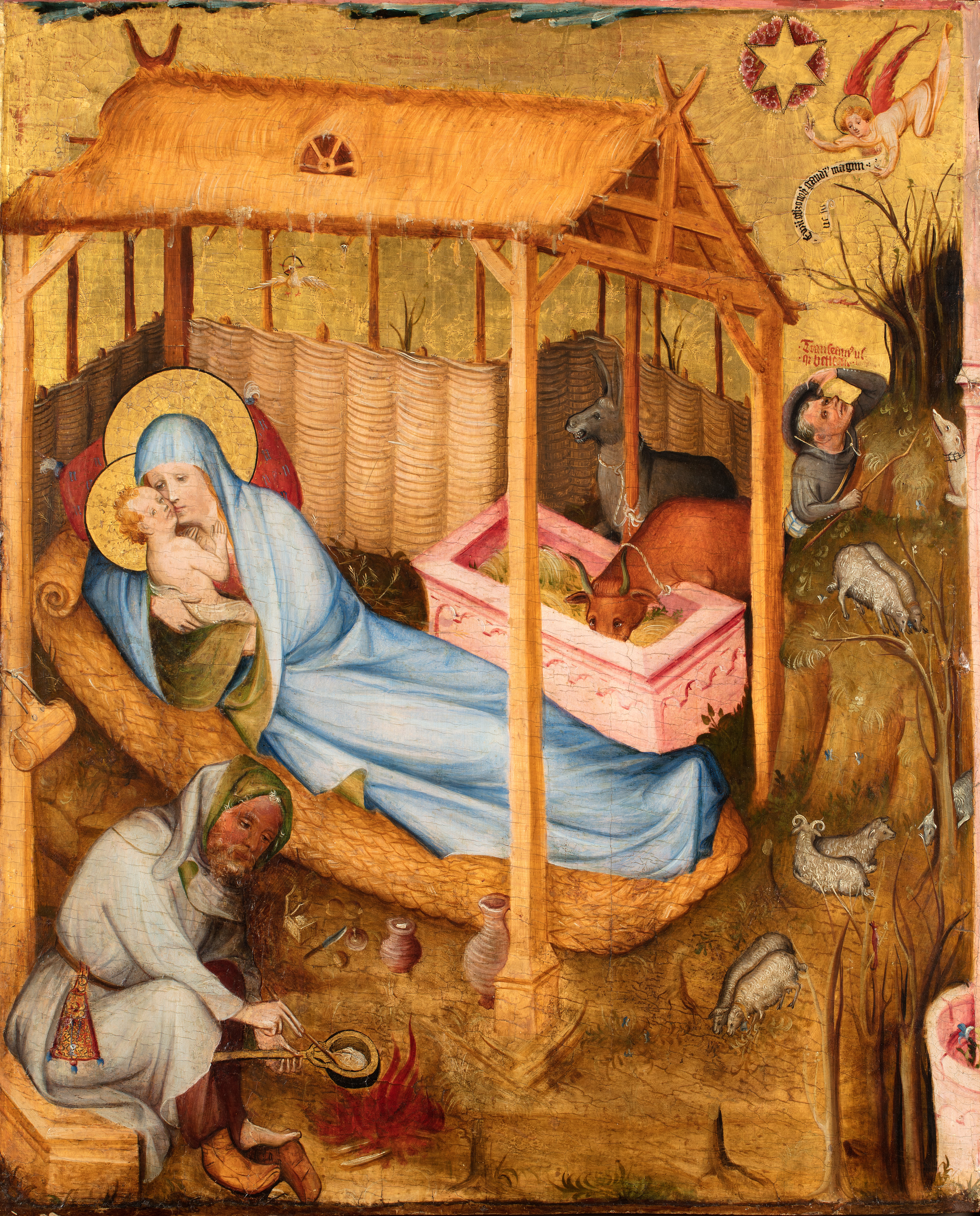
I mention this because the Middle Rhine Altarpiece shows an actively caring and resourceful Joseph at the Nativity, cooking porridge over an open fire to nourish his hungry and tired wife, who reclines on a rollout mat with her newborn.
Also, notice that his left foot is bare. A legend of unknown origin says that Joseph removed his stockings (German hosen) following Jesus’s birth, cutting them into strips in order to swaddle the child. This narrative detail appealed to popular imagination and was referred to in stories, poems, songs, and the visual arts from the fourteenth through sixteenth centuries in the Netherlands and the Rhineland. At the time this altarpiece was made there was even a venerated relic at Aachen Cathedral purported to be the stockings-turned-swaddling bands.
As had become standard in images of the Nativity, this one includes an ox and an ass. The canonical Gospels don’t mention any animals at the birth—though the mention of a manger in Luke 2:7 implies an animal presence. The seventh-century Gospel of Pseudo-Matthew specifically names the ox and ass, citing their supposed adoration of the Christ child as a fulfillment of an Old Testament “prophecy”: “And on the third day after the birth of our Lord Jesus Christ, the most blessed Mary went forth out of the cave, and entering a stable, placed the child in the stall, and the ox and the ass adored Him. Then was fulfilled that which was said by Isaiah the prophet, saying: The ox knows his owner, and the ass his master’s crib (Isa. 1:3).” These two domestic animals are also mentioned in the Nativity account that appears in the Golden Legend, an immensely popular text from the thirteenth century.
Here the ox is nose-deep in straw, while the ass looks up with his mouth agape. Perhaps he’s excited at having just spotted the Spirit-dove under the rafters.
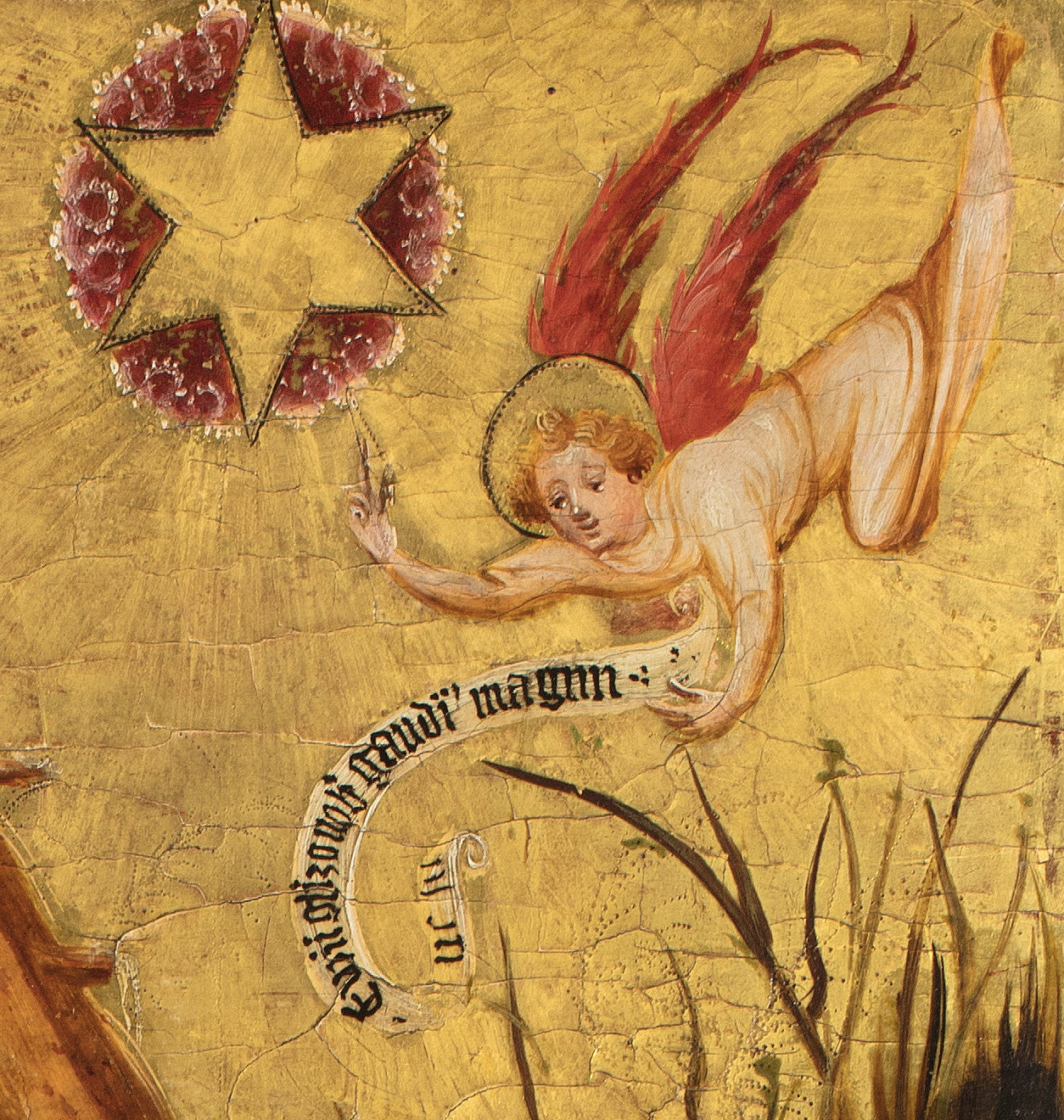
The shepherds are about to arrive at the stable, as in the right background the birth is announced to them. The scroll held by the angel reads, Evanglizo vob[is] gaudi[um] magnu[m] (“I proclaim great joy to you,” Luke 2:10), and above the shepherd is the inscription Transeamu[s] us[que] Betleem (“Let’s go to Bethlehem,” Luke 2:15).
The Adoration of the Magi
In the Adoration of the Magi panel, Mary holds the Christ child on her lap, who is nude save for a thin diaphanous drape, emphasizing his full humanity. She wears a crown, alluding to her identity (in Catholic tradition) as Queen of Heaven. As in the Annunciation, she’s backed by a cloth of honor, which Joseph pulls aside to see what new visitors have come calling. And again, the ever-present Holy Spirit hovers above!
The pointing angel at the top, with the aid of a star, has directed three magi, portrayed here as kings, from their far-off homelands to the Christ child. Ite in iudeam ubi / nascit rex iudeor[um] (“Go to Judea where the king of the Jews was born”), he says.
Having cast his crown at the child’s feet, one of the magi kneels down and kisses the hand of the King of kings. He presents a container of gold coins as tribute, which Jesus rifles through with curiosity (ooo, shiny!).
Two other magi stand behind with their gifts of frankincense and myrrh. One of them, whom tradition calls Balthazar, is African. In the eighth century the historian Bede described Balthazar as having a “black complexion,” and from around 1400 onward he came to be portrayed that way in art, reflecting the growing visibility of other races in Europe.
Exterior Panels
Just to give you a full picture of the altarpiece as a whole . . .
So all together, the altarpiece would have told the gospel story from Christ’s conception and birth to the Crucifixion to the Resurrection and Ascension to Pentecost. And it would have served as the backdrop to the celebration of the Eucharist, spiritually forming parishioners week after week.
Art museums are full of such treasures as these. I encourage you to visit one of your local museums (or maybe take a weekend trip to one), find a piece of historical art that intrigues you, and sit with it for at least ten minutes. What do you notice? What is strange to you? What makes you smile? What was the object’s original context? What lineages is it a part of (e.g., what communities has it passed through, what iconographies or textual traditions does it draw from and develop, etc.)? What theological ideas, if any, does it express?
If you struggle to meaningfully engage with an artwork, I’m sure a docent would love to help you.
You might also take a photo of the artwork and share it on your social media. Ask your friends what stands out to them.
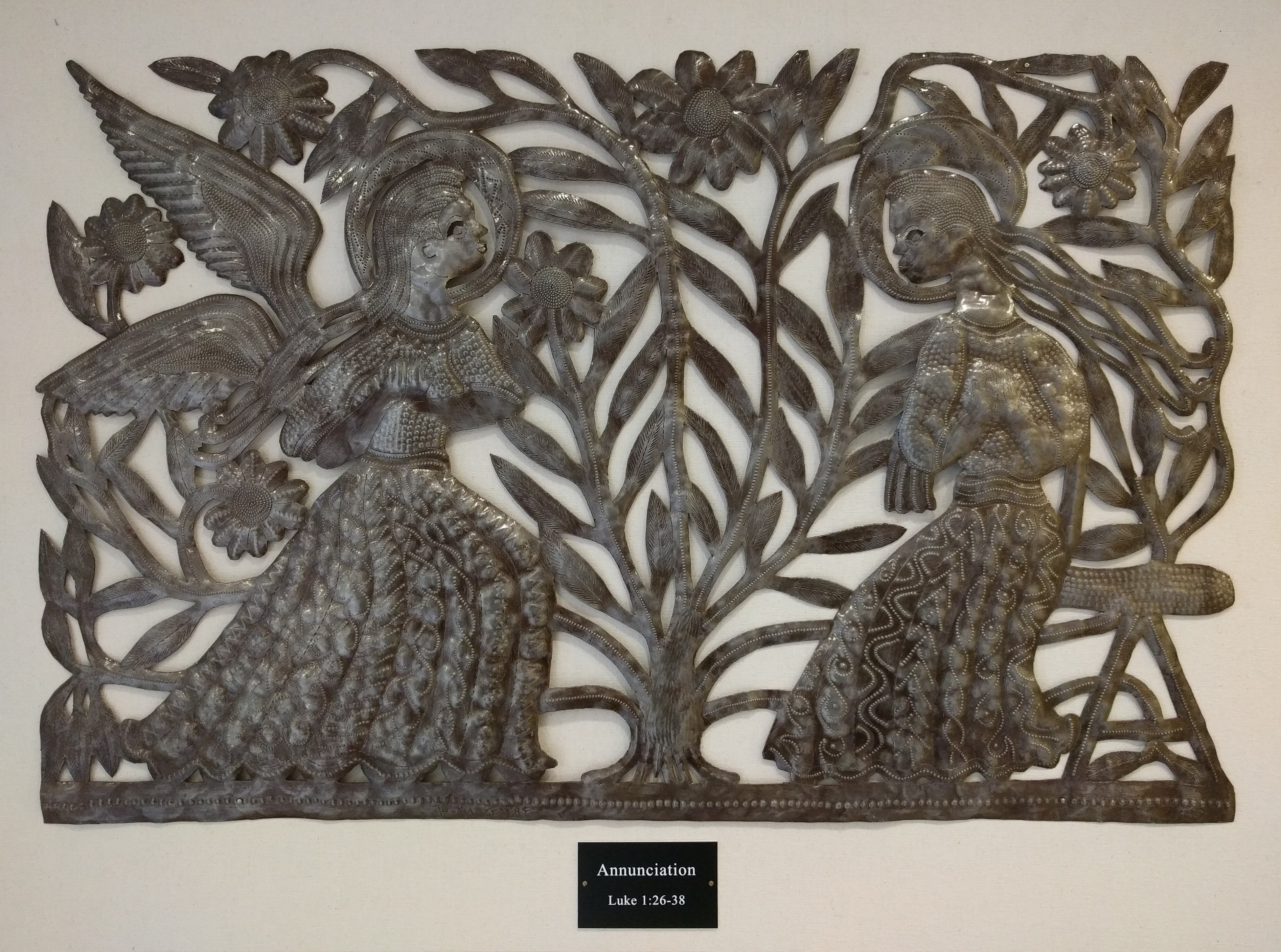
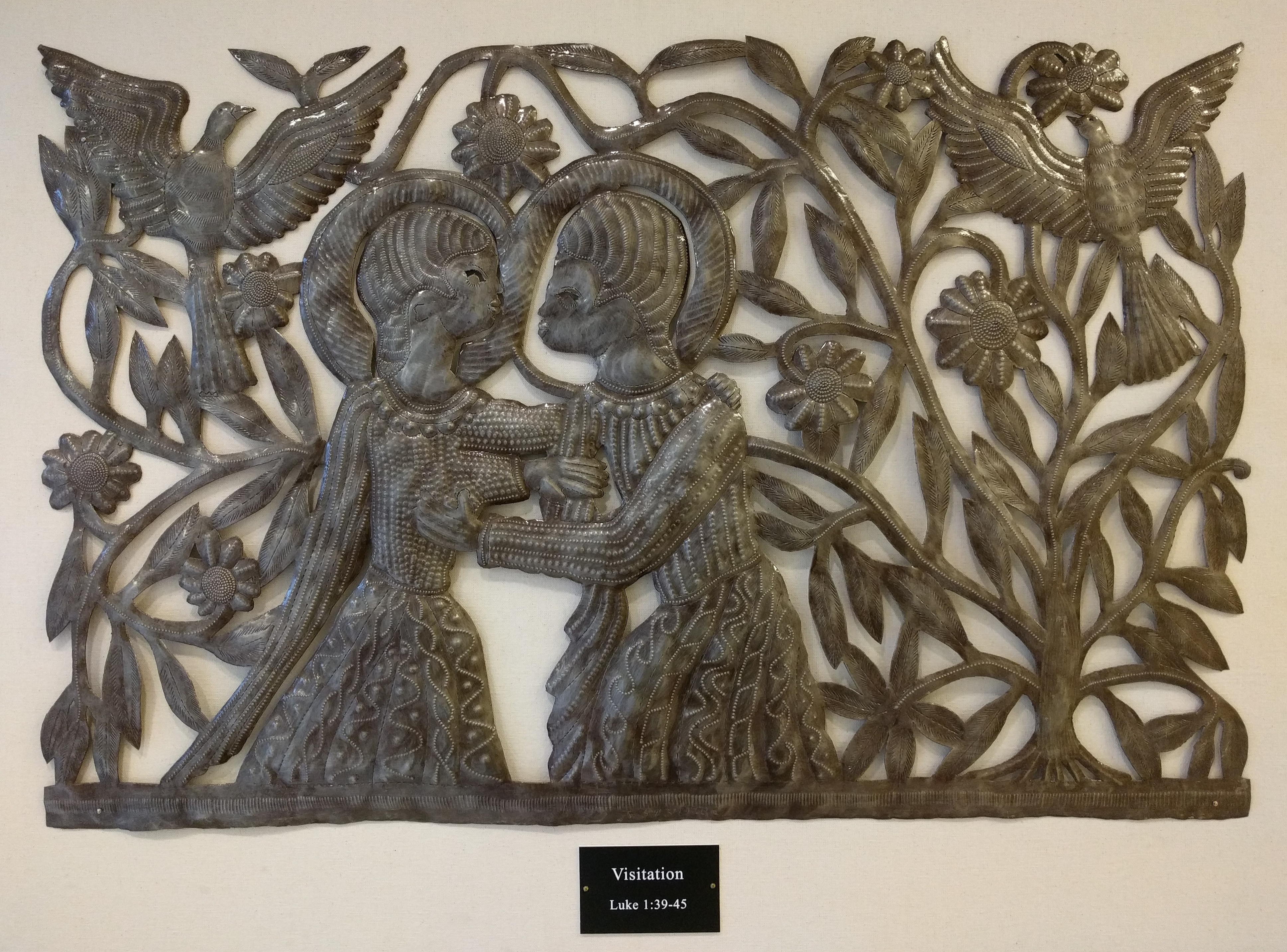
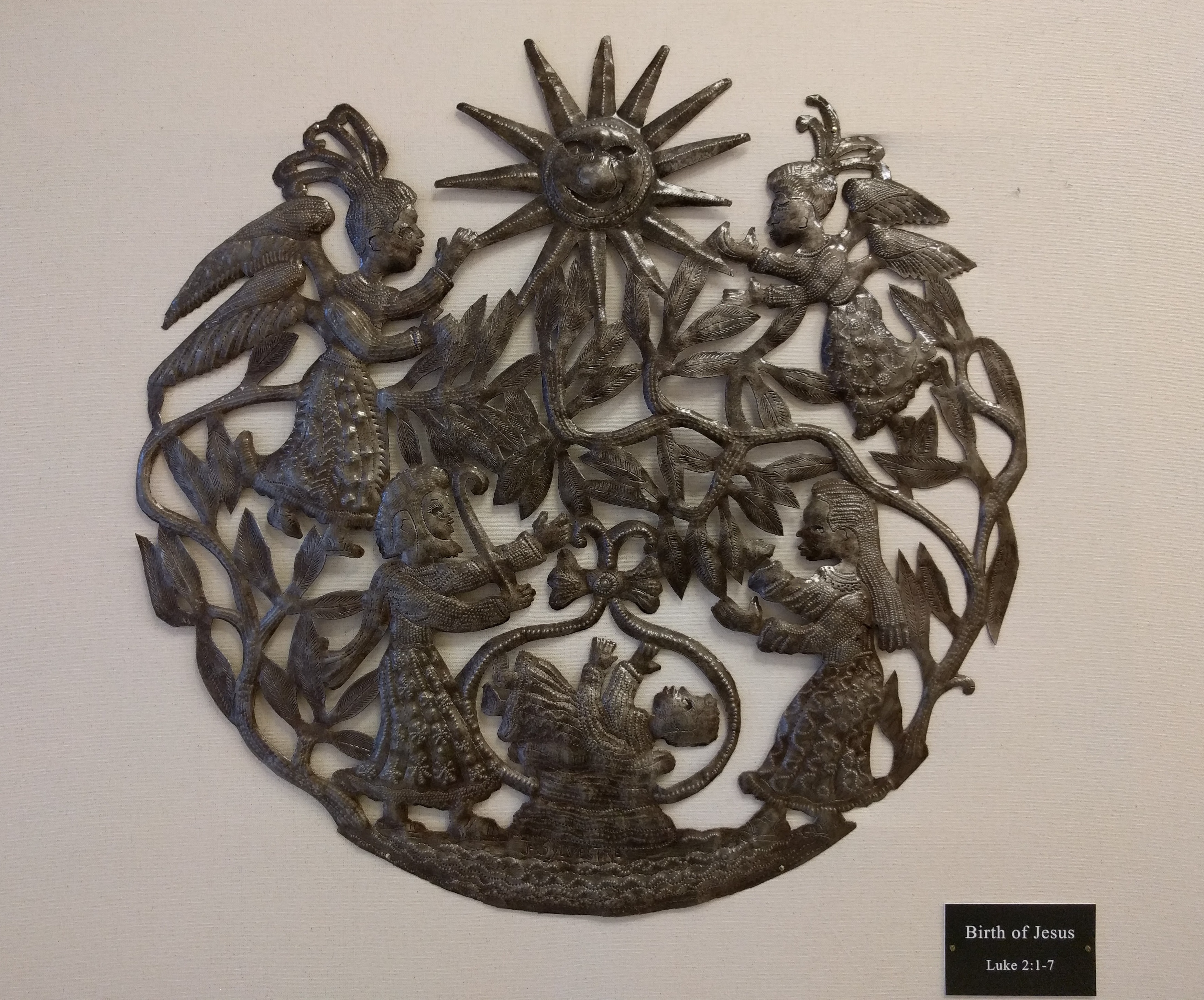
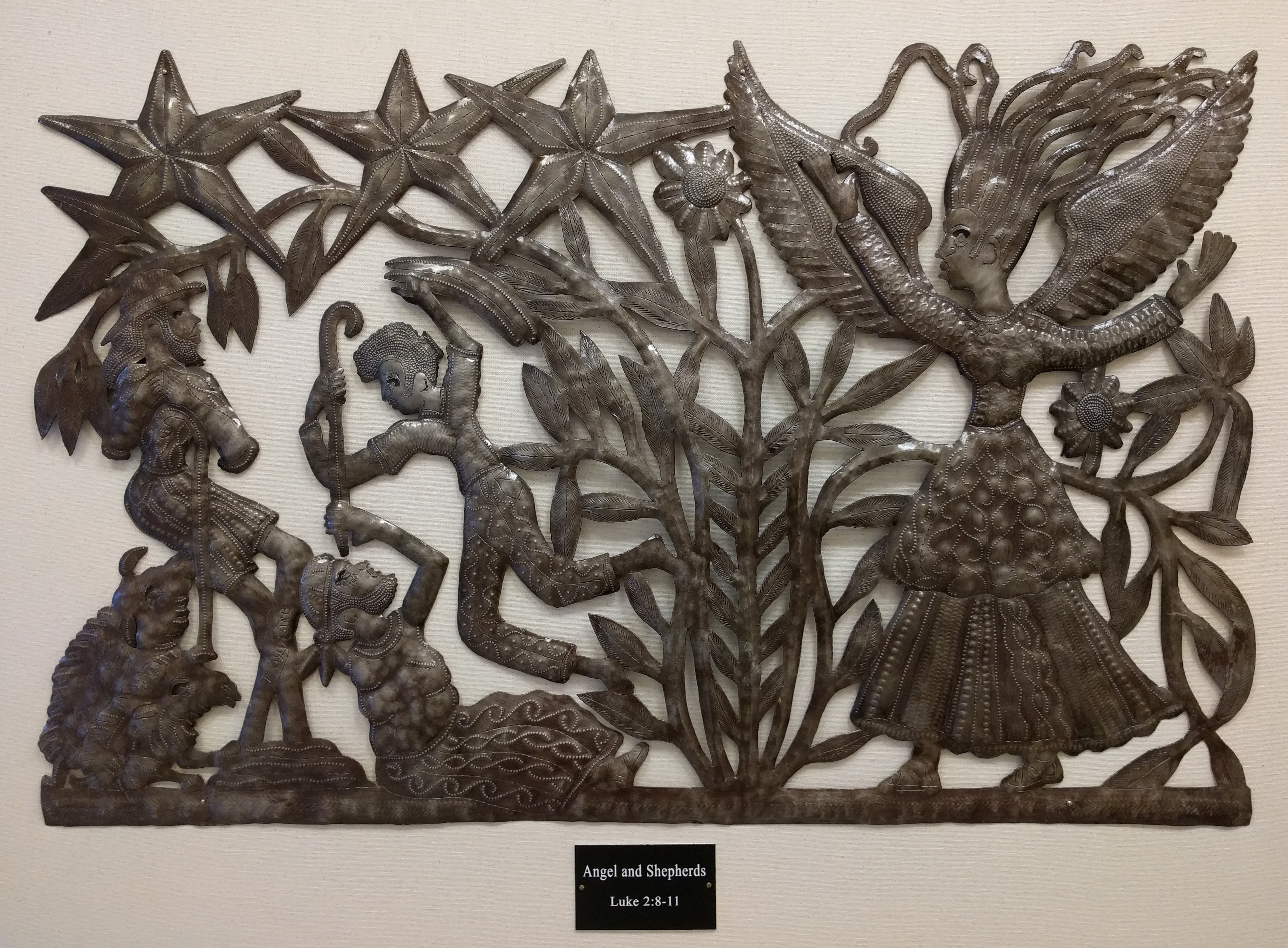
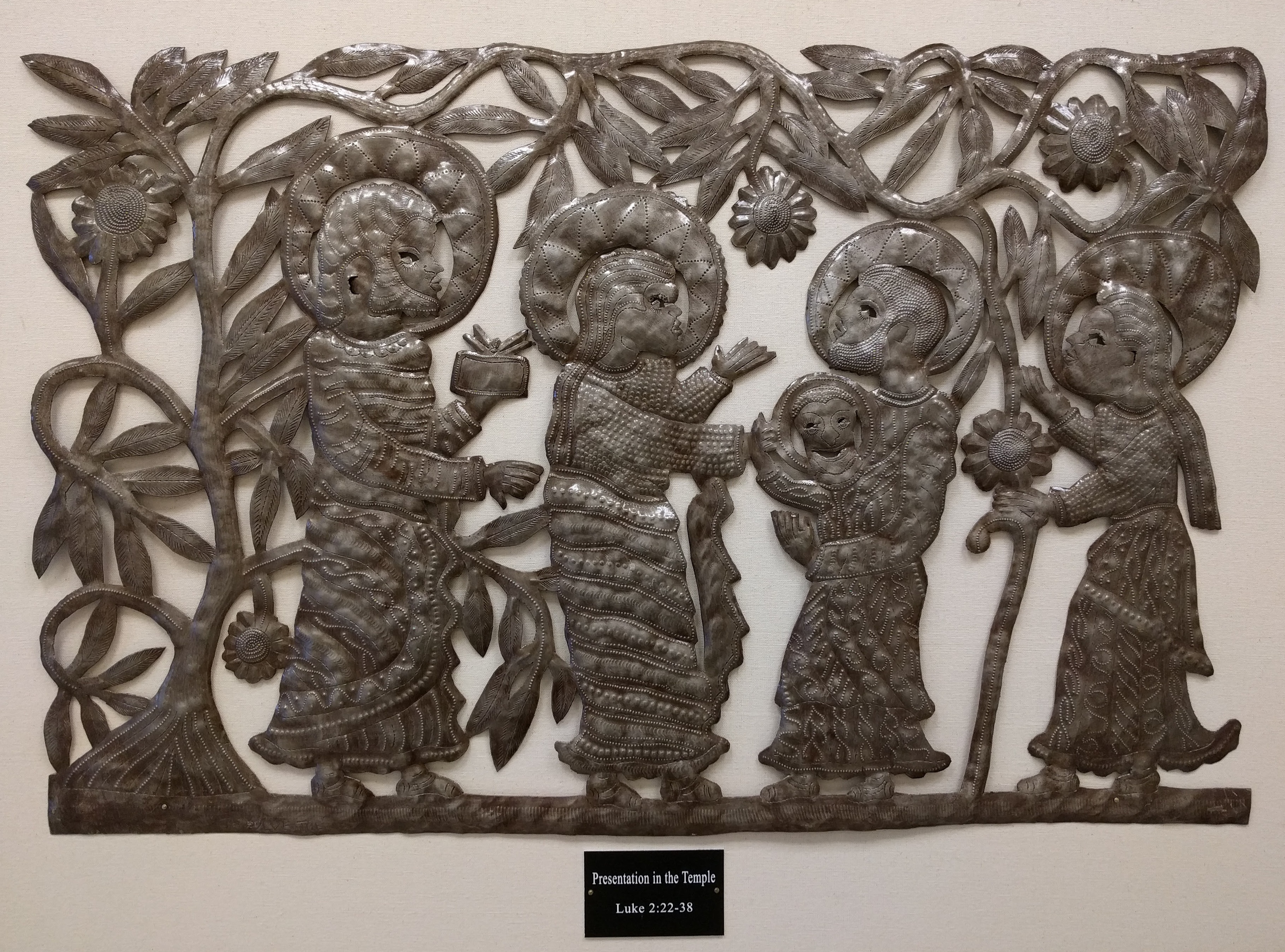
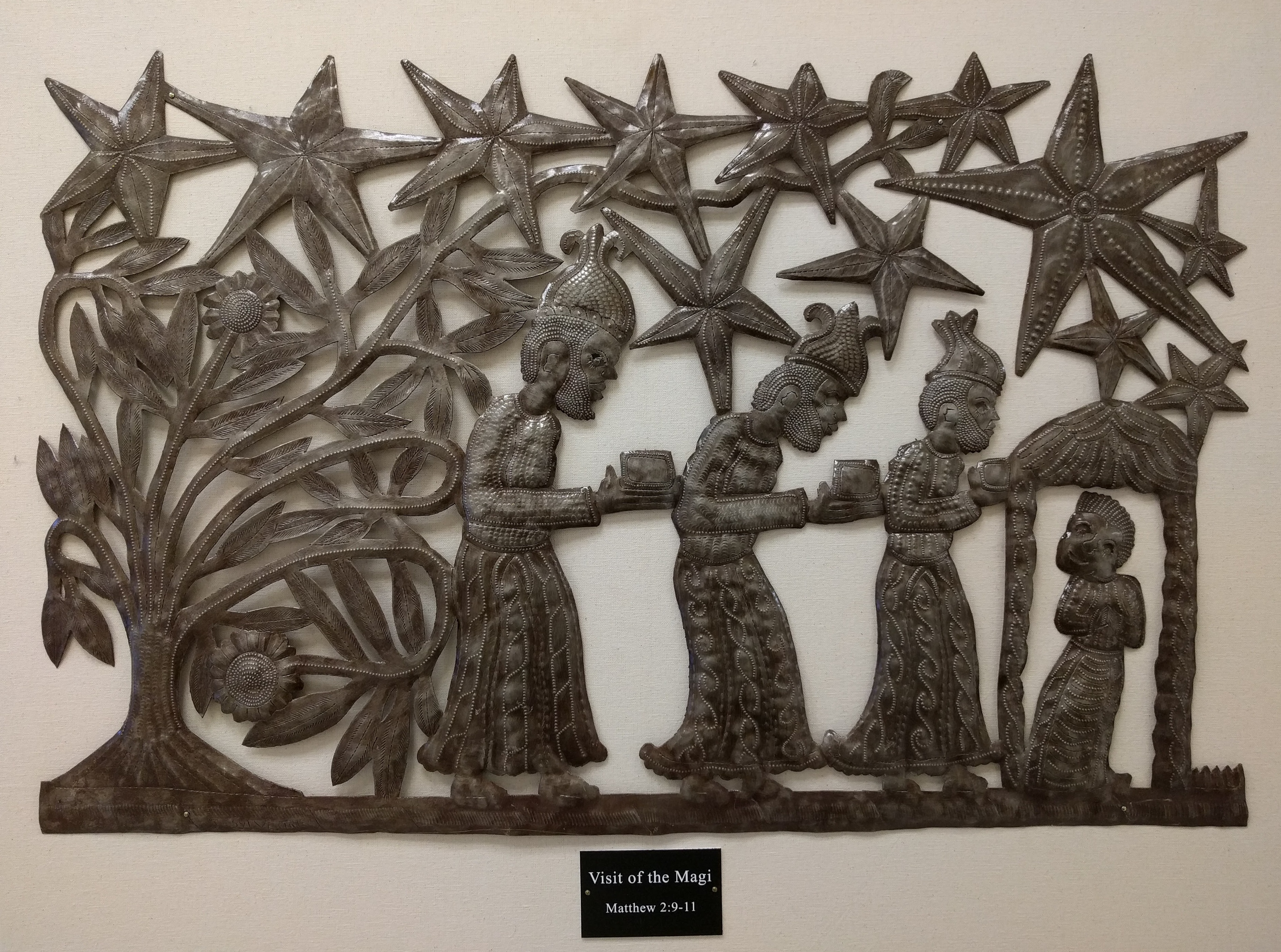
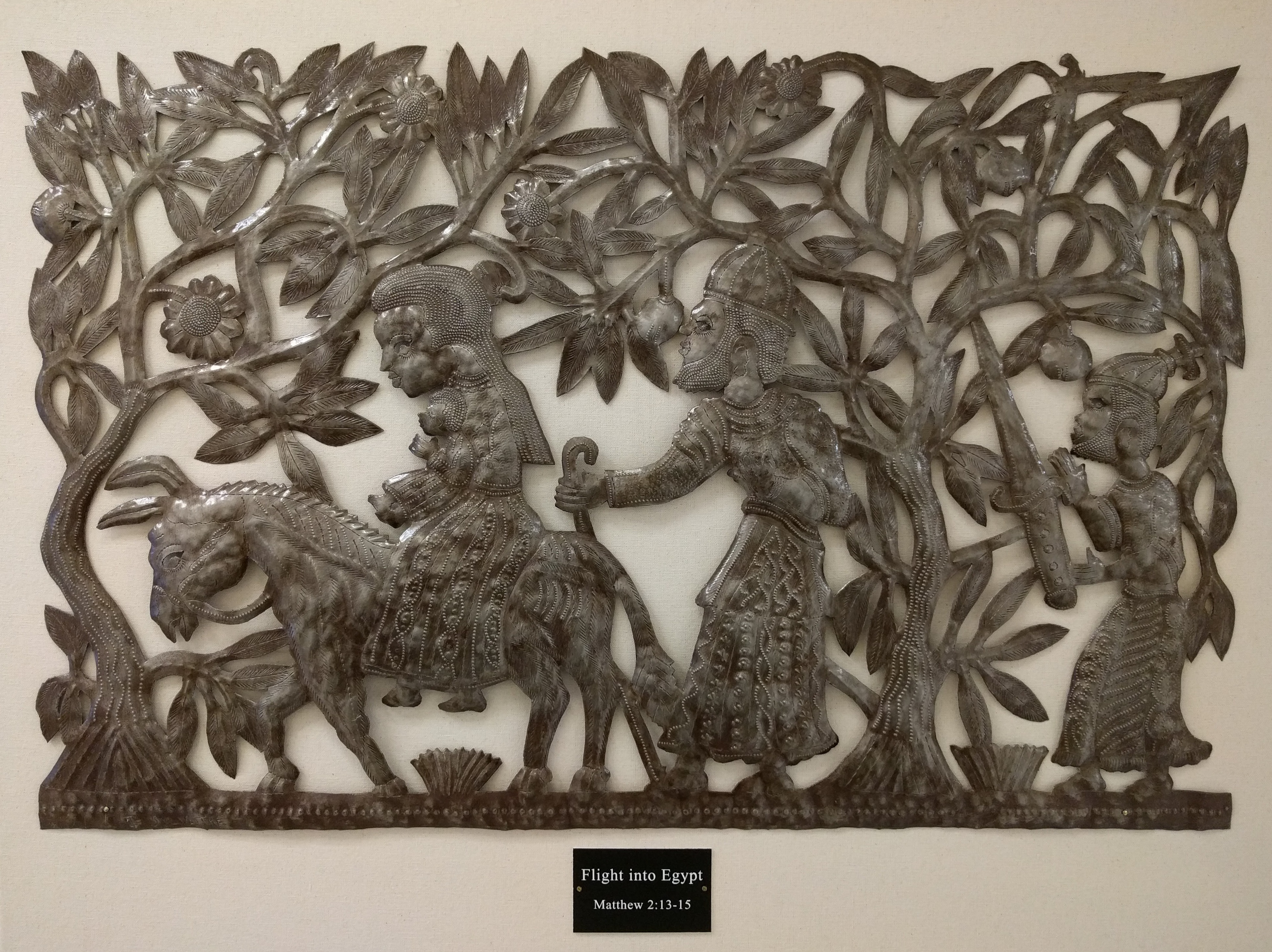
When wandering around the Duke Divinity School campus this summer, waiting for a conference talk to start, I inadvertently encountered a stunning seven-work cycle of metal panels depicting scenes from the biblical narratives of Christ’s birth. They were designed and hand-carved from discarded steel oil drums by Haitian artist Jean Sylvestre, who lives in the village of Croix-des-Bouquets, ten miles outside Port-au-Prince.
Steel drum sculpting is an art form unique to Haiti, and Croix-des-Bouquets is the center of production, home to dozens of workshops. Once acquiring a drum, the artist first removes the round ends and places them inside the cylinder along with dried banana or sugar cane leaves, then sets the leaves on fire to burn off any paint or residue. When the drum cools, the artist makes a cut from top to bottom, then climbs inside and pushes with his legs and arms to open up the metal, which he then pounds into a flat sheet. Next he draws a design onto the metal using chalk, then uses a hammer, chisel, and ice picks to actualize it. To see photos of this process and learn more about it, visit www.haitimetalart.com.
In Sylvestre’s nativity cycle at Duke—a gift from Drs. Richard and Judith Hays—the characters are depicted as native Haitians. Each scene unfolds against a backdrop of curvilinear greenery that is typical of Haitian metalwork.
My favorite of the seven has got to be the Annunciation to the Shepherds; I love the angel’s wild hair and the one shepherd who jumps backward in fear and surprise. I’m also tickled by the smiling sun in the Nativity panel!
Jean Sylvestre (Haitian, 1957–), Annunciation, 2013. Recycled steel. No. 1 from a cycle of seven in the Westbrook Building, Duke Divinity School, Durham, North Carolina. Photo: Victoria Emily Jones.
Jean Sylvestre (Haitian, 1957–), Visitation, 2013. Recycled steel. No. 2 from a cycle of seven in the Westbrook Building, Duke Divinity School, Durham, North Carolina. Photo: Victoria Emily Jones.
Jean Sylvestre (Haitian, 1957–), Birth of Jesus, 2013. Recycled steel. No. 3 from a cycle of seven in the Westbrook Building, Duke Divinity School, Durham, North Carolina. Photo: Victoria Emily Jones.
Jean Sylvestre (Haitian, 1957–), Angel and Shepherds, 2013. Recycled steel. No. 4 from a cycle of seven in the Westbrook Building, Duke Divinity School, Durham, North Carolina. Photo: Victoria Emily Jones.
Jean Sylvestre (Haitian, 1957–), Presentation in the Temple, 2013. Recycled steel. No. 5 from a cycle of seven in the Westbrook Building, Duke Divinity School, Durham, North Carolina. Photo: Victoria Emily Jones.
Jean Sylvestre (Haitian, 1957–), Visit of the Magi, 2013. Recycled steel. No. 6 from a cycle of seven in the Westbrook Building, Duke Divinity School, Durham, North Carolina. Photo: Victoria Emily Jones.
Jean Sylvestre (Haitian, 1957–), Flight into Egypt, 2013. Recycled steel. No. 7 from a cycle of seven in the Westbrook Building, Duke Divinity School, Durham, North Carolina. Photo: Victoria Emily Jones.
Duke Divinity School also owns a fourteen-piece Stations of the Cross cycle by Jean Sylvestre, which is often displayed in the nave of Duke University Chapel during Lent.
Shepherds, I sing you this winter’s night
Our Hope new-planted, the womb’d, the buried Seed:
For a strange Star has fallen, to blossom from a tomb,
And infinite Godhead circumscribed hangs helpless at the breast.
Now the cold airs are musical, and all the ways of the sky
Vivid with moving fires, above the hills where tread
The feet—how beautiful!—of them that publish peace.
The sacrifice, which is not made for them,
The angels comprehend, and bend to earth
Their worshipping way. Material kind Earth
Gives Him a Mother’s breast, and needful food.
A Love, shepherds, most poor,
And yet most royal, kings,
Begins this winter’s night;
But oh, cast forth, and with no proper place,
Out in the cold He lies!
This poem is published in Collected Poems 1943–1987 by John Heath-Stubbs (Carcanet Press, 1988) and is reprinted here by permission of David Higham Associates.
+++
John Heath-Stubbs (1918–2006) was an English poet, translator, critic, and anthologist whose lifelong fascination with world history and literature was borne out in his career. He translated poetry from Greek (Sappho, Anyte, Anacreon), Latin (Horace, Catullus), Persian (Hafiz, Omar Khayyam), Italian (Dante, Giacomo Leopardi), and French (Paul Verlaine) and wrote many verses of his own influenced by classical myths, including an Arthurian epic, Artorius.
Described by friends as a “devout” and “committed” Christian, Heath-Stubbs sometimes turned to the lives of Christ and the saints as subjects for his poetry, as in “‘Through the Dear Might of Him That Walk’d the Waves,’” “Dionysius the Areopagite” (on a pagan’s response to the eclipse during the Crucifixion), “Canticle of the Sun” (on the Resurrection), “Alexandria,” “Maria Aegyptiaca,” and “Virgin Martyrs,” to name a few. In his introduction to his Collected Poems, he wrote that he was interested in “the reaffirmation of orthodox religious themes in the poetry of TS Eliot and Charles Williams and others.”
Among other distinctions, Heath-Stubbs was awarded the Queen’s Gold Medal for Poetry in 1973 and in 1989 was appointed OBE (Officer of the Most Excellent Order of the British Empire). At his death, publications celebrated his style and influence:
“His distinctive achievement was to forge a modern pastoral out of unlikely sources, a style which can encompass Yeatsian symbolism and dry irony.”—Poetry Archive
His diction was conservative, but his lyricism was always modern.—The Telegraph
“His finest work is to be found in his huge output of shorter poems. In their technical mastery, wry wisdom and gloriously deceptive lightness, these place him in the company of W.H. Auden and Robert Graves, a major English poet of the 20th century.”—The Independent
Heath-Stubbs was nearly blind from age three, his eyesight progressively worsening until he lost it completely at age fifty-nine. But rather than regard his blindness as a disability, he regarded it as a gift. “As a poet, I have found that blindness actually tends to stimulate the imagination,” he said.
+++
First published in 1965, “For the Nativity” by John Heath-Stubbs is an ode to the infant Jesus—to him who is Hope, Seed, Star, and Love.
The first stanza is a loose paraphrase of the Annunciation to the Shepherds in Luke 2:10–13, in which an angel tells a group of Jewish night workers that Emmanuel, God-with-us, has been born. Heath-Stubbs uses horticultural imagery: Jesus was planted in Mary’s womb, and now he breaks through into air, blooming for all the world to see. Foreshadowing future events, the “tomb” refers not only to the cave he was born in but also to the cave he’d be buried in. He’d be seeded once again (in death), and again (in resurrection) he’d flower forth with new life. The fourth line embraces the paradox of the Incarnation: that infinite God became a finite human being; the omnipotent Creator, an impotent babe reliant on his mother’s milk. Continue reading ““For the Nativity” by John Heath-Stubbs + choral setting”→







 Art & Theology