Maybe it’s the ocean’s rhythmic tug that helps me sleep, my body’s own surge remembering its deepest pulse.
Think of those Celtic monks who scaled the slippery rocks carrying vellum and inks while the sea broke
and battered beneath them. High in a crevice, a hidden stone hut with cot and candle. The scribe
dips and swirls his quill to preserve the story—Luke’s genealogy, name after name, letters shaped
like birds in every color, a flight of messengers released into history. Each word unfurls the promise,
like Gabriel kneeling. The body knows that wings, like waves, can break through walls and enter,
that the secret of the story is love, that even as we sleep, its tides carry us in a wild safety.
The poem “What the Body Knows” by Jean Janzen is from her collection What the Body Knows (DreamSeeker Books / Cascadia Publishing House, 2015) and is used here by permission of the publisher.
The pages from the early ninth-century Book of Kells (IE TCD MS 58, fols. 200r, 200v, 201r, 201v, 202r) are sourced from the Digital Collections of the Library of Trinity College Dublin. They illuminate Luke 3:23–38 in the Latin Vulgate: Et ipse Iesus erat incipiens quasi annorum triginta ut putabatur filius Ioseph qui fuit Heli qui fuit Matthat qui fuit Levi . . . (“And Jesus himself began to be about thirty years of age, being, as was supposed, the son of Joseph, which was the son of Heli, which was the son of Matthat, which was the son of Levi . . .”) Click on the library link to zoom in and explore more, or on the individual images to view at full resolution.
Advent is just around the corner, and here is some topical content for the season. (Much more to come!)
PODCAST EPISODES:
>>“On Journeying: Travel, Traditions, and Turning to the Psalms with Tsh Oxenreider,”Sacred Ordinary Days, December 22, 2020: Host Jenn Giles Kemper interviews author, travel guide, and fellow podcaster Tsh Oxenreider about her book Shadow and Light: A Journey into Advent. The liturgical calendar is a gift, not a burden, Oxenreider says; it provides scaffolding for our year and connects Christians to one another across time and place, in addition, of course, to promoting encounters with God and God’s story. Oxenreider provides book and music recommendations for the Advent season and shares one of her family’s favorite simple Advent traditions.
>>“The Annunciation and Art with Victoria Emily Jones,”Old Books with Grace, November 17, 2021:Old Books with Grace, hosted by Dr. Grace Hamman [previously], a specialist in medieval literature, is one of my favorite podcasts, so I was beyond excited to be invited on as a guest! In this conversation, Grace and I discuss four paintings and three poems that respond to the momentous event known as the Annunciation, where Gabriel tells Mary that she has been chosen to bear God’s Son. While the feast of the Annunciation is celebrated on March 25, we thought it nonetheless appropriate at this time just before Advent to consider how Mary welcomes Jesus, since we are preparing to welcome him ourselves. Available on YouTube and on all podcast streaming platforms.
Grace just wrapped up a fascinating series on Sir Gawain and the Green Knight, and for the four weeks of Advent she will be taking a closer look at four familiar Christmas carols from different eras, examining their history, theology, and language and recommending an Advent practice inspired by each carol. Follow Old Books with Grace on Instagram or Twitter.
NEW ALBUM: Advent Songs by the Porter’s Gate:The Porter’s Gate [previously] released a new album on November 12, a collection of ten original songs for Advent. The contributing songwriters are Nicholas Chambers, Paul Zach, Kate Bluett, Isaac Wardell, Liz Vice, Latifah Alattas (Page CXVI), and Tenielle Neda. Chambers, Zach, Vice, Alattas, and Neda are also featured as vocalists, as are Molly Parden, Jonathan Ogden, and Lauren Plank Goans. My favorites: “The Reign of Mercy,” “Mary’s Lullaby (Black Haired Boy),” “Simeon’s Song.”
+++
PAINTING + SHORT FILM: In 2017 Holy Family HTX, a church in Houston, commissioned artist-in-residence Lanecia Rouse Tinsley to create nine liturgical paintings, one for each major season of the church year. Called the Parament Collection, these six-by-six-foot pieces rotate throughout the year, signaling the change of season and inviting the congregation into a space of contemplation around seasonal themes.
The first painting in the cycle, Advent, is a minimalist composition predominantly in ultramarine, evoking Yves Klein’s blue monochromes; Tinsley says that, like Klein, she wants to “impregnate” the viewer with blue, which for her signifies hope. Blue (or alternatively, purple) is the primary color of Advent, but pink and white (for Gaudete Sunday and Christmas Eve, respectively) are also associated with it, which Tinsley makes reference to in her painting. At the white bar at the top, you can see a faint mark left by Hurricane Harvey; her studio flooded when the storm hit in August 2017, and this then-blank canvas suffered some water damage, but Tinsley made the conscious decision to use it to further press into the Advent theme of suffering. She lined the canvas in black, inspired by a line from Andy Warhol’s film Sunset: “Black means infinity.” All our longings, Tinsley says, are held within infinity.
The nine-minute film posted above is one of nine in a series by Chap Edmonson, titled Decoded, in which Tinsley discusses her Parament Collection piece by piece. View all nine films here.
+++
I also wanted to remind you about the Art & Theology Advent playlist I compiled on Spotify. Besides the ones mentioned above, here are the songs I’ve added to the mix since last Advent:
“Wonder” by MaMuse
“Better Days” by Chrisinti
“Peace Train” by Cat Stevens
“Peace” by Peter Bruun (a setting of a Gerard Manley Hopkins poem)
“Magnificat primi toni” by Palestrina
“From This Wicked Fall” (Cum erubuerint) and “The Flower Gleams” (Hodie aperuit) by Hildegard of Bingen, arr. Richard Souther
“Mary” by Buffy Sainte-Marie
“Like Mary” by Jess Ray and Langdon
“Restoration Song (Hold On)” by Son of Cloud
Nine songs by Tom Wuest
“Lighten Our Darkness” by Joel Clarkson
“For the Long Night” by Dan + Claudia Zanes
“La Luz” by Brother Isaiah
“Sunrise Song” and “Clouds of Waiting, Clouds of Returning” by Jacob Goins
“Break of Dawn” and “You Always” by Antoine Bradford
VISUAL MEDITATION: “Mary’s Fecund Yes” by Victoria Emily Jones, on Annunciation by Mats Rehnman: My latest ArtWay reflection was published Sunday. It’s on a whimsical Annunciation painting by touring storyteller, author, and visual artist Mats Rehnman, influenced in part by the Annunciation design woven into several nineteenth-century carriage cushions from Scania, Sweden.
ART TALK:“Saying Yes: The Annunciation in Contemporary Art” by Victoria Emily Jones: Speaking of the Annunciation . . . my March 18 presentation from the Breath and the Clay creative arts gathering is now online! (The aforementioned Rehnman piece is one of six I discuss.) With permission from the conference organizers, I have uploaded it to my YouTube channel for public viewing.
It’s an act of vulnerability for me to share it with you, as I’m aware of the ways in which it is deficient (in terms of speech delivery and production values). I lack technical prowess and a charismatic personality and am self-conscious about being on camera—but hopefully with practice, I will improve. The main thing is, I want the work of these artists to be known and shared. I hope to demonstrate how art can pull us deeper into the biblical story, revealing new and sometimes surprising angles or simply helping us dwell there with love and intent, and also how it’s possible to do “theology through art,” relying not exclusively on academic writings or sermons (great as they both are) to do that important work.
While I have created a video for a scholar friend’s art history channel, this is the first on my own channel—which I invite you to subscribe to. (I need at least 100 subscribers to create a custom URL for the channel.) I don’t have imminent plans for more videos, but I am starting to brainstorm ideas and will probably send out a survey to my blog subscribers to get a better sense of what you all would want to see. Several of you have requested that I get into video making, but I’ve been slow to move on it, wanting to better figure out my niche and what I could uniquely bring to such a dense market. I realize that video is a content format that is overwhelmingly preferred to blog posts these days, so I want to make use of it. But videos are much more time-consuming and difficult to produce without having a budget or a team behind me, and also not having the direct access to artworks that museums and other entities have. Please pray for this upcoming venture!
+++
CROSS-CONTINENTAL MUSIC VIDEO: “Song of Hope” by Praveen Francis and friends: This Afro-pop music video is a collaboration between musicians, dancers, and technicians in India, Guatemala, the UK, Republic of the Congo, Cameroon, and the United States. The project was initiated by Praveen Francis, a music producer and sound engineer from Coimbatore in Tamilnadu, India, who wrote the original composition. The languages are English, French, and Lingala, but the hook is a series of nonlexical vocables: “Na na na . . .” [HT: Global Christian Worship]
The video was released April 10, 2021, shortly before the second COVID wave hit India. “This Pandemic has ravaged all our lives,” Francis says. “But we will not give up. We will fight back because there is still HOPE.”
+++
EXHIBITION: Constructed Mysteries: Spirituality and Creative Practice, February 8–April 18, 2021, Olson Gallery, Bethel University: Curated by Kenneth Steinbach and Michelle Westmark Wingard, Constructed Mysteries showcased the art of nine mid-career artists or artist teams whose work engages Christian spirituality: Heather Nameth Bren, Shin-hee Chin, Caroline Kent, Scott Kolbo, Joyce Yu-Jean Lee, Nery Gabriel Lemus, Marianne Lettieri, Cherith Lundin, and Justin Randolph Thompson and Bradly Dever Treadaway. The exhibition has come to a close, but there’s a wonderful twenty-minute video tour of it that’s archived on YouTube, with artist commentaries starting at 2:44:
In addition to the video, there’s an exhibition catalog available for online viewing. It features a series of artist interviews, which address topics such as silence, the importance of process, and the nature of parable. And of course it includes photos of all the works in the exhibition. Let me highlight just two.
Marianne Lettieri, Fenêtre de Réparateurs (Window of Repairers), 2020. Vintage pincushions, wood, paper, 33 × 18 × 3 1/2 in.
The first is by my friend Marianne Lettieri [previously], whose work is informed by her “increased awareness of the enchantment of everyday actions and moments—the sequences of ordinary human existence.
I would hate to think that life is just the important events. You get married, you get an award, have a baby. These are big things, and some are what we call sacraments in the church, but I’ve realized that peeling potatoes, fixing the faucet, and other common tasks make up most of our daily living. The big moments are a part of it, but it’s the string of these small moments that are present and sacred acts we need to pay attention to.
Much of her art illuminates the value of domestic labor, such as Fenêtre de Réparateurs, which sets forty-one used pincushions, still bearing the threads put there by their previous owners, into a wooden framework, evoking a stained glass window. “This work speaks about a culture of menders—people who choose to save, repair, and transform damaged things,” says Lettieri.
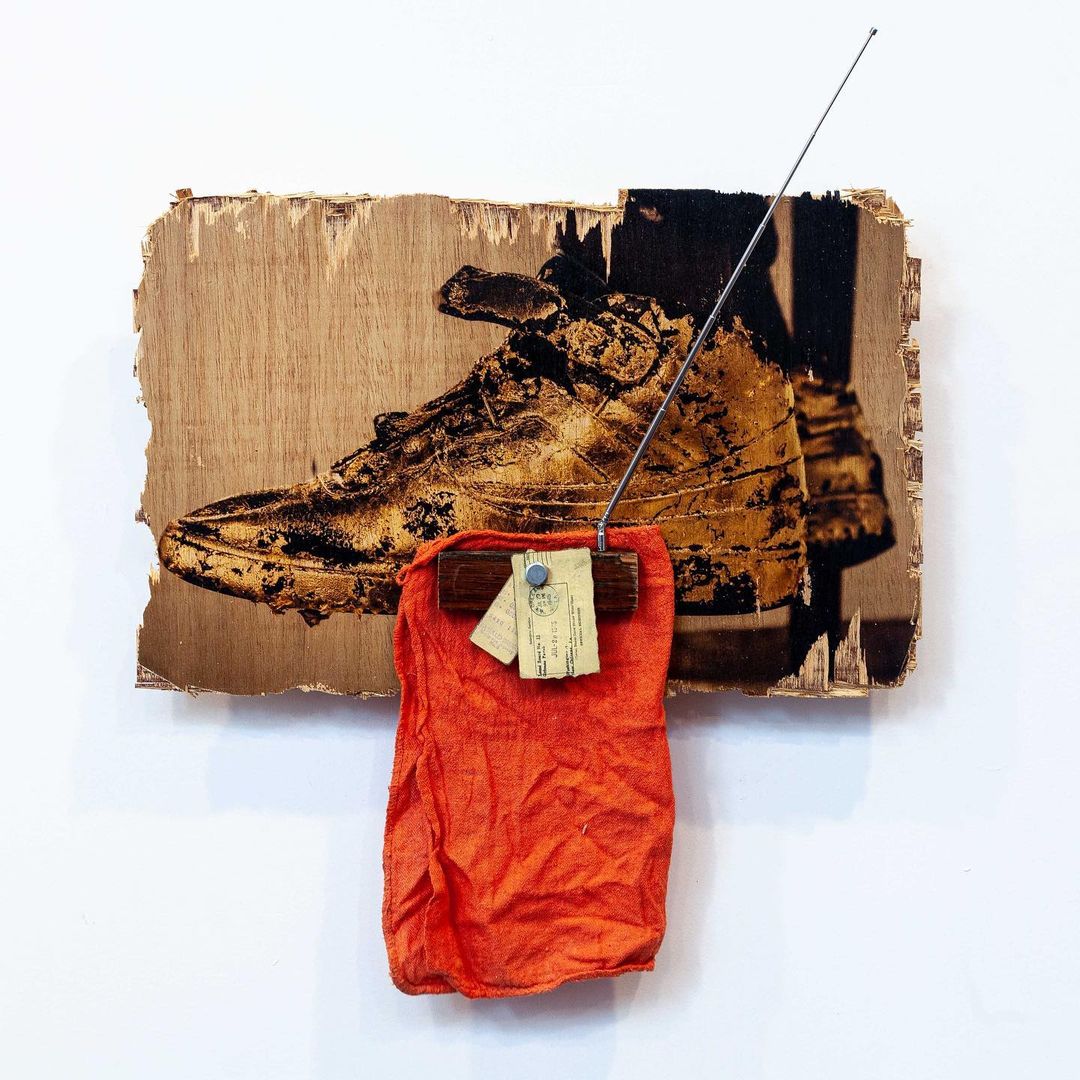
Justin Randolph Thompson and Bradly Dever Treadaway, Baby Needs New Shoes, 2021. Photographic transfer on wood with antenna and rag, 20 × 13 × 2 in.
Second, Traveling Shoes is a performative sound work by longtime collaborators Justin Randolph Thompson and Bradly Dever Treadaway, from 2013’s Flux Night in Atlanta. It involved a two-seat shoe-shine “chariot” being dragged through the crowds, stopping to gold-leaf the shoes of anyone who was interested. All the while, on the back of the chariot, a three-piece jazz band played the traditional African American song “Traveling Shoes,” which is about getting ready for Jesus’s return. The original performance, which lasted around three hours and has been re-created in several different contexts since then, is archived in a twelve-minute video, which is what was on display at Bethel. To go alongside, the curators asked the duo to submit a photograph from the performance series; they went the extra mile and used a photo as the basis of a new mixed-media work that incorporates objects used in the performance, such as a mechanic’s rag and an antenna, which is what I’ve posted here.
+++
RELIGIOUS POEMS SAMPLER: “Original and unorthodox poems about theology,” compiled by Mark Jarman: An excellent selection of ten poems, all but one available for reading from the Poetry Foundation. Jarman is a leading poet of the twenty-first century and a Christian. He was too humble to include one of his own poems on the list, but his poetry is much in this vein, so for number 11 I would add Jarman’s “Five Psalms,” from his collection To the Green Man (2004).
Felice Casorati (Italian, 1883–1963), Study for Portrait, 1919. Oil on cardboard. Museo del Novecento, Florence.
God whispered, and a silence fell; the world Poised one expectant moment, like a soul Who sees at heaven’s threshold the unfurled White wings of cherubim, the sea impearled, And pauses, dazed, to comprehend the whole; Only across all space God’s whisper came And burned about her heart like some white flame.
Then suddenly a bird’s note thrilled the peace, And earth again jarred noisily to life With a great murmur as of many seas. But Mary sat with hands clasped on her knees, And lifted eyes with all amazement rife, And in her heart the rapture of the spring Upon its first sweet day of blossoming.
This sonnet by Theodosia Garrison (1874–1944) originally appeared in The Earth Cry: And Other Poems (New York: Mitchell Kennerly, 1910) and is in the public domain.
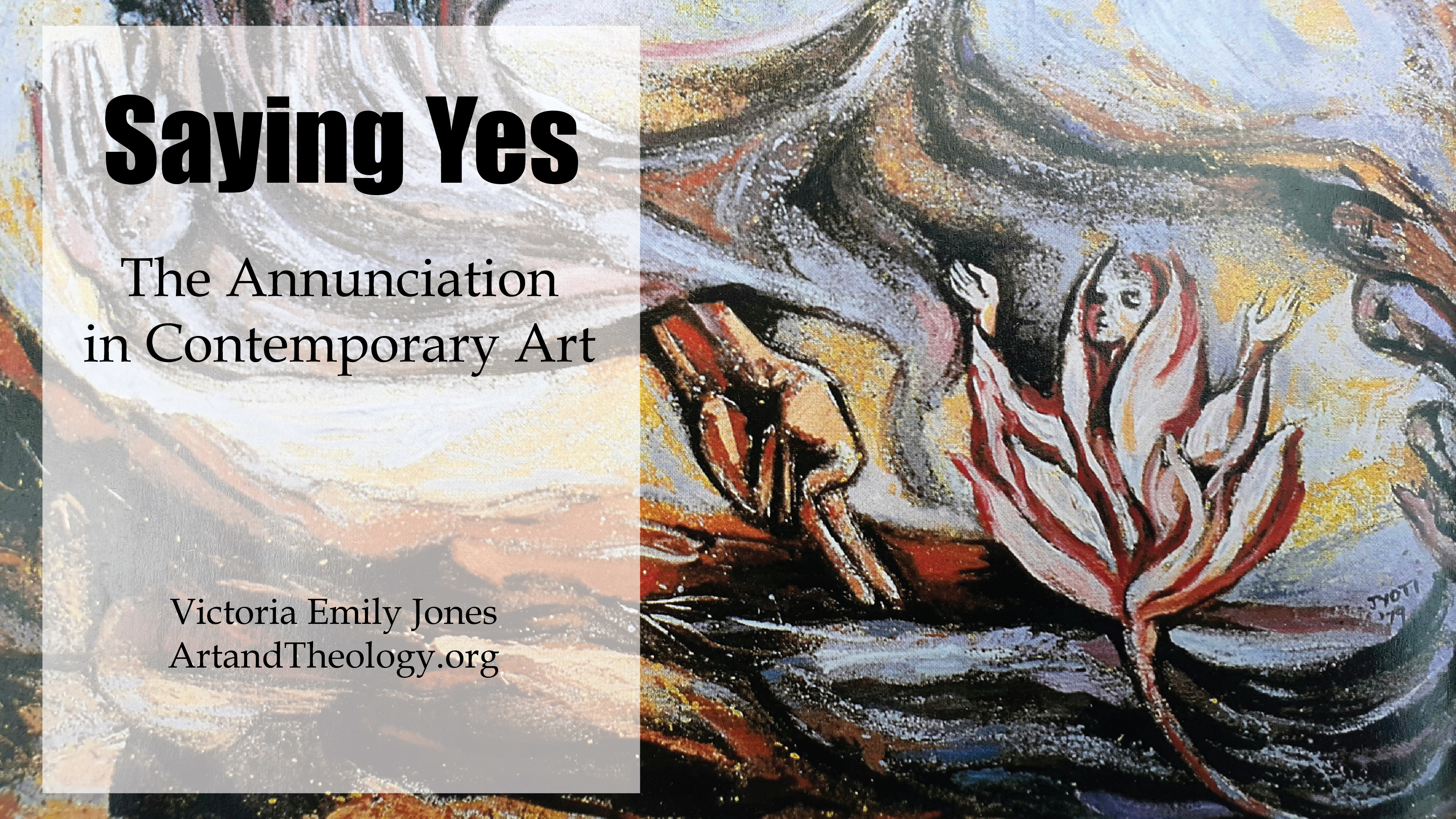
This year’s The Breath and the Clay creative arts gathering, on the theme of “Reenchantment,” is taking place March 17–21, with both in-person (in Winston-Salem, North Carolina) and virtual options. Registration for virtual attendees is pay-what-you-wish. Presenters include theologian Jeremy Begbie, poet Pádraig Ó Tuama, singer-songwriter Joy Ike, contemplative author Christine Valters Paintner, dancer Camille D.C. Sutton, and many more . . . including me! On the evening of March 18 I’ll be giving a twenty-minute talk titled “Saying Yes: The Annunciation in Contemporary Art,” which will be archived online afterward. (The global church celebrates the feast of the Annunciation the following week, on March 25.) (Update: Watch here.) Here’s the description:
The story of Jesus’s miraculous conception in the womb of Mary, a first-century Galilean peasant girl, told in Luke 1 has activated the imaginations of artists since the early Christian era. When an angelic messenger came and told Mary she had been chosen to bear God’s Son, she cycled through a range of emotions before ultimately accepting the call, stepping onto a path that, though scary, would be life-giving not only for her but also for her religious and ethnic community and for the whole world.
God invites us to participate in his work in the world and gives us the grace to do it. When his voice breaks through our safe, predictable routines, calling us to something big, do we respond with brave obedience? In this talk Victoria Emily Jones will share a handful of contemporary artworks that visualize that pivotal moment in salvation history when Mary said yes and set in motion the incarnation. These works show us the wild beauty of God’s plans and can help us tune our ears to the annunciations in our own lives.
(The title slide image is a detail of an Annunciation painting by Jyoti Sahi.)
I’m always impressed by the variety of artists, arts professionals, and art lovers that director Stephen Roach manages to bring together for The Breath and the Clay. Click here to learn more and to register.
+++
ONLINE LENT SERIES:
>> VCS Lent 2021: The Visual Commentary on Scripture is highlighting a different exhibition from its archives for each week of Lent, with new content including a video introduction to the week by Ben Quash and an audio reading of each of the three constituent commentaries.
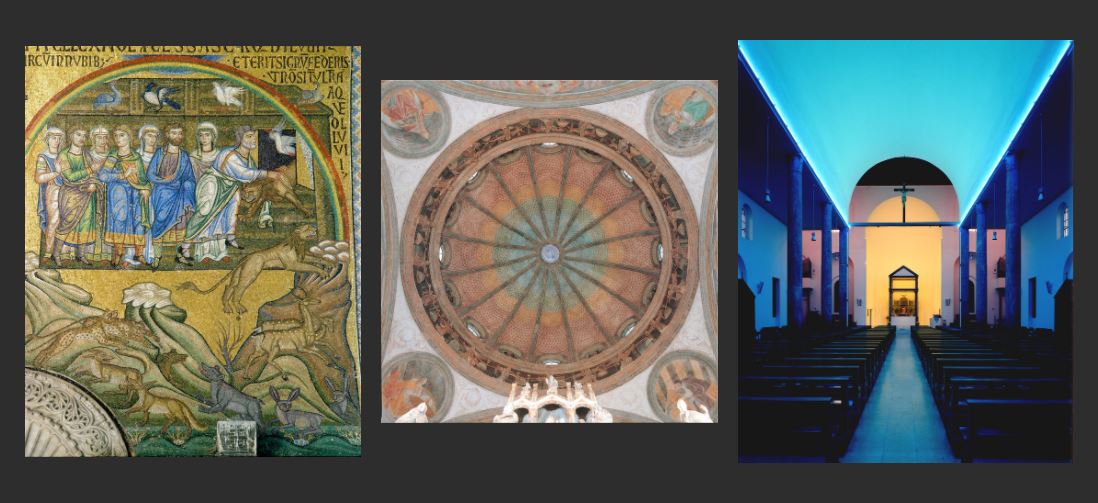
The first week was on the theme of Covenant and covers Genesis 8:20–9:17. Stefania Gerevini curated three artworks from Italy that convey some aspect of the rainbow as divine promise: a thirteenth-century mosaic from the Basilica di San Marco in Venice, a colorful dome fresco (fifteenth century) from the Cappella Portinari in Milan, and a contemporary light installation by Dan Flavin at Santa Maria Annunciata in Chiesa Rossa, also in Milan.
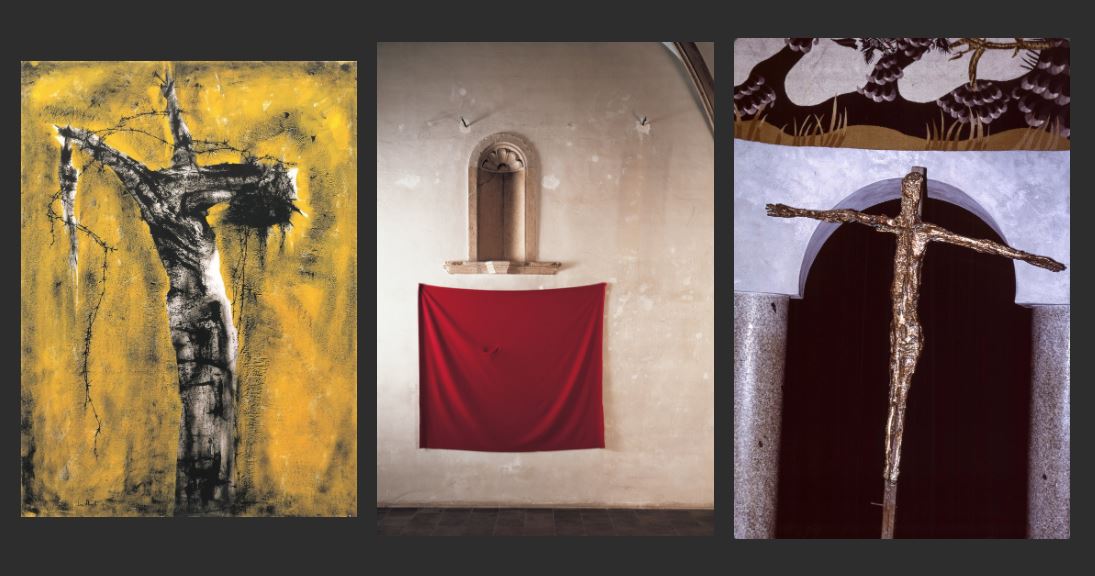
Week 2, on Prophecy, explores the Suffering Servant of Isaiah 53. Jonathan Koestlé-Cate comments on three modern artworks: Crucified Tree Form by Theyre Lee-Elliott, a crucifix by Germaine Richier (which sparked outrage when it was unveiled at Notre-Dame de Toute Grâce, Assy, in 1950), and an installation by postminimalist artist Anish Kapoor at the church of Saint Peter, Cologne.
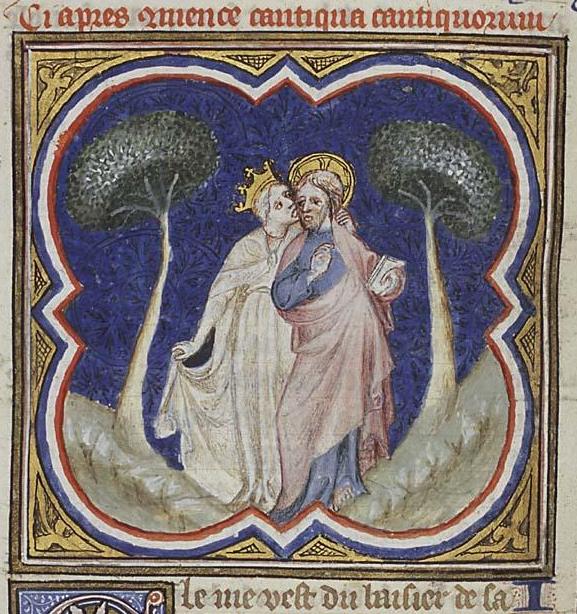
>> “The Many Faces of Jesus”: I’ve been enjoying this Lenten series (on blog andpodcast) by medievalist Dr. Grace Hamman, who makes medieval lit super accessible.“For Lent, Old Books With Grace will share and explore some medieval representations of Jesus in art and literature—the versions of Jesus that dominate the medieval church’s imagination. These medieval portrayals of Jesus may strike us as odd, threatening, charming, creative, stupid, or inspiring. In attending to these versions of Jesus, I hope for a few end goals: the first is that we may expand our Christian imagination. Perhaps a side of Jesus that has never occurred to you, or been sideswept by our contemporary culture, will suddenly illuminate an aspect of the Jesus of scripture. The second is that we may better identify the ways that we ourselves have culturally contained and portrayed Jesus, in positive and negative ways. Often the strangeness of the past helps us recognize the weird or damaging things we believe in order to make Jesus more palatable, understandable, or like us.”
Jean Bondol, “The bride (Ecclesia) and bridegroom (Christ),” from a Bible Historiale made in Paris, 1371–72. The Hague, MMW, 10 B 23, fol. 330v.
>> “Up from My Youth (Psalm 129)” by Advent Birmingham, feat. CashBack and Terence June Gray: This is such a strange and compelling fusion! “An 1806 hymn by Isaac Watts meets hip-hop meets Johnny Cash meets folk meets New Orleans jazz meets industrial steel factory.”
Led by Zac Hicks, Advent Birmingham [previously] is a group of worship musicians from the Cathedral Church of the Advent in downtown Birmingham, Alabama. Hicks wrote this new tune for Isaac Watts’s metrical paraphrase of Psalm 129 and integrated a rap by guest artist Terence June Gray from Memphis. Singing lead (and playing drums) is Leif Bondarenko, the front man of the Johnny Cash tribute band CashBack. The video was filmed at Birmingham’s historic Sloss Furnaces. Available on iTunes, Amazon, and Spotify.
You can read the lyrics here, which include a slight revision of Watts’s verse 6.
POETRY READING:“Phase One” by Dilruba Ahmed, read, with commentary, by Pádraig Ó Tuama, Poetry Unbound: “What do you find hard to forgive in yourself? What might help? In this poem, the poet makes a list of all the things she holds against herself: opening fridge doors, fantasies, wilted seedlings, unkempt plants, lost bags, feeling awkward, treating someone poorly. Dilruba Ahmed repeats the line ‘I forgive you’ over and over, like a litany, in a hope to deepen what it means to be in the world, and be a person of love.”
ONLINE LECTURES, organized by Bridge Projects: This Los Angeles gallery is offering a series of free online events to complement A Composite Leviathan, an exhibition of emerging Chinese artists that runs through February 27, 2021. Here are two I RSVPed for. (Both will be presented in English and Chinese.)
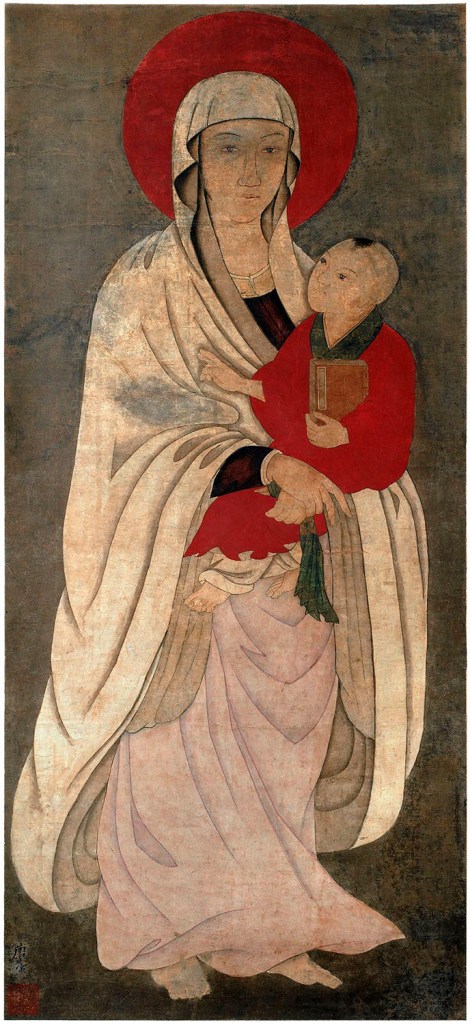
“The Virgin Mother, Her Majesty, Our Lady: Globalism, All-Under-Heaven, and Madonna In-Between” by Dong Lihui, January 12, 8–9:30 p.m. EST: Dong Lihui (PhD, art history), whose research centers on art exchange between East and West, is the author of Chinese Translation of Western Images: Christian Art in China in the 16th and 17th century. In this talk she will discuss the hybridization of European globalism and the Chinese “all-under-heaven” worldview as observed in Chinese Madonna icons made between the sixteenth and twentieth centuries.
Madonna and Child, China, 15th–17th century. Painting on silk, 8 feet high. Field Museum of Natural History, Chicago. Photo: John Weinstein.
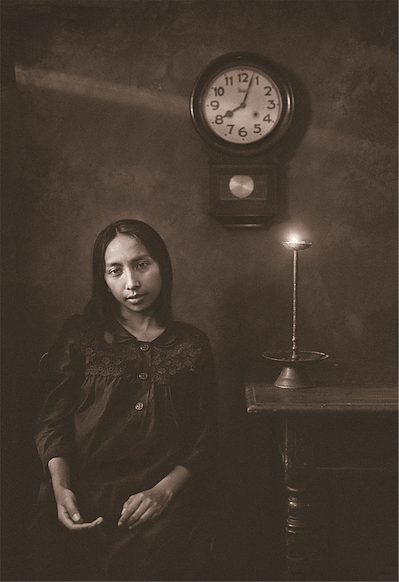
“Counterculture: Chinese Contemporary Christian Art and the Bible” by Clover Xuesong Zhou, January 26,8–9:30 p.m. EST: “The advent of modernity brought with it enmity between Christian traditions and a newly liberated art world. Similarly, contemporary artists in China found themselves at odds with the government beginning in the 1980s. All the while, Christianity has had a torrid relationship with Chinese government and culture. Thus, Chinese artists who are also practicing Christians work within these complex intersections.” Art writer and art theologian Clover Xuesong Zhou will be discussing some such artists, including photographer Stanley Fung (Feng Junlan), video artist Li Ran, and installation artist Gao Lei.
Stanley Fung (Chinese, 1961–), The Lord’s Handmaiden, 2012
+++
SONG: “O Holy Night” by Ben Caplan and friends: An absolutely stunning minor-key rendition by Canadian singer-songwriter Ben Caplan (who is often compared to Leonard Cohen) and a team of others, combining gypsy jazz, classical, and Jewish folksong influences. Caplan, who is Jewish, didn’t grow up listening to much Christmas music. “I have to admit that I find a lot of that music a bit corny. Where is that minor fall? Where is the major lift? Where is the bafflement?” He continues, “I have a deep felt belief that if you don’t like something, you should do something about it. It’s not enough to complain from the sidelines! There are some truly beautiful songs and carols out there, and I wanted to make something that tip-toes towards the sublime rather than shopping-mall-easy-listening.” Arcade Fire’s “My Body Is a Cage” was one of his reference points. (“I wanted to try to recreate that gradual build, and the sublime surrender to an enormous scale of sound.”) There are a few intentional semitone clashes to generate dissonance.
Filmed last year inside Halifax’s Fort Massey United Church and released in November, this recording was in the making for four years and is the result of much collaboration. The left-handed violinist in the video, Donald MacLennan (see, e.g., 1:34), reharmonized the carol, and he, Caplan, upright bass player Anna Ruddick, drummer Jamie Kronick, and vocalist Taryn Kawaja worked out an arrangement for their band, which they performed at a Christmas concert in 2016. Peter-Anthony Togni, who plays organ for the song, was brought in later to arrange the song for string quartet, pipe organ, and bass clarinet. Caplan chose the instrumentation and aesthetic shape. He recounts the process in detail and names all the people involved on his Bandcamp page. “I want to dispel the myth of the lone genius,” he says. “It took a lot of people with a lot of talent to pull this off. I am just the lead singer, and the guy who was stubborn enough to bring all the people together and spend an outlandish amount of money trying to achieve this vision.” Purchase on Bandcamp, and/or stream on Spotify.
I am truly moved by this atmospheric take on an old classic, which perfectly brings together the darkness and light of the Christmas season. “Original, and righteous—hymn for the COVID time,” says one YouTube user. “You’ve found things in this old carol that I never knew existed,” says another. And another: “A sensory feast. So deeply piercing.”
DANCE:“Ave Maria”:Queensland Ballet dancers Victor Estévez and Mia Heathcote perform a pas de deux (ballet duet) to the Schubert melody that today is most associated with the prayer “Ave Maria,” which begins, “Hail Mary, full of grace, the Lord is with thee.” These are the words the angel Gabriel spoke to Mary when he came to announce that she would bear in her body the Son of God. Though I can’t say what this duo had in mind when they choreographed the piece, I can’t help but think, given the music choice, of the Annunciation—the Divine coming to dance with humanity, to partner with her for the redemption of the world. The dancing starts thirty-five seconds in.
+++
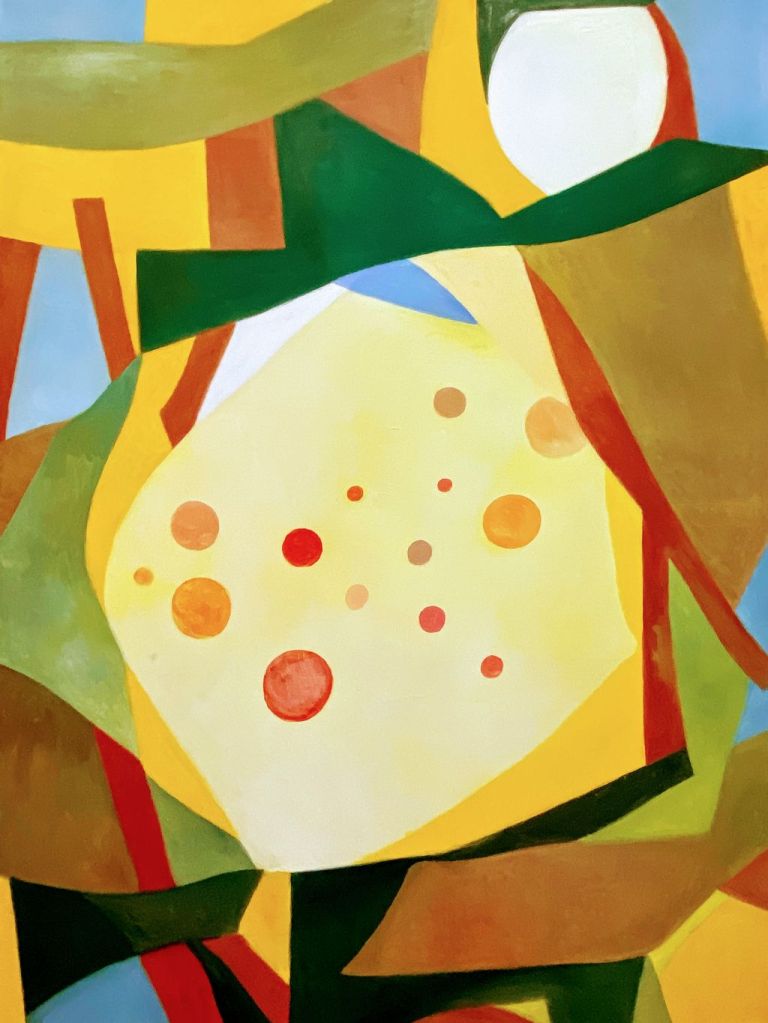
VISUAL MEDITATION: “Embodied Joy, Serious Joy: Making Room in the Body and Life for New Creation” by Alexandra Davison: I shared a visual meditation by this culture care leader just last week. In this devotional piece based on Luke 1:41–55, Davison discusses two abstract paintings from Louise Henderson’s The Twelve Months series. In October, “Henderson has a cropped representation of a pregnant woman, her belly bright and fruitful as a melon, shines with what Henderson describes from her own pregnancy as ‘bubbles of life circulating in the womb.’ She magnifies joy from its tiniest beginnings both seen and unseen in the mother and the child.” Reflecting on this ebullient image in conjunction with her own pregnancy experience and Mary’s, Davison ends by quoting an adaptation of the Magnificat by songwriter Marcus Walton.
Louise Henderson (New Zealand, 1902–1994), October, from the series The Twelve Months, 1987. Oil on canvas, 250 × 150 cm. Auckland Art Gallery Toi o Tāmaki, New Zealand.
+++
VIDEO INSTALLATION:Mary! by Arent Weevers: One of the primary images or metaphors for the season of Advent is pregnancy—the pregnant Mary awaiting the birth of Jesus, her belly swelling a little more each day, and a world heavy with expectancy, at the threshold of (re)birth. In 2009, media artist and theologian Arent Weevers [previously] created a gorgeous video installation titled Mary!. “Standing in the middle, a heavily pregnant young woman. Her hair partly covers her naked body to her ankles. She peers past you, with no expression on her face. From underneath, a gusty wind begins to blow, wafting her hair slowly upwards into the air. Suddenly, the woman bends slightly forward, her left arm in front of her abdomen, and grimaces painfully. Losing her balance, she falls sideways out of the frame until only black remains.” You can preview the video here. (Because of the nudity, there will be a content warning you have to accept before proceeding.)
Weevers’s art aims to express the paradoxical nature of the human body—its vulnerability and its strength—and in her role as Mary, the actor in this video exemplifies both so well. Gloriously gravid and standing tall at first, the woman looks into the distance and sees the future suffering of her son. She clasps her belly protectively in response, hunching forward as the painful knowledge of his destiny shoots through her.
+++
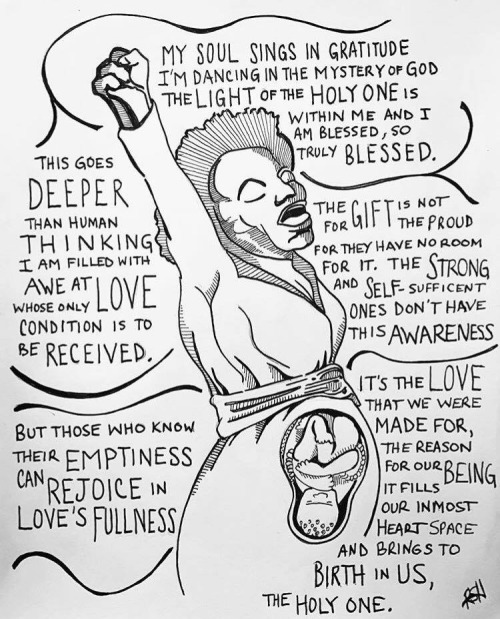
MAGNIFICAT SERMON (and sketch): “The Love That We Are Made For” by Bob Henry: Bob Henry is an American Quaker pastor who often sketches in preparation for and in response to sermons. In this sermon he delivered December 11, 2016, at Silverton Friends Church in Oregon, he reflects on the oldest and most radical Advent hymn: Mary’s Magnificat. We are so used to thinking of Mary as quiet and demure, but Henry imagines her as “a strong woman with arms flaring, fists raised, wild bodily movements, beads of sweat forming on her brow, and a strong voice throwing down these words from Luke 1:46–55.”
“Mary’s Freedom Song.” Illustration and lettering by Bob Henry, 2016. Text by Joy Cowley, 2007, adapted from Luke 1:46–55.
This characterization is expressed in his drawing, which shows a Black Mary, full of faith and fire, surrounded by the words of Joy Cowley’s “Modern Magnificat.” He says the women of the African Methodist Episcopal Church in Chicago, where he used to teach Bible, embody for him Mary’s bold declaration of justice, freedom, and hope in today’s world. He challenges us to sing Mary’s song in our own political climates.
+++
SONG: “Magnify”: For its November 29 worship service, Good Shepherd New York [previously] premiered a new arrangement of Tom Wuest’s “Magnify,” sung by Paul Zach and Lauren Goans, part of the Good Shepherd Collective (see 7:33 in the video below). The piano part includes the Gloria theme from “Angels We Have Heard on High,” played liltingly. Love it! (Update 12/14/20: Paul Zach posted a standalone video of this song on Instagram this morning.)
+++
I’ve added a new batch of songs to “Advent: An Art & Theology Playlist.” I like to “DJ” them (to balance the styles and moods and create thematic links), so they’re not all grouped at the bottom, but you can look at the “Date added” column to see the latest additions. I want to acknowledge the source of those I found from other Advent playlists and resources: Credit goes to Teer Hardy of the Crackers and Grape Juice podcast, compiler of the “Advent Begins in the Dark” playlist, for “The Man Comes Around” by Johnny Cash, “Jesus Gonna Be Here” by Tom Waits, “Shepherd’s Lament” by Kirby Brown, and “Are You Ready?” by Jason Champion. Pastor, pianist, arranger, and Daily Prayer Project founding director Joel Littlepage cued me in to the songs “Tenemos Esperanza,” “Toda la Tierra,” “Hold on Just a Little While Longer,” and “He’s Right on Time” through his “DPP Advent Songbook.” “I Believe in Being Ready” by Rising Appalachia comes from Lauren Plummer’s “Advent 2020: All Earth Is Waiting,” and “My Soul Doth Magnify the Lord” by O’Landa Draper and the Associates is from Tamara Hill Murphy’s “Advent 2020: Gracious Invitation.” “Intro Comfort My People” by Jamaican artist Chrisinti is featured in Biola’s Advent Project 2020.
Montevideo
Virgin! Daughter of mine
Where have you been
You’re all dirty
You smell of jasmine
Your skirt’s stained carmine
And your earrings are clinking
Tlintlintlin?
Mother dear
I’ve been in the garden
I went to look at the sky
And I fell asleep.
When I awoke
I smelled of jasmine
An angel was scattering petals
Over me . . .
Vinícius de Moraes (1913–1980) was a Brazilian poet, lyricist, essayist, playwright, and diplomat who contributed to the birth of bossa nova music. Natalie d’Arbeloff (b. 1929) is a London-based painter, printmaker, cartoonist, and maker of artist’s books, born in Paris of French and Russian parents; she has also lived in Mexico, Paraguay, Brazil, Italy, and the United States.
“Annunciation” takes as its subject the teenage Mary’s mystical encounter with an angel (Luke 1:26–38), after which she becomes pregnant with the Son of God. Moraes sets the event in Montevideo, Uruguay, imagining a dialogue, after the fact, between Mary and her mother.
The central image of scattered jasmine petals is a lovely inversion of the “deflowering” euphemism for first-time sex. In the Holy Spirit’s coming upon her to conceive Jesus, Mary was flowered—her prime beauty bestowed, not (if we were to use the outdated, sexist metaphor) taken away.
While Christianity maintains that Mary remained a virgin at least until Jesus’s birth, her becoming pregnant marked her physically, indelibly. Moraes goes so far as to suggest there was a tearing of the hymen—hence her red-stained skirt, which I read as blood. However, his retelling is nonliteral, more in the mode of magic realism, so there’s no need to get all clinical or to try to “explain” the imagery. It’s dreamlike.
The Gospel writer suggests that Mary interacted with the angel Gabriel in waking reality, but in Moraes’s poem the primary interaction takes place during sleep. In her dream, Mary hears the divine call and consents to its demands, and when she awakes, like in the movies, a material manifestation of the spiritual experience is there to tell her it was real: she is covered in sweet-smelling jasmine.
What is your reaction to or interpretation of the poem?
+++
Annunciation-themed posts from the Art & Theology archives include:
Soaring 150 feet into the air against a Rocky Mountain backdrop, the United States Air Force Academy Cadet Chapel in Colorado Springs is a National Historic Landmark and one of Colorado’s most-visited manmade attractions. It was designed by Walter Netsch Jr. of Skidmore, Owings and Merrill, the architectural firm responsible for the planning and design of the entire academy, and is a recipient of the American Institute of Architects’ Twenty-Five-Year Award. Construction of the Cadet Chapel began in 1959 and was completed in 1962. It was dedicated in 1963.
The Cadet Chapel was designed to house three distinct worship spaces—Protestant, Catholic, and Jewish—on two levels, with a large “All-Faiths Room” on a third (bottom) level available to members of other faiths. In 2007 a Buddhist Chapel (the Vast Refuge Dharma Hall) was added, and more recently a Muslim prayer room, and outside there is a Falcon Circle for the Earth-Centered Spirituality community (pagans, Druids, Wiccans, etc.), dedicated in 2011. Because of the building’s sound-proofing and separate entrances, different services can be held simultaneously without interfering with one another.
I visited the Cadet Chapel last year shortly before it closed in September for a major renovation and restoration project needed to address water damage. It is scheduled to reopen again in fall 2023.
The most striking feature of the exterior is its seventeen spires, made to resemble jet fighter wings. I must admit: though it is an impressive structure, and I’m fully aware it is a military chapel, the evocation of warplanes for a worship space is a little unsettling. But the design choice does give the building great height—it points to the heavens as do the great medieval Gothic cathedrals of Europe, meant to turn the eye upward toward God.
The steel frame of the chapel comprises one hundred identical tetrahedrons, each weighing five tons and enclosed with aluminum panels. The surfaces of the outer panels are striated so that they reflect light differently throughout the day, depending on the sun’s position.
The chapel is situated on a terrace that overlooks part of the campus as well as beautiful mountain vistas.
The front façade faces south—an atypical orientation for churches, which are traditionally built on a west–east axis, but a choice made, I’m assuming, to best utilize the sunlight for the interior decoration (see next section).
To reach the main entrance you have to ascend a wide granite stairway that leads up one story to an uncovered front porch. Walk inside, and you’re in the narthex (lobby) of the Protestant Chapel.
Protestant Chapel
The Protestant Chapel is by far the largest worship space within the Cadet Chapel, taking up the whole main floor—a choice made based on the religious demographics of enrolled cadets at the time of the building’s construction in the early sixties. (An article published shortly after the chapel’s dedication reported that 68% of cadets listed themselves as Protestant, 29% Catholic, and 2% Jewish, with a few listing other faiths or agnosticism.)
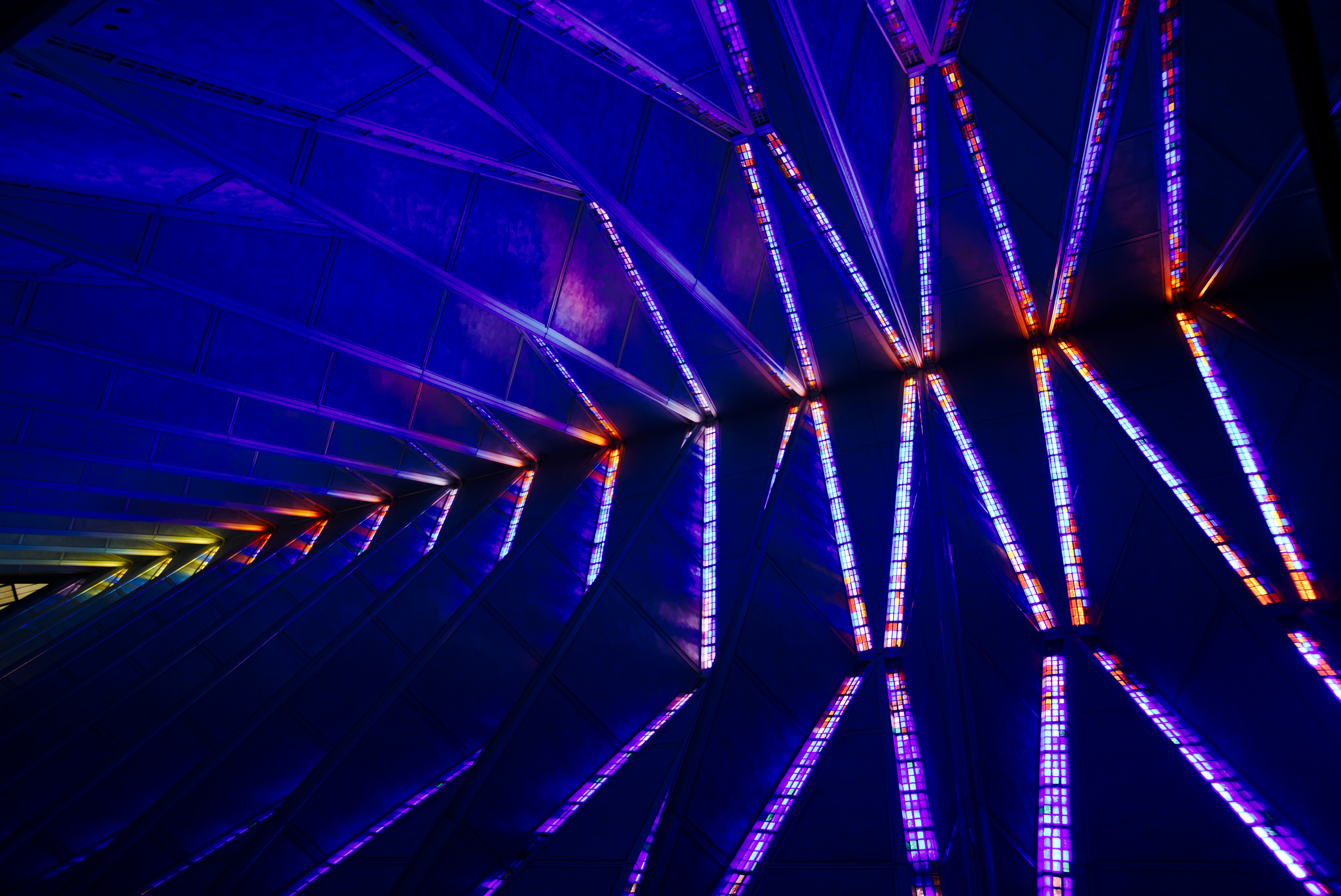
Though the exterior of the Cadet Chapel is, as I experienced it, somewhat cold, sterile, severe, the interior is incredibly warm and genial. Its vertical lift is spectacular. Stained glass strip windows provide ribbons of color between the tetrahedrons and progress from darker to lighter as they reach the altar, with some of the nearly 25,000 dalles (small, thick glass slabs) being deliberately chipped to produce jewel-like facets. The play of colored light across vault, floor, and pews was my favorite part of this space.
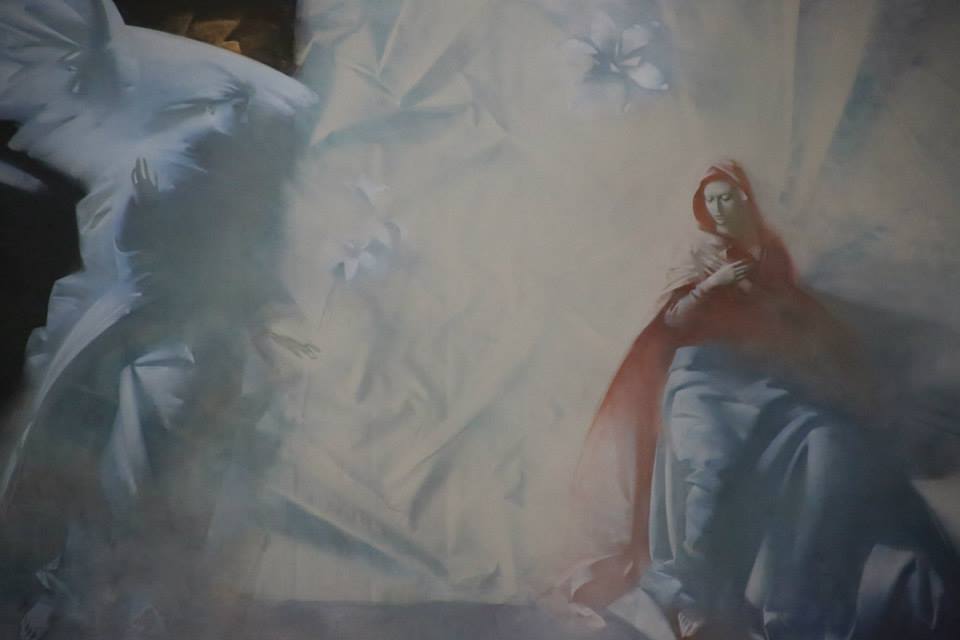
Alexander Blonsky (Ukrainian), The Annunciation, 2014. Oil on canvas, 82 7/10 × 129 9/10 in.
March 25, nine months before Christmas, is when the church celebrates the conception of Christ in the womb of Mary. The narrative of this event is known as the “Annunciation” because Gabriel comes from heaven to announce the good news to Mary that she has been chosen to give birth to and to mother the Son of the Most High God.
Because Luke 1:26–38 is such a familiar Bible passage, it helps to read it in less familiar translations so that it can land fresh in our ears. So here is Eugene Peterson’s translation from The Message:
In the sixth month of Elizabeth’s pregnancy, God sent the angel Gabriel to the Galilean village of Nazareth to a virgin engaged to be married to a man descended from David. His name was Joseph, and the virgin’s name, Mary. Upon entering, Gabriel greeted her:
Good morning!
You’re beautiful with God’s beauty,
Beautiful inside and out!
God be with you.
She was thoroughly shaken, wondering what was behind a greeting like that. But the angel assured her, “Mary, you have nothing to fear. God has a surprise for you: You will become pregnant and give birth to a son and call his name Jesus.
He will be great,
be called ‘Son of the Highest.’
The Lord God will give him
the throne of his father David;
He will rule Jacob’s house forever—
no end, ever, to his kingdom.”
Mary said to the angel, “But how? I’ve never slept with a man.”
The angel answered,
The Holy Spirit will come upon you,
the power of the Highest hover over you;
Therefore, the child you bring to birth
will be called Holy, Son of God.
“And did you know that your cousin Elizabeth conceived a son, old as she is? Everyone called her barren, and here she is six months pregnant! Nothing, you see, is impossible with God.”
And Mary said,
Yes, I see it all now:
I’m the Lord’s maid, ready to serve.
Let it be with me
just as you say.
This traditional Eastern Orthodox acclamation in Church Slavonic, based on Gabriel’s and Elizabeth’s words to Mary in Luke 1 (and better known by the closely related Latin Ave Maria from the West), has been set by various composers over the centuries, most famously by Sergei Rachmaninoff. His solemn interpretation is beautiful, but I’m partial to the celebratory setting by contemporary Estonian composer Arvo Pärt, commissioned by the King’s College Choir, Cambridge, for the festival of Nine Lessons and Carols on Christmas Eve 1990. It is for SATB a cappella choir.
Богородице Дево, радуйся,
благодатная Марие, Господь с тобою.
Благословена ты в женах,
и благословен плод чрева твоего,
яко Спаса родила еси душ наших.
Transliteration:
Bogoróditse Dyévo, ráduisya,
Blagodátnaya Maríye, Gospód s tobóyu.
Blagoslovyéna ty v zhenákh,
i blagoslovyén plod chryéva tvoyevó,
yáko Spása rodilá yesí dush náshikh.
English translation:
Rejoice, O Virgin Theotokos,
Mary full of grace, the Lord is with thee.
Blessed art thou among women,
and blessed is the fruit of thy womb,
for thou hast borne the Savior of our souls.
All but a small number of Pärt’s ninety-odd compositions since 1976 are settings of biblical texts or Christian prayers. For an excellent article on him, see “How Arvo Pärt speaks prayer into a secular world” by Peter C. Bouteneff, published in the Christian Century. “Why are people listening so avidly?” Bouteneff wonders. “The same audience that would instinctively tune out anything with a whiff of Christian sensibility, that would normally be repulsed by pious petitions to Jesus or Mary for the forgiveness of their wretched sins, is held rapt by these very prayers when Pärt speaks them through his compositions.” Beauty has a way of penetrating people’s defenses, it seems. And that’s one reason we so desperately need artists.
This post belongs to the weekly series Artful Devotion. If you can’t view the music player in your email or RSS reader, try opening the post in your browser.
To view all the Revised Common Lectionary scripture readings for the feast of the Annunciation, cycle A, click here.






 Art & Theology