LENT SERIES: “Let go of unlove this Lent: Let’s practice love together—a new and improved Lenten reflection series starting March 5th” by Tamara Hill Murphy: I’ve been nurtured for years by Murphy’s gentle spiritual writing and curated beauty and wisdom, and I especially appreciate her annual Advent and Lent Daybook series. This Lent, she’ll be exploring four postures of cruciform love given to us in 1 Corinthians 13, providing daily scripture readings, prayers, and art, along with weekly practices. You can gain access for just $16. (She uses the Substack platform.)
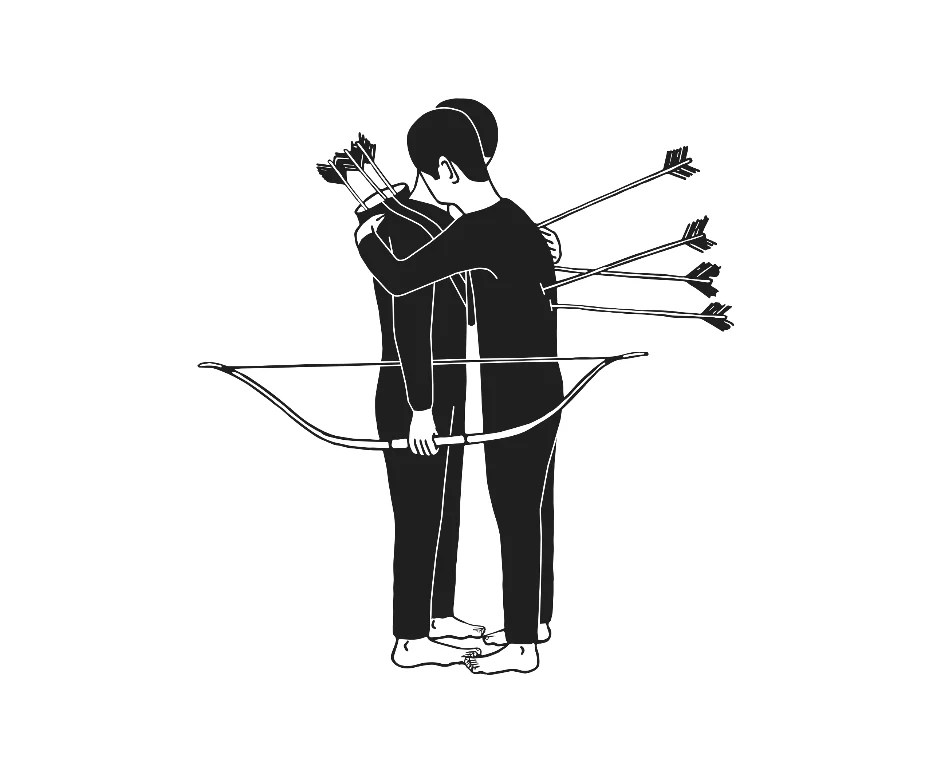
Forgive Thy Other by Scott Erickson
I like how Murphy frames the season: “Lent is a significant time for us to seek a deeper understanding of God’s heart and recognize the gaps in our experiences of His love. Through its beautiful stories, prayers, and practices, Lent also invites us to reflect on our own expressions of love and unlove. The Book of Common Prayer encourages us to let go of our unloving ways so we can love what (and who) God loves. Let’s joyfully embrace this transformative season together, reflecting God’s love with compassion and understanding.”
+++
NEW PLAYLIST: God’s Love (Art & Theology): Related to Tamara Hill Murphy’s 2025 Lent Daybook theme: here’s a new playlist I put together of songs about the abounding, ever-present love of God the Father, Son, and Holy Spirit, a love that seeks, heals, and transforms.
The cover photo is of an early twentieth-century relief sculpture from the exterior of Holy Trinity Church in the town of St Andrews, Scotland, taken by Joy Marie Clarkson; it shows a pelican pecking her breast to feed her young with her own blood, a medieval symbol of Christ’s self-giving love.
There’s some overlap between this playlist and my dedicated Lent Playlist. I hope it uplifts you in the knowledge of the depths and riches of God’s love for you.
+++
SONGS:
>> “And Am I Born to Die?”: Lent opens with a call to “remember you are dust, and to dust you shall return.” A reflection on human mortality, this somber hymn was written by the great English Methodist hymnist Charles Wesley (1707–1788) and set to music—a shape-note tune—by Ananias Davisson (1780–1857), a Presbyterian elder from Virginia. In this video from January 2023, it’s performed by the Appalachian folk musician Nora Brown, with Stephanie Coleman on fiddle and James Shipp on harmonium.
And am I born to die? To lay this body down? And must my trembling spirit fly Into a world unknown?
Awaked by trumpet sounds, I from my grave shall rise, And see the Judge, with glory crowned, And see the flaming skies.
Soon as from earth I go, What will become of me? Eternal happiness or woe Must then my portion be.
>> “Nunc tempus acceptabile” (Now Is the Accepted Time): Second Corinthians 5:20b–6:10 is traditionally read on Ash Wednesday, a passage that includes the adjuration, “Behold, now is the acceptable time; behold, now is the day of salvation!” (2 Cor. 6:2). There’s a beautiful tenth-century Latin hymn for Lent, from the Liber Hymnarius, that opens with this line. In 2013, the Chicago-based composer and conductor Paul M. French set it to music for SSA a cappella choir, its unison opening unfolding into an increasingly expressive three-part harmony. It’s performed here by the Notre Dame Magnificat Choir under the direction of Daniel Bayless.
Nunc tempus acceptabile
Fulget datum divinitus,
Ut sanet orbem languidum
Medela parsimoniae.

Christi decoro lumine
Dies salutis emicat,
Dum corda culpis saucia
Reformat abstinentia.

Hanc mente nos et corpore,
Deus, tenere perfice,
Ut appetamus prospero
Perenne pascha transitu.

Te rerum universitas,
Clemens, adoret, Trinitas,
Et nos novi per veniam
Novum canamus canticum.

Amen.
Today is the accepted time. Christ’s healing light, the gift divine, shines forth to save the penitent, to wake the world by means of Lent.
The light of Christ will show the way that leads to God’s salvation day. The rigor of this fasting mends the hearts that hateful sinning rends.
Keep all our minds and bodies true in sacrifice, O God, to you, that we may join, when Lents have ceased, the everlasting Paschal feast.
Let all creation join to raise, most gracious Trinity, your praise. And when your love has made us new, may we sing new songs, Lord, to you.
LECTURE: “Embracing the Ephemeral: How Art Honors Creaturehood” by James K. A. Smith, Duke Divinity School, February 17, 2022: Mortality means something more than being a creature who will someday die, says philosopher James K. A. Smith; it is a way of being, not defined solely by its terminus. “To be created is to be ephemeral, fugitive, contingent. To be a creature is to be a mortal, subject to the vicissitudes of time.” Part of the Duke Initiatives in Theology and the Arts Distinguished Lecture Series, this talk about developing a Christian temporal awareness is based on chapter 4 of Smith’s then-forthcoming, award-winning book How to Inhabit Time (Brazos, 2022), titled “Embrace the Ephemeral: How to Love What You’ll Lose.”
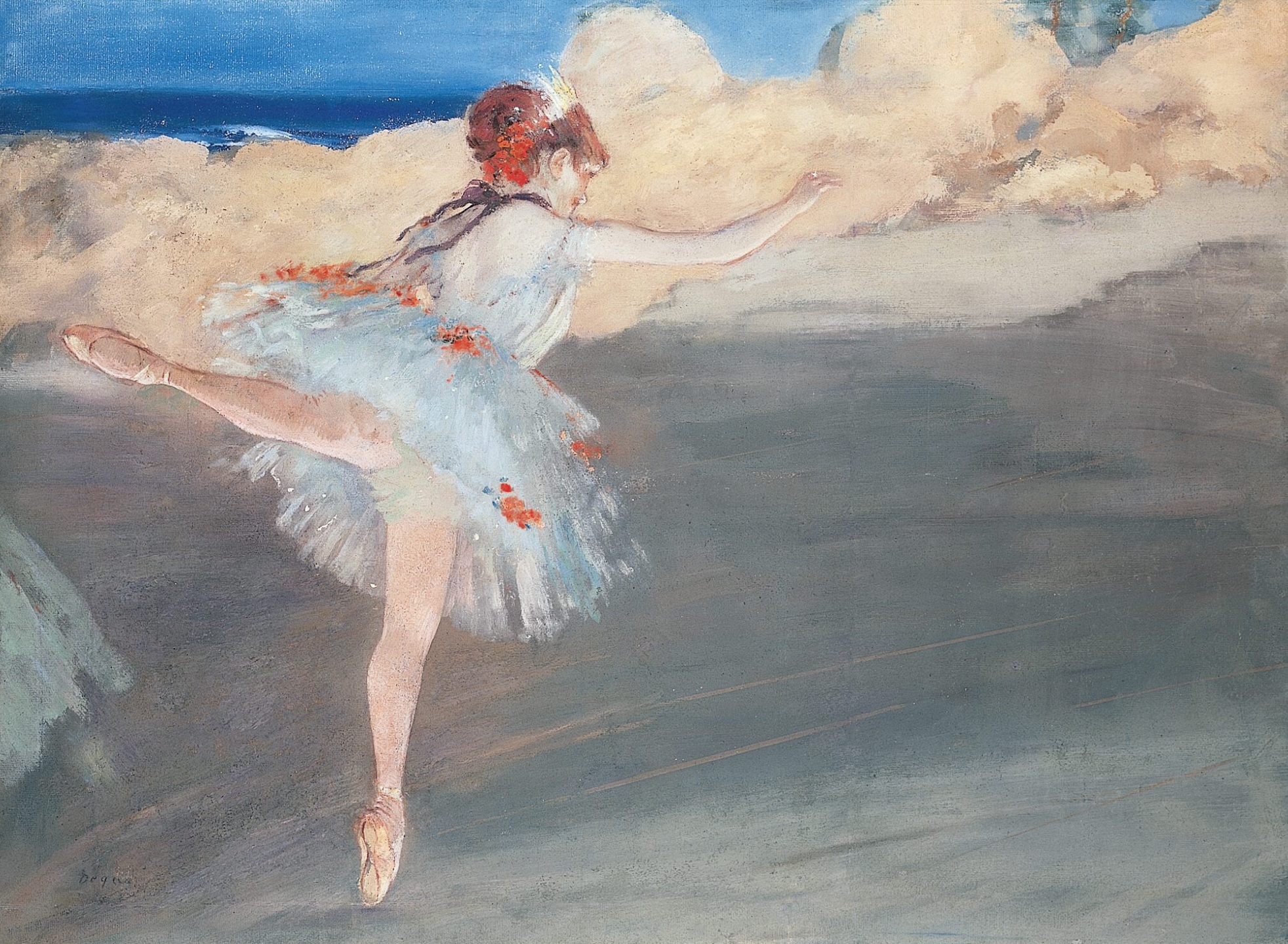
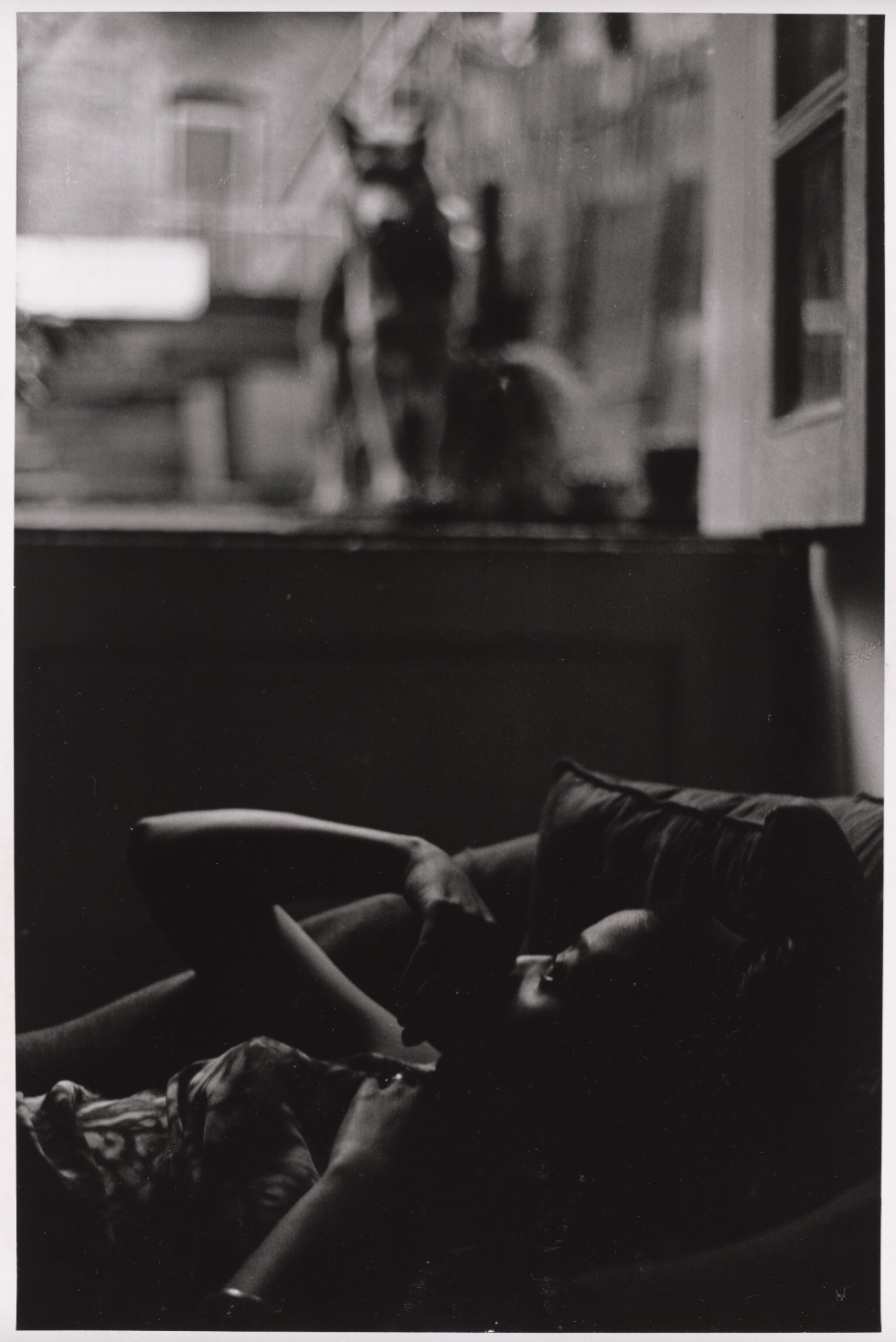
Edgar Degas (French, 1834–1917), The Star: Dancer on Pointe, ca. 1878–80. Gouache and pastel on paper, mounted on board, 22 1/4 × 29 3/4 in. (56.5 × 75.6 cm). Norton Simon Museum, Pasadena, California.Herbert Randall (American, 1936–), Untitled (Lower East Side, New York), 1960s. Gelatin silver print, 13 7/16 × 8 7/8 in. (34.2 × 22.5 cm). J. Paul Getty Museum, Los Angeles.
Some notes I took:
“We need not only memento mori, but also memento tempore—reminders of our temporality, not just our mortality.”
“Imagine embracing the ephemeral as a discipline of not only conceding our mortality as a condition but also receiving our mortality as a gift.”
“Our finitude is not a fruit of the fall, even if it is affected by the fall. Contingency is not a curse. . . . Aging is not a curse. Autumn is not a punishment. Not all that is fleeting should be counted as loss. The coming to be and passing away that characterize our mortal life are simply the rhythms of creaturehood.”
Resting in our mortality instead of resenting it
Theologian Peter Leithart says hebel means not “emptiness,” “vanity,” or “meaninglessness” but, literally, “mist” or “vapor.” The Teacher in Ecclesiastes uses that word repeatedly to describe human life: it’s vaporous, elusive, escapes our efforts to hold on to it, to manage it.
How to sift tragedy from good creaturely rhythms in which good things fade?
“To dwell faithfully mortally is to achieve a way of being in the world for which not all change is loss and not all loss is tragic, while at the same time naming and lamenting those losses that ought not to be. . . . To be faithfully mortal is a feat of receiving and letting go, celebrating and lamenting. Being mortal is the art of living with loss, knowing when to say thank you and knowing when to curse the darkness.”
“One Art” by Elizabeth Bishop: “The art of losing isn’t hard to master . . .”
A Q&A takes place from 39:00 onward. The first question, asked by theologian Jeremy Begbie, is the one I had, and it recurs with different phrasing at 58:17.
Mortality is one of the main themes in Silver’s poetry, including the physicalities of being human, as reflected in “Ash Wednesday,” in which she, the speaker, muses on the shared Christian ritual of the imposition of ashes at the beginning of Lent. Silver, who died of breast cancer eight years after writing this poem, was used to practicing memento mori (“remember you must die”): her mastectomy scar and silicone breast prosthesis are constant reminders of the fact, she writes. She wants to touch the body of God, wants to wrap her fingers around some tangible promise of healing, but both remain elusive. Instead she resolves to embrace the finiteness of her present form, taking the burnt remains of those Hosanna palms from last year and wearing them with repentance and praise, knowing that what is sown in perishability will be raised in imperishability (1 Cor. 15:42).
I’m compelled by how Silver both laments her fragility and owns it. There’s a defiant quality to the tone, the ash-and-oil mixture that’s thumbed into her forehead in the shape of a cross evoking a football player applying eye black in front of a locker room mirror before the big game. Wearing the mark of Christ, she’s ready for the face-off between herself and death.
Following the popularity of last year’s “25 Poems for Christmas,” I’ve decided to publish a brand-new installment, and will perhaps make this a yearly tradition! All the selections can be read online—just follow the links.
Despite the pithy title of this post, not all the poems are “Christmas” poems, strictly speaking, but rather they encompass the season of Advent too, as well as Epiphany. Advent is a four-week season leading up to Christmas that is characterized by a mood of longing and expectation; it is oriented not only toward Jesus’s first coming but also toward his second. Christmas, of course, celebrates the birth of Jesus, the Word of God made flesh. And Epiphany, on January 6, commemorates the visit of the magi to the crib, representing God’s self-revelation to the wider world.
Each poem is accompanied by a micro-commentary or short descriptive blurb, which I suggest you read after reading the poem itself. There’s a benefit to first entering a poem without having any context—then after registering your initial impressions and questions, to consider another person’s framing or analysis or highlights, and reread. And then a third time! Each reading can potentially reveal new meaning.
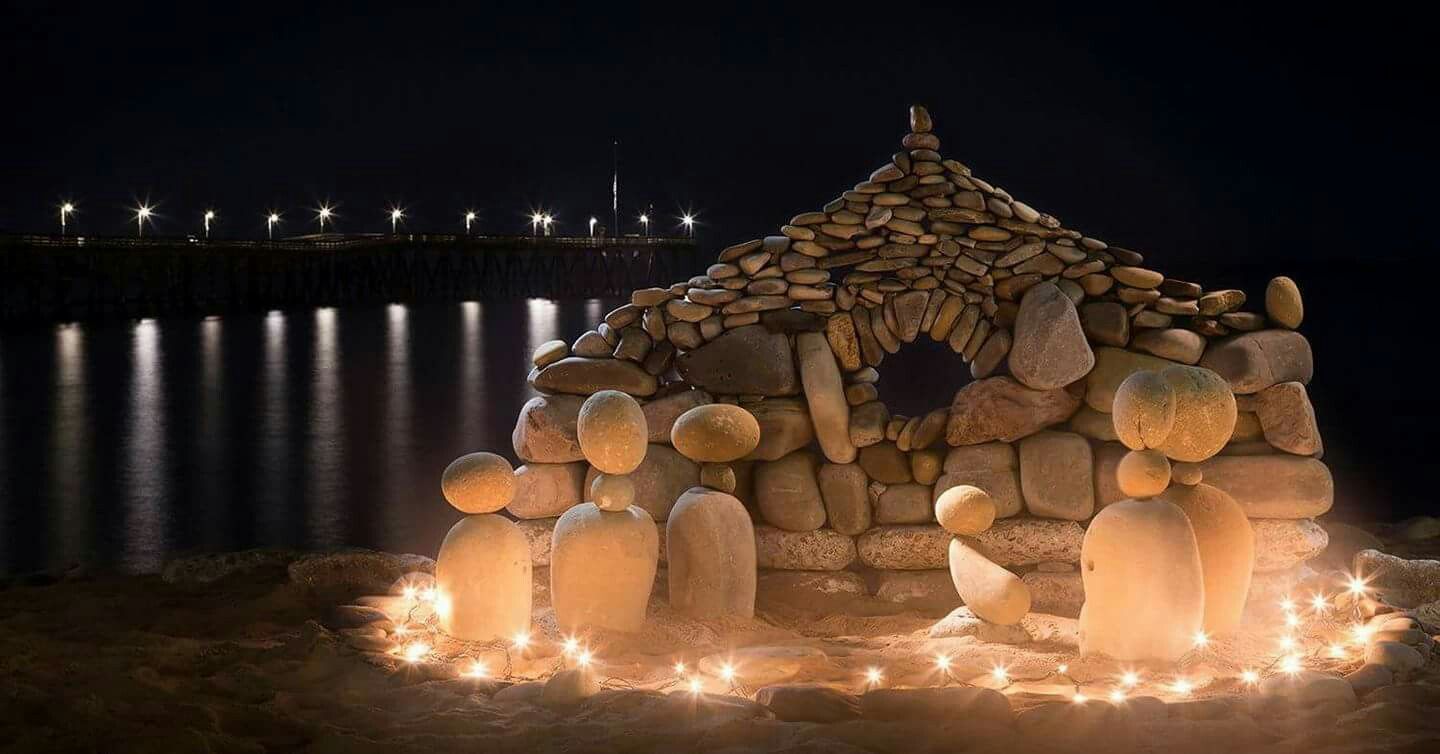
Stone Nativity by Juan Manuel Cisneros, Ventura, California, December 2016 [learn more]
1.“Haiku for an Advent Calendar” by Richard Bauckham: Church services during Advent tend to focus on messianic prophecies from the Hebrew Bible, rumblings of a coming savior. In this sequence of twenty-four haiku, Richard Bauckham pulls a detail from each book of the Jewish scriptures, finding anticipations of Christ. For example, Isaiah: “In the wilderness / a voice cries for centuries / seeking an echo.” Or Job: “God answered Job but / not his question. Maybe he / will do that again.”
2. “How Christ Shall Come” (anonymous): The cosmological Christ blew in from the four cardinal directions, coming as lover, knight, merchant, and pilgrim. So says this fourteenth-century Middle English lyric, rich in metaphor, compiled in a book of preaching aids and sermons by John Sheppey (d. 1360), bishop of Rochester. (It is unclear whether he is the author of the poem.) The great medieval literature scholar Carleton Brown gave it the title “How Christ Shall Come” in his landmark Religious Lyrics of the XIVth Century (1924), and Grace Hamman brought it to my attention recently in her wonderful monthly Substack, Medievalish, providing a modern English translation and commentary.
3.“Hawk Lies Down with Rabbit” by Seth Wieck: What would it look like for death to no longer have dominion in the animal world? Grappling with Isaiah’s end-time vision of a peaceable kingdom void of predation, this poem describes in graphic terms a bird of prey making its kill, feeding on flesh, and wonders how a hawk could still be itself with rewired impulses. Hear the author read and provide context for the poem on the Reformed Journal Podcast.
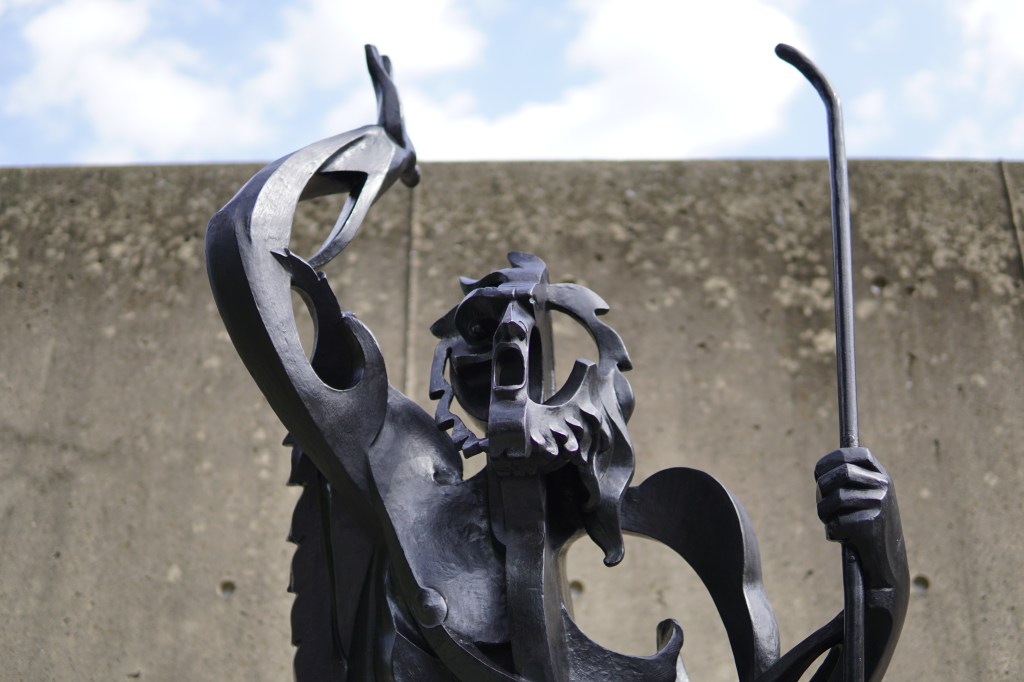
4.“john” by Lucille Clifton: Written in the voice of John the Baptist, this poem is part of an extraordinary sixteen-poem sequence titled “some jesus,” which features a range of biblical characters. In her retelling of his ministry as forerunner to the Messiah, Lucille Clifton casts John as a Black Baptist preacher, preparing his listeners to receive the one who “com[es] in blackness / like a star.” Clifton’s larger body of work would suggest that “blackness” here is multivalent, describing what Jesus comes into and as: the word suggests the darkness of the world that Christ entered, on the one hand, but also functions as a positive racial identifier. In Clifton’s revisioning, Christ comes as a Black man, wearing “a great bush / on his head”—which, again, could be read as an Afro, and/or as a mystical reference to the site at which God revealed himself to Moses in the Sinai desert. Luminous with truth, Christ comes, “calling the people brother.”
Pablo Gargallo (Spanish, 1881–1934), The Prophet (St. John the Baptist) (detail), 1933. Bronze, 91 3/4 × 29 1/2 × 19 in. Wurtzburger Sculpture Garden, Baltimore Museum of Art. Photo: Victoria Emily Jones.
5. “Christmas Mail” by Ted Kooser: Every December the story of an ancient birth comes alive again in couriers’ mailbags, in tin boxes at the ends of driveways, on mantels and fridges. This poem honors those postal workers who deliver good tidings in the form of Christmas cards, the magic spilling out the envelopes to make even the most tiresome routes sparkle a bit.
6. “December 25” by George MacDonald: Through the mid-nineteenth century, denominations influenced by the Reformed tradition, including the Church of Scotland in which George MacDonald was raised, typically did not observe Christmas, the rationale being that no one day should be thought of as holier than any other. But in his book-length dramatic poem Within and Without, MacDonald refers to December 25 as “this one day that blesses all the year”—and in this seven-liner from his Diary of an Old Soul, he describes Christmas as a gleaming blue sapphire, a structural center around which all the other jewels of the church calendar are oriented.
7. “On a Cardinal Climbing Down a Manhole to Restore Power to 400 Homeless People” by Michael Stalcup: On May 11, 2019, Cardinal Konrad Krajewski, the papal almoner (Pope Francis’s special appointee to distribute charity), crawled into a manhole and broke a police seal to personally restore power to a homeless shelter in Rome whose electricity had been shut off due to its failure to pay its bills. The shelter was occupied by some 450 people at the time, 100 of them children, who had been without electric light, hot water, and refrigeration for nearly a week. In this poem, which can be read Christologically, Michael Stalcup celebrates this defiant humanitarian act that brought light to a people living in darkness.
8. “Incarnation” by Amit Majmudar: “Inheart yourself, immensity. Immarrow, / Embone, enrib yourself.” So begins the five-poem sequence “Seventeens.” Musical and witty, this first poem is a plea to the great I AM to take on a body and “be all we are, and all we aren’t.”
9.“The Lord Is with Thee” by Micha Boyett: Written in 2010 as the third in a five-poem sequence commissioned by John Knox Presbyterian Church in Seattle, this poem centers on the Visitation episode described in Luke 1:39–58. It’s about Mary finding belonging in God’s story, especially through the companionship of her elder cousin Elizabeth, who has nurtured Mary’s faith since infancy and continues to do so in this her moment of crisis. “How easily she spoke of God, / as if he were a neighbor, a fish vendor on the street,” Mary admires. Elizabeth supports Mary physically, emotionally, and spiritually, holding her hair back as she vomits, protecting her from vicious rumors, affirming the work of God in her life, and accompanying her at the start of this wild path God has set them both on.
Odilon Redon (French, 1840–1916), Mystical Conversation, ca. 1896. Oil on canvas, 65 × 46 cm. Museum of Fine Arts, Gifu, Japan.
10.“Our Lady” by Mary Elizabeth Coleridge: The great-grandniece of the Romantic poet Samuel Taylor Coleridge, Mary Elizabeth Coleridge (1861–1907) grew up in a home visited by family friends Alfred Lord Tennyson, Anthony Trollope, John Ruskin, and Robert Browning, among others. In this poem she marvels at how God chose the common-born Mary for such a task as mothering the Christ, singing along with Mary’s Magnificat about how God raises up the lowly.
Source: Fancy’s Following (privately published, 1896). Public Domain.
11. “Traveling Man”by Marjorie Maddox: With his pregnant wife alongside, Joseph plods down south to Bethlehem, “convinced of the predestined / roll of dice chrismated with Miracle.” An epigraph from a Leonard Cohen song sets the tone.
12.“Sonnet in the Shape of a Potted Christmas Tree” by George Starbuck: This charming shape poem contrasts the extravagance of our popular celebrations of Christmas with the poverty of the first-century event it marks. The first half describes the furious wind of decorative activity that uproots evergreens from their natural habitats to bring them indoors and deck them with baubles and ribbon. I don’t know how to interpret “no scapegrace of a sect,” but “Daughter-in-Law Elect” refers to a duet from the Gilbert and Sullivan opera The Mikado. The turn comes with “a son born / now / now,” the latter two lines styled as the visible trunk of the tree; here the scene shifts to the simple stable of old, where Mary lies “spent” next to her newborn along with a cow and donkey, a sole “firework” guiding the magi and us all to the spot.
13.“Christmas (I and II)” by George Herbert: George Herbert (1593–1633) is one of the most celebrated poets of the English language. In part 1, a sonnet, of this two-part poem, he imagines himself a weary traveler who chances upon a humble inn where he unexpectedly finds his Lord, the infant Christ. It’s the inn of Bethlehem. Having then received rest from Christ his host, in the closing couplet he expresses his desire to reciprocate—to offer his own soul, lowly though it is, as a residence for Christ, praying that God first adorn it to make it hospitable. In the second part of the poem, Herbert uses a metaphysical conceit (extended metaphor) comparing his soul to a shepherd whose flock of thoughts, words, and deeds pastures on God’s word and who, like the shepherds of Bethlehem, sings glory to God. His shepherd-soul seeks eternal daylight, which he finds in the Son/sun, whose beams so intertwine with his song that the beams sing and his song shines.
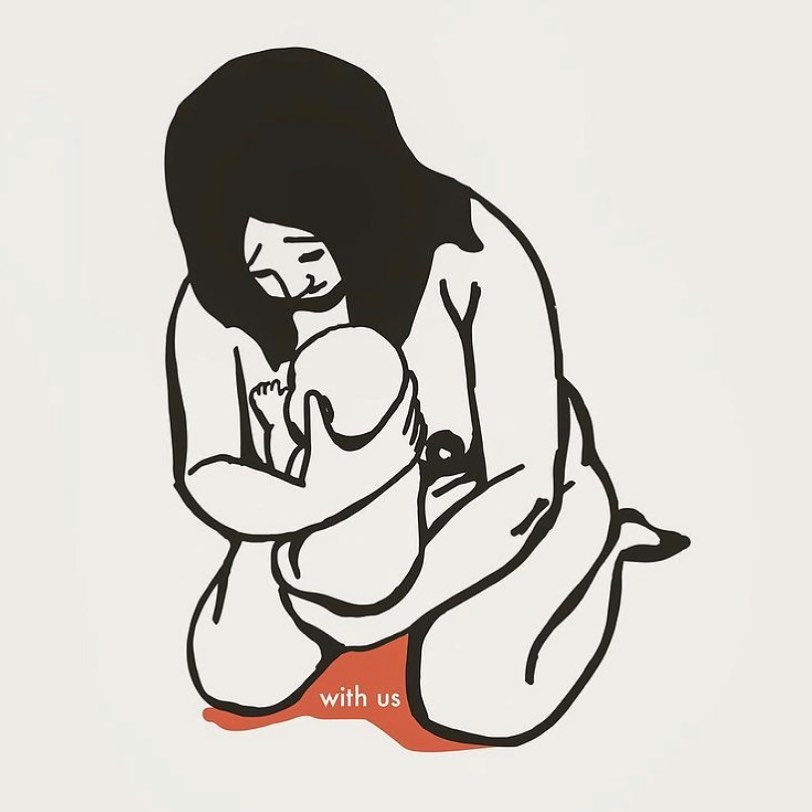
14. “Descending Theology: The Nativity” by Mary Karr: The physicality of childbirth, from the contractions (which pierce the Virgin like a star, Karr writes) to the bodily fluids, is heavily featured in this poem. Jesus emerges from his mother “a sticky grub” with a “lolling head” and “sloppy mouth” that seeks out her breast for food. And as she feeds him physically, he feeds her spiritually. Then he falls asleep. His first nap, Karr writes, is a foretaste of the sleep of death he will eventually come to taste. But for now, he wakes up crying—as all babies do.
Scott Erickson (American, 1977–), With Us, Face to Face, 2016. Digital art. [available for purchase]
15.“from spiralling ecstatically this”by E. E. Cummings: What a fantastic opening line! The heavenly spheres whirling, twirling, down into the “proud nowhere”—Bethlehem—“of earth’s most prodigious night.” Heretofore living in mundanity, the domestic animals, hungry for miracle, for newness, are vouchsafed to be witnesses of this supernatural event, before which they kneel “humbly in their imagined bodies.” Overhead floats the “perhapsless mystery of paradise,” a phrase suggesting that heaven is beyond human understanding but not without certainty; it’s a declarative reality, not subjunctive, even if it can’t quite be put into words. Mary herself has no words—she silently, knowingly smiles, while the created world erupts in song around her. The “mind without soul” is a reference to Herod, who seeks to snuff out this new life, but to no avail.
The omission of spaces after punctuation marks (e.g., “a newborn babe:around him,eyes”) is not a mistake; that’s how E. E. Cummings liked it. Scholars say it’s to create a faster rhythm, but in this poem I don’t think that choice is as effective, as pauses and slow savoring seem more appropriate to its contemplative mood.
16.“How the Natal Star Was Born”by Violet Nesdoly: Narrated by the angel Gabriel, this poem imaginatively describes heaven’s nervously awaiting the birth of Jesus during the nine months following Gabriel’s dispatch to Mary, and then busting out in celebration when at last they hear his infant-cry. When his Son is born, instead of cigars, the Father passes out trumpets to his company of friends, who sound them all the way to Bethlehem’s fields, and pops open a bottle of champagne whose bubbles spray far and wide.
17. Sections 9–10 of “The Child” by Rabindranath Tagore: Hinduism was the religion of Rabindranath Tagore’s birth and upbringing, but he also held deep respect for Jesus Christ. (For more on the influence of Christianity on Tagore’s thought and writing, see chapter 4 of Rabindranath Tagore and Interfaith Dialogue by Manas Kumar Ghosh [DMin thesis, Charles Sturt University, 2010].) “The Child” is a free-verse poem that Tagore wrote in English in 1930 after seeing a passion play in Germany and then translated into Bengali in 1932 with the title “Sishutirtha” (Pilgrimage to Childhood). In it a “Man of faith” gathers people from all walks of life to join him on a “pilgrimage of fulfilment,” to “struggle [through the dark] into the Kingdom of living light.” Initially met with enthusiasm, the Man later becomes a target of the people’s anger and distrust, and they kill him. Disorientation ensues. But a man in the crowd is able to rally the others to repent and resume their quest, following the spirit of “the Victim.”
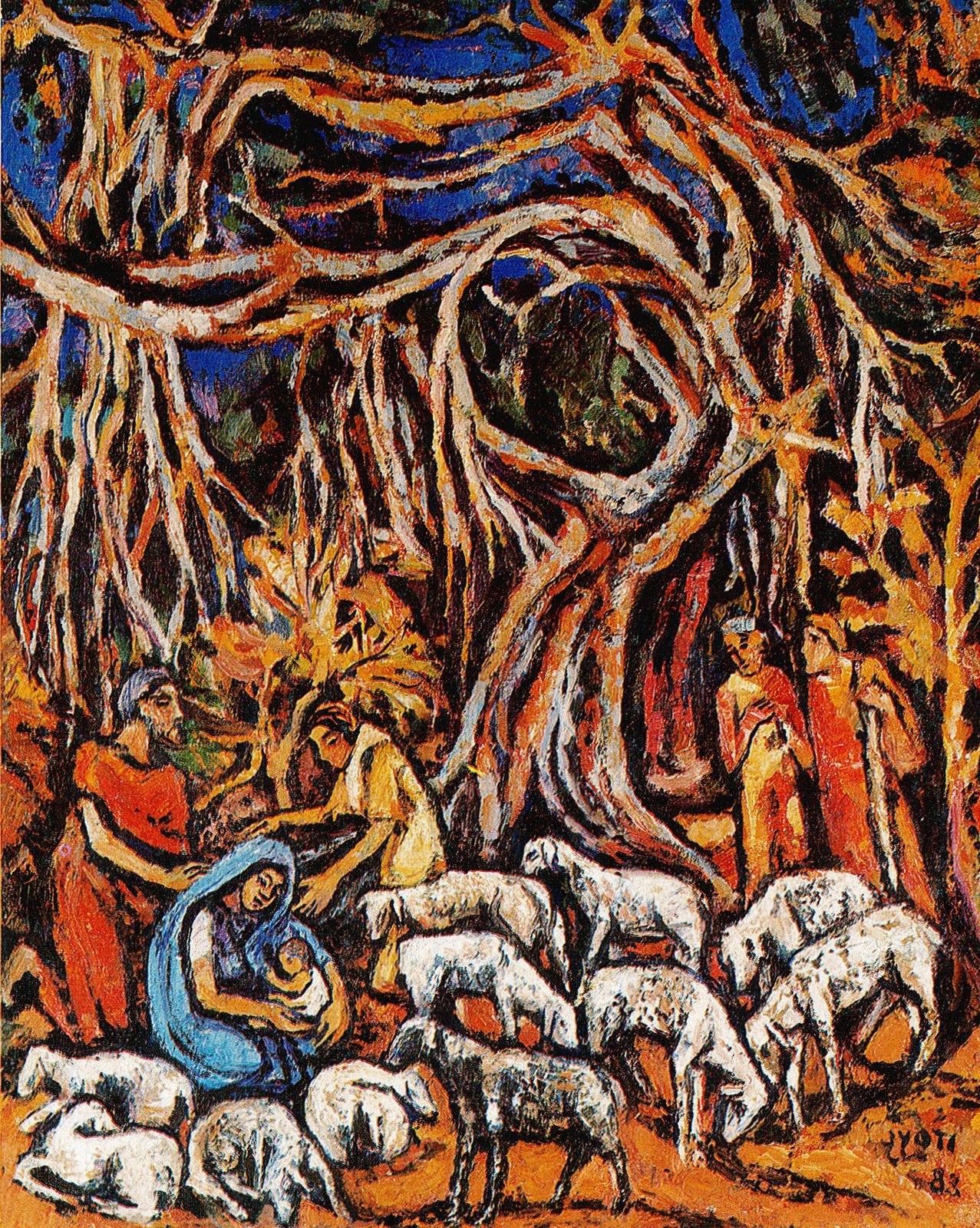
The final two sections, 9 and 10, are the selection I’ve chosen. (Scroll right to read the last.) At “the first flush of dawn,” when the time is ripe, the pilgrims arrive at a thatched hut in a palm grove, where they finally meet the eternal Light they’ve been seeking: “the mother . . . seated on a straw bed with the babe on her lap, / . . . the morning star.” Here is the Child of the title, humanity’s redeemer.
Source: The Child (London: George Allen and Unwin, 1931)
Jyoti Sahi (Indian, 1944–), Adoration of the Shepherds, 1983. Oil and acrylic on canvas.
18. “Love’s Bitten Tongue (11)”by Vassar Miller: This poem, “You, my God, lonesome man, Love’s bitten tongue,” is from a crown of twenty-two sonnets, a type of sequence in which the last line of each sonnet is repeated as the first line of the next, but each time with a new twist of syntax and sense. The crown as a whole expresses the poet-speaker’s struggle against her ego, and her desire for Christ (whom she gives such an evocative name in the title!). In this particular sonnet she describes waiting at the edge of her bed every Christmas Eve as a child in anticipation of both Santa’s arrival with gifts and the holy mystery of Christ’s birth, an admixture of sacred and profane longings that fill her still as an adult.
19. “Gloria in Profundis” by G. K. Chesterton: G. K. Chesterton’s poems are of variable quality, but this one is brilliant, emphasizing God’s descent from the rich heights of heaven into an obscure cave in a simple town. “Glory to God in the lowest!” it exclaims, a clever inversion of the angels’ song to the shepherds in Luke 2:14. The poem was originally published in a 1927 Christmas pamphlet with wood engravings by Eric Gill. The Latin title translates to “Glory in the Depths.”
Source: Gloria in Profundis by G. K. Chesterton (Ariel series pamphlet) (London: Faber and Gwyer, 1927); compiled in The Spirit of Christmas (New York: Dodd, Mead, 1985)
20.“Silent Night” by Bonnie Bowman Thurston: Rev. Dr. Bonnie Thurston invokes a tradition that says the night of Christ’s birth, there was a whole hour in which time stood still and all was silent. What a fascinating legend! Thurston told me its origin is northern European, said she remembers reading it in some scholarly Celtic studies; I wasn’t able to locate any such mentions, but the second-century Protoevangelium of James, chapter 18, probably written in Egypt or Syria, does describe everything momentarily freezing in place around Joseph as he steps out to find a midwife for Mary. Anyway, the poem ends with a striking metaphor! Word, flesh: fire. (Reminds me of this digital artwork by Scott Erickson.)
21. “After Luke 2:19” by Michelle Ortega: When the shepherds recounted to Mary what the angels had told them in the fields about Jesus being the promised Messiah, “Mary treasured all these words and pondered them in her heart,” Luke narrates in his Gospel. Poet Michelle Ortega expounds on this verse, emphasizing the relationship of Mary’s body to her son’s from conception to birth and now postpartum—an intimacy known well by mothers across the centuries. As wondrous as it was to be part of a cosmic story writ large in the skies, Ortega suggests that Mary treasured just as much as the grand pronouncements those small moments of being just an ordinary mama.
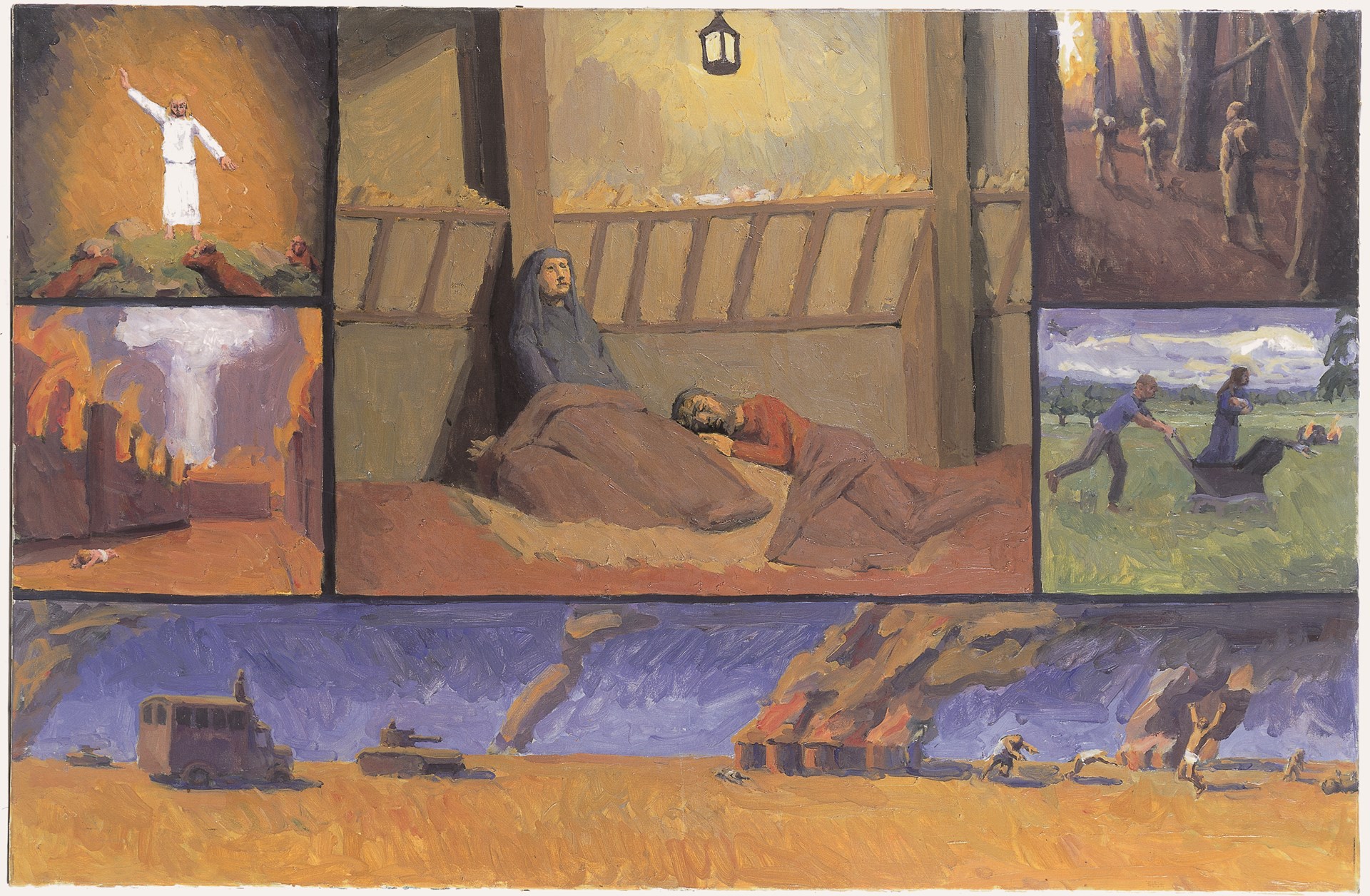
22. “Christmas: 1924”by Thomas Hardy: “We the civilized world have given Christianity a fair trial for nearly 2000 years, & it has not yet taught countries the rudimentary virtue of keeping peace,” lamented the British novelist and poet Thomas Hardy (1840–1928) in a letter to Florence Henniker dated February 25, 1900, during the Boer War. World War I only increased his cynicism, which is on display in this sour little epigram that opens with an ironic quotation of the angels’ proclamation to the shepherds the night of Jesus’s birth.
Francis Hoyland (British, 1930–), Nativity, 1961. Oil on canvas, 90 × 120 cm. Methodist Modern Art Collection, HOY/1963/1.
23. “Eating Baklava on New Year’s Eve” by Anya Krugovoy Silver: Poet Anya Silver (1968–2018) reads a spiritual benediction in her piece of baklava, layered and sweet and consumed on the eve of a new year.
Source: Second Bloom (Eugene, OR: Cascade Books, 2017)
24. “A Ballad of Wise Men”by George M. P. Baird: Jesus so often confounds the wisdom of the wise, starting with his birth. With gentle humor and in iambic rhythm and rhyme, this poem celebrates the simple access we all have to Christ.
Source: Rune and Rann (Pittsburgh: Aldine Press, 1916). Public Domain.
25. “Excrucielsis”by Hannah Main-van der Kamp: Originally published at ArtWay.eu as a response to the contemporary Romanian sculpture The Spring by Liviu Mocan, this poem alternates between the weary journeying toward truth of one of the biblical magi and that of a modern-day seeker similarly “longing for / the something more.” It can be a trudge, finding the Light—it involves risk, a willingness to follow the signs, and the tenacity to hold on to your “vision burden,” “clutch[ing] the weight” of it all the way over rough and varied terrain. But the epiphanic moment awaits, to sound like a trumpet blast. The title of the poem is a neologism combining the words “excruciating” and “excelsis” (Latin for “the heights”); “every excelsis contains something excruciating, that’s how we get to genuine excelsis,” the poet told me in an email. Read a related prose reflection by Main-van der Kamp here.
Source: The Slough at Albion (Victoria, BC: Ekstasis Editions, forthcoming)
Disclosure: This post contains Amazon affiliate links, meaning I earn a small commission from qualifying Amazon purchases originating from clicks on this site.
Your skin slit round with a scalpel: be brave. Rise to the aluminum tray, the biopsy needle. Go, nipple; go, milk ducts; go, veins. Take with you my lymph nodes, canaries of illness, blood cells’ puff balls.
Blessed be my chest wall for surrendering.
Now you will never shrink and wrinkle with age, clove-studded orange, bittersweet.
Taken in your beauty, let the last hands that hold you be gentle.
This poem is from The Ninety-Third Name for God(Baton Rouge: Louisiana State University Press, 2010). Used by permission of the publisher.
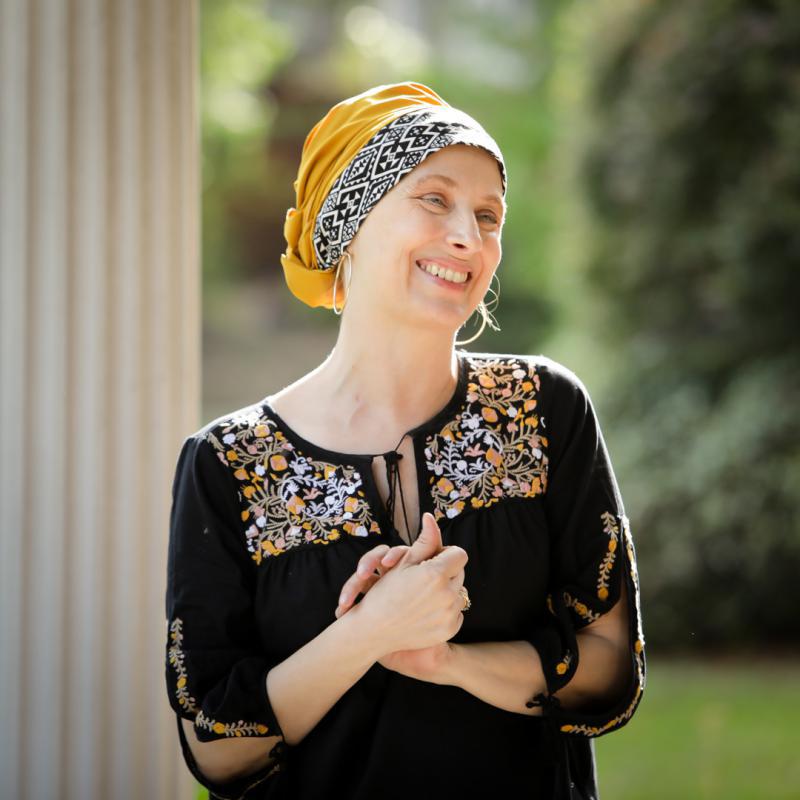
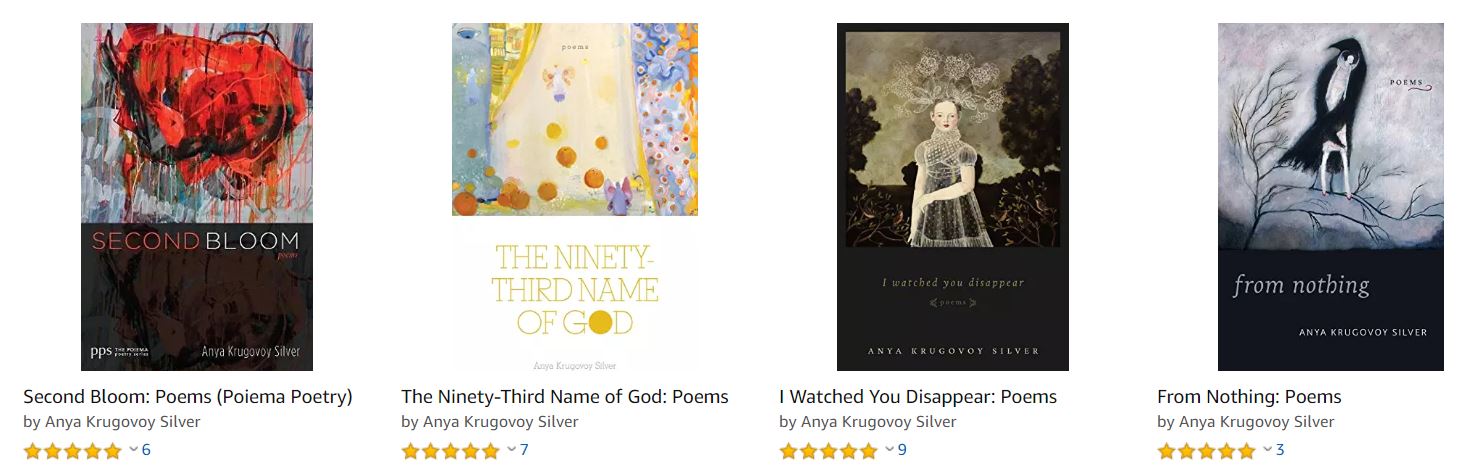
Anya Krugovoy Silver (1968–2018) was an American poet who authored five poetry collections: Saint Agnostica (posthumously published, 2021), Second Bloom (2017), From Nothing (2016), I Watched You Disappear (2014), and The Ninety-Third Name of God (2010). Diagnosed with inflammatory breast cancer in her thirties, she wrote often about life’s precariousness, the trauma of chronic and terminal illness, and holding on to joy and religious faith. She was named Georgia Author of the Year for Poetry in 2015 and was awarded a Guggenheim Fellowship in 2018. She taught at Mercer University until her death in 2018.
William L. Hawkins (American, 1895–1990), Nativity Scene, 1987. Oil on canvas, 48 × 48 in. Newark Museum of Art, Newark, New Jersey.
1.“Remembering that it happened once”by Wendell Berry: For the last forty-plus years, Kentucky farmer Wendell Berry has been writing what he calls “Sabbath poems,” which emerge from his spiritual practice of walking outdoors on Sundays without any to-do’s. “I go free from the tasks and intentions of my workdays,” he says, “and so my mind becomes hospitable to unintended thoughts: to what I am very willing to call inspiration.” This Sabbath poem from 1986 explores how the sacred permeates the mundane and how Christ is, in a sense, always being born. For an SATB choral setting by Doug Brandt, see here.
Source: A Timbered Choir: The Sabbath Poems 1979–1997 (Washington, DC: Counterpoint, 1998); compiled in This Day: Collected and New Sabbath Poems (Washington, DC: Counterpoint, 2014)
2.“BC:AD” by U. A. Fanthorpe: Ursula Askham Fanthorpe (1929–2009), CBE, FRSL, was an English poet who is well loved by both critics and the general public. She was also a practicing Quaker. Each year she wrote a new Christmas poem to send to friends, of which “BC:AD” is the best known. It considers Jesus’s birth as the pivotal point in history, dividing time into epochs, into “before” and “after.” At this nativity, kairos invaded chronos—and we’re still singing about it millennia later.
3.“Making the House Ready for the Lord”by Mary Oliver: For many of us who succumb to cultural pressures, December is a time of rushing around, making sure the house is decorated like a magazine, the Christmas cards sent out, the cookies baked to perfection, the gifts individually selected and bought and wrapped. But in all this flurry of activity, are we missing “the better part” (Luke 10:42)? The speaker of this poem, Martha-like, is busy making preparations for Jesus, who’s coming to visit, but as she’s cleaning, outdoor critters keep popping in. At first she bemoans their presence—they’re not on the guest list!—but eventually she comes to accept, even welcome, them, surrendering her fussy desire for orderliness to a charitable embrace of whatever is. And on another level, this poem is about how all of creation longs for Christ (Rom. 8:19–22); the animals, too, want to see him, want to join the party.
5.“Second Advent”by Anya Krugovoy Silver: Memorializing a friend (Ishiuan Hargrove) who died of metastatic brain tumors, “Second Advent” unsettlingly combines stark hospital-room and anatomical language with language that is soft, gentle, lyrical. Recounting one of Ishiuan’s several neurosurgeries, the poet remarks how her head was nimbed by surgical lights and then swaddled in gauze. The title refers to Ishiuan’s waking up on the second Sunday of Advent, but also to the hope of Christ’s second coming, when pain, disease, and sorrow will be done away with. Anya Silver was herself a cancer patient, an experience she wrote much about in her four volumes of poetry, before dying of breast cancer in 2018.
Source: Second Bloom (Eugene, OR: Cascade Books, 2017)
6.“The Nativity”by Henry Vaughan: “Peace!” rang the angels’ song the night of Christ’s birth—and yet what irony, that he who came to bring peace was himself no beneficiary of it in this life, being born among animals in a borrowed stable, then made a refugee, then later disbelieved, betrayed, mocked, tortured, and crucified. The darkness that bred such unwelcome of the Son of God still persists—violence, ignorance. Referencing the Genesis 1 creation narrative as well as the journey of the magi, the poem ends with an invocation for God’s light to manifest once again, leading us to Christ.
Source: Thalia Redivina: The Pass-Times and Diversions of a Countrey-Muse (London: Robert Pawlet, 1678). Public Domain.
7. [little tree] by E. E. Cummings: One of E. E. Cummings’s earliest published poems (it came out in the January 1920 issue of The Dial), “little tree” was intended to appear as one of five “chansons innocentes” in Cummings’s first book of verse, Tulips and Chimneys, but his editor, Thomas Seltzer, cut it (along with sixty-five others!). In it a young child consoles a recently felled evergreen tree—enlisted for the holiday festivities—with promises of glory and love. Though it runs the danger of being read as twee, Cummings remained fond of the poem and even had it printed and sent it as his family Christmas card in 1960, two years before he died.
8. “Messiah (Christmas Portions)”by Mark Doty: The speaker of this poem is unexpectedly transported by a local community choir performance of Handel’s Messiah. He marvels at how these ordinary, flawed neighbors of his can produce such beauty with their collective voices. The last line is probably a reference to the accompagnato and air sung by the bass toward the end of the oratorio, taken from 1 Corinthians 15:51–54—about how we will all be changed in a moment at the last trump, and the corruptible will put on incorruption.
9. “What the Body Knows” by Jean Janzen: The anonymous scribes and illuminators of the Book of Kells spent countless hours copying and beautifying God’s word amid Viking raids. In this ekphrastic poem, Jean Janzen reflects on the Gospel-book’s five whimsically painted folios of Luke’s genealogy of Christ, commenting on the continual inbreaking of God into our world and the “wild safety” of God’s love.
10.“Confession”by Leila Chatti: The Tunisian American poet Leila Chatti was raised by a Muslim father and a Roman Catholic mother, and both religious traditions have shaped her faith and her writing. Islam and Christianity hold many sacred figures in common, including Mary (Maryam), whose conception and delivery of Jesus (Isa) are narrated in the Quran 19:16–34. Chatti confesses to being more compelled by the Islamic characterization of Mary as grunting and sweating in the pangs of labor (in contrast to Catholic teaching, which says her birthing experience was effortless, her contractions painless, though the Bible itself doesn’t specify). Chatti finds comfort in picturing Mary not as someone exempt from the effects of the fall and set apart on a pedestal of supreme virtue, but as one who suffered the same physical and emotional toll as other childbearing women—and who probably did have the occasional selfish thought, which, in moments of intensity and vulnerability, she deigned to vocalize!
11. “Two Carols”by Evelyn Underhill: An English Anglo-Catholic writer and mystic, Evelyn Underhill meditates in this double poem on how Christ set foot on the long, hard road we travel to be a balm for our wounds and those of the earth. The epigraph to part 1 is from the Latin Vulgate of Song of Solomon 2:12: “The flowers appear on the earth.” What follows are several Catholic titles for Mary: rose without thorn, queen, generatrix. The epigraph to part 2 is a quotation of Romans 8:22: “The whole creation groaneth and travaileth in pain together until now.” The refrain, Dominus tecum!, translates to “The Lord is with you!,” words spoken by the angel Gabriel to Mary and, by virtue of the Incarnation, to all humanity. The other Latin phrases translate to “He who is in the heavens,” “A King is born,” and “Let the kingdom come!” Adveniat regnum!
Source: Immanence: A Book of Verses (London: J. M. Dent, 1912). Public Domain.
12. “The Christmas Babe”by Fr. John Banister Tabb: Written by a Catholic priest from Virginia, this simple quatrain marvels at the paradox of God’s simultaneous largeness and smallness.
Source: Poems (London: John Lane, 1894). Public Domain.
13.“Snowflakes” by Jennifer Grotz: When the world is viewed through a sacramental lens, we recognize God in commonplace wonders like falling snow, and such things can be a sort of wordless prayer that we offer back to God through our enjoyment of them.
14. [The Savior must have been a docile Gentleman]by Emily Dickinson: In these two compact stanzas, Dickinson reflects on how kind Jesus was (an understatement!) to have made the far journey to Bethlehem, “a rugged billion Miles” from heaven, especially in the cold month of December, all “for little Fellowmen.” She refers to him as “docile”—obedient, submissive—harking to Philippians 2, to his yielding to the will of the Father in the Incarnation, taking on human limitations, suffering, and death for the life of the world.
15.[Wilt thou love God, as he thee? Then digest](Holy Sonnet No. 15) by John Donne: A self-address to the soul, this poem by the English poet-priest John Donne, first published in 1633, two years after this death, celebrates the Triune God’s salvific workings: we’re adopted by the Father, redeemed by the Son, indwelt and regenerated by the Spirit. The closing couplet, referencing the imago Dei, packs a wallop: “’Twas much, that man was made like God before, / But, that God should be made like man, much more.”
Source: Poems (London: M.F. [Miles Fletcher], 1633). Public Domain.
16. “The Little Towns of Bethlehem”by John Terpstra: All over Canada, Christ is being reborn this Christmas, in the sense that the Story has taken root, is retold, and continues to have impact. The speaker imagines the Christ child “wrapped in cast-off flannel” in a boxcar stopped on the tracks in Esther, Alberta, or feeding at his mother’s breast in a broken-down car on the shoulder of a road in Englehart, Ontario—actual sights that one might encounter today. Localizing the Story can help us to see it afresh, and to see the sacred humanity of families experiencing homelessness or other hardships.
17. “Song of the Shepherds” by Richard Bauckham: Richard Bauckham, FRSE, FBA, is best known as a biblical scholar—he’s one of today’s tops, in fact—but he also writes poetry! (I featured one of his poems last year.) In this poem, the shepherds on Bethlehem’s hillsides recall an ancient tale about the stars singing at the creation of the universe, which they thought merely a poetic embellishment, until they experienced something of the like for themselves: “a song of solar glory” eclipsing the lesser lights and exorcising the dark, creating the world anew. Unforgettable.
18. “Those Magi”by Kathleen O’Toole: What exactly were the magi seeking? What compelled them to leave their treasure behind in that cattle shed? Whence their strength to defy Herod? Besides musing on these questions, the poem also contains a passing metaphor that I found striking and new: cow breath as incense.
19. “Carol of the Brown King”by Langston Hughes: Tradition names one of the wise men who visited the Christ child “Balthazar” and says he’s from Africa. Langston Hughes, a preeminent poet of the Harlem Renaissance, exults that there was “one dark like me—part of His Nativity.” This poem is included in Hughes’s musical play Black Nativity and is one of six Nativity poems by Hughes that make up a children’s book illustrated by Ashley Bryan.
20. “Mosaic of the Nativity: Serbia, Winter, 1993”by Jane Kenyon: I couldn’t find the particular church mosaic program that Kenyon is writing about, but here’s my interpretation. Set inside a Serbian Orthodox church during the Bosnian War, this poem imagines a mosaic of Christ Pantocrator hovering in the dome, lamenting the violence that goes on beneath. Under the gaze of the I AM is another mosaic, portraying Jesus’s birth, but also, in a way, Mary’s, as she herself is being reborn in Christ, her mind increasingly shaped in accordance to his. Nativity icons often show Mary framed by a red blanket that she’s reclining on at the mouth of a cave, which Kenyon reads as embryonic.
21. “Breath” by Luci Shaw: This poem reflects on the contraction of the infinite God who breathed the universe into existence into a finite human being needing oxygen, who, as is foreshadowed at his birth, will finally ex-pire (“breathe out” his last) on a cross before entering his “next dark cave,” a prelude to resurrection.
22.“Mary’s Vision”from medieval Ireland: Mary foresees the future suffering of her infant son and dialogues with him about it in this poem translated from Middle Irish by Eleanor Hull (the same woman whose versification of a medieval Irish lorica, working from a translation by Mary Elizabeth Byrne, gave us the hymn “Be Thou My Vision”!).
Source: The Poem-Book of the Gael (London: Chatto & Windus, 1912). Public Domain.
23.“Joseph at the Nativity”by Tania Runyan: Staring at the “shriveled pod” that Mary just birthed, Joseph grapples with his complicated feelings—doubt, embarrassment, jealousy, helplessness, confusion, pride—and with figuring out what role he should play in the life of this child going forward.
24.“Waiting in Line After Christmas”by Sharron Singleton: (Scroll down to fourth poem) Rather than exchanges of refunded money for unwanted items, Singleton ponders what a mutually life-giving exchange of intangibles might look like.
25. “Burning the Old Year”by Naomi Shihab Nye: Through the act of forgetting, we must destroy the worthless trivialities of the year, and we must let that which is solid, that which matters—the “stones”—be revealed and remain.
ALBUM REVIEW:“Let’s Go Down: Joy and Humility in Psallos’s Philippians Album” by Victoria Emily Jones: Psallos’s latest album, a musical adaptation of Paul’s letter to the church at Philippi, released on Thursday, and, as I’ve come to expect from the collective, it’s a brilliant work of art, with much to discover! In this review I wrote for the Gospel Coalition, I of course couldn’t address all the album’s intricacies, but I trace a few main themes and motifs. This is the New Testament epistle that gives us such memorable lines, phrases, and passages as “Rejoice in the Lord always!,” “Be anxious for nothing,” “the peace of God that passes all understanding,” “I can do all things through Christ who strengthens me,” and the glorious Christ Hymn (“Let this mind be in you, which was also in Christ Jesus, who, being in the form of God . . .”). It’s delightful to hear what Psallos does with these oft-quoted verses and, even more, to be guided in understanding the larger context in which they appear.
It’s near impossible to choose favorite tracks, as they gain impact from being heard all together and in order, but if Ihad to choose, I’d say “Complete My Joy,” “Hymnos Christou,” “I Am Better Than You” (feat. Shai Linne), and “Will You Go Down?” (feat. Taylor Leonhardt).
+++
POETS’ PANEL:“Surprised by Joy: Poetry about Happiness,” recorded at the Festival of Faith and Writing, April 2018: In Rewrite Radio Episode 29 (a production of the Calvin Center for Faith and Writing), poets Anya Silver, Tania Runyan, Barbara Crooker, and Julie Moore “discuss the landscape of joy amidst suffering in their personal and public lives. Joy, distinct from happiness, can be a form of religious practice. They explore questions regarding what cheapens joy, how Christians view joy, and how to ‘balance the scale’ of joy and pain in writing.” Zora Neale Hurston, Ælfric of Eynsham, Ralph Waldo Emerson, Christian Wiman, Jane Kenyon, John Milton, Dietrich Bonhoeffer, Thornton Wilder, and the apostle Paul are just some of the additional voices they draw into their conversation. They each read three to four of their own poems, and there is an audience Q&A starting at 57:54. A transcript is provided.
Silver and Runyan are two of my favorite poets, and this is such a rich hour spent with them and two of their colleagues.
+++
INTERVIEW: “It’s Not a Poem Until You Discover Something: An Interview with Scott Cairns” by Andy Patton: In this conversation, poet Scott Cairns talks about writing as a discipline, the writer as reader (“The writing life is primarily the reading life”), staying conversant with tradition, the fallacy of originality, the one quality shared most between prayer and poetry, and writing not as giving, serving, but as getting, receiving.
+++
LECTURE: “What Did Jesus Look Like?” by Joan E. Taylor, St. Paul’s Cathedral, London, June 2, 2019: Historian Joan E. Taylor, a professor of Christian origins and Second Temple Judaism at King’s College London, discusses the influences on early depictions of Jesus in art and what they tell us about what he did, or definitely didn’t, look like. This talk is a great intro to her research on the topic, but if you want to learn more, I recommend her full-color book What Did Jesus Look Like? (T&T Clark, 2018), which goes into much more detail, examining artistic, literary, and archaeological evidence, including first- and second-century coins, textiles, skulls, and Egyptian mummy portraits. She also dedicates two chapters to the three most famous acheropitae (images “made without [human] hands”): the Veil of Veronica, the Mandylion, and the Shroud of Turin.
In her talk, Taylor shows how most of the visual representations of Jesus in the Early Christian era were based on Greco-Roman imagery of Zeus Olympus or Zeus Serapis (strong, powerful, seated on a throne; this image came after Constantine), Dionysus (young, curly-haired, beardless), or philosophers. These images aim to show us the meaning of Jesus but not necessarily his physical reality.
Interestingly, Taylor points out that while it’s common to picture Jesus in a long robe (stolē, plural stolai) with baggy sleeves, such clothing indicated social privilege in Jesus’s time, and in Mark 12:38, Jesus explicitly denounces those who parade around in such dress! Jesus would have worn a short, simple tunic, probably undyed—which is how he is depicted in the frescoes from the ancient Dura-Europos house church in present-day Syria.
She also identifies a common strain in early Christian and non-Christian writings that describes Jesus as “little and ugly and undistinguished” (Celsus), probably owing largely to the messianic interpretation of Isaiah 53:2: “he had no form or majesty that we should look at him, nothing in his appearance that we should desire him.” However, there were some claims to the contrary—for example, from Origen—that stated that Jesus was the epitome of physical beauty; after all, divinity must be beautiful, right? We often find throughout art history an attempt to backfill the earthly life of Jesus with his resurrected, ascended, glorified form.
Taylor is not suggesting, as far as I can tell, that all artistic representations of Jesus must be historically authentic to have validity. Rather, she says that if we are going to imagine Jesus humanly doing things—healing the paralytic, for example, or preaching the Sermon on the Mount—we will inevitably have to picture him in our mind, and we might as well have as accurate a picture as possible. She reminds us that if we imagine Jesus as supremely beautiful and well kept and richly arrayed instead of as the poor, bedraggled itinerant that he was, there’s a dissonance with his message; he becomes no longer one of the people but apart from them.
+++
ARTICLE: “Are Images of Jesus a Violation of the Commandments?” by Chad Bird: “Different groups within Christianity disagree as to whether Jesus should be depicted in icons, crucifixes, paintings, or other visual media. In this article, Chad Bird [scholar in residence at 1517] approaches the question from the angle of both the commandments and the incarnation.”
The most pushback I receive on my blogging ministry comes from those who believe it is inherently wrong, even “idolatrous,” to represent Jesus visually. Bird addresses this concern in much the same way I do when asked, and in such a succinct way!
One of the reasons I love poetry is it brings me into more intimate contact with the world. It slows me down and asks me to give my attention to things that, in my constant, often self-inflicted busyness, I fail to notice. And it shepherds me into a deeper sense of gratitude and awe. It’s really easy for me to see the world’s ugliness—sin, suffering—and to be scared, angry, disgusted, horrified, or overwhelmed. My inclination is to see what’s wrong instead of what’s right. While poetry can perform many different functions, one of them is to attune us to the daily gifts and graces that come to us from, I believe, the hand of God.
In the spirit of Thanksgiving, here are ten contemporary poems of gratitude that can be read online. A popular tradition for this holiday is, when gathered with others round the feasting table, to take turns sharing what you’re thankful for. The three most typical answers for adults are: my family, my health, my job. These are perfectly fine answers. But poets can show us what it feels like to be blessed with family, for example, and can teach us how to offer praise even when our health is declining or we’re unemployed. Moreover, poets help us expand our repertoire of thanksgivings, naming things with specificity: “the incense of butter on toast” (Siegel), “the honey-colored toes of mice” (Singleton), “two daughters and one cloud, an old oak / and a great love” (Wiman), the moon that “shakes a dress of light onto my body” (Silver) and “shuffl[es] its soft, blind slippers over the floor” (Hirshfield).
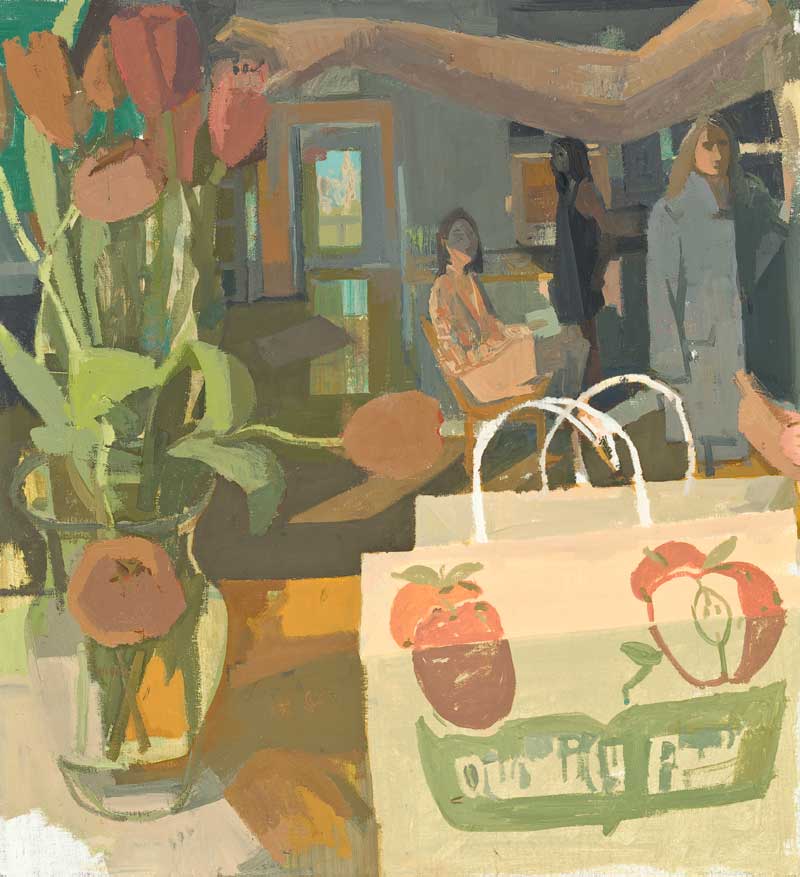
Susan Lichtman (American, 1952–), Orchard Bag and Bouquet, 2015. Oil on linen, 24 × 22 in.
I’ve listed the volume that each poem is published in—I’ve read all but the Browning one, and they’re all excellent. I hope this tiny sampling from the trove of contemporary poetry enlarges your thankfulness and inspires you to read more! Happy Thanksgiving, friends.
“When the sun returns”by Sarah Browning, in Killing Summer (2017): Jesus said to consider the birds. Browning does. “it is hallelujah time, / the swallows tracing an arc / of praise just off our balcony, / the mountains snow-sparkling / in gratitude . . .”
“A Song of Praises”by Robert Siegel (scroll to bottom of page), in Within This Tree of Bones(2013): In this very textural, sensory poem, a humdrum morning routine becomes a litany of more than two dozen in-the-moment gratitudes, for everything from warm washcloths to the snap of elastic to grapefruit flesh to a beautiful face at the breakfast table.
“I Praise Unsalted Butter”by Sharron Singleton, in Our Hands a Hollow Bowl (2018): Another litany of thanksgivings for the mundane, like pearl buttons, babies’ fingernail parings, freckles, delphinium’s cobalt, unseen dendrites, the word “rhubarb,” and so on. In spite of great evil (the poet references the famous “Napalm Girl” photograph), there is still much to wonder at.
“Fifty”by Christian Wiman, in Survival Is a Style (2020): “I never thought I’d live to the age of fifty, so my inclination these days is to praise,” says Wiman, who was diagnosed with a rare blood cancer in 2006 during his first year of marriage. “I wasn’t able to write about joy until I got sick. It wasn’t that sickness brought joy. It’s made me much more conscious of how much joy was in my life and gave me some impetus to articulate it.”
“Morning”by Yahia Lababidi, inBarely There: Short Poems (2013): This six-liner celebrates the newness and invitation of each day. (For a bonus poem by the same author, see “Breath.”)
“Psalm”by Marilyn Nelson, in The Fields of Praise (1997): Reflecting on the inherently dangerous act of driving, Nelson is thankful for (God’s) ongoing protection in the car. The poem ends with a classic line from the biblical book of Psalms.
“How Rarely I Have Stopped to Thank the Steady Effort”by Jane Hirshfield (scroll down to fourth poem), in The Beauty: Poems (2015): I would have never thought to be thankful for walls that stand up! But yes, the basic architecture of my little suburban home is a marvel—how it all holds together. In a pause in conversation, the speaker of this poem ponders all that’s going on in the silence: tree bark absorbing the scent of crow feathers, honey dissolving into tea, DNA replicating. The poem then turns into an expansive reflection on all the invisible phenomena of bodies and lives, of emotions and desires that ebb and flow as their building blocks get rearranged.
“A Handful of Berakhot” by Anya Krugovoy Silver, in The Ninety-Third Name of God (2010): Silver [previously] is one of the consummate poets of gratitude, particularly gratitude amid illness. She was pregnant with her first and only son, Noah, when she was diagnosed with inflammatory breast cancer in 2004. She died in 2018. Her body of work is characterized by a stubborn holding on to joy even as she wrestles honestly with God through many painful years of chemo and a mastectomy. Silver, a Christian, married a Jewish man, whose faith tradition inspired this poem. “In Judaism, a berakhah (pl. berakhot) is a formula of blessing or thanksgiving, recited in public or private, usually before the performance of a commandment, or the enjoyment of food or fragrance, and in praise on various occasions. The function of a berakhah is to acknowledge God as the source of all blessing” [source]. Silver’s nineteen custom berakhot are for such occasions as “buckling my son’s shoes,” “slipping my prosthetic breast into my bra,” “riding the ferris wheel,” and “going to the post office.”
“Gratitude”by Anna Kamieńska, in Astonishments: Selected Poems(2007): “I was full of thanks / like a Sunday alms-box,” Kamieńska writes in this rapturous poem, which bursts with love for everyone and everything.
This August saw the homegoing of two beloved Christian art-makers.
>> “Making meaning out of suffering and loss is one of poetry’s most fundamental aims,” wrote poetAnya Silver, who passed away from inflammatory breast cancer on August 6 at age forty-nine. Since her diagnosis in 2004, she published four volumes of poetry that entwine faith with deep, honest questioning of God. Many of her poems contain imagery related to cancer and its treatment and describe with unswerving candor what it’s like to live under the threat of imminent death. When she received a Guggenheim Fellowship this year, the foundation described her work as “engag[ing] with the trauma of chronic and terminal illness, and with religious faith and mystery, storytelling, memory, and the risks and rewards of being human.” One of her best-known poems is “Psalm 137 for Noah,” written for her only child, whom she gave birth to during her illness.
“I have a tremendous amount of joy in my life, and my joy exists with pain,” Silver said in an interview with Georgia Public Radio in January. “I don’t see those two things as completely separate. All of life is woven together, and separating the strands is impossible.” Read her obituary in the New York Times, and a sweet tribute by Elizabeth Palmer in the Christian Century.
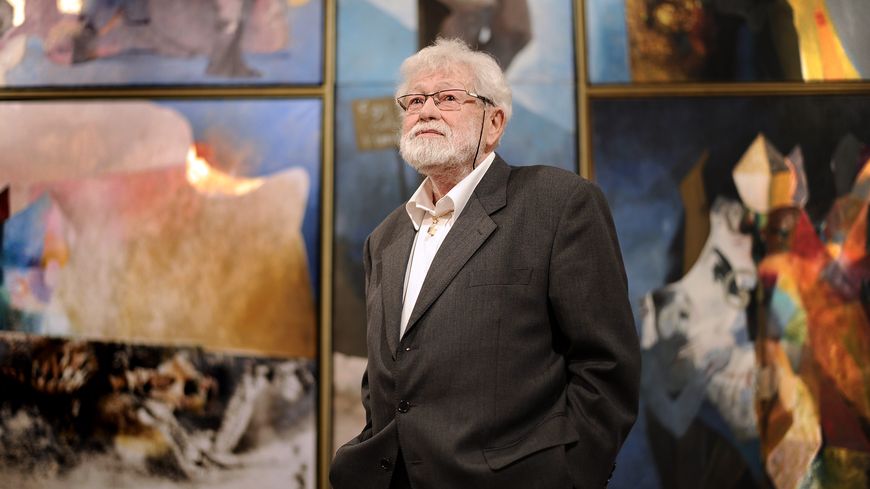
>> A giant of contemporary French sacred art, Jean-Marie Pirot, known professionally as Arcabas, died August 23 at age ninety-one. He is best known for his paintings, which feature biblical characters and scenes, but he also worked in sculpture, engraving, tapestry, mosaic, and cabinetry, as well as in the theater making scenery and costumes. His magnum opus is the interior decoration of Saint-Hugues-de-Chartreuse in the Isère region of France, which comprises over a hundred works by the artist created over a span of thirty-five years.
There has been much published about Arcabas in French (e.g.) but unfortunately very little in English—though for starters, I recommend this ArtWay article. A YouTube search of his name yields several video interviews and feature news segments—again, in French. I’ve embedded a recent video homage below, which shows you inside Saint-Hugues as well as his designs for the stained glass windows inside the Basilica of the Sacred Heart in Grenoble, a project he was working on when he died. I’d love to help bring out some of these books, or even a brand-new catalogue raisonné, in English, so if any of you have connections to Arcabas’s French publishers or people close to him, or have experience translating from French to English, let me know!
+++
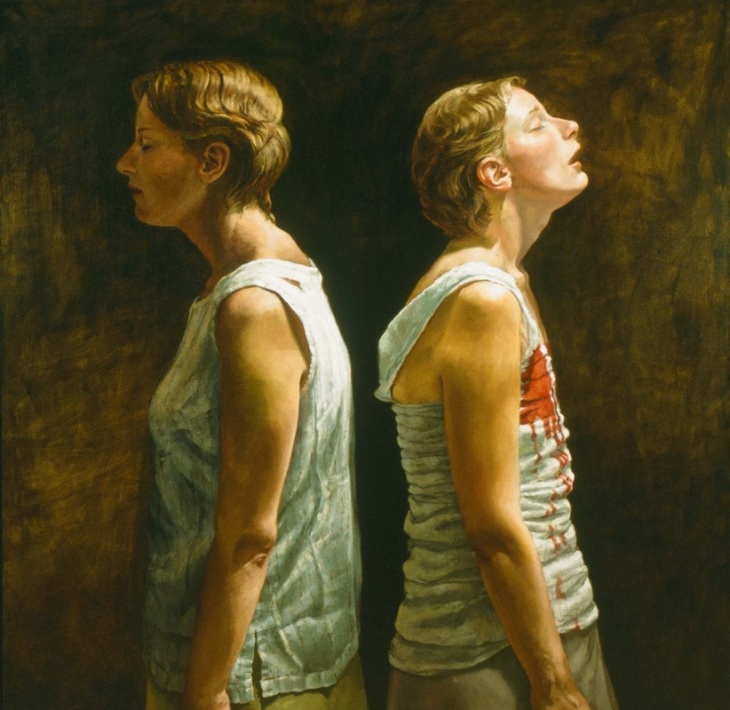
PAINTING: Saint Agatha’s Grief by Melissa Weinman: October is Breast Cancer Awareness Month, so what better time to get acquainted with Agatha of Sicily, patron saint of breast cancer patients. Agatha was a third-century Christian from a noble family whose martyrdom has been authenticated, although its details have not. According to legend, fifteen-year-old Agatha made a vow of virginity and rejected the amorous advances of the Roman prefect Quintianus. After consistently being spurned, Quintianus had her arrested for her faith (this was during the persecutions of Decius) and tortured. Among the tortures she underwent was the tearing off of her breasts with pincers. She died in prison, probably in the year 251.
Melissa Weinman (American), Saint Agatha’s Grief, 1996. Oil on canvas, 42 × 42 in.
In traditional portraiture, Agatha is shown holding her severed breasts on a platter (see, e.g., Francisco de Zurbarán). More recently, though, American artist Melissa Weinman painted a double portrait of Agatha as a modern-day woman in a white tank top enduring the tortuous experience of breast cancer. The two women stand back to back, the left figure having presumably just received the diagnosis, and the right figure bearing blood stains on the chest that indicate a mastectomy. There is an immediate sense of violation in the image, but also a sense that God’s glory is at work. While the one figure is cast in darkness, the other leans toward the light, suggesting hope and faith in the purposes of God, even in the groaning.
+++
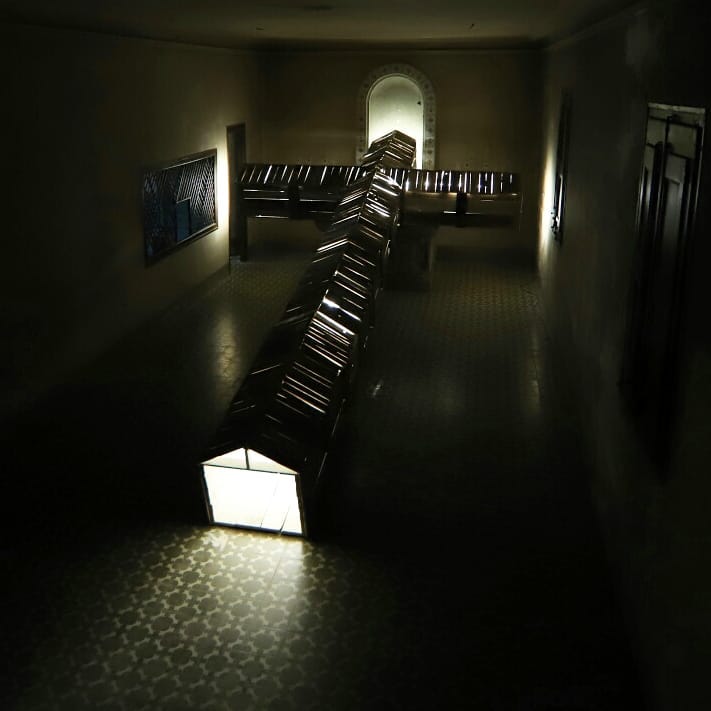
RECENT EXHIBITION: “Creença”: This summer fifty artists from a variety of disciplines participated in a two-month residency at Konvent, a nineteenth-century convent (now an art center) in Cal Rosal, Catalonia, Spain. Organized by Void Projects, the residency culminated in a three-day pop-up exhibition from August 30 to September 2, titled “Creença” (Belief), which included not just visual art but live theater, talks, and music.
Site-specific installation by Jofre Oliveras and Stefan Krische, 2018, in Konvent, Cal Rosal, Catalonia, Spain.
+++
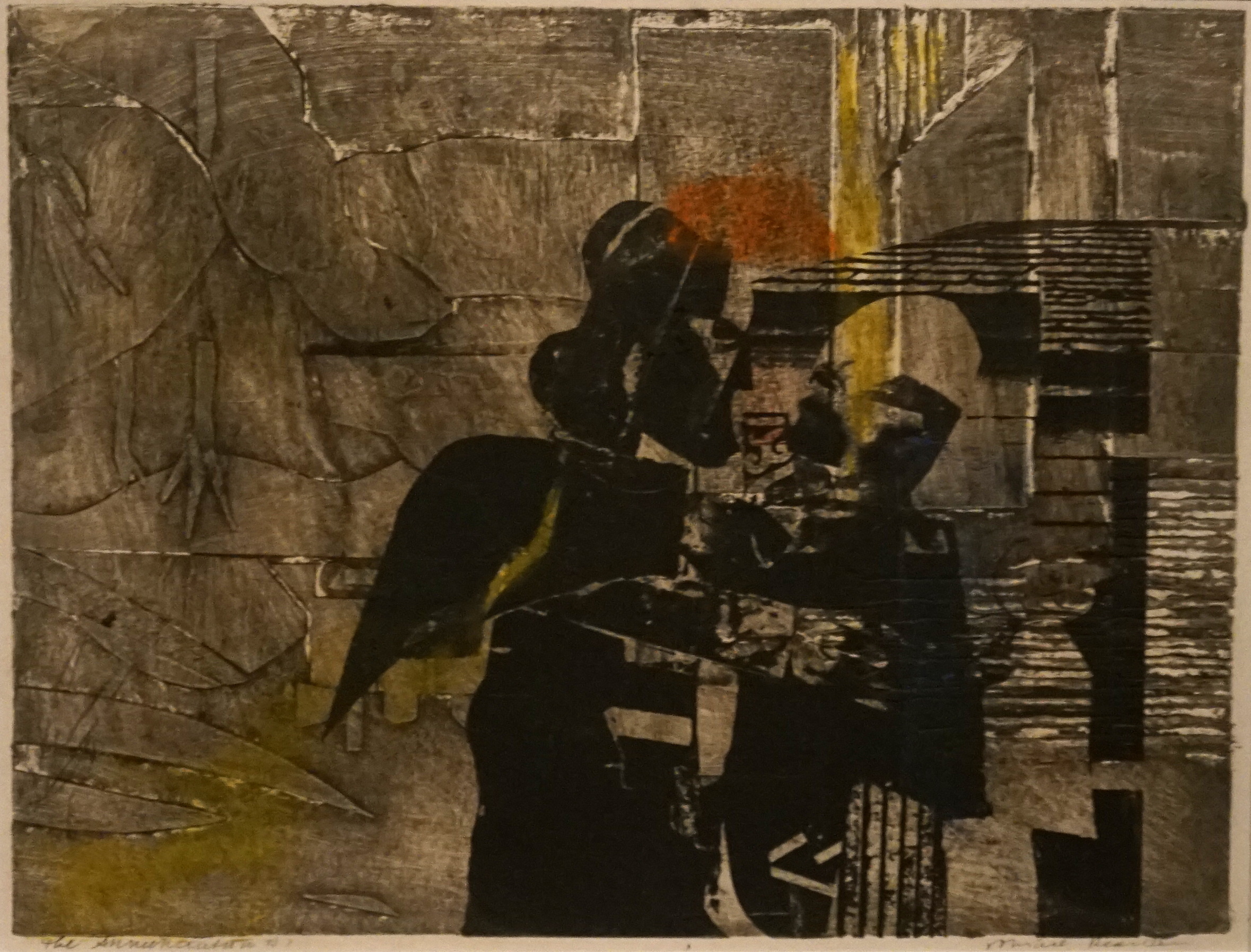
CURRENT EXHIBITION: “Wrestling the Angel: A Century of Artists Reckoning with Religion,” Bechtler Museum of Modern Art, Charlotte, North Carolina: Through October 28, the Bechtler is showing 219 pieces of religious-themed art spread out across its large fourth floor, including works by Dalí, Rouault, Chagall, Warhol, Manessier, Bearden, and other modern greats. I visited last weekend, and while I feel that the theme was treated too loosely and therefore the exhibition lacked the full impact it could have had, I thoroughly enjoyed individual portions, and I appreciate the Bechtler, and in particular curator Jen Edwards, for bringing together these diverse works that speak in some way to religion, spirituality, or morality.
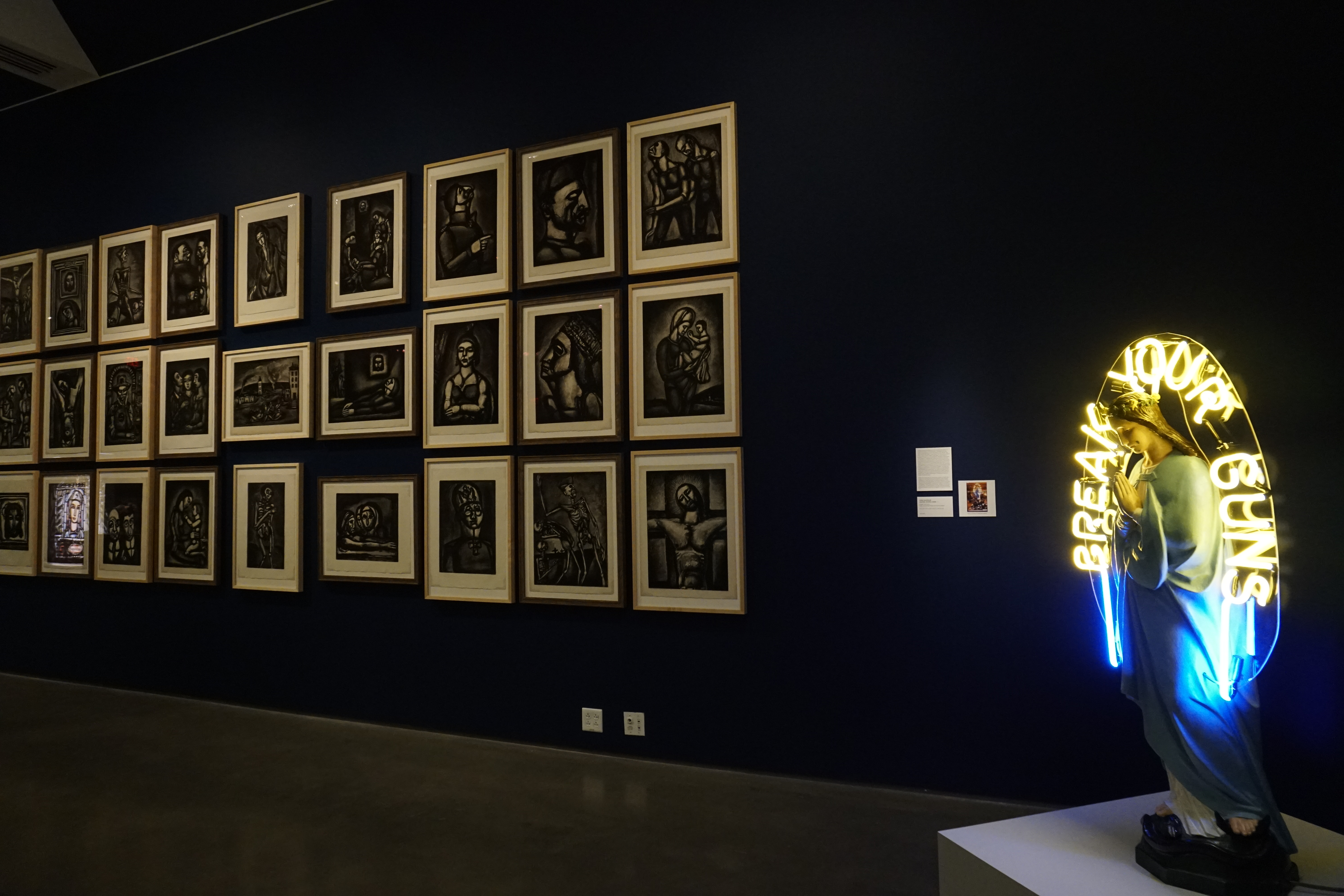
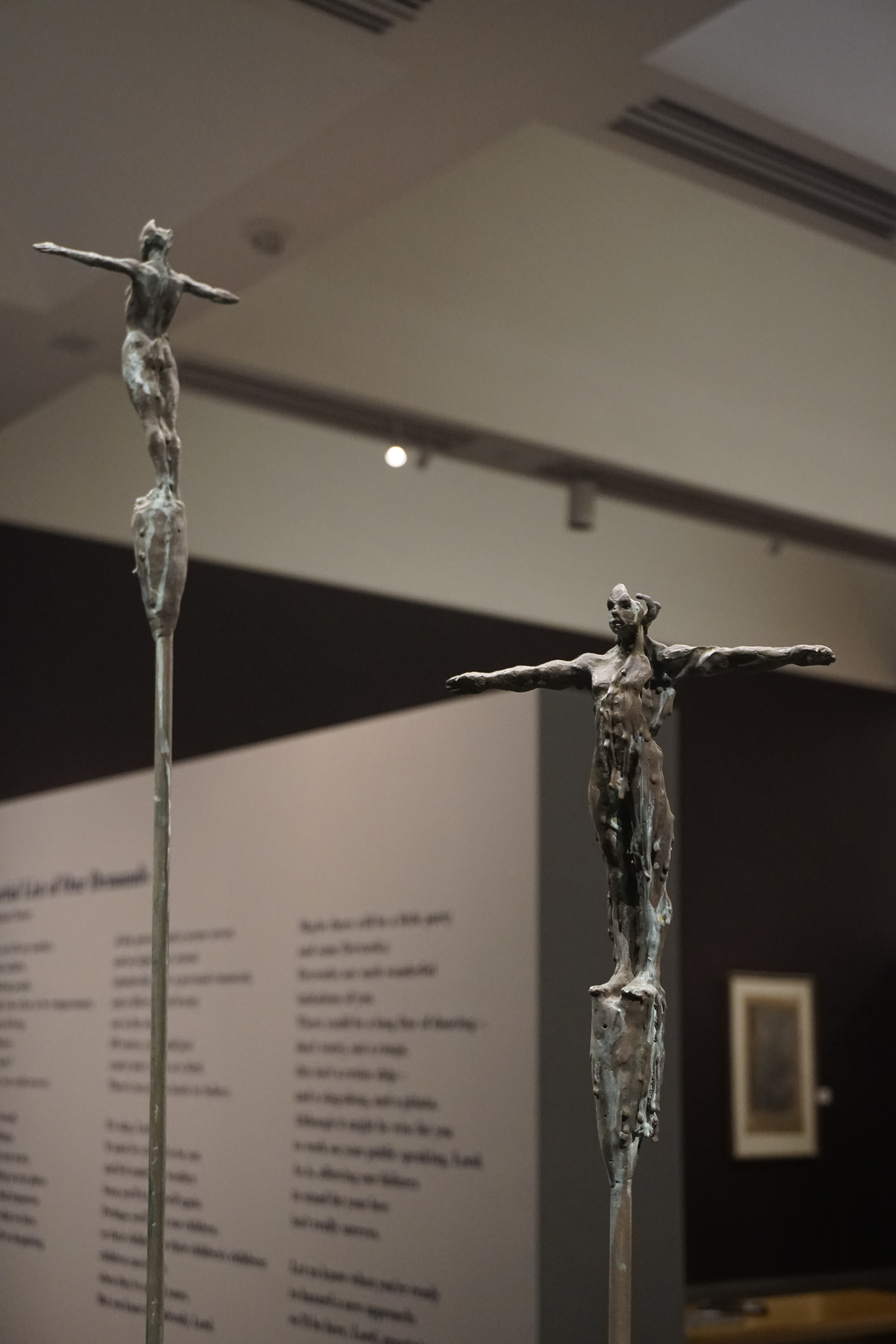
This was the first time I’ve seen Rouault’s entire Miserere (“Have Mercy”) series—all fifty-eight aquatints!—in one space, and it was stunning. Its display alongside Charlotte artist Gina Gilmour’s Break Your Guns and Stacy Lynn Waddell’s Untitled (Mike Brown’s Battle at Normandy) reinforces the theme of lament for violence and suffering inherent in all three. In the same room the set of small bronze crucifixes by Elizabeth Turk, which in their original gallery installation in 2002–03 contained lit candles in the hollows of the heads, invite further reflection on death, subtly connecting (through strategic placement) Christ’s crucifixion with the “crucifixions” of those slain in the past century through acts of war, gun violence, and police brutality.
Installation view: “Wrestling the Angel,” Bechtler Museum of Modern Art, Charlotte, North Carolina, 2018. Left: Prints from Georges Rouault’s Miserere series, 1927. Right: Break Your Guns by Gina Gilmour, 1980. Photo: Victoria Emily Jones.
Elizabeth R. Turk (American, 1961–), untitled bronzes from Poppyfields, 2002–03. Installation view: “Wrestling the Angel,” Bechtler Museum of Modern Art, Charlotte, North Carolina, 2018. Photo: Victoria Emily Jones.
Romare Bearden (American, 1911–1988), The Annunciation, ca. 1967. Collograph, 11 3/4 × 15 1/2 in. (29.6 × 39.4 cm). Courtesy of Jerald and Mary Melberg. Photo: Victoria Emily Jones.
For other reviews of this exhibition, see those by Andy Smith and Barbara Schreiber. And word to the wise: avoid the last day, because it’s a Carolina Panthers NFL home game, and the stadium is right across the street from the museum. (I wish I had thought to check the schedule before I made the cumbersome trek last Sunday!)



 Art & Theology