Medieval roundup: Julian of Norwich, stained glass at York Minster, Jewish hymn from Andalusia, and more

PODCAST EPISODES:

>> “Jack’s Bookshelf: Julian of Norwich” with Dr. Grace Hamman, Pints with Jack: The “Jack’s Bookshelf” podcast series explores the authors and books that influenced the life and writings of C. S. Lewis. Hosted by David Bates, this episode covers Julian of Norwich (ca. 1343–after 1416), an English anchorite and mystic who authored what editors call Revelations of Divine Love or The Showings, the first English-language book by a woman. The most famous quote from this work is “Sin is behoovely, but all shall be well, and all shall be well, and all manner of thing shall be well.” Medieval scholar Grace Hamman [previously] unpacks the quote and discusses other key passages and themes from Julian, as well as what little we know of her biography. An excellent introduction!

>> “Ben Myers—The Divine Comedy,” Life with God: One of the many gifts my parents have given me over the years was a four-month study-abroad stay in Florence during my junior year of college, where one of my courses was devoted to reading and studying—in its original Italian and in the author Dante Alighieri’s hometown!—the masterful trilogy of narrative poems known as La Divina Commedia, or The Divine Comedy in English. Moving through hell, purgatory, and heaven, it is an allegory of the soul’s journey toward God. I enjoyed hearing Dr. Benjamin Myers [previously], director of the Great Books Honors Program at Oklahoma Baptist University, discuss this deeply influential work from the early fourteenth century, and sharing one of his own poems, “Listening to Reggae at the Nashville Airport.”

+++

VIRTUAL TOURS OF CATHEDRALS:

Cathedrals are, among other things, repositories of sacred art. I’m so appreciative of digitization initiatives that seek to make some of those treasures available to global publics online. Here are two admirable examples.

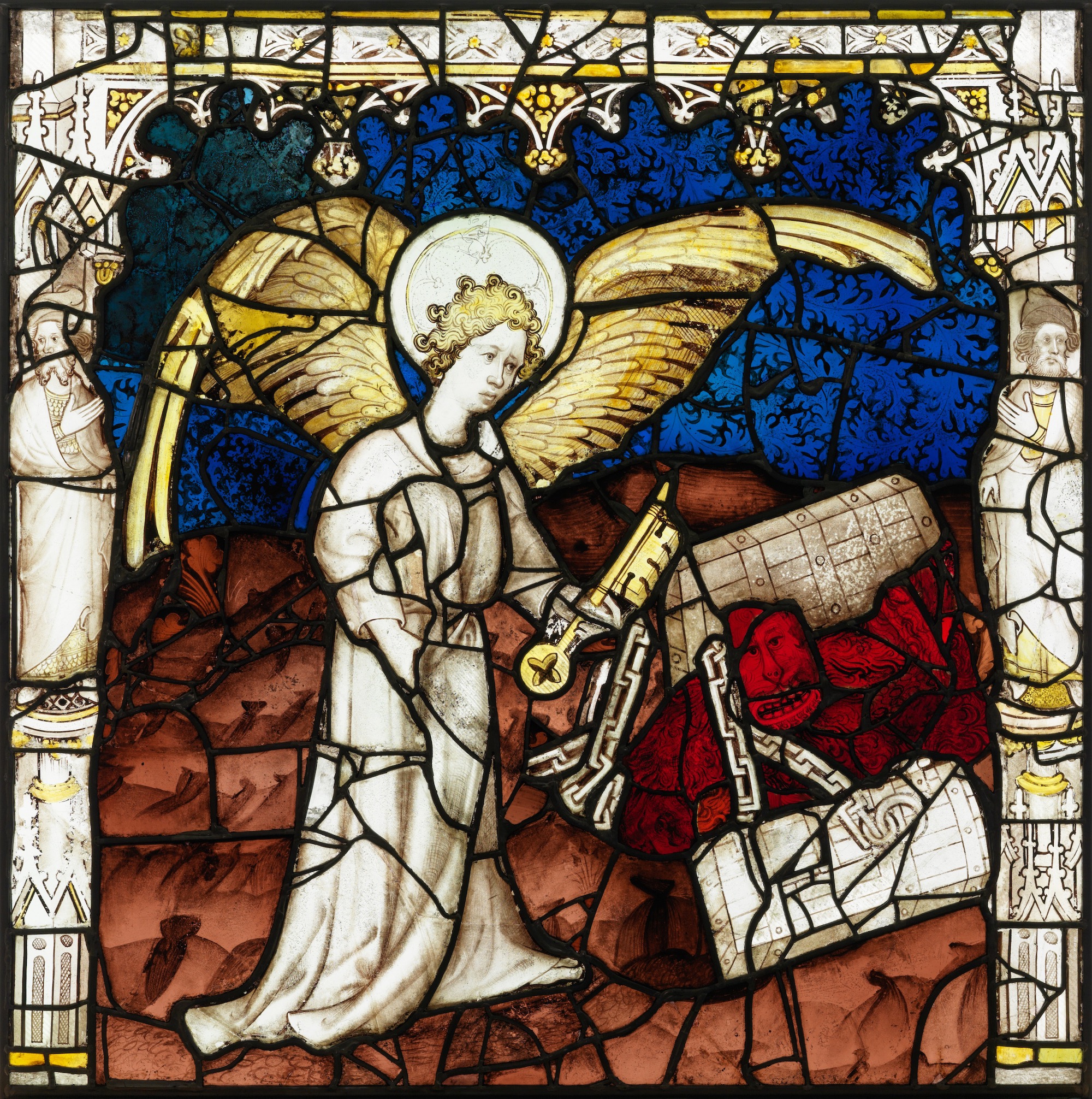
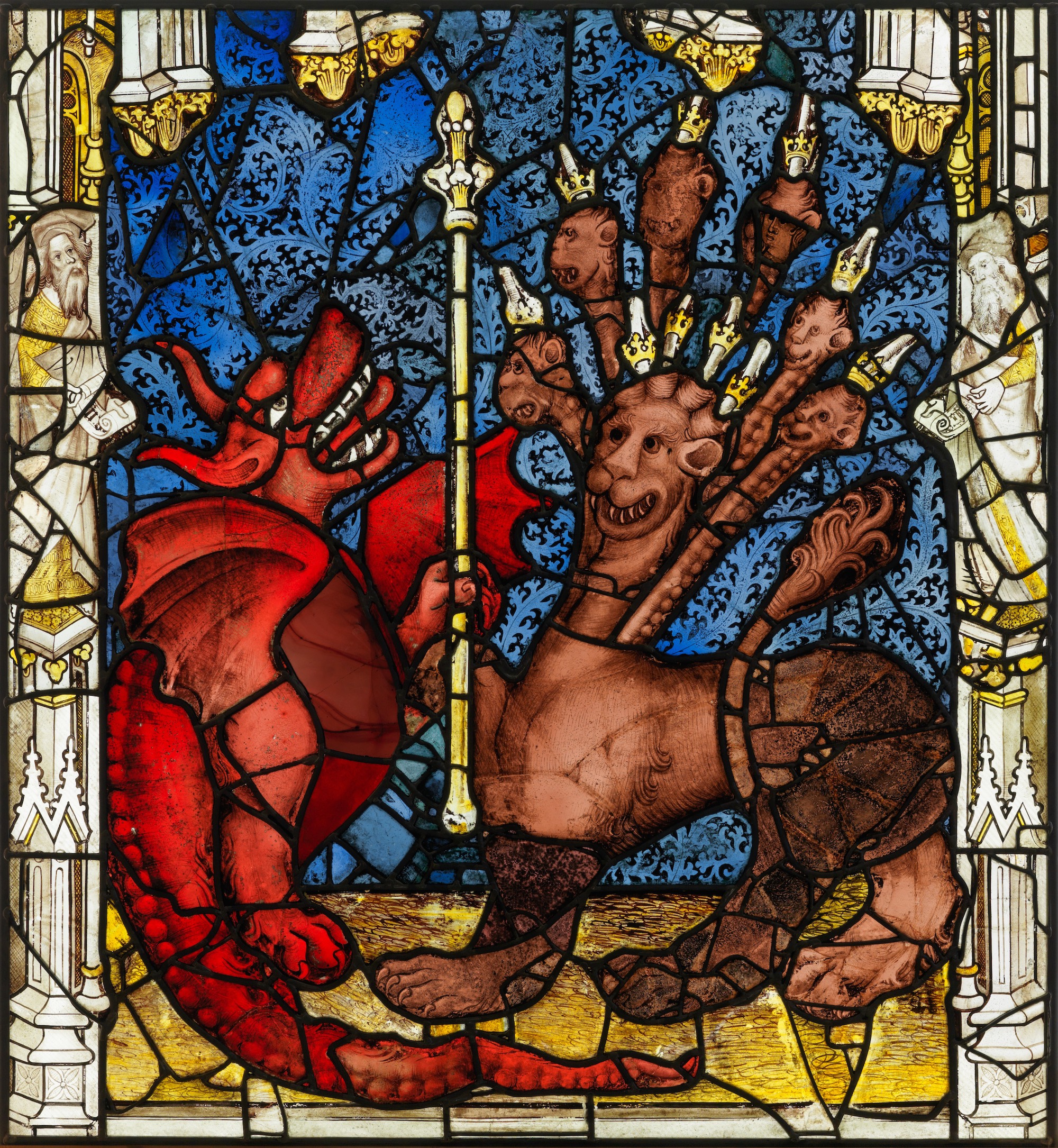
>> The York Minster Stained Glass Navigator: York Minster in northeastern England has the largest collection of medieval stained glass in the UK, with the earliest pieces dating from the late twelfth century. On behalf of the Chapter of York, the York Glaziers Trust is undertaking to photograph it all. These photos are available for viewing online through the cathedral’s “Stained Glass Navigator,” which enables you to hover over panels to identify the scenes, zoom in for higher resolution, and see where each panel in situated in the context of the window’s larger narrative.

I especially recommend exploring the extraordinary Great East Window, which depicts the beginning and the end of all things. The top section opens with the seven days of creation, followed by other select scenes from the Old Testament, but the bulk of the window—and my favorite sequence—consists of scenes from the book of Revelation. The bottom row depicts historical and legendary figures associated with the history of York Minster.
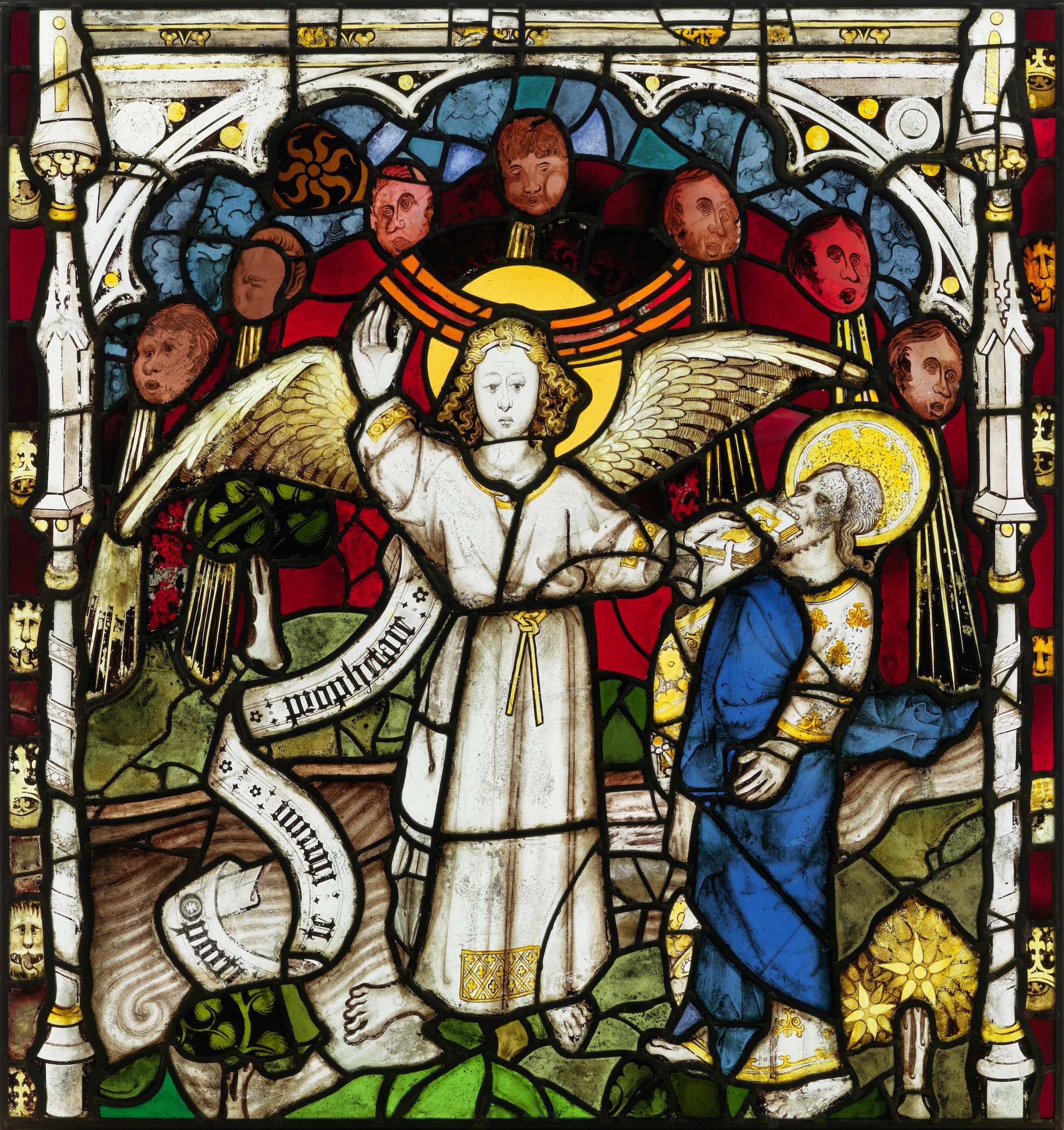
St. John takes the book from the angel (York)
John Thornton of Coventry (British, fl. 1405–1433), St. John Takes the Book from the Angel (Rev. 10:8–11), 1405–8. Stained glass panel from the Great East Window, York Minster, York, England. Photo courtesy of the York Glaziers Trust.

The Dragon gives power to the beast (York)
John Thornton of Coventry (British, fl. 1405–1433), The Dragon Gives Power to the Beast (Rev. 13:1–3), 1405–8. Stained glass panel from the Great East Window, York Minster, York, England. Photo courtesy of the York Glaziers Trust.

Satan chained in the bottomless pit (York)
John Thornton of Coventry (British, fl. 1405–1433), Satan Chained in the Bottomless Pit (Rev. 20:1–3), 1405–8. Stained glass panel from the Great East Window, York Minster, York, England. Photo courtesy of the York Glaziers Trust.

>> Life of a Cathedral: Notre-Dame of Amiens: Located in the heart of Picardy in northern France, Amiens Cathedral is one of the largest Gothic churches of the thirteenth century, renowned for the beauty of its three-tier interior elevation, its prodigious sculpted decoration, and its stained glass. This website put together by Columbia University’s Media Center for Art History offers a detailed virtual tour of the cathedral, drawing attention to its architectural features and artworks, from the many stone relief sculptures over its four portals (my favorite) to the octagonal labyrinth that adorns the marble floor in the nave to the early sixteenth-century misericords in the choir stall.
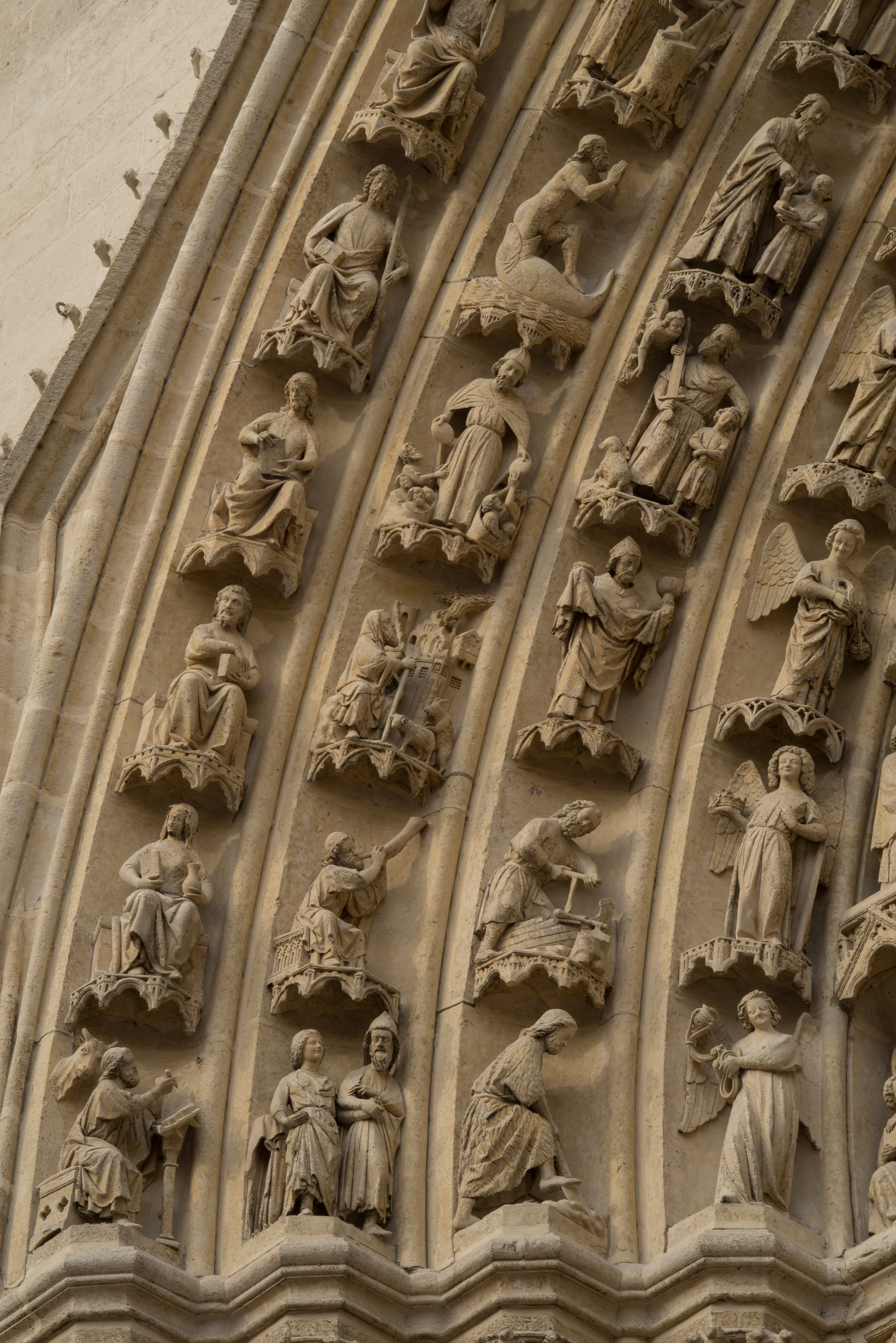
Voussoir close-up, Amiens Cathedral
Detail of voussoirs from the south transept portal of St. Honoré at Amiens Cathedral, ca. 1240, featuring Adam working the ground, Noah building the ark, Jonah being disgorged from the fish, Hosea marrying Gomer, and other biblical figures and vignettes

+++

SONG: “Adon Olam,” performed by the Maqamat Masters, feat. Nissim Lugas: The well-loved text of this traditional Hebrew prayer in five stanzas probably originated in medieval Spain, having been first found in a thirteenth-century siddur (Jewish prayer book) from Andalusia. Drawn from the language of the Psalms, it praises God for both his transcendence and his immanence. He is incomparably great, the ruler over all, and yet he’s also a personal God, a refuge for those who call on him. The prayer’s title and opening phrase translates to “Master of the Universe” or “Eternal Lord.”

Various tunes have been used for the singing of this prayer over the centuries. The Maqamat Masters perform it here with a melody based on the traditional Armenian folk tune NUBAR NUBAR, arranged by Elad Levi and Ariel Berli. They also add to the prayer a few lines from the ghazals of the Persian Sufi poet Saadi (1210–ca. 1292), about the burning fire of God’s love; Lugas sings this Farsi passage from 3:06 to 4:08.

“Maqamat Masters is a unique group of musicians that coalesced around their work together teaching at the Maqamat School of Eastern Music in Safed, Israel,” 12 Tribes Music writes. “Each of the musicians is a master in a different traditional musical genre from the Middle East, and they bring their personal voices and decades of explorations together, to create a magical, new and innovative sound.”

+++

VIRTUAL EXHIBITION: The Faras Gallery: Treasures from the Flooded Desert: In 1960, Faras, a small town in Sudan near the Egyptian border, was one of the archaeological sites designated for flooding by the waters of the Nile to create Lake Nasser. Responding to an international call by UNESCO to preserve the area’s cultural heritage before it would be buried beneath the new reservoir, a Polish team led by Professor Kazimierz Michałowski proceeded with salvage excavations in 1961–64. Their efforts uncovered the wonderfully preserved ruins of a medieval cathedral, active from the eighth to fourteenth centuries (it was built on the remains of an early seventh-century church) and containing over 150 religious paintings, a trove of Nubian Christian art. By agreement with Sudan, half of the findings went to Poland’s National Museum in Warsaw, while the other half are kept in Sudan’s National Museum in Khartoum.


Nubian Madonna and Child
Wall Painting with Bishop Marianos under the protection of Christ and the Mother of God, early 11th century, excavated from Faras Cathedral in modern-day Sudan. Secco tempera on plaster, 247 × 155.5 cm. National Museum, Warsaw.

Excavation of Faras Cathedral

Curated by Paweł Dąbrowski and Magdalena Majchrzak and hosted by Google Arts & Culture, this virtual exhibition spotlights the wall paintings and artifacts from Faras that are housed in Warsaw. It discusses the importance of the discovery of the cathedral and the technical challenges of detaching the paintings (tempera on dry mud plaster) from the walls. It also includes digital reconstructions of the cathedral’s interior and exterior in 3D stereoscopy, as well as video elements. Here is one of the four videos from the exhibition:

Easter, Day 5: Glory to the Risen Lamb!

Then I saw in the right hand of the one seated on the throne a scroll written on the inside and on the back, sealed with seven seals, and I saw a mighty angel proclaiming with a loud voice, “Who is worthy to open the scroll and break its seals?” And no one in heaven or on earth or under the earth was able to open the scroll or to look into it. And I began to weep bitterly because no one was found worthy to open the scroll or to look into it. Then one of the elders said to me, “Do not weep. See, the Lion of the tribe of Judah, the Root of David, has conquered, so that he can open the scroll and its seven seals.”

Then I saw between the throne and the four living creatures and among the elders a Lamb standing as if it had been slaughtered, with seven horns and seven eyes, which are the seven spirits of God sent out into all the earth. He went and took the scroll from the right hand of the one who was seated on the throne. When he had taken the scroll, the four living creatures and the twenty-four elders fell before the Lamb, each holding a harp and golden bowls full of incense, which are the prayers of the saints. They sing a new song:

You are worthy to take the scroll
    and to break its seals,
for you were slaughtered and by your blood you ransomed for God
    saints from every tribe and language and people and nation;
you have made them a kingdom and priests serving our God,
    and they will reign on earth.

Then I looked, and I heard the voice of many angels surrounding the throne and the living creatures and the elders; they numbered myriads of myriads and thousands of thousands, singing with full voice,

Worthy is the Lamb that was slaughtered
to receive power and wealth and wisdom and might
and honor and glory and blessing!

Then I heard every creature in heaven and on earth and under the earth and in the sea and all that is in them, singing,

To the one seated on the throne and to the Lamb
be blessing and honor and glory and might
forever and ever!

And the four living creatures said, “Amen!” And the elders fell down and worshiped.

—Revelation 5 (NRSV)

LOOK: The Vision of the Lamb in the Midst of the Four Living Creatures, from a medieval English apocalypse

Lamb Upon the Throne (Getty)
The Vision of the Lamb in the Midst of the Four Living Creatures and the Twenty-Four Elders, made in London, ca. 1255–60. Tempera, gold leaf, colored washes, and pen and ink on parchment, 12 9/16 × 8 7/8 in. (31.9 × 22.5 cm). J. Paul Getty Museum, Los Angeles, Ms. Ludwig III 1 (83.MC.72), fol. 5.

LISTEN: “Glory to the Risen Lamb!” | Words compiled by Jean Anne Shafferman, 2007, from traditional sources (William Saunders and Hugh Bourne, 1821; Job Hupton, 1805; F. R. Warren, 1878) | Tune: INVITATION (New), from William Walker’s Southern Harmony, 1854 | Performed by musicians at Byford Parish Church, Georgetown, Massachusetts, 2020

Hear the gospel news resounding: “Christ has suffered on the tree;
streams of mercy are abounding; grace for all is rich and free.”

Refrain:
Hallelujah, hallelujah! Glory to the Risen Lamb!
Hallelujah, hallelujah! Glory to the great I AM!

Grace is flowing like a river from the Savior’s wounded side.
Still it flows as fresh as ever; all may live, for Christ has died. [Refrain]

On the cross for our redemption, see him all his lifeblood pour!
There he wins our full salvation, dies that we may die no more. [Refrain]

Advent, Day 17: When Morning Dawns

LOOK: Alpha and Omega by Larain Briggs

Briggs, Larain_Alpha and Omega
Larain Briggs (British, 1960–), Alpha and Omega, 2019. Oil over acrylic underpainting on stretched canvas, 100 × 100 cm.

“Behold, I am coming soon. . . . I am the Alpha and the Omega, the first and the last, the beginning and the end.”

—Revelation 22:12–13

This apocalyptic landscape painting by British artist Larain Briggs was on display at London’s gallery@oxo as part of the 2021 Chaiya Art Awards exhibition “God Is . . .” Briggs’s creative practice is centered on Jungian theory, and in Alpha and Omega she addresses the current “metacrisis,” the complexity of global issues (ecological, cultural, economic, etc.) that interrelate and present an existential threat of unknown magnitude. “The archetypal imagery in the book of Revelation offers the means to understand and process the dark times in which we live,” Briggs told me.

In the exhibition catalog Briggs explains, “Although I perceived the painting to be a vision of the end, it is full of light and hope. The end can equally be viewed as a beginning.”

When I saw this work, I was intrigued. Its title evokes Jesus’s self-declaration in the book of Revelation as the first and the last, and visually, it appears that something significant is in process.

In the center of the composition a faint circular form rests on a heavily textured, curved platform of cloud and smoke (“Behold, he is coming with the clouds . . .” [Rev. 1:7]). At this focal point, turbulence resolves into tranquility and darkness gives way to light. I see the image as the earth being transfigured by the arrival of the King.

The body of water at the bottom may be a reference to the “sea of glass mingled with fire” in Revelation 15:2.

LISTEN: “The King Shall Come” | Words by John Brownlie, based on miscellaneous Greek sources, 1907 | Music: American folk tune from Kentucky Harmony, 1816; arr. Minna Choi, 2020 | Performed by Tiffany Austin, 2020

The King shall come when morning dawns
And light triumphant breaks;
When beauty gilds the eastern hills
And life to joy awakes.

Not as of old, a little child
To bear, and fight, and die,
But crowned with glory like the sun
That lights the morning sky.

O brighter than the rising morn,
When He victorious rose,
And left the lonesome place of death,
Despite the rage of foes;—

O brighter than that glorious morn
Shall this fair morning be,
When Christ, our King, in beauty comes,
And we His face shall see.

The King shall come when morning dawns
And earth’s dark night is past;—
O haste the rising of that morn,
That day that aye shall last.

And let the endless bliss begin,
By weary saints foretold,
When right shall triumph over wrong,
And truth shall be extolled.

The King shall come when morning dawns,
And light and beauty brings;—
Hail! Christ the Lord; Thy people pray,
‘Come quickly, King of kings.’

“The King Shall Come” expresses hopeful longing for the return of Christ, which will bring about a new and lasting morn and the final passing of “earth’s dark night.” Stanza 2 contrasts Jesus’s first coming in suffering and struggle and sacrifice, his glory mostly veiled, with his second, when his glory will be unmistakable, his rule uncontested. The victory of that day, the hymnist writes, will be even more exhilarating than that of Christ’s resurrection, because it is total.

This hymn was written in the early twentieth century by the Scottish Presbyterian minister John Brownlie (1859–1925), who cites inspiration from the hymns of the Greek Orthodox Church. It was originally published in 1907 in Hymns from the East. In the introduction Brownlie writes, “The hymns are less translations or renderings, and more centos and suggestions. . . . The Greek has been used as a basis, a theme, a motive.” He differentiates this approach from that used in his previous volumes, which contain “truthfully rendered translations from the originals.”

Though the hymn is often attributed to an anonymous ancient Greek writer, most scholars consider it an original text by Brownlie that reflects his wide knowledge of Greek hymnody, as no Greek original has ever been found. It’s possible that the lines are a composite and expansion of fragments found in the Greek, but really, it’s a pastiche that nods to the centrality of light in Orthodox theology. 

This wistful arrangement by City Church San Francisco worship arts assistant Minna Choi is performed by guest artist Tiffany Austin, a Bay Area jazz vocalist. The other musicians are Adam Shulman on piano, Jeff Marrs on drums, Jason Muscat on bass, and Wil Blades on organ. Their version omits stanzas 5–6, as do several hymnals.

For more Advent songs from City Church, see “Come, Oh Redeemer, Come,” “Come Light Our Hearts,” “I Wait,” and (from the kids in the congregation!) “O Come, Messiah, Come.” For Christmas music, see the church’s past Lessons and Carols services on YouTube; last year I did a write-up on the one from 2020.

Advent, Day 26

For as the lightning comes from the east and flashes as far as the west, so will be the coming of the Son of Man.

—Matthew 24:27

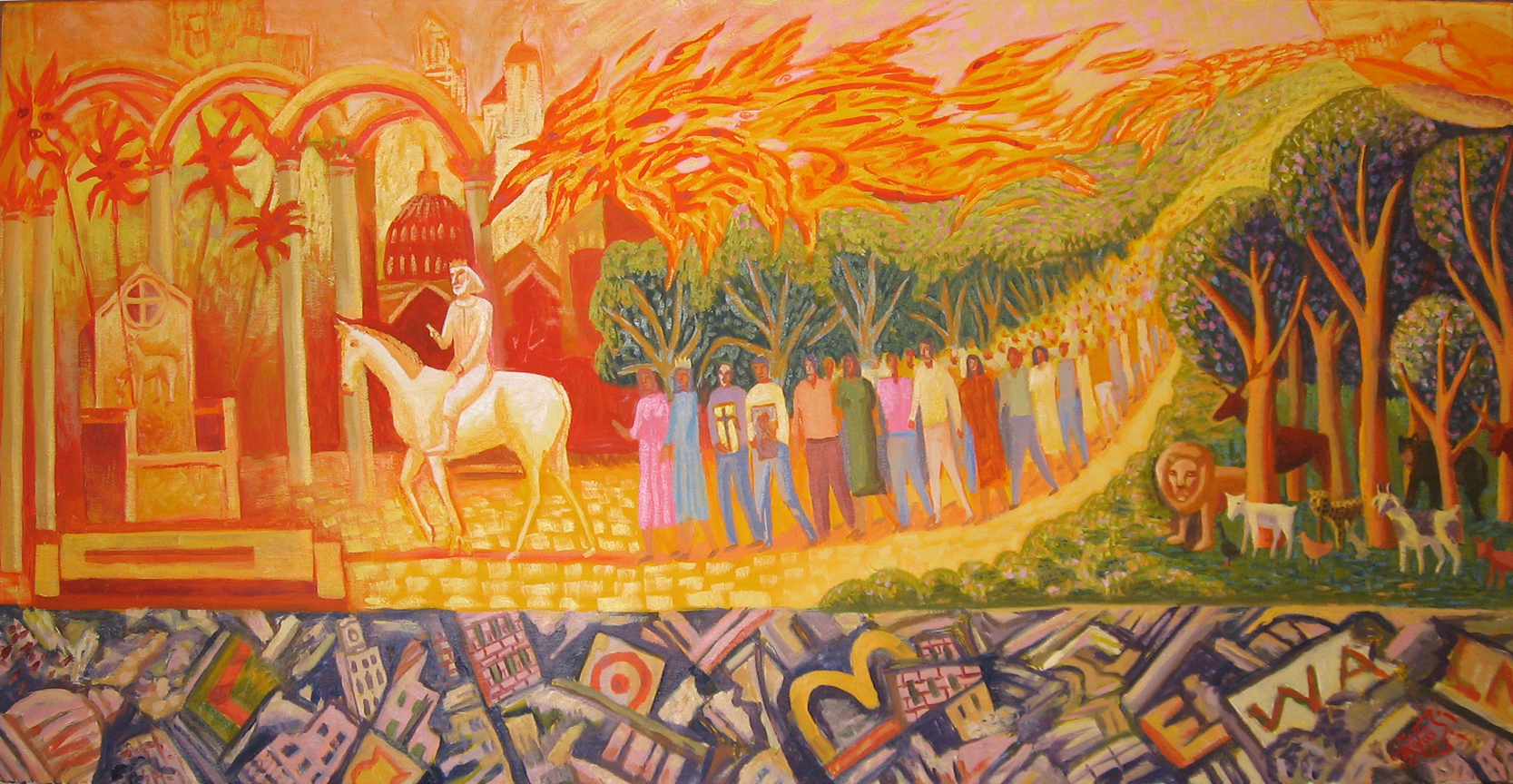
Then I saw heaven opened, and there was a white horse! Its rider is called Faithful and True, and in righteousness he judges and makes war. His eyes are like a flame of fire, and on his head are many diadems; and he has a name inscribed that no one knows but himself. He is clothed in a robe dipped in blood, and his name is called The Word of God.

—Revelation 19:11–13

LOOK: Jesus Rides a White Horse by James B. Janknegt

Janknegt, James B._Jesus Rides a White Horse
James B. Janknegt (American, 1953–), Jesus Rides a White Horse, 2012. Oil on canvas, 18 × 36 in.

LISTEN: “Ride On, King Jesus,” African American spiritual | Performed by Olivet Nazarene University Proclamation Gospel Choir, 2018

Because this song was composed and transmitted orally, many lyrical variations exist. The lyrics used in this particular rehearsal are as follows:

Ride on, King Jesus!
No man can a-hinder thee
Ride on, King Jesus!
No man can a-hinder thee

In that great gettin’-up morning
Fare thee well, fare thee well!
In that great gettin’-up morning
Fare thee well, fare thee well!

Gonna talk about the coming of the Savior
Fare thee well, fare thee well!
Gonna talk about the coming of the Savior
Fare thee well, fare thee well!

Lightning will be flashing
Thunder will be rolling
Trees will be bending

No man can a-hinder thee!

Advent, Day 16

And I saw the holy city, the new Jerusalem, coming down out of heaven from God, prepared as a bride adorned for her husband. And I heard a loud voice from the throne saying,

“See, the home of God is among mortals.
He will dwell with them;
they will be his peoples,
and God himself will be with them;
he will wipe every tear from their eyes.
Death will be no more;
mourning and crying and pain will be no more,
for the first things have passed away.”

And the one who was seated on the throne said, “See, I am making all things new.”

—Revelation 21:2–5a

LOOK: The New Jerusalem by Sassandra

Sassandra_The New Jerusalem
Jacques Richard Sassandra (French, 1932–), The New Jerusalem (Rev. 21:1–4a), 1970–80. Paper collage with AquaLac, 86 × 110 cm.

Jacques Richard, whose artist name is Sassandra, was born in 1932 to a French missionary family in Sassandra, Ivory Coast, where he spent his youth. Upon returning to France, he studied art, followed by theology, and soon became an art teacher in Paris public schools while also maintaining a studio art practice of drawing, painting, collaging, and woodblock printing.

This image is the last of thirty-four collages in his Apocalypse series, compiled in the beautifully produced book Apocalypse: A travers le dernier livre de la Bible | Bilder zum letzten Buch der Bibel (Pictures from the Last Book of the Bible) (1980), with text from Revelation in French and German. View selections from the book at http://galeriesassandra.fr/Apocalypse/index.html.

It shows the hands of God lovingly lowering the heavenly city to earth—the two realms reunited at last. The cross is at the center, forming the trunk of the tree of life, and the Holy Spirit spreads her wings over all.

[Related post: “Grief and Loss Will Be Undone (Artful Devotion)”]

LISTEN: “New World Coming” by Barry Mann and Cynthia Weil, 1969 | Performed by Nina Simone on Here Comes the Sun, 1971

There’s a new world comin’
And it’s just around the bend
There’s a new world comin’ (joy, joy, joy . . .)
This one’s comin’ to an end

There’s a new voice callin’
And you can hear it if you try
And it’s growing stronger
With every day that passes by (yeah, yeah, yeah . . .)

There’s a brand-new mornin’
Rising clear and sweet and free
There’s a new day dawning
That belongs to you and me

Yes, a new world’s comin’
You know the one I’m talking about
The one we’ve had visions of
And it’s comin’ in peace, comin’ in joy
Comin’ in peace, comin’ in joy
Come in peace, come in joy
Comin’ in love

And I saw another sign in heaven
Great and marvelous
Seven angels having the seven last plagues
For in them is filled up the wrath of God
And I saw, as it were, a sea of glass mingled with fire
And them that had gotten the victory over the beast
And over his image
And over his mark
And over the number of his name
Stand on the sea of glass
Having the harps of God all around them

There’s a new world comin’
And it’s just around the bend
There’s a new world comin’
This one’s comin’ to an end

There’s a new voice callin’
And you could hear it if you would just give it a try
And it’s growing stronger
With every day that passes by

And there’s a brand-new mornin’
Rising clear and sweet and free
There’s a new day dawning
That belongs to you and me

Yes, a new world’s comin’
The one we’ve had visions of

Comin’ in peace, yeah
Comin’ in joy, yeah
Comin’ in peace now, yeah
Comin’ in love now, yeah
Comin’ in peace now, yeah
Comin’ in joy now, yeah
Comin’ in peace now, yeah
Comin’ in love, yeah
Comin’ in peace . . .
Comin’ in joy . . .
Comin’ in love (joy)

This song, as you may have noticed, includes a recitation of Revelation 15:1–2:

Then I saw another portent in heaven, great and amazing: seven angels with seven plagues, which are the last, for with them the wrath of God is ended.

And I saw what appeared to be a sea of glass mixed with fire, and those who had conquered the beast and its image and the number of its name, standing beside the sea of glass with harps of God in their hands. (NRSV)

After a cosmic battle between good and evil, peace, love, and joy come to roost.