LOOK: Kiss of Judas by Viktor Dovnar

LISTEN: “Gethsemane…Lanterns, Torches, Weapons” by Paul Clark, on Approaching Jerusalem (2009)

LOOK: Kiss of Judas by Viktor Dovnar
LISTEN: “Gethsemane…Lanterns, Torches, Weapons” by Paul Clark, on Approaching Jerusalem (2009)
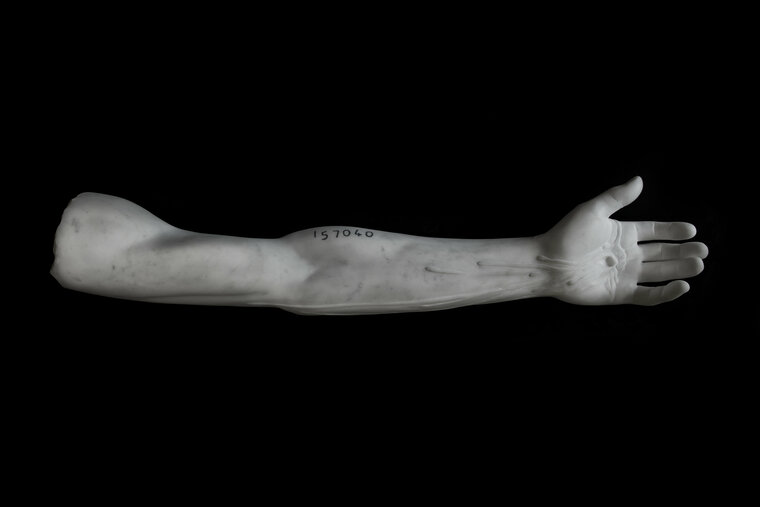
VISUAL MEDITATION: “Golgotha, Auschwitz, and the Problem of Evil” by Victoria Emily Jones: Last month for ArtWay I was asked to write about Emma Elliott’s Reconciliation, a sculpted marble arm that bears both a nail wound of Christ from his crucifixion and the number tattoo of Holocaust survivor Eliezer Goldwyn (1922–2017).
+++
ESSAY: “The church’s reception of Jewish crucifixion imagery after the Holocaust” by Andrew Williams, AGON 48 (Winter 2015): Can Jews create Christian art? “I seek to revisit this question by examining the ways in which Jewish artists have made reference to the central symbol of the Christian faith, the crucifixion, and consider the ethical and theological horizons they open up for the church. . . . Given its place as a symbol of oppression within Judaism, and in particular its integration with the swastika during the years of Nazi power, its widespread adoption within a Jewish artistic vocabulary is remarkable.” Williams discusses “how the resulting christological imagery has been freighted with meaning connected with collective suffering, personal grief and divine abandonment.”
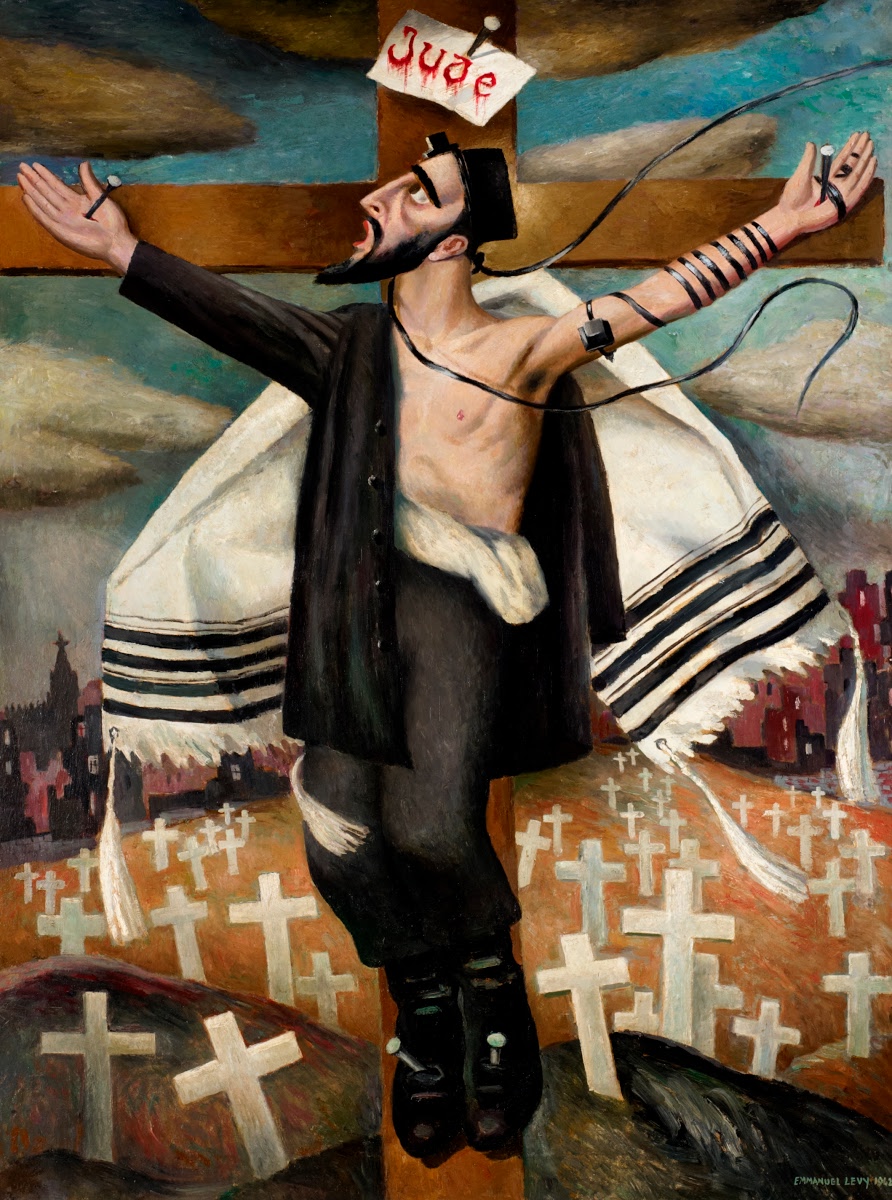
Jacob Epstein, Marc Chagall, Emmanuel Levy, RB Kitaj, Mauricio Lassansky, Abraham Rattner, Samuel Bak, Mark Rothko, Barnett Newman, Adi Nes, and Seymour Lipton are among the artists engaged in this illustrated essay. The author provides an extensive bibliography if you’d like to learn more. I also want to remind you of the excellent exhibition catalog essay “Behold the Man: Jesus in Israeli Art” that I shared back in 2017.
+++
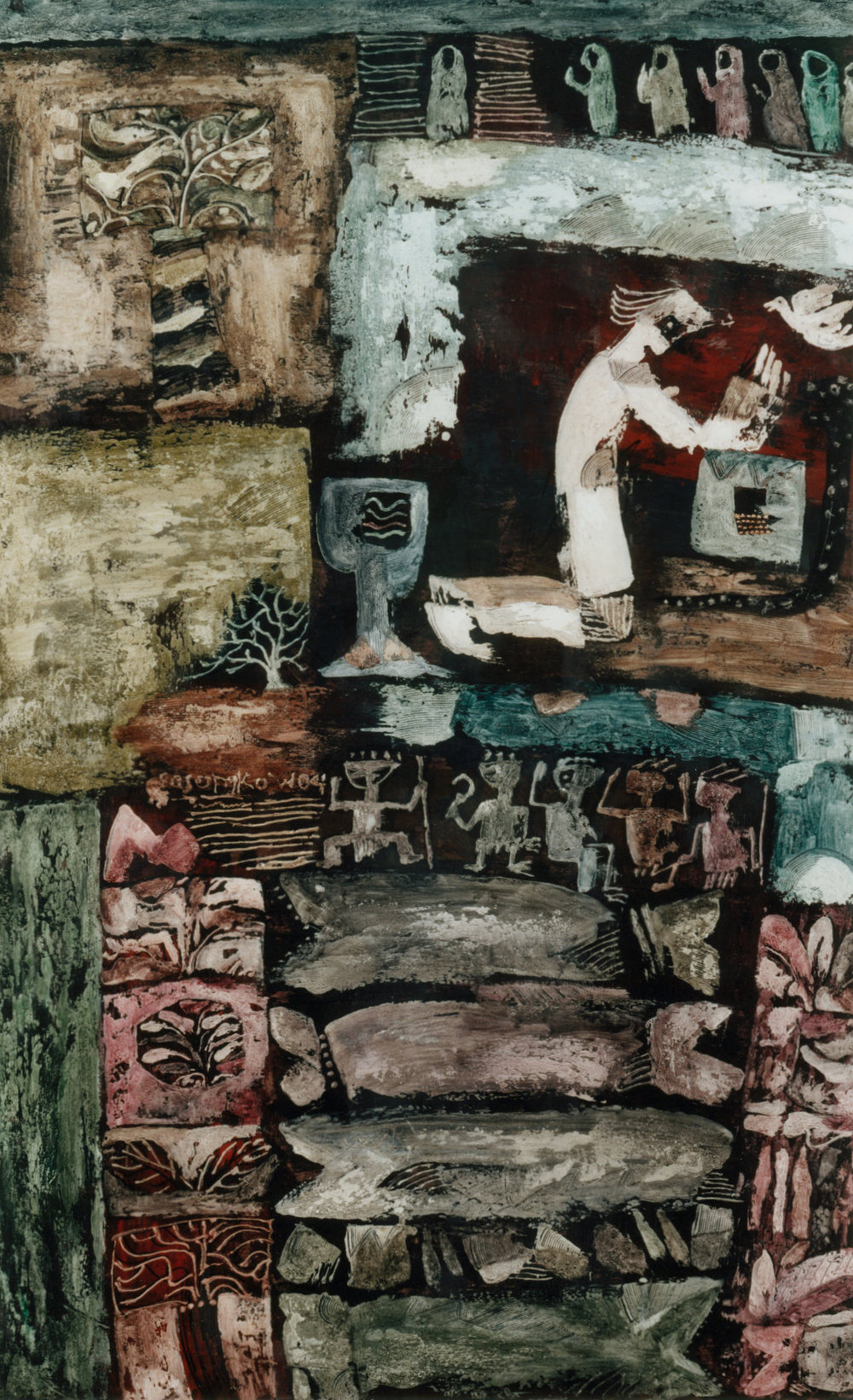
UPCOMING VIRTUAL EVENT: Studio Talk with Indonesian Artist Wisnu Sasongko, April 28, 2022, 8:30 a.m. ET: Organized by the Overseas Ministries Study Center at Princeton Theological Seminary, where Sasongko [previously] served as artist in residence in 2004–5. Cost: $15. Read the artist’s bio and see a sampling of his work at https://omsc.ptsem.edu/artist-sasongko/. There’s also a catalog of his paintings you can buy.
+++
ESSAY: “The Christian Art Scene in Yogyakarta” by Volker Küster: Published June 27, 2012, by Protestantse Theologische Universiteit (Protestant Theological University) in Kampen, Netherlands, this essay spotlights five Indonesian artists whose work culturally contextualizes the Christian story: Bagong Kussudiardja [previously], Hendarto, Hari Santosa, Dopo Yeihan, and Wisnu Sasongko. Küster provides biographical information on the artists, including their religious backgrounds (most are converts from Islam), and discusses three paintings by each, all of which are reproduced in full color.
Want to read more by Volker Küster? His chapter on “Visual Arts in World Christianity” in The Wiley Blackwell Companion to World Christianity is excellent, and some of it is available in the Google Books preview. See also his book The Many Faces of Jesus Christ: Intercultural Christology (Orbis, 2001).
+++
ART VIDEO: “Caravaggio’s Taking of Christ” (Great Art Explained): In 2020 art writer and gallerist James Payne launched the YouTube video series Great Art Explained, consisting of fifteen-minute videos that each explore a single historically significant artwork. Here’s one he did on an extraordinary painting of Caravaggio’s from the collection of the National Gallery of Ireland, which shows Judas’s betrayal of Christ in Gethsemane.
“Mormon painting of a black Eve draws fire, but not for the reasons you might think” by Peggy Fletcher Stack, Salt Lake Tribune: Early this year a new painting of a seminude black Eve by Mormon artist J. Kirk Richards went on display at Writ & Vision gallery in Provo, Utah. While many Mormons have expressed how captivated and inspired they are by it (and I should note, black figures are extremely rare in Mormon art), a few have insisted it’s wrong for a white man to depict a nude black woman because it conjures up collective memories of sexual brutality and enslavement. The article features some interesting perspectives by black Mormon feminists. In addition to raising important questions surrounding racial histories and representation, the painting, I’ve noticed, also illustrates a distinctly Mormon view of the Fall, which differs from the orthodox Christian view—a fact Richards alludes to in his March 14 gallery talk. View the painting.
+++
“A Conversation about Creativity and the Liturgical Calendar,” panel discussion presented by Brehm Center and Fuller Studio: Moderator Edwin M. Willmington, composer-in-residence at Fuller Theological Seminary, talks with an all-star trio of creatives and liturgists comprising David Gungor of The Brilliance [00:50], on authenticity in songwriting and introducing liturgical practices to the evangelical church he attended; Todd E. Johnson [10:40], on the history, purpose, and major observances of the church calendar; and Lauralee Farrer [26:18], on discovering the Canonical Hours in a New Mexico desert and later developing them into characters for a film project. Questions: [34:02] How has liturgy shaped you? [36:20] Advice for artists on how to bring the church year to bear in their art? [37:11] Have you found that lament is generally embraced or resisted? [39:41] Advice for worship leaders?
+++
“An Art Historical Perspective on the Baton Rouge Protest Photo that Went Viral” by An Xiao Mina and Ray Drainville, Hyperallergic: During a July 10 protest following the fatal killing of Alton Sterling, Reuters photographer Jonathan Bachman captured the moment of twenty-eight-year-old Ieshia L. Evans’s arrest. As heavily armored policemen pressed in, the other protestors dropped back, but Ieshia stood assuredly in the middle of the three-lane highway, prepared to be bound. This article lauds the strength of this image of confrontation by citing compositionally and thematically similar paintings, including Briton Riviere’s Daniel in the Lion’s Den and Giotto’s The Arrest of Christ, and other works of art.
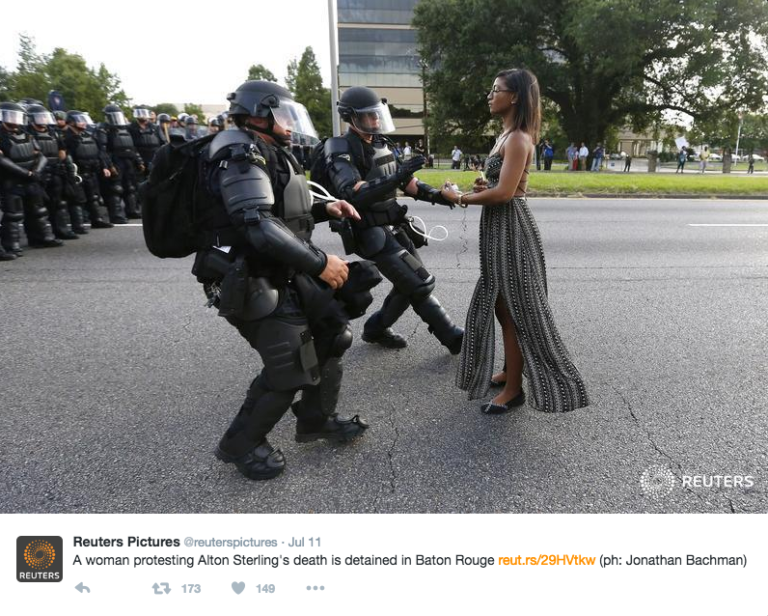
Ieshia considers herself a vessel of God, eager to be used by him to bring justice and peace. Here’s what she wrote on her Facebook wall the night of her release from jail:

+++
“Things Unseen: Vision, Belief, and Experience in Illuminated Manuscripts”: Running through September 25 at the Getty Center in Los Angeles, this exhibition “explores the visual challenges artists faced as they sought to render miraculous encounters with the divine, grand visions of the end of time, the intricacies of belief, and the intimate communications of prayer.” It includes a September 15 talk, “How Do We Depict Religious Experiences?”—that is, how do we convey metaphysical essence in physical form? I appreciated the Getty’s blog post this week featuring a newly acquired choir book leaf that’s part of the exhibition. Curator Bryan C. Keene writes about the difficulties of identifying the illuminator and about discovering, through an examination of the back and a search on the Cantus database, that the illumination depicts the wiping of tears from saints’ eyes, not, as previously assumed, the healing of the blind.

+++
“Ya Hey” song cover by The Brilliance: Written by Ezra Koenig of Vampire Weekend, “Ya Hey” is a modern-day psalm that expresses frustration with God’s seeming unresponsiveness—to being spurned and being sought, to brokenness and suffering, to sin and struggle. The title is a play on the word Yahweh, the Hebrew name for God. The chorus references the burning bush of Exodus 3: “Through the fire and through the flames / You won’t even say your name / Only ‘I am that I am.’” The Brilliance’s acoustic cover of “Ya Hey” was released last month as a music video on YouTube featuring four New York City ballet dancers. It abandons the shrill vocoder and heavy percussion of the original song in favor of a softer, purer sound. Read the lyrics and an analysis at Sound: Interrupted.
 Art & Theology