Not only are humans tired and stressed and in need of deliverance; so is the environment. Today’s two featured works function as a call to care for the earth—the one a performative enactment of said care, tender and consoling, and the other an urgent lament by choir.
The gospel is for more than just humanity; it’s for all the earth—animals and insects, plants and soil, skies and oceans. All creation groans for redemption, Paul says in his letter to the early church in Rome. And in the final book of the Bible, John the Revelator’s vision is of the whole world renewed.
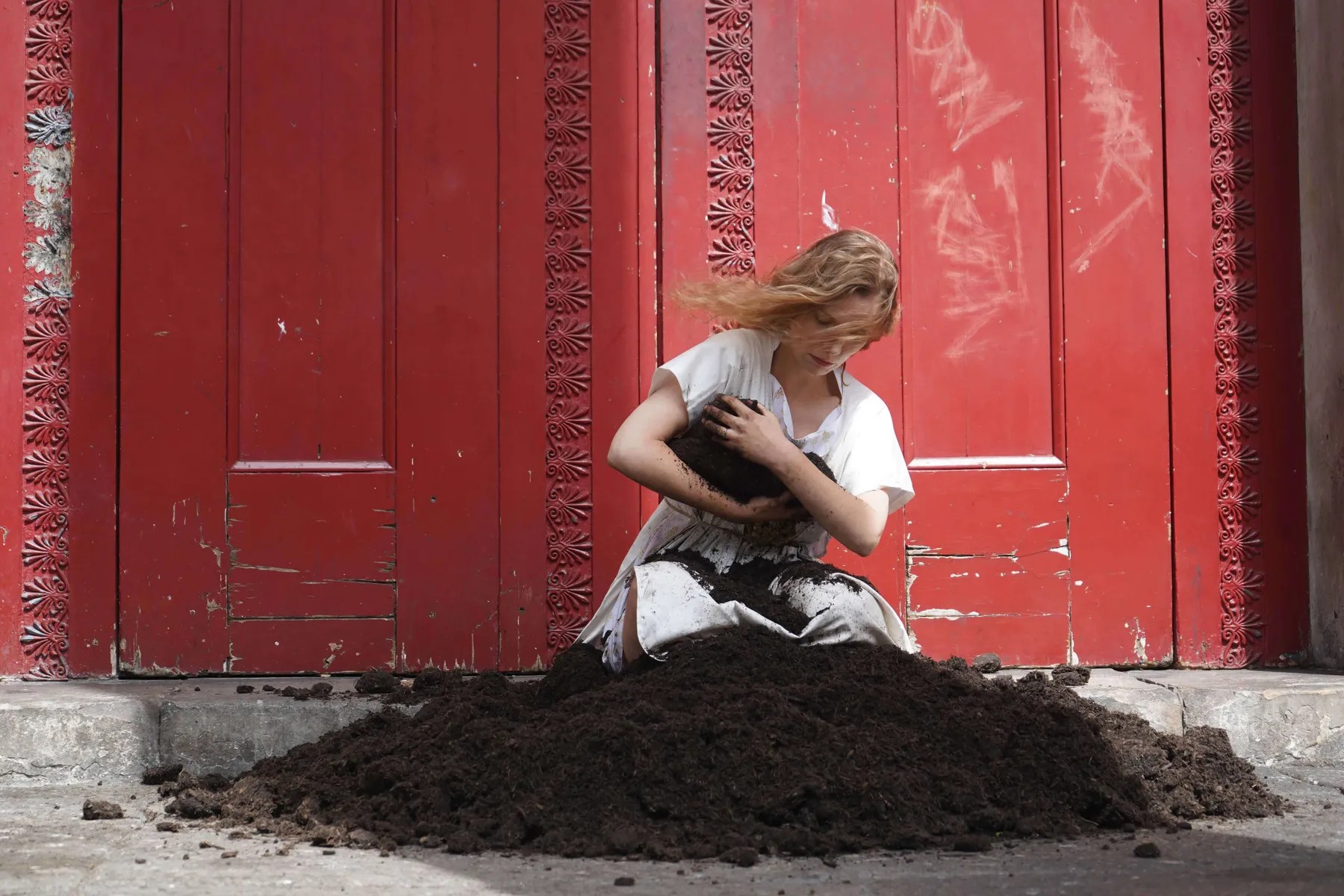
LOOK: Earth Rite by Holly Slingsby
Holly Slingsby (British, 1983–), Earth Rite, performance at St Pancras Church, London, July 6, 2024. Duration: 1 hour. Photo: Adam Papaphilippopoulos.
Artist Holly Slingsby’s Earth Rite premiered at the Ritual/Bodies live performance event that took place at St Pancras Church in London on July 6, 2024, organized by Dr. Kate Pickering. It was one of eight performance works by eight different artists (one work was by two performers; two works were by one) that collectively spanned some three hours, followed by a ninety-minute panel discussion.
In Earth Rite, “a solo performer sits atop a mound of earth, cradling it in her arms. The earth slips away only to be regathered, in a continuous act of generating, losing, and regenerating.” Charles Pickstone, an Anglican priest, reviewed the work in the Autumn 2024 issue of Art + Christianity journal, writing:
Holly Slingsby, in a loose white dress, sat on the church steps on a mound of rich soil, arms folded in embrace. Where one might have expected a baby, the artist was embracing armfuls of soil, constantly replenishing her burden as the soil slipped away from her. Part earth mother, part mourner, on the edge of the busy and noisy Euston Road, the artist made what could have been rather a moralistic revisiting of a well-known theme (compare William-Adolphe Bouguereau’s Charity, perhaps an influence on this work) into a courageous and compelling glimpse of the earth’s abused and vulnerable soil.
Slingsby reprised the performance on September 27, 2025, at the International Forum of Performance Art in Drama, Greece.
LISTEN: “Kasar mie la Gaji” (The Earth Is Tired) by Alberto Grau, 1987 | Performed by Stellenbosch University Choir, dir. André van der Merwe, 2024
“Kasar mie la gaji” is a Hausa saying from the Sahel region of Africa that means roughly “The earth is tired.” In 1987 leading contemporary Venezuelan composer Alberto Grau (b. 1937) set it to music, creating a magnetic choral composition for, in his words, “an international mobilization to save THE EARTH.”
In their performance notes, the Stellenbosch University Choir from South Africa writes: “The composition is designed on hypnotic repetition, with a steady reiteration of the text. Plaintive glissandos and layered ostinato patterns create a compelling chant, begging for justice and rebirth.”
Kathy Romey, the director of choral activities at the University of Minnesota, offers further description:
The work is broken into three distinct sections, of which the first and third incorporate short melodic motives combined with rhythms from traditional South American dance music intensified by clapping and stomping. The middle section is a slow lament and utilizes various special effects for a cappella chorus, including glissandi, whispering, talking, and hissing.
Why is the earth tired? Because we are depleting her resources. We are disrupting her ecosystems. The carbon emissions from our burning of fossil fuels for energy and transportation are trapping heat in her atmosphere and causing extreme weather.
Lord, have mercy. Please help us restore our planet to health and treat her with respect, recognizing that she, as part of your creation, is precious to you.
Have you been delighted or inspired by the Art & Theology blog this year or its Instagram offshoot, @art_and_theology? If so, please consider donating to the work through a secure online form or PayPal, or by buying me a book from my Amazon wish list (my address is privately stored). Thank you to my five regular monthly supporters, and others who have blessed me with one-off donations of funds and books. These gifts not only provide important material assistance but also serve as an emotional boost, a validation that my work has value and is worth continuing.
My blog-related expenses this year have included a replacement of my old laptop, a conference registration and travel fees, a trip to New York, museum admissions, books, licensing fees for two images (I occasionally pay for images when good photos are not available online), and the yearly WordPress Premium fee to keep this site ad-free and mapped to a custom domain. Donations will go toward covering these, and if there is any left over, toward a new camera lens that will enable me to take wider shots, great for cathedrals and for larger artworks in tight quarters.
SPOTIFY PLAYLIST: October 2024 (Art & Theology): Every month I create a digital mixtape of Christian and Christian-adjacent music that deserves attention, consisting of old and brand-new recordings alike. Two hours of beautiful, soulful expressions of praise, prayer, and lament for your ears and heart.
+++
VIDEO: Animal Service at Ely Cathedral: On September 22, Ely Cathedral in England held its annual animal service, attended by some 450 animal lovers and their pets and service animals, mainly dogs. “Our annual Animal Service is an opportunity to give thanks for the animal companions with whom we share our lives and our planet, to bring them into our Cathedral, to ponder how best to care for animals and to ask God to bless them.” Marley the donkey, from the Donkey Sanctuary, led a procession up the nave. The liturgy was led by Canon James Garrard, and, in addition to several congregational hymns, including “All Creatures of Our God and King,” the cathedral’s children’s choir, the Ely Imps, sang “The Barnyard Song” by Rhonda Gowler Greene and “Look at the World” by John Rutter.
In addition to a special prayer of confession, act of commitment, and benediction, the service included this litany from the Book of Common Prayer:
God said, “Let the waters bring forth living creatures, and let birds fly across the sky.”
We thank you for the teeming life of the seas, And the flight of the birds. Help us to protect the environment So that all life may flourish. God of life: Hear our prayer.
God said, “Let the earth bring forth living creatures of every kind.”
We rejoice in the variety of animal life. Grant us grace to treat all animals with respect and care; To protect endangered species, To preserve the variety of habitats, And to honor the delicate balance of nature. God of life: Hear our prayer.
Heavenly Father, you have filled the world with beauty. Open our eyes to behold your gracious hand in all your works, That, rejoicing in your whole creation, We may learn to serve you with gladness, For the sake of him through whom all things were made, Jesus Christ our Lord. God of life: Hear our prayer.
Two volunteer representatives from the charity Medical Detection Dogs were invited to share about the work of dogs who are trained to detect the odor of human disease.
Several churches worldwide hold animal services around this time of the year, the Feast of St. Francis (known for his love and care of animals) being on October 4. These are usually in addition to the regular Sunday morning worship service and are not eucharistic. UMC’s Discipleship Ministries provides a sample liturgy for “A Service for the Blessing of Animals.” Many such services are held outdoors, such as the one organized annually by Washington National Cathedral, which is taking place this Sunday, October 6, at 2 p.m.
>>“There’s a Special Providence”by Seth Wieck, Texas Poetry Assignment:Seth Wieck [previously] is a writer from Amarillo, Texas. Published the week of the last US presidential inauguration, this poem muses on the impermanence of earthly empires, contrasting such with the steady, indifferent labor of birds, which continues on through administration changes and the passing of generations. The title and opening line are a clever rhyming twist on a line from the final act of Shakespeare’s Hamlet, “There’s a special providence in the fall of a sparrow.” For the poetic speaker, there’s a sense of comfort in God’s sovereignty and an orientation toward Christ’s lordship that puts election poll results, though not negligible, in proper perspective.
In a Substack post from February 2021, Wieck wrote, “I am no politician’s acolyte; they’re public servants, not saviors. I catch some heat in private conversation when I say that I couldn’t care less about national politics. That’s not a true statement, but the tense conversations in which I claim my ambivalence usually leave me no room for nuance. Those conversations demand my total wide-eyed attention to the firehouse of information being created by national elections. But as Mary Oliver said, ‘The beginning of devotion is attention.’ Forgive me if I am unwilling to develop devotion for those people whose only interest in my community is the exploitation of our devotion and resources.”
>> “Jesus Heals a Paralytic” by Ryan Keating, Reformed Journal: Ryan Keating is a pastor on the Mediterranean island of Cyprus (he preaches in Turkish and English), an academic writer and poet, and the owner of Exile Coffee and Wine. This poem retells the miracle from Mark 2:1–12 in the voice of the paralyzed man whom Jesus heals. Whereas many artists depict the episode with ropes used as a lowering mechanism, Keating says it’s much more likely, given the typically low ceilings of Middle Eastern homes, that the man would have been received by “a net of hands” raised up by the people in the room.
The poem repeats the word “temple” three times, remarking how the man was “suspended / in a temple by a temple / and landed on holy ground / as a temple . . .” The temple is the place where the crowd is gathered because Jesus is in it, and the four faith-filled friends who bring the paralyzed man there themselves constitute a temple, and the man too becomes a temple, a dwelling-place of God, after being made whole by Jesus. Drawing on Old Testament imagery of the garden of Eden and the exodus, the final stanza is one of restoration. The sea of people parts as the man steps outside into a garden, his friends buoyed by amazement.
+++
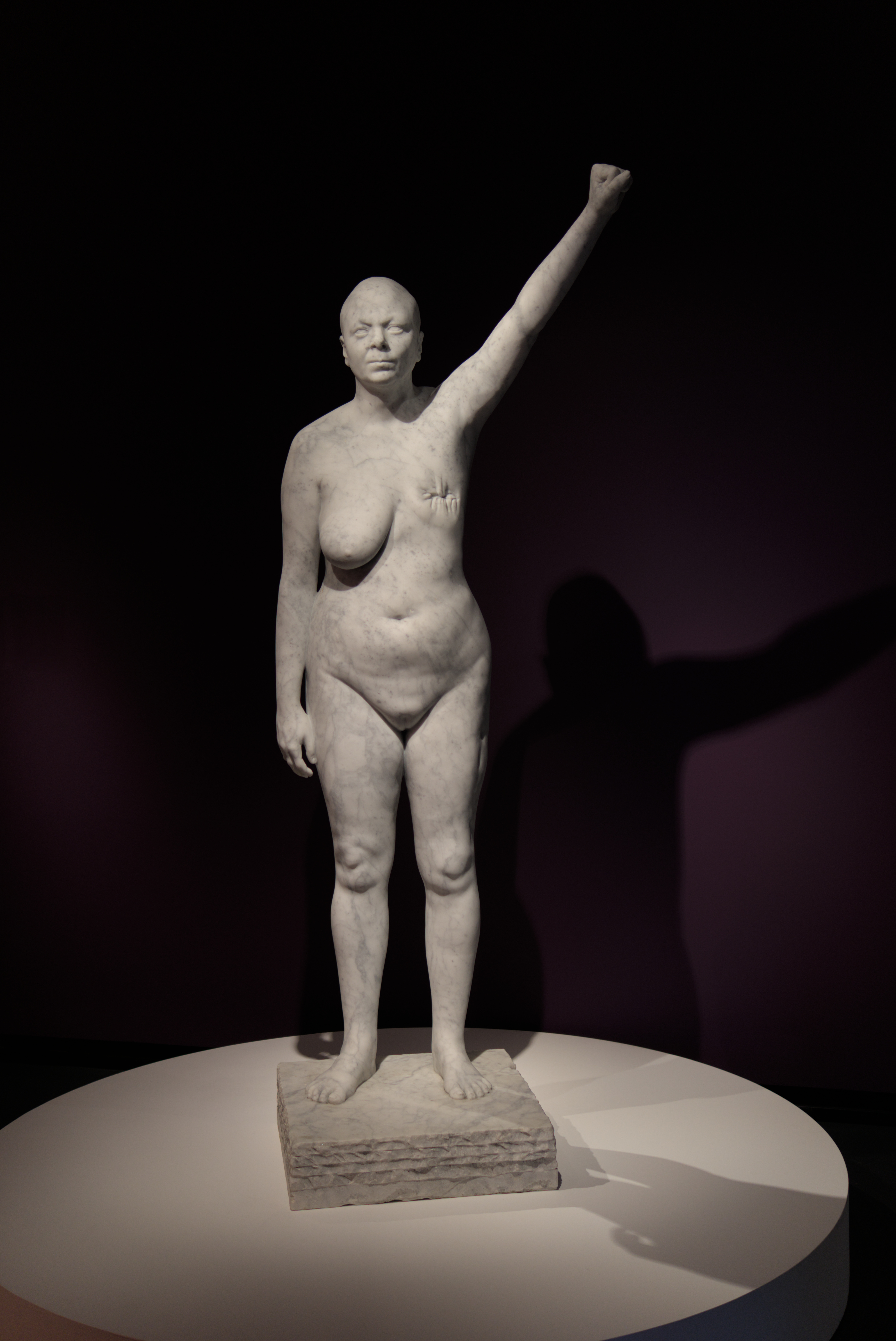
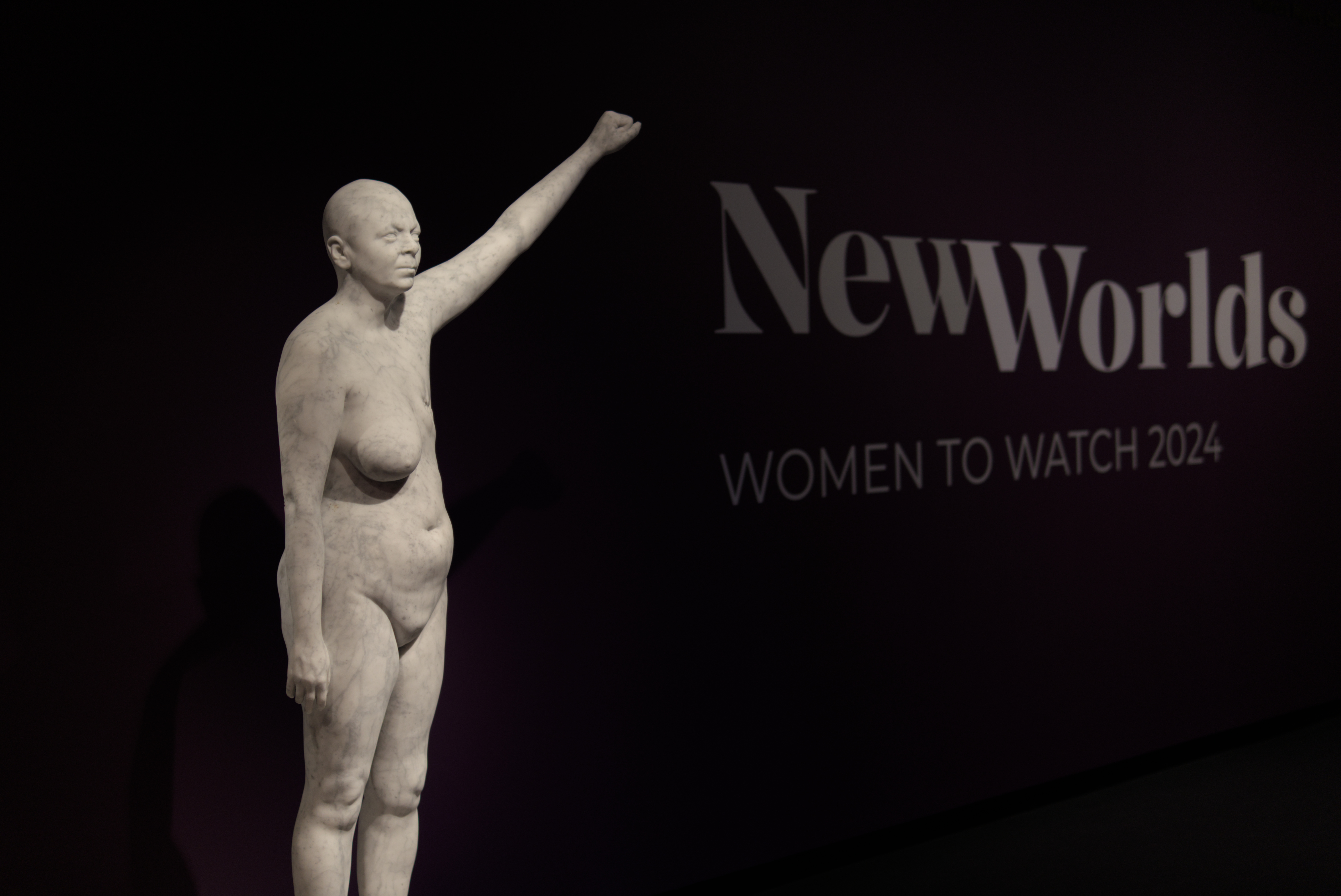
ARTWORK: Intra-Venus by Marina Vargas: October is Breast Cancer Awareness Month, so I wanted to share an artwork I encountered on the subject this summer at the New Worlds: Women to Watch 2024 exhibition at the National Museum of Women in the Arts. Intra-Venus is a nude self-portrait in marble by Spanish artist and breast cancer survivor Marina Vargas, frankly depicting her body after a mastectomy, chemotherapy, and radiation. Owning her scars and her baldness, she uses the language of classical sculpture to monumentalize a common female experience. (The chance of a woman in the US getting breast cancer in her lifetime is 1 in 8, and more than 100,000 US women undergo some form of mastectomy each year; global statistics are harder to come by.) Vargas lost the use of her left arm for a time during treatment, but here she shows herself with her left arm raised in triumph. The sculpture highlights the heroism of women who endure breast cancer and the dignity of their changed form.
Marina Vargas (Spanish, 1980–), Intra-Venus, 2019–21. Carrara marble, 77 1/2 × 26 3/4 × 26 in. Photo: Victoria Emily Jones.
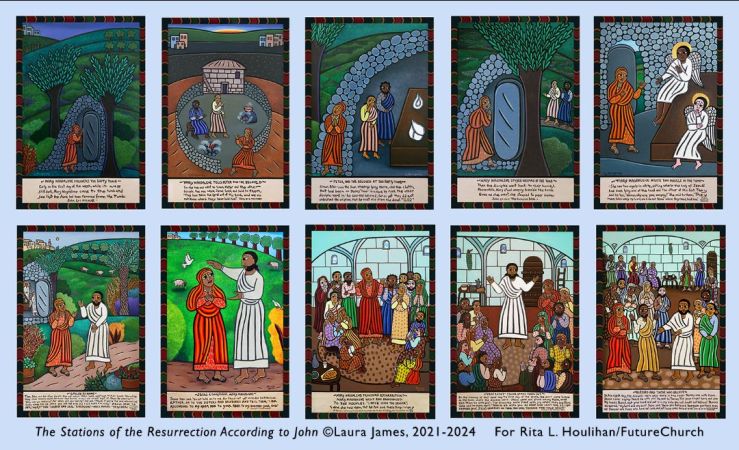
VIRTUAL ARTIST’S TALK: “The Stations of the Resurrection according to John” with Laura James, July 30, 2024, 7:00–8:15 p.m. ET: Next Tuesday, Bronx-based artist Laura James will discuss her latest painting series, The Stations of the Resurrection according to John, in a live online conversation with patron Rita L. Houlihan. Register at the link above.
The series began in 2021 with four paintings—Called by Name, Jesus Commissions Mary Magdalene, Mary Magdalene Proclaims Resurrection, and Pentecost: Jesus Sends Them Out, collectively the Mary Magdalene and the Risen Jesus series (which you can purchase as a set of cards)—and then expanded to include the full resurrection narrative from John 20. View details of all ten paintings for the first time, and hear from the artist about the artistic choices she made.
The daughter of immigrants from Antigua in the Caribbean, Laura James is especially celebrated for her vibrant paintings that depict biblical figures, including Jesus, as dark-skinned, influenced in part by the long tradition of Ethiopian Christian art. Rita Houlihan, who commissioned the Stations of the Resurrection series from James, is a founding member of FutureChurch’s Catholic Women Preach and Reclaim Magdalene projects and a longtime advocate for the restoration of historical memory regarding early Christian women leaders, especially Mary Magdalene.
VIRTUAL BOOK LAUNCH: Refractions, 15th anniversary edition, by Makoto Fujimura, August 6, 2024, 3:00 p.m. ET: Artist, speaker, writer, and IAMCultureCare founder Makoto Fujimura is one of the most prominent voices in the “art and faith” conversation in the US. On Tuesday, August 6, he’s hosting a Zoom event to celebrate the release of the fifteenth anniversary edition of his essay collection Refractions: A Journey of Faith, Art, and Culture, which is updated and expanded. He will read new selections from the book and host a time of Q&A and sharing. Register for the event at the above link, and you will receive a 30% discount on copies of the book preordered before the end of July.
+++
ART TRAIL: Vessel, miscellaneous locations along the Welsh-English border, August 8*–October 31, 2024: An exciting new art trail has been curated by Jacquiline Creswell [previously] for the group Art and Christianity. From the press release: “Vessel is a curated art trail in remote rural churches near the Black Mountains between Usk and Hay-on-Wye [in the border country between South Wales and England]. Seven artworks by seven [contemporary] artists will be shown in seven churches, six of which are maintained by the Friends of Friendless Churches who keep them open all year round. The theme of ‘vessel’ references bodies, boats, secretions and receptacles; each of the artworks will be sited in a particular relationship to the church and its material culture.”
*Lou Baker’s installation at Dore Abbey opens August 21.
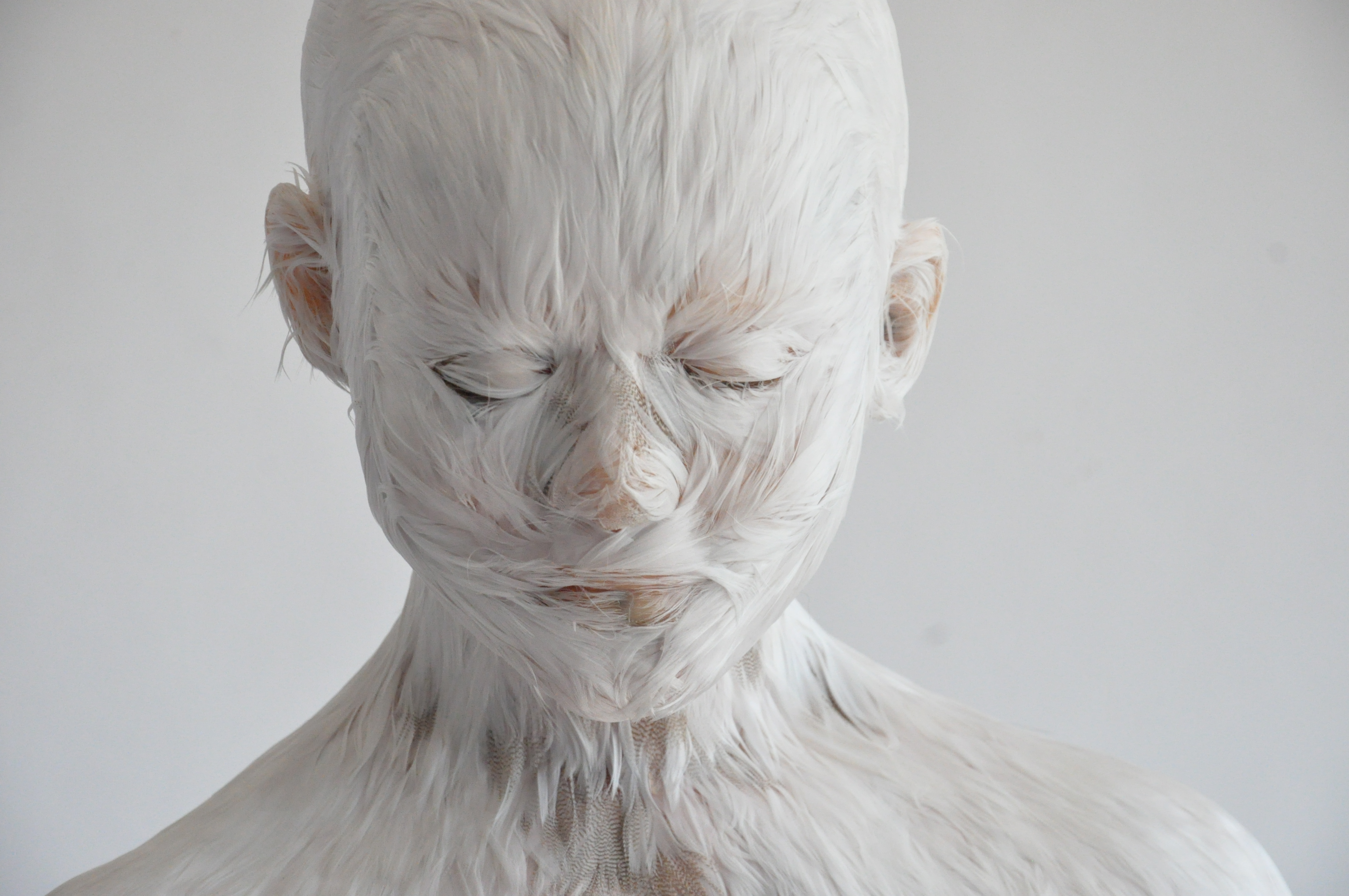
Lucy Glendinning (British, 1964–), White Hart (detail), 2018. Wax, Jesmonite, timber, duck feathers, 175 × 73 × 58 cm. Photo courtesy of Art and Christianity. [artist’s website]
Here is the list of venues, artists, and artworks:
St Michael and All Angels’, Gwernesney, Monmouthshire, Wales: Grace Vessel by Jane Sheppard
St Cadoc, Llangattock Vibon Avel, Monmouthshire, Wales: Wiela by Barbara Beyer
St Mary the Virgin, Llanfair Kilgeddin, Monmouthshire, Wales: Centre by Steinunn Thórainsdóttir
St Jerome, Llangwm Uchaf, Monmouthshire, Wales: White Hart by Lucy Glendinning
St David, Llangeview, Monmouthshire, Wales: Compendium by Andrew Bick
Dore Abbey, Herefordshire, England: Life/Blood by Lou Baker
Castle Chapel, Urishay, Herefordshire, England: Simmer Down I by Robert George
Art + Christianity is offering a weekend retreat September 13–15, based in Abergavenny, that will include a guided minibus tour (led by the curator) to all seven sites, a lecture by Fr. Jarel Robinson-Brown titled “Living Stones: Buildings, Bodies and Spirit,” a presentation and panel discussion on curating and organizing art in rural churches and chapels, and a performance by Holly Slingsby, Felled, Yet Unfurling, that draws on the iconography of the Tree of Jesse. (St Mary’s Priory in Abergavenny houses an extraordinary fifteenth-century oak carving of the Old Testament figure of Jesse that once formed the base of an elaborate sculpture depicting Jesus’s ancestry; to contextualize this artwork, in 2016 a Jesse Tree Window designed by Helen Whittaker was installed in the church’s Lewis Chapel.) Ticket pricing starts at £35 and does not include accommodations.
“As religious affiliation declines, can art provide fresh ways of exploring the questions posed by theology?” Borysewicz asks. “Might art—its creation as well as reception—lead to the discovery of new spiritual information? What do faith traditions lose when they overemphasize the written word and neglect the role of images?
“Historically, faith traditions have focused on both the written word and images as sources of knowledge and meaning. Some would claim that words have taken undue precedence as theologies have developed, while images seem to have been left behind. Has this shift in focus left us wanting?”
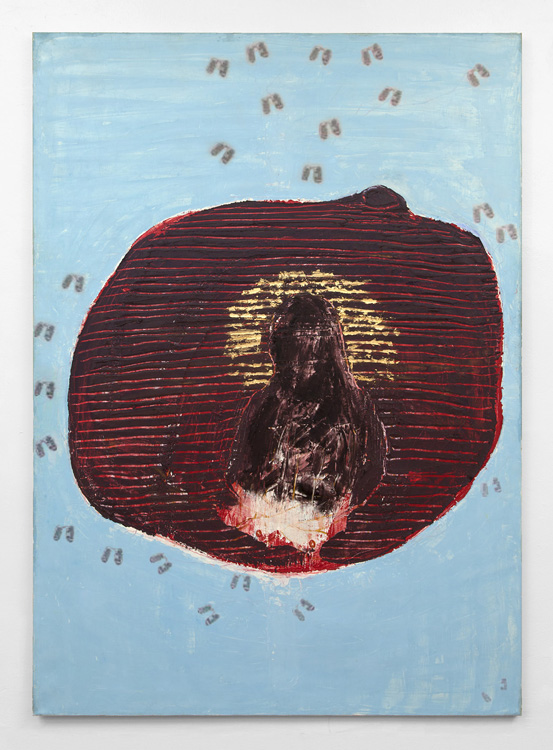
Alfonse Borysewicz (American, 1957–), Pomegranate, 2010–11. Oil and wax on linen, 70 × 50 in. The artist said, “When I see a pomegranate at the market, I see it as a visible sign of the resurrection of Christ; or a hive, the community of Christ.”
+++
SONGS:
>> “Kasih Tuhan” (God’s Love) by Abraham Boas Yarona, performed by Prison Akustik: This video shows, from what I can gather, a group of inmates from Lapas Abepura (Abepura Prison) in Papua, Indonesia, playing and singing an Indonesian Christian song together. It’s one of many lagu rohani (spiritual songs) uploaded to the Prison Akustik YouTube channel (the group is also active on Instagram and TikTok).
>> “Del amor divino, ¿quién me apartará?” (Who Can Separate Me from the Love of God?) by Enrique Turrall and José Daniel Verstraeten, performed by Coro del Seminario Internacional Teológico Bautista: Based on Romans 8:31–39, the lyrics of “Del amor divino” are by Enrique Turrall (1867–1953) of Spain, and the music is by José Daniel Verstraeten (b. 1935). The song was performed in 2018 by a vocal and instrumental ensemble from Seminario Internacional Teológico Bautista (International Baptist Theological Seminary) in Buenos Aires [previously], under the direction of Constanza Bongarrá.The instrumentalists are Jimena Garabaya (guitar), Marcelo Villanueva (charango), and Samy Mielgo (bombo). [HT: Daily Prayer Project]
>> “Caritas abundat in omnia” (Love Aboundeth in All Things) with “O virtus Sapientie” (O Virtue of Wisdom) by Hildegard of Bingen, sung by St. Stanislav Girls’ Choir of the Diocesan Classical Gymnasium, feat. Julija Skobe: Combining two Latin antiphons by the medieval German polymath Hildegard of Bingen [previously], who wrote both the words and music, this song is performed a cappella inside St. Joseph’s Church in Ljubljana, Slovenia, by a student choir with some forty singers between the ages of sixteen and nineteen, directed by Helena Fojkar Zupančič. Mesmerizing! Turn on closed captioning for English subtitles, or see here and here.

 Art & Theology