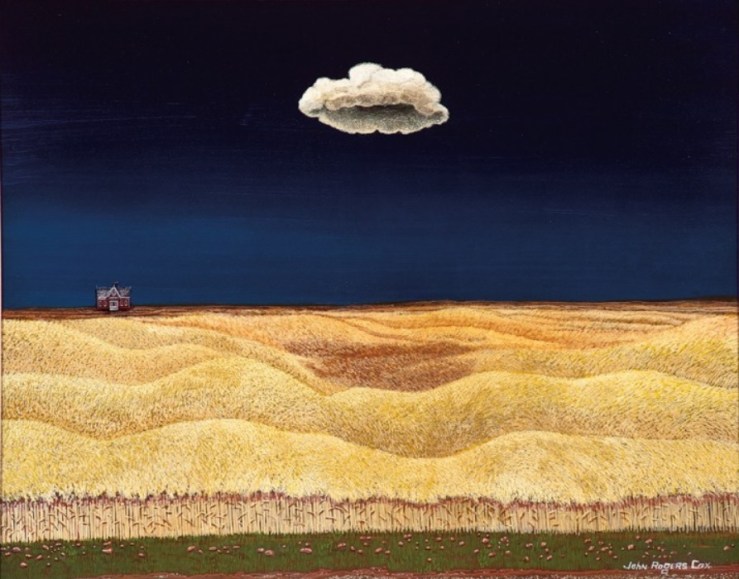
John Rogers Cox (American, 1915–1990), Wheat Field, ca. 1943. Oil on Masonite, 16 × 20 in. The John and Susan Horseman Collection of American Art, St. Louis, Missouri.
And Jesus answered them, “The hour has come for the Son of Man to be glorified. Truly, truly, I say to you, unless a grain of wheat falls into the earth and dies, it remains alone; but if it dies, it bears much fruit. Whoever loves his life loses it, and whoever hates his life in this world will keep it for eternal life. If anyone serves me, he must follow me; and where I am, there will my servant be also. If anyone serves me, the Father will honor him.
“Now is my soul troubled. And what shall I say? ‘Father, save me from this hour’? But for this purpose I have come to this hour. Father, glorify your name.”
Then a voice came from heaven: “I have glorified it, and I will glorify it again.”
The crowd that stood there and heard it said that it had thundered. Others said, “An angel has spoken to him.”
Jesus answered, “This voice has come for your sake, not mine. Now is the judgment of this world; now will the ruler of this world be cast out. And I, when I am lifted up from the earth, will draw all people to myself.” He said this to show by what kind of death he was going to die.
So the crowd answered him, “We have heard from the Law that the Christ remains forever. How can you say that the Son of Man must be lifted up? Who is this Son of Man?”
So Jesus said to them, “The light is among you for a little while longer. Walk while you have the light, lest darkness overtake you. The one who walks in the darkness does not know where he is going. While you have the light, believe in the light, that you may become sons of light.”
When Jesus had said these things, he departed and hid himself from them.
—John 12:23–36
+++
SONG: “Glorify” by Joe Kurtz and Josh Compton, on Last Days by The Brothers of Abriem Harp (2015)
This post belongs to the weekly series Artful Devotion. If you can’t view the music player in your email or RSS reader, try opening the post in your browser.
To view all the Revised Common Lectionary scripture readings for Tuesday of Holy Week, cycle A, click here.
Illumination from the Vaux Passional, England, ca. 1503–4. Peniarth MS 482D, fol. 15v, National Library of Wales, Aberystwyth. [see full page]
Six days before the Passover, Jesus therefore came to Bethany, where Lazarus was, whom Jesus had raised from the dead. So they gave a dinner for him there. Martha served, and Lazarus was one of those reclining with him at table. Mary therefore took a pound of expensive ointment made from pure nard, and anointed the feet of Jesus and wiped his feet with her hair. The house was filled with the fragrance of the perfume. But Judas Iscariot, one of his disciples (he who was about to betray him), said, “Why was this ointment not sold for three hundred denarii and given to the poor?” He said this, not because he cared about the poor, but because he was a thief, and having charge of the moneybag he used to help himself to what was put into it. Jesus said, “Leave her alone; she intended to keep it for the day of my burial. For the poor you always have with you, but you do not always have me.”
When the large crowd of the Jews learned that Jesus was there, they came, not only on account of him but also to see Lazarus, whom he had raised from the dead. So the chief priests made plans to put Lazarus to death as well, because on account of him many of the Jews were going away and believing in Jesus.
—John 12:1–11
+++
SONG: “Said Judas to Mary” by Sydney Carter, 1964 | Performed by ValLimar Jansen and the choir of Christ the King Church, Kingston, Rhode Island, 2015
This post belongs to the weekly series Artful Devotion. If you can’t view the music player in your email or RSS reader, try opening the post in your browser.
To view all the Revised Common Lectionary scripture readings for Monday of Holy Week, cycle A, click here.
Jyoti Sahi (Indian, 1944–), Entry into Jerusalem, 2012. Oil and acrylic on canvas. Photo courtesy of the artist.
. . . Most of the crowd spread their cloaks on the road, and others cut branches from the trees and spread them on the road. And the crowds that went before him and that followed him were shouting, “Hosanna to the Son of David! Blessed is he who comes in the name of the Lord! Hosanna in the highest!” And when he entered Jerusalem, the whole city was stirred up, saying, “Who is this?” And the crowds said, “This is the prophet Jesus, from Nazareth of Galilee.”
Ride on, ride on in majesty!
Hark! all the tribes hosanna cry;
O Savior meek, pursue thy road
with palms and scattered garments strowed.
Ride on, ride on in majesty!
In lowly pomp ride on to die:
O Christ, thy triumphs now begin
o’er captive death and conquered sin.
Ride on, ride on in majesty!
The angel armies of the sky
look down with sad and wond’ring eyes
to see th’approaching sacrifice.
Ride on, ride on in majesty!
Thy last and fiercest strife is nigh;
the Father on his sapphire throne
expects his own anointed Son.
Ride on, ride on in majesty!
In lowly pomp ride on to die;
bow thy meek head to mortal pain,
then take, O Christ, thy pow’r and reign.
This year’s Palm Sunday music selection comes from Hymnistry, an excellent podcast that ran from 2015 to 2018. I’ve always liked Henry H. Milman’s hymn text “Ride On, Ride On in Majesty!,” but not the traditional tunes it’s typically paired with. So I was thrilled to hear this contemporary setting by John Hatfield. Hatfield’s introduction to the hymn starts at 5:51. He discusses the cognitive dissonance of Palm Sunday, a celebratory occasion with somber undertones, because we’re really cheering Jesus on to his death. He’s hailed as king, Hatfield says, and “his first act in office is to give himself up for us.” Milman’s text captures this paradox of victory through a cross, and Hatfield seeks to do so as well in his retuning, maintaining a happy energy throughout but sneaking in a minor chord. The actual hymn starts at 10:32.
In the first half of the episode, the Rev. Jacob Paul Breeze, pastor of Holy Family in downtown Houston, gives some illuminating historical background. He says that when Jesus entered Jerusalem during Passover, the Israelites took out the Hanukkah decorations (palm branches) instead! Why were they getting their holidays mixed up? Well, they weren’t. Waving palm branches, which were a symbol of prosperity and triumph in Judaism, is how they celebrated their ancestor Judah Maccabee’s cleansing of the temple in the second century BCE. (He recaptured Jerusalem from the Syrian Greeks and restored Jewish temple worship, which gave way to the first Hanukkah, really a belated celebration of the fall festival of Sukkot; see 2 Maccabees 10:1–8, cf. 1 Maccabees 4:54–60.) The Israelites’ waving of date palms as Jesus processed into their most holy city was their way of affirming him as their chosen one, Breeze says, to lead a revolt against the Romans and secure their freedom.
+++
I love the colorful flurry of excitement in Jyoti Sahi’s painting Entry into Jerusalem, where crowds gather in effusive praise of their new liberator. Birds and angels wing overhead, while green palm branches spill forth from the bottom right to carpet Jesus’s path.
Jyoti told me he started this painting after visiting Jerusalem for an interfaith meeting—his first trip to the Holy Land—where he presented a paper on art and meditation. He was fascinated by the surrounding landscape. The theme of Christ entering Jerusalem is related to the idea of Christ entering the human heart, he says.
The painting was acquired in 2018 by a visiting Italian monk for a Christian chapel in Sicily.
+++
Palm Sunday–related posts from the Art & Theology archives:
A simple, gradually quickening Hebrew folk melody on accordion accompanies a contemporary Bulgarian icon by Julia Stankova in “Hail to the King (Artful Devotion)”
Modernist paintings by Australian artist Nathan Simpson meet Hiram Ring’s blues-inflected song “My Lord” (“My Lord is a donkey-ridin’ man . . .”) in “He Went On Ahead (Artful Devotion)”
Did you know Simon and Garfunkel adapted Orlande de Lassus’s motet setting of the Benedictus (“Blessed is he that comes in the name of the Lord”) and recorded it for their first album? Read more in my review of Wednesday Morning, 3 A.M.
+++
This is the first in a series of eight Artful Devotions I’ve planned—one for each day of Holy Week and the Paschal Triduum. I’m posting this one several days ahead because it’s more substantial than the others; the rest I will endeavor to post in the early morning of the given day, from next Monday through Sunday (Easter!). Most of the world will be spending Holy Week at home this year due to the COVID-19 pandemic. Paul Neeley of Global Christian Worship has compiled a great list of resources to help individuals and families honor these days while in quarantine: https://globalworship.tumblr.com/post/613778966717841408/holy-week-at-home. I’m sure there are many more ideas and materials out there as well.
This post belongs to the weekly series Artful Devotion. If you can’t view the music player in your email or RSS reader, try opening the post in your browser.
To view all the Revised Common Lectionary scripture readings for Palm Sunday, cycle A, click here.
Julia Stankova (Bulgarian, 1954–), Resurrection of Lazarus, 2006. Painting on wooden panel, 30 × 40 cm.
Now a certain man was ill, Lazarus of Bethany, the village of Mary and her sister Martha. It was Mary who anointed the Lord with ointment and wiped his feet with her hair, whose brother Lazarus was ill. So the sisters sent to him, saying, “Lord, he whom you love is ill.” But when Jesus heard it he said, “This illness does not lead to death. It is for the glory of God, so that the Son of God may be glorified through it.”
Now Jesus loved Martha and her sister and Lazarus. So, when he heard that Lazarus was ill, he stayed two days longer in the place where he was. Then after this he said to the disciples, “Let us go to Judea again.” The disciples said to him, “Rabbi, the Jews were just now seeking to stone you, and are you going there again?” Jesus answered, “Are there not twelve hours in the day? If anyone walks in the day, he does not stumble, because he sees the light of this world. But if anyone walks in the night, he stumbles, because the light is not in him.” After saying these things, he said to them, “Our friend Lazarus has fallen asleep, but I go to awaken him.” The disciples said to him, “Lord, if he has fallen asleep, he will recover.” Now Jesus had spoken of his death, but they thought that he meant taking rest in sleep. Then Jesus told them plainly, “Lazarus has died, and for your sake I am glad that I was not there, so that you may believe. But let us go to him.” So Thomas, called the Twin, said to his fellow disciples, “Let us also go, that we may die with him.”
Now when Jesus came, he found that Lazarus had already been in the tomb four days. Bethany was near Jerusalem, about two miles off, and many of the Jews had come to Martha and Mary to console them concerning their brother. So when Martha heard that Jesus was coming, she went and met him, but Mary remained seated in the house. Martha said to Jesus, “Lord, if you had been here, my brother would not have died. But even now I know that whatever you ask from God, God will give you.” Jesus said to her, “Your brother will rise again.” Martha said to him, “I know that he will rise again in the resurrection on the last day.” Jesus said to her, “I am the resurrection and the life. Whoever believes in me, though he die, yet shall he live, and everyone who lives and believes in me shall never die. Do you believe this?” She said to him, “Yes, Lord; I believe that you are the Christ, the Son of God, who is coming into the world.”
When she had said this, she went and called her sister Mary, saying in private, “The Teacher is here and is calling for you.” And when she heard it, she rose quickly and went to him. Now Jesus had not yet come into the village, but was still in the place where Martha had met him. When the Jews who were with her in the house, consoling her, saw Mary rise quickly and go out, they followed her, supposing that she was going to the tomb to weep there. Now when Mary came to where Jesus was and saw him, she fell at his feet, saying to him, “Lord, if you had been here, my brother would not have died.” When Jesus saw her weeping, and the Jews who had come with her also weeping, he was deeply moved in his spirit and greatly troubled. And he said, “Where have you laid him?” They said to him, “Lord, come and see.” Jesus wept. So the Jews said, “See how he loved him!” But some of them said, “Could not he who opened the eyes of the blind man also have kept this man from dying?”
Then Jesus, deeply moved again, came to the tomb. It was a cave, and a stone lay against it. Jesus said, “Take away the stone.” Martha, the sister of the dead man, said to him, “Lord, by this time there will be an odor, for he has been dead four days.” Jesus said to her, “Did I not tell you that if you believed you would see the glory of God?” So they took away the stone. And Jesus lifted up his eyes and said, “Father, I thank you that you have heard me. I knew that you always hear me, but I said this on account of the people standing around, that they may believe that you sent me.” When he had said these things, he cried out with a loud voice, “Lazarus, come out.” The man who had died came out, his hands and feet bound with linen strips, and his face wrapped with a cloth. Jesus said to them, “Unbind him, and let him go.”
Many of the Jews therefore, who had come with Mary and had seen what he did, believed in him.
Live-in-studio arrangement for Little Fella Media, from 2015:
Looked in your eyes, they were burning like cigarettes
On top of a head that could resurrect Lazarus
Up from the grave that somehow made you cry
Both of your hands were rough like a carpenter’s
So accustomed to nails and to hammers
Never would’ve thought those nails would cut inside
Oh your hands were blessed one holy, holy night
We found your grace, it was waiting inside of a
Dead dark place with few survivors
It seems that you lived in places I reckoned you wouldn’t
And all that we saw were people that had no hope
And you changed my eyes into flaming kaleidoscopes
I saw something that I thought for sure was fiction
But the peace that it brought me erased all of my conviction
There was a knife buried deep inside
The part of our hearts where we learned how to love something
Other than us; it was built on a sandy shore
Hoping the waves wouldn’t come to the door and
Greet us with disdain and heaviness, one of
Redemption, washing away all the thoughts we had
Run to before
Will you rescue me from my disbelief?
Would you please rescue me from being a thief
Of things that will burn up when it’s the end?
Dust collects, yeah, dust it upsets and
We are only dust at best but
You can breathe dust back to life again
Oh flood the whole world, and dust will walk again
This post belongs to the weekly series Artful Devotion. If you can’t view the music player in your email or RSS reader, try opening the post in your browser.
To view all the Revised Common Lectionary scripture readings for the Fifth Sunday of Lent, cycle A, click here.
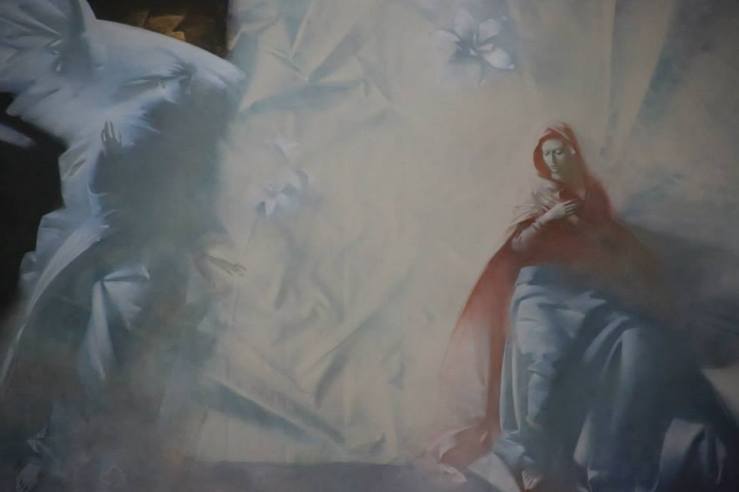
Alexander Blonsky (Ukrainian), The Annunciation, 2014. Oil on canvas, 82 7/10 × 129 9/10 in.
March 25, nine months before Christmas, is when the church celebrates the conception of Christ in the womb of Mary. The narrative of this event is known as the “Annunciation” because Gabriel comes from heaven to announce the good news to Mary that she has been chosen to give birth to and to mother the Son of the Most High God.
Because Luke 1:26–38 is such a familiar Bible passage, it helps to read it in less familiar translations so that it can land fresh in our ears. So here is Eugene Peterson’s translation from The Message:
In the sixth month of Elizabeth’s pregnancy, God sent the angel Gabriel to the Galilean village of Nazareth to a virgin engaged to be married to a man descended from David. His name was Joseph, and the virgin’s name, Mary. Upon entering, Gabriel greeted her:
Good morning!
You’re beautiful with God’s beauty,
Beautiful inside and out!
God be with you.
She was thoroughly shaken, wondering what was behind a greeting like that. But the angel assured her, “Mary, you have nothing to fear. God has a surprise for you: You will become pregnant and give birth to a son and call his name Jesus.
He will be great,
be called ‘Son of the Highest.’
The Lord God will give him
the throne of his father David;
He will rule Jacob’s house forever—
no end, ever, to his kingdom.”
Mary said to the angel, “But how? I’ve never slept with a man.”
The angel answered,
The Holy Spirit will come upon you,
the power of the Highest hover over you;
Therefore, the child you bring to birth
will be called Holy, Son of God.
“And did you know that your cousin Elizabeth conceived a son, old as she is? Everyone called her barren, and here she is six months pregnant! Nothing, you see, is impossible with God.”
And Mary said,
Yes, I see it all now:
I’m the Lord’s maid, ready to serve.
Let it be with me
just as you say.
This traditional Eastern Orthodox acclamation in Church Slavonic, based on Gabriel’s and Elizabeth’s words to Mary in Luke 1 (and better known by the closely related Latin Ave Maria from the West), has been set by various composers over the centuries, most famously by Sergei Rachmaninoff. His solemn interpretation is beautiful, but I’m partial to the celebratory setting by contemporary Estonian composer Arvo Pärt, commissioned by the King’s College Choir, Cambridge, for the festival of Nine Lessons and Carols on Christmas Eve 1990. It is for SATB a cappella choir.
Богородице Дево, радуйся,
благодатная Марие, Господь с тобою.
Благословена ты в женах,
и благословен плод чрева твоего,
яко Спаса родила еси душ наших.
Transliteration:
Bogoróditse Dyévo, ráduisya,
Blagodátnaya Maríye, Gospód s tobóyu.
Blagoslovyéna ty v zhenákh,
i blagoslovyén plod chryéva tvoyevó,
yáko Spása rodilá yesí dush náshikh.
English translation:
Rejoice, O Virgin Theotokos,
Mary full of grace, the Lord is with thee.
Blessed art thou among women,
and blessed is the fruit of thy womb,
for thou hast borne the Savior of our souls.
All but a small number of Pärt’s ninety-odd compositions since 1976 are settings of biblical texts or Christian prayers. For an excellent article on him, see “How Arvo Pärt speaks prayer into a secular world” by Peter C. Bouteneff, published in the Christian Century. “Why are people listening so avidly?” Bouteneff wonders. “The same audience that would instinctively tune out anything with a whiff of Christian sensibility, that would normally be repulsed by pious petitions to Jesus or Mary for the forgiveness of their wretched sins, is held rapt by these very prayers when Pärt speaks them through his compositions.” Beauty has a way of penetrating people’s defenses, it seems. And that’s one reason we so desperately need artists.
This post belongs to the weekly series Artful Devotion. If you can’t view the music player in your email or RSS reader, try opening the post in your browser.
To view all the Revised Common Lectionary scripture readings for the feast of the Annunciation, cycle A, click here.
“Awake, O sleeper,
and arise from the dead,
and Christ will shine on you.”
—Ephesians 5:14
+++
SONG: “Wake Up, Oh Sleeper” by David Nasser, Jonathan Shelton, Mac Powell, and Shane Barnard
Live performance from 2009 by Third Day:
Studio recording by Jason Crabb, Jonathan Shelton, and Bear Rinehart, on Glory Revealed II (2009):
This post belongs to the weekly series Artful Devotion. If you can’t view the music player in your email or RSS reader, try opening the post in your browser.
To view all the Revised Common Lectionary scripture readings for the Fourth Sunday of Lent, cycle A, click here.
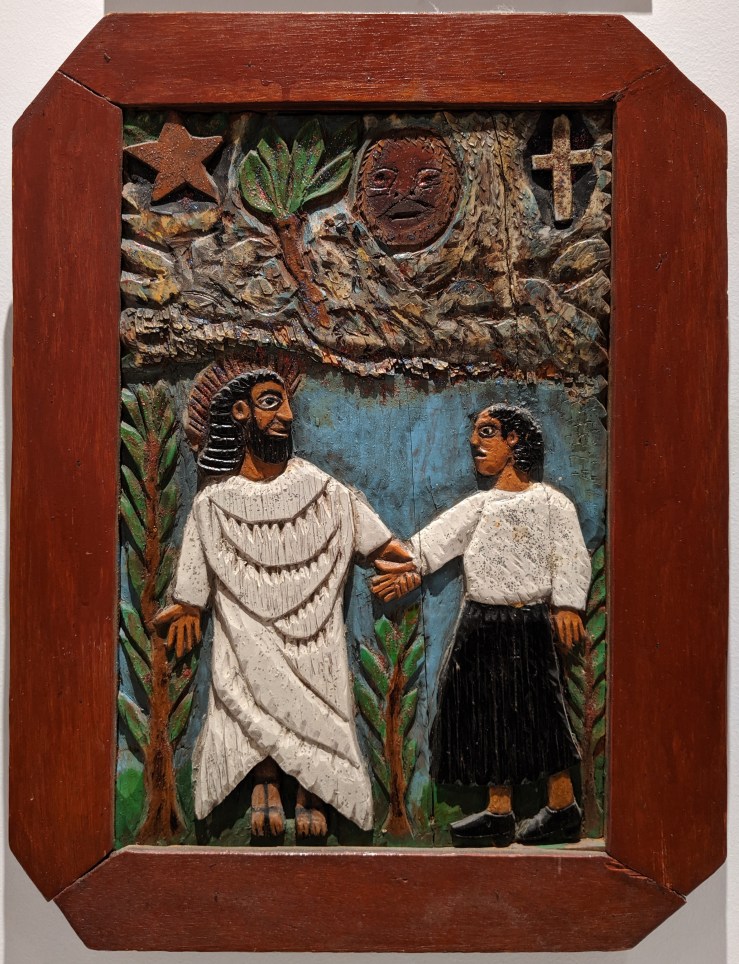
Elijah Pierce (American, 1892–1984), Christ and Lady, 1968. Wood, paint, and glitter, 21 1/2 × 16 1/2 × 1 1/4 in. High Museum of Art, Atlanta. Photo: Victoria Emily Jones.
A woman, a Samaritan, came to draw water. Jesus said, “Would you give me a drink of water?” (His disciples had gone to the village to buy food for lunch.)
The Samaritan woman, taken aback, asked, “How come you, a Jew, are asking me, a Samaritan woman, for a drink?” (Jews in those days wouldn’t be caught dead talking to Samaritans.)
Jesus answered, “If you knew the generosity of God and who I am, you would be asking me for a drink, and I would give you fresh, living water.”
The woman said, “Sir, you don’t even have a bucket to draw with, and this well is deep. So how are you going to get this ‘living water’? Are you a better man than our ancestor Jacob, who dug this well and drank from it, he and his sons and livestock, and passed it down to us?”
Jesus said, “Everyone who drinks this water will get thirsty again and again. Anyone who drinks the water I give will never thirst—not ever. The water I give will be an artesian spring within, gushing fountains of endless life.”
SONG: “Jesus Gave Me Water” by Lucie E. Campbell, 1946 | Performed by Sam Cooke and the Soul Stirrers, 1951
“One of the most regarded composers of African American religious song, Lucie E. Campbell [1885–1963] was a pioneering figure linking traditional hymnody to modern gospel composition and bridging gender and racial divides in the world of gospel music. Alongside such musical peers as Thomas A. Dorsey, Roberta Martin, and fellow Memphian Reverend W. Herbert Brewster, she helped forge the black gospel sound of the first half of the twentieth century and further belongs to a small coterie of composers who have set lasting standards for religious music in the black Baptist church.” (https://memphismusichalloffame.com/inductee/luciecampbell/)
Campbell’s song “Jesus Gave Me Water” was first recorded by Artis Kitchen in 1947. For a partial list of subsequent covers, see secondhandsongs.com. I like Sam Cooke’s version best, from 1951, when he was singing lead for the Soul Stirrers—no one can beat his honey-smooth vocals. You might know him, as I first did, as the singer of hits like “You Send Me,” “Chain Gang,” “Another Saturday Night,” “Twisting the Night Away,” “Cupid,” and “A Change Is Gonna Come.” (I have fond memories of listening to Oldies 100.7 FM in car rides with my dad growing up!) But like many famous soul singers, Cooke, a PK (preacher’s kid), got his start singing at church, at age six. His leadership of the popular black gospel group the Soul Stirrers from 1951 to 1956 propelled his career, and he crossed over into pop with great success.
A self-taught artist born in Baldwyn, Mississippi, Elijah Pierce began wood carving as a young child, using the pocketknife his father gave him. He knew he didn’t want to farm for a living like the rest of his family, so he left home as a teenager and eventually settled in Columbus, Ohio, where he ran a barbershop and led a church congregation. He described his wood carvings as sermons he used to teach people about the Bible. After encountering how Pierce used art to supplement his teaching, Leroy Almon (another celebrated folk artist, unknown at the time) apprenticed himself to Pierce.
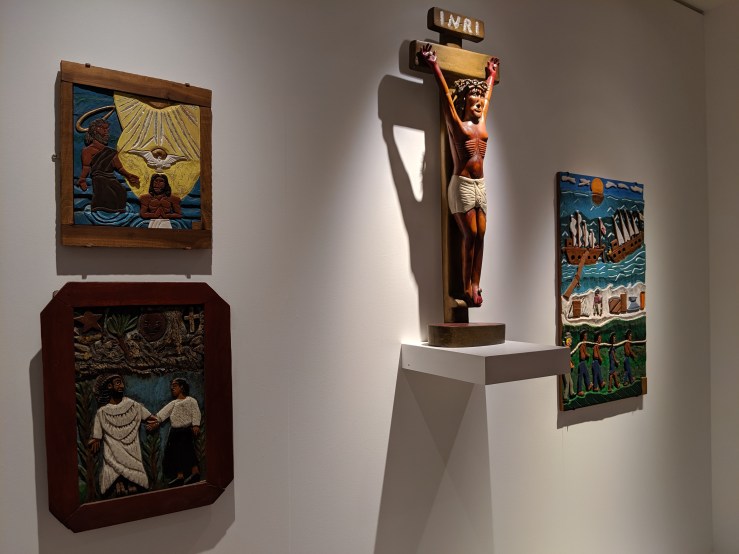
The High Museum of Art in Atlanta has a wonderful collection of folk art, including works by Pierce and his student Almon. Pictured below, from my visit last year, are: Leroy Almon, The Baptism of Jesus, 1983; Elijah Pierce, Christ and Lady, 1968; Ulysses Davis, Jesus on the Cross, 1946; and Leroy Almon, Slavery Time, 1990.
Though no well is visible in Christ and Lady and the title is generic, I see it as a depiction of the Samaritan woman from Sunday’s lectionary reading, and the description on the museum’s label also interprets it that way.
This post belongs to the weekly series Artful Devotion. If you can’t view the music player in your email or RSS reader, try opening the post in your browser.
To view all the Revised Common Lectionary scripture readings for the Third Sunday of Lent, cycle A, click here.
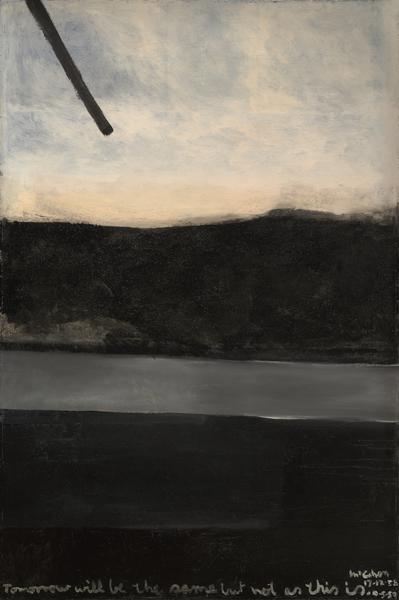
Colin McCahon (New Zealand, 1919–1987), Tomorrow will be the same but not as this is, 1958–59. Solpah and sand on board, 188.6 × 127.8 cm. Christchurch Art Gallery, Christchurch, South Island, New Zealand.
I will lift up mine eyes unto the hills, from whence cometh my help.
My help cometh from the LORD, which made heaven and earth.
He will not suffer thy foot to be moved: he that keepeth thee will not slumber.
Behold, he that keepeth Israel shall neither slumber nor sleep.
The LORD is thy keeper: the LORD is thy shade upon thy right hand.
The sun shall not smite thee by day, nor the moon by night.
The LORD shall preserve thee from all evil: he shall preserve thy soul.
The LORD shall preserve thy going out and thy coming in from this time forth, and even for evermore.
—Psalm 121
+++
SONG: “Traveler’s Psalm” by Donald Boyd | Arranged and performed by Andy Zipf, on Traveler’s Psalms and Carols (2009)
I will lift my eyes unto the hills
Whence cometh my help
My help cometh from the Lord
Who made heaven and earth
He will not allow my foot to stumble
For he’s always on my side
And he’ll guide me through all of the days of my life
Now and forevermore
Andy Zipf received this original song from his maternal grandfather, Donald Boyd (1919–1998), who, in addition to writing hymns, was the choir director of a church in Roland, Iowa, for fifty-one years. He had bought Zipf his first guitar and always encouraged him to sing. As a tribute to Grandpa Boyd and his formative impact, Zipf has made the song available for free download at Bandcamp.
+++
The dusky, reverberant landscape painting Tomorrow will be the same but not as this is by Colin McCahon [previously] shows a sun setting behind a range of dark New Zealand hills, with a gray body suggesting water in the midground. Art critic Justin Paton surmises that the mysterious form in the upper left corner (which he jokingly calls “the windshield wiper of God”) is the tail of a cross, because McCahon did a whole series of drawings of flying crosses within landscapes.
“I think it’s a kind of resurrection painting,” Paton said in an RNZ Saturday Morning interview last November. “It’s talking about the way in which an immense spiritual event could shake your world, but then you go to bed and you wake up the next day. It is still the same world, but how has it altered?” Paton continues, “He [McCahon] deals in visions, he deals in miracles, he deals in cataclysmic and elating spiritual events, but it’s always earthed in the everyday—in a world we recognize, a world we can smell . . .” The medium in Tomorrow is commercial flooring paint mixed with sand.
This post belongs to the weekly series Artful Devotion. If you can’t view the music player in your email or RSS reader, try opening the post in your browser.
To view all the Revised Common Lectionary scripture readings for the Second Sunday of Lent, cycle A, click here.
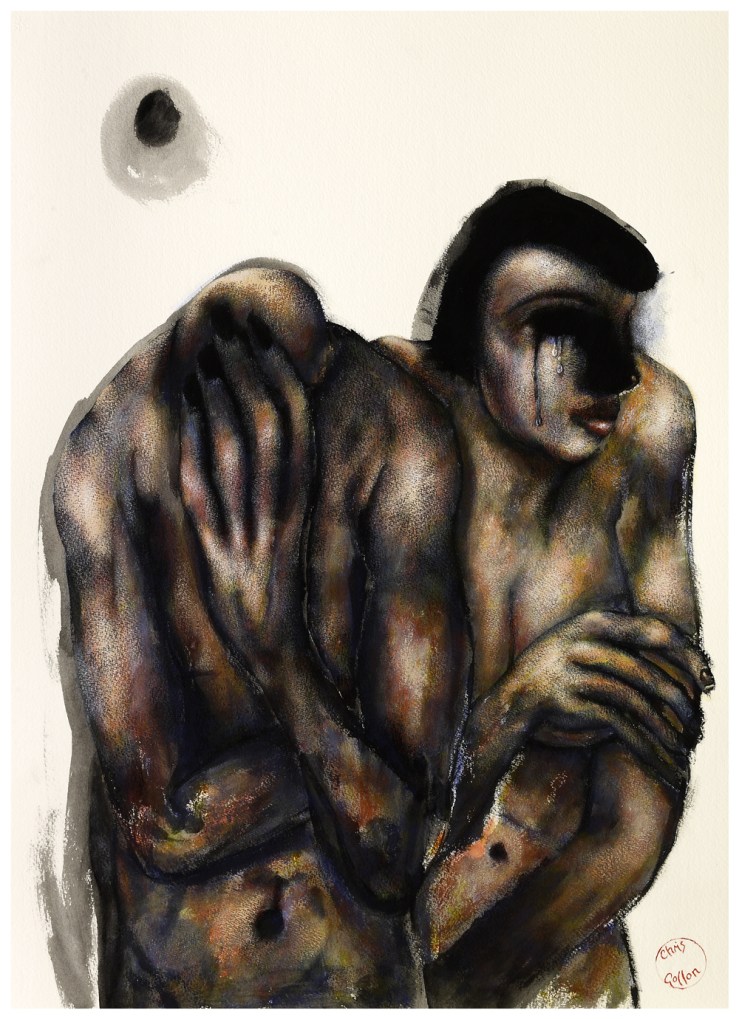
Chris Gollon (British, 1953–2017), Expulsion from Paradise, 2013. Acrylic on paper, 30 × 22 in. (76 × 56 cm).
So when the woman saw that the tree was good for food, and that it was a delight to the eyes, and that the tree was to be desired to make one wise, she took of its fruit and ate, and she also gave some to her husband who was with her, and he ate. Then the eyes of both were opened . . .
The fall, the fall, oh God, the fall of man
The fruit is found in every eye and every hand
Nothing, there is nothing yet, in truest form
We walk like ghosts upon the earth; the ground, it groans
How long, how long will you wait?
How long, how long till you save us all, save us all?
Turn your face to me, turn your face to me
Turn your face to me, turn your face to me
The light, the light, the morning light is gone
And all that’s left is fragile breath and failing lungs
The night, the night, the guiding night has come
Uniting lover with his bride, more precious than the dawn
How long, how long must we wait?
Turn your face to me, turn your face to me
Turn your face to me, turn your face to me
Because of the music behind “Turn your face to me”—soft and smooth, consonant, calm not frantic like the rest—I read this refrain as being spoken by God. The humans lament their fall, asking how long they must wait for salvation, and God gently responds: it’s available now, just turn your face to me.
The idea of “ghosts upon the earth” is inspired by C. S. Lewis’s allegorical novel The Great Divorce, in which a group of travelers from a “grey town” are taken by bus to heaven, a land that proves to be far more solid, more real, than even the travelers’ own bodies. “Sometimes it seems like the most real thing is what we can see and experience with our senses around us—this life, the tangible,” Michael Gungor said. “Ideas like love, like God, these things sometimes feel more disconnected and ethereal, like that’s the ghostly realm. But what if that’s wrong and God and love is actually what is most real, and we are more like ghosts walking upon the earth, hoping to become more real?”
To watch a live performance of Gungor’s “The Fall” from 2012, click here.
This post belongs to the weekly series Artful Devotion. If you can’t view the music player in your email or RSS reader, try opening the post in your browser.
To view all the Revised Common Lectionary scripture readings for the First Sunday of Lent, cycle A, click here.
Brian Kershisnik (American, 1962–), Wounded Saint, 2002. Oil on panel, 40 × 30 in.
Blow the trumpet in Zion; sound the alarm on my holy mountain! Let all the inhabitants of the land tremble, for the day of the LORD is coming, it is near . . .
Yet even now, says the LORD, return to me with all your heart, with fasting, with weeping, and with mourning; rend your hearts and not your clothing. Return to the LORD, your God, for he is gracious and merciful, slow to anger, and abounding in steadfast love, and relents from punishing.
—Joel 2:1, 12–13
Let me hear joy and gladness; let the bones that you have crushed rejoice.
—Psalm 51:8
The sacrifice acceptable to God is a broken spirit; a broken and contrite heart, O God, you will not despise.
—Psalm 51:17
+++
SONG: “Come, Ye Sinners, Poor and Needy” | Words by Joseph Hart, 1759, with anonymous refrain, ca. 1811 | Music: American folk melody (RESTORATION), published in William Walker’s Southern Harmony, 1835 | Performed by Keith and Kristyn Getty, on The Greengrass Session: Six Hymns from the Old World and the New, 2014
Come, ye sinners, poor and needy,
Weak and wounded, sick and sore;
Jesus ready stands to save you,
Full of pity, love, and pow’r.
I will arise and go to Jesus, He will embrace me in His arms; In the arms of my dear Savior, Oh, there are ten thousand charms.
Come, ye thirsty, come, and welcome,
God’s free bounty glorify;
True belief and true repentance,
Every grace that brings you nigh.
Come, ye weary, heavy-laden,
Lost and ruined by the fall;
If you tarry till you’re better,
You will never come at all.
Let not conscience make you linger,
Nor of fitness fondly dream;
All the fitness He requireth
Is to feel your need of Him.
The singing-songwriting duo Keith and Kristyn Getty [previously], who are married, are from Northern Ireland and split their time between there and Nashville, Tennessee, in the United States. In 2014 they recorded a medley of the (American) shape-note hymn “Come, Ye Sinners” with a traditional Irish reel tune known as MUSICAL PRIEST, blending the musics of their two homes. The song starts out at a slow, weary pace with spare violin accompaniment and then picks up with a brisk guitar and other strings, including a free-ranging fiddle. The dirge gives way to celebration—this is the movement of Lent.
“Come, Ye Sinners” appears in hymnals with slight variations in verses, sometimes with an additional two, but the text above is one of the most commonly used. The anonymous refrain (“I will arise . . .”), which makes an oblique reference to the parable of the prodigal son, was added to Hart’s text sometime in the nineteenth century; it is a “floating lyric” found in Southern hymnals as early as 1811.
Though I most associate the hymn with the tune RESTORATION (sometimes called ARISE), it has been set to several tunes over the years, both traditional and contemporary. These include BEACH SPRING, GREENVILLE (which uses a different refrain), and ones by Todd Agnew and Matthew S. Smith, to name a few.
+++
In his painting Wounded Saint, Brian Kershisnik [previously] shows us a young woman with downcast eyes and a bleeding gash in her right arm. This wound, a metaphor for the pain she carries inside, could be self-inflicted or inflicted by others or both, but either way, her child gently leads her forward toward healing, as two angels support her from behind. “Poor and needy, weak and wounded, sick and sore,” the woman returns to her God, whose light emanates faintly from her head. In his arms, as the hymn says, “there are ten thousand charms”—ten thousand graces, ten thousand traits that fascinate, allure, delight . . . and make whole.
+++
I’ve just published a piece on the Christians in the Visual Arts (CIVA) blog to mark Ash Wednesday tomorrow. It’s a short reflection on the interactive installation hash2ash by the Warsaw-based art collective panGenerator, which uses digital technology to turn selfies into a pile of ash. “Dust you are, and to dust you shall return,” as the liturgy goes. Visit https://civa.org/civablog/remember-you-are-dust/ to read more.
This post belongs to the weekly series Artful Devotion. If you can’t view the music player in your email or RSS reader, try opening the post in your browser.
To view all the Revised Common Lectionary scripture readings for Ash Wednesday, cycle A, click here.

_Cropped.jpg)




 Art & Theology