Open-Access Image Archive of Middle Eastern Art, Architecture, and Archaeology

Based at the Faculty of Classics at the University of Oxford, the Manar al-Athar (“Guide to Archaeology”) digital archive provides high-resolution photographs of archaeological sites, buildings, and art from the Levant, North Africa, the Caucasus, and the Balkans, covering the time of Alexander the Great (ca. 300 BCE) through the Byzantine and early Islamic periods, with special emphasis on late antiquity. All the images are freely downloadable, made available for teaching, research, and academic publication under a Creative Commons Attribution-NonCommercial-ShareAlike 2.0 UK (CC BY-NC-SA 2.0) license.

Manar al-Athar was established in 2012 by Dr. Judith McKenzie (1957–2019) and since 2020 has been directed by Dr. Ine Jacobs. It is in continuous development. The photos are cataloged by geographical region and are labeled in both English and Arabic. They picture a range of historical structures—some intact, others in ruins; both interiors and exteriors, where applicable—including mausoleums, churches, mosques, khanqahs (Sufi lodges), hammams (public bathhouses), palace complexes, madrasas (colleges for Islamic instruction), forums, fountains, cisterns, aqueducts, civic buildings, theaters, markets, fortifications, and hostels.

Of primary interest to me is the Christian art from churches and tombs, from countries such as Egypt, Syria, Turkey, Armenia, Georgia, and Serbia, and Jewish art that pictures stories from the Hebrew Bible.

Unfortunately, the subjects of the artworks aren’t labeled and there’s no commentary or transcription/translation of inscriptions, nor are the buildings or artworks dated. Inevitably, many of the frescoes and mosaics have degraded with age, sometimes making the iconography difficult to read. There’s also no way to filter by religion; Christianity accounts for only a portion of the images, with others coming from Jewish, Islamic, or pagan traditions, and a number are from nonreligious contexts. I’d love to see a more robust tagging system and advanced searchability functions as the archive continues to evolve.

The archive is by no means comprehensive, but I hope it will encourage further scholarship and attract more digital image donations.

Below is a sampling of the hundreds of images you can find on the Manar al-Athar website.


One of the earliest surviving and best-preserved Christian cemeteries in the world, used by Christians from the third to eighth centuries, is Bagawat Necropolis in the Kharga Oasis in Egypt’s Western Desert. The Chapel of Peace is one of 263 mud-brick funerary chapels in the cemetery, celebrated for the painting of biblical, early Christian, and allegorical figures inside its dome.
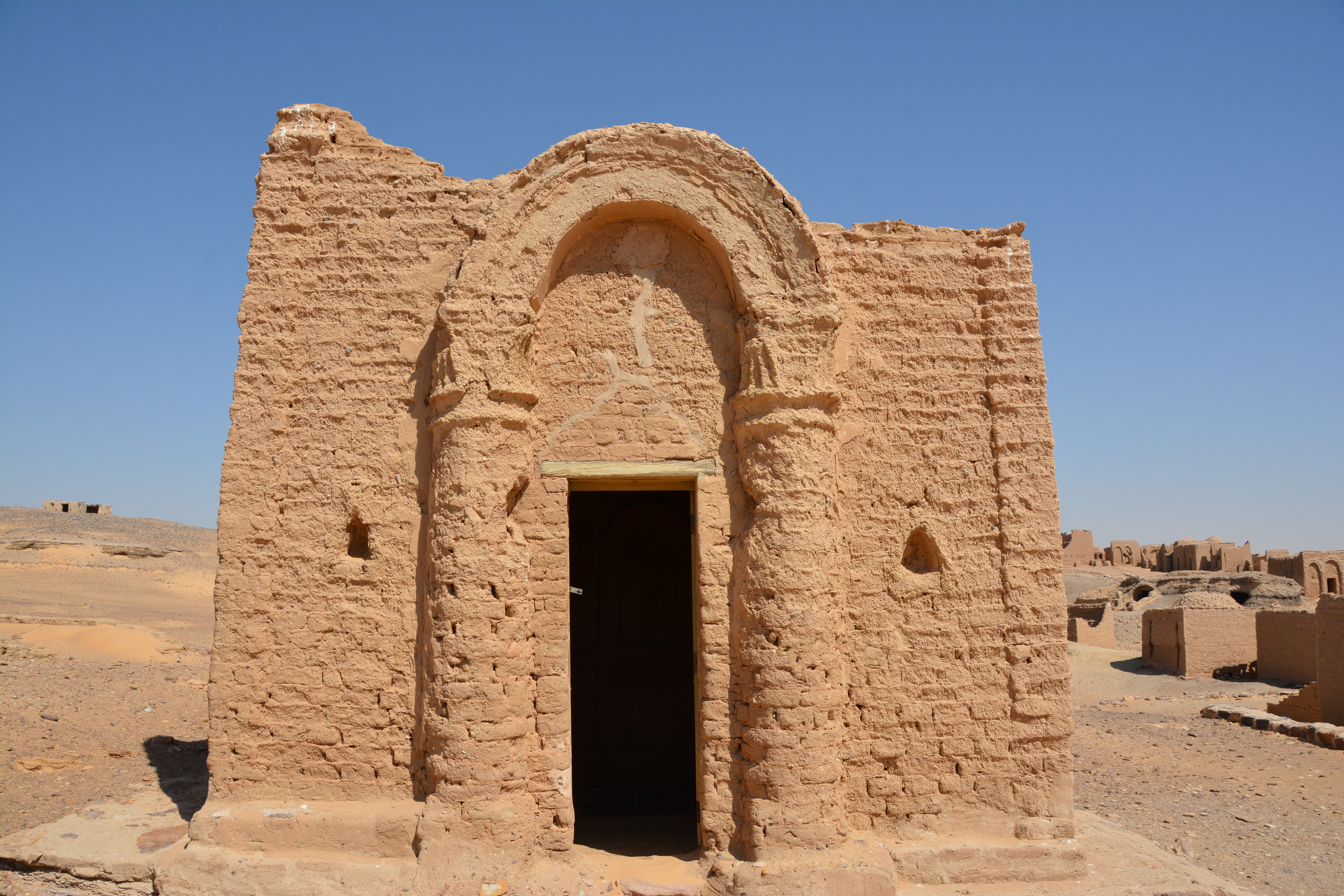
Chapel of Peace (Bagawat, Egypt)
The Chapel of Peace, a monumental Christian tomb at Bagawat Necropolis, Kharga Oasis, Egypt, built 5th or 6th century. Photo: Mohamed Kenawi / Manar al-Athar.

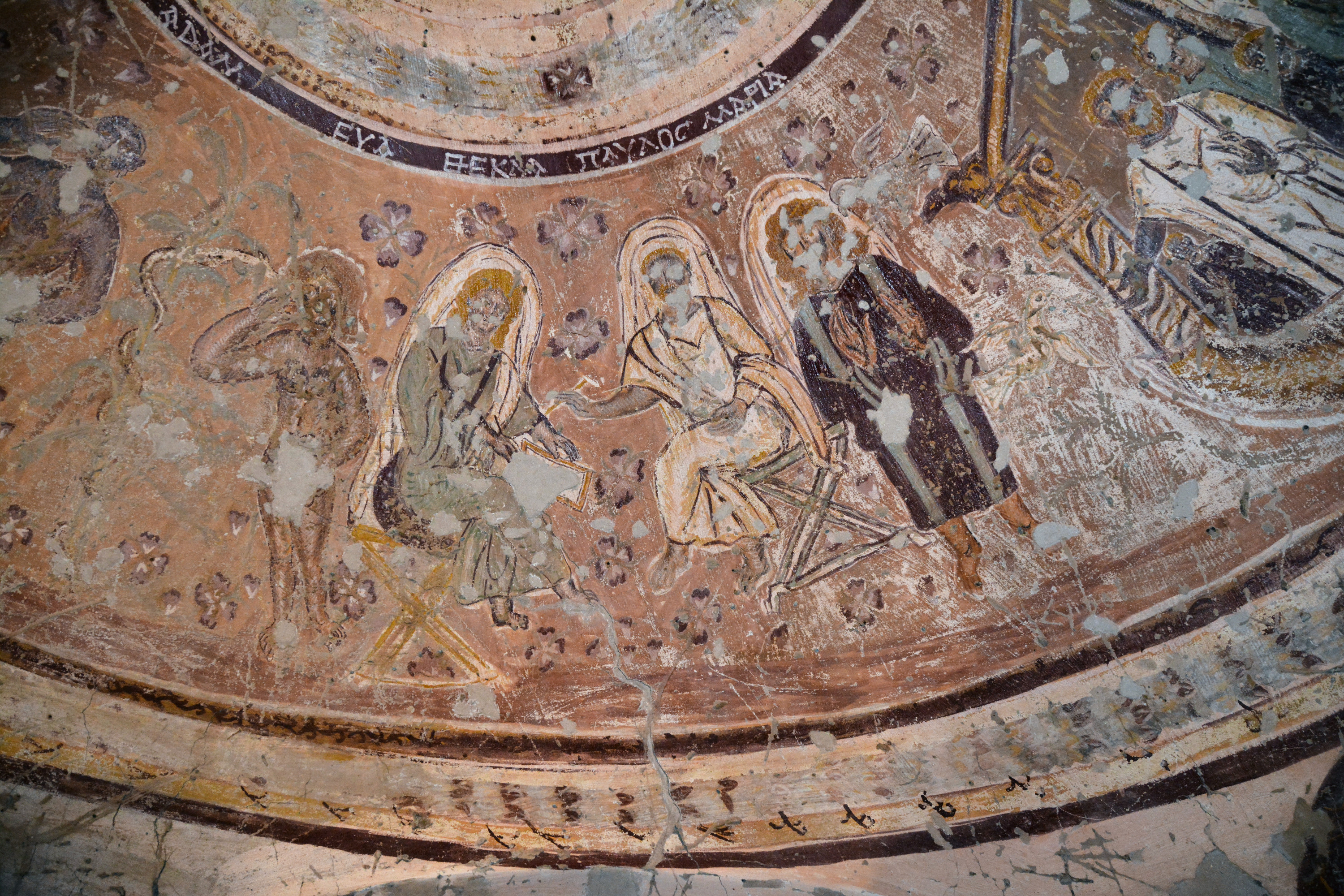
Paul and Thecla (Chapel of Peace)
Dome fresco detail from the Chapel of Peace at Bagawat Necropolis in Kharga Oasis, Egypt, 5th or 6th century. Photo: Mohamed Kenawi / Manar al-Athar.

The detail pictured above shows the female saint Thecla (Θέκλα), a first-century Christian preacher and martyr, learning from the apostle Paul (Παῦλος), as described in the ancient apocryphal Acts of Paul and Thecla. They both sit on stools, Thecla holding open a book on her lap, pen in hand, while Paul points out a particular text.

In addition to Paul and Thecla, the dome fresco also depicts, clockwise from that pair: Adam and Eve; Abraham about to sacrifice his son Isaac, with Sarah stretching out her hand (it’s unclear whether this gesture signifies her surrender to God’s will or an attempt to stop her husband’s act); Peace, holding a scepter and an ankh; Daniel in the Lions’ Den; Justice, holding a cornucopia and balance scales; Prayer; Jacob; Noah’s Ark; and the Virgin Annunciate, the New Eve, who heard the word of God and obeyed it and thus brought forth life, unlike her ancestor, who listened to the lies of the Evil One and brought forth death (the snake and dove at the women’s respective ears emphasize this contrast). View a facsimile of the full dome here.

Also in the Egyptian folder are photos of one of Byzantine Egypt’s most glorious encaustic-painted sanctuaries, that of the Red Monastery Church, a triconch (three-apse) basilica that’s part of the (Coptic Orthodox) Monastery of Apa Bishuy near Sohag.
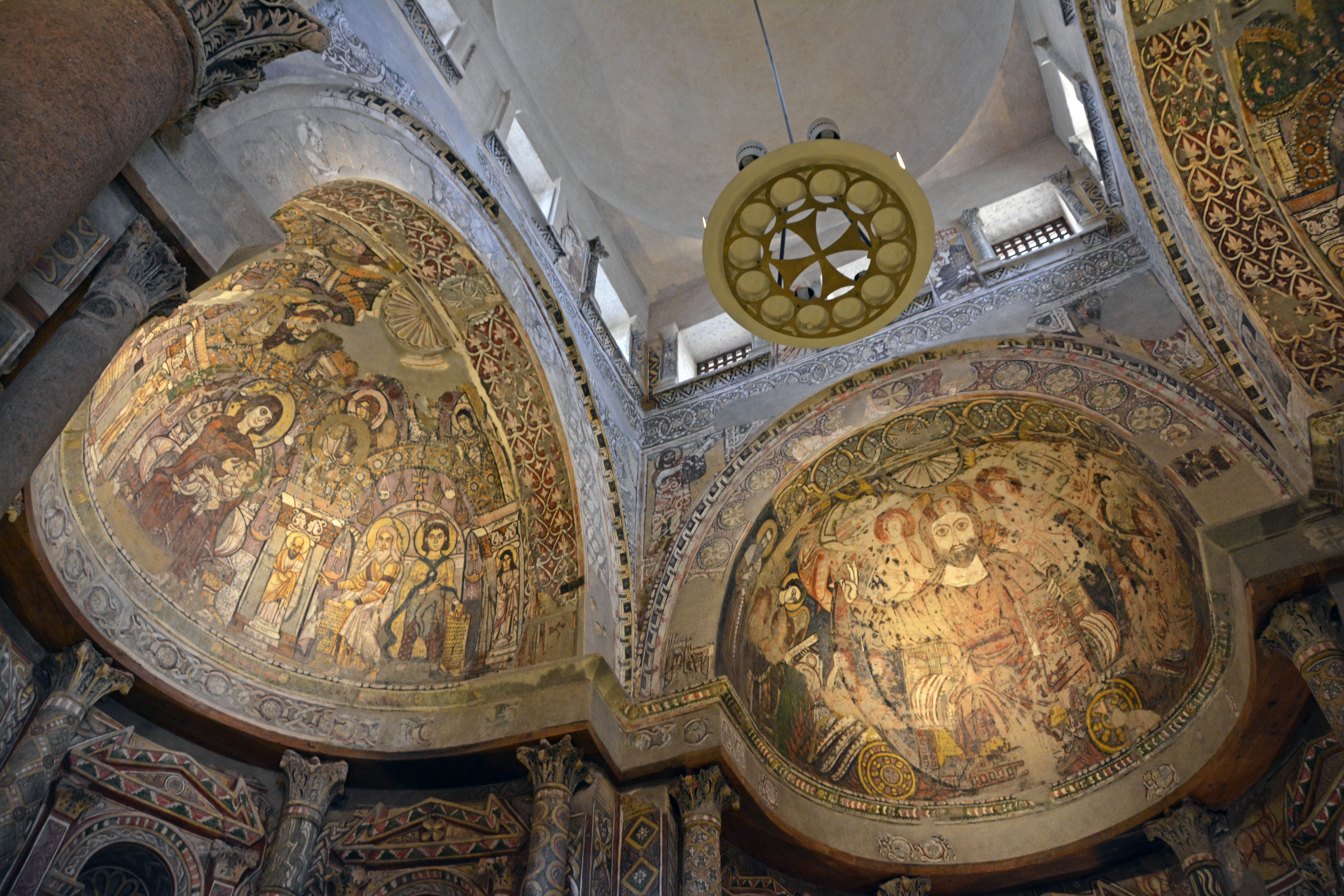
Red Monastery Church
North apse (Virgin Galaktotrophousa, aka the Nursing Madonna) and east apse (Christ Pantocrator), painted 6th–7th or 8th century, Red Monastery Church, near Sohag, Egypt. Photo: Mohamed Kenawi / Manar al-Athar.

Here’s a video that presents a 3D reconstruction and fly-through of the basilica:

Moving northeast into Israel, we come to the sixth-century Bet Alpha (sometimes rendered as Beit Alfa) Synagogue, located in the Beit She’an Valley. The excavation of Jewish sacred sites like this one reveal that, contrary to what is popularly alleged, Judaism is not a strictly aniconic religion. Many Jewish communities have understood the prohibition against graven images in Exodus 20:3–6 and Leviticus 26:1 as a prohibition against idol worship, not figurative art (art that depicts people and animals) in general. Thus several ancient synagogues, not to mention Jewish manuscripts, portray episodes from the biblical narrative, such as the Akedah (Binding [of Isaac]), told in Genesis 22.
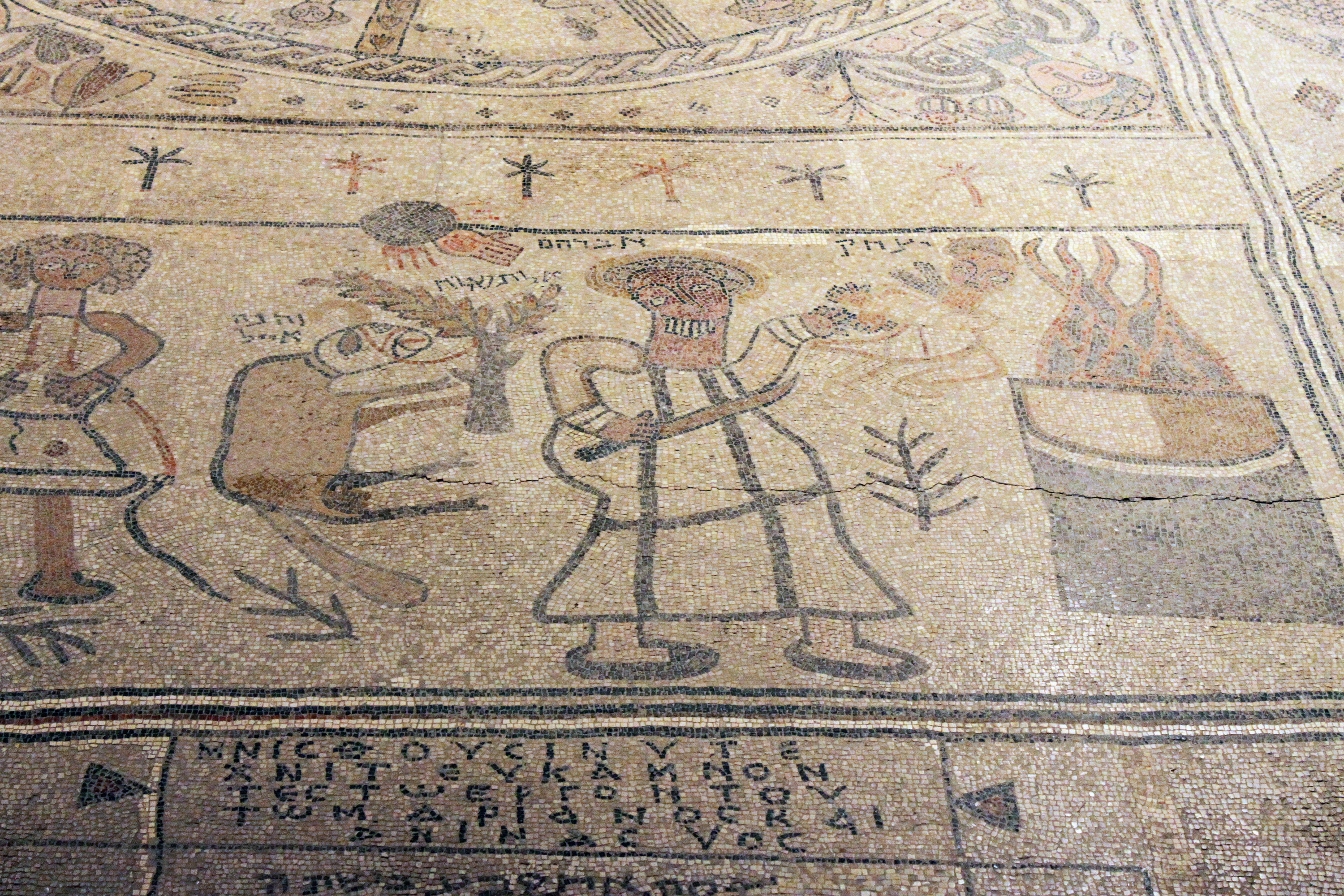
Sacrifice of Isaac (Bet Alpha mosaic)
The Binding of Isaac, early 6th century. Mosaic pavement, Bet Alpha (Beit Alfa) Synagogue, Heftziba, Israel. Photo: Sean Leatherbury / Manar al-Athar.

Rendered in a primitive style, this scene is one of three from the mosaic pavement in the central hall of Bet Alpha. It shows Abraham, sword in hand, about to throw his son Isaac onto a fiery altar, when God, represented by a hand from the sky, intervenes, telling him to stop; it’s then that Abraham notices a ram tangled up in a nearby thicket, which he sacrifices instead. The Hebrew inscriptions read, from right to left, “Yitzhak” (Isaac), “Avraham” (Abraham), “al tishlakh” (Do not lay [your hand on the boy]), and “v’hineh ayil” (Here is a ram). Stylized palm trees line the top of the scene.

Here is video footage of the full floor mosaic in its space, showing wide views as well as details, including of the remarkable zodiac wheel in the center:

Mosaic was a common form of late antique decoration in places of worship. Here are two examples from Syria:
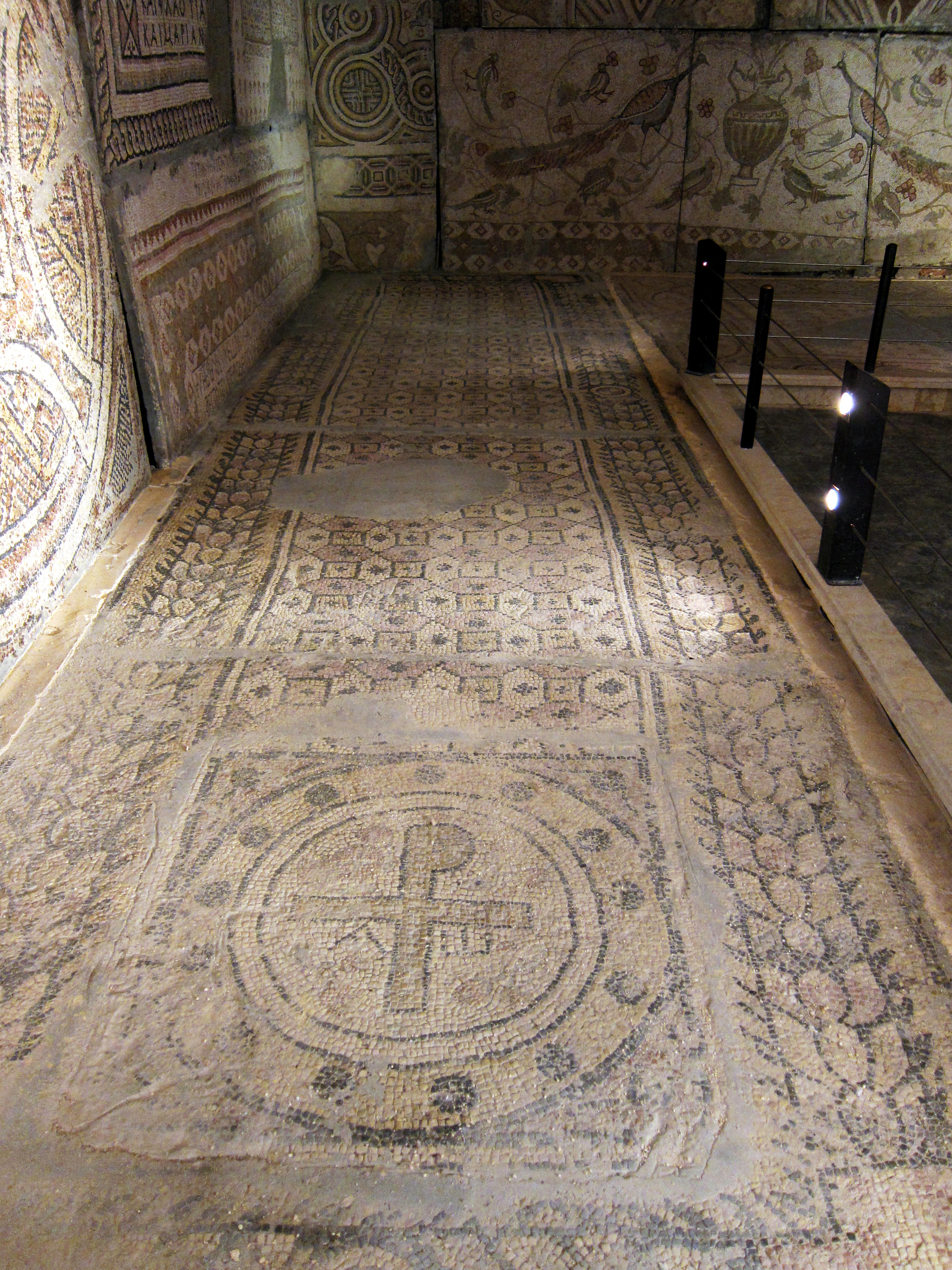
Tell Aar church mosaics
Mosaics from the ancient Tell Aar church, including a chi-rho monogram with an alpha and omega (foreground) and peacocks flanking an amphora (background), housed in the Maarat al-Numan Museum, Syria. Photo: Sean Leatherbury / Manar al-Athar.

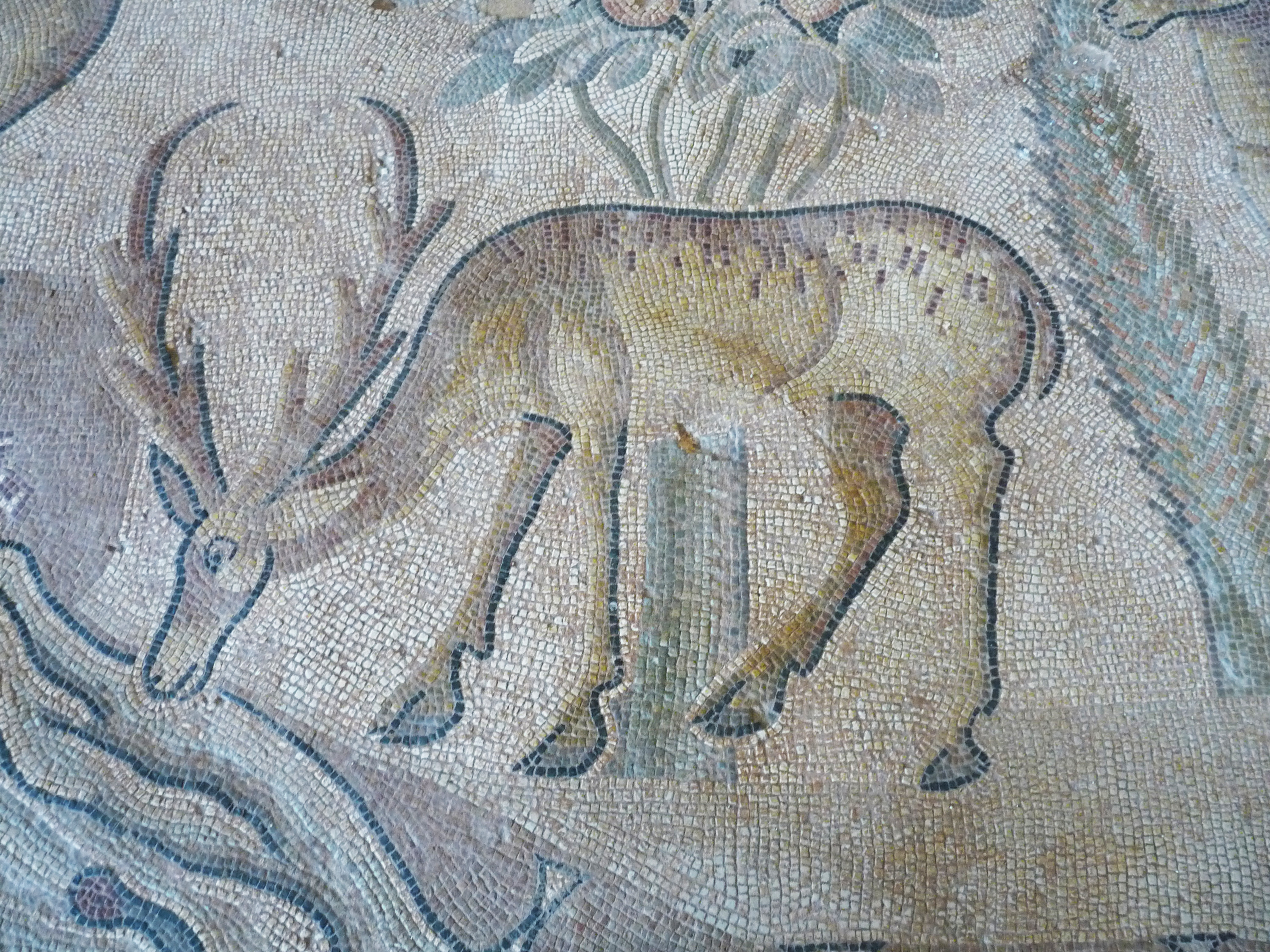
Deer drinking water
Deer drinking from a stream, 5th century. Mosaic, Church of the Martyrs, Taybat al-Imam, Syria. Photo: Jane Chick / Manar al-Athar.

To the north of Syria in Turkey—cataloged by Manar al-Athar under “Anatolia,” the ancient name for the peninsula that comprises the majority of the country—there are the Cappadocian cave churches, hewn out of volcanic tufa. They began to be built in the fifth century, with a boom happening in the ninth through eleventh centuries, which is the period to which almost all the surviving paintings can be dated. There are over a thousand such churches, some very simple inside, and others elaborately painted. The architecture has been described as eccentric and enchanting. I like to imagine the monks, nuns, and other Christians who worshipped there all those centuries ago.
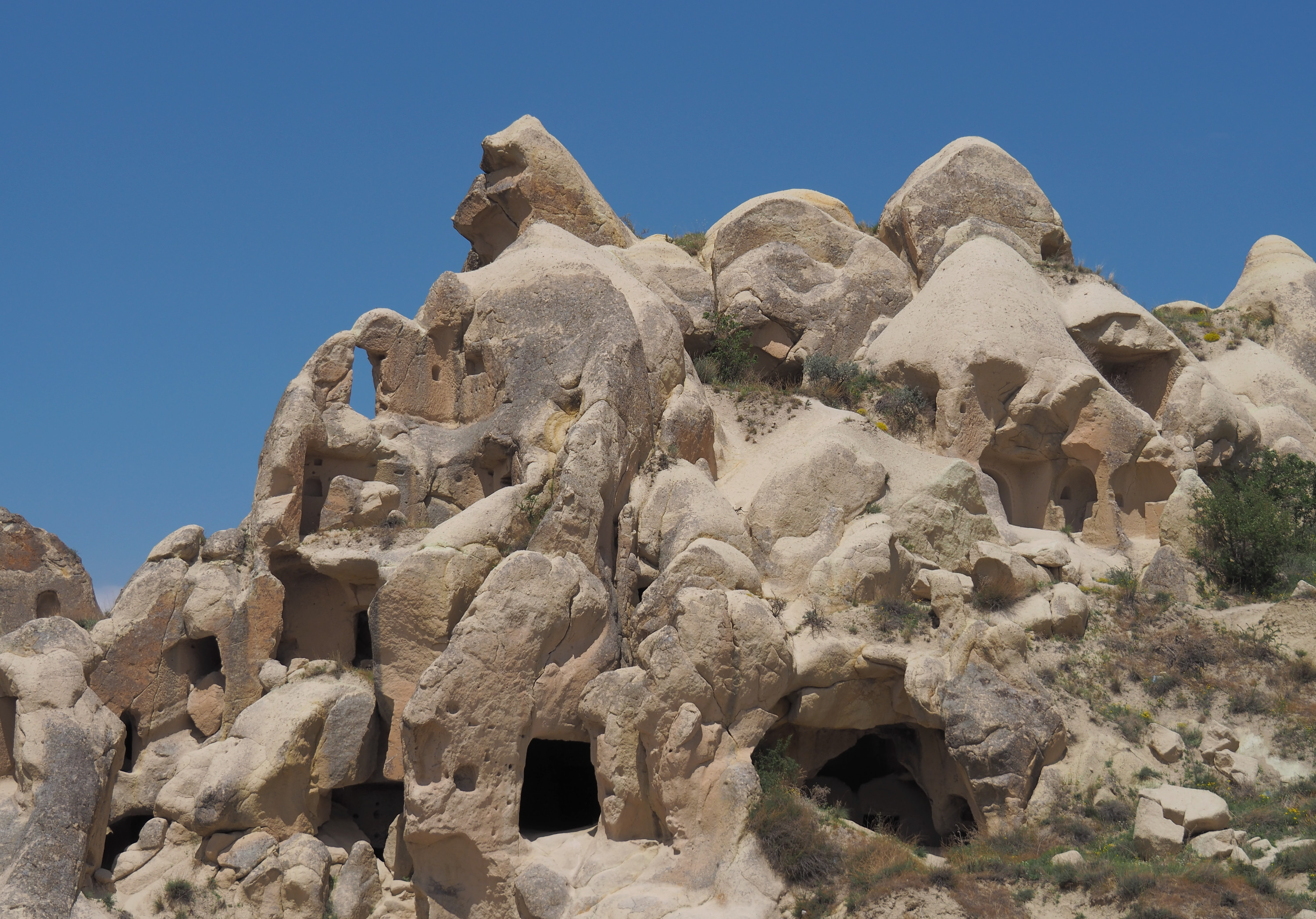
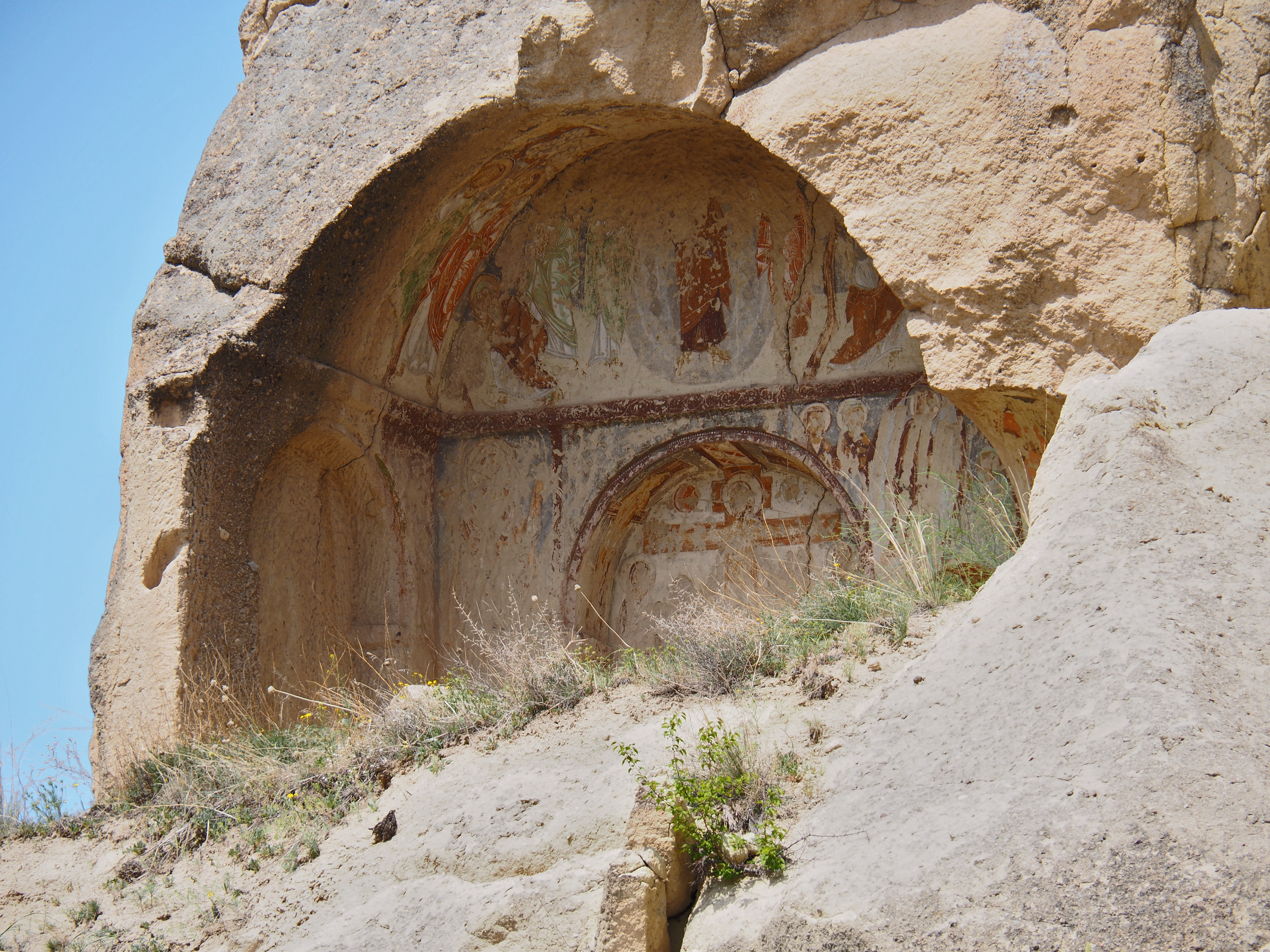
Rock-hewn chapel, Cappadocia
Middle Byzantine cave church, Göreme Open Air Museum, Cappadocia, Turkey. Photo: Marlena Whiting / Manar al-Athar.

Crucifixion and Transfiguration
Frescoes depicting the Crucifixion and the Transfiguration, from a rock-cut chapel at the Göreme Open Air Museum, Cappadocia, Turkey. Photo: Marlena Whiting / Manar al-Athar.

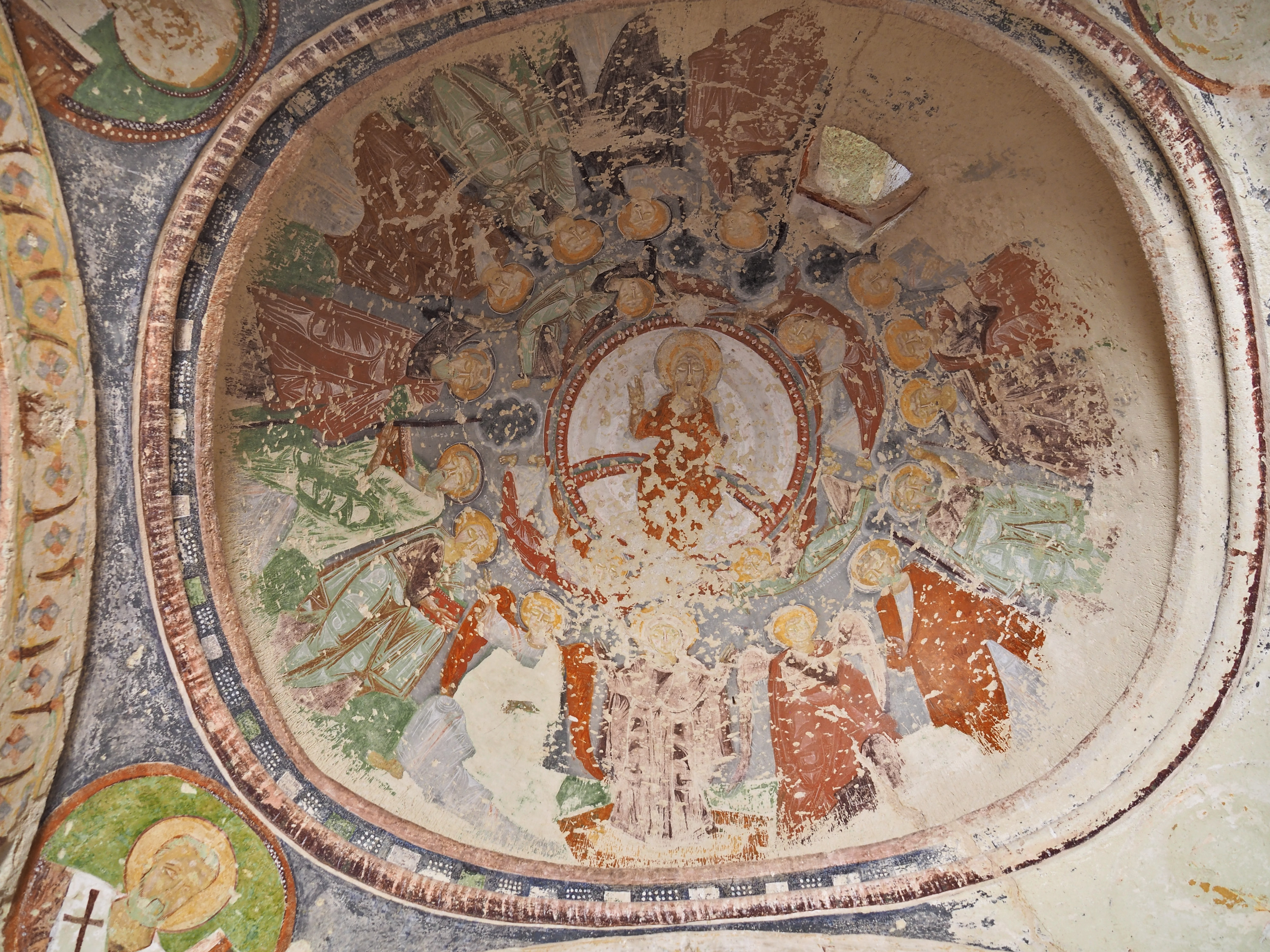
Christ in Glory (Turkey)
The Ascension of Christ, 10th century. Dome fresco, Church of the Evil Eye (El Nazar Kilise), Göreme, Cappadocia, Turkey. Photo: Marlena Whiting / Manar al-Athar.

One of the cave churches in Cappadocia, part of an ancient monastic settlement, is Pancarlik Church, home to an impressive fresco cycle on the Life of Christ that’s painted mainly in rusty red and bean green.
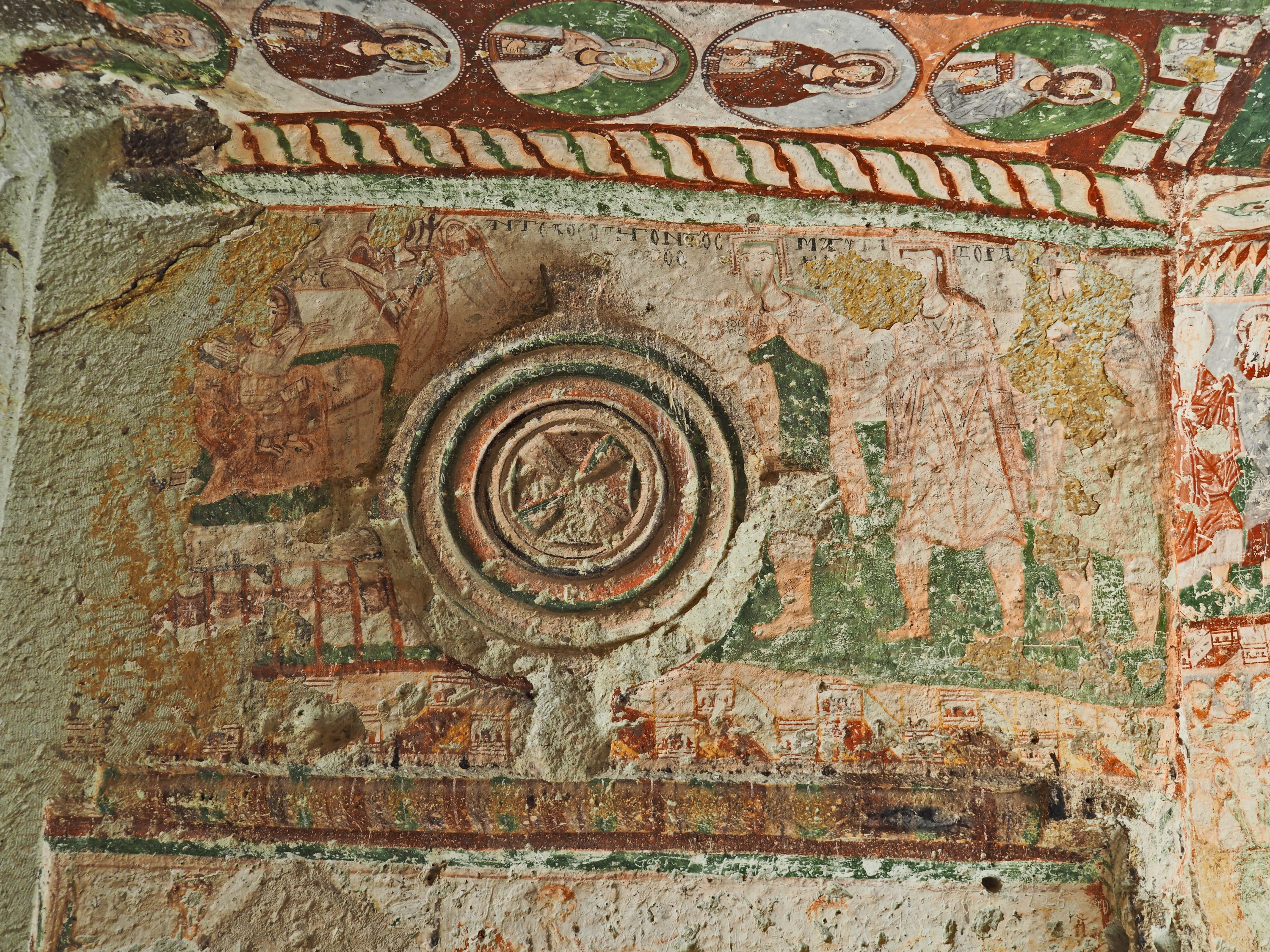
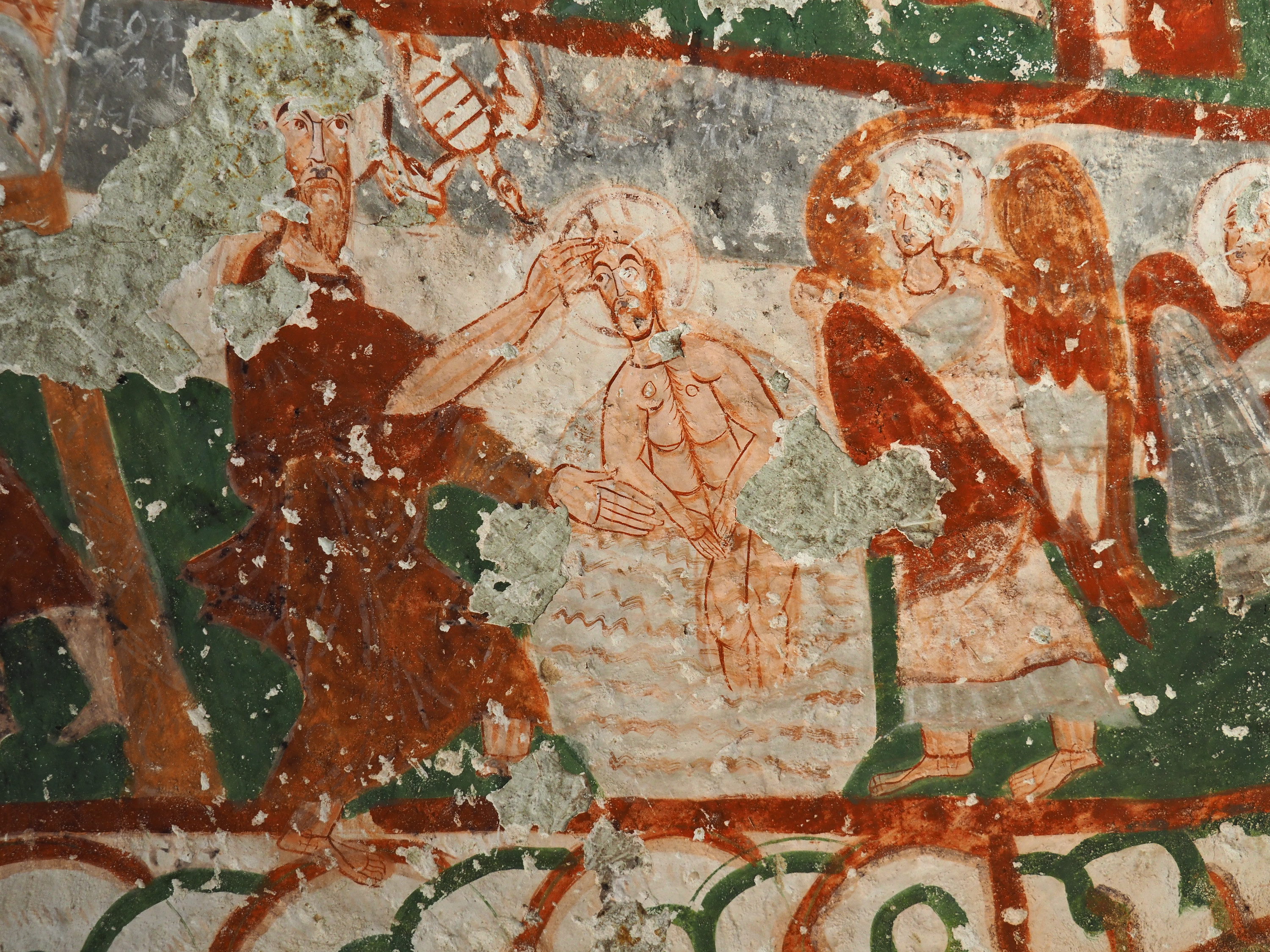
Adoration of the Magi (Turkey)
Adoration of the Magi fresco and Greek cross relief carving, probably early 11th century. Pancarlik Church, Cappadocia, Turkey. Photo: Marlena Whiting / Manar al-Athar.

Baptism of Christ (Pancarlik Church, Turkey)
The Baptism of Christ, probably early 11th century. Fresco, Pancarlik Church, Cappadocia, Turkey. Photo: Marlena Whiting / Manar al-Athar.

Beyond Cappadocia but also in Turkey is Hagia Sophia (Holy Wisdom) in Trabzon, not to be confused with the more famous Hagia Sophia in Istanbul, 650 miles away. Originally a Greek Orthodox church, it was converted into a mosque following the conquest of Trabzon (then called Trebizond) by Mehmed II in 1461. During prayer the frescoes in the nave, made by Christians who built and previously occupied the space, are covered by curtains to honor the Islamic prohibition against images—the veils are pulled aside during tourist hours—while the frescoes in the narthex remain uncovered at all times.
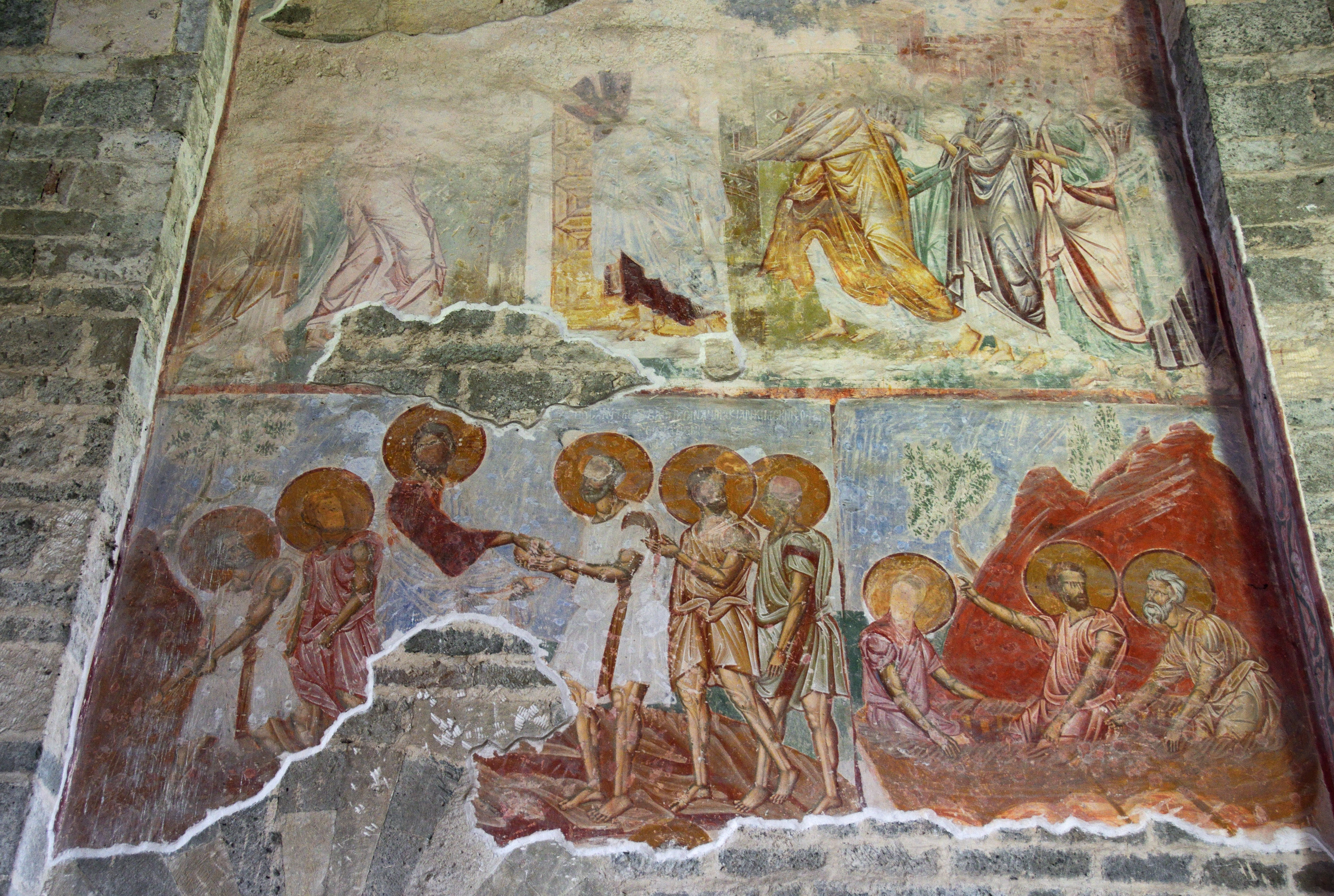
Breakfast on the Shore (Hagia Sophia, Trabzon)
The Incredulity of St. Thomas (top) and The Risen Christ Appears on the Shore (bottom), late 13th century. Frescoes, Hagia Sophia (Aya Sofya Mosque), Trabzon, Turkey. Photo courtesy of Manar al-Athar.

One of the frescoes shows Christ appearing to his disciples after his resurrection on the shore of the Sea of Galilee. He hands a fish and a loaf of bread to Peter, who stands at the front of the group, so that they can all share a joyous breakfast together after the tragic, upending events of the previous week.
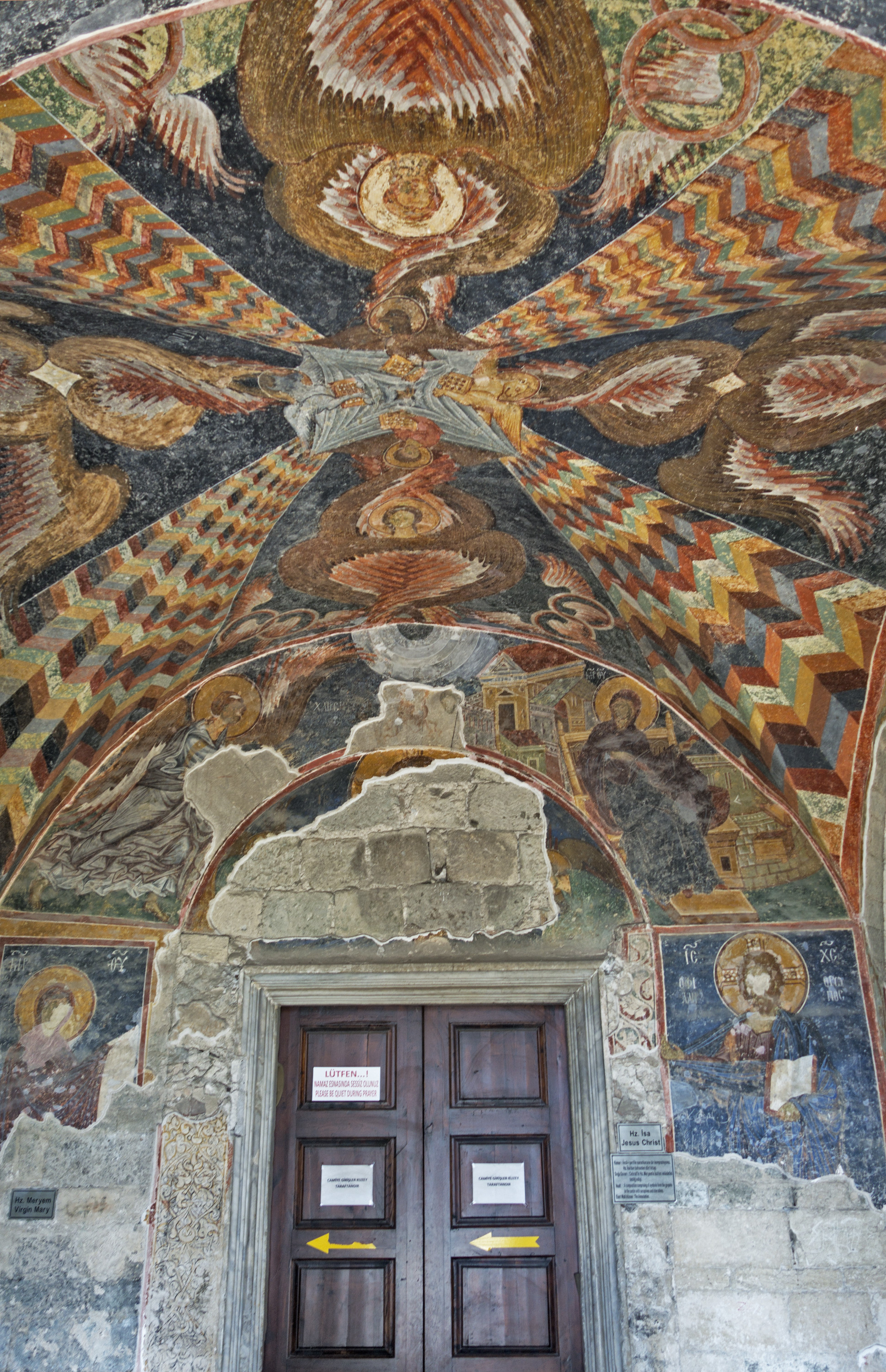
Tetramorph (Hagia Sophia, Trabzon)
Frescoed narthex, late 13th century, Hagia Sophia (Aya Sofya Mosque), Trabzon, Turkey. Photo: Matthew Kinloch / Manar al-Athar.

Another fresco, on the vaulted ceiling of the narthex, shows the four living creatures of Revelation 4—long interpreted by Christian artists as symbols of the Four Evangelists—situated along the four sides of the canopy of the heavens, each holding a golden Gospel-book and surrounded by seraphim and blazes of rainbow light.

In the Caucasus region, Armenia has a long and rich tradition of Christian art, especially relief carving and painting, as the faith took root there early on in the fourth century.
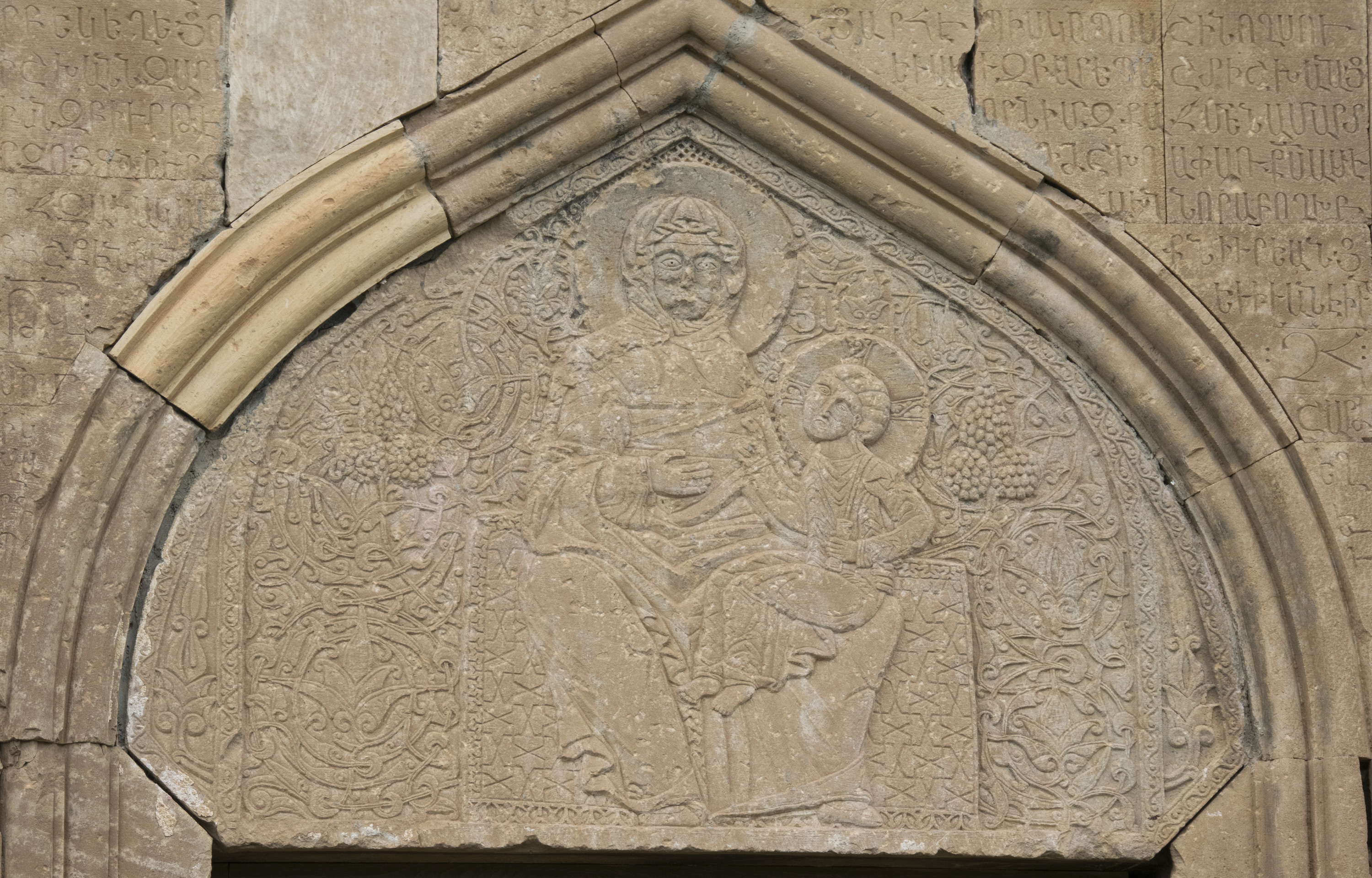
Virgin and Child
Momik Vardpet, Virgin and Child, ca. 1321. Carved tympanum, west portal, Church of St. Astvatsatsin (Holy Mother of God), Areni, Armenia. Photo courtesy of Manar al-Athar.

Overlooking the village of Areni on the eastern bank of the river Arpa is the Church of St. Astvatsatsin, which has a beautiful relief carving in the tympanum above the west portal by the Armenian architect, sculptor, and manuscript illuminator Momik Vardpet (died 1333). It depicts the Christ child seated on the lap of his mother, holding a scroll in one hand and raising the other in blessing. Decorative vines rise up behind and around the pair, suggesting verdancy.

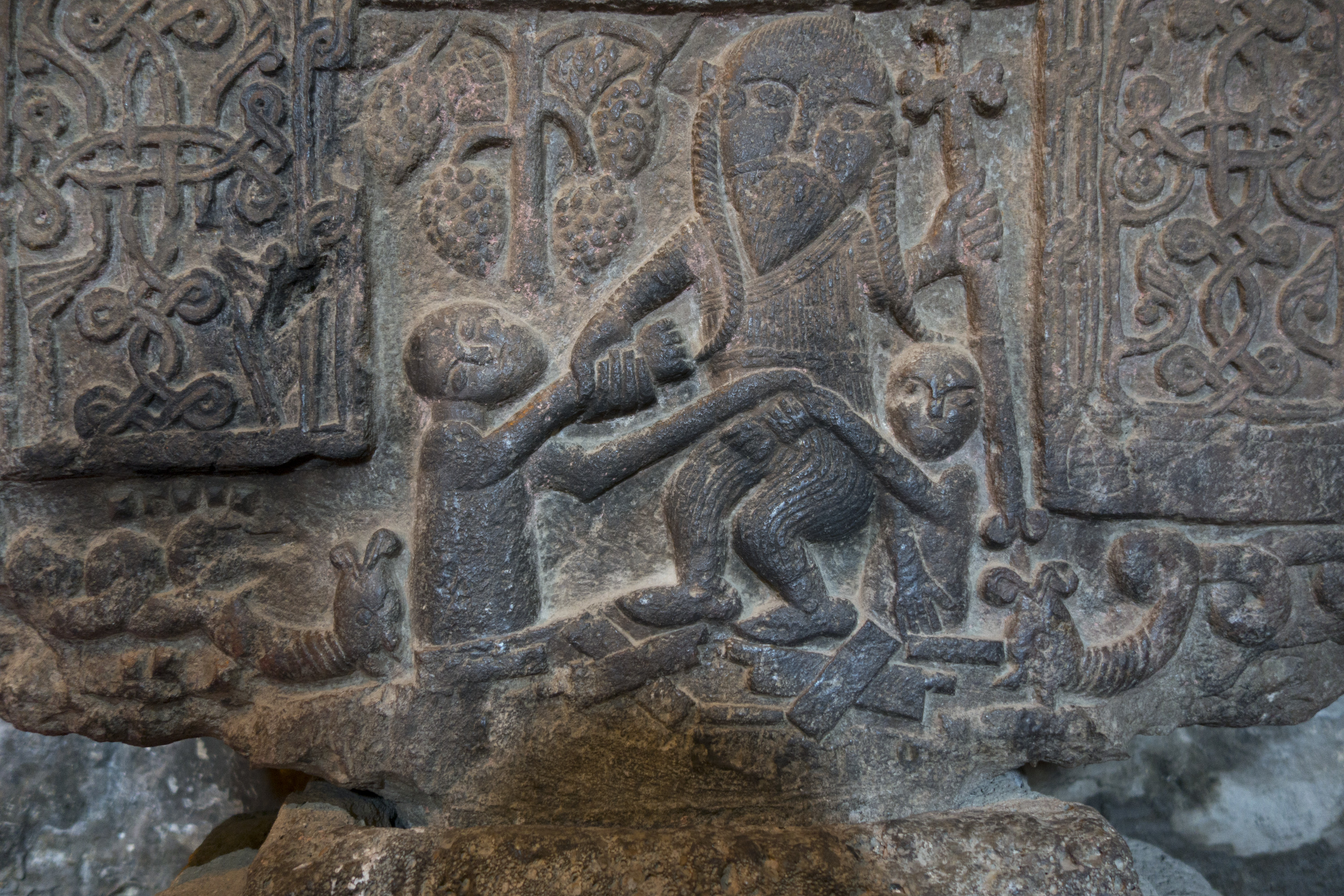
The most distinctive Christian art form in Armenia is the khachkar, a carved memorial stele bearing a cross and often botanical motifs, and only occasionally a Christ figure. In the village of Sevanavank, at a different Church of St. Astvatsatsin, there’s a particularly striking khachkar that portrays the crucified Christ in the center, and below that, a scene of the Harrowing of Hell.
Harrowing of Hell (Armenia)
The Harrowing of Hell, detail of a khachkar from the Church of St. Astvatsatsin (Holy Mother of God) in Sevanavank, Armenia. Photo: Matthew Kinloch / Manar al-Athar. [view full khachkar]

Holding aloft his cross as a scepter, the risen Christ breaks down the gates of death and rescues Adam and Eve, representatives of redeemed humanity, while serpents hiss vainly at his heels. I’m struck by the uniqueness of Christ’s hair, which flows down in two long braided pigtails. Was this a common hairstyle for males in medieval Armenia? I have no idea.

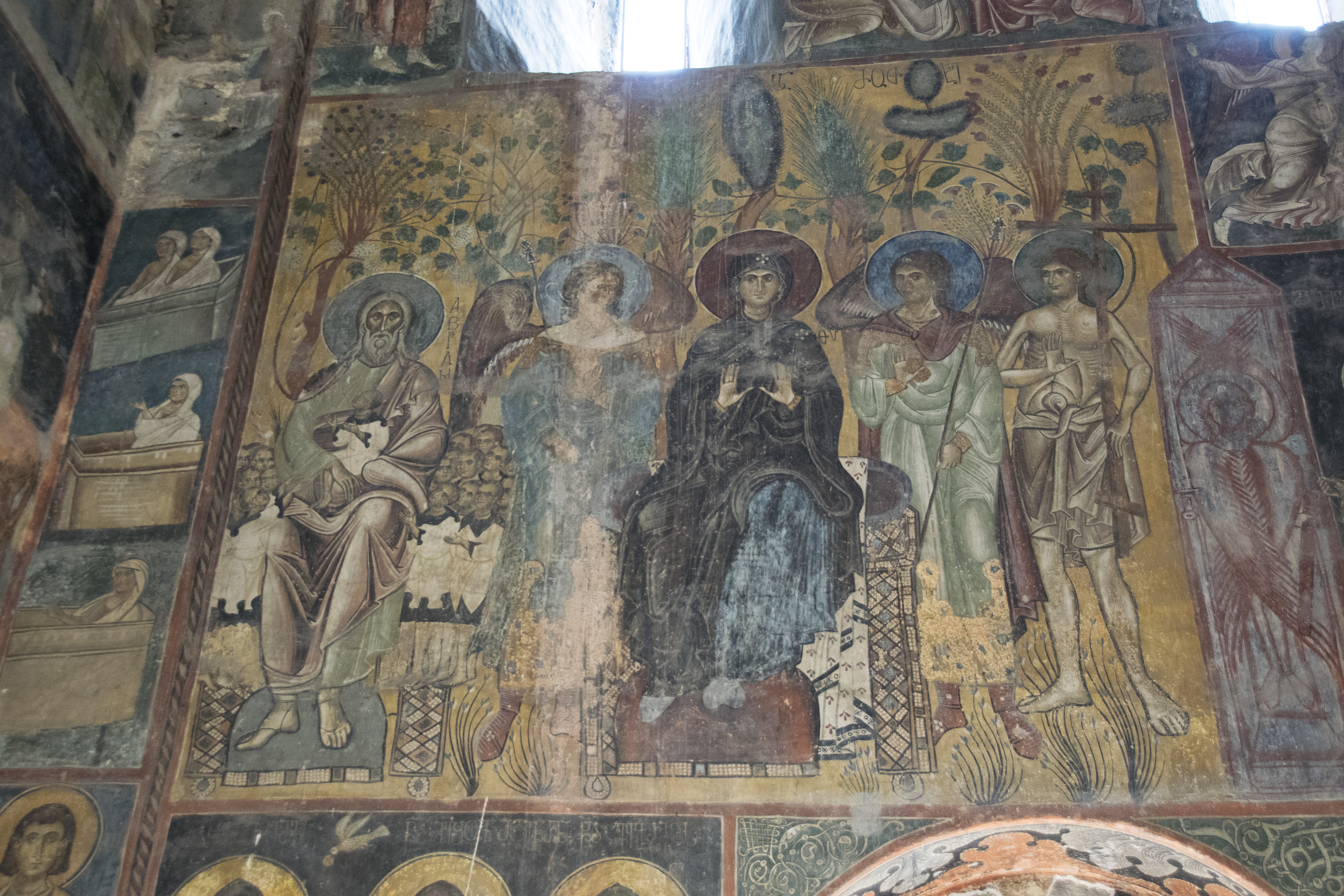
The last artwork from Armenia that I’ll share is an icon of paradise from the Church of St. Astvatsatsin (yes, it’s a popular church name in that country!) at Akhtala Monastery.
Paradise (Armenia)
Paradise, 1205–16. Fresco, west wall, Church of St. Astvatsatsin (Holy Mother of God), Akhtala Monastery, Akhtala, Armenia. Photo courtesy of Manar al-Athar.

In the center is the Mother of God flanked by two angels. On the left is Abraham with a child, representing a blessed soul, sitting on his lap (Luke 10:22 describes how the righteous dead go to “Abraham’s bosom,” a place of repose). On the right is Dismas, the “good thief” who repented on the cross of his execution, and to whom Jesus promised paradise (Luke 23:39–43); he is venerated as a saint in the Catholic and Orthodox churches.

The image is part of a larger Last Judgment scene that covers the entire west wall. A few panels above, at the very top, Christ is enthroned on a rainbow.

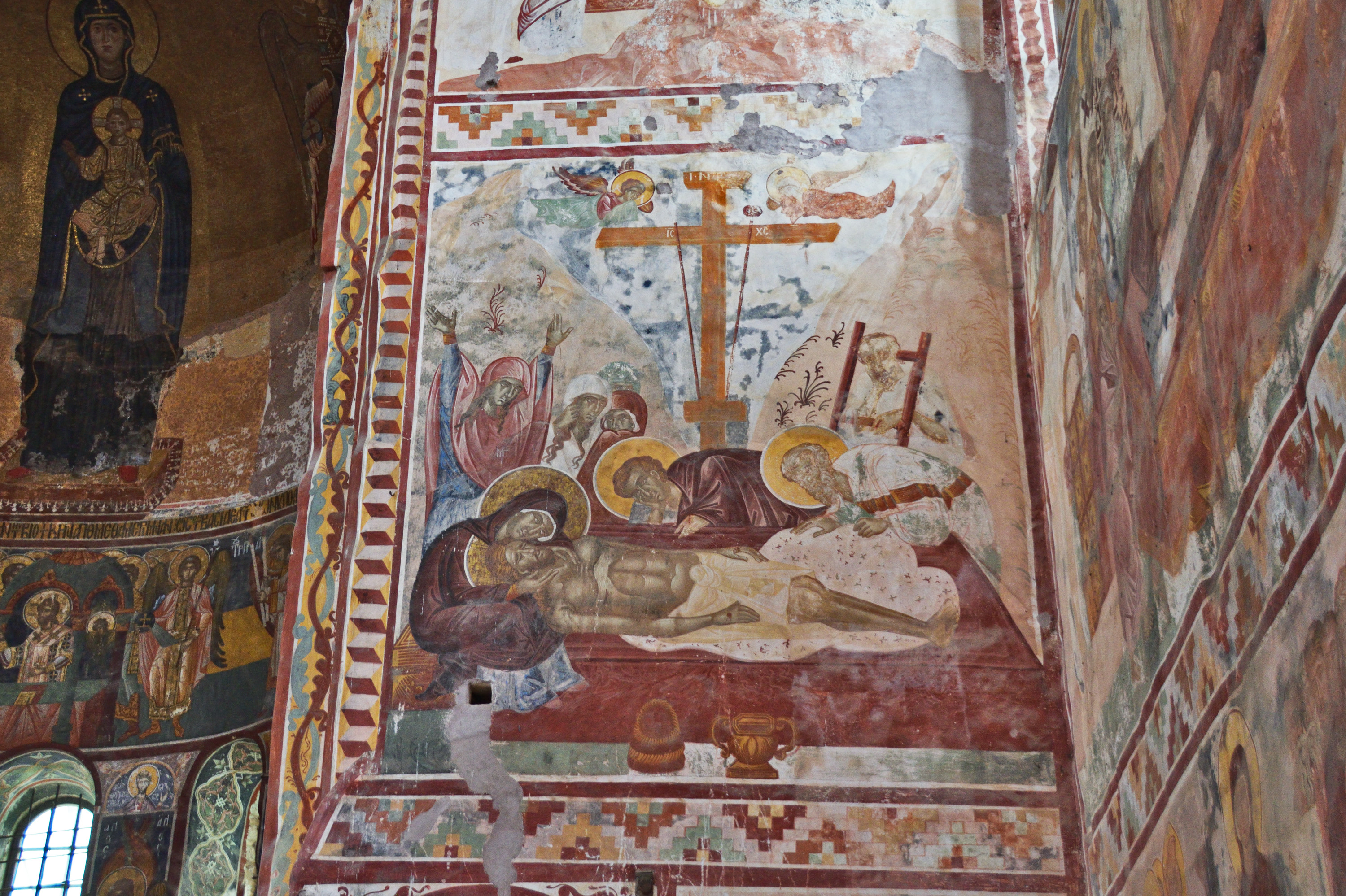
The neighboring country of Georgia has also cultivated a tradition of Christian icon painting. The main church of Gelati Monastery, founded in 1106, is richly decorated with painted murals dating from the twelfth through seventeenth centuries. One of them is the Lamentation over the Dead Christ: The Virgin Mary gently cradles the head of her son and Mary Magdalene throws her arms up in grief while the apostle John leans in close to mourn the loss and Joseph of Arimathea begins to wrap the body in a shroud.
Lamentation (Georgia)
Lamentation over the Dead Christ, fresco, Church of the Blessed Virgin, Gelati Monastery, near Kutaisi, Georgia. Photo courtesy of Manar al-Athar.

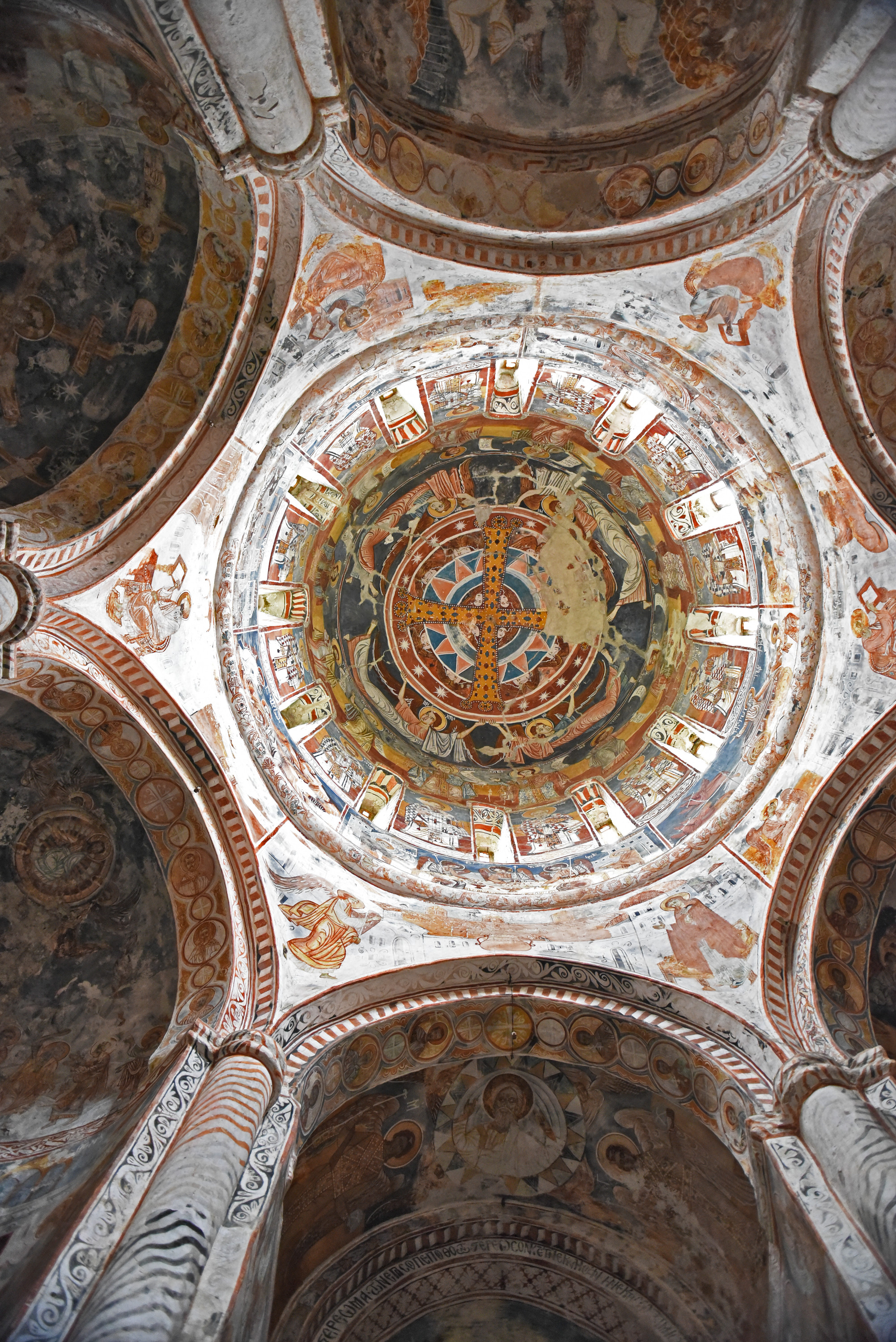
Another Georgian icon painting, from the central dome of the Church of St. Nicholas in Nikortsminda, shows angels bearing aloft a jeweled cross, surrounded by the twelve apostles.
Georgian church dome
Central dome, Church of St. Nicholas, Nikortsminda, Georgia. Photo: Ross Burns / Manar al-Athar.

Lastly, from the Balkans, I want to point out Decani Monastery in Kosovo, a Serbian Orthodox monastery built in the fourteenth century in an architectural style that combines Byzantine and Romanesque influences. The tympana of its katholicon (main church) lean into the Romanesque. The one over the south entrance portrays John baptizing Jesus in the river Jordan, and the Serbian inscription below describes the monastery’s founding.
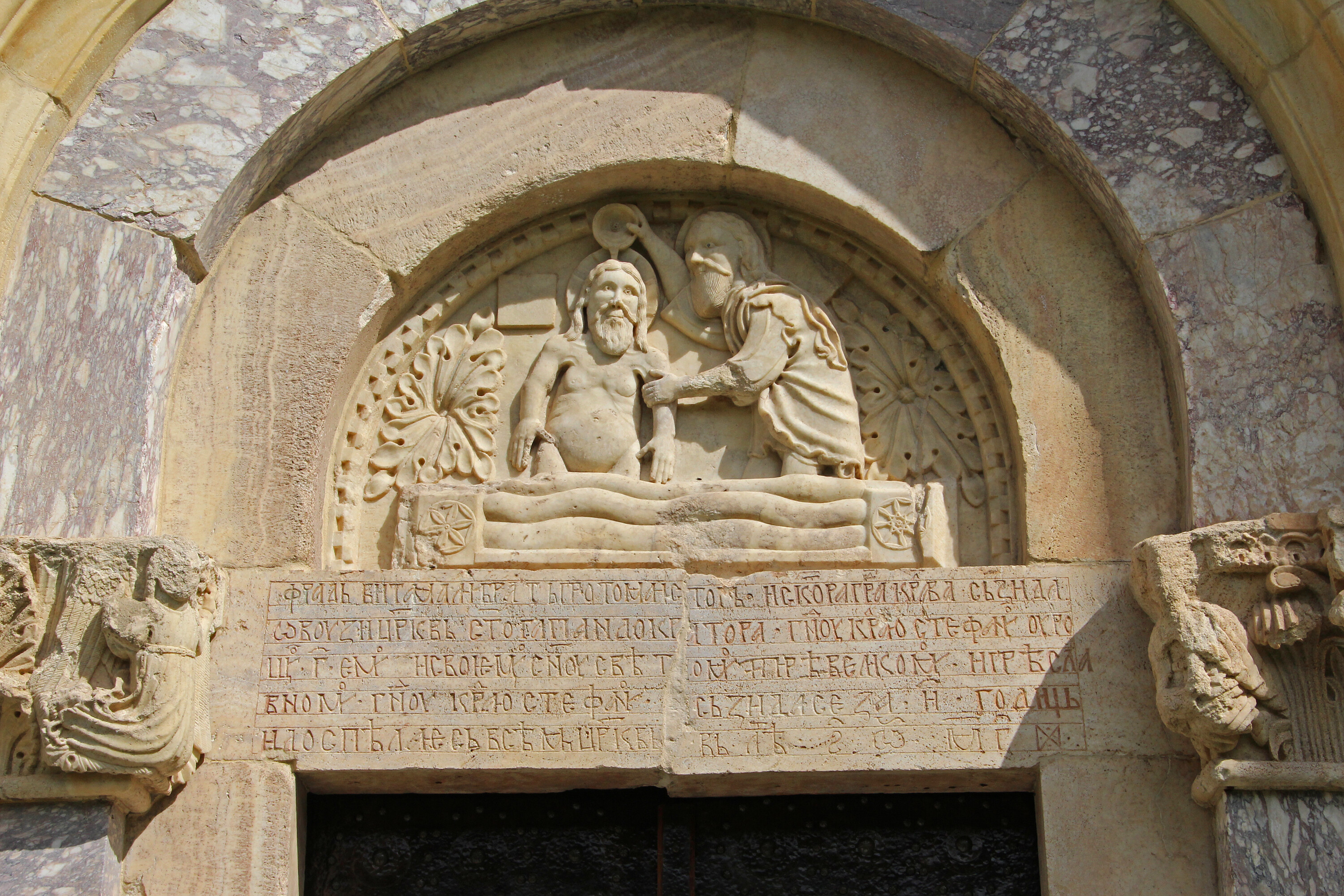
Baptism of Christ tympanum (Decani)
The Baptism of Christ, 1327–35. Carved tympanum, south portal, Christ Pantocrator Church, Decani Monastery, near Deçan, Kosovo. Photo: Mark Whittow / Manar al-Athar.

Decani’s katholicon is the largest and best-preserved medieval church in the Balkans and due to continuing ethnic strife in the region is under international military protection. The Blago Fund website has more and better photos of the extensive frescoes inside, from the fourteenth through seventeenth centuries.

It’s important to note that this is one of a number of churches from the Manar al-Athar archive that are still active sites of Christian worship, where communities of believers are nurtured through word, image, and sacrament.


If you are interested in volunteering with Manar al-Athar—helping with image processing, labeling, fundraising, or web building—or if you have taken any photographs that may be of interest to the curatorial team, email manar@classics.ox.ac.uk.

Website: https://www.manar-al-athar.ox.ac.uk/
Roundup: Ellsworth Kelly’s “Austin,” new book by Jonathan Anderson, religion in pop art, and more

PRINT INTERVIEWS:

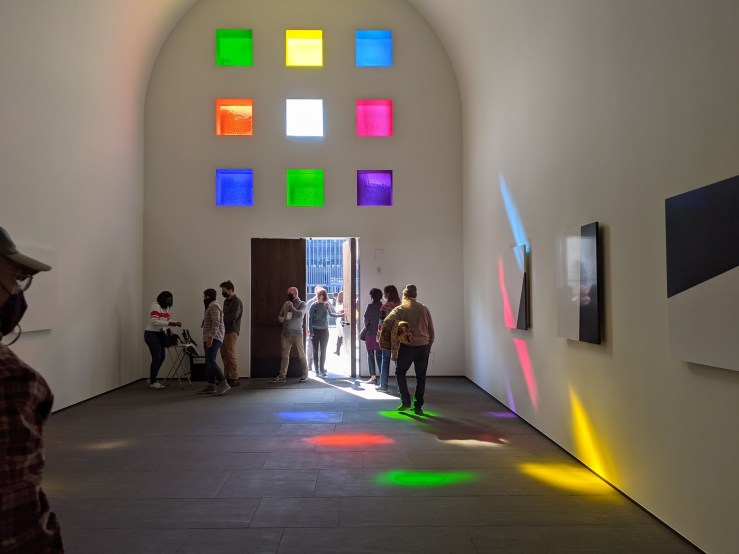
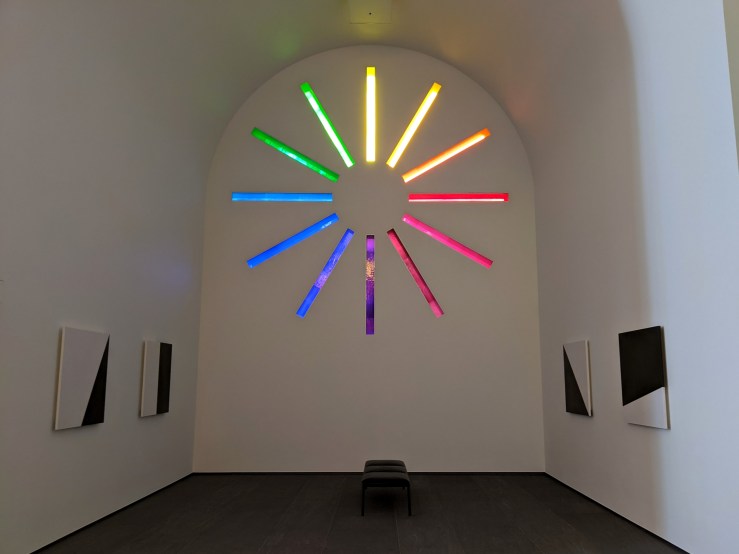
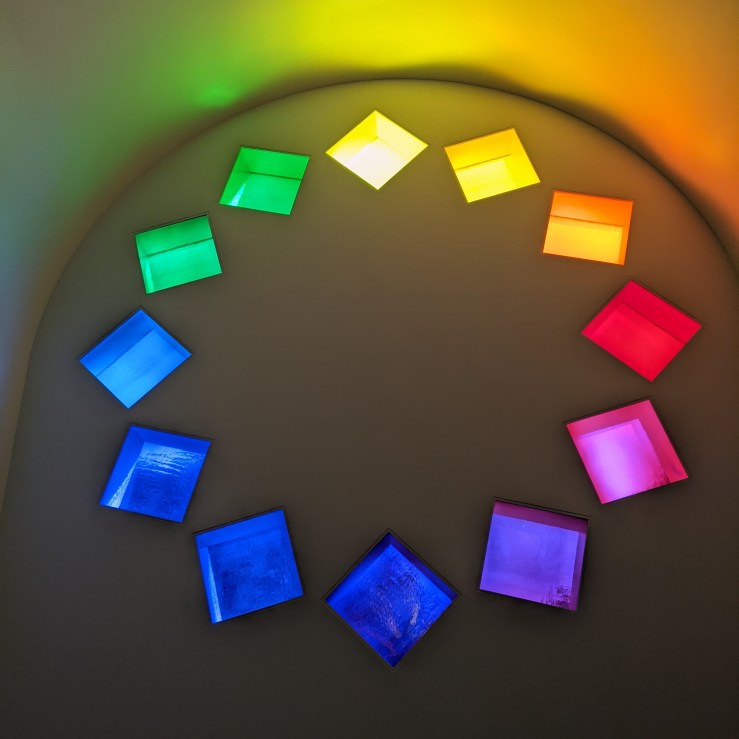
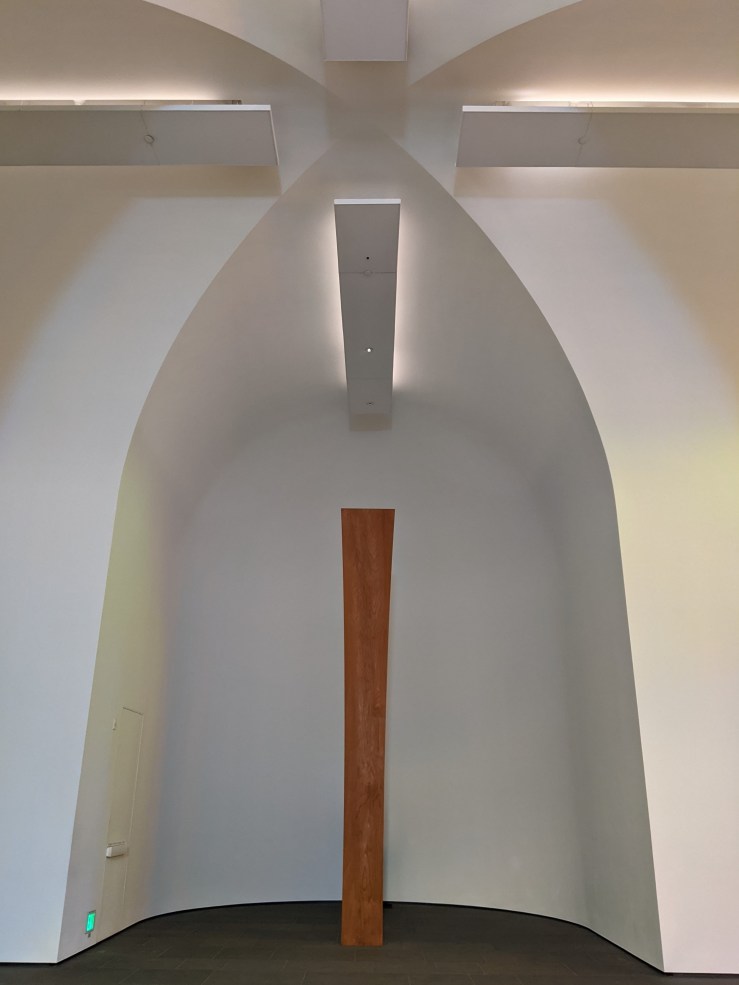
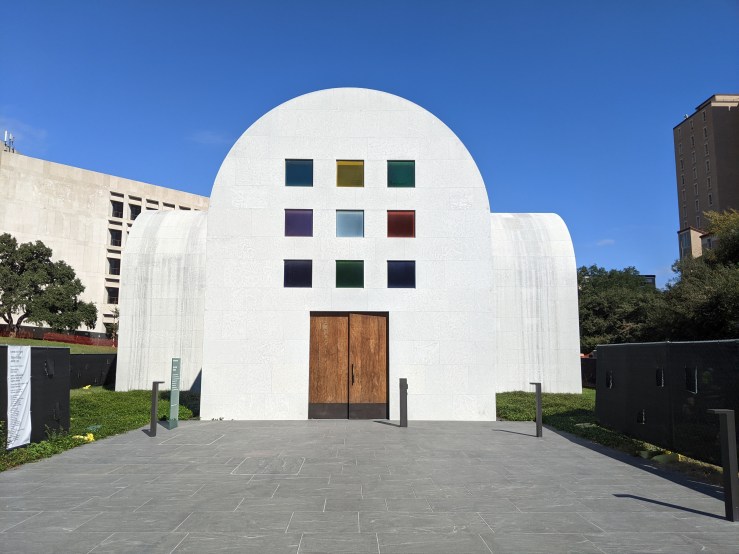
>> “What Remains: The Making of Ellsworth Kelly’s Last Work,” Image interview with Rick Archer: I got to experience Ellsworth Kelly’s Austin—a modernist “chapel” containing three stained glass windows, fourteen black-and-white marble panels (Stations of the Cross), and a redwood totem—while in Texas for a CIVA conference in 2021; see some of my photos below. Kelly was an atheist inspired by Romanesque church architecture, and the architect he chose to collaborate with on Austin, Rick Archer, is a Christian. In this wonderful new interview by Bruce Buescher, Archer discusses his working relationship with Kelly, Kelly’s desire for randomization and form over meaning, the technical and architectural challenges of bringing Kelly’s vision to life, religious references, and the artist’s objective for the space. “I hope when people go in here, they will experience joy,” Archer remembers Kelly saying.

  • Austin by Ellsworth Kelly
  • Austin by Ellsworth Kelly
  • Austin by Ellsworth Kelly
  • Austin by Ellsworth Kelly
  • Austin by Ellsworth Kelly

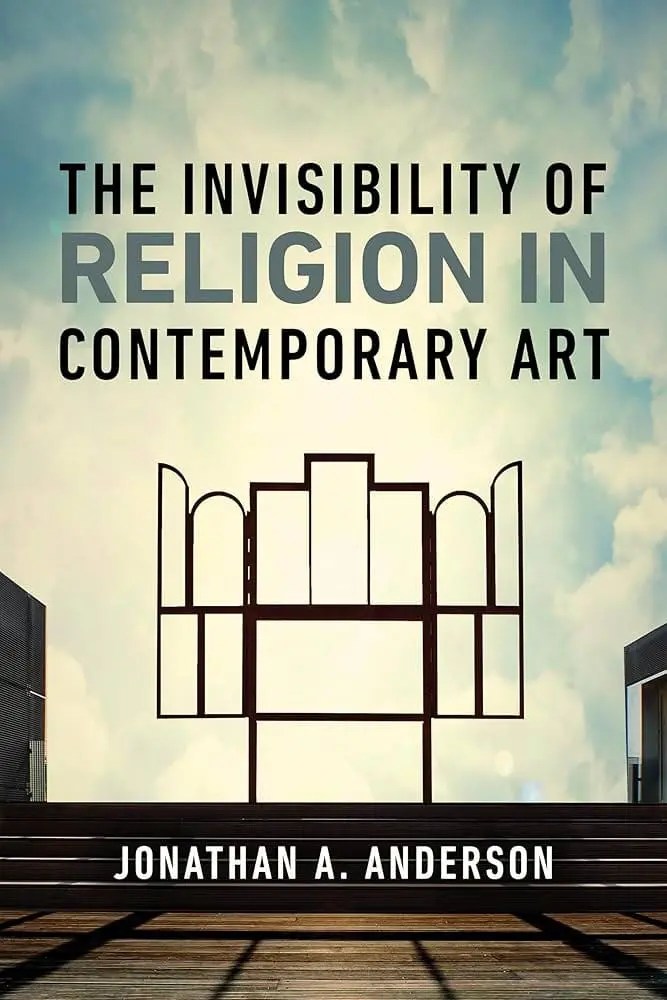
>> “The Invisibility of Religion in Contemporary Art: An interview with Jonathan A. Anderson” by Matthew J. Milliner: Jonathan Anderson [previously] is one of the most important people working across the disciplines of art and theology, and I’m thrilled that his book The Invisibility of Religion in Contemporary Art is now available from the University of Notre Dame Press!

Invisibility of Religion in Contemporary Art

In this recent interview for Comment magazine, Anderson explains his purpose in writing the book:

I have become increasingly convinced that so many pivotal artists and artworks over the past century are deeply shaped by religious traditions and seriously engaged in theological questioning, but this remains severely under-interpreted or misinterpreted in the scholarship about these artists. One might see these threads running through an artist’s artworks and personal writings and even discuss these topics with the artist in their studio, but when one moves to the scholarly writing and teaching about that same artist, that language consistently disappears or is transposed into another register—usually politics, occasionally a highly esoteric spirituality. I wanted to understand, at a non-superficial level, why this was the case, and I wanted to see how other ways of speaking and writing about this topic might be possible.

Don’t miss, at the end of the article, his three hopes for the field of “art and theology,” which I very much share!

+++

LECTURE: “The Problems and Possibilities of Visual Theology: The Ascension as a Case Study” by Jonathan A. Anderson: With Ascension Day coming up on May 29, it’s timely to share this talk given by Jonathan Anderson (see previous roundup item) a few years ago at Duke Divinity School, where he worked as a postdoctoral associate of theology and the visual arts from 2020 to 2023. Anderson explores a handful of images depicting the Ascension of Christ, a particularly challenging subject because of the spatial ambiguity. The scriptural accounts of the event (Luke 24:50–53 and Acts 1:6–11) beg the question, “What does ‘lifted up’ mean? Where is Jesus?” Attempting to work out these spatial difficulties visually can be theologically and exegetically productive, Anderson claims—even if it sometimes leads to unsatisfying results, as, Anderson says, it often does in Western art from the Renaissance onward. By contrast, when artists foster intertextual readings across the biblical canon and focus not so much on what the Ascension looks like as a historical event but rather on what it means, they are generally more successful.

Here are some time stamps, with links to the artworks discussed:

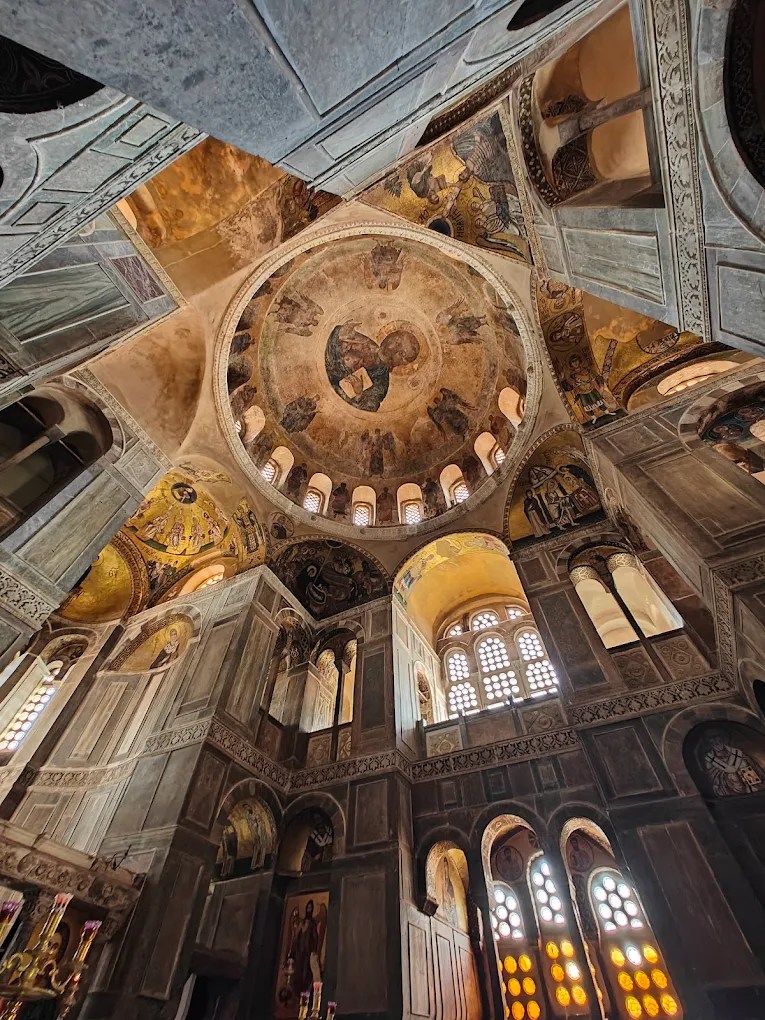
Hosios Loukas
Katholikon of Hosios Loukas monastery, Boeotia, Greece, 1011–12

+++

INSTRUMENTAL JAZZ: “Prayer” by Cory Wong: This video shows a live performance of Cory Wong’s “Prayer” on July 4, 2023, at Gesù music hall in Montreal. Wong, on guitar at far left, is joined by Ariel Posen on guitar, Victor Wooten on bass, and Nate Smith on drums. I learned about Wong through his collaborative album with Jon Batiste, Meditations (2020), which includes a version of this piece featuring Batiste’s piano playing.

+++

EXHIBITION: OMG! Reli Popart, Museum Krona, Uden, Netherlands, April 5–September 7, 2025: This exhibition at Museum Krona (housed in the complex of the still-active Birgittine Abbey of Maria Refugie in Uden, Netherlands) explores the connection between the pop art movement and Christianity through works by artists such as Andy Warhol, Corita Kent, Niki de Saint Phalle, and especially Dutch artists, including Woody van Amen and Wim Delvoye. Pop art is characterized by the use of imagery from popular culture, sourced from television, magazines, comic books, ads—and sometimes from the trash bin.

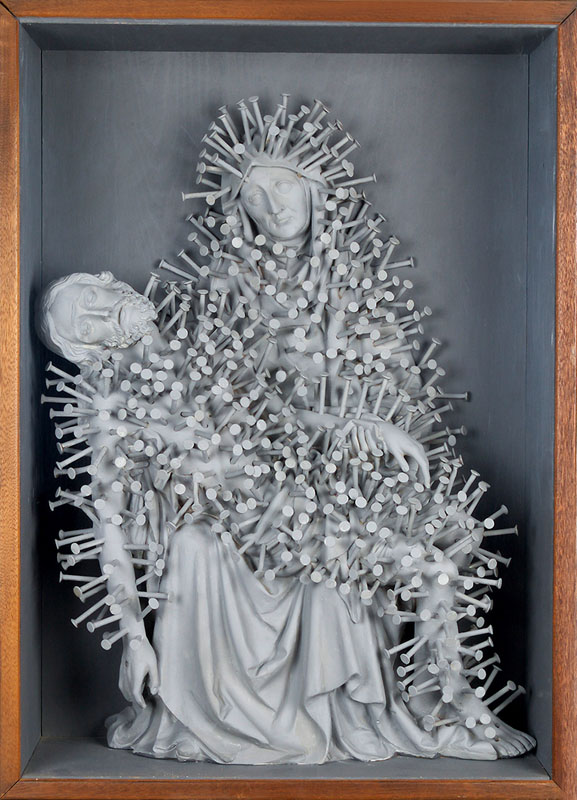
Jacques Frenken [previously], for example, built a body of work by salvaging discarded plaster sculptures of Christ and the saints—mass-produced for Catholic devotional use—and reconstructing them into assemblages. For his Spijkerpiëta, he “brought the Pietà back into our midst and accentuated the pain it radiates with nails,” the artist said.

Frenken, Jacques_Spijkerpieta
Jacques Frenken (Dutch, 1929–2022), Spijkerpiëta (Nail Pietà), 1967. Plaster, paint, iron, wood. Museum Krona, Uden, Netherlands.

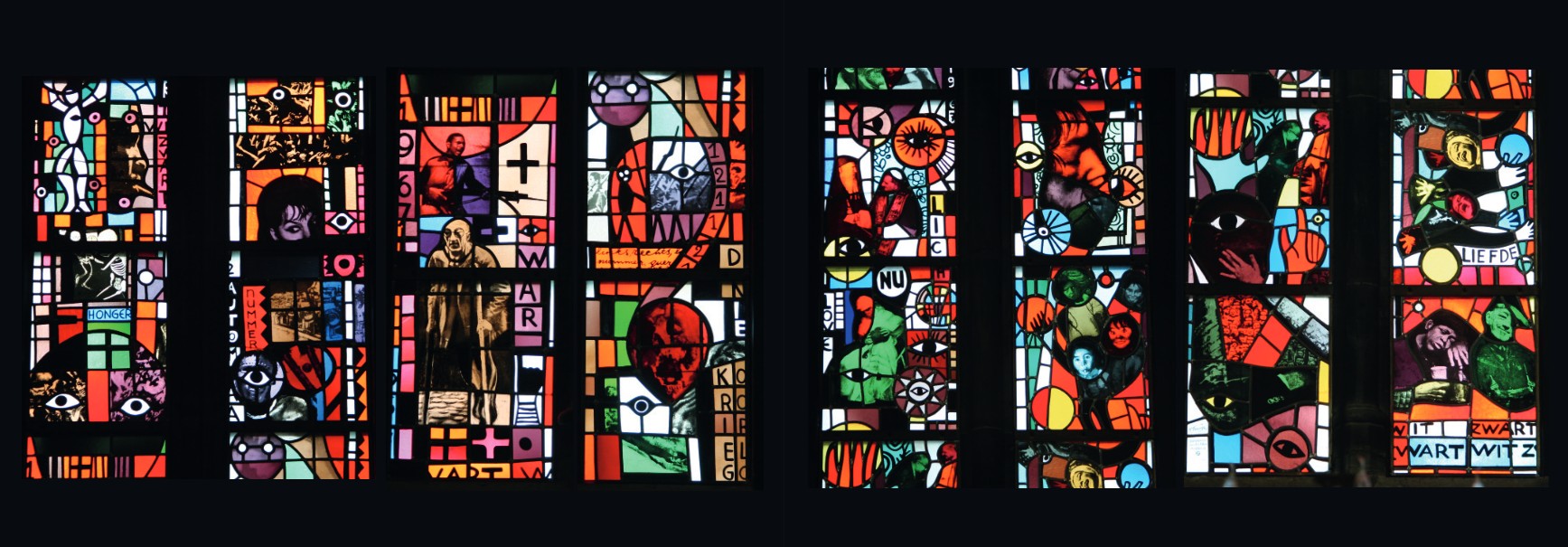
Another artist represented in the exhibition is Hans Truijen, who was commissioned in the 1960s by St. Martin’s Church in Maastricht to design eight stained glass windows for their worship space. The four along the left aisle of the nave depict human and divine suffering, whereas those on the right express hope, love, freedom, and happiness. He chose photographic images from various periodicals, including ones of the Vietnam War, and transferred them to glass using a special screen-printing process.

Truijen, Hans_Stained glass
Hans Truijen (Dutch, 1928–2005), Studies for the eight stained glass windows commissioned by St. Martinuskerk, Wyck-Maastricht, Netherlands, 1966–68. Courtesy of the artist’s son, Marc Truijen.

Roundup: Exhibition at Ely Cathedral, Faith Ringgold video, Ascension Day hymn, and more

Each month I put together a collection of thirty songs on Spotify—an assortment of psalms, hymns, and spiritual songs, old and new. Here’s the playlist for May:

+++

PRESS RELEASE: “Belmont University Launches Creative Arts Collective for Christian Life and Faith”: Supported by a $32 million grant from the Lilly Endowment, Belmont University in Nashville announced on March 26 the launch of a major new nationwide initiative: the Creative Arts Collective for Christian Life and Faith. “Positioned at the intersection of faith and artistry, the Creative Arts Collective is a vibrant community dedicated to exploring the divine through the lens of creativity. We believe in the transformative power of the arts to connect us with God’s profound narrative, uplifting spirits, and uniting hearts in a shared journey of discovery.”

The executive director is Rick Rekedal, who worked for twenty years at DreamWorks Animation on such projects as Shrek, Trolls, Prince of Egypt, Madagascar, Kung Fu Panda, and How to Train Your Dragon.

I’m looking forward to seeing what they do in the coming year!

+++

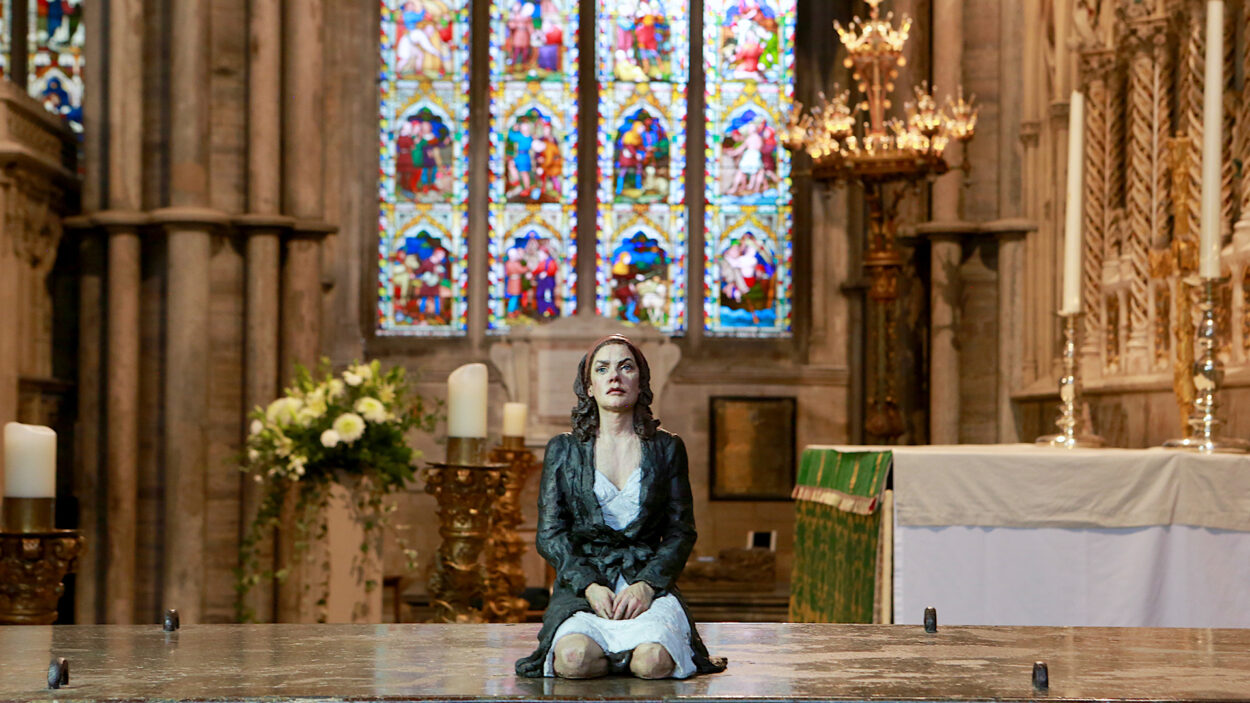
ART EXHIBITION: “Am I my brother’s keeper?” by Sean Henry, Ely Cathedral, England, April 26–September 1, 2024: Curated by Jacquiline Creswell [previously], this new exhibition places twenty-eight painted, contemporary figures from the oeuvre of British sculptor Sean Henry in various spaces in and outside the historic Ely Cathedral. The exhibition is titled after Cain’s indifferent response to God in Genesis 4, after he has just murdered his brother—a question that prompts us to consider our moral responsibility to care for and support one another.

Henry, Sean_Am I my brother's keeper
Sean Henry (British, 1965–), T.P.O.L.R., 2005, bronze, and LM, 2014, bronze. From “Am I my brother’s keeper?,” an exhibition at Ely Cathedral, 2024. Photo courtesy of the cathedral.

Henry, Sean_Am I my brother's keeper
Sean Henry (British, 1965–), Hedda, 2018, ceramic. From “Am I my brother’s keeper?,” an exhibition at Ely Cathedral, 2024. Photo courtesy of the cathedral.

Henry “captures the human form with compassion, depicting the emotions, struggles, and joys that define us as human,” Creswell writes. “His figures also convey the vulnerability, strength and resilience that exist within each individual. They tell stories, evoke emotions and create connections with the viewer.” View more photos from the exhibition on Creswell’s Instagram page, and see also photos from the similar exhibition she curated for Salisbury Cathedral in 2011, Conflux: A Union of the Sacred and Anonymous.

+++

VIDEO INTERVIEW: “Faith Ringgold’s art of fearlessness and joy”: Faith Ringgold (1930–2024), the trailblazing artist best known for her story quilts documenting African American life, died this month at age ninety-three. This CBS Sunday Morning segment from 2021 is a good introduction to her and her work, which you can explore more of at www.faithringgold.com.

Ringgold, Faith_Church Picnic
Faith Ringgold (American, 1930–2024), Church Picnic Story Quilt, 1988. Tie-dyed, printed fabrics and acrylic on cotton canvas, 74 1/2 × 75 1/2 in. High Museum of Art, Atlanta.

Ringgold, Faith_The Flag Is Bleeding #2
Faith Ringgold (American, 1930–2024), The Flag Is Bleeding #2, from the American Collection series, 1997. Acrylic on canvas, painted and pieced border, 76 × 79 in. Pippy Houldsworth Gallery, London.

+++

HYMN FOR ASCENSION DAY (May 9):

“See the Conqueror mounts in triumph” is a ten-stanza hymn by Christopher Wordsworth, nephew of the great poet William Wordsworth, published in his collection The Holy Year in 1862. The Hymnology Archive provides the full lyrics, a revision history, a textual analysis, and sheet music for the tune Wordsworth preferred for it and the one Henry Smart wrote for it six years later. This is not a widely sung hymn, however. I’ve enjoyed hearing how contemporary songwriters have revitalized it through new tunes. Here are two examples:

>> Music by Jenny & Tyler, on Open Your Doors (2012): This married musical duo living in Nashville, Tennessee, uses a 6/8 time signature in their setting, and they’ve added a bridge.

>> Music by Wes Crawford, on Hymns for This World and the Next (2024): Wes Crawford, the worship pastor at Christ Church of Austin, released an album of thirteen retuned hymns this February, and “See the Conqueror” is one of them.

We need more Ascension hymns! Search this site’s “Ascension” tag to find a few more, as well as other Ascension Day content (sometimes mixed into roundups with other miscellany).

+++

ART COMPILATION: “Ascending Jesus—The Last Glimpse” by Aidan Kimmel: Fr. Aidan Kimmel has compiled eighteen medieval paintings depicting the Ascension of Christ, mostly from manuscripts. In several Jesus leaves behind footprints on the Mount of Olives. So delightful!

Ascension (medieval MS)
The Ascension, from a Bible moralisée made in Bruges, ca. 1455–60. The Hague, National Library of the Netherlands, KB, 76 E 7, fol. 219r. The foregrounded figures are Saint Peter and the Virgin Mary.

Roundup: Pentecost-inspired harp duet, the Sacred Art of Reading, and more

AVANT-GARDE CLASSICAL: Klang—Die 24 Stunden des Tages (Sound—The 24 Hours of the Day) is a cycle of chamber-music compositions by the avant-garde German composer Karlheinz Stockhausen, which he worked on from 2004 until his death in 2007. (The intention was for there to be twenty-four pieces, but the cycle was unfinished at twenty-one.) The first two pieces in the cycle, on the themes of Ascension and Pentecost, were commissioned for the interdisciplinary Pause festival at Milan Cathedral by artache, a Milan-based nonprofit committed to showcasing contemporary artworks in public places of worship. The artistic director of artache at the time was Don Luigi Garbini, a priest at the church of San Marco in Milan and cofounding director of the artache initiative the Laboratorio di Musica Contemporanea al Servizio della Liturgia (Laboratory for Contemporary Music in the Service of the Liturgy).

>> No. 81: “KLANG, 1st Hour: Himmelfahrt (Ascension)” by Karlheinz Stockhausen, for organ or synthesizer, soprano, and tenor, 2004–5: This thirty-seven-minute piece premiered at Milan Cathedral on Ascension Day, May 5, 2005. The two hands of the organist almost always play in different, independent tempos of a chromatic time scale, while the soloists sing words or phrases associated with “ascension,” particularly the Ascension of Christ. According to the composer, “Asking a performer to break the barrier of time by playing simultaneously in different tempi is like submitting a man to physical disruption, allowing him to go in spirit form towards another world” (source). For musical analysis by Ed Chang, see here. The performance below is from the North American premiere at the Schwartz Center for the Performing Arts at Emory University in Atlanta on October 11, 2005, featuring organist Randall Harlow, soprano Teresa Hopkin, and tenor John Bigham.

>> No. 82: “KLANG, 2nd Hour: Freude (Joy)” by Karlheinz Stockhausen, for two harps and voice, 2005: This forty-minute piece premiered at Milan Cathedral on July 6, 2006. The text is taken from the medieval Pentecost hymn “Veni Creator Spiritus” [previously], which the harpists sing in spurts, “in alternation or sometimes together . . . , while plucking, picking, caressing, stroking, pinching, rubbing, striping, striking, pinking, jubilating,” as Stockhausen put it. In program notes dated February 15, 2006, he writes, “There is something unique about the adventure to combine two harps which are normally tuned in diatonic scales and to synthesise them into one large chromatic harp. . . . Pentecost unites what has been separated. My work FREUDE too.” For musical analysis by Ed Chang, see here. The performance below is from the Stockhausen Memorial Concert in Kürten, Germany, on December 16, 2017, featuring Marianne Smit and Miriam Overlach.

(As an interesting side note: The Beatles included Stockhausen’s face on the cover of Sgt. Pepper’s Lonely Hearts Club Band. Their “A Day in the Life” and “Revolution 9” were influenced by his electronic music.)

+++

NEW DOCTORAL COHORT: The Sacred Art of Reading: The Eugene Peterson Center for Christian Imagination at Western Theological Seminary in Holland, Michigan, is offering a new, mostly remote, three-year DMin track called “The Sacred Art of Reading,” which begins this October, taught by Professor Chris E.W. Green. The program is centered on the reading of scripture—the Old Testament narrative books (Year 1), Old Testament poetry and wisdom literature (Year 2), and the Gospels and Apocalypse (Year 3)—alongside a number of additional primary texts, whose titles you can view on the website; authors include, among others, Avivah Gottlieb Zornberg, Amy-Jill Levine, Daniel Berrigan, Robert Alter, Shusaku Endo, and of course Eugene Peterson! Participants get together in person for one week each semester (times six semesters) and are responsible for, in addition to the $17,280 tuition, travel and lodging costs. The application deadline is June 30, 2023. Applicants must hold an MDiv degree or its educational equivalent and have at least three years of ministry experience since completing the MDiv. Here’s a condensed program description:

The Sacred Art of Reading cohort will be dedicated to collaboration in “the forbidding discipline of spiritual reading,” confident that such an undertaking cultivates the loving attentiveness, prophetic discernment, and childlike openness to surprise that characterize what St. Paul calls the faith that works by love. . . . The cohort is designed to cultivate an alternative awareness, one shaped by the slow, painstaking work of collaborative interpretation. And to that end, the heart of the program is the reading of the Christian Scriptures. The aim will be both philosophical and devotional, critical and celebratory, mystical and pastoral. No one reading method will be stipulated, but students will be encouraged to find ways to honor the traditions of the communities in which they learned to argue, to muse, and to pray.

Besides Scripture, the cohort will engage a wide range of texts including poems, memoirs, essays, treatises, sermons, and stories old and new, familiar and strange, sacred and “worldly,” in part and in whole, not so much in order to “plunder the Egyptians” as to bear glad witness to the wonder that God is never left without a witness because all truth, truly received, trues.

This approach really wets my whistle! I don’t have a master’s degree, so I’m out, but I feel so energized by the reading list and wanted to share the opportunity with you all, as the program seems doable for those with full-time jobs. A virtual interest meeting is being held on June 1. Click here to view other doctor of ministry cohorts at Western.

+++

FUNDRAISING CAMPAIGN: The Soil and The Seed Project: I’ve mentioned this project several times on the blog before, as I’m a big fan. A ministry of VMMissions (Virginia Mennonite Missions), The Soil and The Seed Project releases original music, art, and liturgies throughout the Christian year, especially suitable for families with littles. They launched in December 2021 and since then have put out seven collections, with their latest and largest yet—Vol. 7 // Ordinary Time—dropping this week. (Request a free download through their website, or stream the music through your favorite service.) Coinciding with this release, they have also launched a campaign to raise $27,000 by June 18 to cover the costs of recording, mixing, pressing, printing, shipping, etc., for future collections. Learn more in the five-minute video below, which features the new songs “In the Little Moments,” “Teach Me, O LORD,” and “Because of Jesus.”

The Soil and The Seed Project offers all their content for free, including physical CDs (as stock permits), and are committed to keeping it that way—which is why they need the support of donors. Donate to their campaign, and you can opt to receive stickers, notecards, and/or a T-shirt as a thank-you. Also note: they’ll be giving a concert at 6:30 p.m. on Saturday, June 3, at the Brethren & Mennonite Heritage Center in Harrisonburg, Virginia.

+++

SONG: “Holy Spirit” by Victoria Williams: “Part front-porch soothsayer, part quirky bayou princess, and part eternal child, Victoria Williams writes songs of indescribable originality that embrace the earthly and the divine with wit, charm, and understated vision,” writes Josh Kun for Bomb magazine. The song “Holy Spirit” [read lyrics] is from her 1990 album Swing the Statue!. It opens with the familiar invocation from a Gullah spiritual: “Kum ba yah, my Lord” (which translates to “Come by here”). She seeks God’s presence and then, given a renewed sensitivity to it, identifies and celebrates its flow throughout her daily goings. She feels the Holy Spirit while building a raft with friends on the shores of Louisiana’s Lake Bistineau and riding a New York City subway beside a whistling stranger, as well as in graveyards and at bars and out under open night skies. The Spirit flows through all of life. I can’t find the song online anywhere other than in this YouTube fan video, which sets it to photos. [HT: Jonathan Evens]

+++

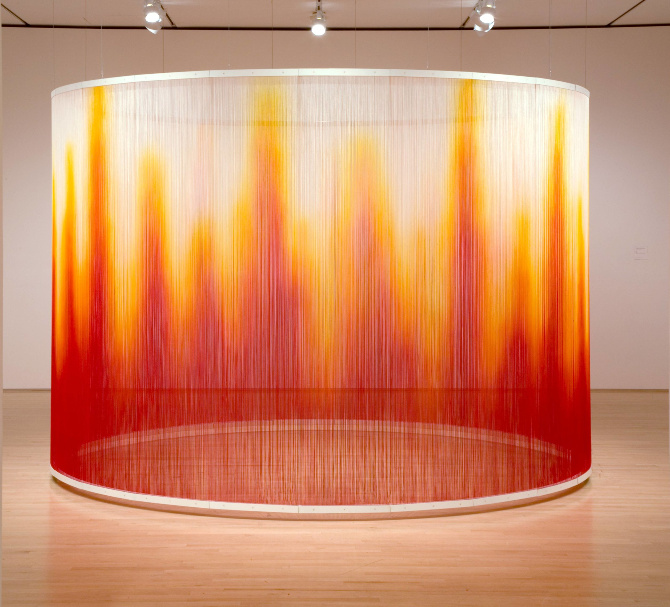
ARTWORK: Fire by Teresita Fernández: In the collection of SFMOMA, this ring of warm-colored silk yarn conveys something of the flickering quality of fire. At the link is a short video interview with the artist about the piece. Fernández says she is interested in the sensorial aspects of viewer engagement with art.

Fernandez, Teresita_Fire
Teresita Fernández (American, 1968–), Fire, 2005. Silk yarn, steel armature, and epoxy, 243.8 × 365.8 cm. San Francisco Museum of Modern Art, California.

Fire was a highlight of the 2013 exhibition Beyond Belief: 100 Years of the Spiritual in Modern Art, jointly organized by SFMOMA and the Contemporary Jewish Museum. Here’s a video of the Lick Wilmerding High School Vocal Ensemble singing “Famine Song” by VIDA around the installation that year, a song inspired by the basket weavers of Sudan, who persist in their craft during times of hardship, their hands working natural fibers into beautiful, colorful vessels. “Weave, my mother; weave, my child; weave your baskets of rushes wild . . .”

Roundup: Ascension Sunday, Mother God, and more

SUMMER COURSES: Arts at Regent: Regent College in Vancouver is offering eight one- or two-week in-person courses on its arts track this summer, including “After Disenchantment” with Joy Marie Clarkson (reading list includes Charles Taylor, James K. A. Smith, Kazuo Ishiguro, etc.), “The Puritan Literary Imagination” (on Paradise Lost and Pilgrim’s Progress) with Johanna Harris, and “The Arts, Empathy, and Spiritual Formation” with Mary McCampbell. Several years ago I took a Regent summer course on worship and the arts and really enjoyed it!

+++

BIBLICAL COMMENTARY: “Ascension Sunday (Year A): Luke 24:44-53 and Acts 1:1-11” by SALT Project: This Sunday marks the risen Jesus’s departure after forty days of dwelling with the community of disciples. While SALT Project’s commentary doesn’t plumb all the meaning of the Ascension, I was struck by its pointing out of the significance of the Mount of Olives (in light of Zechariah’s prophecy and the “choreography” of Palm Sunday) and the resonances with Elijah’s ascent, particularly with Christ’s passing on his mantle to the church.

+++

ASCENSION HYMN: “Alleluia, Sing to Jesus” by William Chatterton Dix, 1866

>> Music by Rowland Hugh Prichard, 1830: The hymn is often paired with the public-domain Welsh tune HYFRYDOL (which I know best from its association with “Jesus, What a Friend for Sinners”). It’s sung here by Ben Lashey and Chris Joyner:

>> Music by Rebecca Almazar and Brian Gurney, 2020: I really love this new tune that Almazar and Gurney wrote for the hymn while they were at New City Fellowship in Manassas, Virginia, which was released on the church’s EP A Liturgy. Gurney is now the director of contemporary worship at The Falls Church Anglican in Falls Church, Virginia. The song is not yet available on CCLI, but in the meantime, he has granted permission for license-free church use; here are the chords.

+++

CALL FOR ENTRIES: 2023 Sacred Art Competition and Exhibition: “Seeking the finest contemporary sacred art for an online juried exhibition hosted by the Catholic Art Institute, with a world-wide audience and the opportunity to sell work, be featured on the Catholic Art Institute website.” The top prize is $2,500. The deadline for submission is November 6, 2023. From what I can tell, participants need not be Catholic, but the artwork(s) should be suitable for devotional and/or liturgical use by Catholics.

+++

PODCAST EPISODE: “Loving Christ Our Mother with Julian of Norwich,” Old Books with Grace, May 17, 2023: This month marks the 650th anniversary of the anchorite Julian of Norwich’s visionary encounter with God, which she recorded in her Showings, the earliest surviving work of literature in English by a woman. In this twenty-minute episode of her podcast, medievalist Grace Hamman, author of the forthcoming Jesus Through Medieval Eyes: Beholding Christ with the Artists, Mystics, and Theologians of the Middle Ages, introduces us to Julian, dwelling especially on one of Julian’s favorite metaphors: that of Christ as mother.

In the fourteenth century, Hamman says, fathers generally loved their children but were less involved in the day-to-day tasks of caring for their physical and emotional needs, whereas mothers were deeply present. Julian wrote about how Christ gave birth to his children on the bed of the cross, how he nurses them from his side, and how he acutely hears and responds to their individual cries. This podcast episode is an excellent summation of a theological idea that may sound odd and unorthodox at first but that is in fact biblically derived, appearing throughout church history, and that grants us fuller insight into who Christ is.

(Related post: “Our Sweet, Travailing Mother Christ”)

+++

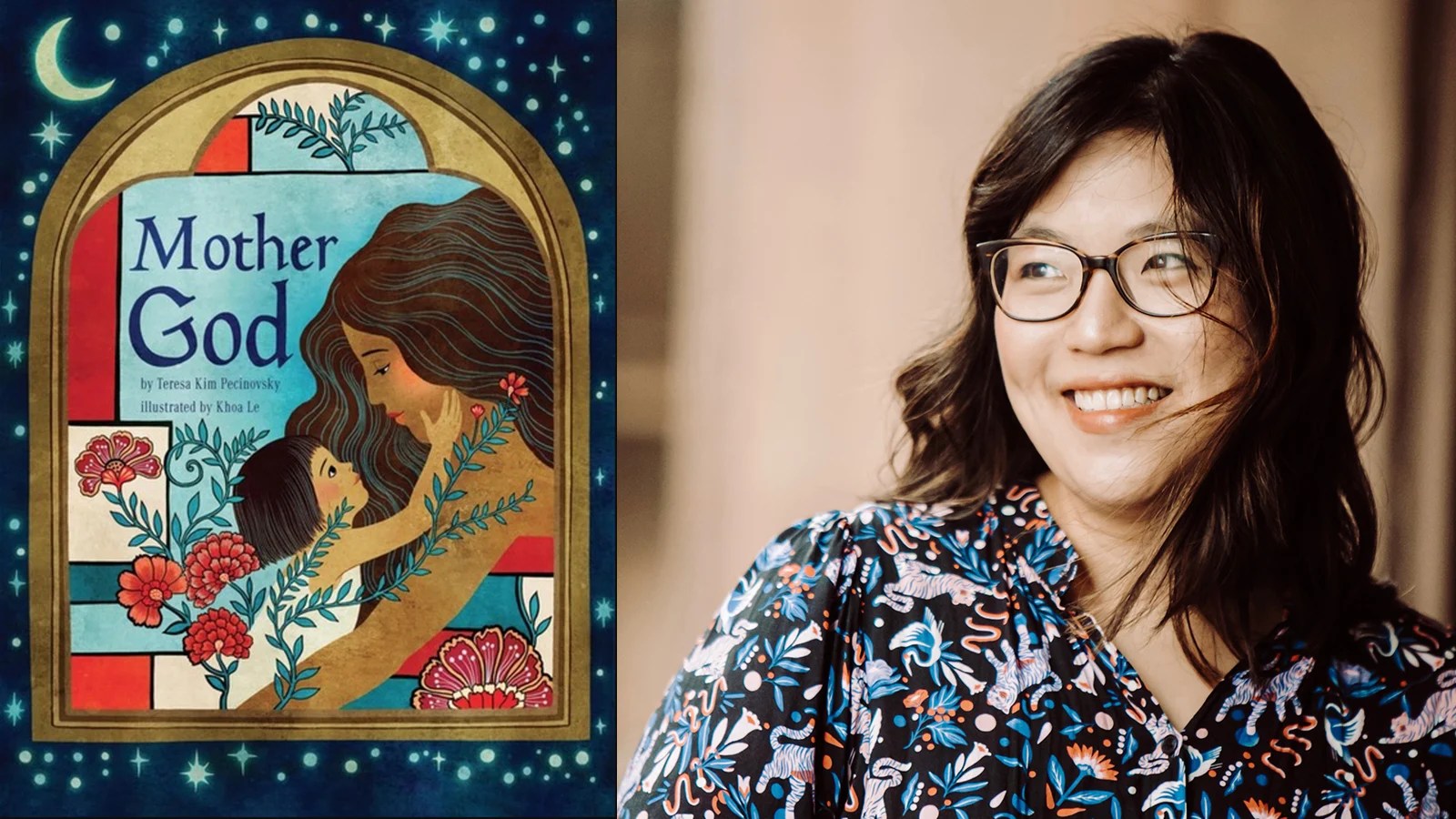
BOOK: Mother God by Teresa Kim Pecinovsky, illustrated by Khoa Le: Dovetailing with Hamman’s recent podcast episode is this beautifully unique children’s book that came out last year from Beaming Books. “With lyrical, rhyming text and exquisite illustrations, Mother God introduces readers to a dozen images of God inspired by feminine descriptions from Scripture. Children and adults alike will be in awe of the God who made them as they come to know her as a creative seamstress, generous baker, fierce mother bear, protective mother hen, strong woman in labor, nurturing nursing mother, wise grandmother, and comforting singer of lullabies. This gorgeous picture book welcomes children into a fuller, more diverse understanding of what it means to be made in the image of God.” Born in South Korea, raised in Iowa, and living in Texas, author Teresa Kim Pecinovsky (MDiv, MEd) (pictured below) is a hospice chaplain ordained in the Christian Church (Disciples of Christ) and a former elementary school teacher. Khoa Le is an artist from Vietnam.

Mother God
Illustration by Khoa Le

Some traditionalists will no doubt have a visceral reaction against the cover and concept—“God reveals himself as Father, not Mother!” they’ll say, or “The Bible uses only masculine pronouns for God”—but it’s important to remember that God is nongendered, although God does contain both the masculine and the feminine (see, e.g., Gen. 1:27). “Father” is a metaphor, same as “mother.” God became incarnate as a male, Jesus, but as Hamman shows (see previous roundup item), Jesus also exhibited some qualities traditionally associated with women and mothers in particular, and therefore we can speak metaphorically of Christ as mother, as we can, too, of the First Person of the Trinity. Having an academic background in literature, I’m very comfortable with (and enthralled by!) metaphor, but I can understand, lamentably, how it trips some people up.

+++

ARTICLE: “Waking Ancient Seeds: Why the Middle Ages Matter” by Matthew J. Milliner, Comment, May 10, 2023: “For the medievals, Jesus is the Rosetta stone of cosmic meaning, with whom all things are aglow in the polyphonic resonance of truth, and without whom the world hurdles into centrifugal disconnection,” writes Matt Milliner, a theologically trained professor of art history at Wheaton College, an evangelical institution in Illinois. “It is our world that has been flattened, lacking the full-orbed splendour of medieval significance and depth.” In this article he contrasts the symbolism and sense of wonder and reverence of the Middle Ages with the deficits of the present, identifying several, sometimes unlikely places in which these “ancient seeds” are sprouting again.

Ascension: “A Hymn of Glory Let Us Sing” by the Venerable Bede (with two tunes)

Looking for hymns for Ascension Day (which is May 18 this year), I came across “A Hymn of Glory Let Us Sing.” Originally written in Latin, it is attributed to the Venerable Bede (673–735), a monk at the Northumbrian monastery of Monkwearmouth and one of the most important scholars of the Early Middle Ages.

“Hymnum canamus gloriæ” circulated throughout medieval Europe in various versions, with the earliest known surviving example appearing in the mid-eleventh century in Beinecke MS 481.36, fols. 2r–2v.

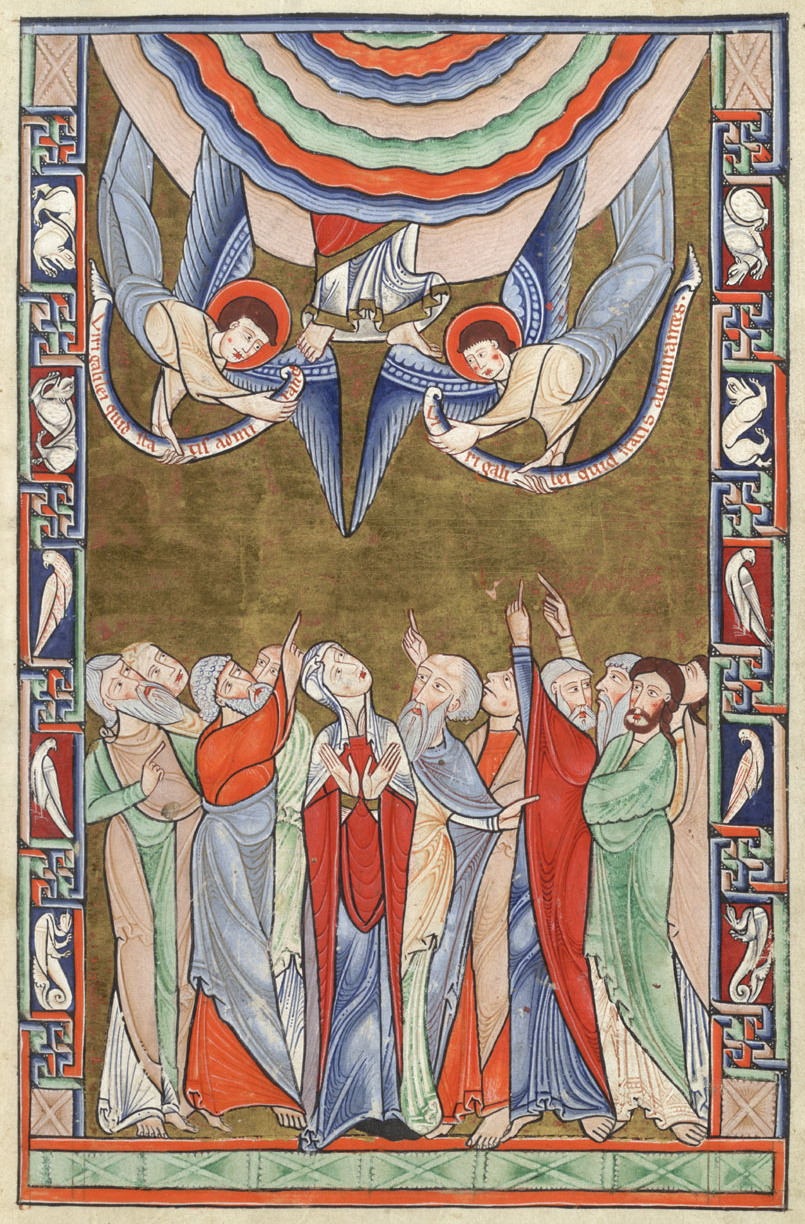
Ascension (Hunterian Psalter)
The Ascension, from the Hunterian Psalter, made in England, ca. 1170. Glasgow University Library, MS Hunter 229, fol. 14r.

Below is the fairly standardized seven-stanza version that appears in the Hymnale Secundum Usum Insignis Ac Praeclarae Ecclesiae Sarisburiensis (London, 1850), pages 163–64, which in turn is taken from the Psalterium cum Hymnis ad usum insignis Ecclesiae Sarum et Eboracensis, a quarto edition printed in Paris by Byrkman in 1516. The English translation on the right, from the 1852 edition of the Hymnal Noted, is by Benjamin Webb.

Hymnum canamus gloriæ,
Hymni novi nunc personent,
Christus novo cum tramite
Ad Patris ascendit thronum.

Apostoli tunc mystico
In monte stantes chrismatis
Cum matre clara virgine,
Iesu videbant gloriam.

Quos alloquentes angeli,
Quid astra stantes cernitis?
Salvator hic est, inquiunt,
Iesus triumpho nobili;

Sicque venturum asserunt,
Quemadmodum hunc viderunt,
Summa polorum culmina
Scandere Iesum splendida.

Da nobis illuc sedula
Devotione tendere,
Quo te sedere cum Patre
In arce regni credimus.

Tu esto nostrum gaudium,
Qui es futurus præmium,
Sit nostra in te gloria,
Per cuncta semper sæcula.

Gloria tibi, Domine,
Qui scandis supra sidera,
Cum Patre et Sancto Spiritu
In sempiterna sæcula.
Sing we triumphant hymns of praise,
New hymns to heav’n exulting raise;
Christ, by a road before untrod,
Ascendeth to the throne of God.

The holy apostolic band
Upon the Mount of Olives stand,
And with the Virgin Mother see
Jesu’s resplendent majesty.

To whom the angels, drawing nigh,
“Why stand and gaze upon the sky?
This is the Savior,” thus they say;
“This is his noble triumph day.”

“Again shall ye behold him so
As ye today have seen him go,
In glorious pomp ascending high,
Up to the portals of the sky.”

O grant us thitherward to tend,
And with unwearied hearts ascend
Unto thy kingdom’s throne, where thou,
As is our faith, art seated now.

Be thou our joy, and thou our guard,
Who art to be our great reward:
Our glory and our boast in thee
For ever and for ever be!

All glory, Lord, to thee we pay,
Ascending o’er the stars today;
All glory, as is ever meet,
To Father and to Paraclete.

Numerous layers of translation and revision have marked the transmission of this hymn text. Two other nineteenth-century English translations are by:

  • John David Chambers, from Lauda Syon, Ancient Latin Hymns of the English and Other Churches, Translated into corresponding Metres (London, 1857), pp. 198–99
  • Elizabeth Rundle Charles, from The Voice of the Christian Life in Song; or Hymns and Hymn Writers of Many Lands and Ages (London, 1858), pp. 165–66

O grant us thitherward to tend and, with unwearied hearts, ascend unto thy kingdom’s throne, where thou, as is our faith, art seated now.

Bede, trans. Benjamin Webb

The version used in most twentieth-century English-language hymnals appears to be a mashup of Charles (from whom comes the title and first line “A Hymn of Glory Let Us Sing”) and Webb, with additional editorial alterations. For example, here’s what’s in Christian Worship: A Lutheran Hymnal (1993), which is credited as a composite translation:

A hymn of glory let us sing!
New songs throughout the world shall ring:
Alleluia, alleluia!
Christ, by a road before untrod,
ascends unto the throne of God.
Alleluia, alleluia!
Alleluia, alleluia, alleluia!

The holy apostolic band
upon the Mount of Olives stand.
Alleluia, alleluia!
And with his followers they see
their Lord ascend in majesty.
Alleluia, alleluia!
Alleluia, alleluia, alleluia!

To them the shining angels cry,
“Why stand and gaze upon the sky?”
Alleluia, alleluia!
“This is the Savior,” thus they say.
“This is his glorious triumph day.”
Alleluia, alleluia!
Alleluia, alleluia, alleluia!

“You see him now, ascending high
up to the portals of the sky.”
Alleluia, alleluia!
“Hereafter Jesus you shall see
returning in great majesty.”
Alleluia, alleluia!
Alleluia, alleluia, alleluia!

Be now our joy on earth, O Lord,
and be our future great reward.
Alleluia, alleluia!
Then, throned with you forever, we
shall praise your name eternally.
Alleluia, alleluia!
Alleluia, alleluia, alleluia!

O risen Christ, ascended Lord,
all praise to you let earth accord.
Alleluia, alleluia!
You are, while endless ages run,
with Father and with Spirit one.
Alleluia, alleluia!
Alleluia, alleluia, alleluia!

Christian Worship pairs the text with LASST UNS ERFREUEN, a seventeenth-century tune from Germany that is most commonly associated with “All Creatures of Our God and King.” It works really well! Below you can listen to an abridgement of this version of “A Hymn of Glory Let Us Sing” (verses 1, 5, and 6), plus a different version featuring a new, custom melody.

>> Tune: LASST UNS ERFREUEN, 1623 | Performed by the Good Shepherd Collective, 2023: The musicians who make up the Good Shepherd Collective are masters of their craft. Each week I tune in to the musical portion of the Good Shepherd New York virtual worship service for inspiration and nourishment, and to see what they’ve been up to. I always love their arrangements and the breadth encompassed by their selections. I’ve cued up their premiere performance of “A Hymn of Glory Let Us Sing” from the GSNY April 30 service, located at 1:49–4:57. The lead vocalists are Jonathan Seale and Jayne Sugg.

>> Music by Steven Brooks, 2020 | Performed by Andrew Shubin, 2020: Dr. Steven D. Brooks is a pastor, author, professor of music and worship at Azusa Pacific University, and the founding director of Worship Quest Ministries, which serves as a resource for worship renewal and spiritual formation in the global church. A former student of Brooks’s, Andrew Shubin is a singer, guitarist, and actor living in Los Angeles. He has done session singing, appeared on TV, starred in musical theater productions, and written original songs. In this video he sings a retuned version of “A Hymn of Glory Let Us Sing” by Brooks, which uses the three-verse translation from the United Church of Christ’s New Century Hymnal (1995) but adds a new refrain. For permission to use this song, email resources@worshipquest.net.

A hymn of glory let us sing!
New songs throughout the world shall ring:
Christ, by a road before untrod,
ascends unto the throne of God.

Refrain:
Alleluia!
Arise and let your praises ring.
Alleluia!
Arise and sing to Christ the King.

You are a present joy, O Christ,
triumphant love once sacrificed,
and great the light in you we see
to guide us to eternity. [Refrain]

O risen Christ, ascended now,
to your blessed name all knees shall bow;
you are, while endless ages run,
in Triune Godhead ever One. [Refrain]

Roundup: Steve Martin on banjo, poetry comic about the Resurrection, and more

BANJO DUET: “Foggy Morning Breaking” by Alison Brown and Steve Martin: Did you know the actor Steve Martin also has a music career? He’s been playing the banjo since he was a teenager, and he writes, records, and tours, both solo and as part of bluegrass bands. He’s even won three Grammys for his banjo music!

Fellow banjoist Alison Brown invited him to contribute to one of the tunes on her forthcoming album, On Banjo, which releases May 5. It’s called “Foggy Morning Breaking.” She wrote and plays the A section; he wrote and plays the B. The piece was released last month as a single, along with this music video.

+++

VIDEO: “Spring” by Jamie Scott: This time-lapse short film of flowers blooming is extraordinary! It’s by visual effects artist and time-lapse photographer Jamie Scott (IG @invisiblejam). The score is by Jim Perkins. [HT: Tamara Hill Murphy]

+++

EVENTS:

>> April 22: “The Ekstasis Café: An Evening of Poetry, Music, Testimony, and Gallery,” Goldberry Books, Concord, North Carolina: Ekstasis is a beautiful quarterly magazine “exhibit[ing] arts and letters that reflect the depths of Christian life.” Next Saturday they are hosting their first-ever public gathering! Their hope with it is to foster meaningful connections, conversation, deep aesthetic encounters, and inspiration.

>> April 28: Artists’ Talk and Reception for The Resurrection and the Life by Fish Coin Press Exhibition, Sojourn Arts Gallery, Louisville, Kentucky: Fish Coin Press (IG @fishcoin.press) is a Richmond, Virginia–based publisher of illustrated books, comics, and trading cards rooted in the story of scripture. They work with a range of artists and are doing really imaginative work.

Procopio, Stephen_Ascension
Stephen Procopio, Ascension, 2020. A full-color version of an illustration for Come See a Man (an illustrated Gospel of John) by Fish Coin Press.

From April 9 to May 28, the gallery at Sojourn Church Midtown in Louisville is exhibiting a selection of art from Fish Coin projects (open Sundays from 9 a.m. to 12:30 p.m., or by appointment); here are a few exhibition views. And two Friday evenings from today, Fish Coin Press creative director Jared Boggess and development lead Stephen Procopio, who are illustrators themselves, will be visiting the gallery to discuss “visual theology” and its role in the local church. There will be a Q&A and a sneak preview of upcoming publications.

+++

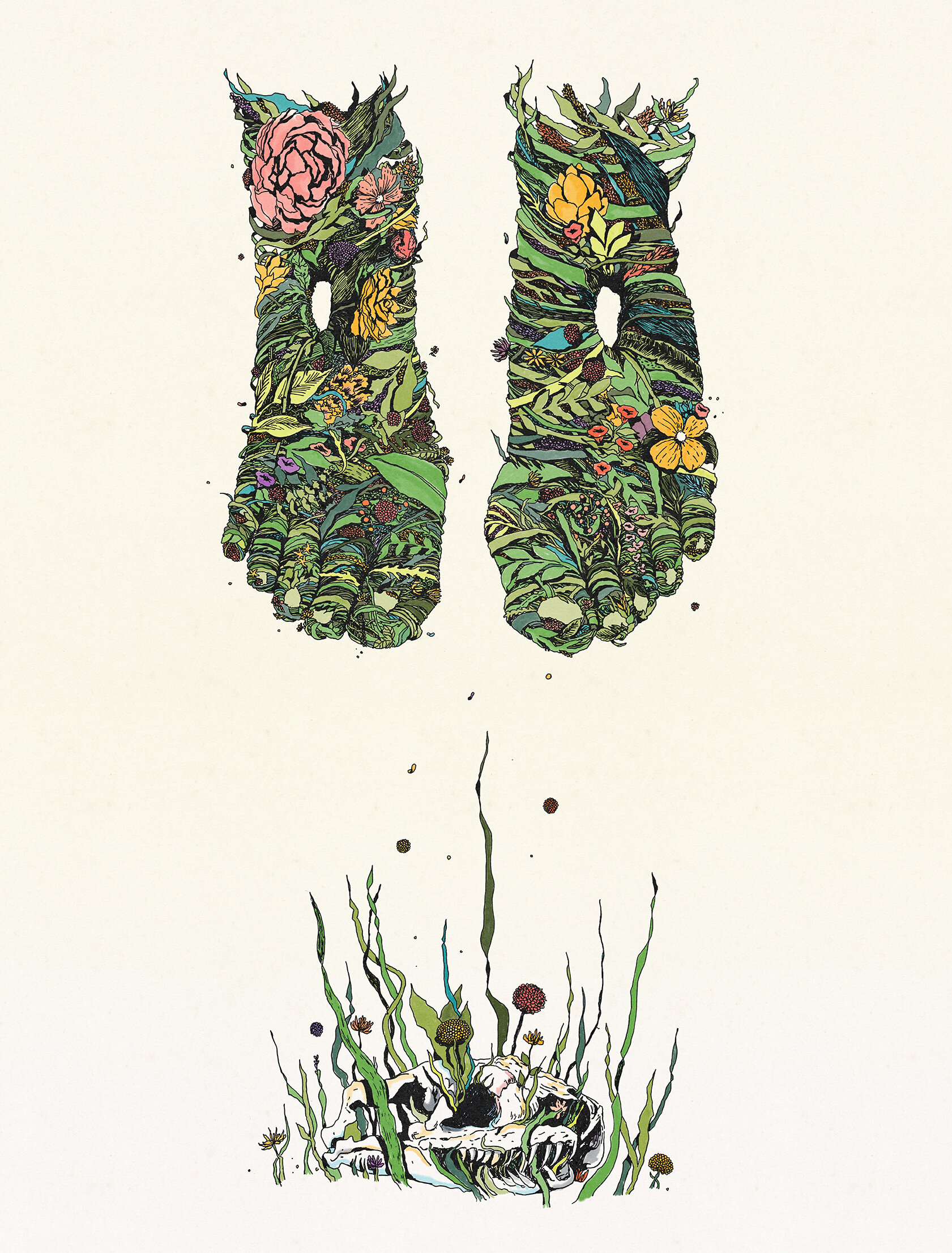
POEM: “Psalm” by Dorianne Laux: This poem sings the glories of “the hidden and small,” of the plants and creatures beneath our feet. Read more of Laux’s poems at https://www.doriannelaux.net/poems.

+++

LECTURE: “Resurrection and the Renewal of Creation” by N. T. Wright: In this 2018 lecture sponsored by Lanier Theological Library and Baylor University’s Truett Seminary, ancient historian and New Testament scholar N. T. Wright discusses the meaning of Jesus’s resurrection, a topic he explores thoroughly in the influential academic tome The Resurrection of the Son of God and its more accessible corollary, Surprised by Hope: Rethinking Heaven, the Resurrection, and the Mission of the Church. “Easter is the start of something; it isn’t the ending,” he says. With the resurrection of Christ, the new creation has been launched and put to work in the world. It’s not about securing our souls a place in some nonspatiotemporal heaven when we die but about heaven colonizing earth here and now. We humans, he says, are meant to stand at the place where heaven and earth interlock. We who have received life are to be ourselves life-bringers, to participate in God’s massive renewal project. We are resurrection people!

Wright addresses common Christian misconceptions about death, judgment, and the fate of this world, seeking to root out the corrupting influence of Platonism and other pagan Greek philosophies on Christian eschatology. (For example, the new creation won’t be a creatio ex nihilo, creation out of nothing; it will be a creatio ex vetere, a creation out of the old. The implications of that are huge.) He also affirms the absolute importance of belief in Jesus’s bodily resurrection—his rising is no mere metaphor!—and calls on Christians to recover a centralizing hope in the general resurrection (what he calls “life after life after death”; fully embodied life in the new heavens and the new earth that comes after the not-yet-fully-realized life experienced in the interim between one’s death and the future cosmic coming of Christ) rather than regarding what happens immediately after one’s death as the ultimate beatitude.

Wright always makes me excited about what God’s doing and excited to be a disciple of Jesus. What more could a preacher ask for?

The final half hour of the video is Q&A.

+++

DIGITAL COMIC: 30 Days of Comics (2022) by Madeleine Jubilee Saito: Madeleine Jubilee Saito [previously] is a Seattle-based cartoonist who is interested, as she says on her website, in “friendship, formal experimentation, medieval sacred comics, the built environment, solidarity, climate justice, the psalms, the material world, and the sacred.” Last year she was one of five artists in the inaugural cohort of On Being Project’s Artist Residency; during that time she created “For living, in climate crisis.” Her work is poetic, spiritual, and earthy, and I love it.  

Saito, Madeleine Jubilee_Made New
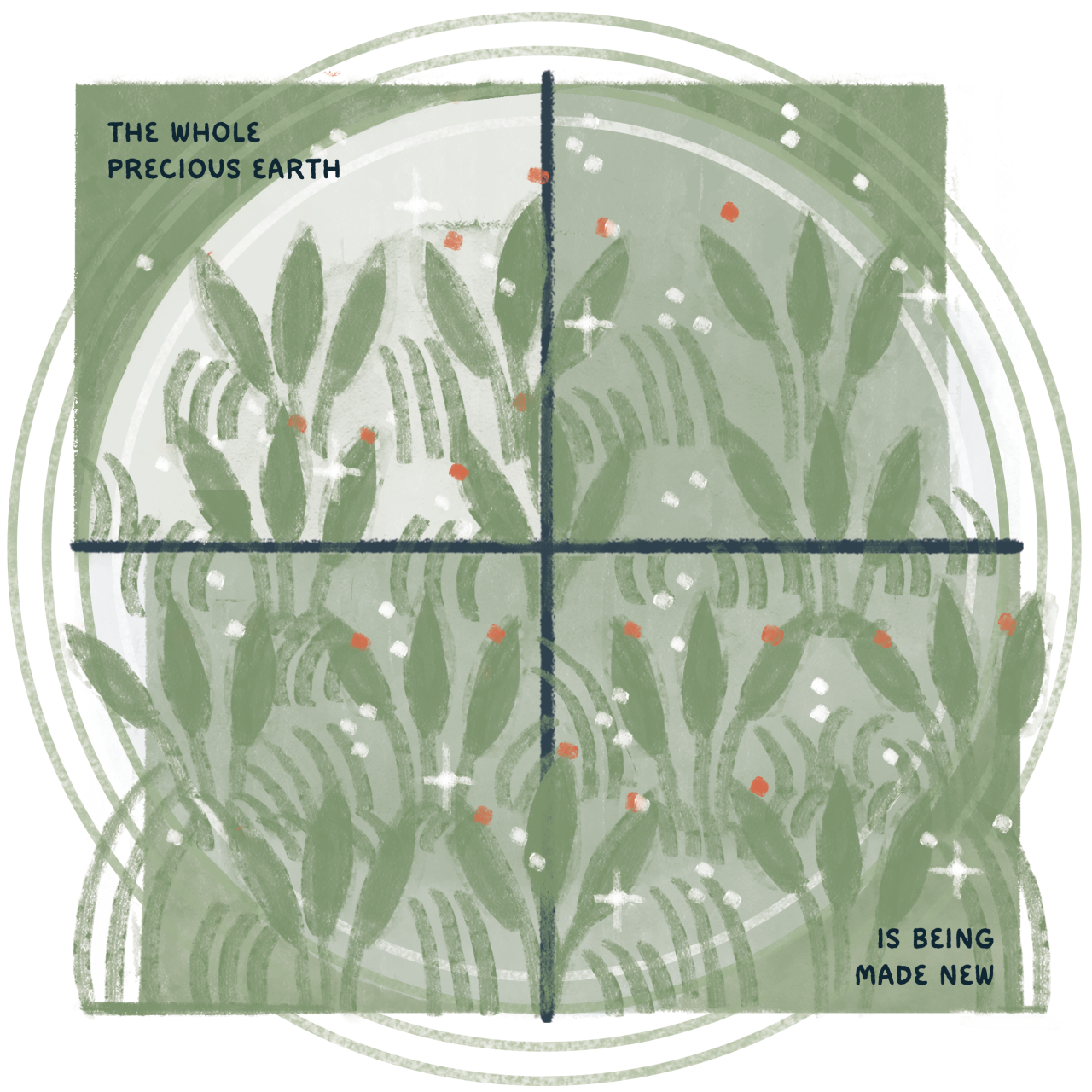
Comic by Madeleine Jubilee Saito, 2022, the ninth of thirty from “30 Days of Comics.”

In November 2022 Saito made a one-page, four-panel comic (almost) every day for the duration of the month. The series is resurrection-themed and, she told me, inspired by one of my blog posts: the one about Fra Angelico’s Noli me tangere at San Marco, a painting in which Christ the Gardener sows his stigmata across the lawn, as art historian Georges Didi-Huberman so beautifully interprets in his monograph on the artist. Click on the image and scroll down (then, at the bottom, click “←older”) to view all twenty-seven comics from the series. Each can stand alone, but they also have a cumulative effect. It’s stunning! You can follow Saito on Instagram @madeleine_jubilee_saito.

Roundup: Paradise-themed contemporary art, Rogationtide hymn, Gija Ascension painting, and more

EXHIBITION: Here After, Bridge Projects, Los Angeles, May 7–July 30, 2022: This latest offering from the spirituality-forward art gallery Bridge Projects looks amazing! I appreciate their commitment to featuring religiously and ethnically diverse artists, as well as a range of styles and media.

Here After exhibition
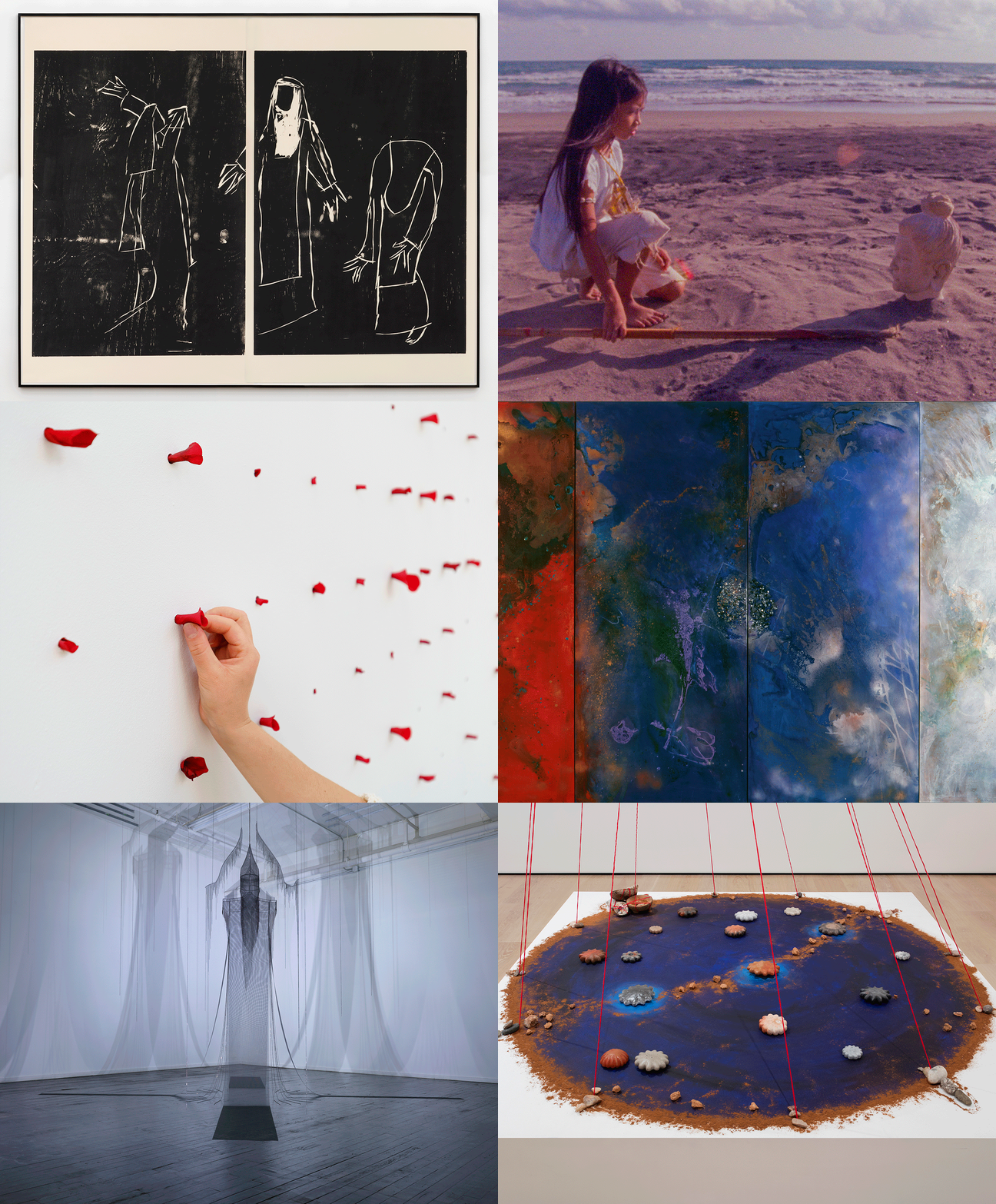
Andrea Büttner, Dancing Nuns, 2007; Tuan Andrew Nguyen, video still from The Boat People, 2020; Belu-Simion Fainaru, Monument for Nothingness, 2012–22; Bonita Helmer, The Four Worlds (Tiferet), 2002–5; Afruz Amighi, Guardian, 2021; Mercedes Dorame, Orion’s Belt—Paahe’ Sheshiiyot—a map for moving between worlds, 2018

The group exhibition features thirty-seven artists who explore the idea of paradise—both how it has been pursued on earth across history, and how it is imagined after life. From Pure Land Buddhism’s chant “Namu Amida Butsu” (“I take refuge in Amida Buddha”) to Christianity’s prayer for the Kingdom to be “on earth as it is in heaven,” the concepts of paradise are as diverse as those who hope for it.

In Here After, works like William Kurelek’s Farm Boy’s Dream of Heaven (1963) envision an eschatological beyond in figurative form, while works by Bonita Helmer and Zarah Hussain do so in more abstract terms. Andrea Büttner and Claire Curneen’s works point to a vulnerable, sensual bodiliness, embedded in the surface of the world where all things come to pass. There is a land beyond the river by Gyun Hur and Tuan Andrew Nguyen’s The Boat People make space for remembrance of those who have passed, while Afruz Amighi, Mercedes Dorame, and Charwei Tsai position the viewer between worlds, feet firmly planted on the ground yet gazing at the glory and wonder of the beyond. In his installation Skywall, David Wallace Haskins plunges into the boundless sky and its immaterial light, letting all the expansive beauty grip the viewer. Kate Ingold intones the rhythmic mantras of what the divine is not with minute stitches, employing almost impossible patience to painstakingly outline absence. Kris Martin lodges small contradictions in the mind, which, in time, grow to be distracting puzzles—the candle in a sealed box, whose existence cannot be proven with the senses. And Tatsuo Miyajima uses digital counters to display the uncountable, unending dimension of existence.

+++

SONGS:

>> “O Jesus, Crowned with All Renown,” performed by Jon and Amanda McGill: The Monday to Wednesday preceding Ascension Day is known as Rogationtide, a short liturgical period (observed by most Anglicans, Episcopalians, Catholics, and others) in which we pray that God blesses the crops so that they yield a good harvest. It falls on May 23–25 this year. The hymn “O Jesus, Crowned with All Renown” is especially associated with the Rogation Days. It was written in 1860 by Edward White Benson, archbishop of Canterbury, and is typically paired with the tune KINGSFOLD.

O Jesus, crowned with all renown,
Since thou the earth hast trod,
Thou reignest, and by thee come down
Henceforth the gifts of God.
Thine is the health and thine the wealth
That in our halls abound,
And thine the beauty and the joy
With which the years are crowned.

Lord, in their change, let frost and heat
And winds and dews be giv’n;
All fostering power, all influence sweet,
Breathe from the bounteous heav’n.
Attemper fair with gentle air
The sunshine and the rain,
That kindly earth with timely birth
May yield her fruits again.

That we may feed the poor aright,
And gathering round thy throne,
Here, in the holy angels’ sight,
Repay thee of thine own:
That we may praise thee all our days,
And with the Father’s name,
And with the Holy Spirit’s gifts,
The Savior’s love proclaim.

Spiritual director and writer Tamara Hill Murphy explains the meaning of Rogationtide:

“Rogation” is derived from the Latin verb rogare, which means “to ask.” In the liturgies of Rogation Days, we ask the Lord to bless the fields, the crops, and the hands of farmers who produce our food. Worship on Rogation Days teaches us that we depend upon God’s favor over his land. We ask him for goodness over not just an abstract idea of our “land” but the very real earth beneath our feet in our backyards, our neighborhoods, and whatever part of the earth our feet hit the ground. As we’ve become a post-industrial society, the prayers for Rogation Days have expanded to include not only prayers for farmers and fishermen, but also for commerce and industry, and for all of us as stewards of creation.

>> “The Twelve: An Anthem for the Feast of Any Apostle,” words by W. H. Auden and music by William Walton: In 1965 the dean of the choir school at Christ Church, Oxford—Dr. Cuthbert Simpson—approached poet W. H. Auden and composer William Walton to write a choral anthem for use on apostolic feast days. “The Twelve” is the result. In this video filmed at Keble College, Oxford, in July 2021, it is performed by the vocal ensembles VOCES8 and Apollo5 (both directed by Barnaby Smith), with Peter Holder on organ. Learn more about the background and structure of the anthem here.

This performance appears on Renewal?, a concept album released February 25 that combines new works by Paul Smith (cofounder of VOCES8) and Donna McKevitt with works by three influential modern composers: William Walton, John Cage, and William Henry Harris. “Multifaceted texts by Lal Ded, Edmund Spenser, W. H. Auden, Lord Byron, Pablo Neruda, Maya Angelou, and Edna St. Vincent Millay offer space to consider our world, past and present, and meditate on a response to build a better future.”

You can read the full text of “The Twelve” in the YouTube video description. It begins,

Without arms or charm of culture,
Persons of no importance
From an unimportant Province,
They did as the Spirit bid,
Went forth into a joyless world
Of swords and rhetoric
To bring it joy.

+++

VISUAL MEDITATIONS:

Ascension Day occurs every year on the Thursday that falls forty days after Easter (see Acts 1:1–3). This year it is May 26. Here are two Ascension-themed visual meditations from ArtWay.eu.

>> On the Reidersche Tafel, by Nigel Halliday: This ivory bas-relief, which was probably originally embedded in a book cover, is the earliest known representation of the Ascension. It shows Jesus striding up a mountain, being pulled up into heaven by the hand of God the Father. (Mark and Luke use the passive voice to describe the Ascension: “he was taken up into heaven.”) He is dressed in a toga and holding a scroll. Learn more from Nigel Halliday at the above link, or visit this Instagram post I made two years ago.

Ascension (Reidersche Tafel)
The Women at Christ’s Tomb and the Ascension, Milan or Rome, ca. 400. Ivory plaque, 18.7 × 11.5 cm. Bayerisches Nationalmuseum (Bavarian National Museum), Munich, Germany.

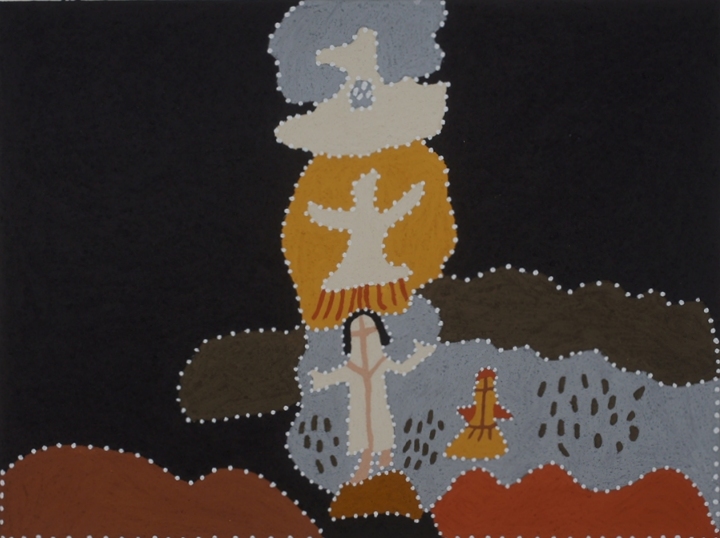
>> On Ngambuny Ascends by Shirley Purdie, by Rod Pattenden: Ngambuny is the Gija name for Jesus. Aboriginal Australian artist Shirley Purdie sets his ascension within the indigenous landscape of the Bungle Bungle Range, using her characteristic style of dotted outlines. “Purdie draws on her cultural tradition to locate the presence of God within the skin of her land,” writes the Rev. Dr. Rod Pattenden. “Her work is literally painted with the earth, as she collects ochres from the land she is responsible for and mixes it with glue to attach to her warm hued canvases.” Pattenden offers a fascinating reading of Purdie’s Ngambuny Ascends, discussing the use of black ocher, God as Creator Spirit alive in the earth, and more.

Purdie, Shirley_Ngambuny Ascends
Shirley Purdie (Gija, 1948–), Ngambuny Ascends, 2013. Natural ocher on canvas, 60 × 80 cm. Private collection. The artist is represented by the Warmun Art Centre in Warmum, WA, Australia.

A Cloud Took Him (Artful Devotion)

Houghton, Georgiana_The Risen Lord
Georgiana Houghton (British, 1814–1884), The Risen Lord, 1864. Watercolor and gouache on paper laid on board with pen and ink inscription on the reverse. Photo: Jessica Freeman-Attwood/Hyperallergic.

In the first book, O Theophilus, I have dealt with all that Jesus began to do and teach, until the day when he was taken up, after he had given commands through the Holy Spirit to the apostles whom he had chosen. He presented himself alive to them after his suffering by many proofs, appearing to them during forty days and speaking about the kingdom of God.

And while staying with them he ordered them not to depart from Jerusalem, but to wait for the promise of the Father, which, he said, “you heard from me; for John baptized with water, but you will be baptized with the Holy Spirit not many days from now.”

So when they had come together, they asked him, “Lord, will you at this time restore the kingdom to Israel?” He said to them, “It is not for you to know times or seasons that the Father has fixed by his own authority. But you will receive power when the Holy Spirit has come upon you, and you will be my witnesses in Jerusalem and in all Judea and Samaria, and to the end of the earth.” And when he had said these things, as they were looking on, he was lifted up, and a cloud took him out of their sight.

—Acts 1:1–9

+++

SONG: “Coelos ascendit hodie” (Ascended today into heaven) | Words: Anonymous, 12th century | Music by Charles Villiers Stanford, ca. 1892 | Performed by the Stanford Chamber Chorale and the Choir of Trinity College, Cambridge, under the direction of Stephen M. Sano, 2007

Coelos ascendit hodie
Jesus Christus Rex gloriae
Sedet ad Patris dexteram
Gubernat coelum et terram

Jam finem habent omnia
Patris Davidis carmina
Jam Dominus cum Domino
Sedet in Dei solio

In hoc triumpho maximo
Benedicamus Domino
Laudatur Sancta Trinitas
Deo dicamus gratias

English translation:

Jesus Christ, the King of Glory,
has ascended today into the heavens.
He sits at the right hand of the Father
and rules heaven and earth.

Now all the psalms of David,
our father, are fulfilled.
Now the Lord sits with the
Lord on the seat of God.

In this greatest of triumphs
let us bless the Lord.
The Holy Trinity be glorified.
Let us give thanks to God.

Stanford’s “Coelos ascendit hodie,” op. 38, no. 2, is a double-choir motet setting of a medieval Ascension hymn, the second piece in his Three Latin Motets set [previously].

+++

Consisting of “frenetic spirals of color and swirling sinuous lines” (source), The Risen Lord by Georgiana Houghton was produced in Victorian England some eighty years before abstract expressionism came onto the scene. Houghton renounced authorship of her artworks, believing herself to be a medium who channeled saints, archangels, Renaissance painters, and dead relatives to produce what she called “spirit drawings.” She was a Spiritualist, which means she believed in the possibility of contact with a spirit realm and that such communication could bring one closer to God. Ink and watercolors were, for her, a way of unveiling an invisible reality, of conveying God’s “wondrous attributes,” she said.

“On the back of most of her works, Houghton included a handwritten explanation, with illustrated annotations of the abstract forms,” Jessica Freeman-Attwood said. “In The Risen Lord Houghton writes that the lower part corresponds to the virtues and sufferings of Christ’s life on earth, whereas the upper part, dominated by arabesque white threads, represents his ascension into heaven.”

+++

Ascension Day is May 21 this year. For previous years’ devotions for the occasion, see “God Ascended” (featuring a German Renaissance painting and a clever repurposing and retuning of an eighteenth-century verse) and “Carried Up” (featuring a balletic Christ image by the late Javanese artist, dancer, and choreographer Bagong Kussudiardja, and a Romantic piano composition).


This post belongs to the weekly series Artful Devotion. If you can’t view the music player in your email or RSS reader, try opening the post in your browser.

To view all the Revised Common Lectionary scripture readings for the Ascension of the Lord, cycle A, click here.

The Tabernacle of Cherves (Limoges enamel, 13th century)

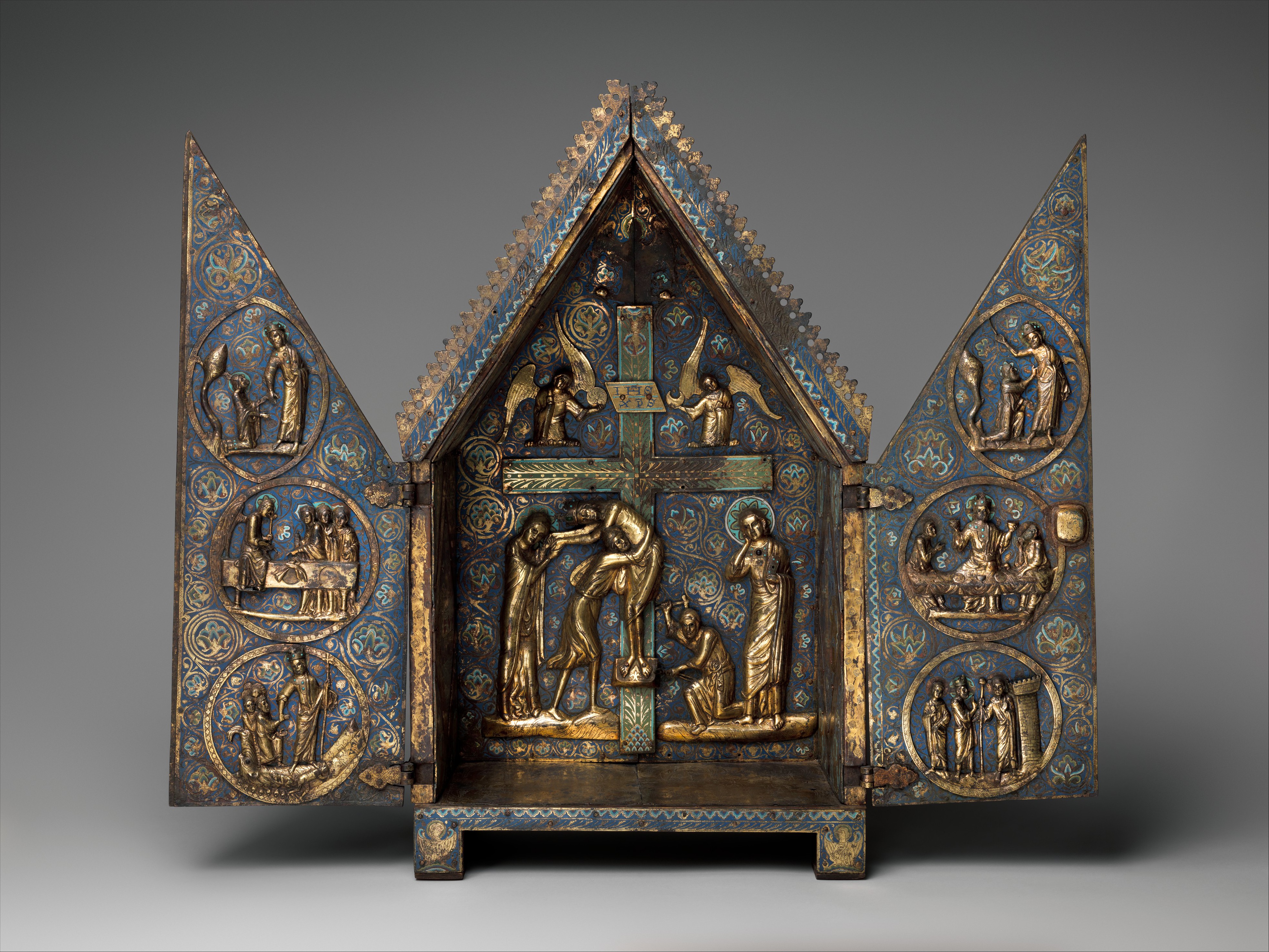
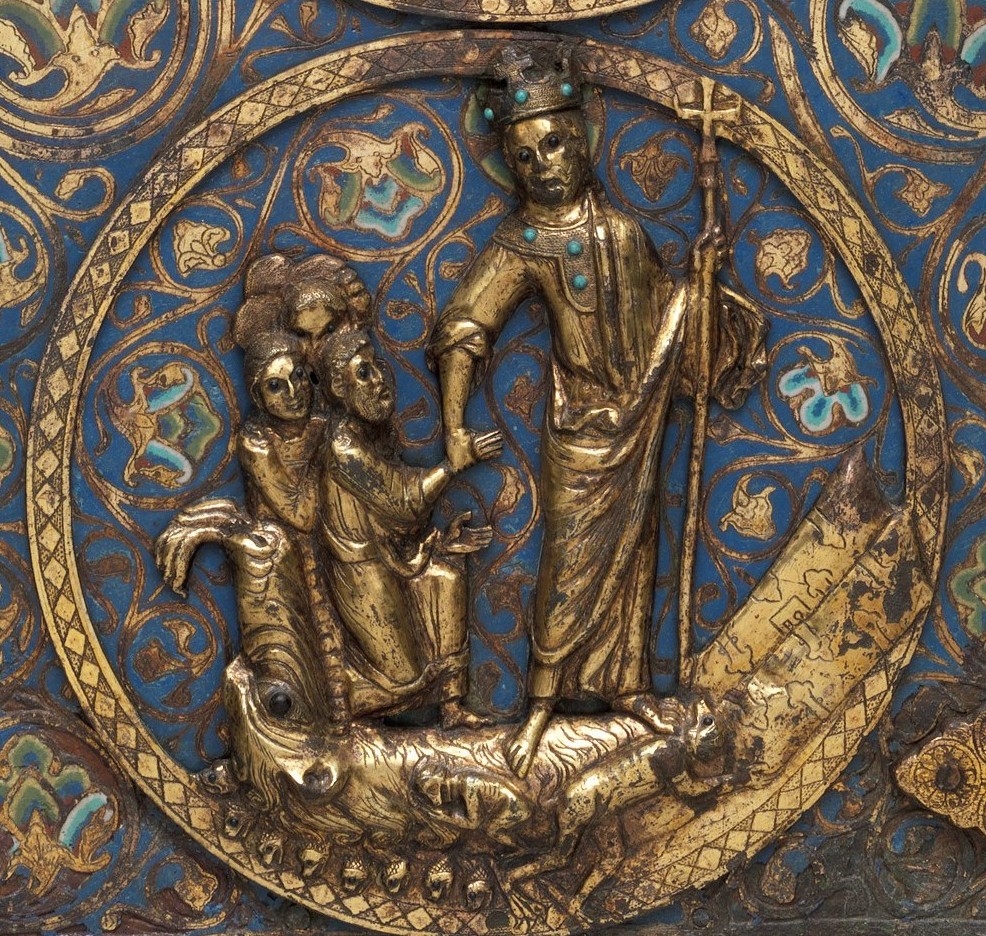
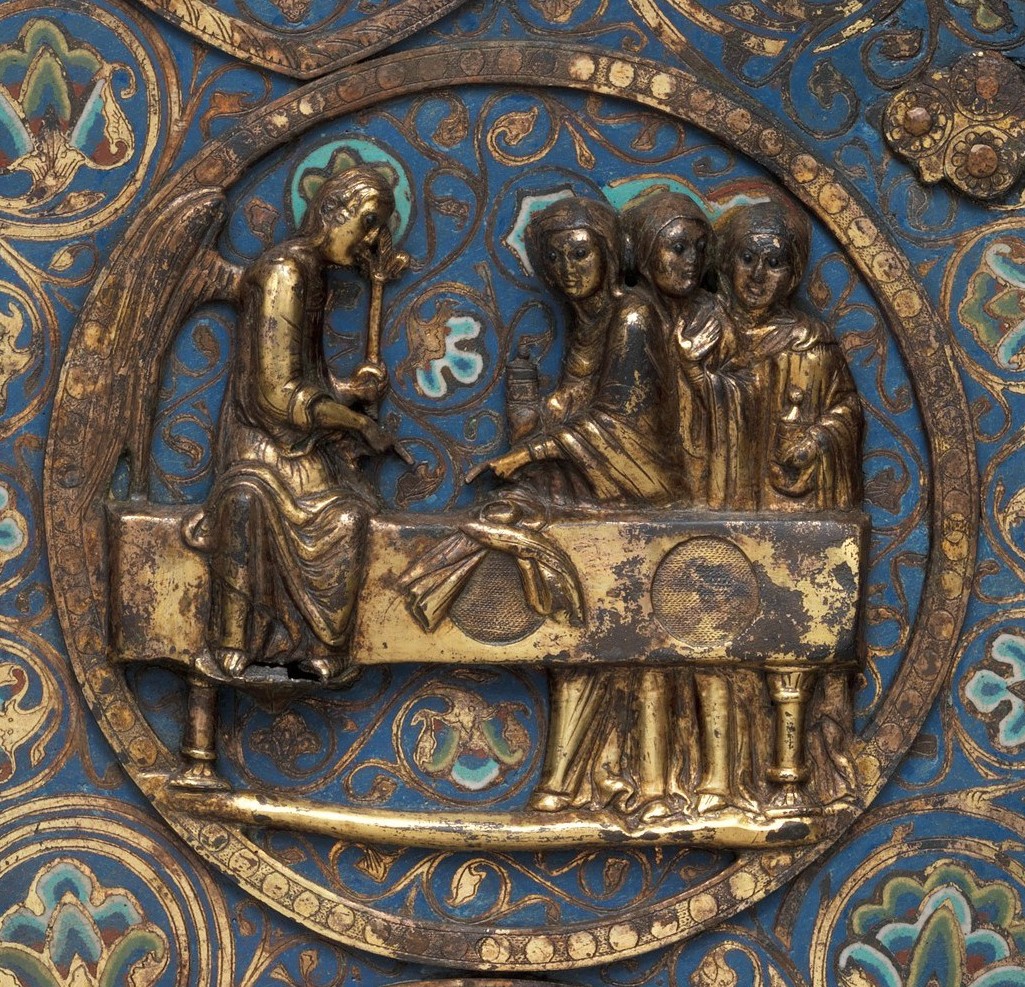
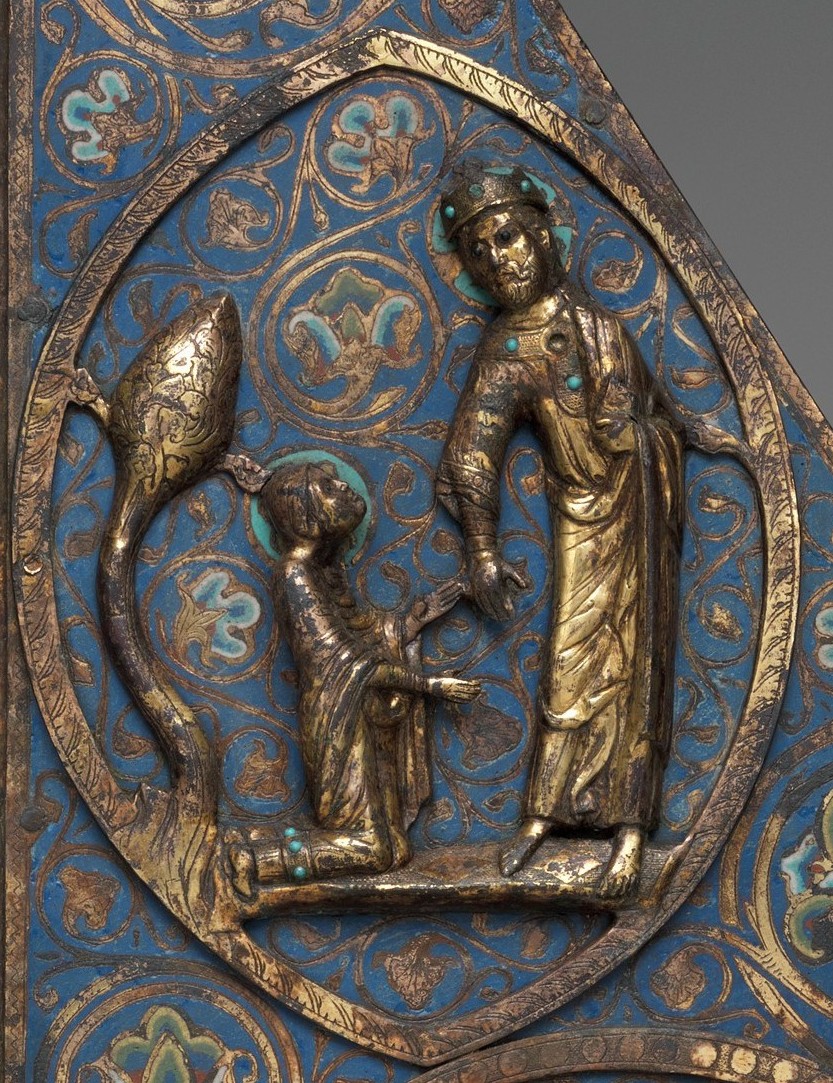
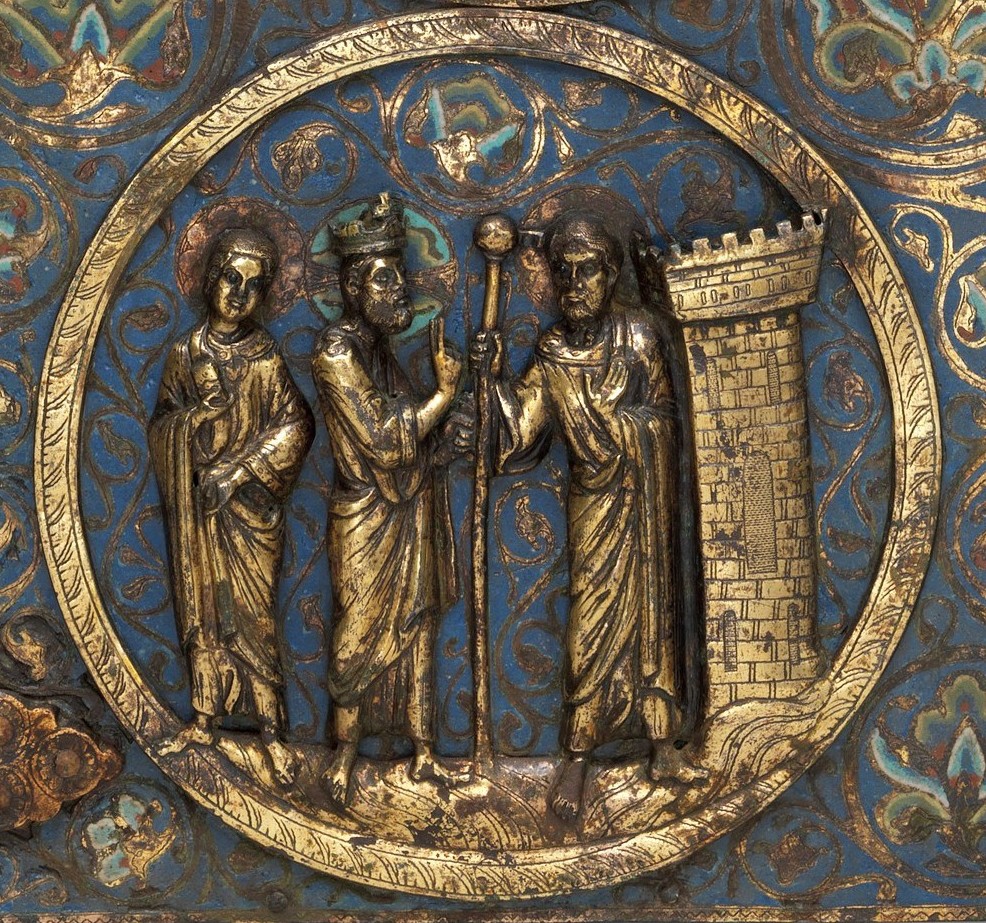
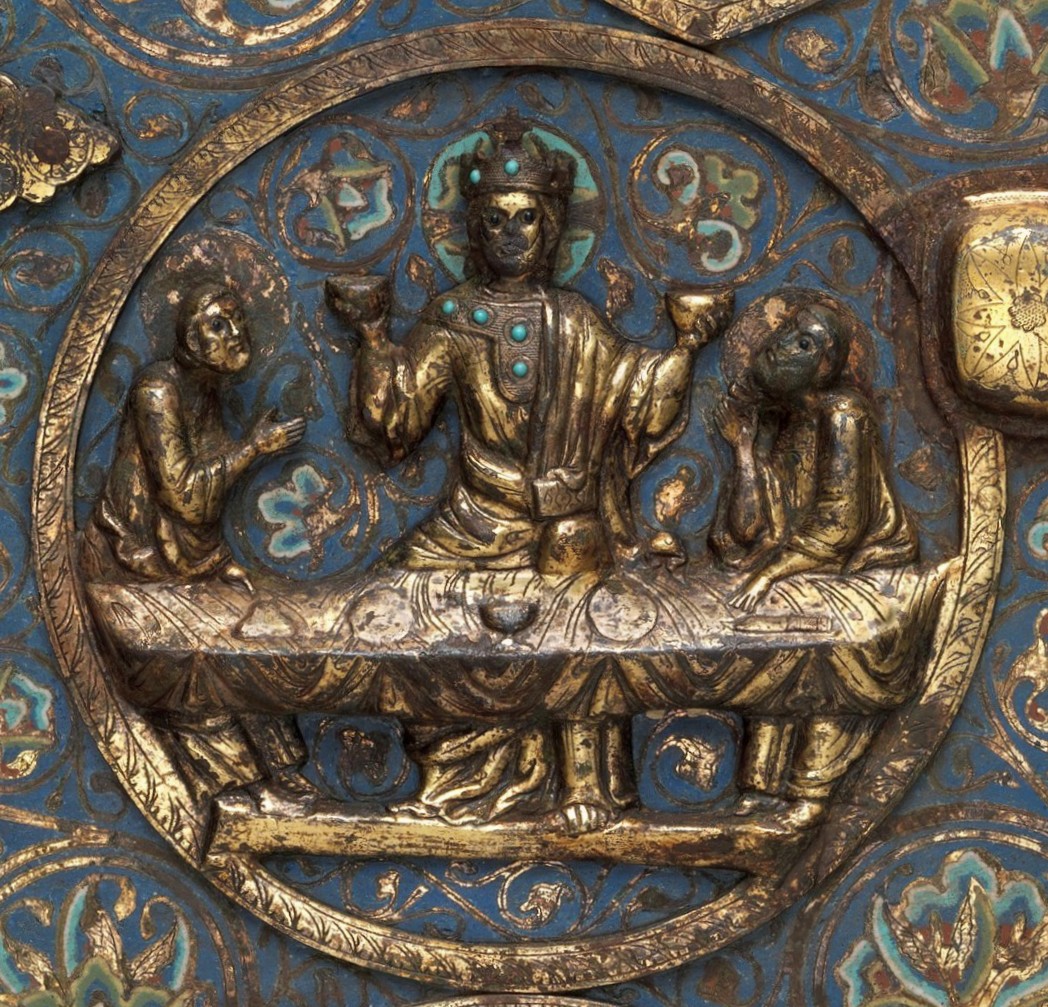
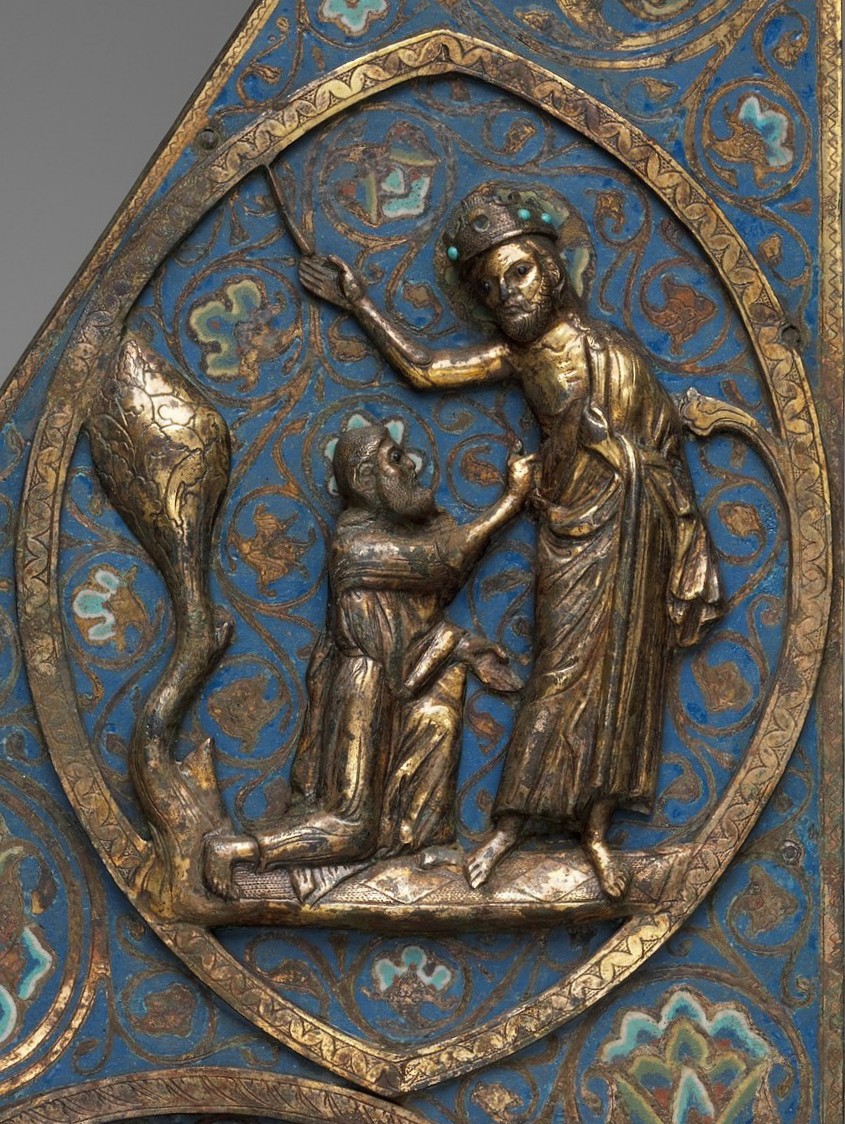
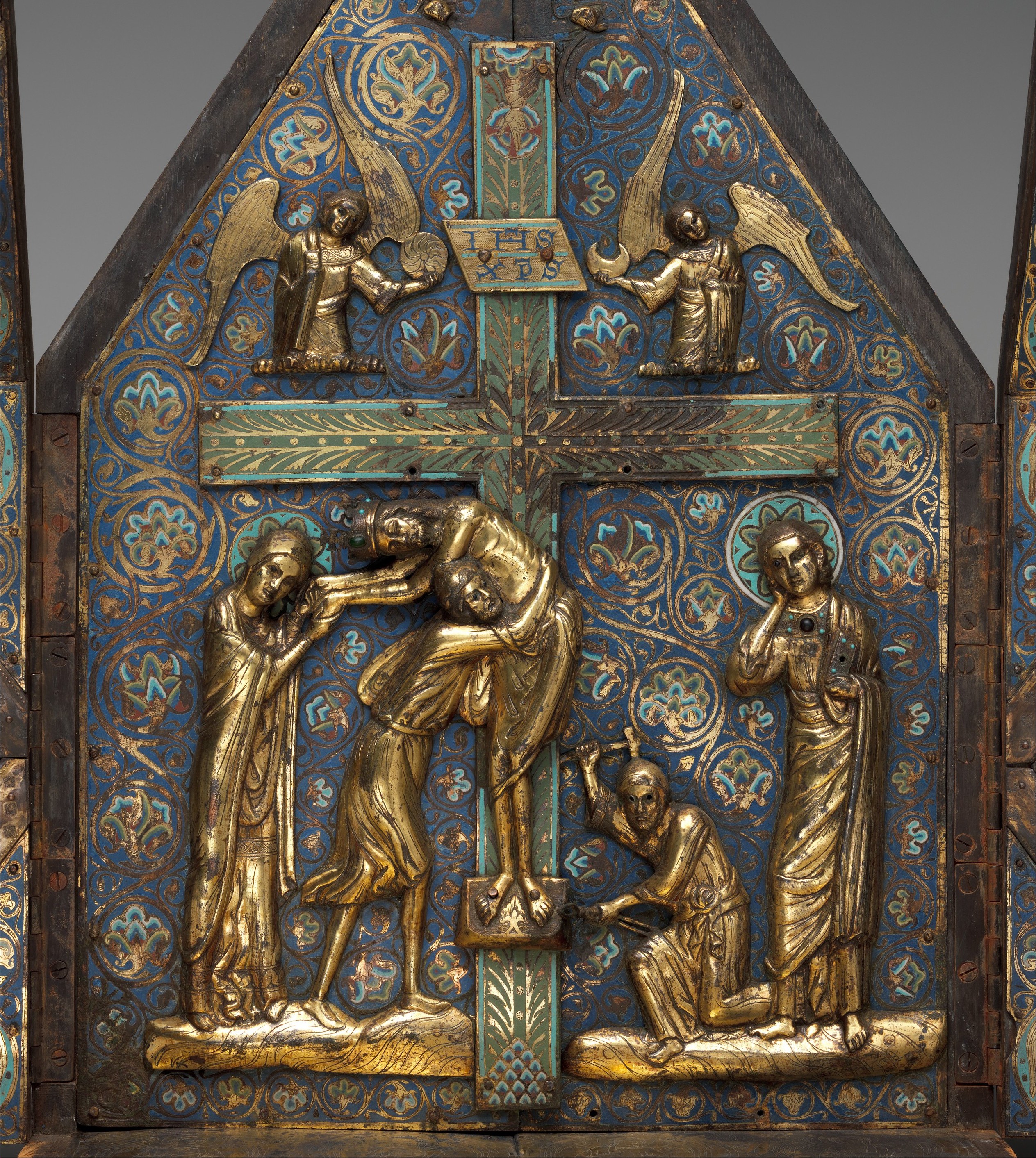
The Met Cloisters in New York City—the branch of the Metropolitan Museum of Art devoted to the art and architecture of medieval Europe—has some of the most beautiful Christian art objects I’ve seen. Here I’ll share just one of them: an elaborately decorated champlevé enamel tabernacle, that is, a cupboard where the vessels containing the “reserved Eucharist,” the already-blessed bread and wine, are kept. The primary scene represents the descent of Christ’s body from the cross, while the six medallion scenes on the interior doors (Christ’s appearance to Mary Magdalene, Thomas, and the Emmaus pilgrims; the holy women at the tomb; and the Harrowing of Hell) all have to do with the resurrection. To indicate his kingliness, Christ wears a crown. More on the iconography below.

Tabernacle of Cherves
Tabernacle of Cherves, Charente, France, ca. 1220–30. Champlevé enamel and copper, open: 33 × 37 3/4 × 10 3/4 in. (83.8 × 95.9 × 27.3 cm). Metropolitan Museum of Art, New York.

The enameled metalworks produced in twelfth- through fourteenth-century Limoges in southwestern France are renowned for their exquisite craftsmanship, which contemporary makers still marvel at. Some 7,500 such objects still survive in a variety of forms, including altar frontals, book covers, candlesticks, censers (incense burners), chrismatories (containers for chrism oil), coffers, croziers (bishop’s staffs), reliquaries (containers for relics), gemellions (handwashing basins), pyxides (small receptacles for the consecrated host), and more. The large concentration of churches and monasteries in France’s Limousin region created a large demand for decorated liturgical objects, which led to the rise of enamel workshops in the city of Limoges, located at the intersection of major trade routes. The technical and artistic mastery of these workshops’ products meant that soon orders were being placed by buyers in other regions and countries, and for a more diversified range of objects, not just those for church use.

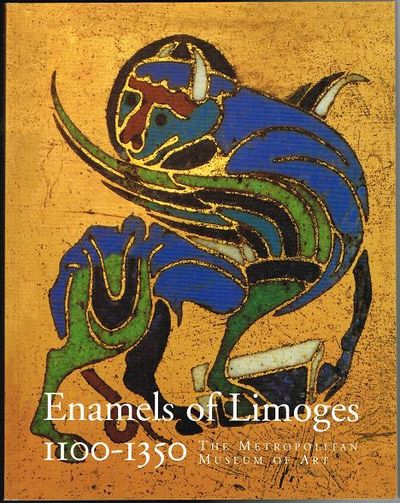
The champlevé method of enameling, the predominant decorative technique associated with Limoges, first requires the gouging out of a prepared metal substrate (almost always copper) to create cells. Enamel powder, made from shards of colored glass, is carefully laid into these recessed cells and the object is fired, then cooled, then polished. Champlevé enamels often have appliqué figures attached to them. These are created from copper sheet that is raised from the back and then finished from the front using various specialized tools. For a detailed description of the creation process, which I find fascinating, see the essay “Techniques and Materials in Limoges Enamels” by Isabelle Biron, Pete Dandridge, and Mark T. Wypyski, in the 1996 Met exhibition catalog Enamels of Limoges, 1100–1350, available for free download from MetPublications.

The Cherves tabernacle, so named because it was discovered in the Cherves-Richemont commune near the site of a ruined priory, is one of only two enamel tabernacles that have survived from the Middle Ages. It consists of blue, turquoise, green, yellow, red, and white champlevé enamel; gilded copper figures shaped by the twin metalworking techniques of repoussé (hammering from the reverse side to create a design in low relief) and chasing (hammering on the front side, sinking the metal); and, on the inside gables, engraved copper plaques covered in gold leaf. Its wood support was fabricated after the object was excavated at Château-Chesnel, near Plumejeau, in 1896.

The following text, written by Barbara Drake Boehm, senior curator at the Met Cloisters, is reproduced from pages 299–302 of the book Enamels of Limoges, 1100–1350 by permission of the publisher. I’ve inserted one bracketed note, plus hyperlinks on references that may be unfamiliar to readers. All photos are courtesy of the museum and are linked to their source page.

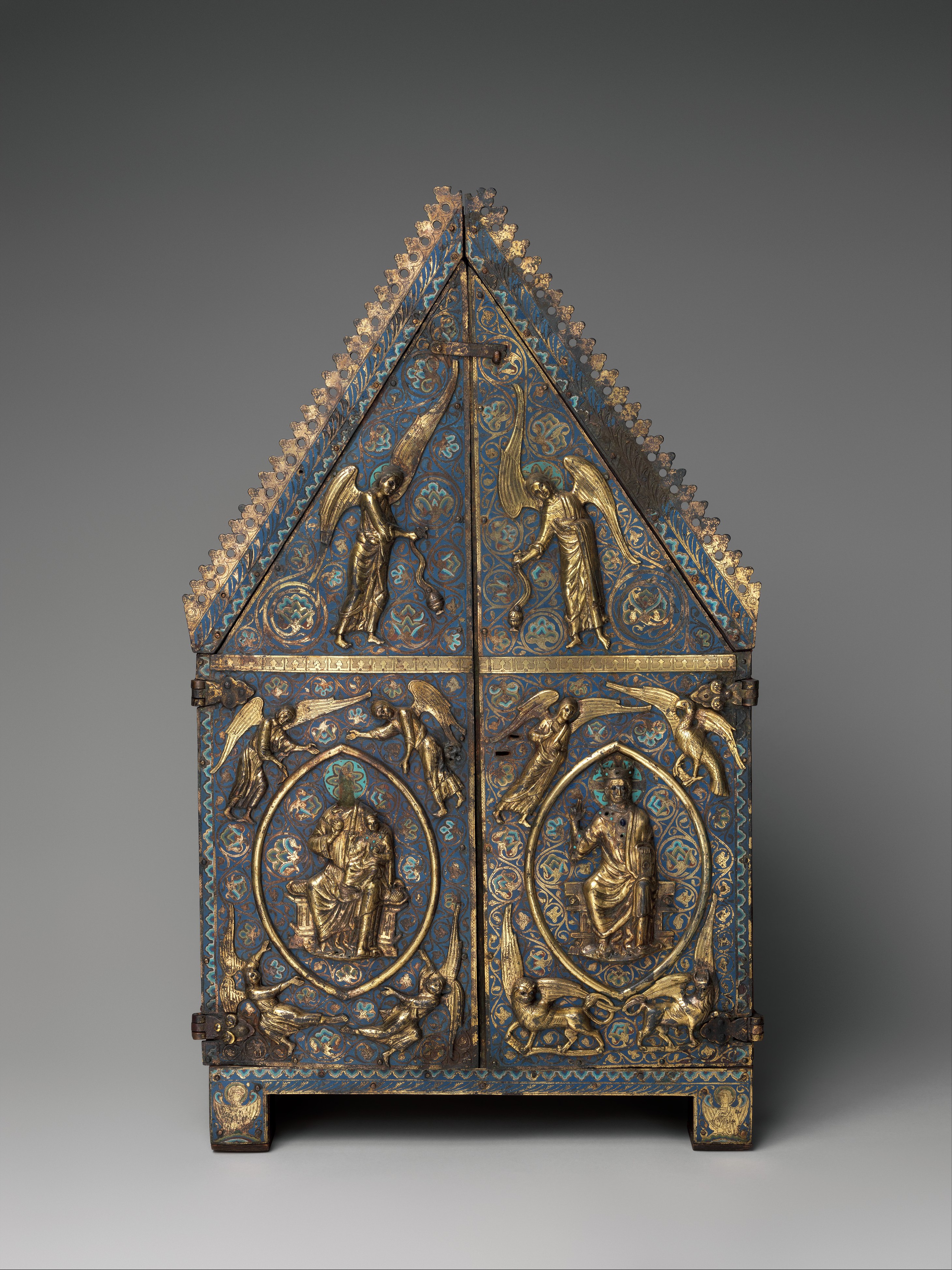
Tabernacle of Cherves (closed)
Closed view (the Virgin’s head is missing)

Standing on short legs, the tabernacle is in the form of a gabled cupboard with hinged doors. Gilded repoussé figures are applied to copper plates decorated with enameled foliate ornament. On the outside of the proper left door is the figure of Christ in Majesty, enthroned in a mandorla and surrounded by symbols of the evangelists. Opposite him on the proper right door is the Virgin with the Infant Jesus on her lap. She is framed within a mandorla and surrounded by four angels. Above them on the roof are two full-length angels, each holding a censer. Across the front runs a band of gilt copper inscribed with a decorative pattern derived from Kufic script, apparently based on the Arabic word yemen.

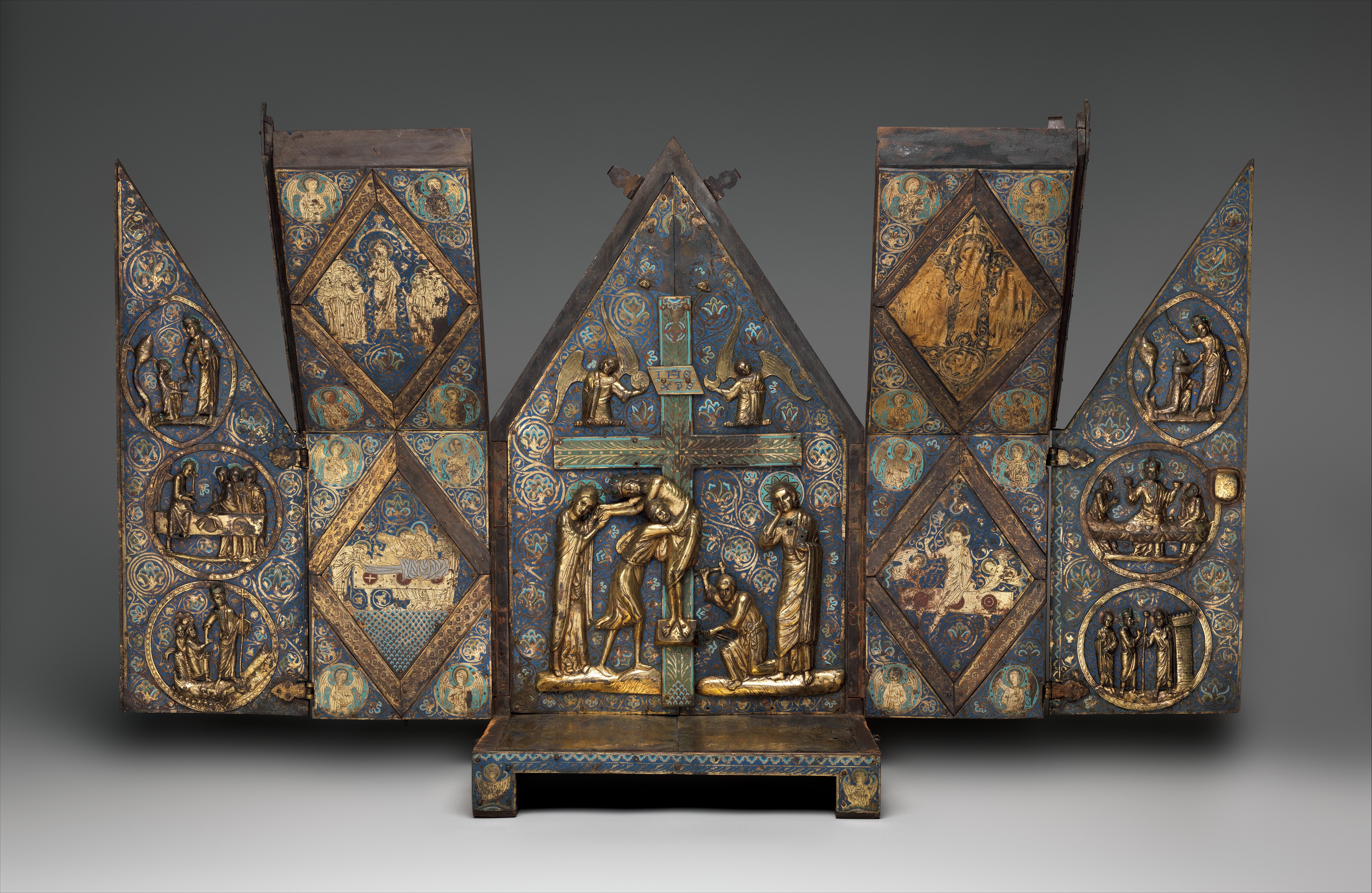
Tabernacle of Cherves (fully open)
Overall, all wings completely open

At the center of the open tabernacle, against its back wall, are appliqué figures representing the Descent from the Cross. Joseph of Arimathea takes the torso of the dead Christ in the arms as Nicodemus uses pliers and a hammer to remove the nails that still hold Christ’s feet to the green-enameled cross. The Virgin takes her son’s hands in hers and gently pulls them to her cheek; Saint John looks on from the opposite side, his head resting in his hand. Above the arms of the cross, two half-length angels hold emblems of the sun and moon. The Hand of God appears at the top of the cross; another figure of an angel once stood over it.

Tabernacle of Cherves (Harrowing of Hell)
The Harrowing of Hell

Tabernacle of Cherves (Empty Tomb)
The Holy Women at the Tomb

Tabernacle of Cherves (Noli me tangere)
“Noli me tangere” (The risen Christ appears to Mary Magdalene)

Tabernacle of Cherves (Road to Emmaus)
The Road to Emmaus

Tabernacle of Cherves (Supper at Emmaus)
The Supper at Emmaus

Tabernacle of Cherves (Incredulity of Thomas)
The Incredulity of Saint Thomas

On the insides of the doors are openwork medallions recounting the events that followed the Crucifixion, reading from lower left to upper right. The first is the Descent into Limbo, a nonscriptural image of Jesus leading souls by the hand out of the mouth of Hell, which is seen as the gaping mouth of a dragonlike beast. Set above it is the scene of the Holy Women arriving at the tomb of Jesus on Easter Sunday. Following the account in the Gospel of Mark (16:1), they bear jars of unguent to anoint the body and are greeted by a man, seen here as winged, who informs them that Jesus has risen. In the almond-shaped medallion above, Mary Magdalen meets the risen Christ in the garden (Mark 16:9; John 20:14–18), where he backs away and advises her not to touch him yet. At the lower right, the apostles on the road outside the walls of Emmaus (Luke 24:13–35) are greeted by Jesus, attired as a pilgrim; in the roundel above, they dine with him at Emmaus and realize who he is when he breaks bread with them. In the oval at the upper right, Saint Thomas (Doubting Thomas) touches the wound in Jesus’ side and is convinced of his Resurrection (John 20:24–29).

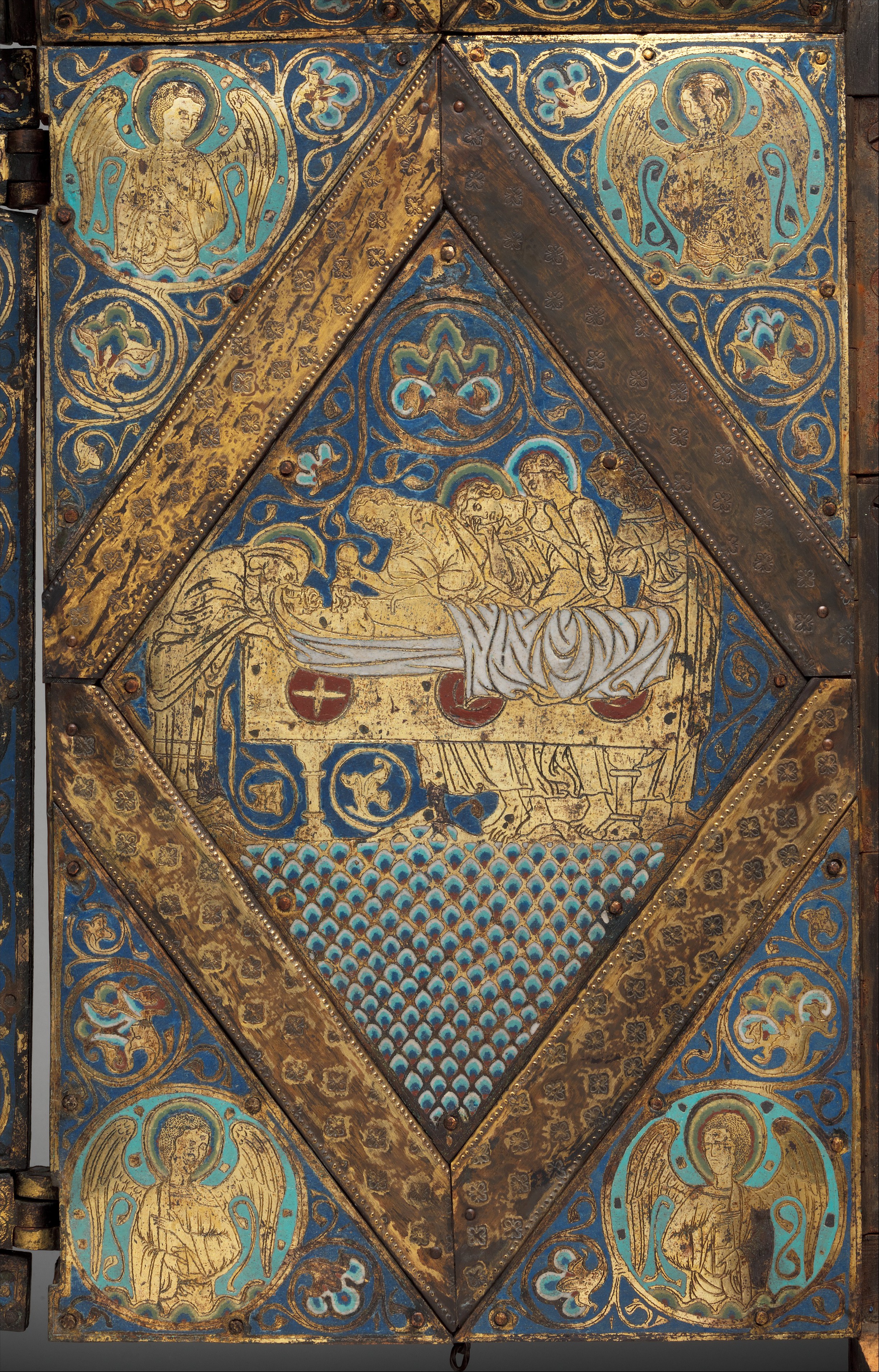
Tabernacle of Cherves (Entombment)
The Entombment

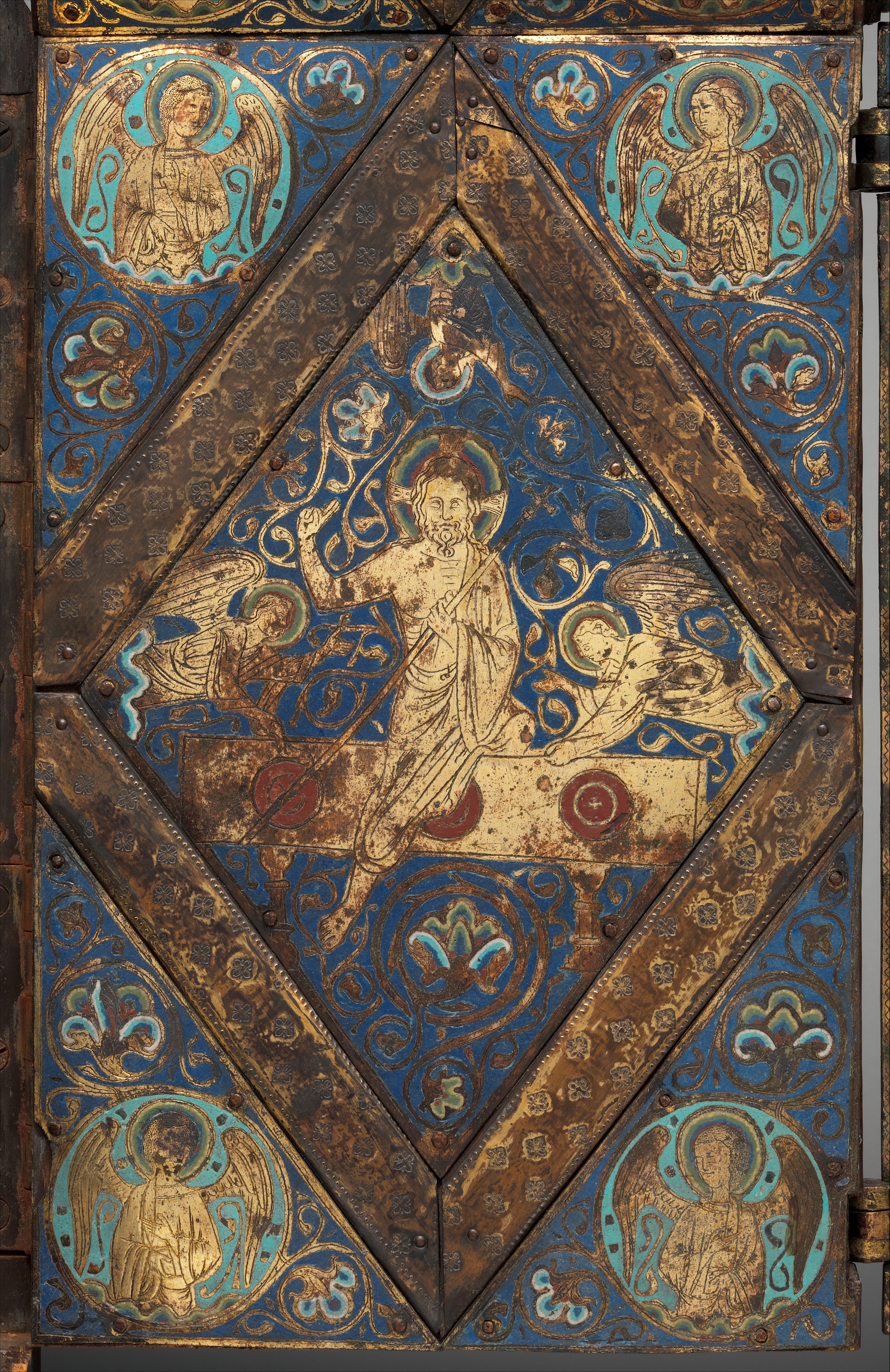
Tabernacle of Cherves (Resurrection)
The Resurrection

Tabernacle of Cherves (Ascension)
The Ascension

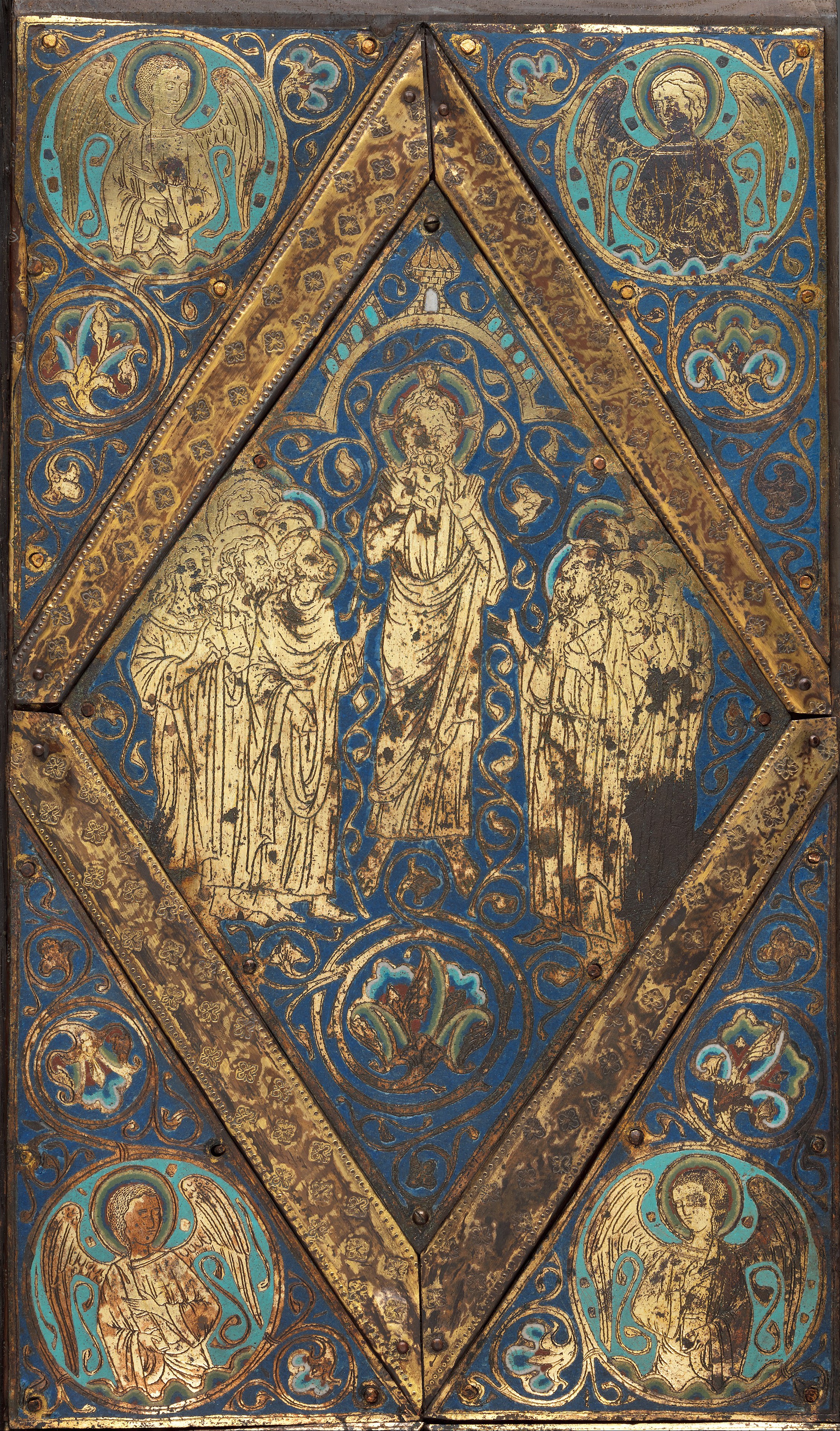
The interior side panels of the tabernacle have large lozenges with engraved figurative scenes framed at the corners by triangular enamel plaques, each depicting an angel in a roundel. At the lower left is the Entombment of Christ; at the upper left is the Ascension. At the lower right, Christ emerges from his tomb, with angels at either side. The base of the cupboard is covered with sheets of gilt copper depicting angels in roundels.

The tabernacle of Cherves is remarkable for its iconographic sophistication and for the dialogue established compositionally and visually between thematically related scenes. On the insides of the doors, Jesus guides souls out of the mouth of Hell at the lower left; at the lower right, he guides the apostles on the journey to Emmaus. On the center left roundel, the Holy Women seek Jesus’ body and find it gone; on the center right roundel, Jesus offers his body to the apostles in the sacrament of bread and wine. At the upper left, he tells the Magdalen it is too soon to touch him; at the upper right, he invites Thomas to touch his wound. In the inside lozenge at the left, Jesus is lowered into his tomb; at the right, he rises from it. At the upper left, he leaves his apostles and rises to heaven; at the upper right, the Holy Spirit descends from heaven on the apostles in a representation of Pentecost. [This latter scene is missing and has been replaced by a copy on paper or parchment of the Ascension image opposite it.]

Tabernacle of Cherves (Deposition)
The Descent from the Cross

The Descent from the Cross is both elegant and full of pathos, a masterpiece of Gothic relief sculpture. As such, it has rightly served as a point of comparison with works in other media, notably the ivory Descent from the Cross in the Louvre. A number of gilt-copper relief sculptures produced in the Limousin but now isolated from their original contexts can be compared with those on the Cherves tabernacle. Notable among these is the Descent from the Cross preserved in the Abegg-Stiftung, Bern, first recorded in 1870. Most of these reliefs are presumed to come from altar frontals.

The enameled ground of the Cherves tabernacle, with its strong concentric circles of reserved gilt copper enclosing full fleurons, seems to anticipate the enameled plate of the tomb effigy of John of France of after 1248.

The identification of this enameled cupboard as a tabernacle for the consecrated Host has not been confirmed: the Church of the Middle Ages had no universal custom for the reservation of the Eucharistic bread or regulations requiring a tabernacle. Nor is there a wealth of comparative medieval examples. Only one other Limoges tabernacle of this type is known; it was acquired by the cathedral of Chartes in the nineteenth century, and its earlier history is not known. The supposition that the enameled cupboard from Cherves is a Eucharistic tabernacle is based on its resemblance in form to later tabernacles, its subject matter, and even the gilt-copper base plate which would allow an enclosed pyx to slide easily in and out.

Soon after its discovery in 1896, the tabernacle was presented to the Société archéologique de la Charente by Maurice d’Hauteville, a curator at Angoulême and son-in-law of Ferdinand de Roffignac, on whose property it was unearthed. He suggested that the treasure could have come from the Benedictine monastery of Fontdouce, founded in 1117. More recently it has been supposed that the treasure at Cherves comes from the Grandmontain foundation at Gandory, of which, unfortunately, there are no remains.

Since its discovery, the tabernacle of Cherves has been recognized as a masterpiece of Limoges work in the Gothic period. Part of a larger treasure, . . . it was exhibited successively at Poitiers, Brive, and Limoges, and then at the Musée de Cluny before being sent to Great Britain.

You can explore other champlevé enamels at the Met using its website’s advanced search function. If you wish to study the topic in more depth, the book I’ve quoted from is an excellent resource, featuring essays as well as photographs and descriptions of 157 objects not only from the Met’s collection but also from the Louvre and various other European and American museums, ecclesiastical institutions, and private collections. Click on the cover image to go to the book page.

Enamels of Limoges