
“The Fury of Sunrises” by Anne Sexton (poem)

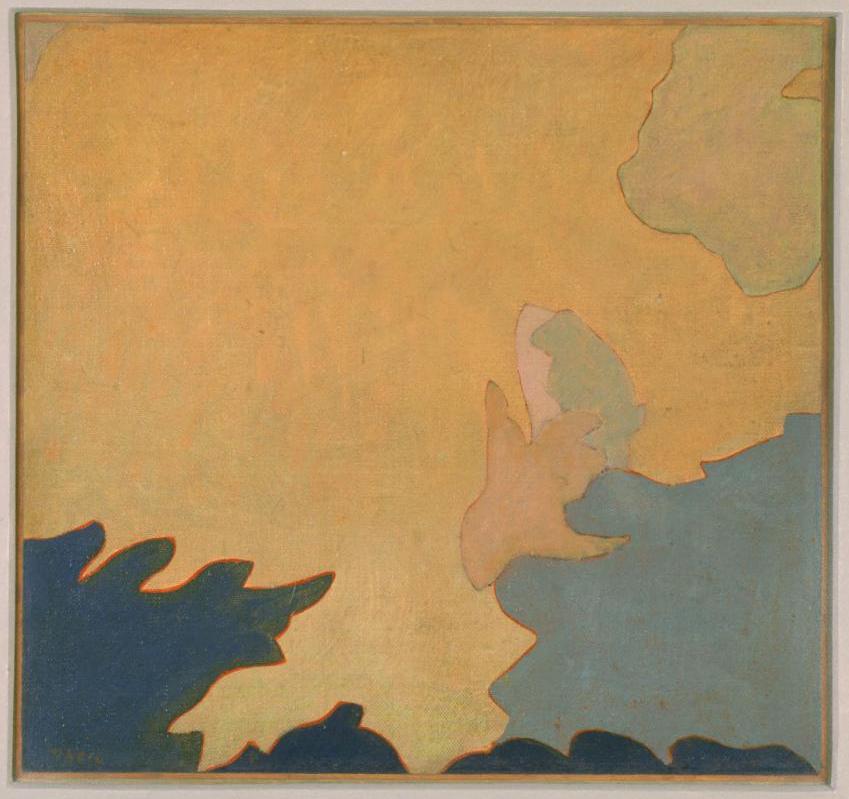
Tack, Augustus Vincent_Dawn
Augustus Vincent Tack (American, 1870–1949), Dawn, 1934–36. Oil on canvas mounted on hardboard, 23 3/4 × 24 3/4 in. (60.3 × 62.9 cm). Phillips Collection, Washington, DC.

Darkness
as black as your eyelid,
poketricks of stars,
the yellow mouth,
the smell of a stranger,
dawn coming up,
dark blue,
no stars,
the smell of a lover,
warmer now
as authentic as soap,
wave after wave
of lightness
and the birds in their chains
going mad with throat noises,
the birds in their tracks
yelling into their cheeks like clowns,
lighter, lighter,
the stars gone,
the trees appearing in their green hoods,
the house appearing across the way,
the road and its sad macadam,
the rock walls losing their cotton,
lighter, lighter,
letting the dog out and seeing
fog lift by her legs,
a gauze dance,
lighter, lighter,
yellow, blue at the tops of trees,
more God, more God everywhere,
lighter, lighter,
more world everywhere,
sheets bent back for people,
the strange heads of love
and breakfast,
that sacrament,
lighter, yellower,
like the yolk of eggs,
the flies gathering at the windowpane,
the dog inside whining for food
and the day commencing,
not to die, not to die,
as in the last day breaking,
a final day digesting itself,
lighter, lighter,
the endless colors,
the same old trees stepping toward me,
the rock unpacking its crevices,
breakfast like a dream,
and the whole day to live through,
steadfast, deep, interior.
After the death,
after the black of black,
this lightness—
not to die, not to die—
that God begot.

“The Fury of Sunrises” is the last of fifteen poems from Anne Sexton’s “The Furies” cycle, published in The Death Notebooks (Houghton Mifflin, 1974). Copyright is held by the Estate of Anne Sexton, represented by Sterling Lord Literistic.

Anne Sexton (1928–1974) was a Pulitzer Prize–winning confessional poet from New England who wrote in starkly personal terms about her psychiatric struggles (she suffered from bipolar disorder and died by suicide), sexuality, and other taboo subjects. Much of her poetry expresses a yearning for the ecstatic and sublime and explores religious questions, referencing God and faith—even though she characterized herself, in a 1968 BBC interview, as an atheist, albeit one who was “rather attracted to Catholicism.”

Lent, Day 2

LOOK: Canyon by Augustus Vincent Tack

Tack, Augustus Vincent_Canyon
Augustus Vincent Tack (American, 1870–1949), Canyon, ca. 1923–24. Oil on canvas mounted on plywood panel, 29 × 40 in. (73.7 × 101.6 cm). The Phillips Collection, Washington, DC.

LISTEN: “Valley of Vision” | Words by Arthur Bennett, 1975 | Music by Tenielle Neda, 2019

The text of this song is taken from The Valley of Vision: A Collection of Puritan Prayers and Devotions, compiled and edited by Arthur Bennett (Edinburgh: Banner of Truth Trust, 1975) from various seventeenth- through nineteenth-century sources. (Learn more about this wonderful little prayerbook here.) The opening prayer—the only one written by the editor—is titled “The Valley of Vision,” and it appears in the book as follows:

Lord, high and holy, meek and lowly,
Thou hast brought me to the valley of vision,
      where I live in the depths but see thee in the heights;
      hemmed in by mountains of sin I behold thy glory.
Let me learn by paradox
      that the way down is the way up,
      that to be low is to be high,
      that the broken heart is the healed heart,
      that the contrite spirit is the rejoicing spirit,
      that the repenting soul is the victorious soul,
      that to have nothing is to possess all,
      that to bear the cross is to wear the crown,
      that to give is to receive,
      that the valley is the place of vision.
Lord, in the daytime stars can be seen from deepest wells,
      and the deeper the wells the brighter thy stars shine;
Let me find thy light in my darkness,
                     thy life in my death,
                     thy joy in my sorrow,
                     thy grace in my sin,
                     thy riches in my poverty,
                     thy glory in my valley.

The title of this prayer and its musical setting comes from the heading that is Isaiah 22:1: “The burden of the valley of vision.” The valley here refers to Jerusalem, a city located in the middle of a range of low mountains (it’s surrounded by seven peaks higher than itself) and a seat of divine revelation—where prophetic visions were given, and where God manifested himself in the temple. And in the context of the chapter, “burden” means a mournful oracle, as Isaiah warns of Jerusalem’s destruction.

Bennett extracts the phrase “valley of vision” from the Isaiah context, using it as a metaphor for the low, dark places where we can see God most clearly. “The way down is the way up,” he writes—one of the several paradoxes of the Christian faith. In God’s kingdom the lowly are uplifted; to admit defeat is to win the victory; and to die is to live.

Author Edna Hong refers to Lent as a “downward ascent” in which we go down into the depths of ourselves, acknowledging our fragility and examining and confessing our sins, in order that we might rise anew with Christ, with a refreshed understanding and experience of his love, power, and grace. May you find that refreshment this Lenten season. May your vision of God and self come into clearer, more glorious focus.