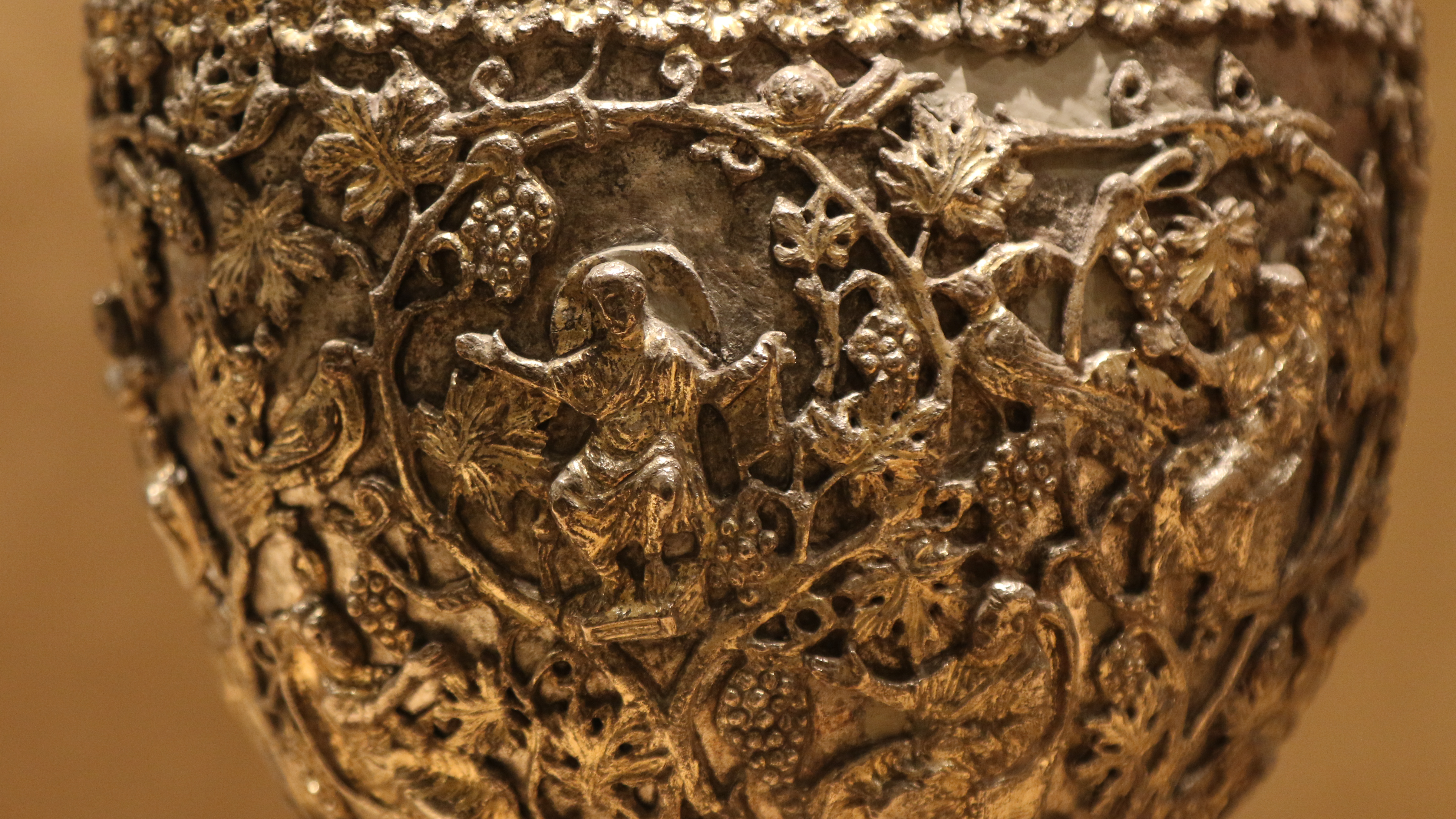
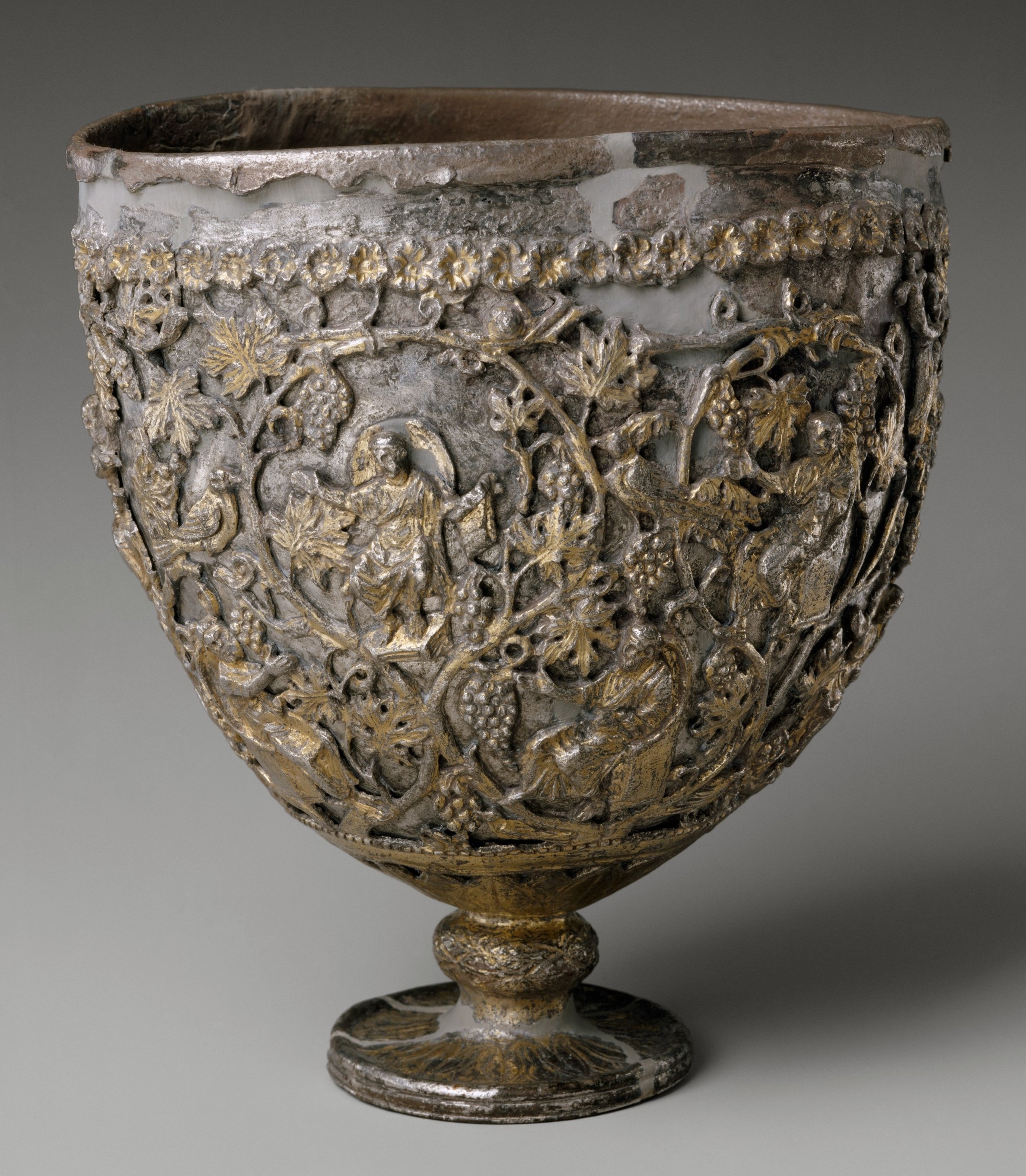
The Antioch “Chalice,” Byzantine (Syria), 500–550. Silver, silver-gilt, overall 7 11/16 × 7 1/16 × 6 in. (19.6 × 18 × 15.2 cm). Metropolitan Museum of Art, New York. Photo: Fr. Lawrence Lew, OP.
This Byzantine liturgical object was discovered in 1908 in Antioch on the Orontes (in modern-day Turkey, near the Syrian border) and is thought to be from the first half of the sixth century. Originally it was identified as a chalice, used in the celebration of the Eucharist, but more recent scholarship suggests that it was probably a standing oil lamp that was used in church.
The elaborate silver shell that encloses the plain silver bowl is covered in emblems of the renewal of life—vines, fruit, doves, a butterfly, a rabbit. There are also snails and a grasshopper! If indeed the object is a lamp, its flame would have reinforced Jesus’s self-identification as the light of the world.
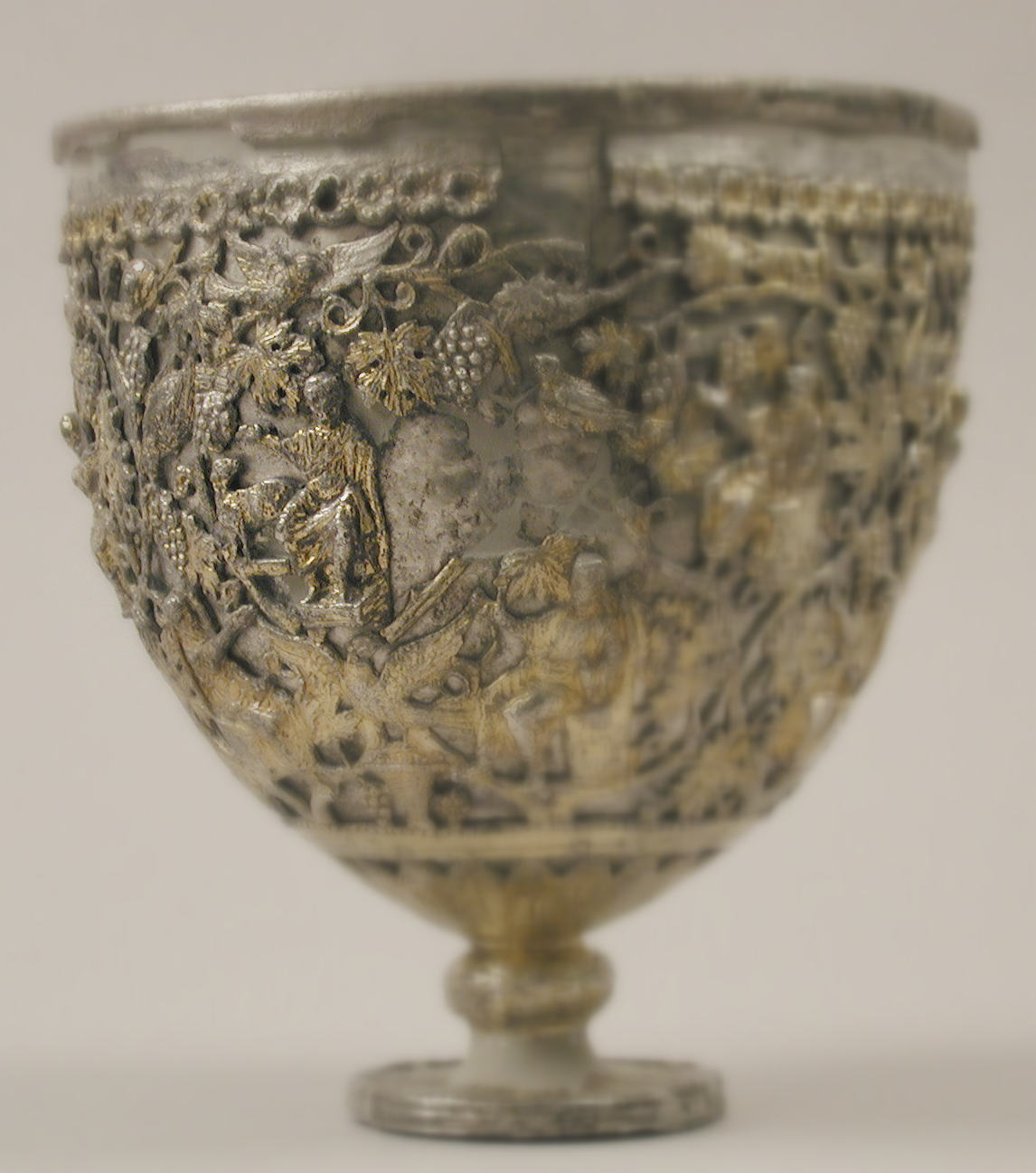
Twelve seated human figures circle the bowl, two of which likely represent Christ, as each is surrounded by five figures in attitudes of directed reverence. One Christ figure (see the first photo below) is shown with a scroll draped over his left arm, representing his teaching. The other Christ, on the opposite side, is depicted as the resurrected Lord and giver of life; a lamb stands under his right arm, and beneath him, an eagle with outspread wings perches on a fruit basket.
View 1, what I’ll call the frontView 2, what I’ll call the back. Photo edited by me to focus on the (second) Christ figure and the lamb. Click on image for original.
The subordinate figures, all holding scrolls, may be apostles, or they may be philosophers of the classical age who, like the Hebrew prophets, had foretold the coming of Christ.
LISTEN: Christ lag in Todesbanden (Christ Lay in the Bonds of Death) (BWV 4) by J. S. Bach, 1707 | Words by Martin Luther, 1524 | Performed by Ensemble Orlando Fribourg at the Church of St. Michael’s College, Fribourg, Switzerland, 2016
Bach wrote this Easter cantata—one of his earliest works—at age twenty-two as part of his application for the post of organist at Divi Blasii church in Mühlhausen, Germany. (He got the job!) Its text and melody are taken from the hymn of the same name by Martin Luther, which was itself derived from the eleventh-century plainsong “Victimae paschali laudes.”
The twenty-two-minute cantata is divided into an opening instrumental movement, called a sinfonia, and seven vocal movements corresponding to the stanzas of Luther’s hymn. These are arranged symmetrically—chorus–duet–solo–chorus–solo–duet–chorus—with the focus on the high drama of the central fourth movement, which describes the battle between Life and Death.
Sinfonia
1. Choral Christ lag in Todesbanden, für unsre Sünd gegeben, der ist wieder erstanden und hat uns bracht das Leben. Des wir sollen fröhlich sein, Gott loben und dankbar sein und singen Halleluja. Halleluja.
2. Duett (SA) Den Tod niemand zwingen kunnt bei allen Menschenkindern; das macht alles unsre Sünd, kein Unschuld war zu finden. Davon kam der Tod so bald und nahm über uns Gewalt, hielt uns in seim Reich gefangen. Halleluja.
3. Aria (T) Jesus Christus, Gottes Sohn, an unser Statt ist kommen und hat die Sünde abgetan, damit dem Tod genommen all sein Recht und sein Gewalt; da bleibt nichts denn Tods Gestalt, den Stachel hat er verloren. Halleluja.
4. Choral Es war ein wunderlich Krieg, da Tod und Leben ’rungen; das Leben, behielt den Sieg, es hat den Tod verschlungen. Die Schrift hat verkündet das, wie ein Tod den andern fraß, ein Spott aus dem Tod ist worden. Halleluja.
5. Duett(ST) Hier ist das rechte Osterlamm, davon wir sollen leben, das ist an des Kreuzes Stamm in heißer Lieb gegeben. Des Blut zeichnet unsere Tür, das hält der Glaub dem Tode für, der Würger kann uns nicht rühren. Halleluja.
6. Aria (B) So feiern wir das hoh Fest mit Herzensfreud und Wonne, das uns der Herre scheinen lässt. Er ist selber die Sonne, der durch seiner Gnaden Glanz erleucht unsre Herzen ganz; der Sünden Nacht ist vergangen. Halleluja.
7. Choral Wir essen und leben wohl, zum süßen Brot geladen; der alte Sau’rteig nicht soll sein bei dem Wort der Gnaden. Christus will die Kost uns sein und speisen die Seel allein; der Glaub will keins andern leben. Halleluja.
Sinfonia
1. Chorale Christ Jesus lay in death’s strong bands for our offenses given; but now at God’s right hand he stands and brings us life from heaven. Therefore let us joyful be and sing to God right thankfully loud songs of alleluia! Alleluia!
2. Duet(SA) No son of man could conquer death, such ruin sin had wrought us. No innocence was found on earth, and therefore death had brought us into bondage from of old and ever grew more strong and bold and held us as its captive. Alleluia!
3. Aria (T) Christ Jesus, God’s own Son, came down, his people to deliver; destroying sin, he took the crown from death’s pale brow forever. Stripped of pow’r, no more it reigns; an empty form alone remains; its sting is lost forever. Alleluia!
4. Chorale It was a strange and dreadful strife when life and death contended. The victory remained with life, the reign of death was ended. Holy Scripture plainly saith that death is swallowed up by death; disgraced, it lies defeated. Alleluia!
5. Duet (ST) Here the true Paschal Lamb we see, whom God so freely gave us; he died on the accursed tree— so strong his love—to save us. See, his blood now marks our door; faith points to it; death passes o’er, and Satan cannot harm us. Alleluia!
6. Aria (B) So let us keep the festival to which the Lord invites us; Christ is himself the joy of all, the sun that warms and lights us. Now his grace to us imparts eternal sunshine to our hearts; the night of sin is ended. Alleluia!
7. Chorale Then let us feast this Easter day on Christ, the bread of heaven; the Word of grace has purged away the old and evil leaven. Christ alone our souls will feed; he is our meat and drink indeed; faith lives upon no other! Alleluia!
A praising of God is what laughter is, because it lets a human being be human.
Laughter is a praise of God, because it lets a human being be a loving person.
Laughter is praise of God because it is a gentle echo of God’s laughter, of the laughter that pronounces judgment on all history.
Laughter is praise of God because it foretells the eternal praise of God at the end of time, when those who must weep here on earth shall laugh.
The laughter of unbelief, of despair, and of scorn, and the laughter of believing happiness are here uncannily juxtaposed, so that before the fulfillment of the promise, one hardly knows whether belief or unbelief is laughing.
Soichi Watanabe (Japanese, 1949–), You Shall Laugh, 2011. Oil on canvas, 16 × 12 in. (41 × 31 cm). Kwansei Gakuin University Chapel, Kobe, Japan. Photo courtesy of the artist.
Soichi Watanabe is a Japanese Christian artist who served as the 2008–9 artist in residence at the Overseas Ministries Study Center (OMSC) in New Haven, Connecticut (now at Princeton Theological Seminary). OMSC published a catalog of his work, titled For the Least of These: The Art of Soichi Watanabe, in 2010, featuring forty-three of his paintings.
Watanabe doesn’t supply facial features for his human figures because he wants viewers to be able to see themselves in the characters portrayed. He concentrates on form and color.
I was introduced to this painting of his through the OMSC-sponsored Zoom presentation he gave on February 3, 2021. There he said, “We can laugh as the love of God is being poured out on us . . . the laughter of knowing that the Lord is with us in pain and sorrow.” The wave shape at the bottom, he told me in an email, is a reference to the tsunami of March 11, 2011, which wiped out his home city of Ishinomaki and accelerated his mother’s dementia.
Watanabe also painted a companion piece, With Those Who Weep, which shows the same three figures huddled together in a mass, one comforting the two who are crying. Together, the paintings encourage us to fully feel our griefs and our hurts, and to be present to one another through those experiences, but also to hold on to joy, which transcends circumstance.
The artist pointed out to me that the three figures in You Shall Laugh resemble a flower spreading out its petals. The kanji for “bloom,” he says, originally meant “laugh” and was written as “birds sing, flowers laugh.”
LISTEN: “Jesus soll mein erstes Wort” (Jesus shall be my first word) from Gott, wie dein Name, so ist auch dein Ruhm (God, as your name is, so also your praise is to the ends of the world) (BWV 171) | Words by Picander (Christian Friedrich Henrici), 1728 | Music by Johann Sebastian Bach, 1728 | Performed by Kathleen Battle and Itzhak Perlman on J. S. Bach: Arias for Soprano and Violin, 1991
Jesus soll mein erstes Wort
In dem neuen Jahre heißen.
Fort und fort
Lacht sein Nam in meinem Munde,
Und in meiner letzten Stunde
Ist Jesus auch mein letztes Wort.
Jesus shall be my first word
uttered in the new year.
Again and again
his name laughs in my mouth,
and in my last hour
Jesus will also be my last utterance.
This aria is the fourth movement of a cantata Bach composed for his church in Leipzig for New Year’s Day 1729. January 1 is also the Feast of the Holy Name of Jesus, since Jesus was given his name when he was eight days old (Luke 2:21). Read the full libretto of BWV 171 here, and listen to the full cantata here. (It’s only sixteen minutes.)
For the excerpt I’ve chosen a recording by the legendary American operatic soprano Kathleen Battle, who is accompanied by the equally famous Israeli American violinist Itzhak Perlman.
LOOK: Jesus as Bridegroom of the Soul from the Rothschild Canticles
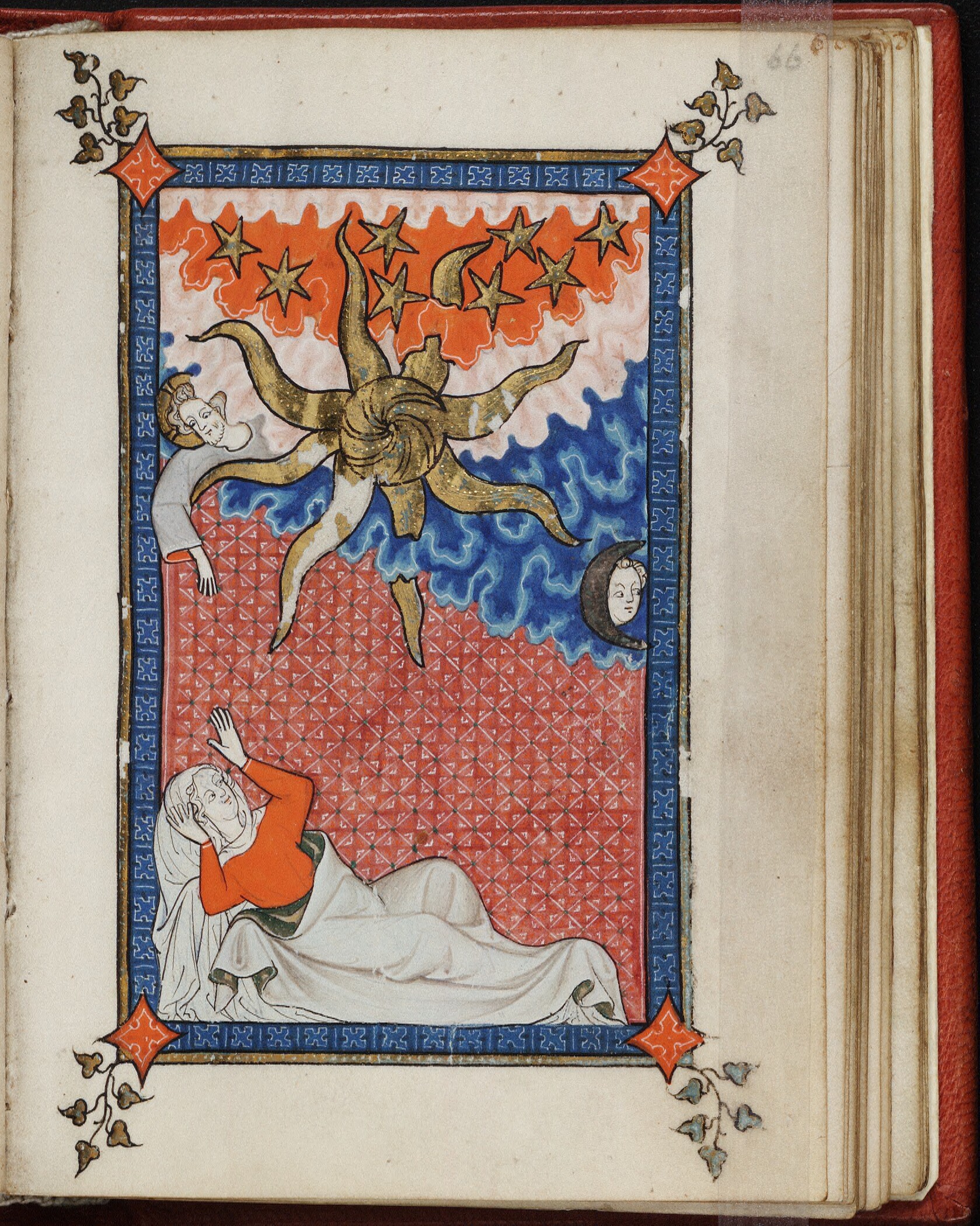
Jesus as Bridegroom of the Soul, from the Rothschild Canticles, Flanders or Rhineland, ca. 1300. Beinecke Library, Yale University, MS 404, fol. 66r.
The Rothschild Canticles from early fourteenth-century Flanders or the Rhineland (whose innovative Trinity miniatures I wrote about in 2021) is a cento of biblical, liturgical, and patristic citations accompanying an extraordinary program of images. Much of the content reflects the bridal mysticism that was popular at the time, emphasizing spiritual oneness with Christ. The compiler, artist(s), scribe(s), and original recipient of the manuscript are not known, but it was very likely made by a male monastic for a nun or canoness to use in her private devotions.
The miniature on folio 66r is the first in a five-miniature sequence (of which four survive) on the theme of mystical union. It shows the human soul, represented as a woman, about to receive her Bridegroom, Christ, in the marriage bed. Art historian Jeffrey Hamburger writes that in this image, “Christ emerges from the heavens with the energy of a cosmic explosion[,] . . . as a dramatic sunburst dissolving the mists. . . . Christ is the sun, its brightness, the light of the visio Dei. Just as sunlight generates heat, so Christ provokes desire.” [1] The artist uses that whirling sun with its tentacle-like rays as an attribute of Christ throughout the manuscript.
At her lover’s luminous descent, the Bride awakes from her sleep and raises her arms in ecstasy.
The face peeking out from behind the crescent moon on the right may be an angel, whose gaze directs us forward to the next scene, which shows the Bride reclining outdoors amid sprouting vines, “languish[ing] with love” (Song 2:5), and then being led into a wine cellar by the Bridegroom, to be inebriated by his sweet goodness (Song 2:4) .
The corresponding text on the facing page of this image, set inside a bedchamber, incorporates the following excerpts:
“I call you into my soul, which you are preparing for your reception, through the longing which you have inspired in it.”—Augustine, Confessions X.1
“God comes from Lebanon, the Holy One from the shady and thickly covered mountain.”—Habakkuk 3:3, used in medieval Advent liturgies
“I passed by you again and looked on you; you were at the age for love.”—Ezekiel 16:8
Plus miscellaneous adaptations of lines from the Song of Songs
In the Middle Ages it was common for Christian mystics, such as Mechthild of Magdeburg and Gertrude of Helfta, to describe and picture spiritual union in terms of physical union, as they “realized that bodily language better conveys the power, intensity, and personality of desire than overly spiritualized language does,” writes medievalist Grace Hamman. [2] And not only was the church, a corporate body, perceived as the bride of Christ, but so was the individual soul. The consummation of the marriage between Christ and his beloved was seen as eschatological, yes—coming at the end of time—but such intimate closeness and pleasure was also seen as something that could be enjoyed now on some level, as devotees commune with Christ through prayer, scripture reading, and the celebration of the Eucharist.
For the nun who used this book, it must have aided her in cultivating a deep love for Christ and strengthened her longing for that full and final coming together, when Christ will return to be with his bride.
LISTEN: Wachet auf, ruft uns die Stimme, BWV 140 by Johann Sebastian Bach, 1731| Words by Philipp Nicolai, 1599 (movements 1, 4, 7), and an anonymous other | Melody of movements 1, 4, and 7 by Philipp Nicolai, 1599
Here are two listening options—the first from an album, and the second a live performance that you can hear as well as watch.
>> Performed by the Monteverdi Choir and the English Baroque Soloists, dir. John Eliot Gardiner, on Bach: Cantatas BWV 140 and 147 (1992)
>> Performed by the Choir and Orchestra of the J. S. Bach Foundation, dir. Rudolf Lutz (soloists: Nuria Rial, Bernhard Berchtold, Markus Volpert), Evangelisch-Reformierte Kirche Trogen, Switzerland, 2008 (**The copyright owner has disallowed video embeds, but you can watch the video directly on YouTube by clicking the link below.)
In the libretto that follows, the capital letters in parentheses indicate which voice parts are singing that movement: soprano, alto, tenor, or bass.
1. Choral (SATB)
Wachet auf, ruft uns die Stimme,
der Wächter sehr hoch auf der Zinne,
wach auf, du Stadt Jerusalem.
Mitternacht heißt diese Stunde,
sie rufen uns mit hellem Munde,
wo seid ihr klugen Jungfrauen?
Wohlauf, der Bräut’gam kömmt,
steht auf, die Lampen nehmt,
Alleluia!
Macht euch bereit
zu der Hochzeit,
ihr müsset ihm entgegen gehn.

2. Rezitativ (T)
Er kommt, er kommt,
der Bräut’gam kommt,
ihr Töchter Zions, kommt heraus,
Sein Ausgang eilet aus der Höhe
in euer Mutter Haus.
Der Bräut’gam kommt, der einen Rehe
und jungen Hirschen gleich
auf denen Hügeln springt
und euch das Mahl der Hochzeit bringt.
Wacht auf, ermuntert euch,
den Bräut’gam zu empfangen;
dort, sehet, kommt er hergegangen.

3. Duett (SB) (Dialog - Seele, Jesus)
Wenn kömmst du, mein Heil?
 – Ich komme, dein Teil. –
Ich warte mit brennenden Öle.
Eröffne den Saal
  – Ich öffne den Saal –
zum himmlischen Mahl.
Komm, Jesu.
  – Ich komme, komm, liebliche Seele. –

4. Choral (T)
Zion hört die Wächter singen,
das Herz tut ihr vor Freuden springen,
sie wachet und steht eilend auf.
Ihr Freund kommt von Himmel prächtig,
von Gnaden stark, von Wahrheit mächtig,
ihr Licht wird hell, ihr Stern geht auf.
Nun komm, du werte Kron’,
Herr Jesu, Gottes Sohn,
Hosianna!
Wir folgen all
zum Freudensaal
und halten mit das Abendmahl.

5. Rezitativ (B)
So geh herein zu mir,
du mir erwählte Braut!
Ich habe mich mit dir
von Ewigkeit vertraut.
Dich will ich auf mein Herz,
auf meinen Arm gleich wie ein Sigel setzen,
und dein betrübtes Aug’ ergötzen.
Vergiß, o Seele, nun
die Angst, den Schmerz,
den du erdulden müssen;
auf meiner Linken sollst du ruhn,
und meine Rechte soll dich küssen.

6. Duett (SB) (Dialog - Seele, Jesus)
Mein Freund ist mein,
  – und ich bin dein, –
die Liebe soll nichts scheiden.
Ich will mit dir
  – du sollst mit mir –
im Himmels Rosen weiden,
da Freude die Fülle, da Wonne wird sein.

7. Choral (SATB)
Gloria sei dir gesungen,
mit Menschen- und englischen Zungen,
mit Harfen und mit Zimbeln schon.
Von zwölf Perlen sind die Pforten,
an deiner Stadt sind wir Konsorten
der Engel hoch um deine Thron.
Kein Aug’ hat je gespürt,
kein Ohr hat je gehört
solche Freude,
des sind wir froh,
io, io,
ewig in dulci jubilo.
1. Chorus (SATB)
Awake, calls the voice to us
of the watchmen high up in the tower;
awake, you city of Jerusalem.
Midnight the hour is named;
they call to us with bright voices;
where are you, wise virgins?
Indeed, the Bridegroom comes;
rise up and take your lamps,
Alleluia!
Make yourselves ready
for the wedding,
you must go to meet him.

2. Recitative (T)
He comes, he comes,
the Bridegroom comes!
O daughters of Zion, come out;
his course runs from the heights
into your mother’s house.
The Bridegroom comes, who like a roe
and young stag
leaps upon the hills;
to you he brings the wedding feast.
Rise up, take heart,
to embrace the Bridegroom;
there, look, he comes this way.

3. Duet (SB) (Dialogue - Soul, Jesus)
When will you come, my Savior?
  – I come, as your portion. –
I wait with burning oil.
Now open the hall
  – I open the hall –
for the heavenly meal.
Come, Jesus!
  – I come, come, beloved soul! –

4. Chorale (T)
Zion hears the watchmen sing,
her heart leaps for joy within her,
she wakens and hastily arises.
Her glorious beloved comes from heaven,
strong in mercy, powerful in truth;
her light becomes bright, her star rises.
Now come, precious crown,
Lord Jesus, the Son of God!
Hosanna!
We all follow
to the hall of joy
and hold the evening meal together.

5. Recitative (B)
So come in to me,
you my chosen bride!
I have to you
eternally betrothed myself.
I will set you upon my heart,
upon my arm as a seal,
and delight your troubled eye.
Forget, O soul, now
the fear, the pain
which you have had to suffer;
upon my left hand you shall rest,
and my right hand shall kiss you.

6. Duet (SB) (Dialogue - Soul, Jesus)
My friend is mine,
  – and I am yours, –
love will never part us.
I will with you
  – you will with me –
graze among heaven’s roses,
where complete pleasure and delight will be.

7. Chorale (SATB)
Let Gloria be sung to you
with mortal and angelic tongues,
with harps and even with cymbals.
Of twelve pearls the portals are made;
in your city we are companions
of the angels high around your throne.
No eye has ever perceived,
no ear has ever heard
such joy
as our happiness,
io, io,
eternally in dulci jubilo! [in sweet rejoicing]
Bach wrote this cantata during his time as cantor (music director) at St. Thomas Church in Leipzig, Germany, a post he served from 1723 until his death in 1750. (Imagine having Bach write and lead music for your church. During his first few years at St. Thomas, he composed a new cantata nearly every week for Sunday worship! His productivity is uncanny.) It premiered the twenty-seventh Sunday after Trinity Sunday, the final week of the liturgical year, on November 25, 1731, to correspond to the day’s assigned Gospel reading.
Bach scored the work for three vocal soloists—soprano (playing the Soul), tenor (the Watchman), and bass (Jesus)—a four-part choir, and an instrumental ensemble consisting of a horn, two oboes, taille, violino piccolo, strings, and basso continuo, including bassoon. Musicologist William G. Whittaker calls it “a cantata without weaknesses, without a dull bar; technically, emotionally and spiritually of the highest order. Its sheer perfection and its boundless imagination rouse one’s wonder time and time again.”
The first time I ever heard Bach’s Cantata 140 was in the Western music history course I took my first year of college. Our professor played a recording of the opening movement in class, then told us to go home and listen to the other six for homework—we would discuss them the next day. Sitting before my laptop at my dorm room desk, ensconced in my headphones, I was transported.
Bach’s Wachet auf, ruft uns die Stimme (Awake, calls the voice to us) is based on a chorale (congregational hymn) of the same name by the German Lutheran pastor, poet, and composer Philipp Nicolai, which conflates the parable of the ten virgins in Matthew 25 with the bridal theology of the Prophets and Revelation. The hymn appears in some English-language hymnals under the title “Wake, Awake, for Night Is Flying” (Catherine Winkworth) or “Sleepers, Wake! A Voice Astounds Us” (Carl P. Daw). Bach used the hymn’s three stanzas, both text and tune, for movements 1, 4, and 7.
The words of movements 2, 3, 5, and 6 are possibly by Picander (the pseudonym of Christian Friedrich Henrici), a frequent literary collaborator of Bach’s. Tender and rapturous, they draw on the imagery of the Song of Songs to describe the marriage of Christ and the human soul.
It’s a remarkable work. I encourage you to listen to it in one sitting—it’s twenty-eight minutes long—while you follow along with the lyrics. Revel in the love of Christ for you, his bride. Get excited for the sweet union to come.
As a bonus, here’s a gorgeous performance of the Nicolai hymn that forms the core of Bach’s cantata. It was arranged by F. Melius Christiansen in 1925 and performed in 2018 by the St. Olaf Massed Choirs under the direction of Anton Armstrong, using William Cook’s 1871 English translation:
Wake, awake, for night is flying, the watchmen on the heights are crying. Awake, Jerusalem, arise! Midnight’s solemn hour is tolling, his chariot wheels are nearer rolling; he comes; prepare, ye virgins wise. Rise up, with willing feet, go forth, the Bridegroom meet. Hallelujah! Bear through the night your well-trimmed light, speed forth to join the marriage rite.
Hear thy praise, O Lord, ascending from tongues of men and angels blending with harps and lute and psaltery. By thy pearly gates in wonder we stand, and swell the voice of thunder in bursts of choral melody. Hallelujah! No vision ever brought, no ear hath ever caught, such bliss and joy. We raise the song, we swell the throng, to praise thee ages all along.
Wood scuplture of the Madonna and Child, Yorubaland, Nigeria, mid-20th century. Photo: Lee Boltin.
This sculpture by a Yoruba artist from Nigeria shows the Christ child seated on the lap of his mother, Mary, who wears a traditional Yoruba hairstyle and dress. If I had to guess, I’d say it’s probably by George Bandele Areogun (1908–1995), as it is commensurate in quality and style with his other work.
The image appears as figure 27 in the 1974 book The Faces of Jesus by Frederick Buechner (which contains an excellent selection of full-color art from around the globe!) with the vague caption “Madonna and Child, wood, Africa, contemporary.” At the time of publication, the sculpture was in the private collection of Maurice Lavanoux (1894–1974), a specialist in church art living in New York, but I don’t know its current whereabouts.
LISTEN: “Et incarnatus est” (And was incarnate) by J. S. Bach, from his Mass in B minor, BWV 232, completed 1749 | Performed by Robin Johannsen, Marie-Claude Chappuis, Helena Rasker, Sebastian Kohlhepp, Christian Immler, and the Akademie für Alte Musik Berlin, dir. René Jacobs, 2022
Et incarnatus est de Spiritu Sancto, ex Maria virgine; et homo factus est.
English translation: And [he] was incarnate by the Holy Spirit, of the Virgin Mary; and was made man.
Comprising twenty-seven movements in four parts, Bach’s B minor setting of the Latin Mass is widely regarded as one of the highest achievements of classical music. “Et incarnatus est” is the fourth movement of part 2, “Symbolum Nicenum” (Nicene Creed).
This post is part of a daily Advent series from December 2 to 24, 2023 (with Christmas to follow through January 6, 2024). View all the posts here, and the accompanying Spotify playlist here.
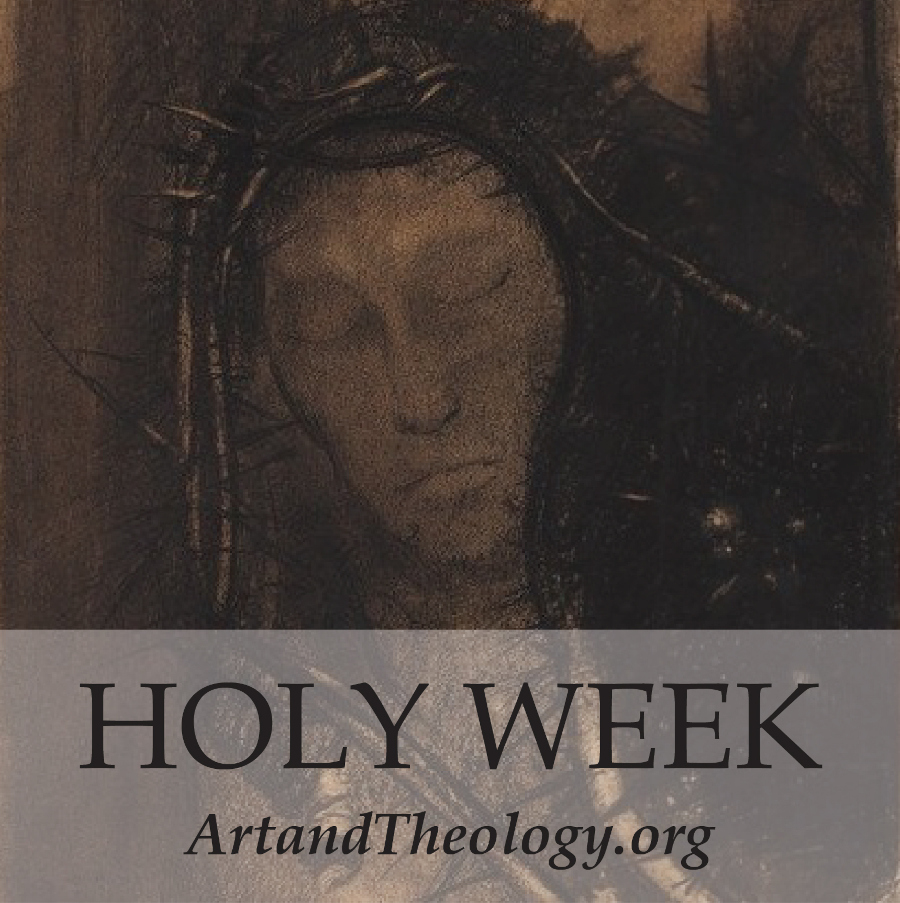
There are hundreds of thousands of musical works, from a range of genres, inspired by Christ’s passion, especially his death on the cross, which, along with the resurrection, is the centerpiece of the Christian faith. I’ve curated just a sampling of these on Spotify, from across time periods and countries, to serve as an aural guide through the final week of Jesus’s life. The drama begins with Christ’s triumphal entry into Jerusalem on a donkey, where he’s hailed with hosannas, and then continues with a last supper shared with his disciples, an agonized prayer in Gethsemane followed by betrayal and arrest, then, all in one day, multiple trials (religious and civil), conviction by mob, a public execution, and burial. Many of the playlist selections are narrative in character, while some have a more theological bent. My hope is that these pieces aid you in observing this most holy of weeks, walking with Christ through the shadows, taking in how “he himself bore our sins in his body on the tree, that we might die to sin and live to righteousness. By his wounds [we] have been healed” (1 Pet. 2:24).
To add the playlist to your account, open the Art & Theology Holy Week Playlist link, then click on the More (…) icon and select “Save to Library.”
[Playlist cover art: Odilon Redon, Christ, ca. 1895, charcoal, chalk, pastel, and pencil on paper, Museum of Modern Art, New York]
The playlist is a mixture of classical and popular (indie-folk, gospel) music. In this post I want to provide a little context for some of the pieces, by which I mainly mean translations of all the non-English lyrics. Because of what you see here, you might get the wrong impression that the list is almost entirely classical; actually, it’s only about half.
The opening track, “Herr, unser Herrscher” (Lord, Our Ruler), is a unique arrangement of the opening chorus from Johann Sebastian Bach’s St. John Passion, a Good Friday oratorio in German.
Herr, unser Herrscher, dessen Ruhm
In allen Landen herrlich ist!
  Zeig uns durch deine Passion,
  Daß du, der wahre Gottessohn,
  Zu aller Zeit,
  Auch in der größten Niedrigkeit,
  Verherrlicht worden bist!
Lord, our ruler, whose fame
In every land is glorious!
  Show us, through your passion,
  That you, the true Son of God,
  Through all time,
  Even in the greatest humiliation,
  Have become transfigured! [source]
Unique, because the Baroque choir and orchestra are accompanied by an ensemble of Gabonese musicians who contribute their own rhythmic profile, along with solo percussionists Sami Ateba from Cameroon and Naná Vasconcelos from Brazil. The recording, rereleased on the compilation album Babel (2008), is originally from Lambarena: Bach to Africa (1995), a collaboration between French composer and producer Hughes de Courson and Gabonese composer and guitarist Pierre Akendengué, synthesizing two disparate sound worlds. (“Bombé / Ruht wohl, ruht wohl, ihr heiligen Gebeine” is another highlight from the album. For weeks I debated whether to include it on this playlist—adding it, taking it off, adding it back again—ultimately deciding to leave it off, the reason being that it overlays Bach’s choral rondo with music and invocations to the dead from a Bwiti religious ritual. Though sonically compelling and worth listening to, I felt that it might impede some Christians’ ability to engage this list in a devotional way; so I opted for a traditional Western classical recording instead.)
Other selections from Bach’s St. John Passion are:
>> “Christus, der uns selig macht”
Christus, der uns selig macht,
Kein Bös’ hat begangen,
Der ward für uns in der Nacht
Als ein Dieb gefangen,
Geführt für gottlose Leut
Und fälschlich verklaget,
Verlacht, verhöhnt und verspeit,
Wie denn die Schrift saget.
Christ, who makes us blessed,
committed no evil deed,
for us he was taken in the night
like a thief,
led before godless people
and falsely accused,
scorned, shamed, and spat upon,
as the scripture says. [source]
>> “Petrus, der nicht denkt zurück”
Petrus, der nicht denkt zurück,
Seinen Gott verneinet,
Der doch auf ein' ernsten Blick
Bitterlichen weinet.
Jesu, blicke mich auch an,
Wenn ich nicht will büßen;
Wenn ich Böses hab getan,
Rühre mein Gewissen!
Peter, who did not recollect,
denied his God,
who yet after a serious glance
wept bitterly.
Jesus, look upon me also,
when I will not repent;
when I have done evil,
stir my conscience! [source]
>> “O große Lieb”
O große Lieb, O Lieb ohn alle Maße,
Die dich gebracht auf diese Marterstraße!
Ich lebte mit der Welt in Lust und Freuden,
Und du mußt leiden.
O great love, O love beyond measure,
that brought you to this path of martyrdom!
I lived with the world in delight and joy,
and you had to suffer. [source]
>> “Ruht wohl, ihr heiligen Gebeine”
Ruht wohl, ihr heiligen Gebeine,
Die ich nun weiter nicht beweine,
Ruht wohl und bringt auch mich zur Ruh!
Das Grab, so euch bestimmet ist
Und ferner keine Not umschließt,
Macht mir den Himmel auf und schließt die Hölle zu.
Rest well, you blessed limbs;
now I will no longer mourn you.
Rest well and bring me also to peace!
The grave that is allotted to you
and encloses no further suffering
opens heaven for me and closes off hell. [source]
For Bach’s St. Matthew Passion—one of the most celebrated works of classical sacred music ever written, right up there with Handel’s Messiah—I’ve drawn from the abridged English version (rather than the original German), translated by the Rev. Dr. John Troutbeck and performed in 1962 by the New York Philharmonic and Collegiate Chorale under the direction of Leonard Bernstein. I chose just a few pieces from it, not wishing to replicate the whole thing; as you can see, I tend to favor chorales over arias.
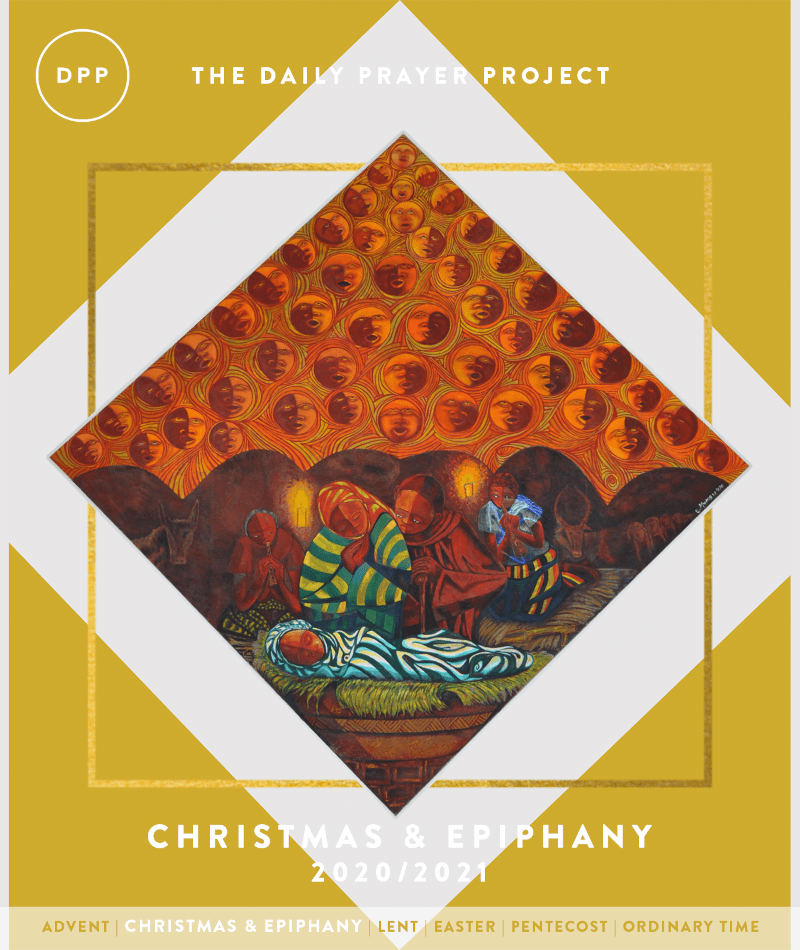
The Christmas–Epiphany 2020/21 edition of the Daily Prayer Project [previously], a publication I work for part-time, released this week! The cover image is from the sanctuary mural at Holy Angels Catholic Church in Chicago, by Cameroonian artist-priest Engelbert Mveng. (See the full mural here.) Also in this edition are images of Grace Carol Bomer’s From Strength to Strength, showing Light stepping into darkness, and the Piper-Reyntiens stained glass window in Coventry Cathedral, with its yellow sunburst amid an abstract pattern of reds, blues, and greens. We include visual art as a supplement to the prayers, scripture readings, and songs with the understanding that it, too, can promote spiritual development and a deeper communion with God.
You can purchase a digital copy (PDF) of the Christmas–Epiphany edition (December 24–February 16) through the website, and if in the future you’d like to receive hard copies, starting with Lent 2021, you can become a monthly subscriber. Part of the money goes to supporting artists.
+++
Whenever I see a Helena Sorensen [previously] byline, I perk up, because I always find myself connecting so much with her writing. She’s a regular contributor to the Rabbit Room blog. Her two most recent posts are “Things Fall Apart” and “Advent, Week One: Hope.”They’re both great.
+++
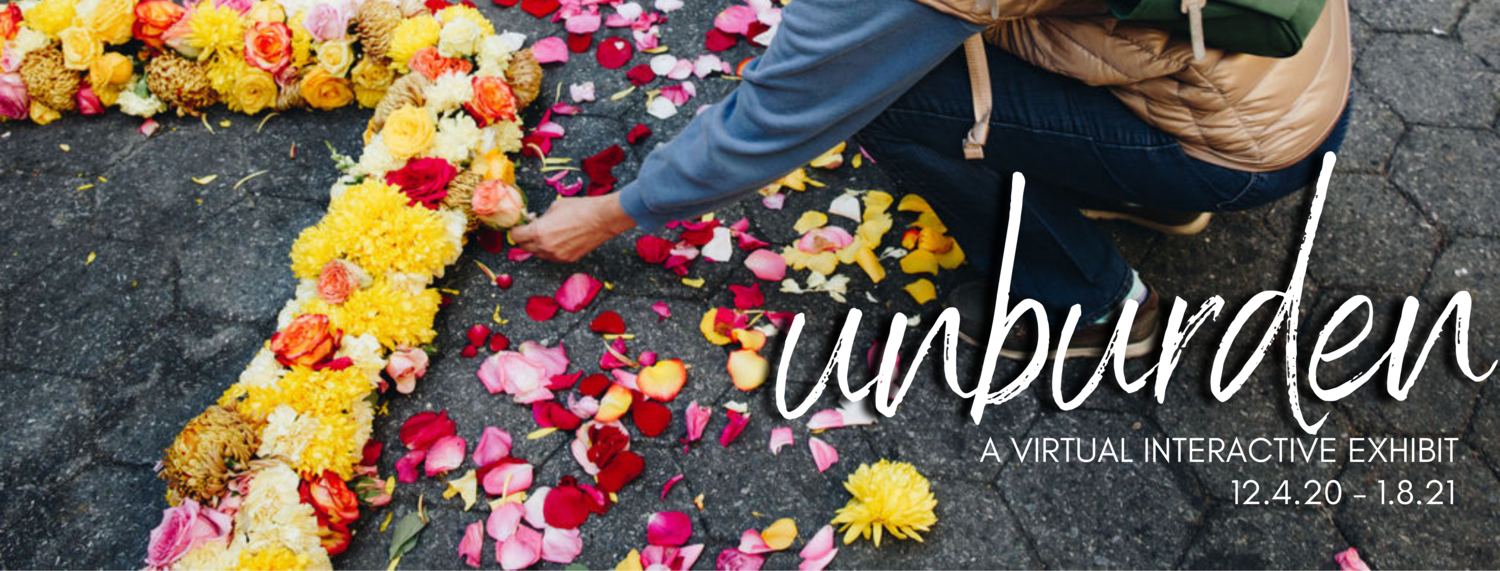
Unburden: A Virtual Interactive Exhibit, December 4, 2020–January 8, 2021: The Gallery at W83 is part of a 45,000-square-foot cultural center built by Redeemer Presbyterian Church in Manhattan’s Upper West Side as a service to the city’s artists and larger community. W83 Events and Programming Director Eva Ting has curated a virtual exhibition of photographs and stories from Kristina Libby’s Floral Heart Project, a series of living memorials to those lost to or suffering from COVID-19. Libby initiated the project in New York City in May, partnering with 1800Flowers.com to place floral heart garlands all around the city to create space for ceremony and to invite the community to process and mourn. The project has since grown nationwide.
“Many of us are carrying burdens of loss, anxiety, and uncertainty as we move towards the end of 2020,” Ting writes. “We have all been impacted in some way by the events of this year, and we bear fatigue weighed heavier by the inability to gather as a community to collectively grieve. In this interactive virtual exhibit Unburden, the Gallery at W83 invites you to participate in an unburdening of the load we carry.”
The exhibition webpage invites you to release personal burdens by writing down any grief, fears, loss, or anxiety you wish to let go of (can be submitted anonymously if desired). These words will be incorporated into a new floral heart laying on December 20 at Fort Tryon Park, an event that will be livestreamed. You can also ask for prayer, and members of the W83 team will pray for your requests. “Through these individual and collective acts of unburdening, may we imagine what it would look like to truly let go of these burdens.”
Photo by Erica Reade
+++
I enjoyed attending the virtual “Songs of Hope: A TGC Advent Concert,” featuring music and spoken-word performances from a variety of artists (see YouTube description), interspersed with Advent readings. It was a truly meaningful worship experience.
I’m sure there are many more virtual Advent/Christmas concerts and other online events coming up. What ones are you most looking forward to?
One that I’ll probably be tuning in to is “We Three Queens Holiday Show” by Pegasis, a sister trio, on December 17, 8:30 p.m. EST (7:30 p.m. CST). It will be live on Facebook and and Instagram. (Update, 12/17/20: View the performance here. My favorite two songs are probably “Poncho Andino” at 19:04 and “Mary Had a Baby” at 45:24—such a unique arrangement!)
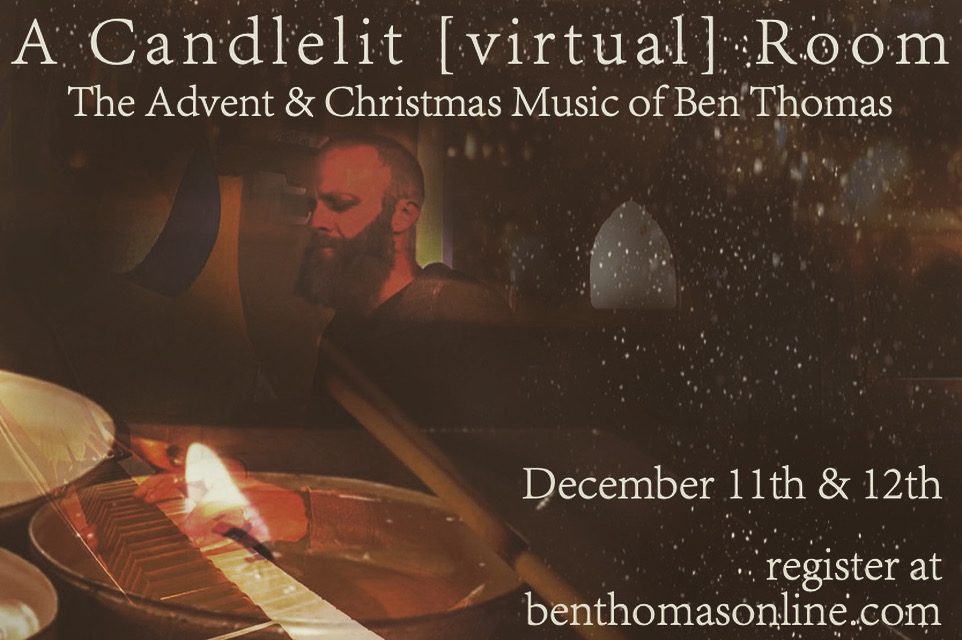
There’s also “A Candlelit (Virtual) Room: The Advent Christmas Music of Ben Thomas” on December 11 and 12 (10 p.m. EST and 8 p.m. EST, respectively), two private Zoom concerts open to the first twenty-five registrants each. He’ll be performing original songs from his albums The Bewildering Light, The Wilderness Voice, and Peace Here, all of which I recommend. My favorite tracks: “Justice Will Sprout from the Ground,” “Zechariah and the Least Expected Places,” and “Shepherds and Angels.” (The latter two were recorded under the name So Elated.)
POEM: “Harlem” by Langston Hughes: This is a brilliant poem—its sensory images, its rhythm, its rhyme, its multivalence (especially the last line). I loved it so much when I first read it in ninth grade that I memorized it unbidden. When writer and podcaster Joy Clarkson posted a reflection on the poem for her Patreon community in October, resulting in a lively conversation thread in the comments section, it reignited my enthusiasm for and got me thinking more deeply about “Harlem.” She opened by quoting Proverbs 13:12: “Hope deferred makes the heart sick, / But desire fulfilled is a tree of life.”
“What happens to a dream deferred? // Does it dry up / like a raisin in the sun?” Written in 1951 as part of a sequence of poems exploring black life in Harlem, “Harlem” is inextricably tied to the civic discourse of the contemporary American moment, writes Scott Challener in Poetry Foundation’s guide to the poem. The “dream” he refers to is the American Dream, unattainable for so many due to racial inequalities and oppression. (Also assigned in ninth-grade English curricula in the US is Lorraine Hansberry’s A Raisin in the Sun, which takes its title from and addresses the questions of “Harlem.”)
While not wishing to strip the poem of its specific context, I have been thinking about all the dreams that have been deferred this year—put on hold, or even irretrievably lost, because of COVID-19. Hughes posits a string of descriptive similes for a deferred dream: a dried-up raisin, a festering sore, rotting meat, a crusted-over sweet, a sagging load. One commenter on Joy’s Patreon observed how a raisin can’t turn back into a grape, rotten meat can’t be made fresh again, and an overcooked dessert can’t be cooked back down, but a sore can heal and a load can be lifted.
The final suggestion—“or does it explode?”—can be read in myriad ways. In one respect it could refer to the explosion of cultural output, of creativity, that results from deferred dreams—i.e., the Harlem Renaissance. I’ve definitely seen this happen this year, as people, in the face of crushing personal and professional disappointments, have found unique ways to come together and produce and share works of beauty within the restrictiveness of health and safety protocols. One example—speaking of Harlem—is the Dance Theatre of Harlem, a groundbreaking neoclassical ballet company founded at the height of the civil rights movement in 1969 and still active today. Bans on gatherings of certain numbers have meant that dancers and other performers have had to find alternative ways of reaching their audiences, so DTH artists Derek Brockington and Alexandra Hutchinson created “Dancing Through Harlem,” taking choreography from Robert Garland’s “New Bach” out into the streets and capturing it on video for people to enjoy from home. To help support the DTH during this time, you can donate easily through the fundraising sidebar on the video’s YouTube page or through the company’s website.
+++
SONG: “400 Years” by Sarah Sparks: This original song, sung with Kate Lab, appears on Sarah Sparks’s new album, Advent, Pt. One. It’s about how the centuries-long silence of God between the ministry of Malachi (ca. 420 BCE) and the appearance of John the Baptist in the early first century CE was broken with the birth of Jesus—the Word made flesh. Its refrain, “For the first time, not a silent night,” cleverly turns on its head the sweet, familiar carol “Silent Night.” Through the incarnation, God spoke to all who would listen.
OBITUARY:“Sister Wendy Beckett, Nun Who Became a BBC Star, Dies at 88”: A nun since the age of sixteen, Sister Wendy spent most of her life living in silence in a windowless trailer on the grounds of the Carmelite monastery in East Anglia, England. She read voraciously about art but had never set foot in a museum or seen any great paintings in person—until in 1991, a BBC producer persuaded her to do a documentary about the paintings in London’s National Gallery. She agreed, thinking it would be a flash in the pan, but it was very successful, and so throughout the nineties she presented several other documentaries on the history of art, including Sister Wendy’s Odyssey, Sister Wendy’s Grand Tour, and Sister Wendy’s Story of Painting. She quickly became the world’s best-loved art critic, as her unscripted commentaries, so full of wonder and enthusiasm, connected well with the general public, making high art accessible. She also authored some thirty-five books.
“One of the ways, for me, of looking at God is by looking at art,” she says in the intro to Odyssey. Not that art is God but that art can lead us to a deeper understanding of who, and Whose, we are.
Sister Wendy was a major influence on my path to becoming a writer on Christianity and the arts. I first encountered her in high school through her Story of Painting series, which a studio art teacher made our class watch excerpts from. This was my entrée into art history, a subject that captivated me then and that inspired me to pursue some such coursework in college, including a semester abroad in Florence, Italy. Without this initial incitement of interest from Sister Wendy, I doubt I would be writing about art today.
What attracts me to her is what attracts most people: her utter joy and rapture as she discusses art. She is the first person who taught me how to look at a painting and read it. I appreciate her charitable stance toward modern and contemporary art (movements that large swaths of Christians reject), and her unabashed delight in the nude body. Over the years, people have tended to be either amused or shocked, or both, by her frankness in talking about sexuality in art, but she was always insistent on the goodness of the human body and of sex. When Bill Moyers asked her back in 2000 whether she’s scandalized by the carnality, the sensuality, of so much art, she really stumps him with her matter-of-fact response! (See 4:15 of the video below.)
+++
INTERVIEW: “Why You Should Read Devotional Poetry in 2019” by Leland Ryken: In this interview with Collin Huber, Ryken cites three reasons why Christians should read devotional poetry, elaborating on each one: (1) devotional poets express our spiritual experiences, (2) it sets our affections “in right tune,” and (3) it will take us to corners of the spiritual life that might otherwise remain unvisited. He also discusses how poetry has shaped him; the obstacles that keep people from enjoying poetry, and how to overcome them; what makes poetry distinctive as a genre; and the prevalence of poetry in the Bible. “Mastering a devotional poem by a famous English or American poet requires nothing beyond what mastering a psalm requires,” he says. “If you can possess Psalm 23, you can possess Milton’s sonnet on his blindness.”
STREET PERFORMANCE: Toccata and Fugue in D minor (BWV 565) by J. S. Bach: Bach’s Toccata and Fugue is probably the most famous organ work in existence. But last fall in Cologne, a group of four musicians, whose names I cannot find, performed it on two accordions, a violin, and a tuba! It’s uncanny how closely the collective timbre approximates that of an organ. The tuba grants sonority, and the other instruments contribute to the full-bodied sound.
This performance took place between Hohe Straße and Theo-Burauen-Platz in Cologne, Germany, but a few commenters on the video have reported witnessing near-identical performances in other parts of the country, so either this group travels, or the arrangement is circulating.
+++
SACRED ARCHITECTURE
I frequently encounter articles on or photos of contemporary religious architecture. Here are just two notable buildings I’ve come across recently—the first one, thanks to Michael Wright’s Still Lifenewsletter (to which you should subscribe!).
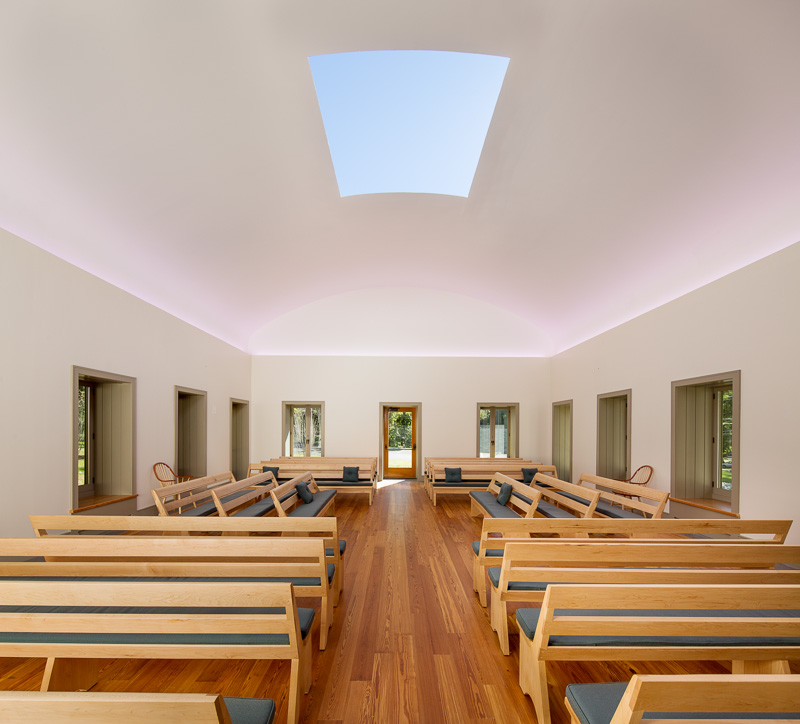
Chestnut Hill Friends Meeting (2013): When the Chestnut Hill Friends Meeting in northwest Philadelphia was building a new meetinghouse, they invited contemporary light artist James Turrell, himself a Quaker, to design one of his famous “Skyspaces” for the meeting room—that is, an aperture in the ceiling that’s open to the sky. From the beginning, Turrell collaborated with architect James Bradberry to achieve this permanent art installation; for example, Turrell wanted the aperture to have no perceptible thickness, so Bradberry and his team developed a sophisticated steel roof structure and “knife’s edge” opening. The achieved effect of paper thinness is impressive: when I first saw photos, I assumed the “sky” on the ceiling was just a painted patch! (Visitors have reported similar surprise.) Turrell calls this Skyspace Greet the Light, a reference not only to the light of the sun but to the Quaker doctrine of the “Inner Light,” God within.
Chestnut Hill Friends Meeting Room, Philadelphia, Pennsylvania, featuring a permanent Skyspace installation, titled Greet the Light (2013), by James Turrell.
The meeting room is open to the public, for free, on select days (more info here). Visitors are invited to bring a yoga mat, pillow, and blankets (when the retractable roof is open, the room is unheated) and to lie on their backs on the floor or benches. Silence is requested. Turrell’s installation also makes use of artificial light: over the course of fifty minutes or so, the vaulted ceiling is bathed in turn in four color variations—green, red, blue, and white—which augments the natural light projected by the opening.
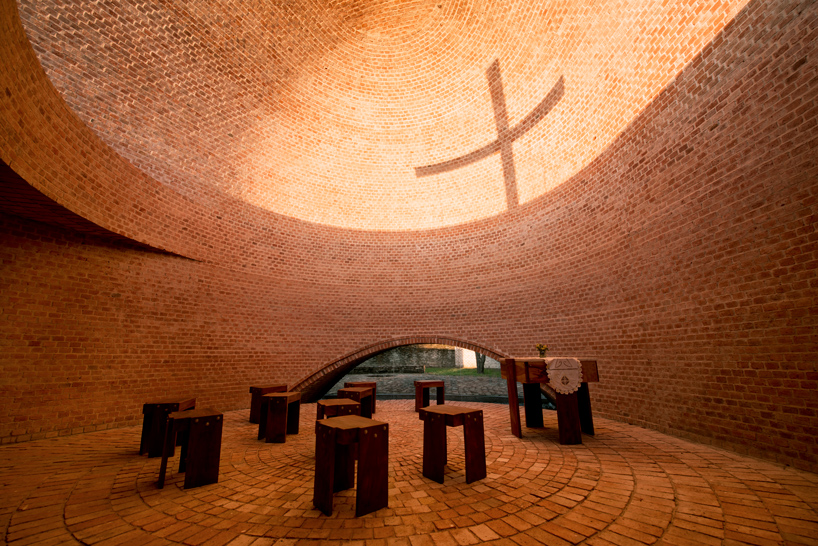
San Bernardo Chapel (2015): Located in a wooded grove in Argentina’s Pampas lowlands, just east of Córdoba, Capilla San Bernardo (St. Bernard Chapel) was designed by Nicolás Campodonico. It was constructed using hundred-year-old bricks that had been dismantled from the rural home and courtyard that previously stood on the site. There is no electricity in the area, so natural light plays a huge role, especially in the chapel’s most unique feature: two perpendicular beams, independently suspended from a large exterior opening, cast shadows onto an interior wall, which glide progressively toward each other throughout the day, ultimately overlapping to form a cross (see time lapse). Campodonico said he had in mind Jesus’s journey to Golgotha with the transverse beam, which, upon arrival at the execution site, was attached to the vertical mount; it’s as if the passion is being reenacted daily through the shadows, he said. See more photos at designboom.
Capilla San Bernardo (St. Bernard Chapel), La Playosa, Córdoba Province, Argentina. Photo: Nicolás Campodonico.
+++
FREE ALBUM: Into the Light by Joel LeMaire: Fans of Josh Garrels, Iron and Wine, and John Mark Pantana will probably enjoy Joel LeMaire’s 2015 EP, which is about finding hope in the letting go and stepping into the unknown. Download your own copy from NoiseTrade, and read more about the meaning behind the songs on LeMaire’s blog.
John White Alexander (American, 1856–1915), Landscape, Cornish, N.H., ca. 1890. Oil on canvas, 30 3/8 × 45 in. (77.2 × 114.2 cm). Smithsonian American Art Museum, Washington, DC.
The LORD is my shepherd; I shall not want.
He maketh me to lie down in green pastures:
he leadeth me beside the still waters.
He restoreth my soul . . .
Yea, though I walk through the valley of the shadow of death,
I will fear no evil:
for thou art with me;
thy rod and thy staff,
they comfort me.
—Psalm 23:1–3a, 4
+++
MUSIC: “Sheep May Safely Graze,” from BWV 208 | Composed by Johann Sebastian Bach (1713) | Performed by London Symphony Orchestra, on Night in Berlin (2001)
The aria “Schafe können sicher weiden” (Sheep May Safely Graze) comprises the ninth movement of Bach’s Was mir behagt, ist nur die muntre Jagd (The Lively Hunt Is All My Heart’s Desire)—known informally as the Hunting Cantata. Written for the thirty-first birthday of Duke Christian of Saxe-Weissenfels, the cantata was performed as a surprise at a banquet at the ducal hunting lodge, and it’s full of flattery. The text of “Sheep May Safely Graze,” written by Solomon Franck, praises Christian for his wise, protective leadership (in actuality, he was a lousy ruler):
Sheep may safely graze and pasture
In a watchful shepherd’s sight.
Those who rule, with wisdom guiding,
Bring to hearts a peace abiding,
Bless a land with joy made bright.
At 1:31 in the above recording, you can hear potential danger lurking nearby, but the attentive shepherd neutralizes the threat, keeping safe his flock.
Bach originally scored this piece for soprano with two recorders and continuo, but it has since been transcribed for orchestra and countless other combinations of instruments and is most popular without words. I enjoy playing Egon Petri’s transcription for solo piano, performed here by Alessio Bax:
Its pastoral mood, befitting Psalm 23, and its celebration of a good shepherd’s care have led it to be applied to the Good Shepherd and performed in church services. I’ve even come across some piano arrangements that interfuse it with “Savior, Like a Shepherd Lead Us” (for an intermediate arrangement of such by Cindy Berry, see Classical Hymns).
This post belongs to the weekly series Artful Devotion. If you can’t view the music player in your email or RSS reader, try opening the post in your browser.
To view all the Revised Common Lectionary scripture readings for Proper 11, cycle B, click here.
You’ve probably heard this lovely lilting Baroque piece performed as an instrumental at weddings. But the composer who popularized the tune—the inimitable J. S. Bach—originally used it for the two chorale movements, one of them the finale, of a ten-movement liturgical work celebrating the miraculous pregnancies of Mary and Elizabeth from the Gospel of Luke, and God’s subversion of the world order through the birth of Christ. “The wondrous hand of the exalted Almighty / is active in the mysteries of the earth!” the work proclaims.
Under Bach’s design, those iconic triplets (DUM-da-da DA-da-da DA-da-da . . .) gird up a choir-song of praise to Jesus Christ, Emmanuel, our joy and our strength. Even when the light, bright major chords give way to the minor in line 5, signifying the turning of life’s circumstances, the Christian’s confession remains the same: Jesus is mine; what shall I fear?
Though Bach is often cited as the melody’s originator, that credit in fact goes to Johann Schop; it was first published in 1642 with Johann Rist’s hymn text “Wach auf, mein Geist, erhebe dich” (“Wake, My Spirit, Rise”). In 1661 Martin Janus wrote a new text for the tune—of no less than nineteen stanzas!—titled “Jesu, meiner Seelen Wonne” (“Jesus, My Soul’s Bliss”). Bach took stanzas 6 and 17 of this hymn, harmonized and orchestrated them, and placed them as the closings to part 1 and part 2, respectively, of his cantata Herz und Mund und Tat und Leben (Heart and Mouth and Deed and Life) (BWV 147).
These two chorale movements, titled “Wohl mir, daß ich Jesum habe” (Blest am I, that I have Jesus) and “Jesus bleibet meine Freude” (Jesus shall remain my joy), have identical musical settings, and their English translation is as follows:
Blest am I, that I have Jesus!
O how tightly I cling to him,
so that he delights my heart
when I am sick and sad.
I have Jesus, who loves me
and gives himself to me as my own;
ah, therefore I will not let go of Jesus,
even if my heart is breaking.
Jesus shall remain my joy,
my heart’s comfort and sap;
Jesus shall fend off all sorrow.
He is the strength of my life,
the delight and sun of my eyes,
the treasure and wonder of my soul;
therefore I will not let Jesus go
out of my heart and sight. [source]
Bach wrote Herz und Mund in 1723 during his first year as the director of church music in Leipzig, basing it on an earlier cantata he had written in Weimar in 1716 for the fourth Sunday of Advent. Because Leipzig observed tempus clausum (a “closed time” of penitence) during Advent, allowing cantata music only on the first Sunday of the season, Bach could not perform the cantata for the same occasion in Leipzig, so he adapted it for the Feast of the Visitation on July 2.
Scored by Bach for four solo vocalists, a four-part choir, and an instrumental ensemble of trumpet, two oboes, violin, viola, and continuo, the chorale music was first given the title “Jesu, Joy of Man’s Desiring” in 1926 when Dame Myra Hess published a transcription for solo piano—which you can hear Benjamin Moser play in the video below.








 Art & Theology