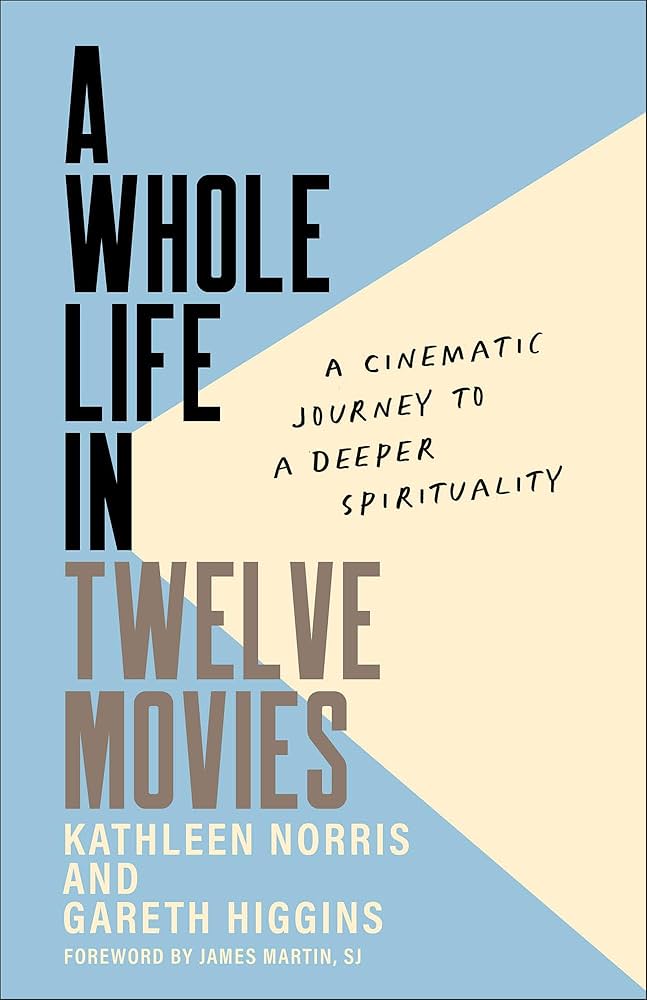
NEW BOOK: A Whole Life in Twelve Movies: A Cinematic Journey to a Deeper Spirituality by Kathleen Norris and Gareth Higgins: Published last October by Brazos Press, this excellent book comprises twelve chapters reflecting on fourteen movies (two chapters feature a complementary pair), drawing out story, insights, and meaning. It’s authored by the award-winning American spiritual memoirist and poet Kathleen Norris (Acedia and Me; The Cloister Walk; Dakota: A Spiritual Geography) and the Irish writer, peace activist, retreat leader, and festival organizer Gareth Higgins. Each chapter contains two mini-essays—one by each author, the second responding to the first, sometimes disagreeing on points—and a section of “Questions and Conversation,” which make the book especially fitting for a film/reading club. There’s also a “For Further Viewing” section in the back, with many more recommendations, several of which are new to me and which I’ve been watching (e.g., Le Havre, Love Is Strange, Patti Cake$) and really enjoying!
I so appreciate the variety of films featured in the book—which come from different eras, cultures, and genres and address different themes—and I like that the writers don’t overdetermine the films’ meanings to try to make them fit a Christian agenda, which is sometimes a trap that people writing on Christianity and film fall into (influenced partly, I’m sure, by publishers’ demands, to make the marketing easier). Norris and Higgins are simply two Christians writing about their shared love of cinema, and I had so much fun listening in on their conversations.
You may also want to check out the Substack that Norris and Higgins write together, Soul Telegram: Movies & Meaning, whose purpose is “to help people find the most life-giving movies, and to write about them as a way of reflecting on the meaning of our lives.” See also the recent Habit podcast episode “Kathleen Norris watches movies,” where Norris discusses Paterson, Babette’s Feast, After Life, and more.
>> “Sawubona”(I See You) by Jane Ramseyer Miller, 2012: The most common greeting used by Zulu people is “Sawubona,” literally meaning “I see you,” with the implication of “My whole attention is with you. I value you.” The word conveys a deep witnessing and presence, acknowledgment and connection. A standard reply is “Ngikhona,” “I am here.” This humanity-honoring exchange that occurs regularly in South Africa was set to music by the American choral director Jane Ramseyer Miller and is performed in the video below by the Justice Choir, a grassroots movement that encourages more community singing for social and environmental justice.
The song is authorized for free noncommercial use, and sheet music is available from the Justice Choir Songbook.
In this recent podcast interview, he talks about his most amazing teaching experience to date; helping Protestants like himself recover a sacramental ontology of the world; asking questions verbally versus aesthetically; death and mortality; what conceptual art is, and why it’s “real art”; what the esteemed Roger Scruton got wrong in his documentary Why Beauty Matters; the “Art of Attention” study he conducted with a psychophysiology colleague in the modern wing of the Art Institute of Chicago (which I participated in! here’s one of the three pieces I was tasked with looking at for five straight minutes while hooked up to a heart-rate monitor); and why artists inspire him.
VIDEO INTERVIEW: “VCS Creative Conversations: Ben Quash with Steve Reich”: “This film continues our series of ‘Creative Conversations’. In these conversations, living artists working in a variety of different artistic media discuss how the Bible and its legacies of visual and theological interpretation operate as a vital resource for their own creativity. In this film, VCS [Visual Commentary on Scripture] Director Ben Quash interviews the legendary American contemporary composer Steve Reich. They discuss the profound role of the Bible in transforming both the subject matter and the style of Reich’s music, reflecting especially on his settings of the Abraham story, the episode of Jacob’s ladder, and texts from the Psalms.”
Since the Middle Ages, the Roman Catholic Church has celebrated May, a time of new growth, as “Mary’s month.” The calendrical placement of this celebration probably has to do in part with the fact that the ancient Greeks celebrated a festival to Artemis, the goddess of fecundity, in May; the ancient Romans, Flora, the goddess of flowers and spring. Because Mary, by the power of the Holy Spirit, conceived in her womb and brought to birth the life of the world, Jesus Christ, Christians see her as standing at the threshold of an eternal springtime.
POLL QUESTION: Before moving on to the six roundup items below, if you are a regular reader of this blog or other media like it, would you please help me out by answering the following poll question? (I’m trying out this WordPress feature for the first time!) Over the years I’ve gathered a lot of compelling poems and artworks on the Annunciation, encompassing a variety of eras, styles, and perspectives, and I’d like to pursue the idea of turning one or the other, or both, into a book. Which kind of Annunciation-themed book would you be most inclined to buy? Keep in mind that a book with art would cost significantly more because it would be in full color and probably a larger hardcover. Also note that a book that combines art and poetry would obviously have fewer selections of each than a book dedicated fully to one or the other.
+++
UPCYCLED MARY STATUETTES:Soasig Chamaillard is a French artist who, since 2006, has been acquiring small, damaged statues of the Virgin Mary—either from garage sales or received donations—and restoring and transforming them, often with reference to children’s toy lines and media franchises, comic book heroes, or other pop-culture icons. Some are silly or irreverent; others, merely quirky. Here are two I like, which both modernize Mary, by her dress or her reading material. Click on the images to view detail photos of the final product, and see here and here for blog posts that document the transformation process.
Before/After. Right: Soasig Chamaillard (French, 1976–), Jeans-Marie (Jeans Mary), 2015. Plaster, acrylic paint, resin, metal frame, height 48 cm.Before/After. Right: Soasig Chamaillard (French, 1976–), Nouvelle Bible (New Bible), 2008. Plaster, acrylic paint, resin, digital print, height 40 cm.
The first shows Mary in high-waisted jeans and red Converse high-tops with rosettes on the tongues. The second one, a Madonna del Parto, shows her pregnant and reading the book J’élève mon enfant (Raising My Child) by Laurence Pernoud, picking up tips on being a new mom.
+++
ESSAY: “Mary: Evolution of a Bookworm” by Joel J. Miller: “It’s unlikely the historical Mary could read at all, but medieval Christians transformed her into an icon of literacy,” often showing her with a book in hand, whether as a child learning to read from her mother, Saint Anne; at the Annunciation, with the book of Isaiah, the Psalter, or a book of hours splayed open on her lap; or teaching her own child, Jesus, how to read. Drawing on the research of Laura Saetveit Miles, author of The Virgin Mary’s Book at the Annunciation: Reading, Interpretation, and Devotion in Medieval England [previously], Joel J. Miller discusses how images of Mary reading “rode a wave of rising female literacy and simultaneously encouraged its expansion.”
Ivory plate of the Annunciation from the Brunswick Casket, made in Metz, France, ca. 860–70. Herzog Anton Ulrich Museum, Braunschweig, Lower Saxony, Germany. This is the earliest known representation of the Virgin Mary with a book at the Annunciation.Lorenzo Costa (Italian, 1460–1535), Annunciation (Mary Reading), first third of 16th century. Oil on panel, 62 × 60.5 cm. Gemäldegalerie Alte Meister (Old Masters Picture Gallery), Dresden, Germany.
+++
CONVERSATION: “Sacra Conversazione” with Walter Hansen and Bruce Herman: In this written conversation from Image no. 62, artist Bruce Herman [previously] and patron Walter Hansen discuss the two large altarpieces Herman produced comprising six paintings on the life of the Virgin Mary: Miriam, Virgin Mother and Second Adam. The article is about the creative process and Herman’s collaboration with Hansen and with student apprentices in Orvieto, Italy, but it’s also about attempting to recover Mary’s image from a heap of the saccharine or overly exalted on the one hand, and ironic detachment on the other. Herman says,
I had vivid memories of Boston art critics and museum people back in the 1980s telling me that [religious] subject matter could only be approached ironically, but I had a persistent feeling that they were wrong. I’ve sensed for many years that the tradition of biblical imagery in art is far from exhausted—maybe simply stalled out due to loss of nerve or imagination. To me, much of the recent religious imagery we’ve inherited is fairly shallow. I know this might sound odd, given more than a thousand years of tradition, but I honestly believe that new insights are arrived at in every generation. Why can’t a contemporary artist paint the Virgin Mary without irony—and maybe even specifically attack the problematic nature of much Marian imagery? Why can’t a century of experimentation in painting yield something relevant to that tradition?
It’s an excellent conversation! You may have to subscribe to Image journal to access it, but it’s well worth it for all the wonderful content they put out quarterly and access to their archives.
Bruce Herman (American, 1953–), Miriam, Virgin Mother, 2007. Oil on wood with silver and gold leaf, 95 × 154 in. (241.3 × 391.2 cm).
Read more about the two altarpieces and view more photos at www.bruceherman.com/magnificat, and in the beautifully produced catalog magnificat, with a foreword by Hansen and essays by Rachel Hostetter Smith and John Skillen. The book also features four paintings from Herman’s related Woman series.
+++
ART VIDEOS:
What follows are my two favorite videos from the Visual Commentary on Scripture’s twelve-episode series “Unlocking Christian Art: The Virgin Mary,” in which theologian Ben Quash and art historian Jennifer Sliwka discuss religious artworks from museums in Berlin.
>> “Holy Kinship”: The subject of this video is a late medieval German limewood carving by Hans Thoman depicting Jesus’s extended family on his mother’s side. He and his mom, grandma, grandpa, step-grandpas, aunts, and cousins pose for this matriarchal family portrait that reflects a medieval legend (rejected by the Council of Trent) that Saint Anne was grandmother not just to Jesus but also, through two subsequent marriages, to five of the twelve apostles: James the Greater, Simon, Jude, James the Less, and John the Evangelist. Also included in this sculpture group are Elizabeth and Zechariah with their son, John the Baptist, and Emelia with her son Servatius of Tongeren, a fourth-century saint whom legends name a distant relative of Jesus. [view object record]
>> “Leave-Taking”: From the same period and general region as the above sculpture comes a painting by Bernhard Strigel (1460–1528) that shows Jesus taking leave of his mother just before his entry into Jerusalem the week of his death, a popular subject in northern Europe in the sixteenth century. The episode derives from a versified Marienleben (Life of Mary) from the early fourteenth century written by the Carthusian monk Philipp von Seitz, aka Bruder Philipp, from Middle Franconia. [view object record]
SONG: “Mary” by Patty Griffin: “Mary, you’re covered in roses, you’re covered in ashes, you’re covered in rain . . .” From the 1998 album Flaming Red by the country-folk artist Patty Griffin, the song “Mary” is a tribute to the woman who mothered Jesus and mothers us all. A compassionate presence who lives on in heaven at her son’s right hand, she feels the pain of other mothers who’ve lost their children. Griffin sings of Mary’s beautiful, big, humble, suffering, nurturing, pondering heart.
+++
POEM: “Christ’s Mother Reflects: His Childhood”by Micha Boyett: This is the last in a series of five Advent poems written from the perspective of Mary for John Knox Presbyterian Church in Seattle in 2010, the other four being on the subjects of the Annunciation, the boy who is snatched away by a dragon in Revelation 12, the Visitation, and the Nativity. Here, after Jesus’s death, Mary reflects back on his life—an early heartbreak of his, his contemplative nature, a question he once asked, his delight in scripture study, the hard choices he made, her own unfulfilled hope for normalcy on his behalf, the tearing of his flesh that mends us.
ANNOUNCEMENT: Vatican to hold Stations of the Cross art contest: Artists from across the globe are encouraged to participate in the Vatican-sponsored contest for fourteen new Stations of the Cross paintings. The winner will be announced September 30, 2024, awarded €120,000 (about $131,000), given a year to complete the commission, and then have their set of paintings exhibited in St. Peter’s Basilica during Lent 2026. The first step is to fill out an online application, which will become available January 8, with a deadline of January 31. Learn more at the link. (Update: The registration link is now live at https://contest.viacrucis2026.va/en/registration.)
+++
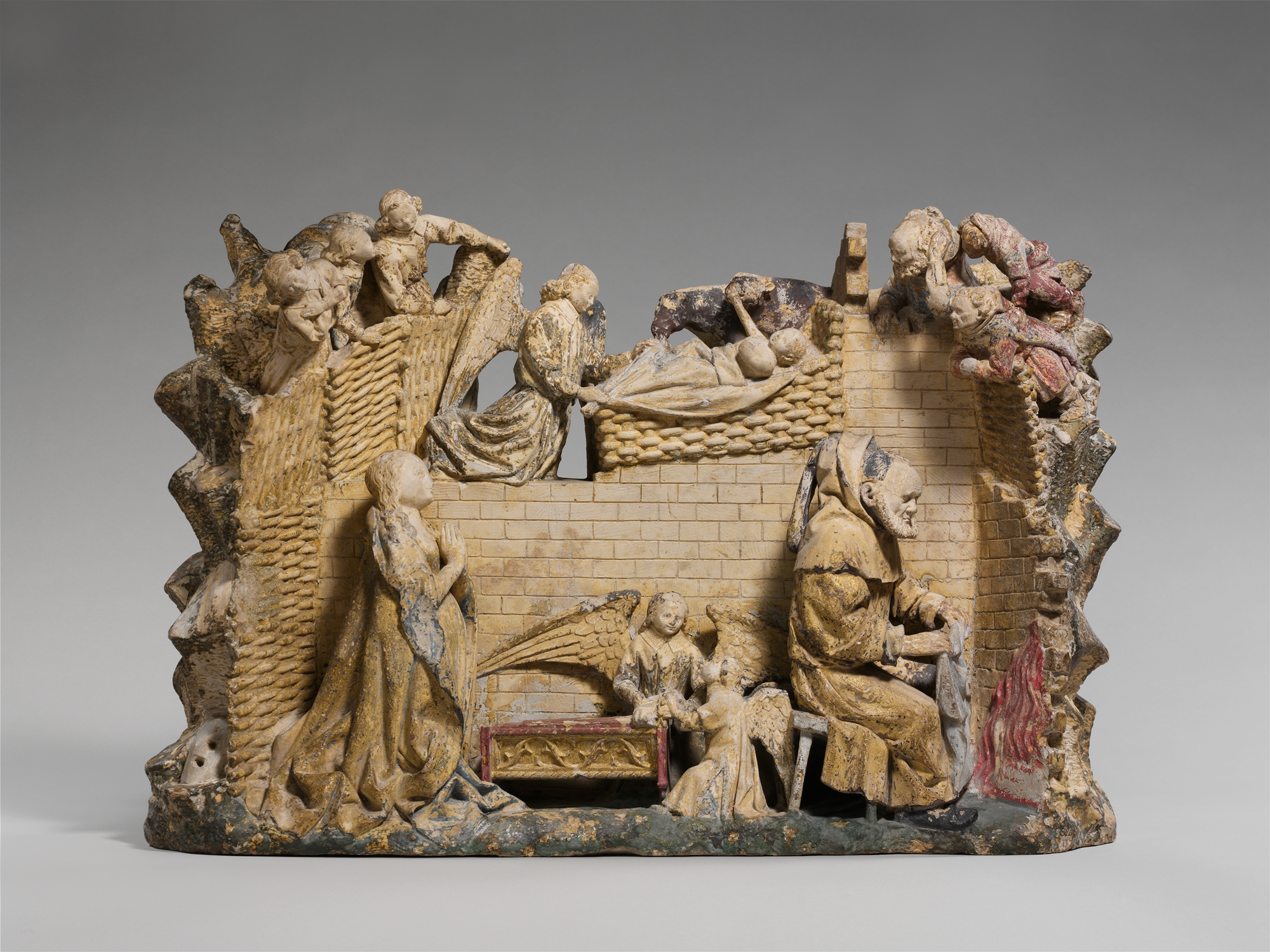
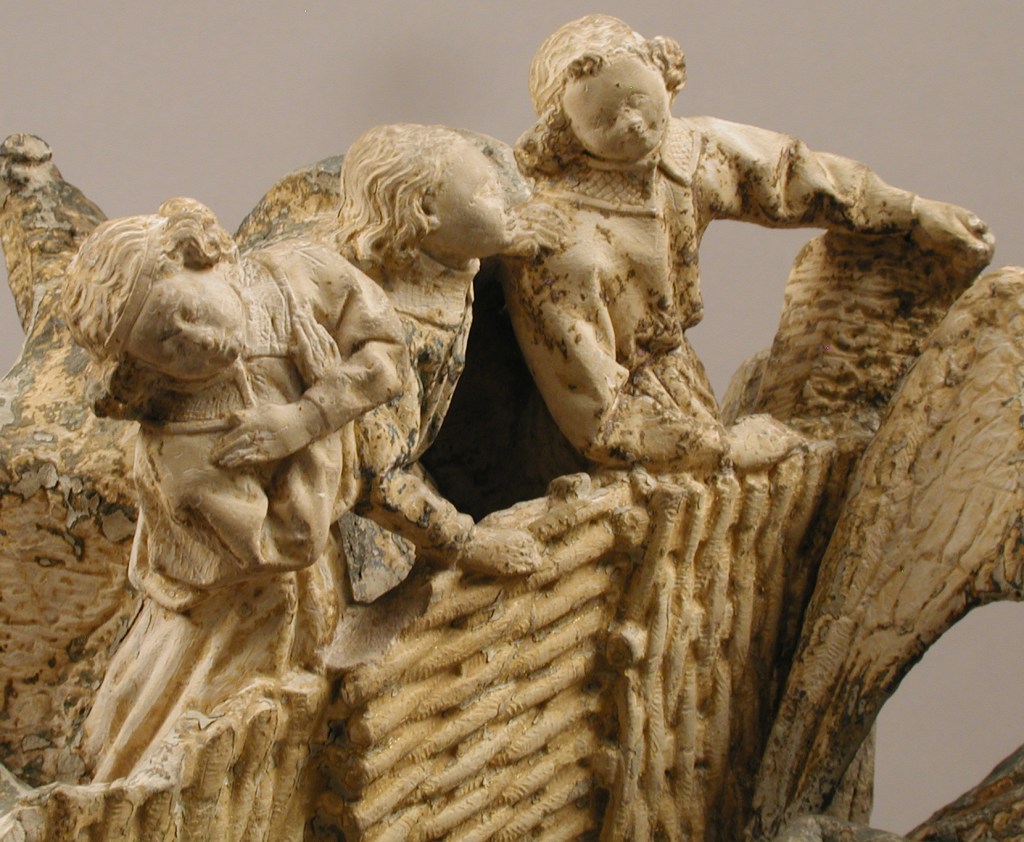
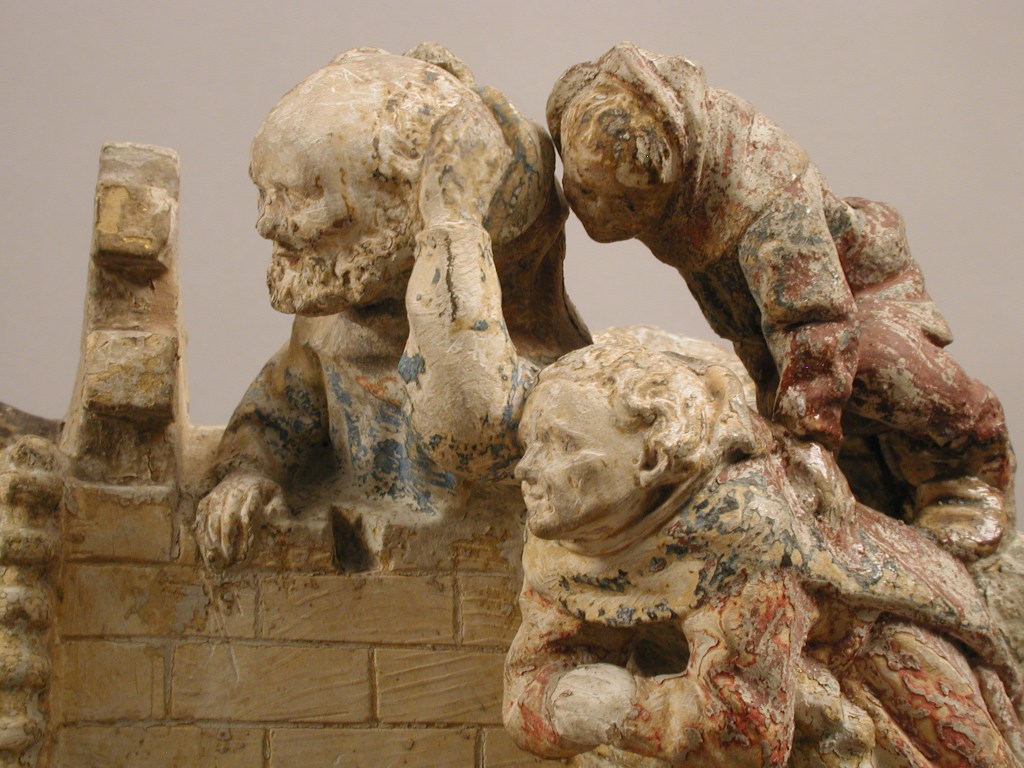
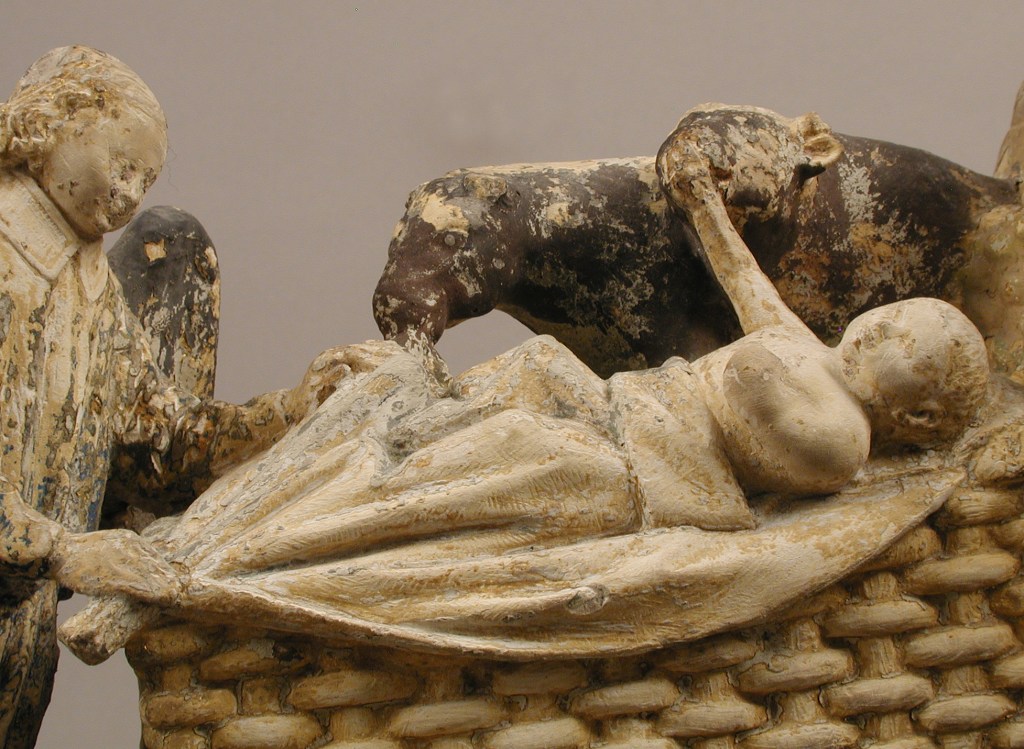
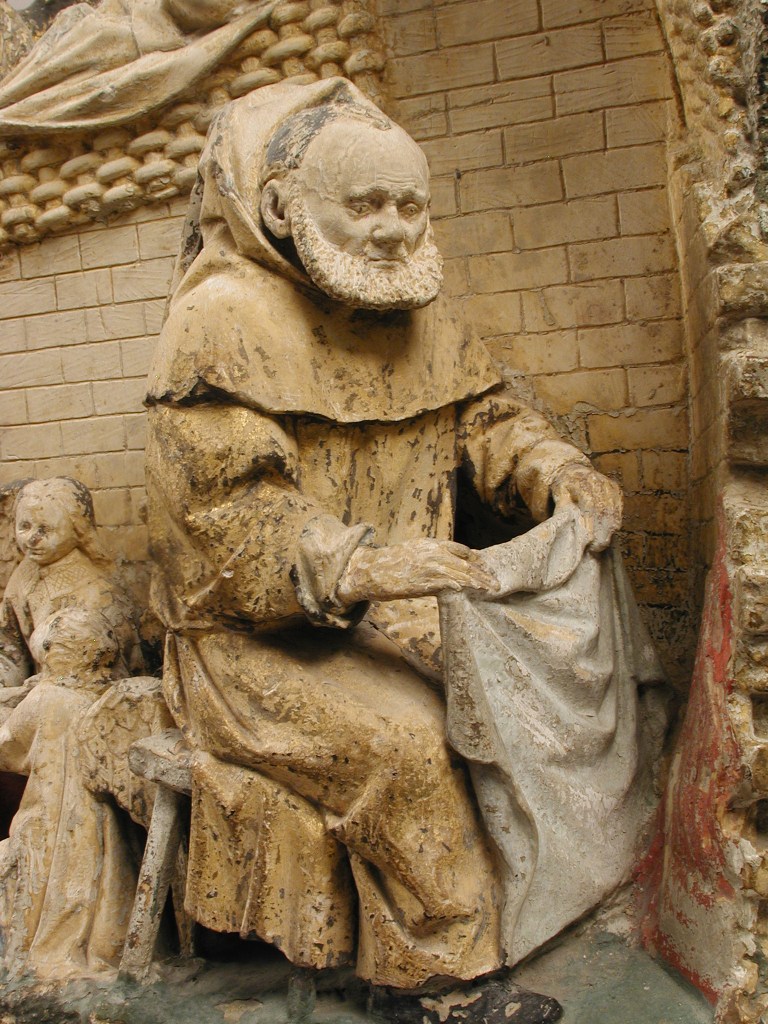
ART OBJECT: Burgundian Crèche, ca. 1450: In researching depictions of Joseph at the Nativity, I came across this charming little limestone-carved crèche from fifteenth-century Burgundy, France, acquired by the Metropolitan Museum of Art. Set inside a dilapidated brick interior patched with wattled matting, the scene portrays the infant Christ lying in a wattled manger that rests on a crumbling wall ledge. Such an unusual composition! I’m not sure why the infant is placed so precariously and at a height when there’s a carved cradle available on the ground, where angels kindly fluff his pillow, but I suppose it was to avoid overcrowding and for visual balance.
Circle of Antoine Le Moiturier (French, 1425–1495), Nativity, Burgundy, France, ca. 1450. Limestone with later paint and gilding, 17 3/4 × 25 7/8 × 7 1/4 in. (45.1 × 65.7 × 18.4 cm). Metropolitan Museum of Art, New York.
A donkey licks Christ’s feet while an ox licks his hand, which he appears to delight in, as he lifts his arm for better access. To the left and right of him are a trio of angels and shepherds, respectively, excitedly leaning in from outside to get a better look. Mary gazes up at her son in adoration while Joseph dutifully tends to a parental chore: drying one of Jesus’s freshly washed linens at the fire. (Dad doing laundry—huzzah!)
ART COMMENTARY: On The Adoration of the Magi by Domenico Veneziano: From the Visual Commentary on Scripture comes this 2022 video, one in a series filmed on-site at the Gemäldegalerie in Berlin. Theologian Ben Quash and art historian Jennifer Sliwka discuss an early Italian Renaissance tondo depicting the Adoration of the Magi.
+++
SONGS:
>> “Rejoice with Exceeding Great Joy”: Written by Lanny Wolfe in 1978 and performed by Reggie Smith, Charlotte Ritchie, and Ladye Love Smith at Bill and Gloria Gaither’s Homecoming Christmas 2006:
>> “Star of Bethlehem”: Written by Noel Dexter, arranged by C. S. (Cedron) Walters, and performed by the Jamaica Youth Chorale at their 2019 Christmas concert. Noel Dexter (1938–2019) was a Jamaican composer, choir director, and music educator, and this is probably his best-known work. It’s set to a Nyabinghi rhythm.
When the star of Bethlehem arise, hallelujah When the star of Bethlehem arise, hallelujah When the star of Bethlehem arise Come show me where the young child born!
There were wise men coming from the east, hallelujah There were wise men coming from the east, hallelujah There were wise men coming from the east Come show me where the young child born!
They brought gold, frankincense, and myrrh . . .
Not a man can save my soul . . . But Jesus! Show me where the young child born!
+++
VIDEO:“#NatZooZen: Giant Pandas Mei Xiang and Tian Tian in the Snow”: This Smithsonian’s National Zoo cam footage from January 2021 shows two giant pandas at play, sliding down a snowy hill! So adorable. Tian Tian and Mei Xiang arrived at the National Zoo in 2000 and in 2020 produced a cub, Xiao Qi Ji. All three pandas returned to Beijing in November, having been lent to the US by China as part of a cooperative research program whose contract has expired.
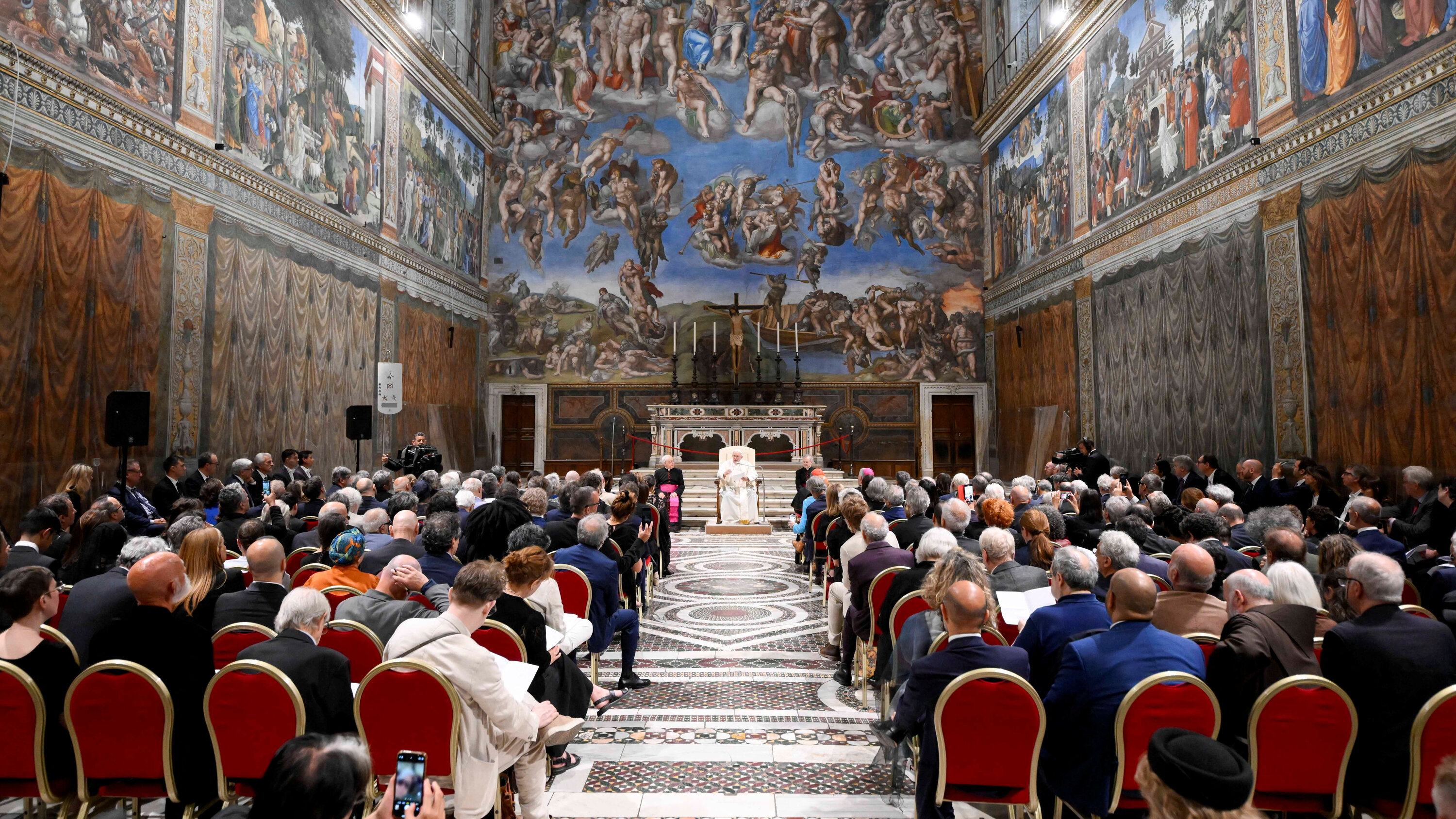
SPEECH: “Address of His Holiness Pope Francis to Artists for the 50th Anniversary of the Inauguration of the Vatican Museums’ Collection of Modern Art”: On June 23, at the invitation of Pope Francis, some two hundred select visual artists, filmmakers, composers, poets, and other creatives gathered at the Sistine Chapel to commemorate the fiftieth anniversary of the Vatican Museums’ Collection of Modern and Contemporary Art, inaugurated in 1973 by Pope John Paul VI. “One of the things that draws art closer to faith is the fact that both tend to be troubling,” Pope Francis said last Friday. “Neither art nor faith can leave things simply as they are: they change, transform, move and convert them.” He applauded how “artists take seriously the richness of human existence, of our lives and the life of the world, including its contradictions and its tragic aspects. . . . Artists remind us that the dimension in which we move, even unconsciously, is always that of the Spirit. Your art . . . propel[s] us forward.” For reporting on this event by the New York Times, see here.
Pope Francis addresses a group of artists, June 23, 2023. Photo: Vatican Media, via Reuters.
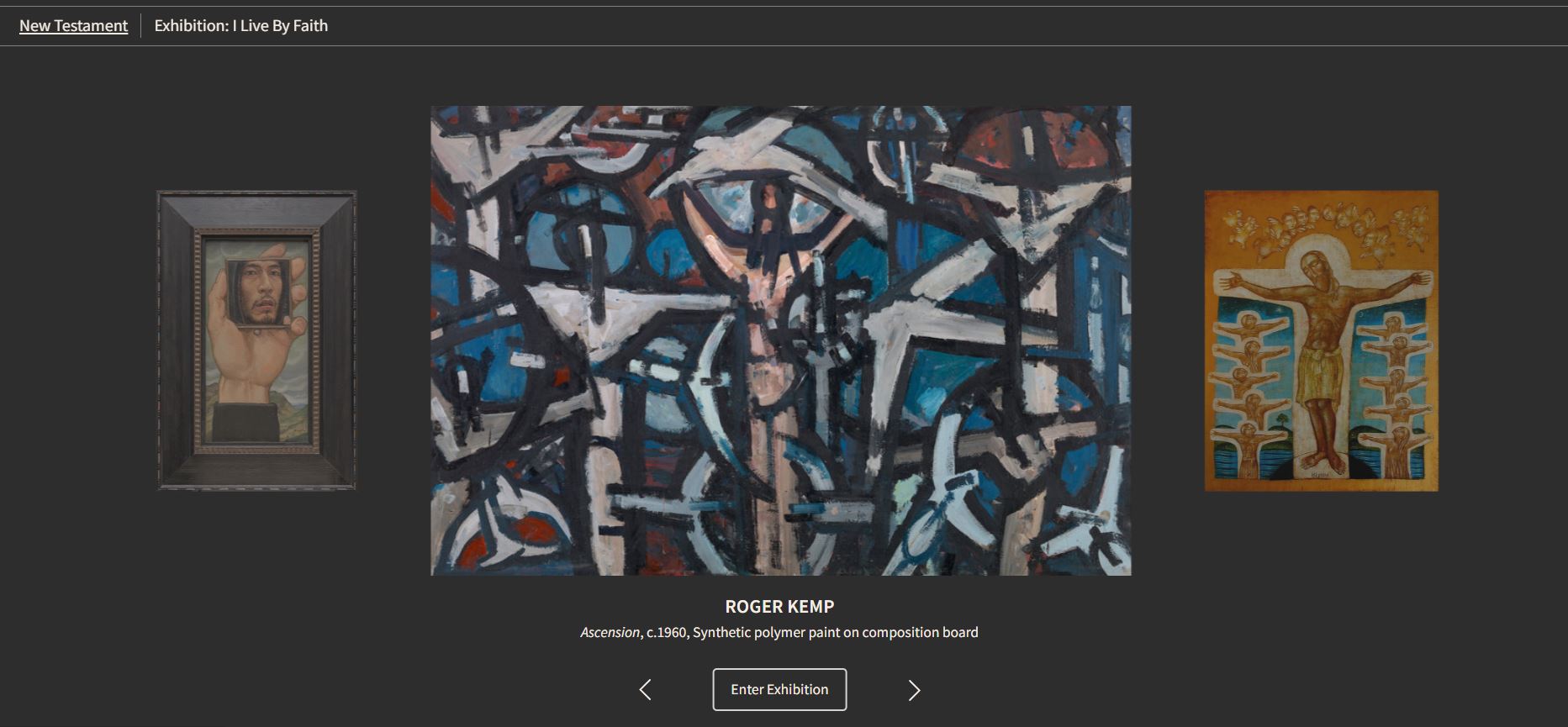
VISUAL COMMENTARY ON SCRIPTURE: “I Live by Faith (Galatians 2:15–21)” by Victoria Emily Jones: My latest set of commentaries for the VCS went live this month! It centers on one of Paul’s famous sayings: “I have been crucified with Christ, and it is no longer I who live, but it is Christ who lives in me.” I was bummed that one of the three commentaries I originally wrote had to be scrapped because the image permission was ultimately denied; I thus had to reconfigure and replace, and I ended up with two artworks in the three-piece exhibition that aren’t as diverse from each other as I had hoped. But still, each artwork brings a unique and compelling lens through which to examine this passage. (Note: If you’re viewing the exhibition on your phone, after you “Enter Exhibition,” you’ll need to expand the “Exhibition Menu” to access the “Show Commentary” button.)
VIDEO: “Abraham: An Interfaith Discussion at the Bode-Museum, Berlin”: Besides publishing written commentaries on works of art in dialogue with Bible passages, the Visual Commentary on Scripture also produces videos. This one brings together an Anglican Christian priest (who directs the VCS), a Jewish rabbi, and a Muslim theologian around a fifth-century ivory pyxis depicting Abraham, a figure held in common by all three faith traditions.
+++
POEM:“Gate A-4”by Naomi Shihab Nye: I’ve always loved this heartwarming poem about an unexpected moment of communion shared with strangers at an airport, made possible through kindness and the letting down of one’s guard. Listen to commentary by Joanne Diaz and Abram Van Engen on the Poetry for All podcast, episode 19; they answer the question “Why is this a poem?” Here’s a video of Nye reading it herself:
+++
NEW ALBUMS:
>> April 21: Worship for Workers by the Porter’s Gate: “In 2022 a group of songwriters, pastors, and professionals gathered in Nashville, Tennessee to write a series of worship songs for workers. Over three days they discussed the spiritual, emotional, and material struggles facing workers around the world today. Soon enough, they began to compose a series of songs specifically designed to help Christians carry their daily work before the Lord.” Here’s one of the thirteen songs on the album, “You Hold It All”:
The Worship for Workers album is part of a larger project, sponsored by the Brehm Center and a number of other institutions, to provide music, prayers, art, liturgies, and training to the church around the topic of work. It grew out of the book Work and Worship: Reconnecting Our Labor and Liturgy by Matthew Kaemingk and Cory Willson.
>> May 5: Glory Hour by Victory: Victory Boyd [previously] is a Grammy-winning soul and gospel artist who got her start singing with her siblings in the group Infinity Song but whose career really kicked into high gear when she worked as a songwriter for Kanye West’s Jesus Is King (2019). Glory Hour is her second full-length album as a solo artist; its title refers to the time of the morning when the sun rises. Most of the tracks are original songs or spoken word, but there are also three classic hymns/gospel songs: “His Eye Is on the Sparrow,” “Great Is Thy Faithfulness,” and “I Know It Was the Blood.” Here’s the music video for “Just like in Heaven,” based on the Lord’s Prayer:
>> May 19: Seven Psalms by Paul Simon: Paul Simon released this original seven-movement composition about doubt and belief as a single thirty-three-minute track, as it is meant to be listened to in one sitting. I’m a Simon fan; one of my early blog posts is a review of his and Garfunkel’s debut album, Wednesday Morning, 3 A.M. But if I’m honest, I was underwhelmed by this much-anticipated release. I’m in the minority there, so I think I’ll need to give it another listen. What do you think of it? Here’s the trailer:
>> June 2: Byrd: Mass for Five Voicesby the Gesualdo Six: One of my favorite vocal ensembles has just come out with an album of songs by William Byrd—his setting of the Mass along with a handful of motets. A Catholic composer in Protestant England in the late Renaissance, Byrd wove together musical “notes as a garland to adorn certain holy and delightful phrases of the Christian rite,” as he wrote in the preface to his second book of Gradualia (1607). Here’s the Gesualdo Six’s performance of his “Afflicti pro peccatis nostris,” a Latin prayer, a desperate plea for sanctification, that translates to “Afflicted by our sins, each day with tears we look forward to our end: the sorrow in our hearts rises to thee, O Lord, that you may deliver us from those evils that originate within us”:
DOCUMENTARY SERIES: Taste and See, dir. Andrew Brumme: “Taste and See is a documentary series exploring the spirituality of food with farmers, chefs, bakers, and winemakers engaging with food as a profound gift from God. Their stories serve as a meditation on the beauty, mystery, and wonder to be found in every meal shared at the table.” The Rabbit Room, who is partnering with them for a virtual cinema event (see below), says, “If, in some blessed alternate universe, Robert Farrar Capon had decided to make a documentary with Terrence Malick, guided by the foundational wisdom of Wendell Berry, then they would have made something like the pilot of Taste and See.”
Some of the people you see in the series trailer are Shamu Sadeh, cofounder of Adamah Farm and Fellowship in Connecticut, which integrates organic farming, Jewish learning, sustainable living, and contemplative spiritual practice (Adamah is the focus of the pilot film); The Soul of Wine: Savoring the Goodness of God author Gisela Kreglinger, who grew up on a winery that has been in her family for generations and who leads wine pilgrimages in Burgundy and Franconia (“a spiritual, cultural, and sensory exploration of wine”); Norman Wirzba, a professor at Duke who teaches and publishes at the intersections of theology, philosophy, ecology, and agrarian and environmental studies (see, e.g., his Food and Faith: A Theology of Eating); Kendall Vanderslice, a North Carolina baker, author, and founder of Edible Theology, which offers “curriculum, community, and communications that connect the Communion table to the kitchen table”; and Joel Salatin, who raises livestock on his Polyface Farm in Swoope, Virginia, in the Shenandoah Valley.
You can buy tickets to a virtual screening of the hour-long pilot, which is happening twice daily from June 3 to June 19 and includes exclusive access to a panel discussion with singer-songwriter Andrew Peterson, theologian Norman Wirzba, and director Andrew Brumme. Revenue from ticket sales will fund the production of future films, some of which are already in the works. “The funding raised will determine how far we can go and which stories we can pursue,” Brumme tells me. “We’re hopeful the virtual event will bring together enough of a supportive base of people who want to see this series made.” There’s also an option on the website to donate.
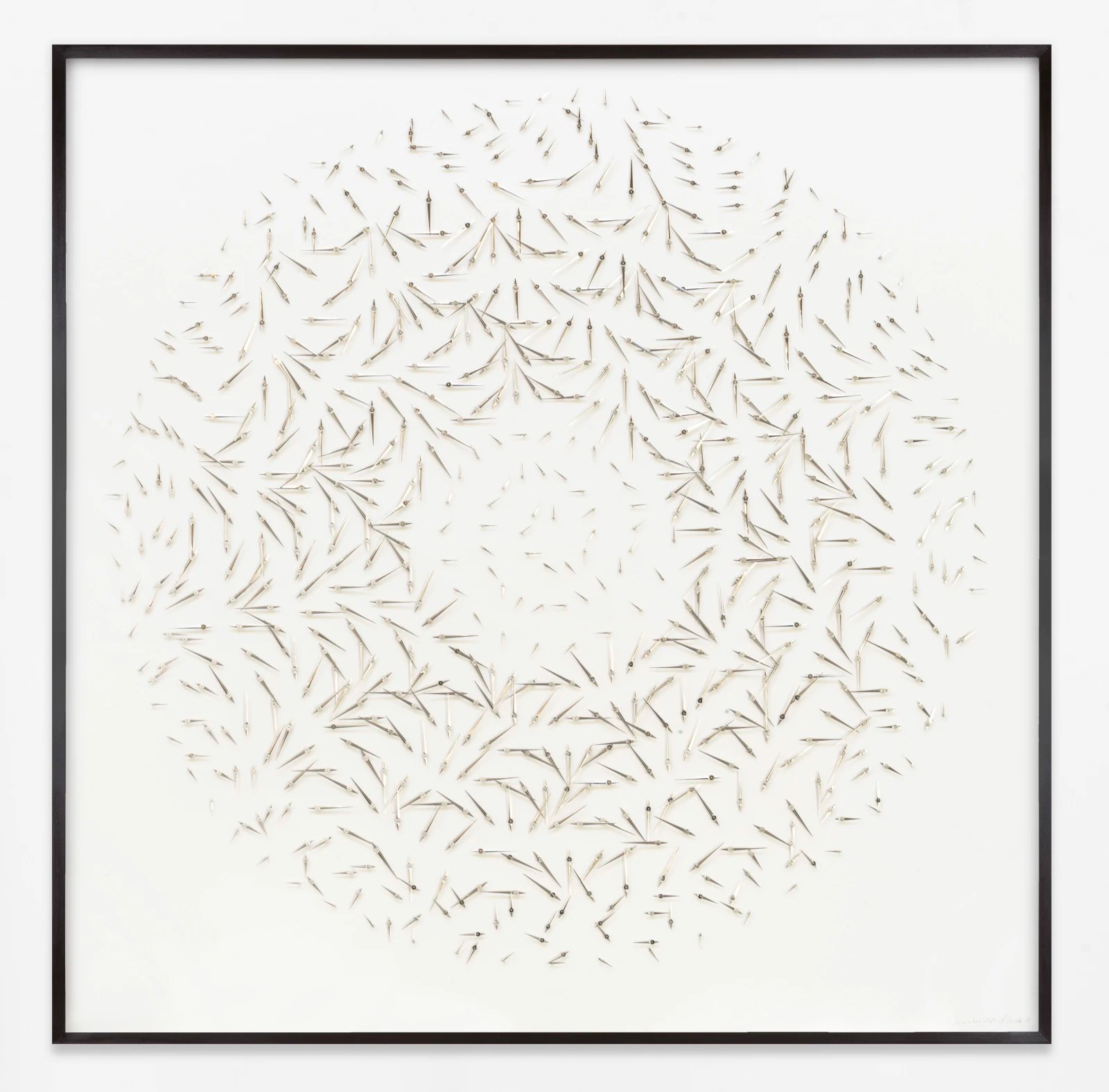
DISCUSSION PANEL: “Art Between the Sacred and the Secular,” June 6, 2022, Akademie der Künste, Berlin: Moderated by the Rev. Professor Ben Quash, this free public event (reserve tickets here) puts in conversation artist Alicja Kwade; Dr. María López-Fanjul y Díez del Corral, senior curator of the Bode Museum and the Gemäldegalerie; and Dr. Neil MacGregor, former director of the British Museum and the National Gallery, London. The questions they’ll address (see below) sound really intriguing!
Alicja Kwade (Polish, 1979–), Causal Emergence (December 2020), 2019. Watch hands on cardboard, framed, 175 × 175 cm.
“The abiding power of Christian motifs, ideas and styles in a host of modern and contemporary works that superficially look un- or anti-Christian indicates that visual art and Christian tradition have not become complete strangers. This invites analysis and understanding.
“How have Christian artworks and artistic traditions found new articulations, caused new departures, or provoked new subversions in the last 100 to 150 years? What forms of engagement between theology and modern and contemporary art do such developments in the relationship between art and Christianity invite and reward?
“How do viewers (Christian and non-Christian) interact with historical Christian art today, and how do modern sensibilities affect our viewing of earlier Christian artworks and artistic traditions?
“Is contemporary art an alternative to religion or can it sometimes be an ally? How do contemporary art and religion each respond to human experiences of the absurd or the tragic? What do contemporary art and the spaces in which we encounter it, tell us about the histories of both Western Christianity and Western secularisation?”
+++
FUNDRAISER: New Ordinary Time Album: The indie folk trio Ordinary Time is one of my favorite musical groups—I heard them in concert at a church here in Baltimore a few years ago!—so I’m really excited to see that they’re working on their sixth full-length album, their first since 2016. It will be produced by the esteemed Isaac Wardell, founder of Bifrost Arts and the Porter’s Gate. Per usual, it will comprise a mix of original and classic sacred songs, including the new “I Will Trust,” demoed in the second video below. Help fund their production costs through this Indiegogo campaign, which ends June 15. A donation of just $25 will get you an early download of the album.
The music video was shot in February at a bar in Daphne, Alabama, with some eighty of Kimbrough’s friends and supporters, and it premiered May 13. It was his way of saying farewell to his Church of the Apostles community in Fairhope, Alabama, where he served as worship leader and artist-in-residence for eight years. He left this spring to take a new job as uptown artist-in-residence at Church of the Incarnation in Dallas.
“From the time I wrote ‘Oh Give Thanks,’ I always pictured it as a bar tune, specifically set in New Orleans,” Kimbrough says. “The image Psalm 107 conjures for me is a group of friends sitting together swapping stories of God’s deliverance and raising their glasses to celebrate his goodness.” He has noted that some people are uneasy about singing the line “We cried like drunken sailors” in church, but he points out that it’s there in the Old Testament psalm! (Recounting how God rescued a group of men from a storm at sea, the psalmist says that as the waves rose, “they reeled and staggered like drunkards / and were at their wits’ end. Then they cried to the Lord in their trouble, / and he brought them out from their distress,” vv. 27–28).
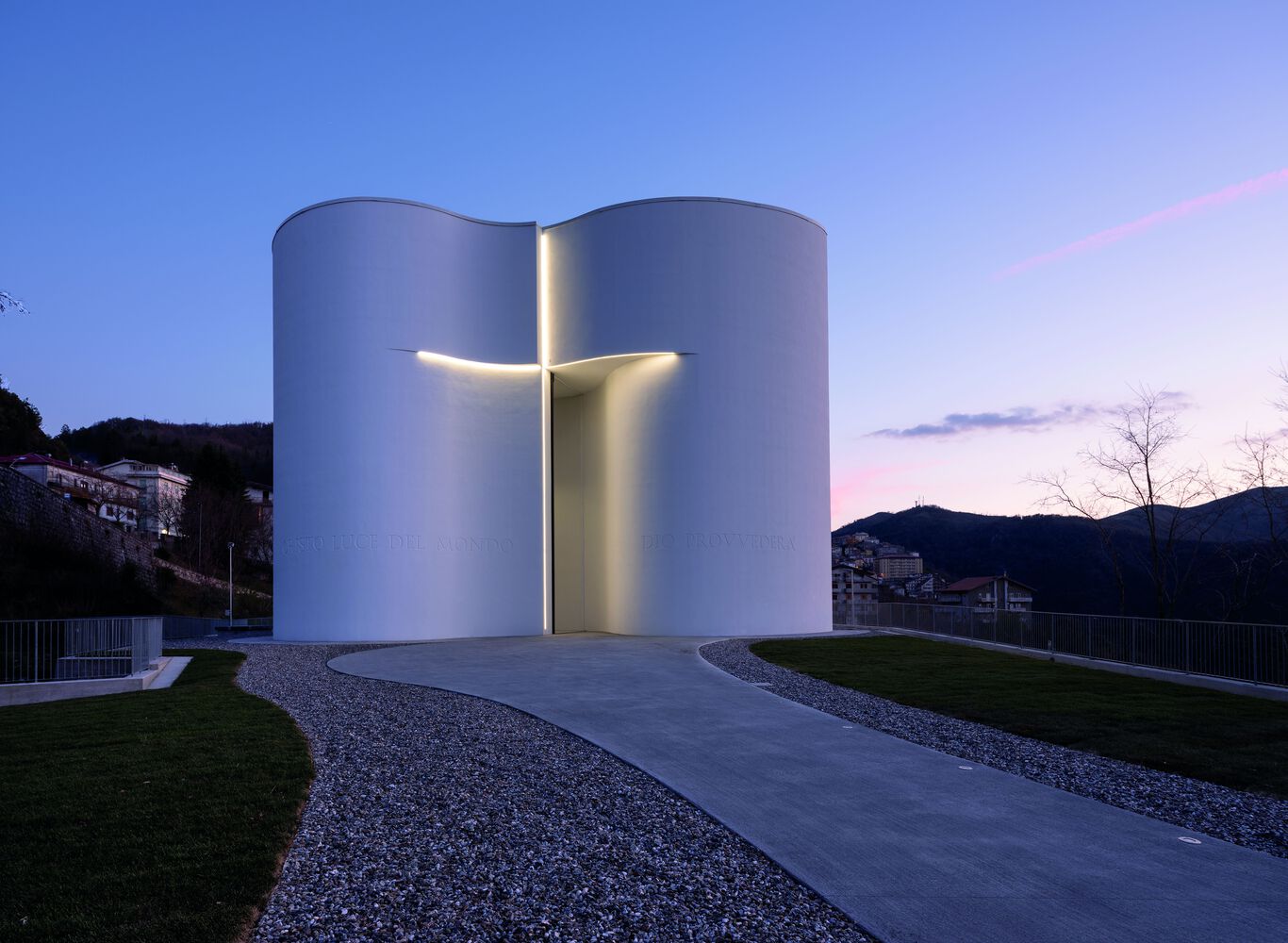
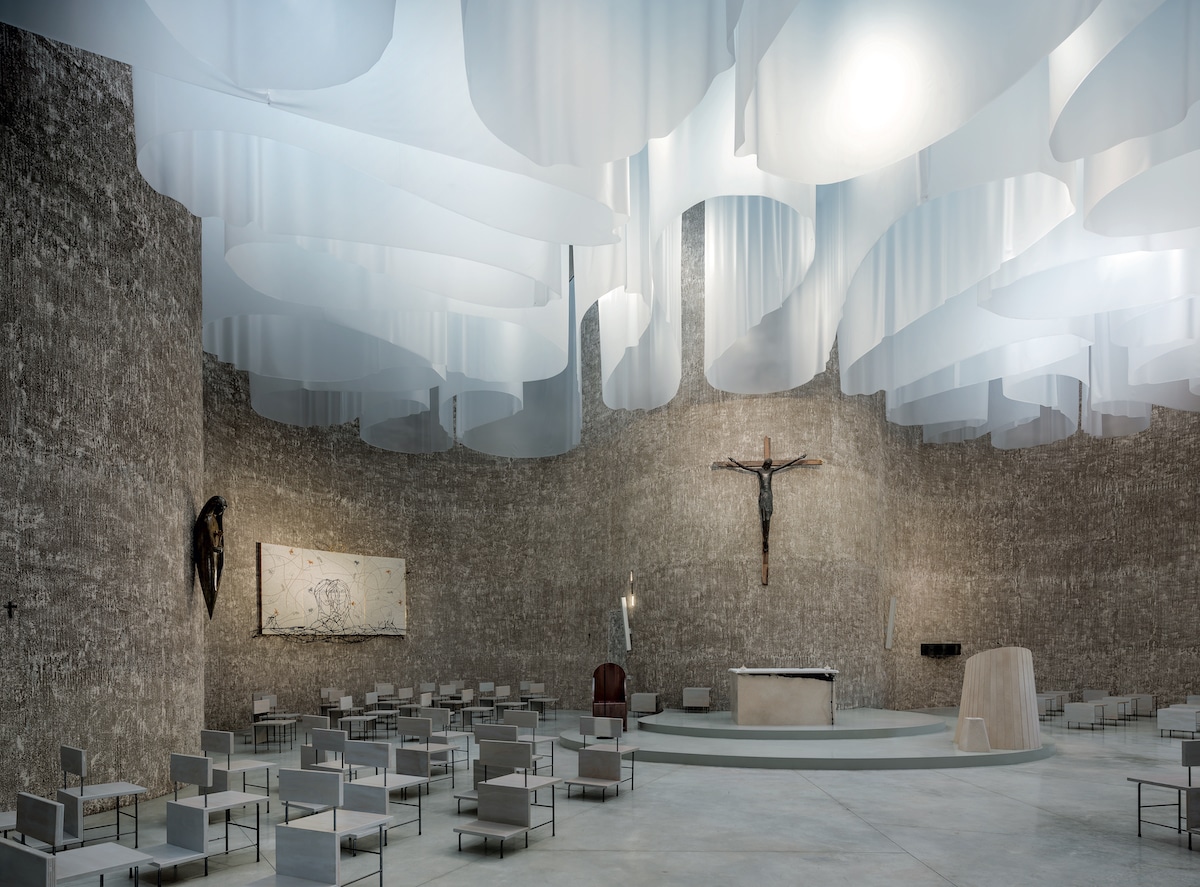
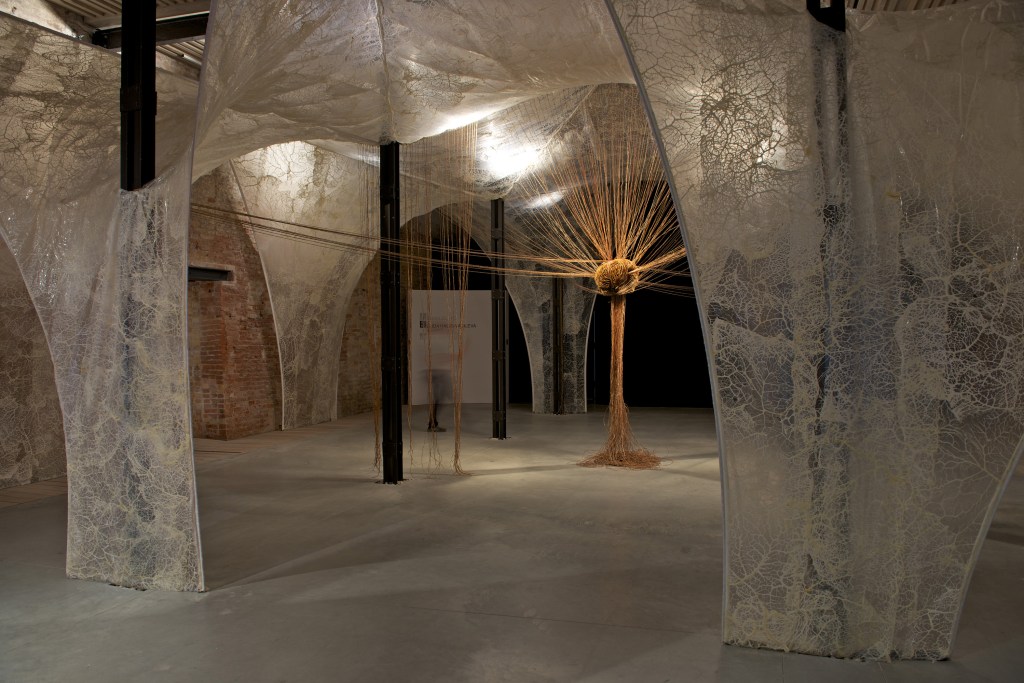
CHURCH ARCHITECTURE: Santa Maria Goretti Church, Mormanno, Italy: In 2013 architect Mario Cucinella won a competition held by Italy’s assembly of Catholic bishops to create the new parish church of Santa Maria Goretti in the hilltop town of Mormanno in Calabria. Because a third of the funds had to be raised locally, the project wasn’t completed until last year. Cucinella says that gave him time to win over its most important constituency: the elderly women who go to Mass every day, and who at first “were suspicious of its modernism.” [HT: My Modern Met]
Cucinella designed an elegantly minimalist concrete building with sinuous surfaces that form the shape of a four-leaf clover, a reinterpretation, Cucinella says, of the shape of Baroque churches. The enclosure has only a few openings. “On its north side, two walls part to create an entrance—while also contributing edges to a cross cut into the curves and lit by LEDs at night. On its south side, a small window is positioned to focus afternoon sunlight on a crucifix on July 6,” Maria Goretti’s birthday.
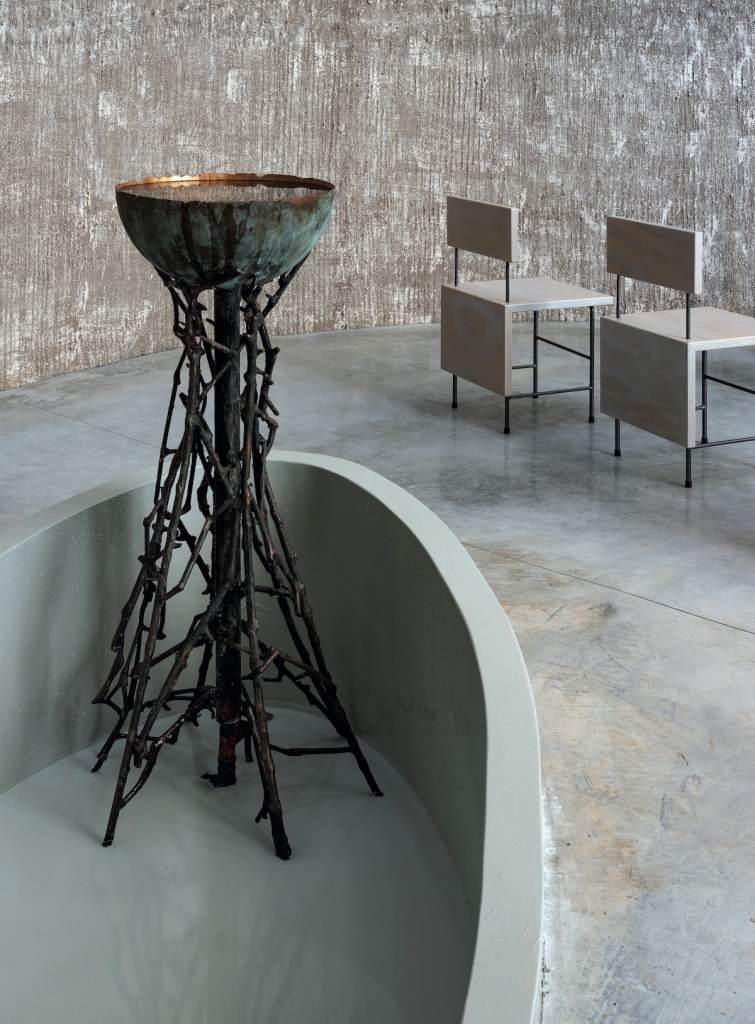
Santa Maria Goretti Church, Mormanno, Italy, designed by Mario Cucinella Architects, completed 2021. Photo: Duccio Malagamba.Photo: Duccio MalagambaBaptismal font by Giuseppe Maraniello. Photo: Duccio Malagamba.
Inside, the walls are hand-finished in plaster mixed with hemp fibers and lime, which give them a mottled, earth-toned look. The most dominant feature of the interior is the twelve-foot-deep scrim that falls from the ceiling in swirls, filtering in sunlight. Artist Giuseppe Maraniello (b. 1945) was commissioned to create the lectern, tabernacle, baptismal font, and figure of the Virgin Mary, while the simple steel and wood seating is by Mario Cucinella Design. Click on any of the three photos above to view more.
The church’s namesake, one of the youngest saints to be canonized, was stabbed to death in 1902 at age eleven while resisting a rape. She is the patron saint of purity, young women, and victims of sexual assault.
For the first time, this year I plan on publishing short daily posts for the entirety of Lent and for the Octave of Easter, pairing a visual artwork with a piece of music along the seasons’ themes (for an example of this format, see here)—just an FYI of what to expect. I also have several poems lined up. And you might want to check out the Art & Theology Lent Playlist and Holy Week Playlist on Spotify (introduced here and here respectively), which I’ve expanded since last year. I’m very pleased with the Holy Week Playlist in particular.
+++
NEW RESOURCE FOR HOME LITURGIES:The Soil and The Seed Project: Directed by Seth Thomas Crissman of The Walking Roots Band [previously] and with the contributions of a team of artists, writers, and musicians, “The Soil and The Seed Project nurtures faith through music, art, and Little Liturgies for daily and weekly use in the home. These resources help establish new rhythms of faith as together we turn towards Jesus, believing and celebrating the Good News of God’s Love for the whole world.” The project launched in November 2021 with its Advent/Christmas/Epiphany collection. When the project is complete it will consist of four volumes of music (forty-plus songs total—all original, save for a couple of reimagined hymns) and four liturgical booklets that include responsive scripture-based readings, reflection prompts, suggested practices, and an original artwork.
Thanks to a community of generous donors, The Soil and The Seed Project gives away all its content for free, including shipping, to anyone who is interested (individuals, couples, families, churches, etc.); request a copy of the latest music collection and liturgies here. CDs and printed booklets are available only while supplies last (1500 copies have been pressed/printed for this collection), but digital copies of course remain available without limit.
+++
CONVERSATIONS AT CALVIN: Below are two videos (of many!) from the 2022 Calvin Symposium on Worship, which took place earlier this month.
>> “Modern-Day Prophets: How Artists and Activists Expand Public Worship” with Nikki Toyama-Szeto: A writer, speaker, and activist on issues of justice, leadership, race, and gender, Nikki Toyama-Szeto is the executive director of Christians for Social Action and a leading voice for Missio Alliance. Here she is interviewed by preacher and professor Noel Snyder. They discuss the generativity of imagination, and its invitation to displacement; the connection between corporate worship and public witness; the movement of the Holy Spirit outside church walls; “political” and “pastoral” as classifications that differ from group to group; embracing messiness; and what pastors can learn from artists and activists.
A few quotes from Toyama-Szeto that stood out to me:
“Part of what we’re trying to do at Christians for Social Action is stir the Christian imagination for what a fuller followership of Jesus looks like in a more just society. The word ‘imagination,’ and I would say specifically Christian imagination, I think of as the dream that God dreams for his people and his creation. What does it mean to be oriented toward the dream that God is dreaming? Another word for it is shalom—the full flourishing of all his creation and all his people. And if you look at the gap between where we are today and what that dream is, that gap is imagination. How is it that we get from here, the broken world we see . . . how do we press in and lean into the dreams that God dreams for his people and for his world?”
“For me, I have found artists and prophets—those who are agitating for justice—are ones who help dislodge me from everyday things I take for granted, and those assumptions, and they help me to dream new and bigger dreams.”
“The pursuit of justice is the declaration of God’s character in the public square.”
Smith shares his frustration that often the only Christians who endeavor to learn other languages and develop cultural intelligence and appreciation are those who are preparing to be missionaries in a foreign country, and they do it only for the purpose of missional effectiveness.
If you take one piece of theology [i.e., evangelism] and try and make that the bit that’s about cultural difference, that puts distortions into the conversation. . . . You might want to think about mission, but you might also want to think about what it means to be made in the image of God. Does that mean everyone’s the same, or does it mean everyone has responsibility for shaping culture and we might all do it in different ways, and you have to make space for that? We might need to think about the cross. We might need to think about God’s embrace of us and how we embrace each other. We might need to think about love of neighbor. We might need to think about the body of Christ and the makeup of the early church. . . . You might have to visit a whole bunch of different theological places to get a composite picture rather than saying this is the doctrine that somehow solves cultural difference for us.
I was also struck by Smith’s discussion of how cultural difference can help us read the scriptures in a new way (see 19:38ff.). He gives an example from In the Land of Blue Burqas, where Kate McCord, an American, describes her experience reading the Bible with Muslim women from Afghanistan, and particularly how they taught her a very different interpretation of John 4, the story of Jesus’s encounter with the Samaritan woman at the well. Wow.
+++
VISUAL COMMENTARY ON SCRIPTURE: The Transfiguration: In churches that follow the Revised Common Lectionary, this Sunday, the last Sunday in the Epiphany season, is Transfiguration Sunday, giving us a vision with which to enter Lent. (Other traditions celebrate Jesus’s transfiguration on August 6.) In this video from the Visual Commentary on Scripture project, art historian Jennifer Sliwka and theologian Ben Quash discuss this New Testament event through three visual artworks: a fifteenth-century icon by Theophanes the Greek, which shows the “uncreated light” revealed to Peter, James, and John on Mount Tabor; a fresco by Fra Angelico from the wall of a friar’s cell in Florence, where Jesus’s pose foreshadows his suffering on the cross; and a contemporary light installation by the seminary-educated American artist Dan Flavin, comprising fluorescent light tubes in the shape of a mandorla. Brilliant!
+++
CIVA TRAVELING EXHIBITION: Again + Again, curated by Ginger Henry Geyer with Asher Imtiaz: “A photography exhibition that invites recurring and fresh contemplation of the ordinary and extraordinary through the seasons of the Christian liturgical calendar,” sponsored by Christians in the Visual Arts. The show will be on view at Second Presbyterian Church in Indianapolis from February 26 to March 26 and is available for rental in North America after that. I saw it at St. David’s Episcopal Church in Austin in November at the CIVA biennial and was impressed! It is accompanied by a beautifully designed catalog that pairs each photograph with a poem, several of which were written specifically for the exhibition and which respond directly to a given photo.
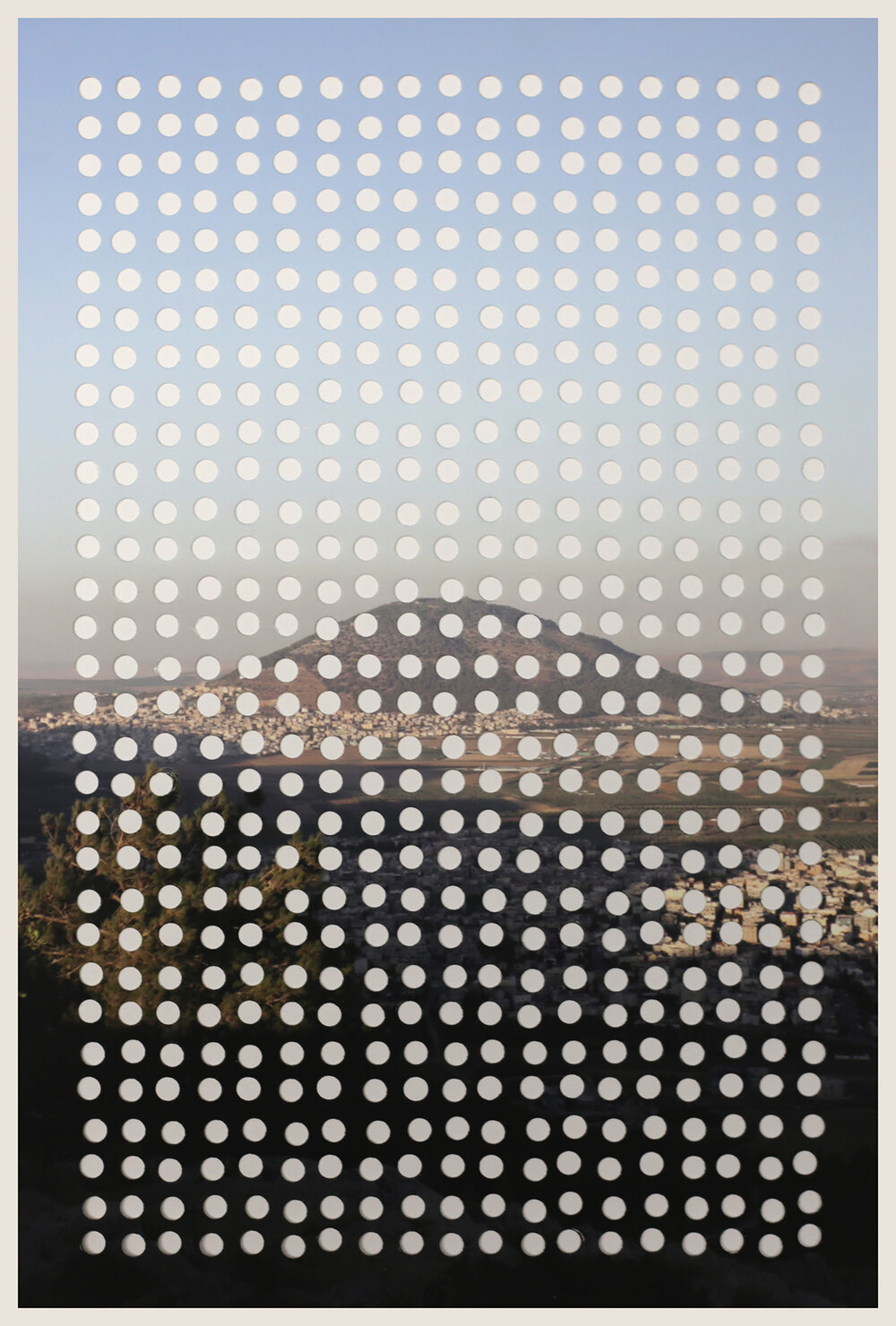
Michael Winters, Mount Tabor, June 2017, 2017. Inkjet print with holes punched out in white wood frame, 19 × 13 in.
One of my favorite art selections is Mount Tabor, June 2017 by Michael Winters, the director of arts and culture at Sojourn Church Midtown in Louisville, Kentucky. “Mount Tabor . . . is where the transfiguration of Christ is thought to have occurred,” Winters writes. “I stood viewing that scene in 2017. It looked so normal. I’m not sure why I felt compelled to punch holes in this photograph, but I think it’s because I wanted to be able to see through this ‘normal’ landscape to the glory of the transfigured Christ—which is to say, I wanted to see reality.”
Organized by Mount Tabor Ecumenical Centre for Art and Spirituality:
>> April 10, 11 a.m.–12:30 p.m. EDT: “The Victory of Life (Easter in Renaissance Art)”: “The most important event of New Testament belief, Christ’s Resurrection, is not described in the Scriptures. That has not prevented artists however from imagining it. As we celebrate Eastertide, we invite you to join Monsignor Timothy Verdon as he reflects on a number of works focused on this theme.”
>> April 15, 11:30 a.m.–1 p.m. EDT: “In the Shadow of Your Wings: Musical Bible Study on the Psalms”:Deus Ex Musica presents this interactive event in which participants watch prerecorded live performances of three brand-new vocal settings of Psalm 57, each set to music by a composer representing a different Christian tradition. After viewing the performances, participants will engage in moderated small-group discussions. No musical expertise is required.
Deus Ex Musica is an ecumenical organization of musicians, educators, pastors, and scholars that promotes the use of sacred music as a resource for learning and spiritual growth.
>> April 26, 3–4 p.m. EDT: “Art and the Liturgical Year: Bringing the Church Calendar to Life”: Organized in partnership with the CEEP Network. “This workshop explores ways of engaging artists with churches/congregations using the church calendar. What might inspire artists in engaging with the patterns that underpin the life of many churches, and how might engaging with artists open up understandings of faith in new ways for congregations? Examples of the kind of projects we will explore include initiatives using the visual arts in dialogue with scripture or exhibitions/installations in particular seasons such as Advent or Lent. Fundamentally, though, this workshop seeks explore a range of ideas and approaches and to hear about the benefits both for artists and congregations.”
Panelists:
Janet Broderick, Beverly Hills, California: Rector, All Saints Beverly Hills
Paul-Gordon Chandler, Casper, Wyoming: Bishop, Diocese of Wyoming; and Founding President of CARAVAN Arts (moderator)
Catriona Laing, Brussels: Chaplain, St. Martha & St. Mary’s Anglican Church Leuven; Associate Chaplain, Holy Trinity Brussels
Ben Quash, London: Professor, Christianity and the Arts & Director, Center for Arts and the Sacred, King’s College London; Director, Visual Commentary on Scripture Project
Aaron Rosen, Washington, DC: Professor, Religion and Visual Culture; Director, Henry Luce III Center for the Arts and Religion, Wesley Theological Seminary; Cofounder, Stations of the Cross Public Art Project
>> June 4, 11, 18, 25, 11:30 a.m.–1 p.m. EDT: “Jesus Is Just Alright: What Pop Songs About Jesus Can Teach Christians Today”: Led by composer, musician, and educator Delvyn Case of Deus Ex Musica. “For over fifty years, pop musicians in all genres have explored the meaning and significance of Jesus in their music. The result is a rich collection of songs that consider important spiritual questions like faith, doubt, and prayer in unique and often provocative ways. Through a combination of listening and discussion, this four-part series invites participants to explore a different spiritual topic each week. Join us to listen to great music that asks tough questions about our faith and our lives as Christians.”
>> April 21, 1–2 p.m. EDT: “Exhibiting Faith in the Museum and Beyond”: World-leading experts Ittai Weinryb, Neil MacGregor, and Jennifer Sliwka will discuss the joys and difficulties of introducing to the general public art that builds on a faith tradition. “They will discuss what has become a major concern for teachers, lecturers and museum curators in many countries. How do you encourage a largely secular audience to step inside a work of art, in such a way that its religious meaning is felt and understood, and the artistic experience can become immersive? . . . Among the topics to be explored are:
The opening up of museums and galleries to enhanced audiences during the pandemic.
How certain objects are altered by their move from a sacred space into a museum, yet how they also ‘live on’ beyond the museum plinth or computer screen.
The need to understand secular inhibitions and the loss of interest in Christianity and to find ways in which works of art can readdress this situation.”
>> April 29, 2–3:30 p.m. EDT: “Coventry Cathedral: Icon and Inspiration”: “Join Alexandra Epps [an Accredited Lecturer for The Arts Society and Guide and Lecturer at Tate Modern, Tate Britain and the Guildhall Art Gallery] for the extraordinary story of the rebuilding of Coventry Cathedral as a symbol of peace and reconciliation and its inspiring commitment to the modern. Experience the artistic journey that is the Cathedral discovering the work of many of the world-class artists associated with its many treasures including Jacob Epstein, Elisabeth Frink, John Piper, Graham Sutherland and more.”
>> May 5, 5–6 p.m. EDT: “The Art of Criticism: The People’s Madonna”: “Filmmaker Lucia Senesi grew up in Arezzo, Italy, within walking distance of several Old Master Madonnas. But it wasn’t until she was older—and viewing films by Andrei Tarkovsky and Valerio Zurlini, who were both captivated by the Madonna del Parto in Monterchi—that she saw these paintings with fresh eyes. Her essay in the spring issue of Image describes the fascinating history of a Madonna commissioned by peasants, executed by a Renaissance master, condemned by popes, and preserved through wars and social upheaval. She’ll talk with culture editor Nick Ripatrazone about film, the populism of sacred art, and the scandal of a woman pregnant with God.”
>> May 26, 5–6 p.m. EDT: “The Art of Imagery: You Are What You Contemplate”: “Artist Scott Erickson wanted to design a series of Stations of the Cross that people in his Portland neighborhood could encounter without the barrier of having to enter a church building—and he wanted to make them accessible to all. The result is a series of downloadable, printable images that have appeared all over the globe. His most recent book is Honest Advent: Awakening to the Wonder of God-with-Us Then, Here, and Now. He’ll speak with Image editor in chief James K.A. Smith about church, art, and ‘spiritual formation through image contemplation.’”
PANEL DISCUSSION: “Religious Art,” organized by the Forum for Philosophy: I posted about this live online event a month ago, and now that it’s passed, I want to share the video recording. Theologian Ben Quash (King’s College, London), curator Lieke Wijnia (Catharijneconvent Museum, Utrecht), and art historian Mehreen Chida-Razvi (Khalili Collections, London) discuss the relationship between art and religion, how art can function within religious practice, how to exhibit religious art in a museum, and artworks as sites of conversation across religious traditions.
Quash opens by proposing different categories of “religious art”: art for religion, art about religion, art with religion, and art instead of religion. The three unpack those a bit, discussing the intentions of the artist or patron versus how the artwork is perceived by the viewer. Quash mentions Haruspex by Elpida Hadzi-Vasileva (a fascinating installation commissioned by the Vatican for the 2015 Venice Biennale, a contemporary artist’s response to “In the beginning . . . the word became flesh”; read Quash’s essay and an artist interview), the East Window at St Martin-in-the-Fields by Shirazeh Houshiary, the Raphael Cartoons, and Aaron Rosen’s 2016 Stations of the Cross exhibition throughout the city of London, which shows the permeability of the boundaries between sacred and secular. (I participated, as viewer/pilgrim, in a 2019 iteration of the Stations project in Amsterdam.)
Elpida Hadzi-Vasileva (Macedonian, 1971–), Haruspex, 2015. Organic materials. Installation at the Pavilion of the Holy See at the 56th Venice Biennale.
In reference to Hadzi-Vasileva’s canopy of pig’s caul fat, Quash says that challenge or provocation can be a meaningful thing to happen in a religious context:
Works that ambush you are also religiously important, because a sort of religious art that only gives you what you already expect and want quickly becomes kitsch. It’s just a reward of your expectations. And that shouldn’t be what religious art does, it seems to me. It should actually want to take you somewhere else, just as good religion should—it should be transformative, not merely confirming where you already are. So there’s a role for these sorts of artworks within religion as well as outside it.
Chida-Razvi shares slides of Islamic architectural spaces, devotional objects, and manuscript illuminations, including a Mughal painting that exemplifies the interfaith dialogue going on at the court of Akbar in Lahore, and Wijnia shares her experience curating objects people pray with for museum display and (forthcoming) an exhibition on Mary Magdalene. Such great content!
+++
ADVENT SONGS:
“He Comes,” words by Kate Bluett, music by Paul Zach: A lovely new Advent hymn, performed here by Paul Zach.
“The Heavens Shake” by Reindeer Tribe:Reindeer Tribe is a group of friends based in Los Angeles who get together each year to make a live Christmas album, a mix of originals and traditional, sometimes retuned, carols. They bring their voices, instruments, and arrangements and jam together for a long weekend in a big living room. (COVID-19 put the kibosh on this year’s gathering.) This original song, perfect for Advent, is on their 2014 album, A Great Light. “For thus says the LORD of hosts: Yet once more, in a little while, I will shake the heavens and the earth . . .” (Haggai 2:6).
+++
ARTICLE: “We don’t need to be afraid of the Christmas tree’s pagan roots” by Damian Costello, America: Dr. Damian Costello specializes in the intersection of Catholic theology, Indigenous spiritual traditions, and colonial history. In this article he considers how the Christmas tree pictures Christ as the new Yggdrasil (the giant ash tree at the center of the Norse cosmos), and the spiritual character of nature. The second half—about “the hidden agency of trees”—stretches my categories for sure, and I wonder if it’s a bit overwrought, but I’m intrigued by the links Costello draws between the Psalms, Anishinaabe spirituality, and the theology of the Catholic saint John Henry Newman. The article reminds me of Luci Shaw’s poem “Perfect Christmas Tree.”
+++
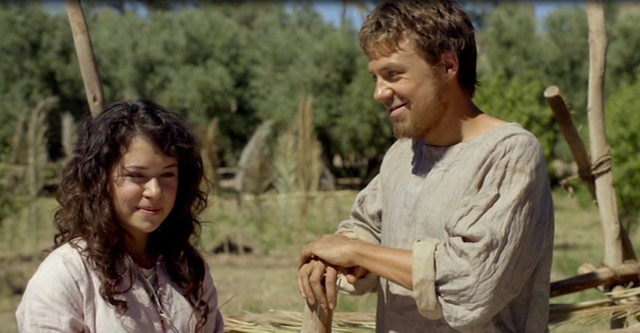
FILM: The Nativity (2010), written and directed by Tony Jordan: I’m always skeptical of film adaptations of the Bible because so many are poorly done. But I gave this four-part BBC miniseries (streaming on Amazon Prime) a shot, and, other than a really cheesy moment during the birthing scene, I thought it was quite good! Writer-director Tony Jordan is not a Christian but approaches the story with the reverent curiosity of a dramatist. He said he never connected with the nativity story until he worked on this project and started to see the very real humans beneath the auras tradition has given the “holy couple”—he saw their earthiness and complexity and began to imagine their emotional lives, especially their reactions to the disruptions they encountered. He said the relationship between Mary and Joseph was key to him. Many storytellers assume that because the marriage was arranged (or because, according to apocryphal sources, Joseph was an old man), there was no passion in their relationship, that they were bound together more by duty than by love, but Jordan, without overly romanticizing, imagines otherwise. The warmth between Mary and Joseph in the first half, which they have to work to regain after news of Mary’s pregnancy hits Joseph like a ton of bricks, is a hallmark of the movie.
Tatiana Maslany (Orphan Black) is probably my favorite Mary I’ve seen onscreen. (I also like Andrew Buchan [Broadchurch] as Joseph.) Jordan says most people see Mary as “a one-dimensional character with a halo round her head,” but actually, “she’s not saccharine. Just a nice kid—real but fallible.” He shows her as virtuous but not a goody-goody, fun-loving and confused and scared and courageous all at once, stepping into her new role by faith without seeing the full picture and even discipling Joseph into that faith. Maslany plays the part brilliantly, endearingly. The film addresses the isolation Mary felt, being rejected not only by her fiancé at first but also by the synagogue leadership and disbelieved, too, by the community she had grown up in. I’ve seen many actors portray Mary as detached, transcending all her difficult circumstances with calm, unshaken resolve. This Mary, by contrast, experiences hurt and fear and yet endures, which, I suspect, is closer to the historical reality. This in no way undermines her faith.
I was delighted by the Annunciation scene, where Gabriel comes to Mary as an ordinary man, much like the angels who visited Abraham generations earlier. He is not wearing ermine or carrying a scepter or standing on a rock above Mary with a booming voice and a heavenly glow. He’s simply a stranger who startles her, even more so when he relays his news. He speaks gently, colloquially. The moment of conception is portrayed as sudden and visceral; Mary feels Light enter her and reacts with a sort of joyful shock.
The trailer and posters, I will say, make the film seem pretty conventional. It does follow some conventions, but it’s also fresh, and while it has some flaws, I think it’s a very worthy use of two hours—it brings this ancient story to life in compelling ways.
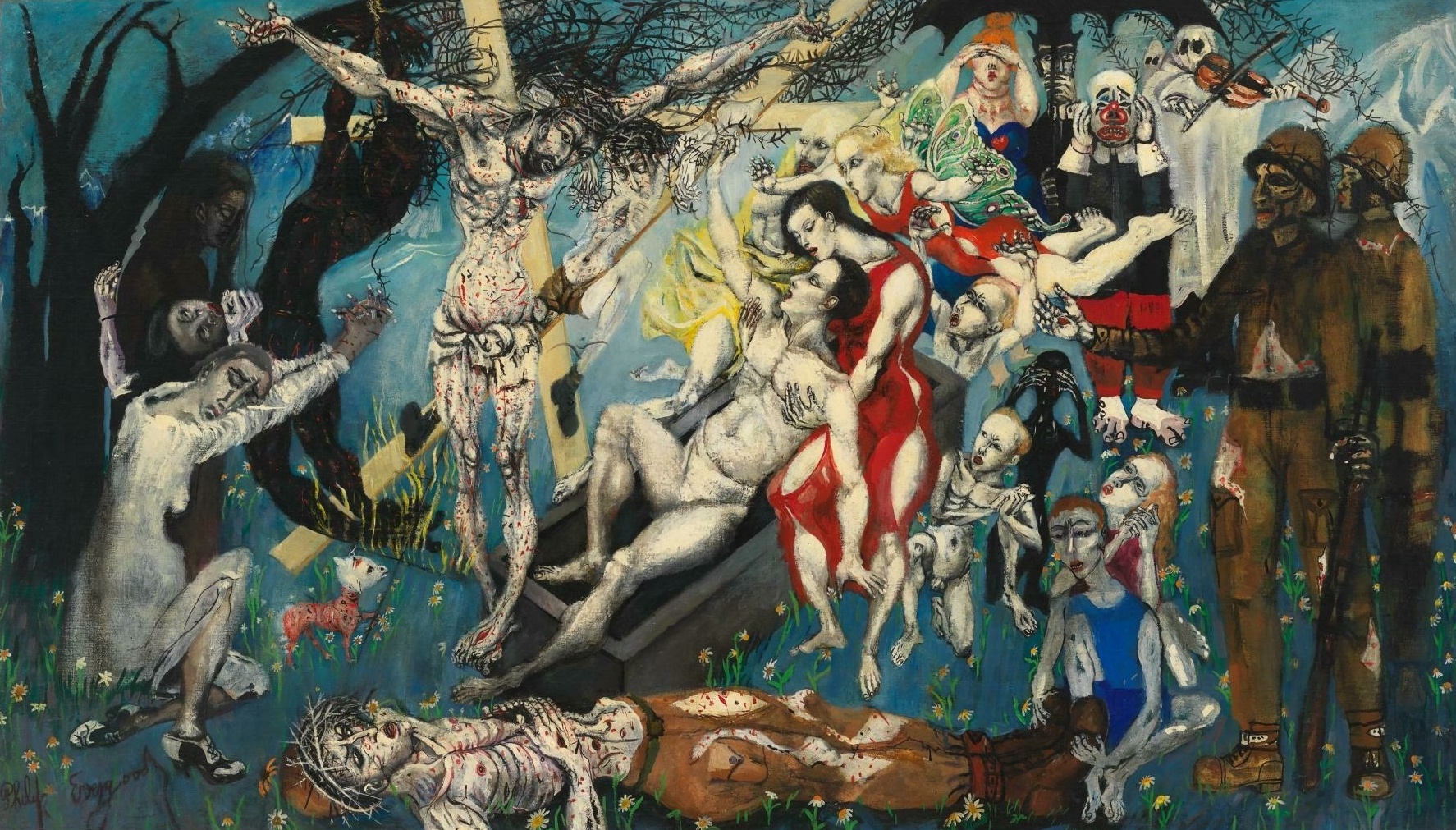
VISUAL MEDITATION: “Waking Up from Apathy,” on Philip Evergood’s The New Lazarus: My latest visual meditation for ArtWay has just been published. It’s on a crowded, noisy, garish painting that, honestly, is distressing to look at. And it’s supposed to be. Because it exposes what Martin Luther King Jr. called the triple evils of society: racism, militarism (war), and economic exploitation (aka extreme materialism, a systematic cause of poverty). Though Philip Evergood was not a Christian, he draws on Christian narrative and iconography, with the figures of Lazarus and Christ, to protest the cycles of violence that we need to rise out of before we self-destruct.
Philip Evergood (American, 1901–1973), The New Lazarus, 1927–54. Oil and enamel on canvas mounted on wood, 148 × 237.2 cm. Whitney Museum of American Art, New York.
The see-nothing, hear-nothing, say-nothing figures in the background remind me of people today who insist that racism does not exist and therefore tune out the cries of Black Lives Matter, for instance. I’m implicated too by these symbols of willful ignorance, because I admit that I do not often care to question where my food, clothes, coffee, chocolate, and other conveniences come from, or how the businesses I regularly support with my dollars treat their employees.
Evergood was politically engaged in both his art and his life, espousing egalitarian ideals. He participated in strikes and demonstrations for workers’ rights and was jailed more than once and beaten by police. He was greatly influenced by Mexican muralism, and he embraced the label of “propaganda” for his art, acknowledging that he was trying persuade the public to join the cause of social justice. “He was a figurative painter when much of the art world placed greater value on abstraction,” writes the University of Kentucky Art Museum, “and he was a moralist when moralizing was not considered an option for serious painters.” Nevertheless, he had a successful career, and his work is in many major museum collections, including the Tate Gallery, the Los Angeles County Museum of Art, the Art Institute of Chicago, the Hirshhorn Museum, the Museum of Modern Art, and the Whitney Museum of American Art.
In addition to providing individual commentaries, Quash also talks about reading art theologically instead of just aesthetically, art as developing physical sight toward spiritual insight (external and internal seeing), the persistence of Christian iconography in the art of today, and the ways in which art can implicate the viewer.
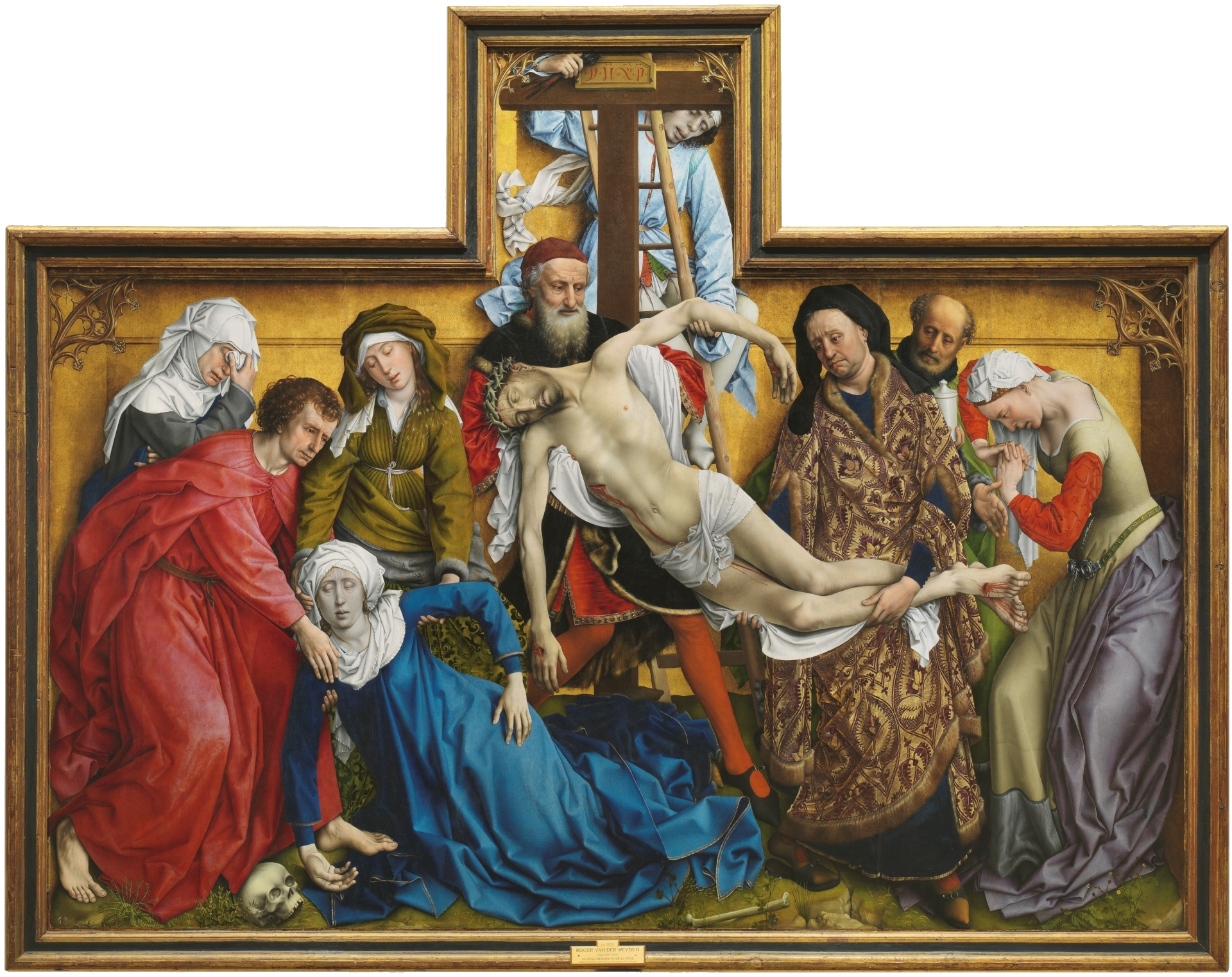
Rogier van der Weyden (Netherlandish, 1399–1464), Descent from the Cross, before 1443. Oil on panel, 204.5 × 261.5 cm. Museo Nacional del Prado, Madrid.
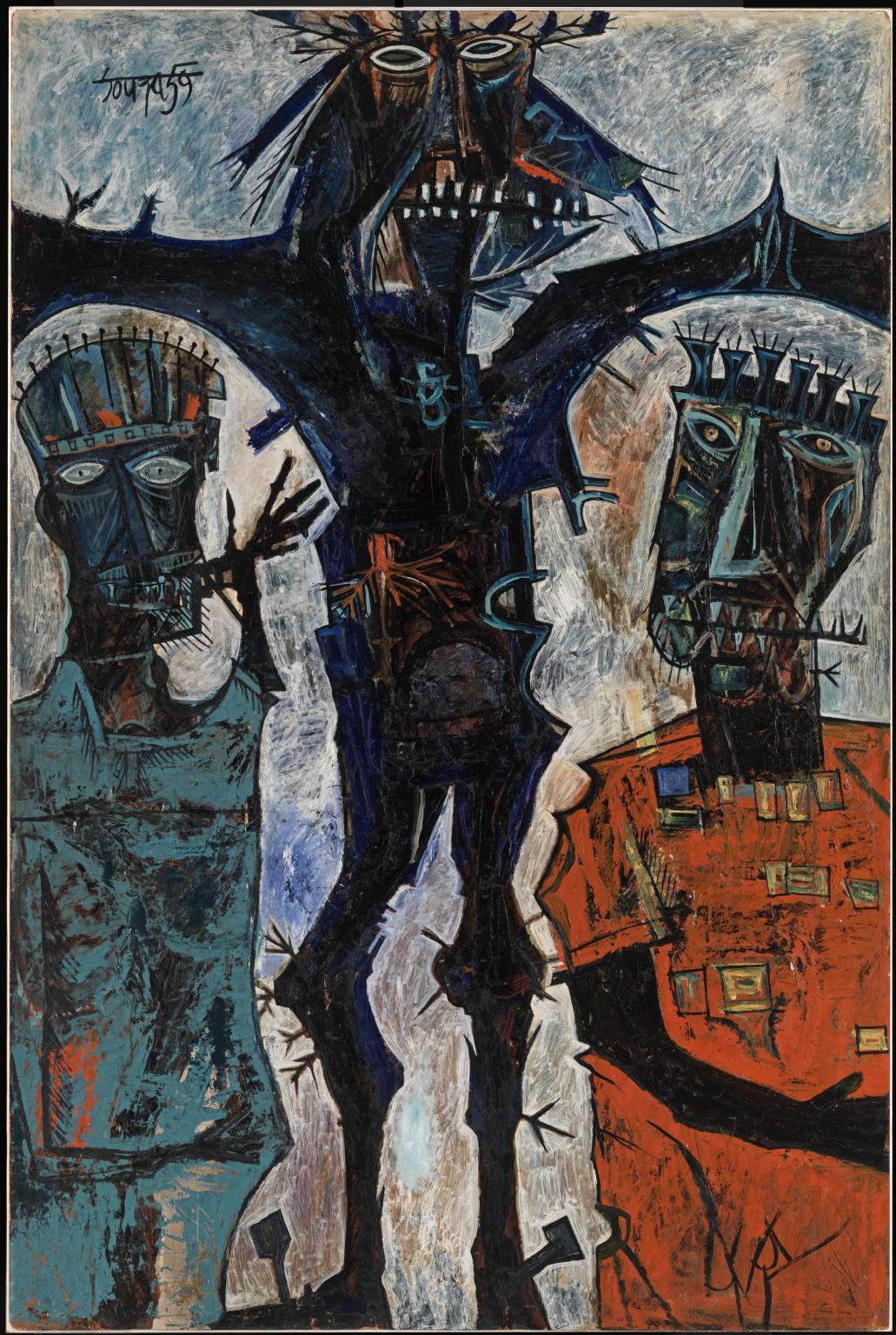
F. N. Souza (Indian, 1924–2002), Crucifixion, 1959. Oil on board, 183.1 × 122 cm. Tate Modern, London.
There’s so much that’s quotable in the conversation, but because it applies to the ArtWay meditation I linked to above, I’ll just highlight part of his discussion of nonreligious artists’ attraction to Crucifixion imagery in the twentieth century. The Isenheim Altarpiece (1515), he says, a visual reference point for many modern artists,
shows an agonized Christ whose tongue is swollen and protruding from his mouth, whose body is covered in sores, whose skin is tinged green, whose fingers are curled up in agony. There’s no idealization here of what a death like that might have been. Instead there’s a strong assertion that the extremes of human pain and suffering are not alien to the Christian message. And yet it’s a religious image—this is a Christian image painted for a Christian context.
When that work comes into contact with the new traumas of the twentieth century—we talked about [Stanley] Spencer and the Second World War, here [Francis Newton] Souza experiencing colonialism in India—when that painting comes into contact with those sorts of extremes of human experience, it activates, it speaks to them, and calls forth new artistic responses, because it feels as though Christianity can still speak, even in those extremes. And I think Souza, like [Graham] Sutherland and [Francis] Bacon, while they may not have felt comfortable with traditional Christianity, saw the power of that Christian tradition to in some way help them articulate the traumas and the horrors of their own time.
So that’s a very interesting work, and typical of several examples of the extraordinary way in which we might think we’re in a secular age, but Christian iconography is probably as lively as ever—although it’s doing new things—in the work of modern and contemporary artists.
+++
SONGS . . .
from the GOOD SHEPHERD COLLECTIVE: Spearheaded by David Gungor and Tyler Chester, the Good Shepherd Collective [previously] “creates liturgical art to inspire the Christian imagination, that we may embody the love of Christ for the good of our neighbors.” They’ve just released an album of ten hymns. One of them is “Joyful, Joyful, We Adore Thee,” queued up in the liturgical service video below, and though it didn’t make the final album cut, I also really like their version of “His Eye Is on the Sparrow.”
from Family Company: Charles Jones, the lead singer on both of the above videos, is also a part of Family Company, an LA-based music collective celebrating the traditions of soul, blues, and R&B. You might enjoy these seventies covers of theirs: “Heaven Help Us All” (popularized by Stevie Wonder), featuring Charles Jones, and “Let Us Love” by Bill Withers, featuring Teddy Grossman. See more on their YouTube channel.
+++
BALLET SOLO: “Lift Every Voice and Sing”: Premiering at the Lincoln Center in 2019, Ounce of Faith is a contemporary ballet choreographed by Darrell Grand Moultrie, the score a mix of jazz standards, original music, and spoken word. This excerpt is performed by Khalia Campbell of the Alvin Ailey American Dance Theater, with movements suggestive of both struggle and pride.
Known as the Black National Anthem, “Lift Every Voice and Sing” was written in 1899 by writer and activist James Weldon Johnson and set to music by his brother, John Rosamond Johnson. The hymn is sung here, just the first of its three verses, by Aisha Jackson, with Dante Hawkins on piano. It’s a song of historical remembrance and lament but also of hope, a rallying cry to move forward together, in unity, out of our “dark past,” into the truth of God, continuing to fight injustice wherever we find it so that everyone can live free. It acknowledges that God is the one who leads his people in love and who wills liberty, and it supplicates: “Keep us forever in the path [of Your light], we pray.” Learn more about the hymn in this NPR feature. See also this UMC Discipleship article, especially the part where Dr. James Abbington, a choir director and a scholar of African American sacred music, answers the question, “Is this a hymn just for African Americans or is it for all people?”
+++
LITERARY ESSAY: “To Sit with an Onion” by Elizabeth Harwell: God “is tethered to this world in delight” and does not weary of it as we do, writes Elizabeth Harwell after having sat with a mussel shell for one hour, upon the advice of Robert Farrar Capon. (An exercise in wonder! Any inanimate object will do.) Harwell marvels at how the shell—blueberry-blue and milk-white, cold, curvaceous, smooth—was “an entire world to the mussel who called [it] home,” and now, since she picked it up off a Maine beach, it sits in a silver dish in her dining room, a reminder of the Creator’s quiet mirth. And there’s much more where that came from. “That shell represented one of thousands (millions?) of pearly homes that will never lay bare in front of human eyes—miles of ocean floor, covered in secret delights, that began as thoughts in my Father’s mind. We humans can be so self-important that we’ve never considered that God is enjoying parts of creation that none of us will ever see.” Read the whole essay at The Rabbit Room.
(Quash’s discussion of Stanley Spencer’s Wilderness series in the abovementioned podcast, in which Christ gets down on the ground like a curious child to observe wildflowers, scorpion, hen, dovetails nicely with this essay!)
I’m super-excited to share with you all a major new project I’ve contributed to, which is the Visual Commentary on Scripture (VCS), a free online publication that provides theological commentary on the Bible through the skillful selection of works of art. Launched November 6, 2018, at a reception at the Tate Modern, the VCS is directed by Professor Ben Quash of King’s College London and is funded in large part by Roberta and Howard Ahmanson.
As Quash explains in the introductory video, the VCS aims to demonstrate how visual art itself can serve as biblical commentary, and when placed in conversation with other “visual commentaries” on the same text, the meaning of said text potentially becomes all the more clear. This practice of compiling diverse theological perspectives on a biblical text for their dialogical potential has ancient roots. The Jewish Talmud, for example, gathers together the viewpoints of different rabbis, not because they all necessarily agree but often because they constructively disagree—and there’s value in that conversation. The equivalent in the Christian tradition is the Catenae.
Translating this tradition into a modern, visual format, the VCS comprises virtual “mini-exhibitions” of three works of art per biblical passage, along with a short textual commentary on each artwork and one comparative commentary. (Currently about one hundred passages have gone live, and the goal is to cover the entire Bible.) The commentaries are written for nonspecialists but are grounded in detailed theological and art-historical research. Care is taken to secure the highest-quality images, which you can zoom in on.
Art historian Matthew Milliner calls the VCS “the Biblia pauperum of our time,” referring to the relatively accessible block-printed picture Bibles of the Middle Ages:
Let’s face it: new commentaries, and the academic library subscriptions necessary to come with them, are expensive. Add to that the fact that attention spans are famously declining, and increasingly privilege (for better or for worse) the visual. Perhaps these factors make the Visual Commentary on Scripture, which is actually . . . wait for it . . . free, the biblia pauperum (Bible for the poor) of the twenty-first century. Every minister should be talking about this homiletical goldmine.
YES. I would love to see pastors and seminary students using the VCS as a resource for their biblical and theological studies and sermon preparation.
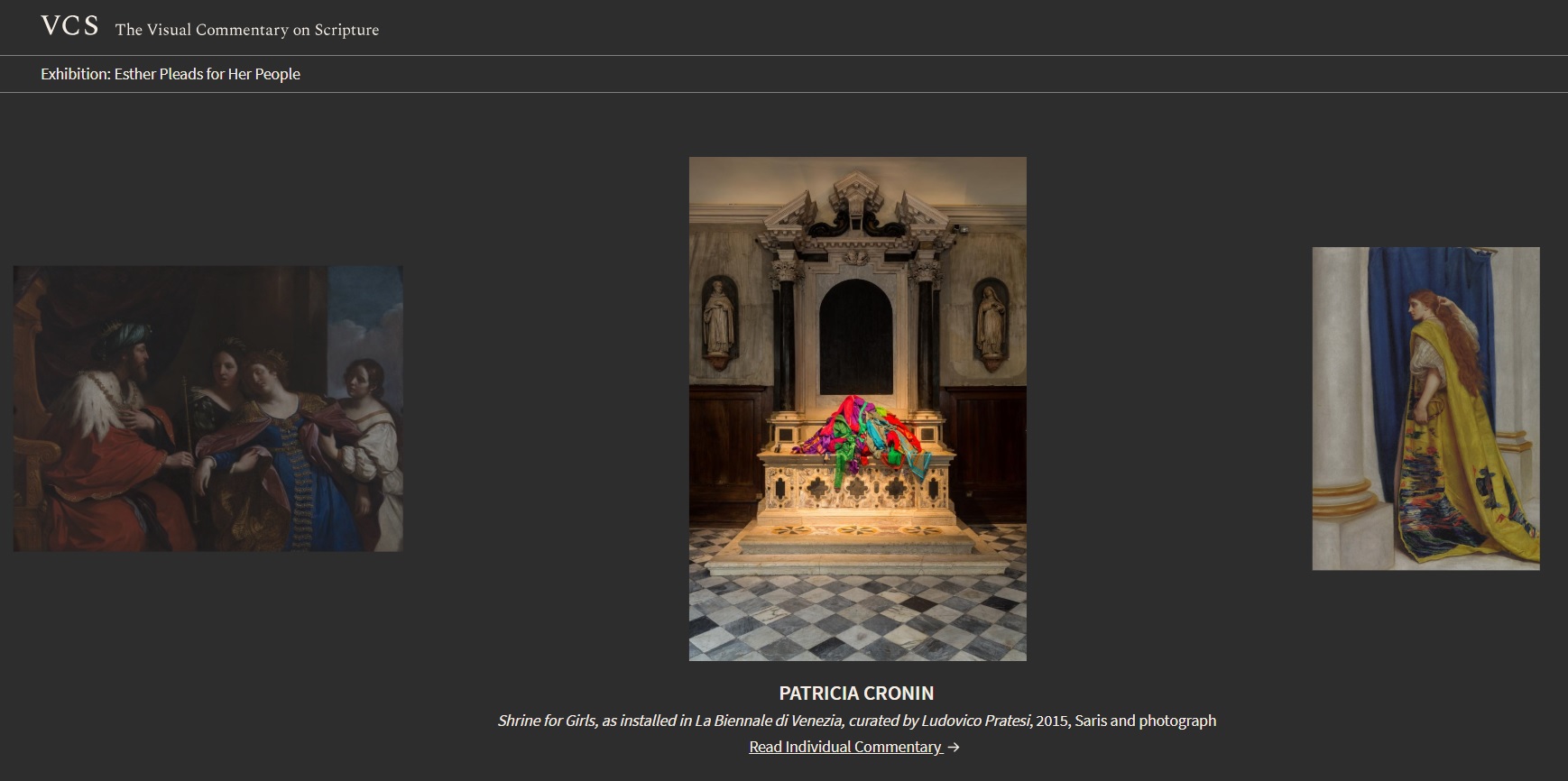
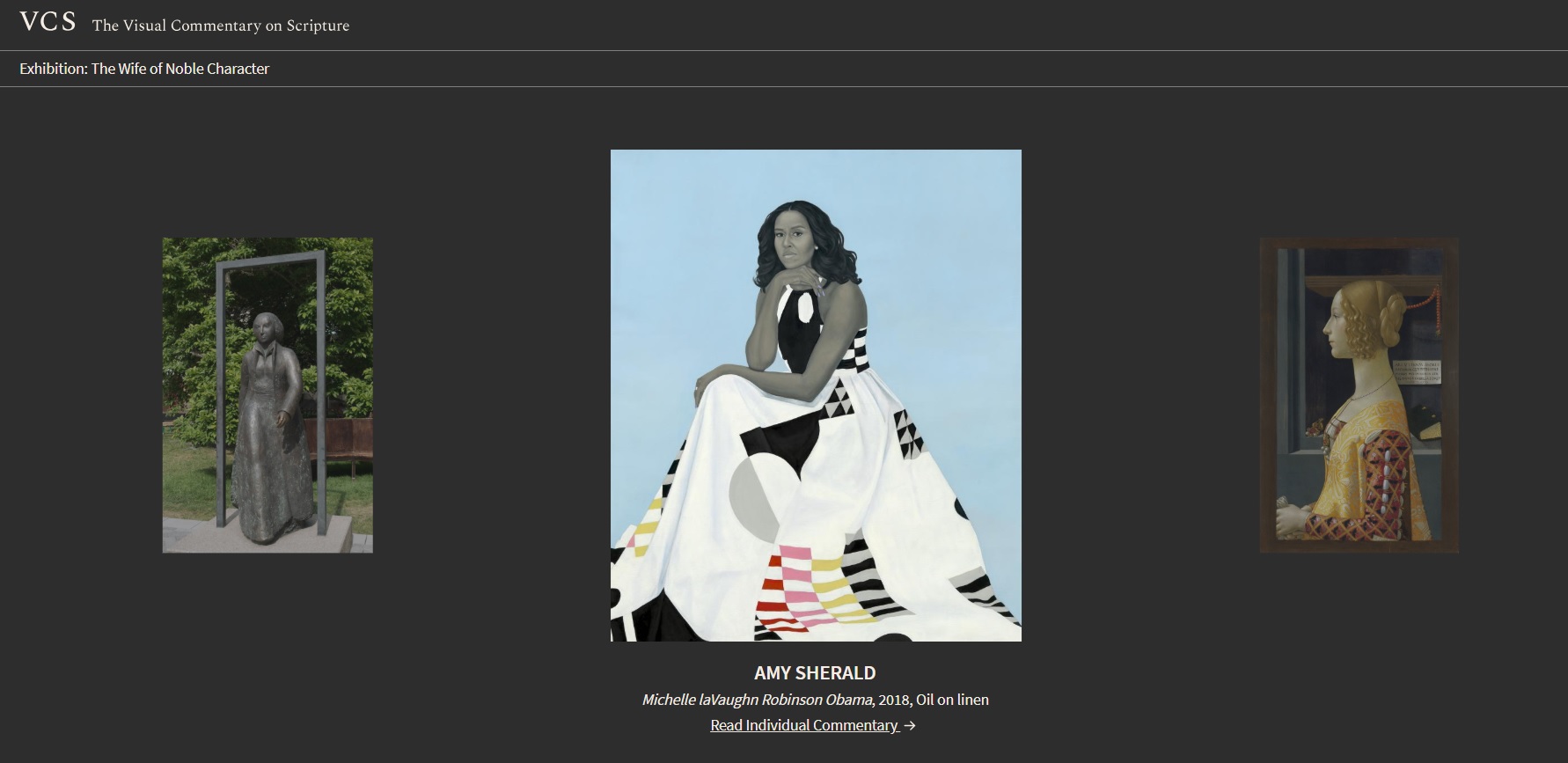
The exhibitions are arranged by biblical text for easy searching—and there are so many fantastic ones. I especially enjoy the ones that include a contemporary art selection. For example, Ayla Lepine ingeniously chose Patricia Cronin’s Shrine for Girls from the 2015 Venice Biennale to converse with Esther 8, in which Esther pleads for the deliverance of her people. Ursula Weekes curated an eclectic trio of portraits—of Florentine noblewoman Giovanna degli Albizzi Tornabuoni, German Reformer Katharina von Bora (Martin Luther’s wife), and former US First Lady Michelle Obama—to interact with the famous “wife of noble character” passage from Proverbs 31. And Pablo Perez d’Ors places Michael Landy’s kinetic sculpture Doubting Thomas, made of found objects and inviting viewer participation, side by side with Old Master paintings to probe the significance of that famous resurrection encounter.
“Physical sight can be a pathway to spiritual insight,” Quash says, affirming the eighth-century monk John of Damascus, who wrote that “just as [through] words perceived by the senses we hear with bodily ears, and understand what is spiritual, so through bodily vision we arrive at spiritual contemplation” (In Defense of Icons 3.12).
+++
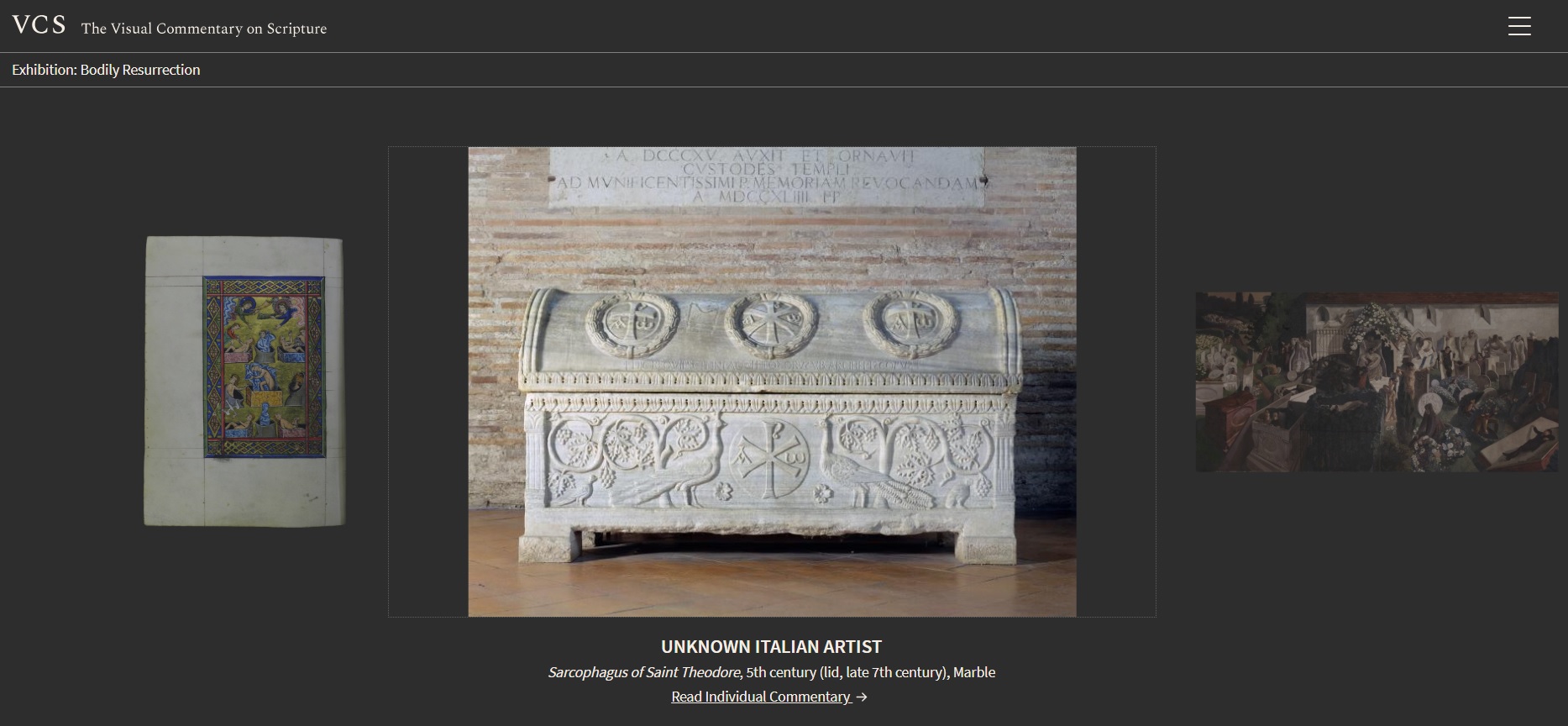
I curated the “Bodily Resurrection” exhibition for the VCS, which takes as its basis 1 Corinthians 15:35–58. After reading the passage many times, including in the context of the whole epistle, and meditating on it, I wanted to investigate how the church has interpreted it over the centuries, so I read Caroline Walker Bynum’s excellent book The Resurrection of the Body in Western Christianity, 200–1336, which quotes from and summarizes a wealth of patristic and medieval writings on the topic. That led me to Tertullian’s On the Resurrection of the Flesh, an extensive treatise from the early second century. They were both fascinating reads.
In addition to the Pauline metaphor of the seed, Bynum writes,
the resurrection of the body is also described by theologians as the flowering of a dry tree after winter, the donning of new clothes, the rebuilding of a temple, the hatching of an egg, the smelting out of ore from clay, the reforging of a statue that has been melted down, the growth of the fetus from a drop of semen, the return of the phoenix from its own ashes, the reassembling of broken potsherds, the vomiting up of bits of shipwrecked bodies by fishes that have consumed them . . . (6)
I realized that I had never really thought about the logistics of the doctrine of the general resurrection, and although, as with other doctrines, the mechanics are not what’s important, it was interesting to consider what my resurrected body might look like, and how (and whence) it will be reconstituted once it decomposes, turns to dust. Some of the conjectures I found to be quite amusing—like Gregory of Nyssa’s claim that in heaven we will have neither genitals nor intestines, because there will be no procreation or digestion. Or Augustine’s suggestion that we will receive back all the bits of ourselves that we ever had, including nail and hair clippings, but the excess will not necessarily go to our fingers and heads but rather will become absorbed into our flesh (so that we don’t look freakish).
I spent a lot of time wrestling through the paradox, held consistently by the church throughout the ages, that the resurrection body will be both identical to the one we have now and new. This particular passage from Paul seems to emphasize the new aspect. He contrasts “physical”/“terrestrial” and “spiritual”/“celestial” bodies. What does he mean by the latter?
Choosing only three images to open up this rich theological doctrine was a real challenge, and I cycled through dozens before landing on the ones I did.
At the outset, I was cognizant that the resurrection Paul writes about, which will occur “at the last trumpet,” is distinct from the spectacular rising from the graves that occurred on the day Jesus was crucified (Matthew 27:52)—so although there are many fine examples of that latter episode in art, I passed them over for this assignment. I also passed over images of Ezekiel in the valley of dry bones, since that narrative is rooted in a different passage (see the VCS exhibition), even though there is an obvious intertextual link between the two.
I was intrigued by the “second Adam” motif present in the Pauline text, and I considered several artworks that follow that vein, including ones depicting the “Harrowing of Hell,” or, as it’s called in the Orthodox tradition, the Anastasis, in which the resurrected Christ pulls up Adam, Eve, and other Old Testament saints from Sheol. This iconographic type would have made a particularly apt pairing with the passage’s triumphant ending: “Death is swallowed up in victory.” But strictly speaking, the harrowing has already taken place (according to church tradition, on Holy Saturday), and although it prefigures the future resurrection, I wanted to keep the focus on the yet-to-come event that Paul is talking about. Plus, I figured that the harrowing will almost surely make an appearance in some other VCS commentary.
Anastasis fresco in the parecclesion of Chora Church, Istanbul, Turkey, ca. 1315.
A related image I found, a contemporary one, very unique in its approach and theologically loaded, is a life-size painting by Caleb Stoltzfus that shows the glorious nude Christ, his puncture wounds visible, pulling up a man from the dust. It’s titled Resurrection. I love this image, and there’s much that could be said about it—but ultimately, I felt that it fit better with the passage preceding mine, in particular 1 Corinthians 15:20: “But in fact Christ has been raised from the dead, the firstfruits of those who have fallen asleep.” Read the artist’s commentary at http://www.calebstoltzfus.com/blog/resurrection.
Caleb Stoltzfus (American), Resurrection, 2016. Oil on linen, 6.5 × 5 ft.
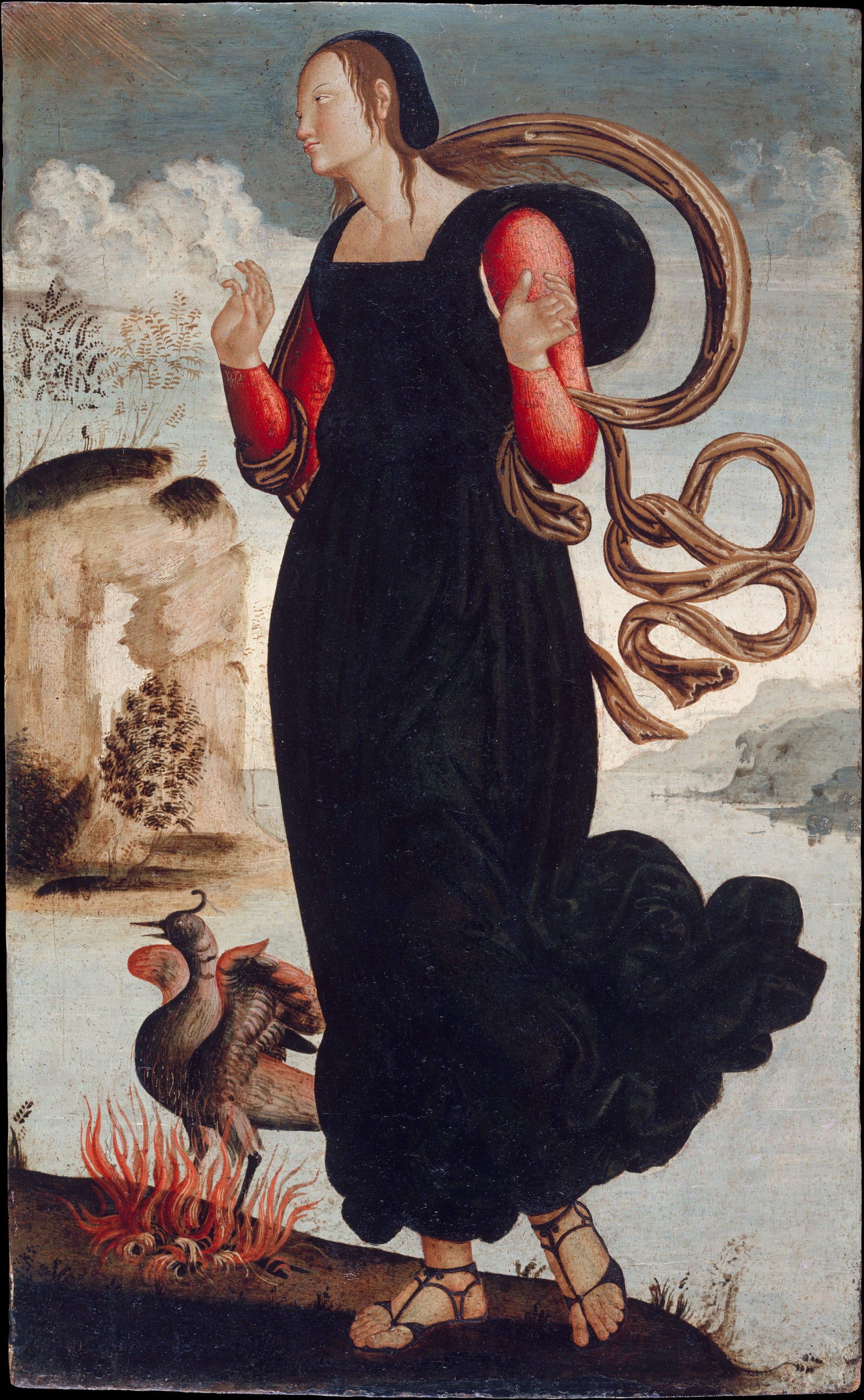
In my image search, I also examined a lot of symbolic bird imagery of the resurrection—that is, phoenixes and peacocks. The phoenix is a mythological bird that dies but then rises up from its own ashes, and the flesh of the peacock was thought to not decay, giving both birds a theological weight since the earliest era of Christian art, where they sometimes stand in for Christ’s resurrection and, by extension, our own. Thinking I’d draw this visual tradition into conversation with 1 Corinthians 15, I came close to selecting Hope, a Renaissance painting from Umbria, Italy, from a set of three allegorical paintings on the theological virtues; in it Hope is personified as a woman who squints her eyes toward the sun and catches a wind as she stands beside a phoenix on its pyre—suggesting the Christian hope of life after death. Although hope is implicit in the Corinthians passage, it’s not a keyword, so I ultimately decided not to include the Umbrian painting in my selection. Peacocks, however, did make the cut! (See below.)
Italian (Umbrian) painter, Hope, ca. 1500. Tempera and gold on wood, 29 1/8 × 17 7/8 in. (74 × 45.4 cm). Metropolitan Museum of Art, New York.
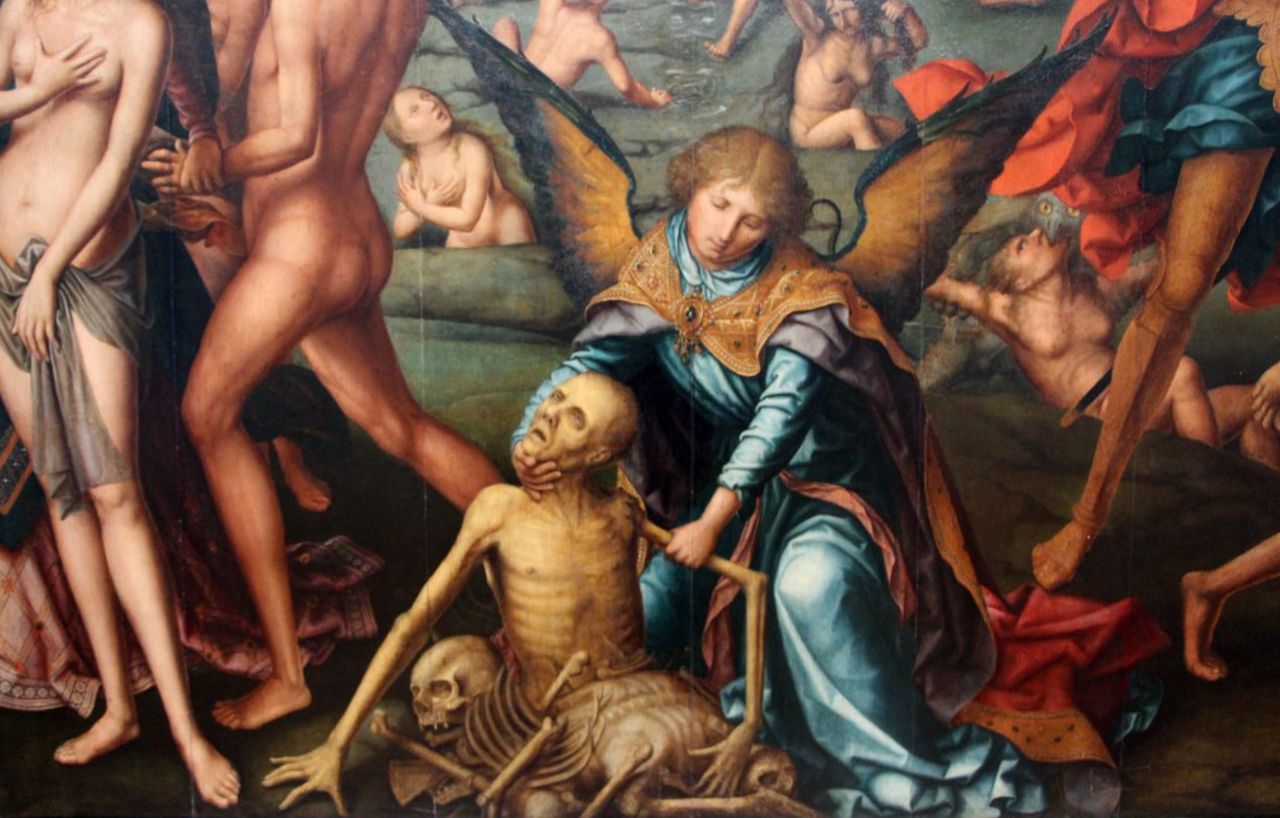
Another shortlisted artwork was the Last Judgment triptych by Jean Bellegambe, a French-speaking Flemish painter of the early sixteenth century. I was particularly drawn in by a detail at the bottom of the central panel, which shows skeletons in the process of acquiring flesh, and an angel reassembling body parts. It is very common in historical works of art for the resurrection of the dead to be subsumed under a larger visual program of the Last Judgment—but Paul doesn’t discuss judgment in my given passage, so I decided to move away from that context.
Jean Bellegambe (French/Flemish, ca. 1470–1535/36), Triptych with the Last Judgment (detail), ca. 1525. Oil on oak panels. Gemäldegalerie, Staatliche Museen, Berlin.
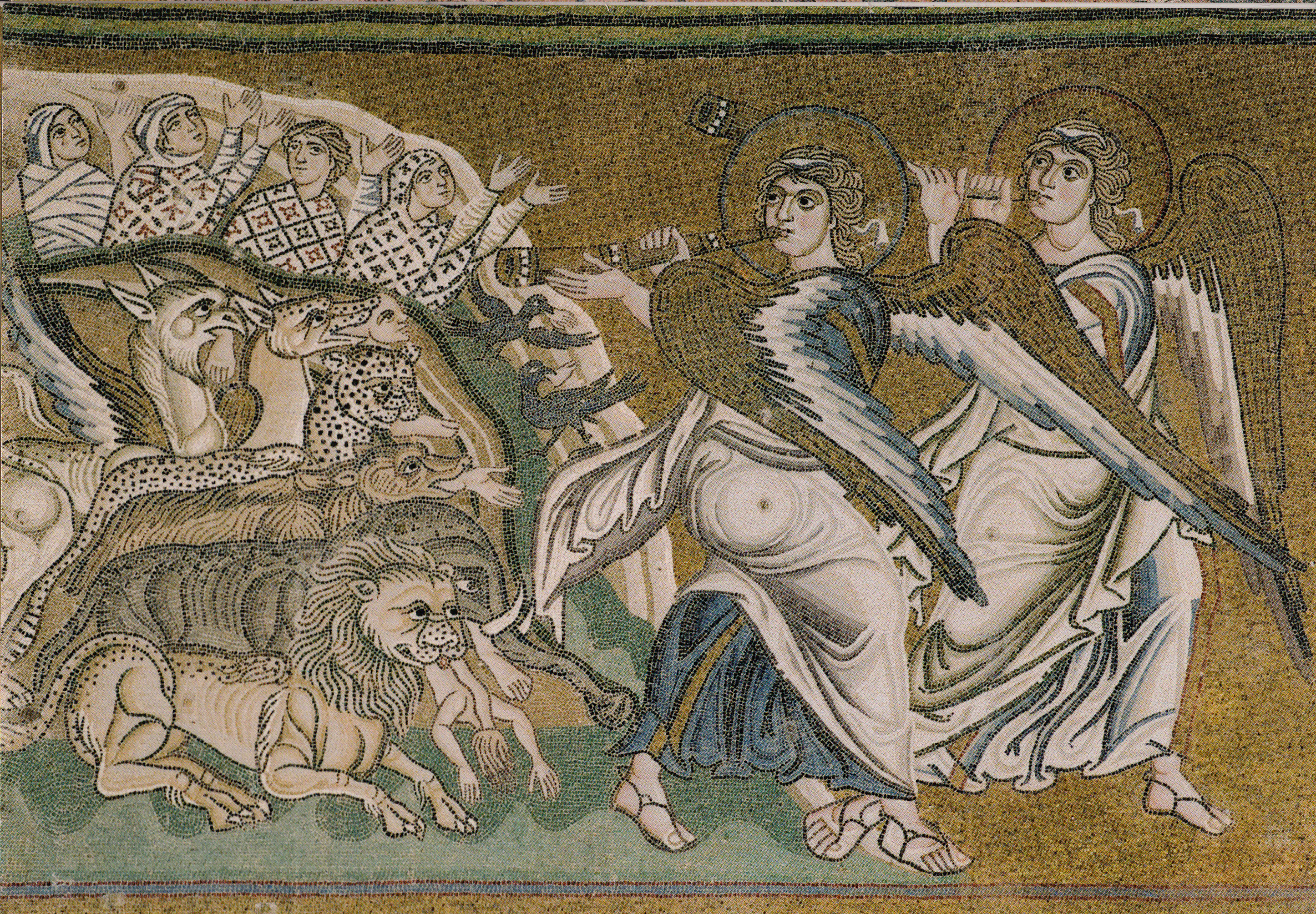
Probably the most unusual thing I discovered in the course of my research was the “regurgitation motif,” which shows animals vomiting up human body parts (from the corpses they have eaten) for reassembly on the last day. Several early church fathers mentioned that this would happen in their theologies of the resurrection, but its visual origin is attributed to the posticonoclastic East and the Carolingian-Ottonian West; it continues down into modern times in Greek, Bulgarian, and Russian frescoes. One of the best-known examples (in the West) is from the monumental twelfth-century mosaic at Torcello near Venice.
Last Judgment (detail), 12th century. Mosaic, west wall, Church of Santa Maria Assunta, Torcello, Venice, Italy.
Last Judgment (detail), 12th century. Mosaic, west wall, Church of Santa Maria Assunta, Torcello, Venice, Italy.
Bynum cites a handful of other examples in her aforementioned book and discusses the motif in depth, contributing to one of her main theses: damnation is swallowing, salvation is regurgitation. An absolutely brilliant argument, drawing heavily on visual theology.
It’s likely that Revelation 20:13 (“And the sea gave up the dead which were in it . . .”) influenced the creation of this motif. Because Paul himself doesn’t mention the mouths of animals giving up their dead, I decided not to go with the extraordinary Torcello mosaic. But I was able to sneak in a reference to that tradition by way of a side detail in one of the paintings I chose. It’s almost comical to look on, how literal it is. But it’s also thought-provoking. If our dead bodies are eaten and digested by worms or carrion beasts—or, God forbid, we meet our end through the mouth of a wild animal—then what remains of us, if we are divided into parts, mere particles, even? Will we ever be made whole again? If we are both body and soul, as Christianity attests, then isn’t our material continuity essential?
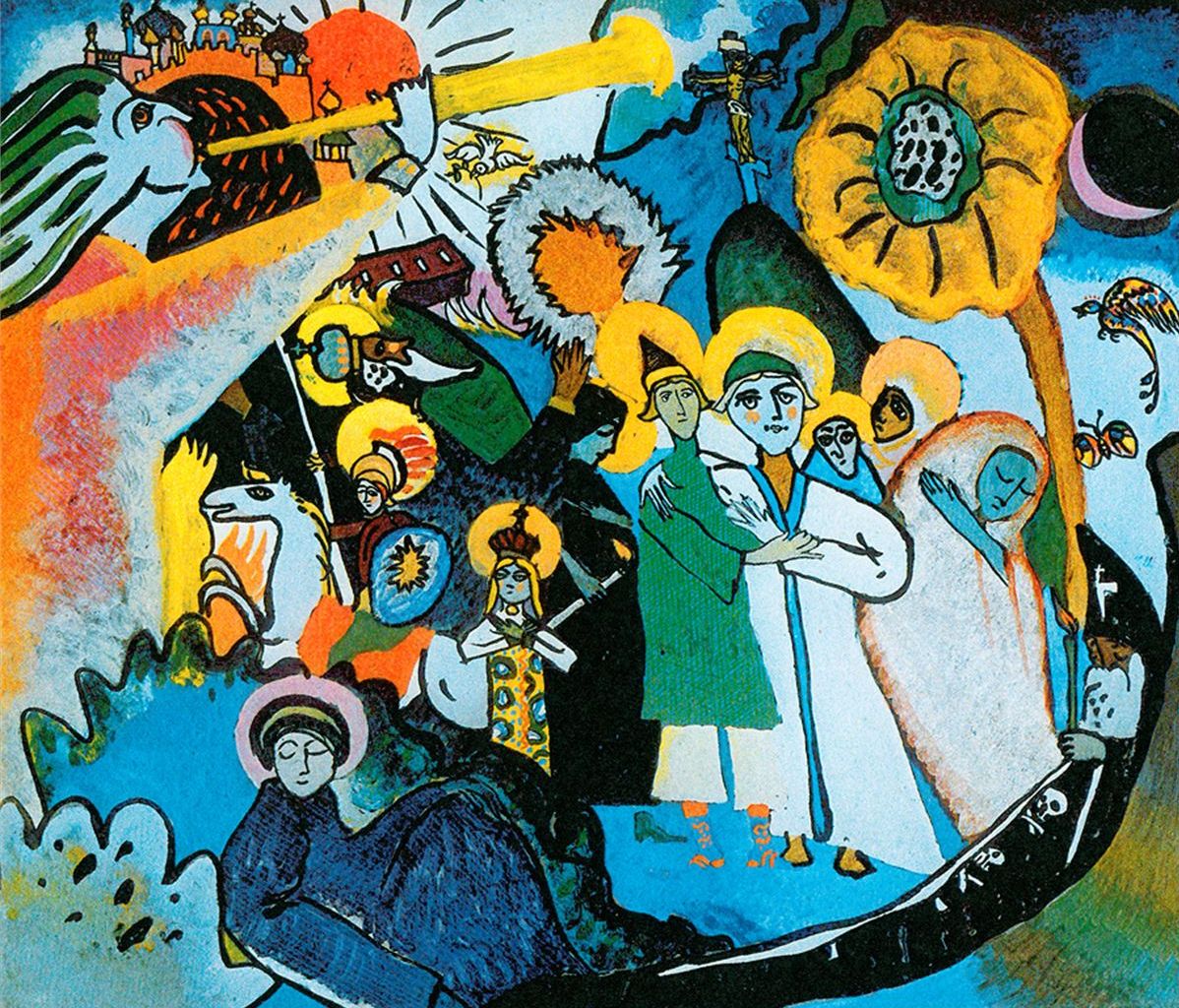
Other runners-up that didn’t make the cut were Wassily Kandinsky’s eschatological paintings—for example, All Saints I and Composition V. I wanted to choose artworks from three different countries and eras, and for the modern period, I just had to go with Stanley Spencer, who is renowned for his many resurrection paintings, localized to his hometown of Cookham in the UK. (I also felt a little out of my depth writing about Kandinsky’s radical style and spiritual approach to painting.)
Wassily Kandinsky (Russian, 1866–1944), All Saints I [Allerheilgen], 1911. Reverse glass painting, 20 × 24 in. Städtische Galerie im Lenbachhaus, Munich, Germany.
The inclusion of Spencer also influenced my choice, after some consideration, not to go with the Harrowing panel from Nicholas Mynheer’s Wilcote polyptych. (Two twentieth-century British paintings would have presented too limited a range.) It would have fit well with the Corinthians passage, which talks about us being sown in dust and reaped in glory—and its juxtaposition with Adam and Eve’s expulsion from paradise, on the opposite wing of the altarpiece, further underscores this theme. I wrote about the altarpiece as a whole a few years ago at Art & Theology.
Nicholas Mynheer (British, 1958–), The Harrowing, extreme right inner panel of a polyptych, 1999. Wilcote Chapel, St. Mary’s Church, North Leigh, Oxfordshire, England.
+++
So what did I end up choosing?
A fifth-century Christian sarcophagus from Italy, emphasizing Paul’s metaphor of the body as seed that, once buried, will flower forth in life
A thirteenth-century German psalter illumination that shows the dead casting off their grave-clothes and “putting on” immortality
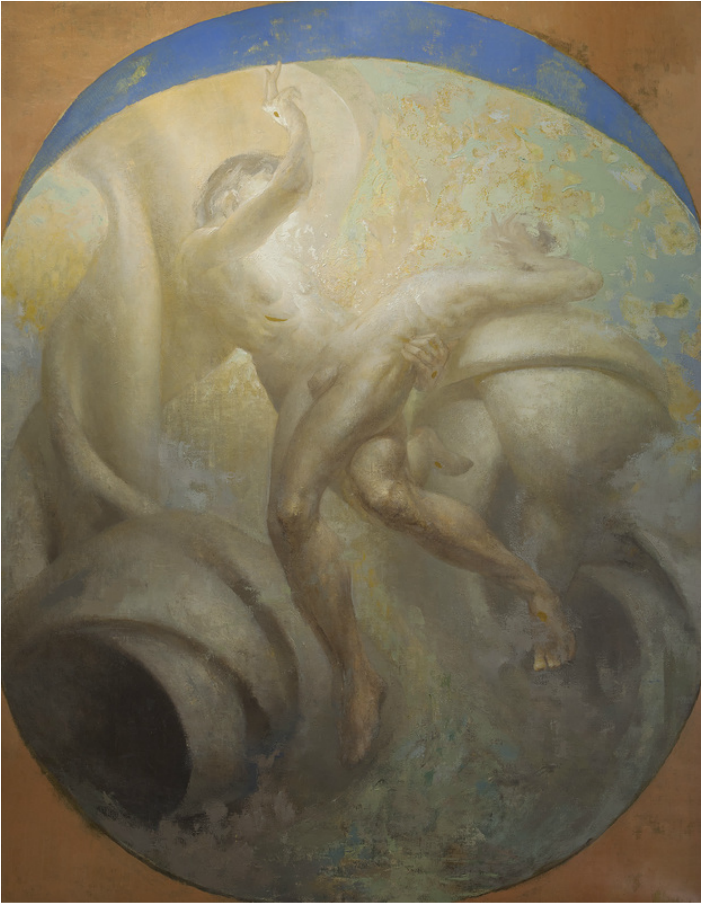
A twentieth-century painting by the British master Sir Stanley Spencer, who set the resurrection in a local churchyard, using his friends and neighbors as subjects








 Art & Theology