Holy Wednesday: Gallows

LOOK: Portrait of Judas by Julia Stankova

Stankova, Julia_Portrait of Judas
Julia Stankova (Bulgarian, 1954–), Portrait of Judas, 2004. Tempera, gouache, watercolor, and lacquer technique on wood, 45 × 60 cm.

In this painting by Julia Stankova, Judas presses in for his infamous kiss, identifying Jesus to his captors. Stankova portrays the moment as one of double woe, leading to the death of both Jesus and Judas. To heighten the emotional impact, she tightly crops the composition, eliminating all other figures besides the two. Jesus closes his eyes to receive with grace what has been a long time coming. Judas keeps his open. With one arm, he embraces his former friend; with the other, he holds a branch that’s ornamented, forebodingly, with his own dangling corpse. The Bulgarian inscription names the painting: Portrait of Judas.

Adapted from my commentary originally published in the two-part IMB article “Journey to the Cross: Artists Visualize Christ’s Passion.”

LISTEN: “Gallows of My Desire” by Kris MacQueen, on Good Morning. Happy Easter. 3 (2014)

Tonight we ate together
Bread and the wine cooked rare
You looked so disappointed
When I took off down the stairs
We took the road together
But I just exited right
I’ll see you in a little while
And again on the other side

Refrain:
I stood above you
Like a conqueror
And you stood beside me like a friend
I kissed you goodbye
At the gates of hell
But you’ve always called my bluff
Yeah, you know my every tell

Tonight I’m taking matters
Into my guilty hands
Just sold the Prince of Peace out
For a little stretch of land
There’s nothing like the yoke
Of the innocent when they die
It came upon me like a stone
When I saw the deed was mine [Refrain]

Now I’m swinging in the gallows
Of my own desire
My spirit is departing to God knows where
Is there a grace sufficient
To receive this broken soul?
You bled out for the whole wide world
How ’bout your very own? [Refrain]

But I always knew I’d bow to you in the end

Kris MacQueen is a singer-songwriter and former pastor from Kitchener, Ontario. Since 2019 he has been recording music with his wife, Liv, under the name The MacQueens. It is their voices on “Gallows.” This song was released in 2014 on a little six-song compilation album of Passion-Easter-Pentecost music put out by Morning and Night Music, which is no longer available. I asked MacQueen if he’d be willing to post his contribution online so that you all can enjoy it, and he obliged!

The song is in the voice of Judas, who is feeling the full weight of his betrayal—the innocent Christ’s death a yoke or a millstone around his neck. Many Christian interpreters think that Judas gave Jesus up to the authorities as a way to force his hand; impatient with Jesus’s not seizing power from Rome, Israel’s political oppressors, he thought that an arrest would be just the inciting event Jesus needed to finally unleash the forces of heaven against the empire, obtaining vindication and freedom for God’s people. Judas, according to this theory, was genuinely shocked and horrified when Jesus submitted to the capture and then the death sentence.

By asserting his own plans and desires counter to God’s, Judas effectively builds his own death trap, as the guilt over the consequences of his betrayal leads him to suicide. But before tying that noose, maybe, we can only hope, he sought redemption for his wrongdoing. His return of the blood money seems to indicate as much. He was clearly remorseful. MacQueen’s Judas prays from the gallows, pleading the blood of Jesus. If Jesus’s blood can save even the most odious of sinners, he reasons, then surely it avails for me. But he’s not so sure; he poses it as a question, a challenge, even.

The final line of the song suggests that in the end, perhaps Judas was finally able to see the rightness of Jesus’s way and was able to bow not to the king he imagined or wanted him to be, but to the king he was—the Prince of Peace, the servant-Christ, the sacrificial Lamb.
Roundup: Via Dolorosa with medical X-rays, hope in the night, and more

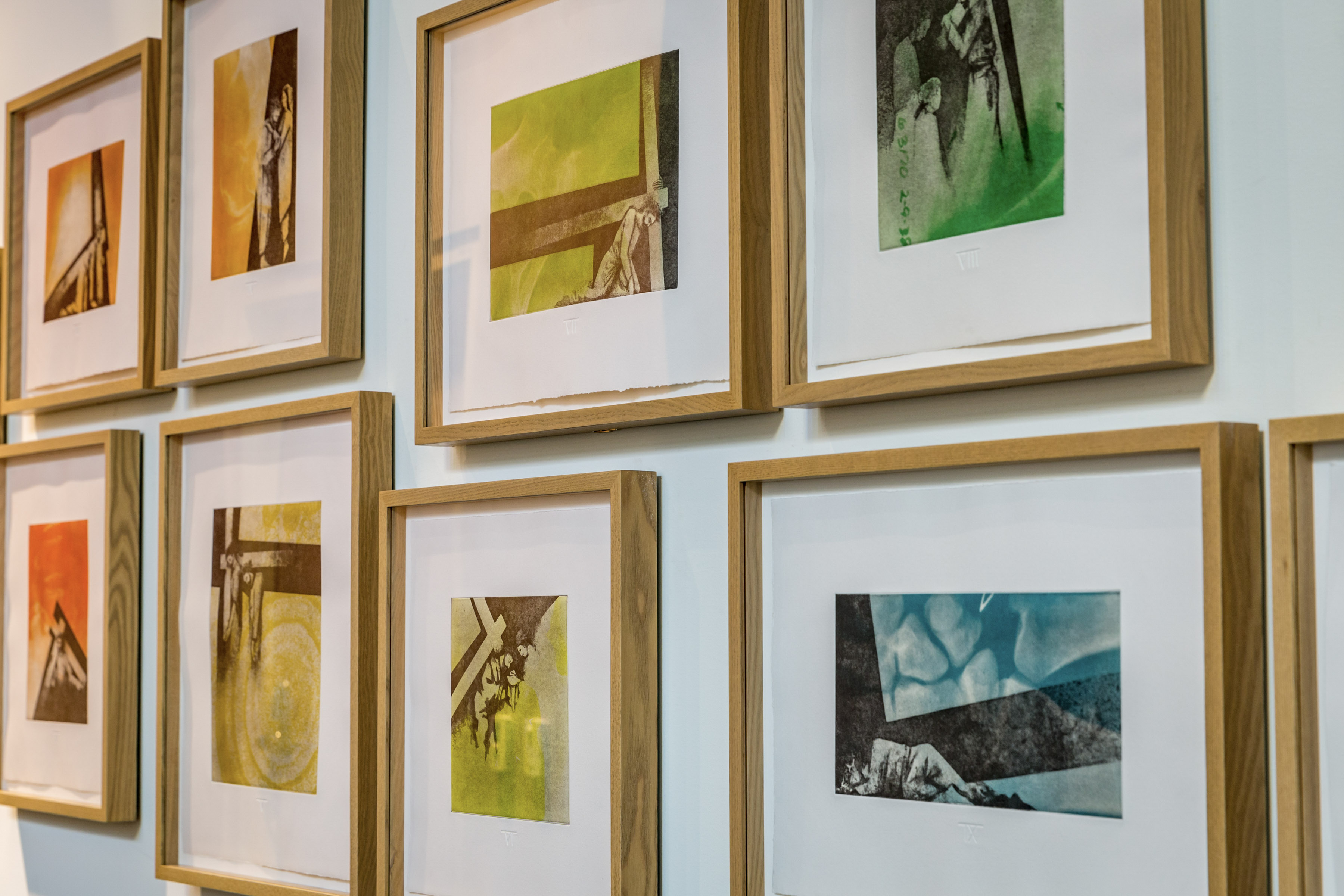
PRINT SUITE: Via Dolorosa by William Frank: Commissioned by SSM Saint Louis University Hospital for their chapel, this set of Stations of the Cross prints by William Frank combines depictions of Christ’s passion with diagnostic X-ray imaging of patients from the hospital’s archives. “The human body, and the community, act as the landscape,” he told me. A bullet in the spine, a kidney stone, a wrist fracture, a tumor, tuberculosis of the bones—Jesus’s suffering unfolds against the backdrop of these specific, tangible forms of suffering. But the rainbow color scheme transforms the stark black-and-white medical images into something a little less scary, suggesting hope and promise—maybe healing, maybe not, but at the very least, divine accompaniment along the path of sorrow.

Frank, William_Via Dolorosa
William Frank (American, 1984–), Via Dolorosa (installation detail), 2020. Etching, archival inkjet, chin collé, with embossment, suite of fourteen prints, overall 4 × 16 ft. SSM Saint Louis University Hospital Chapel, St. Louis, Missouri. Photo: Lisa Johnston, courtesy of the artist.

This year, the Catholic Health Association of the United States created a set of video reflections around Frank’s Stations, one for each piece, which you can find at https://www.chausa.org/prayers/lent-reflections. They also shot a video conversation with the artist:

The suite won a Faith & Form International Award for Religious Architecture & Art.

+++

NEW SONG: “Spooling” by Rev. Matt Simpkins: Diagnosed with stage 4 skin cancer, the Rev. Matt Simpkins [previously] of Lexden in Colchester, an Anglican vicar and a rock musician, said the only way he could calm his nerves enough to get through his next MRI scan was by writing a song from inside the machine. He composed some words and harmonies in his head to the “groovy,” sonorous beeps of the scanner, recording the song afterward using sampling, thus turning a typically threatening, antiseptic medical sound into a party vibe. He was interviewed on the BBC about it last month:

And here’s the bizarre music video, with special effects!

“I’m in a difficult situation with stage 4 cancer, but again, you’ve got a choice, and this song is a good example of that—how you can take something up into song and live,” he says. He hopes the song will minister to those who are undergoing cancer treatment or facing a possible diagnosis—that it is a small oasis, a source of silly laughter, comfort, and strength, for those in dire health.

“Spooling” is the first single from Simpkins’s forthcoming album Pissabed Prophet, a collaboration with his friend Ben Brown. The album is available for preorder on Bandcamp.

+++

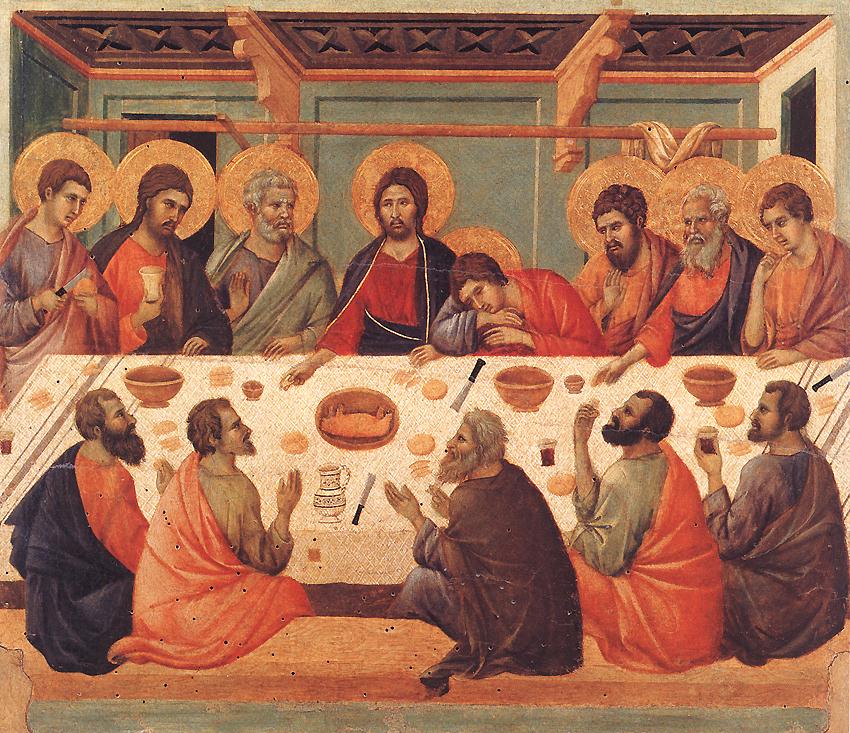
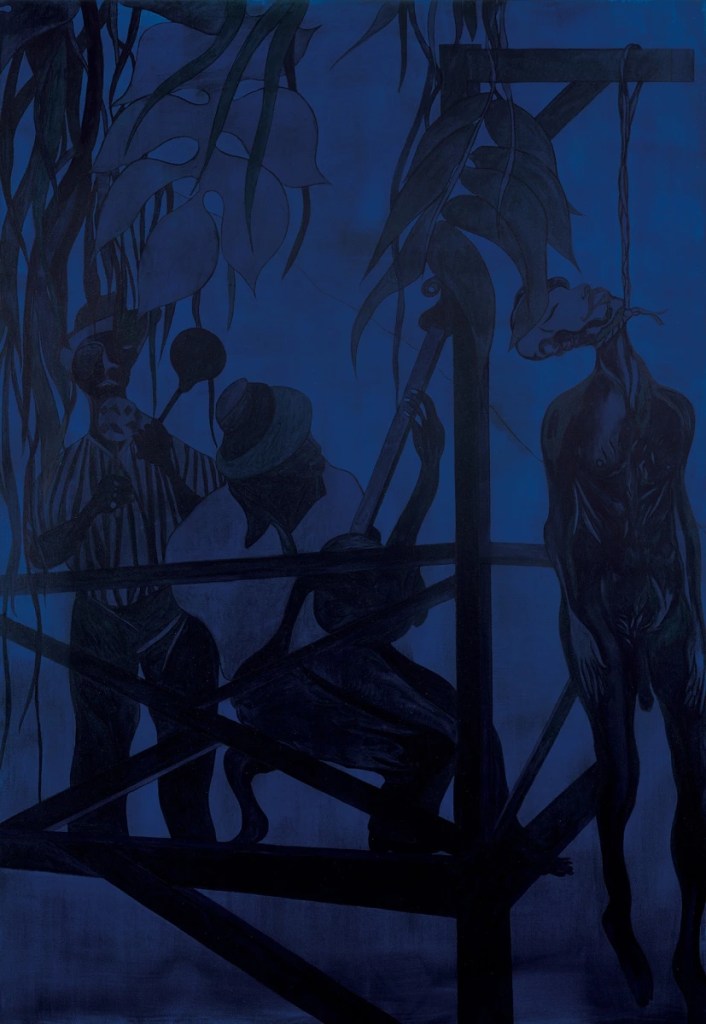
ART COMMENTARY: The Apostle Judas by Adrienne Dengerink Chaplin: As part of the Visual Commentary on Scripture project, Dr. Adrienne Dengerink Chaplin has selected three artworks that in some way interpret Matthew 26:20–25 (and parallel passages), when at the Last Supper Jesus announces that someone there will betray him. Rather than featuring the more common portrayals of Judas as malevolent, halo-less, and/or segregated from the group at the far end of the table, Dengerink Chaplin has chosen works that show him integrated and indistinct, one of twelve betrayers, whose treachery, she boldly proposes, we might construe as “a happy fault.”

  • Ofili, Chris_The Upper Room
  • Duccio_Last Supper
  • Ofili, Chris_Iscariot Blues

With the Duccio panel, she points out something I’ve often contemplated as well: that Jesus feeds Judas with the element he calls his body, keeps communion with him, and is there not a preemptive forgiveness implicit in that act?

+++

SONG: “In the Night” by Andrew Peterson: At a Laity Lodge retreat in 2015, Andrew Peterson of Nashville performed one of the songs from his album Counting Stars (2010) with fellow musicians Buddy Greene, Jeff Taylor, and Andy Gullahorn. “In the Night” rehearses “dark night” stories from scripture: Israel wrestles with God, is enslaved by Egypt, is pressed in by Syria; a prodigal son must resort to eating pig slop; the Son of Man is beaten and killed. But in each of these stories, deliverance comes. Hence the refrain: “In the night, my hope lives on.”

+++

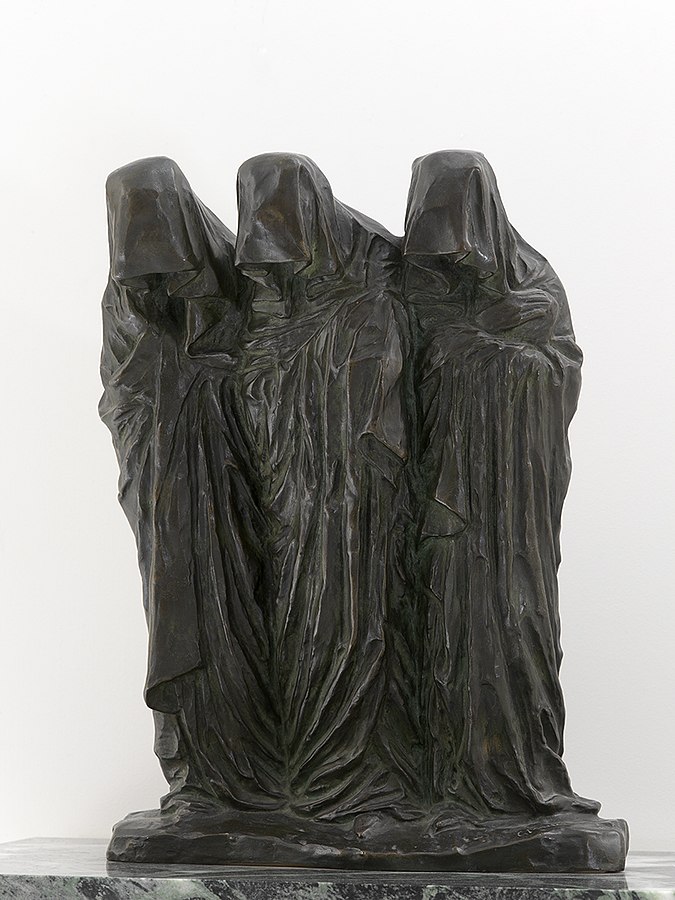
VISUAL MEDITATION: On The Holy Women at the Tomb by George Minne, commentary by Marleen Hengelaar-Rookmaaker: Marleen Hengelaar-Rookmaaker, the creator of ArtWay, writes about a nineteenth-century bronze sculpture by the Belgian artist George Minne, which shows the three women who went to Jesus’s tomb on Easter morning in an attitude of grief—bent backs, bowed heads—drawing on the gothic pleurants, or weepers, of late medieval tombs. The women are “totally enwrapped in mourning their beloved,” Hengelaar-Rookmaaker writes. “This is in fact the very last moment of the passion, the last moment of suffering past the Pietà and the burial of Christ. It will only be a minute before their hoods will come off and the news of the resurrection will enter their numbed minds.”

Minne, George_The Holy Women at the Tomb
George Minne (Belgian, 1866–1941), Les saintes femmes au tombeau (The Holy Women at the Tomb), 1896. Bronze, 44.5 × 62 × 20.5 cm. Groeningemuseum, Bruges, Belgium.

This composition by Minne also exists in granite, wood, and plaster versions.

+++

NEW PLAYLIST: April 2023 (Art & Theology): Includes an excerpt from the psychedelic rock–style Mass in F Minor by the Electric Prunes, “The Outlaw” by Jesus Movement icon Larry Norman, a chuckle-inducing bluegrass song first recorded in 1926 by Gid Tanner and Faith Norris and covered here by the Local Honeys, a choral setting of Psalm 128 (“Happy is everyone who fears the Lord, who walks in his ways . . .”) by the Italian Jewish Renaissance composer Salomone Rossi, Whitney Houston’s rendition of “His Eye Is on the Sparrow,” and a short Kiowa Apache church song that translates to “Son of our Father will set up a cedar tree / Now he is calling to us / He’s going to heal our minds / That’s why he is calling to us.”

Roundup: Crucifixion and Holocaust, Indonesian Christian art, and more

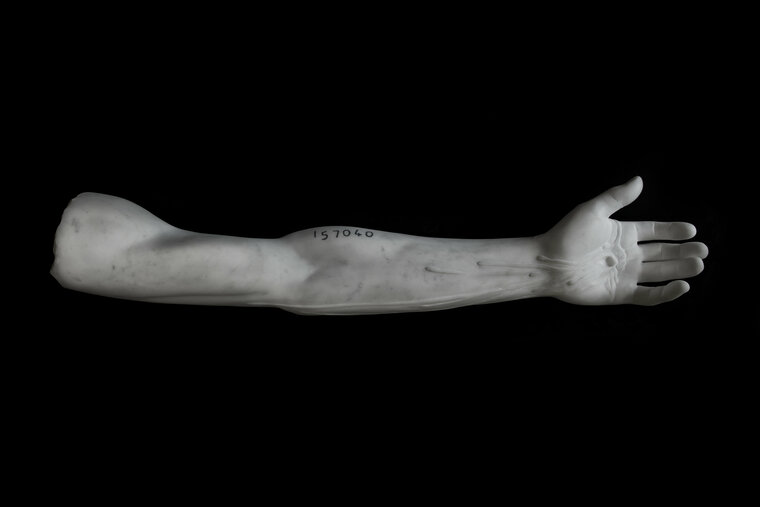
VISUAL MEDITATION: “Golgotha, Auschwitz, and the Problem of Evil” by Victoria Emily Jones: Last month for ArtWay I was asked to write about Emma Elliott’s Reconciliation, a sculpted marble arm that bears both a nail wound of Christ from his crucifixion and the number tattoo of Holocaust survivor Eliezer Goldwyn (1922–2017).

Elliott, Emma_Reconciliation
Emma Elliott (British, 1983–), Reconciliation, 2016. Carrara marble, 20 × 110 × 25 cm.

+++

ESSAY: “The church’s reception of Jewish crucifixion imagery after the Holocaust” by Andrew Williams, AGON 48 (Winter 2015): Can Jews create Christian art? “I seek to revisit this question by examining the ways in which Jewish artists have made reference to the central symbol of the Christian faith, the crucifixion, and consider the ethical and theological horizons they open up for the church. . . . Given its place as a symbol of oppression within Judaism, and in particular its integration with the swastika during the years of Nazi power, its widespread adoption within a Jewish artistic vocabulary is remarkable.” Williams discusses “how the resulting christological imagery has been freighted with meaning connected with collective suffering, personal grief and divine abandonment.”

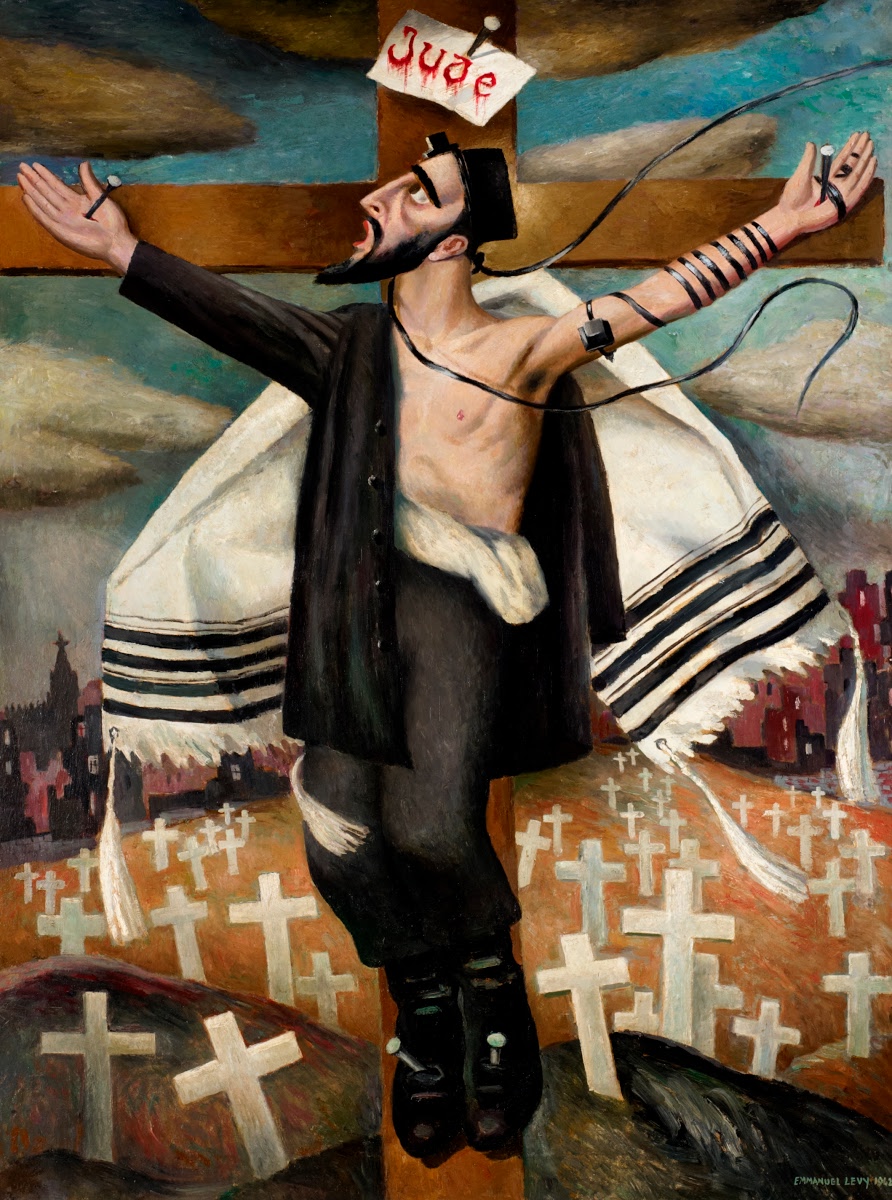
Levy, Emmanuel_Crucifixion
Emmanuel Levy (British, 1900–1986), Crucifixion, 1942. Oil on canvas, 102 × 78 cm. Ben Uri Gallery, London.

Jacob Epstein, Marc Chagall, Emmanuel Levy, RB Kitaj, Mauricio Lassansky, Abraham Rattner, Samuel Bak, Mark Rothko, Barnett Newman, Adi Nes, and Seymour Lipton are among the artists engaged in this illustrated essay. The author provides an extensive bibliography if you’d like to learn more. I also want to remind you of the excellent exhibition catalog essay “Behold the Man: Jesus in Israeli Art” that I shared back in 2017.

+++

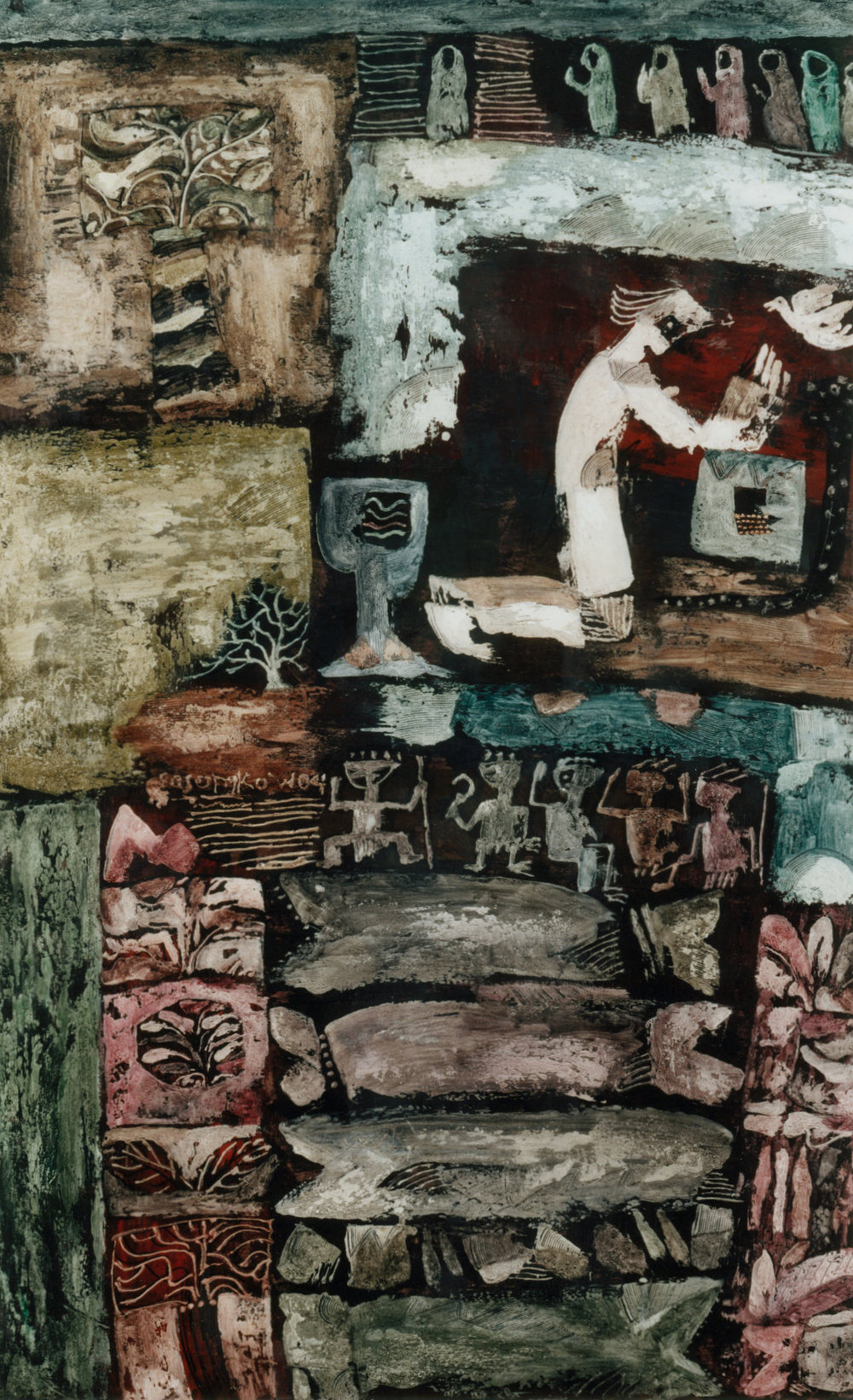
UPCOMING VIRTUAL EVENT: Studio Talk with Indonesian Artist Wisnu Sasongko, April 28, 2022, 8:30 a.m. ET: Organized by the Overseas Ministries Study Center at Princeton Theological Seminary, where Sasongko [previously] served as artist in residence in 2004–5. Cost: $15. Read the artist’s bio and see a sampling of his work at https://omsc.ptsem.edu/artist-sasongko/. There’s also a catalog of his paintings you can buy.

Sasongko, Wisnu_Gethsemane
Wisnu Sasongko (Indonesian, 1975–), Last Night in Gethsemane, 2005. Acrylic on canvas, 48 × 34 in.

+++

ESSAY: “The Christian Art Scene in Yogyakarta” by Volker Küster: Published June 27, 2012, by Protestantse Theologische Universiteit (Protestant Theological University) in Kampen, Netherlands, this essay spotlights five Indonesian artists whose work culturally contextualizes the Christian story: Bagong Kussudiardja [previously], Hendarto, Hari Santosa, Dopo Yeihan, and Wisnu Sasongko. Küster provides biographical information on the artists, including their religious backgrounds (most are converts from Islam), and discusses three paintings by each, all of which are reproduced in full color.

Want to read more by Volker Küster? His chapter on “Visual Arts in World Christianity” in The Wiley Blackwell Companion to World Christianity is excellent, and some of it is available in the Google Books preview. See also his book The Many Faces of Jesus Christ: Intercultural Christology (Orbis, 2001).

+++

ART VIDEO: “Caravaggio’s Taking of Christ (Great Art Explained): In 2020 art writer and gallerist James Payne launched the YouTube video series Great Art Explained, consisting of fifteen-minute videos that each explore a single historically significant artwork. Here’s one he did on an extraordinary painting of Caravaggio’s from the collection of the National Gallery of Ireland, which shows Judas’s betrayal of Christ in Gethsemane.

Album Review: Last Days by the Brothers of Abriem Harp

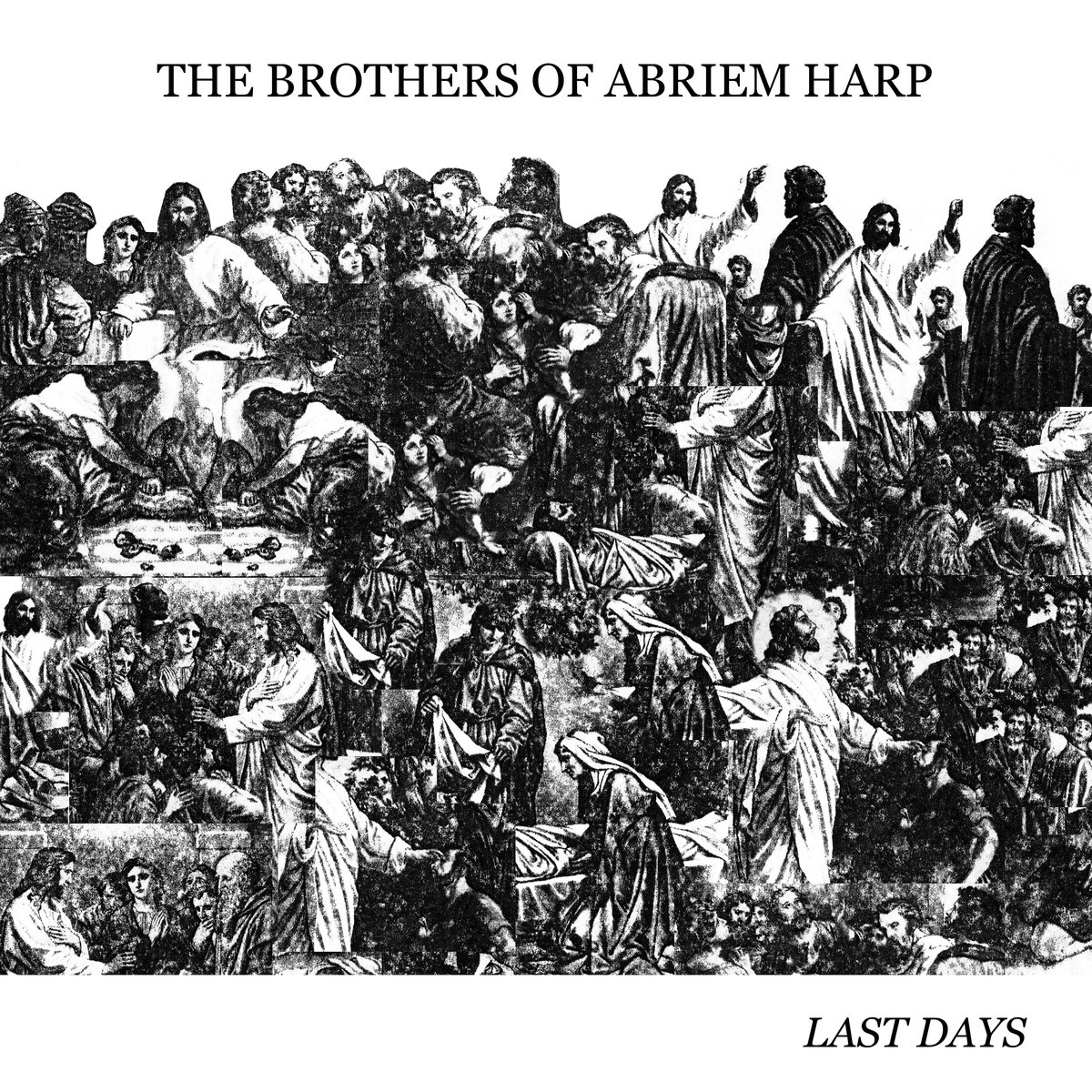
Released in 2015, the album Last Days by the Brothers of Abriem Harp features twelve original indie-folk songs for Holy Week that tell the story of Christ’s passion, from the thundering voice of the Father affirming the Son but also presaging judgment, to the glorification of Christ in the resurrection. One of its major draws is its quiet, understated conveyance of the week’s drama through several different voices: Jesus, of course, but also Mary, Peter, Judas, and other unnamed disciples who reflect on the events they witness, especially in light of their histories with Christ.

Last Days album cover

Approaching Jesus’s last days primarily through the lens of story—plot, character, mood, etc.—rather than the lens of doctrine makes the listening experience more immersive. That’s not to say theology is absent from the album; it’s very much there. But it is not heavy-handed or abstruse, and neither is it reduced to clichés.

The songs are written and sung by Joe Kurtz (pseudonym: Abriem Harp) and Josh Compton (Josh Harp), with Matt Kurtz (Matthew Harp) on percussion and John Finley (Hezekiah Harp) playing many of the other instruments. On the band’s Facebook page they describe themselves as “gospel-shoutin’ melody makers from the Rust Belt,” and among their musical influences are field recordings, the Sacred Harp tradition, and mountain music.

In the video below, the Brothers have set the entire album to altered footage from Vie et Passion du Christ (Life and Passion of the Christ), a forty-four-minute silent film released in France in 1903. The album is also available for streaming and purchase at https://harpfamilyrecordings.bandcamp.com/album/last-days.

Here’s a rundown of the songs.

1. “Glorify”

A voice arose, a voice arose
A voice arose, a voice
It sounded like thunder, pounded like thunder (×4)

It said, “I’ve glorified it, and again I’ll glorify it”
Yeah, “I’ve glorified it, and again I’ll glorify it” (×3)

This is an unconventional starting point for the passion narrative, which typically begins with Christ’s entry into Jerusalem. Instead, the Brothers have chosen a lesser-known episode from John’s Gospel, which occurs just after the triumphal entry—and what a beautiful passage to highlight. (I actually was not familiar with the references in the song and had to look them up—a great example of how the arts can stimulate renewed engagement with the Bible!)

“The hour has come for the Son of Man to be glorified. Truly, truly, I say to you, unless a grain of wheat falls into the earth and dies, it remains alone; but if it dies, it bears much fruit. . . .

“Now is my soul troubled. And what shall I say? ‘Father, save me from this hour’? But for this purpose I have come to this hour. Father, glorify your name.”

Then a voice came from heaven: “I have glorified it, and I will glorify it again.” The crowd that stood there and heard it said that it had thundered. Others said, “An angel has spoken to him.”

Jesus answered, “This voice has come for your sake, not mine. Now is the judgment of this world; now will the ruler of this world be cast out. And I, when I am lifted up from the earth, will draw all people to myself.” He said this to show by what kind of death he was going to die.

John 12:23–24, 27–33

“It’s time.” That’s essentially what Jesus is saying. And then in the middle of this discourse with the disciples, Jesus gets real with the Father. “I’m scared! But what can I do? This is my destiny; I can’t avoid it.” And then, his words of acceptance, of surrender: “Father, glorify your name.” It’s unclear whether this prayer was audible to the disciples or was expressed merely internally. Whatever the case, the Father’s response was heard by all—though some attributed it to natural phenomena, or to an angel.

As this passage clarifies, the “it” in the song is the Father’s name: God says that he has glorified it in the past, and he will glorify it again, when Christ is lifted up for the salvation of the world.

John uses the words glory and glorified a lot in his Gospel, especially in relation to Christ’s passion. In John 13:31, after the Last Supper, where Jesus has just identified Judas as his future betrayer, Jesus says, “Now is the Son of man glorified, and God is glorified in him.” Later that night, in Gethsemane, Jesus prays, “Father, the hour has come; glorify your Son that the Son may glorify you. . . . I glorified you on earth, having accomplished the work that you gave me to do. And now, Father, glorify me in your own presence with the glory that I had with you before the world existed” (John 17:1, 4–5).

The opening song on Last Days, therefore, though just three allusive lines, repeated, is packed with meaning, much of it concentrated in that dense word glorify, a word that orients the whole album. Much like the opening sequence of a movie sets the movie’s tone and hints at what you’re in for, so do opening songs on albums, and this one is somewhat portentous, leaving us wondering, “How will God’s name be glorified?”; it also gives the Father a speaking role and thus situates him as a main character in the story.   Continue reading “Album Review: Last Days by the Brothers of Abriem Harp”