
Online highlights from the 2023 Calvin Symposium on Worship

On February 8–10, 2023, I had the pleasure of attending in person my first Calvin Symposium on Worship, an annual ecumenical gathering of Christian worship leaders from throughout North America (and some from overseas) organized by the Calvin Institute of Christian Worship at Calvin University and the Center for Excellence in Preaching at Calvin Theological Seminary in Grand Rapids, Michigan. The half-week is full of diverse worship services, lectures, breakout sessions, and opportunities to meet and mingle with folks who serve the church as pastors, liturgists, musicians, publishers, scholars, etc. It was an invigorating time!

The CICW is generous in providing recordings of much of its symposium content for free on their YouTube channel several months after the event, and they’ve just released a big batch. Below are some of my highlights that are shareable.  

Though music is not the exclusive focus of the symposium, it is a major component, and my ministry background is in that area, so I want to share with you some of the new songs I learned.

The worship service on February 9, titled “Rooted in Christ,” was excellent and worth watching in full (the sermon, on Colossians 2:6–15, was preached by Rev. Dr. Marshall E. Hatch, pastor of New Mount Pilgrim Missionary Baptist Church in Chicago), but here are three standout songs. The first two are led by the Calvin University Gospel Choir, directed by Nate Glasper Jr., and feature guest soloist Eric Lige.

“On Christ the Solid Rock,” adapt. and arr. Gerald Perry, 2022:

This song is a new gospel adaptation and arrangement by Gerald Perry of the classic Edward Mote–William Bradbury hymn “The Solid Rock.” It appears on the 2022 album Legacy by the James Family Singers (which is on Spotify), a West Michigan gospel group founded by Oscar and Erma James in 1981 and to which Perry belongs, along with more than two dozen members of his extended family.

“God Is Good” by Morris Chapman, 1992:

A call-and-response song written by Lige’s late mentor, Morris Chapman (1938–2020), a Grammy- and Dove Award–nominated composer and recording artist. The song appears on the 2010 compilation album Incredible Gospel, vol. 2.

“If God” by Casey Hobbs, John Webb Jr., and Natalie Sims, 2019:

This song of lament was sung by Samantha Caasi Tica, then a senior in Calvin’s speech-language pathology department, and Calvin alum Emma Gordon as the “Prayer of Intercession” portion of the service. The congregation (is that what you’d call the group of worshippers at a symposium?) was asked to come in on the chorus and the “Nothing but the Blood of Jesus” bridge. For the official live video of the song as performed by its writer, Casey J, see here.

And now from other worship services at the symposium:

“Los que sembraron con lágrimas” (Those Who with Tears Went Out Sowing) (Psalm 126) by Carlos Colón, 2019:

The Bifrost Arts setting of Psalm 126 by Isaac Wardell is one of my favorite congregational songs—it leans into the “weeping” aspect of the psalm. But this new setting by Carlos Colón leans into the psalm’s “joy” aspect, which gives it a different tone that works equally well, I think. It was led by Colón at the piano, with the help of Calvin University students and guest Wendell Kimbrough. (Watch full worship service.) It is #333 in the bilingual hymnal Santo, Santo, Santo: Cantos para el pueblo de Dios (Holy, Holy, Holy: Songs for the People of God).

“His Love Is My Resting Place (Psalm 23)” by Wendell Kimbrough, 2020:

There’s no standalone video for this song from the symposium, but I cued up the service video to where the song starts at 13:42; you can also listen to the solo recording released by songwriter Wendell Kimbrough in 2020. Director of music and songwriter at Church of the Incarnation in Dallas, Kimbrough is one of today’s foremost composers of biblical psalm settings for contemporary worship. Despite the dozens of settings that already exist of this most famous psalm, which begins “The Lord is my shepherd . . . ,” Kimbrough’s take is not a redundancy but rather a vibrant new and easily singable addition to this catalog of options. I brought it back with me to the local congregation I’m a member of, and the people took to it really well.

“Anta Atheemon” (You Are a Great God) by Ziad Samuel Srouji, 1990:

“Anta Atheemon” is sung by Christians throughout the Middle East and the Arabic-speaking world. It was written by Ziad Samuel Srouji, who was born in Haifa, Israel, and raised in Lebanon but then displaced by civil war to the United States. He is pastor of the Gate International Church in San Mateo, California.

“Soul, Adorn Yourself with Gladness / Vengo a ti, Jesús amado” (cued to 59:00):

What a wonderful song for the celebration of the Eucharist! “Bless the one whose grace unbounded this amazing banquet founded! The high and exalted and holy deigns to dwell with you most lowly. Be thankful! Soul, adorn yourself with gladness and rejoice!” I love the exuberant Puerto Rican melody.

The source of this hymn is the German communion chorale “Schmücke dich, O liebe seele” by Johann Franck (1618–1677). After being translated into Spanish by Albert Lehenbauer (1891–1955) for Lutherans in South America, the chorale traveled up to Puerto Rico, where it was reset to the tune CANTO AL BORINQUEN by Evy Lucío Cordova (b. 1934), now with an added refrain by Esther Eugenia Bertieaux (b. 1944). The English in the bilingual version here, published in Evangelical Lutheran Worship‎ #489, is a composite translation, borrowing from Catherine Winkworth (1827–1878) and others.

+++

The worship services, several a day, are only one component of the Calvin Symposium on Worship. There are also wonderful talks, panel discussions, and workshops—such as “Hardwired to Sing: Entrainment, Interactional Synchrony, and the Spirit-ed Magic of Corporate Song” by Dr. W. David O. Taylor. In this talk Taylor, a liturgical theologian teaching at Fuller Theological Seminary, expands on what I think is the most fascinating chapter of his latest book, A Body of Praise: Understanding the Role of Our Physical Bodies in Worship, which is “The Nature of the Body: Scientific Perspectives on the Body in Worship.”

“First, I wish to suggest that it is the Holy Spirit’s pleasure to work in and through our physical bodies, not just in our heads and hearts, in order to form us wholly into Christ’s body,” Taylor says. “And second, I would like to show how the sciences offer empirical insights into the metaphysical work of the Spirit to form our embodied communal singing.”

Citing Hebbian theory—namely, that “neurons that fire together wire together”—he says that singing together in corporate worship bonds us in ways that nothing else can, strengthening our kinship with one another through our bodies. “People who sing together experience a wiring together of their neural networks. They become tethered to one another in neurological and physiological ways, not just affective or relational ways.” He demonstrates this principle with the help of some audience volunteers.

The last twenty-five minutes of the video are Q&A. Unfortunately, the questioners aren’t miked, and not all the questions are repeated for the recording, so that part is a little hard to follow.

My favorite session that I attended was “The Practice of Lament,” a panel discussion with Drs. Wilson de Angelo Cunha, Cory B. Willson, and Danjuma Gibson, moderated by David Rylaarsdam—all Calvin faculty. “What are the different faces of lament? What is the goal of lament? How can pastoral leaders facilitate lament? What does lament reveal about the nature of God and what it means to be human?” It’s an excellent introduction to this important Christian discipline.

“Lament is a central part of our mission as God’s people, and I will say, we have largely failed,” says Willson. And later: “You cannot be a hopeful people or community if you don’t lament. And we need each other to hold out hope for us when we can’t find the strength to swing our feet from the bed to take another step toward a future.”

Asked to define lament, Gibson, a professor of pastoral care and a practicing psychotherapist, said, “Lamentation, or griefwork, is the process you engage in to come to terms with what has been lost, the rupture, the unattaching to what you have loved—that may be a way of life, that may be a person, that may be an image of how you thought things should have been—when there is a tragedy.”

Later in the discussion, in response to a question about how lament coheres with the apostle Paul’s call to rejoice always, Gibson clarifies: “Lamentation is not the opposite of joy. Lamentation is a particular manifestation of joy. And how I understand joy in my own work is this: joy is the inner assurance that you cultivate over time that you belong to God no matter what. . . . Lamentation is a declaration of that joy.”

Again, the questions from the audience are inaudible. But from memory, I can tell you that one was about divine impassibility (Greek apatheia), an attribute ascribed to God in classical theology that means that God does not feel pain or have emotions. This is an ascription that has always puzzled me and that I reject (it makes a virtue out of Stoicism), and indeed many Christian theologians have problems with it as well, because the picture of God that we have in both Testaments is of a God who is passionate, who grieves and gets angry and exults, and who is responsive to his people, empathetic.

Another question mentions the beating to death of Tyre Nichols by police officers in Memphis. Another asks how we know when we’re done lamenting a particular tragedy.

There’s so much that’s helpful and illuminating in this conversation; please give it a listen.

Another great panel discussion at the symposium was “Worship Music from Africa and the African Diaspora,” between Drs. James Abbington, Stephanie Boddie, Brandon A. Boyd, Pauline Muir, and Jean Kidula:

“What treasures and insights from the rich history of Christian worship music on the continent of Africa as well as from African diaspora communities in the United States and England should be more celebrated and cherished? What misunderstandings should be corrected? How can we learn from this rich history without misappropriating it? What signature examples of congregational song should we all learn more about and from? How can we all continue to learn more and explore more deeply connections across continents and Christian traditions?”

At 57:35, Abbington asks each panelist if they could teach the church one congregational song, one that’s important for the church to know, what would it be?

At the symposium, I also really enjoyed the lecture “More Than We Can Ask or Imagine: Music and the Uncontainability of Hope” by Dr. Jeremy Begbie, a theologian and pianist—but it is not and will not be available online. However, it draws on the themes of his new book from Baker Academic, Abundantly More: The Theological Promise of the Arts in a Reductionist World, which just released this week.


There were lots of other sessions offered as well—on creating a sense of belonging with youth in worship, intergenerational worship in global contexts, worshipping God with our public witness, sacred architecture and space design, cultural intelligence, singing the Psalms, wisdom from Indigenous Christians in Australia, how to shape a compelling sermon, lessons for leading congregational singing, refugia faith, and more. Several of these were recorded and are now hosted online in the Calvin Institute of Christian Worship Resource Library, which has content going back more than a decade (see also their YouTube channel @worshiprenewal).

Registration for next year’s Calvin Symposium on Worship has not yet opened, but the dates have been announced: February 7–9, 2024. The theme is Ezekiel. Find out more at https://worship.calvin.edu/symposium/index.html.
Epiphany: Glory

And when Christ, who is your life, is revealed to the whole world, you will share in all his glory.

—Colossians 3:4

Epiphany, meaning “revelation,” is the capstone of the Christmas season. In this final post of this year’s Christmas series, I leave you with a striking, light-flecked painting from Japan and a slow-tempo Black gospel song from the US. What marvel, that God’s glory fills such places as ours, and that he invites us not only to behold his glory but also to participate in it.

May God’s light continue to guide and enfold you throughout the year, and may you never stop seeking his face.

To view a compilation of this season’s numbered Christmas posts, click here; for Advent, here.

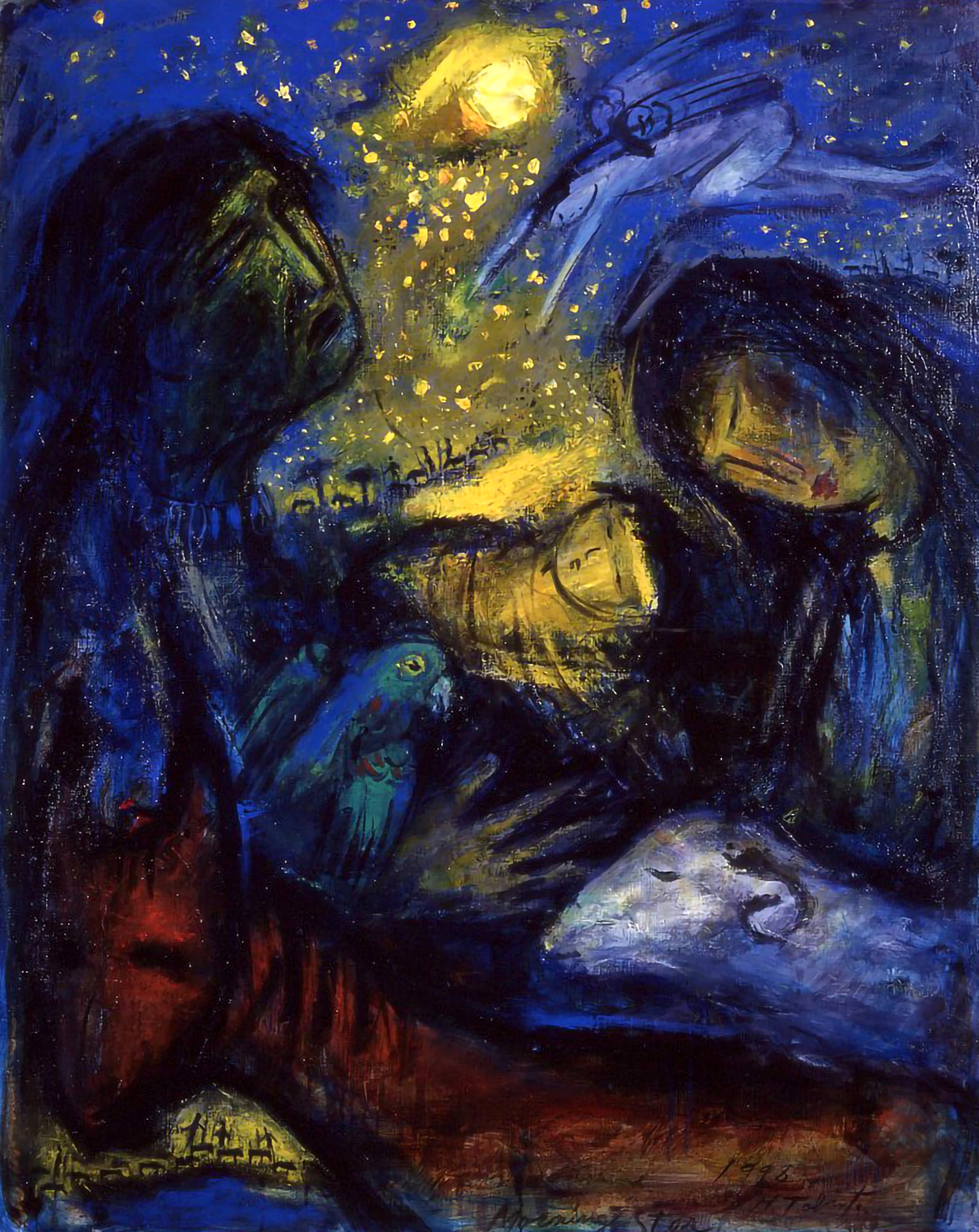
LOOK: Morning Star by Hiroshi Tabata

Tabata, Hiroshi_Morning Star
Hiroshi Tabata (田畑弘) (Japanese, 1929–2014), Morning Star, 1998. Oil on canvas, 90.9 × 72.7 cm. Private collection. Photo courtesy of the Estate of Hiroshi Tabata.

Born in Takaoka City, Hiroshi Tabata (1929–2014) studied art at the University of Toyama, later moving to France for two years for further art education. He exhibited his work throughout Japan and at Parisian salons. From 1966 to 1972 he lived intermittently in Brazil among the Xingu people, which led to his conversion to Christianity. From then on until his death, he painted biblical subjects. “The Bible is the ultimate theme for me,” he said; its world is “infinitely deeper” than we can comprehend.

In Tabata’s expressionistic Morning Star, starlight falls in a luminescent sheen over the face of the Christ child, whom Mary looks upon in tender adoration as Joseph wonders at the angelic activity above. The tight cropping around the Holy Family heightens the sense of intimacy. A sheep, donkey, and Amazon parrot (the latter a callback to his time in Brazil) crowd into the foreground, while on distant hills shepherds behold the glorious light display, hear the announcement that will propel them to their newborn Messiah. The wise men, too, are on their way. Epiphany is at hand. Heaven’s raining down (Isa. 45:8).

This visual reflection (by me) originally appeared in the Christmas/Epiphany 2022–23 edition of the Daily Prayer Project. Tabata’s art appears on the cover, by kind permission of his son-in-law. To view more biblical art by Tabata, see the beautifully produced, full-color book 田畑弘作品集 一つの星 (Hiroshi Tabata Works: Morning Star); the text is all Japanese.

LISTEN: “A Star Stood Still (Song of the Nativity)” | Words and music by Barbara Ruth Broderick and Johnny Broderick, 1956 | Performed by Mahalia Jackson with the Falls-Jones Ensemble, conducted by Johnny Williams, on Silent Night: Songs for Christmas, 1962

And we shall share
In the glorious light

In Bethlehem
The wind had ceased
The Lamb lay sleeping
On the hill

When all the earth
Was stilled with peace
Then lo, a star stood still

A star stood still
On yonder hill
Praise God that star still
Shining still

And we shall share
In the glory of love
Because a star stood still
That night a star stood still

A star stood still
On yonder hill
Praise God that star still
Shining still

And we shall share
In the glory of love
Because a star stood still
That night a star stood still

Note to readers: Art & Theology is noncommercial, but I do accept donations (monetary, or in-kind books!) to help keep it running. Learn more here.

Christmas, Day 8: All the Way

LOOK: Avatharana by Solomon Raj

Raj, Solomon_Avatharana
Solomon Raj (Indian, 1921–2019), Avatharana (Incarnation), late 1980s, batik. Source: Living Flame and Springing Fountain (Indian Society for Promoting Christian Knowledge, 1993).

Avataraṇa (अवतरण), from which we get the word “avatar,” is a Sanskrit word that means stepping down from a higher position. It’s the word used in Hinduism to refer to the incarnation of a deity, to his or her descending to earth. The late Indian Lutheran pastor, artist, and theologian Solomon Raj, from Andhra Pradesh, used the word, with nuance, to refer to the incarnation of Christ.

In this batik—a type of dyed cloth artwork made using a wax-resist method—Raj shows Jesus diving through the ether, surrounded by angels. He hurtles headfirst from heaven to earth to be with humanity. Reproduced in the book Living Flame and Springing Fountain (1993), the image is accompanied by this verse-style reflection by Raj:

When God became man and came to us,
the heavens donned a new robe of light.
When the son of man came to this earth,
the whole creation became renewed.
The universe now is redeemed and kept
for a glory yet greater than the first
because the unknown and the unknowable One
became man to live with mankind.

For more on the concept of Jesus as avatar from Christian perspectives, see:

LISTEN: “All the Way from Heaven Down” by Thomas Whitfield | Performed by the Thomas Whitfield Company, on The Annual Christmas Services (1988)

All the way from heaven down
Just to save me
All the way from heaven down
Just to love me

Abby the Spoon Lady, Americana percussionist

Abby Roach, known as Abby the Spoon Lady, is an American roots musician from Kansas, specializing in playing the spoons. It’s a skill she picked up in her late twenties while hopping freight trains around the United States and staying in homeless encampments. (A Peruvian man named Gil taught her.) Since then she has made a living performing primarily on the streets, creating a variety of sounds and rhythms with the simple castanet-like instrument. Her repertoire consists of early jazz, gospel, ragtime, country blues, jug band, Western swing, and Appalachian folk.

Abby grew up in Wichita but left her hometown at age twenty-five to start a new life. “Homeless by choice,” she used Nashville as a hub for a while until the police started discouraging busking in 2012. She spent 2013 to 2019 in Asheville, North Carolina, where she struck up a musical partnership with singer-guitarist Chris Rodrigues. The two are featured in Erin Derham’s Buskin’ Blues (2015) (watch for free!), an hour-long documentary about the street performance culture in Asheville, and they recorded an album together, Working on Wall Street (2017), titled after the picturesque side street where they regularly performed.

In Asheville Abby hosted a weekly radio broadcast at WPVM 103.7 FM and became president of the Asheville Buskers Collective, advocating for the interests of the busking community to the city council and local businesses. 

“The real reason that street performance is important, and the reason it should be preserved, is because it turns our sidewalks into our front porch,” Abby says. “Since the invention of the air conditioner, we have all gone inside. Nobody’s sharing anything anymore. Nothing’s raw anymore. And when you do experience any kind of culture, it’s through a lens of some sort—on a screen. What street performance provides is a live avenue where people can experience, witness, and even sometimes partake in these cultures, and have it put in front of them.”

In 2019 Abby moved back to Kansas, purchasing a little green bus that she converted into a mobile home and, more recently, a house in Winfield, which she is fixing up. She releases YouTube videos through what she calls Spooniversal Studios, sharing music and stories, and travels the US, performing outside in downtown areas, at festivals, and at small music venues. Besides Rodrigues, she has also performed with the Tater Boys (Tub Martin and Dusty Whytis), the Steel City Jug Slammers, Matt Kinman, Les Blackwell, and others. Though the spoons are her primary instrument, she also plays the mountain dulcimer and the musical saw.

Abby doesn’t romanticize the nomadic life; she says it’s dangerous (especially for women), dirty, tiring, and often lonely. People love to ask her about her train-hopping days, and while she does have tales to regale, she emphatically warns folks not to ride freight trains—you don’t need to do that to be free, she says.

Below are filmed performances of some of the traditional gospel songs Abby has done over the past five years, starting with “Angels in Heaven” (aka “I Know I Been Changed”), which went viral in 2017 and currently has over 59 million views! Her beagle, Willie, often appears in the videos.

“John the Revelator,” which intersperses a refrain about the apostle John writing the Apocalypse with verses about Adam hiding from God in Eden, Jesus in Gethsemane the night of his arrest, and Jesus on Easter morning commissioning Mary Magdalene to preach the Resurrection:

“Jesus on the Mainline,” about how Jesus is always available to talk to:

“Don’t Let the Devil Ride,” not giving sin a foothold:

“Soldier in the Army of the Lord”:

“Gospel Plow,” a call to perseverance:

“Laid My Burden Down”:

“Ain’t No Grave” (a version of this song appears on Abby’s 2020 album with the Tater Boys, In the Dirt and Thriving):

“He’s Got the Whole World in His Hands”:

“I Feel the Lord Stretching Out in Me” (“I feel the Lord stretching out in me. I cleaned up my house, and I kicked the devil out. I feel the Lord stretching out in me!”):

You can support Abby the Spoon Lady through PayPal or Venmo (@SPOONIVERSALSTUDIOS), or by purchasing merchandise. View her travel schedule here, and follow her on Facebook and Twitter.

Lent, Day 21 (Feast of the Annunciation)

LOOK: The Annunciation by Steven Homestead

Homestead, Steven_The Annunciation
Steven Homestead (American, 1982–), The Annunciation, 2020. Digital collage.

Artist, composer, writer, curator, and speaker Steven Homestead of Orange County, California, created this collage by overlaying and manipulating three photographs from Unsplash. It depicts the moment when the angel Gabriel came to Mary of Nazareth to tell her that she had been chosen to bear God’s Son. Though Mary was initially taken aback by this announcement, she ultimately gave her full assent, leaning into the future God had for her. Through her fiat, her yes, God worked the salvation of the world.

Gabriel and Mary are represented here by two Brazilian models whose raised arms—his right, her left—form near symmetrical arcs. It’s as if he’s calling and she’s responding. She’s bending to God’s will, but not with the sort of demure posture so often assigned to her in art history; instead, her stance is one of freedom and power and becoming.

The curve of Gabriel’s hand matches the curve of the stained glass leading, which encircles his head and frames a representation of the Holy Spirit as dove, flying forth from a sunburst.

The setting is outdoors in a wooded area. Mary is dressed in white, like a bride. As she surrenders to the Divine, she becomes filled with light, the sun’s rays converging on her womb. A mystical veil falls around the two figures, suggesting sanctity and mystery. Her body has become the temple of the Lord.

March 25—exactly nine months before Christmas—is when the church celebrates the miraculous conception of Christ in Mary’s womb, the first stage of the Incarnation. It’s an event that fills me with awe and wonder—as it has thousands of artists over the centuries. I’m building a Pinterest board of Annunciation art that I find compelling, which you may be interested to browse: https://www.pinterest.com/art_and_theology/annunciation/. Homestead’s piece is my latest addition.

LISTEN: “Lord, Prepare Me to Be a Sanctuary” by Randy Lynn Scruggs and John W. Thompson, 1982 | Arranged and performed by the West Angeles COGIC Mass Choir and Congregation on No Limit, 2007

Lord, prepare me
To be a sanctuary
Pure and holy
Tried and true
And with thanksgiving
I’ll be a living
Sanctuary
For you

And whatever you tell me, my answer will be yes
Yes (yes)
Yes (yes to your will, Lord)
Yes (yes to your way)
Yes (Lord, I’ll go where you want me to go)
Yes (yes)
Yes, yes (yes)
Yes (whatever you tell me to do, Lord)
Yes
Yes (my will is your will for me, Lord)
Yes (come on, let’s take it higher, say yeah)

Lord, prepare me
To be a sanctuary
Pure and holy
Tried and true
And with thanksgiving
I’ll be a living
Sanctuary
For you

Hallelujah, hey!
Now I want the Lord to mold me
I want him to make me, I want him to shape me
I want him to direct me, I want him to purge me
I want him to wash me
Whatever he wants me to be
I’ll be just that, so I tell him:

Lord, mold me (mold me)
What you want me to be (what you want me to be)
Oh mold me (mold me)
What you want me to be (what you want me to be)
Oh and say mold me (mold me)
Say what you want me to be (what you want me to be)
Oh mold me (yes, what you want me to be) (mold me)
What you want me to be (what you want me to be)

Mold and we’ll say yes (yes)
Yes to your will say (yes to your will)
Say yeah, yeah (yeah)
Yes to your way, Lord (yes to your way)
Say yes everyday (yes everyday)
Yes to your way (yes to your way)
Say yes, I’ll obey (yes, I’ll obey)
Say yes to your way (yes to your way)

Lord, mold me
What you want me to be
Say what you want me to do
Where you want me to go
Say where you want me to go
When you want me to go
Say how you want me to go
What you want me to do

And you will say yeah (yeah)
Say yeah, yeah, yeah, yeah, yeah, yeah, yeah, yeah (yeah)
Say yes to your way (yes to your way)
Ooh ooh ooh yeah, yeah, yeah, yeah (yeah)
Say yes to your will (yes to your will)
Say, say yeah, yeah, yeah, yeah (yeah)
Say:

Lord, prepare me
To be a sanctuary
Pure and holy
Tried and true
And with thanksgiving
I’ll be a living
Sanctuary
For you

Hallelujah
Lord, I say yes
Lord, I say yes
Lord, I say yes
To your will and to your way
Not my time, but yours

If there’s one word I most associate with the Annunciation, it’s “yes.”

This song doesn’t directly reference the Annunciation, but it does capture the attitude of surrender to God that Mary modeled for us. “Lord, I say yes to your will and to your way.” We can assume that throughout her girlhood she cultivated a devotion that made her open and receptive to God’s call when it came. She was ready to offer herself as God’s sanctuary, a house for his incarnate presence. She literally became pregnant with God!

In a spiritual sense, we too are called to bear Christ within us (Rom. 8:10; 2 Cor. 4:6–7; 13:5; Gal. 1:15–16; 2:20). To be temples of his Spirit (1 Cor. 6:19–20). And to answer yes when God invites us into some new adventure.

Christmas, Day 2

LOOK: Jesus, Light of the World by Wayne Forte

Forte, Wayne_Jesus, Light of the World
Wayne Forte (Filipino American, 1950–), Jesus, Light of the World, 2009. Oil and acrylic on canvas, 30 × 24 in.

LISTEN: “Jesus, Light of the World” | Words by Charles Wesley (stanzas), 1739, and George D. Elderkin (refrain), 1890 | Music by George D. Elderkin, 1890 | Performed by Isaac Cates and Ordained on Carol of the Bells, 2014 (soloists: Margaret Rainey and Kami Woodard)

Hark! the herald angels sing.
Jesus, the light of the world.
Glory to the newborn King,
Jesus, the light of the world.

We’ll walk in the light, beautiful light.
Come where the dewdrops of mercy shine bright.
Oh, shine all around us by day and by night.
Jesus, the light of the world.

Joyful, all you nations, rise.
Jesus, the light of the world.
Join the triumph of the skies.
Jesus, the light of the world.

Christ, by highest heav’n adored.
Jesus, the light of the world.
Christ, the everlasting Lord,
Jesus, the light of the world.

Hail the heav’n-born Prince of Peace.
Jesus, the light of the world.
Hail the Sun of righteousness!
Jesus, the light of the world.

In 1890 Chicago publisher George D. Elderkin adapted Charles Wesley’s beloved Christmas hymn text “Hark! the Herald Angels Sing,” using the first two lines of Wesley’s stanzas 1, 2, 3, and 5 and adding a refrain that’s based on a Fanny Crosby text from 1880. For the music, he wrote a gospel waltz. Although Elderkin was not African American, this hymn has become especially well loved in Black churches. Read a more detailed history of the hymn’s composition at the UMC Discipleship website.  

Isaac Cates’s 2014 arrangement and recording is my favorite. Cates is a gospel vocalist, arranger, and pianist who performs with his choir, Ordained.