Roundup: Stained glass by Kerry James Marshall, “Still I Rise” choreography, Black Liturgies, and more

February is Black History Month, and while I endeavor to showcase Black art year-round, today’s post gives it dedicated attention.

VIDEO: “Kerry James Marshall, Now and Forever; Elizabeth Alexander, ‘American Song,’ Washington National Cathedral,” Smarthistory, January 22, 2024: Art historian Beth Harris and Kevin Eckstrom, former chief public affairs officer of Washington National Cathedral, explore the latest artwork to be permanently installed in the US capital’s “house of prayer for all people”: two Now and Forever stained glass windows by Kerry James Marshall, depicting a march for racial justice. Unveiled on September 23, 2023, these replace windows that memorialized Confederate generals Robert E. Lee and Stonewall Jackson, which had been donated by the United Daughters of the Confederacy and installed in 1953. (For my international readers: The Confederacy was a group of eleven Southern US states that seceded from the Union in 1860 and 1861 to preserve the institution of race-based chattel slavery on which their plantation economies relied; its government was dissolved in 1865 following the end of the Civil War, but its legacy continued.)

In 2015, when a white supremacist, who touted the Confederate flag as symbolic of his ideology, murdered nine Black churchgoers in Charleston, South Carolina, Washington National Cathedral’s dean at the time, the Very Rev. Gary Hall, called for the removal of the Lee-Jackson windows, which initiated a two-year discernment process involving ample community discussions. The cathedral finally took down the windows in 2017 following a white nationalist rally in Charlottesville, Virginia, that claimed yet another life. The Very Rev. Randolph Hollerith, then the dean, said the windows “were a barrier to our mission, and an impediment to worship in this place.” Their removal and the installation of the Now and Forever windows in their place were funded by private foundations.
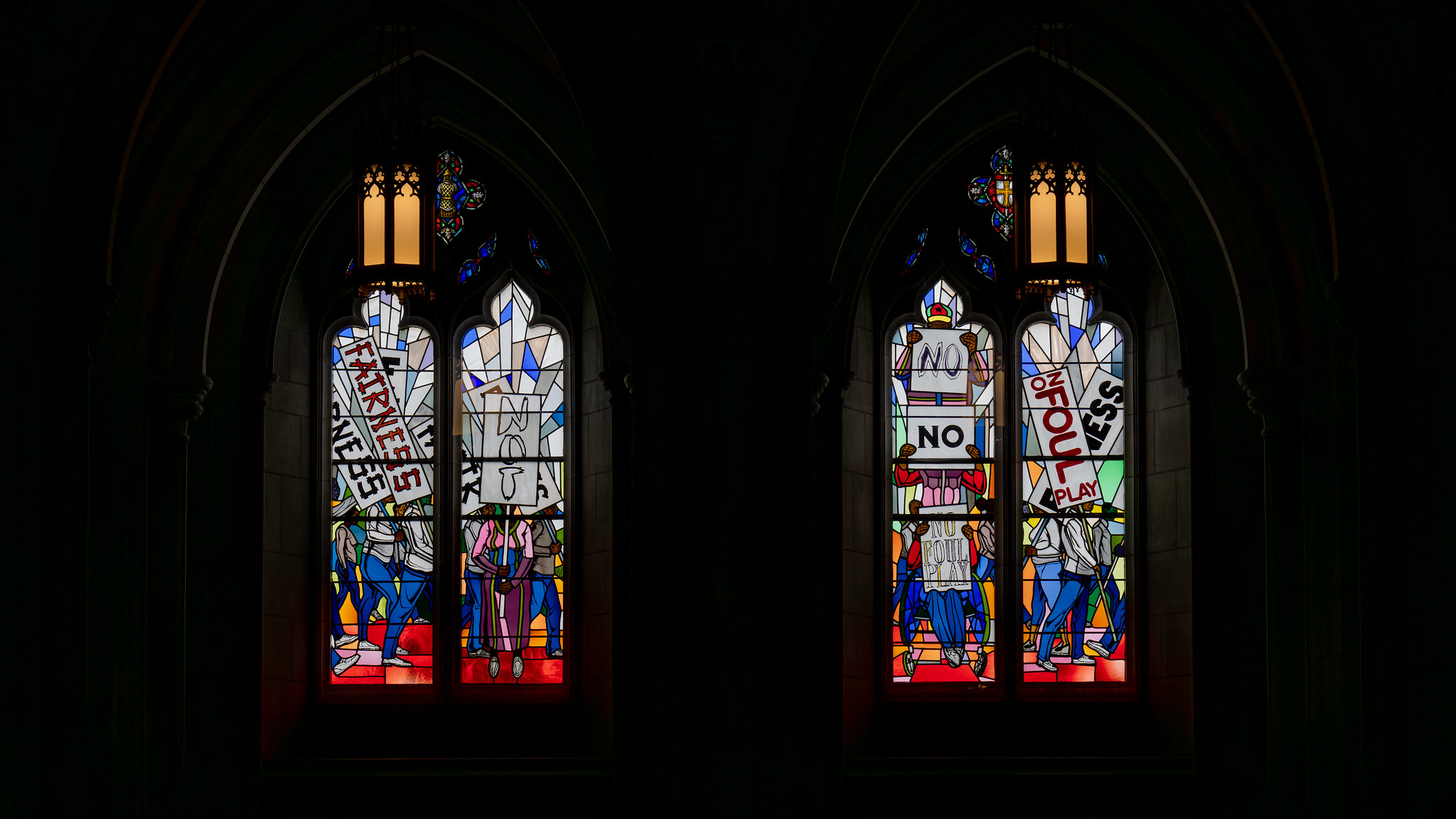
Marshall, Kerry James_Now and Forever
Kerry James Marshall (American, 1955–), Now and Forever, 2023. Fabricated by Andrew Goldkuhle. Stained glass windows, south outer aisle, bay 7, Washington National Cathedral, Washington, DC. Photo: Steven Zucker.

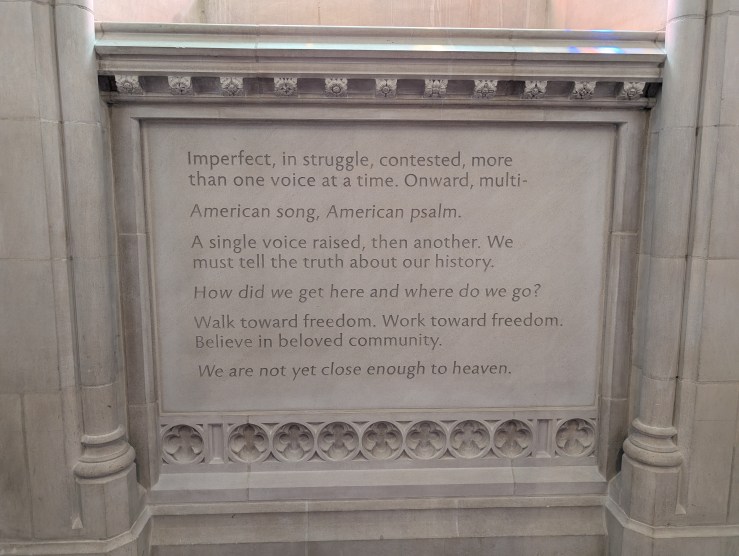
  • "American Song" by Elizabeth Alexander
  • American Song by Elizabeth Alexander

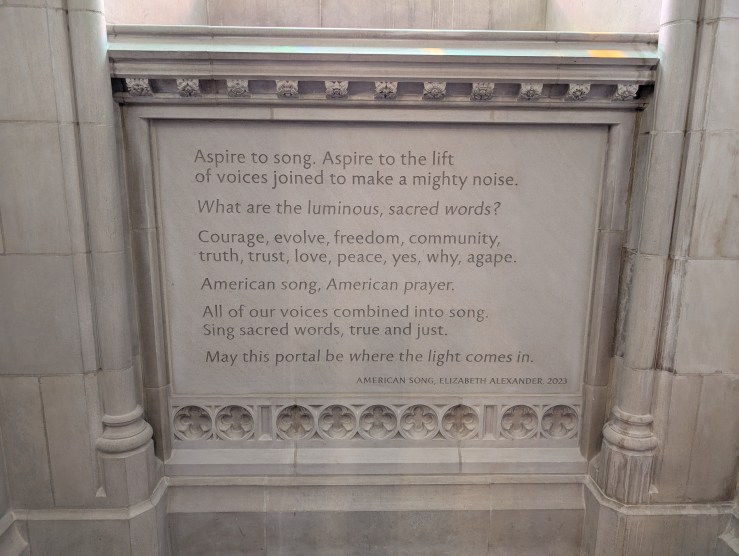
In addition to commissioning Marshall to design new windows, the cathedral commissioned the Pulitzer-nominated poet Elizabeth Alexander, who wrote and read “Praise Song for the Day” for President Barack Obama’s 2009 inauguration, to write a poem for this occasion. Titled “American Song,” it is inscribed on two limestone tablets beneath Marshall’s windows. The Windows Replacement Committee gave both artists this assignment:  

We seek to tell a story of resilience, endurance, and courage that gives meaning and expression to the long and arduous plight of the African American, from slavery to freedom, from alienation to the hope of reconciliation, through physical and spiritual regeneration, as we move from the past to present day. The artist will capture both darkness and light, both the pain of yesterday and the promise of tomorrow, as well as the quiet and exemplary dignity of the African American struggle for justice and equality and the indelible and progressive impact it has had on American society. Each artist should respond in his or her own creative way to these ideals and aspirations, framing both the earthly and the divine, within the sacred space of the Washington National Cathedral.

When I was there last year, I asked the guide why the signs the figures hold don’t bear any of the more familiar slogans of our historical moment, such as “Black Lives Matter.” She said the artist deliberately did not want to tether the protest to a particular time period, in order to emphasize that the struggle for racial equality is ongoing. “Fairness,” “No Foul Play,” “No,” “Not”—these are expressions of demand and defiance that could apply to a number of justice-related issues and that encompass people of all races.

Learn more at https://cathedral.org/college/windows/.

+++

DANCE: “Still I Rise,” choreographed by Sean Cheesman: I really miss the TV show So You Think You Can Dance, which had aspiring dancers train across genres—contemporary, hip-hop, ballroom, jazz, etc.—with renowned choreographers, performing to compete for the title of “America’s favorite dancer.” It was entertaining, impressive (the athleticism!), and often moving. Here’s a contemporary routine choreographed by Sean Cheesman to spoken word artist Alexis Henry’s reading of a classic poem by Maya Angelou about Black strength and defiance. It’s danced by Koine “Koko” Iwasaki, Kiki Nyemchek, Taylor Sieve, and Mark Villaver. It’s from season 14, episode 12, which aired September 4, 2017.

(Another memorable Cheesman-choreographed dance from season 14 is an African jazz duet to Sheila Chandra’s “Speaking in Tongues II,” which unfortunately, I cannot find online.)

+++

ARTICLE: “Stephen Towns’ Quilted Works Emphasize Black Joy as Resistance in ‘Safer Waters’” by Kate Mothes: Through June 14, the Wichita Art Museum in Kansas is hosting the exhibition Safer Waters: Picturing Black Recreation at Midcentury, featuring eleven quilts and six paintings by the Baltimore-based artist Stephen Towns [previously]. Black history has always been an important aspect of Towns’s work, and in this series he was inspired by historic photographs (by Bruce Mozert) of Paradise Park, a segregated attraction in Silver Springs, Florida, that operated from 1949 to 1969 and that was popular among Black vacationers, providing a space for leisure and togetherness away from Jim Crow.
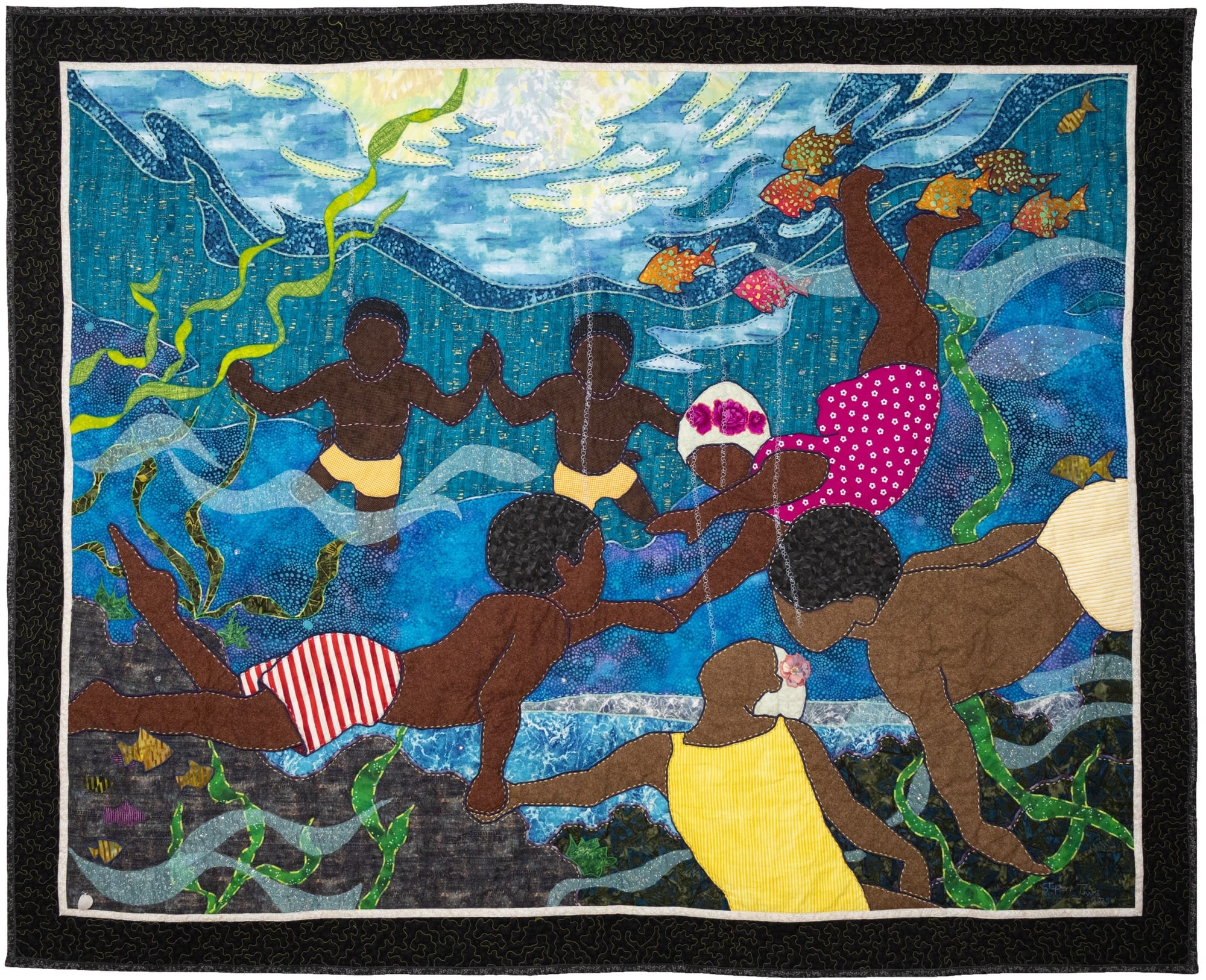
Towns, Stephen_All We Knew Was Joy
Stephen Towns (American, 1980–), All We Knew Was Joy, 2025. Natural and synthetic fabric, polyester and cotton thread, cubic zirconia, glass beads, and shell, 55 × 65 1/2 in.

Towns began his Paradise Park series in 2022 after reading Remembering Paradise Park by Cynthia Wilson-Graham and Lu Vickers, and this show is a continuation of it, for which he made seven new quilts (pictured in Mothes’s article). His art is displayed alongside some of Mozert’s photographs and related objects from Florida archives and collectors. See an exhibition walk-through on the artist’s Instagram page; see also photos from the opening on January 16–17.

Here is a short 2024 interview with Towns about this body of work, as presented at the earlier exhibition Private Paradise: A Figurative Exploration of Black Rest and Recreation at the Rockwell Museum in Corning, New York:

+++

SONGS:

Gospel music is one of the many gifts the Black church has given the world. Here are two songs from that distinctive choral tradition.

>> “Perfect Praise (How Excellent)” by Brenda Joyce Moore, performed by the Sunday Service Choir: Written in 1989 based on Psalm 8, this song gained recognition through its performance on the 1990 album This Is the Day by Walt Whitman and the Soul Children of Chicago, featuring Lecresia Campbell. It has since become a gospel choir standard, though often with the lead vocals eliminated (and that part taken by the full choir). It’s performed in this video by Sunday Service at the Théâtre des Bouffes du Nord in Paris on March 1, 2020.

>> “He’s a Wonder” by Jamel Garner, performed by the Chicago Mass Choir, feat. Cornelius Owens: This song about Jesus’s miracles is from the Chicago Mass Choir’s 2024 album Greater Is Coming.

+++

PODCAST EPISODES:

>> “Artist Archetypes with Jakari Sherman,” Be. Make. Do., January 21, 2025: I really enjoyed this conversation with Jakari Sherman on the soul|makers podcast hosted by Rev. Lisa Cole Smith, where he describes his journey as an artist and a believer. Sherman is a choreographer within the tradition of stepping, a percussive dance practice in which dancers use primarily their hands and feet to create music. Stepping comes from the African American Greek letter organizations and has roots, Sherman explains, in the antebellum South, where enslaved people had their drums taken away and thus had to find ways to express the rhythms they felt using just the floor and their own bodies. (Tap evolved largely for the same reason.)

Sherman is the creative director of [Jk]creativ, a multidisciplinary company developing purpose-driven and truth-seeking cultural works. From 2007 to 2014 he served as the artistic director of Step Afrika! and has continued to develop and direct works for them, such as Drumfolk and The Migration (which I saw in 2024 and was excellent). To establish a foundation for his scholarly research on the history of stepping, he completed a master of arts program in ethnochoreology at the Irish World Academy of Music and Dance in 2015. Below is a trailer for one of Sherman’s latest works, Our Road Home, an interactive rhythmic production that meditates “on what is means to find freedom—and to live it fully in body, soul, and spirit”; it premiered last June as part of a year-long collaboration with the Houston Freedmen’s Town Conservancy.

>> “Cole Arthur Riley – Black Liturgies,” Nomad, February 9, 2024: Tim Nash interviews Cole Arthur Riley, the best-selling author of Black Liturgies: Prayers, Poems, and Meditations for Staying Human (which grew out of her popular Instagram account @blackliturgies) and This Here Flesh: Spirituality, Liberation, and the Stories That Make Us. She is a wise, feeling, richly spiritual and embodied writer and speaker whose work I’ve appreciated. In this conversation she discusses her hang-ups with the Book of Common Prayer; battling chronic illness; balancing the active and contemplative lives; the revival of lament; self-sacrifice versus self-care; her experience of white people engaging with her work (“I like to think that there’s something mysterious that’s healed in us when we encounter each other’s interior worlds; when we hear words written by a Black woman toward God, that that could somehow move someone in some way, and move us closer to each other”); and what hope means to her and where she sees signs of it.
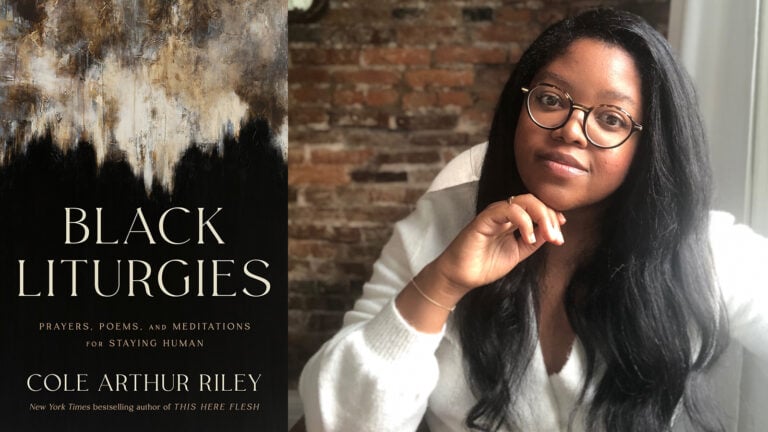
Black Liturgies by Cole Arthur Riley

Even though I, as a white person, am not the intended audience for the book Black Liturgies, in reading it, I found it meaningful to listen to the cries of Riley’s heart. While many of the prayers are particular to the experience of being Black, still many others are general enough that they could be prayed by anyone. Part 1, organized thematically, consists of chapters such as “Dignity,” “Wonder,” “Doubt,” “Lament,” “Rage,” and “Rest,” whereas part 2 contains prayers for dawn, day, and dusk as well as for the liturgical year, secular holidays, and life occasions. I like the names for God with which she opens each prayer—e.g., “God of the shadows,” “God who expands,” “Divine Labyrinth,” “God aware,” “God of locked doors,” “God who reclaims,” “God our home,” “God of delight,” “God of the art that will never be seen,” “God who whispers”; it has prompted me to consider the names and descriptions I use for God and how they influence how I pray.

To give you a flavor of Black Liturgies, here are two prayers from the book (and note that prayers are only one component; also included are letters, quotes, questions for contemplation, confessions and assurances of pardon, and benedictions):

For Marveling at Your Own Face

God of the flesh,
When we consider what is worthy of our wonder, it is easy to forget our own faces, our bodies. The world is relentless in indoctrinating us into self-hatred—into anti-Blackness, into transphobia, into misogyny in all forms. We are slowly and steadily brainwashed to despise our own faces from the time we’re tall enough to stare up at ourselves in the mirror. How can we resist this? Let the tyranny of the mirror be no more. May it instead become a portal—to delight, to pleasure, and to love. These noses, these hips, the way our hair rises and falls. The memories etched into our hands and faces. Remind us of the miracle of flesh that grows back, of blood that pulses warm beneath the skin that holds us. Of bodies, these holy beautiful bodies, that are working a thousand unseen miracles just so that we can read these lines, breathe this air, cry or not cry. As we peer into the face before us, remind us that we are something to behold. We believe; forgive our unbelief. Ase.

For Those Who Doomscroll

Still God,
We confess that we are addicted to pessimism. Although we rarely name it as such, so much of our attention is devoted to negativity. Show us how we use technology to soothe and stir the aches in us. Keep us from turning control over to our anxiety, that it would no longer feed itself with news of tragedy and impending disaster. It is easy to become lost, buried in the quicksand of digital catastrophe. Draw our attention upward. Guide us to look away habitually; and not just away, but up at the sky, the grass, the table. Guide us inward as well. Acquaint us with goodness again. In the world, and in ourselves. Let us follow the children, freed from the grip of seriousness. Renew our playfulness. Lead us into wise rhythms of engagement, retreating to rest and breathe. Remind us that there is much the world needs, including our attention to atrocity—but if we watch the world burn for long enough, the fire will become our only reality. Amen.

“Our Grandmothers” by Maya Angelou (poem)

White, Charles_Mother Courage II
Charles White (American, 1918–1979), Mother Courage II, 1974. Oil on canvas, 49 3/4 × 39 7/8 in. National Academy of Design, New York.

She lay, skin down in the moist dirt,
the canebrake rustling
with the whispers of leaves, and
loud longing of hounds and
the ransack of hunters crackling the near branches.

She muttered, lifting her head a nod toward freedom,
I shall not, I shall not be moved.

She gathered her babies,
their tears slick as oil on black faces,
their young eyes canvassing mornings of madness.
Momma, is Master going to sell you
from us tomorrow?

Yes.
Unless you keep walking more
and talking less.
Yes.
Unless the keeper of our lives
releases me from all commandments.
Yes.
And your lives,
never mine to live,
will be executed upon the killing floor of innocents.
Unless you match my heart and words,
saying with me,

I shall not be moved.

In Virginia tobacco fields,
leaning into the curve
of Steinway
pianos, along Arkansas roads,
in the red hills of Georgia,
into the palms of her chained hands, she
cried against calamity,
You have tried to destroy me
and though I perish daily,

I shall not be moved.

Her universe, often
summarized into one black body
falling finally from the tree to her feet,
made her cry each time into a new voice.
All my past hastens to defeat,
and strangers claim the glory of my love,
Iniquity has bound me to his bed,

yet, I must not be moved.

She heard the names,
swirling ribbons in the wind of history:
nigger, nigger bitch, heifer,
mammy, property, creature, ape, baboon,
whore, hot tail, thing, it.
She said, But my description cannot
fit your tongue, for
I have a certain way of being in this world,

and I shall not, I shall not be moved.

No angel stretched protecting wings
above the heads of her children,
fluttering and urging the winds of reason
into the confusions of their lives.
They sprouted like young weeds,
but she could not shield their growth
from the grinding blades of ignorance, nor
shape them into symbolic topiaries.
She sent them away,
underground, overland, in coaches and
shoeless.
When you learn, teach.
When you get, give.
As for me,

I shall not be moved.

She stood in midocean, seeking dry land.
She searched God’s face.
Assured,
she placed her fire of service
on the altar, and though
clothed in the finery of faith,
when she appeared at the temple door,
no sign welcomed
Black Grandmother. Enter here.

Into the crashing sound,
into wickedness, she cried,
No one, no, nor no one million
ones dare deny me God, I go forth
along, and stand as ten thousand.
The Divine upon my right
impels me to pull forever
at the latch on Freedom’s gate.

The Holy Spirit upon my left leads my
feet without ceasing into the camp of the
righteous and into the tents of the free.

These momma faces, lemon-yellow, plum-purple,
honey-brown, have grimaced and twisted
down a pyramid of years.
She is Sheba and Sojourner,
Harriet and Zora,
Mary Bethune and Angela,
Annie to Zenobia.

She stands
before the abortion clinic,
confounded by the lack of choices.
In the Welfare line,
reduced to the pity of handouts.
Ordained in the pulpit, shielded
by the mysteries.
In the operating room,
husbanding life.
In the choir loft,
holding God in her throat.
On lonely street corners,
hawking her body.
In the classroom, loving the
children to understanding.

Centered on the world’s stage,
she sings to her loves and beloveds,
to her foes and detractors:
However I am perceived and deceived,
however my ignorance and conceits,
lay aside your fears that I will be undone,

for I shall not be moved.

from I Shall Not Be Moved (Random House, 1990), copyright © Caged Bird Legacy, admin. CMG Worldwide

Maya Angelou (1928–2014) was an African American poet, storyteller, civil rights activist, and lecturer, most famous for her autobiography I Know Why the Caged Bird Sings (1969). She began her career as a singer, dancer, and actress but started writing in the late 1950s, often combining personal narrative with advocacy for racial and gender equality. In 1960 she worked as the northern coordinator for Martin Luther King Jr.’s Southern Christian Leadership Conference, before moving to Egypt and then Ghana with her son. She returned to the US in 1965 to help Malcolm X build the Organization of Afro-American Unity.

In addition to seven autobiographies and multiple poetry collections, Angelou also wrote children’s books, cookbooks, essays, short stories, stage plays, screenplays, documentaries, and music (including film scores). She was a recipient of three Grammys for her spoken-word albums, an Emmy nomination for her portrayal of Kunta Kinte’s grandmother in the miniseries Roots (1977), the National Medal of Arts (2000), the Presidential Medal of Freedom (2010), the Literarian Award (2013), and many other honors. Recurring themes in her literary works include hardship and loss, love, social justice, Black beauty, the strength of women, and the human spirit.


In her Nancy Hanks Lecture on Arts and Public Policy, given March 20, 1990, for the American Council for the Arts in Washington, DC, Maya Angelou addressed her audience with a question:

I often wonder what would happen if I could come face to face with a grandparent, a great-great-great-grandparent. Suppose you did? Just imagine. What would happen? Not a specter, a real person, 200 years old, who said, “So . . . You’re the reason I took the lash, you’re it, huh? So you’re the reason I took the auction block, and stayed alive . . . you’re it, are you? How is it with you? How are you doing with the gifts I gave you?”

She went on to describe how her grandmother and mother used to sing the African American spiritual “I Shall Not Be Moved” around the house. Its lyrics are based on Jeremiah 17:7–8: “Blessed are those who trust in the LORD, whose trust is the LORD. They shall be like a tree planted by water, sending out its roots by the stream. It shall not fear when heat comes, and its leaves shall stay green; in the year of drought it is not anxious, and it does not cease to bear fruit” (cf. Ps. 1:3; 62:6).

Angelou then talked about the importance of “being flexible so one can bend, resilient so that one can stand erect after being knocked down,” before proceeding to read her poem “Our Grandmothers.”

The poem celebrates the strong Black women who have gone before, that great cloud of witnesses, the ancestors, who stood firm in the face of all kinds of adversity, giving life to succeeding generations. The queen of Sheba (who gifted gold, spices, and jewels to King Solomon of Israel, as 1 Kings 10 relates, and who the ancient historian Josephus said ruled over Ethiopia and Egypt), abolitionist Harriet Tubman, writer Zora Neale Hurston, and educator and philanthropist Mary Bethune are among the women named. Self-assertive, tenacious, filled with holy desire, steadfast in the pursuit of freedom and justice.

Angelou is one of the most banned authors in the United States, particularly in high schools, where some districts deem her books inappropriate for their use of racial epithets and frank depictions of violence, including sexual assault. “Our Grandmothers” is mild by comparison to her first autobiography, but it does allude to lynching and rape and contains a litany of vulgar, demeaning names. She does not want to sugarcoat these realities, this history.

While acknowledging the suffering endured by Angelou’s female forebears, the poem is triumphant in tone. It’s that refusal to despair, that holding on to faith, that Angelou so admires and that impels her to join in that old refrain, composed in chains and having carried her people through countless trials and acts of resistance: “Like a tree planted by the water, I shall not be moved.”

Roundup: Why go to church, “Good Trouble,” “Sacred Songs Suite,” and more

SPOTIFY PLAYLIST: February 2025 (Art & Theology): I put these monthly playlists on pause for December and January, since I’ve already published long, dedicated playlists for the seasons of Advent, Christmas, and Epiphany, but now I’m picking back up my usual smorgasbord routine. Enjoy two hours of songs handpicked by me!

+++

PODCAST EPISODE: “Nadia Bolz-Weber: From Fundamentalism to Stand-Up Comedy to Ordained Pastor,” No Small Endeavor, January 27, 2025: “Christian Fundamentalism is often looked down upon for its dualistic, black-and-white outlook, which is often used for policing behavior. But, Nadia Bolz-Weber explains, these are the same extreme tendencies that she found in secular activism after she left the church. Later in life, after working as a comedian and entering recovery, Nadia began to untangle the mindset that had taken her from one extreme to the other. Her long journey has since led her to becoming a Lutheran pastor and a three-time bestselling author. In this episode, she tells her story.”

In conversation with host Lee C. Camp, Bolz-Weber [previously] discusses some of the gifts and wounds from her Church of Christ upbringing; how comedy prepared her for preaching; the influence of AA’s Twelve-Step Program on her life, especially her necessary reckoning with her powerlessness (“it doesn’t mean you don’t have access to power; it’s just that it doesn’t all come from you”); moving through the grief of losing her nephew; and her Red States Revival tour, which since the date of recording has been actualized!

+++

SUBSTACK POST: “Why go to church, anyway” by Amy Peterson, Making All Things New, November 20, 2024: Amy Peterson is an Episcopal priest from Asheville, North Carolina, and the author of one of my favorite books from 2020, Where Goodness Still Grows: Reclaiming Virtue in an Age of Hypocrisy. In this Substack post from last November, she shares some responses from when she asked on Instagram, “Why did you stop going to church?” and, to a different set of respondents, “Why do you go to church?” Then she answers the second question for herself, giving fourteen reasons why she would still go to church even if it wasn’t her job. I (a regular churchgoer who has been hurt in the past by the church, though not to the degree that many others have been) find these reasons so compelling and encouraging.

+++

SONG: “Good Trouble by Thomas Keesecker: This choral work was inspired by the catchphrase of the civil rights icon John Lewis (1940–2020), who repeatedly called on Americans to “get in good trouble”—to agitate for liberty and justice for all. For example, on June 27, 2018, he tweeted, “Do not get lost in a sea of despair. Be hopeful, be optimistic. Our struggle is not the struggle of a day, a week, a month, or a year, it is the struggle of a lifetime. Never, ever be afraid to make some noise and get in good trouble, necessary trouble.” Similarly, on December 4, 2019, at the opening of the Library of Congress exhibition Rosa Parks: In Her Own Words, Lewis said, “Rosa Parks inspired us to get in trouble. And I’ve been getting in trouble ever since. She inspired us to find a way, to get in the way, to get in what I call good trouble, necessary trouble.”

Lewis was a crucial leader of the civil rights movement, chairing the Student Nonviolent Coordinating Committee (SNCC) from 1963 to 1966, participating in sit-ins and Freedom Rides, co-organizing the 1963 March on Washington, and, on March 7, 1965, physically leading, with Hosea Williams, some six hundred peaceful marchers across the Edmund Pettus Bridge from Selma to Montgomery to protest the disenfranchisement of African Americans, an action that erupted into what’s known as Selma’s Bloody Sunday. When the marchers refused to disperse, Alabama state troopers attacked them with billy clubs and teargas, fracturing Lewis’s skull. He survived and continued his political activism and advocacy for another half century, serving in the US House of Representatives for Georgia’s Fifth Congressional District from 1987 until his death in 2020.

To learn more about John Lewis and his remarkable Christian witness, see the documentary John Lewis: Good Trouble, which is streaming for free on Kanopy (ask your local library if they subscribe). Here’s a trailer:

+++

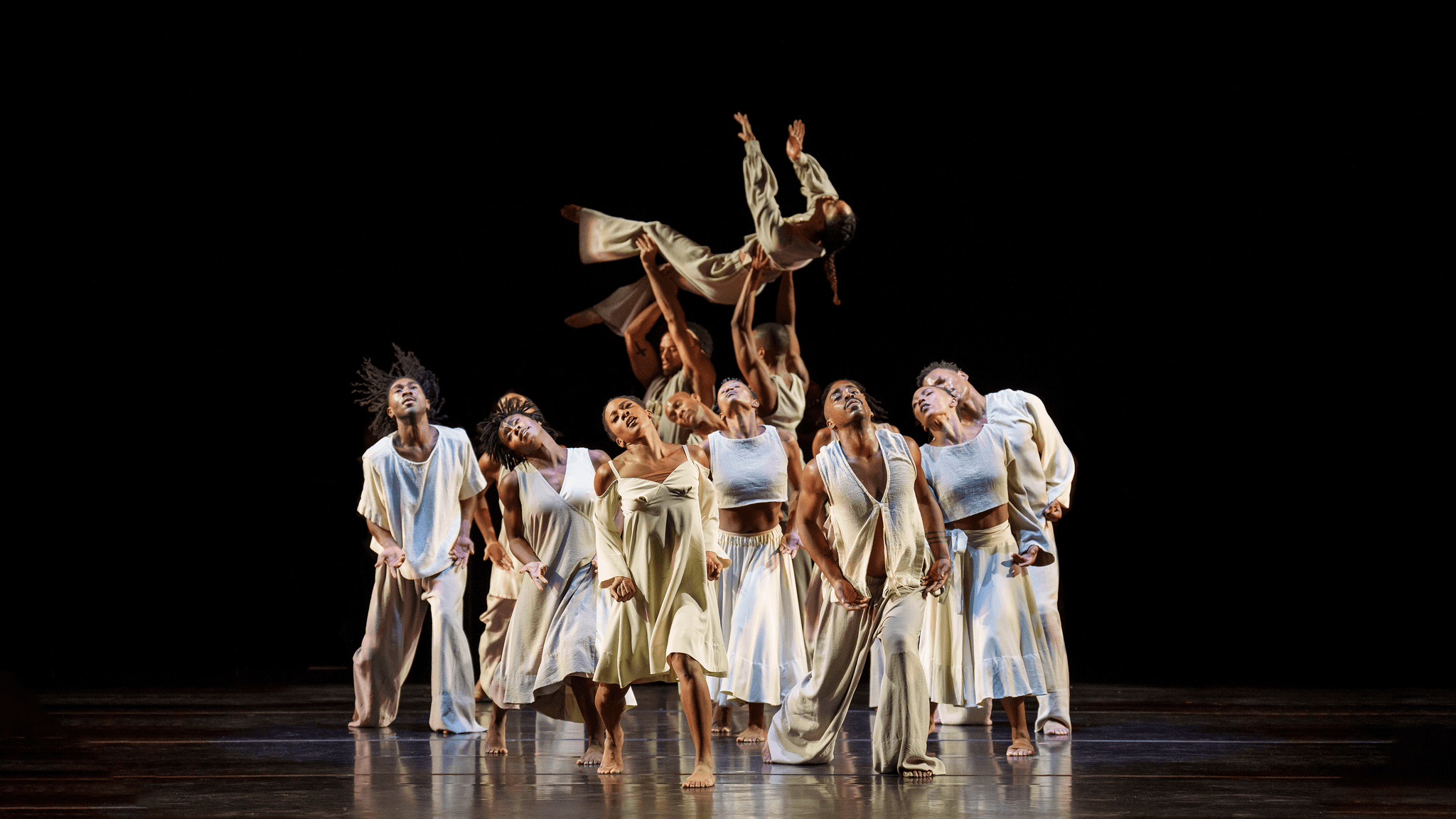
NEW ALBUM: Sacred Songs Suite by Du’Bois A’Keen: Last month I had the privilege of seeing Sacred Songs, a new dance work choreographed by Matthew Rushing and scored by Du’Bois A’Keen, performed by Alvin Ailey American Dance Theater. It was phenomenal! Both a visual and aural experience. The music was performed live with four vocalists (A’Keen sang lead) and a four-piece band, and throughout the evening, the verbal responses from the audience—“Mmmm” and “Amen” and “Yes, Lord!”—made me feel much more like I was in church than in a performing arts center.

Sacred Songs

Featuring original arrangements of nine spirituals, Sacred Songs “brings together and reimagines the sounds of jazz, West African drums, gospel, hip-hop, calypso, and more to call on the past, engage our present, and invite the listener into a magical, hopeful, and musical future.” A’Keen released the music, plus a few bonus tracks, on his album Sacred Songs Suite on January 18. “By the Waters” is one of the most memorable sections for me.

+++

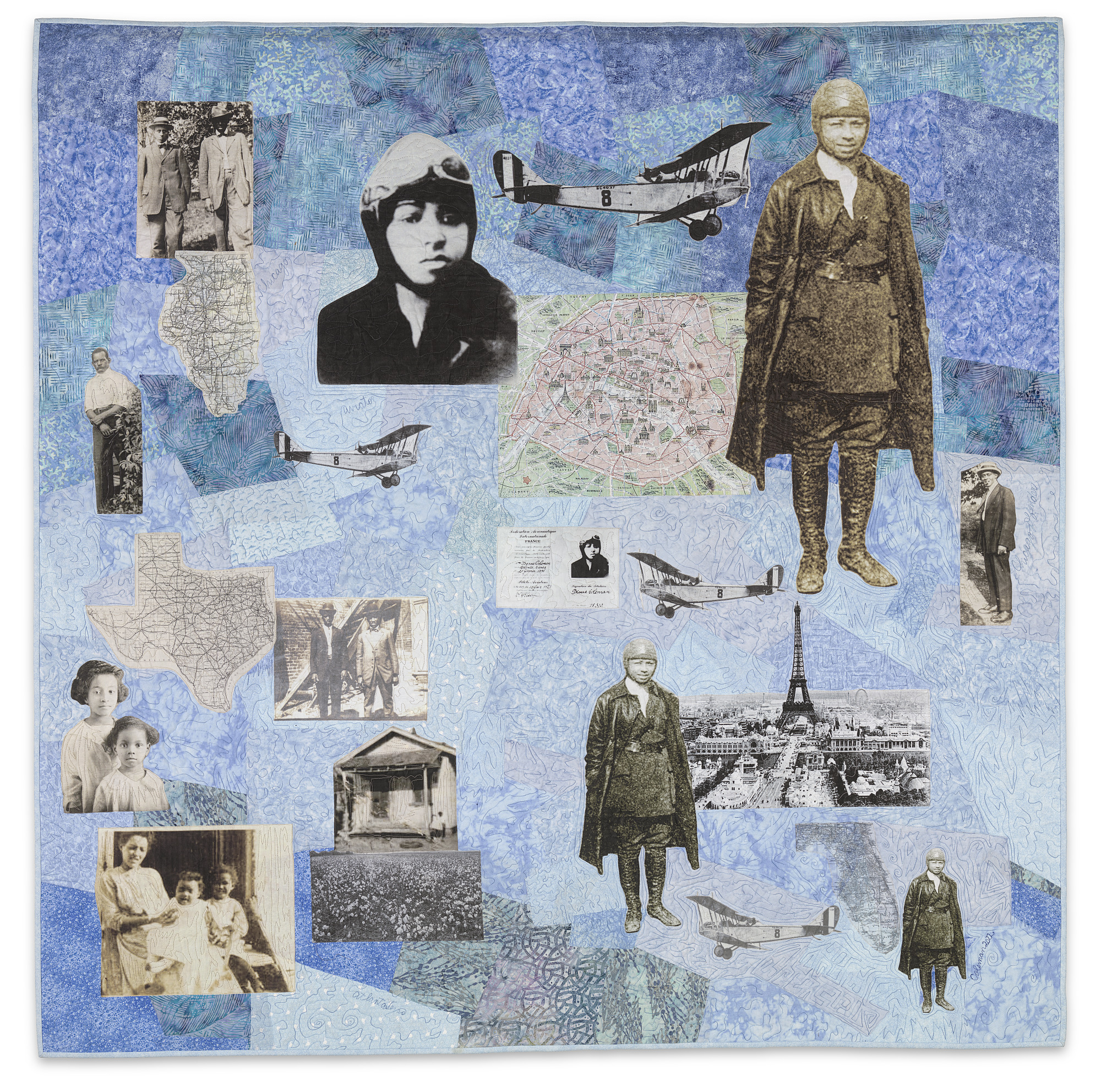
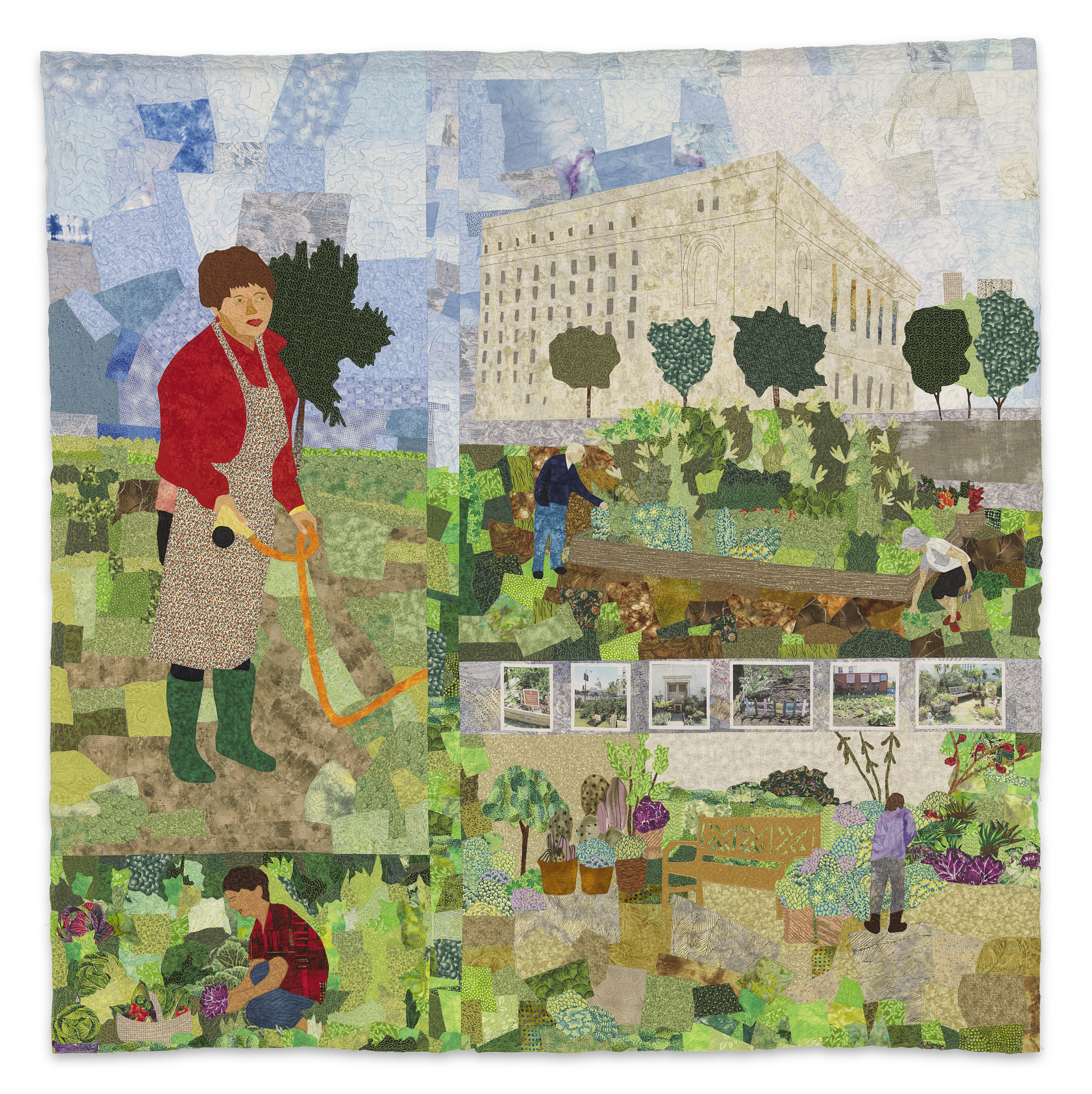
VIDEO PROFILE: “NEA National Heritage Tribute Video: Marion Coleman”: I learned about the quilter and NEA National Heritage Fellow Marion Coleman last year when perusing the book Visioning Human Rights in the New Millennium: Quilting the World’s Conscience at the Subversive, Skilled, Sublime: Fiber Art by Women exhibition at the Renwick Gallery in Washington, DC. (The book is not a catalog of the exhibition but was complementary in nature and thus was left on one of the gallery tables.) Her work is amazing! Here’s a video that provides a nice snapshot:

Coleman, Marion_Her Heart Was in the Clouds
Marion Coleman (American, ?–2019), Her Heart Was in the Clouds, 2012. Cotton fabric, cotton thread, and cotton batt, 60 1/2 × 60 in. (153.7 × 152.4 cm). Smithsonian American Art Museum, Washington, DC.

Coleman, Marion_Tender Gardens
Marion Coleman (American, ?–2019), Tender Gardens, 2014. Cotton fabric and batt, 72 1/2 × 72 1/8 in. (184.2 × 183.2 cm). Smithsonian American Art Museum, Washington, DC.