
“Go to the Limits of Your Longing” (Book of Hours I, 59) by Rainer Maria Rilke

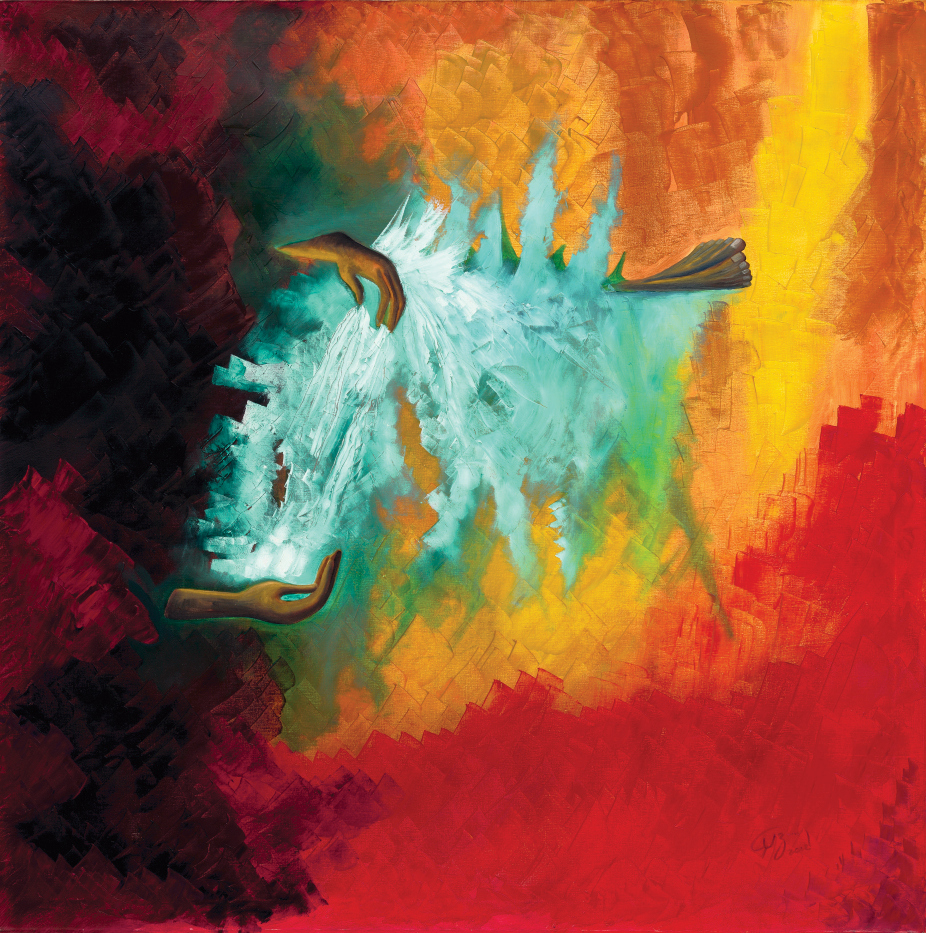
Guzman, Juan_Espíritu sin Medida
Juan Francisco Guzmán (Guatemalan, 1954–), Espíritu sin Medida (Spirit Without Measure), 2012. Oil on canvas, 103 × 102 cm. © missio Aachen.

God speaks to each of us as he makes us,
then walks with us silently out of the night.

These are the words we dimly hear:

You, sent out beyond your recall,
go to the limits of your longing.
Embody me.

Flare up like flame
and make big shadows I can move in.

Let everything happen to you: beauty and terror.
Just keep going. No feeling is final.
Don’t let yourself lose me.

Nearby is the country they call life.
You will know it by its seriousness.

Give me your hand.

From Rilke’s Book of Hours: Love Poems to God (Riverhead, 1996, 2005), translated by Anita Barrows and Joanna Macy. The original German is in the public domain.

Rainer Maria Rilke (1875–1926) was a primarily German-language lyric poet, playwright, and short story writer. Born of Catholic parents in Prague, then part of the Austro-Hungarian empire, he came to reject church dogma as an adult, though he maintained a lifelong fascination with Christian imagery and biblical stories. His volumes of poetry include Das Stunden-Buch (The Book of Hours) (1899–1903), about the search for God; Das Buch der Bilder (The Book of Images) (1902–6); Das Marienleben (The Life of Mary) (1913), a thirteen-poem cycle about the Virgin; the Duineser Elegien (Duino Elegies) (1922), which weigh beauty and existential suffering; and Sonette an Orpheus (Sonnets to Orpheus) (1922). After Rilke’s death from leukemia, a young mentee of his, Franz Xaver Kappus, compiled ten of the letters Rilke had written to him about creativity, the poetic vocation, and the inner life; published as Briefe an einen jungen Dichter (Letters to a Young Poet) (1929), this correspondence has influenced generations of writers and other artists.

Anita Barrows (born 1947) is a clinical psychologist, political activist, poet, and translator from German, French, and Italian. She lives in the Bay Area of California.

Joanna Macy (1929–2025) was a scholar of Buddhism, general systems theory, and deep ecology. A respected voice in movements for peace, justice, and environmentalism, she wove her scholarship with decades of activism.

Pentecost roundup: Invocations; Holy Spirit as “lodes-mon”; organ improv; tongues of fire in a flower patch

SONGS:

Here are three sung invocations of the Holy Spirit, seeking his power, liberation, comfort, light, and renewal.

>> “Holy Spirit, Come with Power”: This hymn was written by Anne Neufeld Rupp in 1970, who set it to a Sacred Harp tune from 1844 attributed to B. F. White. It’s performed here by the Bel Canto Singers from Hesston College in Kansas, featuring Gretchen Priest-May on fiddle and Tim May on acoustic guitar.

I was introduced to this hymn through the Voices Together Mennonite hymnal, where it appears in both English and Spanish as no. 57.

>> “Mweya Mutsvene” (Holy Spirit, Take Your Place) by Joshua Mtima and The Unveiled: The Unveiled is a collective of Christian musicians from Harare, Zimbabwe, founded by Joshua Mtima in 2020. Here they sing one of their songs in Shona. An English translation is provided onscreen. [HT: Global Christian Worship]

>> “Ven Espíritu Divino (Secuencia de Pentecostés)” (Come, Spirit Divine) by Pablo Coloma, performed by Chiara Bellucci: The Spanish lyrics of this contemporary Christian song from the Latin American Catholic tradition are in the YouTube video description. They ask the Holy Spirit, “sweet guest of our souls,” to come bringing healing, regeneration, growth, joy, and charisms.

+++

SUBSTACK POST: “Veni Creator Spiritus: A Lush Middle English Hymn” by Grace Hamman, Medievalish: Dr. Grace Hamman shares Friar William Herebert’s (ca. 1270–ca. 1333) Middle English translation of the classic Latin Pentecost hymn attributed to Rabanus Maurus (ca. 780–856), “Veni Creator Spiritus” [previously]. Herebert uses words like vor-speker (for-speaker; i.e., intercessor), lodes-mon (lodesman; i.e., journeyman or navigator), and shuppere (shaper) as titles for the Holy Spirit.

+++

ORGAN WORK: “Improvisation on Veni Creator Spiritus” by Alfred V. Fedak: “Your congregation will hear the rushing of the Holy Spirit in this improvisatory prelude (taken from Fedak’s and Carl P. Daw’s oratorio The Glories of God’s Grace),” writes Selah Publishing. “Fedak effectively uses sweeping whole-tone scale passages and arpeggios to indicate the Spirit’s presence, while the pedal plays phrases of the hymn tune,” a medieval plainchant. The publisher has posted the following performance of the piece (audio only), by the composer himself, along with a selection of Pentecost art from the thirteenth to eighteenth centuries. [HT: Global Christian Worship]

There are many other works on organ (fantasias, partitas, fugues) based on the “Veni Creator Spiritus” tune; view a select list on Wikipedia.

+++

POEM: “Book of Hours” by Kimberly Johnson: “A pentecost of bloom: all the furred tongues / awag in the iris patch, windrush through the fireflower.” So opens the poem “Book of Hours” by Kimberly Johnson [previously], from her collection Uncommon Prayer (Persea, 2014). A book of hours is a genre of medieval prayer-book used by laypeople, which arranges prayers, scripture, and other devotional texts for reading at prescribed times of the day. Johnson’s “Book of Hours” draws on the fields of codicology (the study of manuscripts as physical objects) and botany to consider how God’s Spirit moves through and enlivens the material world, be it the irises, fire lilies, alyssum, and paperwhite narcissus in her garden, or the ink and natural pigments on calfskin—green verdigris, red cochineal, yellow curcumin—in the rare manuscripts library where she examines a book of hours whose embellished Latin text she can’t quite make out but whose beauty enraptures her nonetheless. These are but two untranslatable experiences of sensual, embodied communion with God that Johnson narrates in the collection, the paint flakes on her lips and the pollen on her wrist a chrism and a prayer.